In the ongoing sexual abuse crisis that has wracked the Roman Catholic Church, it is helpful to remember that the evil transpires on both spiritual and historical planes. That is to say, we can productively speak of sexual abuse as a spiritual attack upon the Church’s absolute purity, a purity she receives from Christ, her spouse and head. The violations committed by priests and religious is a stain upon that purity but nevertheless leaves the fundamental holiness of the Church intact. And this because the Church has no holiness that is not primarily the holiness of Jesus. All that is good in her flows from Him.
However, we can maintain this truth while simultaneously recognizing deep underlying structural problems in the Church’s culture and modus operandi. The holiness of the Church comes from above, not below; in the course of human history, we have often seen great evils nurtured within the very breast of the Church as a human institution. The sex abuse crisis is one such horror. Only a realistic attitude can bring us the reform that we so desperately need.
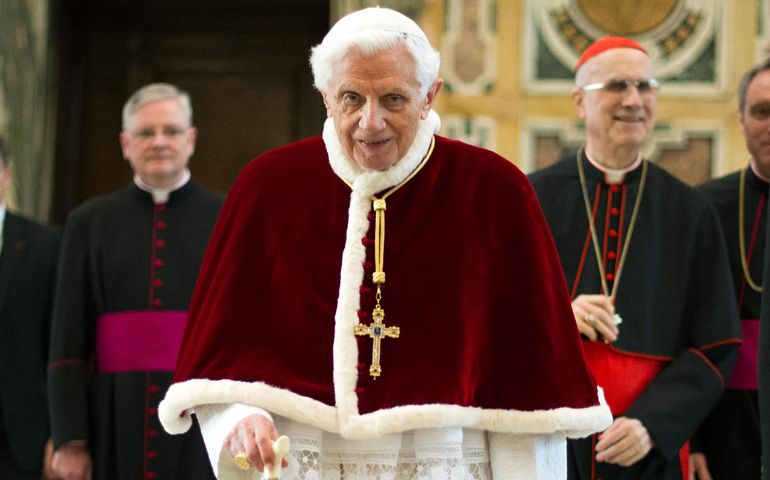
It’s because of this that I was disappointed to read Benedict XVI’s recent letter on the subject. There are certain passages that show the Pope-Emeritus’s continuing theological acumen. He writes movingly about the primacy of Faith, especially Faith in the Blessed Sacrament, as a foundational principle of renewal in our time. He also calls for a deeper ecclesial sensibility among the faithful. Catholics should meditate on these passages, which have a good deal of insight and even consoling power. His words on martyrdom are particularly profound and poignant, given his own impending mortality.
However, as a response to the egregious crimes committed by priests and other clerical personnel against innocents, the document represents a major failure.
This letter is a turgid, historically specious bit of sleight of hand. In treating the abuse crisis as a problem of laxity in moral teaching, the Pope turns sex abuse into a theological problem. He is closer to the heart of things when he discusses the evolution of the disciplinary measures in Canon Law and the various difficulties thrown up by legal “reforms” in the middle of the century. However, he also dissolves the very real psychological and social factors that permitted a culture of tolerance for pedophilia within the church to flourish for so long. Ratzinger writes, “Why did pedophilia reach such proportions? Ultimately, the reason is the absence of God.” This is, strictly speaking, a spiritual truth. Had the Pope-Emeritus treated this as a statement about the souls of the pedophiles, for whom God must be in some way ultimately unreal, the statement would be entirely defensible. However, Ratzinger is speaking historically. He immediately seems to attribute to the spread of pedophilia to secularization in Europe.
After the upheaval of the Second World War, we in Germany had still expressly placed our Constitution under the responsibility to God as a guiding principle. Half a century later, it was no longer possible to include responsibility to God as a guiding principle in the European constitution. God is regarded as the party concern of a small group and can no longer stand as the guiding principle for the community as a whole.
Joseph Ratzinger
The problem is relativism – namely, secular relativism as an other, as something outside the life of the Church. We read, “The long-prepared and ongoing process of dissolution of the Christian concept of morality was…marked by an unprecedented radicalism in the 1960s.” According to the Pope, “Part of the physiognomy of the Revolution of ‘68 was that pedophilia was then also diagnosed as allowed and appropriate…It was theorized only a short time ago as quite legitimate, but it has spread further and further.” He takes the cause of recent pedophilia, and thus of the scandals within the Church, to be the sexual revolution.
But apart from Gayle Rubin, the filmmakers who got Jodie Foster and Brooke Shields naked, and the perverts at NAMBLA, who exactly were the people trying to normalize pedophilia? C.C. Pecknold suggests it might be those activists in favor of “abolishing age-of-consent laws since the 1970s.” Possibly. At any rate, the Pope provides neither names nor sources. It’s a serious enough claim that he owes us that courtesy. To what extent were these efforts merely marginal phenomena? He seems to take them as a synecdoche of the broader movement, however implausibly.
By appealing to an established right-wing boogeyman (sixties revolutionaries), he dissolves the problem into a theological haze. He makes no mention of the complex psychological reasons for abuse, simply posits that relativism leads to sexual license. Nor does he prove any causes to tie together his case studies. He just asserts that various phenomena are connected without supplying proof. Given the genre of the piece, perhaps this brevity is to be expected. But is this schema really representative of Ratzinger’s mentality as he handled sex abuse cases in his tenure as head of the CDF and, later, as Pope? If so, no wonder things were so long mismanaged and so often minimized. Sex abuse is not a matter of which moral theologians you’re reading, and to treat it as such is profoundly irresponsible.
The fact that Francis asked Benedict to prepare this statement suggests to me that it represents an attempt by both Popes to shoot the elephant (and scapegoat) in the room, namely, the homosexuality of the clergy. This phenomenon has become the cause célèbre of conservative and traditional Catholics trying to understand the sex abuse crisis. It has also been recently highlighted in a largely credible if somewhat sensationalist way by the gay activist Frédéric Martel, whose book on clerical homosexuality Catholics should read (if with a grain of salt). Too sharp a focus on homosexuality (a) doesn’t actually solve the problem of clerical sex abuse and (b) is too dangerous for all ideological camps (no pun intended) within the clerical establishment. Ratzinger’s letter here shifts the focus away from that particular systemic and more or less quantifiable phenomenon and onto an amorphous if politically-charged abstract. While I can’t be sure, the missive seems to be designed to influence Ratzinger’s own partisans and lead them away from the gay issue.
After all, the one narrative that Ratzinger doesn’t tell us is the one most favored by conservatives. Namely, as Pecknold puts it, “by the late 1980s the homosexual hierarchies that ruled now were descending, with greater frequency, into pedophilia.” But this is not what the Pope writes. In a passage worth quoting at length, Ratzinger tells us,
In various seminaries homosexual cliques were established, which acted more or less openly and significantly changed the climate in the seminaries. In one seminary in southern Germany, candidates for the priesthood and candidates for the lay ministry of the pastoral specialist [Pastoralreferent] lived together. At the common meals, seminarians and pastoral specialists ate together, the married among the laymen sometimes accompanied by their wives and children, and on occasion by their girlfriends. The climate in this seminary could not provide support for preparation to the priestly vocation. The Holy See knew of such problems, without being informed precisely. As a first step, an Apostolic Visitation was arranged of seminaries in the United States. As the criteria for the selection and appointment of bishops had also been changed after the Second Vatican Council, the relationship of bishops to their seminaries was very different, too. Above all, a criterion for the appointment of new bishops was now their “conciliarity,” which of course could be understood to mean rather different things. Indeed, in many parts of the Church, conciliar attitudes were understood to mean having a critical or negative attitude towards the hitherto existing tradition, which was now to be replaced by a new, radically open relationship with the world. One bishop, who had previously been seminary rector, had arranged for the seminarians to be shown pornographic films, allegedly with the intention of thus making them resistant to behavior contrary to the faith. There were — not only in the United States of America — individual bishops who rejected the Catholic tradition as a whole and sought to bring about a kind of new, modern “Catholicity” in their dioceses. Perhaps it is worth mentioning that in not a few seminaries, students caught reading my books were considered unsuitable for the priesthood. My books were hidden away, like bad literature, and only read under the desk. The Visitation that now took place brought no new insights, apparently because various powers had joined forces to conceal the true situation. A second Visitation was ordered and brought considerably more insights, but on the whole failed to achieve any outcomes. Nonetheless, since the 1970s the situation in seminaries has generally improved. And yet, only isolated cases of a new strengthening of priestly vocations came about as the overall situation had taken a different turn.
Joseph Ratzinger
That first line is the only explicit reference to homosexuality in the entire letter. In his his forceful First Things follow-up, Archbishop Chaput confirms this point:
He remains silent on what many see as the continuing resistance of Rome to candidly name the core issue of the clergy abuse problem, which is not primarily a matter of clerical privilege but rather a pattern of predatory homosexuality.
Archbishop Charles Chaput
Ratzinger is quick to move from the various gay circles among the seminarians of yesteryear to the presence of women in seminaries, and then on to theological liberalism in general. This is not the argument, put forward by so many, that homosexuality in the priesthood leads to sex abuse. It’s a broader case, one that sees homosexuality as only one part in a constellation of radicalism.
And it’s a radicalism that emphatically has its origins outside of the Church. Archbishop Chaput builds on Benedict, writing,
But priests and bishops have no miraculous immunity to the abnormality bubbling around them. Ratzinger locates the seed of the current crisis in the deliberate turn toward sexual anarchy that marked much of Europe in the 1960s, and the complete failure of Catholic moral theologians to counter it—a failure that more often resembled fellow-traveling.
Archbishop Charles Chaput
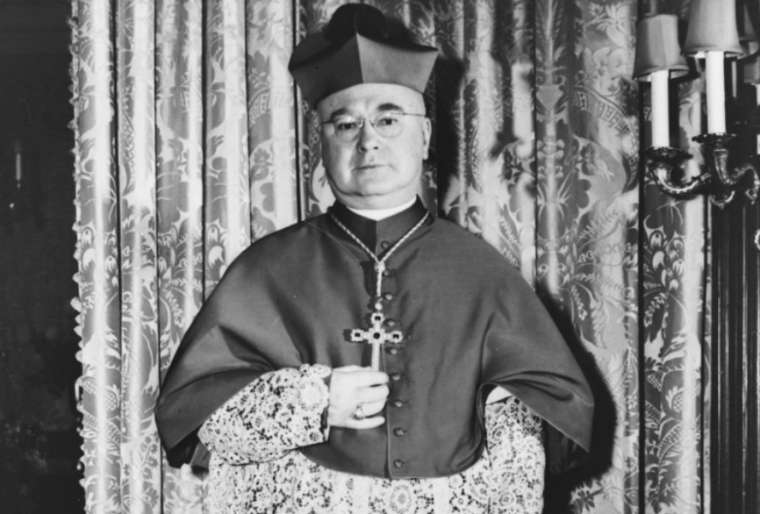
This is nothing less than an abdication of moral responsibility. The 1960’s did not produce pedophilia, ephebophilia, or the longstanding culture of omertà among the hierarchy (see the extensive research carried out by, inter alia, Richard Sipe). Indeed, predatory sexuality has been in the Church for a long time. I refer the reader to the cultures created by Cardinal Spellman in New York, Cardinal O’Connell in Boston, and Cardinal Wright in Worcester. The permissiveness in these dioceses was in place before the sexual revolution hit, and in each we see major flare-ups of the child sex abuse crisis. We could look back even further. There were pedophiles in the circle of St. Joseph Calasanz, and he died in 1648!
The cover-up, too, has a long life. As Ulrich Lehner has pointed out, the old practice used to be that religious orders had to destroy any incriminating files every five years; the use of special prisons for clergy and religious only added to the secrecy of the early modern ecclesiastical disciplinary apparatus. All of these points undermine the basic historical narrative Ratzinger tells us – namely, that the sexual revolution and subsequent buckling of Catholic moral theology lead to a simultaneous spread of pedophilia and a complete failure of the ecclesiastical establishment to respond.
One of the less edifying elements in the letter is that Ratzinger took the time to engage in subtle if unmistakeable academic score-settling throughout. Speaking of an ethicist he disagreed with, Ratzinger writes,
I shall never forget how then-leading German moral theologian Franz Böckle, who, having returned to his native Switzerland after his retirement, announced in view of the possible decisions of the encyclical Veritatis splendor that if the encyclical should determine that there were actions which were always and under all circumstances to be classified as evil, he would challenge it with all the resources at his disposal. It was God, the Merciful, that spared him from having to put his resolution into practice; Böckle died on July 8, 1991.
Joseph Ratzinger
Leaving aside the question of whether Böckle was right (and he wasn’t), the slight chuckle with which Benedict describes his death is extraordinarily petty. What a tawdry, sorry, cynical intervention from the ailing pontiff.
The letter fails in its description of the sources of pedophilia and ephebophilia. Yet at least Ratzinger attempts to make a case for why the priesthood has seen such widespread sexualization, with such prominent lapses, over the course of the last few decades. His letter does not, however, address the cover-up at all. If anything, he seems to end the letter on a rather troubling note:
Today, the accusation against God is, above all, about characterizing His Church as entirely bad, and thus dissuading us from it. The idea of a better Church, created by ourselves, is in fact a proposal of the devil, with which he wants to lead us away from the living God, through a deceitful logic by which we are too easily duped. No, even today the Church is not just made up of bad fish and weeds. The Church of God also exists today, and today it is the very instrument through which God saves us.
Joseph Ratzinger
I suppose that, on the spiritual level, the Pope is not wrong here. But it does rather seem to me that he is perhaps too concerned with the reputation of the Church – a holy body, yes, but also one riddled with both sexual predators and the venal men who protect them. In trying to end on a hopeful message, the Pope sounds a false note. He seems to have erased the mysterium iniquitatis. The effect is one of minimization of grave evil rather than a proper and reforming zelus domus Domini.
Yet the most frustrating feature of this letter, beyond its occasional historical errors and indulgence in the petty sparring of academia, is that it feeds into a narrative that conservative Catholics have used for years to exonerate themselves in the sex abuse crisis. That narrative chalks up clerical sex abuse to post-conciliar laxity alongside the sexual revolution. If only, these conservatives and traditionalists say, if only we hadn’t gone off the rails in 1968. Sex abuse becomes the exclusive property of ecclesiastical liberals.
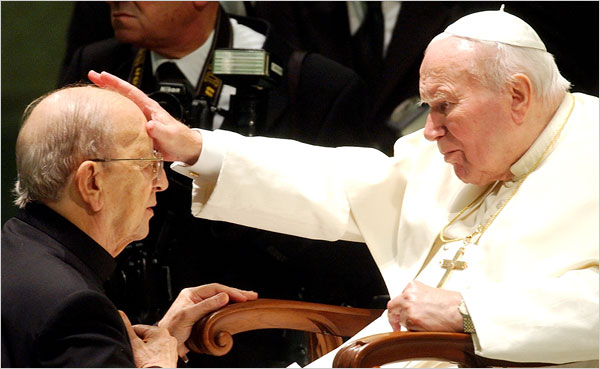
But this is a false narrative. It’s a lie – a half-truth, perhaps, but still a lie – that conceals the suffering of victims prior to that age as well as all those who have suffered abuse at the hands of conservative and traditionalist clergy. Men for whom the Revolution did not transpire. There are many examples of this kind of thing. One only needs to point to Marcial Maciel, Carlos Urrutigoity, Tony Anatrella, Fernando Karadima…the list goes on. None of these men were liberals. Some worked closely with John Paul II and Benedict XVI. Yet the narrative in this letter cheapens the experience of their victims and lulls conservatives and traditionalists into a false sense of self-righteous security – exactly the opposite of what we need if we are ever to get a handle on the problem of clerical sex abuse wherever it should rear its ugly head. It’s a narrative that helps us look the other way as more and more innocents get hurt. And it’s gravely irresponsible for the Pope-Emeritus to propagate this lie.
Thus passes a great theologian.


 The Amish Catholic

