Elsewhere: Two Readings for a First Friday

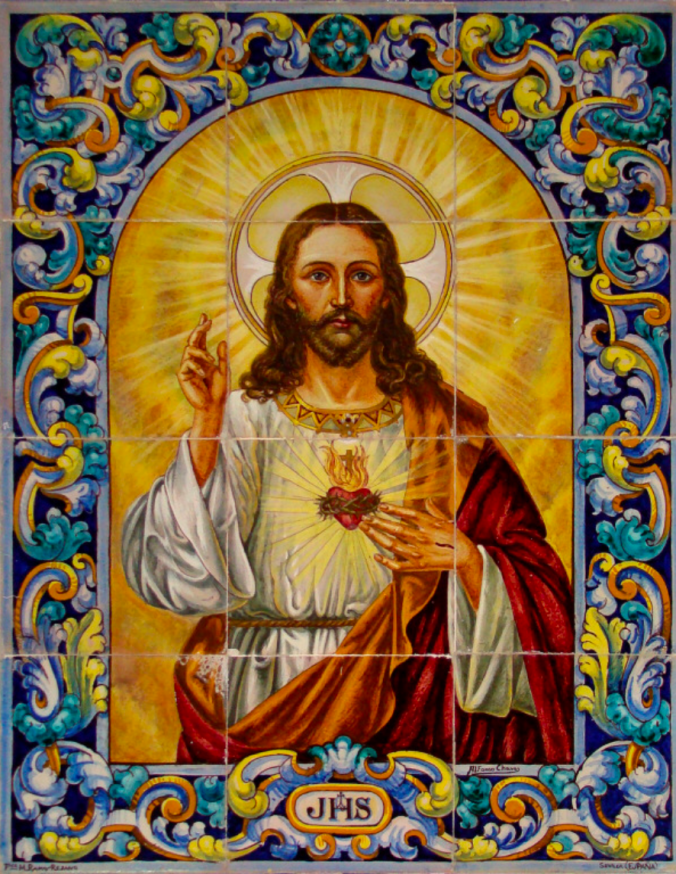
Screen Shot 2018-07-06 at 2.40.31 AM

Sacred Heart of Jesus, have mercy on us. (Source)

I’m working on a big blog post that’s running rather long. In the meantime, I wanted to refer two posts that, although different in some ways, have a common center.

The first is a little old, though I rather sheepishly confess I only just read it. John Monaco has a very good post over at Inflammate Omnia on how the Sacred Heart devotion can help those struggling with mental illness. John goes over the history of the scrupulous, doubtful view of God’s love, most egregiously enshrined in the heresy of Jansenism. But he also looks at the ways that the Sacred Heart can lead those who suffer from scrupulosity and obsessive-compulsive disorder to approach a healthier, more accurate relationship with God.

The second is from an acquaintance of mine named Patrick McCoy who is both a fairly traditional Catholic and same-sex attracted. Over at his blog, O Crux Ave, he relates his recent experience engaging in street evangelism at St. Louis PrideFest, where he led a small team with the goal of sharing the Love of God with the LGBT community. Appropriately enough, he calls this ministry #SacredHeartLoves Outreach.

Although the two posts deal with different topics, together they form a kind of diptych about the Sacred Heart. Both are honest, even vulnerable personal narratives. Both proclaim the unconditional Love of God for stigmatized groups: the mentally ill and sexual minorities. Thus, both are fitting to read on this first Friday of July, the month of the Precious Blood of Jesus, spilled for all mankind.

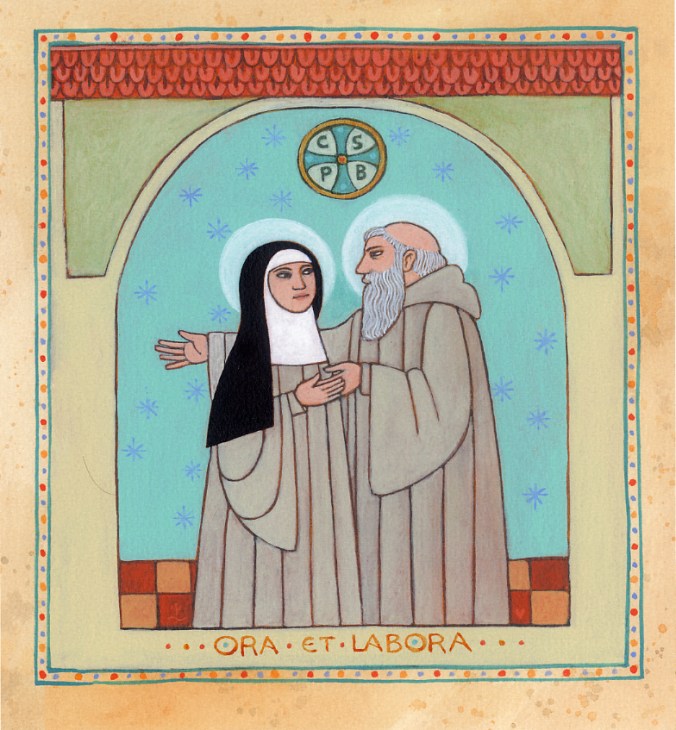
Novena to St. Benedict

HolyTwinsPrint.jpg

A print from The Holy Twins by Tomie dePaola, depicting SS Benedict and Scholastica. (Source)

I hope my readers will join me on a novena to the Patriarch of Western Monks, starting today (July 3rd) and ending on the Feast of St. Benedict, the 11th of July. Here is the prayer I will use, taken from EWTN’s website:

Glorious Saint Benedict, sublime model of virtue, pure vessel of God’s grace! Behold me humbly kneeling at your feet. I implore you in your loving kindness to pray for me before the throne of God. To you I have recourse in the dangers that daily surround me.
Shield me against my selfishness and my indifference to God and to my neighbor.
Inspire me to imitate you in all things. May your blessing be with me always, so that I may see and serve Christ in others and work for His kingdom. Graciously obtain for me from God those favors and graces which I need so much in the trials, miseries and afflictions of life. Your heart was always full of love, compassion and mercy toward those who were afflicted or troubled in any way. You never dismissed without consolation and assistance anyone who had recourse to you. I therefore invoke your powerful intercession, confident in the hope that you will hear my prayers and obtain for me the special grace and favor I earnestly implore.

{mention your petition}

Help me, great Saint Benedict, to live and die as a faithful child of God, to run in the sweetness of His loving will, and to attain the eternal happiness of heaven.

Amen.

My First Year at Grad School in Twelve Musical Selections

Screen Shot 2018-06-22 at 2.00.39 AM.png

A still from Farinelli. This was the year I both became an 18th century scholar and discovered Castrato arias. (Source)

12. “Somebody That I Used to Know” only Vaporwave.

11. “Sumer is Icumen In,” from The Wicker Man (1973).

10. “Demons,” by Alex and “Sleep Games,” by Pye Corner Audio.

9. Tchaikovsky’s Swan Lake theme.

8. Psalm 129 from King’s College Choir, Cambridge.

7. The soundtrack from Le Roi Danse.

6. “Never Enough” from The Greatest Showman.

5. “Pur Ti Miro,” by Monteverdi.

4. The Little Match Girl Passion, by David Lang

3. The Farinelli soundtrack.

2. Michael Nyman’s “The Garden is Becoming a Robe Room,” “Prospero’s Magic,” and “Chasing Sheep is Best Left to Shepherds.”

1. Various Arias from Handel, especially Rinaldo‘s “Il Vostro Maggio” and “Lascia Ch’io Piangia” as well as most of “Ode for the Birthday of Queen Anne.”


Charles Williams, Marriage, and a Shameless Plug

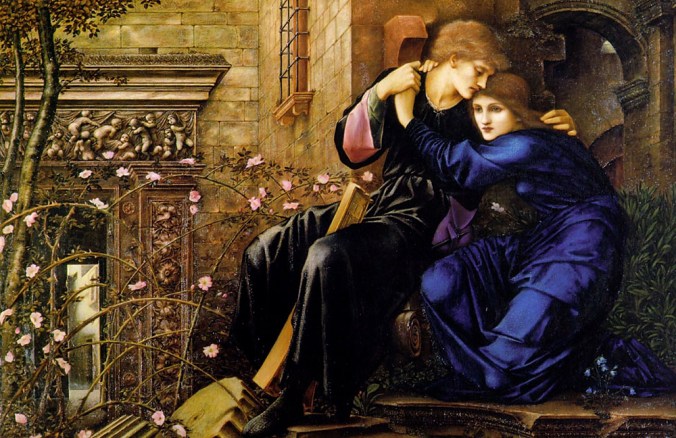
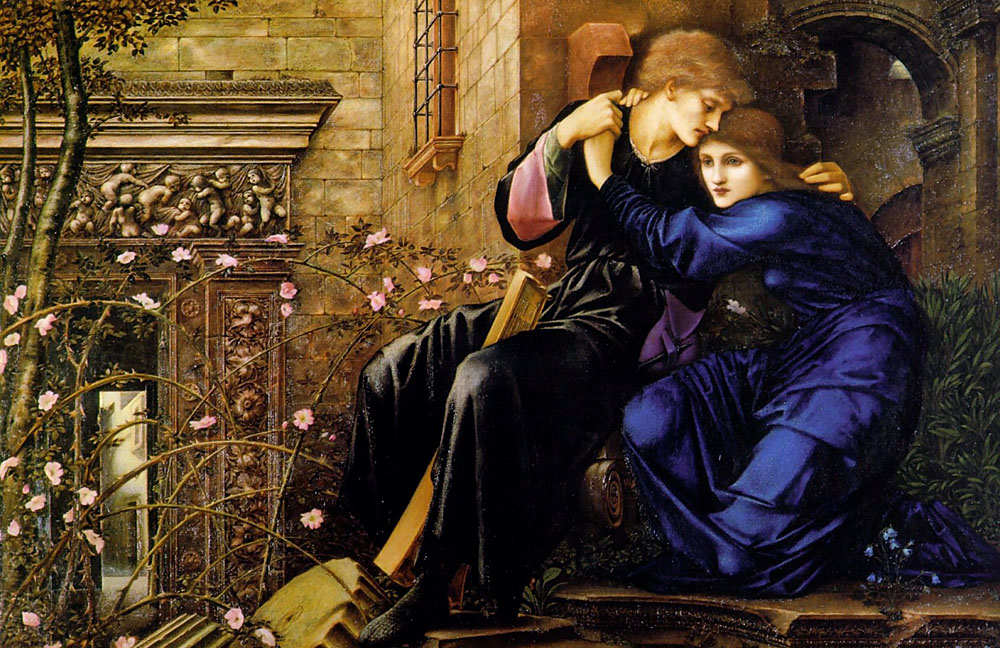
edward_burne-jones_love_among_the_ruins

Love Among the Ruins, Edward Burne-Jones (Source)

I have a very exciting if somewhat tardy announcement. I have some poetry being published in Volume II of Jesus the Imagination, the hot new Sophiological journal by Angelico Press. There’s plenty of other really good material in the journal, too, including work by friends of mine. Plus an interview with the Revolutionary Army of the Infant Jesus! What’s not to love? As far as I’m aware I’m making no money whatsoever off this venture, but I still encourage you to buy a copy (or two, or three) if you want to read my contributions…or just the far more brilliant materials you’ll find there, too.  Either way, I can promise you that Jesus the Imagination won’t disappoint!

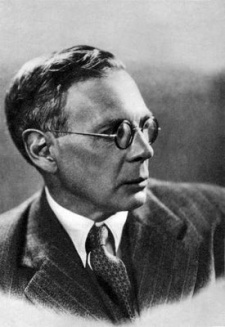
225px-Charles_Williams

A portrait of Charles Williams: poet, critic, lecturer, editor, author, sorcerer, mystic (Source)

The theme for this volume is Marriage. As I’m sure many of you know, marriage is an extraordinarily deep mystery in the heart of the Church’s sacramental life, mystical being, quotidien experience, and esoteric practice. To celebrate, I am reproducing here a poem by Charles Williams that scratches the surface of Matrimony’s essence. Williams, a friend of T.S. Eliot and fellow-Inkling to C.S. Lewis and J.R.R. Tolkien, was a profound mystical thinker who kept returning to nuptial themes over the course of his career. The poem below comes from his first poetry collection, The Silver Stair (1912), a slim book I recently examined in the Bodleian. Enjoy.

Of Marriage and of its Priesthood

Charles Williams

Here shall no pagan foot nor claw of beast
Enter; nor wizard sorcery be seen.
But sometime here have all true lovers been,
Nor hath the tale of outland riders ceased.
With hands of consecration now the priest
Exalts the holy sacrament between
The altar lights. Now, if your souls be clean,
Draw near: Himself Love gives you in His feast.

Whose voice in solemn ritual lifted up
Praises the Name of Love? Whose hands have blest
For you, His votaries, the mysterious Cup,
And set before you the ordained Food?
Voice of Himself, to narrow vows professed,
And hands of His adorable maidenhood.

The Voice of Arthur Machen

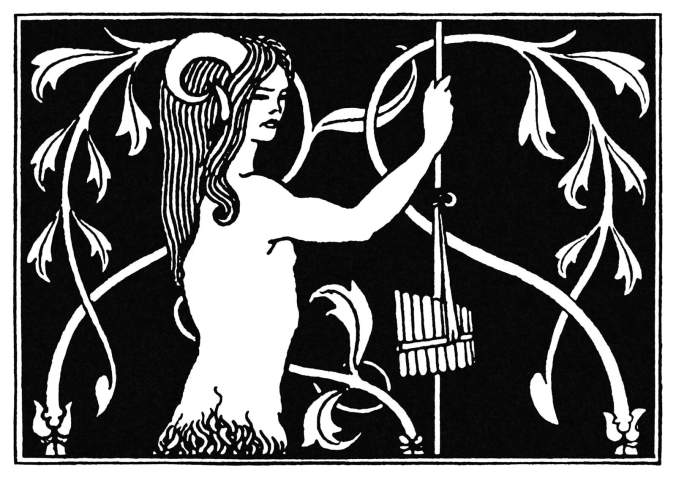
GreatGodPanBeardsley.jp

The title illustration of Machen’s The Great God Pan and the Inmost Light (1896), famously rendered by Aubrey Beardsley (Source)

Arthur Machen (1863-1947) was one of the greatest horror writers in the English language. His particular brand of esoteric paganism, the dangers of the occult, the sinister truth lurking behind folktales, and a highly-developed knack for evoking eldritch terror – all of these elements exerted a profound influence on the development of weird literature. Those who enjoy Lovecraft will recognize much in Machen that later made its way into Lovecraft’s own corpus. The dark bard of Providence held Machen in high esteem.

Machen was also a deeply spiritual Christian, best but imperfectly classed as an Anglo-Catholic. His strong sense of the mystical life found its fullest expression not in his horror stories, which do indeed bear some mark of his sacramental worldview, but in his later writings. A Welshman, he was fascinated by the Grail legend and connected it with his idea of an ancient, vividly supernatural “Celtic” Christianity.

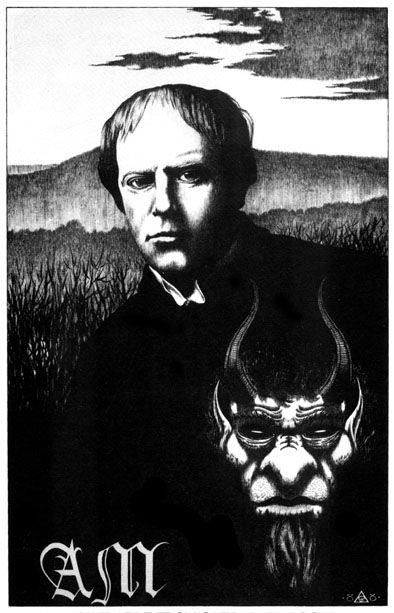
AMachen.jpg

Portrait of Arthur Machen (Source)

Machen is a favourite of mine. I cannot recommend his stories highly enough – especially The Great God Pan, “The Novel of the White Powder,” “The Shining Pyramid,” “The Ceremony,” and “The Lost Club.” He is far scarier than some of his better-known contemporaries such as M.R. James or Sir Arthur Conan Doyle.

He also figures prominently in some of my research. I recently came upon a recording of his voice from 1937, in which he speaks of Chesterton, Dickens, Thackeray, and the art of fiction more broadly. Some of my readers may find this as enjoyable as I do, and so I provide a link here.

A Poem by Montague Summers

madonna-delle-grazie-santa-chiara-giuseppe-marullo

Madonna delle Grazie, Naples (Source)

Some of my readers will no doubt remember that very strange fellow I once wrote about, the Rev. Montague Summers. I have had to look at quite a lot of his orchidaceous writings recently for my research, including his poetry. Here is one such poem he wrote in Antinous and Other Poems (1907). It was written while he was still an Anglican, though it anticipates the lusciously Baroque spirituality that would mark his later writings.

Madonna Delle Grazie

Montague Summers

In the fane of grey-robed Clare
Let me bow my knee in prayer,
Gazing at thy holy face
Gentle Mary, Queen of Grace.
Thou who knowest what I seek,
Ere I unlock my lips to speak,
For I am thine in every part
And thou knowest what my heart,
Yearning in my fervid breast,
Ere it be aloud confessed,
Longeth for exceedingly,
Mamma cara, pity me!

By the dearth of childlorn years,
By thy mother Anna’s tears,
By the cry of Joachim,
When the radiant seraphim,
Girdled with eternal light,
Blazed upon the patriarch’s sight
With the joyous heraldry
Of thy sinless infancy.

By the bridal of the Dove,
By thy God’s ecstatic love,
By the home of Nazareth,
When the supernatural breath
Of God enfolded thee, and cried:
“Open to me, love, my bride,
Come to where the south winds blow,
Whence the mystic spices flow,
Calamus and cinnamon,
Living streams from Lebanon.
Fresh flowers upon the earth appear
The time of singing birds is near,
The turtle-dove calls on his mate,
The fruit is fragrant at our gate.
Thy lips are as sweet-smelling myrrh,
When the odorous breezes stir
Amid the garden of the kings;
As incense burns at thanksgivings.
Thy lips are as a scarlet thread,
Like Carmèl is they comely head,
Thou art all mine, until the day
Break, and the shadows flee away!”

Mother, by thy agony
‘Neath the rood of Calvary,
When the over-piteous dole
Pierced through thy very soul
With a sevenfold bitter sword
According to the prophet’s word.
By the sweat and spiny caul,
By the acrid drink of gall,
By the aloes and the tomb,
By thy more than martyrdom,
Dolorosa, give to me
The thing I lowly crave of thee.

By thy glory far above,
Mother, Queen of heavenly love,
By thy crown and royal state,
By thy Heart Immaculate,
Consort of the Deity,
Withouten whose sweet assent He
May nothing deign to do or move
Bound by ever hungered love,
God obedient to thee!

Mother, greatly condescending,
To thy humblest suitor bending,
From thy star-y-pathen throne,
Since it never hath been known
Whoso to this picture hied,
Whoso prayed thee was denied,
Mamma bella, give to me,
The boon I supplicate of thee!

In Santa Chiara, Napoli.

Screen Shot 2018-06-04 at 11.43.14 PM.png

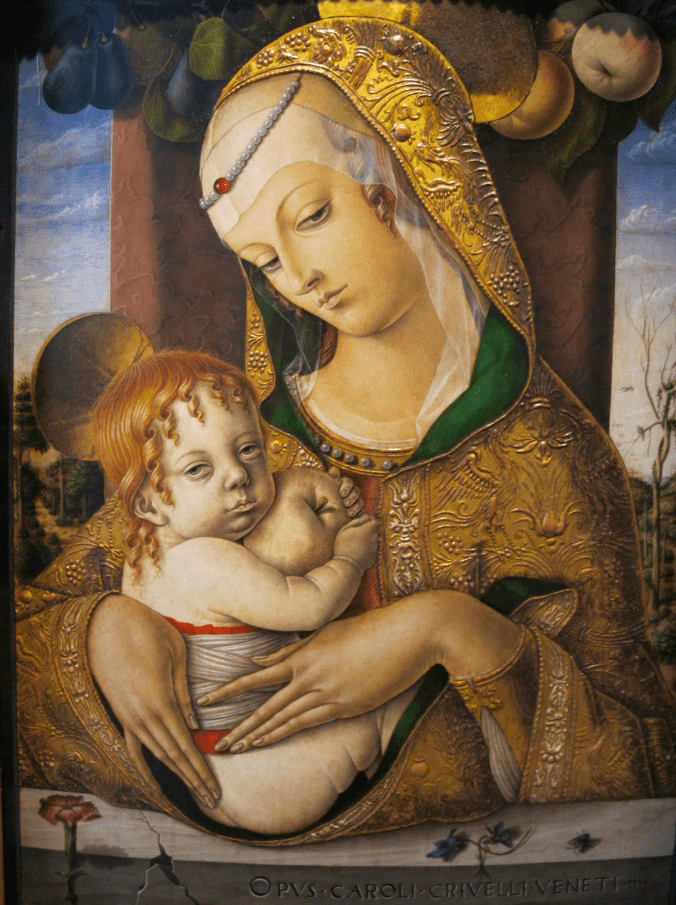
“Madonna and Child,” Carlo Crivelli, c. 1480 (Source)

Elsewhere: A Powerful Prayer of Deliverance

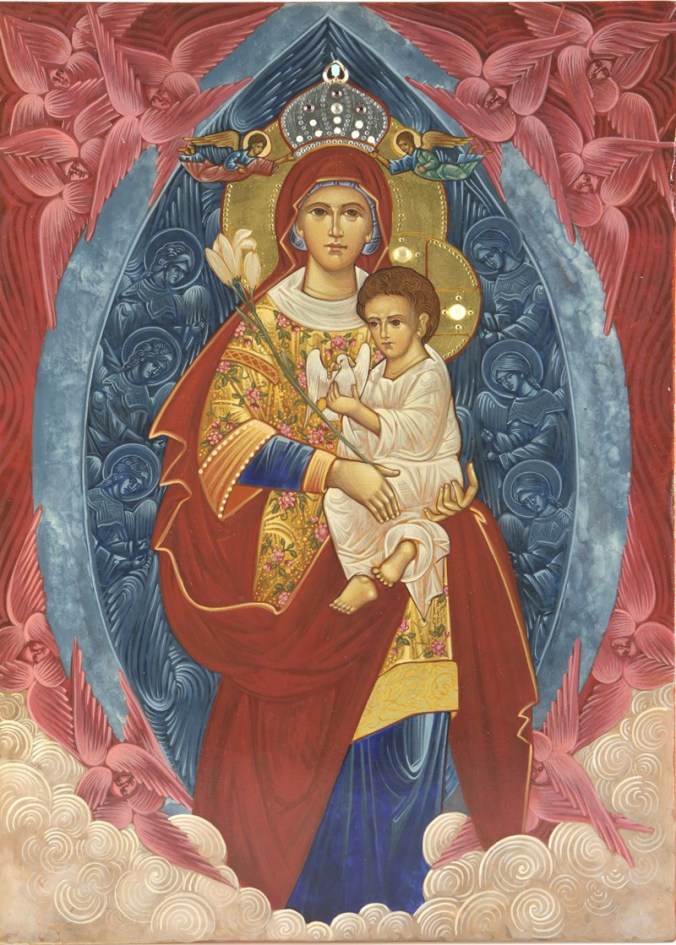
Our Lady of Angels

Icon of Our Lady of Angels. (Source)

Over at Vultus Christi, you can find a series of Chapter Talks on the Rule of Saint Benedict. Today’s commentary concludes with the story of a mighty prayer of deliverance given by the Blessed Virgin Mary to a French priest of the nineteenth century, Bl. Louis-Edoard Cestac. Here it is:

August Queen of Heaven, sovereign Mistress of the Angels, thou who from the beginning hast received from God the power and the mission to crush the head of Satan, we humbly beseech thee to send thy holy legions, that under thy command and by thy power they may pursue the evil spirits, encounter them on every side, resist their bold attacks, and drive them hence into eternal woe.

Who is like unto God?

O good and tender Mother, thou willest always to be our love and our hope.
O Mother of God, send thy holy Angels to defend us and drive far from us the cruel enemy.
Holy Angels and Archangels, defend us and keep us. Amen.

Go read the whole thing. In fact, all of the commentaries are edifying; read them all.

A Belated Word of Thanks

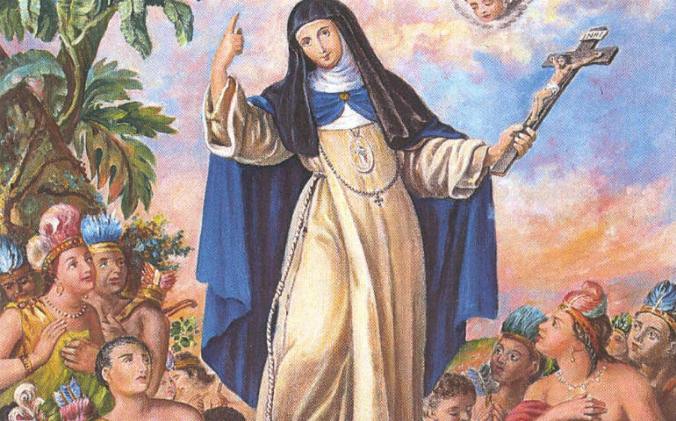
Maria-de-Jesus-de-Agreda

The Ven. Mary of Agreda, seen here preaching to the Indians by the miracle of bilocation. She was one among many who taught the Absolute Primacy of Christ. (Source)

I must thank Fr. Maximilian Mary Dean for republishing two of my pieces over at  Absolute Primacy of Christ: my introduction to the life and thought of Fr. Faber as well as my survey of art depicting the Subtle Doctor. It is a great honor to have been thought worthy of republication on a site I so greatly esteem. I have learned a lot from Fr. Maximilian’s blog and hope I might continue to do so! Go check it out.

“Love is His Bond”

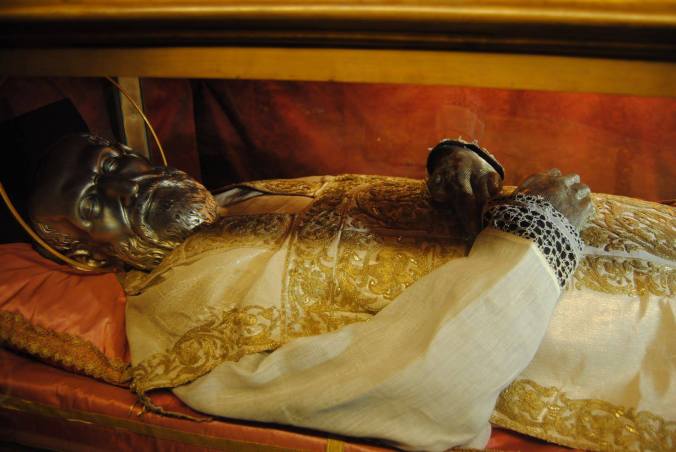
stphilipneribody

St. Philip, pray for us. (Source)

The Mass of St. Philip Neri is a little lesson in joy. The propers again and again stress a common theme: namely, the great saint’s joy, built upon his constant and fiery communion with the Holy Ghost. Holy Mother Church lifts her voice and sings in the Introit, “The love of God is shed abroad in our hearts by the Holy Ghost which dwelleth in us. Praise the Lord, O my soul; and all that is within me praise His holy name.” At the Collect, we pray to God to “mercifully grant that we, who rejoice in his solemnity, may be profited by the example of his virtues.” When, in the third reading, we hear of the saint’s overpowering love of “the spirit of wisdom,” we learn as well that “All good things together came to me with her…and I rejoiced in them all” (from Wisdom 7). The Offertory likewise proclaims with the Psalmist, “I will run the way of Thy commandments, when Thou hast set my heart at liberty” (Ps. 118). Everywhere we turn, we find the joy and freedom that alone springs from communion with the Holy Ghost.

And then we come to a remarkable moment. In the Secret, the priest prays over the offerings,

We beseech Thee, O Lord, favorably to regard these present sacrifices: and grant that the Holy Spirit may inflame us with that fire, wherewith he wondrously penetrated the heart of blessed Philip.

The Church has here enshrined a stunning and highly instructive truth. Yet it is easy to miss.

The very heart of St. Philip – that organ claimed so powerfully by the Holy Ghost in the catacombs of St. Sebastian, ever converting those sinners with the happy fortune of touching Philip’s breast, inflaming the saint with the deathless ardor of love, bearing such close likeness to those sacred hearts of Christ, Our Lady, and St. Joseph, beloved by generations upon generations – that heart is set up for us here in parallel to the Eucharist. For just as it is the Spirit who will so shortly transform bread into the most holy and eternal heart of Jesus, so it is that same Spirit who made of St. Philip’s heart a “hostia pura, hostia sancta, hostia immaculata.” Christ gives himself entirely to us by the Holy Ghost in the Liturgy, and St. Philip Neri became entirely Christ’s by the arrival of the Holy Ghost in those dark catacombs. To possess the heart is to possess the whole man.
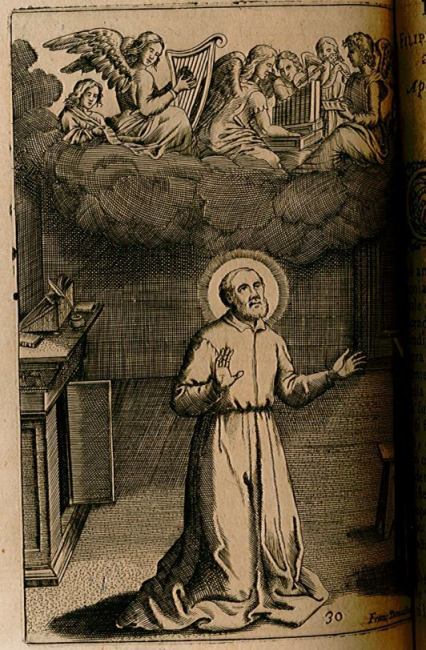
RarePlatePNCardiff

A plate illustrating the life of St. Philip from a rare 1699 Vita, kindly shown to me and since publicly shared by the Cardiff Oratorians. (Source)

This mutual possession of God and man animates everything for the Christian. The more we are given over to it, the more God allows us to partake of His own life. The more we are His, the more He becomes ours. This spiritual truth was well understood by St. Philip, who enshrined it as the principal of unvowed community life in the Oratory. In the words of Bl. John Henry Newman, “Love is his bond, he knows no other fetter.” This line, written of St. Philip, could apply just as well to Our Savior, Jesus Christ. For it is by His indwelling love that we come to love Him. It is by love that we can join our hearts to His in the Eucharist. It is truly by love that we share “that fire, wherewith [the Holy Spirit] wondrously penetrated the heart of blessed Philip.”

The 83rd Psalm comes to the Church’s lips at the Communion. She sings, “My heart and my flesh rejoice in the living God.” These are not only St. Philip’s words, but those of every soul who gives herself over to the indwelling love of God. And at the Postcommunion, the Church prays,

O Lord, who hast fulfilled us with Thy heavenly delights: we beseech Thee, that by the merits of blessed Philip Thy Confessor, and by following him, we may ever earnestly seek after those things whereby we truly live.
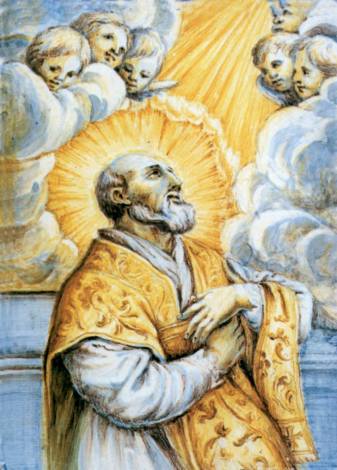
filippo-neri

St Philip lived a preeminently liturgical life. (Source)

What are “those things whereby we truly live?” The Holy Ghost, the Eucharist, and prayer – those things, if it be not too blasphemous to speak of them as “things,” which were ever St. Philip’s “heavenly delights.” Or, more properly, that mystic unity of the three in the Liturgy. In his own words, “A man without prayer is like an animal without the use of reason.” And it is surely the grand and orderly and perfect prayer of Christ the Priest and Victim that St. Philip means when he speaks of our super-sensual reason.

What, then, does it mean to “truly live?” If I may be permitted to tie together a few of St. Philip’s maxims, we can discern his own answer to this question:

In the spiritual life there are three degrees: the first may be called the animal life; this is the life of those who run after sensible devotion, which God generally gives to beginners, to allure them onwards by that sweetness to the spiritual life, just as an animal is drawn on by a sensible object. The second degree may be called the human life; this is the life of those who do not experience any sensible sweetness, but by the help of virtue combat their own passions. The third degree may be called the angelic life; this is the life which they come to, who, having been exercised for a long time in the taming of their own passions, receive from God a quiet, tranquil, and almost angelic life, even in this world, feeling no trouble or repugnance in anything. Of these three degrees it is well to persevere in the second, because the Lord will grant the third in His own good time.

A departure from the passions and a cleaving to virtue; mortification mixed with convivial, holy companionship; and above all, an overriding joy.  These are the manifestations of the indwelling love of God. These constitute a life “truly lived.” These are the fragrant flowers accompanying the fruits of the Holy Ghost. “Thou hast set my heart at liberty;” the saint embodies the song of the Offertory.

St. Philip’s life was marked in every way by such a communion with the Holy Ghost, first in a singular and miraculous way in the catacombs, and then again at every Mass. The love of God made him the most perfect model of the very “angelic life” he described to his sons and companions. Those of us privileged enough to count him among our heavenly friends may, by his merciful intercession, hope to share that one Divine Joy he knew so well. May he so pray for us on this, his feast.
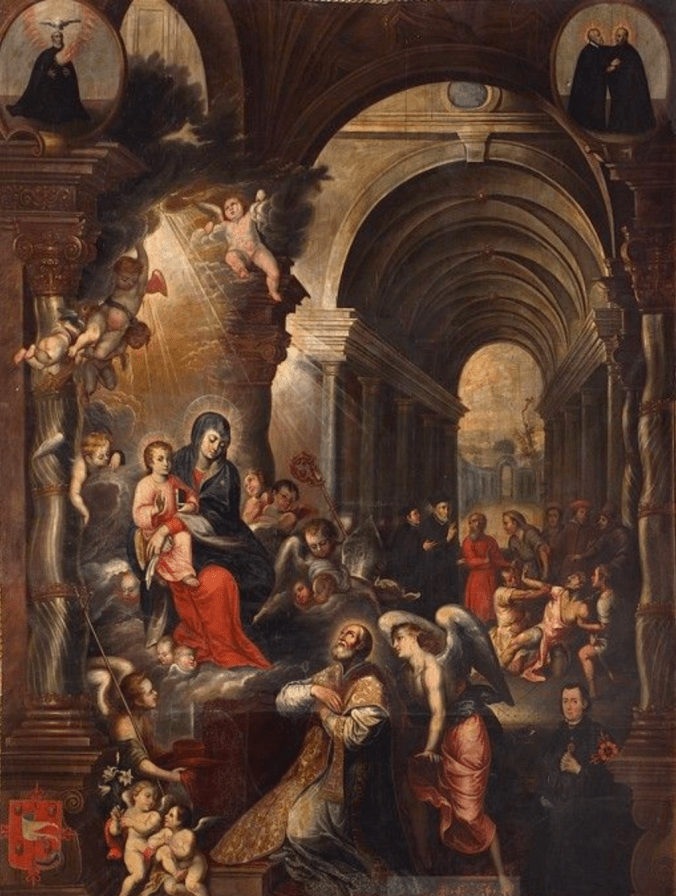
Screen Shot 2018-05-22 at 11.27.28 PM.png

Aparición de la Virgen a San Felipe Neri, Mexico, detail. (Source)