A Corpus Christi Meditation

GasparroTransustanziazio

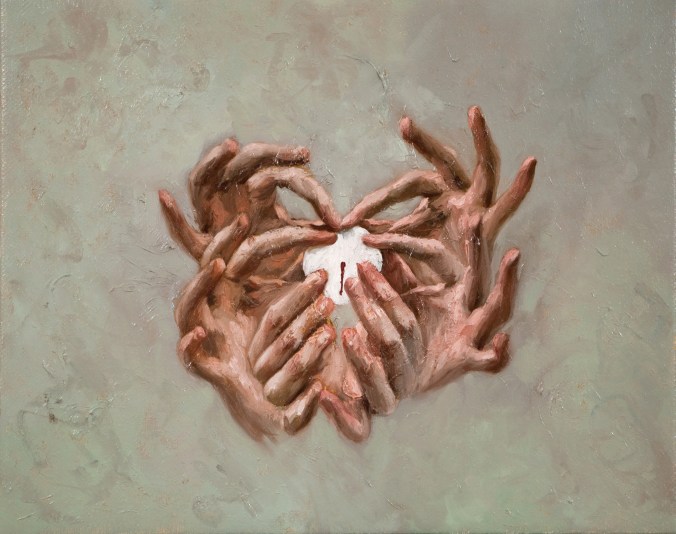
Transustanziazione,” by Giovanni Gasparro. He’s one of the best Catholic artists working today.

In my parish, as in most, the Solemnity of Corpus Christi has been moved from its traditional spot on the Thursday after Trinity to the following Sunday. There are many unfortunate implications of this liturgical change, but today I’d rather focus on what grace I received from the readings and prayers of today’s Ferial Mass.

I’d like to start, however, with a painting, “Transustanziazione,” by Giovanni Gasparro. Only in the work of Salvador Dali do we find a modern artist who captures the mystical dimension of the Eucharist in such an original way. And Gasparro’s piece is far simpler, and therefore more visually striking, than any of Dali’s several Eucharistic paintings.

Three pairs of hands, like the three pairs of wings on the seraphim and cherubim, bear aloft a bleeding host in undifferentiated space. The three sets of hands appear the samethey are, perhaps, the hands of the same priest captured over the lapse of time. This distortion of time and space lends the image a sense of eternity. We are viewing something transcendent. The Eucharist is not just an earthly event. It is also a rite which happens forever in the cosmic liturgy of heaven. And who is the Great High Priest offering that liturgy for us mortals? Who but Christ? In Gasparro’s image, Christ is present as priest and victim.

The three pairs of hands also remind us of the Trinity. When we approach the Eucharist, we truly approach the Triune God. At every Mass, the act of Transubstantiation only happens because of the work of the whole Trinity. Christ offers Himself to the Father in the Holy Spirit, through the hands of His priests and the prayer of His bride, the Church. It is meet and right that we should consider the painting at this point between the Ordinary Form celebrations of Trinity Sunday and Corpus Christi.

The painting has a certain sacramentality, in that, like the liturgy, it captures something of the invisible and manifests it to our earthbound senses. Looking at Gasparro’s painting, we have the sense that we are glimpsing something profound, unsettling, and sacredsomething ordinarily hidden from us. Do we not hear the words of St. Thomas’s Corpus Christi hymn, Lauda Sion?

Here beneath these signs are hidden,
Priceless things, to sense forbidden,
Signs, not things, are all we see.

Today’s liturgy powerfully brings this quality to mind. As we turn to the First Reading from today’s Mass, we encounter the words of St. Paul:

Brothers and sisters: To this day, whenever Moses is read, a veil lies over the hearts of the children of Israel, but whenever a person turns to the Lord the veil is removed. Now the Lord is the Spirit and where the Spirit of the Lord is, there is freedom. All of us, gazing with unveiled face on the glory of the Lord, are being transformed into the same image from glory to glory, as from the Lord who is the Spirit.

Therefore, since we have this ministry through the mercy shown us, we are not discouraged. And even though our Gospel is veiled, it is veiled for those who are perishing, in whose case the god of this age has blinded the minds of the unbelievers, so that they may not see the light of the Gospel of the glory of Christ, who is the image of God. For we do not preach ourselves but Jesus Christ as Lord, and ourselves as your slaves for the sake of Jesus. For God who said, Let light shine out of darkness, has shone in our hearts to bring to light the knowledge of the glory of God on the face of Jesus Christ.

This, from the Second Epistle to the Corinthians.

The Liturgical Providence of God permits us to hear these words of the Apostle on a day which, in the Old Calendar, was the preeminent feast of the Eucharist as such. All Thursdays are to be read in light of the Eucharist, mystically tied as they are to this holy feast and to Maundy Thursday.

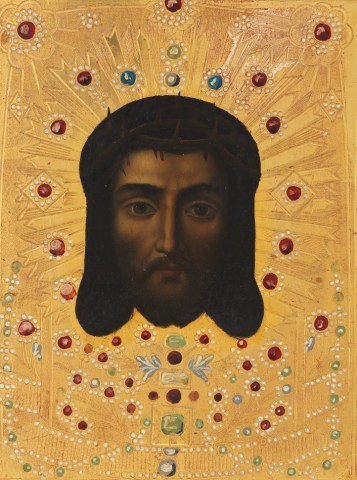
RussianHolyFace

Russian icon of The Holy Face of Jesus “Not-Made-by-Hands”(Source).

St. Paul is doing many things in this passage. It is an extremely rich vein of mystical insight, and it could yield untold spiritual fruit. But one very clear move that St. Paul makes here is the parallel he draws between our faces and the face of Christ. As the Spirit has removed the veil of sin from our faces in Baptism, so too, He removes the veil from Christ’s priestly face in the Eucharist. In the Eucharist, the Baptized stand face-to-face with God Almighty. We must grow in the likeness of Christ’s Holy Face—”from glory to glory”—but only by approaching the glory of that face in the Eucharist.

What does this transformation practically look like? The readings give us hints.

The Gospel Acclamation, drawn from St. John, summarizes the commands of the Lord in the proper Gospel. We sing, “I give you a new commandment: love one another as I have loved you.” Then, Christ tells us,

Therefore, if you bring your gift to the altar, and there recall that your brother has anything against you, leave your gift there at the altar, go first and be reconciled with your brother, and then come and offer your gift.

Eucharistic community is characterized by peace. Its members govern their actions by deliberate and conscientious love. We are obliged to strive for this peace.

The proper Psalm depicts the spiritual condition of that moral environment, when

Kindness and truth shall meet;
justice and peace shall kiss.
Truth shall spring out of the earth,
and justice shall look down from heaven.

What, precisely, is the nature of this union of heaven and earth? Here, too, the Psalm furnishes a deeper insight. We sing in the refrain, “The glory of the Lord will dwell in our land.” There are many meanings bound up in this line of Holy Scripture. Three are immediately relevant to our purposes. The passage’s Sophiological meaning is that God’s glory will ultimately interpenetrate, indwell, and crown the redeemed cosmos. The passage’s Mariological meaning is that Christ will give His own divine-human self to the Church, the New Israel, through the Church’s perfect microcosm and icon, Mary, the true Daughter of Zion.

But the passage also has a Eucharistic meaning. There is a reason we are meant to chant this particular line of the Psalter on the Thursday that was (and at some level, still is) Corpus Christi. The Glory of God will dwell in the land by its fruits—bread and wine. Indeed, the Glory of God will so fill the bread and wine that they will cease to be bread and wine. God will pour out his glory upon our offerings until our “cup runneth over.” They may appear all the same to us, but in truth, they will become the Body and Blood of Christ. No part of their original essence will remain. This single act of outpouring and indwelling is God’s privileged path of union with souls and with all creation.

As the great theologian Jean Daniélou writes, “We have already seen the Eucharist as communion, covenant. Now we see it as presence, shekinah.” It is the same presence that animates the entire liturgy of the Ferial Thursday after Trinity and that hides quietly in the simple and sacramental art of Giovanni Gasparro.

A Poem for Trinity Sunday

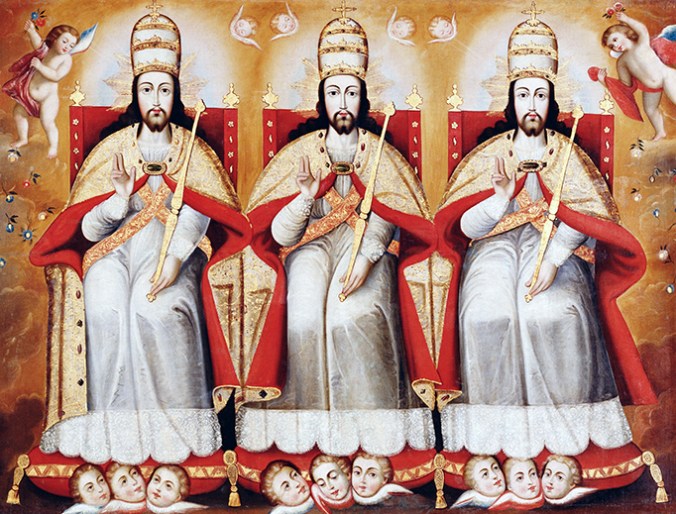
TrinityThrones

“The Enthroned Trinity.” Cuzco School. c. 1730. (Source).

Holy Sonnet XIV
John Donne

Batter my heart, three-person’d God, for you
As yet but knock, breathe, shine, and seek to mend;
That I may rise and stand, o’erthrow me, and bend
Your force to break, blow, burn, and make me new.
I, like an usurp’d town to another due,
Labor to admit you, but oh, to no end;
Reason, your viceroy in me, me should defend,
But is captiv’d, and proves weak or untrue.
Yet dearly I love you, and would be lov’d fain,
But am betroth’d unto your enemy;
Divorce me, untie or break that knot again,
Take me to you, imprison me, for I,
Except you enthrall me, never shall be free,
Nor ever chaste, except you ravish me.
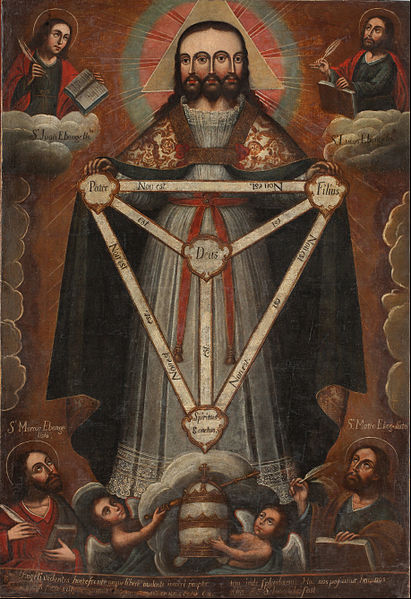
TrifacialTrinityCuzcoSchool

“Trifacial Trinity,” Cuzco School. c. 1750-70. (Source).

Three Poems for Whitsunday

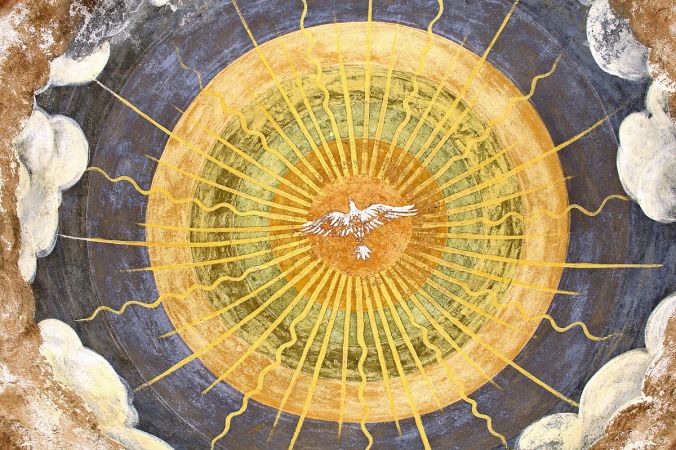
Fresco-Zica

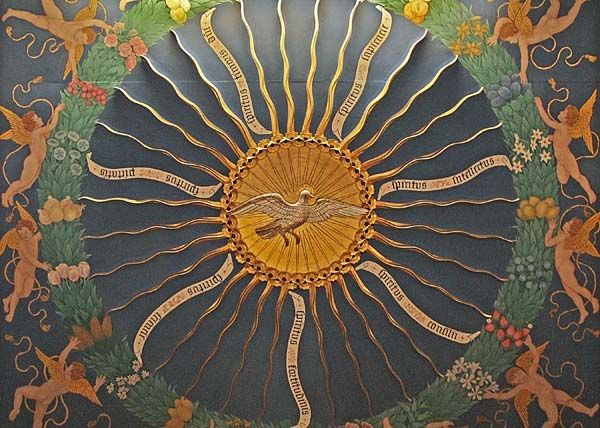
The Dove Descending…(Source)

Inspired by and borrowing from Artur Rosman’s similar post, I offer you some Pentecostal poetry.

“Little Gidding” IV, by T.S. Eliot

The dove descending breaks the air
With flame of incandescent terror
Of which the tongues declare
The one discharge from sin and error.
The only hope, or else despair
Lies in the choice of pyre of pyre-
To be redeemed from fire by fire.

Who then devised the torment? Love.
Love is the unfamiliar Name
Behind the hands that wove
The intolerable shirt of flame
Which human power cannot remove.
We only live, only suspire
Consumed by either fire or fire.

“God’s Grandeur,” by Gerard Manley Hopkins S.J.

The world is charged with the grandeur of God.
    It will flame out, like shining from shook foil;
    It gathers to a greatness, like the ooze of oil
Crushed. Why do men then now not reck his rod?
Generations have trod, have trod, have trod;
    And all is seared with trade; bleared, smeared with toil;
    And wears man’s smudge and shares man’s smell: the soil
Is bare now, nor can foot feel, being shod.
And for all this, nature is never spent;
    There lives the dearest freshness deep down things;
And though the last lights off the black West went
    Oh, morning, at the brown brink eastward, springs —
Because the Holy Ghost over the bent
    World broods with warm breast and with ah! bright wings.


“Epigrammata Sacra XIII” – The descent of the Holy Spirit – Richard Crashaw

Bear, o bosoms, bear ye what Heaven’s vintage showers,
Sacred clusters pouring from ethereal bowers.
Too happy, surely, ye who drink of wine so good;
It comes into your bosoms a sparkling, cooling flood.
Behold, with nectar’d star, each head is shining, shining;
Around your purpl’d locks a crown of life entwining.
O Spirit of all flesh, to drink who’d be denied,
Since Thou, lest they should falter, mak’st wine a torch to guide?

HolySpiritCeiling

Veni Sancte Spiritus! (Source)

The Seven Sacraments in Flannery O’Connor

image.jpeg

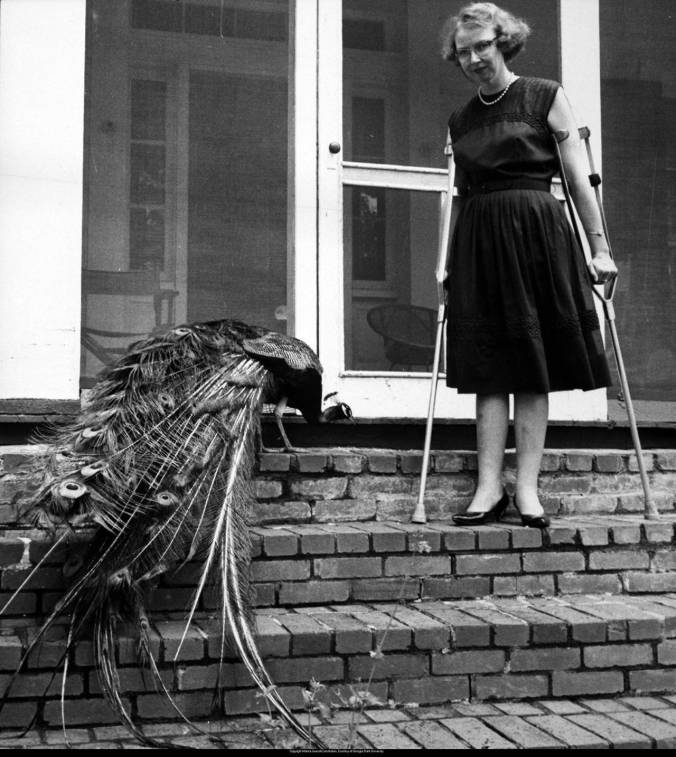
Flannery O’Connor at her farm, Andalusia, with one of her beloved peacocks. (Source).

Flannery O’Connor’s name is synonymous with the American short story tradition. What sets her apart from her peers, besides her mastery of plot and her succinct, grotesque style, is the deep concern for issues of faith and grace that animates all of her stories. As O’Connor once put it, “All my stories are about the action of grace on a character who is not very willing to support it, but most people think of these stories as hard, hopeless, brutal, etc.” There is a certain delicious cruelty to her work. The nasty fates she metes out to children, let alone the adults who deserve what they get, rank her with the best of the gothic writers (and a humorous one at that—we can only imagine the hysterical laughter that something like Der Struwwelpeter would have provoked in her).

Yet O’Connor never show us violence for its own sake, nor for mere moralizing, nor as a ploy for cheap entertainment. Violence is the only outlet for grace in a fallen, “Christ-haunted” world. Her pages are choked and sodden with the precious blood that flows from the Cross.

Seven_Sacraments_Rogier

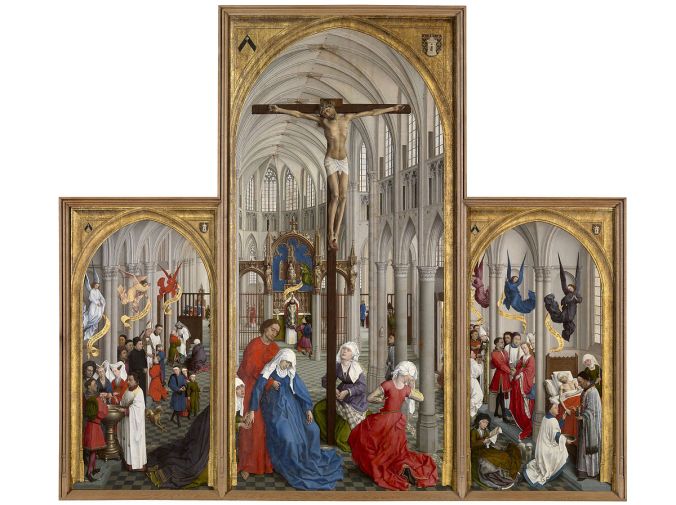
The Seven Sacraments, Rogier van der Weyden, c. 1448. O’Connor provides us with a (southern) gothic view of the sacraments. (Source)

It is a commonplace among critics that O’Connor’s writing is deeply sacramental. But to my knowledge, no author who has made that claim has also tried to find the fullness of the sacramental system present in her work.

I maintain that all seven sacraments appear in her fiction under different guises. Very often, we are given only implicit or twisted versions. It is common in O’Connor’s dark narratives to find flashes of grace in the inverse of sacraments; the truth emerges through its own negationhence her heavy use of violence. But all seven are all there, for those who “hath ears to hear” (Matt. 13:9 KJV).

In giving short descriptions of the following stories, my effort is not to justify my choices so much as to provoke further reading. As such, I will keep my descriptions succinct and relatively spoiler-free. Those who have read them may be able to see where I’m coming from. Those who haven’there’s some summer reading for you.

Baptism“The River”

This is one of O’Connor’s more overtly sacramental stories. The young son of irreligious parents accidentally gets himself baptized by a preacher in a Southern riverwith lethal consequences.

Honorable mention: The Violent Bear It Away. O’Connor thought about baptism a lot, probably because, as a rite of initiation, it is so centrally connected with questions of faith.

Confirmation“The Enduring Chill”

A sick and snobbish intellectual. A garrulous Jesuit. An overt reference to “A Simple Life” by Flaubert. Sometimes, the descent of the Holy Spirit doesn’t feel quite the way we expect.

Eucharist“A Temple of the Holy Ghost”

The only short story I know by any author that quotes the Tantum Ergo at length. There’s a good example of the “Red, Eucharistic Sun” motif that O’Connor was so fond of using. And lovers of the weird O’Connor will find her incarnational vision at a particularly grotesque note in this story.

The thinkpiece that uses “Temple” to discuss contemporary gender identity issues, sadly, has yet to be written.

ChurchDevilSign.jpg

O’Connor knew how to use a Protestant idiom to communicate Catholic doctrine. (Source).

Confession“The Lame Shall Enter First”

At one point, the liberal main character’s office is compared to a confessional. In confession, however, you hope that a good priest will comfort those who need comfort and afflict those who need affliction, for the edification and sanctification of all. Not so in Sheppard’s benevolently atheist bubble.

Marriage“Parker’s Back”

In this remarkable narrative, one of O’Connor’s most Catholic stories, we read the story of a marriage broken apart by a dramatically visible expression of extraordinary grace. Theological and moral Puritans won’t be pleased by the implications.

Holy OrdersWise Blood

What happens when you really, really, really don’t want to accept your vocation? You end up like Hazel Motes, and chase after a “Holy Church of Christ Without Christ.” The last chapter can be read as a meditation on the Imago Dei.

Unction“A Good Man is Hard to Find”

If only for that incredible, climactic line spoken by the Misfit, “She would of been a good woman…”

I may try to expand this list into a real academic work some day. For now, take this list for what it isa few reading suggestions for those of you who, like me, enjoy O’Connor, Southern Lit generally, and Catholicism.

Also peacocks.

Lots of peacocks.

CompleteStoriesFO

Cover of The Complete Stories. (Source).

Our Lady of the Cenacle in Armenian Iconography

ArmenianOLCenacle

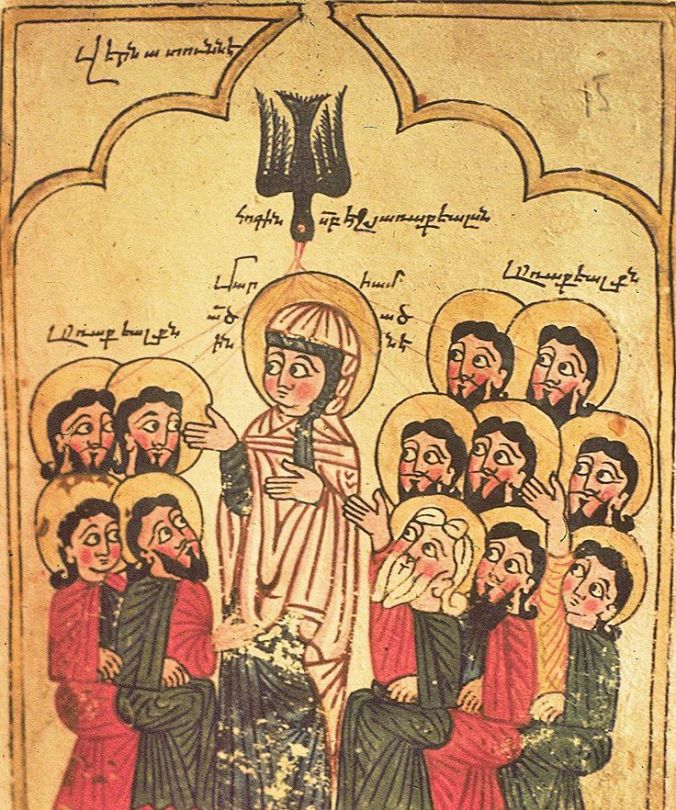
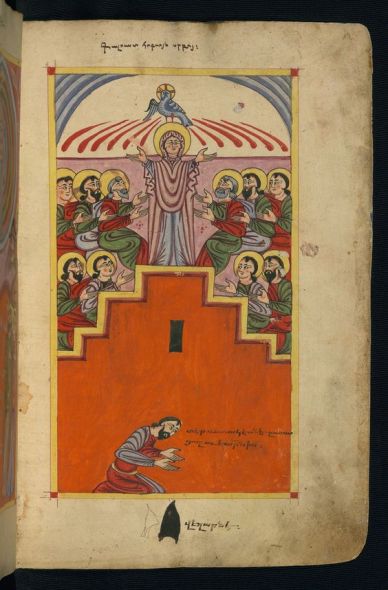
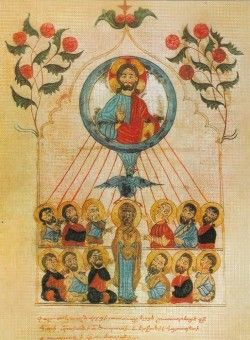
Figure A. Our Lady of the Cenacle, pray for us. From the source: “MINIATURES – Erevan, Matenadaran, MS 8772, Gospel, Aght’amar, Vaspurakan, 1391, artist Dzerun, Pentecost. Photo: Dickran Kouymjian.” (Source)

Throughout the Latin Church, Saturday in the Ascension Octave is kept as the Feast of Our Lady of the Cenacle. On this holy day, we remember the Mother of God keeping vigil with the Apostles in the Upper Room, or “Cenacle.” The place is significant. Here, Christ gathered the Twelve on the night of his betrayal, Maundy Thursday. At that time, He instituted the priesthood and the Eucharist. Later, on Pentecost, the Holy Spirit will descend upon the congregation and truly constitute the Church as such, confirming its sacramental essence and mission in the world of time.

Mary’s position in this unique place at this unique time is captured in the title, “Our Lady of the Cenacle.” But that name conceals a much deeper mystery. What, precisely, was she doing in the Cenacle? Why was she there? And does her presence, never mentioned in the Bible, nevertheless retain important meaning for us today?

As with any mystery unspoken in Scripture but passed on to us by the Tradition, we can approach it by many paths. One of the wonderful things about the Church is that, in her sacramentality, she recasts everything in the light of Christ and opens all things to a deeper meaning than we ordinarily encounter. So today, I’d like to consider Our Lady of the Cenacle through art. Specifically, iconography. Even more specifically, Armenian illuminated manuscripts.

pentecost_kirillo-belozersk-c-1497.jpg

Figure B. A Greek-style Russian icon of 1497. Note the emptimess of the “Teacher’s Seat” at center. (Source)

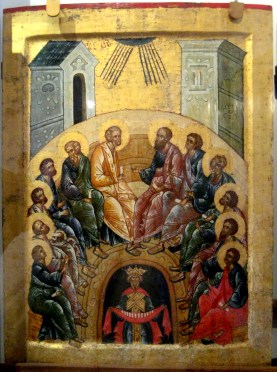
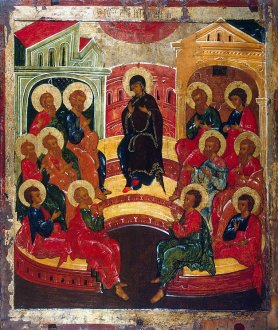
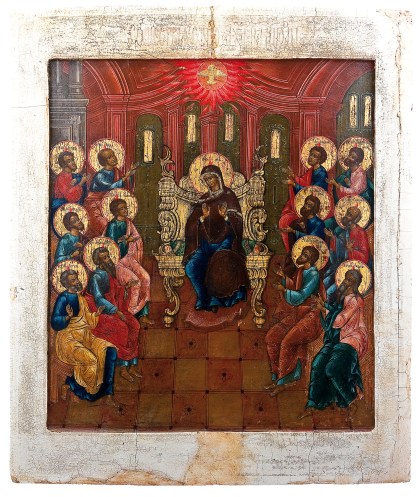
In the Greek iconographic tradition, Pentecost is usually depicted with an empty seat in the center…the place of Christ the King and Teacher, who has ascended and sent the Holy Spirit in his stead. The icon for the feast of mid-Pentecost dovetails with this custom, as it depicts Jesus the youth instructing the teachers of the Law in an arrangement that approximates that of Pentecost proper. The Russian and Slavic iconographic tradition largely copies this model, with one notable exception. Many Russian iconographers include the Mother of God in what would ordinarily be the empty “Teacher’s Seat.” As one writer puts it, “Mary is therefore shown in the ‘teacher’s seat’ as the best example we have, and the person on earth who most resembled Jesus Christ (both physically, as His mother, and spiritually as His disciple).” Indeed.

Icon-The-Descent-of-the-Holy-Spirit

Figure C. A Russian-style icon with the Mother of God in the “Teacher’s Seat,” date unknown. (Source).

The Armenian iconographic tradition differs from both the Greek and Russian streams in important ways, not all of which we can get into here. For our purposes, it is enough for us to observe that the Armenians have a tendency to place the Mother of God at the center of the Pentecostal scene.

Examine, if you will, the illumination at the top of this essayFigure A.

Mary is, by far, the largest character. The Apostles crowd around her on both sides expectantly. Her hands are lifted in the orans position of prayer. She stands in a red mantle and a dark blue robe that matches the hue of the Holy Spirit alighting above her. Every one of the bird’s tongues of flame move through her nimbus to reach the Apostles, some of whom even raise their own hands as if to reach out and take hold of the mystical fire.

A similar placement and posture is written into the following icon:

Pentecost2

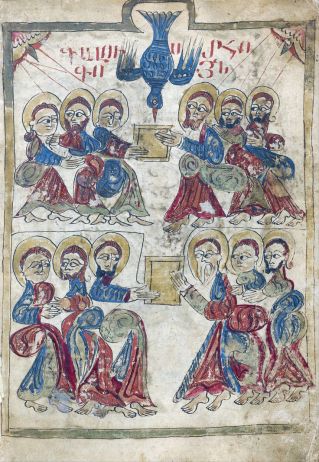
Figure D. Description from source: “This Armenian Gospel book was produced in 904 of the Armenian era (1455 CE) at the monastery of Gamałiēl in Xizan by the scribe Yohannēs Vardapet, son of Vardan and Dilšat, and was illuminated by the priest Xačʿatur.” (Source)

Mary is the central pillar of the icon. The Holy Spirit does not just descend, but rests upon her as He sends forth his tongues of flame. Here, too, their colors match. We can see that the Holy Spirit is customarily written in blue for this festal icon.

Blue is an interesting color, one with mystical associations. I won’t attempt a full symbolic analysis here, but it is worth contemplating the range of natural and supernatural meanings which Christianity has invested in this delicate shade. It suffices to say that blue is a sophianic color, calling to mind the wisdom and beauty of God (see the pertinent chapter in The Pillar and Ground of the Truth, by the great Russian theologian Father Pavel Florensky). The iconographic tradition is of great help in this subject as well; besides gold, blue is the only other color allowed for the background of icons in the Greek and Slavic canons.

DarkDove1

Figure E. An Armenian Pentecost icon without Mary, but with a blue dove of the Spirit. (Source)

SmallIcon

Figure F. Pentecost icon of unconfirmed but probably Armenian origin. Same blue Spirit, roughly the same placement of the Theotokos. (Source).

It is also perhaps worthy of note that in Figure D, Mary doesn’t just match the hue of the Spirit. The colors she wears also match the architecture of the Cenacle. She is one with the Cenacle; the Cenacle is hers, and hers alone. The Cenacle is the Church, the Cenacle is every tabernacle in the world, the Cenacle is Heaven, the Cenacle is the New Jerusalem, the Cenacle is the Throne of God, the Cenacle is the Eschaton, the Cenacle is the final consummation of sophianic being brought about by Christ’s gloriously triumphant Incarnation, sacrifice, and Resurrection.

And in all these mystical dimensions of the Cenacle, Our Lady is Queen.

Mary is the woman who bears the Holy Spirit, the living icon of the Church. When we look at Mary, we are to think of the Spirit. The Mother of God always points us to her son, but also to the Holy Spirit, and through both, to the Father. She is never apart from the Holy Spirit. They abide together, and the Cenacle is where her truly Eucharistic and sophianic state of being is manifested for the awe-struck view of the whole Church. She is the consummation of what is accomplished by the Trinity in the Cenacle, the woman who fully cooperates in the salvation of the world, the Co-Redemptrix and Mediatrix of All Graces. Indeed, do we not read the latter title in the first illumination above? Do we not see it in the slim orange lines of fire that move through her halo to the Apostles below? They only receive the Spirit as it passes through Mary.

Mary does nothing of her own effort. God does all in her, and she freely agrees to accept and work for God’s will. St. Paul can speak of “those things that are wanting of the sufferings of Christ, in my flesh” (Col. 1:24 DRA). Not so with Mary. In her, the cross’s victory is complete. In her, it has become the Tree of Life, “so that the birds of the air,” such as the blue bird of the icons, “come and lodge in the branches thereof” (Matt. 13:32 KJV).

On this feast day, let us remember the manifold graces that Our Lady showers upon us from her throne in the eternal Cenacle. Let us also take heart that, with so powerful an advocate at the heart of the Church, no controversies or troubles can ever overwhelm the Barque of Peter. Finally, let us pray to Our Lady of the Cenacle for the Benedictines of Silverstream on this, their patronal feast.

Heat, Song, Sweetness: A Meditation on the Benedictine Life of St. Philip Neri

spn-indies

“Rome will be your Indies.” St. Philip receives his vocation from a Cistercian. (Source)

It has not been remarked upon very often that St. Philip loved the Benedictines. Monks played an important part in his life at two critical moments: first, when he decided to go to Rome, and second, when he decided to stay in Rome.

While working with his uncle Romolo in San Germano, near Naples, St. Philip would go to pray at Monte Cassino. As one author has it, “From [the Benedictines], he developed a profound love of the liturgy, the Bible and the ancient Church Fathers.” Their rich spiritual life helped cultivate a sense of God’s will, which led him to his first conversion. St. Philip quit his lucrative mercantile career with Romolo and set off for the Holy City. We shall examine his second run-in with the sons of St. Benedict later.

In considering St. Philip, we start to find similarities with other saints. Father Faber likened him unto St. Francis of Assisi; just as St. Francis was the “representative saint” of the middle ages, so was St. Philip the true saint of modernity. Cardinal Newman took another approach, tracing the influence of S.s Benedict, Dominic, and Ignatius Loyola,  thereby arriving at something like a portrait by comparison. My strategy and emphases will differ somewhat from both of theirs.

Among the “great cloud of witnesses” who make up the Church Triumphant, there are an infinite number of likenesses and connections between the saints. Here and there, one spies a similarity in outlook, or devotion, or manner of life between figures who lived across centuries and continents. The eternal coinherence, the “dance” that binds them all, is the ineffable life of the Trinity in Unity. Thus, it is not surprising that when we observe similarities between Philip Neri and that great father among the saints, Benedict of Nursia, we should also find a deeper, Trinitarian resemblance.

I would like to offer a meditation on the life and spirituality of St. Philip through the lens of the Benedictine vows. In doing so, I hope to shed light on the Trinitarian character of the three vows as well as St. Philip’s remarkable interior life. His Trinitarian spirituality was distinguished by the threefold experience of God that the great English mystic Richard Rolle describes in The Fire of Love: “ghostly heat, heavenly song and godly sweetness” (Rolle I.5).

Keeping all of these disparate lenses in mind, let us commence.

I. The Warmth of the Father’s Stability
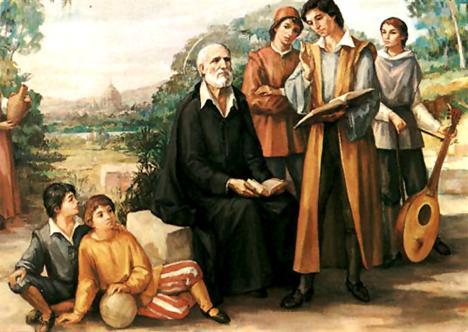
St-Philip-NeriBoys

St. Philip Neri was especially popular among the young men of Rome. (Source)

St. Philip was the spiritual father of many men in his own day. Palestrina, Animuccia, St. Camillus of Lellis, and others received forgiveness from him in the confessional. He was particularly kind to youth. Once, when the scholarly Baronius complained that the children with whom St. Philip was playing in the yard were too loud for his studies, St. Philip replied that he’d let them chop wood off his own back, if only they might not sin. The long-suffering Baronius accepted St. Philip’s paternal will. It was a salutary and exemplary mortification, and St. Philip knew that. It was also a lesson. St. Philip intended for his sons to live out spiritual fatherhood in the world. And they were to do it, following his own example, with intense joy.

When we contemplate the Fatherhood of God, we are struck dumb with wonder at the abyss of Being abiding in His fullness. God the Father is the immovable, the unshakeable, the indefinable One. It is from God the Father that we learn that fatherhood can only be cultivated upon presence…rootedness…constancy. And it must also blaze with the heat of love. The two qualities are mutually reinforcing. Put briefly, the warmest paternity will cool, harden, and falter if it is not sustained by stability.

St. Benedict understood this dynamic, and when he sought to compose a rule for his spiritual family, he knew that he had to incorporate it into his model. In the very first chapter of the Rule, we read of the different kinds of monks. The worst are those whom St. Benedict calls “Gyrovagues,” men who

…spend their whole lives tramping from province to province, staying as guests in different monasteries for three or four days at a time. Always on the move, with no stability, they indulge their own wills and succumb to the allurements of gluttony (Rule of St. Benedict I).

Instead, St. Benedict calls for his monks to pass their lives in one place, at one task—seeking God. Stability is so central to his vision that he doesn’t even bother writing a chapter about it. Instead, he assumes it as a necessary condition from the very beginning and lets it color his prescriptions from then on.

St. Philip was equally adamant about stability. The organization of the Oratory is a great testament to his idea of stability. Even in the early days, when he first sent some priests to San Giovanni dei Fiorentini, he required that they return to his chamber above San Girolamohis “cenacle,” if you willand continue with the exercises of the Oratory.  When the priests finally left both parishes and moved to Santa Maria in Vallicella, the Chiesa Nuova, St. Philip imagined that his religious family would never grow beyond its four walls. He was deeply reluctant to grant the foundation of an Oratory in Naplesthough it would furnish the Church with great saints such as the Blessed Giovanni Juvenal Ancina.

The basic grain of St. Philip’s idea has endured in those lands where the Oratory has flourished. Oratorians spend their whole priestly lives in one community. They can travel and work more freely than vowed religious, since they are truly secular priests, but their range of motion is restricted by the value of stability that St. Philip imposes on his sons. The quality of that stability differs from the asceticism which marked the experience of the early monks. As Newman puts it:

The Congregation is to be the home of the Oratorian. The Italians, I believe, have no word for homenor is it an idea which readily enters into the mind of a foreigner, at least not so readily as into the mind of an Englishman. It is remarkable then that the Oratorian Fathers should have gone out of their way to express the idea by the metaphorical word nido or nest, which is used by them almost technically. (Newman, qtd. by Robinson).

As Newman said elsewhere:

…the objective standard of assimilation is not simply the Rule or any abstract idea of an Oratory, but the definite local present body, hic et nunc, to which [the novice] comes to be assimilated (Newman, qtd. on the Toronto Oratory Vocations page).

The stability of the Oratory is enlivened with a certain warmth, a familial domesticity that is adequately captured in the Italian nido. The Oratorian has his “nest” in his cell, and beyond that, his house, and beyond that, the city where God has led him. None of these becomes his “nest” by matter of location, but by the network of sacramental relationships he enters there. He is begotten anew by the paternity of St. Philip, by his immediate superiors, and ultimately, by God. The same spirit prevails in the very best monastic houses, as any visitor to Silverstream Priory or the Monastero di San Benedetto in Monte or Stift Heiligenkreuz or Clear Creek Abbey or L’Abbaye Sainte-Madeleine du Barroux can attest. Dom Aelred Carlyle’s Caldey Island had just such a sensibility, as did Nashdom Abbey before its decline. The Oratory and the Benedictine Monastery keep alive the fire of God’s paternal love by their community life and stability in prayer.

II. The Son’s Obedient Song
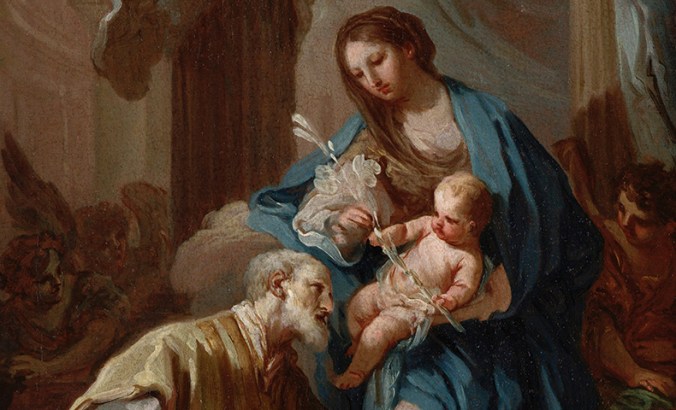
StPhilipNeriMadonna

The Madonna Appearing to Saint Philip Neri, Sebastian Conca. (Source)

Up to now, I have not addressed the peculiar irony in my approach. The model that St. Philip left for his sons is singular among all others in the Church in its total rejection of vowssuch as those that mark the Benedictine vocation. The constitutions of the Congregation are very clear. Even if all the members around the world should take vows and only one abstain, the true Oratory would rest with that lone dissenter, and not the majority. Instead, Newman tells us, “Love is his bond, he knows no other fetter.” St. Philip trusted that bond of charity to sustain the common life he envisioned for the Oratory.

St. Philip hoped that his sons, through mortification of the intellect and an easy, friendly concord, would persevere in the love that was their peculiar vocation. Just as voices unite in harmony for no better end than beauty, so might we describe the Oratorian ideal as a kind of “song”Rolle’s second experience of God. The liturgy for the Sixth Sunday in Easter illustrates this point admirably. The Introit (Vocem iucunditatis annuntiate), Psalm (Let all the earth cry out to God with joy), and Offertory (Benedicite gentes Dominum) all refer to song as the properly obedient response to God’s grace. The truth and beauty of that good song is attractive to souls made weary by the heavy dross of the world. St. Philip knew this fact well, and he employed some of the leading composers of the timePalestrina and Animucciato write music for the exercises of the Oratory.

Moreover, one could almost imagine that the first reading, which mentions the Apostle Philip, was really intended to tell us something about the life of the Joyful Saint:

Philip went down to the city…and proclaimed the Christ to them. With one accord, the crowds paid attention to what was said by Philip when they heard it and saw the signs he was doing…There was great joy in that city. (Acts 8: 5-8 NAB)

Similarly, the Epistle calls to mind St. Philip’s singular mystical life. We read, “Sanctify Christ as Lord in your hearts,” (1 Pet. 3: 15-18 NAB). And how are we, like St. Philip, to go about sanctifying Christ in our hearts? The Gospel tells us:

If you love me, you will keep my commandments. And I will ask the Father, and he will give you another Advocate to be with you always, the Spirit of truth, whom the world cannot accept, because it neither sees nor knows him. But you know him, because he remains with you, and will be in you. (John 14:15-17 NAB)

Christ is preeminently the man who responds with a song of obedience, and St. Philip follows his lead. And what do St. Philip and his sons sing in their common life? What but the praise of God? What but the Divine Word, the Logos, Christ made present in prayer and scripture and sacrament? Indeed, Eliot’s description of “every phrase/And sentence that is right” could apply just as well to the Oratorian life:

…where every word is at home,
Taking its place to support the others,
The word neither diffident nor ostentatious,
An easy commerce of the old and the new,
The common word exact without vulgarity,
The formal word precise but not pedantic,
The complete consort dancing together
(Little Gidding V)

The life of the Benedictine monk is not so seemingly free. He has one work, the liturgy, the Opus Dei. This one task is the first and final way that the Benedictine fulfills his vow of obedience to Christ. As Chapter 5 of the Holy Rule has it: “The first degree of humility is obedience without delay. This is the virtue of those who hold nothing dearer to them than Christ” (Rule of St. Benedict V). The eleven degrees that follow build upon this cornerstone, marked as it is by the love of Christ. It is a love that conforms the monk to the obedience of Christ crucified. The wicked Sarabaites that St. Benedict describes in Chapter 1 are chiefly marked by their unwillingness to obey:

They live in twos or threes, or even singly, without a shepherd, in their own sheepfolds and not in the Lord’s. Their law is the desire for self-gratification: whatever enters their mind or appeals to them, that they call holy; what they dislike, they regard as unlawful. (Rule of St. Benedict I).

St. Philip knew how to obey. When he was under suspicion of heresy, he immediately ceased his labors in submission to the Papal investigators until he knew the outcome. He only resisted when it came to the cardinalate, which he always resolutely refused. Once, upon receiving the Red Hat, he made jokes about the honor and laughed it off as if it were nothingin the very presence of the Pope! Exasperated, the Holy Father decided to grant St. Philip’s wish, and did not insist on the appointment.

But he also obeyed the voice of God through other figures, such as when he formally received his vocation. Hearing the many stories of St. Francis Xavier in the East, St. Philip determined to set out for India. But he decided to wait and test the calling with the advice of another man he trusted.

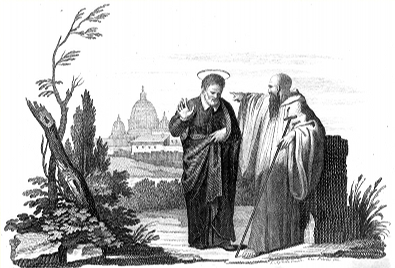
In Rome, there is a Cistercian monastery called the Tre Fontane, which takes its name from the legend that when St. Paul was martyred, his head bounced three times. It is said that three fountains miraculously sprang up from the earth where his head fell. Later, a house of religion was founded there. It was to this monastery that St. Philip went to consult a well-respected monk known for his spiritual insights. The monk listened to St. Philip’s situation, and told him to return later. When St. Philip came back to the Tre Fontane, he had his answer“Rome will be your indies.” He never again desired to leave the Holy City. Cardinal Newman tells us that the monk did this under the spiritual guidance of St. John. How appropriate that the Apostle so intimately tied to the Second Person of the Trinity should teach St. Philip to imitate Christ’s obedient humility!

III. The Sweetness of the Spirit’s Conversatio Morum
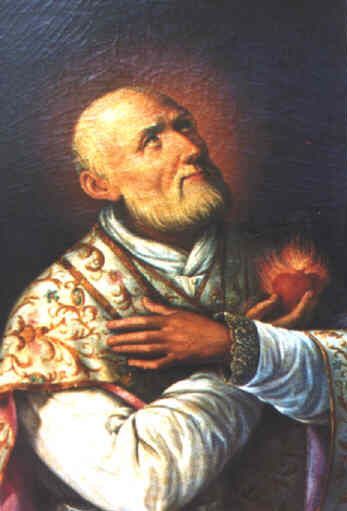
StPhilipNeriFlamingHeart

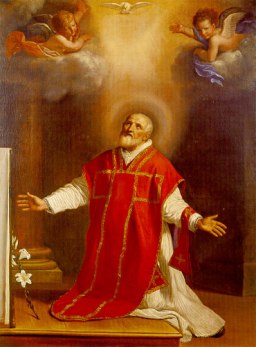
The Holy Spirit made the heart of St. Philip sacramental while on this earthly journey. (Source)

Few saints have such a manifest intimacy with the Holy Spirit as St. Philip Neri. Biographers and commentators throughout the centuries have always noted the peculiar affinity between St. Philip and the Third Person of the Holy Trinity.

When St. Philip first came to Rome, he spent most of his nights praying in the catacombs. He drew surpassing sweetness from this salutary solitude. For him, Rome was not just a (recently sacked) city of decadent palaces, picturesque ruins, and opulent vices. Rome was a landscape marked by the work of the Holy Spirit through human history. The catacombs reminded St. Philip of the Church of the martyrs.

It was on one of these vigils that St. Philip experienced a visitation by the Holy Spirit. He came to the catacomb of St. Sebastian on the night before Pentecost. While praying, the Holy Spirit descended upon him. Fr. Philip G. Bochanski of the Oratory describes the scene well:

As the night passed, St Philip was suddenly filled with great joy, and had a vision of the Holy Spirit, who appeared to him as a ball of fire. This fire entered into St Philip’s mouth, and descended to his heart, causing it to expand to twice its normal size, and breaking two of his ribs in the process.  He said that it filled his whole body with such joy and consolation that he finally had to throw himself on the ground and cry out, “No more, Lord!  No more!” (Source).

Throughout his life, St. Philip would report an unremitting heat throughout all of his body, though always most intense around his heart. Even in the dead of winter, he’d be so warm as to freely unbutton his collar when everyone else was shivering. Pressing someone’s head to his breast, letting him hear his heartbeat and feel the miraculous warmth, was enough to convert even the most hardened and impenitent sinners. We can say with no exaggeration that the Holy Spirit made St. Philip a living sacrament. He became a fountain issuing forth graces. He bore all of the sweet fruits of the Holy Spirit. As Fr. Bochanski puts it, “St Philip was convinced and constantly aware of the presence and action of the Holy Spirit in him and through him…He was sure that he had received the gifts of the Holy Spirit, and this assurance set him free to bear the Spirit’s fruits.”

St. Philip’s special relationship with the Holy Spirit drew him into an almost uncontrollable ardor of love for the Eucharist. He was a great mystic of the Blessed Sacrament. Under St. Philip’s direction, the Roman Oratory popularized the Forty Hours Devotion of Eucharistic Adoration, an important precursor for later efforts at Perpetual Adoration. In spite of his wise suspicion of visions and miracles, he was granted innumerable ecstasies. These would usually come in some connection with the Eucharist. St. Philip had jokes read to him in the sacristy as he vested, as he had a very realistic fear of entering a sweet trance of joy before the Mass even began.

In his old age, St. Philip was allowed to give free reign to these Eucharistic ecstasies. By special permission of the Pope, he would say his Mass only in a private chapel on the top floor of the Vallicella. At the consecration, he would kneel down before the altar. The servers would close the windows, shut the door, and place a sign on the handle which read, “Silence! The Father is saying Mass.” Then, in darkness and silence, St. Philip would commune with the Eucharistic God for upwards of two hours. When he was done, the servers would ring a bell, the sign on the door would be removed, and he would continue the Mass as if nothing had happened.

In all of these phenomena, we may be tempted to draw a contrast with the staid, rhythmic, simple spirituality of St. Benedict’s Rule. Not sofor we must examine why St. Philip was given the singular graces that marked his life in the Holy Spirit.

The third vow that St. Benedict demands of his sons is Conversatio Morum, the conversion of manners (Rule of St. Benedict LVIII). The monk enters the monastery that he might “seeketh God,” and seek Him fully (Rule of St. Benedict LVIII). Like all Christians, he is after deification. But unlike most of us, he is called to theosis by shunning the distractions of the World. He can only do this by entering into the sacrifice of the Eucharistic Christ, whom he adores in the liturgy that marks the hours of every day. The Benedictine vocation is, at its heart, life made explicitly Eucharistic.

Dom Mark Daniel Kirby of Silverstream, building upon the work of the Blessed Abbot Columba Marmion and Mother Mectilde de Bar, has put the point admirably. Among many other similar passages, we find in a poem from 2011:

The Eucharistic Humility of God
is inseparable from His Eucharistic Silence.
This Saint Benedict understood,
for in his Rule, the silent are humble,
and the humble silent.
This our Mother Mectilde understood
for she wanted her Benedictine adorers to bury themselves
in the silence of the hidden God,
the ineffably humble God
in the Most Holy Sacrament of the Altar. 
(Source)

In the Eucharist, we find the consummation of all God’s sweetness. “O taste, and see that the Lord is sweet: blessed is the man that hopeth in him” (Psalm 33:9 DRA). It is the grand work of the Spirit, the crown of the sacraments, the dawn of the new and everlasting life. Just as Richard Rolle passed into “the most delectable sweetness of the Godhead,” so too does the monk return each day to the Eucharist to drink of the Spirit’s epicletic sweetness (Rolle I.5).

And St. Philip, with his Eucharistic ecstasies and his intimacy with the Spirit, knew that sweetness better than we can possibly imagine. The sweetness of the Holy Spirit transformed him into an instrument of grace, a human sacrament whose own manners were deeply converted and who aided many along the same journey. It is little wonder that Oratories and Benedictine monasteries remain centers of reverent and beautiful celebration of the Holy Sacrifice of the Mass.

Conclusion
Ritratto di San Filippo-b

Portrait of St. Philip Neri. (Source)
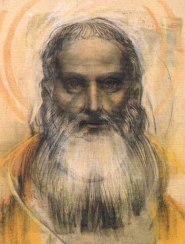
St.-Benedict-81

Portrait of St. Benedict. (Source)

Many writers have found in St. Philip Neri the likeness of other saints, including those predecessors whom he admired, the contemporaries whom he loved, and the innumerable great saints who followed in the generations since he went on to immortal glory.

Yet is any resemblance so striking, and so Trinitarian, as that between the Father of the Oratory and the Father of Monks? In both, we find the very image of the Father, the Son, and the Holy Spirit. In both, we can see the marks of stability, obedience, and conversion of manners. And in both, we detect the surpassing heat, song, and sweetness which Richard Rolle describes as indicative of a true encounter with God.

By their prayers, may we someday share that eternal encounter.
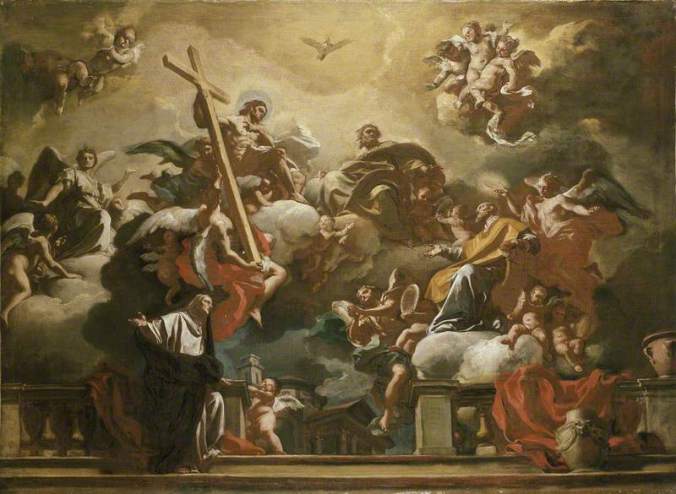
Solimena, Francesco, 1657-1747; The Holy Trinity with St Philip Neri in Glory

The Holy Trinity with St. Philip Neri in Glory, Francesco Solimena. The figure at left is probably the Benedictine Oblate, St. Francesca Romana. The painting, originally intended for the Naples Oratory, now hangs in the Ashmolean Museum of Art and Archaeology at Oxford (Source).
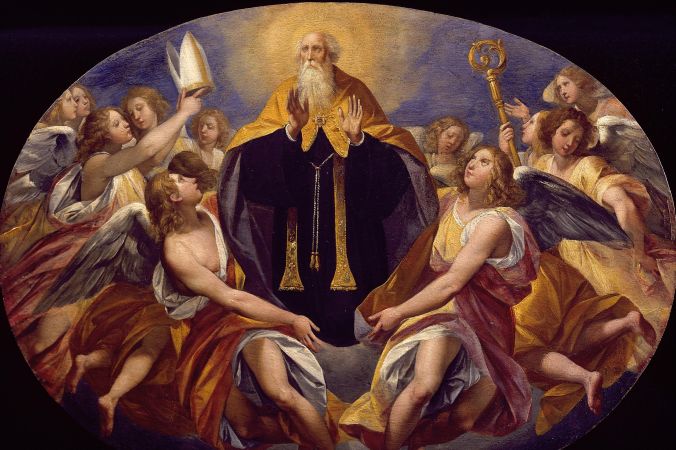
Saint-Benedict-in-Glory-1500-58b5a7553df78cdcd88ab39f

St. Benedict in Glory, c. 1500. Artist unknown. (Source)
A Poem for Ascension Day

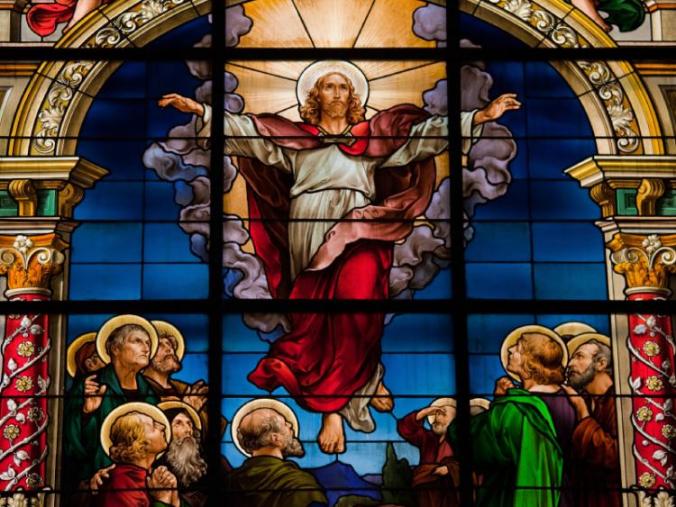
AscensionWindow

A stained glass window depicting the Ascension of the Lord. (Source).

Salute the last, and everlasting day,

Joy at the uprising of this Sun, and Son,

Ye whose true tears, or tribulation

Have purely wash’d, or burnt your drossy clay.

Behold, the Highest, parting hence away,

Lightens the dark clouds, which He treads upon;

Nor doth he by ascending show alone,

But first He, and He first enters the way.

O strong Ram, which hast batter’d heaven for me!

Mild lamb, which with Thy Blood hast mark’d the path!

Bright Torch, which shinest, that I the way may see!

O, with Thy own Blood quench Thy own just wrath;

And if Thy Holy Spirit my Muse did raise,

Deign at my hands this crown of prayer and praise.

(John Donne)

Four Luminous Days

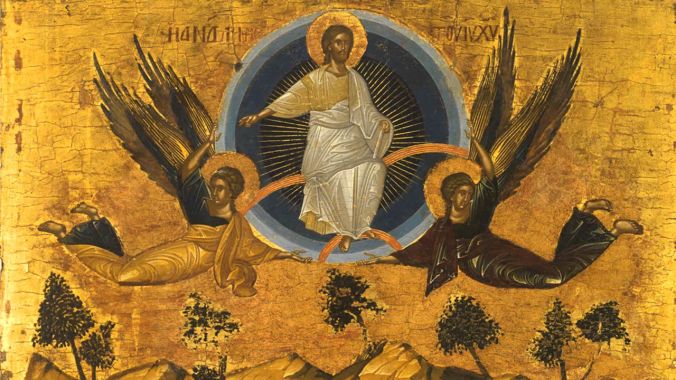
ascension-header

From an Icon of the Ascension. (Source)
This week, we are about to enter a truly remarkable liturgical sequence.

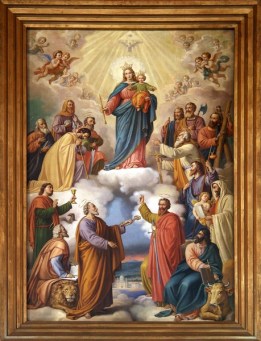
MariaAuxiliadoracuadro

Our Lady, Help of Christians. (Source)
Wednesday is Our Lady, Help of Christians, patroness of my parish here in South Carolina.

Thursday is the Ascension (sadly moved to Sunday in my province of Atlanta).

Friday is St. Philip Neri, and then on Saturday comes Our Lady of the Cenacle.

We could extend our reckoning to Sunday, but for now, I think it is appropriate for us to hesitate on the threshold of the Mystical Sabbath. Let us instead examine only these four days and their import.

We begin and end the progression with Mary. First, we see her in her relation to humanity. She is the help of Christians. Then, we see her in relation to God. She receives the Holy Spirit. Taking both feasts together, we see Our Lady participating in God-humanity; she becomes the perfect emblem of Divine Wisdom.

StPhilipHS

St. Philip Neri, who received the Holy Spirit in the catacombs. (Source)
Studying Sophiology has made me appreciate Our Lady of the Cenacle even more. There is a deep connection, I think, between the manifestation of Divine Wisdom in the creation of the Cosmos, at the Baptism of Christ, and at the descent of the Spirit upon Our Lady at Pentecost. They are mutually illuminating events. I wonder if we can find that connection at the level of the propers for each liturgy, a project I may try to engage in before Saturday.

And how appropriate that St. Philip, who experienced his own Pentecost in the catacombs of St. Sebastian, should go forth as a herald for Our Lady of the Cenacle! It is a kind of liturgical proof of the hierarchical principle, that we are led by lower things to higher things. St. Philip received the Holy Spirit into his heart as a ball of fire in the catacombs under the city of Rome, once a place of persecution, the mythical “Babylon” of Revelation. He guides us to Our Lady as she waits and prays in the Cenacle, the Upper Room in Jerusalem where the sacraments of the Eucharist and Orders were instituted and where the Holy Spirit descended upon the Church in tongues of fire on Pentecost. What a picture of the historical Church in pilgrimage! From the darkness of the Roman catacombs to the heights of the upper room in Zion. We could read an eschatology out of these mystical days.

RussianPentecostIcon

Russian Icon of Pentecost, 18th century. The Slavs are unique among the Eastern Orthodox in placing Our Lady in the scene. (Source).


Nevertheless, this week’s procession is easy to overlook, since its central diamond, the Ascension, has been misplaced by so many bishops. Celebrating the feast on Sunday robs it of its truly Eucharistic meaning, for the Ascension’s traditional place on a Thursday meant that it could only be read through the texts of Maundy Thursday. Ascension Day is to Maundy Thursday as Pentecost is to Easter, the initiator of a new liturgical season and a reminder of the Mystical Priesthood of Christ. All of this is admirably explained by Dom Mark Daniel Kirby OSB in his podcasted homilies and in his blog, Vultus Christi.

The Eucharistic and Priestly meaning of the Ascension matters for the rest of the four-day sequence insofar as the Eucharist represents, sustains, and completes every instantiation of Sophianic being. The Sophianic character of the four days can only be discerned in the light of Christ’s face as He ascends into his cosmic priesthood on Thursday. This would be true even if St. Philip were not there to complete the set. This is, after all, a fairly uniqueE situation. Ever spry, St. Philip moves around the sacred calendar with the bustling rhythms of profane time. But in this auspicious year, so full of historical resonances and providential patterns, let us rejoice in the days that the Lord has made (Psalm 118).


Elsewhere: More on Julien Green’s Life, Death, and Love of God

KlagenfurtChurch

St. Egid Church, Klagenfurt, Austria. (Source)
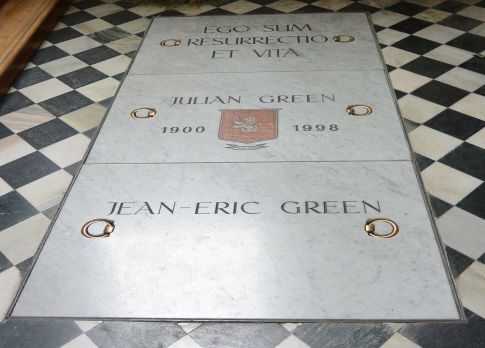
Pater Edmund Waldstein O.Cist. was kind enough to mention my recent post about Julien Green on his superlative blog, Sancrucensis. But what’s more, he built off of my essay in a really wonderful way. In his post, you can find more information on Green (particularly his later years, death, and entombment) as well as a wonderful homily he wrote incorporating elements of Green’s life and spirituality. I highly recommend a view.

JulianGreenKlagenfurt

The tomb of Julian Green and his adopted son, Jean-Eric Green. (Source)
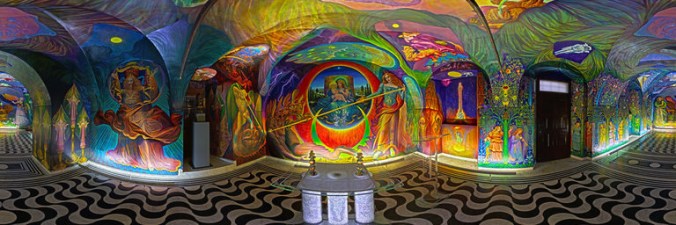
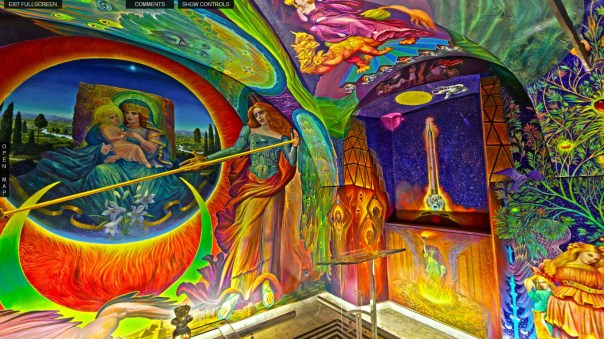
The only thing I’ll add is only tangentially related to Green. St. Egid Church, where Green is interred, is also host to one of the most remarkable chapels in existence. The Austrian artist Ernst Fuchs, a Catholic whose work draws upon the best of the Western visionary, symbolist, and esoteric tradition, was commissioned to create a chapel in the crypt. The result is…something. Although I’m a fan of Fuchs generally, I’m not convinced that his was the best approach to sacramental space. And…a clear altar?

KlagenfurtApocalypseChapel

The Apocalypse Chapel, by Ernst Fuchs. St. Egid Church, Klagenfurt, Austria. (Source)
It’s a bit too psychedelic for a temple of God, I think. But hey, I’d rather attempt to worship in this overabundance of color and image than, say, a vaguely imposing and tomb-like structure that leaves its visitors depressed. I must emphasize that Fuchs’s art really can be mystical, even sophianic. Perhaps I’ll write a post on it some time soon.


apocalypse-chapel

Those really are a rocket and the Statue of Liberty. Really. (Source).

And perhaps I’ll someday have the chance to visit St. Egid Church, make the pilgrimage to pray for Green at his tomb, and see the chapel myself.

The Fifteen Most Important Films I Have Watched at UVA

In my time at the University of Virginia, I’m grateful to have received an unofficial aesthetic education parallel to (and sometimes part of) what I was learning in class. As part of a series of somewhat nostalgic posts, I’d like to revisit some of these and perhaps leave you with a few recommendations.

Some of this will be review. A great deal will be personal narrative. “Important” here is not an absolute quality, but rather a relative one. These films have been the most important to me over my four years. Moreover, there will be occasional spoilersthough, as with No. 5 and No. 4 on my list, I don’t spoil very much.

Keeping those disclaimers in mind, let’s begin.

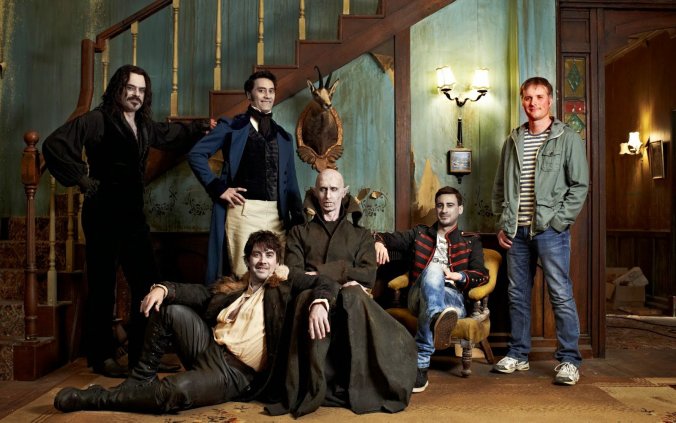
15. What We Do in the Shadows

WhatWeDointheShadows

I watched this New Zealand horror comedy with a friend (whom I will call here and throughout by the name “Sherman Pine”). And I’m glad I did. What We Do in the Shadows is one of the best depictions of male friendship I have ever seen. Not only is the film by turns hilarious and macabre, it also manages to evoke the unique social pressures facing (post)modern man. It deals with issues of difference, acceptance, competition, and more.

And for anyone with a taste for blood – or at the very least, a good vampire story – the number of playfully subverted classic genre tropes in the film will certainly please.

WWDITS was also my introduction to Taika Waititi, whom some of you may recognize as the director of the upcoming Thor: Ragnarok.

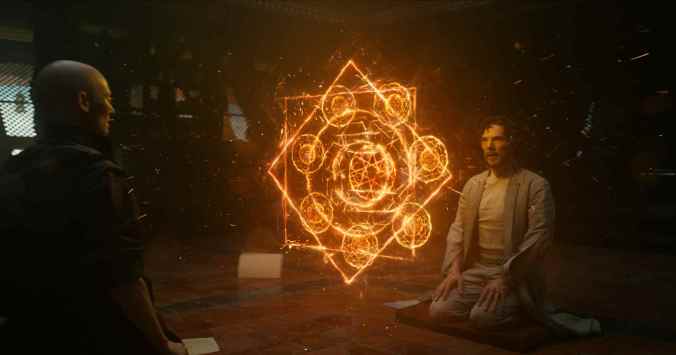
14. Doctor Strange

null

Before I came to UVA, I wasn’t a fan of the Marvel universe. While I wasn’t exactly a DC partisan, I never paid much attention to the Avengers. I disliked the only Iron Man movie I had seen, and I had never bothered to watch any of the Thor or Captain America films.

But then came Guardians of the Galaxy, The Avengers: Age of Ultron, and Captain America: Civil War. Those three films and the conversations with friends that they engendered drastically changed my perspective on Marvel.

None of those, however, reached the artistic or philosophical heights of Doctor Strange. The beautifully kaleidoscopic special effects never drown out the excellent performances by Benedict Cumberbatch, Tilda Swinton, Mads Mikkelsen, and Chiwetel Ejiofor. And the plot contains a number of religious themes. It’s one of the few superhero movies I’ve seen that embraces a quasi-Christian worldview (the climax involves a kind of harrowing of hell).

In short, I guess I can now say that I’m a fan of the Marvel universe. Doctor Strange is just the best reason why.

13. Silence

Screen Shot 2017-03-23 at 1.35.41 PM

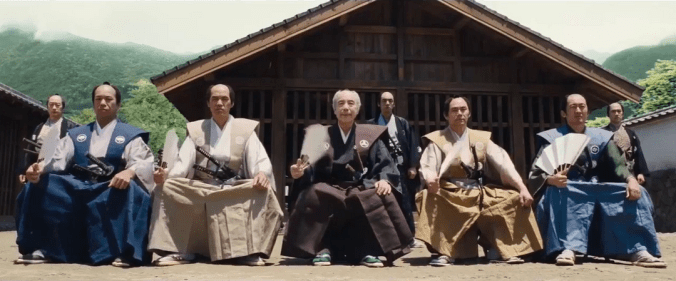
Wrenching, problematic, and beautiful, Silence is the only Martin Scorsese film on this list. I saw it with friends from one of my oratorical societies. We all went in with different perspectives, and came out with different reactions. Mostly, I just felt numb. I couldn’t find any words at all, but like Job, felt it necessary to “lay mine hand upon my mouth” in awe (Job 40:4 KJV).

I could probably write at length about the various theological issues, cultural questions, and cinematic gems that the film poses. I won’t. I’ll merely say that, while I found it emotionally crushing, I appreciate that art doesn’t abide by the rules we try to set it. Good Christian art – even Sophianic art – never loses sight of the essential brokenness of our fallen world. If anything, perhaps the great take-away from Silence is something like the advice I was once given by a very holy priest: “Never despair of the mercy of God.”

I’ll add briefly that, as someone who wants to focus on early modern Catholicism, I found the film a helpful occasion to raise awareness about the history of Christian persecution in Japan. The reconstructed world of 17th century Japan is sumptuously simple. Every aesthetic note is perfectly put. It will almost certainly be remembered as Scorsese’s masterpiece.

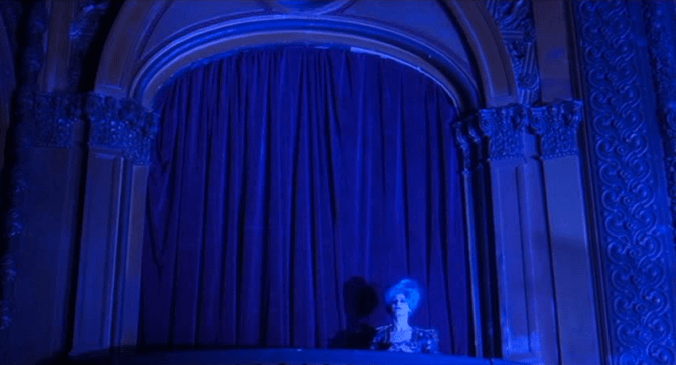
12. Mulholland Drive

Screen Shot 2017-03-23 at 1.32.01 PM

We move from Silence to “Silencio.”

Last Fall, I decided to watch Twin Peaks. That process entailed a general inquiry into the works of David Lynch, whom I had long admired. I told Sherman Pine, who shares my appreciation of Lynch, that I had yet to see the director’s famous neo-noir Mulholland Drive, and he was kind enough to watch it with me.

I still don’t understand this movie. I won’t pretend to. But boy, is it a ride.

I’ll add that Lynch really smartly contrasts different musical styles, which mirrors the doubling in the plot (but I won’t spoil those details). I know of no other director who is so committed to staged performance as a portrayal of themes. Particularly as they relate to the underlying tensions of sex and gender present in much of his work.

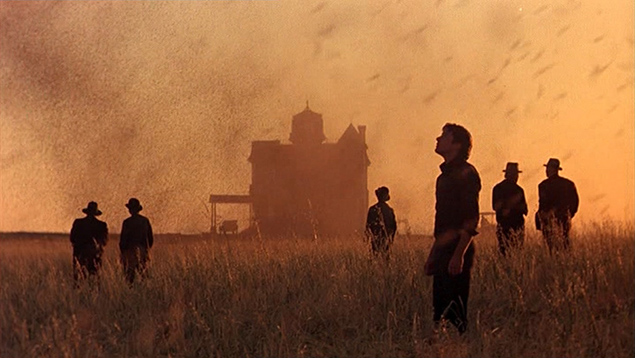
11. Days of Heaven

DaysofHeaven

My first Terrence Malick movie, but not the only one on this list. Watching Days of Heaven was like stepping into an Edward Hopper or Andrew Wyeth painting. Like a few other films – say, August: Osage County or NebraskaDays of Heaven stands as one of the quietly towering cinematic monuments of Midwestern life.

I also happened to watch the film with a friend (the aforementioned Sherman Pine) wile I was enrolled in an Anthropology class called “Language and Cinema,” which meant that I was particularly attuned to the way Malick crafts his story through sound. No other film that I know of uses such a wide range of realistic sounds so artfully. You can’t hear all the dialogue, and what you can hear, you can’t always understand. The voice-over narration is spoken by a child in the working-class accent of 1916 Chicago.

Of course, being a Malick film, the visuals are also gorgeous. A swarm of locusts is an inherently mythic phenomenon, but I think that only Malick could make them as beautiful as the sunlight they block and the fields they devour.

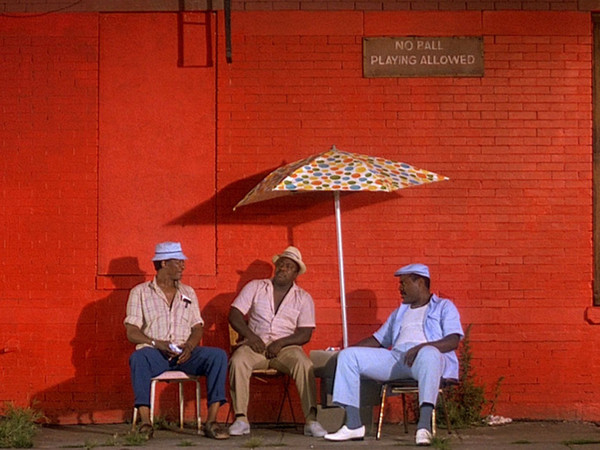
10. Do the Right Thing

DoTheRightThing

Because I was in that “Language and Cinema” class, I had the opportunity to watch several films I had never seen before. A few worth mentioning include Zoot Suit, the 1939 edition of Stagecoach, and Smoke Signals. Of all of the films we watched, one that really stood out to me as an exceptional piece of art was Spike Lee’s famous 1989 movie, Do the Right Thing.

The script offers a remarkable variety of linguistic turns that make it a rich field of social analysis. The film also impressed me as a bitingly relevant commentary on racism and policing. As someone with no prior awareness of the issues surrounding police brutality in 1980’s New York City, the movie made me want to learn more about a dark and overlooked chapter of our history. Given the recent spate of police brutality incidents over the last few years, it seems to me that more people should return to this film, a movie that carefully treads the line between the two social values on Radio Raheem’s fists: love and hate.

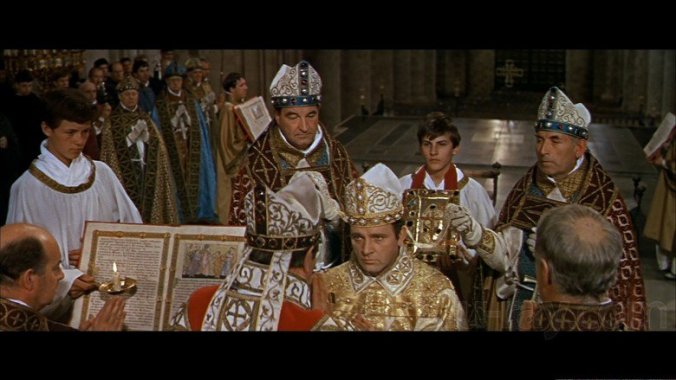
9. Becket

Becket

Becket is not the greatest Catholic film ever made, but it comes close. Gorgeously fabricated costumes, historically-conscious sets, a richly Romanesque liturgical sensibility, copious use of Gregorian Chant, and an excommunication scene that thrills the cockles of every cold Traditionalist heartwhat’s there not to love?

Beyond these largely aesthetic factors, Becket has two unique strengths. First, the movie lacks any of the problematic theology or complicated nuances that has marked more artistically impressive Catholic films (such as Silence and Calvary). Of course, there’s nothing wrong with art engaging in these questions, but occasionally a more affirming film can be helpful. Becket, like A Man for All Seasons, manages to unite faithfulness to the Church’s teachings with genuine artistry. The titular bishop often defends “the Honor of God” against a rapacious monarch. And that brings us to the movie’s second great strength: its depiction of a friendship gone awry. This is a theme that isn’t treated as often as it should be in movies.

Of course, I may be mistaking my own reading of the film and its objective strengths. I first saw Becket when I was in a similar situation. A friend had quickly and completely become an enemy, and I could relate to St. Thomas’s exasperated struggle against a corrupt king.

And on top of that, it’s about St. Thomas Becket, who is one of the coolest British saints.

8. The Witch

TheWitch1

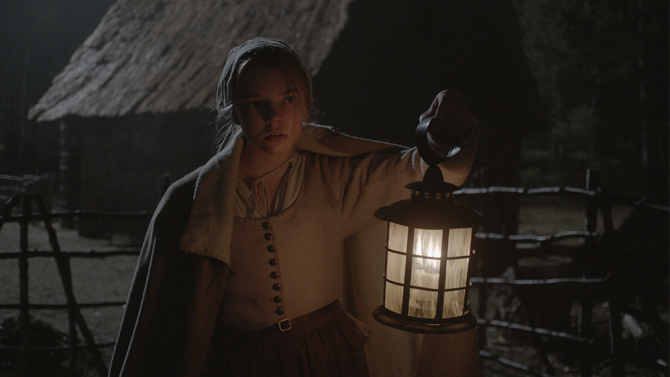
If you know me personally, you know that I adore The Witch (aka The VVitch). It may well be one of the finest horror movies ever made. It features all the tropes of early modern witch lore, a soundtrack that evokes the terrors of the Puritan frontier, and dialogue in 17th century dialect (my jam). Its understated visual style allows the actors’ performances to shine through. And the goat! The goat! Just look at it!

This film rekindled my interest in the tradition of horror in New England, which I’ve blogged about before in relation to Lovecraft. It was also the first horror movie I had ever seen in a cinema. The Witch also established A24 in my mind as one of the leaders of the new horror, a genre trend that I hope it continues with the upcoming It Comes at Night.

I consider The Witch to be the greatest Protestant film ever made. Yes, the Satanic Temple really liked it. Yes, A24 consciously hyped the film’s satanic themes as part of its publicity efforts. Fine. But the movie’s horror works by letting us into the world of Puritan New England, a world where the devil is real, witches kill babies, and the livestock aren’t always what they seem. And we are meant to sympathize with these people. They’re not the dupes of McCarthyesque hysteria. They’re the victims of supernatural evil.

I also read The Witch as a cinematic meditation on original sin in its Calvinist interpretation. Everything in the movie happens because of the father’s pride. He’s unwilling to repent and submit to the colonial community, and as a result, the whole family is expelled into the wilderness. The subsequent deterioration and damnation mirrors our own condition under Adam.

Also, if you like Goya’s Black Paintings, you’ll really like The Witch.

7. Herz aus Glas

HerzausGlas

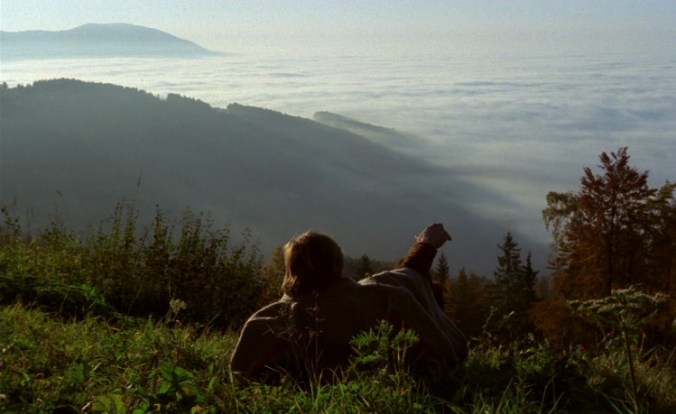
I saw Herz aus Glas (Heart of Glass) while on a Nietzsche kick in my second year. It messed with my head and made me want to read obscure Continental writers. I’ve always seen it as somehow quintessentially German. At the very least, Herz aus Glas introduced me to the remarkable oeuvre of Werner Herzog, who is my favorite European nihilist director. Not quite as grim as Béla Tarr, not quite as operatically depraved as Lars von Trier.
The film itself tells the story of a glass-producing village in Bavaria that descends into madness after the death of its chief glassblower. A highland prophet delivers cryptic messages throughout. The conclusion comes out of nowhere. At the end of the day, it’s probably a commentary on the German experience of capitalism and fascism, but who knows? Don’t question it.

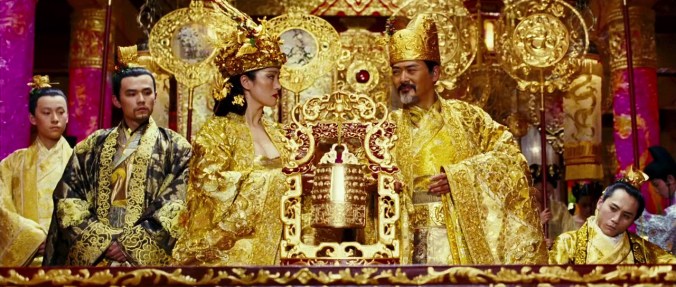
6. Curse of the Golden Flower

CurseoftheGoldenFlower1

I first saw Curse of the Golden Flower with fourth-year friends when I was a lowly first-year. For me, it will always be a symbol of the similarly golden days between Spring finals and graduation.

The film struck me then as one of the most visually striking movies I had ever seen. The highly stylized recreation of Tang Dynasty China probably speaks to that part of me that also takes a guilty pleasure in the orientalist paintings of Gérôme and Delacroix. Each shot is saturated with a carefully chosen array of colors. The costumes and set design work together to fashion a stunning aesthetic experience. Think Beijing Olympics Opening Ceremony, but with more swords and cloth-of-gold.

Everyone to whom I have showed it since has agreed with my own assessment. The action thrills, and all the actors put in excellent performances. I’d also highly recommend Curse of the Golden Flower to fans of Game of Thrones. The palace intrigue that makes up the bulk of the plot resonates with much of what goes on in Westeros.

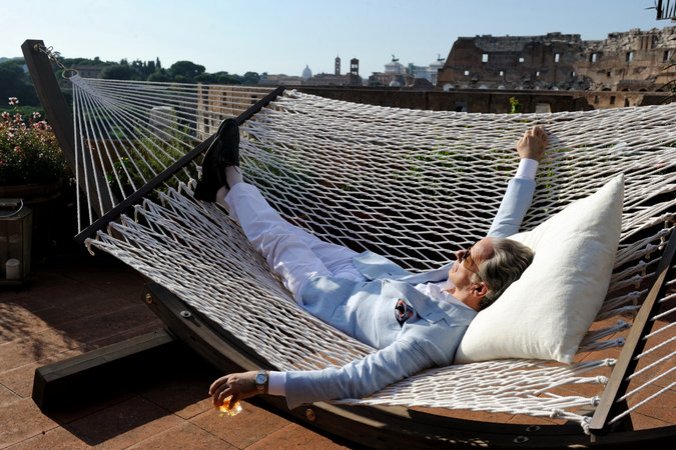
5. The Great Beauty

TheGreatBeautyhammock

When I started composing this list, The Great Beauty was down several places. But the longer I’ve thought about it, the higher I’ve ranked this film by Paolo Sorrentino. Readers of this blog will know that I kinda have a thing for his recent HBO limited series, The Young Pope. That show prompted me to look at Sorrentino’s cinematic work. The Great Beauty was the first of his movies that I watched. I’ve had the chance to watch it twice, and I may go back for round three in the next few weeks.

The film depicts the life of Jep Gambardella, a fictional Italian author who moves through the boozy and hedonistic world of the Roman intelligentsia. We see his interactions with other writers, strippers, a floundering performance artist, the wreck of the Costa Concordia, and more. He searches for the titular “grande bellezza,” only to find it after encountering love, suffering, and simplicity.

There isn’t much plot, but there is a whole lot of character development. Ensconced in a party lifestyle, Jep can’t produce any more books; he feels stuck. When he receives word that his first love has died, he goes through a period of intense introspection. As he looks back upon his life, he realizes that he’s lost any meaningful sense of joy. He’s caught in a malaise of memory. Only the wise words of a Mother Theresa-like nun whom everyone refers to as “the Saint” unlocks his situation.

She asks, “Do you know why I only eat roots?” Jep replies that he doesn’t know. She turns back, and without even a smile, says to him, “Because roots are important.” The terse, spiritual one-liners of The Great Beauty are typical Sorrentino fare. Similar lines appear throughout The Young Pope.

I first saw the film in February. I’ve been ruminating on it ever since. It has stayed with me and fermented in my soul like few other films. I can’t help but relate to the protagonistand not just because we share a similar sleep cycle. Jep Gambardella, played masterfully by Tony Servillo, strikes me as a character who could relate to the strange feelings of nostalgia and loss that I’ve had in the Spring of my fourth year. So much so, that along with the next two films, I consider it one of the triad of movies that has defined my final year at the University.

Also, the music in this film is totally gorgeous, and has given me a renewed appreciation of the Holy Minimalists. The soundtrack features both of the songs I described in a recent post on the Light of Tabor and Lent.

So go see it, because it really is too great a beauty to pass up.

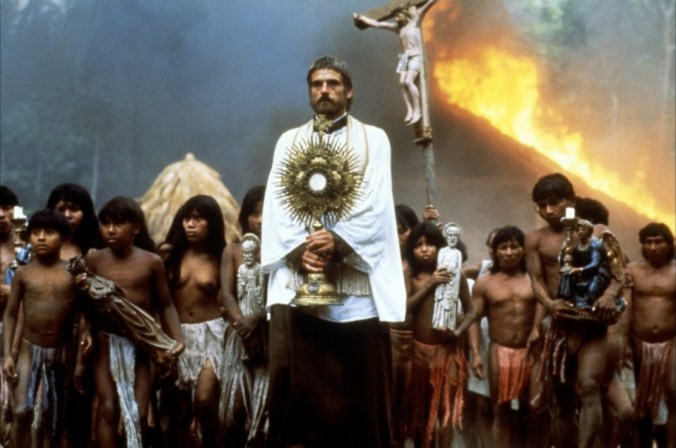
4. The Mission

TheMission

Although I had heard of The Mission years ago, I only became really determined to watch it as the result of a class I took last fall, “Reformation Europe.” I’m glad I did. It also had a profound impact on me. I don’t think I know of a Catholic film that more perfectly depicts the difficult realities of balancing missionary work and the demands of Christian peace. The tension between the Jesuits played by Robert de Niro and Jeremy Irons is only undone through the reconciliation implicit in the climactic scene. It is the Eucharist, and the Eucharist alone, which can effect true peace – especially in the face of martyrdom.

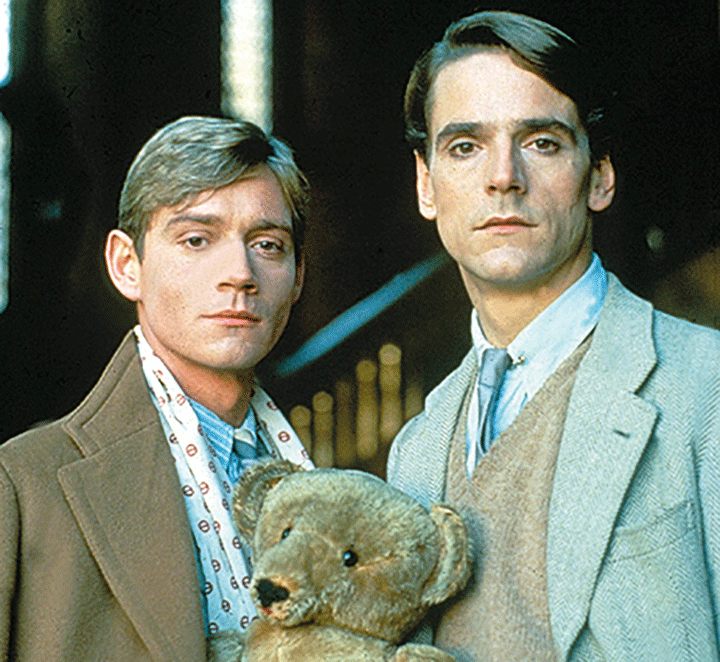
A few ancillary personal notes. First, as an aspiring early modernist, I found that the film disposed me to take a much deeper interest in colonial South America. It also made me take a much more serious look into Christian pacifism. The best art should do that. It captures the imagination and lead us on from the beautiful to the true or the good. Secondly, “Gabriel’s Oboe” is also, for my money, the most uplifting music from any of the films I have listed in this post. Finally, it confirmed Jeremy Irons in my mind as the Most Catholic Non-Catholic currently acting in Hollywood (see Brideshead Revisited, The Borgias).

3. The Tree of Life

TheTreeofLife

For years, friends told me that I had to watch The Tree of Life. That it was an incredible piece of art. That it could never be adequately described. That it might just induce a religious experience.

Having watched it recently, I concur. The film is too vast to try and capture in any depth here. I’ll simply say that it is the most sophianic piece of cinema I have ever seen, and that if I have any time in the future, I may try to analyze it from a sophiological perspective. But not without one more viewing.

2. Into Great Silence

IntoGreatSilence.jpg

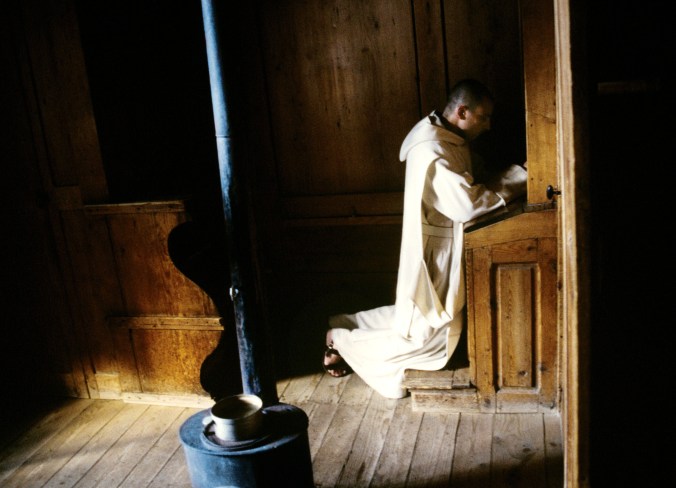
For a while, I made it a practice to watch Into Great Silence at least once per semester. I believe I first saw the film in the Fall of my First Year, and in that sense, it was my first real introduction to monastic spirituality. The simplicity and manifest holiness of the Carthusians in the movie captured my imagination. Their silence spoke to me.

Nothing happens. Insofar as there is a narrativeand I must emphasize, there really isn’t oneit’s the first year in the monastery of a newly-professed novice. But we don’t focus on him. Instead, we watch many of the monks as they go about life. We are brought into the rhythms of their own silence, the particular ways they fill it with prayer and work. When the monks do speak, they often drop deep little lines. The only interview in the documentary is conducted with an ancient, blind monk. At one point, he says,

The past, the present, these are human. In God there is no past. Solely the present prevails. And when God sees us, He always sees our entire life. And because He is an infinitely good being, He eternally seeks our well-being. Therefore there is no cause for worry in any of the things which happen to us.

These words are good theology, spoken by a saint, given for our practical sanctification. Or consider an even better, briefer quip spoken by a monk at recreation:

The symbols are not to be questionedwe are.

Words to live by.

If you are Catholic, the hauntingly beautiful scene that depicts the Carthusian night office will make you want to go to adoration at midnight. If you are not religious, the film will make you take the ascetic life more seriously. And if you are pondering the Catholic life, I can’t think of a better cinematic introduction to the Church’s spirituality.

Well, I suppose there’s Bishop Barron’s Catholicism series. But that’s a show, not a film.

  1. Baraka

Baraka

Without a doubt, this film has defined my time at UVA. I discovered Baraka by accident, and it stirred something in me that has never quite settled.

One part nature documentary, one part travelogue, one part blistering social criticism, Baraka can be summed up in one word: transcendent. Everything in the film points towards what is beyond it, towards what it dare not express in words. There is no dialogue. The central theme is that ritual and nature connect mankind with the mystery of his existence, and it proceeds to show how the way we break, deform, and reconstruct ritual in modernity has led to untold suffering. The film suggests that a return to the ancient wisdom of religion can restore the meaning we have lost in the 20th century.

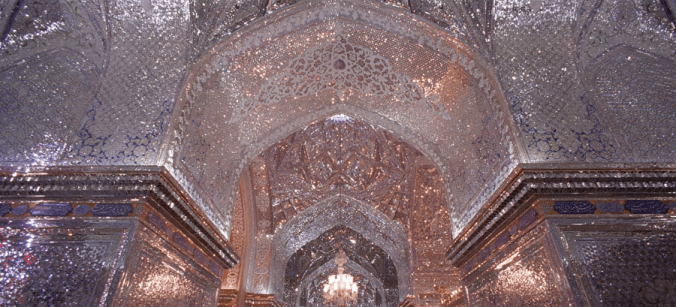
Whether you buy into that traditionalist interpretationor its postmodernist, ecofeminist, anti-colonialist, or anti-capitalist variantsthe film will stun you. Director Ron Fricke cut his teeth as director of photography for Koyaanisqatsi (1982) and director of Chronos (1985), the film’s spiritual antecedents. He would later go on to direct a sequel to Baraka, another beautiful film called Samsara (the featured image at the top of this article is a still from that movie). While all are worth seeing, Baraka is the best of the lot. It has the most coherent spiritual vision, the best music, and the most striking visuals.

I encountered Baraka my third year, at a time in my life when I was under tremendous personal stress, as I alluded to in my discussion of Becket. Maybe that slight desperation opened me to a film of Baraka‘s sensibilities. I don’t know. But I don’t think I watched a film while at UVA that more profoundly shaped my worldview and aesthetic. I’d say that everyone who studies or practices religion should see it, but that would be a lie. Everyone should see itperiod.