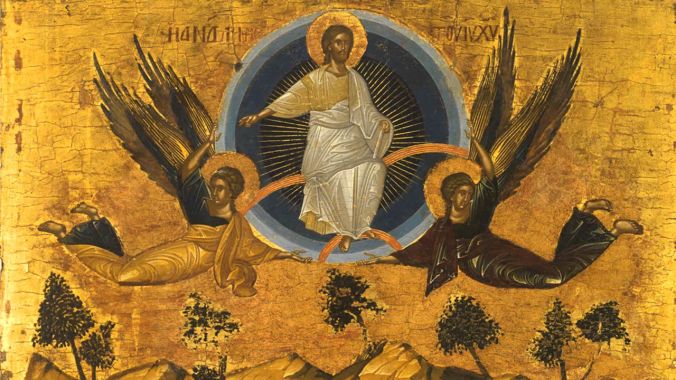
From an Icon of the Ascension. (Source)
This week, we are about to enter a truly remarkable liturgical sequence.
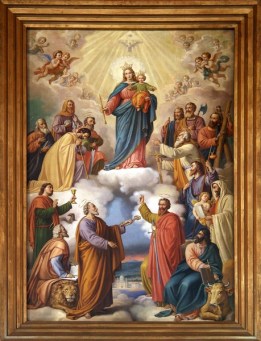
Our Lady, Help of Christians. (Source)
Wednesday is Our Lady, Help of Christians, patroness of my parish here in South Carolina.
Thursday is the Ascension (sadly moved to Sunday in my province of Atlanta).
Friday is St. Philip Neri, and then on Saturday comes Our Lady of the Cenacle.
We could extend our reckoning to Sunday, but for now, I think it is appropriate for us to hesitate on the threshold of the Mystical Sabbath. Let us instead examine only these four days and their import.
We begin and end the progression with Mary. First, we see her in her relation to humanity. She is the help of Christians. Then, we see her in relation to God. She receives the Holy Spirit. Taking both feasts together, we see Our Lady participating in God-humanity; she becomes the perfect emblem of Divine Wisdom.
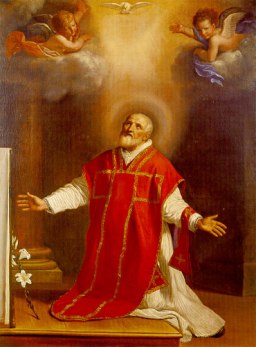
St. Philip Neri, who received the Holy Spirit in the catacombs. (Source)
Studying Sophiology has made me appreciate Our Lady of the Cenacle even more. There is a deep connection, I think, between the manifestation of Divine Wisdom in the creation of the Cosmos, at the Baptism of Christ, and at the descent of the Spirit upon Our Lady at Pentecost. They are mutually illuminating events. I wonder if we can find that connection at the level of the propers for each liturgy, a project I may try to engage in before Saturday.
And how appropriate that St. Philip, who experienced his own Pentecost in the catacombs of St. Sebastian, should go forth as a herald for Our Lady of the Cenacle! It is a kind of liturgical proof of the hierarchical principle, that we are led by lower things to higher things. St. Philip received the Holy Spirit into his heart as a ball of fire in the catacombs— under the city of Rome, once a place of persecution, the mythical “Babylon” of Revelation. He guides us to Our Lady as she waits and prays in the Cenacle, the Upper Room in Jerusalem where the sacraments of the Eucharist and Orders were instituted and where the Holy Spirit descended upon the Church in tongues of fire on Pentecost. What a picture of the historical Church in pilgrimage! From the darkness of the Roman catacombs to the heights of the upper room in Zion. We could read an eschatology out of these mystical days.
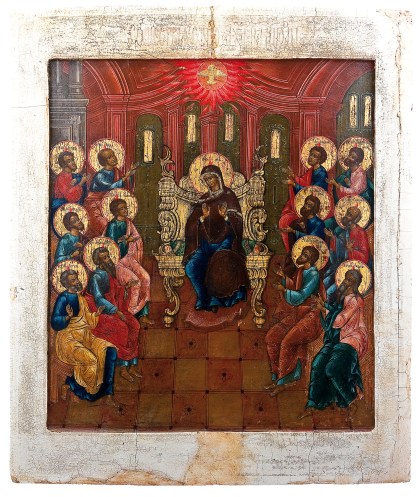
Russian Icon of Pentecost, 18th century. The Slavs are unique among the Eastern Orthodox in placing Our Lady in the scene. (Source).
Nevertheless, this week’s procession is easy to overlook, since its central diamond, the Ascension, has been misplaced by so many bishops. Celebrating the feast on Sunday robs it of its truly Eucharistic meaning, for the Ascension’s traditional place on a Thursday meant that it could only be read through the texts of Maundy Thursday. Ascension Day is to Maundy Thursday as Pentecost is to Easter, the initiator of a new liturgical season and a reminder of the Mystical Priesthood of Christ. All of this is admirably explained by Dom Mark Daniel Kirby OSB in his podcasted homilies and in his blog, Vultus Christi.
The Eucharistic and Priestly meaning of the Ascension matters for the rest of the four-day sequence insofar as the Eucharist represents, sustains, and completes every instantiation of Sophianic being. The Sophianic character of the four days can only be discerned in the light of Christ’s face as He ascends into his cosmic priesthood on Thursday. This would be true even if St. Philip were not there to complete the set. This is, after all, a fairly uniqueE situation. Ever spry, St. Philip moves around the sacred calendar with the bustling rhythms of profane time. But in this auspicious year, so full of historical resonances and providential patterns, let us rejoice in the days that the Lord has made (Psalm 118).

 The Amish Catholic
.jpg)