Father Faber on the Holy Souls in Purgatory

OLYMPUS DIGITAL CAMERA

We should always remember to pray for the Holy Souls in Purgatory, especially in this, their month. (Source)

Today is Remembrance Sunday here in the U.K. We had a splendid Solemn High Requiem Mass at the Oxford Oratory, complete with black vestments. The setting was a Requiem by Haydn, which seem to draw us on the journey of a holy soul. From an Introit that sounds like the mournful ghosts of the dead, we proceed to a communion that is full of airy light and calm joy – with a great deal of drama in between. 

I realized that I had not posted anything for All Souls’ Day. Since today is yet another day set aside, at least by British Catholics, for praying on behalf of the dead, I decided I’d post something by that spiritual master, Father Frederick William Faber of the London Oratory. In his own life, Fr. Faber was known for his great devotion to the Holy Souls. One of his more famous texts deals with prayer for those in Purgatory. I have selected the following passage from that work, Fr. Faber’s Purgatory. You can also find it on this website. I offer it here for your consideration and in the hope that the good priest’s words might kindle in us a fonder and more steadfast devotion to the Faithful Departed.

Both views [of Purgatory within Catholicism] agree again in holding that what we in the world call very trivial faults are most severely visited in purgatory. St. Peter Damian gives us many instances of this, and others are collected and quoted by Bellarmine. Slight feelings of self-complacency, trifling inattentions in the recital of the Divine Office, and the like, occur frequently among them. Sister Francesca mentions the case of a girl of fourteen in purgatory, because she was not quite conformed to the will of God in dying so young: and one soul said to her: Ah men little think in the world how dearly they are going to pay here for faults they hardly note there. She even saw souls that were immensely punished only for having been scrupulous in this life; either, I suppose, because there is mostly self-will in scruples, or because they did not lay them down when obedience commanded. Wrong notions about small faults may thus lead us to neglect the dead, or leave off our prayers too soon, as well as lose a lesson for ourselves.

Then, again, both views agree as to the helplessness of the Holy Souls. They lie like the paralytic at the pool. It would seem as if even the coming of the angel were not an effectual blessing to them, unless there be some one of us to help them Some have even thought they cannot pray. Anyhow, they have no means of making themselves heard by us on whose charity they depend. Some writers have said that Our Blessed Lord will not help them without our co-operation; and that Our Blessed Lady cannot help them, except in indirect ways, because she is no longer able to make satisfaction; though I never like to hear anything our dearest mother cannot do; and I regard such statements with suspicion. Whatever may come of these opinions, they at least illustrate the strong way in which theologians apprehend the helplessness of the Holy Souls. Then another feature in their helplessness is the forgetfulness of the living, or the cruel flattery of relations who will always have it that those near or dear to them die the deaths of Saints. They would surely have a scruple, if they knew of how many Masses and prayers they rob the souls, by the selfish exaggeration of their goodness. I call it selfish, for it is nothing more than a miserable device to console themselves in their sorrow. The very state of the Holy Souls is one of the most unbounded helplessness. They cannot do penance; they cannot merit; they cannot satisfy; they cannot gain indulgences; they have no Sacraments; they are not under the jurisdiction of God’s Vicar, overflowing with the plentitude of means of grace and manifold benedictions. They are a portion of the Church without either priesthood or altar at their own command.
holy-souls._jpg

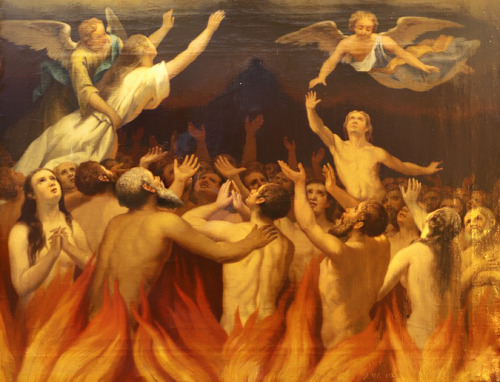
Pray for the Holy Souls in Purgatory. (Source)

Those are the points common to both views of purgatory; and how manifold are the lessons we learn from them, on our own behalf as well as on behalf of the Holy Souls. For ourselves, what light does all this throw on slovenliness, lukewarmness, and love of ease? What does it make us think of performing our devotions out of a mere spirit of formality, or a trick of habit? What diligence in our examens, confessions, Communions, and prayers! It seems as if the grace of all graces for which we should ever be importuning our dear Lord, would be to hate sin with something of the hatred wherewith He hated it in the garden of Gethsemane. Oh, is not the purity of God something awful, unspeakable, adorable? He, who is Himself a simple act, has gone on acting, multiplying acts since creation, yet he has incurred no stain! He is ever mingling with a most unutterable condescension with what is beneath Him-yet no stain! He loves His creatures with a love immeasurably more intense than the wildest passion of earth- yet no stain! He is omnipotent, yet it is beyond the limits of His power to receive a stain. He is so pure that the very vision of Him causes eternal purity and blessedness. Mary’s purity is but a fair thin shadow of it, and yet we, even we, are to dwell in His arms for ever, we are to dwell amid the everlasting burnings of that uncreated purity! Yet, let us look at our lives; let us trace our hearts faithfully through but one day, and see of what mixed intentions, human respects, self-love, and pusillanimous temper our actions, nay, even our devotions, are made up of; and does not purgatory, heated seven-fold and endured to the day of doom, seem but a gentle novitiate for the Vision of the All-holy?
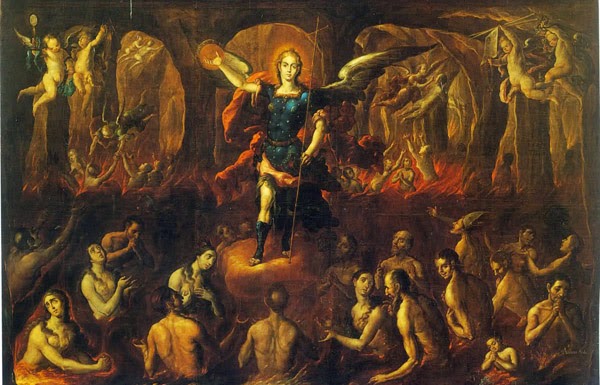
St.-Michael-the-Archangel-and-the-Souls-in-Purgatory

St. Michael the Archangel has traditionally been closely associated with the Holy Souls of Purgatory in the Church’s devotional life. (Source)

But some persons turn in anger from the thought of purgatory, as if it were not to be endured, that after trying all our lives long to serve God, we should accomplish the tremendous feat of a good death, only to pass from the agonies of the death-bed into fire, long, keen, searching, triumphant, incomparable fire. Alas! my dear friends, your anger will not help you nor alter facts. But have you thought sufficiently about God? Have you tried to realise His holiness and purity in assiduous meditation? Is there a real divorce between you and the world which youknow is God’s enemy? Do you take God’s side? Are you devoted to His interests? Do you long for His glory? Have you put sin alongside of our dear Saviours’ Passion, and measured the one by the other? Surely, if you had, purgatory would but seem to you the last, unexpected, and inexpressibly tender invention of an obstinate love, which was mercifully determined to save you in spite of yourself. It would be a perpetual wonder to you, a joyous wonder, fresh every morning, a wonder that would be meat and drink to your soul, that you, being what you know yourself to be, what God knows you to be, should be saved eternally. Remember what the suffering soul said so simply, yet with such force, to Sister Francesca: ‘ Ah! those on that side of the grave little reckonhow dearly they will pay on this side for the lives they live! To be angry because you are told you will go to purgatory! Silly, silly people Most likely it is a great false flattery, and that you will never be good enough to go there at all. Why, positively, you do not recognise your own good fortune, when you are told of it. And none but the humble go there. I remember Maria Crocifissa was told that although many of the Saints while on earth loved God more than some do even in heaven, yet that the greatest Saint on earth was not so humble as are the souls in purgatory. I do not think I ever read anything in the lives of the Saints which struck me so much as that. You see it is not well to be angry; for those only are lucky enough to get into purgatory who sincerely believe themselves to be worthy of hell.
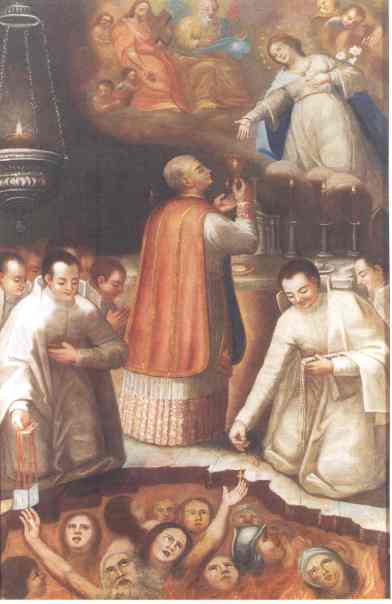
Purgatory_Mass._jpg

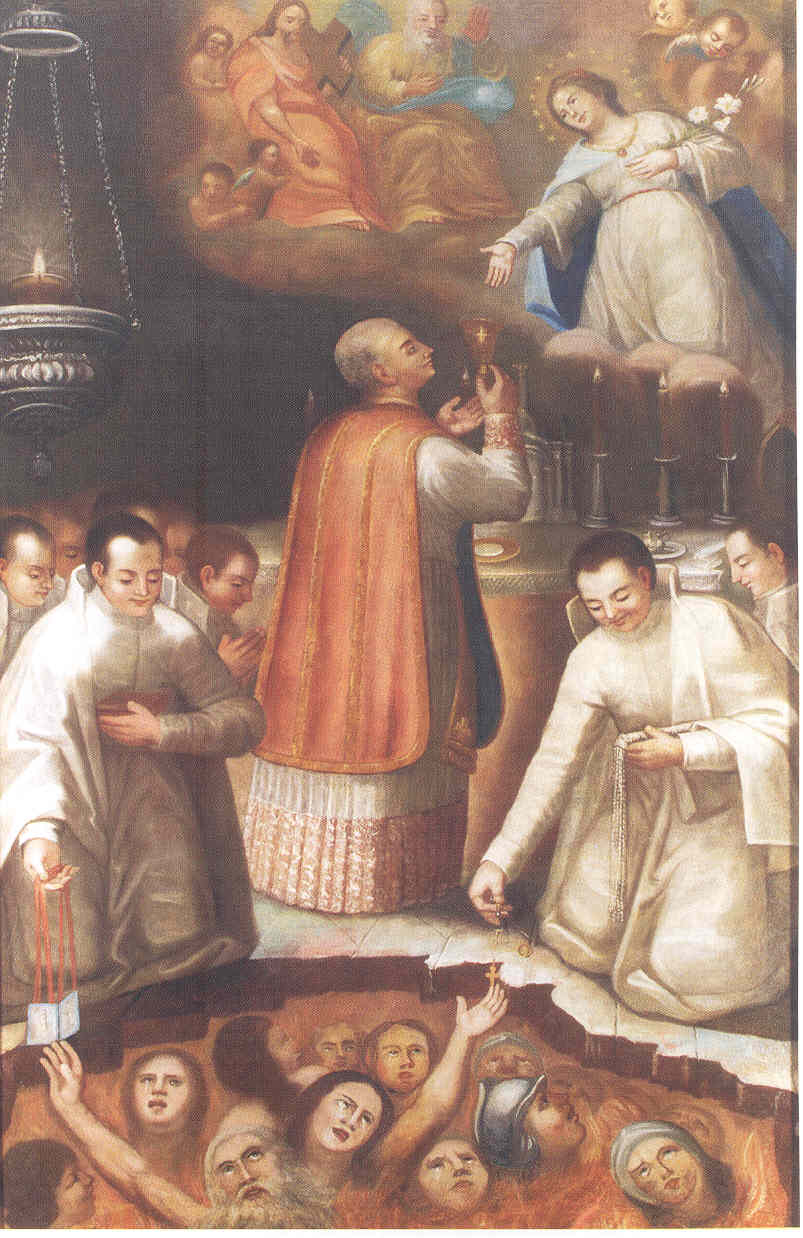
Masses and indulgences can be tremendously helpful to the souls suffering in Purgatory. (Source)

But we not only learn lessons for our own good, but for the good of the Holy Souls. We see that our charitable attention towards them must be far more vigorous and persevering than they have been; for men go to purgatory for very little matters, and remain there an unexpectedly long time. But their most touching appeal to us lies in their helplessness; and our dear Lord, with His usual loving arrangement, has made the extent of our power to help them more than commensurate with their ability to help themselves. Some theologians have said that prayer for the Holy Souls is not infallibly answered. I confess their arguments on this head do not convince me; but, conceding the point, how wonderful still is the power which we can exercise in favour of the departed! St. Thomas has at least taught us that prayer for the dead is more readily accepted with God than prayer for the living. We can offer and apply for them all the satisfactions of Our Blessed Lord. We can do vicarious penance for them. We can give to them all the satisfactions of our ordinary actions, and of our sufferings. We can make over to them, by way of suffrage, the indulgences we gain, provided the Church has made them applicable to the dead. We can limit and direct to them, or any one of them, the intention of the Adorable Sacrifice. The Church, which has no jurisdiction over them, can yet make indulgences applicable or inapplicable to them by way of suffrage; and by means of liturgy, commemoration, incense, holy water, and the like, can reach efficaciously to them, and most of all by her device of privileged altars. The Communion of Saints furnishes the veins and channels by which all these things reach them in Christ. Heaven itself condescends to act upon them through earth. Their Queen helps them by setting us to work for them, and the Angels and the Saints bestow their gifts through us, whom they persuade to be their almoners; nay, we are often their almoners without knowing that we are so. Our Blessed Lord vouchsafes to look to us, as if He would say: Here are my weapons, work for me! just as a father will let his child do a portion of his work, in spite of the risk he runs in having it spoiled. To possess such powers, and not to use them, would be the height of irreverence towards God, as well as of want of charity to men. There is nothing so irreverent, because nothing so unfilial, as to shrink from God’s gifts simply because of their exhuberance. Men have a feeling of safety in not meddling with the supernatural; but the truth is, we cannot stand aloof on one side and be safe. Naturalism is the unsafe thing. If we do not enter the system, and humbly take our place in it, it will draw us in, only to tear us to pieces when it has done so. The dread of the supernatural is the unsafest of feelings. The jealousy of it is a prophecy of eternal loss.

It is not saying too much to call devotion to the Holy Souls a kind of centre in which all Catholic devotions meet, and which satisfies more than any other single devotion our duties in that way; because it is a devotion all of love, and of disinterested love. If we cast an eye over the chief Catholic devotion, we shall see the truth of this. Take the devotion of St. Ignatius to the glory of God. This, if we may dare to use such an expression of Him, was the special and favourite devotion of Jesus. Now, purgatory is simply a field white for the harvest of God’s glory. Not a prayer can be said for the Holy Souls, but God is at once glorified, both by the faith and the charity of the mere prayer.
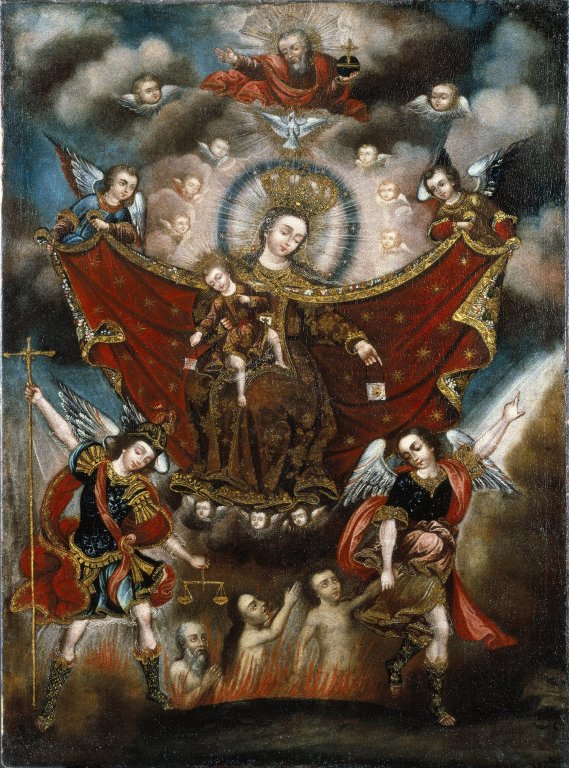
Brooklyn_Museum_-_Virgin_of_Carmel_Saving_Souls_in_Purgatory_-_Circle_of_Diego_Quispe_Tito_-_overall

The Virgin of Carmel Saving Souls in Purgatory, Circle of Diego Quispe Tito, c. 17th century. Brooklyn Museum. (Source)
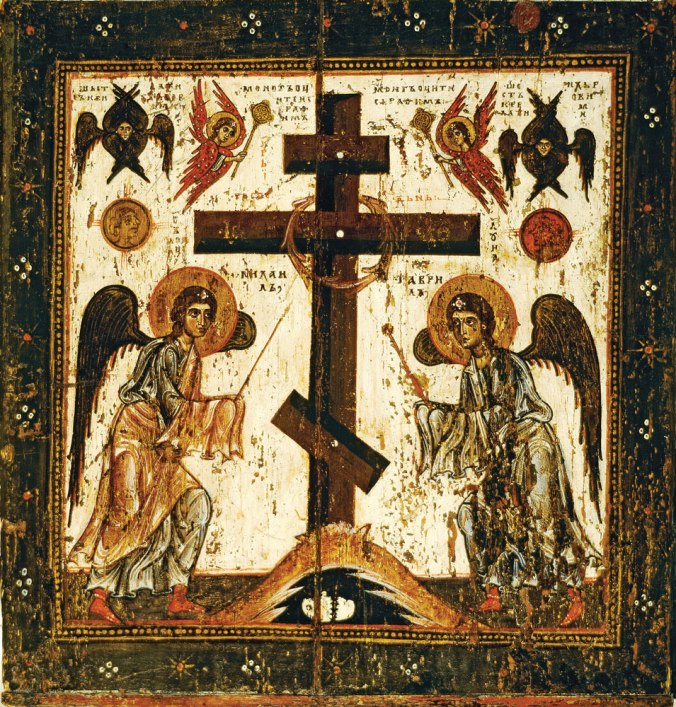

Newman on the Cross of Christ

image

An icon of the Holy Cross. (Source)

My favorite sermon by John Henry Newman is directly germane to our feast today. He preached it at St. Mary the Virgin, Oxford, while still an Anglican. Though originally delivered on the sixth Sunday of Lent, the text fits admirably for today’s mystery, I take it from the Newman Reader, which makes available all of his writings for free online.

The Cross of Christ the Measure of the World

“And I, if I be lifted up from the earth, will draw all men unto Me.” John xii. 32.

A GREAT number of men live and die without reflecting at all upon the state of things in which they find themselves. They take things as they come, and follow their inclinations as far as they have the opportunity. They are guided mainly by pleasure and pain, not by reason, principle, or conscience; and they do not attempt to interpret this world, to determine what it means, or to reduce what they see and feel to system. But when persons, either from thoughtfulness of mind, or from intellectual activity, begin to contemplate the visible state of things into which they are born, then forthwith they find it a maze and a perplexity. It is a riddle which they cannot solve. It seems full of contradictions and without a drift. Why it is, and what it is to issue in, and how it is what it is, and how we come to be introduced into it, and what is our destiny, are all mysteries.

In this difficulty, some have formed one philosophy of life, and others another. Men have thought they had found the key, by means of which they might read what is so obscure. Ten thousand things come before us one after another in the course of life, and what are we to think of them? what colour are we to give them? Are we to look at all things in a gay and mirthful way? or in a melancholy way? in a desponding or a hopeful way? Are we to make light of life altogether, or to treat the whole subject seriously? Are we to make greatest things of little consequence, or least things of great consequence? Are we to keep in mind what is past and gone, or are we to look on to the future, or are we to be absorbed in what is present? How are we to look at things? this is the question which all persons of observation ask themselves, and answer each in his own way. They wish to think by rule; by something within them, which may harmonize and adjust what is without them. Such is the need felt by reflective minds. Now, let me ask, what is the real key, what is the Christian interpretation of this world? What is given us by revelation to estimate and measure this world by? The event of this season,—the Crucifixion of the Son of God.

It is the death of the Eternal Word of God made flesh, which is our great lesson how to think and how to speak of this world. His Cross has put its due value upon every thing which we see, upon all fortunes, all advantages, all ranks, all dignities, all pleasures; upon the lust of the flesh, and the lust of the eyes, and the pride of life. It has set a price upon the excitements, the rivalries, the hopes, the fears, the desires, the efforts, the triumphs of mortal man. It has given a meaning to the various, shifting course, the trials, the temptations, the sufferings, of his earthly state. It has brought together and made consistent all that seemed discordant and aimless. It has taught us how to live, how to use this world, what to expect, what to desire, what to hope. It is the tone into which all the strains of this world’s music are ultimately to be resolved.

Look around, and see what the world presents of high and low. Go to the court of princes. See the treasure and skill of all nations brought together to honour a child of man. Observe the prostration of the many before the few. Consider the form and ceremonial, the pomp, the state, the circumstance; and the vainglory. Do you wish to know the worth of it all? look at the Cross of Christ.

Go to the political world: see nation jealous of nation, trade rivalling trade, armies and fleets matched against each other. Survey the various ranks of the community, its parties and their contests, the strivings of the ambitious, the intrigues of the crafty. What is the end of all this turmoil? the grave. What is the measure? the Cross.

Go, again, to the world of intellect and science: consider the wonderful discoveries which the human mind is making, the variety of arts to which its discoveries give rise, the all but miracles by which it shows its power; and next, the pride and confidence of reason, and the absorbing devotion of thought to transitory objects, which is the consequence. Would you form a right judgment of all this? look at the Cross.

Again: look at misery, look at poverty and destitution, look at oppression and captivity; go where food is scanty, and lodging unhealthy. Consider pain and suffering, diseases long or violent, all that is frightful and revolting. Would you know how to rate all these? gaze upon the Cross.

Thus in the Cross, and Him who hung upon it, all things meet; all things subserve it, all things need it. It is their centre and their interpretation. For He was lifted up upon it, that He might draw all men and all things unto Him.

But it will be said, that the view which the Cross of Christ imparts to us of human life and of the world, is not that which we should take, if left to ourselves; that it is not an obvious view; that if we look at things on their surface, they are far more bright and sunny than they appear when viewed in the light which this season casts upon them. The world seems made for the enjoyment of just such a being as man, and man is put into it. He has the capacity of enjoyment, and the world supplies the means. How natural this, what a simple as well as pleasant philosophy, yet how different from that of the Cross! The doctrine of the Cross, it may be said, disarranges two parts of a system which seem made for each other; it severs the fruit from the eater, the enjoyment from the enjoyer. How does this solve a problem? does it not rather itself create one?

I answer, first, that whatever force this objection may have, surely it is merely a repetition of that which Eve felt and Satan urged in Eden; for did not the woman see that the forbidden tree was “good for food,” and “a tree to be desired”? Well, then, is it wonderful that we too, the descendants of the first pair, should still be in a world where there is a forbidden fruit, and that our trials should lie in being within reach of it, and our happiness in abstaining from it? The world, at first sight, appears made for pleasure, and the vision of Christ’s Cross is a solemn and sorrowful sight interfering with this appearance. Be it so; but why may it not be our duty to abstain from enjoyment notwithstanding, if it was a duty even in Eden?

But again; it is but a superficial view of things to say that this life is made for pleasure and happiness. To those who look under the surface, it tells a very different tale. The doctrine of the Cross does but teach, though infinitely more forcibly, still after all it does but teach the very same lesson which this world teaches to those who live long in it, who have much experience in it, who know it. The world is sweet to the lips, but bitter to the taste. It pleases at first, but not at last. It looks gay on the outside, but evil and misery lie concealed within. When a man has passed a certain number of years in it, he cries out with the Preacher, “Vanity of vanities, all is vanity.” Nay, if he has not religion for his guide, he will be forced to go further, and say, “All is vanity and vexation of spirit;” all is disappointment; all is sorrow; all is pain. The sore judgments of God upon sin are concealed within it, and force a man to grieve whether he will or no. Therefore the doctrine of the Cross of Christ does but anticipate for us our experience of the world. It is true, it bids us grieve for our sins in the midst of all that smiles and glitters around us; but if we will not heed it, we shall at length be forced to grieve for them from undergoing their fearful punishment. If we will not acknowledge that this world has been made miserable by sin, from the sight of Him on whom our sins were laid, we shall experience it to be miserable by the recoil of those sins upon ourselves.

It may be granted, then, that the doctrine of the Cross is not on the surface of the world. The surface of things is bright only, and the Cross is sorrowful; it is a hidden doctrine; it lies under a veil; it at first sight startles us, and we are tempted to revolt from it. Like St. Peter, we cry out, “Be it far from Thee, Lord; this shall not be unto Thee.” [Matt. xvi. 22.] And yet it is a true doctrine; for truth is not on the surface of things, but in the depths.

And as the doctrine of the Cross, though it be the true interpretation of this world, is not prominently manifested in it, upon its surface, but is concealed; so again, when received into the faithful heart, there it abides as a living principle, but deep, and hidden from observation. Religious men, in the words of Scripture, “live by the faith of the Son of God, who loved them and gave Himself for them:” [Gal. ii. 20.] but they do not tell this to all men; they leave others to find it out as they may. Our Lord’s own command to His disciples was, that when they fast, they should “anoint their head and wash their face.” [Matt. vi. 17.] Thus they are bound not to make a display, but ever to be content to look outwardly different from what they are really inwardly. They are to carry a cheerful countenance with them, and to control and regulate their feelings, that those feelings, by not being expended on the surface, may retire deep into their hearts and there live. And thus “Jesus Christ and He crucified” is, as the Apostle tells us, “a hidden wisdom;”—hidden in the world, which seems at first sight to speak a far other doctrine,—and hidden in the faithful soul, which to persons at a distance, or to chance beholders, seems to be living but an ordinary life, while really it is in secret holding communion with Him who was “manifested in the flesh,” “crucified through weakness,” “justified in the Spirit, seen of angels, and received up into glory.”

This being the case, the great and awful doctrine of the Cross of Christ, which we now commemorate, may fitly be called, in the language of figure, the heart of religion. The heart may be considered as the seat of life; it is the principle of motion, heat, and activity; from it the blood goes to and fro to the extreme parts of the body. It sustains the man in his powers and faculties; it enables the brain to think; and when it is touched, man dies. And in like manner the sacred doctrine of Christ’s Atoning Sacrifice is the vital principle on which the Christian lives, and without which Christianity is not. Without it no other doctrine is held profitably; to believe in Christ’s divinity, or in His manhood, or in the Holy Trinity, or in a judgment to come, or in the resurrection of the dead, is an untrue belief, not Christian faith, unless we receive also the doctrine of Christ’s sacrifice. On the other hand, to receive it presupposes the reception of other high truths of the Gospel besides; it involves the belief in Christ’s true divinity, in His true incarnation, and in man’s sinful state by nature; and it prepares the way to belief in the sacred Eucharistic feast, in which He who was once crucified is ever given to our souls and bodies, verily and indeed, in His Body and in His Blood. But again, the heart is hidden from view; it is carefully and securely guarded; it is not like the eye set in the forehead, commanding all, and seen of all: and so in like manner the sacred doctrine of the Atoning Sacrifice is not one to be talked of, but to be lived upon; not to be put forth irreverently, but to be adored secretly; not to be used as a necessary instrument in the conversion of the ungodly, or for the satisfaction of reasoners of this world, but to be unfolded to the docile and obedient; to young children, whom the world has not corrupted; to the sorrowful, who need comfort; to the sincere and earnest, who need a rule of life; to the innocent, who need warning; and to the established, who have earned the knowledge of it.

One more remark I shall make, and then conclude. It must not be supposed, because the doctrine of the Cross makes us sad, that therefore the Gospel is a sad religion. The Psalmist says, “They that sow in tears shall reap in joy;” and our Lord says, “They that mourn shall be comforted.” Let no one go away with the impression that the Gospel makes us take a gloomy view of the world and of life. It hinders us indeed from taking a superficial view, and finding a vain transitory joy in what we see; but it forbids our immediate enjoyment, only to grant enjoyment in truth and fulness afterwards. It only forbids us to begin with enjoyment. It only says, If you begin with pleasure, you will end with pain. It bids us begin with the Cross of Christ, and in that Cross we shall at first find sorrow, but in a while peace and comfort will rise out of that sorrow. That Cross will lead us to mourning, repentance, humiliation, prayer, fasting; we shall sorrow for our sins, we shall sorrow with Christ’s sufferings; but all this sorrow will only issue, nay, will be undergone in a happiness far greater than the enjoyment which the world gives,—though careless worldly minds indeed will not believe this, ridicule the notion of it, because they never have tasted it, and consider it a mere matter of words, which religious persons think it decent and proper to use, and try to believe themselves, and to get others to believe, but which no one really feels. This is what they think; but our Saviour said to His disciples, “Ye now therefore have sorrow, but I will see you again, and your heart shall rejoice, and your joy no man taketh from you.” … “Peace I leave with you; My peace I give unto you; not as the world giveth, give I unto you.” [John xvi. 22; xiv. 27.] And St. Paul says, “The natural man receiveth not the things of the Spirit of God; for they are foolishness unto him; neither can he know them, because they are spiritually discerned.” “Eye hath not seen, nor ear heard, neither have entered into the heart of man, the things which God hath prepared for them that love Him.” [1 Cor. ii. 9, 14.] And thus the Cross of Christ, as telling us of our redemption as well as of His sufferings, wounds us indeed, but so wounds as to heal also.

And thus, too, all that is bright and beautiful, even on the surface of this world, though it has no substance, and may not suitably be enjoyed for its own sake, yet is a figure and promise of that true joy which issues out of the Atonement. It is a promise beforehand of what is to be: it is a shadow, raising hope because the substance is to follow, but not to be rashly taken instead of the substance. And it is God’s usual mode of dealing with us, in mercy to send the shadow before the substance, that we may take comfort in what is to be, before it comes. Thus our Lord before His Passion rode into Jerusalem in triumph, with the multitudes crying Hosanna, and strewing His road with palm branches and their garments. This was but a vain and hollow pageant, nor did our Lord take pleasure in it. It was a shadow which stayed not, but flitted away. It could not be more than a shadow, for the Passion had not been undergone by which His true triumph was wrought out. He could not enter into His glory before He had first suffered. He could not take pleasure in this semblance of it, knowing that it was unreal. Yet that first shadowy triumph was the omen and presage of the true victory to come, when He had overcome the sharpness of death. And we commemorate this figurative triumph on the last Sunday in Lent, to cheer us in the sorrow of the week that follows, and to remind us of the true joy which comes with Easter-Day.

And so, too, as regards this world, with all its enjoyments, yet disappointments. Let us not trust it; let us not give our hearts to it; let us not begin with it. Let us begin with faith; let us begin with Christ; let us begin with His Cross and the humiliation to which it leads. Let us first be drawn to Him who is lifted up, that so He may, with Himself, freely give us all things. Let us “seek first the kingdom of God and His righteousness,” and then all those things of this world “will be added to us.” They alone are able truly to enjoy this world, who begin with the world unseen. They alone enjoy it, who have first abstained from it. They alone can truly feast, who have first fasted; they alone are able to use the world, who have learned not to abuse it; they alone inherit it, who take it as a shadow of the world to come, and who for that world to come relinquish it.


Original Art: Some Recent Work

Here are some more of my August projects.

image.jpeg

“Map of Hanserat, Vosh Kyaz, and the Isles.” Photo by artist. An imaginary map I came up with a while ago and wanted to see in color.

image

“Under the Sycamore Trees.” Photo by artist. We are like the dreamer…

image.jpeg

“Gluttony.” Photo by artist. I may do a series on the seven deadly sins.

And After the Fire

the-morning-after-the-deluge

“The Morning After the Deluge,” J.M.W. Turner, c. 1843. (Source).

I am still shocked and furious about the events of the last few days. Fascists of various sorts have descended upon Charlottesville, Virginiaa town I loved and called home for four years—and caused immense pain for the entire community. One woman, a Wobbly protester, died at the hands of a Neo-Nazi who rammed his car into a crowded alley. I had friends in the counter-protest. I had friends who feared for their lives. And all I could do was watch and pray. The Rosary, the Imprecatory Psalms, Invocations to St. Michael. But how I wish I could have done so much more.

I was following the news across Facebook, CNN television, and Twitter. I observed mixed responses. Some, even among baptized Catholics, sympathize with the Alt-Right fascists. They point the finger of blame at Antifa, the several Socialists who showed up in counterprotest, the Media, and Black Lives Matter activists. Likewise, some Christians equivocated. They were happy to condemn the Alt-Right briefly, while also complaining at length about how the Media wasn’t focusing on Antifa, or the Police didn’t do enough, or, incredibly, how all of this is really just the fault of the Democratic Party (here’s looking at you, John Zmirak and Dinesh D’Souza). Then, there were those brave Catholics like Chad Pecknold, Robert George, and Bishop Barron who condemned white supremacy and racism outright. And they received backlashshameful!from those who should know better.

But I haven’t lost hope.

The Liturgical Providence of God is so calibrated to our salvation that we receive the graces we need at precisely the moment we need them, even when we could never have anticipated needing them in the first place. It works even through a deficient calendar, such as we have in the Novus Ordo. For today, we read and hear about a great many disruptions and turbulent tumults. We turn first to the Prophet Elijah at Sinai where, having cast down fire from heaven upon the Prophets of Baal, he hides and waits for the Lord to speak.

At the mountain of God, Horeb,
Elijah came to a cave where he took shelter.
Then the LORD said to him,
“Go outside and stand on the mountain before the LORD;
the LORD will be passing by.”
A strong and heavy wind was rending the mountains
and crushing rocks before the LORD—
but the LORD was not in the wind.
After the wind there was an earthquake—
but the LORD was not in the earthquake.
After the earthquake there was fire—
but the LORD was not in the fire.
After the fire there was a tiny whispering sound.
When he heard this,
Elijah hid his face in his cloak
and went and stood at the entrance of the cave.

1 Kgs 19:9a, 11-13a

The wind rises high all about Elijah; it howls and screams like the very demons of Hell. It rushes up the mountain like the chariots of the wicked King who sought the prophet’s life. But the Lord was not in the wind.

The earthquake causes the whole mountain to tremble. Rocks shake as if they are about to be torn asunder by invisible hands. The trees seem to dance in an unholy rhythm, threaten to crack and topple over. But the Lord was not in the earthquake.

The fire courses across the plain and up the slopes, hungrily devouring the short desert grasses that line the path to Horeb’s cave. The smoke fills the air; the sweltering heat traps Elijah, and threatens to make a furnace of his narrow cell. But the Lord was not in the fire.

The Lord came, instead, in a “tiny whispering sound” that followed all that tumult and trial. The frightful violence of nature may have been sublime, and it may have sorely threatened Elijah. But it was empty. God does not dwell in the frenzy of the wind, the earthquake, and the fire. He comes in peace, and He meets His servant in peace.

This week’s Psalm takes up the same theme.

R. (8) Lord, let us see your kindness, and grant us your salvation.
I will hear what God proclaims;
the LORD — for he proclaims peace.
Near indeed is his salvation to those who fear him,
glory dwelling in our land.
R. Lord, let us see your kindness, and grant us your salvation.
Kindness and truth shall meet;
justice and peace shall kiss.
Truth shall spring out of the earth,
and justice shall look down from heaven.
R. Lord, let us see your kindness, and grant us your salvation.
The LORD himself will give his benefits;
our land shall yield its increase.
Justice shall walk before him,
and prepare the way of his steps.
R. Lord, let us see your kindness, and grant us your salvation.

Ps 85:9, 10, 11-12, 13-14

The peace and salvation of God is near to those who fear Him. A great mystery hovers within these lines: “Kindness and truth shall meet; justice and peace shall kiss. Truth shall spring out of the earth, and justice shall look down from heaven.”

Justice. Peace. Those are words that scare a lot of us traditionalists. After all, haven’t so many abuses of doctrine and the liturgy occurred precisely in the name of “social justice?” Haven’t whole orders been gutted by their worldly capitulation to liberal standards of “social justice” work? And aren’t the proverbial “Social Justice Warriors” the very people who most oppose the Church’s teachings on abortion, marriage, gender, and so many other issues?

All of these criticisms are valid. But they are not complete. Justice is a cardinal virtue. To quote one of the better Anglican principles, “The abuse of a thing doth not take away the good use of it.” Consider what the Psalm teaches us of God’s Justice. Here is a picture of the Last and Eternal Day, when the New Heavens and the Earth will united at the Wedding Feast of the Lamb. But we also find a practical insight for the here and now. When we read, “Justice shall walk before him, and prepare the way of his steps,” we recognize in this a prophecy of Christ. Our Lord, whose way was prepared by St. John the Baptist (that man so like an icon of Justice), is never far from Justice. The wind and earthquake and fire of injustice will one day yield to the peace of Christ. But in the meantime, we must do what we can to realize that justice in our own communities. Indeed, in our own hearts.

This can only begin when we faithfully repair to the sacrament of penance, confessing our sins with compunction, and seek to live always as Christ would have us. For some, this may mean abandoning deep bigotries like white supremacy or a hatred of the poor. It will be difficult for those caught in such snares to relinquish their demonic ideologies, so we must pray for them. But is there anyone among us who does not cherish some prejudice, some little parasite of pride, some vice that blinds us to the manifold ways we are complicit in the oppression of our brethren? Even I am no saint in this respect, and I pray that God’s mercy might change me to better reflect His love for all people.

For some, direct action may be the right course. I am not an activist. I started this essay confessing that I wish I could have done more to help those standing against white supremacists yesterday. Yet I recognize that I have a temperamental aversion to any kind of on-the-ground activism. The task of marching, picketing, and chanting songs of justice may be what some are called to. Dorothy Day provides a wonderful Catholic example of this kind of work.

And there are other strategies, which theologians and activists have pursued for years, that aim at incarnating Justice. It would be redundant to attempt any kind of review here. But no matter how we go about the task of Justice, we musn’t lose hope. Let us hear the commiserating words of St. Paul to the Romans:

Brothers and sisters:
I speak the truth in Christ, I do not lie;
my conscience joins with the Holy Spirit in bearing me witness
that I have great sorrow and constant anguish in my heart.
For I could wish that I myself were accursed and cut off from Christ
for the sake of my own people,
my kindred according to the flesh.
They are Israelites;
theirs the adoption, the glory, the covenants,
the giving of the law, the worship, and the promises;
theirs the patriarchs, and from them,
according to the flesh, is the Christ,
who is over all, God blessed forever. Amen.

Rom 9:1-5

Even amidst the anguish we feel for our brethren, we must not lose sight of the Holy Face triumphant. Nor must we forget that Justice is not itself the highest good. God is. With these two truths in mind, we turn to the Gospel.

After he had fed the people, Jesus made the disciples get into a boat
and precede him to the other side,
while he dismissed the crowds.
After doing so, he went up on the mountain by himself to pray.
When it was evening he was there alone.
Meanwhile the boat, already a few miles offshore,
was being tossed about by the waves, for the wind was against it.
During the fourth watch of the night,
he came toward them walking on the sea.
When the disciples saw him walking on the sea they were terrified.
“It is a ghost,” they said, and they cried out in fear.
At once Jesus spoke to them, “Take courage, it is I; do not be afraid.”
Peter said to him in reply,
“Lord, if it is you, command me to come to you on the water.”
He said, “Come.”
Peter got out of the boat and began to walk on the water toward Jesus.
But when he saw how strong the wind was he became frightened;
and, beginning to sink, he cried out, “Lord, save me!”
Immediately Jesus stretched out his hand and caught Peter,
and said to him, “O you of little faith, why did you doubt?”
After they got into the boat, the wind died down.
Those who were in the boat did him homage, saying,
“Truly, you are the Son of God.”

Mt 14:22-33

We learn from the Psalm that “Justice shall walk before him, and prepare the way of his steps.” So Our Lord sends forth His Apostles, His Church, to “precede him to the other side” of the sea. The Church mystically incarnates Justice at every Mass. And it can only hope to sustain Justice, a Cardinal Virtue, with Faith. For when Peter, Prince of the Apostles, goes out of the boat to walk towards His Lord, he only sinks when he loses his Faith in fear.

But all is not lost. Christ comes through the storm and shows that He is master of it. He walks on water. No tempest can withstand Him, just as no wind, earthquake, fire, flood, protest, or violence of this world can drown out His voice. No slogan of oppression, no act of terrorism, no brawl in the summer streets can overcome the peace that Christ alone brings in and to and through His Church.

I hope that my friends in Charlottesville will take heart. The last few days have been tempestuous, to say the least. But Christ will conquer the waves of this world. Have faith, and He will grant us both justice and peace.

Baronius on Religious Writing

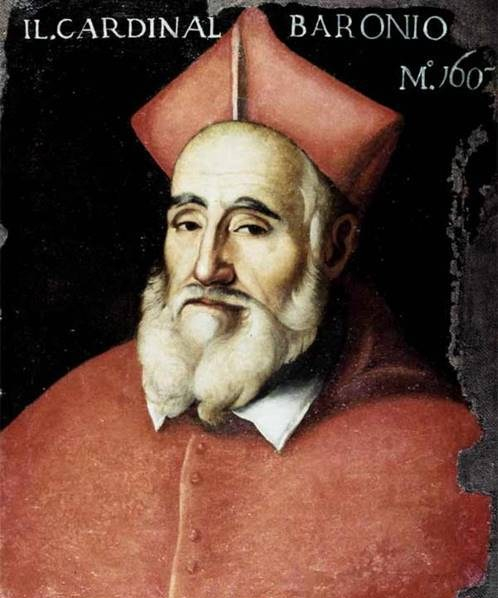
BaroniusColor

Portrait of Cesar Cardinal Baronius. (Source)

In a recent post, I quoted a letter sent by de Marquais, Abbot of St. Martin’s, to Cesar Baronius about humility and trust in the Providence of God whenever our work seems discouraging. The source I used, the Mediatrix Press edition of Lady Amabel Kerr’s biography of Baronius, has been a great read thus far. In the same chapter, I also found this excellent passage from the Annals, presumably also translated by Lady Kerr herself. She takes it from the dedication of the sixth volume of the Annals.

“No man, however distinguished in intellect or excellent in virtue, is sufficient of himself to handle sacred things. This is clearly demonstrated in Scripture by the example of that artificer who, though employed on only the mechanical structure of the place wherein God was to be worshipped, was declared by Moses to be thereby specially united to divine things. ‘The Lord has filled Bezaleel with the Spirit of God,’ said he, ‘with wisdom and understanding and knowledge and learning, and to work in gold, silver and brass, and in engraving stones and in carpenter’s work. Whatever can be devised artificially He hath given his hand.’ Yet Moses adds that even this work, so well done by aid of the Holy Spirit, was not to be used for God until it had been blessed. If then he who handled only the materials intended for the future service of God had to be himself given to God, how much more is expected of him on whom falls the burden of expounding those things which belong to the truth of the Church. Without doubt he should be ever filled with the Spirit of truth, so that he may complete his work standing firm in the truth.” (qtd. in Kerr 156-57)

As someone who hopes to someday write actual theology, I find these words both challenging and profound. I love the idea that a book can be a kind of little Tabernacle. I hope to carry out my own workacademic, creative, and whatever I can throw up on this blogin just such a spirit.

Too often, it seems that contemporary theologians treat their field as part of the Humanities rather than Divinity. They are overly concerned with political questions, or theories of signification and interpretation, or some such narrow province. On the other hand, some would go too far and forget the other side of the truth that Baronius expounds through his metaphor. The theologian, like Bezaleel, prepares a human work fit for a divine dwelling, but it is indeed a human work. It should speak a human language.

The proper posture, I think, is somewhere between the two. In other words—theologians must remember that their vocation, like all vocations, is theandric. The Sophiological Renaissance led by Michael Martin and the other folks over at Jesus: The Imagination seems to be a good example of that balance applied to actual religious writing. So is the deeply Eucharistic monastic theology of Dom Mark Daniel Kirby. In both of these (very different) cases, the writers achieve the divinity-humanity balance in their theology by hewing close to the sacraments and the sacramental worldview. As Sergius Bulgakov said, “one should imbibe theology from the bottom of the Eucharistic Chalice.”

I like to think that Cardinal Baronius might agree.

The Poetry of St. Philip Neri

SanFelipeRed

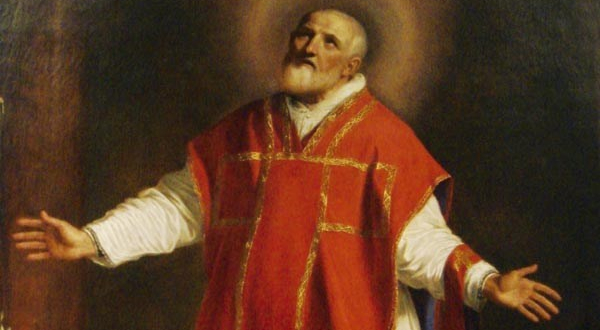
He would be 502 years old today. (Source).

In honor of St. Philip Neri’s birthday today, I reproduce here the translations of two of his three surviving sonnets, taken from the Liturgia Latina collection of Oratorian materials. That site reports that the translations from the original Italian are by Fr Henry Ignatius Dudley Ryder, of the Birmingham Oratory.

I.

The soul derives from God her being high,
In one keen instant out of nothing brought,
Not painfully through second causes wrought;
How should she, then, submit to things that die?

To hope, desire, to joy, to enmity;
To her confusion by these guides mistaught,
Of One confronting her she knoweth naught,
One glimpse of Whom would lift her to the sky.

How should the baser nature dare rebel
Against the higher, nor, as meet, consent
To do its bidding, but essay to quell?

Why prison bars the aspiring soul prevent
From leaving earth, above the stars to dwell,
To die to self, to live to God, intent.

II.

I love, and loving must love ceaselessly,
So whole a conquest in me love hath won;
My love to Thee, Thy love to me doth run,
In Thee I live, and Thou dost live in me.

Surely the day is nigh when I may flee
From this dark gaol, for ever to have done
With vanity and blind oblivion,
Where, exiled from myself, I used to be.

Earth laughs and sky, green branches and soft air,
The winds are quiet, and the water still,
No sun before has shed so bright a day;

The gay birds sing, love’s joy is everywhere;
My heart alone has no responsive thrill,
My powers flag and shrink from joy away.

The Advice of an Abbot

17thCenturyAbbot

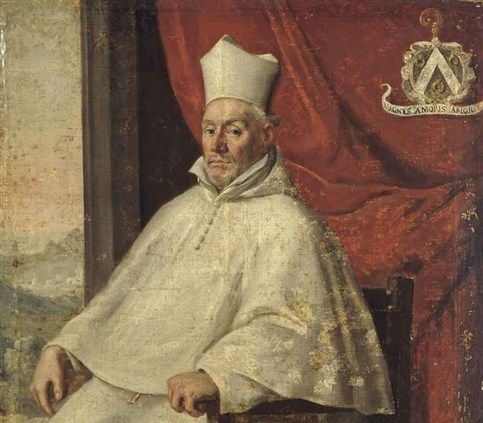
Portrait of an abbot, half-length, in a white cassock, before a draped curtain, a landscape beyond, Italian School, c. 17th century. (Source)

I came across this passage in Lady Amabel Kerr’s biography of Cardinal Baronius, as republished by Mediatrix Press in 2015. It comes a letter sent by the Abbot of St. Martin’s to Baronius when the latter was “in a fit of despondency…as to the real value of the Annals” (Kerr 154). I felt it was a good bit of advice generally, and thought I’d make it more readily available here for those who might derive some benefit therefrom. The translation is, no doubt, from Lady Kerr’s own hand. It can be found on page 154 of the volume.

Do not be cast down. Eat the bread of life and drink of eternal wisdom; and so will you more easily reach the Mount of God. You have not got to live for yourself alone, but for the Church of God and the good of your fellow men. Acquit yourself manfully, and your heart will be comforted, and God will sustain you. Truly it belongs to our mortality to be filled with fear when we look forward to the day of our judgment; but perceiving as we do so many earnests of our eternal happiness, and experiencing as we do the work of the Spirit of God within us, why should we be anxious and tormented of soul? Be of good heart, my Cesare, and think of nothing but of persevering until you have completed your work, which is so pleasing to the Church, and which will live for ever. When it is finished, then by all means devote yourself solely to the thoughts of eternal life; and I feel confident that at the last day the just Judge will give to you, who have worn yourself out by your labours for Him, a crown of justice.

The Orange Pope

Yesterday was the 327th anniversary of the Battle of the Boyne, when the forces of Protestant Britain defeated the Catholic Irishmen fighting for James II, rightful king of England, Scotland, and Ireland. It is a black day for many Catholics, in no small part because many of them descend from Irish communities that remember the oppression that followed under the penal laws. In Northern Ireland today, July 12th remains a divisive date marked by sectarian tensions and the triumphalist pageantry of the native Scotch-Irish Protestants. One wonders whether the new Conservative-DUP alliance in the Commons will have had any affect on the infamous marches of the Orange Order, founded in remembrance of today’s events.As cursed as the memory of the Boyne remains for Catholics today, it’s worth remembering that things were a bit more complex in the 17th century. I enjoy a good bit of Jacobite nostalgia as much as the next trad, but I also think a more honest assessment of history is worth exploring. Human life is a complicated thing, and the strange story of the Williamite War is riddled with contradictions.

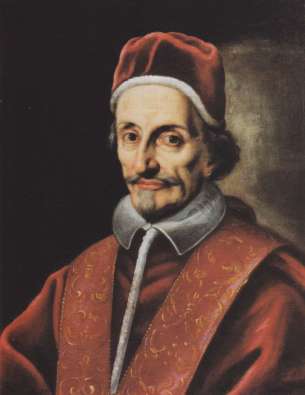
Tremendous irony lies at the heart of the Boyne and what it represents. William of Orange, the stalwart champion of Protestantism, overthrew the Catholic James while secretly in league with Pope Innocent XI.

InnocentXI

His Holiness, Innocent XI P.M. (Source).

Innocent’s political priorities centered on maintaining the balance of power in Europe. In 1690, that meant checking the bellicose Louis XIV. Ever since the marriage of Charles I and Henrietta Maria, the British Crown had been in an ever-closer relationship with France. James II was Louis’s only real ally, and Innocent knew it. The Pope also seems to have considered James a bit dull. He is known to have found his methods in the re-conversion of England more than a little imprudent (it was, in short, a massive failure of triangulation between the vitriolically anti-Catholic Whigs and the pro-Establishment Tories. James was not shrewd enough to manage the two, and ended up pleasing no one).

There was another threat on the table. The future of Catholic France was at stake. Louis XIV had, on the one hand, made moves designed to give him the appearance of Catholic zeal. The revocation of the Edict of Nantes, though not approved by the Pope, is perhaps the greatest example. More troublingly, Louis had rammed through the Four Articles that so antagonized the Papacy by more or less establishing Gallicanism throughout the land. Innocent fought against these measures.

Things came to a boiling point when the Pope, in league with almost all the crowned heads of Europe, clashed with Louis over who would fill the see of Cologne. When the election proved inconclusive, Innocent decided in favor of his own candidate. To quote the Catholic Encyclopedia: “Louis XIV retaliated by taking possession of the papal territory of Avignon, imprisoning the papal nuncio and appealing to a general council. Nor did he conceal his intention to separate the French Church entirely from Rome. The Pope remained firm.”

Enter the Dutch.

image.png
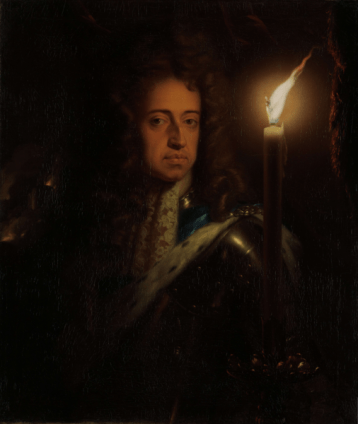
Willem III, Prince of Orange, King of England and Stadtholder, by Godfried Schalcken. c. 1692-97. (Source)

It is unclear to what extent Innocent might have aided William of Orange. An old legend current at the time asserts that the Pope had financed the expedition with a secret loan of 150,000 scudi. As one reporter puts it, “The sum, equivalent to more than £3.5 million today, equalled the Vatican’s annual budget deficit.” There is, it seems, some truth to this statement. The legend has been supported by more recent research, such as that conducted by the fiction authors Rita Monaldi and Francesco Sorti. They uncovered evidence that corroborated the longstanding claims of other historians.

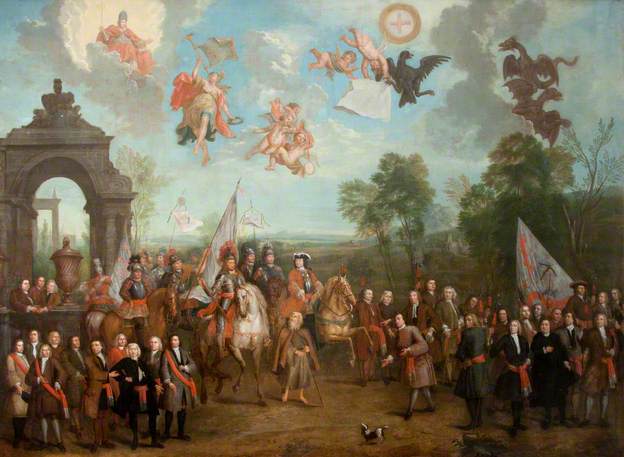
Which leads us to a singular painting by Pieter van der Meulen, The Entry of King William Into Ireland. It has played a controversial role in Northern Irish history. Purchased by the Unionist government of Ulster in 1933, it originally hung in the Great Hall of Stormont. After shifting locations several times, eventually the Rev. Dr. Ian Paisley (of all people) hung it in his office. It is presumably the only picture of the Pope in glory that Dr. Paisley ever liked.

(c) Northern Ireland Assembly; Supplied by The Public Catalogue Foundation

The Entry of King William Into Ireland, Pieter van der Meulen. (c) Northern Ireland Assembly; Supplied by The Public Catalogue Foundation. (Source).

So, why would a Pope act against a Catholic monarcheven covertly?

It seems that he sold Britain and Ireland to save France…and by extension, continental Catholicism. It was a gamble, and a costly one at that. But it seems to have worked in the short run. Although France would later see a terrible anti-Catholic upheaval of its own, Louis was forced to abandon his immediate moves towards schism. He did not become a French Henry VIII. Among all the terrible things that followed the Boyne, at least that one very important good came of it.


Remember Hamburg

Hamburg_cartoon

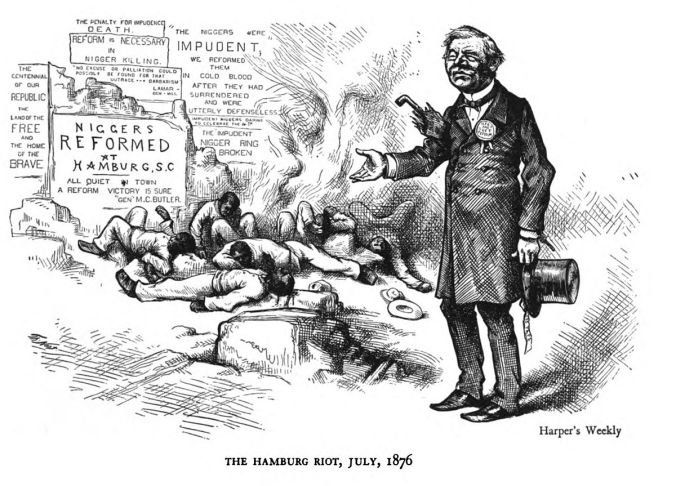
Reaction of the Northern press to the Hamburg Massacre. (Source).

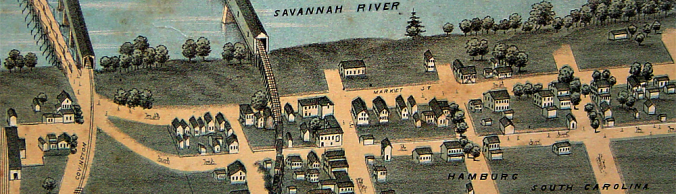
One of the great tragedies of Reconstruction was the Hamburg Massacre, committed 141 years ago today. Never heard of it? Neither had I prior to last summer. That was when I saw a temporary exhibit at the Aiken County History Museum, in Aiken, South Carolina. The story shocked me. I reproduce for you here a summary from BlackPast.org.

On July 8, 1876, the small town of Hamburg, South Carolina erupted in violence as the community’s African American militia clashed with whites from the surrounding rural area.  Hamburg was a small all-black community across the river from Augusta, Georgia.   Like many African American communities in South Carolina, it was solidly Republican and with the GOP in charge in Columbia, some of its men were members of the South Carolina National Guard (the Militia).

On July 4, two white farmers from surrounding Edgefield County, Thomas Butler and Henry Getzen, attempted to drive a carriage through the town along the main road, but were obstructed by the all-black Militia which was engaged in a military exercise.  Although the farmers got through the military formation after an initial argument, racial tensions remained high.

Two days later Butler and Getzen brought a formal complaint of obstruction of a public road before the local court in Hamburg.  The case was postponed until July 8.  By that point Matthew C. Butler, an Edgefield attorney, appeared as the farmer’s counsel.  Butler demanded that the Hamburg militia company be disbanded although that action had no direct connection to the complaint.

By this point hundreds of armed white men, including many who were members of various rifle clubs, descended upon the small black community.  Militia members retreated to a stone warehouse which they used as their armory.

Hamburg_Massacre1

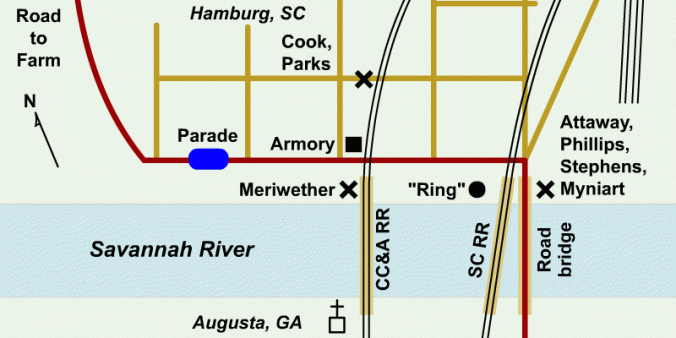
A map of the events. (Source).

Sometime during the afternoon a battle ensued. Surrounded and outnumbered, twenty-five militiamen and fifteen Hamburg residents fought back from the armory. By mid afternoon a white attacker and a militiaman lay dead, and a few more members of the militia were wounded. A cannon was brought over from nearby Augusta and aimed at the armory. As cannon fire blew a hole in the armory, some black militiamen and Hamburg’s Town Marshal, James Cook, attempted to flee. Cook was shot and killed.

The rest of the militiamen and towns people were captured in the armory.  Four of the militiamen were brought out and immediately executed by the white mob. The rest were allowed to escape, though as soon as they began to flee, the whites trained their guns on the escaping men, shooting as many as possible.

Seven men died that afternoon. Six were black militiamen or civilians and one was a white farmer killed in the attack on the armory.

You can read the official report here. The names of the six black men who died are Allen Attaway, Jim Cook, Albert Myniart, Nelder Parker, Moses Parks, David Phillips, and Hampton Stephens.

HamburgMap

The town of Hamburg, SC. It was situated immediately across the river from Augusta, GA. (Source)

The massacre sparked other troubles throughout the state. Benjamin Tillman, a particularly vitriolic racist, led a pack of Red Shirts that rioted in nearby Ellenton. To quote Wikipedia, “The official record of Deputy US Marshalls indicated between 25 and 30 black men were killed. A New York Times reporter in an article stated as many as 100 blacks were killed in the conflicts, which extended to September 21, with several whites wounded.”

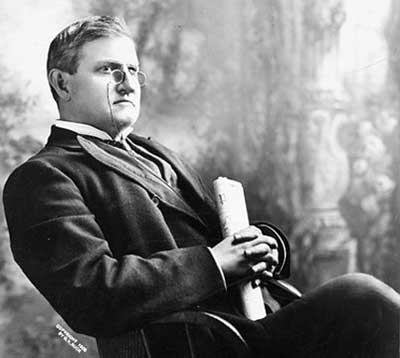
The violence centered on the political tensions. Remember, this was 1876—an election year. Democrats were desperate to take back political control throughout the South. They launched a major campaign of fraud and intimidation to depress the numbers of black voters. The murders at Hamburg, Ellenton, and elsewhere helped sweep Democrat and ex-Confederate general Wade Hampton III to the governor’s office. He went on to “redeem” South Carolina, instituting harsh new laws designed to strictly curtail the rights of the freemen. Tillman would later cite his experience in speeches before the U.S. Senate, stump addresses during his own gubernatorial campaign in 1890, and even a 1909 Red Shirt reunion. On that last occasion, “Pitchfork Ben” declared that “The leading white men of Edgefield” had determined “to seize the opportunity that the Negroes might offer them to provoke a riot and teach the Negroes a lesson.” Tillman claimed that the Hamburg Massacre was a way that “the whites demonstrate[d] their superiority by killing as many of them as possible.” Tillman told his audience,

The purpose of our visit to Hamburg was to strike terror, and the next morning (Sunday) when the negroes who had fled to the swamp returned to the town (some of them never did return, but kept on going) the ghastly sight which met their gaze of seven dead negroes lying stark and stiff, certainly had its effect…It was now after midnight, and the moon high in the heavens looked down peacefully on the deserted town and dead negroes, whose lives had been offered up as a sacrifice to the fanatical teachings and fiendish hate of those who sought to substitute the rule of the African for that of the Caucasian in South Carolina. (Source).

bentillman

Senator and Governor Benjamin “Pitchfork Ben” Tillman, one of the most important white supremacists of the late 19th and early 20th centuries. (Source)

The town of Hamburg eventually washed away in a 1927 flood, with most of the surviving residents relocating to North Augusta. In that city stands a monument to Thomas McKie Meriwether, the only white man who died in the “battle.” It’s a graceful and dignified obelisk that proclaims Meriweather a “young hero” who “gave his life that the civilization builded by his fathers might be preserved for their children’s children unimpaired” and “exemplified the highest ideal of Anglo-Saxon civilization.” The monument breathlessly declares that “By his death he assured to the children of his beloved land the supremacy of that ideal” (Source). No memorial was erected to the six black men killed in the massacre until March of 2016. Their names share a simple stone with Meriwether’s.

These problematic memorials remind me of another controversy very much alive today…and by today, I do truly mean today, July the 8th. Later this afternoon, a collection of white supremacists, fascists, and malcontents will assemble at Lee Park in Charlottesville to protest the removal of the general’s statue. The Washington Post reports that the Ku Klux Klan will be involved and armed. Richard Spencer is headlining the event, but other minor and stranger figures of the Alt-Right are also scheduled to appear (including Augustus Sol InvictusSatanist, Neo-Nazi, ex-Senatorial candidate for the Libertarian Party, and certified Florida Man). The rally, billed as “Unite the Right,” proves a point I have said before and must, sadly, say again; a conservatism that is not anti-racist is not worth defending.

While I don’t have a very strong opinion on the statue’s removal, I do that know that some of my friends will be counter-protesting. I pray that they stay safe. I pray that the forces of violence and oppression will be overcome by the powers of love and justice. And I pray that the horrible example of Hamburg will never be forgottenor repeated.

UPDATE: I mistakenly conflated two different fascist rallies (never thought I’d have to say that). The one on Saturday was just various Klan groups. Photos are all over UVA student and Charlottesville social media. The “Unite the Right” rally is taking place in early August. God deliver us from the Alt-Right.