Finally, Fleet Foxes

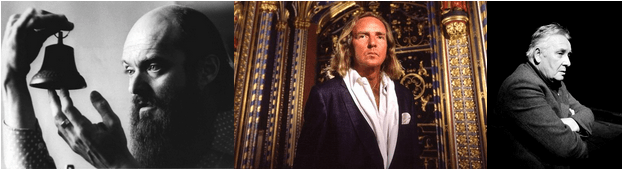
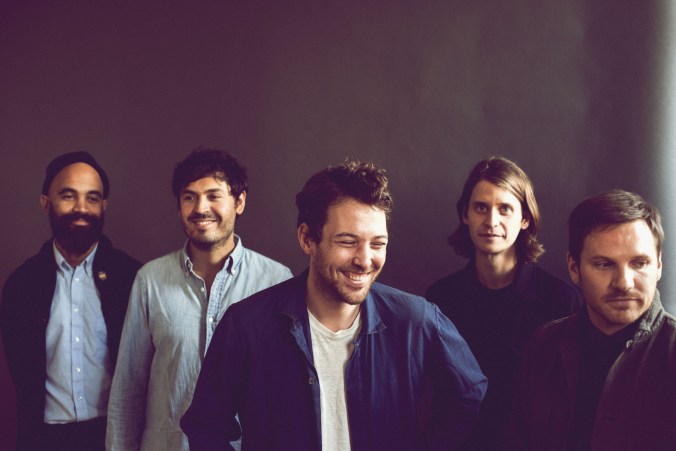
Fleet-Foxes-Press-2017

Fleet Foxes, 2017. (Source)

The day we have waited for has arrived. Fleet Foxes have finally returned with a triumph of an album. Those of us who have been longstanding fans of the band will no doubt recognize in Crack-Up, their new release from Nonesuch Records, an expansion and deepening of the artistry that marked their earlier work. A statement released by the band reads:

From the outset of recording, we aspired to make an album that could stand alongside our previous work, venture into its own territory, and that would leave a clear horizon for us moving forward.

Crack-Up does all these things and more. It is an alternately intimate, exuberant, and cerebral collection of songs. Robin Pecknold, the band’s frontman and chief songwriter, spent four years at Columbia University after 2011’s Helplessness Blues. It’s evident that he paid attention in class. Allusions to Shakespeare and Shaw and Beowulf and Goya and Muhammad Ali and classical history pepper the poetic lyrics alongside references to contemporary political events. The rhythm of Pecknold’s words at times seems to evoke the sprung rhyme of Gerard Manley Hopkins (see, for instance, the first song on the album, “I Am All That I Need / Arroyo Seco / Thumbprint Scar“). Musically, Pecknold draws from sources as diverse as medieval music (even mentioning the Dorian mode in some of the lyrics) and Ethiopian jazz. It is, needless to say, a sophisticated album.

Yet its sophistication remains understated. Fleet Foxes manage to avoid the self-important pretensions of their one-time drummer, Father John Misty. Even in songs that comment on the acid politics of our time, we never hear the kind of hamfisted preaching that FJM is so fond of. Instead, we have the sense that we are listening to creative representations, an earnest testimony of experiences and impressions filtered through disparate symbols of personal and civilizational import.

Take this verse from “Cassius,

Song of masses, passing outside
All inciting the fifth of July
When guns for hire open fire
Blind against the dawn
When the knights in iron took the pawn
You and I, out into the night
Held within the line that they have drawn

What a breath of fresh air after Father John Misty’s pompous propaganda! Pecknold never allows his own agenda to get in the way of his first duty as an artistproducing good art.

Consider, if you will, the multiple layers of meaning he invests in one of his songs.

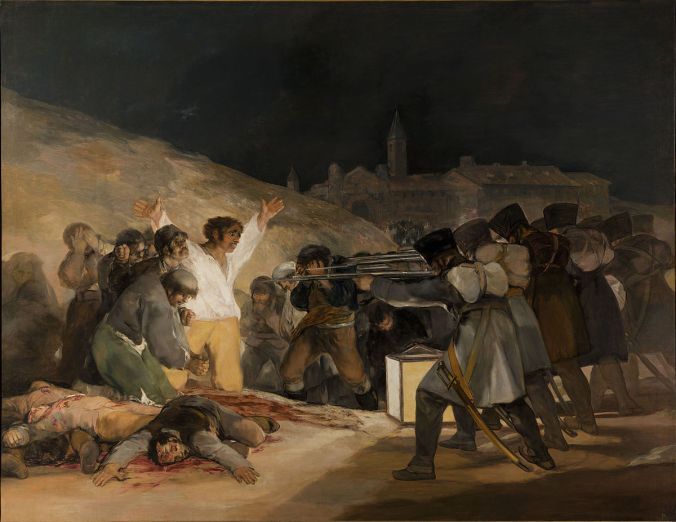
GoyaThirdofMay

A very important painting. (Source).

The painting you see above is The Third of May 1808, by Francisco Goya, circa 1814. The image seems to have influenced one of the best songs on the album, “Third of May / Ōdaigahara.” The music video of that song shows us a splattering of multicolored paint. As it runs across the screen in extreme close-up, we can catch a certain formal resemblance to the flow of spilled blood. Taking into account the album’s overall political orientation, I’d suggest that it’s likely that Pecknold probably sees something of our own social moment in the painting. I would further guess that, as with other songs on the album, the allusion refers to recent cases of police brutality. After all, the painting depicts a dark-skinned man with his hands up about to be killed by men in uniform. If my interpretation is correct, then perhaps the point of the song as represented in the video is to suggest that even the death of innocents can be transfigured into art.

Finding that meaning requires a coalescence of art history, lyrics, video, music, the other songs on the album, and the news. It is, simply put, a minor feat of artistic genius. Of course, Robin Pecknold has provided some rather different elucidation of his own which is well worth checking out (he has a great comment on the line about “carved ivory”). Great art bears many meanings.

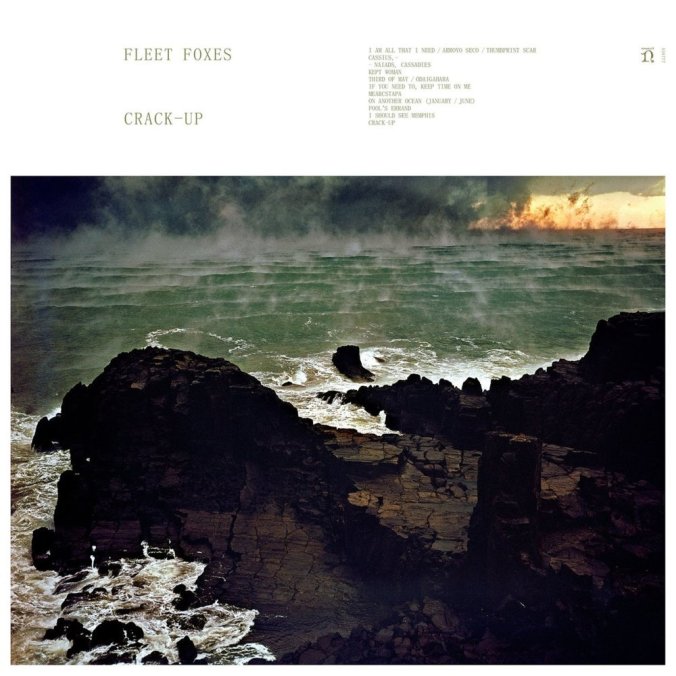
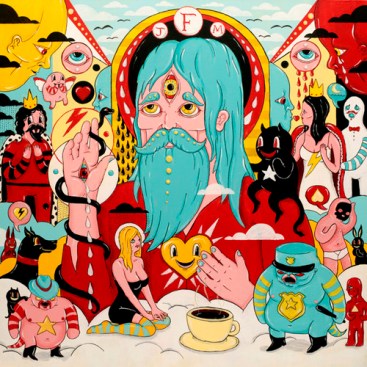
There’s more to like here. Rarely is an album composed of such tightly-wedded form and content. An oceanic motif winds through the lyrics. Likewise, the music rises and falls with the rhythm of the sea, crashing gloriously and settling into glassy streams. Listening to Crack-Up is like diving into a steaming sea, only to feel deeper currents of cool water tug from below. The pelagic theme even extends to the album’s visualsits cover and the (very aesthetic) music video for “Fool’s Errand” both depict the rocky Pacific coast. And those astract arrangements of wet paint that move around in the video for “Third of May / Ōdaigahara” are probably watercolors.


FleetFoxesCrackUp

Album cover, Crack-Up. (Source).

Particular favorites include the haunting “Kept Woman” and the meditative and atmospheric “I Should See Memphis.” The titular, concluding song is pretty great, too. I can’t say that I have too many criticisms. A few of the songs are a bit bland. The album lacks some of the dark beauty that made Helplessness Blues so stirring. Alas. We can’t always get what we want. There is more than enough new spirit in this album to make up for that loss.

Crack-Up
Fleet Foxes, Nonesuch Records
8.5/10 stars

The Oratorian Option

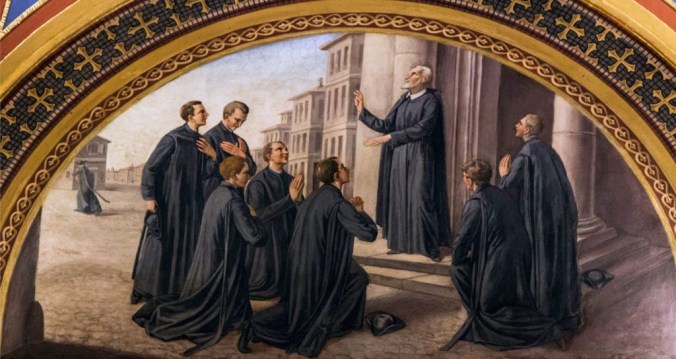
StPhilipNeriandEnglishSeminarians

St. Philip Neri blessing the departing seminarians of the English College. Fr. V.J. Matthews tells us that St. Philip would hail the seminarians, whose college is directly across from San Girolamo, with the words Salvete Flores Martyrum, “Hail, flowers of the Martyrs” (Matthews 85). Edited photo by Fr. Lawrence Lew, OP.  (Source).

In a recent post, I suggested that Rod Dreher’s The Benedict Option is a flawed, if well-intentioned, strategy for the Church in our times. I stand by that opinion. I also would like to offer my own “option,” as so many others have done. I will refrain from detailing specific suggestions and strategies, as I have neither the time nor the knowledge nor the experience to profitably contribute to any discussion of specifics. Nonetheless, I think I can say a few things about the general spirit and principles of what we might choose instead of The Benedict Option.

For starters, it would be called something different. Although St. Benedict is an eminent and powerful patriarch, I submit to you that, for our purposes, we must look at another man in an era far more like our own, a man whose spiritual sons also offer powerful examples. That man, of course, is St. Philip Neri.

Early Modernity as Proto-Postmodernity

Like Dreher, I choose my patron saint in part because I think the unique conditions of our own moment deeply resonate with those which St. Philip faced. Any comparison between different periods of time are naturally going to fall flat in certain specifics. But consider, if you will, the following phenomena.

The rise of the Internet, like the advent of printing, has opened up new models of knowledge and new conceptions of the self. Our lives are ever more global, even as new forms of nationalism emerge. We are increasingly aware of various forms of religious difference. Some are extremist, and even violent (see, inter alia, the Münster Rebellion and the sects of the Interregnum). Within the Church, we face public in-fighting among the Cardinals, dangerous sacramental, moral, and doctrinal laxism, a German Church that is falling apart, and a Pope whom the Roman People themselves dislike. We face serious problems with the climate. Our educational aspirations and models are increasingly oriented towards social climbing, even as our specialties are becoming narrower. Literary and textual criticism set the terms of debate in the academy. More broadly, sexual mores have changed considerably, and culture war is the order of the day. Homosexuality and gender nonconformity have emerged as increasingly widely-recognized social phenomena. Our civilizational relationship with Islam is complicated, to say the least. Class divisions and structural inequality have led to political instability. Indeed, unthinkable political events, stemming in large part from those class frictions, have jettisoned any sense of certainty we might hope to sustain.

St. Philip arrived in Rome shortly after just such an unthinkable event. In 1527, the armies of the Emperor descended upon the Papal States and launched a horrifyingly brutal sack of the Eternal City. Both Lutheran andmore scandalouslyCatholic soldiers raped, pillaged, and desecrated their way through Rome. It was the second and last sack of Rome committed by civilized Christians, and it put an effective end to the Renaissance in that great city.

Alfonso Cardinal Capecelatro, one of St. Philip’s nineteenth century biographers, describes the event as:

…the terrible sack of Rome in 1527, which had no parallel in the history of the Church, whether regarded as a warning or a chastisement. We must go back to Attila and Genseric to find any event which even distantly approaches it in horror; and even those barbarians were civilized and even reverent in comparison with the soldiers of the most Catholic king and emperor, Charles V. A drunken, furious horde of Lutherans and Catholics together was let loose upon Rome…there were…unutterable outrages not to be thought of without a shudder. (Capecelatro 23).

Pertinent to our purposes, however, is the effect that this calamity left on the culture of Rome. Here, too, Capecelatro is a helpful resource.

To enter into the city of the Holy Apostles Peter and Paul at a time when their authority was spurned, vilified, and trampled into the mire by a terrible heresy; to visit the spots hallowed by the blood of martyrs when all around were the hideous traces of their recent profanation; to live in the holy city when the lives of the clergy themselves were dissolute or unbecoming, when paganism in science and letters and art was alone in honours must have been, to the heart of a saint such as Philip’s, an anguish inconceivably bitter. (Capecelatro 24).
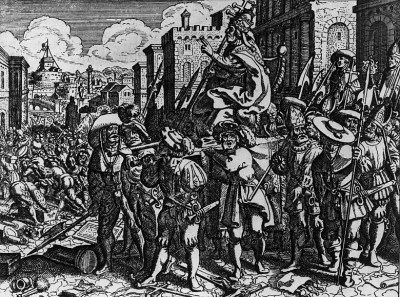
SackofRome1527

A blasphemous mock-Papal procession during the 1527 Sack of Rome. (Source).

If, like Dreher, we wish to compare our own times to the sack of Rome, we ought to look a thousand years later than he does. As with Rome circa 1535, we live in a culture riddled with “a terrible heresy,” Dreher’s “Moralistic Therapeutic Deism” (among others). We Christians in America have witnessed the martyrdoms of our Coptic and Middle Eastern brethren over mass media. The Church is still reeling from a time when “the lives of the clergy themselves were dissolute [and] unbecoming.” The sins of clerical sex abuse continue. And insofar as there is a pagan tendency in our culture today (Camille Paglia certainly thinks there is), it resides in our “science and letters and art.”

While I don’t wish to belabor the point too much, I’ll add that not all is cause for alarm. Many of the good things about early modernity are also true today.

In 1850, Fr. Faber gave a series of lectures to his spiritual sons at the London Oratory. His subject was “The Spirit and Genius of St. Philip Neri.” The second lecture includes a long consideration of St. Philip as the “representative saint of modern times” (Faber 38). Faber argues,

The very essence of heresy and schism is constantly found in the disobedient and antiquarian worship of some pet past ages of the Church, in contradistinction to the present age, in which a man’s duties lie, and wherein the spirit and vigour of the living Church are in active and majestic energy. The Church of a heretic or schismatic is in books and on paper…A Catholic, on the contrary, belongs to the divine, living, acting, speaking, controlling Church, and recognizes nothing in past ages beyond and edifying and instructive record of a dispensation, very beautiful and fit for its day, but under which God has not cast his lot, and which, therefore, he has no business to meddle with or to endeavour to recall. One age may evoke his sympathies, or harmonize with his taste, more than another. Yet he sees beauty in all and fitness in all, because his faith discerns Providence in all. (Faber 40-41).

Dreher would do well to note Fr. Faber’s point. The uncharitable pessimism that animates so much of The Benedict Option is not entirely misbegotten, but certainly falls short of the truth. And why? In part, because Dreher never mentions Church history. His historical narrative of Christianity in Western culture overlooks the actual ways that Christians have responded to modernity since the 16th century. Fr. Faber does not. Instead, he writes,

…it is plain that we are in possession of a great many more doctrinal definitions than we were; the limits of theological certainty are immensely extended. Just as verified observations have extended the domain of the physical sciences, so the number of truths which a believer cannot, without impiety, or in some cases formal heresy, reject, has added to the domain of theology…Now this greater body of certain dogmatic teaching must necessarily influence the whole multitude of believers. It it tells upon literature; it tells upon popular devotion; it tells upon practice…and lastly, it tells upon ecclesiastical art…Neither, in speaking of Modern Times, must we omit to notice the natural connection there is between an increased knowledge of dogma, and the spirit of reverent familiarity in devotion, which has been so prominent a feature in the later Saints.  The more extended the vision of faith becomes, th more familiar a man necessarily grows with the sacred objects of which that faith so infallibly assures him…We must not omit then to name the increase and greater universality of mental prayer, the more generally adopted systematic methods of self-examination, the more common practice of spiritual reading, the ways of hearing mass, the obligation of meditation made the condition in most cases of gaining the indulgences of the Rosary, and other things which are all so many marks of what is called nowadays the increased “subjectivity” of the Modern Mind.(Faber 44-46, 49-50).

FatherFaber2

Fr. Frederick William Faber, founder of the Brompton Oratory in London. (Source)

Faber adds that anyone who would ignore this latter tendency towards “subjectivity” when seeking to evangelize would inevitably “find himself miserably out in his reckoning…The experiment would correct itself” (Faber 50). While Fr. Faber’s optimism is perhaps just as simplistic as Dreher’s pessimism, his perspective helps us attain the proper, prudential, balanced orientation towards modernity that The Benedict Option flatly misses.

Faber offers his historical assessment as a prelude to the consideration of St. Philip Neri’s life and spirituality. For Fr. Faber, St. Philip combines in his person and example the very best of what modernity has to offer. After all, Faber notes, Pippo Buono was ordained while the Council of Trent met. His movement began in an urban setting, “the very capital of Christendom itself,” and he managed to meet and influence “people of all nations” (Faber 51).

Even St. Philip’s personality was that of

…a modern gentleman, of scrupulous courtesy, sportive gaiety, acquainted with what was going on in the world, taking a real interest in it, giving and getting information, very neatly dressed, with a shrewd common sense always alive about him, in a modern room with modern furniture, plain, it is true, but with no marks of poverty about it; in a word, with all the ease, the gracefulness, the polish, of a modern gentleman of good birth, considerable accomplishments, and very various information. (Faber 52).

Fair enough. But why bother applying the example of this modern saint to our peculiar cultural and religious circumstances? It is one thing to say that a saint might have something to teach us. It is another thing altogether to say that a saint’s teaching might prepare us for the peculiarly harsh cultural conditions which seem to loom on the horizon (Dreher wasn’t wrong about all of it).

Faber answers this question, too. He writes of St. Philip:

He came to Rome at one of the most solemn crises of the Church; the capital was full of Saints, and full of corruption too. He was the quietest man at his hard work that ever was seen; yet he magnetized the whole city; and when he died he left it quite a different city from what it was, nay, with the impress of his spirit and genius so deep upon it, that it was called his city, and he the apostle of it, second only to St. Peter. It was no man clothed in camel’s hair, with the attractive paraphernalia of supernatural austerities upon him, no St. Francis, with his Chapter of Mats all round the Porziuncula, that the city and its foreign visitants went so anxiously to see; it was simply an agreeable gentleman, in a comfortable little room, apparently doing and saying just what any one else might do or say as well. He had come at his right time; he suited his age; men were attracted; he fulfilled his mission. (Faber 53).

St. Philip’s example is pertinent to our present debate insofar as he reformed late Renaissance Rome, a society much like ours, by means far more achievable and far more charitable than the contorted stratagems of The Benedict Option.

“Roots Are Very Important”

Admittedly, those words weren’t spoken by St. Philip. They’re actually the climactic revelation from Paolo Sorrentino’s La Grande Bellezza (2013), one of my favorite filmsa story that takes place in Rome. And as with all things Roman, St. Philip is never far away.

Two very singular facts stand out about St. Philip. One is that he was deeply attached to the Eternal City. And, relatedly, he never wished to start a religious order. He always claimed that the Congregation was entirely the work of Mary and the Holy Spirit. St. Philip was even reluctant to permit some of his sons to begin a house in Naples, a decision which would ultimately yield the harvest of many saints. Long before that, St. Philip required those priests he sent to San Giovanni dei Fiorentini to return to San Girolamo every day for the exercises of the Oratoryeven in sweltering heat and downpours of rain.

Borromini Facade of Oratorio dei Filippini (as drawn by Barriere, 1720 engraving)

Borromini’s facade of the Roman Oratory, sketched 1720’s. (Source).

In my recent post on St. Philip’s Benedictine tendencies, I noted that St. Philip understood that spiritual fatherhood can only be built upon a certain degree of stability. Along with that comes a strong sense of place, an immersion in the particular life of any given community. This decentralized localism is why every house of the Oratory throughout the world has its own unique spirit and apostolate. The Congregation only unites under the general aegis of St. Philip’s inspiration, not the ordinary vows of a religious order. To use a somewhat hackneyed analogy—if the Jesuits are the global corporations of the ecclesiastical world, then Oratorians are the folks who run mom & pop shops. However, there is a deeper meaning to this organizational quirk that we will have occasion to examine soon.

That domestic spirit can be summed up by the Oratorian conception of nido, or “nest.” As one source has it,

St Philip’s disciples and penitents sometimes sought him out in his room, where the Exercises of the Oratory were held in the early days. The Oratorian does not emulate a monastic detachment which would periodically surrender one’s very bedroom in manifestation of the premise that material goods are merely ad usum. The Oratorian identifies his room as a nido, a “nest.”

Strong Christian community requires roots. Dreher, as well as the good folks over at places like Front Porch Republic and Solidarity Hall, has frequently made this point over the last several years. It is not a new idea. The Benedict Option is peppered with quotes from Wendell Berry, the godfather of all American localist movements today. If Dreher’s Christian communitarianism is to succeed, then it must be predicated on something very much like the Oratorian sense of place. We would be wise to draw upon the domestic spirit of St. Philip’s nido.

santa-maria-in-vallicella-2

The effigy of St. Philip Neri, created from life once he could no longer lead the pilgrimage to the Seven Churches. Currently in possession of the Roman Oratory. (Source).

And that very sense of local domesticity often leads to precisely the kind of worldly engagement that Dreher’s book tends to overlook and minimize. Although St. Philip was by no means a polemicist, he took an active interest in the affairs of the worldas they transpired within the walls of Rome. He intervened in affairs of state only once, when he required Baronius to withhold absolution from the Pope until the latter had reversed the excommunication of Henri IV. This successful bit of string-pulling on St. Philip’s part probably kept the French crown Catholic for the duration of the Bourbon dynasty.

Of course, there is more to Oratorian domesticity than that. St. Philip’s genius lies not only in his stability, but in the way he invested so much of his spiritual ministry with romanità (in every sense of the word). He drew his principle practices from the sun-baked stones and the boiling air of the Eternal City, as if by some secret alchemy. He was famous for leading ever-more popular pilgrimages along the path of the Seven Churches. And all this, to compete with and vitiate the heathen delights of the Carnival. Where else but in Rome could a saint freely lead and care for such masses of pilgrims along such a venerable route? Where else in the history of modern Europe do we see such a providential alignment of personality, place, and practice against the pagans? The established traditions of spirituality which had already formed Rome were in turn re-formed by St. Philip. It is for this reason that he has been given the honorific title of “Apostle of Rome,” alongside Saints Peter and Paul.

As long as Christianity remains tied to the parish structure, it will always be a local religion. Consequently, St. Philip Neri’s unique resourcefulness will always be relevant. Especially today. As one writer puts it, “The mission of an Oratorian is to work at ‘home’; the Oratory is thus an apt instrument of the New Evangelization, re-proposing the gospel in formerly Christian societies.” God furnishes us with opportunities all around, if only we wish to see with “the eyes of the dove” (Cant. 1:15 paraphrased).

Illumine the Intellect

Such sight will be clearer and more invigorating if sharpened by the intellect. St. Philip’s exercises in the Oratory constituted a kind of holy pedagogy for the men of Rome. In his biography of the saint, the French Oratorian Louis Bouyer describes it well:

The programme of their meetings took some ten years to crystallize into the following form: reading with commentary, the commentary taking the form of a conversation, followed by an exhortation by some other speaker. This would be followed in turn by a talk on Church History, with finally, another reading with a commentary, this time from the life of a saint. All this was interspersed with short prayers, hymns and music, and the service always finished with the singing of a new motet or anthem. It was taken for granted that everyone could come and go as they chose, as Philip himself did. He and the other speakers used to sit quite informally on a slightly raised bench facing the gathering. (Bouyer 54).

Another author gives us a more detailed understanding of the kinds of materials that St. Philip and his sons were reading, hearing, and discussing in the exercises:

In St Philip’s time, the most important of his Exercises, which came to be known as the Secular Oratory, or in some places the Little Oratory, was a daily practice spread out over two to three hours during the leisurely Roman siesta and consisting of (1) a period of mental prayer; (2) a reading from the Scriptures or some spiritual book (e.g., Denys the Carthusian, John Climacus, Cassian, Richard of St Victor, Gerson, Catherine of Siena, Innocent III’s De Contemptu Mundi, Serafino da Fermo’s Pharetra Divini Amoris—St Philip’s favourite readings were the Laudi of Jacopone da Todi and The Life of Blessed Colombini by Feo Belcari), followed by a “discourse on the book,” a commentary and dialogue on the subject of the reading; (3) a discourse on the life of a saint; (4) a moral exhortation—a discourse on the virtues and vices; (5) a discourse on the history of the Church; and finally (6) an oratorio or spiritual canticle. (Source).

Herein we find the germ of Oratorian life, “the daily use of the Word of God” (Talpa, quoted here). St. Philip’s model is eminently conversational. The Oratory converts and sanctifies, not only through its stated arms of the sacraments, prayer, and preaching, but through discussionand, as well shall see, aesthetics.

St. Philip was not, however, given to ostentatious and idle chatter. He well understood the words of St. James, that “the tongue is a fire, a world of iniquity” (James 3:6 KJV). Consequently, he always urged his sons to mortify their speech as well as their reason and intellect. The Oratorians were to be wise, intelligent, even scholarly. But they were not to speak freely of the arts and sciences, nor were they to flaunt their learning. One Oratorian father went so far as to feign ignorance of Latin; another would always try to change the subject when any scholarly or humanistic matter came up in conversation. Amare nesciri“to love to be unknown”these words were ever on St. Philip’s lips.

CaesarBaronius

The Venerable Cardinal Caesar Baronius, author of the Annales Ecclesiastici, father of Church history. (Source).

None of this is to suggest that St. Philip was actively anti-intellectual. Far from it! After all, St. Philip was a devoted student of theology and philosophy in his younger days, and Father Faber calls even the mature St. Philip a “great student of history” (Faber 53).  Those words could perhaps be more truly applied to St. Philip’s spiritual son, the Venerable Cardinal Caesar Baronius. It was St. Philip who commanded Baronius to write the Annales Ecclesiastici, the first great work of church history in modern times. The project served a few functions. First, it got Baronius off of preaching, as he had the unpleasant but slightly amusing habit of turning every sermon into a lengthy and vivid discourse on the everlasting torments of hell (I hope that, when he is eventually canonized, the good Cardinal becomes the patron saint of horror writers). The project also productively occupied Baronius’s prodigious intellect, which St. Philip mortified in many other ways. For instance, Baronius was given kitchen duty so frequently that St. Philip playfully wrote above the stove, “Baronius, Coquus Perpetuus.” Finally, St. Philip and Baronius conceived of the book, which unexpectedly became a decades-long enterprise, as a way of challenging the then-dominant historiography of Protestant authors, as exemplified by the Magdeburg Centuries.  A cynic might call this bias. In context, it’s perhaps more fair to interpret Baronius’s motive as one very much akin to those that animate the scholarly disputes of our own day. And because of Baronius’s thoroughgoing method, academic rigor, and meticulous attention to detail, the Annales were received with respect even by those who disputed its claims. It was so impressive a work that several centuries later, Lord Acton could honestly call it “the greatest history of the Church ever written” (Source).
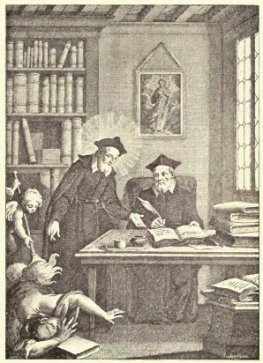
baronius2

St. Philip urging Baronius to write the Annales. (Source).

Nor was Baronius the only model of learning in the Oratory. His fellow cardinal, the aristocratic Francesco Maria Tarugi, was the fox to his hedgehog. Louis Bouyer writes that Tarugi “captivated everyone with his natural eloquence and was never at a loss, no matter what the topic of the moment might be” (Bouyer 64). Here again we see the mark of what we may call the specifically Oratorian geniuserudition crowned with beautiful style and fluency in speech.

If St. Philip stands for an appropriate humility of the intellect, Baronius for a rigorous love of truth, and Tarugi for eloquence in discourse, then we must turn to a fourth figure, the greatest scholar ever to enter the Oratorian life. I speak, of course, of John Henry Cardinal Newman.

In Newman’s long, productive, and complicated life, a few key themes emerge. Three are worth examining in connection with the intellectual tradition of the Oratory. First, we may duly note that Newman always exhibited a great love of knowledge for its own sake, and thus of Truth as such. As he writes in The Idea of a University,

Useful Knowledge then, I grant, has done its work; and Liberal Knowledge as certainly has not done its work,—that is, supposing, as the objectors assume, its direct end, like Religious Knowledge, is to make men better; but this I will not for an instant allow, and, unless I allow it, those objectors have said nothing to the purpose. I admit, rather I maintain, what they have been urging, for I consider Knowledge to have its end in itself. For all its friends, or its enemies, may say, I insist upon it, that it is as real a mistake to burden it with virtue or religion as with the mechanical arts. Its direct business is not to steel the soul against temptation or to console it in affliction, any more than to set the loom in motion, or to direct the steam carriage; be it ever so much the means or the condition of both material and moral advancement, still, taken by and in itself, it as little mends our hearts as it improves our temporal circumstances. And if its eulogists claim for it such a power, they commit the very same kind of encroachment on a province not their own as the political economist who should maintain that his science educated him for casuistry or diplomacy. Knowledge is one thing, virtue is another; good sense is not conscience, refinement is not humility, nor is largeness and justness of view faith. Philosophy, however enlightened, however profound, gives no command over the passions, no influential motives, no vivifying principles. Liberal Education makes not the Christian, not the Catholic, but the gentleman. (The Idea of a University 120-21).

CARDINAL JOHN HENRY NEWMAN PICTURED IN 1865 PHOTO

Newman never abandoned the life of the mind. (Source).

Along with this purity of vision, we naturally find in Newman a perennial appreciation of academic engagement, and when necessary, controversy. Indeed, Newman rose to fame and eventually converted because of his involvement in the ecclesiastical turmoil of the 1830’s and 40’s. He produced his first two great works, Tracts for the Times (1833-1841, in collaboration with others) and The Arians of the Fourth Century (1833) in light of those disputes. Likewise, Newman articulated his great theories of doctrinal development (Essay on the Development of Doctrine, 1845) and the important role of the laity (“On Consulting the Faithful,” 1859) in texts occasioned by ongoing controversies within the Anglican and Roman Catholic churches respectively. And although he could be terribly sensitive to even the slightest criticism, Newman took pains to respond with courtesy, as he did to Charles Kingsley in his famous Apologia Pro Vita Sua (1865). While Newman never sought out polemics and controversies, he was willing to engage in them when the Truth and Honor of God was at stake.

Finally, we ought to remember that Newman was always animated by a sincere love of that singular matrix of the intellectual lifeacademic community. His experience at Oxford profoundly shaped his worldview. He is, of course, still widely regarded as one of the great theorists of higher learning. The Idea of a University (1852, 1858) remains one of the most influential texts on Catholic education in modern times. But the impression that Oxford left on Newman is deeper and more subtle. Newman was drawn to the Oratory in part because he recognized in it the same collegiality that defined the best of the houses at Oxford. Newman writes,

Now I will say in a word what is the nearest approximation in fact to an Oratorian Congregation that I know, and that is, one of the Colleges in the Anglican Universities. Take such a College…change the religion from Protestant to Catholic, and give the Head and Fellows missionary and pastoral work, and you have a Congregation of St Philip before your eyes. (Newman, quoted here).

Newman first considered the Oratory in part because he hoped to offer a ministry to the intellectuals of Britain:

The local bishop, Nicholas Wiseman, invited them to the former seminary at Old Oscott while they decided what to do. Newman named it “Maryvale” and planned some sort of Catholic educational institute there. But then Wiseman sent them off to Rome for ordination. While there, they examined various religious congregations, and realised that St Philip’s Oratory was the most suitable. The Birmingham Oratory was accordingly set up in Maryvale (2 February 1847), before settling on its present site, with another Oratory in London. (Oxford Oratory).

Sadly, Newman was unable to achieve his dream of an Oratory in Oxford during his lifetime. Fr. Jerome Bertram CO has a monograph on the subject, worth looking into. Suffice it to say, Newman looked upon the university as a major and potentially ripe field for an intellectual, aesthetically sensitive Catholic missionary presence. There is a reason why Catholic ministries to university students are very often called Newman Centers.
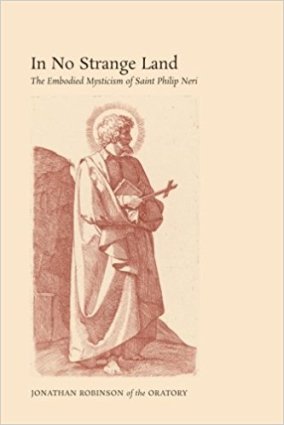
RobinsonBook

The Oratorian tradition of scholarship continues today, as with, inter alia, the work of Fr. Jonathan Robinson of the Toronto Oratory. Here is the cover of his 2015 book, In No Strange Land: The Embodied Mysticism of Saint Philip Neri. (Source).

Insofar as we are trying to draw out principles that might be of use to the Church in the face of the various cultural challenges which prompted Dreher to write The Benedict Option, I think the Oratorian example, particularly as reflected in Newman’s life and work, may be of use. What lesson we should take? That we ought not abandon the universities and all that they stand for. Yes, there are failures of free speech, episodes of intimidation, and other serious problems at many institutions of higher learning. Dreher, to his credit, has done a good job reporting on the recent madness at Middlebury and Evergreen State.

But the universities overwhelmingly remain the central locations of serious intellectual exchange in this country and the world. While there are some impressive institutions of higher learning outside of or parallel to the formal university system, these are few and far between (see, inter alia, the Maryvale Institute and the Institute for Advanced Studies in Culture). For what it’s worth, Alasdair MacIntyre has explicitly argued for a retrenchment of our position within the academy, both in Three Rival Versions of Moral Enquiry (1990) and elsewhere. As Rowan Williams notes in his review of the book, Dreher seems to write off public discourse entirely. Dreher’s decision to do so is very foolish, more likely to hurt than help the position of Christians in our culture. Moreover, it is alien to the quintessentially Oratorian spirit of a man like Newman.

Contemplate Beauty

One of the marks of the Oratorian charism is a devoted attention to aesthetics. Perhaps it is only appropriate that a vocation emerging from and responding to the Neo-Platonist Renaissance should share its love of beauty. The Florentine St. Philip seems to have known instinctively that beauty evangelizes well and widely.
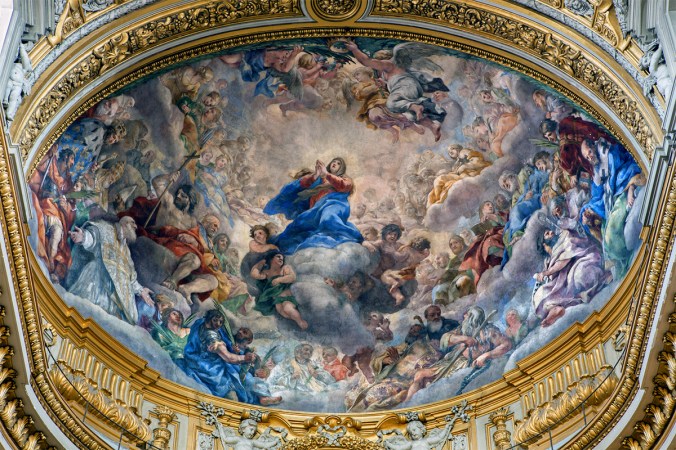
Rome - fresco of Assumption of Virgin Mary in Chiesa Nuova

Baroque apse of Santa Maria in Vallicella, by Pietro da Cortona (Source).

The exercises of the Oratory were never complete without a great deal of music. Louis Bouyer tells us that St. Philip “liked the conversations to be interspersed with music and the meetings to be brought to a close by some singing, so that the evening was filled with harmony” (Bouyer 54). St. Philip engaged the talents of some of the greatest Roman composers of his day. Giovanni Pierluigi da Palestrina took St. Philip as his confessor, and Giovanni Animuccia was so frequently involved that Bouyer tells us, “In all truth nothing but one of Animuccia’s lovely motets could distill the essence of the Oratory and pass it on undiluted” (Bouyer 55). That same essence continued in the Congregation even after St. Philip’s death. Emilio de’ Cavalieri’s Rappresentatione di Anima et di Corpo premiered at the house of the Roman Oratorians in 1600, and as a result, is generally considered the first oratorio.

St. Philip did not limit his careful deployment of beautiful and holy music to the formal exercises of the Oratory. He also knew that the long walks and pilgrimages he conducted around Rome would more easily win souls if they were elevated by sweet harmony. As Bouyer reports,

On such occasions music played a more important role than ever. Animuccia would bring along Rome’s best musicians, and the ‘Adoremus te Christe’ by Orlando de Lassus, or the ‘O vos omnes’ by Vittoria, would mingle with the sound of the fountains’ silvery cascades, of the leaves rustling in the sea breeze…On their way in the freshness of those early summer mornings on the Roman Campagna, Serafino Razzi’s Laudi would alternate with Gregorian Litanies.

At San Sebastiano…would follow a fine Polyphonic Mass, perhaps Palestrina’s wonderful ‘Mass of Pope Marcellus’ or his ‘Ecce Sacerdos magnus’…On their return to the centre of the city they would visit Santa Maria Maggiore on the heights of the Esquiline. Beneath the ceiling which Alexander VI had just decorated with the first American gold to be brought by Christopher Columbus from Peru, and among the Ionic columns of pure white marble, the day would draw to a close in an outburst of Palestrina music, and a ‘Salve Regina’ would fill the falling night with its loveliness gathered from the rivers and the stars. (Bouyer 57-60).

Nor was St. Philip insensible to the appeal of visual beauty. He was fond of Federico Barocci. We can detect in Barocci’s work a certain light sfumato, an airy other-worldliness that hovers over the strikingly intimate scenes the artist depicts. In the works of Barocci, there is something of the spirit of St. Philip, in whom the presence of God was so manifest and so exemplary in one so strangely human.

Federico_Barocci_-_Virgin_and_Child_with_Sts_Simon_and_Jude_(Madonna_di_San_Simone)

Madonna di San Simone, by Federico Barocci, c. 1567. (Source).

Some years after St. Philip’s death, the Oratorian fathers commissioned Caravaggio to create a sizeable painting for a side-altar. The result was the famous “Entombment of Christ (1603-04), now hanging in the Vatican Museums.
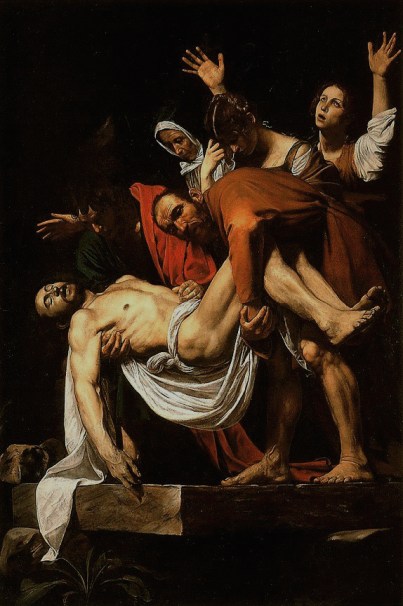
CaravaggioDeposition

The Entombment of Christ, Caravaggio, c. 1603-04. (Source).

These artistic traditions have not fallen away in later houses of the Congregation. The Brompton Oratory in London is renowned for its architecture as well as its world-class Schola Cantorum. Its founder, Fr. Faber, gained wide respect as a hymnodist and poet. Newman also wrote some excellent verse, though he is more commonly regarded as a master prose stylist; Joyce considered him the greatest prose writer in the English language. St. Philip wrote some poetry too, though he destroyed most of his verses before he died. All that survive are a few religious sonnets. As one Italian author puts it,

Philip was perhaps the first who, after the reform in our poetry effected by Bembo and other distinguished men, treated religion with that fine poetic taste with which Petrarch treated the philosophy of Plato. Philip flourished as a poet about 1540; and then he forsook literature and gave himself wholly to God, and flourished far more in holiness, until his death. But though he no longer wrote poetry, he did not set it altogether aside. He well knew its great uses when guided by a christian spirit, and therefore he made a great point of it in his Congregation. He read poetry himself, and ordered that it should be always read and used by his followers in the way described in our previous notes. (Crescimbeni, quoted by Capecelatro, here).

St. Philip frequently found ways of incorporating the Laudi of Jacopone da Todi into the spiritual reading that formed such an important part of the exercises of the Oratory. It was one of only two books we know he brought with him from Florence. The Laudi was a text to which St. Philip returned frequently throughout his life, and one that always bore new graces (Bouyer 53).
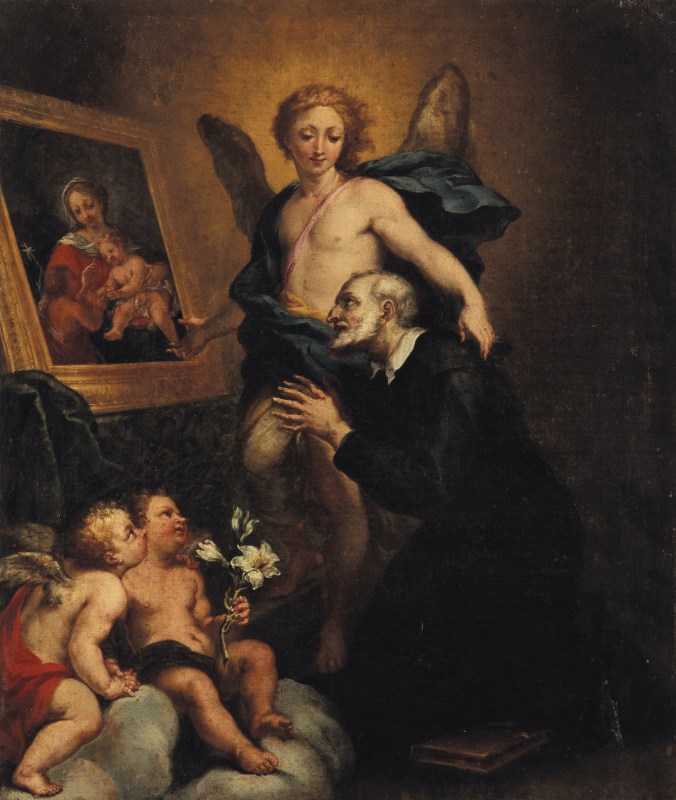
AngelStPhilip

“L’Angelo mostra a San Filippo Neri un dipinto della Vergine con Bambino e San Giovannino,” Circle of Carlo Maratti (Source).

All of this goes to say that St. Philip and his sons were no philistines. They appreciated and, in some cases, produced fine art across a variety of disciplines. While their vocation was never primarily or deliberately aesthetic, Oratorians throughout history have understood the spiritual importance of beauty.

Dreher hits this point pretty well in The Benedict Option. In that sense, my dissent from his recommendation may be more a matter of emphasis than of substance. Insofar as we differ at all, I think my issue is summed up well by Rebecca Bratten Wise:

Perhaps the critics who are timid about these powerful Catholic writers working right now in our midst are waiting for someone else to “baptize” them? Perhaps they are waiting for someone else to say “I heard God there” – because they, themselves, have not learned to open the inner chambers of the ear? Because we do not have a robust Catholic arts culture that teaches us to open all the portals for reception, but instead have embraced a misnamed “Benedict Option” which is all about putting up walls and barriers, drawing those lines in the sand.

Nevertheless, I do strongly criticize Dreher for lacking a sufficiently sacramental vision. The Oratorian aesthetic makes up for this failure, in that it is primarily liturgical.

Live and Love Eucharistically

And thus, we finally turn to the most important feature of St. Philip’s life and charism, the feature which made him a saint and a father of saintshis burning, Eucharistic charity. We can find evidence of St. Philip’s Eucharistic life in the peculiar and highly somatic form of mysticism that we encounter in his vitae. St. Philip never trusted ecstasies and visions, though he was granted such graces himselfusually in connection with the celebration of the Holy Sacrifice.

Capecelatro depicts the scene for us:

But now, in his 76th year, he could no longer restrain the impetuosity of Divine love which glowed within his heart, and he resolved to say Mass in private that he might give free course to his devotion.

MassofSanFilippo

“Madonna con Bambino in trono e san Filippo Neri,” Giacomo Zoboli (Source)

From that time his usual method of saying Mass was this: up to the Domine, non sum dignus, everything went on as before; but at the solemn moment which precedes the priest’s communion, those who were in the chapel withdrew, the server lighted a lamp, put out the altar candles, closed the shutters of the windows, locked both doors, and left the Saint alone with God. Philip would have none to witness the raptures of his love, or to check the freedom of his sighs, words, and tears. A notice was then hung on the door, with these words: “Silence—the Father is saying Mass.” He would remain alone with Jesus in the Adorable Sacrament for two hours, hours of contemplation and of prayer with many tears, and urgent intercession for the Holy Church, the Bride of Jesus Christ, that He would render it as holy in the life of its children as it is in its faith and teaching. After two hours the server came back and knocked gently at the door; if the Saint answered, he opened the door, relighted the candles on the altar, opened the window-shutters, and Philip finished his Mass in the usual way. If the server received no answer, he went away for some time longer, nor did he enter the chapel until the Saint gave some sign that he might do so. What passed in those hours is known to God alone; those who saw Philip when his Mass was over were struck with amazement and awe, until his countenance was pale and wasted, as of one about to die. (Capecelatro 131-32).

And this in the immediate age of Trent! What are we to make of these irregularities?

St. Philip’s Mass is not a model of liturgical praxis, but of liturgical spirituality. In his own highly idiosyncratic prayer, St. Philip becomes a universal model of the soul in adoration of the Eucharistic God. St. Philip was, indeed, one of the great apostles of adoration in his time, as he popularized the Forty Hours’ devotion in Rome. Today, the Quarant’Ore remains a tradition of the Church and the Oratory throughout the world.
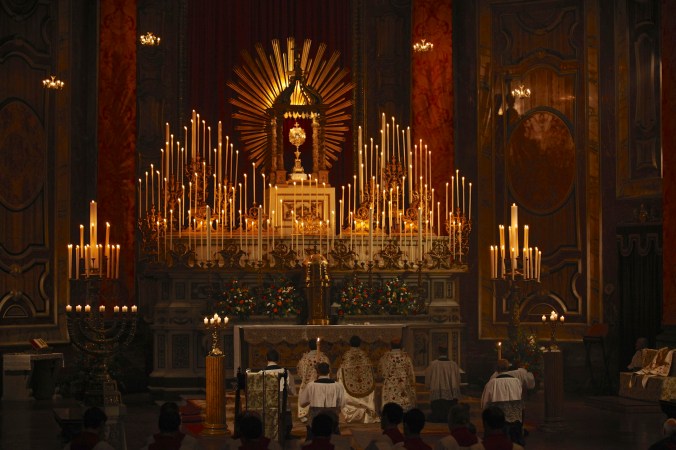
QuarantOreLondon

The Forty Hours’ Devotion at the London Oratory. (Source).

St. Philip’s sons are known for their tender devotion to the liturgical rubrics. In fact, I draw my title from a line in Fr. Jonathan Robinson’s foreword to Resurgent in the Midst of Crisis: Sacred Liturgy, the Traditional Latin Mass, and Renewal in the Church (2014), by Dr. Peter Kwasniewski. Fr. Robinson speaks of an “Oratorian option” not in relation to the early stages of the Benedict Option controversy, but as “a Reform-of-the-Reform ars celebrandi” (Robinson, in Kwasniewski 3). Indeed, the Oratories of the Anglophone world have a particularly strong reputation for their reverent and careful celebration of the Holy Sacrifice of the Mass. As with the best monasteries, the best Oratories exhibit “dignity and magnificence of the liturgical ars celebrandi” (source). In London, Birmingham, Oxford, Toronto, Vienna, Cincinnati, Pittsburgh, Washington, Brisbane, York, Manchesterin short, wherever the spirit of St. Philip prevails over all rivals and distractionswe find a true Domus Orationis, a “House of Prayer” (Matt. 21:13).

The chief fruit of this discipline is supernatural charity. St. Philip sought to found his congregation on this virtue, not the vows which have historically defined the religious state. There is a Trinitarian logic to this plan. For, just as the superabundant love in the heart of the Trinity impels the Three Divine Persons freely to create, redeem, and sanctify, so too should the love of the Oratory overflow into the streets and lead its members to good works. The love of God descends to a love of brethren, which descends in turn to a love of neighbor. Each of these lesser loves ought to confirm, extend, and refine the higher loves. This chain of charity, then, is a veritable Jacob’s ladder, for those in the angelic state are called ever to climb up and down until their passage into beatitude.

Of course, the basic pattern here is not unique to the Oratory. What sets the Oratory apart is its love of the world. A kind of holy worldliness distinguishes the Oratorian spirit, even as St. Philip’s own outlandish behavior earned him a reputation for other-worldliness. I don’t mean to suggest that St. Philip and his sons were given over to the permissive and pagan times in which they lived. Rather, I mean that St. Philip and the Oratorians are characterized by two separate but related qualities that proceed from their Eucharistic life.

First, St. Philip was renowned for prudence. After all, he was a much sought-after confessor. The irony at the heart of so many of his jokes is that, by mocking his own and others’ pretensions, he demonstrated how utterly divorced so many of our lives are from good Christian common sense. In this respect, he was a true fool for Christ very much after the Eastern model. St. Philip’s prudence did indeed appear foolish to those whose vision could not penetrate to the mysteries of God.
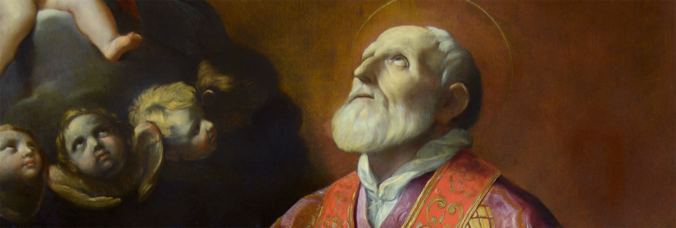
San-Filippo-in-estasi-Guido-Reni-001

From Guido Reni. It seems only appropriate that St. Philip should be so frequently depicted fully vested for Mass. (Source).

While in other ages, prudence led some saints to undertake and advise great hardships for the kingdom, that same virtue taught St. Philip a different path. He drew his own strength from fastidious and hidden rigors, but he always counseled his penitents to avoid excessive asceticism. Once, when the future Cardinal Tarugi, still young and wealthy and vain, came to him for confession, he asked St. Philip if he might wear a hairshirt. St. Philip saw through the man’s pride. He assentedbut only allowed Tarugi to wear the hairshirt on top of all his other garments! For such an admirer of Savonarola, St. Philip could hardly have been farther from his practice when it came to matters of mortification. What little he did urge he usually salted with his own brand of humor. He famously took the Dominican novices of the Minerva out on long picnics and urged them to eat and grow fat. So, too, his pleasant indulgence of children was legendary. And what of those long walks with the crowds under the Roman sky?

St. Philip loved the world. He hated its lies and vices, but he was ever able to peer beyond that sordid stratum and into God’s glory. As one source puts it, “St. Philip was the Apostle of Rome, who by means of the ‘counter-fascination of purity and truth’ reconverted both clerics and laymen in the city at the centre of the Church.” Or, as Louis Bouyer tells us,

Does not Philip, in fact, merely yield to Renaissance optimism? Does he not ignore original sin when he bases his apostolate on freedom and confidence? His ‘religion without tears’ surely expects from undisciplined nature what the discipline of grace alone can produce?

…There is no doubt that it was dangerous to go out against the new paganism with no other arms save love, and just as dangerous to expose his apparently vulnerable simplicity to its disturbing influence, yet his outrageous method made him the victorious apostle of neo-pagan Rome. (Bouyer 28-29).

The love that conquered Rome was the fruit of St. Philip’s sacramental interior life. The unique grace of his special relationship with the Holy Spirit was a cardinal element of that life, but so was his ardent devotion to the Eucharist.

It was this element that I found so disturbingly absent in Dreher’s book. There is no properly Christ-like love of the lost in The Benedict Option, only one angry jeremiad after another. And why? Perhaps because Dreher hardly ever mentions the Eucharist. Dreher writes as if Christ’s presence on earth is an afterthought, one tool among many to be deployed in the quest for community. The result is a spiritually crabbed book, insufficiently sacramental and brimming with self-righteous anxiety.

St. Philip shows us another way.

Conclusion

At the end of the day, there is no silver bullet to halt the various troubles that the Church faces in what seems like an increasingly hostile, secular West. Christ never abandons us to the narrow limits of our own imagination and resources. Instead, He furnishes the Church with untold gifts, charisms, and holy exemplars among the saints. In this sense, the recent proliferation of “Options”to which this essay contributesis probably a blessing.

But we musn’t forget one ineradicable fact. Christ never raises these lesser creations over His own Body, Blood, Soul, and Divinity. There is no blessing, no vocation, and no grace that can go beyond the work of the Adorable Sacrament. If we forsake the one rock of the Altar and instead build upon the sand of the innumerable personal graces and unique charisms spread throughout the Church Universal, then all of our works will shatter beneath the hammer of the storm.

St. Philip Neri understood this truth and lived it out across the long span of his ministry. Those qualities which distinguish the Oratorian charismdomesticity, localism, intellectual rigor, humility, collegiality, aesthetics, urbanity, prudence, and love of the worldcan only be integrated and understood in the light of the sanctuary lamp. St. Philip’s entire life was a ceaseless testament to the power of the Eucharist “for the life of the world” (John 6:52 KJV). In keeping close to the Sacrament and to the example of St. Philip, we may just make it after all.
The Polyphony of Paul Jernberg

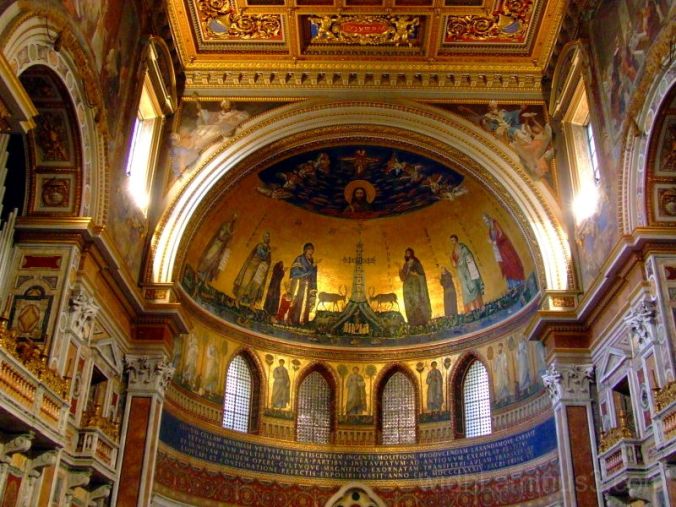
basilica-st-john-lateran

The Basilica of St. John Lateran, Rome. (Source).

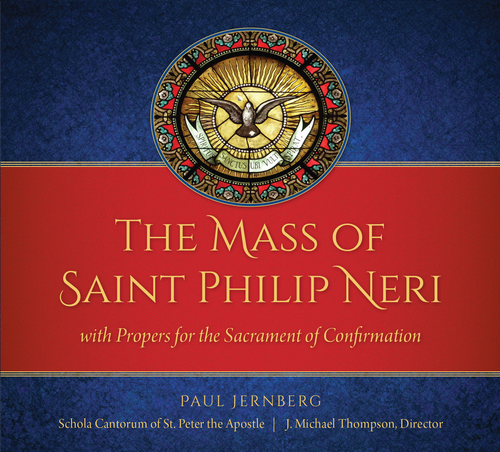
What a delectable treat it is to discover a composer of sacred music who really manages to capture something of the transcendent in his liturgical settings. Having just come across the work of Paul Jernberg, I must say that I am gobsmacked. Really. With his Mass of St. Philip Neri, Jernberg has done for the Latin Rite what Roman Hurko accomplished for the Ukrainians with his Liturgy No. 3. Finally, we have a modern polyphonic Mass setting that evokes the eternal, delights the senses, and inspires the heart with a sense of God’s glory. And in English!

I am sure that those more in the loop of liturgical news will be well aware of this recording from 2014, but it came to me as a revelation. My guess is that most Catholics are probably unaware that a musical setting this rich, hieratic, and flat-out beautiful has come to be in recent years. And no doubt, those with Oratorian connections and interests will also appreciate the particular Mass that Jernberg chose.

Do take some time to listen to the Gloria, the Kyrie, the Alleluia, the Eucharistic Ordinary, the Sanctus, and the various other excerpts provided on Jernberg’s own website. You won’t regret it.

Jernberg

What a feat. (Source).

Twin Mashups of Twin Peaks

TwinPeaksWoodsman1

“Gotta light?” (Source)

If you’re a Twin Peaks fan like me, you watched what must be the strangest hour of material ever to air on television last Sunday. There are those who are also calling it one of the greatest episodes of any tv show in history. They may be right. In any case, Season Three, Part Eight has lingered with me (as with so many others). I thought I’d play around and make some mashups using footage from the new series and sound from the old. Don’t watch either if you don’t want spoilers. And remember to mute and expand the first video in each.

Here’s one using the “Twin Peaks Theme.”

And here’s one using “Laura Palmer’s Theme.

Enjoy.

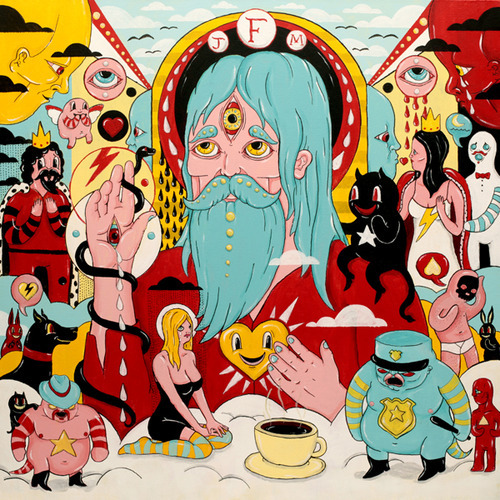
The Waste Land of Father John Misty

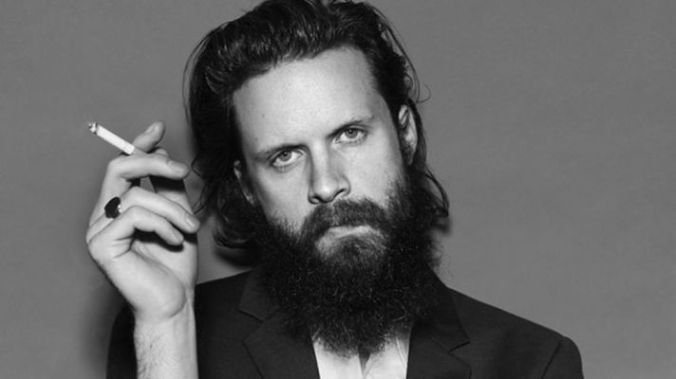
image

Father John Misty. (Source).

A Christ in sunglasses is nailed to a papier-mâché cross. He is, in fact, not just Jesus, but also Macauley Culkin and Kurt Cobain at once, the triune victim of philistines and a squad of jackbooted, mocking Romans who are dressed as Ronald McDonald. A Xenomorphic version of the clown himself pops out of the hook-handed captain’s chest and fires a lazer at a bleeding-eyed Virgin in a red Wendy’s wig. The good thief is Bill Clinton on a confetti-colored cross. The titulus crucis has been replaced with a cardboard scroll that reads “King of the Cucks.” Before departing, the last fast-food fascist takes a selfie with the Cobain-Christ. And good old George Washington, Oculus Rift still clasped to his head, burns to a crisp in orgiastic entertainment as the virtual sacrifice concludes.

Was this an Ayahuasca trip, a mystic hallucination, or a rather heavy-handed SNL skit?

The answer, of course, is D, none of the above. It’s just another Father John Misty video. This one is entitled “Total Entertainment Forever,” and the track comes from his new release from Sub Pop, Pure Comedy. Father John Misty (alias Josh Tillman) has long produced a body of work at once blasphemous and baffling, though occasionally given to brief bursts of beauty. There is less of this latter quality in his newest album, and it’s sorely missed. Tillman has instead given us a project bloated with its own sense of self-importance and suffocating on its own shallow satirical spite.

Of course, it’s perfectly fine for an artist to mock, to rally, or to critique. Some of the greatest art does all three at once. Take, for instance, that modernist monolith, The Waste Land. T.S. Eliot may have contended for years that it was just “the relief of a personal and wholly insignificant grouse against life…just a piece of rhythmical grumbling,” but critics of every generation have recognized in the poem a powerful diagnosis of the sickness of Western civilization. Much of Eliot’s “grouse” remains relevant today, in part because, even as he pilloried all kinds of people, he grounded his art in the perennial images of human culture.

Father John Misty, alas, does not. He is content to complain without saying anything all that deep, and without investing his work with the kind of symbolic depth we recognize in Eliot.

The titular track, “Pure Comedy,” sets the mood for the rest of the album. We might as well spend some time looking at the lyrics. They reveal quite a lot about Father John Misty’s priorities and self-perception. Here are the first lines:

The comedy of man starts like this
Our brains are way too big for our mothers’ hips
And so Nature, she divines this alternative
We emerged half-formed and hope that whoever greets us on the other end
Is kind enough to fill us in
And, babies, that’s pretty much how it’s been ever since

The song goes on to announce that mankind’s lot is really just,

Comedy, now that’s what I call pure comedy.
Just waiting until the part where they start to believe
They’re at the center of everything
And some all-powerful being endowed this horror show with meaning

That right there is the little light in the plane that tells us to buckle up and get ready for the hackneyed atheist bits.

Oh, their religions are the best
They worship themselves yet they’re totally obsessed
With risen zombies, celestial virgins, magic tricks, these unbelievable outfits
And they get terribly upset
When you question their sacred texts
Written by woman-hating epileptics

For those of you who didn’t watch the video I linked above, let me save you some time. He’s not talking about Islam and Judaism. Tilman is mainly targeting Catholicism, even if he refrains from becoming explicit about it in the lyrics. Worse, he’s not even terribly original. The verse just distills the common, fedora-tipping New (c. 2006) Atheism of the Internet. Josh Tilman is no Ivan Karamazov.

Tillman has shown a longstanding interest in religious themes, as his previous two album covers demonstrate. He is known to sprinkle his songs with religious allusions. Pure Comedy features a track entitled “When the God of Love Returns There’ll Be Hell to Pay.” Tillman sings about what he would tell Jesus as the Apocalypse unfolds. He says that he would give Jesus a tour of the world, then says:

Barely got through the prisons and stores
And the pale horse looks a little sick
Says, “Jesus, you didn’t leave a whole lot for me
If this isn’t hell already then tell me what the hell is?”

Tillman, never wary of blasphemy, says to Christ, “And now you’ve got the gall to judge us.” One might point out the irony of Tillman posing as a holier-than-thou moral authority when, just a few lines earlier, he equates prisons and stores. If this fatuous and fundamentally unserious judgment doesn’t betray a warped moral sensibility, then I’m not sure what does.

On a more philosophical note, let me say that it is the prerogative of the artist to explore the bounds of the possible, especially when crafting strange hypotheticals like the one that Tillman imagines. Tillman also works in a long tradition of artists who mediate their work through the careful deployment of personae. His stage-name, Father John Misty, is a good example of this tendency (and a religiously-tinged one at that). But even granting these stipulations about the nature of art, we should remember a third point. All art inherently crafts aesthetic experience and therefore “sets the stage” for a presentation and affective reception of beauty. Insofar as art is bound to beauty, it is necessarily tied to the good and the true as well. Art can deny, flatter, hide, contest, mask, or assail goodness and truth, but it can never be rid of them and their own proper criteria. The problems that arise when we try too hard to make art “good” or “true” are many and easy to identify. But we cannot totally separate the aesthetic world from the moral and scientific spheres of life. An artist whose work displays a perverse moral sensibility may produce great art, but it will be somewhat immoral, and it may not correspond to the way things really are.

FearFun

Fear Fun (2012). A much better album. Note the religious imagery underneath all the chaos.

ILoveYouHoneyBear

I Love You, Honeybear (2015). A not very good but still better album. Here, too, FJM appropriates Christian iconography.

But back to “Pure Comedy.”

Perhaps because his criticism of religion/Christianity is so stale, Tillman spices things up a bit in the next verse by trying to be Relevant© and Woke™. Even without watching the video, you can tell that it’s about a certain unsavory Head of State.

Their languages just serve to confuse them
Their confusion somehow makes them more sure
They build fortunes poisoning their offspring
And hand out prizes when someone patents the cure
Where did they find these goons they elected to rule them?
What makes these clowns they idolize so remarkable?
These mammals are hell-bent on fashioning new gods
So they can go on being godless animals

It’s not clear whether Tillman lost his faith in humanity because of Trump, or if the Donald’s ascent merely confirmed a longstanding pessimism. One could perhaps sympathize with the latter position, if only because it would be intellectually honest.

But I digress.

We come to the emotional climax of the song.

Oh comedy, their illusions they have no choice but to believe
Their horizons that just forever recede
And how’s this for irony, their idea of being free is a prison of beliefs
That they never ever have to leave

I would take his point more seriously if it were not a banal and adolescent bastardization of Camus or Rand or Nietzsche or [insert edgelord here]. “Pure Comedy” is not unique in this sense of immaturity. Listening and reading through all the songs, I was repeatedly reminded of angsty teenage poetry. Tillman’s unhappy tendency to be biographical, abstract, and preachy was not nearly as pronounced in his earlier work as Father John Misty (I can’t speak to his releases as J. Tillman).

Unfortunately, the song doesn’t get better from there. In the final verse, Tillman croons,

The only thing that seems to make them feel alive is the struggle to survive
But the only thing that they request is something to numb the pain with
Until there’s nothing human left
Just random matter suspended in the dark
I hate to say it, but each other’s all we got

The idea of our planet being nothing more than a rock in space comes up again and again throughout the album. At the beginning of one track, Tillman calls the earth “this bright blue marble orbited by trash.” It’s Eliot’s “Unreal City,” brought up to date for the space age. But in that last line, we hear the echoes of Auden’s famous poem about the beginning of World War II; “We must love one another or die.” It’s a maudlin sentiment that Auden repented for the rest of his life. One wonders if Tillman will someday look back on the shallow clichés of “Pure Comedy” with the same sense of regret.

The rest of the album continues these themes. Tillman gives us a tour of the imbecility of human nature, especially as manifested by the entertainment industry, pharmaceutical corporations, Republicans, fast food, the religious, Middle America, social media, public intellectuals, and ideologues of all sorts. By the end, the Holden Caulfield act gets old. In most of the songs, the music trundles along aimlessly, neither powerful nor novel enough to sustain Tilman’s puerile lyrics.

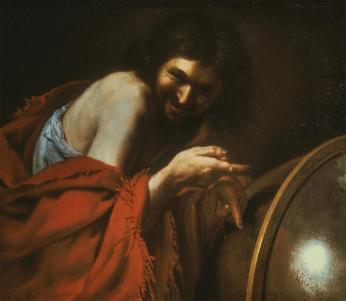
Democritus-laughing

Democritus laughs because he sees that the world is hopeless. (Source).

All of which is a serious disappointment to someone like me, who’s been a fan for years. You see, this ain’t Father John Misty’s first rodeo in the American Wasteland. His earlier work often treated these same themes, but in a more aesthetically and intellectually sophisticated way. Where in Pure Comedy do we find a song that matches the sultry and haunting sense of doom rippling through “Funtimes in Babylon?” Or the perky, quirky, frenzied mania of “I’m Writing a Novel?” Or the languid malaise of “Bored in The USA?” Or the soulfully earnest and operatically desperate madman’s litany, “Holy Shit,” perhaps Tilman’s finest piece yet? All of these songs work, not just because of their evocative lyrics, but because they are genuine musical accomplishments. Each is a gem of a song in its own way. In each, Tillman flexes the considerable powers of his unique voice. His sound manages to swing seamlessly between a controlled vigor and a vulnerability that shines without brittleness.

The album is not without its strengths. The satire does sometimes land pretty well, as in “Birdie” and “Things It Would Have Been Helpful To Know Before the Revolution” and “Ballad of the Dying Man.” In “The Memo,” Tillman wields his well-refined sense of shock value to drive home an unremittingly cynical take on the entertainment and advertising industries. But perhaps I’m just gravitating to songs that are pretty clearly meant to mock the left establishment or deflate the pretensions of neoliberals and transhumanists.

In “Dying Man,” we hear:

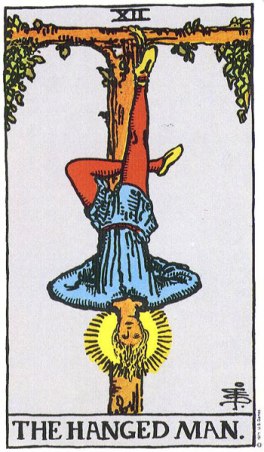
TheHangedManTarot

“Consider Phlebas…” (Source)

So says the dying man once I’m in the box
Just think of all the overrated hacks running amok
And all of the pretentious, ignorant voices that will go unchecked
The homophobes, hipsters, and 1%
The false feminists he’d managed to detect
Oh, who will critique them once he’s left?

A nice bit of biting sarcasm there. But sadly, Tilman smothers his wit under clunky dictiona verbose, chatty mess apparently composed without any care for euphony. Paired with lackluster music, the song fails.

The only really superlative work in the entire album is Tillman’s flawless penultimate track, “So I’m Growing Old on Magic Mountain.” Here, too, he is commenting on the madness of our times. But he’s left aside the pose of the pontificating prophet. Gone are the grand and sweeping lines about “human nature” as in “When the God of Love Returns.” Gone, too, are the plastic, pop-culture in-jokes that masquerade as hot takes; gone, the pearl-clutching about the woes of consumerism and fast food and the stupid white people who vote Republican and believe in God.

Instead, Tillman tells a story. A New Year’s Eve party has just ended, and the revelry is fading away. One of the guests describes the scene.

That’s it. Observe:

The wine has all been emptied
And smoke has cleared
As people file back to the valley
On the last night of life’s party
These days the years thin till I can’t remember
Just what it feels like to be young forever

Tillman’s more symbolic and sensitive tack suits his message; our age echoes the cultural moment that led Thomas Mann to write The Magic Mountain, and coming to grips with that realization has aged us. His sonic scene-craft evokes universal images and elevates the song into a testament of the human condition. If Tilman intends to speak to our particular cultural moment in Pure Comedy, he succeeds with “Magic Mountain.”

The only real shame is that there weren’t more songs like it on the rest of the album.

Pure Comedy
Father John Misty, Sub Pop Records, 2017
5.5/10 stars.

The Fifteen Most Important Films I Have Watched at UVA

In my time at the University of Virginia, I’m grateful to have received an unofficial aesthetic education parallel to (and sometimes part of) what I was learning in class. As part of a series of somewhat nostalgic posts, I’d like to revisit some of these and perhaps leave you with a few recommendations.

Some of this will be review. A great deal will be personal narrative. “Important” here is not an absolute quality, but rather a relative one. These films have been the most important to me over my four years. Moreover, there will be occasional spoilersthough, as with No. 5 and No. 4 on my list, I don’t spoil very much.

Keeping those disclaimers in mind, let’s begin.

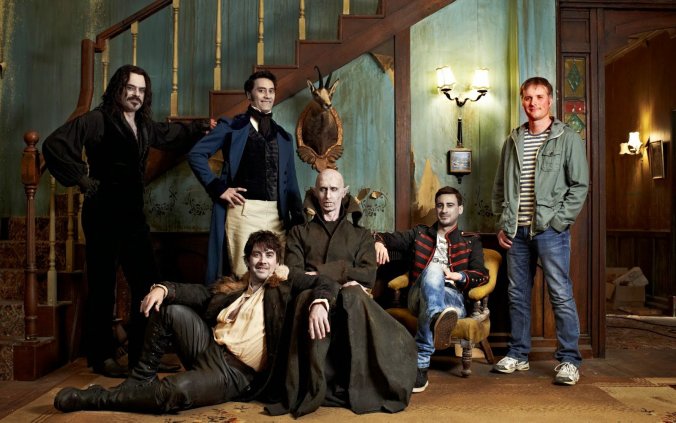
15. What We Do in the Shadows

WhatWeDointheShadows

I watched this New Zealand horror comedy with a friend (whom I will call here and throughout by the name “Sherman Pine”). And I’m glad I did. What We Do in the Shadows is one of the best depictions of male friendship I have ever seen. Not only is the film by turns hilarious and macabre, it also manages to evoke the unique social pressures facing (post)modern man. It deals with issues of difference, acceptance, competition, and more.

And for anyone with a taste for blood – or at the very least, a good vampire story – the number of playfully subverted classic genre tropes in the film will certainly please.

WWDITS was also my introduction to Taika Waititi, whom some of you may recognize as the director of the upcoming Thor: Ragnarok.

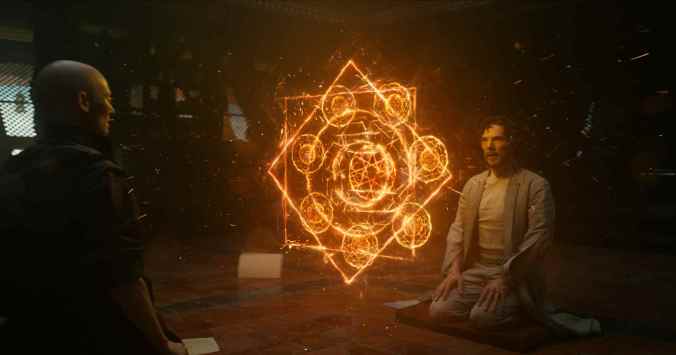
14. Doctor Strange

null

Before I came to UVA, I wasn’t a fan of the Marvel universe. While I wasn’t exactly a DC partisan, I never paid much attention to the Avengers. I disliked the only Iron Man movie I had seen, and I had never bothered to watch any of the Thor or Captain America films.

But then came Guardians of the Galaxy, The Avengers: Age of Ultron, and Captain America: Civil War. Those three films and the conversations with friends that they engendered drastically changed my perspective on Marvel.

None of those, however, reached the artistic or philosophical heights of Doctor Strange. The beautifully kaleidoscopic special effects never drown out the excellent performances by Benedict Cumberbatch, Tilda Swinton, Mads Mikkelsen, and Chiwetel Ejiofor. And the plot contains a number of religious themes. It’s one of the few superhero movies I’ve seen that embraces a quasi-Christian worldview (the climax involves a kind of harrowing of hell).

In short, I guess I can now say that I’m a fan of the Marvel universe. Doctor Strange is just the best reason why.

13. Silence

Screen Shot 2017-03-23 at 1.35.41 PM

Wrenching, problematic, and beautiful, Silence is the only Martin Scorsese film on this list. I saw it with friends from one of my oratorical societies. We all went in with different perspectives, and came out with different reactions. Mostly, I just felt numb. I couldn’t find any words at all, but like Job, felt it necessary to “lay mine hand upon my mouth” in awe (Job 40:4 KJV).

I could probably write at length about the various theological issues, cultural questions, and cinematic gems that the film poses. I won’t. I’ll merely say that, while I found it emotionally crushing, I appreciate that art doesn’t abide by the rules we try to set it. Good Christian art – even Sophianic art – never loses sight of the essential brokenness of our fallen world. If anything, perhaps the great take-away from Silence is something like the advice I was once given by a very holy priest: “Never despair of the mercy of God.”

I’ll add briefly that, as someone who wants to focus on early modern Catholicism, I found the film a helpful occasion to raise awareness about the history of Christian persecution in Japan. The reconstructed world of 17th century Japan is sumptuously simple. Every aesthetic note is perfectly put. It will almost certainly be remembered as Scorsese’s masterpiece.

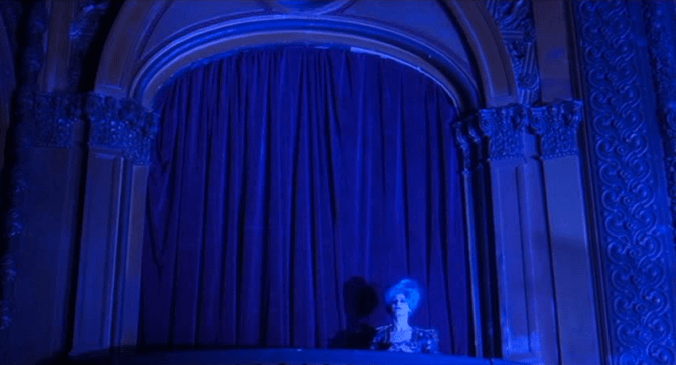
12. Mulholland Drive

Screen Shot 2017-03-23 at 1.32.01 PM

We move from Silence to “Silencio.”

Last Fall, I decided to watch Twin Peaks. That process entailed a general inquiry into the works of David Lynch, whom I had long admired. I told Sherman Pine, who shares my appreciation of Lynch, that I had yet to see the director’s famous neo-noir Mulholland Drive, and he was kind enough to watch it with me.

I still don’t understand this movie. I won’t pretend to. But boy, is it a ride.

I’ll add that Lynch really smartly contrasts different musical styles, which mirrors the doubling in the plot (but I won’t spoil those details). I know of no other director who is so committed to staged performance as a portrayal of themes. Particularly as they relate to the underlying tensions of sex and gender present in much of his work.

11. Days of Heaven

DaysofHeaven

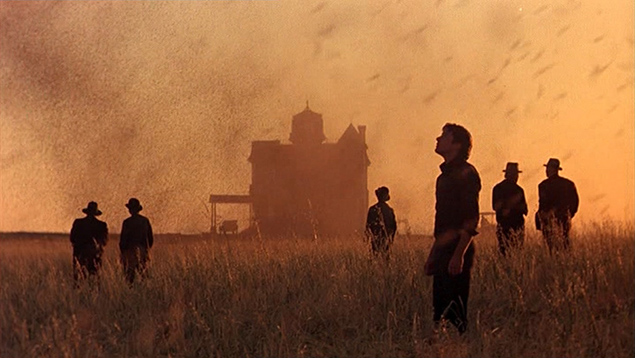
My first Terrence Malick movie, but not the only one on this list. Watching Days of Heaven was like stepping into an Edward Hopper or Andrew Wyeth painting. Like a few other films – say, August: Osage County or NebraskaDays of Heaven stands as one of the quietly towering cinematic monuments of Midwestern life.

I also happened to watch the film with a friend (the aforementioned Sherman Pine) wile I was enrolled in an Anthropology class called “Language and Cinema,” which meant that I was particularly attuned to the way Malick crafts his story through sound. No other film that I know of uses such a wide range of realistic sounds so artfully. You can’t hear all the dialogue, and what you can hear, you can’t always understand. The voice-over narration is spoken by a child in the working-class accent of 1916 Chicago.

Of course, being a Malick film, the visuals are also gorgeous. A swarm of locusts is an inherently mythic phenomenon, but I think that only Malick could make them as beautiful as the sunlight they block and the fields they devour.

10. Do the Right Thing

DoTheRightThing

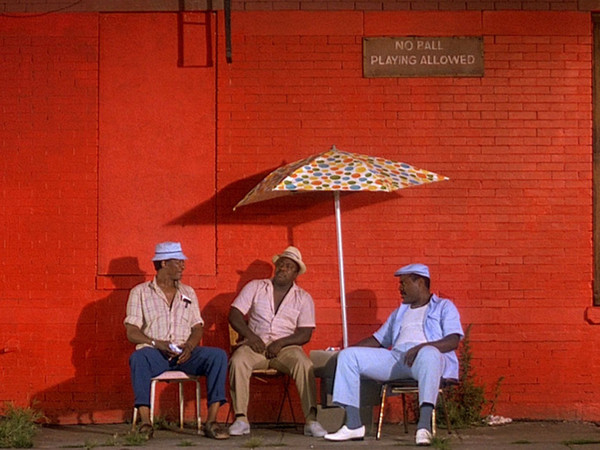
Because I was in that “Language and Cinema” class, I had the opportunity to watch several films I had never seen before. A few worth mentioning include Zoot Suit, the 1939 edition of Stagecoach, and Smoke Signals. Of all of the films we watched, one that really stood out to me as an exceptional piece of art was Spike Lee’s famous 1989 movie, Do the Right Thing.

The script offers a remarkable variety of linguistic turns that make it a rich field of social analysis. The film also impressed me as a bitingly relevant commentary on racism and policing. As someone with no prior awareness of the issues surrounding police brutality in 1980’s New York City, the movie made me want to learn more about a dark and overlooked chapter of our history. Given the recent spate of police brutality incidents over the last few years, it seems to me that more people should return to this film, a movie that carefully treads the line between the two social values on Radio Raheem’s fists: love and hate.

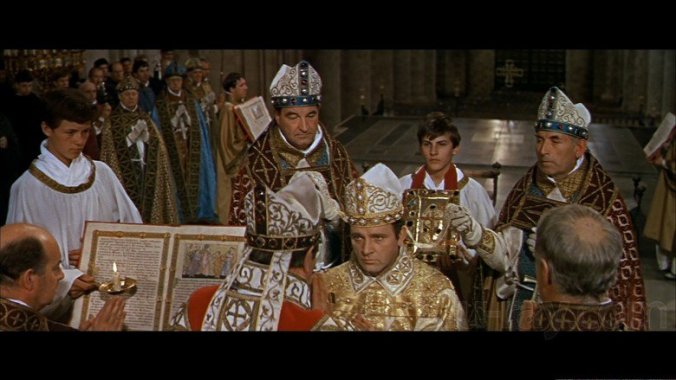
9. Becket

Becket

Becket is not the greatest Catholic film ever made, but it comes close. Gorgeously fabricated costumes, historically-conscious sets, a richly Romanesque liturgical sensibility, copious use of Gregorian Chant, and an excommunication scene that thrills the cockles of every cold Traditionalist heartwhat’s there not to love?

Beyond these largely aesthetic factors, Becket has two unique strengths. First, the movie lacks any of the problematic theology or complicated nuances that has marked more artistically impressive Catholic films (such as Silence and Calvary). Of course, there’s nothing wrong with art engaging in these questions, but occasionally a more affirming film can be helpful. Becket, like A Man for All Seasons, manages to unite faithfulness to the Church’s teachings with genuine artistry. The titular bishop often defends “the Honor of God” against a rapacious monarch. And that brings us to the movie’s second great strength: its depiction of a friendship gone awry. This is a theme that isn’t treated as often as it should be in movies.

Of course, I may be mistaking my own reading of the film and its objective strengths. I first saw Becket when I was in a similar situation. A friend had quickly and completely become an enemy, and I could relate to St. Thomas’s exasperated struggle against a corrupt king.

And on top of that, it’s about St. Thomas Becket, who is one of the coolest British saints.

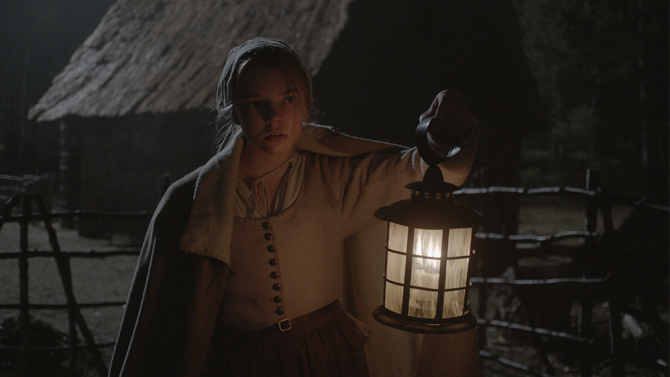
8. The Witch

TheWitch1

If you know me personally, you know that I adore The Witch (aka The VVitch). It may well be one of the finest horror movies ever made. It features all the tropes of early modern witch lore, a soundtrack that evokes the terrors of the Puritan frontier, and dialogue in 17th century dialect (my jam). Its understated visual style allows the actors’ performances to shine through. And the goat! The goat! Just look at it!

This film rekindled my interest in the tradition of horror in New England, which I’ve blogged about before in relation to Lovecraft. It was also the first horror movie I had ever seen in a cinema. The Witch also established A24 in my mind as one of the leaders of the new horror, a genre trend that I hope it continues with the upcoming It Comes at Night.

I consider The Witch to be the greatest Protestant film ever made. Yes, the Satanic Temple really liked it. Yes, A24 consciously hyped the film’s satanic themes as part of its publicity efforts. Fine. But the movie’s horror works by letting us into the world of Puritan New England, a world where the devil is real, witches kill babies, and the livestock aren’t always what they seem. And we are meant to sympathize with these people. They’re not the dupes of McCarthyesque hysteria. They’re the victims of supernatural evil.

I also read The Witch as a cinematic meditation on original sin in its Calvinist interpretation. Everything in the movie happens because of the father’s pride. He’s unwilling to repent and submit to the colonial community, and as a result, the whole family is expelled into the wilderness. The subsequent deterioration and damnation mirrors our own condition under Adam.

Also, if you like Goya’s Black Paintings, you’ll really like The Witch.

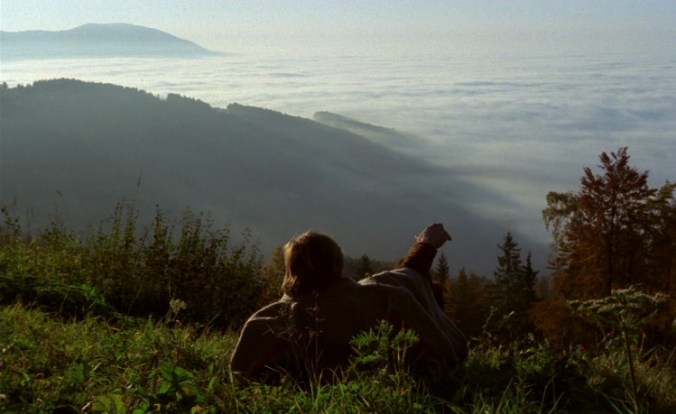
7. Herz aus Glas

HerzausGlas

I saw Herz aus Glas (Heart of Glass) while on a Nietzsche kick in my second year. It messed with my head and made me want to read obscure Continental writers. I’ve always seen it as somehow quintessentially German. At the very least, Herz aus Glas introduced me to the remarkable oeuvre of Werner Herzog, who is my favorite European nihilist director. Not quite as grim as Béla Tarr, not quite as operatically depraved as Lars von Trier.

The film itself tells the story of a glass-producing village in Bavaria that descends into madness after the death of its chief glassblower. A highland prophet delivers cryptic messages throughout. The conclusion comes out of nowhere. At the end of the day, it’s probably a commentary on the German experience of capitalism and fascism, but who knows? Don’t question it.

6. Curse of the Golden Flower

CurseoftheGoldenFlower1

I first saw Curse of the Golden Flower with fourth-year friends when I was a lowly first-year. For me, it will always be a symbol of the similarly golden days between Spring finals and graduation.

The film struck me then as one of the most visually striking movies I had ever seen. The highly stylized recreation of Tang Dynasty China probably speaks to that part of me that also takes a guilty pleasure in the orientalist paintings of Gérôme and Delacroix. Each shot is saturated with a carefully chosen array of colors. The costumes and set design work together to fashion a stunning aesthetic experience. Think Beijing Olympics Opening Ceremony, but with more swords and cloth-of-gold.

Everyone to whom I have showed it since has agreed with my own assessment. The action thrills, and all the actors put in excellent performances. I’d also highly recommend Curse of the Golden Flower to fans of Game of Thrones. The palace intrigue that makes up the bulk of the plot resonates with much of what goes on in Westeros.

5. The Great Beauty

TheGreatBeautyhammock

When I started composing this list, The Great Beauty was down several places. But the longer I’ve thought about it, the higher I’ve ranked this film by Paolo Sorrentino. Readers of this blog will know that I kinda have a thing for his recent HBO limited series, The Young Pope. That show prompted me to look at Sorrentino’s cinematic work. The Great Beauty was the first of his movies that I watched. I’ve had the chance to watch it twice, and I may go back for round three in the next few weeks.

The film depicts the life of Jep Gambardella, a fictional Italian author who moves through the boozy and hedonistic world of the Roman intelligentsia. We see his interactions with other writers, strippers, a floundering performance artist, the wreck of the Costa Concordia, and more. He searches for the titular “grande bellezza,” only to find it after encountering love, suffering, and simplicity.

There isn’t much plot, but there is a whole lot of character development. Ensconced in a party lifestyle, Jep can’t produce any more books; he feels stuck. When he receives word that his first love has died, he goes through a period of intense introspection. As he looks back upon his life, he realizes that he’s lost any meaningful sense of joy. He’s caught in a malaise of memory. Only the wise words of a Mother Theresa-like nun whom everyone refers to as “the Saint” unlocks his situation.

She asks, “Do you know why I only eat roots?” Jep replies that he doesn’t know. She turns back, and without even a smile, says to him, “Because roots are important.” The terse, spiritual one-liners of The Great Beauty are typical Sorrentino fare. Similar lines appear throughout The Young Pope.

I first saw the film in February. I’ve been ruminating on it ever since. It has stayed with me and fermented in my soul like few other films. I can’t help but relate to the protagonistand not just because we share a similar sleep cycle. Jep Gambardella, played masterfully by Tony Servillo, strikes me as a character who could relate to the strange feelings of nostalgia and loss that I’ve had in the Spring of my fourth year. So much so, that along with the next two films, I consider it one of the triad of movies that has defined my final year at the University.

Also, the music in this film is totally gorgeous, and has given me a renewed appreciation of the Holy Minimalists. The soundtrack features both of the songs I described in a recent post on the Light of Tabor and Lent.

So go see it, because it really is too great a beauty to pass up.

4. The Mission

TheMission

Although I had heard of The Mission years ago, I only became really determined to watch it as the result of a class I took last fall, “Reformation Europe.” I’m glad I did. It also had a profound impact on me. I don’t think I know of a Catholic film that more perfectly depicts the difficult realities of balancing missionary work and the demands of Christian peace. The tension between the Jesuits played by Robert de Niro and Jeremy Irons is only undone through the reconciliation implicit in the climactic scene. It is the Eucharist, and the Eucharist alone, which can effect true peace – especially in the face of martyrdom.

A few ancillary personal notes. First, as an aspiring early modernist, I found that the film disposed me to take a much deeper interest in colonial South America. It also made me take a much more serious look into Christian pacifism. The best art should do that. It captures the imagination and lead us on from the beautiful to the true or the good. Secondly, “Gabriel’s Oboe” is also, for my money, the most uplifting music from any of the films I have listed in this post. Finally, it confirmed Jeremy Irons in my mind as the Most Catholic Non-Catholic currently acting in Hollywood (see Brideshead Revisited, The Borgias).

3. The Tree of Life

TheTreeofLife

For years, friends told me that I had to watch The Tree of Life. That it was an incredible piece of art. That it could never be adequately described. That it might just induce a religious experience.

Having watched it recently, I concur. The film is too vast to try and capture in any depth here. I’ll simply say that it is the most sophianic piece of cinema I have ever seen, and that if I have any time in the future, I may try to analyze it from a sophiological perspective. But not without one more viewing.

2. Into Great Silence

IntoGreatSilence.jpg

For a while, I made it a practice to watch Into Great Silence at least once per semester. I believe I first saw the film in the Fall of my First Year, and in that sense, it was my first real introduction to monastic spirituality. The simplicity and manifest holiness of the Carthusians in the movie captured my imagination. Their silence spoke to me.

Nothing happens. Insofar as there is a narrativeand I must emphasize, there really isn’t oneit’s the first year in the monastery of a newly-professed novice. But we don’t focus on him. Instead, we watch many of the monks as they go about life. We are brought into the rhythms of their own silence, the particular ways they fill it with prayer and work. When the monks do speak, they often drop deep little lines. The only interview in the documentary is conducted with an ancient, blind monk. At one point, he says,

The past, the present, these are human. In God there is no past. Solely the present prevails. And when God sees us, He always sees our entire life. And because He is an infinitely good being, He eternally seeks our well-being. Therefore there is no cause for worry in any of the things which happen to us.

These words are good theology, spoken by a saint, given for our practical sanctification. Or consider an even better, briefer quip spoken by a monk at recreation:

The symbols are not to be questionedwe are.

Words to live by.

If you are Catholic, the hauntingly beautiful scene that depicts the Carthusian night office will make you want to go to adoration at midnight. If you are not religious, the film will make you take the ascetic life more seriously. And if you are pondering the Catholic life, I can’t think of a better cinematic introduction to the Church’s spirituality.

Well, I suppose there’s Bishop Barron’s Catholicism series. But that’s a show, not a film.

  1. Baraka

Baraka

Without a doubt, this film has defined my time at UVA. I discovered Baraka by accident, and it stirred something in me that has never quite settled.

One part nature documentary, one part travelogue, one part blistering social criticism, Baraka can be summed up in one word: transcendent. Everything in the film points towards what is beyond it, towards what it dare not express in words. There is no dialogue. The central theme is that ritual and nature connect mankind with the mystery of his existence, and it proceeds to show how the way we break, deform, and reconstruct ritual in modernity has led to untold suffering. The film suggests that a return to the ancient wisdom of religion can restore the meaning we have lost in the 20th century.

Whether you buy into that traditionalist interpretationor its postmodernist, ecofeminist, anti-colonialist, or anti-capitalist variantsthe film will stun you. Director Ron Fricke cut his teeth as director of photography for Koyaanisqatsi (1982) and director of Chronos (1985), the film’s spiritual antecedents. He would later go on to direct a sequel to Baraka, another beautiful film called Samsara (the featured image at the top of this article is a still from that movie). While all are worth seeing, Baraka is the best of the lot. It has the most coherent spiritual vision, the best music, and the most striking visuals.

I encountered Baraka my third year, at a time in my life when I was under tremendous personal stress, as I alluded to in my discussion of Becket. Maybe that slight desperation opened me to a film of Baraka‘s sensibilities. I don’t know. But I don’t think I watched a film while at UVA that more profoundly shaped my worldview and aesthetic. I’d say that everyone who studies or practices religion should see it, but that would be a lie. Everyone should see itperiod.

Some Occasional Thoughts on the Holy Minimalists and the Light of Tabor

IconTransfigurationFeofanGrek

Icon of the Transfiguration, by the hand of the great 15th century iconographer of Moscow, Theophanes the Greek.

Jesus took Peter, James, and John his brother, and led them up a high mountain by themselves. And he was transfigured before them; his face shone like the sun and his clothes became white as light. And behold, Moses and Elijah appeared to them, conversing with him. Then Peter said to Jesus in reply, “Lord, it is good that we are here. If you wish, I will make three tents here, one for you, one for Moses, and one for Elijah.” While he was still speaking, behold, a bright cloud cast a shadow over them, then from the cloud came a voice that said, “This is my beloved Son, with whom I am well pleased; listen to him.” When the disciples heard this, they fell prostrate and were very much afraid. But Jesus came and touched them, saying, “Rise, and do not be afraid.” And when the disciples raised their eyes, they saw no one else but Jesus alone.

As they were coming down from the mountain, Jesus charged them,”Do not tell the vision to anyone until the Son of Man has been raised from the dead.”

These words from St. Matthew were the Gospel reading at Mass last night. Yesterday was the second weekend of Lent, and the Church directs our eyes, alongside those of the holy apostles, to the face of Our Lord in His Transfiguration. And in the Eastern Churches, today is St. Gregory Palamas Sunday. Palamas is most famous for his articulation of the Essence-Energies distinction as part of a broader polemic against the Byzantine Scholastic attacks on Hesychasm carried out by Barlaam of Seminara. One of Palamas’ key Scriptural examples of God’s energies is the “uncreated light” of Christ’s glory in the Transfiguration. St. Gregory is celebrated to this day by the Eastern Orthodox and by Eastern Catholics on their Lenten calendars; yet in the post-Scholastic West, he still holds no place on the calendar. I must wonder whether or not the readings for the Second Sunday of Lent were chosen at the revision of the Lectionary in part as an ecumenical gesture to the Orthodox, though my knowledge of 20th century liturgical innovations is shallow at best. Regardless, those who, to adapt a phrase of Pope St. John Paul II, “breathe with both lungs” of the Church can recognize the Providential coincidence of these two celebrations.

The Light of Tabor is, in a Palamite reading, the eternal Glory of God made manifest in, with, and through Christ’s created humanity. The Transfiguration is therefore an archetypal moment for every mysticnot just the Hesychasts whom St. Gregory was defending. In view of all this, while I listened to the priest reading the Gospel this evening, a song came to mind: “My Heart’s in the Highlands,” by Arvo Pärt. The lyrics are taken from a poem by Robert Burns. Here’s the chorus:

My heart’s in the Highlands, my heart is not here,
My heart’s in the Highlands, a-chasing the deer;
Chasing the wild-deer, and following the roe,
My heart’s in the Highlands, wherever I go.

A few weeks ago, when I first listened to the song, it immediately struck me as a potent metaphor for the contemplative life. Is not the contemplative’s heart set in the “high lands” of the spirit, like St. John of the Cross’s Mount Carmel? And has the Divine not been associated with wild deer throughout history, from the panting hart of Psalm 42 to the vision of St. Hubert to the White Stag of Narnia? The Apostles, like the mystics, like the chanting voice in Pärt’s song, are “led…up a high mountain by themselves.” There, they find Christ’s true glory, the energy of His divinity totally interpenetrating all they can perceive of him. The created rises into the divine, and the uncreated bends towards the creaturely; the two meet in the transfigured Christ. The dual presence of the heavenly Elijah and the Sheol-bound Moses demonstrates the moment of radiant communion between God and His creation, manifested perfectly in Christ, the Word made flesh.

Pärt’s song describes the experience of the mystic, not because Burns’ words actually refer to contemplation, but because of the way he takes up the verse and stretches it against an agonizingly poignant organ composition. He sets secular words to sacred music. Thus he accomplishes in miniature the assumption of the creaturely by the divine that comes before our vision in the Transfiguration. Art at its finest is called to participate in this lesser Transfiguration, and Pärt is a consummate master of what Tolkien might call “sub-creation.”

But Pärt is not alone in this; one of his colleagues, John Tavener, arguably a finer and more mystically-oriented composer, also transfigured profane writings into sacred pieces of music. I can think of no better example of this than his brief and delightful motet, “The Lamb.” Tavener took the lyrics from William Blake’s poem of the same name. In full, it reads:

Little lamb, who made thee
 Dost thou know who made thee,
Gave thee life, and bid thee feed
By the stream and o’er the mead;
Gave thee clothing of delight,
Softest clothing, woolly, bright;
Gave thee such a tender voice,
Making all the vales rejoice?
 Little lamb, who made thee?
 Dost thou know who made thee?

 Little lamb, I’ll tell thee;
 Little lamb, I’ll tell thee:
He is callèd by thy name,
For He calls Himself a Lamb.
He is meek, and He is mild,
He became a little child.
I a child, and thou a lamb,
We are callèd by His name.
 Little lamb, God bless thee!
 Little lamb, God bless thee!

Here too, we might glimpse the transfigured Lamb of God between the lines of Blake’s verse. The lamb’s “clothing of delight/Softest clothing, woolly, bright” seems to echo the robe rendered “white as light” on Mt. Tabor. Blake speaks of “the vales” when Scripture instead would bring us up to the peaks. And the question that ends the first verse is fundamentally the same as that which must have run through the minds of the bewildered apostles; who is this man? The answer, of course, comes from the voice in the cloud: “This is my beloved Son, with whom I am well pleased; listen to him.” And Tavener’s eerily beautiful choral setting imbues the lyrics with a dimension hitherto unimagined. Many of his works remind one of candlelight on ritual gold, or the smell of incense flying forth with the rhythm of thurible bells, or the echo that thins out asymptotically under the glittering mosaic of a high dome. “The Lamb” is all of this, presented compactly. It stands as one of his finest works, and one of his most spiritually rich.

I recently wrote about the Holy Minimalists in a piece on the music of The Young Pope. They’ve been on my mind. But I didn’t connect their artistic project to the Transfiguration until tonight. We Christians are to become “little Christs,” imitating Jesus in all things by adoption and deification. Sometimes, that takes the form of contemplation. The apostles model that path for us in their behavior on Mt. Tabor. But at other times, and in other ways, we are called to live the life of Christ more directly. The Transfiguration provides a mystical glimpse of what happensand indeed, what will happenwhen the uncreated Light of God assumes, permeates, and glorifies the creation. Of course, the energies of God are not found in the artifices of men; but artists can practice their own, creaturely form of transfiguration. The pieces of music I have discussed are shot through with an awareness of the divine presence, and the words that began as profane poetry become something altogether different, something sacred, something nearly liturgical.

At the beginning of Lent, T.S. Eliot tells us to “Redeem/The time.” On this, the Second Sunday of the penitential season, Christ reveals in Himself how we might do soa transfiguration that Arvo Pärt and John Tavener have achieved, in some small way, through their own creative work.


Notes on the Music of “The Young Pope”

screen-shot-2017-02-11-at-4-47-34-pm

The Prime Minister of Greenland gives the Pope a record of Nada’s “Senza un Perche.” And then dances to it. Alone. While the credits role.

In a previous post, I discussed the visual aesthetic of Paolo Sorrentino’s new drama, The Young Pope. Today, I’d like to examine another facet of the show’s artistry: the soundtrack. The Young Pope‘s music has occasioned a few admiring or even acerbic comments, but little serious inquiry.

Although I am by no means an expert in musical theory, I know enough to realize that few shows have ever had quite the musical mix that The Young Pope has. And since I have a Spotify account, I have the luxury of perusing the entire official Young Pope playlist. A few types of music emerge. I would like to examine these in turn.

The Original Score

Is relatively unremarkable. Ramin Djawadi has given us better music in HBO’s other great recent dramas, Game of Thrones and Westworld. But Lele Marchitelli’s “Cardinals” has a delightful airiness, the sense of a certain holy whimsy about it. It’s happy music.

Techno

levorecondite

“Levo,” by Recondite

The show is very European, and incorporates a great degree of the continent’s signal, stereotypical genre.

Michael Baumann over at The Ringer offers a great analysis of one of the songs, “Levo,” by Recondite, a techno artist from Germany. Baumann notes that Sorrentino “folds ‘Levo’ into Lenny Belardo’s character the way Prokofiev folded the French horn into the Wolf’s.” The song is deployed at moments that reveal critical new plot developments that are really the Pope at his purest.

Sorrentino also deploys Techno at moments that seem particularly surreal; the twitching scratch of a beat in Labradford’s “By Chris Johnston, Craig Markva, Jamie Evans” opens the series with Lenny’s nightmare Urbi et Orbi. The piece lends the slow-mo cinematography and almost sculptural quality of the characters the air of a dance. It balances the stillness and motion of the moment, in keeping with Sorrentino’s neomodernist aesthetic.

And yes, I know it’s technically post-rock. But it sounds close enough to Techno to work in this category.

Pop Singles

nada

This song will get stuck in your head.

Lenny Belardo is an American, and the show is set in the near future. It only makes sense that Sorrentino adds pop to the aural texture of several of his key moments.

A few songs come to mind: Nada’s “Senza un Perché,” Lotte Kerstner’s cover of “Halo,” by Beyoncé, LMFAO’s “Sexy and I Know It,” Flume’s “Never Be Like You,” and that cover of “All Along the Watchtower” that marks the opening sequence. Of these, two are particularly worth closer analysis: the covers of “Halo” and “All Along the Watchtower.”

By choosing Kerstner’s slow, soulful cover over Beyoncé‘s original version, Sorrentino draws our attention to the singularly religious inflection of the lyrics:

Everywhere I’m looking now
I’m surrounded by your embrace
Baby, I can see your halo
You know you’re my saving grace
You’re everything I need and more
It’s written all over your face
Baby, I can feel your halo
Pray it won’t fade away

The song frames love as a religious experience, an encounter with a divine other. We can read here the central (albeit de-eroticized) element of Lenny’s spiritual vision; the way he ties together the love of his parents and his belief in God. And the luminescent lyrics work perfectly for the glowing landscape and figures that we see in Africa and Colorado. The lyrics perfectly match the Pope’s solitary walk through the sleeping journalists on the plane:

Hit me like a ray of sun
Burning through my darkest night
You’re the only one that I want
Think I’m addicted to your light
I swore I’d never fall again
But this don’t even feel like falling
Gravity can’t forget
To pull me back to the ground again
Feels like I’ve been awakened
Every rule I had you break it
The risk that I’m taking
I’m never gonna shut you out

The language here practically describes the scene. We are on the plane at night, and Lenny, the only one whom the journalists want to see, has arrived to watch them sleep. Their flight is quite literally defying gravity. As the Pope breaks his rule about meeting journalists, he finds one awake. It’s a risk, but it rewards him with a moment of admiring affirmation.

And we don’t need to consciously apprehend the meaning of the words as we watch the scene to feel their impact. Aesthetically, the song’s dreamy tremor fits well with the soft-focus visuals that Sorrentino uses in that scene and throughout the series.

Secondly, Sorrentino opens most of the episodes with a sequence of the Pope passing nine paintings and a sculpture of Pope St. John Paul II. An instrumental cover of “All Along the Watchtower” plays in most iterations of the sequence. The song’s connotations of cultural revolution represent Lenny’s monumental program of change and remind us of his parents’ own ideological leanings. The irony of the song pairs well with the irony of the visuals, as Lenny’s shooting star disrupts the order of the paintings.

Holy Minimalism

For me, the most striking addition to the repertoire is the heavy use of the Holy Minimalists. Arvo Pärt, Henryk Górecki, and John Tavener, some of the most respected members of the movement, all appear in the playlist.

screen-shot-2017-02-14-at-1-15-35-am

The Holy Minimalists: (l-r) Arvo Part, John Tavener, Henryck Gorecki

The Holy Minimalists were a group of composers active from the 1970’s whose work sought to reinvigorate more traditional sacred forms. Often by working in conversation with Eastern Christian formsPärt, like the late Tavener, is a convert to Eastern Orthodoxy, while Górecki was a Polish Catholicthe Holy Minimalists sought to capture a sense of the eternal in their inventive and dissonant work. Listening to their music, one has the sense of peering through the cracks of our broken human existence to glimpse yawning chasms of infinite glory.

No fewer than 12 works by the Holy Minimalists are featured in the show’s official playlist. I’d like to focus on two pieces, deployed in juxtaposition at one of the most climactic moments in the entire series.

lennygoals

“Knock, knock.”

As Pius XIII enters the Sistine Chapel to address his assembled cardinals, he is borne aloft by attendants on a Sedia Gestatoria. John Tavener’s haunting dirge for Princess Diana, “Song for Athene,” seems to float in along with him. But just as the climax is about to resolve into a peaceful, triumphant harmony (the part of the song that evokes the Resurrection and the Life eternal), Lenny opens his eyesand the music stops instantly. It’s a chilling moment. In that second, before he even starts to speak, we understand the gist of what is about to follow.

The music only begins again with a single, unnerving note on the piano, when the Pope directs their attention to a mysterious door that has appeared at the other end of the chapel. He continues his dark (and, if we’re being honest, rather magnificent) speech for nearly another eight minutes. The lone note is joined by others, and becomes Arvo Pärt‘s “Lamentabile – ” before concluding with the humiliation of Cardinal Voiello.

I think Sorrentino relies so heavily on the Holy Minimalists in his aural aesthetic to suggest another element of Lenny’s spiritual vision. Throughout the series, Lenny is able to deliver profound wisdom through quiet, concise statements. Simplicity is the garment of his unique insights. And the Holy Minimalists sought to re-present the sacred tradition of Christian music for modernity; their project is consonant with Lenny’s.

It’s also worth pointing out that, in addition to the Holy Minimalists, Sorrentino deploys a few works by regular, ordinary, profane minimalist John Adams (those of you who played Civ IV growing up will recognize his “Shaker Loops: III. Loops and Verses“).

In Sum

I know I’m missing a few things, since the playlist is long, and I’m not a musicologist. But that very fact points to the multiple layers of meaning that Paolo Sorrentino has inscribed in his rich soundtrack. I encourage everyone to give the playlist a serious and attentive listen-through, possibly several. There are gems in there. And if you can go through it (or the show) without getting “Senza un Perché” stuck in your head, you’re doing it wrong.