The Poetry of St. Philip Neri

SanFelipeRed

He would be 502 years old today. (Source).

In honor of St. Philip Neri’s birthday today, I reproduce here the translations of two of his three surviving sonnets, taken from the Liturgia Latina collection of Oratorian materials. That site reports that the translations from the original Italian are by Fr Henry Ignatius Dudley Ryder, of the Birmingham Oratory.

I.

The soul derives from God her being high,
In one keen instant out of nothing brought,
Not painfully through second causes wrought;
How should she, then, submit to things that die?

To hope, desire, to joy, to enmity;
To her confusion by these guides mistaught,
Of One confronting her she knoweth naught,
One glimpse of Whom would lift her to the sky.

How should the baser nature dare rebel
Against the higher, nor, as meet, consent
To do its bidding, but essay to quell?

Why prison bars the aspiring soul prevent
From leaving earth, above the stars to dwell,
To die to self, to live to God, intent.

II.

I love, and loving must love ceaselessly,
So whole a conquest in me love hath won;
My love to Thee, Thy love to me doth run,
In Thee I live, and Thou dost live in me.

Surely the day is nigh when I may flee
From this dark gaol, for ever to have done
With vanity and blind oblivion,
Where, exiled from myself, I used to be.

Earth laughs and sky, green branches and soft air,
The winds are quiet, and the water still,
No sun before has shed so bright a day;

The gay birds sing, love’s joy is everywhere;
My heart alone has no responsive thrill,
My powers flag and shrink from joy away.

Books I Have Finished This Summer

OldBooks

Old volumes. (Source).

I intend to keep updating this post as a running list of the books I have completed (though not necessarily started and completed) over the summer. I will include a short blurb and review for each title. Thus far:

1. The Benedict Option. Rod Dreher. 2017. Non-fiction.
An argument for focusing on Christian community-building in the face of an increasingly hostile secular liberal order. And a very flawed argument at that. But the book got me thinking about a better option, so as a provocation to thought and discussion, it works pretty well.
Score: 3/5.

2. A Litany of Mary. Ann Ball. 1987. Non-Fiction.
A lovely exposition of and meditation on various titles of Mary. Would recommend for anyone seeking a deeper understanding of Our Lady, her role, and her apparitions in the modern world. Particular highlights are some of the rarer titles such as Our Lady of the Cenacle and Our Lady of the Most Blessed Sacrament. If you have (or want) a devotion to Mary under one of her titles, this is the book for you.
Score: 4/5

3. Free Women, Free Men. Camille Paglia. 2017. Non-fiction.
The dissident feminist’s newest collection of essays. Gives a great taste of her style and scholarly concerns over the course of her long career. Topics range from The Real Housewives, “Southern Women,” BDSM, Puritanism, and all kinds of feminist spats. Her essay “On Abortion” is one of the most idiosyncratic and provocative takes on the issue I have yet read. Paglia never tires of displaying her acid wit and crackling prose. Perhaps her greatest flaw, beyond those points where she is simply wrong, is her irritating autobiographical tendency. I could do without the seventh mention of her childhood Halloween costumes. But all in all, a read well worth the effort.
Score: 4.25/5

4. The Leopard. Giuseppe di Lampedusa. 1958. Fiction.
The decline and fall of a Sicilian noble family. There’s romance, history, and a dollop of nostalgia that Lampedusa sprinkles with acerbically cynical observations about his characters. It’s uncommon to find a class commentary that doubles as a sensitive psychological portrait. The Leopard is just such a rare gem. Lampedusa has a knack for evocation. You can feel the heat of the Sicilian sun radiating from the pages; with Lampedusa, you can almost catch a faint whiff of ambergris over the rot. His style is a slow-moving delight, well-suited to his subject. There’s also a Great Dane, which is always a plus.
Score: 4.5/5

5. The Black Arts. Richard Cavendish. 1967. Non-fiction.
A helpful, if perhaps somewhat dated, exposition of occult history and practice. Cavendish presents a thorough overview of dark magic. His wry, understated humor makes it a great read (one quote: “[Éliphas Lévi’s] later books are less interesting, including his History of Magic (1860) and The Key of the Mysteries (1861), which he himself translated into when he was reincarnated as Aleister Crowley…The learned English occultist A. E. Waite, who was not a reincarnation of Lévi, but succeeded in translating the secrets of the Doctine and Ritual all the same” pg. 29). Would strongly recommend to anyone with a love of horror fiction, the macabre, Christopher Lee, the Kabbalah, Latin, and batsh*t crazy characters from the Victorian and Edwardian periods (including Montague Summers). It made me want to read Valentin Tomberg’s Meditations on the Tarot and watch Penny Dreadful.
Score: 4/5

6. Chickamauga. Charles Wright. 1995. Poetry.
Remarkable, luminous poetry by a professor at my alma mater. T.S. Eliot’s spiritual and stylistic successor. Reading him is like reading a mystic in motionmore ornate that Wendell Berry, more apophatic than William Blake. I cannot recommend him highly enough.
Score: 5/5


Poem: “To the Romanian”

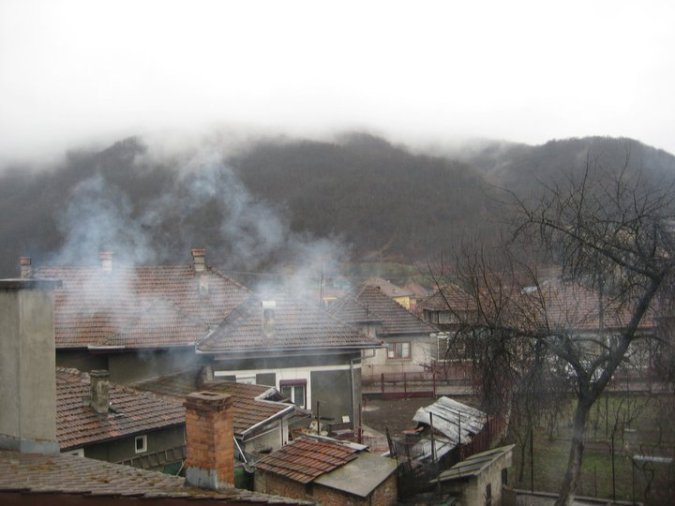
RomaniaSmoke

Romania. Photo taken by the author, March 2011.

Since the response to my last two original poems has been so positive, I thought I’d publish a little more. I wrote this piece a few years ago.

To the Romanian

I am opening a window in my mind again.
I am peering into the sodden landscape
Of stone, snow, and parted lips of lead,
The chalice which catches the wax
Imported from Carinthia—like the
Ring that snags on the
Crow’s ashen teeth.
The shudders are snapping in the wind;
Smoke is rising from the valley.

Poem: “Southern Storm”

CloudsBW

Clouds. (Source).

Another original piece from the old notebook, spruced up a bit. As I mentioned in my earlier poem, at this point I don’t really plan on putting too much of my own stuff here. But in lieu of some other posts that are taking longer to finish than I had hoped, here you go.  

He is the ghost that fogs the mirror
before you rise to greet your Sunday face,
beer-swilling face with stubble like termites
tumbling through your grandmother’s antique chair
as she sings half-bred hymns to you in a
Gypsy tongue she learned off a carnival
barker. He stands before the black bookshelf,
pondering the glass veil between Word
and Man, wondering if sand or stone would
feel better in an old shoe, or like a
paper Mephistopheles, he leaps now
into the street, wild, un-tame and unkempt,
with matted hair drawn into a loose bun
or some pin-stuck old Indian style.
He offers you his body for consolation.
He offers you his tongue in lieu of words,
they are all tied up in leather behind
the shimmering partition like a
coquette calling from her Japanese screen.
And he dances lugubriously,
inebriate on the sound of
jazz funerals winding their way down dirt
roads to the noose-cackle of strings and the
lantern-glow of heat-lightning.

Poem: “Fernandina”

SpanishMossCurtain

Spanish moss. (Source).

I recently discovered an old notebook of mine with several poems I had forgotten about writing a few years ago. While I don’t intend to publish much of my own creative work on this site, I liked this piece enough to offer it up for your consideration.

Fernandina

Spanish moss is a
green garland at dawn and a
gibbet at twilight.

The sea is foaming
at the mouth again. Someone
ought to put it down.

The bricks, like whores, are
washed in salt and made sooty
once more in lamp-glow.

I see your face there,
reflected in the postcard
nestled in my hand.

Amidst the buzzing
kitsch, it whispers a simple
note: “Wish you were here.”

A Norbertine Poem for the Sacred Heart

SacredHeartBlackBackground

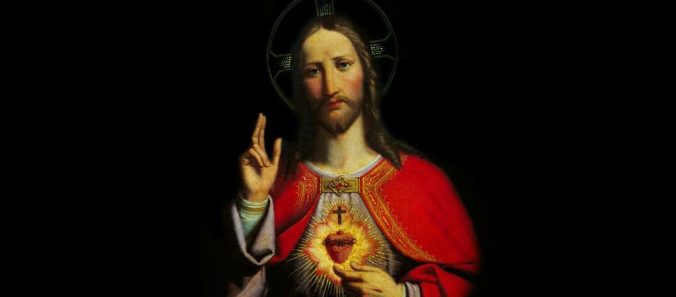
Most Sacred Heart of Jesus, have mercy on us. (Source).

I happened upon this wonderful poem by one Frater Simeon Charles Goodwin, O.Praem., a seminarian at St. Michael’s Abbey. It’s always a delight to find good rhyming verse with a tightly-wound meterand rich theology to boot! Throughout the text, we can detect hints of Chesterton and, in the very last couplet, the sensual, baroque Richard Crashaw. I offer it here for your enjoyment on this solemnity of the Sacred Heart.

The Sacred Heart

    by Simeon Charles Goodwin, O.Praem.

There is a heart that beat with love
When time could mark no beat.
It echoed with a triple-pulse
And surged in thunders sweet.

Too happy not to overflow
It laughed and all was made.
It sighed and angel hosts came forth
In myriad parade.

It sang the seas and skies to be,
Hummed forth the rolling hills.
It beamed out beast and bird in love,
A sweet and mighty will.

It breathed into the mire and muck,
Sweet nothings to the earth;
And clay was made creation’s crown,
Man made with God’s own worth.

And how that heart did pound with peace
When he and man would walk
In silent love in evening winds
Too full of love for talk.

Oh man was glad and God was glad
And all creation too,
But man in madness pierced God’s heart
And rent the world in two.

There is a secret hideaway
Where cosmoi come to cry,
With atrium no bigger than
The needle’s narrow eye.

And there the mighty waters wait
To burst on arid wastes.
Men need but kiss the lance-made lips
To learn how sweet blood tastes.

A Poem for Trinity Sunday

TrinityThrones

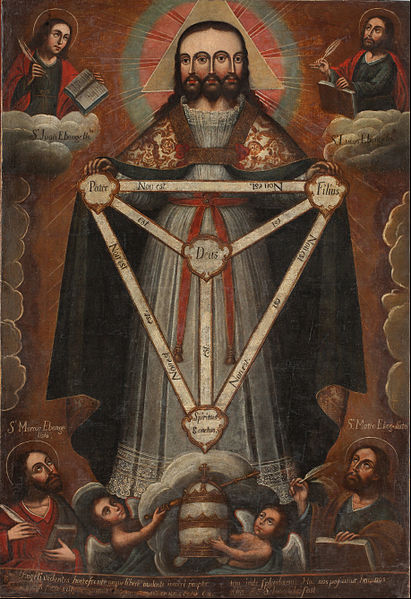
“The Enthroned Trinity.” Cuzco School. c. 1730. (Source).

Holy Sonnet XIV
John Donne

Batter my heart, three-person’d God, for you
As yet but knock, breathe, shine, and seek to mend;
That I may rise and stand, o’erthrow me, and bend
Your force to break, blow, burn, and make me new.
I, like an usurp’d town to another due,
Labor to admit you, but oh, to no end;
Reason, your viceroy in me, me should defend,
But is captiv’d, and proves weak or untrue.
Yet dearly I love you, and would be lov’d fain,
But am betroth’d unto your enemy;
Divorce me, untie or break that knot again,
Take me to you, imprison me, for I,
Except you enthrall me, never shall be free,
Nor ever chaste, except you ravish me.
TrifacialTrinityCuzcoSchool

“Trifacial Trinity,” Cuzco School. c. 1750-70. (Source).

Three Poems for Whitsunday

Fresco-Zica

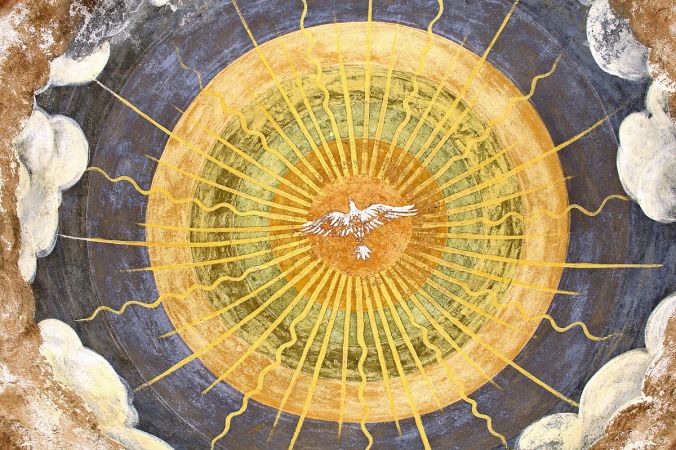
The Dove Descending…(Source)

Inspired by and borrowing from Artur Rosman’s similar post, I offer you some Pentecostal poetry.

“Little Gidding” IV, by T.S. Eliot

The dove descending breaks the air
With flame of incandescent terror
Of which the tongues declare
The one discharge from sin and error.
The only hope, or else despair
Lies in the choice of pyre of pyre-
To be redeemed from fire by fire.

Who then devised the torment? Love.
Love is the unfamiliar Name
Behind the hands that wove
The intolerable shirt of flame
Which human power cannot remove.
We only live, only suspire
Consumed by either fire or fire.

“God’s Grandeur,” by Gerard Manley Hopkins S.J.

The world is charged with the grandeur of God.
    It will flame out, like shining from shook foil;
    It gathers to a greatness, like the ooze of oil
Crushed. Why do men then now not reck his rod?
Generations have trod, have trod, have trod;
    And all is seared with trade; bleared, smeared with toil;
    And wears man’s smudge and shares man’s smell: the soil
Is bare now, nor can foot feel, being shod.
And for all this, nature is never spent;
    There lives the dearest freshness deep down things;
And though the last lights off the black West went
    Oh, morning, at the brown brink eastward, springs —
Because the Holy Ghost over the bent
    World broods with warm breast and with ah! bright wings.


“Epigrammata Sacra XIII” – The descent of the Holy Spirit – Richard Crashaw

Bear, o bosoms, bear ye what Heaven’s vintage showers,
Sacred clusters pouring from ethereal bowers.
Too happy, surely, ye who drink of wine so good;
It comes into your bosoms a sparkling, cooling flood.
Behold, with nectar’d star, each head is shining, shining;
Around your purpl’d locks a crown of life entwining.
O Spirit of all flesh, to drink who’d be denied,
Since Thou, lest they should falter, mak’st wine a torch to guide?

HolySpiritCeiling

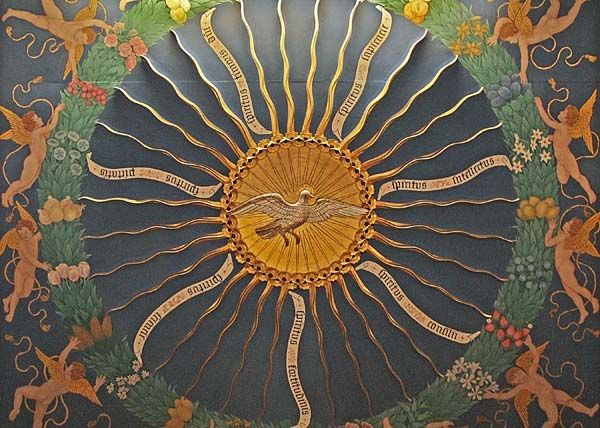
Veni Sancte Spiritus! (Source)

A Poem for Ascension Day

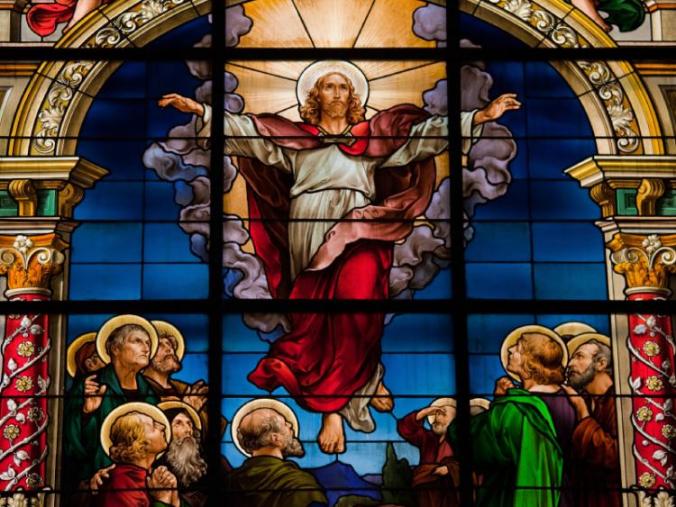
AscensionWindow

A stained glass window depicting the Ascension of the Lord. (Source).

Salute the last, and everlasting day,

Joy at the uprising of this Sun, and Son,

Ye whose true tears, or tribulation

Have purely wash’d, or burnt your drossy clay.

Behold, the Highest, parting hence away,

Lightens the dark clouds, which He treads upon;

Nor doth he by ascending show alone,

But first He, and He first enters the way.

O strong Ram, which hast batter’d heaven for me!

Mild lamb, which with Thy Blood hast mark’d the path!

Bright Torch, which shinest, that I the way may see!

O, with Thy own Blood quench Thy own just wrath;

And if Thy Holy Spirit my Muse did raise,

Deign at my hands this crown of prayer and praise.

(John Donne)

A Poem for the First of May

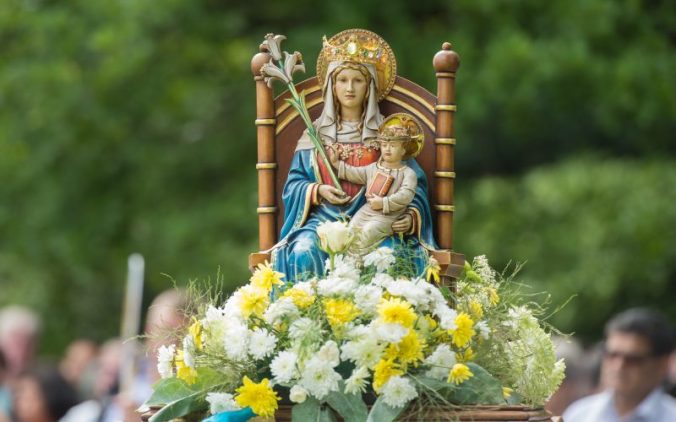
OLWasinghamFlowers

Our Lady of Walsingham, borne aloft by the faithful in a procession. Source.

May is Mary’s month, and I
Muse at that and wonder why:
Her feasts follow reason,
Dated due to season—

Candlemas, Lady Day;
But the Lady Month, May,
Why fasten that upon her,
With a feasting in her honour?

Is it only its being brighter
Than the most are must delight her?
Is it opportunest
And flowers finds soonest?

Ask of her, the mighty mother:
Her reply puts this other
Question: What is Spring?—
Growth in every thing—

Flesh and fleece, fur and feather,
Grass and greenworld all together;
Star-eyed strawberry-breasted
Throstle above her nested

Cluster of bugle blue eggs thin
Forms and warms the life within;
And bird and blossom swell
In sod or sheath or shell.

All things rising, all things sizing
Mary sees, sympathising
With that world of good,
Nature’s motherhood.

Their magnifying of each its kind
With delight calls to mind
How she did in her stored
Magnify the Lord.

Well but there was more than this:
Spring’s universal bliss
Much, had much to say
To offering Mary May.

When drop-of-blood-and-foam-dapple
Bloom lights the orchard-apple
And thicket and thorp are merry
With silver-surfed cherry

And azuring-over greybell makes
Wood banks and brakes wash wet like lakes
And magic cuckoocall
Caps, clears, and clinches all—

This ecstasy all through mothering earth
Tells Mary her mirth till Christ’s birth
To remember and exultation
In God who was her salvation.

– “May Magnificat,” by Gerard Manley Hopkins, SJ

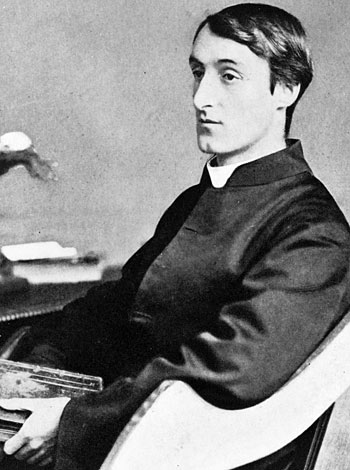
GerardManleyHopkins2

Gerard Manley Hopkins, SJ. Source