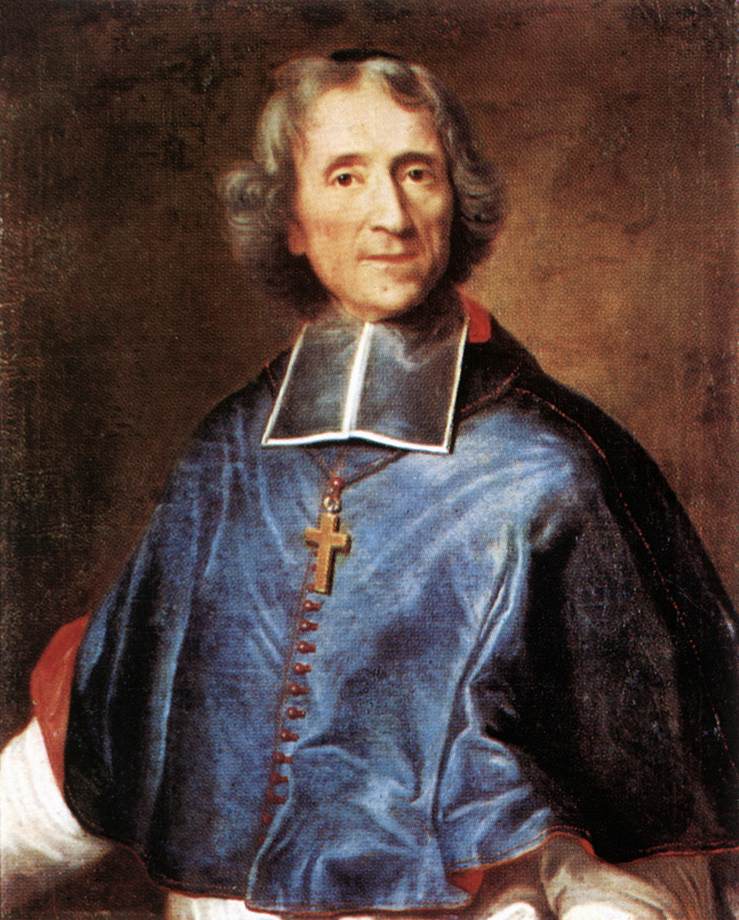
Christmas With Quesnel

This year, for Christmas, I wanted to present a brief, original translation of Pasquier Quesnel’s edifying Réflexions Morales. The following passages, which concern the second chapter of St. Luke, are taken from the 1693 edition, Volume III, pages 30-37. All Biblical citations are from the Douay-Rheims.
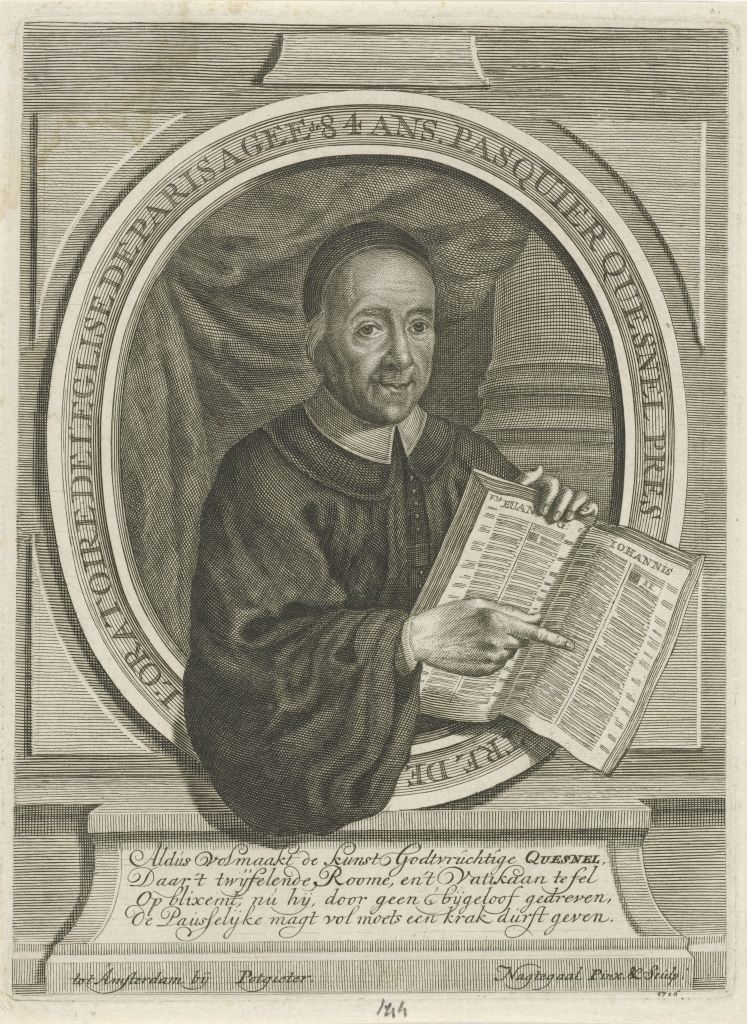
Dutch portrait of M. Quesnel, Priest of the French Oratory (Source)

The Birth of the Incarnate Son of God – Luke 2:1-7

  1. And it came to pass, that in those days there went out a decree from Caesar Augustus, that the whole world should be enrolled.
  2. This enrolling was first made by Cyrinus, the governor of Syria.

The greatest princes often give themselves to great movements and take up magnificent designs without knowing the reason why. Augustus imagined working for the glory of his name and the splendor of his reign – and his orders, by orders more powerful and more absolute than his own, served to accomplish the prophecies that were unknown to him, at the birth of a king he would never know, and the establishment of a monarch that would subjugate his own and all others. This is what happens in every age, and we think not of it.

3. And all went to be enrolled, every one into his own city.
4. And Joseph also went up from Galilee, out of the city of Nazareth into Judea, to the city of David, which is called Bethlehem: because he was of the house and family of David,
5. To be enrolled with Mary his espoused wife, who was with child.
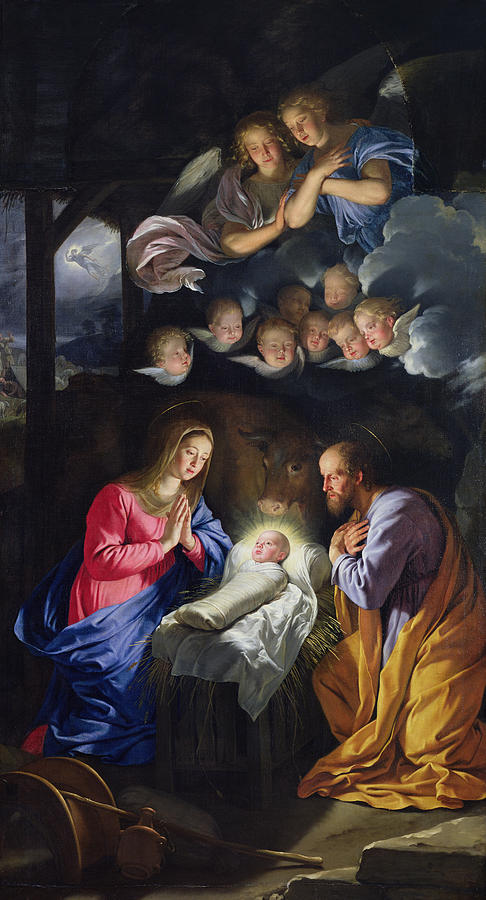
Nativity, Philippe de Champaigne (Source)

There is nothing here that seems to happen by chance; and yet, all is ordained by Providence to assure and fix by a public testimony the knowledge of the time and the place of the birth of the Messiah and the origin of the house of David.

The Son of God, recorded from his birth as a real man, acknowledges, so to speak, his obedience, his humility, and the accomplishment of his promises. It is well visible from this that his grandeur, predicted by the angel, is not a human grandeur.

The poverty, fatigue, and subjugation in which Joseph and Mary find themselves are the preparation for the gift that they are going to receive from God.

Let us learn to submit ourselves to every creature for God, and principally to the royal power, in seeing Jesus Christ begin to obey from his birth and before his birth.

6. And it came to pass, that when they were there, her days were accomplished, that she should be delivered.

Jesus Christ subjected himself to the laws of nature and to a prison of nine months. He hides the glory of His birth, in being born in an unknown place; teaches us to detach ourselves from our country and from all the present world, in being born in a voyage; recommends to us poverty, mortification, and humility, in being born in a borrowed place, deprived of all conveniences and help.

What instructions for us from this first moment, if we know how to hear them well! Let us listen to them in a spirit of adoration and annihilation.

7. And she brought forth her firstborn son, and wrapped him up in swaddling clothes, and laid him in a manger; because there was no room for them in the inn.

Jesus Christ is the firstborn of the Virgin; we are, in a certain sense, the next-born.

His humiliation in the infirmity of childhood is all the more worthy to be adored, as it seems the more unworthy of His grandeur and His wisdom. Rejected by men, he borrows the dwelling of beasts. May human pride blush as long as it is pleased to have a God become a child of a day and a moment, reduced to the captivity of swaddling-clothes, to the lowliness of a manger, and to the dwelling of beasts, to race again to the help of His creatures – and to be rejected! It is the glory of the Christian that his God has desired to do and to suffer all that for his salvation. It is his honor to adore Him, to recognize Him as his king, and to render him homage in all His states.

The Shepherds – Luke 2:8-20

8. And there were in the same country shepherds watching, and keeping the night watches over their flock.

9. And behold an angel of the Lord stood by them, and the brightness of God shone round about them; and they feared with a great fear.

Jesus Christ manifests Himself to the simple and the poor rather than to the learned and the rich. He reserves to the vigilant shepherds the knowledge of the mysteries and duties of religion; the negligent ones are left in their shadows.

Thou dost begin from this moment, Lord, to show who are those whom Thou hast chosen for Thy Kingdom, and who are the ones whom Thou hast cast off.
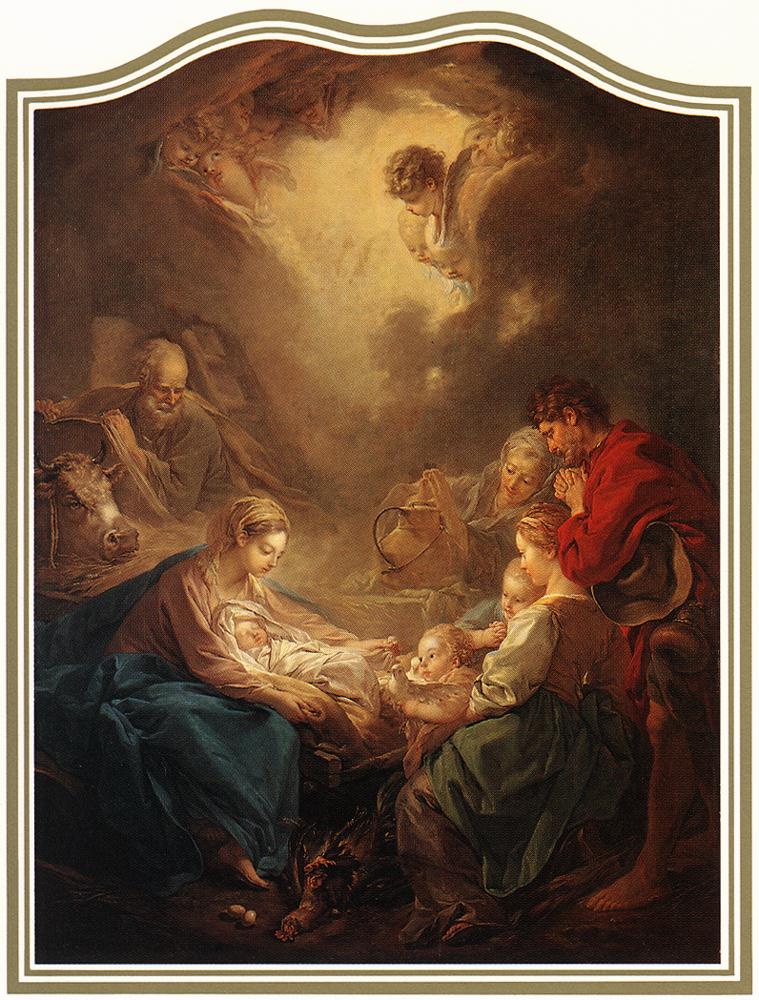
The Light of the World, François Boucher, 1750 (Source)

10. And the angel said to them: Fear not; for, behold, I bring you good tidings of great joy, that shall be to all the people

The birth of Jesus is the joy of this world, and the world did not know it. The world has its vain joys, its criminal joys, and by these it is unworthy to share in the joy of the birth of the Savior. It is the image of what happens every day; men have a heart closed to the things of God, in proportion to the extent to which they have one open to the pleasures and greed of this world.

11. For, this day, is born to you a Saviour, who is Christ the Lord, in the city of David.

Abridgement of all the grandeurs of Jesus exposed to the faith of the shepherds, and which God formed in their hearts by the exterior sign of the light which surrounded them. As son of David and heir of the promises, he had a royal birth; as Savior, a sovereign goodness; as Christ, the fullness of the Spirit of God and of the sacerdotal and prophetic unction; as the Lord, a divine power.

What must we not hope of a Savior in whom one finds a sovereign power joined to an infinite goodness, which he annihilates for us?

12. And this shall be a sign unto you. You shall find the infant wrapped in swaddling clothes, and laid in a manger.

Is it there, Lord, the mark of Thy grandeurs, the ornaments of Thy royalty, the throne of Thy glory? O crèche, worthier than all that the world has of great riches and precious things, may I learn at your feet that it is by humility that Jesus comes to reign and that there is only “this path which leads to his kingdom!”

Pride is the character of the sons of Adam; humility, the mark of the Son of God and of the elect.

13. And suddenly there was with the angel a multitude of the heavenly army, praising God, and saying:

God, bringing honor by the celestial spirits to his Son, annihilated in infancy, teaches those of the earth, for whom He comes, what homage they owe Him in this state.

The angels remain happy to raise up by their praises the glory of a newborn infant, and to adore Him as their God. Will men be disdainful?

The crèche of the Savior is a scandal to the Jews and folly to the Greeks as much as the Cross; His infancy as well as His death is the pitfall of human pride. But it is the power of God for the salvation of those who have faith, and even the object of adoration for the angels.

Adoration of the Shepherds, Eustache La Sueur (Source)

14. Glory to God in the highest; and on earth peace to men of good will.

The two principal motives of the Incarnation are the glory of God and the reconciliation of mankind.

God promises peace on earth to those whom He loves, but not repose.

The peace of God consists in His love, through whatever trouble and whatever storms this love may expose the Christian.

The peace that reigns on earth in these times only marks the birth of God in peace.

15. And it came to pass, after the angels departed from them into heaven, the shepherds said one to another: Let us go over to Bethlehem, and let us see this word that is come to pass, which the Lord hath shewed to us.

When God inspires someone to search out Jesus Christ, to render Him some duty, to apply one’s self to one of his mysteries, we must not neglect it.

The angel does not order the shepherds to go to Bethlehem; but rather makes known and proposes the good to faithful souls so as to make them undertake it. It is thus to a good Christian and to a pious lady to say to them: Jesus Christ is in this poor tabernacle as in a manger, wrapped up in the appearances of bread, abandoned by all the world – He is in this poor one, almost naked, lodged in a miserable hut, lacking everything.

This is the image of the holy assemblies of zealous persons, who, profiting from exhortations and the light of their visible angels, mutually encourage each other to visit the Blessed Sacrament, poor households, and foundlings, in honor of Jesus the poor infant, swaddled and sleeping in a manger. Let us go to Bethlehem, the “house of the bread” of Heaven. May it please God that those who are outside this house, that is, outside the Church, might encourage each other to go look for Jesus Christ to taste there what our Savior causes us to know!
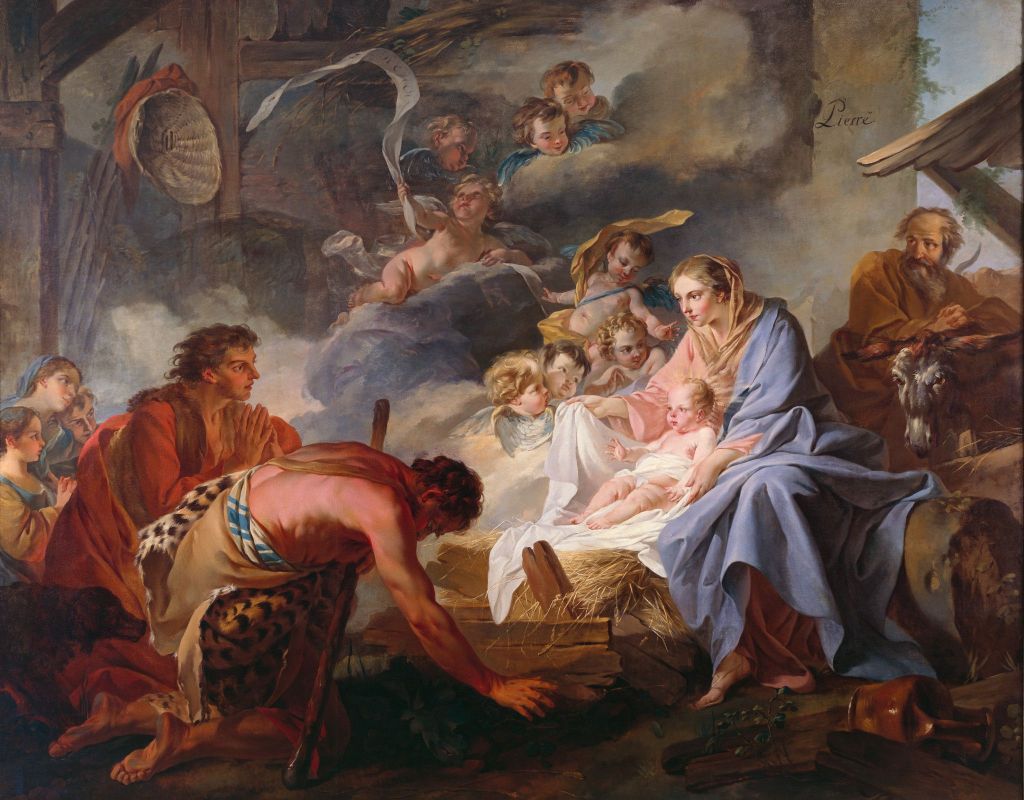
The Adoration of the Shepherds, Jean Baptiste Marie Pierre, 1745 (Source)

16. And they came with haste; and they found Mary and Joseph, and the infant lying in the manger.

Will not sinners blush from the luxury and the delicacy of their beds, seeing the Son of God in a manger?

When a good work presents itself, far from losing time, we must follow the movement of grace without delay, for fear lest it pass, and for fear that another will take from us either the occasion or the beginnings of a holy work.

This reversal of order, the bride named before the bridegroom, creatures before the Creator, marks well the reversal made by the Incarnation. Mary is truly the Mother of God, and this dignity grants her the first rank in His house.

17. And seeing, they understood of the word that had been spoken to them concerning this child.

These shepherds believe the word of the angel without reasoning about it; they see the lowness and poverty of the manger, without being scandalized, and reflect on all, without being troubled. This is the advantage of a humble, simple, and submissive faith.

What false reasonings do the Philosophers make! How many apparent contradictions are embraced by the beaux esprits of the world!

18. And all that heard, wondered; and at those things that were told them by the shepherds.

The shepherds, first apostles of the infant Jesus, are faithful in announcing the news of His birth. God blesses the simplicity of their report in causing it to be believed everywhere.
God does not love and does not bless that human prudence which believes it must hide the apparent lowliness of the mysteries of religion. It belongs to man to obey and to suppress nothing, and to God to cause belief by inspiring faith.

19. But Mary kept all these words, pondering them in her heart.

Mary, consecrated and elevated to Jesus Christ, full of his mysteries, and entirely applied to the collection of virtue, spirit, and grace, condemns the forgetfulness and negligence in which Christians live with regards to what the Savior has done for them.

It is not easy to profit from the mysteries and the truths of the Gospel, and to preserve them in one’s memory; one must sustain them in the presence of Our Lord, and meditate upon them often, according to the example of the Blessed Virgin.

She is the teacher and the first model of Christian meditation upon the life of Jesus Christ. Let us profit in the school of our holy Mistress.

20. And the shepherds returned, glorifying and praising God, for all the things they had heard and seen, as it was told unto them.

The shepherds imitate her in adoring and glorifying God. This is the first effect of faith, the first duty of religion, a tribute of recognition that we owe to the gifts of God.

The praise of these good people is as simple as their faith, and that is what God loves.

Thus should true Christians return to their own homes from the Church where they came to adore Jesus Christ and to listen to the preaching of His mysteries, His virtues, and His maxims.
A Prayer from Port-Royal on Saint Augustine’s Day

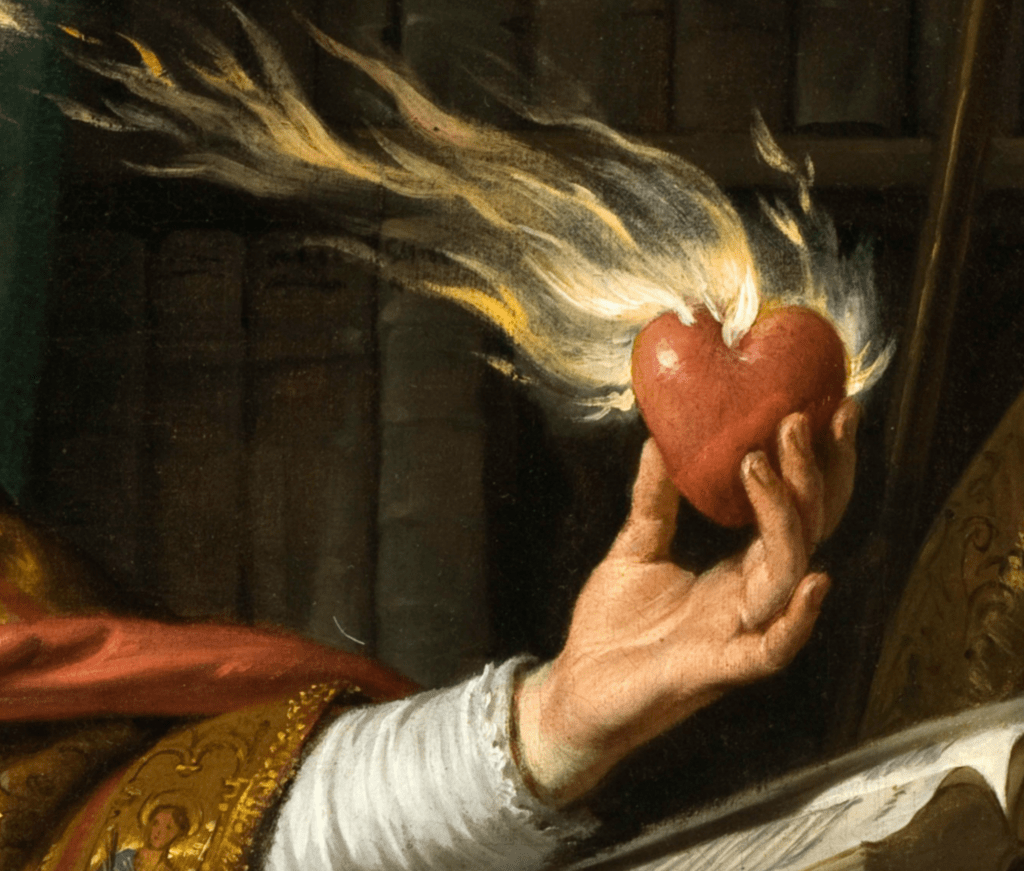
Saint Augustine, Philippe de Champaigne, c.1645-50 (Detail) – (Source)

On Saint Augustine – A Prayer of M. Hamon

O God, who, after having shown to us in Saint Augustine the very excess into which corrupt nature causes us to fall, hast also caused us to see in him the strength and the empire of Thy Grace over our hearts, grant us, we beseech thee, so perfect a knowledge of our extreme misery and of Thy infinite mercy, that, expecting everything from Thee, and nothing from ourselves, we might hope fully in Thee by defying ourselves completely.

O God, who in embracing Saint Augustine with Thy Love, and in elevating him above all men by the knowledge of Thy Truth, hast placed him in Thy Church as a fiery and shining lamp, so that he might illuminate and defend her by his doctrine, and console and edify her by his sanctity; grant, by the help of his charitable intercession, that we might imitate his virtues; and, at his example, rejoicing only in the truth, and having taste only for the fruits of charity, we might despise this mortal life by the hope and feeling of the all-divine life which Thou hast promised us; so that, loving Thee alone, we might also place all our happiness in Thee alone.

Thus we beseech thee by Jesus Christ our Lord. Amen.

(From Jean Hamon, Entretiens d’une âme avec Dieu, New Edition (Avignons, 1740), pp. 405-06; original translation by The Amish Catholic)

Elsewhere: A Medieval Sermon on the Ascension

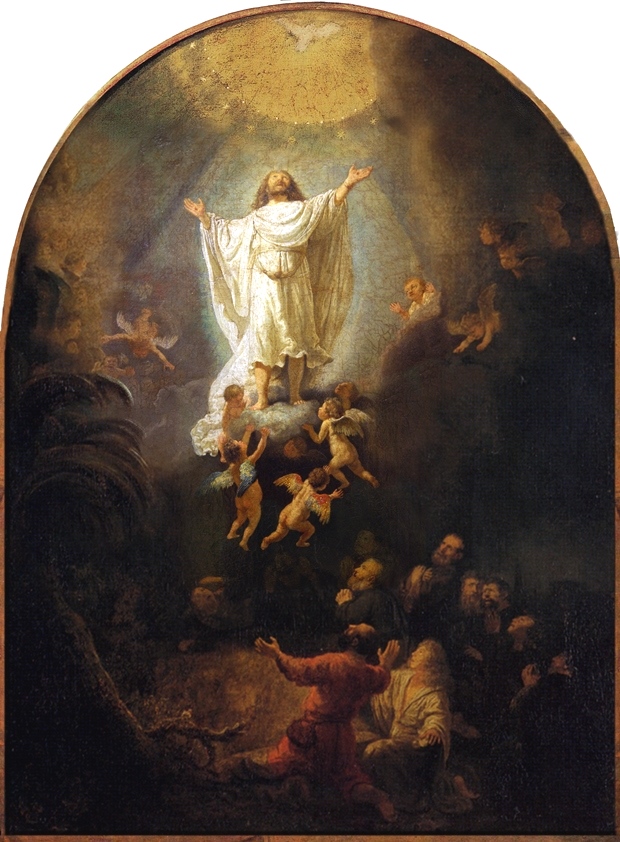
The Ascension, Rembrandt van Rijn, 1636 (Source)

Ascensiontide is perhaps my favorite season of the Church Kalendar for personal as well as theological reasons. And so I am delighted to share with my readers an extremely good post over at Canticum Salomonis, featuring a translated sermon by Honorius Augustodunensis (c. 1080-1154), a lesser-known contemporary of St. Bernard. Here is an excerpt from the beginning of this richly-illustrated translation:

The sun was raised aloft, and the moon stood still in her course.[1] Christ is the eternal sun who sheds his radiance upon all the choirs of angels; he is the true light[2] who enlightens every soul, who long lay concealed behind the cloud of his flesh, wreathed in the shadows of our frailty. Emerging at last from the shadows of Hell, today he rises gloriously above the stars and, raised above all the decorated ranks of angels, he sits, Lord of majesty, at the right hand of the Father. The moon, that is the Church, stands still in her course, gleaming in his light, when in the person of the apostles she saw him ascend into heaven. For the apostles showed themselves to be the Church’s course when they taught her the course of good living, and taught her how to order her course[3] after the Sun of justice. O! what brilliant horns the new-born moon has beamed forth today, when the Sun reaching the heights of heaven has infused her with a ray of eternal light! O! how serene her face as she stood in her course, when she saw her flesh penetrate the heavens in her Head, her Redeemer, her Spouse, her God! She saw them, I say, through the eyes of the apostolic chorus, who were her course, and of the Virgin Mother of God, her type! O what joy burst forth today among the angels in heaven when the Son of God, who had gone from his palace into the Prison for the sake of his servant, yea from his fatherland into banishment, an exile for an exile, now returns in triumph to his Father’s kingdom! And so today is clept the day of God’s triumph, when the victor over death triumphant was welcomed by the senate of the celestial court with hymnic praises, glorifying the author of life!

Honoratus Augustodunensis, On Our Lord’s Ascension

Read the whole thing, and have a blessed Ascension Day.

The Clock of the Passion

What follows is an original translation of L’Horloge de la Passion, a brief meditative text written by the Solitaire of Port-Royal, Jean Hamon (1618-1687), a doctor of medicine, mystic, and exegete. Hamon wrote L’Horloge for the sisters of Port-Royal to use during perpetual adoration of the Blessed Sacrament, perhaps during the Triduum. Perpetual adoration was a central feature of life at Port-Royal from 1647, when Mère Angélique returned from the unsuccessful venture of the Institut du Saint-Sacrement.

Each hour represents a different mystery of the Passion and is calibrated to follow the Passion narrative in real time. Hamon concludes with several prayers, probably composed first in Latin and then put into the vernacular. I have take the liberty of reproducing the Latin below while translating from the accompanying French.

This document, though originating from the heyday of Port-Royal, was only published in 1739 in the post-Unigenitus ferment of Jansenist print culture. It remains a very edifying text and a testament of the vitality of the spiritual life that characterized those wayward ascetics clustered around Port-Royal. I offer it here both out of historical interest for those who, like me, look at Port-Royal for academic reasons, and because I felt that such a text may be of some use and consolation to the faithful in this very unusual Holy Week, when death hedges us all around.

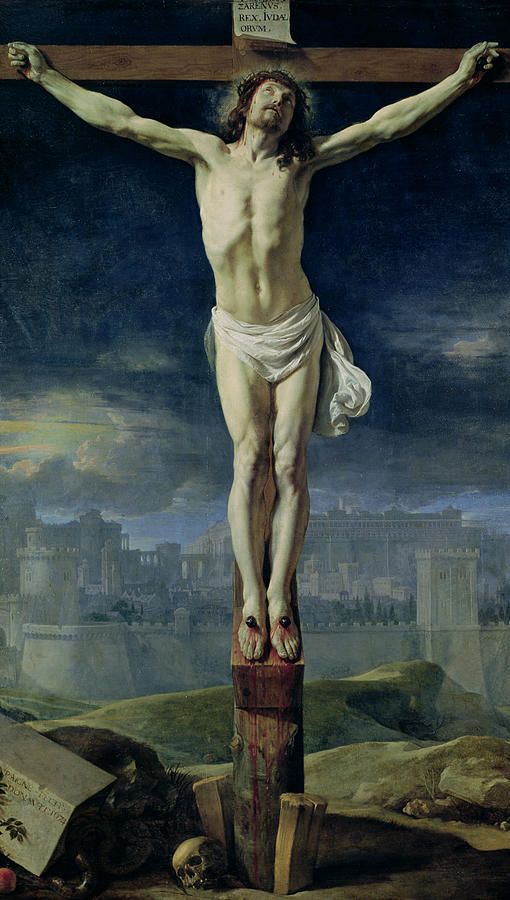
Christ on the Cross, Philippe de Champaigne, before 1650 (Source)

L’Horloge de la Passion

At six o’clock in the evening: Jesus Christ washes the feet of His Apostles. Humility. Help to our neighbor.

At seven o’clock in the evening: Jesus Christ institutes the Most Blessed Sacrament. Recognition and perpetual memory of this benefit.

At eight o’clock in the evening: Jesus Christ prays to His Father for the salvation and union of His Elect. To renounce everything that can stops us from being one with Jesus Christ and our brethren.

At nine o’clock in the evening: Jesus Christ is sad even unto death. Confidence in the weakness of Jesus Christ, who is our strength in our dejection and our miseries.

At ten o’clock in the evening: Jesus Christ prays to His Father to take away the chalice of His sufferings. Submission to the will of God.

At eleven o’clock in the evening: Jesus Christ enters into agony. To resist sin with courage.

At midnight: Jesus Christ, after having turned back the Jews by a single word, allows himself to be caught. To see God in all that man cause us to suffer.

At one o’clock in the morning: Jesus Christ allows himself to be carried off by the Jews. Sweetness and humility in ill-treatment.

At two o’clock in the morning: Jesus Christ is presented to the High Priest. To revere God in secular and ecclesiastical authorities.

At three o’clock in the morning: Renunciation and penance of St. Peter. Fidelity in confessing the name of Jesus Christ. Humble return to Him after our falls.

At four o’clock in the morning: Jesus Christ is presented before the Council of the Jews. To listen to the word of God as being truly His word. To adorer the Truth, never to raise ourselves against it.

At five o’clock in the morning: Jesus Christ mocked and outraged by the servants of the Priests. To suffer humbly both scorn and injuries.

At six o’clock in the morning: Jesus Christ is brought before Pilate. Adoration and imitation of the silence of Jesus Christ, when we are accused.

At seven o’clock in the morning: Jesus Christ is sent to Herod. To pass as foolish before men even though we be truly wise.

At eight o’clock in the morning: Jesus Christ is scourged. To take part in the sufferings of Jesus Christ and His members.

At nine o’clock in the morning: Jesus Christ is crowned with thorns. To adore Jesus Christ as our King. To suffer with him, is to reign.

At ten o’clock in the morning: Jesus Christ is condemned to death. To die to one’s self is to live in Jesus.

At eleven o’clock in the morning: Jesus Christ carries His Cross. Let us carry ours after him; he carries it with us.

At noon: Jesus Christ is crucified. To attach ourselves to Jesus Chris, and to desire to be attached by Him to the Cross.

At one o’clock in the afternoon: Jesus Christ is lifted up upon the Cross. To raise our eyes and heart towards the mysterious and divine Serpent.

At two o’clock in the afternoon: Jesus Christ speaks to His Father, to the Blessed Virgin Mary His Mother, and to St. Jean. Attention to these divine words that comprehend our duties.

At three o’clock in the afternoon: Jesus Christ gives up the ghost. To adore His death; to unite ours to him.

At four o’clock in the afternoon: The open side of Jesus Christ sheds blood and water. Rest in the Side and in the Wounds of Jesus Christ. To honor the Sacraments established in the Church.

At five o’clock in the evening: Jesus Christ is buried, and placed in the tomb. To be buried with Him. To hope for the Resurrection.

Prayers – That one can say in adoring the Death of Jesus Christ

Ut beatam horam Mortis tuae adoramus, Domine, da nobis ut horam mortis nostrae, quam solus nosti, perfecto corde & vivendo & moriendo adoremus.

Vouchsafe unto us grace, O Lord, that in adoring the hour of Thy Death, we might adore, in living and dying with a heart perfectly submitted to Thine commands, the hour of our death, that is known to none but thee.

Domine Jesu, qui mori voluisti ne moreremur, sed de morte ad vitam transiremus, recordare Mortis tuae in tempore mortis meae, cum nec tui nec mei recordari potuero.

Lord Jesus, who hast desired to die to deliver us from death, and to cause us to pass from death to life, remember Thou Thy Death at the hour of mine, when I will be no longer in a state to think of either myself or Thee.

Mortem meam quae poena peccati est, tutetur & protegat Mors tua, quae tollit peccata mundi, ut jam pie cogitando quia mortuus es, tunc moriendo non moriar.

May Thy Death that nullifies the sins of the world be my protection in death, which shall be the penalty of sin; and in thinking with piety that Thou art dead, in dying even may I not die.

Versetur semper ante oculos meos tempus Mortis tuae, quae mihi sit fons vitae, cum vita mea defecerit, ut in Morte tua vitam invenire possim qui in vita mea mortem singulis diebus invenio.

May Thy Death always be present to me, so that it may be unto me a source of immortal life when I will lose this corruptible life; and instead of often finding death in my life, may I find life in Thy Death.

Fac, Domine, semper conjungam cogitationem Mortis tuae cogitationi mortis meae, ut quod in morte mea amarum esse potest, benedictione Mortis tuae dulcescat; sicque vitae permanentis amore, mortis transeuntis levem ictum non reformidem.

Vouchsafe unto me the grace, O Lord, of ever uniting myself to the thought of Thy Death in the remembrance of mine, so that what there might be of bitterness in my death might be sweetened by the blessing of Thine; and thus that the love of an eternal life might cause me not to dread anything of the blow, so light, of a voyaging death.

Bene vivam, Domine, ut bene moriar. Ut bene vivam, vivam de te. Ut bene moriar, moriar in te,. Vitam meam informet Vita tua, ut sancta sit; & mortem meam defendat Mors tua, salus nostra, ut sit salutaris,

Vouchsafe unto me the grace, O Lord, of living well, that I may die well. May I live in Thee, that I might live well: and to die well, may I die in Thee. May Thy life be the rule of my life, so that it may be holy; and may Thy Death, which is the cause of our salvation, safeguard my death so that it may procure unto me salvation.

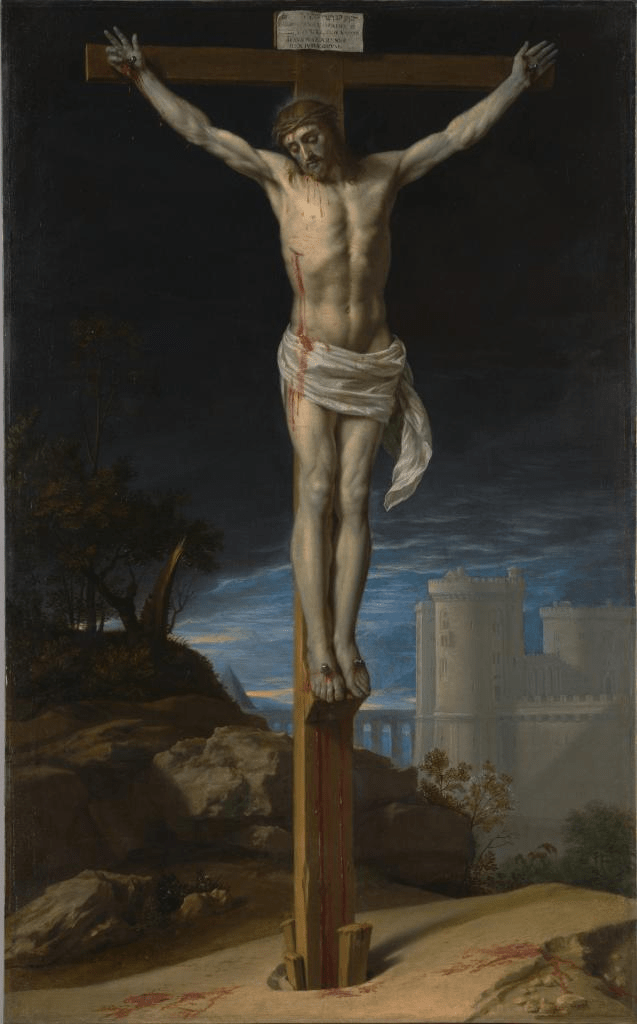
Christ on the Cross. Another treatment of the Passion by Philippe de Champaigne. c. 1655. Given by the artist to his sister Marie, a Beguine in Brussels. (Source)

Advice from a French Nun

Screen Shot 2018-10-28 at 10.13.24 PM.png

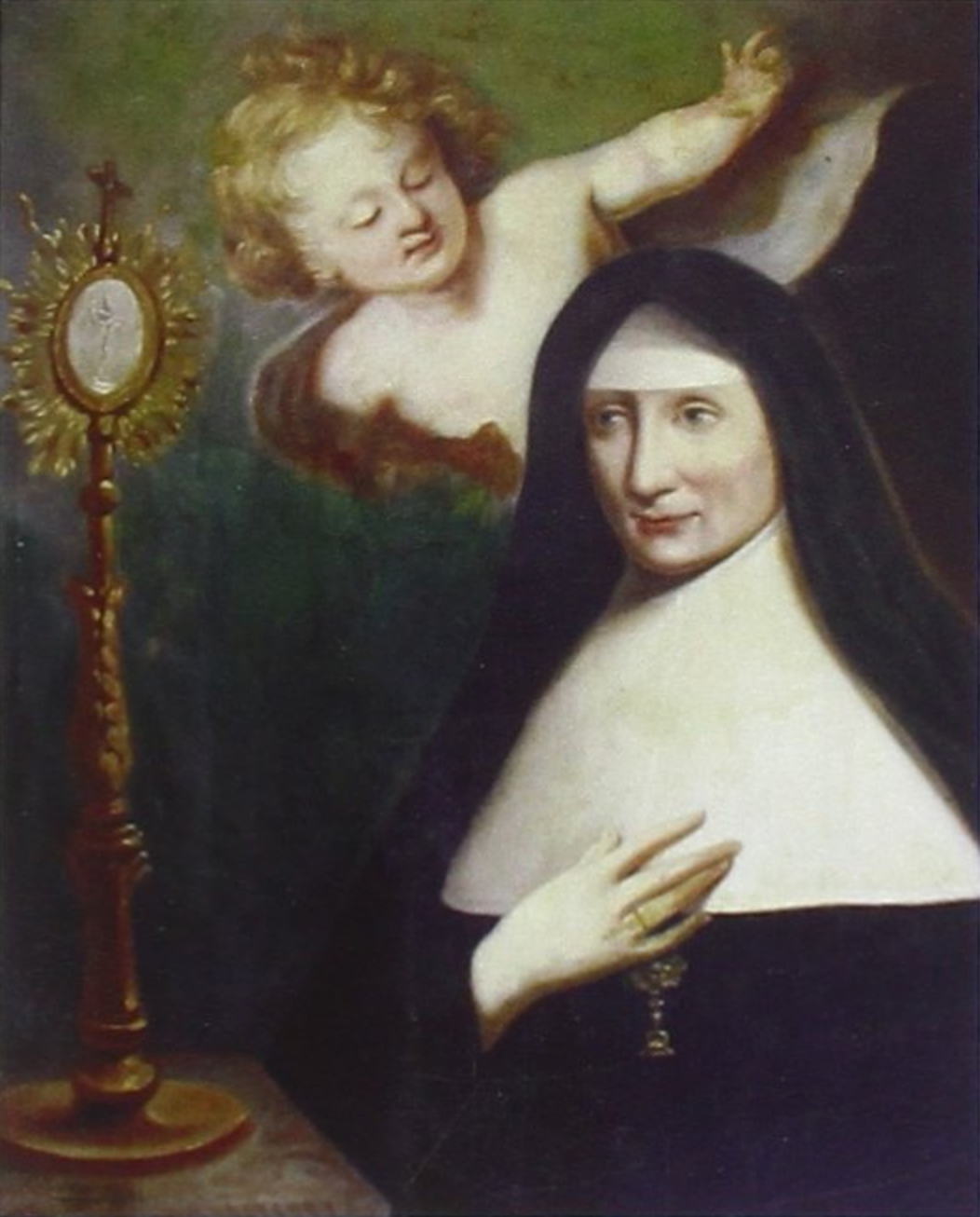
A portrait of Mother Mectilde de Bar adoring the Blessed Sacrament. (Source)

Sometimes readers ask me about more information on Mother Mectilde de Bar (1614-1698), the saintly foundress of the Benedictine Nuns of Perpetual Adoration of the Most Blessed Sacrament of the Altar. I would of course direct those who read French or Italian to any of the several biographical studies about Mother Mectilde that have come out in those languages. However, I would perhaps more eagerly urge my readers to a series of recent posts at Vultus Christi presenting what is, I believe, the first English translations of some of Mother Mectilde’s spiritual letters. Here they are with the titles the translator has given them at VC.

I. “So that I might begin to live in simplicity, like a child.”

II. “On the Meaning of Desolation and Sufferings.”

III. “The state in which you find yourself is of God.”

IV. “The divine labourer who works in you.”

V. “Yet ever thou art at my side.”

VI. “Nothingness doesn’t even attach itself to nothingness.”

VII. “Some sayings of Mother Mectilde.”

VIII. “He sets fire everywhere.”

IX. “All our discontent comes from self-will.”

And on top of all that, there’s a letter from the lay mystic Jean de Bernières to Mother Mectilde. Bernières is a good example of someone who, though posthumously condemned as a “Quietist,” is now being recovered as a source of valuable mystical insight. We have seen the same happen to Benet Canfield before, and it may yet occur to someone like Pietro Matteo Petrucci. More work needs to be done in this area. At any rate, translation of these early modern mystical works is badly needed.

Both as a practicing Catholic and as an historian of early modern Catholicism, I am encouraged that these works are being put into English for the first time. The English-speaking world is now getting a much better sense of the importance of this unique tradition within the Benedictine family. More translations, we are told, are coming. I eagerly await their publication.


Elsewhere: Benedictine Mementos from England

caldey-5

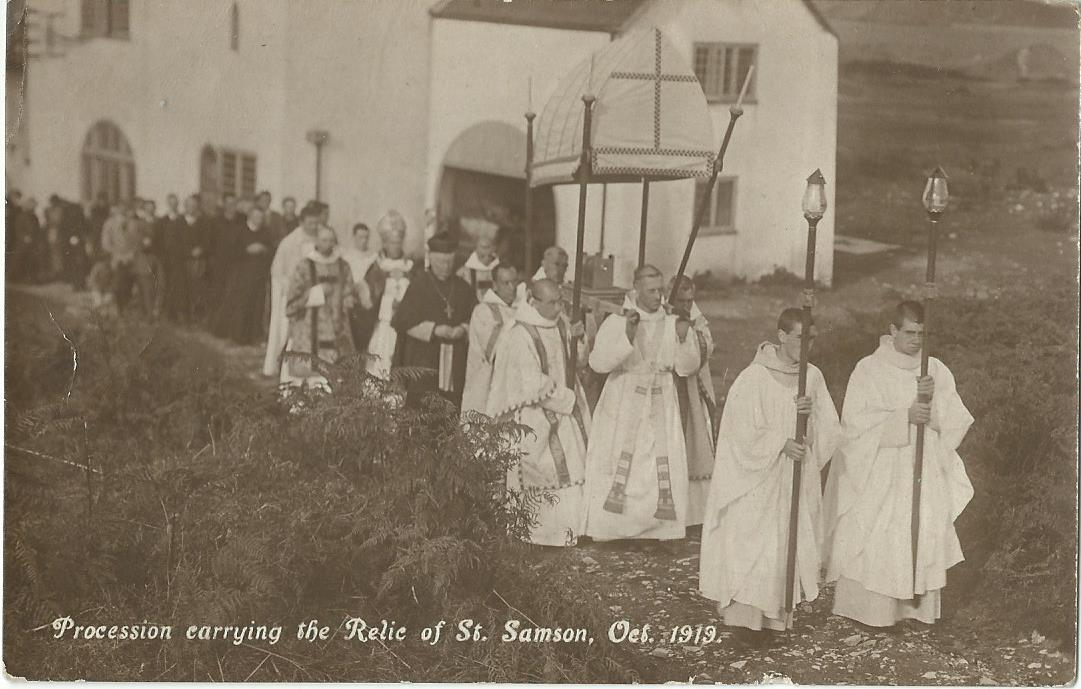
A procession on Caldey Island. (Source)

I’m not sure how I missed this astounding collection of photos of old Caldey, Prinknash, Pershore, Nashdom, and Farnborough when it came out last year, but I’m very glad to have discovered the trove yesterday. Some highlights include:

1. The barge fitted with heraldic devices that Peter Anson describes in Abbot Extraordinary, which was used specifically for the translation of St. Samson’s relics.

2. The silver sanctuary lamp in the shape of a galleon at full sail – once in Aelred Carlyle’s abbatial house (read: palace), now in the main oratory at Prinknash.

3. The various stones of dissolved abbeys brought to Caldey and placed into a single altar. If I’m not mistaken, Fr. Hope Patten must have gotten the idea for the Shrine at Walsingham from Caldey, as he knew Aelred Carlyle quite well.

4. Some lovely images of St. Samson and the Holy Face of Jesus used on printed material from the monasteries.

5. One or two excellent frontals, especially the one embroidered with seraphim at Prinknash.

6. An abbess of Kylemore Abbey in Ireland.

7. Peter Anson’s several drawings of Prinknash.

8. A procession for the 1964 Nashdom jubilee.

9. F.C. Eden’s terrifically English reredos at Caldey.

10. Scenes of the community’s collective reception into Rome in 1914 – including a shot of the Bl. Columba Marmion, who was an enthusiastic supporter of old Caldey.

Those who like Anglo-Catholic or monastic history will no doubt be as excited about this collection as I am.

UPDATE: A reader has kindly reminded me that, of course, Caldey Island is off the coast of Wales. So my title is perhaps a little misleading.

Fénelon on the Return to God

Fenelon

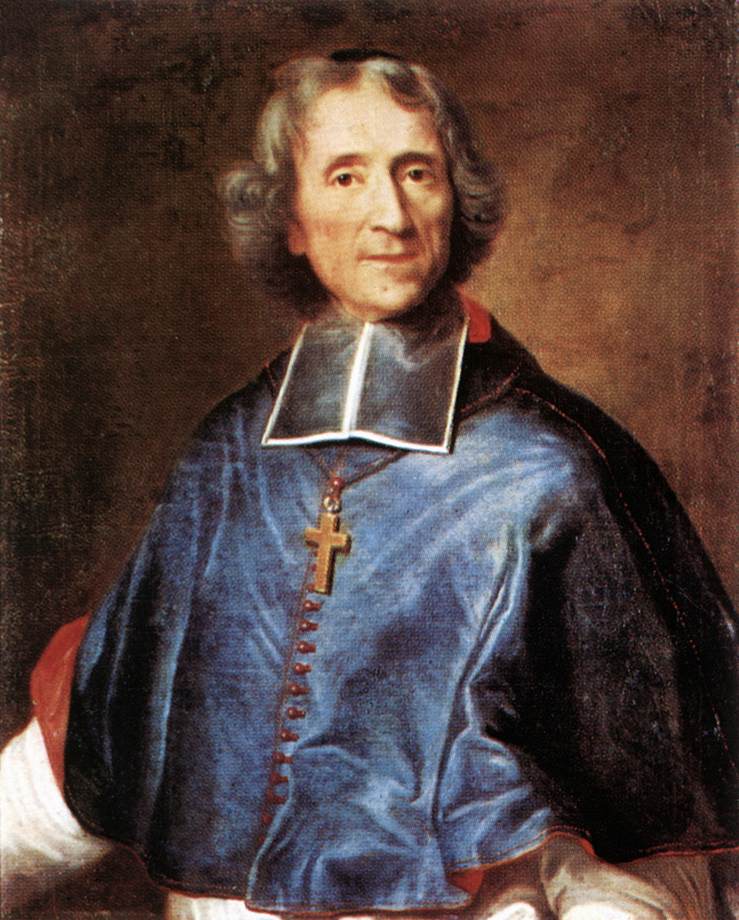
François de Salignac de la Mothe-Fénelon, Archbishop of Cambrai in the age of Louis XIV (Source)

Continuing my Lenten series of Wednesday spiritual masters, I present to you here a letter by Archbishop Fénelon to an officer, often identified as the Chevalier Colbert. The translation I am using comes from 1877, but I would also recommend to you the version by fellow Wahoo Chad Helms in the 2006 Paulist Press edition of Fénelon‘s Selected Writings. It struck me by its beauty and force of feeling, as well as its Lenten spirit. 

You have forgotten me, sir, but it is impossible for me to forget you. Something in my heart continually recalls you, and makes me want to hear of you, as I have more especially felt during the campaign and its perils. Your forgetfulness only makes me feel the more. The friendship you showed me once is of a kind never to be forgotten; and when I recall some of our conversations, my eyes are filled with tears. I trust that you remember how pleasant and hearty they were. Have you found anything since then more acceptable than God? Have the truths which then satisfied you failed? Is the pure light of the kingdom of God quenched? Has the world’s nothingness acquired some fresh value? Is that which was but a wretched dream not still the same? Is the God to Whom you poured out your soul, and Who filled you then with a peace beyond all earthly ken, no longer to be loved? Has the eternal beauty, ever so fresh to pure eyes, no longer charms for you? Is that source of heavenly joy, of unmarred happiness, which springs from the Father of Mercies and God of Consolation, dried up? No, for He has filled me with an urgent desire to recall you to Him. I cannot resist it: for long I have hesitated, and said to myself that I should only worry you. Even as I began this letter, I laid down a limit of discretion to myself; but after the first few words, my heart burst its bounds. Even should you not answer, or should think me absurd, I should not cease to speak sorrowfully to God of you, when unable to speak to you yourself any more. Once more, sir, forgive me if I exceed all due limits. I know it as well as you, but I feel irresistibly urged: God has not forgotten you, since He stirs up so eager a desire for your salvation in me.

What does He ask of you, save to be happy? Have you not realised that one is happy in loving Him? Have you not felt that there is no other real happiness, whatever excitement may be found in sensual pleasures, apart from Him? Since, then, you know where to find the Fountain of Life, and have of old drunk thereof, why would you seek foul, earthly cisterns? Bright, happy days, lighted up by the soft rays of loving mercy, when will ye return? When will it be given me to see this child of God reclaimed by His powerful Hand, filled with His favour, and the blessings of His holy Feast; causing joy in Heaven, despising earth, and acquiring an inexhaustible fund of humility and fervour from his experience of human frailty?

1280px-Rembrandt_Harmensz_van_Rijn_-_Return_of_the_Prodigal_Son_-_Google_Art_Project2

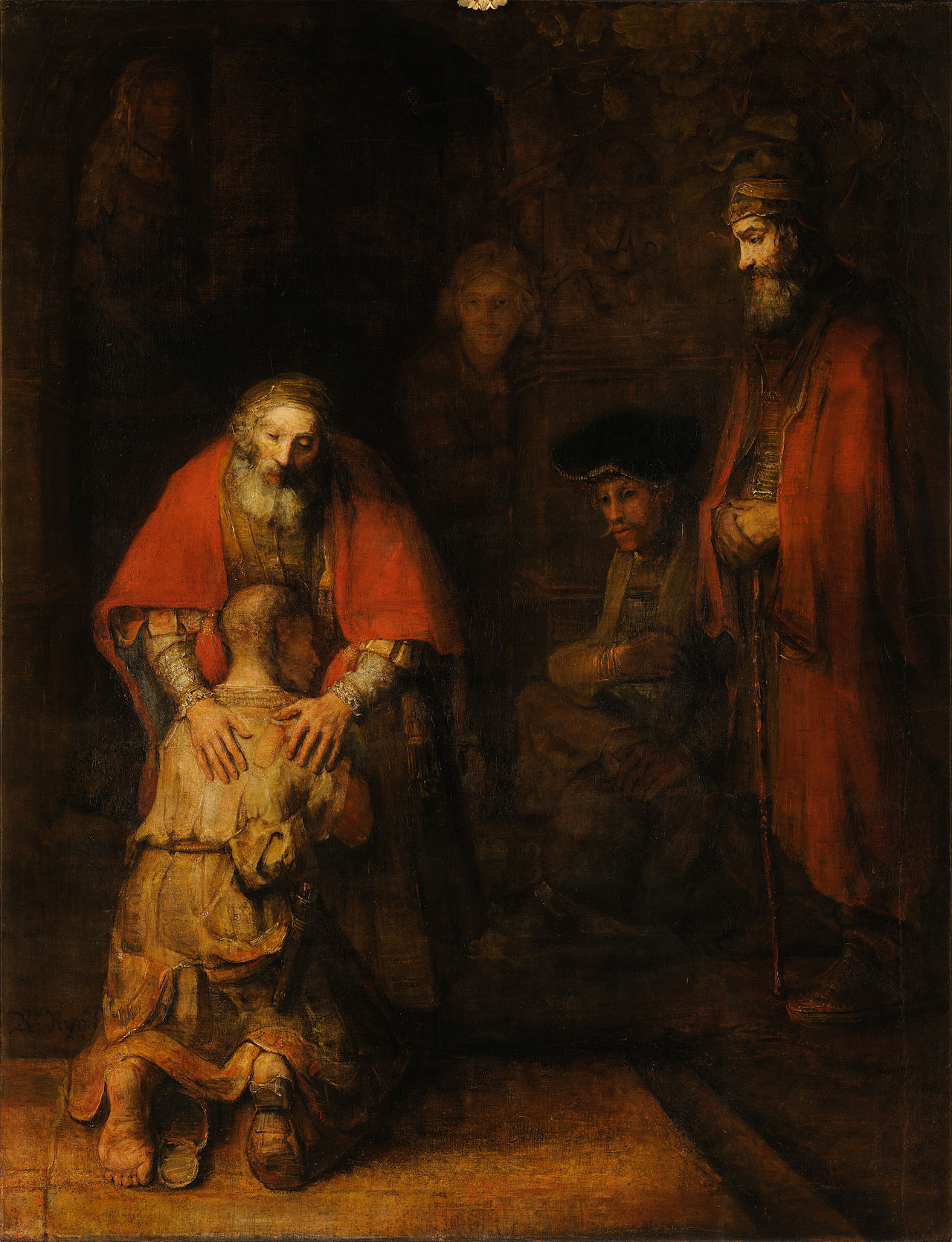
The Return of the Prodigal Son, Rembrandt van Rijn, c. 1661-69. (Source)

I am not dictating what you should do. God will Himself make that plain to you according to your needs, so long as you hearken inwardly to Him, and despise boldly that which is despicable. Do whatever you will, only love God, and let His Love, revived in your heart, be your guide. I have often thanked Him for having shielded you amid the perils of this campaign, in which your soul was even more exposed to risk than your body. Many a time I have trembled for you: put an end to my fears, and fill my heart with gladness. None can possibly be greater than to find myself once more with you in the house of God, united in heart and soul, looking together to one glorious hope, and the Coming of our Great God, Who will fill us with the flood of His pure delights. Your ears are not yet closed to the sublime language of truth, your heart is made to feel its charms. “Taste and see” the pleasant bread daily spread for us at our Father’s table. Why have you forsaken it? With such support, who can fear that anything else will be lacking? Even if you do not feel strong enough to regain the happy position where you were, at least answer me, at least do not shun me. I know what it is to be weak; I am a thousand times weaker than you. It is very profitable to have realised what one is; but do not add to that weakness, which is inseparable from human nature, an estrangement from the means of strength. You shall regulate our intercourse; I will only speak to you of such things as you are willing to hear. I will keep God’s secret in my heart, and shall be always, with unchanging affection and regard, etc.


A Benedictine Prayer to St. Philip Neri in Lenten Time

gueranger4-150dpi

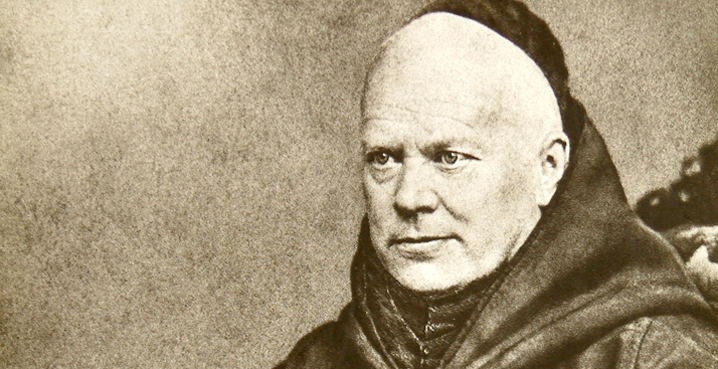
Ven. Dom Prosper Guéranger. (Source)

Many of my readers will know the Venerable Dom Prosper Guéranger (1805-1875) for his monumental work of sacramentology and liturgical exegesis, The Liturgical Year. I happened to be perusing a 1908 French edition of the text and came upon Dom Guéranger’s homage to St. Philip Neri in Volume 3 of his Easter writings. Naturally, this discovery was of great interest to me, as I have written before on the similarities between the Oratorian and Benedictine vocations. I thus present to you my own translation of the prayer, found on pages 548-50 in the edition I was using. I hope it may be thought a fair translation of the great monk’s words. At any rate, I have tried to render his prayer in an elevated style worthy to the subject.

Thou didst love the Lord Jesus, O Philip, and thy whole life was nothing but a continuous act of love; but thou didst not wish to enjoy the highest good alone. All thine efforts tended to make Him known by all men, such that all might love Him with thee and thus reach their supreme end. For forty years, thou wast the indefatigable apostle of the holy city, and nothing could subtract from the action of the divine fire that burned in thee. We who are the posterity of those who heard thy words and admired the celestial gifts in thee, we dare to beg of thee to cast thy gaze upon us as well. Teach us to love our Jesus resurrected. It does not suffice for us to adore Him and to rejoice in His triumph; we must love Him: for the train of His mysteries from His Incarnation to His Resurrection have no other aim but revealing to us, in an ever growing light, His divine kindness. It is by loving him ever more that we shall succeed in elevating ourselves to the mystery of His Resurrection, which fulfills in us the revelation of all the riches of His heart. The more He lifts Himself into the new life that He won in leaving His tomb, the more He appears full of love for us, and the more He desires that our hearts should be joined with His. Pray, O Philip, and beg that “our heart and our flesh might quake for the living God” [Ps. 83:2]. After the mystery of Easter, introduce us to that of the Ascension; dispose our hearts to receive the divine Spirit of Pentecost; and when the august mystery of the Eucharist shines before our eyes with all its fires in the solemnity that approaches, thou, O Philip, who didst celebrate it one last time here below, who didst rise at the end of the day to that eternal rest where Jesus shows Himself unveiled, do thou prepare our souls to receive and to taste “the living bread which giveth life to the world” [John 6:33].

The sanctity that shone in thee, O Philip, had as its character the momentum of thy soul towards God, and all those who approached thee soon participated in this disposition that alone could respond to the call of the divine Redeemer. Thou didst know that thou took hold of souls, and thou drovest them to perfection by the way of trust and generosity of heart. In this great work thy method was never to have any method at all, imitating the Apostles and the ancient Fathers, and thou didst trust in the virtue proper to the word of God. By thee the fervent frequenting of the sacraments reappeared as the surest sign of the Christian life. Pray for the faithful, and come to the aid of so many souls who grow restless and exhaust themselves in the paths that the hand of man hast traced, and that too often retard or prevent the intimate union of Creator and creature.

Thou didst most ardently love the Church, O Philip; and this love of the Church is the indispensable sign of sanctity. Thine elevated contemplation did not distract thee from the dolorous lot of this holy Bride of Christ, so tested in the century when thou wast born and died. The efforts of triumphant heresy in so many countries enkindled zeal in thy heart: obtain for us from the Holy Ghost this living sympathy for Catholic Truth that renders us sensible to its defeats and victories. It does not suffice for us to save our souls; we must desire with ardor and aid with all our means the advancement of the Reign of God on earth, the extirpation of heresy, and the exaltation of our mother the holy Church: it is in this condition that we are children of God. By thine examples, O Philip, inspire in us this ardor by which we must totally associate ourselves with the sacred interests of our common mother. Pray as well for the Church Militant which counted thee in her ranks as one of her best soldiers. Serve valiantly the cause of Rome, which holds as an honor the debt owed to thee for so many of thy services. You sanctified her during thy mortal life; hallow her again and defend her from heaven on high.

sc1119.jpg

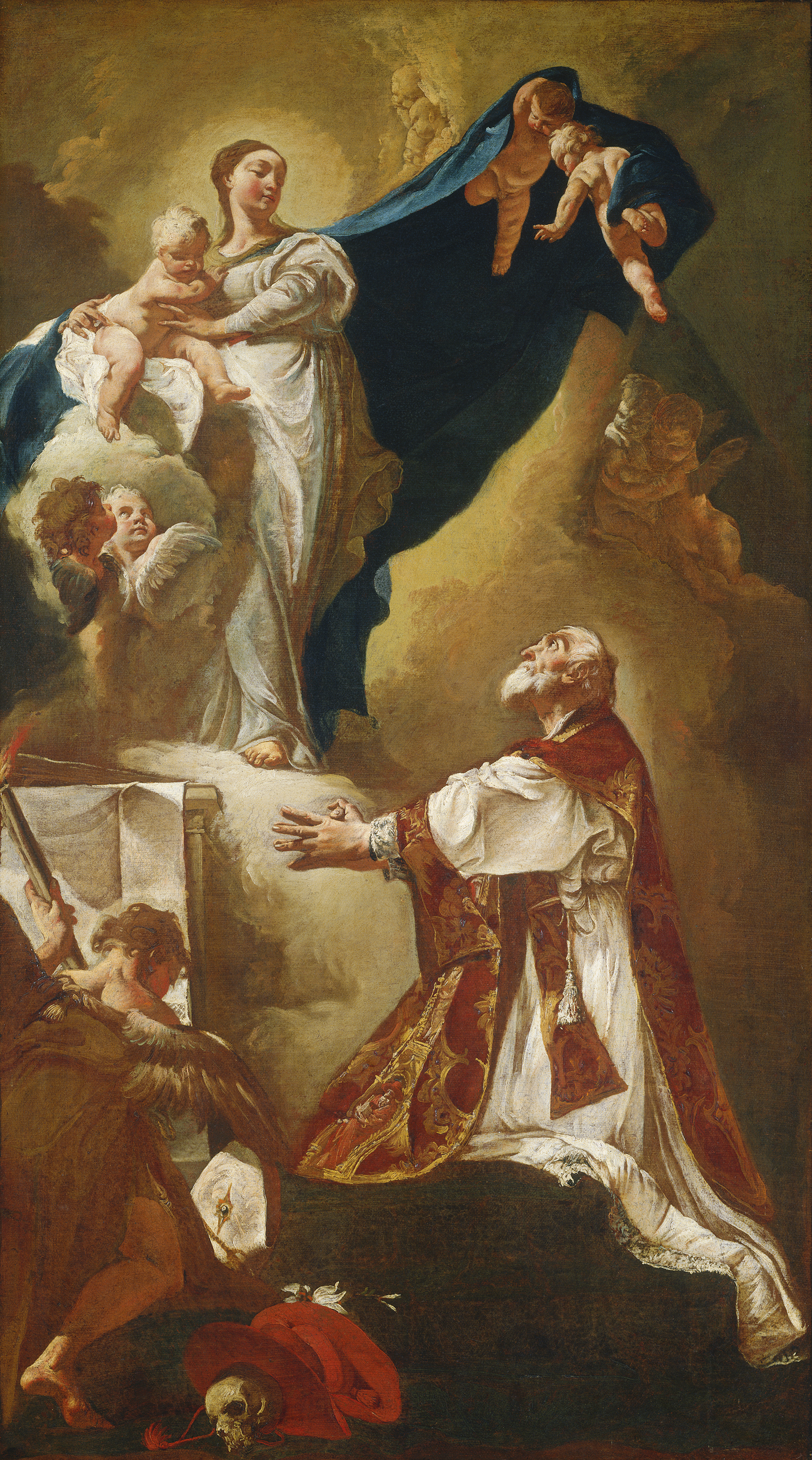
Madonna and Child Appearing to St. Philip Neri, Giovanni Battista Piazzetti, c. 1725. (Source)