Another View of the Sacraments in the Eighteenth Century

A while back I produced a short post entitled “A View of the Sacraments in the Age of Enlightenment.” Here I give you another series of similar images, this time from the hand of Giuseppe Maria Crespi, also known as “Lo Spagnuolo.” These paintings from 1712, so reminiscent of Rembrandt, hang in the Gemäldegalerie, Dresden. Originally commissioned by Cardinal Pietro Ottoboni, that towering figure of late Baroque culture, they passed posthumously up to Germany, where they made their way into collection of the Elector of Saxony.

Let me begin by saying that, as with the information in the above paragraph, all of the images can be found at Wikipedia.
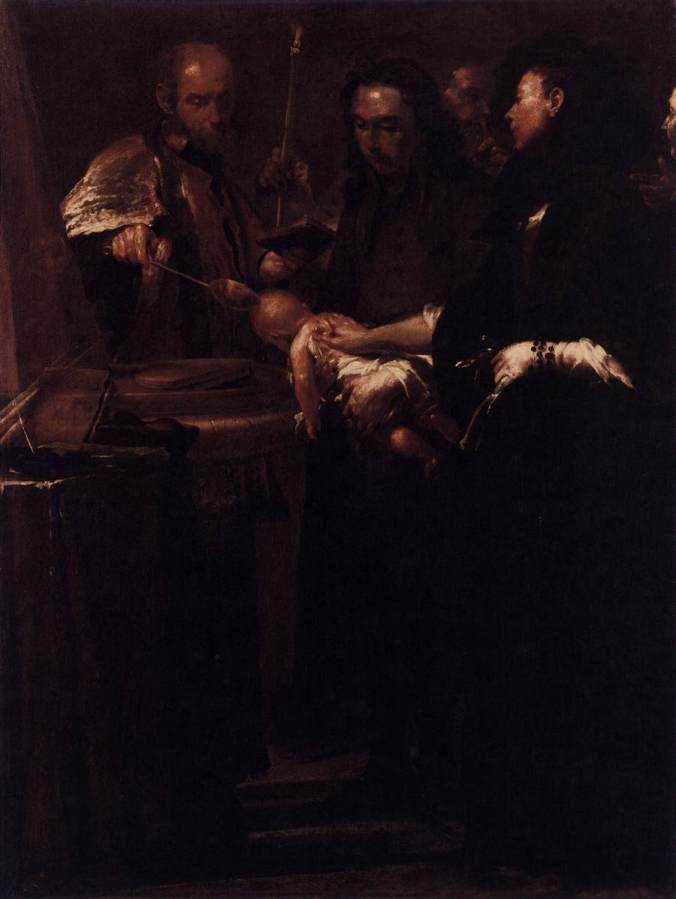
Giuseppe_Maria_Crespi_-_Baptism_-_WGA05763

“Baptism.” Crespi’s sparing use of light demonstrates the central conjunction of the scene. Allowing our eyes to wander along the central line of illumination, we follow the arm of the priest pouring water on the head of the outstretched infant to the mother’s rosary-wrapped wrist just beyond. I am convinced that the use of light in all of these images is the key to their meaning. Crespi uses light to illustrate the work of sacramental grace, and darkness to emphasize the mortality, evanescence, and weariness of our ordinary world. “The people in darkness have seen a great light” – thus spake Isaiah.
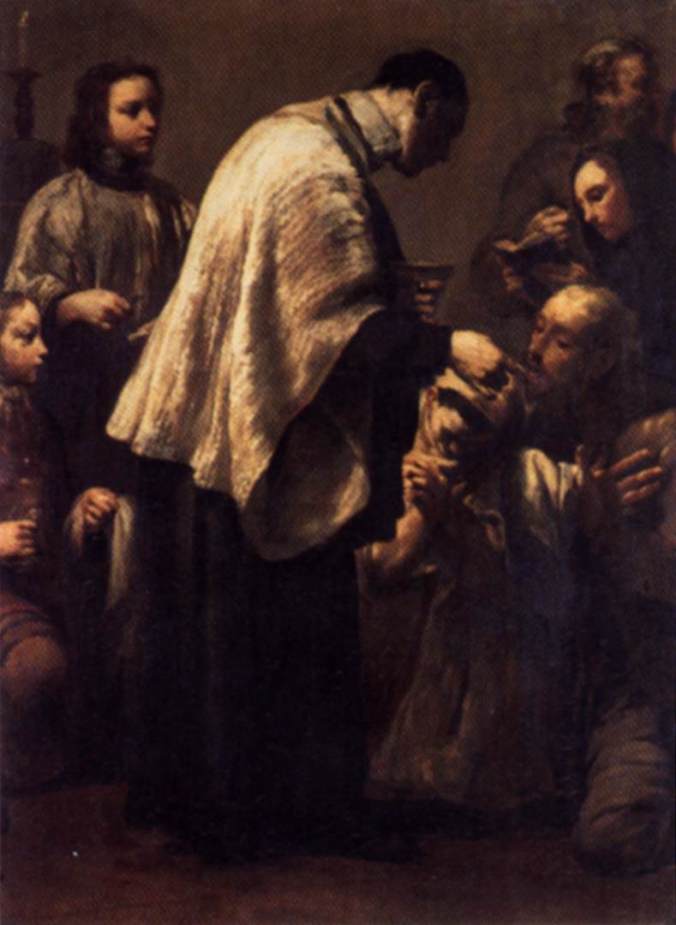
Giuseppe_Maria_Crespi_-_Communion_-_WGA05766

“Communion.” The priest’s face is shrouded in darkness, and rightly so. It is not he who offers the bread of life, but Christ in him. Interesting collar, too. Sure looks familiar. Cardinal Ottoboni was patron of the Congregation of the Oratory at Rome for some time, and it’s entirely possible that Crespi would have taken the Oratorians as his model here. Besides that, the setting of the scene is strikingly barren. Crespi’s choice to leave out the probable altar rail lends the scene an intimacy that captures the very heart of the worship here portrayed.
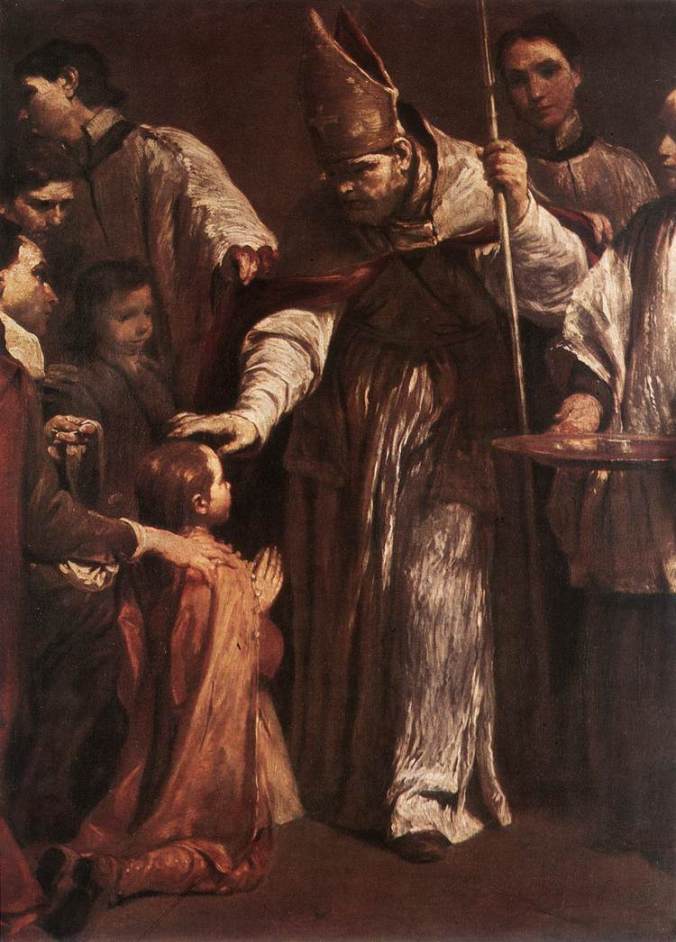
Giuseppe_Maria_Crespi_-_Confirmation_-_WGA05765

“Confirmation.” Crespi’s lightest and most colorful piece in the series. The vivid red-orange of the boy’s robes call to mind the tongues of flame that appeared on Pentecost, as does the (relatively) diffuse light bathing the scene. The brightest part of the image is the Bishop’s arm, only just anointing the boy’s head.  The strong predominance of vertical and diagonal lines in this piece only reinforce the sense of descent. Like all the paintings, the scene here is crowded without being cramped. Crespi seems to have penetrated to the deeply ecclesial nature of the sacraments. The sacraments are what give the Christian community its underlying spiritual cohesion and form. To quote De Lubac, “The Eucharist makes the Church.”
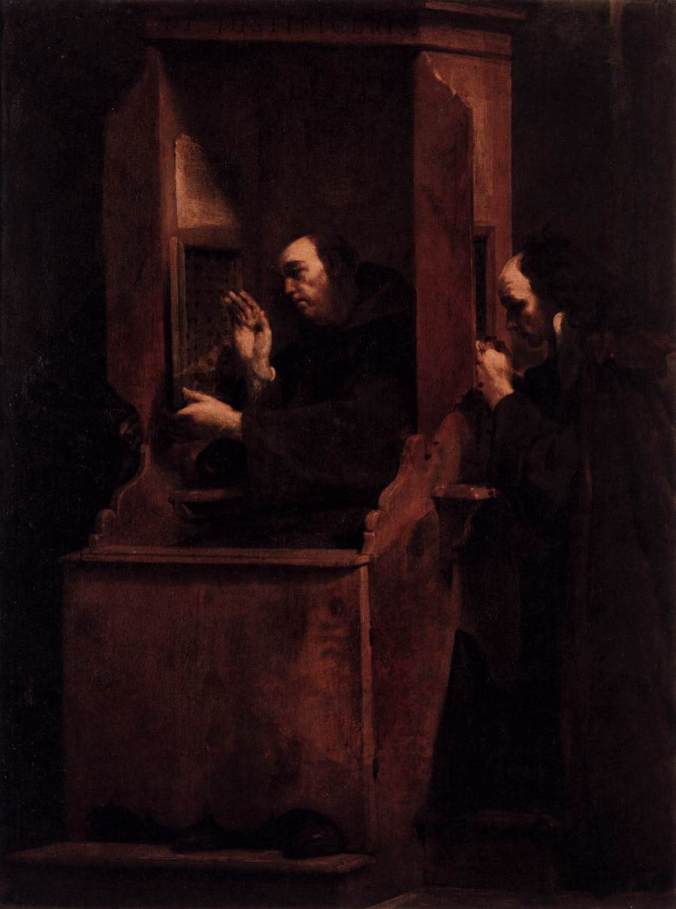
Giuseppe_Maria_Crespi_-_Confession_-_WGA05764

“Confession.” Quite in contrast to “Confirmation,” we come to Crespi’s darkest piece in the series. The overwhelming color is black. Confession is the sacrament that deals most straightforwardly with the reality of sin. The narrow contraction of the light – it comes only from one side, and very weakly. The formal likeness between confessor and penitent reminds us of the condition of sin common to all men. This painting is also the only one in the series where we don’t see a crowd. Only two figures are visible. In the end, we are always “alone with the Alone.”
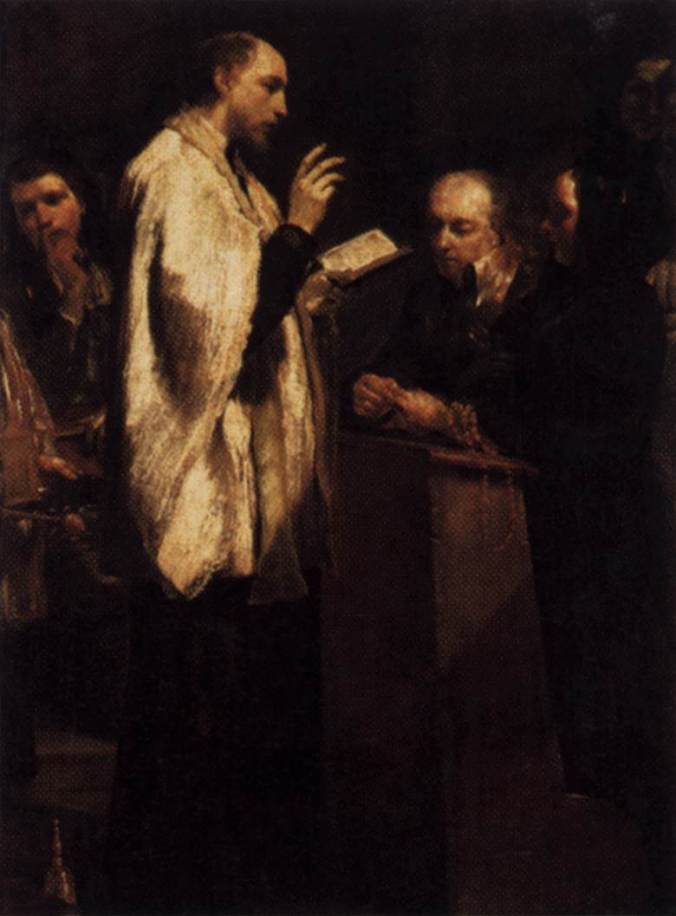
Giuseppe_Maria_Crespi_-_Matrimony_-_WGA05769

“Matrimony.” Perhaps the most human of Crespi’s scenes. But we find unusual notes, things I can’t quite interpret with satisfaction. For a painting of matrimony, we hardly see the couple. Indeed, the bride has almost been swallowed up by the shadows. Nigra sum sed formosa. Perhaps. The priest stands like a pillar of cloud before them, blessing their union. That seems straightforward enough. Yet why is the man on the left holding his hand to his mouth, as if to signal silence? Perhaps because the matter of this sacrament is always properly taken in secret…
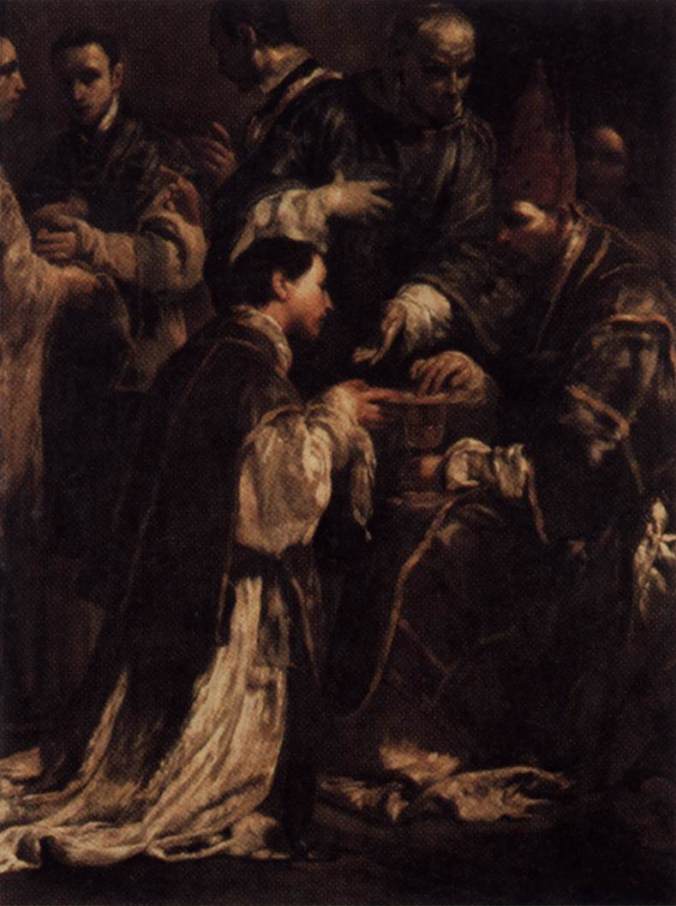
Giuseppe_Maria_Crespi_-_Ordination_-_WGA05768

“Ordination.” This composition is a swirling mix of blacks, browns, subtle golds, and occasionally, whites. The point that stands out most is the break in this overall scheme – the youthful, rosy visage of the ordinand, coupled with the slightly ruddy shadows that fall across his hand. What a contrast with the other figures, all of whom are shrouded in darkness and invested with a manifest pallor. Here is an image of youth, a prospect of renewal against a backdrop of dignified decay.
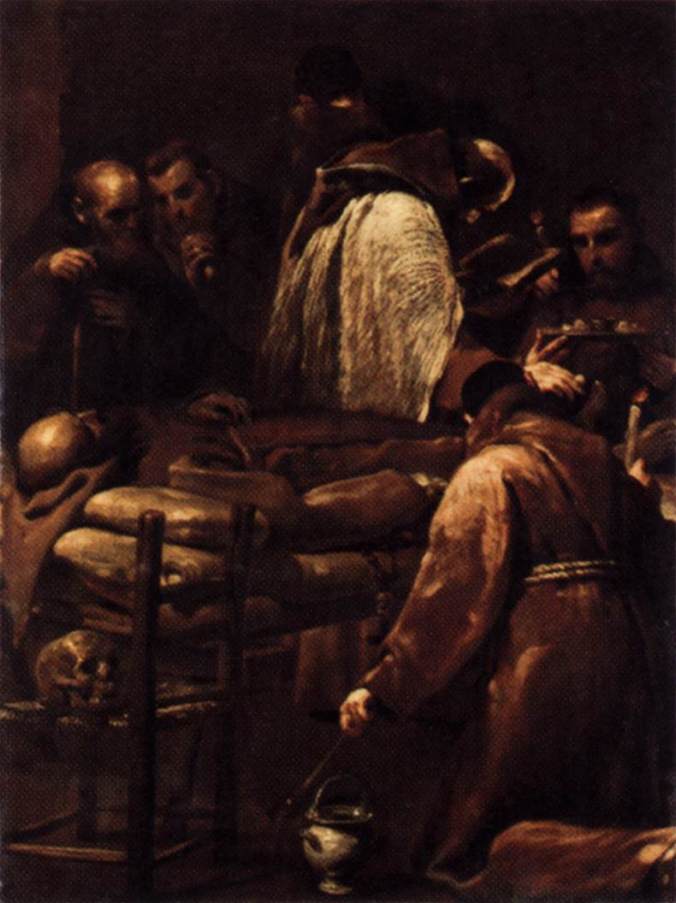
Giuseppe_Maria_Crespi_-_Extreme_Unction_-_WGA05767

“Extreme Unction.” At last we come to the end, the place of the skull. It is only fitting that Crespi should choose to depict a collection of Franciscans for this sacrament. Religious life is always a preparation for death. Yet the bright patch of light improbably illuminating the shoulder of the attendant friar contrasts starkly with the shadowy body of the dying father and points to new hope.
A Benedictine Prayer to St. Philip Neri in Lenten Time

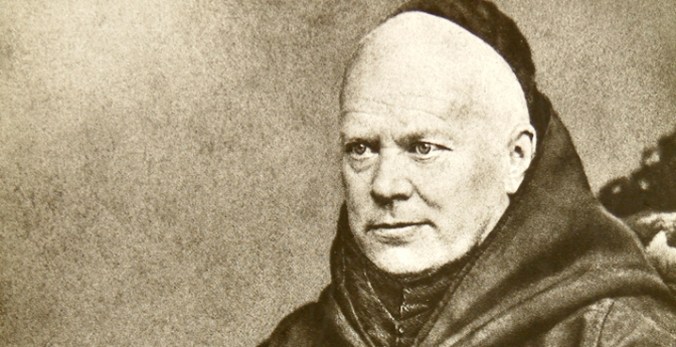
gueranger4-150dpi

Ven. Dom Prosper Guéranger. (Source)

Many of my readers will know the Venerable Dom Prosper Guéranger (1805-1875) for his monumental work of sacramentology and liturgical exegesis, The Liturgical Year. I happened to be perusing a 1908 French edition of the text and came upon Dom Guéranger’s homage to St. Philip Neri in Volume 3 of his Easter writings. Naturally, this discovery was of great interest to me, as I have written before on the similarities between the Oratorian and Benedictine vocations. I thus present to you my own translation of the prayer, found on pages 548-50 in the edition I was using. I hope it may be thought a fair translation of the great monk’s words. At any rate, I have tried to render his prayer in an elevated style worthy to the subject.

Thou didst love the Lord Jesus, O Philip, and thy whole life was nothing but a continuous act of love; but thou didst not wish to enjoy the highest good alone. All thine efforts tended to make Him known by all men, such that all might love Him with thee and thus reach their supreme end. For forty years, thou wast the indefatigable apostle of the holy city, and nothing could subtract from the action of the divine fire that burned in thee. We who are the posterity of those who heard thy words and admired the celestial gifts in thee, we dare to beg of thee to cast thy gaze upon us as well. Teach us to love our Jesus resurrected. It does not suffice for us to adore Him and to rejoice in His triumph; we must love Him: for the train of His mysteries from His Incarnation to His Resurrection have no other aim but revealing to us, in an ever growing light, His divine kindness. It is by loving him ever more that we shall succeed in elevating ourselves to the mystery of His Resurrection, which fulfills in us the revelation of all the riches of His heart. The more He lifts Himself into the new life that He won in leaving His tomb, the more He appears full of love for us, and the more He desires that our hearts should be joined with His. Pray, O Philip, and beg that “our heart and our flesh might quake for the living God” [Ps. 83:2]. After the mystery of Easter, introduce us to that of the Ascension; dispose our hearts to receive the divine Spirit of Pentecost; and when the august mystery of the Eucharist shines before our eyes with all its fires in the solemnity that approaches, thou, O Philip, who didst celebrate it one last time here below, who didst rise at the end of the day to that eternal rest where Jesus shows Himself unveiled, do thou prepare our souls to receive and to taste “the living bread which giveth life to the world” [John 6:33].

The sanctity that shone in thee, O Philip, had as its character the momentum of thy soul towards God, and all those who approached thee soon participated in this disposition that alone could respond to the call of the divine Redeemer. Thou didst know that thou took hold of souls, and thou drovest them to perfection by the way of trust and generosity of heart. In this great work thy method was never to have any method at all, imitating the Apostles and the ancient Fathers, and thou didst trust in the virtue proper to the word of God. By thee the fervent frequenting of the sacraments reappeared as the surest sign of the Christian life. Pray for the faithful, and come to the aid of so many souls who grow restless and exhaust themselves in the paths that the hand of man hast traced, and that too often retard or prevent the intimate union of Creator and creature.

Thou didst most ardently love the Church, O Philip; and this love of the Church is the indispensable sign of sanctity. Thine elevated contemplation did not distract thee from the dolorous lot of this holy Bride of Christ, so tested in the century when thou wast born and died. The efforts of triumphant heresy in so many countries enkindled zeal in thy heart: obtain for us from the Holy Ghost this living sympathy for Catholic Truth that renders us sensible to its defeats and victories. It does not suffice for us to save our souls; we must desire with ardor and aid with all our means the advancement of the Reign of God on earth, the extirpation of heresy, and the exaltation of our mother the holy Church: it is in this condition that we are children of God. By thine examples, O Philip, inspire in us this ardor by which we must totally associate ourselves with the sacred interests of our common mother. Pray as well for the Church Militant which counted thee in her ranks as one of her best soldiers. Serve valiantly the cause of Rome, which holds as an honor the debt owed to thee for so many of thy services. You sanctified her during thy mortal life; hallow her again and defend her from heaven on high.

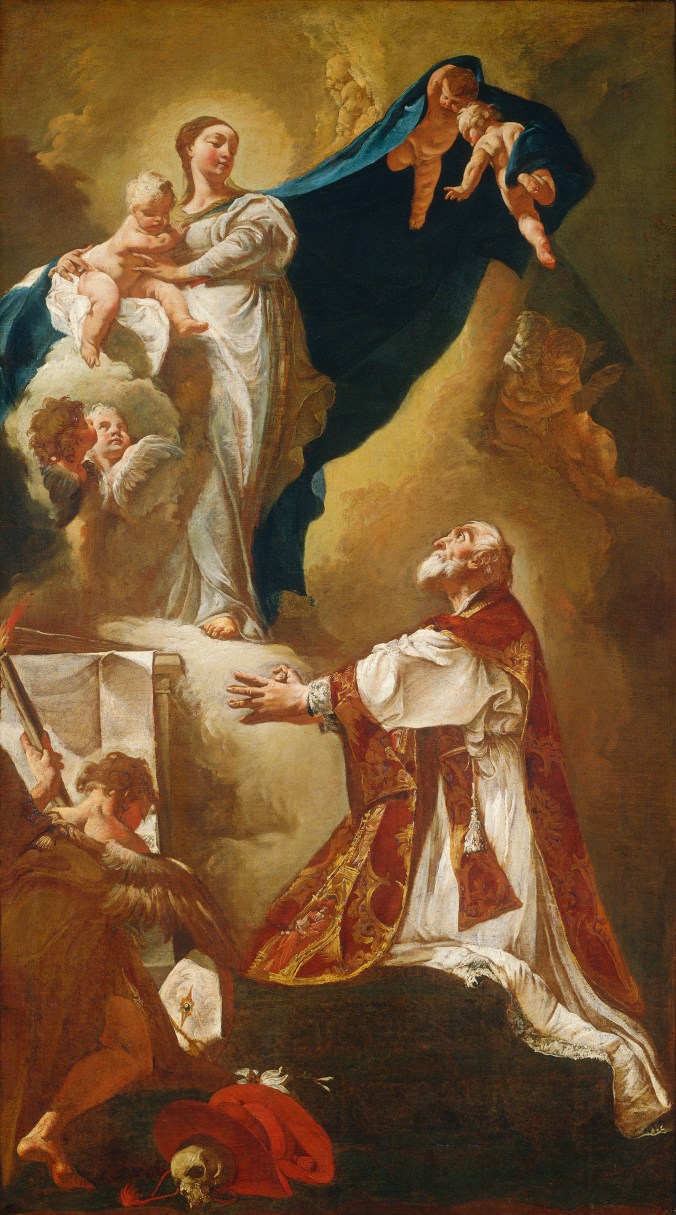
sc1119.jpg

Madonna and Child Appearing to St. Philip Neri, Giovanni Battista Piazzetti, c. 1725. (Source)


Elsewhere: Fr. Hunwicke on Liturgical Wigs

image

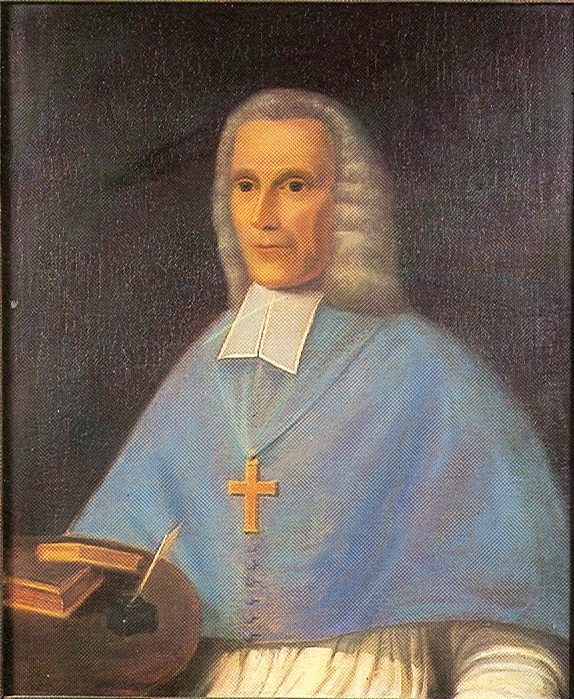
The famous portrait of Bishop Challoner to which Fr. Hunwicke refers in his piece. (Source)

I haven’t written much this week, as I’ve been traveling. However, on this beautiful  St. Bernard’s Day, I thought I’d share this brief and wonderful gem of a piece by Fr. John Hunwicke of the Ordinariate.

An excerpt:

I’m sure there are zillions of you out there who have the following sort of information right at your snuff-stained finger tips: did prelates eo fere tempore wear their wigs all through Mass? Even after their zucchetto had been removed as they approached the Consecration? When did Catholic bishops stop wearing wigs? (I think it went out of fashion in Anglican cicles in the 1830s.)

He also gets into the question of blue episcopal choir dress, mainly used in France and Ireland. Read the whole thing.

Clerical dress is one of my longstanding interests, as is the history of 18th century Catholicism. I’m glad Fr. Hunwicke is using his formidable celebrity to draw attention to these matters. While some may dismiss clerical fashion (particularly that of the Ancien Régime) as a trivial matter, I beg to differ. Clerical dress both during and outside of the liturgy is one more aesthetic component by which we can present “the beauty of holiness.” The nondescript threads worn by so many clergy and religious today are, alas, one more surrender to the cult of stark utility, false equality, failed individuality, and, in the end, boring homogeneity.

At the moment, I don’t have the time or capacity to research the questions Fr. Hunwicke raises. But The Amish Catholic will follow this story with all due attention and gravity. You can count on that. In the meantime, I’ll feast my eyes on this doozy of a cappa magna.