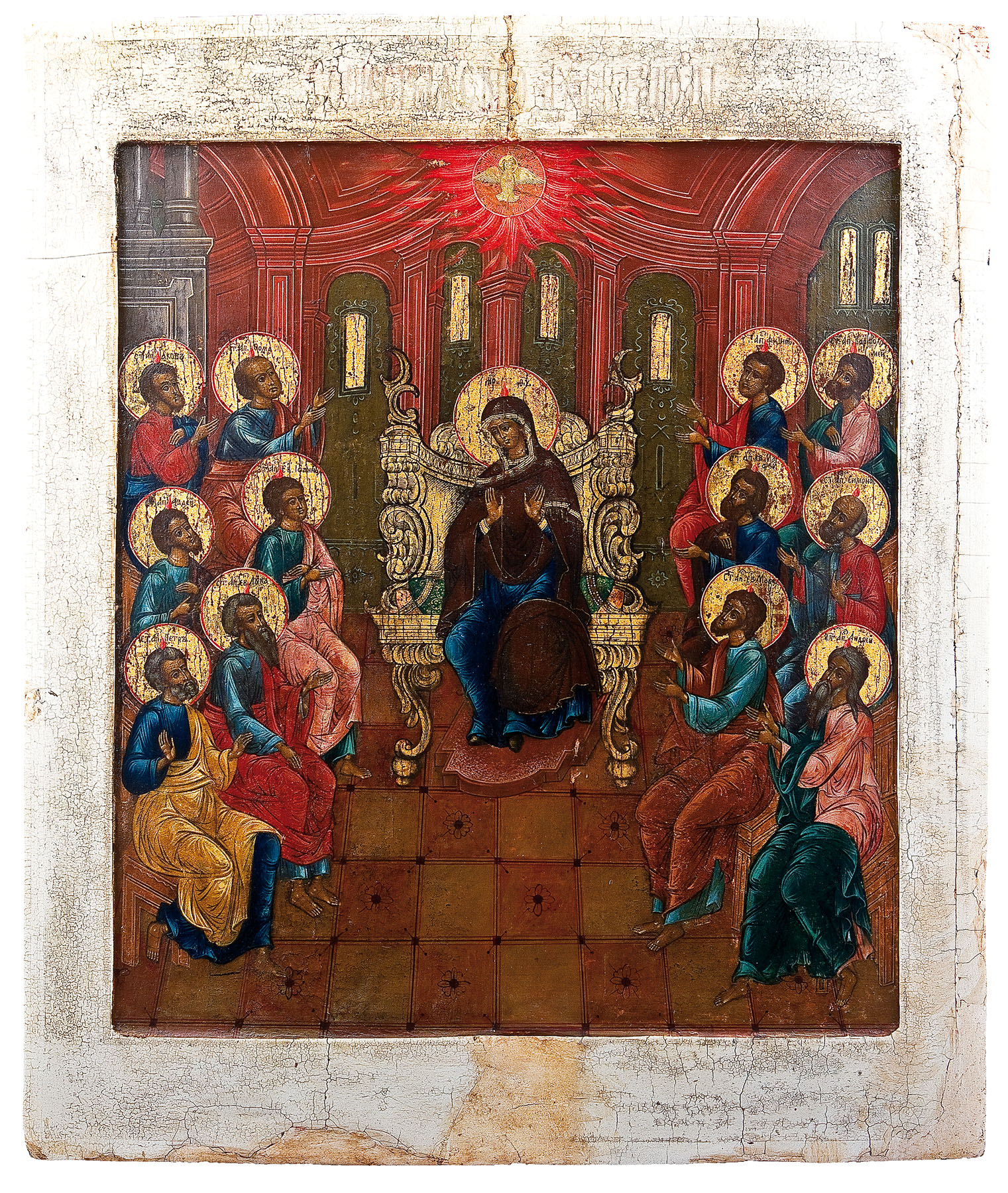
On Faith and the Priesthood of Christ

And he led them out as far as to Bethany, and he lifted up his hands, and blessed them. And it came to pass, while he blessed them, he was parted from them, and carried up into heaven. And they worshipped him, and returned to Jerusalem with great joy: And were continually in the temple, praising and blessing God. Amen. – Luke 24: 50-53

Many years ago, shortly after the start of my faith journey, I received some very good advice from an Anglican friend of mine. Or rather, I received a very good prayer. She told me that whenever she was anxious or worried or stressed about anything, she resorted to a prayer that ran like this:

“Jesus Christ is my High Priest, and He will always see me through.”

There is much consolation in these simple words, as I have had frequent occasion to learn in the years since then. And, to be honest, I am most drawn to Christ in the mystery of His High Priesthood. I often find myself asking Him to pray for me, not in the sense that one asks a friend or a saint to pray, but as one can only ask a sovereign and perfect intercessor. This sense of Christ as High Priest has become part of the basic structure of my own faith. Yet today’s feast, the Ascension of Our Lord into Heaven, invites us all to dwell upon this mystery in a more explicit way.

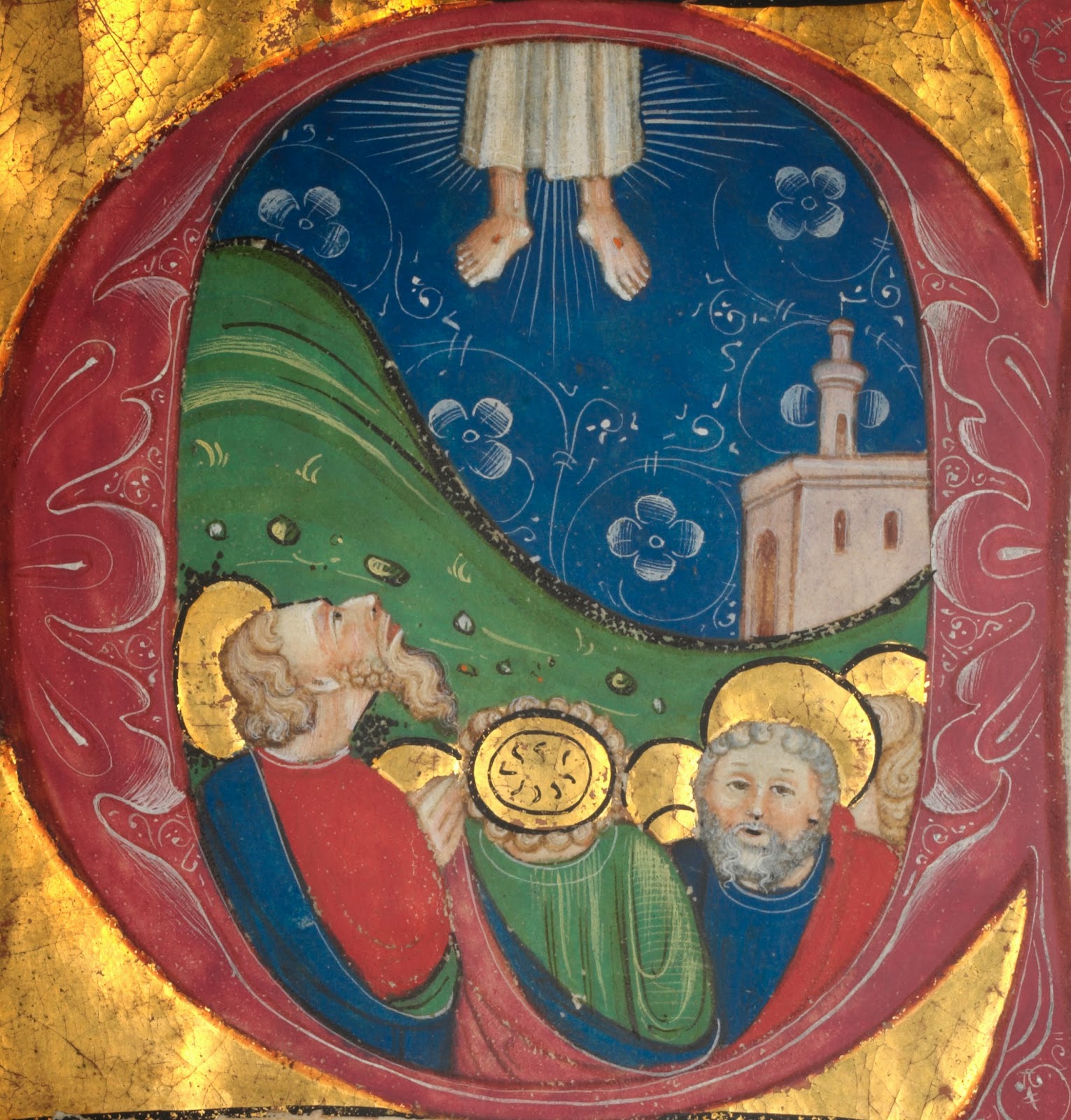
The Ascension from the Très Riches Heures du Duc de Berry ©Photo. R.M.N. / R.-G. OjŽda (Source)

It is a curious fact of the Church’s kalendar that in those solemnities when she most fervently celebrates the Incarnation, she also insists most firmly upon the hiddenness of God. In Christmas, we observe Christ born in a lowly shed at night, disclosing His presence only to those shepherds who resemble Him in their poverty, humility, and obscurity. Today’s feast of the Ascension is composed of a similar doubling. It brings before our eyes the Incarnation in its most radical implications—while reminding us that we live in and with Christ’s apparent absence.

It is, therefore, a salutary lesson in the virtue of Faith. I think that we too often lose sight of what Faith really is. Scripture tells us: “Now faith is the substance of things hoped for, the evidence of things not seen” (Heb. 11:1 KJV). But what does this really mean?

God’s absence is felt in two ways. First, we feel it through the insistent reality of evil. The agony of the world we live in is too great, too universal, and too obvious to need any underlining. The Church is no different. How many malicious and mediocre priests seem to cloud the pure light of the Gospel! Their sin weighs more heavily, for they have been given a greater charge. Yet there is some comfort in the High Priesthood of Christ. If our earthly priests falter and fail, Christ never will. He remains forever a spotless offering in the sight of the Father, and His blood is all-cleansing. The invisible pontiff of an invisible, all-embracing, and everlasting temple, Christ never abandons His children, who linger below with expectant eyes.

Let us pass on to the second sense in which God hides Himself, leaving us with, in the words of R.S. Thomas,

this great absence
that is like a presence, that compels
me to address it without hope
of a reply.

R.S. Thomas, “The Absence”

The past is forever dead to us, an enormous absence, a distantly glimmering mirage that fades even as we approach it. Sacred History, even supported by texts and archaeology, is not a special case. There is a sense in which the facts of the Incarnation, Death, and Resurrection of Christ are no different here. We may participate in them, but we cannot directly experience them as historical events, in historical time.
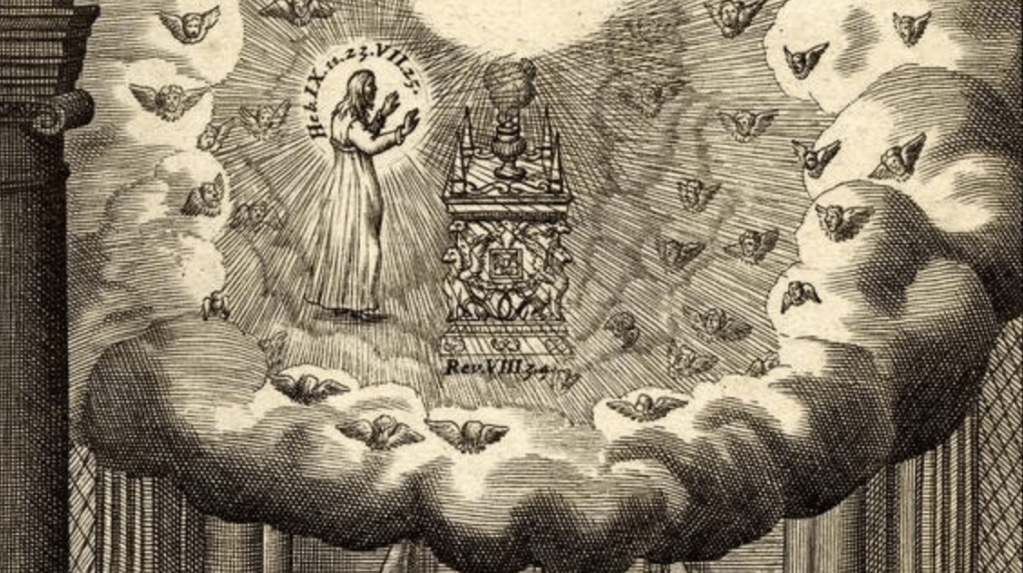
The great High Priest in Heaven. (Source)

So, what are we to do? How do we deal with the fact that God’s acts of revelation lie hidden behind the curtain of time? Quite simply, we must have faith. We must declare that faith is not certainty and not knowledge, but an engraced movement to trust those little lights given unto us. Those lights are, mainly, Scripture and Tradition, particularly the Liturgy, in which the Church as a body transcends the limits of earthly time through her collective remembrance. There is a tendency in Catholicism to downplay the “memorial” function of liturgy. This is a mistake. In fact, there is a sense in which the essence of the Liturgy (or rather, the Liturgies of the various Catholic Churches) is memory. But it is the memory of the Church as the very Body of Christ, a memory which realizes and re-presents the object of remembrance, not mere empty symbolism. Orthodox theologians have been better on this point than Western ones, perhaps because they have not been so fearful of the specter of Zwingli. But I digress.

All of this is to say that we cannot state with the certainty of historical science whether Sacred History is true. There is no real evidence for most of revelation, and we should not let the apologists delude us on this point. They’re far more addled by modernity than they realize. But by grace we can and should leap boldly across the chasm of our natural uncertainty, avoiding the Scylla of Apologetic Positivism and the Charybdis of Naturalistic Doubt. The result is not knowledge, which has no meaning here, but faith.

We would all be better off in a position of greater epistemological humility. For instance—let’s be honest—we have absolutely no knowledge of what happens after death. The data is inconclusive: annihilation, a flash of light, reincarnation, hauntings, purgatory, heaven and hell. We know nothing. It may seem like a commonplace, but it bears repeating, that our fate after death is a mystery. All we can do is have faith that what we have been promised is true. But none of this is certainty, not even for our own salvation. Do you know you will be saved? No. For no one can know what comes after death. Eternal hellfire or an infinity of mute blackness or a strange new human life could come instead. The only thing to do is to pray for mercy “in fear and trembling,” placing our faith in the Hidden God (Philip. 2:12).
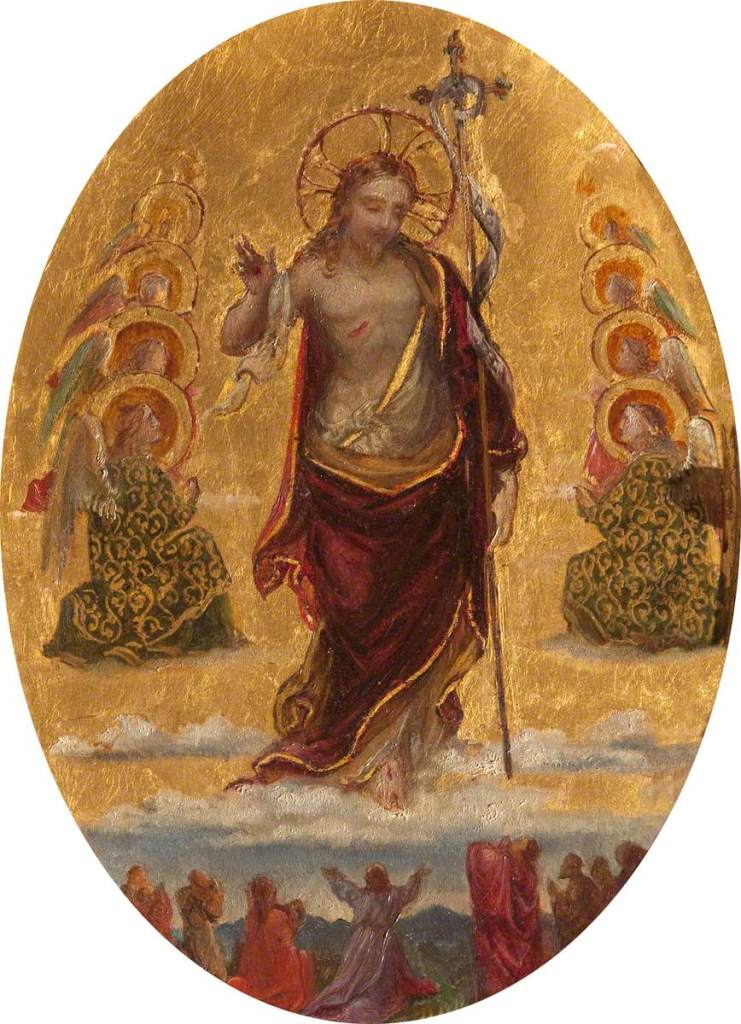
Rebecca Dulcibella Orpen, The Risen Christ (The Ascension), National Trust, Baddesley Clinton (Source)

Do not say to me that you “know” these things because you “know” your Bible or because you “know” Church teaching or even because you “know” Jesus. To be frank, I don’t believe it. In fact, I’m not confident we can know God at all, in the sense of positive knowledge. God’s existence is not like a mathematical theorem or the date of the Battle of Waterloo. Nor do I think you can know God or any of His saving mysteries like you can know another person. You cannot see God; you cannot touch Him; you cannot hear Him like you can hear a friend or lover or even a stranger passing in the street. Simply put, I don’t believe that our “knowledge” of God, the Infinite and loving ground of Being, should be called “knowledge” at all. In fact, I rather suspect that this fixation with “knowledge” has been a very substantial problem for the Church throughout her history.

To interject a personal note; I look back at my life and I sometimes wonder if I ever really knew Christ. There are others I doubt as well. False mystics and visionaries abound, as the Church chokes on her own prelest. But when I look at my own case, I remain unsure. I certainly know a lot about the Church, and have ever since I eagerly began RCIA nearly ten years ago. But did I know Christ? Was I just enamored with my own exaltation, with the fool’s-gold assurances of spiritual certainty, with the glittering baubles that float like empty bottles down the Tiber? Is it even possible to know Him? Or must we just choose, by grace, to have faith—to place our confidence in Him, trusting that He will guide us through the overwhelming darkness of uncertainty which is the very tissue of our lives?

I have come around to the latter position. The virtue of Faith has nothing to do with knowledge per se, and is as far from certainty as East from West. It is granted to us precisely because we lack certain knowledge of the immense realities it comprehends, and probably must by our very nature. Eliot writes in “Burnt Norton” that “Human kind/cannot bear very much reality.” We forget our weakness too easily.
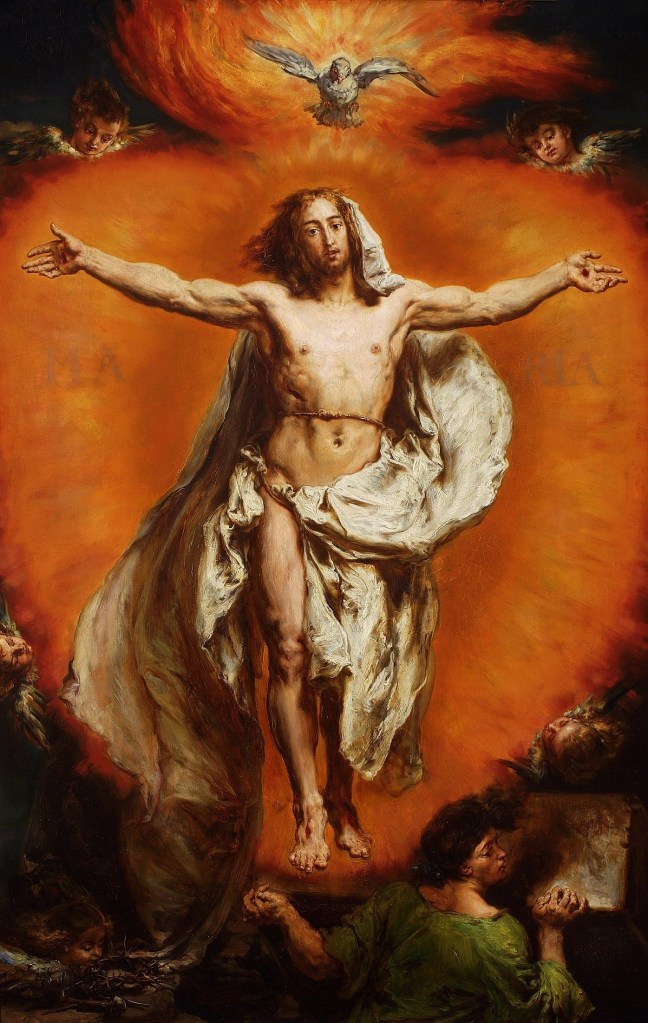
Jan Matejko, The Ascension of Christ, 1884 (Source)

Happily, the substance of our faith does not reside in the natural faculties of understanding. As Pascal says, “It is the heart which experiences God, and not the reason. This, then, is faith: God felt by the heart, not by the reason.” In a sense, the Ascension is the true beginning of the Christian faith in history, for it inaugurates our sensible separation from Christ. Our eyes grow dim, but not our hearts. The blindness of nature is transformed into sight by grace.

In Exodus, God tells Moses that “Thou canst not see my face: for there shall no man see me, and live.” (Ex. 33:20 KJV). The Ascension is the triumphant reversal of these words. For today, a man greater than Moses, a man greater than Enoch and greater than Elijah, but a man all the same, sees the Face of the Father. He has “ascended into Heaven, and sitteth on the right hand of God, the Father Almighty.” Godhead wraps Himself in human nature, and humanity is plunged into the abyss of everlasting Light. A human being stands at the threshold of eternity. The Ascension brings humanity into the very Holy of Holies of the cosmos. We truly participate in this Ascension if we unite ourselves to Christ through the grace given us, especially the grace of the sacraments. If we one day enjoy the Blessed Vision of the Divine Essence, it will be through the eyes of our High Priest, our Head, the Lamb who is the Lamp of the New Jerusalem (Rev. 21:23). John Donne puts it thus:

Behold the Highest, parting hence away,
Lightens the dark clouds, which He treads upon;
Nor doth he by ascending show alone,
But first He, and He first enters the way.

John Donne, “Ascension”

By grace, we shall follow these luminous steps, someday. So many saints have – including today’s great saint, Philip Neri, Apostle of Rome. Their stories remind us that now is the time of faith, and hope, and the charity that breathes life into both.   

If the Ascension is a lesson in Faith, it is just as much a lesson in Hope. It shows us which way we must go. It tells us that we must look to the hills, from whence cometh our help (Ps. 121:1). We need go neither backwards nor forwards, neither to the East nor to the West—but rather, up. Up, into the hidden mystery of the Divine Life. Our help is not from man but from the God-Man, the one who brought our very nature beyond the veil of the celestial temple. And what do the Apostles do? They imitate their Head and repair to the visible and earthly temple, there to sing and praise and preach the Gospel of the Lord. So have all the saints throughout the long, dark centuries since the Ascension. And so should we.  

But even as we tabernacle in the visible Church, we are truly cloistered in the heart of the Most High. As St. Paul writes to the Colossians,

If ye then be risen with Christ, seek those things which are above, where Christ sitteth on the right hand of God. Set your affection on things above, not on things on the earth. For ye are dead, and your life is hid with Christ in God.

Colossians 3:1-3

Let us pray with the Apostles that we might one day ascend with Christ. And let us ever hold in remembrance that Jesus Christ is our High Priest, and He will always see us through.
Elsewhere: A Medieval Sermon on the Ascension

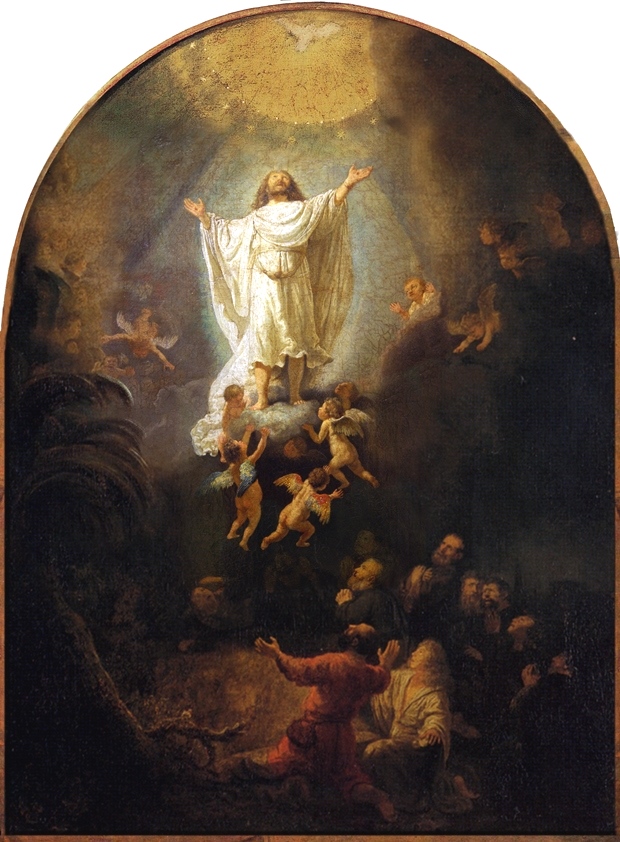
The Ascension, Rembrandt van Rijn, 1636 (Source)

Ascensiontide is perhaps my favorite season of the Church Kalendar for personal as well as theological reasons. And so I am delighted to share with my readers an extremely good post over at Canticum Salomonis, featuring a translated sermon by Honorius Augustodunensis (c. 1080-1154), a lesser-known contemporary of St. Bernard. Here is an excerpt from the beginning of this richly-illustrated translation:

The sun was raised aloft, and the moon stood still in her course.[1] Christ is the eternal sun who sheds his radiance upon all the choirs of angels; he is the true light[2] who enlightens every soul, who long lay concealed behind the cloud of his flesh, wreathed in the shadows of our frailty. Emerging at last from the shadows of Hell, today he rises gloriously above the stars and, raised above all the decorated ranks of angels, he sits, Lord of majesty, at the right hand of the Father. The moon, that is the Church, stands still in her course, gleaming in his light, when in the person of the apostles she saw him ascend into heaven. For the apostles showed themselves to be the Church’s course when they taught her the course of good living, and taught her how to order her course[3] after the Sun of justice. O! what brilliant horns the new-born moon has beamed forth today, when the Sun reaching the heights of heaven has infused her with a ray of eternal light! O! how serene her face as she stood in her course, when she saw her flesh penetrate the heavens in her Head, her Redeemer, her Spouse, her God! She saw them, I say, through the eyes of the apostolic chorus, who were her course, and of the Virgin Mother of God, her type! O what joy burst forth today among the angels in heaven when the Son of God, who had gone from his palace into the Prison for the sake of his servant, yea from his fatherland into banishment, an exile for an exile, now returns in triumph to his Father’s kingdom! And so today is clept the day of God’s triumph, when the victor over death triumphant was welcomed by the senate of the celestial court with hymnic praises, glorifying the author of life!

Honoratus Augustodunensis, On Our Lord’s Ascension

Read the whole thing, and have a blessed Ascension Day.

The Threefold Maternity of Mary

OurLadyCenacle.jpg

Our Lady of the Cenacle, pray for us. Photo by Lawrence Lew O.P. (Source)

God seems very fond of doing things in a Trinitarian way. Everywhere we look, in nature, in our lives, in the life of the Church, it seems that we constantly come upon things that speak of threeness-in-oneness. So it is with God’s finest creation, Our Lady. Or rather, with her maternity. She has but one singular motherhood – her highest title, Theotokos, means “Mother of God.” Nothing can surpass this supreme gift. Nothing greater can be said of the Lord’s chosen. Nothing can reveal more about Our Lady’s life and mission. Yet we detect a certain triune quality to this one eminent dignity. We can speak of the threefold maternity of Mary.

Screen Shot 2018-05-12 at 12.17.34 AM.png

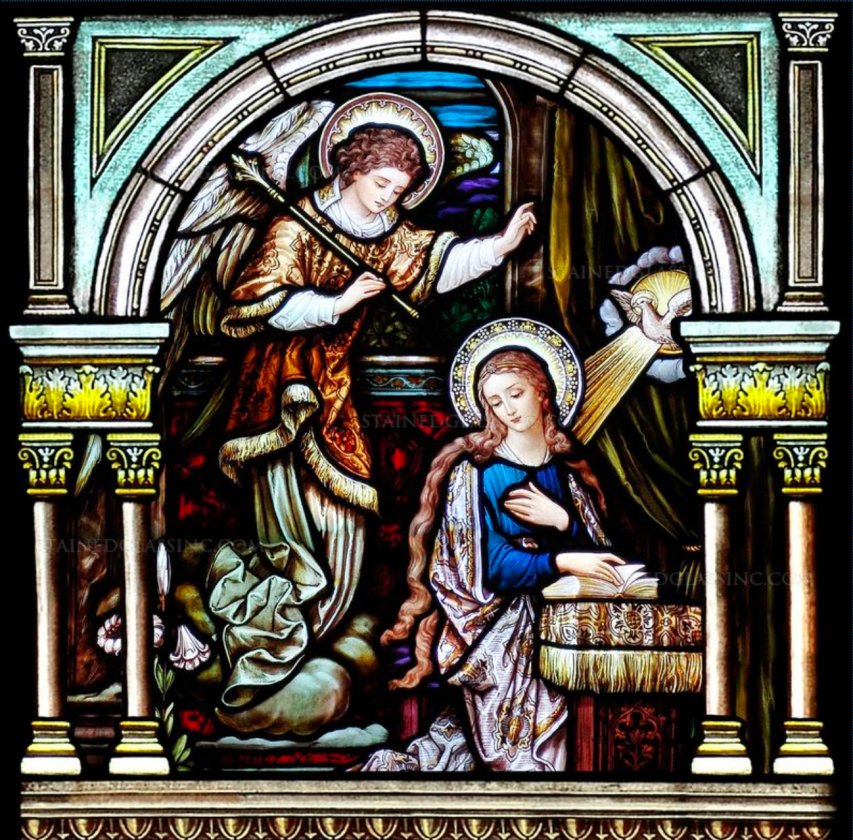
Our Lady of the Annunciation (Source)

First, we encounter Mary’s basic, physical motherhood of Jesus at the Annunciation. In welcoming the will of God into her life, she becomes the mother of the Most High, God Incarnate in Jesus Christ. The Holy Ghost, her divine spouse, conceives the Son in her womb. Her mystical partner and guardian in this parentage is St. Joseph. And in the joy of that maternity, we see Mary and Joseph as two models of chastity. Everything in those joyful mysteries becomes a parable of purity. The sanctity of the Holy Family consists in no small part in the innocence that pervades the hearts of each member. For that innocence is an opening to charity.

sorrowfulmotherwindow

Our Lady of Sorrows (Source)

Then, after the three and thirty years, Mary stands mournful beneath the cross. It was there that she became Mother of the Eucharistic Christ. For, offering up the sorrow of her own Immaculate Heart in union with her son’s High Priestly sacrifice, she bound herself to all the altars of the world as first adorer and co-redemptrix. Gone is St. Joseph; in his stead we find St. John, the figure of all priests under Christ. He would share the Eucharistic life with Mary forever after, entrusted with her care. Here, the great virtue uniting both of the hearts below the Cross is obedience. Our Lady obeys the paramount Providence of God in consenting to the sacrifice of her son, and St. John obeys the words of Our Lord in taking responsibility for the Sorrowful Mother.

But it is today’s feast of Our Lady of the Cenacle that points to the full and final extension of these two prior forms of motherhood. It falls on a most interesting point in the calendar, Saturday in the Octave of the Ascension. It is as if we are standing in the middle of a bridge between two shining cities, and can hear the mingled music of both. This liminal quality is important. For the feast we celebrate today has a double meaning. Two feasts of different but equal importance and dignity seem to unite in this celebration.

We have just left Christ in his Ascension. The Ascension is a memorial of Christ’s High Priesthood. It is like the prayers at the foot of the altar in the Cosmic Liturgy. Pentecost is a glorious theophany, the arrival of the Holy Ghost. We are thus mid-way between a mystery of veiling, and mystery of unveiling. And who do we turn to, but Mary, she who both hid and manifested God in her person?

When we celebrate Our Lady of the Cenacle, we commemorate her vigil of silent prayer with the Apostles in the upper room in those intense days following Our Lord’s Ascension. But we also remember the descent of the Holy Ghost into her own Immaculate Heart and into those of her companions. At the deepest level of reality, these constitute a single event in the History of Salvation. And they give us a sense of Mary’s deepening, widening maternity.

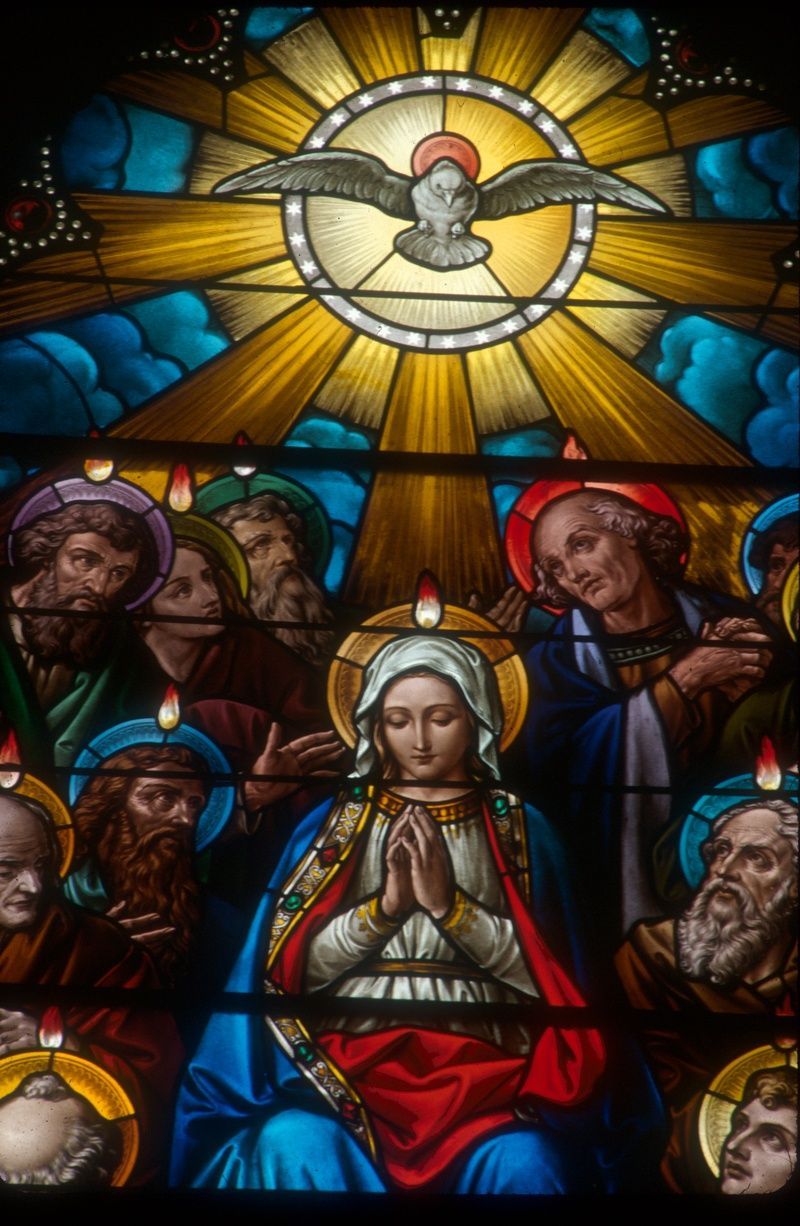
MaryCenacleSpirit.jpg

Our Lady of the Cenacle (Source)

Wherever Mary communes with her divine spouse, the Holy Ghost, there is conceived the Body of Christ. First, that meant the physically Incarnate Word. Then it was the Eucharist extended throughout all time. And finally, as a consequence of these two forms of motherhood, we come to Mary’s maternity of the Church. This maternity is the crown of the other two, for it has never ended. The Holy Spirit came to that silver throne, the Immaculate Heart of Mary, and has never left. In all the rest of Mary’s earthly life and eternal existence in beatitude, she has never been deprived of that intimate union begun in Pentecost. And so the Church remains. Mary’s union with the Holy Ghost is at the very heart of the Church’s being. That union brought forth Christ once. It brings forth the Eucharist at every Mass. And now, at Pentecost, it brings forth the Eucharistic community, Christ in His members.

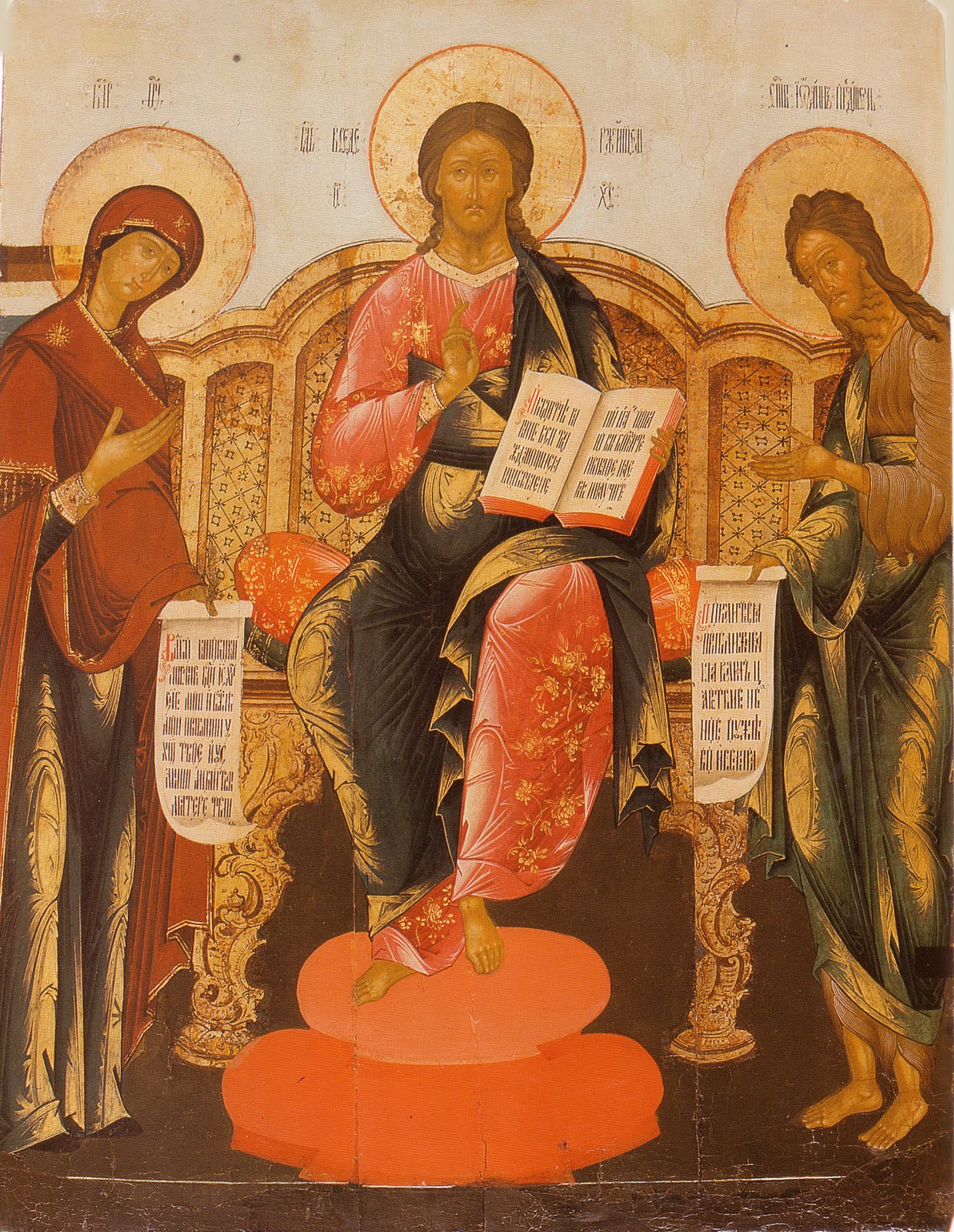
Yet in what does this exalted maternity consist? Prayer, offered perfectly in the Immaculate Heart united to the Holy Ghost. Contemplation, adoration, reparation, intercession – in all its forms, prayer rises from Mary’s heart like huge storms of incense blowing across a desert plain, raining down graces to make it fertile. Yet one form of prayer does not. Mary cannot be contrite. She has never sinned. But we turn to her mystic partner in this maternity, and find a pillar of penance. Who else shares in the life of the Spirit in such a fiery way, but St. John the Baptist? Such is the heavenly reality expressed by the Deisis icon. It shows the Blessed Virgin Mary, paragon of prayer, and St. John the Baptist, archetype of penance, adoring Christ the Lord. Both Our Lady and St. John represent the twin realities of the Ecclesial life – prayer and penance – ordered to Christ – the Sacraments. We might thus speak of Mary’s motherhood of the Church as her Sophianic Maternity, for it is entirely drawn from and oriented to the Divine Wisdom.

Deisis.jpg

A typical deisis. (Source)

The feast of Our Lady of the Cenacle is thus a profoundly maternal day in the Church’s liturgy. Let us join her in prayer. Perhaps we shall taste something of that everlasting life granted to her in the Cenacle.

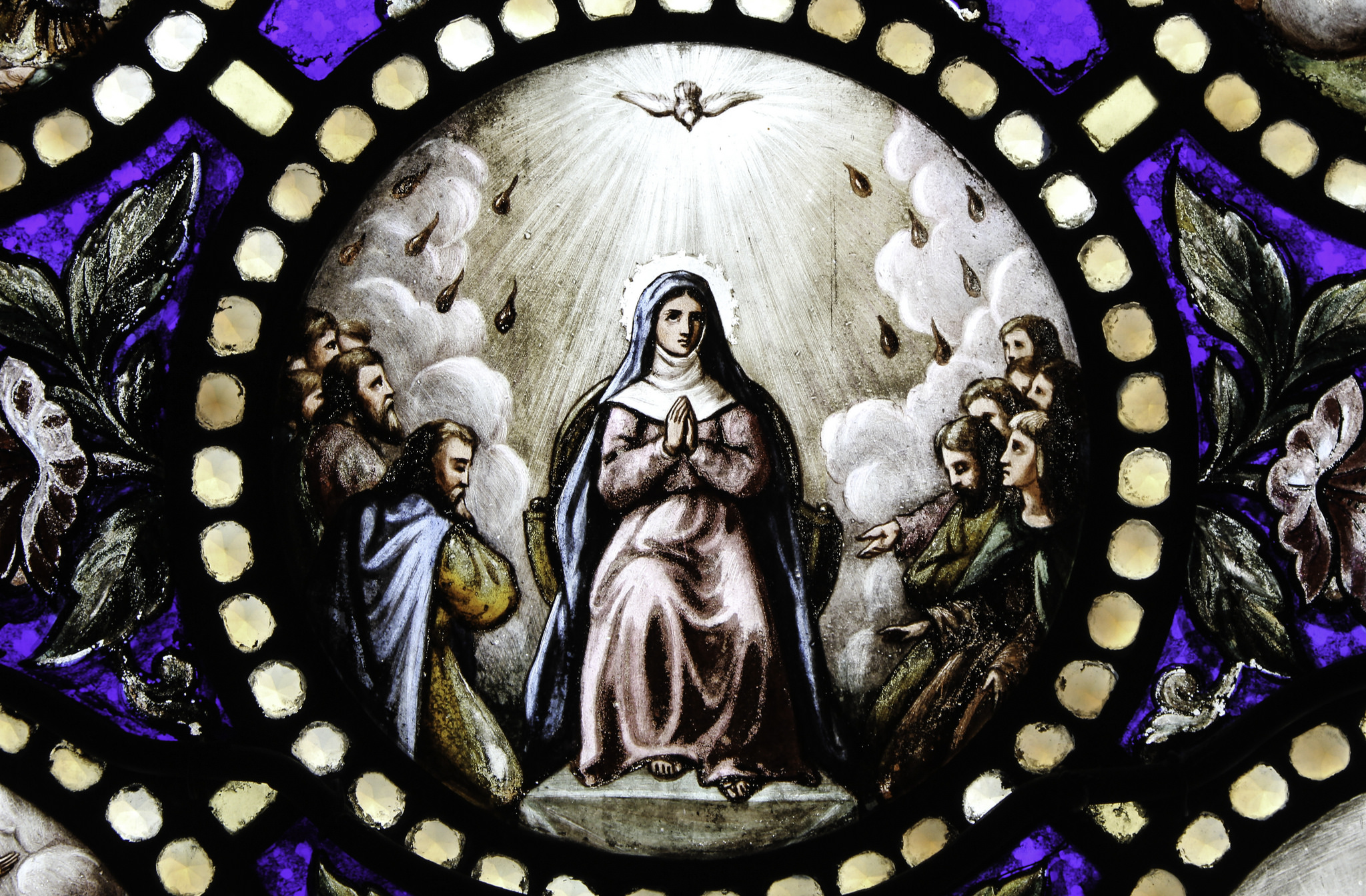
CenacleRound.jpg

Monstra Te Esse Matrem (Source)

“God is Gone Up With a Merry Noise”

AscensionLetter.jpg

Ascendit Deus in iubilatione, alleluia (Source)

God is Gone Up With a Merry Noise

Rick Yoder

Rear a hill in my heart, O God,
from which Thou might ascend.
But o! How swift I overshoot
and rush on to the end.
For first Thou must come hallow it
with that most kingly flood,
the pearls surpassing every price,
Thine own most precious blood.
And though I wander far, O Lord,
from Thy most holy fount,
yet never shall I lose the sight
of Thine eternal mount.
The shadows of the day grow long
and silence takes the land;
still do I hope in Thy sweet song
and Thy high priestly hand.
“The Lord ascends with gladsome noise
and hath taken the better part.”
So runs the word, so I rejoice,
for He rises there in my heart.

Monsieur Olier on the Ascension

QueensCollegeAscension.jpg

The Ascension fresco at Queen’s College Chapel, Oxford – perhaps my favorite chapel in the entire University. Photo by Fr. Lawrence Lew OP. (Source)

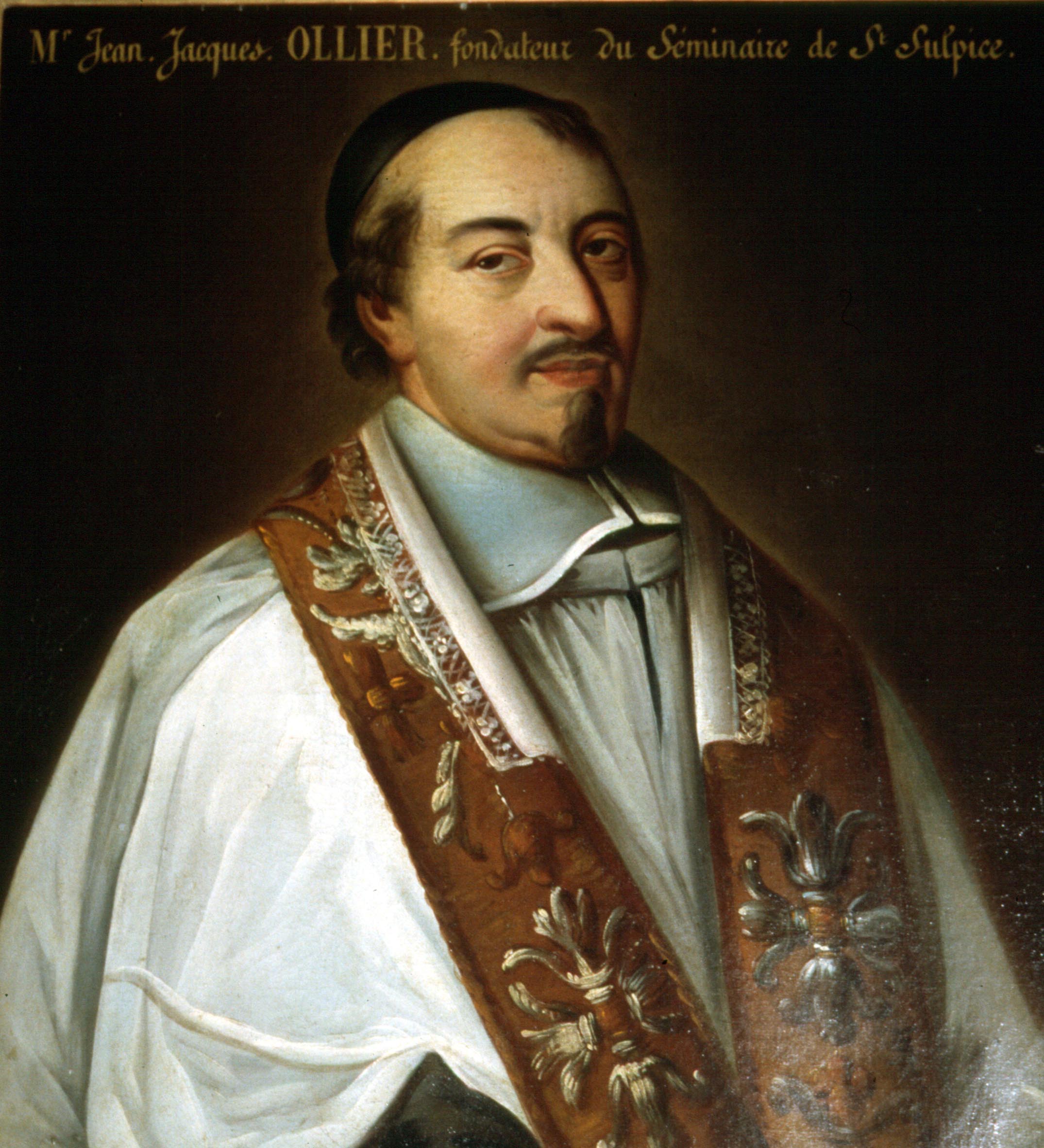
One of the greatest luminaries of the French Church in the 17th century, that period known as the Grand Siècle, was Jean-Jacques Olier. Though barely read today, he exerted a profound influence upon the formation of the French School of Spirituality through his work in founding the Sulpician Order. He was a close associate of St. Vincent de Paul, who always regarded him as a saint.

M.Olier.jpg

M. Olier, priez pour nous! (Source)

I have excerpted here his short chapter on the Ascension from his book, The Interior Life of the Most Holy Virgin. I must ask my readers to forgive me for not translating this edifying work, as I did not have the time. Those with French, however, will appreciate the depth of M. Olier’s insight.

***

Le sacrifice de Jésus-Christ étant offert pour l’Église, qui est visible, devait être visible lui-même dans toutes ses parties, afin de nous donner une certitude parfaite de notre réconciliation avec Dieu. Marie, dans le jour de la Purification, avait paru à l’offrande de la victime, en présentant elle-même, au nom de l’Église, Jésus-Christ notre hostie, et en le dévouant à l’immolation. Elle avait aussi été présente à la deuxième partie du sacrifice, à l’immolation réelle de Jésus-Christ sur la croix. La troisième, qui était la consommation ou le transport de la victime en Dieu, avait eu lieu dans le mystère de la Résurrection. Mais cette consommation s’était opérée d’une manière invisible; et la bonté de Dieu voulait que, pour notre consolation, cette partie du sacrifice devînt visible aussi bien que les deux autres, ou plutôt que Notre-Seigneur montât au ciel pour aller se perdre dans le sein de Dieu non-seulement à la vue de la très-sainte Vierge sa mère, mais encore sous les yeux de tous les apôtres par qui l’Église était représentée. C’est ce qu’avait figuré autrefois Élie montant au ciel dans un char de feu à la vue d’Élisée ; et ce prophète avait déclaré expressément à son disciple que, s’il le voyait monter, il aurait son double esprit. Don mystérieux, qui exprimait le fruit du sacrifice, c’est-à-dire l’esprit de mort et de résurrection ou de vie divine, que Jésus-Christ devait laisser à l’Église figurée par Élisée.

Après sa résurrection, il communiquait toutes les dispositions et tous les sentiments de son âme à sa bénite Mère. Il lui exprimait spécialement les désirs ardents qui le pressaient d’aller enfin se réunir à Dieu son Père, pour le louer et le glorifier dans le ciel. Marie, de son côté, éprouvait un véhément désir d’y accompagner son Fils, pour s’unir à ses louanges; et sans doute qu’elle eût terminé alors sa vie et l’eût suivi dans les cieux, s’il n’eût voulu se servir d’elle pour aider l’Église dans ses commencements.

L’oeuvre de cette divine Mère était encore incomplète. Après avoir donné, par Marie, naissance au chef, Dieu voulait procurer aussi, par elle, la formation de tout le corps. Il voulait la rendre mère de sa famille entière, de Jésus-Christ et de tous ses enfants d’adoption. Par zèle pour la gloire de Dieu et par charité pour nous, elle accepte avec joie la commission que Notre-Seigneur lui laisse de travailler à faire honorer son Père par les hommes, et de demeurer sur la terre jusqu’à ce que l’Église ait été bien affermie.

Le quarantième jour après la Résurrection étant donc venu, Jésus-Christ- se rend à Béthanie avec sa sainte Mère et ses apôtres; là élevant les mains et les bénissant, il se sépare d’eux, et en leur présence s’élève vers le ciel. Ils l’y suivirent des yeux, jusqu’à ce qu’enfin une nuée le dérobe à leur vue; et comme néanmoins ils tenaient toujours leurs regards fixés au ciel, deux anges vêtus de blanc leur apparurent et leur dirent : Pourquoi vous arrêtez-vous à regarder le ciel? Ce Jésus, qui a été attiré du milieu de vous dans le ciel, viendra de la même manière que vous l’avez vu monter au ciel. Ainsi Dieu voulut-il que l’acceptation solennelle qu’il faisait de notre hostie, eût pour témoins non-seulement tous les apôtres et la très-sainte Vierge, qui l’avait produite de sa propre substance, mais les anges eux-mêmes.

En montant dans les cieux, Jésus-Christ élève avec lui tous les saints patriarches et les autres justes qu’il avait retirés des limbes, et va les offrir à son Père, comme les premières dépouilles qu’il a ravies au démon par sa mort. Enfin, dérobé par la nuée à la vue de ses disciples, il laisse rejaillir la splendeur de sa gloire, qu’ils n’auraient pu soutenir et dont il avait retenu l’éclat dans ses diverses apparitions.

Comme les enfants des rois donnent des présents à leurs sujets, en faisant leur entrée dans leur royaume, Jésus-Christ, montant à la droite de son Père pour prendre possession de son trône, voulait envoyer à ses apôtres son esprit et ses dons, c’est-à-dire dilater son coeur en faisant entrer les hommes dans ses sentiments de religion envers Dieu son Père, et achever ainsi son ouvrage. Dans ce dessein et par son commandement, les disciples s’assemblèrent à Jérusalem avec la très-sainte Vierge et plusieurs saintes femmes; et là ils étaient en prière, louant, bénissant le nom de Dieu, et attendant la venue de l’Esprit-Saint. Marie était au milieu d’eux et présidait ce sacré concile, comme ayant, pour aviser à établir la gloire de Dieu dans le monde, une grâce qui excellait par-dessus celle de tous les apôtres. Quoique Jésus-Christ n’eût pas voulu qu’elle fût présente à la Cène, ni qu’elle offrît extérieurement le saint sacrifice, ni qu’elle fût prêtre selon l’ordre de Melchisédech, il voulait néanmoins que Marie, destinée à être la mère des vivants, se trouvât dans le Cénacle avec les apôtres, afin de verser la plénitude de son esprit en elle, comme dans le réservoir de la vie divine, et de la distribuer par elle à tous ses enfants, et aussi pour apprendre à l’Église que jamais elle ne serait renouvelée qu’en la société de sa divine Mère et en participant à son esprit.

rococoascensionaltar

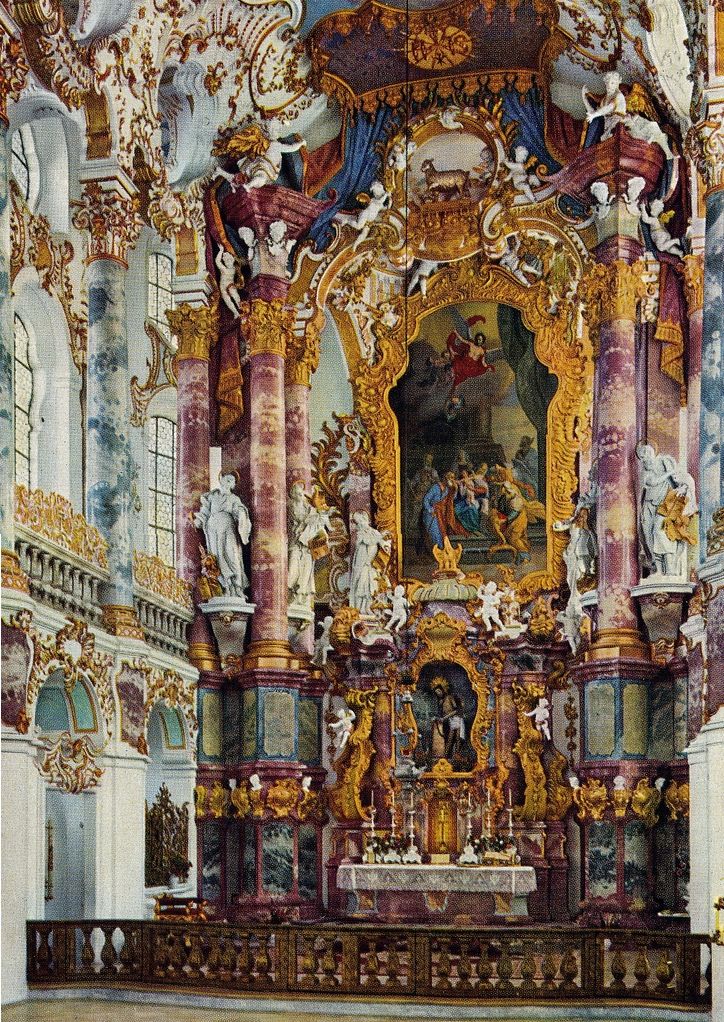
A rococo altar depicting the Ascension, Ottobeuren, Germany. (Source)

Our Lady of the Cenacle in Armenian Iconography

ArmenianOLCenacle

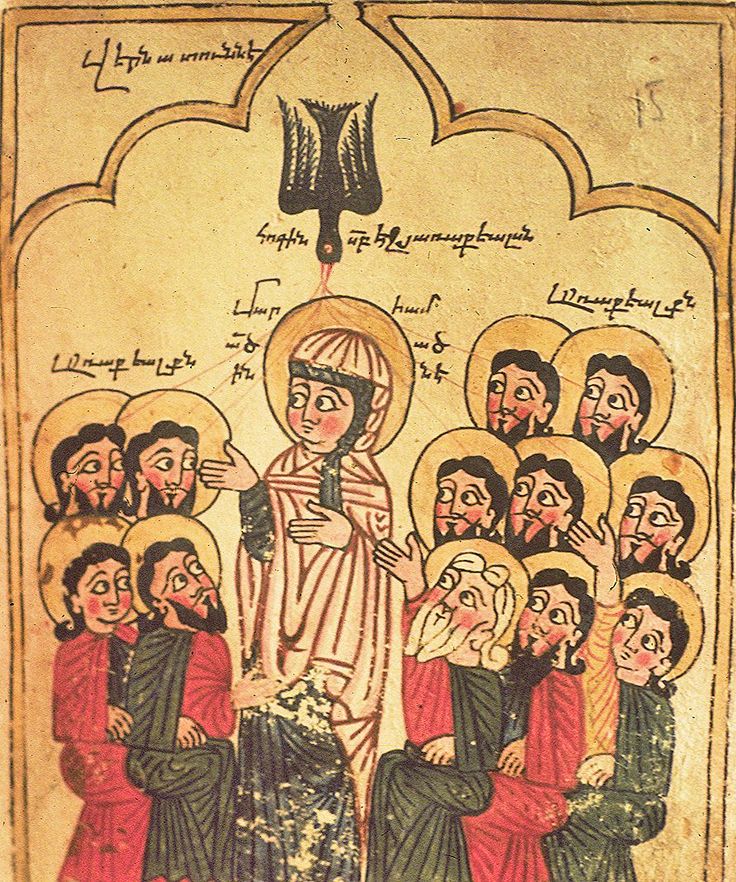
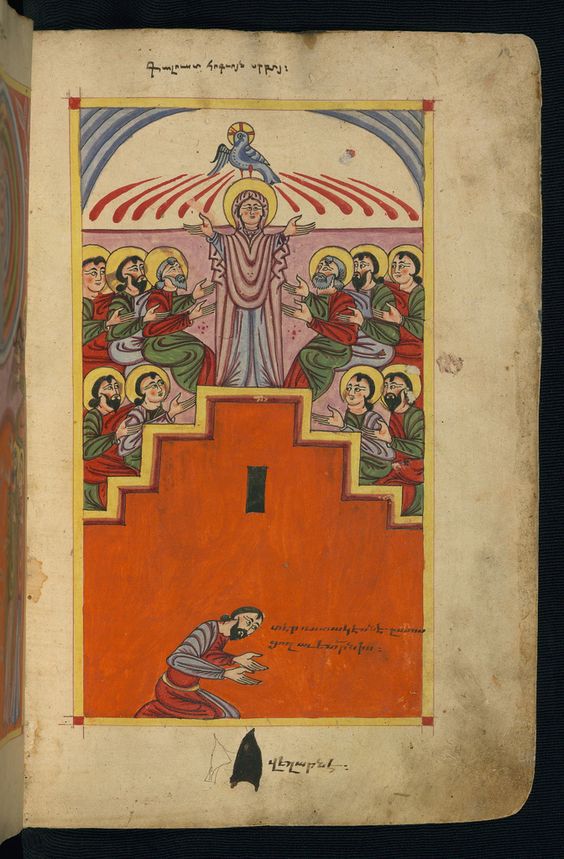
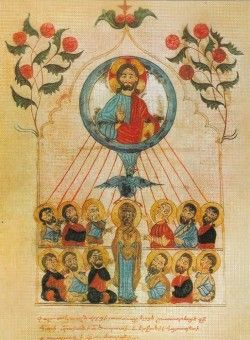
Figure A. Our Lady of the Cenacle, pray for us. From the source: “MINIATURES – Erevan, Matenadaran, MS 8772, Gospel, Aght’amar, Vaspurakan, 1391, artist Dzerun, Pentecost. Photo: Dickran Kouymjian.” (Source)

Throughout the Latin Church, Saturday in the Ascension Octave is kept as the Feast of Our Lady of the Cenacle. On this holy day, we remember the Mother of God keeping vigil with the Apostles in the Upper Room, or “Cenacle.” The place is significant. Here, Christ gathered the Twelve on the night of his betrayal, Maundy Thursday. At that time, He instituted the priesthood and the Eucharist. Later, on Pentecost, the Holy Spirit will descend upon the congregation and truly constitute the Church as such, confirming its sacramental essence and mission in the world of time.

Mary’s position in this unique place at this unique time is captured in the title, “Our Lady of the Cenacle.” But that name conceals a much deeper mystery. What, precisely, was she doing in the Cenacle? Why was she there? And does her presence, never mentioned in the Bible, nevertheless retain important meaning for us today?

As with any mystery unspoken in Scripture but passed on to us by the Tradition, we can approach it by many paths. One of the wonderful things about the Church is that, in her sacramentality, she recasts everything in the light of Christ and opens all things to a deeper meaning than we ordinarily encounter. So today, I’d like to consider Our Lady of the Cenacle through art. Specifically, iconography. Even more specifically, Armenian illuminated manuscripts.

pentecost_kirillo-belozersk-c-1497.jpg

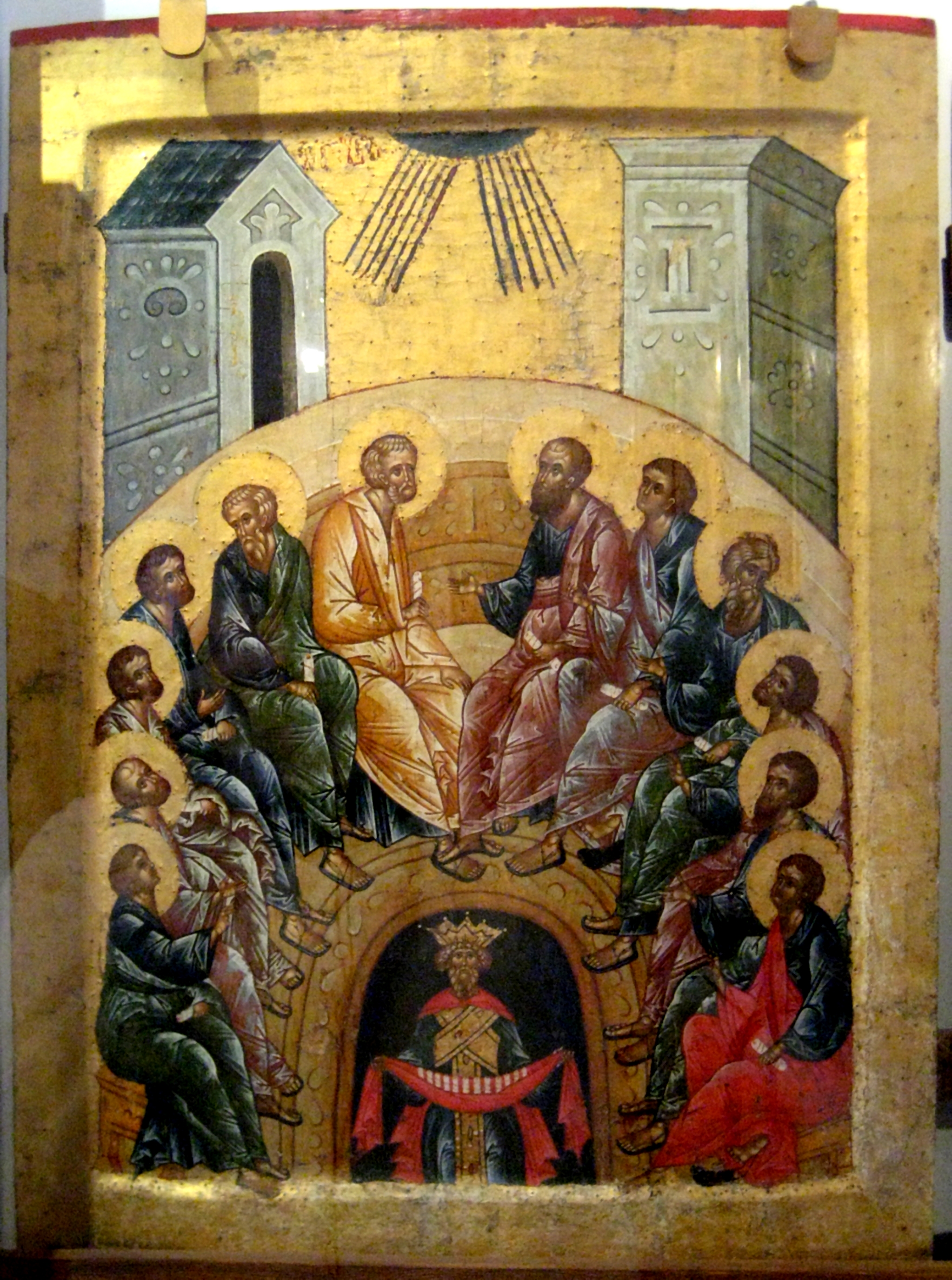
Figure B. A Greek-style Russian icon of 1497. Note the emptimess of the “Teacher’s Seat” at center. (Source)

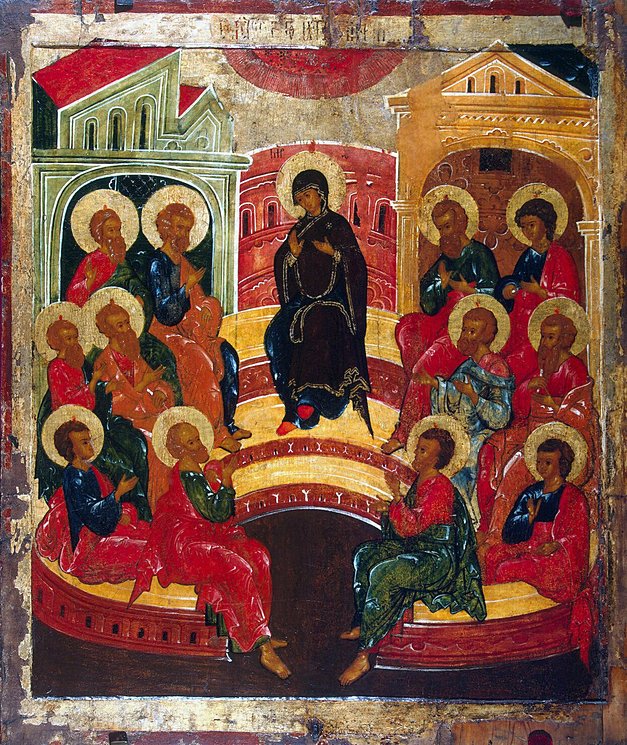
In the Greek iconographic tradition, Pentecost is usually depicted with an empty seat in the center…the place of Christ the King and Teacher, who has ascended and sent the Holy Spirit in his stead. The icon for the feast of mid-Pentecost dovetails with this custom, as it depicts Jesus the youth instructing the teachers of the Law in an arrangement that approximates that of Pentecost proper. The Russian and Slavic iconographic tradition largely copies this model, with one notable exception. Many Russian iconographers include the Mother of God in what would ordinarily be the empty “Teacher’s Seat.” As one writer puts it, “Mary is therefore shown in the ‘teacher’s seat’ as the best example we have, and the person on earth who most resembled Jesus Christ (both physically, as His mother, and spiritually as His disciple).” Indeed.

Icon-The-Descent-of-the-Holy-Spirit

Figure C. A Russian-style icon with the Mother of God in the “Teacher’s Seat,” date unknown. (Source).

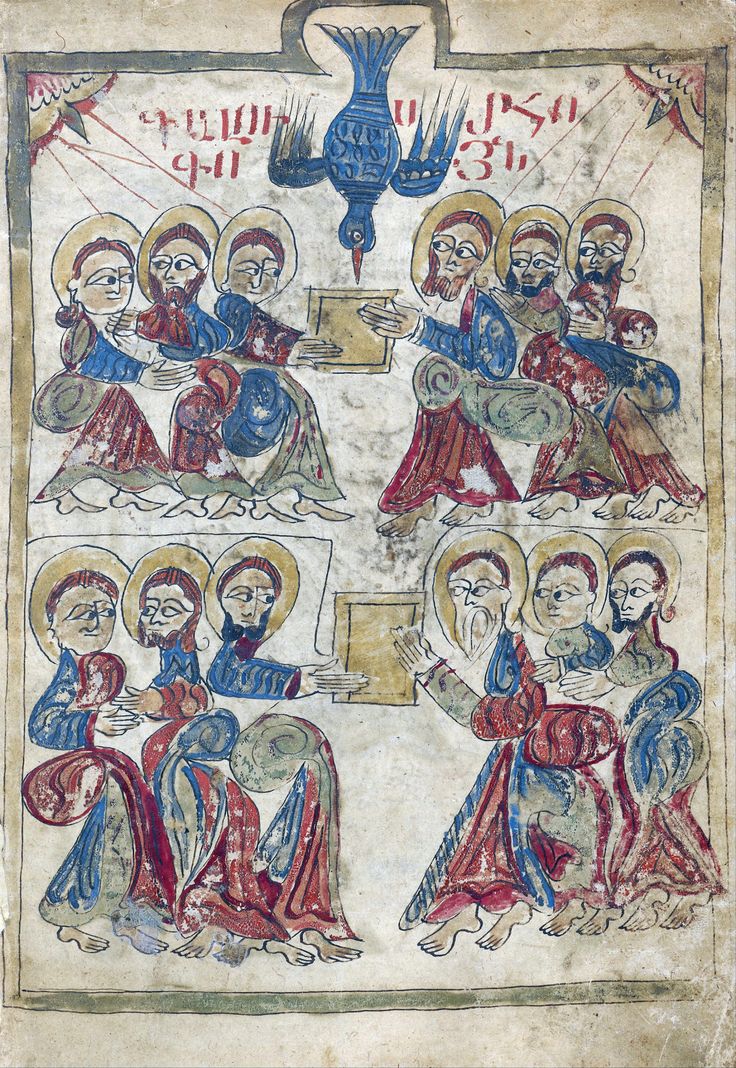
The Armenian iconographic tradition differs from both the Greek and Russian streams in important ways, not all of which we can get into here. For our purposes, it is enough for us to observe that the Armenians have a tendency to place the Mother of God at the center of the Pentecostal scene.

Examine, if you will, the illumination at the top of this essayFigure A.

Mary is, by far, the largest character. The Apostles crowd around her on both sides expectantly. Her hands are lifted in the orans position of prayer. She stands in a red mantle and a dark blue robe that matches the hue of the Holy Spirit alighting above her. Every one of the bird’s tongues of flame move through her nimbus to reach the Apostles, some of whom even raise their own hands as if to reach out and take hold of the mystical fire.

A similar placement and posture is written into the following icon:

Pentecost2

Figure D. Description from source: “This Armenian Gospel book was produced in 904 of the Armenian era (1455 CE) at the monastery of Gamałiēl in Xizan by the scribe Yohannēs Vardapet, son of Vardan and Dilšat, and was illuminated by the priest Xačʿatur.” (Source)

Mary is the central pillar of the icon. The Holy Spirit does not just descend, but rests upon her as He sends forth his tongues of flame. Here, too, their colors match. We can see that the Holy Spirit is customarily written in blue for this festal icon.

Blue is an interesting color, one with mystical associations. I won’t attempt a full symbolic analysis here, but it is worth contemplating the range of natural and supernatural meanings which Christianity has invested in this delicate shade. It suffices to say that blue is a sophianic color, calling to mind the wisdom and beauty of God (see the pertinent chapter in The Pillar and Ground of the Truth, by the great Russian theologian Father Pavel Florensky). The iconographic tradition is of great help in this subject as well; besides gold, blue is the only other color allowed for the background of icons in the Greek and Slavic canons.

DarkDove1

Figure E. An Armenian Pentecost icon without Mary, but with a blue dove of the Spirit. (Source)

SmallIcon

Figure F. Pentecost icon of unconfirmed but probably Armenian origin. Same blue Spirit, roughly the same placement of the Theotokos. (Source).

It is also perhaps worthy of note that in Figure D, Mary doesn’t just match the hue of the Spirit. The colors she wears also match the architecture of the Cenacle. She is one with the Cenacle; the Cenacle is hers, and hers alone. The Cenacle is the Church, the Cenacle is every tabernacle in the world, the Cenacle is Heaven, the Cenacle is the New Jerusalem, the Cenacle is the Throne of God, the Cenacle is the Eschaton, the Cenacle is the final consummation of sophianic being brought about by Christ’s gloriously triumphant Incarnation, sacrifice, and Resurrection.

And in all these mystical dimensions of the Cenacle, Our Lady is Queen.

Mary is the woman who bears the Holy Spirit, the living icon of the Church. When we look at Mary, we are to think of the Spirit. The Mother of God always points us to her son, but also to the Holy Spirit, and through both, to the Father. She is never apart from the Holy Spirit. They abide together, and the Cenacle is where her truly Eucharistic and sophianic state of being is manifested for the awe-struck view of the whole Church. She is the consummation of what is accomplished by the Trinity in the Cenacle, the woman who fully cooperates in the salvation of the world, the Co-Redemptrix and Mediatrix of All Graces. Indeed, do we not read the latter title in the first illumination above? Do we not see it in the slim orange lines of fire that move through her halo to the Apostles below? They only receive the Spirit as it passes through Mary.

Mary does nothing of her own effort. God does all in her, and she freely agrees to accept and work for God’s will. St. Paul can speak of “those things that are wanting of the sufferings of Christ, in my flesh” (Col. 1:24 DRA). Not so with Mary. In her, the cross’s victory is complete. In her, it has become the Tree of Life, “so that the birds of the air,” such as the blue bird of the icons, “come and lodge in the branches thereof” (Matt. 13:32 KJV).

On this feast day, let us remember the manifold graces that Our Lady showers upon us from her throne in the eternal Cenacle. Let us also take heart that, with so powerful an advocate at the heart of the Church, no controversies or troubles can ever overwhelm the Barque of Peter. Finally, let us pray to Our Lady of the Cenacle for the Benedictines of Silverstream on this, their patronal feast.

Four Luminous Days

ascension-header

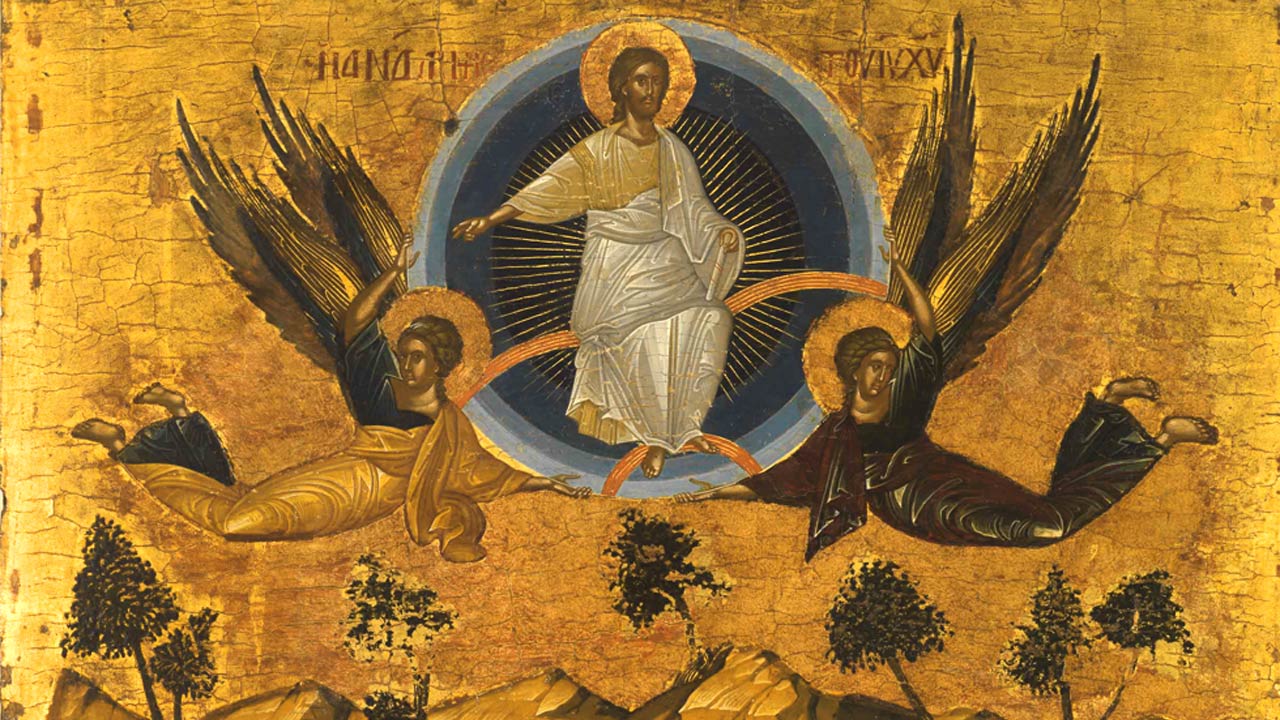
From an Icon of the Ascension. (Source)

This week, we are about to enter a truly remarkable liturgical sequence.

MariaAuxiliadoracuadro

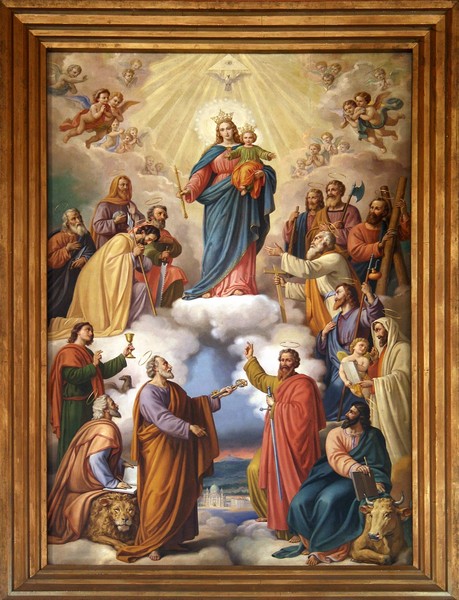
Our Lady, Help of Christians. (Source)

Wednesday is Our Lady, Help of Christians, patroness of my parish here in South Carolina.

Thursday is the Ascension (sadly moved to Sunday in my province of Atlanta).

Friday is St. Philip Neri, and then on Saturday comes Our Lady of the Cenacle.

We could extend our reckoning to Sunday, but for now, I think it is appropriate for us to hesitate on the threshold of the Mystical Sabbath. Let us instead examine only these four days and their import.

We begin and end the progression with Mary. First, we see her in her relation to humanity. She is the help of Christians. Then, we see her in relation to God. She receives the Holy Spirit. Taking both feasts together, we see Our Lady participating in God-humanity; she becomes the perfect emblem of Divine Wisdom.

StPhilipHS

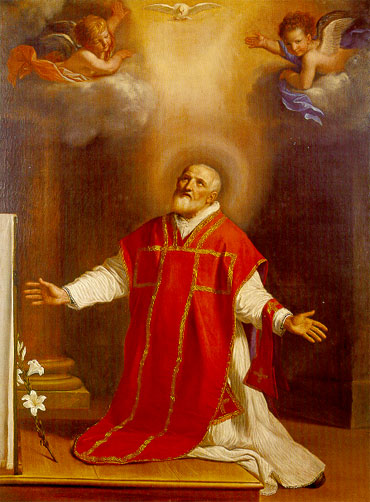
St. Philip Neri, who received the Holy Spirit in the catacombs. (Source)

Studying Sophiology has made me appreciate Our Lady of the Cenacle even more. There is a deep connection, I think, between the manifestation of Divine Wisdom in the creation of the Cosmos, at the Baptism of Christ, and at the descent of the Spirit upon Our Lady at Pentecost. They are mutually illuminating events. I wonder if we can find that connection at the level of the propers for each liturgy, a project I may try to engage in before Saturday.

And how appropriate that St. Philip, who experienced his own Pentecost in the catacombs of St. Sebastian, should go forth as a herald for Our Lady of the Cenacle! It is a kind of liturgical proof of the hierarchical principle, that we are led by lower things to higher things. St. Philip received the Holy Spirit into his heart as a ball of fire in the catacombs under the city of Rome, once a place of persecution, the mythical “Babylon” of Revelation. He guides us to Our Lady as she waits and prays in the Cenacle, the Upper Room in Jerusalem where the sacraments of the Eucharist and Orders were instituted and where the Holy Spirit descended upon the Church in tongues of fire on Pentecost. What a picture of the historical Church in pilgrimage! From the darkness of the Roman catacombs to the heights of the upper room in Zion. We could read an eschatology out of these mystical days.

RussianPentecostIcon

Russian Icon of Pentecost, 18th century. The Slavs are unique among the Eastern Orthodox in placing Our Lady in the scene. (Source).


Nevertheless, this week’s procession is easy to overlook, since its central diamond, the Ascension, has been misplaced by so many bishops. Celebrating the feast on Sunday robs it of its truly Eucharistic meaning, for the Ascension’s traditional place on a Thursday meant that it could only be read through the texts of Maundy Thursday. Ascension Day is to Maundy Thursday as Pentecost is to Easter, the initiator of a new liturgical season and a reminder of the Mystical Priesthood of Christ. All of this is admirably explained by Dom Mark Daniel Kirby OSB in his podcasted homilies and in his blog, Vultus Christi.

The Eucharistic and Priestly meaning of the Ascension matters for the rest of the four-day sequence insofar as the Eucharist represents, sustains, and completes every instantiation of Sophianic being. The Sophianic character of the four days can only be discerned in the light of Christ’s face as He ascends into his cosmic priesthood on Thursday. This would be true even if St. Philip were not there to complete the set. This is, after all, a fairly uniqueE situation. Ever spry, St. Philip moves around the sacred calendar with the bustling rhythms of profane time. But in this auspicious year, so full of historical resonances and providential patterns, let us rejoice in the days that the Lord has made (Psalm 118).