On Faith and the Priesthood of Christ

And he led them out as far as to Bethany, and he lifted up his hands, and blessed them. And it came to pass, while he blessed them, he was parted from them, and carried up into heaven. And they worshipped him, and returned to Jerusalem with great joy: And were continually in the temple, praising and blessing God. Amen. – Luke 24: 50-53

Many years ago, shortly after the start of my faith journey, I received some very good advice from an Anglican friend of mine. Or rather, I received a very good prayer. She told me that whenever she was anxious or worried or stressed about anything, she resorted to a prayer that ran like this:

“Jesus Christ is my High Priest, and He will always see me through.”

There is much consolation in these simple words, as I have had frequent occasion to learn in the years since then. And, to be honest, I am most drawn to Christ in the mystery of His High Priesthood. I often find myself asking Him to pray for me, not in the sense that one asks a friend or a saint to pray, but as one can only ask a sovereign and perfect intercessor. This sense of Christ as High Priest has become part of the basic structure of my own faith. Yet today’s feast, the Ascension of Our Lord into Heaven, invites us all to dwell upon this mystery in a more explicit way.

The Ascension from the Très Riches Heures du Duc de Berry ©Photo. R.M.N. / R.-G. OjŽda (Source)

It is a curious fact of the Church’s kalendar that in those solemnities when she most fervently celebrates the Incarnation, she also insists most firmly upon the hiddenness of God. In Christmas, we observe Christ born in a lowly shed at night, disclosing His presence only to those shepherds who resemble Him in their poverty, humility, and obscurity. Today’s feast of the Ascension is composed of a similar doubling. It brings before our eyes the Incarnation in its most radical implications—while reminding us that we live in and with Christ’s apparent absence.

It is, therefore, a salutary lesson in the virtue of Faith. I think that we too often lose sight of what Faith really is. Scripture tells us: “Now faith is the substance of things hoped for, the evidence of things not seen” (Heb. 11:1 KJV). But what does this really mean?

God’s absence is felt in two ways. First, we feel it through the insistent reality of evil. The agony of the world we live in is too great, too universal, and too obvious to need any underlining. The Church is no different. How many malicious and mediocre priests seem to cloud the pure light of the Gospel! Their sin weighs more heavily, for they have been given a greater charge. Yet there is some comfort in the High Priesthood of Christ. If our earthly priests falter and fail, Christ never will. He remains forever a spotless offering in the sight of the Father, and His blood is all-cleansing. The invisible pontiff of an invisible, all-embracing, and everlasting temple, Christ never abandons His children, who linger below with expectant eyes.

Let us pass on to the second sense in which God hides Himself, leaving us with, in the words of R.S. Thomas,

this great absence
that is like a presence, that compels
me to address it without hope
of a reply.

R.S. Thomas, “The Absence”

The past is forever dead to us, an enormous absence, a distantly glimmering mirage that fades even as we approach it. Sacred History, even supported by texts and archaeology, is not a special case. There is a sense in which the facts of the Incarnation, Death, and Resurrection of Christ are no different here. We may participate in them, but we cannot directly experience them as historical events, in historical time.
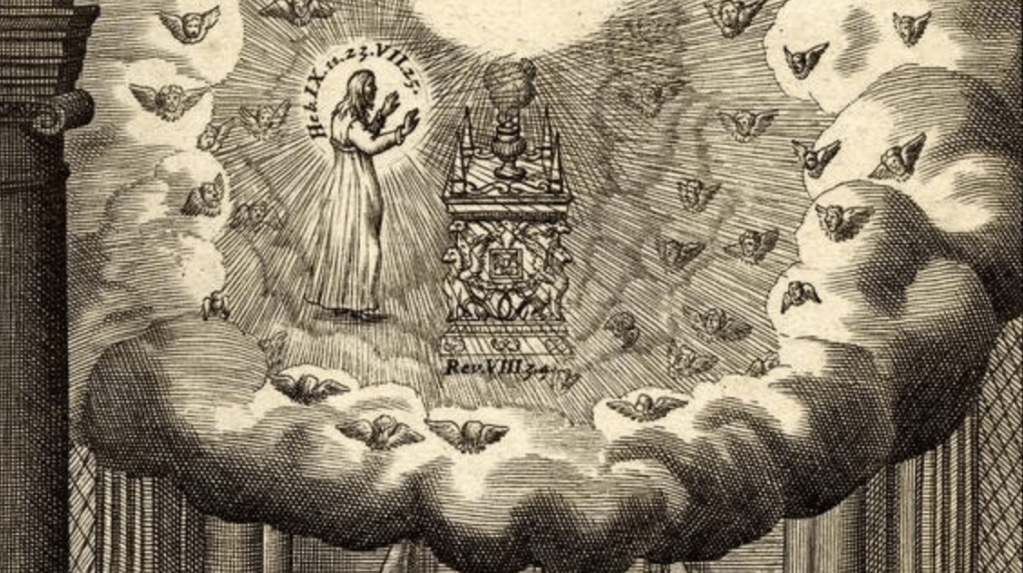
The great High Priest in Heaven. (Source)

So, what are we to do? How do we deal with the fact that God’s acts of revelation lie hidden behind the curtain of time? Quite simply, we must have faith. We must declare that faith is not certainty and not knowledge, but an engraced movement to trust those little lights given unto us. Those lights are, mainly, Scripture and Tradition, particularly the Liturgy, in which the Church as a body transcends the limits of earthly time through her collective remembrance. There is a tendency in Catholicism to downplay the “memorial” function of liturgy. This is a mistake. In fact, there is a sense in which the essence of the Liturgy (or rather, the Liturgies of the various Catholic Churches) is memory. But it is the memory of the Church as the very Body of Christ, a memory which realizes and re-presents the object of remembrance, not mere empty symbolism. Orthodox theologians have been better on this point than Western ones, perhaps because they have not been so fearful of the specter of Zwingli. But I digress.

All of this is to say that we cannot state with the certainty of historical science whether Sacred History is true. There is no real evidence for most of revelation, and we should not let the apologists delude us on this point. They’re far more addled by modernity than they realize. But by grace we can and should leap boldly across the chasm of our natural uncertainty, avoiding the Scylla of Apologetic Positivism and the Charybdis of Naturalistic Doubt. The result is not knowledge, which has no meaning here, but faith.

We would all be better off in a position of greater epistemological humility. For instance—let’s be honest—we have absolutely no knowledge of what happens after death. The data is inconclusive: annihilation, a flash of light, reincarnation, hauntings, purgatory, heaven and hell. We know nothing. It may seem like a commonplace, but it bears repeating, that our fate after death is a mystery. All we can do is have faith that what we have been promised is true. But none of this is certainty, not even for our own salvation. Do you know you will be saved? No. For no one can know what comes after death. Eternal hellfire or an infinity of mute blackness or a strange new human life could come instead. The only thing to do is to pray for mercy “in fear and trembling,” placing our faith in the Hidden God (Philip. 2:12).
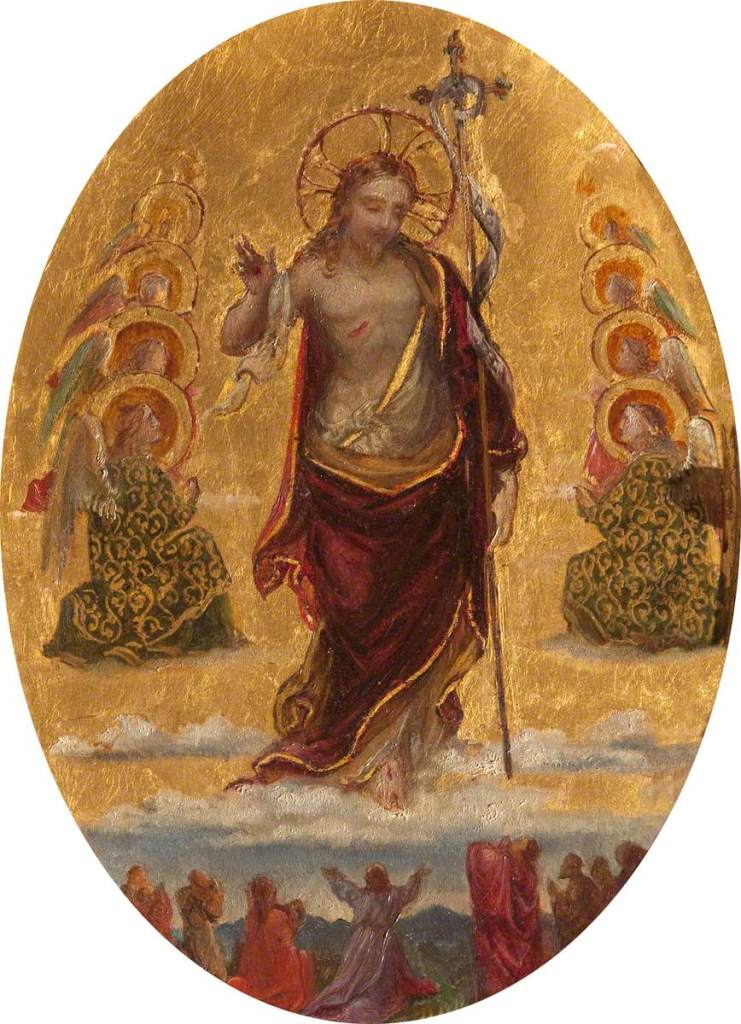
Rebecca Dulcibella Orpen, The Risen Christ (The Ascension), National Trust, Baddesley Clinton (Source)

Do not say to me that you “know” these things because you “know” your Bible or because you “know” Church teaching or even because you “know” Jesus. To be frank, I don’t believe it. In fact, I’m not confident we can know God at all, in the sense of positive knowledge. God’s existence is not like a mathematical theorem or the date of the Battle of Waterloo. Nor do I think you can know God or any of His saving mysteries like you can know another person. You cannot see God; you cannot touch Him; you cannot hear Him like you can hear a friend or lover or even a stranger passing in the street. Simply put, I don’t believe that our “knowledge” of God, the Infinite and loving ground of Being, should be called “knowledge” at all. In fact, I rather suspect that this fixation with “knowledge” has been a very substantial problem for the Church throughout her history.

To interject a personal note; I look back at my life and I sometimes wonder if I ever really knew Christ. There are others I doubt as well. False mystics and visionaries abound, as the Church chokes on her own prelest. But when I look at my own case, I remain unsure. I certainly know a lot about the Church, and have ever since I eagerly began RCIA nearly ten years ago. But did I know Christ? Was I just enamored with my own exaltation, with the fool’s-gold assurances of spiritual certainty, with the glittering baubles that float like empty bottles down the Tiber? Is it even possible to know Him? Or must we just choose, by grace, to have faith—to place our confidence in Him, trusting that He will guide us through the overwhelming darkness of uncertainty which is the very tissue of our lives?

I have come around to the latter position. The virtue of Faith has nothing to do with knowledge per se, and is as far from certainty as East from West. It is granted to us precisely because we lack certain knowledge of the immense realities it comprehends, and probably must by our very nature. Eliot writes in “Burnt Norton” that “Human kind/cannot bear very much reality.” We forget our weakness too easily.
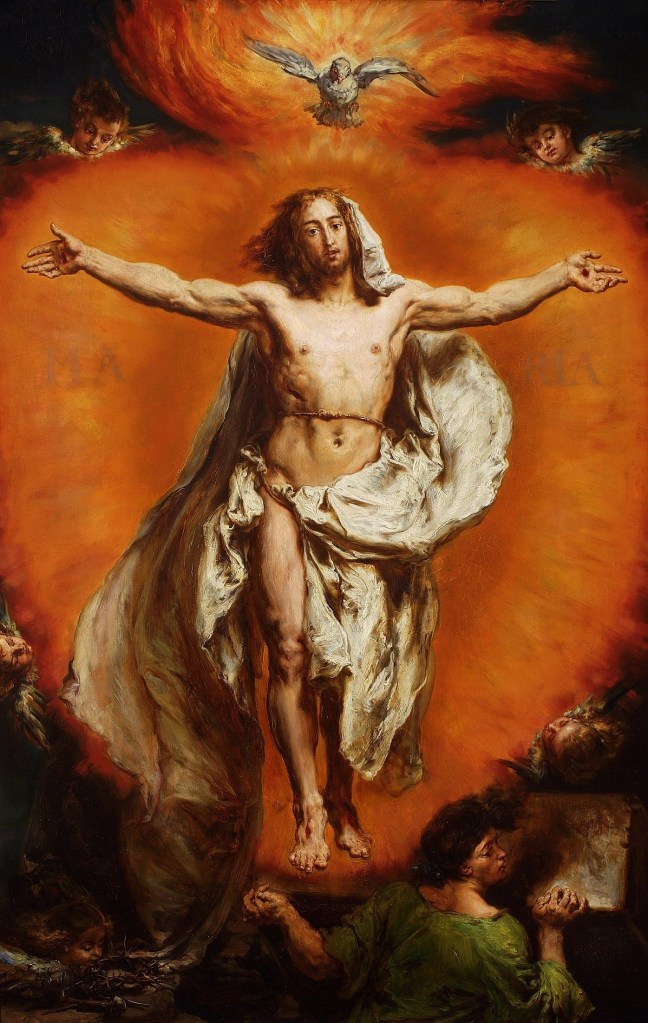
Jan Matejko, The Ascension of Christ, 1884 (Source)

Happily, the substance of our faith does not reside in the natural faculties of understanding. As Pascal says, “It is the heart which experiences God, and not the reason. This, then, is faith: God felt by the heart, not by the reason.” In a sense, the Ascension is the true beginning of the Christian faith in history, for it inaugurates our sensible separation from Christ. Our eyes grow dim, but not our hearts. The blindness of nature is transformed into sight by grace.

In Exodus, God tells Moses that “Thou canst not see my face: for there shall no man see me, and live.” (Ex. 33:20 KJV). The Ascension is the triumphant reversal of these words. For today, a man greater than Moses, a man greater than Enoch and greater than Elijah, but a man all the same, sees the Face of the Father. He has “ascended into Heaven, and sitteth on the right hand of God, the Father Almighty.” Godhead wraps Himself in human nature, and humanity is plunged into the abyss of everlasting Light. A human being stands at the threshold of eternity. The Ascension brings humanity into the very Holy of Holies of the cosmos. We truly participate in this Ascension if we unite ourselves to Christ through the grace given us, especially the grace of the sacraments. If we one day enjoy the Blessed Vision of the Divine Essence, it will be through the eyes of our High Priest, our Head, the Lamb who is the Lamp of the New Jerusalem (Rev. 21:23). John Donne puts it thus:

Behold the Highest, parting hence away,
Lightens the dark clouds, which He treads upon;
Nor doth he by ascending show alone,
But first He, and He first enters the way.

John Donne, “Ascension”

By grace, we shall follow these luminous steps, someday. So many saints have – including today’s great saint, Philip Neri, Apostle of Rome. Their stories remind us that now is the time of faith, and hope, and the charity that breathes life into both.   

If the Ascension is a lesson in Faith, it is just as much a lesson in Hope. It shows us which way we must go. It tells us that we must look to the hills, from whence cometh our help (Ps. 121:1). We need go neither backwards nor forwards, neither to the East nor to the West—but rather, up. Up, into the hidden mystery of the Divine Life. Our help is not from man but from the God-Man, the one who brought our very nature beyond the veil of the celestial temple. And what do the Apostles do? They imitate their Head and repair to the visible and earthly temple, there to sing and praise and preach the Gospel of the Lord. So have all the saints throughout the long, dark centuries since the Ascension. And so should we.  

But even as we tabernacle in the visible Church, we are truly cloistered in the heart of the Most High. As St. Paul writes to the Colossians,

If ye then be risen with Christ, seek those things which are above, where Christ sitteth on the right hand of God. Set your affection on things above, not on things on the earth. For ye are dead, and your life is hid with Christ in God.

Colossians 3:1-3

Let us pray with the Apostles that we might one day ascend with Christ. And let us ever hold in remembrance that Jesus Christ is our High Priest, and He will always see us through.
On Joy

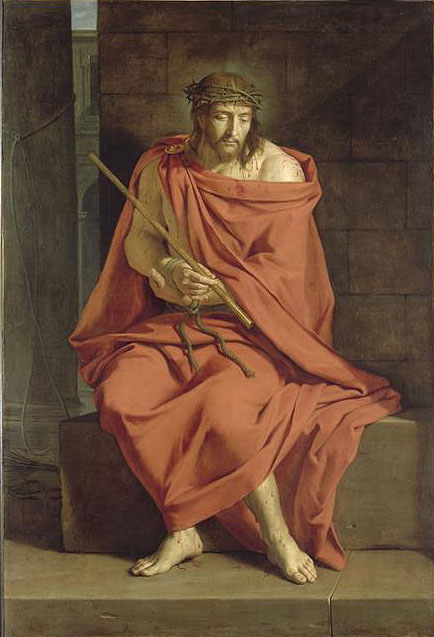
Le Christ aux outrages, Philippe de Champaigne, 17th c. (Source)

“Jesus Christ will be in agony until the end of the world” – Blaise Pascal

We shall not be blamed for not having worked miracles, or for not having been theologians, or not having been rapt in divine visions. But we shall certainly have to give an account to God of why we have not unceasingly mourned.” – St John Climacus

Recently I have had occasion to consider the role of joy in the Christian life. While I don’t believe that any particular emotions as such are intrinsic to Christianity, I sometimes feel that there is in the Church’s culture a kind of low-level idolatry of affective joy that makes it a good in itself and, more poisonously, demonizes those who do not share in it. This rather shallow (and ultimately false) view of joy as relentless and mandatory happiness has at times eclipsed the demands of the Cross, and has little to offer the suffering, the infirm, the distressed, the depressed, the sorrowful, the anxious, and the temperamentally gloomy. Are they to be excluded from heaven if they cannot force a smile? This soft and implicit Pelagianism of the emotions is a greater discouragement to souls than an honest reckoning with the sorrows of life and the terrible demands of the Cross.[1]

So, I thought I would put down a few very brief meditations on true and false joy. I would not wish to speak in absolute and general terms, but rather, out of the fullness of my heart, and all that I – a mere layman – have gleaned from seven years in the faith, the reading of Scripture, and the study of the Church’s spiritual history.

St. Paul tells us that joy is a fruit of the Spirit; he does not promise us that we shall have all those fruits at all times, or that they grow in us for own profit alone.[2] If I may alter the metaphor a bit for illustrative purposes (without in any way denying the truth St. Paul teaches), I would say that joy is the flower, and not the root or the fruit, of the Christian life as such.[3] It is chiefly given to us by God so that we might advance His Kingdom. Like the pleasant blooms of spring, joy is meant to attract souls who do not yet know the grace of God, and thereby to spread the life of the spirit. As soon as we have it, we must give it away. It is like an ember in our hands – giving light and heat, but liable to burn us if we hold on to it. For who are we to keep it, we who are nothing? And so, we should not be surprised if even this true joy is fleeting, and given to us only in rare occasions as a special grace. For the joy of God is not like the joy of the world. The former is rare as gold, and the latter as common as fool’s gold.

And as fool’s gold will not purchase what true gold can buy, so does a false joy fail in this paramount duty of conversion. We should not force ourselves to seem happier than we really are; a certain virtuous attempt at good cheer in the face of sorrow is always welcome, and we generally should not air our griefs too freely. I believe this virtue, built upon a detachment from our worldly disposition, is what the Apostle refers to when he tells us to “Rejoice always.”[4] But let us not delude ourselves into thinking that this human cheer can ever compare with the supernatural joy that comes only from God, and which many just souls have not been granted. To do so approaches dishonesty, both to ourselves and to our neighbor. Let us not pretend that our faith cheers us more than it really does; let us instead recognize that it promises us suffering, and a yoke that, though light, is nevertheless still a yoke.[5] And under that yoke, someone else will lead us where we do not wish to go.[6]

Joy is only true if it comes from, is ordered to, and brings us back to the Cross. The joy that God gives is always stained with the Precious Blood. But even then, we are not entitled even to this joy in our present life; rather, we are given the Cross as our inheritance. For what is the world if not a land of false joys? They come from nothing, they come to nothing; in their essence, they are nothing. Well and truly does the Sage condemn it all as vanity.[7] Well and truly does the Psalmist speak of it as “the valley of the shadow of death.”[8] Well and truly do we address the Mother of God from “this valley of tears.” We can do no other.

This life of the Cross is a gradual annihilation – what the French call anéantissement – a fearsome but salutary tutelage in humility and in the growing recognition of our own nothingness. To live and die on the Cross is to say every day with St. John the Baptist that “He must increase, I must decrease.”[9] Yet how hard this is! We lose sight of the fact that at the end, when we are nothing again, we can grasp the God who is No-Thing, the One who is beyond the traps, illusions, trinkets, clutter, disappointments, and, indeed, the joys of this world. We efface ourselves now so we may one day face Him. We mourn our sins today so we may rejoice in attaining God on the last day.

That is the true joy of the Cross – that, in mounting it, we can see God. But how rare is such a grace in this life! Most of us are caught up into the business of the world. Most of our lives are a long distraction. Most of us will only achieve the vision of God after the sorrows of this life and the pains of purgatory. And so, let us never forget that to be a Christian is to let Christ suffer and die in us, so that one day, we too may rise with Him.[10]


[1] James 4:4.

[2] Galatians 5:22-23.

[3] The root is faith, and the fruits are redemptive suffering and acts of charity.

[4] 1 Thessalonians 5:16.

[5] Matthew 11:28-30.

[6] John 21:18.

[7] Ecclesiastes 1:2.

[8] Psalm 22 (23): 4.

[9] John 3:30.

[10] Galatians 2:20; 2 Corinthians 4:11; 2 Timothy 2:11; Philippians 1:21

Two Reflections on the Present Crisis

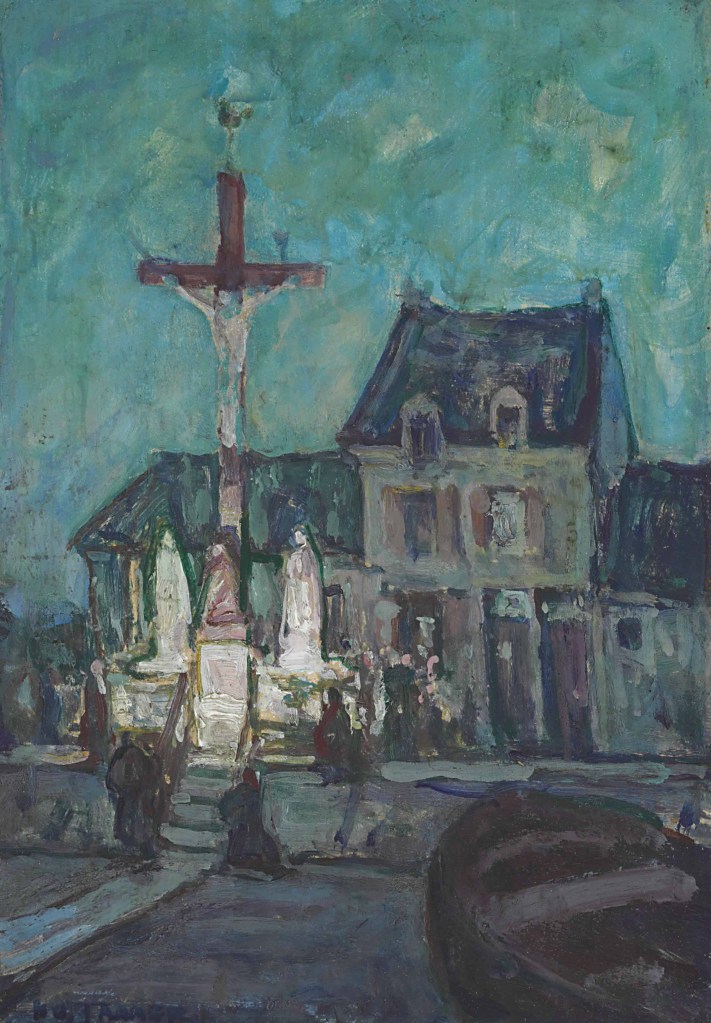
Fishermen’s Devotions, Étaples, Henry Ossawa Tanner, c. 1916 (Source)

I must refer my readers to two very moving pieces written by two dear friends of mine. Both are intensely personal and both are profound meditations on the present moment as a lived reality. The first is an almost Pascalian intervention from Mr. Jackson Wolford, who writes that our first task in this crisis – before any interpretations of what is going on all around us – is to witness the suffering. The second is a quiet reflection on impending fatherhood from Mr. Nathan Goodroe. He considers what it means to face the birth of a child in the midst of suffering through an extended look at the Holy Family’s trek to Bethlehem. We may be in Holy Week, but I still found his words to be very timely. In fact, both are. Please give them a read.

Pascal on Christ’s Agony

This year, the Lenten Spirituality Series will happen on Fridays. We begin the season with a salutary meditation taken from the Pensées of Blaise Pascal, Section 522 on “The Mystery of Jesus.”

Blaise Pascal, theologian, philosopher, mathematician, confessor, and ascetic (Source)

The Mystery of Jesus.—Jesus suffers in His passions the torments which men inflict upon Him; but in His agony He suffers the torments which He inflicts on Himself; turbare semetipsum. This is a suffering from no human, but an almighty hand, for He must be almighty to bear it.

Jesus seeks some comfort at least in His three dearest friends, and they are asleep. He prays them to bear with Him for a little, and they leave Him with entire indifference, having so little compassion that it could not prevent their sleeping even for a moment. And thus Jesus was left alone to the wrath of God.

Jesus is alone on the earth, without any one not only to feel and share His suffering, but even to know of it; He and Heaven were alone in that knowledge.

Jesus is in a garden, not of delight as the first Adam, where he lost himself and the whole human race, but in one of agony, where He saved Himself and the whole human race.

He suffers this affliction and this desertion in the horror of night.

I believe that Jesus never complained but on this single occasion; but then He complained as if he could no longer bear His extreme suffering. “My soul is sorrowful, even unto death.”

Jesus seeks companionship and comfort from men. This is the sole occasion in all His life, as it seems to me. But He receives it not, for His disciples are asleep.

Jesus will be in agony even to the end of the world. We must not sleep during that time.

Jesus, in the midst of this universal desertion, including that of His own friends chosen to watch with Him, finding them asleep, is vexed because of the danger to which they expose, not Him, but themselves; He cautions them for their own safety and their own good, with a sincere tenderness for them during their ingratitude, and warns them that the spirit is willing and the flesh weak.

Jesus, finding them still asleep, without being restrained by any consideration for themselves or for Him, has the kindness not to waken them, and leaves them in repose.

Jesus prays, uncertain of the will of His Father, and fears death; but, when He knows it, He goes forward to offer Himself to death. Eamus. Processit (John).

Jesus asked of men and was not heard.

Jesus, while His disciples slept, wrought their salvation. He has wrought that of each of the righteous while they slept, both in their nothingness before their birth, and in their sins after their birth.

He prays only once that the cup pass away, and then with submission; and twice that it come if necessary.

Jesus is weary.

Jesus, seeing all His friends asleep and all His enemies wakeful, commits Himself entirely to His Father.

Jesus does not regard in Judas his enmity, but the order of God, which He loves and admits, since He calls him friend.

Jesus tears Himself away from His disciples to enter into His agony; we must tear ourselves away from our nearest and dearest to imitate Him.

Jesus being in agony and in the greatest affliction, let us pray longer.

We implore the mercy of God, not that He may leave us at peace in our vices, but that He may deliver us from them.

If God gave us masters by His own hand, oh! how necessary for us to obey them with a good heart! Necessity and events follow infallibly.

—”Console thyself, thou wouldst not seek Me, if thou hadst not found Me.

“I thought of thee in Mine agony, I have sweated such drops of blood for thee.

“It is tempting Me rather than proving thyself, to think if thou wouldst do such and such a thing on an occasion which has not happened; I shall act in thee if it occur.

“Let thyself be guided by My rules; see how well I have led the Virgin and the saints who have let Me act in them.

“The Father loves all that I do.

“Dost thou wish that it always cost Me the blood of My humanity, without thy shedding tears?

“Thy conversion is My affair; fear not, and pray with confidence as for Me.

“I am present with thee by My Word in Scripture, by My Spirit in the Church and by inspiration, by My power in the priests, by My prayer in the faithful.

“Physicians will not heal thee, for thou wilt die at last. But it is I who heal thee, and make the body immortal.

“Suffer bodily chains and servitude, I deliver thee at present only from spiritual servitude.

“I am more a friend to thee than such and such an one, for I have done for thee more than they, they would not have suffered what I have suffered from thee, and they would not have died for thee as I have done in the time of thine infidelities and cruelties, and as I am ready to do, and do, among my elect and at the Holy Sacrament.”

“If thou knewest thy sins, thou wouldst lose heart.”

—I shall lose it then, Lord, for on Thy assurance I believe their malice.

—”No, for I, by whom thou learnest, can heal thee of them, and what I say to thee is a sign that I will heal thee. In proportion to thy expiation of them, thou wilt know them, and it will be said to thee: ‘Behold, thy sins are forgiven thee.’ Repent, then, for thy hidden sins, and for the secret malice of those which thou knowest.”

—Lord, I give Thee all.

—”I love thee more ardently than thou hast loved thine abominations, ut immundus pro luto.

“To Me be the glory, not to thee, worm of the earth.

“Ask thy confessor, when My own words are to thee occasion of evil, vanity, or curiosity.”

—I see in me depths of pride, curiosity, and lust. There is no relation between me and God, nor Jesus Christ the Righteous. But He has been made sin for me; all Thy scourges are fallen upon Him. He is more abominable than I, and, far from abhorring me, He holds Himself honoured that I go to Him and succour Him.

But He has healed Himself, and still more so will He heal me.

I must add my wounds to His, and join myself to Him; and He will save me in saving Himself. But this must not be postponed to the future.

Eritis sicut dii scientes bonum et malum. Each one creates his god, when judging, “This is good or bad”; and men mourn or rejoice too much at events.

Do little things as though they were great, because of the majesty of Jesus Christ who does them in us, and who lives our life; and do the greatest things as though they were little and easy, because of His omnipotence.