Flannery O’Connor and the Protestant Ex Voto Tradition

Recently I came across a very strange song from an equally bizarre album. The song was “I’m Not Handicapped, Just Inconvenienced,” by Gary Dee Bradford. It was on his 1979 album of the same title. The piece is a chilling mix of bad ventriloquism, preachy Carter-era Evangelicalism, and awkwardly poor singing. Which means, of course, that I loved it.

BradfordHandi.jpg

I’m curious what’s on the full album. (Source)

I soon found out that Bradford, who suffers from a rare physical disability called phocomelia (he lacks arms and has hands at his shoulders), produced a few other albums. Although he produced his most recent work in 2002, most of his output came in the 1970’s and 80’s. In one of the only other songs by Bradford I can find online, 1977’s “Good Ole Gospel Music,” we can hear the prepubescent Bradford sing in a high and eerie voice about the superiority of his chosen genre:

It is the sweetest love song
Ever heard by mortal man.
If we had more Gospel Music
We’d have a better land…a better land!

GaryDeeBradfordGOGM.jpg

Gotta love that 70’s montage work. (Source)

It’s catchy, I have to admit. Even if it’s not exactly Mozart.

It would be easy to make fun of the sheer cheesiness of Bradford’s records and write them off as one more episode in the history of odd music. But in fact, Bradford’s albums deserve more respect than that. They tell us something about the history and spirituality of mid-20th century American Christianity. Bradford wasn’t working in a vacuum.

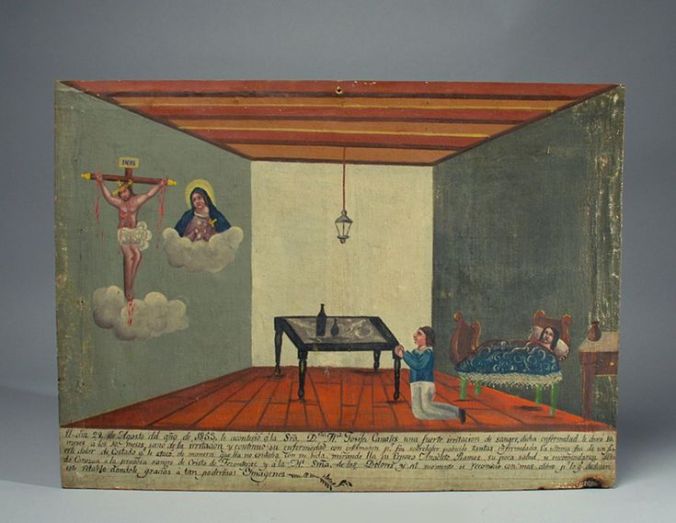
American Gospel music, particularly that brand of Gospel that flourished in the predominately white churches of the mid-century South, has roots in the musical traditions of Appalachia. One of the most common and longstanding song forms found there is the ballad. Appalachian ballads often tell stories of woe and redemption, sadness and hope. When given a religious inflection, they become the musical versions of faith-sharing, testifying to the work of God in redeeming poor sinners. They are also the Protestant equivalents of the Catholic world’s longstanding folk ex voto tradition.
ExVoto1.jpg

An example of a Mexican ex voto, 1853. (Source)

The ex voto is a little painted image offered by a devotee in thanksgiving to Christ, the Virgin, or a saint for a perceived blessing. Usually, the scene of the miracle is depicted in fairly simple (or what the art critics would call “naive”) terms, with a short, handwritten narrative describing the incident below. They are emphatically not “fine art.” Ex votos are the result of folk piety, and they depict the most fundamental relationship of the worshiper and the supernatural, the body and the invisible world, faith and crisis.

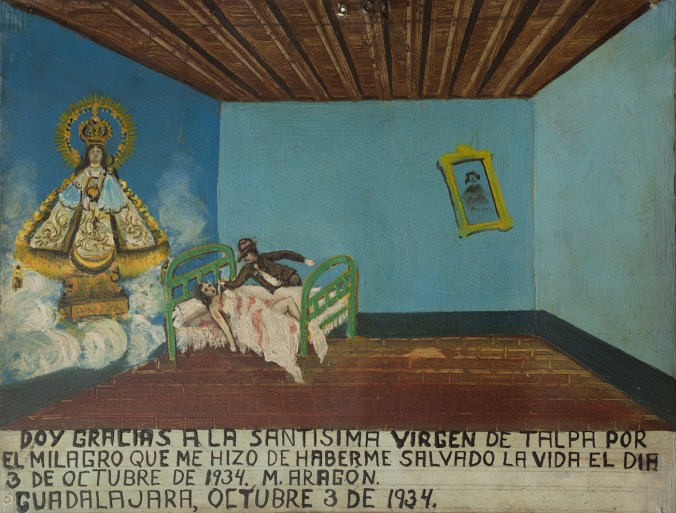
There’s also a uniquely New-World flavor to the ex voto form. While examples abound from most historically Catholic cultures, the most exemplary tradition of ex votos can be found in Mexico. Indeed, the ex voto has become one of the country’s national art forms, often stylized and reinterpreted by contemporary artists. Frida Kahlo even collected them.
exvotokahlo01.jpg

An ex-voto of a woman stabbed in bed, owned by Frida Kahlo and believed to have inspired her own painting, “A Few Small Nips.” (Source)

We can see the same kinds of spiritual impulses behind a whole wave of calamity-themed songs in mid-to-late-20th century Gospel. Perhaps we shouldn’t be surprised that, in a Protestant context, the ex voto takes an audible rather than visual form. Take, for example, Jerry D. Brown’s A Crippled Boy’s Prayer and The Fuller Family’s slightly earlier but almost identical A Little Crippled Girl’s Prayer.

CrippledBoysPrayer.jpg

Not a great song, but it makes sense as a sort of ex voto. (Source)

Sometimes, the album as a physical object mirrors the makeup of an ex voto. The back of the albums often carry long messages of praise and thanksgiving in spite of the various afflictions the artists suffer from. For example, on the back of A Little Crippled Girl’s Prayer, we read the words of wheelchair-bound Marsha Fuller:

It’s so great to be a Christian and serving such a great God. He has given so much to me, for most children with my disease lead a quiet life and never have the opportunities that I have had.  At the age of three He gave me a voice to sing with. And three years later God inspired me to write two songs. Since then, I have written four other songs and made two recordings. He has also blessed me in other ways. He gave me a wonderful Mom and Dad whom have loved and cared for me so much. He gave me a wonderful brother, Gene. You don’t find too many twenty-year-old men who loves to sing for the Lord the ways he does. As a family we have had rough times together. Sometimes we didn’t know where the next meal was going to come from because of hospital bills, but, God has always pulled us through. Our house might not be the biggest and our clothes might not be the finest, but as long as we stay true to Jesus someday we’ll have a mansion that outshines the sun. We truly hope that you will be blessed by our message in song to you. Yours in Christ, Marsha Fuller

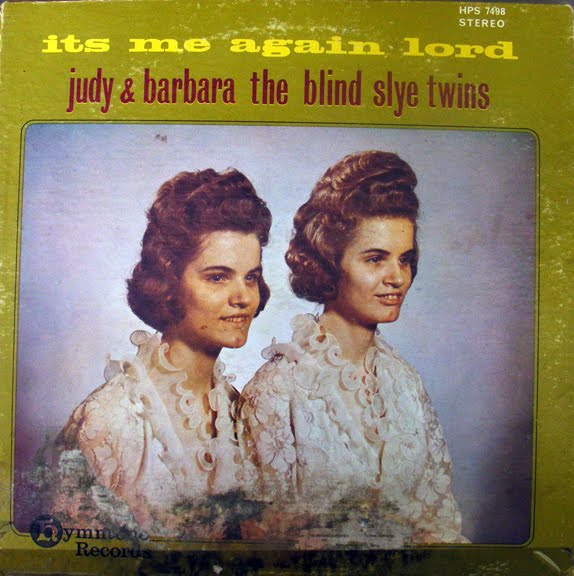
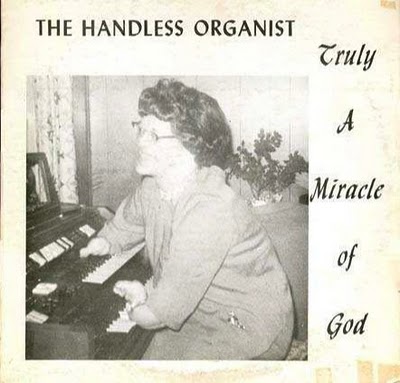
There was a veritable cottage industry of Christian albums by blind, amputee, or otherwise disabled artists that flourished in the middle of the twentieth century. To give a few examples:

ClosertotheSavior.jpg

Denise’s Closer to the Savior, probably from the 1960’s or 1970’s. (Source)
BlindSlye.jpg

Another blind album, It’s Me Again, Lord by Judy & Barbara, the Blind Slye Twins (Source)

BennyDeanBlind.jpg

Benny Dean’s I’d Rather Be Blind (In My Eyes Than In My Soul). A bit on the nose. (Source)

12 JEFF (STEINBERG).jpg

Here’s Something Special from Jeff Steinberg. Note the hook. (Source)
HandlessOrganist.jpg

“Truly a Miracle of God!” (Source)

GospelofLoveAmputee.jpg

Richard & Gail Miller Sing the Gospel of Love. (Source)
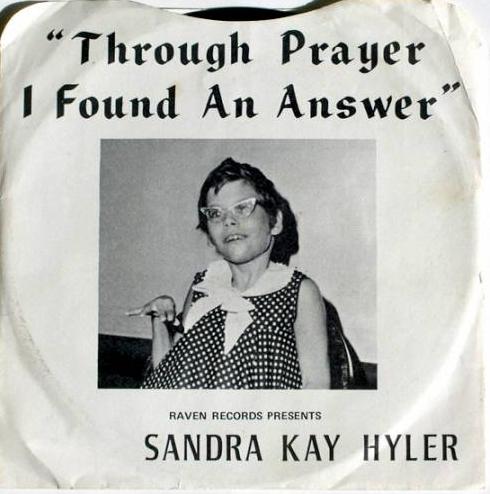
ThroughPrayer.jpg

Sandra Kay Hyler in “Through Prayer I Found An Answer.” (Source)
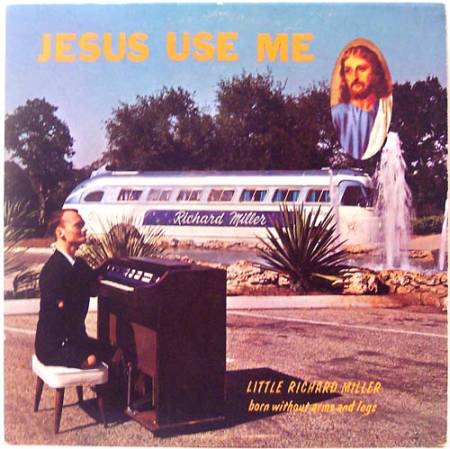
29 richard miller.jpg

Another offering from “Little Richard Miller,” this time with cover art that closely if unintentionally replicates the ex voto model. The full album is online for your listening pleasure. (Source)

These musical works differ from the mainstream of Protestant aural culture in that, even when the songs themselves are classic hymns or are just covers of more obscure songs by disabled artists, they take on a new, personal, and highly-charged meaning in the context of public disability. The artists are not just performing music, they are performing both disability and Christianity – indeed, they perform their disability precisely as the core of their Christianity, and their Christianity as intimately bound up with their disability. The singer born without arms or the blind crooner or the organist missing her hands can all achieve a new status as an icon of model Christian disability. Their performance points towards the hope of a transfiguration that surpasses disability in the kingdom of heaven. Moreover, their physical or mental incapacity is often an implicit analogy for the spiritual deformation, blindness, or weakness found in the more conventional Gospel ballad. The healing of both comes from Jesus.

Mary Douglas, among other anthropologists, has noted that the body physical is often used as an analogy of the body politic. The symbolic representation of the individual corpus speaks to the social body at large – culturally-coded anxieties about the limits of the physical body frequently point to an underlying anxiety about threats to the community. Should it surprise us that the most visible flowering of this disability-obsessed genre came at a time when the culture wars were starting to animate the full force of Southern and Midwestern Protestantism into a politically active bloc with an agenda for cultural change? Surely that socio-political context stands behinds Gary Bradford’s “better land.” The Evangelical doom song, with perhaps its best representatives in the Louvin Brothers, rose to prominence at much the same time.

The fundamentalist folk spirituality that these songs present are a major cultural context in the wonderfully disturbing, deeply Catholic work of Flannery O’Connor. In her short story “A Temple of the Holy Ghost,” she injects it into her description of a Southern freak show. An intersex person addresses two crowds – one made up of men, another of women – before displaying their unusual genitalia. The freak says,

“I’m going to show you this and if you laugh, God may strike you the same way.” The freak had a country voice, slow and nasal and neither high nor low, just flat. “God made me thisaway and if you laugh He may strike you the same way. This is the way He wanted me to be and I ain’t disputing His way. I’m showing you because I got to make the best of it. I expect you to act like ladies and gentlemen. I never done it to myself nor had a thing to do with it but I’m making the best of it. I don’t dispute hit.” Then there was a long silence on the other side of the tent and finally the freak left the men and came over onto the women’s side and said the same thing. (The Collected Stories of Flannery O’Connor 245).

Later, they lead a kind of religious service centered on their own experience of God’s Providence.

She could hear the freak saying, “God made me thisaway and I don’t dispute hit,” and the people saying, “Amen. Amen.”
“God done this to me and I praise Him.”
“Amen. Amen.”
“He could strike you thisaway.”
“Amen. Amen.”
“But he has not.”
“Amen.”
“Raise yourself up. A temple of the Holy Ghost. You! You are God’s temple, don’t you know? Don’t you know? God’s Spirit has a dwelling in you, don’t you know?”
“Amen. Amen.”
“If anybody desecrates the temple of God, God will bring him to ruin and if you laugh, He may strike you thisaway. A temple of God is a holy thing. Amen. Amen.”
“I am a temple of the Holy Ghost.”
“Amen.”
The people began to slap their hands without making a loud noise and with a regular beat between the Amens, more and more softly, as if they knew there was a child near, half asleep. (Ibid., 246)

O’Connor, who suffered from lupus herself, draws a parallel between the freak’s preaching and Benediction of the Blessed Sacrament. In the two episodes, we can perceive both the sovereignty of God’s Providence and the sacramental capacity of matter to bear God.
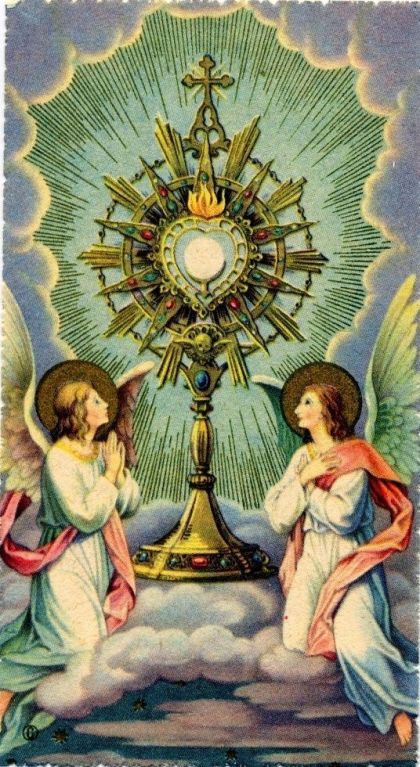
eucharistmonstranceholycard.jpg

A holy card depicting a monstrance, used in Benediction. (Source)

It strikes me as intuitively sensible that O’Connor should have chosen precisely this story to contrast Protestant and Catholic music. Early on in the story, two young Church of God men try to woo a pair of Catholic sisters by singing a Gospel hymn, complete with guitar and harmonica. The girls, who have been educated at convent school, bite back their giggles and respond with the Tantum Ergo. One of their suitors is more right than he knows when, puzzled and slightly disapproving, he calls it “Jew singing.” The two forms of music, though standing in an apparent contradiction, together anticipate the underlying sacramental truth presented by both the Protestant and Catholic services that conclude the story.

O’Connor makes much of Protestant devotional culture in one of her novels, The Violent Bear It Away (1955). It is the story of a boy called to prophesy, of his skeptical schoolteacher cousin, and of the battle they wage for the soul of a mentally disabled child. At one point, we come to the performance of a family of traveling musical missionaries. The high point of the act comes when their little daughter emerges from behind the curtain to preach a rousing sermon. In the course of her preaching, she delivers what may be the book’s central message:

“I’ve seen the Lord in a tree of fire! The Word of God is a burning Word to burn you clean!…Burns the whole world, man and child…none can escape…Are you deaf to the Lord’s Word? The Word of God is a burning Word to burn you clean, burns man and child, man and child the same, you people! Be saved in the Lord’s fire or perish in your own! Be saved in…” (The Violent Bear It Away 134-35).

O’Connor is fond of granting the most clear-eyed spiritual vision to the children in her stories. Many have profound experiences of grace that mark them forever, or they bear testimony of the invisible world’s dangerous immediacy to more skeptical characters.

CrippledGirl

This album makes me think of O’Connor’s 1955 The Violent Bear It Away. (Source)

That includes O’Connor’s disabled children. “The Lame Shall Enter First,” one of O’Connor’s most emotionally crushing short stories, is a close companion to The Violent Bear It Away. It tells the story of a well-meaning social worker, Sheppard, who takes in a clubfooted juvenile delinquent, Rufus Johnson, hoping to steer him towards a productive life. Although he can overlook Rufus’s constant spite, Sheppard is exasperated by the fundamentalist beliefs he clings to. Rufus is convinced he is going to hell, and starts to talk about it with the social worker and his impressionable young son. He steadily grows into the role of preacher even as Sheppard tries desperately to “flush that out of [his] head.” I won’t get into any spoilers, as the story has a wrenching, unforeseen climax. I’ll just say that Sheppard finally realizes he has failed only when Rufus cries at him,

“I lie and I steal because I’m good at it! My foot don’t have a thing to do with it! The lame shall enter first! The halt’ll be gathered together. when I get ready to be saved, Jesus’ll save me, not that lying, stinking atheist, not that…” (The Collected Stories of Flannery O’Connor 480).

Sheppard attributes all of Rufus’s bad behavior to the emotional effect of his clubfoot. But Rufus finds his one hope of salvation in the fact that he has a disability that, according to the logic of heaven, will ensure that he enters the Kingdom first. For Rufus, as for so many of the artists mentioned above, it represents both faith and hope (if not yet charity). Sheppard is too blinded by his prejudice and his loneliness to see that. The results are calamitous.

Rufus’s underlying insight speaks to a truth often forgotten in the Church’s treatment of the disabled. Those with disabilities are not “problems.” It’s true that they may have some special needs with regards to access, attention, etc. But at the end of the day, they are people who have the same basic spiritual needs as any other human beings. They, too, can embody and image Christ – often better than those of us who are blessed enough to be of both sound mind and body.

Gary Bradford himself has spoken publicly about this issue before. Some time in the late 1980’s or early 1990’s, Bradford – by then an adult – gave an interview with a Christian television network. He says,

In the past…so many of our churches, and so many of our people in our church in the past, it’s been the place for the good, the well-bodied, and the abled…And the Church isn’t to be like that; the Church is to take all.

Of course, the other great danger is to place too much emphasis on the disability and not enough on the person who has it. The “magical disabled person” should not become a trope in Christian life. We can’t load our disabled brethren in Christ with that moral freight. It isn’t fair. The disability Gospel genre fosters precisely that kind of harmful thinking; perhaps that is its greatest cultural fault.

I think we can avoid either extreme – neglect or overemphasis – by focusing instead on the individuality and personhood of every disabled Christian. Insofar as the disability Gospel song is an ex voto, it may seem to correspond to a certain type. Catholic ex votos usually do. But that’s only to the outsider who beholds the ex voto. For the one who makes it (or commissions it), the story it tells carries intense and highly particular personal meaning. Put another way; Sheppard may not grasp the hidden meaning of Rufus’s club foot, but Rufus does.

The same goes for the Protestant ex votos we find in this genre. They may seem to correspond to the demands of a cottage industry, but they all epitomize and present individual experiences. That particularity is the best thing we can take from this strange, lost genre of Christian music. There are no generic souls, abled or otherwise.

Novena to St. Benedict

HolyTwinsPrint.jpg

A print from The Holy Twins by Tomie dePaola, depicting SS Benedict and Scholastica. (Source)

I hope my readers will join me on a novena to the Patriarch of Western Monks, starting today (July 3rd) and ending on the Feast of St. Benedict, the 11th of July. Here is the prayer I will use, taken from EWTN’s website:

Glorious Saint Benedict, sublime model of virtue, pure vessel of God’s grace! Behold me humbly kneeling at your feet. I implore you in your loving kindness to pray for me before the throne of God. To you I have recourse in the dangers that daily surround me.
Shield me against my selfishness and my indifference to God and to my neighbor.
Inspire me to imitate you in all things. May your blessing be with me always, so that I may see and serve Christ in others and work for His kingdom. Graciously obtain for me from God those favors and graces which I need so much in the trials, miseries and afflictions of life. Your heart was always full of love, compassion and mercy toward those who were afflicted or troubled in any way. You never dismissed without consolation and assistance anyone who had recourse to you. I therefore invoke your powerful intercession, confident in the hope that you will hear my prayers and obtain for me the special grace and favor I earnestly implore.

{mention your petition}

Help me, great Saint Benedict, to live and die as a faithful child of God, to run in the sweetness of His loving will, and to attain the eternal happiness of heaven.

Amen.

A Ghastly Hymn for Good Shepherd Sunday

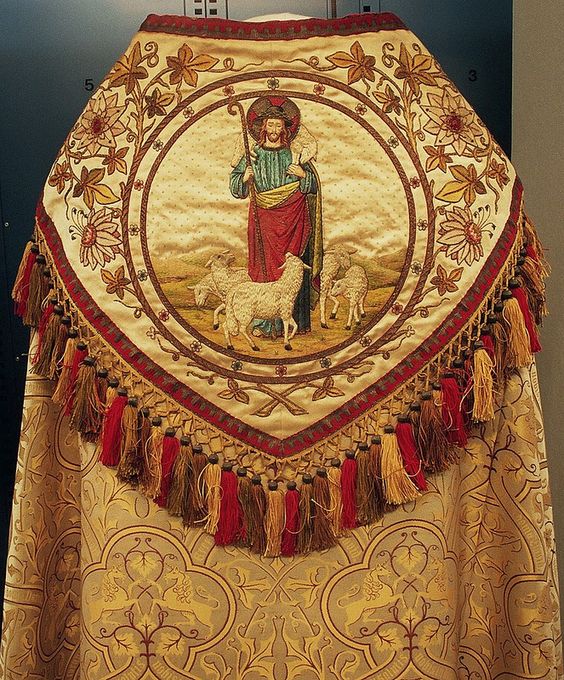
Cope2

A cope depicting the Good Shepherd. (Source)

I realize that technically last week was Good Shepherd Sunday in the traditional calendar, but as most of the Catholic world (alas) celebrates it tomorrow, I thought I’d offer up this truly dismal hymn from Fr. Faber. I have never yet heard it set to music, so if any of my readers happen to know of a recording, I would appreciate them kindly sharing it. Fr. Faber is one of my favorite spiritual writers and hymnodists…even when he’s outlandishly bad.

The True Shepherd

Fr. Frederick William Faber

I was wandering and weary
When my Saviour came unto me;
For the ways of sin grew dreary
And the world had ceased to woo me:
And I thought I heard Him say,
As He came along His way,
O silly souls! come near Me;
My sheep should never fear Me;
I am the Shepherd true.

At first I would not hearken,
And put off till the morrow;
But life began to darken,
And I was sick with sorrow;
And I thought I heard Him say,
As He came along His way,
O silly souls! come near Me;
My sheep should never fear Me;
I am the Shepherd true.

At last I stopped to listen,
His voice could not deceive me;
I saw His kind eyes glisten,
So anxious to relieve me:
And I thought I heard Him say,
As He came along His way,
O silly souls! come near Me;
My sheep should never fear Me;
I am the Shepherd true.

He took me on His shoulder,
And tenderly He kissed me;
He bade my love be bolder,
And said how He had missed me;
And I’m sure I heard Him say,
As He went along His way,
O silly souls! come near Me;
My sheep should never fear Me;
I am the Shepherd true.

Strange gladness seemed to move Him,
Whenever I did better;
And he coaxed me so to love Him,
As if He was my debtor;
And I always heard Him say,
As He went along His way,
O silly souls! come near Me;
My sheep should never fear Me;
I am the Shepherd true.

I thought His love would weaken,
As more and more He knew me;
But it burneth like a beacon;
And its light and heat go through me;
And I ever hear Him say,
As He goes along His way,
O silly souls! come near Me;
My sheep should never fear Me;
I am the Shepherd true.

Let us do then, dearest brothers!
What will best and longest please us,
Follow not the ways of others,
But trust ourselves to Jesus;
We shall ever hear Him say,
As He goes along His way,
O silly souls! come near Me;
My sheep should never fear Me;
I am the Shepherd true.

Five Years a Catholic

ImmaculateHeartCard

May the Sorrowful and Immaculate Heart of Mary pray for us. (Source)

“To begin and end well, devotion to our Blessed Lady, the Mother of God, is nothing less than indispensable.” – St. Philip Neri, Maxims.

Five years ago, I was received into the Roman Catholic Church at the Easter Vigil. The journey since then has been an adventure, to say the least. Not all of it has been good. I’ve continued to make lots of mistakes, often failing in faith, hope, charity, and all the other virtues. Individual Catholics have often disappointed me. There were moments of doubt along the way, and, like the infamous Pillar of Salt, I am no stranger to the occasional backwards glance.

But in reflecting on those five years, the overwhelming feeling is one of gratitude. The many wonderful people I have met – and, more importantly, the graces I have received – have confirmed for me the essential soundness of my choice. I have no regrets. I only wish more people could know the abiding peace that comes with conversion to the Church that Christ established on St. Peter. And having consecrated myself to Mary, I feel as if I have had a new strength in the spiritual life since last Summer.

Thus far, I have dedicated each year to some mystery of the Faith. It is in that same spirit that I consecrate this sixth year of my Catholic life to the Sorrowful and Immaculate Heart of Mary. I pray that by her triumphant heart, she will continue to guide me to a more perfect knowledge of Her Father, Son, and Spouse. As St. Philip says, “Our Blessed Lady ought to be our love and consolation.” I hope that she ever will be mine.

And thus on this Good Friday, I beg your prayers and those of the saints, that I might persevere in the faith and grow in the love of God.

Most Sacred Heart of Jesus, pray for us.
Our Lady Immaculate, pray for us.
St. Joseph, pray for us.
St. Philip Neri, pray for us.

Amen.

HolyCardMary

The Queen of Heaven. (Source)

A Letter on the Face of God

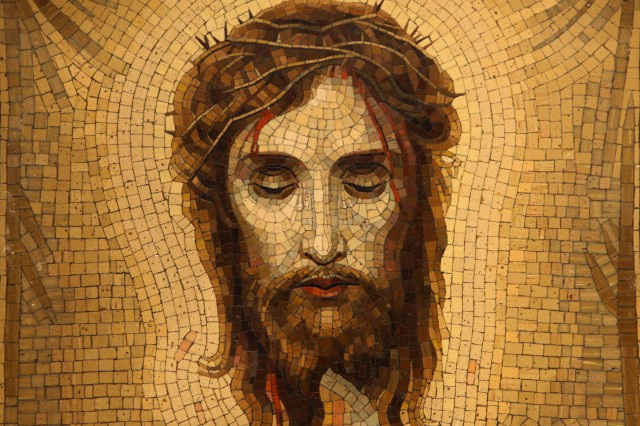
HolyFaceMosaic

The Holy Face of Christ. (Source)

Dear Miriam,

Forgive me for my delay in replying to your message. You pose an excellent question, one that deserves an honest and well-considered answer. Indeed, I am not sure that I’m entirely qualified to speak on the matter. Not being a Biblical scholar, I can’t discuss the critical questions of authorship, Hebrew grammar, and culture that could be so useful. Alas. Nonetheless, I shall try to tell you what I understand the verse to mean, and why I saw fit to use it.

You ask me about what the Priestly Blessing meansespecially what we are to understand by those mysterious words, “The Lord make his face shine upon thee, and be gracious unto thee: The Lord lift up his countenance upon thee, and give thee peace” (Numbers 6:25-26 KJV). You are right to note that there is something odd about this passage.

I believe the prayer is best understood through meditation. Let us look first at the beginning and bulk of the passage:

The Lord make his face shine upon thee, and be gracious unto thee: The Lord lift up his countenance upon thee…

What do we learn from these words? What does it mean to say, however poetically, that God has a “face,” a “countenance?”

First, it means that God is personal. The God of Abraham, Isaac, and Jacob is not an abstract, nameless force. He is not the Tao of the Chinese mysticsor not just that. Rather, He is someone, a who, an infinite yet utterly unique spirit. This truth entails another; God is relational. The face is the chief organ and sign by which we communicate with other people. The full range of our emotions find expression in the human face. The face becomes a symbol or synecdoche of our individual souls. It is the way we share our hearts. It is the bridge between our interiority and the other. Through speech, a kiss, an exchange of glances, the face mediates our personhood and thus becomes the location of communion.

The use of the word “countenance” in English sums up all these ideas, with one rather startling implication. God Almighty desires to be in a relationship with us. More than that, He wishes to dwell with us. The words of the blessing are not that of a God who will reign remotely. If the metaphor of the “face” suggests personality and relationship, it also suggests presence. God wants us to be wholly His, that He may be wholly ours. That is why He goes so far as to establish multiple, connected covenants with Adam, Noah, Abraham, Moses, and David.

But covenants, like great love stories, are exclusive. You are right to point out the negative implication in the verse. If we pray for God to turn His face towards us, then surely God’s face could be turned away from us as well? I think the certain answer of the Bible, not to mention ordinary human experience, is yes. The ancient Israelites believed that they were a privileged, priestly people, subject to a totally unique relationship with God. Yet the whole of the Old Testament’s historical and prophetic corpus also shows that the Nation of Israel repeatedly caused God to “turn His face” away from them, not in loving them less, nor in breaching His covenant, but in permitting them to suffer chastisements that they might return to Him. The Holy only communes with the holy; God cannot abide with sin. And the Israelites often sinned. We all do. Speaking from my own life, I can testify that mortal sin is a terrible thing. To fall away from the face of God, to want to hide from His face as Adam did in the Garden, to feel Him turn His holy face away from yousuch is the interior darkness and desolation wrought by sin.

Yet the ground of your questionwhy God’s face would be turned away from anyone reveals that whether you realize it or not, you already have a basically Christian idea of God. To the ancient Jews who composed the Priestly Blessing for the liturgies of Tabernacle and Temple, the Face of God only turned towards the Nation of Israel. The idea that God loves all, and loves them unconditionally, is a notion that did not exist anywhere before the coming of Christ.

Indeed, the prayer receives its perfect answer and fulfillment when God takes on a human face. Jesus Christ is the Face of God, a divine person who wishes to be in an eternal and perfect communion with all men. That is why He is called Emmanuel, “God with us.” He is our eternal high priest (Hebrews 7:23-28; 9:11-14; 10:10-14).

And as our high priest, He has fulfilled the Priestly Blessing in three ways, all of which were unimaginable when it was written.

First, in His coming. In Christ, God has turned His face towards usin the manger at Bethlehem, in His ministry among the poor and sick, in His companionship with sinners, in His Transfiguration, in His ceaseless prayer for us, in His cruel and unjust death upon the cross, and in His glorious Resurrection and Ascension.

Secondly, in the heart of the Godhead. By assuming human nature, God the Son becomes a human. By His Incarnation, Death, Resurrection, and Ascension into Heaven, He has brought a human face into the inner life of the Most Holy Trinity. God the Father gazes upon the human face of His Son, and He desires to see all mankind in and through that face. God the Spirit, eternal love, is born forth out of this mutual gaze. The Father and the Son only behold each other in the absolute love of the Spirit.

But what is the fruit for us today? The rest of the prayer tells us:

…and give thee peace.

Peace is not the absence of suffering, but the absence of disturbance. The peace of Christ, the peace “which passeth all understanding” is not to be taken as earthly ease and comfort (Philippians 4:7 KJV). That would merely be the false and facile peace of the world. The peace of God is a foretaste of Heaven, an inner rock upon which we may stand when suffering assails us, a seed of the Kingdom that may render us more perfect imitators of Christ. With the peace of God in our hearts, we may hope to know the true joy that, paradoxically, only grows from the cross. This peace is not a quiet meekness. It is the liberating freedom and security that comes from the knowledge of His love. Peace does not paralyzeit propels. It makes us undertake great adventures for God. Why? Because true peace is communion with God.

That is why I made use of the prayer at the end of my “Letter on Loneliness.” It occurred to me that the torment of loneliness is in some way redeemed if we remember the presence of the God who is love, and thus attain to His peace.

I don’t believe we can hope for the fullness of that peace without the sacraments, especially the Eucharist. It is simply impossible to be a Christian without the Eucharist. Any grace, any glory, any goodness in the world is only granted and sustained by Christ present with us in the Most Holy Sacrament of the Altar. Indeed, the graces of all the other sacraments flow from the Eucharist, since it is Christ Himself.

And it is in the Eucharist that we find the third way that Christ has fulfilled the Priestly Blessing and extended its meaning to all peoples and all epochs. In the Eucharist, we once again come face to face with the God of Israelquite literally. His Eucharistic Face can be found in any Catholic Church on earth. Go to a service of Benediction. Chant hymns of adoration as the incense flies up like a ghost into the shadowy heights of the sanctuary. Let your soul rise with it, high above the little lights of the candles that line the altar. Then, as the bell rings and the priest lifts the Host, you will see God. Or at least, you will see His veil. He hides Himself under the sight of mere matter. No matter what, He will see you.

Better yet, go to Mass. Go to the Easter Vigil. Go on any Sunday. There, you will not only see God, but hundreds of perfectly ordinary people communing with Him in the most intimate way imaginablebody and soul. That holy act is the true fulfillment of the Priestly Blessing. It is the seal and crown of all the covenants. Not everyone in the world partakes of itbut happy are those who do! They alone know the Peace that was promised, the Peace that is He.

Forgive me if I have rambled. One could, in theory, write whole volumes on the verses you have asked me about. I am sure someone with more learning and a deeper life in Christ could give you an altogether better explanation. But what I have written is drawn ex corde meo. I hope, at the very least, that I’ve answered your question. I’d be happy to continue discussing the matter.

Until then, I pray that the Good Lord blesses you in all your works and ways.

In Christ,

Rick

A Spanish Mystic of the Sacred Heart

Providence sometimes ordains that we should come across new friends in Heaven at exactly the right time. This happy accident of grace has just occurred to me.

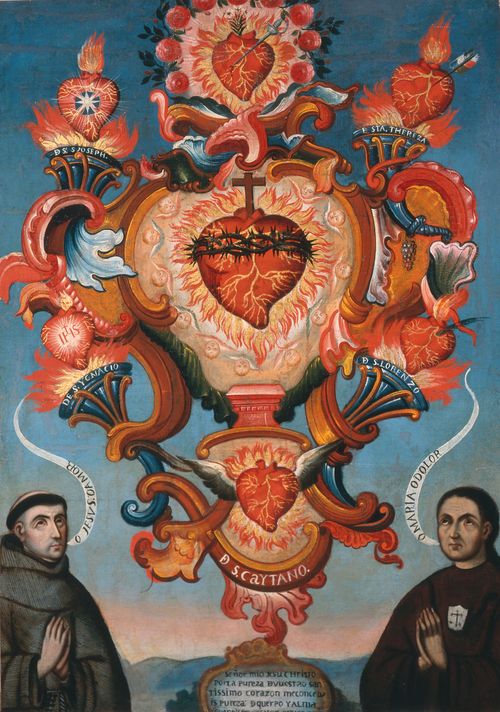
SacredHeartTimesSix.jpg

Holocausto de Corazones al Sagrado Corazon de Jesus, 17th century Mexican. (Source)

I’ve been reading about the Jesuits of the late 17th and early 18th centuries quite a lot recently in connection with my research. My admiration for them has grown tremendously. I always used to have a devotion to the Jesuit martyrs of Elizabethan and Jacobean England, and to an extent, I still do. But the Continental Jesuits who did so much to combat the spread of Jansenism are a marvel to behold. For all my jokes about the suppression of the Jesuits and my appreciation of Pascal, I have to say that the Jansenists were a nasty bunch. The more one studies their history and doctrines, the colder one feels. Thus, I especially admire those tireless evangelists of the Sacred Heart such as St. Claude de la Colombière, whose feast we celebrated yesterday. Along with this revived interest in the Continental Jesuits, I’ve found myself drawn to the Sacred Heart in recent weeks.

librohoyos

Bl. Bernardo Francisco de Hoyos S.J. (Source)

Into this recent ferment of the spirit came an unexpected intrusion of grace. As I was scrolling through Facebook, I saw that in one of my Catholic groups, someone had posted an article about a mystic and asked what we all thought. I opened the link and discovered a new and remarkable saint: the Blessed Bernardo Francisco de Hoyos, S.J.

The Blessed Bernardo entered the Jesuit novitiate in 1726 when he was not yet fifteen. In the early years of his formation, he felt a strong attraction to the (then) Blessed John Berchmans, a model of Jesuit youth, seeking to emulate him in all things. The young saint later had a powerful “dark night of the soul” that involved demonic torments. When he came out on the other side, however, the Lord appeared to him in some of the most remarkable visions of the age. To wit:

Always holding my right hand, the Lord had me occupy the empty throne; then He fitted on my finger a gold ring…“May this ring be an earnest of our love. You are Mine, and I am yours. You may call yourself and sign Bernardo de Jesus, thus, as I said to my spouse, Santa Teresa, you are Bernardo de Jesus and I am Jesus de Bernardo. My honor is yours; your honor is Mine. Consider My glory that of your Spouse; I will consider yours, that of My spouse. All Mine is yours, and all yours is Mine. What I am by nature you share by grace. You and I are one!” – The Visions of Bernard Francis De Hoyos, S.J., Henri Béchard, S.J.

bernardfrancishoyos

A modern rendition of Bl. Bernardo. (Source)

Assuming this quote is accurate – like the author from whom I took it, I am unable to verify it (Bechard’s book is extremely rare) – it evinces an eminent degree of spiritual maturity. Dom Mark Daniel Kirby reports on more of the young saint’s experiences:

On August 10, 1729, the Saviour, covered with His Precious Blood, appeared to Bernardo, and showing him the wound in His Side, said, “Rejected by humanity, I come to find my consolation with chosen souls.” Bernardo’s experience closely resembles that of Saint Margaret Mary Alacoque fifty-three years earlier in the Visitation Monastery of Paray-le-Monial in France.

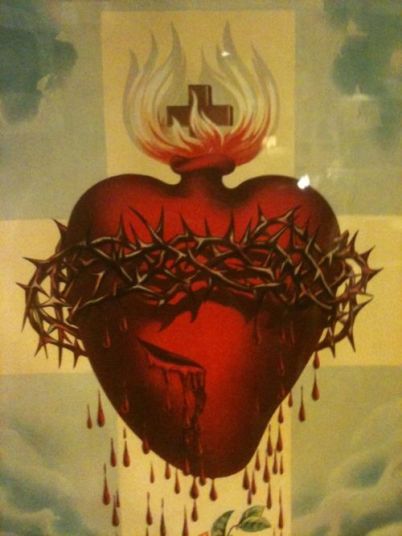
SacredHeartprint

The Sacred Heart of Jesus. (Source)

It should be no surprise to us, then, that Bl. Bernardo was a profound devotee and propagator of the Sacred Heart of Jesus. In 1732, when he was only 22, the Lord entrusted him with the mission of spreading love for the Sacred Heart, both “as a means of personal sanctification and as an effective means for accomplishing the apostolate.” That year, he consecrated himself to the Sacred Heart using St. Claude’s formula. Shortly after, he collaborated on a book about the devotion entitled The Hidden Treasure (alas, I don’t know if it has been translated into English). His brief priesthood – he died of typhus less than a year after ordination – was a total gift to the Sacred Heart. He was known to say, “Oh, how good it is to dwell in the Heart of Jesus.” These were, no doubt, the words of one who dwelt there indeed.

Bl. Bernardo was beatified in Valladolid on April 19, 2010. He is a special patron against the sin of impurity, perhaps because his own chastity was sealed in a mystical marriage to Jesus.

One of the things that truly struck me about Bl. Bernardo’s story – aside from his devotion to the Sacred Heart, which is, as I mention, timely – was his youth. He was only a year older than me when he died. To think that someone could achieve such heights of holiness in such a short time is a wonderful encouragement.

But of course, the growth of a soul is not, strictly speaking, a matter of our own effort. It is the work of the Holy Ghost in us. Bl. Bernardo is an example of what happens when we open ourselves totally to the operations of the Holy Ghost. Not everyone will receive visions. In fact, very few souls are so privileged. But they are given to the Memory of the Church so that we who are less favored may take some inspiration by their example and glimpse more perfectly some aspect of Our Savior. Christ is the one light caught by so many prisms through the centuries. Bl. Bernardo is one such pure glass, shining through the ages to light our way. May he pray for us in this Lenten season.

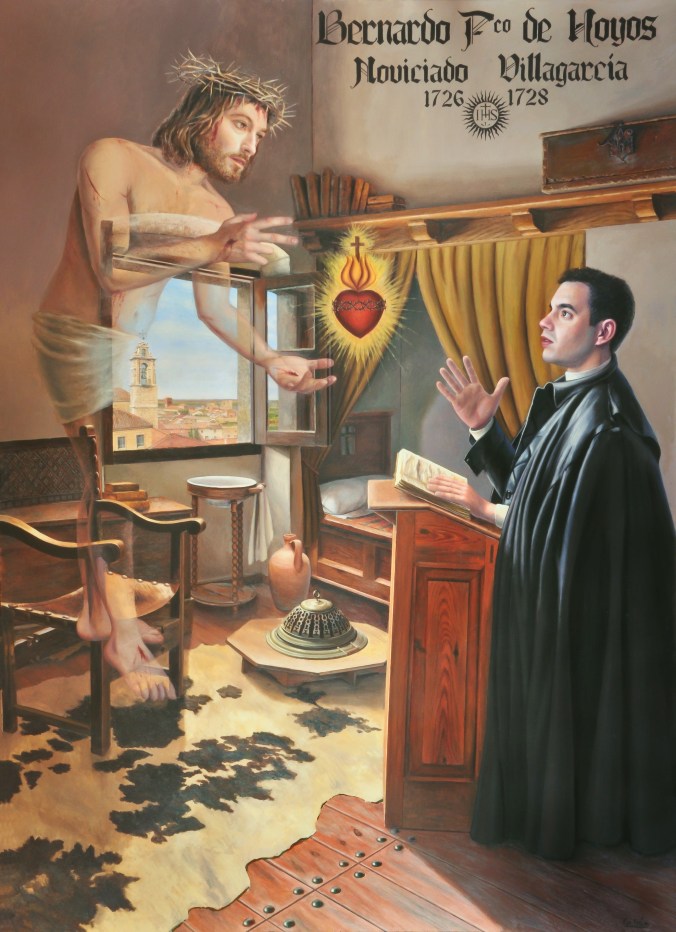
Bernardo_Fco_de_Hoyos.jpg

Bl. Bernardo Francisco de Hoyos’s vision of the Sacred Heart. (Source)

Elsewhere: A New Blog on Christianity and Cricket

19century_cricket.jpg

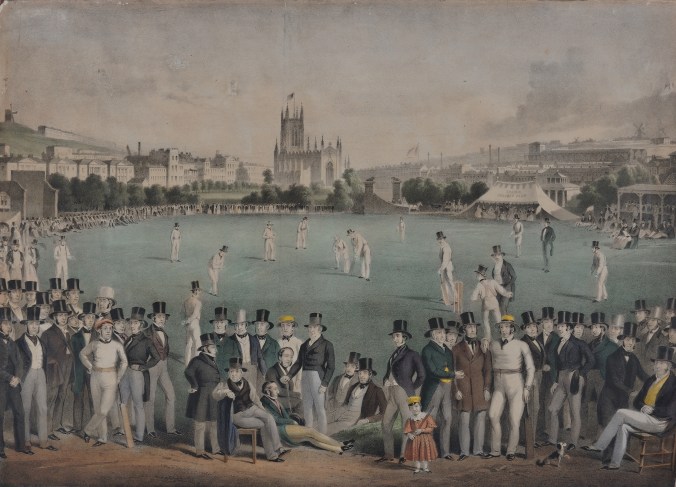
A scene of English life in the 19th century; top hats in the foreground, a Gothic Cathedral in the background, and between them, cricket. (Source)

Living at an Anglo-Catholic seminary has been an education in many respects, but I still haven’t got a handle on the sport of cricket. Luckily for me (and for many of my readers, I’m sure), a new blog hopes to correct that oversight. My friend and fellow Staggers resident, Mr. William Hamilton-Box, has just begun writing on Cricket, Christianity, and various fun facts. Do give it a look-see.

A Letter on Loneliness

Veronese-Cristo-nell-orto-del-Getsemani-1024x797

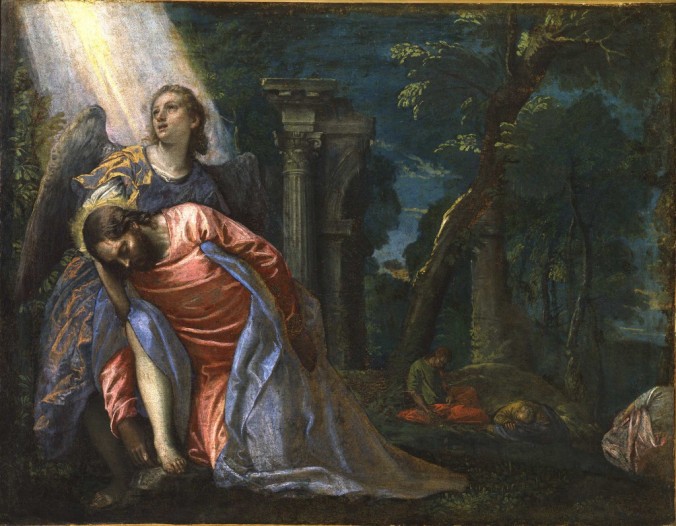
Christ in the Garden of Gethsemane, Veronese. Pinacoteca di Brera (Source)

My Dear Brother Josiah,

I received your last correspondence with a mixture of joy and sorrow. Joy, for all the good news you shared of our friends and familiars; sorrow, for those matters closer to your own heart that weigh so heavily upon your soul. Normally, I would not venture to offer unsolicited advice. However, as you have come to me seeking counsel, I will try to speak from what little light I have been granted. I will offer you, I hope, nothing but the constant teaching of the saints, nor anything I would not myself seek to follow. So much of what I must share is rooted in my own experience, the fruit of suffering not in all respects unlike your own.

You tell me that you worry about God’s blessing. You write that, in view of your griefs, you no longer trust that the Lord will bless you. This is a failure of Christian hope, but an understandable one. Faced with one reversal after another, it is easy to despair. I will point you first to the book of Job, a well from whose water I know you have already imbibed in more bitter times. What else could I tell you? The key practical thing is to recollect often those graces you have received. Savor them. Go over each, holding them close to your heart in memory. Make space in your week – better yet, your day – to ponder the grand and little mercies of God. I commend to you one of the very greatest pieces of wisdom I have received, that “a grace remembered is a grace renewed.” Continual recollection means that we are never really bereft of those graces once delivered unto us.

Look over your current state of life. The world, at least, sees your success. Many would desire your place. Thank God for what He has seen fit to give you so far.

But I know how incomparably small all of those worldly triumphs seem next to the losses you’ve suffered. I see what you mean when you say that you don’t trust God to bless you anymore. You aren’t speaking of those tangible blessings the world prizes in its vanity. You speak instead of the love of those taken from you. That golden blessing is worth all the others combined.

And so, we come to what seems to me to be the basic problem; not despair, but loneliness. The chill that stains even the brightest happiness and reveals the joys of this world to be fool’s gold. Have you considered loneliness in itself? Perhaps you have. It is a dark and loathsome thing. Perhaps you have found it buried down in your soul. A void. A hole that, like a carious tooth, aches and aches until it cries out for your full attention. A little black space at the bottom of things. You carry it around with you and never set it down. Grief carved it out, shaped it to its own image, and colors it even today.

I don’t know if you will always bear that burden. Some of us must. But I would encourage you to embrace it. That emptiness is, in the words of R.S. Thomas, “a vacuum he may not abhor.” Come close to the void. Peer at it. Ecce lignum crucis! It is the cross you have been given. Fasten your heart to its center with the very nails of Our Lord’s passion. Accept His invitation, and you will be able to endure those long and painful hours when hope fails. One day, when you are least expecting it, something may very well happen. You may be at prayer in your room. You may be savoring the Eucharist at Mass. You may be finishing the sorrowful mysteries of the rosary. But suddenly, unbidden, the Holy Ghost will visit you. The darkness will turn to dazzling light. By some strange alchemy known only in heaven, the emptiness will all at once turn into a full fountain of molten gold. The cavern will become a cup that runneth over. The silence will become song beyond sound or human voice. And your heart will be seized by the beautiful and terrifying realization that the Living God sees you. If only for a moment, you will know what it is to be “alone with the Alone.” Then will your heart become one with His. Then will you know a communion that obliterates all loneliness and a joy that erases all grief.

This moment cannot be rushed. God will not come but in His own way and in His own time. All the same, one can prepare.

First and foremost, take your loneliness and grief to the sacraments. When you are at the offertory or some other convenient point at the Mass, give your heart to the Eucharistic Christ. Ask to be alone with Him in the Tabernacle. Cleave to it as to the one rock of safety in a stormy sea. Consider, too, how Our Lord suffers loneliness in the Tabernacle. Think how He is neglected in His tabernacles through all the world. Think how He desires your consolation – yours! Truly, He wishes to make that emptiness in your soul His true and everlasting Tabernacle. Will you deny your Lord? For in the Tabernacle, He is at once most suffering and most glorious. So, too, where you are most suffering, He will render you most glorious.

Second, make a point of consciously drawing near to Christ crucified in your daily prayer. One thing I’ve done in the past – though, I confess, I have lately been lax about it – is to pray the Divine Mercy chaplet and dedicate each decade to one of the Holy Wounds. Start by contemplating Our Lord’s feet, His physical presence on Earth during His lifetime and evermore in the Eucharist. Consider His comings and goings, and how He willingly ceases all of that to offer Himself to the Father on the cross. Then consider His left hand, the Kingly hand that holds the orb of the world. Ponder the ways of His Providence. Take heart in His mercy towards the penitent and His just judgment of the wicked. Praise Him for His true and final victory over the forces of evil, for scattering the proud in their conceit. Then, move to His right hand, the Priestly hand of blessing. Think of how He has transformed all things by the peace wrought with His right hand, under the sign of His blessing. Look forward to the world as it shall be on the day of His Wisdom’s Triumph. It is a world we can already enter at the Mass. Bring your gaze up to the Holy Face, wounded by the crown of thorns. Offer him your anxieties, your fears for the future, and all those worries that come from not knowing what you must do or why some calamity has transpired. Consider the crown of thorns as the mortification of your very reason. As Our Lord unquestioningly accepted the will of His Father, may you do the same. But remember to gaze into the Holy Face as into the very countenance of the Living God. Ponder Jesus Christ in His humanity. God is a person; nor is he just any person, but a person who suffered all that we suffer, and more. Finally, move to the wound in the Holy Side and the Sacred Heart. Give yourself up to as pure an expression of love for your Savior as you can muster. Consider the flood of water and blood that fell from those triumphant gates, so rudely torn open. Think, if you can, of the power so much as one drop of either precious liquid would have to redeem not just one soul, but millions and millions of universes teeming with the souls of the very worst sinners. Ponder what it means that you may receive the Precious Blood at even a low Mass. Fix your gaze beyond the Holy Side, passing into the darkness of Our Lord’s chest. Dwell upon the Sacred Hear in its quiet and eternal radiance. Know that Our Lord’s chest cavity is so very much like the void to which I have already alluded, and so like the Tabernacle. For in both, we find the Heart of God! Imagine yourself receiving the Sacred Heart in the Eucharist. Meditate upon the immense fire of Love pulsing there until the last shudder of death – and, as you come to the Trisagion, recall how that love blazed forth again on Easter Morn, never to be extinguished.

Third, keep in mind the words of St. Philip Neri. Amare Nesciri – “Love to be unknown.” One thinks of St. Benedict. In his rule, St. Benedict enjoins his children to overcome the temptations of lust with a similarly simple phrase, “Love chastity” (RB IV). St. Philip’s words carry many meanings. They are a wonderful program of humility, of perfection, of freedom, but also of loneliness and grief. Love to be unknown. Find God in the moment when no one else notices you. Don’t do what you do to be recognized, as the Scribes and Pharisees (Matt. 6:3, 16, Luke 18:9-14). Be content that God sees and knows you. It will take time to grow into this practice, but you will come to recognize its benefit. You may someday find someone to share or alleviate the yoke of your sorrows – maybe even someone to love. But until then, embrace Solitude as St. Benedict would have us embrace Chastity; that is, as a beloved spouse. Focus on that task, the one you have been given for now, and the rest will come to you as God sees fit in His own time. I would wager that it will make you happier and help you love others more perfectly.

Fourth, do not depart from under Mary’s mantle. If you wish to see the very picture of loss, I will show you the woman who, though the only one free of sin among the whole human race, suffered the loss of her parents, her husband, and her son. Turn your eyes to Mary. The sorrows of her Immaculate Heart demand your attention. We have no greater advocate and comfort in our own suffering than Mary, in union with her eternal spouse, the Paraclete.

Finally – hardest of all – you must forgive. Jesus’s death was not just a perfect sacrifice because He was an innocent and willing victim. He forgave His murderers. If we are to have a share in that death, we must learn the extremely difficult discipline of forgiveness. It is the only way we can be truly free.

I would be remiss in giving you these counsels if I did not add with all due caution that, insofar as any of it applies to me, I often fail. But I feel no shame in saying so, since Our Lord is magnified in weakness. Don’t rely only on my words, narrow and feeble as they are. If anything I have said is contradicted by the example of the saints and the teaching of God’s holy Church, refer to their superior model. After all, I’m not a priest. I’m not even all that well versed in theology. Seek out a spiritual father who can help your soul more intimately than a friend can.

For all that, be assured of my prayers and affection. I hope you find the hope that can only come from the Lord, my dear brother. May He bless you and keep you, and make His face shine upon you, and be gracious to you; may He turn His countenance upon you, and give you peace.

In Christ,

RTY

“Awake and Sing and Be All Wing”

MostHolyNameofJesus

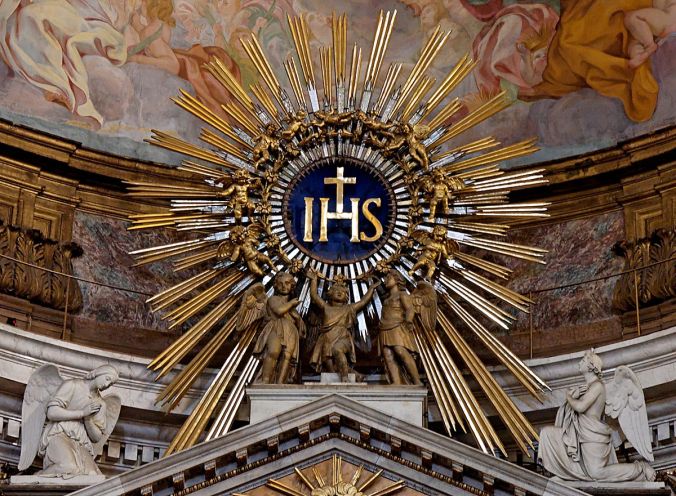
The Most Holy Name of Jesus at the High Altar of the Gesu, Rome. (Source)

To the Name above every Name, the Name of Jesus

By Richard Crashaw

A HYMN


I SING the Name which None can say

But touch’t with An interiour Ray:

The Name of our New Peace; our Good:

Our Blisse: and Supernaturall Blood:

The Name of All our Lives and Loves.

Hearken, And Help, ye holy Doves!

The high-born Brood of Day; you bright

Candidates of blissefull Light,

The Heirs Elect of Love; whose Names belong

Unto The everlasting life of Song;

All ye wise Soules, who in the wealthy Brest

Of This unbounded Name build your warm Nest.

Awake, My glory. Soul, (if such thou be,

And That fair Word at all referr to Thee)

Awake and sing

And be All Wing;

Bring hither thy whole Self; and let me see

What of thy Parent Heaven yet speakes in thee,

O thou art Poore

Of noble Powres, I see,

And full of nothing else but empty Me,

Narrow, and low, and infinitely lesse

Then this Great mornings mighty Busynes.

One little World or two

(Alas) will never doe.

We must have store.

Goe, Soul, out of thy Self, and seek for More.

Goe and request

Great Nature for the Key of her huge Chest

Of Heavns, the self involving Sett of Sphears

(Which dull mortality more Feeles then heares)

Then rouse the nest

Of nimble, Art, and traverse round

The Aiery Shop of soul-appeasing Sound:

And beat a summons in the Same

All-soveraign Name

To warn each severall kind

And shape of sweetnes, Be they such

As sigh with supple wind

Or answer Artfull Touch,

That they convene and come away

To wait at the love-crowned Doores of

This Illustrious Day.

Shall we dare This, my Soul? we’l doe’t and bring

No Other note for’t, but the Name we sing.

Wake Lute and Harp

And every sweet-lipp’t Thing

That talkes with tunefull string;

Start into life, And leap with me

Into a hasty Fitt-tun’d Harmony.

Nor must you think it much

T’obey my bolder touch;

I have Authority in Love’s name to take you

And to the worke of Love this morning wake you;

Wake; In the Name

Of Him who never sleeps, All Things that Are,

Or, what’s the same,

Are Musicall;

Answer my Call

And come along;

Help me to meditate mine Immortall Song.

Come, ye soft ministers of sweet sad mirth,

Bring All your houshold stuffe of Heavn on earth;

O you, my Soul’s most certain Wings,

Complaining Pipes, and prattling Strings,

Bring All the store

Of Sweets you have; And murmur that you have no more.

Come, né to part,

Nature and Art!

Come; and come strong,

To the conspiracy of our Spatious song.

Bring All the Powres of Praise

Your Provinces of well-united Worlds can raise;

Bring All your Lutes and Harps of Heaven and Earth;

What ére cooperates to The common mirthe

Vessells of vocall Ioyes,

Or You, more noble Architects of Intellectuall Noise,

Cymballs of Heav’n, or Humane sphears,

Solliciters of Soules or Eares;

And when you’are come, with All

That you can bring or we can call;

O may you fix

For ever here, and mix

Your selves into the long

And everlasting series of a deathlesse Song;

Mix All your many Worlds, Above,

And loose them into One of Love.

Chear thee my Heart!

For Thou too hast thy Part

And Place in the Great Throng

Of This unbounded All-imbracing Song.

Powres of my Soul, be Proud!

And speake lowd

To All the dear-bought Nations This Redeeming Name,

And in the wealth of one Rich Word proclaim

New Similes to Nature.

May it be no wrong

Blest Heavns, to you, and your Superiour song,

That we, dark Sons of Dust and Sorrow,

A while Dare borrow

The Name of Your Dilights and our Desires,

And fitt it to so farr inferior Lyres.

Our Murmurs have their Musick too,

Ye mighty Orbes, as well as you,

Nor yields the noblest Nest

Of warbling Seraphim to the eares of Love,

A choicer Lesson then the joyfull Brest

Of a poor panting Turtle-Dove.

And we, low Wormes have leave to doe

The Same bright Busynes (ye Third Heavens) with you.

Gentle Spirits, doe not complain.

We will have care

To keep it fair,

And send it back to you again.

Come, lovely Name! Appeare from forth the Bright

Regions of peacefull Light,

Look from thine own Illustrious Home,

Fair King of Names, and come.

Leave All thy native Glories in their Georgeous Nest,

And give thy Self a while The gracious Guest

Of humble Soules, that seek to find

The hidden Sweets

Which man’s heart meets

When Thou art Master of the Mind.

Come, lovely Name; life of our hope!

Lo we hold our Hearts wide ope!

Unlock thy Cabinet of Day

Dearest Sweet, and come away.

Lo how the thirsty Lands

Gasp for thy Golden Showres! with longstretch’t Hands.

Lo how the laboring Earth

That hopes to be

All Heaven by Thee,

Leapes at thy Birth.

The’ attending World, to wait thy Rise,

First turn’d to eyes;

And then, not knowing what to doe;

Turn’d Them to Teares, and spent Them too.

Come Royall Name, and pay the expence

Of all this Pretious Patience.

O come away

And kill the Death of This Delay.

O see, so many Worlds of barren yeares

Melted and measur’d out is Seas of Teares.

O see, The Weary liddes of wakefull Hope

(Love’s Eastern windowes) All wide ope

With Curtains drawn,

To catch The Day-break of Thy Dawn.

O dawn, at last, long look’t for Day!

Take thine own wings, and come away.

Lo, where Aloft it comes! It comes, Among

The Conduct of Adoring Spirits, that throng

Like diligent Bees, And swarm about it.

O they are wise;

And know what Sweetes are suck’t from out it.

It is the Hive,

By which they thrive,

Where All their Hoard of Hony lyes.

Lo where it comes, upon The snowy Dove’s

Soft Back; And brings a Bosom big with Loves.

Welcome to our dark world, Thou

Womb of Day!

Unfold thy fair Conceptions; And display

The Birth of our Bright Ioyes.

O thou compacted

Body of Blessings: spirit of Soules extracted!

O dissipate thy spicy Powres

(Clowd of condensed sweets) and break upon us

In balmy showrs;

O fill our senses, And take from us

All force of so Prophane a Fallacy

To think ought sweet but that which smells of Thee.

Fair, flowry Name; In none but Thee

And Thy Nectareall Fragrancy,

Hourly there meetes

An universall Synod of All sweets;

By whom it is defined Thus

That no Perfume

For ever shall presume

To passe for Odoriferous,

But such alone whose sacred Pedigree

Can prove it Self some kin (sweet name) to Thee.

Sweet Name, in Thy each Syllable

A Thousand Blest Arabias dwell;

A Thousand Hills of Frankincense;

Mountains of myrrh, and Beds of species,

And ten Thousand Paradises,

The soul that tasts thee takes from thence.

How many unknown Worlds there are

Of Comforts, which Thou hast in keeping!

How many Thousand Mercyes there

In Pitty’s soft lap ly a sleeping!

Happy he who has the art

To awake them,

And to take them

Home, and lodge them in his Heart.

O that it were as it was wont to be!

When thy old Freinds of Fire, All full of Thee,

Fought against Frowns with smiles; gave Glorious chase

To Persecutions; And against the Face

Of Death and feircest Dangers, durst with Brave

And sober pace march on to meet A Grave.

On their Bold Brests about the world they bore thee

And to the Teeth of Hell stood up to teach thee,

In Center of their inmost Soules they wore thee,

Where Rackes and Torments striv’d, in vain, to reach thee.

Little, alas, thought They

Who tore the Fair Brests of thy Freinds,

Their Fury but made way

For Thee; And serv’d them in Thy glorious ends.

What did Their weapons but with wider pores

Inlarge thy flaming-brested Lovers

More freely to transpire

That impatient Fire

The Heart that hides Thee hardly covers.

What did their Weapons but sett wide the Doores

For Thee: Fair, purple Doores, of love’s devising;

The Ruby windowes which inrich’t the East

Of Thy so oft repeated Rising.

Each wound of Theirs was Thy new Morning;

And reinthron’d thee in thy Rosy Nest,

With blush of thine own Blood thy day adorning,

It was the witt of love óreflowd the Bounds

Of Wrath, and made thee way through All Those wounds.

Wellcome dear, All-Adored Name!

For sure there is no Knee

That knowes not Thee.

Or if there be such sonns of shame,

Alas what will they doe

When stubborn Rocks shall bow

And Hills hang down their Heavn-saluting Heads

To seek for humble Beds

Of Dust, where in the Bashfull shades of night

Next to their own low Nothing they may ly,

And couch before the dazeling light of thy dread majesty.

They that by Love’s mild Dictate now

Will not adore thee,

Shall Then with Just Confusion, bow

And break before thee.

Becket’s “Easier Victory”

becket_martyr

Saint Thomas of Canterbury, pray for us and for England. (Source)

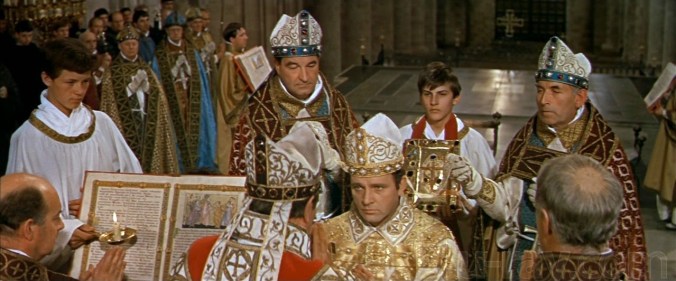
It’s that time a year again. The Feast of St. Thomas Becket, Martyred Archbishop of Canterbury, defender of the Church’s independence from the Crown. Which means we get to watch that fantastic and ever so Catholic film, Becket (1964). For those without access to the full movie, you can watch the very best scene here.

Becket#4

One of the film’s great charms is its collection of beautiful Romanesque vestments, all used properly. (Source)

Let me also add in a great excerpt from T.S. Eliot’s classic 1935 verse drama about the Archbishop, Murder in the Cathedral. It comes from the most climactic moment of the play, when Thomas is about to be killed. His priests have barred the doors of the cathedral to the four assassins, but Thomas will have none of their worldly prudence. His speech presents a brief theology of martyrdom that must stir the heart of any Catholic.

You think me reckless, desperate and mad.
You argue by results, as this world does,
To settle if an act be good or bad.
You defer to the fact. For every life and every act
Consequence of good and evil can be shown.
And as in time results of many deeds are blended
So good and evil in the end become confounded.
It is not in time that my death shall be known;
It is out of time that my decision is taken
If you call that decision
To which my whole being gives entire consent.
I give my life
To the Law of God above the Law of Man.
Unbar the door! unbar the door!
We are not here to triumph by fighting, by stratagem, or by resistance,
Not to fight with beasts as men. We have fought the beast
And have conquered. We have only to conquer
Now, by suffering. This is the easier victory.
Now is the triumph of the Cross, now
Open the door! I command it. OPEN THE DOOR!

(MITC 73-74)

May we so speak in the many trials of our own lesser martyrdoms.