A “Liturgical Voyage” to Port-Royal des Champs

Choral prayer at Port-Royal des Champs, Louise-Magdeleine Horthemels, Collection du Château de Versailles (Source)

Popular Catholic memory of Port-Royal, especially outside the Francophone world, is of a knot of disgruntled nuns who, in a spirit of disobedience to their lawful superior, refused to condemn the heresies of Cornelius Jansen. There are many problems with this unfair caricature, an inheritance of the final Ultramontane and Jesuit victory over Jansenism in the wake of the French Revolution. The truth is much more complicated, as truth tends to be. We too often forget that these nuns and the community of hermits, servants, and local peasants around them led a life of penance and prayer that was widely admired in their own time (even by saints, as Ellen Weaver notes, building on Louis Cognet and Augustin Gazier). The liturgical and devotional aspects of Port-Royal’s community life have too often been neglected by scholars and, especially, popular Catholic writers who turn their eyes to the Jansenists. We have fixated too much on the controversies of the 1640s-60s, and too little on what daily life was like for those who worked out their salvation in “fear and trembling” at Port-Royal.   

It is thus with great pleasure that I here co-publish an edifying and informative excerpt from the Voyages liturgiques of Jean-Baptiste Le Brun des Marettes, Sieur de Moléon, translated by the authors at Canticum Salomonis. They have already given an excellent overview of this text, in which they note that Marettes, educated at the Petites écoles de Port-Royal, retained something of a Jansenist liturgical sensibility. They sum up his work thus:

On the whole, the picture he paints is of a French people who are deeply engaged in their liturgical life and cathedral chapters that observe the whole office. His “taste” is for antiquity and ceremonial splendor, and this leads him to admire the pontifical liturgies of the middle ages. Admittedly, perhaps he does so because he believes them to be much more ancient than the extant source-books: expressions of the most ancient Gallic liturgies.

Aelredus Rievallensis, “The Voyages Liturgiques: A Roundup,” Canticum Salomonis

Their introduction to the translated chapter on Port-Royal, pages 234-43, follows with the text below. However, let me add a brief preface of my own.

The Voyages liturgiques offers several fascinating glimpses into the communal piety of Port-Royal des Champs. Marettes pays attention to the physical space of Port-Royal. He reports that the paintings in the church are by Philippe de Champaigne. The great French classicist had a daughter at the convent, Soeur Catherine de Saint-Suzanne, and seems to have provided the monastery with several portraits of both nuns and solitaires as well as several edifying works of art. The large altarpiece depicting the Last Supper is today in the Musée des Beaux-Arts de Lyon, with a copy in the Louvre. Marettes devotes particular attention to the epitaphs in and around the church. The epitaphs for the solitaires Emmanuel le Cerf, an Oratorian, and Jean Hamon, a medical doctor and mystic, are especially moving.

Yet it is the liturgical and communal details he provides here that are most exciting for the historian of Jansenism and which, in fact, force us to take the nuns more seriously as daughters of St. Benedict and St. Bernard. Following the egalitarian reform of Mère Angélique, the Abbey did not require dowries of its postulants. Singing the office according to the use of Paris, they prayed the whole Psalter every week. The first chapter of the Constitutions of Port-Royal is dedicated to veneration of the Blessed Sacrament, a significant organizational choice. There were in fact both communal and individual devotions to the Blessed Sacrament at Port-Royal; for, “in addition to engaging in perpetual adoration…they also have the custom of prostrating themselves before the Sacrament before going up to receive holy communion.” Following an ancient usage, they only exposed the Blessed Sacrament during the Octave of Corpus Christi, and even then, only after the daily High Mass. Usually, the Sacrament was reserved in a hanging pyx, “attached to the end of a veiled wooden fixture shaped like a crosier.” The French Jansenists seem to have had a fixation with hanging pyxes; both M. Saint-Cyran and M. Singlin wrote about “suspension” of the Blessed Sacrament in this form.
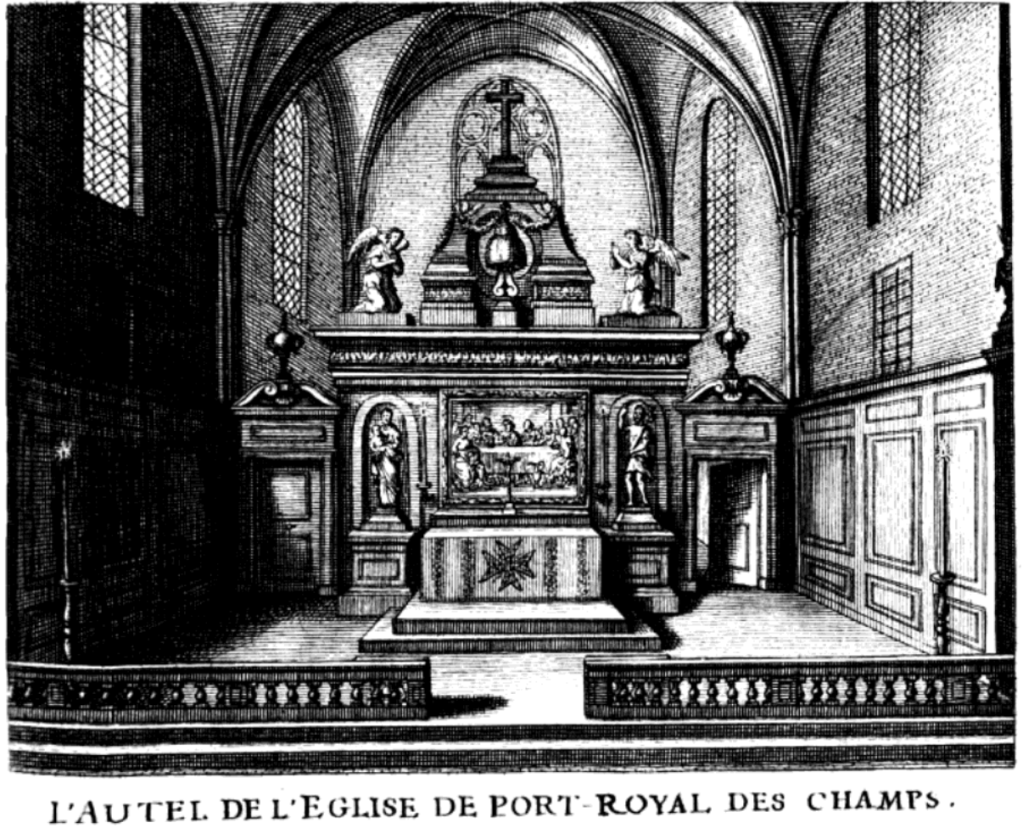
The High Altar at Port-Royal des Champs. You can see the hanging pyx at top. This engraving shows the depth of the apse, which was largely filled by a sacristy and which would have featured hidden stairs leading to the pyx. (Source)

The community would meet for chapter daily. The nuns engaged in an exacting and penitential adherence to the Rule, including silence, vegetarianism, abstinence from strong drink, and only a single meal per day in Lent. In their persons as in their ecclesiastical furniture, they followed the Cistercian spirit of holy simplicity; Marettes reports that “The nuns’ habits are coarse, and there is neither gold nor silver in their church vestments.” Yet they were not without the consolation of quiet reading in the garden during summertime.
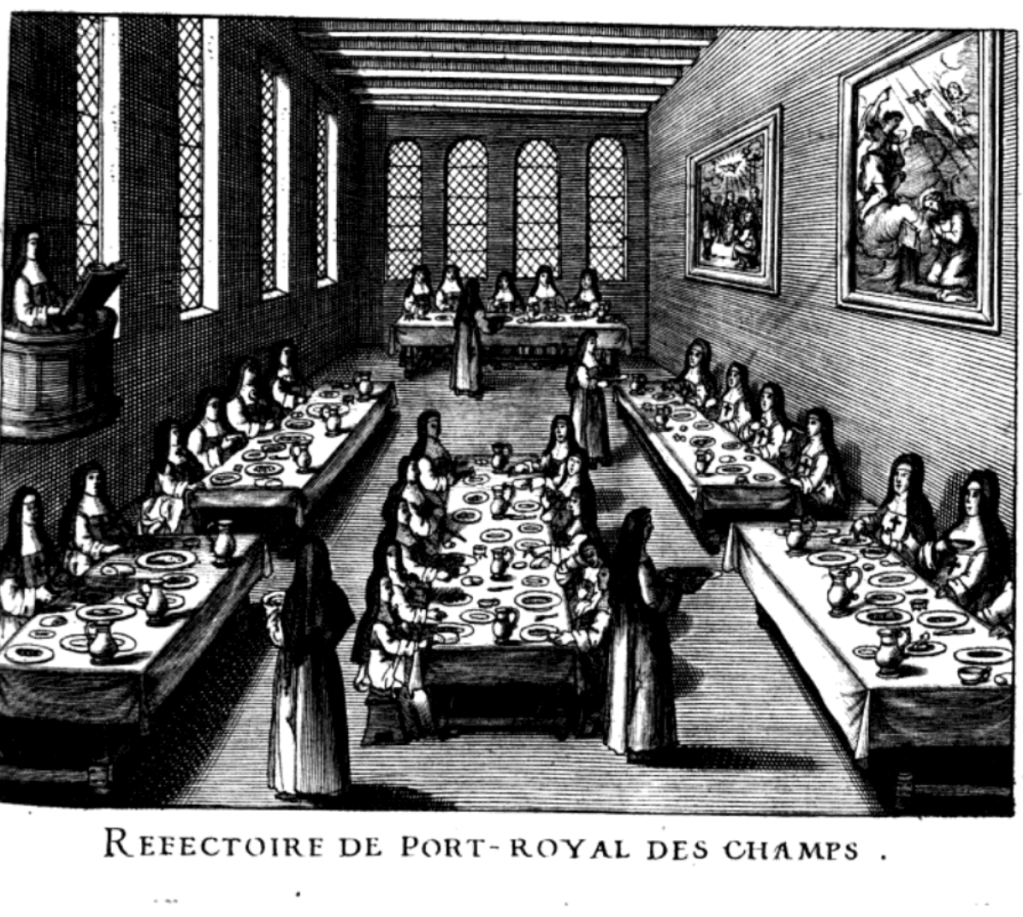
Although I have not been able to ascertain whether or not this engraving accurately reproduces the art on the walls of the monastery refectory, if it does, it evidences a strongly pneumatic spirituality. We see here twinned paintings of the Annunciation and the Descent of the Holy Spirit at Pentecost, including upon Our Lady of the Cenacle. (Source)

Marettes reminds us that Port-Royal was not just a community of nuns, but also included male hermits and domestics. He writes, “After the Credo, the priest descends to the bottom of the altar steps and blesses the bread offered by one of the abbey’s domestics.” These servants and workers seem to have had a special participation in the liturgy through this rite, so reminiscent of the blessing of bread found even today in the Eastern Churches. The Necrology of Port-Royal includes these men as well in its roll-call of the Abbey’s luminaries, confirming the sometimes-overlooked egalitarianism of Port-Royaliste spirituality.

One of the more striking moments in the text comes when Marettes writes that “On Sundays and feasts of abstention from servile work there is a general communion; at every Mass said in this church at least one of the nuns receives communion.” The practice of lay communion at every Mass contradicts the usual picture of the Jansenists receiving infrequently or as discouraging lay communion. The nuns themselves, at least, seem to have received the Sacrament daily.
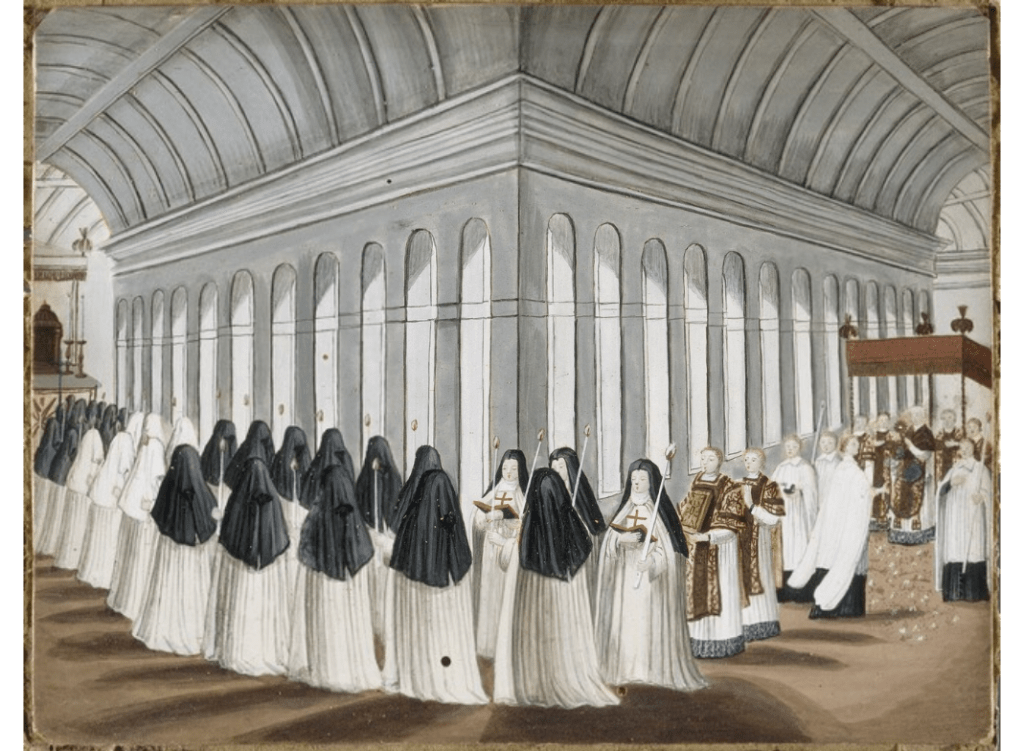
A Corpus Christi procession at Port-Royal des Champs, Louise-Magdeleine Horthemels, Collection du Château de Versailles (Source)

And I cannot help but see in one custom a potent metaphor for the troubled history of the monastery. Marettes writes, “On Holy Saturday, they extinguish the lights throughout the entire house, and during the Office they bring back the newly blessed fire.” The extraordinary and unjust persecution that the nuns endured under the authorities of the French Church and State – to the point of being deprived of communion during Easter, of being denied the last rites, of condemnation to a slow decline even after reconciliation with the Archbishop, and, at the very end, of having their bodies desecrated and even fed to the dogs – must have seemed like a very long Holy Saturday. Yet the blessed fire of the Holy Ghost does not abandon those who faithfully serve God in humble prayer and penitence. Where we find the Cross, Resurrection follows.

It is not for us to resurrect the nuns and solitaires of Port-Royal; historians can only do so much. But by taking the dead on their own terms, we can at least pay them the homage we owe any historical figure, and perhaps especially the defeated, the maligned, the powerless, and the forgotten. Only by doing so can we reckon with our implication in the longstanding myths that efface those voices. It is my hope that the publication of this important translation will help us in that process of revision.


In his monumental Institutions liturgiques, Dom Prosper Guéranger famously castigated the Neo-Gallican liturgies that proliferated in 17th and 18th century France for, inter alia, being products of Jansenist inspiration. Setting aside the question of whether these liturgies betray a heretical notion of predestination, it is true that many figures associated with the Jansenist movement did have a keen interest in the liturgy. Contrary to what one might expect given Dom Guéranger’s accusations, these “Jansenists” prized respect for ancient custom and repudiated needless novelty. 

The intellectual centre of Jansenism was the Abbey of Port-Royal, a community of Cistercian nuns who were reformed in the early 17th century by the formidable Abbess Angélique Arnauld and became noted for their exemplary religious observance and cultivation of liturgical piety. This attracted a number of intellectuals who chose to settle as solitaires on the abbey grounds, leading a retired life of study and simple manual labour, including Angélique’s brother Antoine, one of the most prominent Jansenist theologians. Both the nuns and solitaries set up schools to teach neighbouring children. 

One of those children was Jean-Baptiste Le Brun des Marettes, whom our readers will remember as the author of the Voyages liturgiques. His father had been sent to the galleys for publishing Jansenist works, and Jean-Baptiste himself once did a stint at the Bastille for his involvement in the controversy. His main interest, however, was not moral theology but liturgy. His Voyages evince his veneration for liturgical antiquity and opposition to modern developments in matters of ritual, furnishing, and vestments. Yet he found a way to reconcile such views with his enthusiasm for the Neo-Gallican reforms of the Mass and Office, ultimately sharing the hubristic certainty of most men of his age that their own putative enlightenment was able to improve upon “Gothic barbarism”. Our Aelredus has described and critiqued the seemingly contradictory tastes that Jean-Baptiste Le Brun shared with other Jansenist figures

With these remarks in mind, let us see how the liturgy was celebrated in the Jansenist stronghold of Port-Royal, in a chapter of the Voyages that Jean-Baptiste Le Brun wrote before the abbey’s suppression in 1708 and the destruction of most of its buildings. (Although the Voyages was published in 1718, Le Brun employs the present tense in this chapter.) 

We are obliged to the Amish Catholic for his help in translating this chapter.


Port-Royal-des-Champs is an abbey of nuns of the Order of Cîteaux lying between Versailles and the former monastery of Chevreuse.

The church is quite large, and its simplicity and cleanliness inspires respect and devotion. 

The main altar is not attached to the wall, since the ample and well-kept sacristy is located behind it. Above the altar hangs the holy pyx, attached to the end of a veiled wooden fixture shaped like a crosier. It is set under a large crucifix above a well-regarded painting of the Last Supper by Philippe de Champaigne.

There is nothing on the altar but a crucifix. The four wooden candlesticks are set on the ground at its sides.

The woodwork of the sanctuary and parquet floor is very well maintained, as is that of the nuns’ choir. Indeed, the stalls are kept in such good condition that one would think they were carved not twenty years ago, when in fact they are over 150 years old.1 

The church contains some paintings in the style of Champaigne, and a very well-kept holy water basin to the right of its entry.

Inside the cloister, there are several tombs of abbesses and other nuns. From these tombs one can garner

1. that the first abbesses of the Order of Cîteaux, following the spirit of St Bernard, did not have croziers. Even today, the Abbess of Port-Royal does not use one.

2. that in this monastery the nuns used to be consecrated by the bishop. Two of them are represented on the same tomb wearing a sort of maniple.2 See figure XIV. The inscription around the tomb reads:

“Here lie two blood-sisters, consecrated nuns of this abbey, Adeline and Nicole aux Pieds d’Estampes. May their souls rest in everlasting peace. Amen. Adeline died in the year of our Lord 1288.”3

There is an ancient necrology or obituary in this abbey that includes the ritual for the consecration or blessing of a nun. It describes how on these occasions the bishop celebrated Mass and gave communion to the nun he blessed. To this effect he consecrated a large host which he broke into eight particles, giving one as communion to the nun. He then placed the seven other particles of his host in her right hand, covered by a Dominical or small white cloth. During the eight days after her consecration or blessing, she gave herself these particles as communion. Priests also used to give themselves communion during the forty days after their ordination or consecration.4

Under the lamp by the baluster lies a tomb dated 1327, if I remember correctly, which is worthy of description, especially given that its most interesting aspect is misreported in the Gallia Christiana of the brothers de Sainte-Marthe. 

It used to be the custom for devout noble ladies to take up the nun’s habit during their last illness, or at least to be clothed in it after their death. See, for example, the tomb of Queen Blanche, mother of King St Louis, at Maubuisson Abbey near Pontoise. Here in Port-Royal we find the tomb of one Dame Marguerite de Levi—wife of Matthew V de Marly of the illustrious House of Montmorency, Grand-Chamberlain of France—buried in a nun’s habit, with this inscription: 

“Here rested, whose name thou shalt have there hereafter. Marguerite was the wife of Matthew de Marly, and daughter of the noble Guy de Levi. She bore six boys. After her husband died, she went to the nuns. Amongst the claustral sisters she chose to make her home. In her long rest, may she be buried in nun’s clothing. May eternal light shine upon her in peace everlasting. Year 1327.”5

By the door of the church, in the vestibule, is the tomb of a priest vested in his vestments. His chasuble is rounded in all corners, not cut or clipped, gathered up over his arms, and hanging down below and behind him in points. His maniple is not wider below than it is on top, and he does not wear his stole crossed over his breast, but straight down like bishops, Carthusians, and the ancient monks of Cluny, who have rejected innovation on this point. His alb has apparels on the bottom matching the vestments: this is what the manuscripts call the alba parata. They are still used in cathedral churches and ancient abbeys.

Next to the church door and the clock tower lies the small cemetery of domestics, where two epitaphs are worthy of note. 

“To God the Best and Greatest.

“Here lies Emmanuel le Cerf, who, after dedicating most of his life to the education of the people, deemed the evangelical life superior to evangelical preaching and, in order that he who had lived only for others should die to himself, embraced a penitential life in his old age as eagerly as he did seriously. He embraced the weight of old age, more conducive to suffering than aught else, and various diseases of the body as remedy for his soul and advantageous provision for the journey to eternity. Humbly he awaited death in this port of rest, living no longer as a priest but as a layman, and attained it nearly ninety years old. He died on 8 December 1674, and wished to be buried in this cemetery near the Cross. May he rest in peace.”6

And the other:

“Here rests Jean Hamon, doctor, who, having spent his youth in the study of letters, was eminently learned in the Greek and Latin tongues. Seeing that he flourished in the University of Paris by the renown of his eloquence, and that his fame grew daily for his skill of medicine, he feared the lure of flattery and fame and the haughtiness of life. Suddenly stirred by the prompting of the Holy Spirit, he quickly poured out the value of his inheritance into the bosom of the poor and, in the thirty-third year of his age, he dragged himself into this solitude, as he had long pondered doing. First he applied himself to the labour of the fields, then to serving the ministers of Christ, and soon returned to his original profession, healing the wounded members of the Redeemer in the person of the poor, among whom he honoured the handmaidens of Christ as the spouses of the Lord. He wore the coarsest garments, fasting nearly every day, slept on a board, spent day and night in nearly perpetual vigils, prayer, and meditation, nocturnal works everywhere breathing the love of God. For thirty-seven years he accumulated the toils of medicine, walking some twelve leagues every day, very often while fasting, to visit the sick in the villages, providing them what they might need, helping them by counsel, by hand, with medicines, with food whereof he deprived himself, living for twenty-two years on eating bran bread and water, which he ate secretly and alone, while standing up. As wisely as he had lived, considering every day his last, thus he departed this life in the Lord, amidst the prayers and tears of his brethren, in deep silence and sweet meditation of the Lord’s mercies, with his eyes, mind, and heart fixed on Jesus Christ, mediator between God and man, rejoicing that he obtained the tranquil death for which he had prayed, that he might gain eternal life, at the age of 69, on 22 February 1687.”7

Heeding the spirit of St Bernard, the nuns are subject to the Lord Archbishop of Paris, who is their superior. They also sing the office according to the use of Paris, except that they sing the ferial psalms every day in order to fulfill the Rule of St Benedict which they follow, and which binds them to saying the entire psalter every week. This they do with the approbation of the late M. de Harlay, Archbishop of Paris.
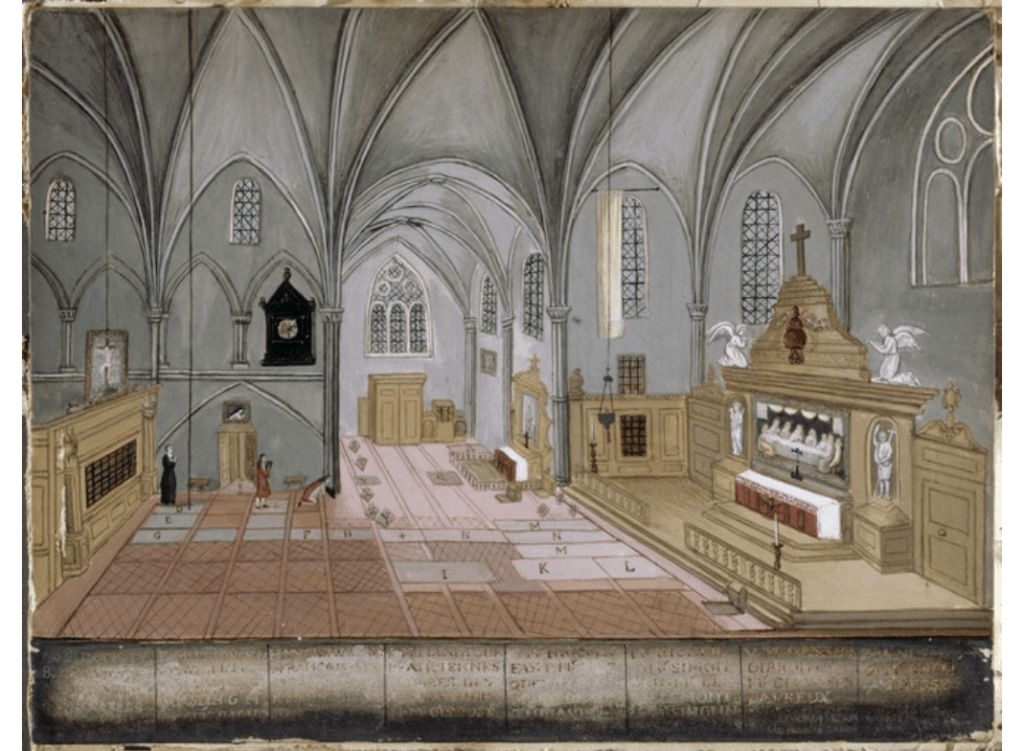
The High Altar, the chapel of St. Lawrence, and the front of the choir-grille at Port-Royal des Champs. Note the solitaires standing and kneeling in prayer – though there seem to be a few prie-Dieu here and there, there were no pews in this ancient church. Note as well the various burials in the floor of the church. Louise-Magdeleine Horthemels, Collection du Château de Versailles (Source)

At the blessing and aspersion of holy water on Sundays, the abbess and her nuns come forward to receive it at the grill from the priest’s hand. 

After the Credo, the priest descends to the bottom of the altar steps and blesses the bread offered by one of the abbey’s domestics. He then announces any feasts or fasting days during the coming week, and gives a short exhortation or explanation of the day’s Gospel.

At every High Mass of the year, the sacristan or thurifer goes to the nuns’ grill at the end of the Credo to receive, through a hatch in the screen, a box from the sister sacristan containing the exact number of hosts needed for the sisters who are to receive communion. He brings them to the altar and gives them the celebrant.

At High Masses for the Dead, the sacristan goes to the grill to receive the bread, a large host, and the wine in a cruet, and brings them to the altar. He gives the host to the priest on the paten, kissing it on the inside edge, and the cruet of wine to the deacon, who pours the wine into the chalice.

At the Agnus Dei, the nuns embrace and give each other the kiss of peace.

On Sundays and feasts of abstention from servile work there is a general communion; at every Mass said in this church at least one of the nuns receives communion.

Devotion for the most blessed Sacrament is so great in this monastery that in addition to engaging in perpetual adoration as part of the Institute of the Blessed Sacrament (it is for this reason that they have exchanged their black scapular for a white one charged with a scarlet cross over the breast, about two fingers in width and a half-foot tall), they also have the custom of prostrating themselves before the Sacrament before going up to receive holy communion. 

Nevertheless, the Blessed Sacrament is only exposed during the Octave of Corpus Christi, and this every day after High Mass. For here Mass is never said at an altar where the Blessed Sacrament is exposed. We will come back to this point.

The nuns of this monastery observe an exact and rigorous silence. Except in cases of illness, they never eat meat, and fish only rarely, about twelve or fifteen times a year. They solely drink water, and observe the great fast of Lent in its full rigour, as in the age of St Bernard, eating only at five in the evening after Vespers, which they usually say at 4 p.m., even though they wake up at night to sing Matins and perform manual labour during the day. 

A spiritual conference is held after lunch, during which they continue to work, and during which it is not permitted to speak aloud. 

During the summer, the nuns are sometimes allowed to go into the garden after dinner, but many refrain from doing so, and those that go do so separately, taking a book to read or some work to do.
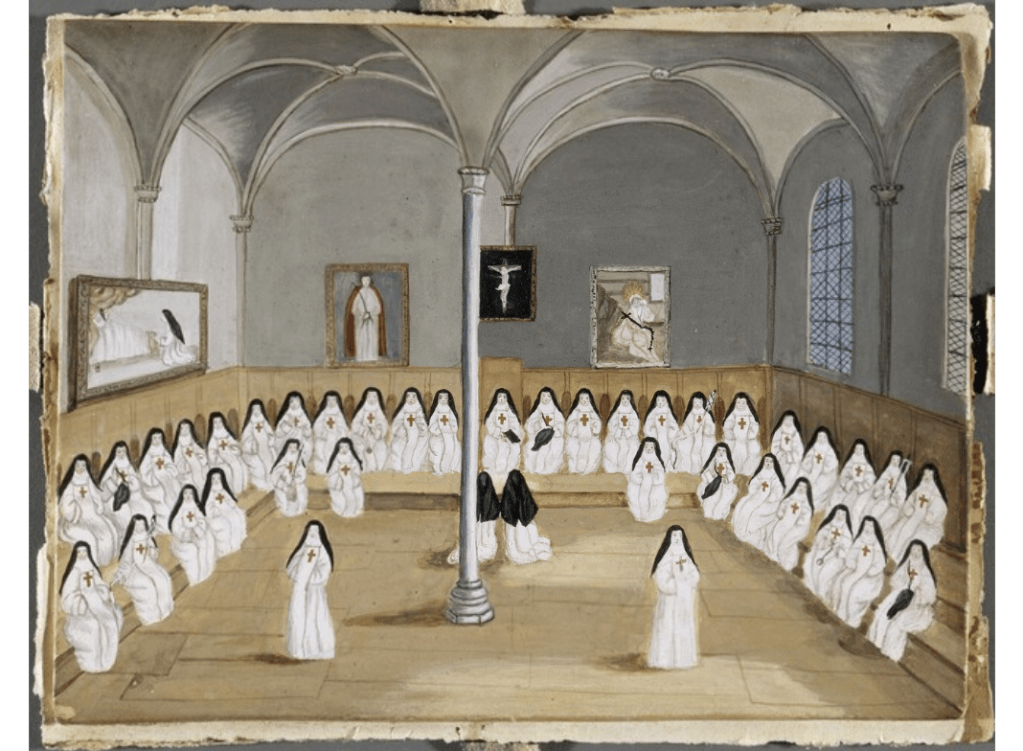
Daily chapter at Port-Royal. Note the various nuns knitting. M. Hamon likewise fond of knitting, and the later Jansenist “saint,” François de Pâris, was often depicted in his usual labor of weaving socks for the poor of Paris. Louise-Magdeleine Horthemels, Collection du Château de Versailles (Source)

Matins are said here at 2 a.m. together with Lauds, but in winter Lauds are said separately at 6 a.m, and then a Low Mass is celebrated between Lauds and Prime. During the rest of the year, Prime is said at 6 a.m., followed by a Conventual Low Mass. Chapter follows with a reading from the Martyrology, the Necrology, and the Rule, some chapter of which the Abbess explicates once or twice a week. Then they hold the proclamation of faults, and appropriate penances are imposed.

Terce is said at 8:30 a.m., followed by High Mass. Sext is at 11 a.m., and on ecclesiastical fast days at 11:45, after which they go to lunch, except in Lent when they do not dine, for in the Rule of St Benedict to lunch means not to fast. None is at 2 p.m. in winter and at 2:30 in summer.

The first bell for Vespers rings at 4 p.m., and the office begins some fifteen minutes later. It finishes at 5 or 5:15, for they sing very unhurriedly and distinctly. After Vespers in Lent, they sound the refectory bell, and the nuns go there to lunch and dine together. One sees nuns following this regime until they are 72 or 75 or even older. Not too long ago there was a priest who, in Lent, only ate in the evening, even though he was 87 years old, and lived till he was 92.

On Holy Saturday, they extinguish the lights throughout the entire house, and during the Office they bring back the newly blessed fire.

The nuns’ habits are coarse, and there is neither gold nor silver in their church vestments.

The Abbey receives girls without a dowry, and makes neither pacts or conventions for the reception of nuns, following the primitive spirit of their monastery, as is clear from the following acts:

“Be it known to all men that I, Eudes de Thiverval, esquire, and Thècle my wife gave in pure and perpetual alms, for the salvation of our souls and those of our ancestors, two bushels of corn, that is, one of winter-crop and the other of oats from our tithe-district of Jouy, to the Church of Our Lady of Port-Royal and the nuns serving God therein, to be collected every day on the feast of St Remigius. Be it known that the Abbess and Convent of the said place freely received one of our daughters into their society of nuns. Not wishing to incur the vice of ingratitude, we have given the said two bushels of corn in alms to the said House of our will without any pact. Which, that it may remain ratified and fixed, we have made to be confirmed by the support of our seal. Done in the year of grace 1216.”8

Another:

“Renaud, by the grace of God bishop of Chartres, to all who would earlier or later inspect the present page, in the Lord greeting. We make it known to all future and present that by these presents that the Abbess and Convent of Nuns of Porrois [i.e. Port-Royal] freely received in charity Asceline, daughter of Hugues de Marchais, esquire, as a sister and nun of God. Thereafter the said esquire, lest he should give away his said daughter to be betrothed to Christ without a dowry from part of his patrimony, standing in our presence did give and grant to the Church of Porrois and the nuns serving God therein in perpetual alms for the portion of his said daughter the return of one annual bushel of corn in his grange of Marchais or Lonville to be collected every year in the Paris measure of Dourdan, and three firkins of wine in his vineyard of Marchais to be collected yearly, and ten shillings in his census-district of Marchais. That his gift may remain ratified and fixed, at the petition of the same Hugues we have made the present letters to be confirmed by our seal in testimony. Done at Chartres in the year of the Incarnation of Our Lord 1217, in the month of April.”9

Another:

“Be it known to all them that I, Odeline de Sèvre, gave in pure and perpetual alms to the house of Port-Royal for the soul of my late husband Enguerrand of happy memory, and for the salvation of my soul, and of all my children and ancestors, and especially for the salvation and love of my daughter Marguerite who received the religious habit in the same house, four arpents of vine in my clos of Sèvre to be possessed in perpetuity. My sons Gervais the eldest, Roger, and Simon praised, willed, and granted this donation, to whom it belonged by hereditary right. And further we offered the same donation with the book upon the altar of Port-Royal. In testimony and perpetual confirmation whereof, since by said sons Gervais, Roger, and Simon were not yet esquires and did not yet have seals, I the said Odeline confirmed the present charter by the support of my seal with their will and convent. Done on the year of our Lord 1228.”10

  1. Author’s note: [After the Abbey’s suppression] the altar and choir stalls were purchased by the Cistercian nuns of Paris and placed in their church, where one can see them.
  2. Translators’ note: As did Carthusian nuns.
  3. Hic jacent duae sorores germanae, hujus praesentis Abbatiae Moniales Deo sacratae, Adelina et Nicholaa dictae ad Pedem, de Stampis quondam progenitae: quarum animae in pace perpetua requiescant. Amen. Obiit dicta Adelina anno Domini M. C. C. octog. octavo.
  4. Author’s note: See Fulbert. Epist. 2 ad Finard. Rituale Rotomag. ann. 1651.
  5. Hic requievit, ibi post cujus nomen habebis.
    Margareta fuit Matthæi Malliancensis
    Uxor; & hanc genuit generosus Guido Levensis.
    Sex parit ista mares. Vir obit. Petit hæc Moniales.
    Intra claustrales elegit esse lares.
    In requie multa sit Nonnæ veste sepulta;
    Luceat æterna sibi lux in pace suprema.
    Anno M. C. bis, LX. bis, V. semel, I. bis. 
  6. D. O. M.
    Hic jacet Emmanuel le Cerf, qui cum majorem vitæ partem erudiendis populis consumpsisset, vitam evangelicam evanglicæ prædicationi anteponendam ratus, ut sibi moreretur, qui aliis tantum vixerat, ad pœnitentiam accurrit senex eo festinantius, quo serius; pondusque ipsum senectutis, quo nihil ad patiendum aptius, et varios corporis morbos in remedium animæ conversos, tanquam opportunum æternitatis viaticum amplexus; mortem humilis, nec se jam sacerdotem, sed laicum gerens, in hoc quietis portu expectavit, quæ obtigit fere nonagenario. Obiit 8 Decembris 1674 et in Cœmeterio prope Crucem sepeliri voluit. Requiescat in pace.
  7. Hic quiescit Joannes Hamon Medicus, qui adolescentia in studiis litterarum transacta, latine græceque egregie doctus, cum in Academia Parisiensi eloquentiæ laude floreret, et medendi peritia in dies inclaresceret, famae blandientis insidias et superbiam vitæ metuens, Spiritus impetu subito percitus, patrimonii pretio in sinum pauperum festinanter effuso, anno ætatis xxxiij in solitudinem hanc, quam diu jam meditabatur, se proripuit. Ubi primum opere rustico exercitus, tum Christi ministris famulatus, mox professioni pristinæ redditus, membra Redemptoris infirma curans in pauperibus, inter quos ancillas Christi quasi sponsas Domini sui suspexit; veste vilissima, jejuniis prope quotidianis, cubatione in asseribus, pervigiliis, precatione, et meditatione diu noctuque fere perpetua, lucubrationibus amorem Dei undique spirantibus, cumulavit ærumnas medendi quas toleravit per annos xxxvj quotidiano pedestri xij plus minus milliarum itinere, quod sæpissime jejunus conficiebat, villarum obiens ægros, eorumque commodis serviens consilio, manu, medicamentis, alimentis, quibus se defraudabat, pane furfureo et aqua, idque clam et solus, et stando per annos xxij. sustentans vitam, quam ut sapienter duxerat, quasi quotidie moriturus, ita inter fratrum preces et lacrymas in alto silentio, misericordias Domini suavissime recolens; atque in Mediatorem Dei et hominum Jesum Christum, oculis, mente, t corde defixus, exitu ad votum suum tranquillo lætus, ut æternum victurus clausit in Domino, annos natus 69 dies 20 viij Kalend. Mart. anni 1687.
  8. Noverint universi quod ego Odo de Tiverval miles et Thecla uxor mea dedimus in puram et perpetuam eleemosynam, pro remedio animarum nostrarum et antecessorum nostrorum, Ecclesiae beatae Mariae de Portu-Regio et Monialibus ibidem Deo servientibus duos modios bladi, unum scilicet hibernagii, et alterum avenae in decima nostra de Joüy, singulis annis in festo S. Remigii percipiendos. Sciendum vero est quod Abbatissa et ejusdem loci Conventus unam de filiabus nostris in societatem Monialium benigne receperunt. Nos vero ingratudinis vitium incurrere nolentes, praedictos duos modios dictae jam domui de voluntate nostra sine aliquo pacto eleemosynavimus. Quod ut ratum et immobile perseveret, sigilli nostri munimine fecimus roborari. Actum anno gratiae M. CC. xvj.
  9. Reginaldus Dei gratia Cartonensis Episcopus, universis primis et posteris praesentem paginam inspecturis salutem in Domino. Notum facimus omnibus tam futuris quam praesentibus quod, quoniam Abbatissa et Conventus Sanctimonialium de Porregio Acelinam filiam Hugonis de Marchesio militis in sororem et sanctimonialiem Dei et caritatis intuitu gratis receperant, postmodum dictus miles in nostra constitutus praesentia, ne dictam filiam suam nuptam Christi parte sui patrominii relinqueret indotatam, Ecclesiae de Porregio et Monialibus ibi Deo servientibus dedit et concessit in perpetuam eleemosynam, pro portione dictae filiae suae unum modium bladi annui redditus in granchia sua de Marchesio vel de Lonvilla singulis annis percipiendum ad mensuram Parisiensem de Dordano, et tres modios vini in vinea sua de Marchesio annuatim percipiendos, et decem solidos in censu suo de Marchesio. Ut autem donum ejus ratum et stabile permaneret, ad petitionem ipsius Hugonis praesentes Litteras in testimonium sigillo nostro fecimus roborari. Actum Carnoti anno Dominicae Incarnationis M. CC. septimo decimo, mense Aprili.
  10. Noverint universi quod ego Odelina de Sèvre donavi in puram et perpetuam eleemosynam domui Portus-Regis pro anima bonae memoriae Ingeranni quondam mariti mei, et pro salute animae meae, et omnium liberorum et progenitorum meorum; et maxime pro salute et amore Margaretae filiae meae quae in eadem domo religionis habitum assumpserat, quatuor arpentos vineae in clauso meo de Sèvre jure perpetuo possidendos. Hanc autem donationem laudaverunt, voluerunt et concesserunt filii mei Gervasius primogenitus, Rogerus et Simon, ad quos eadem donatio jure hereditario pertinebat. Immo et ipsi eandem donationem obtulimus cum libro super altare Portus Regis. In cujus rei testimonium et conformationem perpetuam ego praedicta Odelina, quia praedicti filii mei G. R. et Simon necdum milites erant, et necdum sigilla habebant, de voluntate eorum et assensu praesentem Chartam sigilli mei munimine roboravi. Actum anno Domini M. CC. vigesimo octavo.
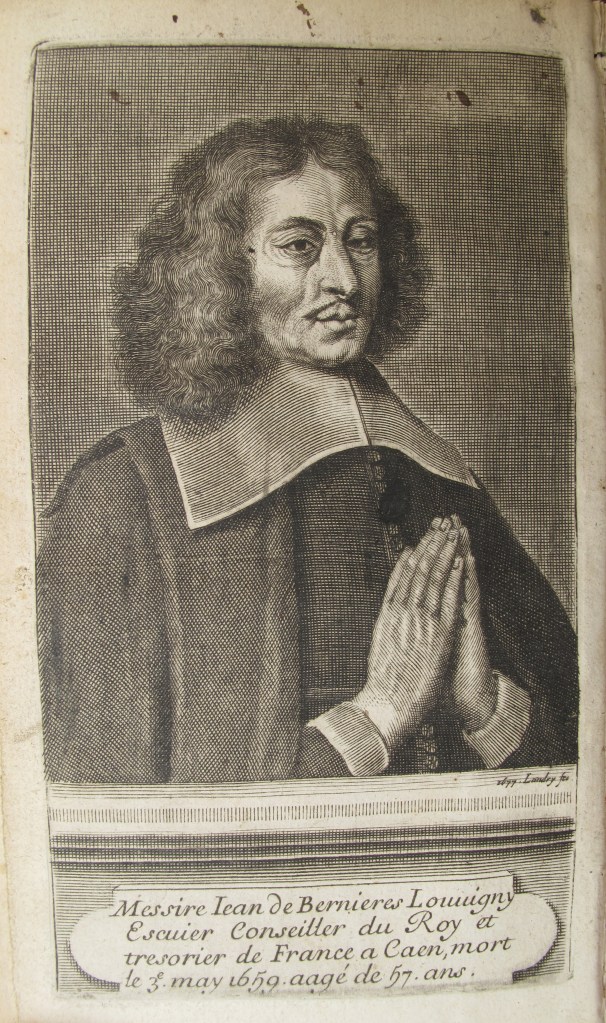
Jean de Bernières on Humility and Communion

This week’s contribution to the Lenten Spirituality Series comes from Jean de Bernières-Louvigny (1602-1659), a pious lay mystic who lived and died in Caen. From his hermitage in this rainy Norman town, Jean de Bernières gave himself over to profound experiences of contemplative prayer. His spirituality, as expressed in the two volumes of his Le chrestien intérieur (Paris: 1661), was deeply indebted to the apophatic tradition of mystical theology. Although a solitaire, Jean de Bernières was engaged in ecclesiastical and charitable networks that included some of the greatest spiritual figures of his day. He was a member of the Compagnie du Saint-Sacrement in Caen and corresponded with such notable individuals as St. François de Montmorency-Laval, Bishop of Québec, and Mother Mectilde de Bar, Foundress of the Benedictines of Perpetual Adoration of the Most Blessed Sacrament of the Altar. He met the latter at Caen; she became, as it were, a dear friend. Translated into German in the eighteenth century, Jean de Bernières had an important influence on the trajectory of Pietism in that country. He has, as far as I can tell, never been fully translated into English. What I produce below is my own translation, in the hope it may offer some aid to pious souls in this time of temptation. The excerpt comes from the Second Volume, Book V, Chapter II of Le chrestien intérieur, pp. 6-11. I would add, for those who take an interest in such matters, that one of the extra difficulties in translating Jean de Bernières is that he uses Norman French vocabulary that no longer appears in standard French. I hope I have managed to capture his sense here.

May the Blessed Hermit Jean de Bernières pray for us in this time of penance. (Source)

To commune worthily, one must place oneself in a state conformed to that of Jesus, in the Blessed Sacrament.

Jesus Christ wishes to give Himself to us in this august mystery, in a state of death with respect to the life of the senses, but as a source of life with respect to the interior life, the divine life, the life of grace, the life of contemplation and continuous application to the grandeurs of God His Father; a life poor and annihilated [aneantie] in exteriors, but entirely brilliant with majesty, and infinitely rich under the veil of the species that hide it from the eyes of the world. It is with these dispositions that that He comes to present Himself to us, wishing as well that we too should present ourselves to Him with dispositions conformed to His.

The Humanity that He gives to you in Communion has been elevated to the divine life by the hypostatic union; we too must be such by grace, that our understanding would be elevated to a high knowledge, and our will to a sublime sentiment of love of God, and that our soul would live the life of grace. O sublimity of the life of grace, you are so admirable, you are so high, you are so ineffable! You raise man from earth to heaven, and you make him live in God, and even of God, because you dispose him to live on the earth from the same substance by which the Blessed live in heaven. O great life of grace, you are poor to the exterior, but very rich in the interior: you seem low, but you are most high: you have ravished me with you beauty, I can no longer live a moment without thee, who make [me] live from a divine life, who places the soul in the heart of God, and who disposes her to see God placed in her heart.

Since the beauty of this life manifests itself to the soul, she leaves everything to embrace it, and everything else seems to her naught but death and corruption; we abandon the world, honors, and riches; we condemn ourselves to penances, to mortifications, to poverty, so as to live this divine life; and we feel a holy hunger for this adorable food that nurtures the soul. O that I might know it, my God, and that I might follow it, this divine life, so little known to the world, practiced by so few in the world, that also does not find itself altered by the waters of Thy eternal fountains! O Jesus, draw me after Thee in the actions of the life of grace, which is in its full exercise in misery and scorn. Draw me, Lord, I run after Thee in the odor of Thy perfumes. What pleasure, my soul, to behold you walking as a giant in the ways of grace, nourished and fortified in your course with the bread of grace: Ambulavit in fortitudine cibi illius usque ad montem Dei.

To live in one’s own death, as Jesus seems to us in the Blessed Sacrament, to lose one’s glory in contempt, to be ravished when one is annihilated [aneanti] and sacrificed; this is proper to the life of grace. Making everything dead to the exterior, it brings life to the interior, and gives principally the spirit of prayer, putting it almost continuously in exercise in the soul, applying itself to this infinite and incomprehensible Being that it adores, unable to comprehend It, and annihilating itself [s’aneantit] before Him, unable even to admire His divine grandeurs, as annihilated [aneanties] in the Eucharist. O my soul, how great is your vileness, how extreme your poverty! What is man, that You should have remembrance of him, Lord, and that You should visit him, and that You should take Thy delight from coming to dwell personally with him? His soul is drawn from nothing, and his body is nothing but a little mud, and Thou deignest to set Thine eyes upon him! How is it that this creature, so dirty, so minuscule, so coarse, could receive the infinite majesty of God? Humble thyself to the bottom of thy nothingness, and confess thy baseness, my soul. Lower thine eyes, and swear that thou art unworthy to turn them only towards that formidable grandeur; but be still more moved with admiration, of recognition and love of such excessive goodness, which deigns well to annihilate itself [s’aneantir] in that incomprehensible mystery, to bring itself to you even unto your nothingness.

We must truly love the state of interior captivity, where the soul, bound and tied up, stays in the obscurity of its prison. This state will honor the captivity of Jesus enclosed under the little host. This divine Lord place himself in a little prison for our love. The King of Glory is restricted under these small species, and thereby a captive and prisoner of man, He renders Himself, it seems, his slave, giving Himself entirely to him; He suffers, so to speak, and dies for him, and communicates to him all the merits of His Precious Blood. O divine Captive, captivate my heart so strongly, that it may never more return to natural liberty; but that all destroyed and annihilated [aneanti], it may not live another life than the superhuman, nor may it enjoy any other liberty than that of Thy children.

Each time that one takes Communion, Jesus Christ giving Himself entirely to all, there are all new obligations that we contract to live entirely for Him, and to render all our actions divine. It is necessary therefore for a good soul not to say: I have not such time to prepare myself for Communion; because she must not aim at another thing by all the actions of her life, but to receive the Bread of Life, in order to live the life of Jesus, and to persevere perpetually in similar dispositions to those that appear to us in the Blessed Sacrament.

Bossuet on the Sufficiency of God

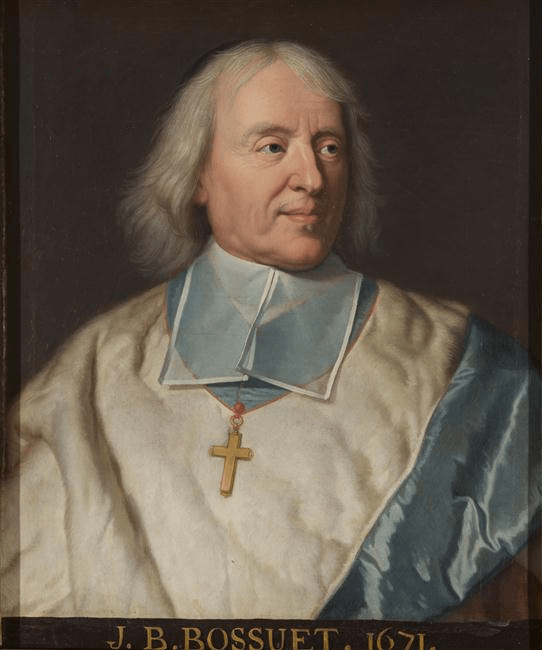
There are many candidates for the title of “Greatest Preacher in Christian History,” but my money’s on Jacques-Bénigne Bossuet (1627-1704), “The Eagle of Meaux,” Bishop and Tutor to the Grand Dauphin of France. Famed in his own day for the clarity of his doctrine, the incisive vigor of his spirituality, and the dazzling versatility of his oratorical skill, Bossuet stands as one of the late flowers of the Grand Siècle. Trumpet of the Gallicans and Hammer of Quietism, Bossuet nevertheless is not merely to be regarded as a relic of dusty seventeenth-century controversies. He still has much to teach us. In this excellent passage, excerpted from a recent translation and edited collection of his Meditations for Lent by Christopher O. Blum (Sophia Institute Press, 2013), we can see the essentially ascetic cast of Bossuet’s mind. This was the same man who, in a felicitious turn of phrase, elsewhere referred to the Rule of St. Benedict as “a little abridgment of the Gospel.” The relevant passage can be found on pages 10-12 of the source text.

Portrait of Bossuet by Charles Sevin de la Penaye, after Hyacinthe Rigaud, c. early 18th century (Source)

“Lord, show us the Father, and we shall be satisfied” (John 14:8). God alone suffices, and all we need to possess him is to see him, because in seeing him, we see all his goodness, as he himself explained to Moses: “I will make all my goodness pass before you” (Ex. 33:19). We see all that attracts our love, and we love him beyond all limits. Let us join St. Philip in saying with all our heart, “Lord, show us the Father, and we shall be satisfied.” He alone can fill all our emptiness, satisfy all our needs, content us, and make us happy.

Let us then empty our heart of all other things, for if the Father alone suffices, then we have no need for sensible goods, less for exterior wealth, and still less for the honor of men’s good opinion. We do not even need this mortal life; how then can we need those things necessary to preserve it? We need only God. He alone suffices. In possessing him we are content.

How courageous are these words of St. Philip! To say them truthfully, we must also be able to say with the apostles: “Lord, we have left everything and followed you” (cf. Matt. 19:27). At the least we must leave everything by way of affection, desire, and resolution, that is, by an invincible resolution to attach ourselves to nothing, to seek no support except in God alone. Happy are they who carry this desire to its limit, who make the final, lasting, and perfect renunciation! But let them not leave anything for themselves. Let them not say: “This little thing to which I am still attached, it is a mere nothing.” We know the nature of the human heart. Whenever a little thing is left to it, there the heart will place all its desires. Strip it all away; break from it; let it go. To own things as though one had nothing, to be married as though one were not, to make use of this world as though one were not using it, but as though it did not exist, and as though we were not a part of it: this is the true good for which we should strive. We are not Christians if we cannot say sincerely with St. Philip, “Show us the Father, and we shall be satisfied.”

It is from the very depths of faith that these words are spoken, and it is in a certain sense from the very foundation of nature itself. For in the depths of our nature we sense our need to posses God, that he alone is capable of fulfilling our nature, and that we are anxious and tormented when separated from him…Man, abandoned to himself, does not know what to do, nor what to become. His pleasures carry him off, and these very same pleasures destroy him. With each sin of the senses he gives himself a killing blow, and he not only kills his soul by his intemperance, in his blindness and ignorance he kills the very body that he would flatter. Since the Fall, man is born to be unhappy…We do not know how to desire or ask for what we need.

St. Philip’s words teach us everything. He limits himself to what Jesus taught us is the one thing needful. Lord, you are the way.

M. Olier on Patience for Christ

In week two of the Lenten Spirituality Series, we have another treasure from seventeenth-century France. One of the great exponents of the French School of Spirituality, M. Jean-Jacques Olier, writes movingly about our suffering in this life as a means of bringing us closer to Christ. His words on the virtue of Patience, though directly primarily to clerics, have a wider application to all Christians in their Royal Priesthood. The text is excerpted from M. Olier’s “Introduction to the Christian Life and Virtues,” translated by Lowell M. Glendon, S.S. in Bérulle and the French School: Selected Writings (Paulist Press, 1989), 244-47. M. Olier’s description of patience crescendos into a typically French, Eucharistic note.

Jean-Jacques Olier, founder of the Sulpicians and a spiritual master of the Grand Siècle. (Source)

We are obliged to be patient. First, in our condition as creatures; for God, sovereign master of life and death, on whom our existence depends absolutely, has the right to dispose of us as he chooses…

Second, as sinners. For in this condition, we must bear with the effects of his justice and wrath toward us. All the punishments that he carries out in this world are nothing compared to what we deserve and what he would make use suffer if he did not choose to be merciful toward us and to treat us with gentleness and clemency in this life. The punishments that God meted out to sinners, as we see in the holy scripture, even the torments of the damned and the penalties the demons suffer and will suffer eternally for one sin, should cause us not only to be at peace, but to rejoice in our sufferings…

Third, as Christians. For as such we should bear with many difficulties and sufferings. This is why we are intitiated into the church. For our Lord only admitted us into it to continue his life, which is a life of opposition, contradiction, and condemnation toward the flesh.

He must then humiliate it and subdue it in us, using the ways he knows and judges to be most useful, so as to win a complete victory, He first achieved victory in his own flesh, and he wishes to continue it in ours in order to show forth in us a sample of the universal triumph that he had achieved over it in his own person.

The church and Christians are only a handful of flesh compared to the whole world. Nevertheless, he still desires to be victorious in them to proclaim his triumph and to give definite signs of his victory. Thus, from this perspective, the Christian should be very faithful to the Spirit and completely abandoned to him in order to overcome the flesh and to destroy it completely.

There will be no lack of opportunities in this life, for he must suffer; first, the attacks of the world through scorn, calumny and persecution; second, the violent onslaughts of the flesh in its uprisings and its revolts; third, the battles with the devil in the temptations he sends us; finally, the ordeals from God through dryness, desolation, abandonment and other interior difficulties, which he afflicts on him in order to initiate him into the perfect crucifixion of the flesh.

Fourth, as clerics. For clerics should participate in the fulfillment of Christianity. This cannot exist without patience.

Patience is a sign that the soul is intimately united to God and that it is rooted in perfection. For it must be very much in God and fully possessed by him in order to bear difficulties and torments with peace, tranquility and even joy and beatitude in one’s heart.

It must be quite profoundly immersed in him and remain quite powerfully and strongly united to him, so that the flesh has no power at all to attract it to itself and share with him the feelings and aversions that it has towards suffering and endurance.

In this state the soul experiences the perfection attainable in this life, since it conforms to our Lord’s perfect submission to God during his sufferings. For although his flesh experienced aversion and revulsion for the cross, he paid no attention to it with his will. Rather, he always adhered perfectly to the wishes of his Father.

Therefore clerics, being perfect Christians chosen from the midst of the church to assist before the tabernacle of God, should pay particular attention to this virtue. This is their very nature. It is the sign by which they can be identified. This is what predisposes them for the honorable rank that they possess. This is how they are recognized as domestics and servants of God.

Finally, priests and pastors should have a very high degree of patience because, in Jesus Christ and with Jesus Christ, they are both priests and victims for the sins of the world. Jesus Christ the priest wished to be the victim of his sacrifice. He became the host-victim for all people. Since priests are like sacraments and representations of him who lives in them to continue his priesthood and whom he clothes with his external conduct and his interior dispositions, as well as with his power and his person, he wishes furthermore that they be interiorly rooted in the spirit and dispositions of a host-victim in order to suffer, endure, do penance, in short, to immolate themselves for the glory of God and the salvation of the people.

In imitation of our Lord, priests should not only be victims for sin through persecution, penance, internal and external sufferings, but also they should be like the victims of a holocaust. This is their true vocation. For they should not merely suffer, as he did, all sorts of difficulties both for their own sins and the sins of the people entrusted to them, but even more the should be entirely consumed with him through love.

The spirit of love strengthens and empowers us to endure affliction and suffering, no matter how great they are. Since he is infinite, he gives us as much as we need to endure those that can occur in our vocation.

All the torments of the world are nothing to a generous soul filled with the power of a God, who is able to shoulder countless sufferings more violent than all those that the world and the devil might afflict us with. It is with this Spirit that Saint Paul said: I can do all things in him who strengthens me (Phil 4:14). Everything he saw seemed little to do or suffer because of the God who dwelled in him.

It is through this same eternal, immense, and all-powerful Spirit that he called his sufferings light and momentary, because Jesus Christ who suffered and bore them in himself and allowed him to see and experience something of his eternity through his presence, caused him to look upon the entire duration of this life as but a moment. This is how our Lord, who allows us to experience interiorly that his power and his strength could support a thousand worlds, leads us to call his burden light.

Fénelon on Perseverance in Prayer

In Lent, I often return to the words of the great Bishop of Cambrai, François de Salignac de la Mothe-Fénelon. He is a perennially refreshing source of spiritual wisdom and guidance. Since we are finally in Passiontide, I thought this excerpt from Fénelon’s sermon on prayer, “The Saints Converse with God,” would be greatly edifying for all those of my readers keeping up with the Lenten Spirituality Series.

A portrait of Fénelon in excellent blue-purple episcopal garb (Source)

We must pray with perseverance. The perfect heart is never weary of seeking God. Ought we to complain if God sometimes leaves us to obscurity, and doubt, and temptation? Trials purify humble souls, and they serve to expiate the faults of the unfaithful. They confound those who, even in their prayers, have flattered their cowardice and pride. If an innocent soul, devoted to God, suffer from any secret disturbance, it should be humble, adore the designs of God, and redouble its prayers and its fervor. How often do we hear those who every day have to reproach themselves with unfaithfulness toward God complain that He refuses to answer their prayers! Ought they not to acknowledge that it is their sins which have formed a thick cloud between Heaven and them, and that God has justly hidden Himself from them? How often has He recalled us from our wanderings! How often, ungrateful as we are, have we been deaf to His voice and insensible to His goodness! He would make us feel that we are blind and miserable when we forsake Him. He would teach us, by privation, the value of the blessings that we have slighted. And shall we not bear our punishment with patience? Who can boast of having done all that he ought to have done; of having repaired all his past errors; of having purified his heart, so that he may claim as a right that God should listen to his prayer? Most truly, all our pride, great as it is, would not be sufficient to inspire such presumption! If then, the Almighty do not grant our petitions, let us adore His justice, let us be silent, let us humble ourselves, and let us pray without ceasing. This humble perseverance will obtain from Him what we should never obtain by our own merit. It will make us pass happily from darkness to light; for know, says St. Augustine, that God is near to us even when He appears far from us.

How to Celebrate Lent like a French Princess

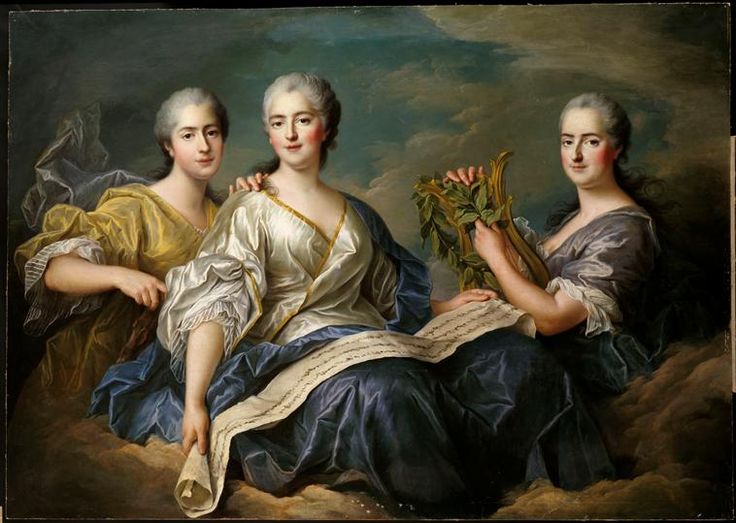
Mesdames Victoire, Adélaide, and Louise, three of the pious daughters of Louis XV, known collectively as “Mesdames de France” or “Mesdames Tantes” after the accession of Louis XVI. Only Adélaide married; Louise later became a Carmelite prioress at Saint-Denis before having the extremely good fortune to die in 1787. Source

The inimitable John McManners, late Regius Professor of Ecclesiastical History at the University of Oxford, provides a window into the world of late Ancien Régime piety (or, rather, its dearth) in his monumental Church and Society in Eighteenth-Century France. He writes:

“To what extent was the fast of Lent observed? It was commonly said that the austerities of the penitential season were endured only by the poor. According to the Lenten pastoral letter of the archbishop of Sens in 1779, the rich often obtained medical certificates allowing them to eat what they liked. This was the fashionable thing to do. ‘Look at our bourgeois citizen and his wife in their (draper’s) shop, observing Lent strictly,’ said teh Jesuit Père Croisset in his Parallel des moeurs de ce siècle et la morale de Jesus-Christ (1727): ‘their fortune changes…and scarcely has the tape measure dropped from their hands than you see them putting on airs like people of quality and asking for dispensations from fasting.’ This class distinction was observed even in the kitchens of the Bastille: on the first Friday of his imprisonment, Marmontel gloomily at the meatless meal provided, not knowing that it had been meant for his servant. In any case, there were plenty of succulent dishes within the rules, for those who could afford them.

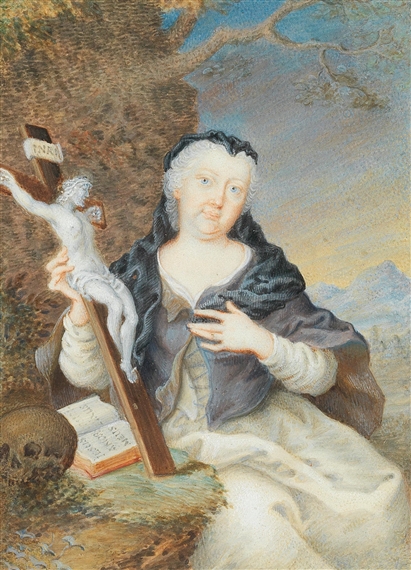
Empress Maria Theresa of Austria in the garb of a penitent (Source)

“Lent was the season to have tubs of fresh butter sent in from the countryside, and to ensure plentiful supplies of fish and water birds (the tes of an allowable fowl was: did the gravy remain uncongealed after fifteen minutes? – so a bishop gravely advised Mme Victoire, Louis XV’s pious but comfortable daughter). The peasant, whose existence is a perpetual Lent anyway, said Voltaire, awaits episcopal permission to eat his farmyard eggs, while the bishop himself looks forward to expensive dishes of soles. Certainly, things were well organized at Versailles. ‘A ray of grace has descended on us,’ wrote the duc de la Vallière in April 1756; ‘we fasted for three days a week during the whole of Lent, but on condition that we suffered no deprivations.’ Preachers were well aware that those with money and leisure could organize an attractive Lent for themselves: an occasional walk in a procession (a penitent’s garb was no disadvantage to a good-looking woman), extra time in bed to recuperate from privations, and food more delicately cooked and served than usual. ‘For some – God grant that there are none in my congregation today,’ thundered the Oratorian Surian, ‘Lent is a more agreeable time, in a sophisticated way, than the other seasons of the year.'”

(Vol. I, pg. 86-87).

Ah, the trials of the penitential season!

St. Francis de Sales Doesn’t Dance

Here is an extremely amusing (and, in its own way, edifying) little chapter from Introduction to the Devout Life. I’ve only just encountered it by chance. It’s passages like this that rather make one understand why Evelyn Underhill summed up his teaching in the one line, “Yes, indeed, my dear Duchess, as Your Grace so truly observes, God is love.”

One can almost hear the Gentleman Saint sipping his tea at the end of each numbered item in the list below.

CHAPTER XXXIII. Of Balls, and other Lawful but Dangerous Amusements.

DANCES and balls are things in themselves indifferent, but the circumstances ordinarily surrounding them have so generally an evil tendency, that they become full of temptation and danger. The time of night at which they take place is in itself conducive to harm, both as the season when people’s nerves are most excited and open to evil impressions; and because, after being up the greater part of the night, they spend the mornings afterwards in sleep, and lose the best part of the day for God’s Service. It is a senseless thing to turn day into night, light into darkness, and to exchange good works for mere trifling follies. Moreover, those who frequent balls almost inevitably foster their Vanity, and vanity is very conducive to unholy desires and dangerous attachments.

I am inclined to say about balls what doctors say of certain articles of food, such as mushrooms and the like—the best are not good for much; but if eat them you must, at least mind that they are properly cooked. So, if circumstances over which you have no control take you into such places, be watchful how you prepare to enter them. Let the dish be seasoned with moderation, dignity and good intentions. The doctors say (still referring to the mushrooms), eat sparingly of them, and that but seldom, for, however well dressed, an excess is harmful.

So dance but little, and that rarely, my daughter, lest you run the risk of growing over fond of the amusement.

Pliny says that mushrooms, from their porous, spongy nature, easily imbibe meretricious matter, so that if they are near a serpent, they are infected by its poison. So balls and similar gatherings are wont to attract all that is bad and vicious; all the quarrels, envyings, slanders, and indiscreet tendencies of a place will be found collected in the ballroom. While people’s bodily pores are opened by the exercise of dancing, the heart’s pores will be also opened by excitement, and if any serpent be at hand to whisper foolish words of levity or impurity, to insinuate unworthy thoughts and desires, the ears which listen are more than prepared to receive the contagion.

Believe me, my daughter, these frivolous amusements are for the most part dangerous; they dissipate the spirit of devotion, enervate the mind, check true charity, and arouse a multitude of evil inclinations in the soul, and therefore I would have you very reticent in their use.

To return to the medical simile;—it is said that after eating mushrooms you should drink some good wine. So after frequenting balls you should frame pious thoughts which may counteract the dangerous impressions made by such empty pleasures on your heart.

Bethink you, then—

1. That while you were dancing, souls were groaning in hell by reason of sins committed when similarly occupied, or in consequence thereof.

2. Remember how, at the selfsame time, many religious and other devout persons were kneeling before God, praying or praising Him. Was not their time better spent than yours?

3. Again, while you were dancing, many a soul has passed away amid sharp sufferings; thousands and tens of thousands were lying all the while on beds of anguish, some perhaps untended, unconsoled, in fevers, and all manner of painful diseases. Will you not rouse yourself to a sense of pity for them? At all events, remember that a day will come when you in your turn will lie on your bed of sickness, while others dance and make merry.

4. Bethink you that our Dear Lord, Our Lady, all the Angels and Saints, saw all that was passing. Did they not look on with sorrowful pity, while your heart, capable of better things, was engrossed with such mere follies?

5. And while you were dancing time passed by, and death drew nearer. Trifle as you may, the awful dance of death must come, the real pastime of men, since therein they must, whether they will or no, pass from time to an eternity of good or evil. If you think of the matter quietly, and as in God’s Sight, He will suggest many a like thought, which will steady and strengthen your heart.

St. Francis de Sales, giving you the side-eye.

The Funerary Rites of James II

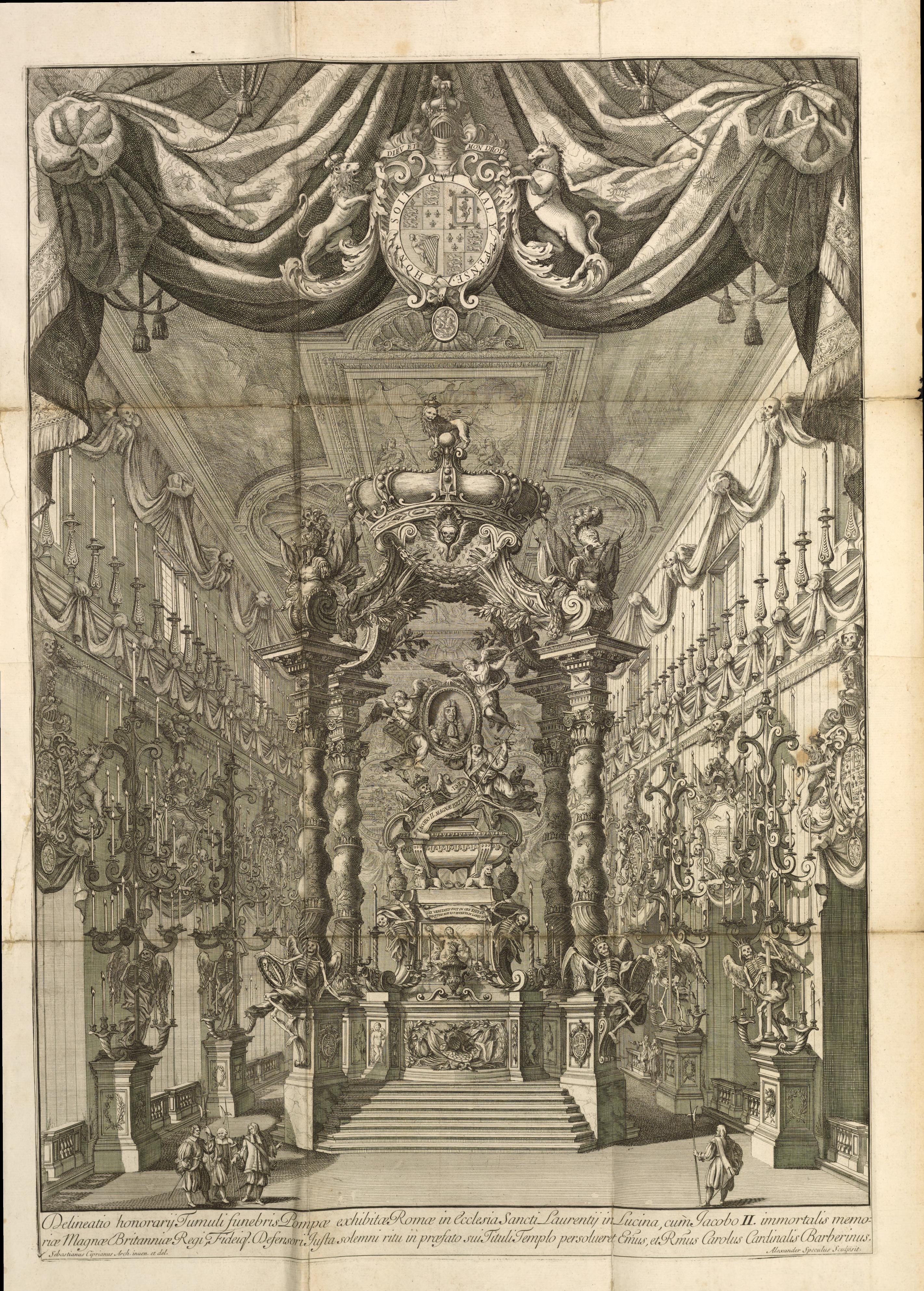
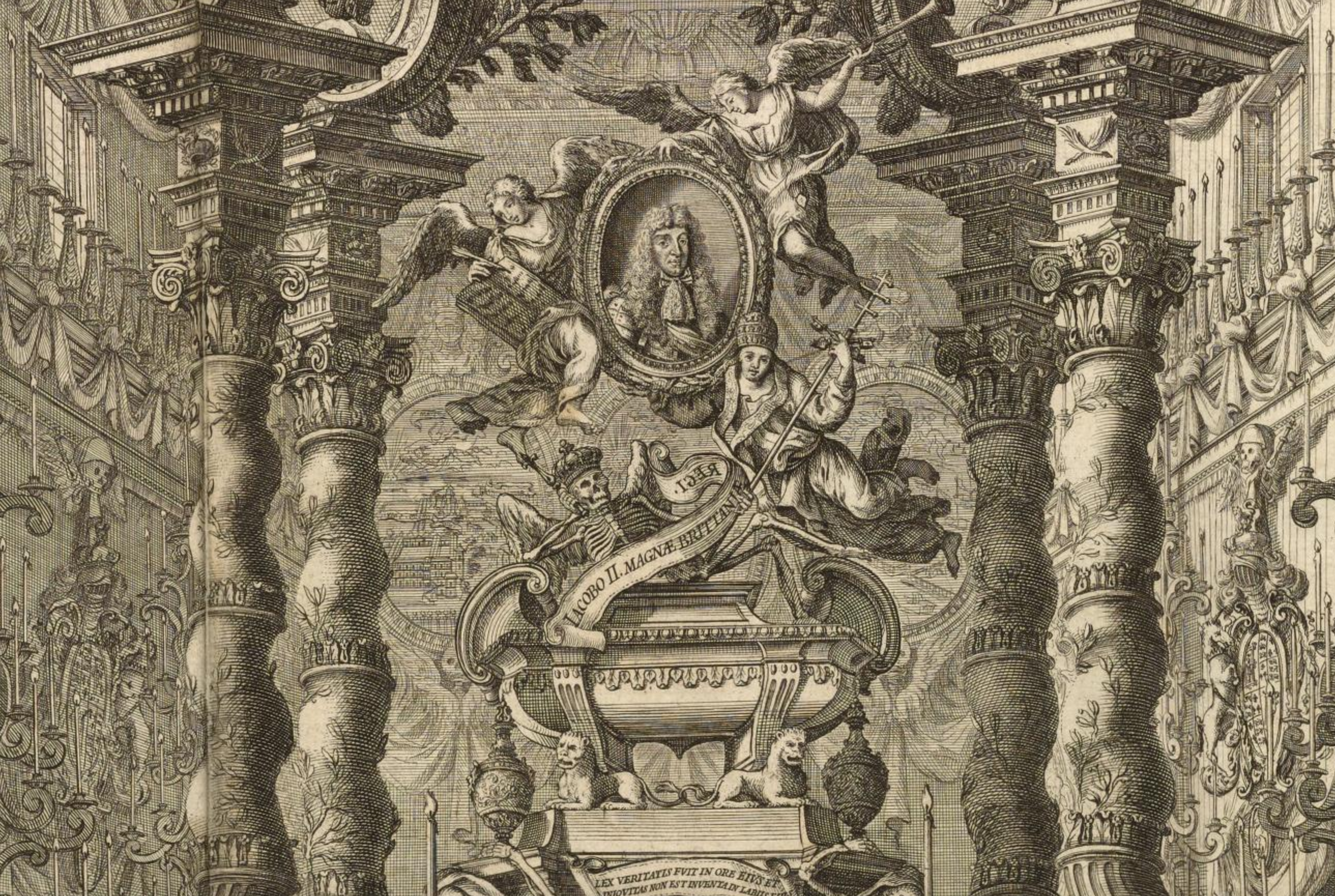
sacraexequialiai00aqui_00062.jpg

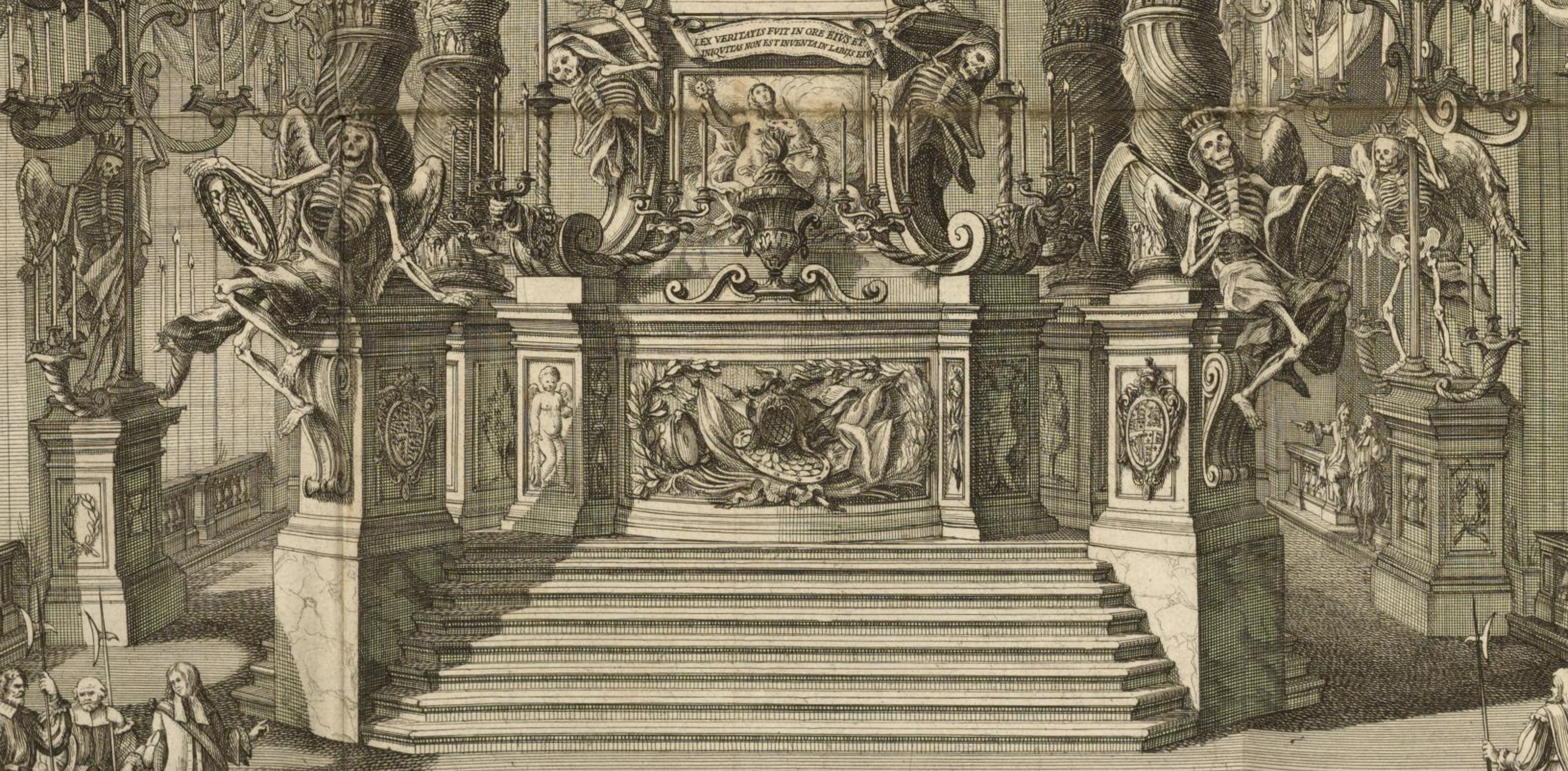
Frontispiece of the Sacra Exequialia. Note the skeletons at the base of the candelabra and baldachin columns. (Source)

A forgotten Latin text of 1702, the Sacra Exequialia in Funere Jacobi II, provides some wonderful views of early modern Catholic funerary rites. Or at least, as those rites were employed for dead monarchs. The central text is Cardinal Barberini’s funeral oration for the king at Rome. Fun fact: if you Google “Exequialia,” it’s the first and one of the only results. While it may not be a hapax legomenon, it’s the sort of rare word that makes epeolaters and logophiles drool.

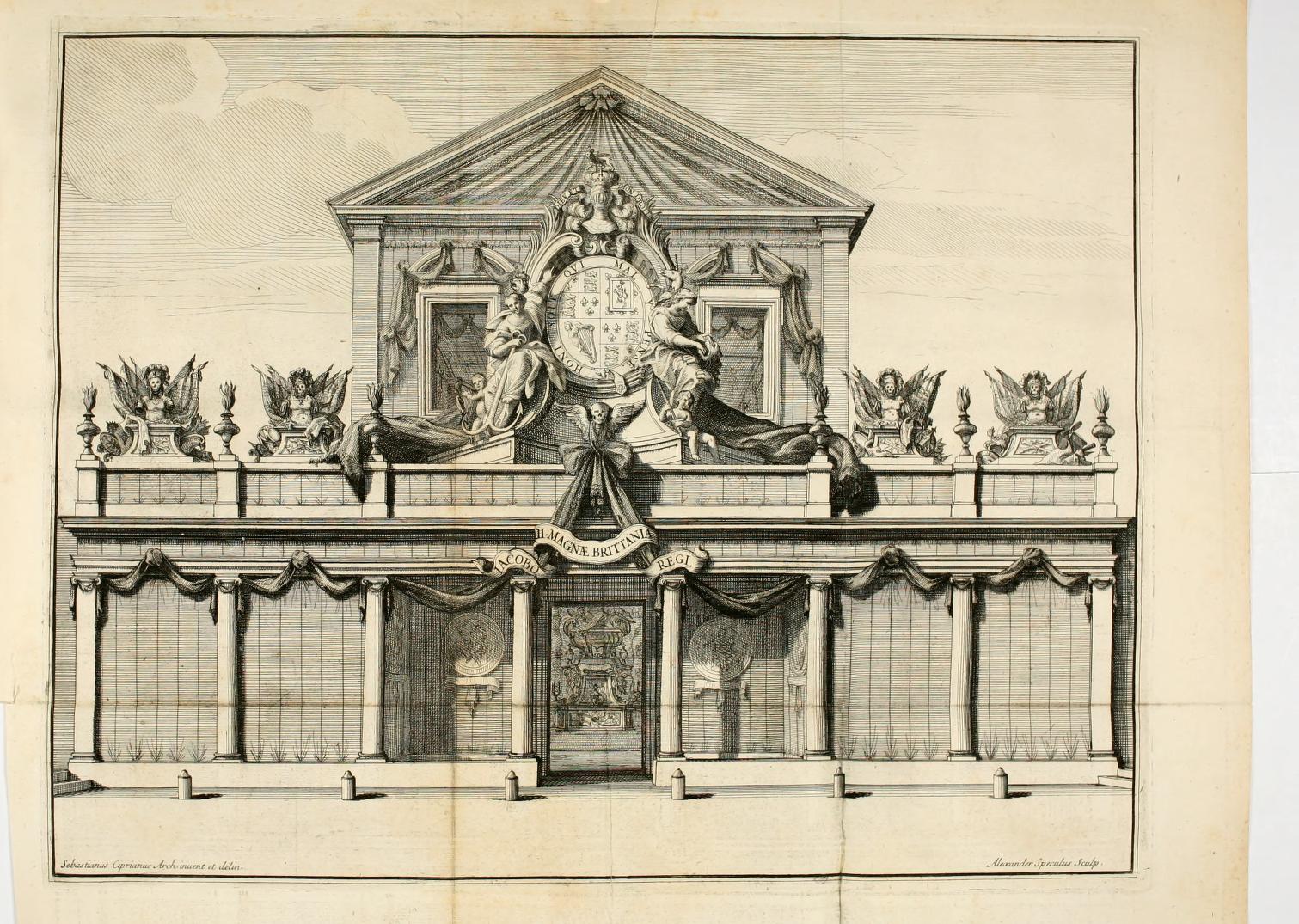
At any rate, I’m not writing this post because of Barberini’s text. The book’s more delicious feature is its several illustrations, including the wild Baroque decoration of the church of San Lorenzo in Lucina as well as several emblems.

sacraexequialiai00aqui_0032

The decorations of San Lorenzo in Lucina for the occasion. (Source)

Of course, James II died in Paris and buried in the English Benedictine church there. It is a testament to the respect he was held in by the Papal court that a Cardinal of such standing as Carlo Barberini, Archpriest of the Vatican Basilica, should preach an oration for him in Rome.

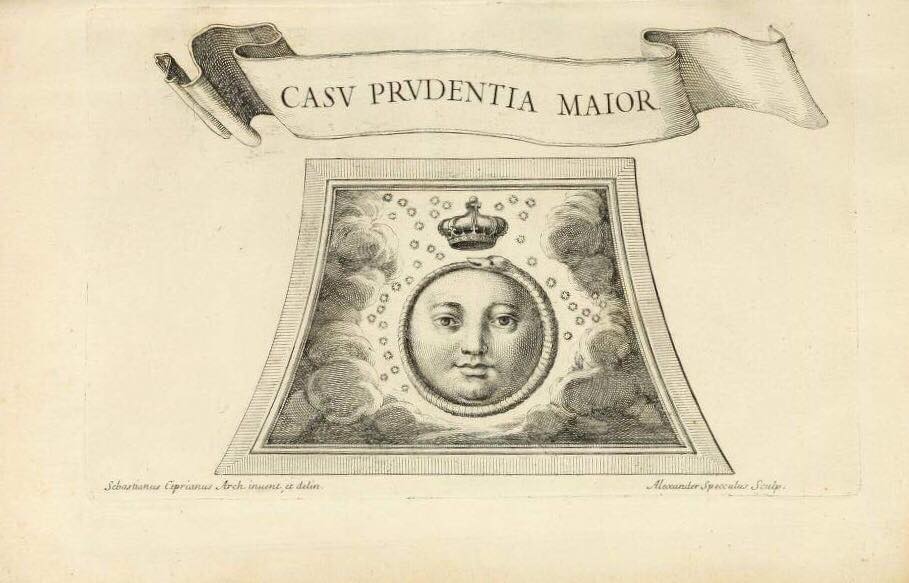
SacraExequialiaSunOurobouros

One of the marvellous emblems in the text. Note the Ouroboros. (Source)

sacraexequialiai00aqui_0041

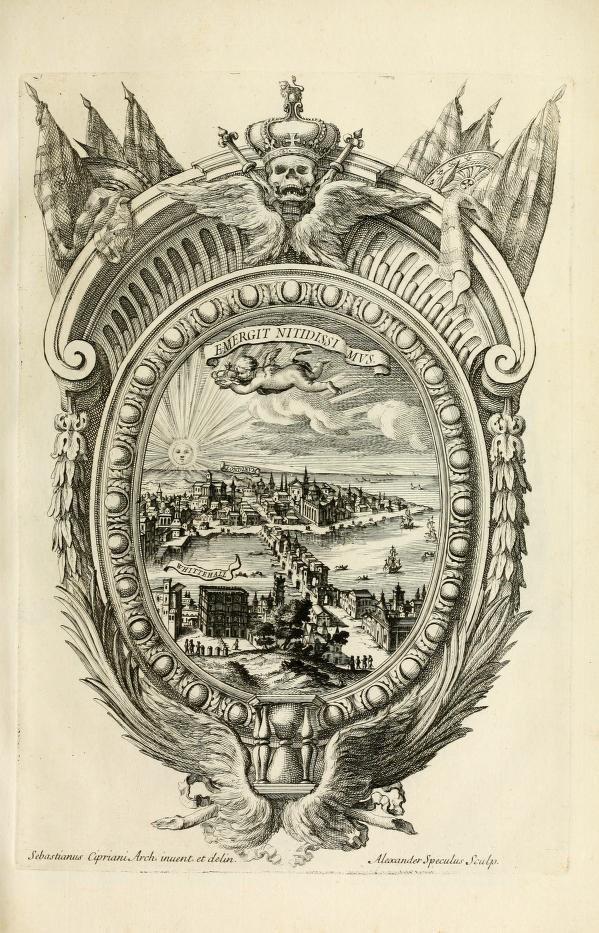
An image of London. There are similar views of Paris and Rome. All were at hung at the high altar behind the catafalque and its baldachin. (Source)

sacraexequialiai00aqui_0061

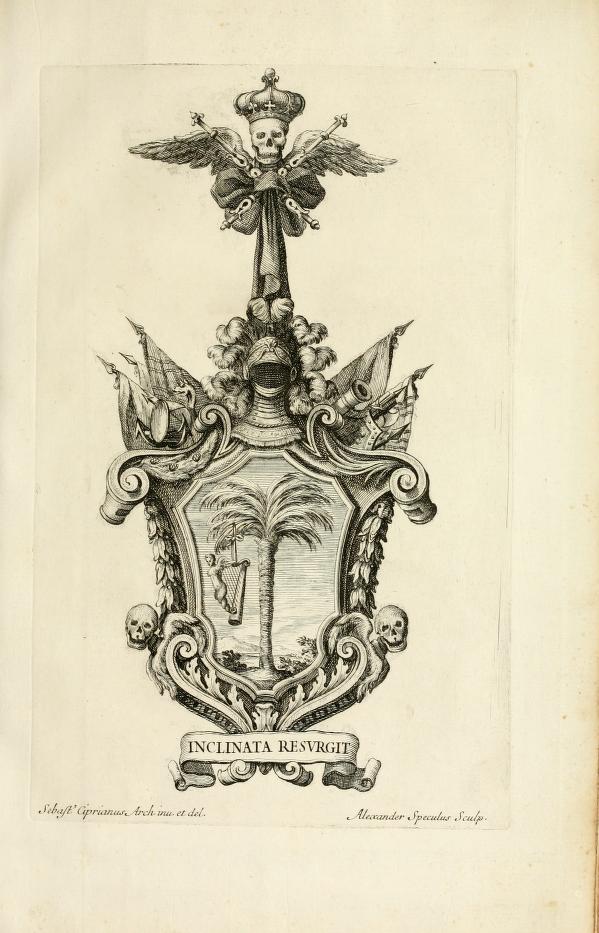
Another moral emblem. I’m particularly fond of this one as the harp recalls not only the exile in Babylon (and thus the Jacobite exile) but also the valiant Irish defense of James’s claim to the throne in 1689. These also would have adorned the walls of the church alongside the King’s arms. (Source)

sacraexequialiai00aqui_0066

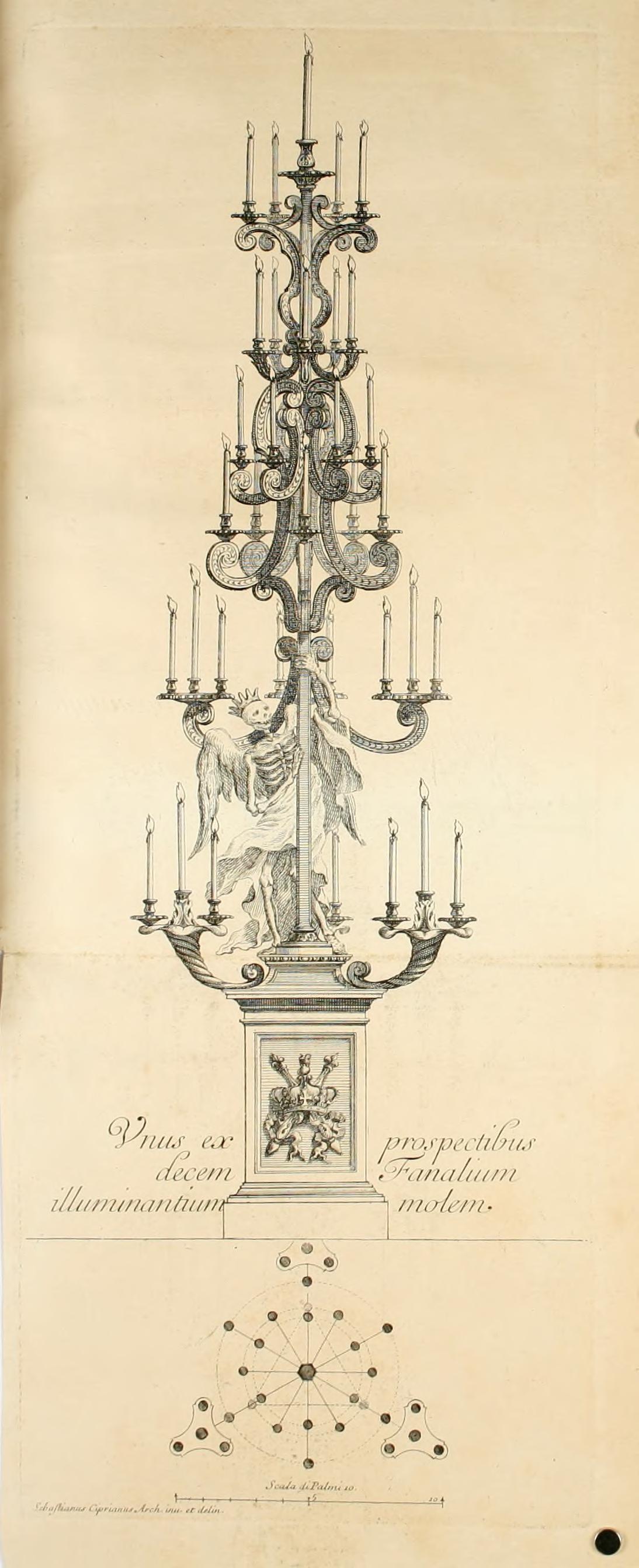
A closer view of the skeletal flambeaux. One can never have too many at a funeral. (Source)

Screen Shot 2018-11-02 at 10.07.34 AM.png

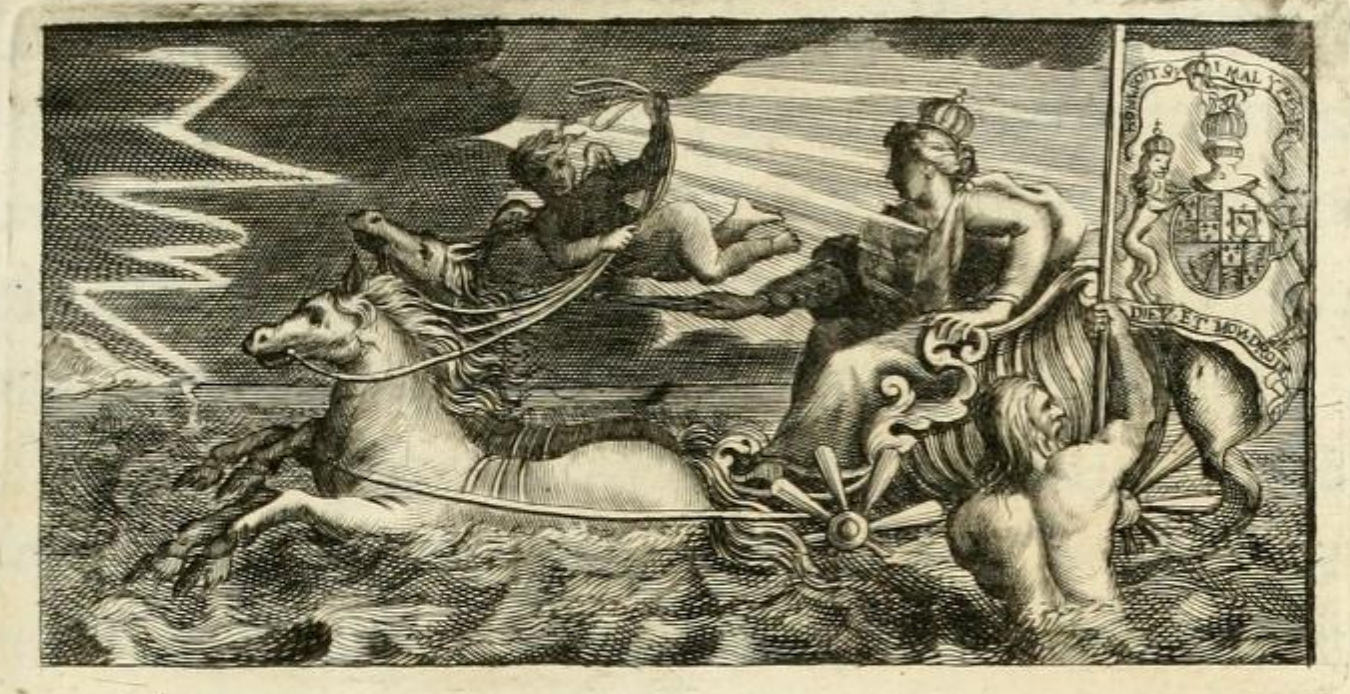
Jacobite emblem accompanying the text of the Oration. (Source)

Screen Shot 2018-11-02 at 10.10.05 AM.png

A closer view of the frontispiece. Note the Pope flying over the catafalque. (Source)

Screen Shot 2018-11-02 at 10.12.19 AM.png

Here you can see the spooky scary skeletons all around the room. (Source)


Advice from a French Nun

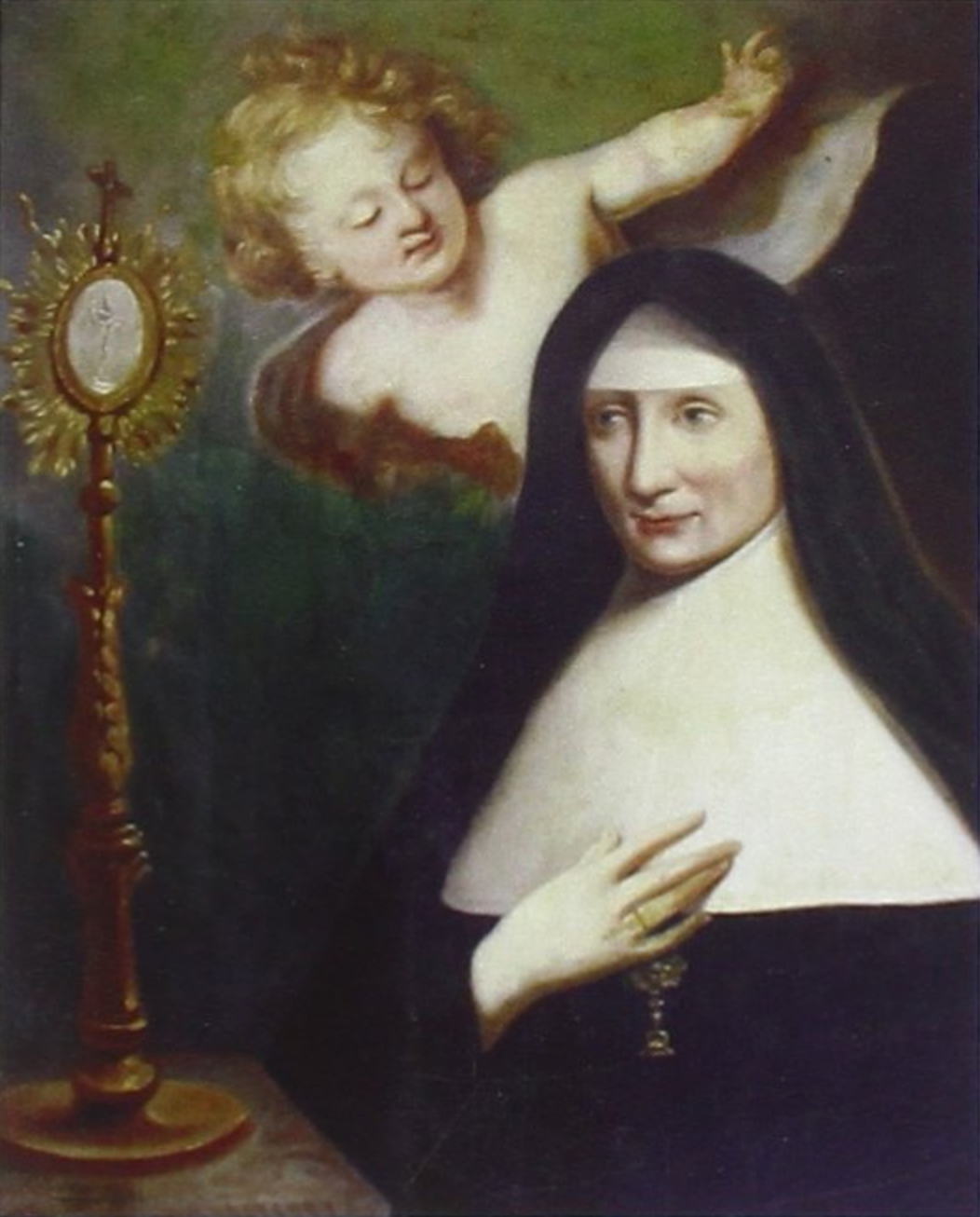
Screen Shot 2018-10-28 at 10.13.24 PM.png

A portrait of Mother Mectilde de Bar adoring the Blessed Sacrament. (Source)

Sometimes readers ask me about more information on Mother Mectilde de Bar (1614-1698), the saintly foundress of the Benedictine Nuns of Perpetual Adoration of the Most Blessed Sacrament of the Altar. I would of course direct those who read French or Italian to any of the several biographical studies about Mother Mectilde that have come out in those languages. However, I would perhaps more eagerly urge my readers to a series of recent posts at Vultus Christi presenting what is, I believe, the first English translations of some of Mother Mectilde’s spiritual letters. Here they are with the titles the translator has given them at VC.

I. “So that I might begin to live in simplicity, like a child.”

II. “On the Meaning of Desolation and Sufferings.”

III. “The state in which you find yourself is of God.”

IV. “The divine labourer who works in you.”

V. “Yet ever thou art at my side.”

VI. “Nothingness doesn’t even attach itself to nothingness.”

VII. “Some sayings of Mother Mectilde.”

VIII. “He sets fire everywhere.”

IX. “All our discontent comes from self-will.”

And on top of all that, there’s a letter from the lay mystic Jean de Bernières to Mother Mectilde. Bernières is a good example of someone who, though posthumously condemned as a “Quietist,” is now being recovered as a source of valuable mystical insight. We have seen the same happen to Benet Canfield before, and it may yet occur to someone like Pietro Matteo Petrucci. More work needs to be done in this area. At any rate, translation of these early modern mystical works is badly needed.

Both as a practicing Catholic and as an historian of early modern Catholicism, I am encouraged that these works are being put into English for the first time. The English-speaking world is now getting a much better sense of the importance of this unique tradition within the Benedictine family. More translations, we are told, are coming. I eagerly await their publication.


On Gallicanism and Ultramontanism

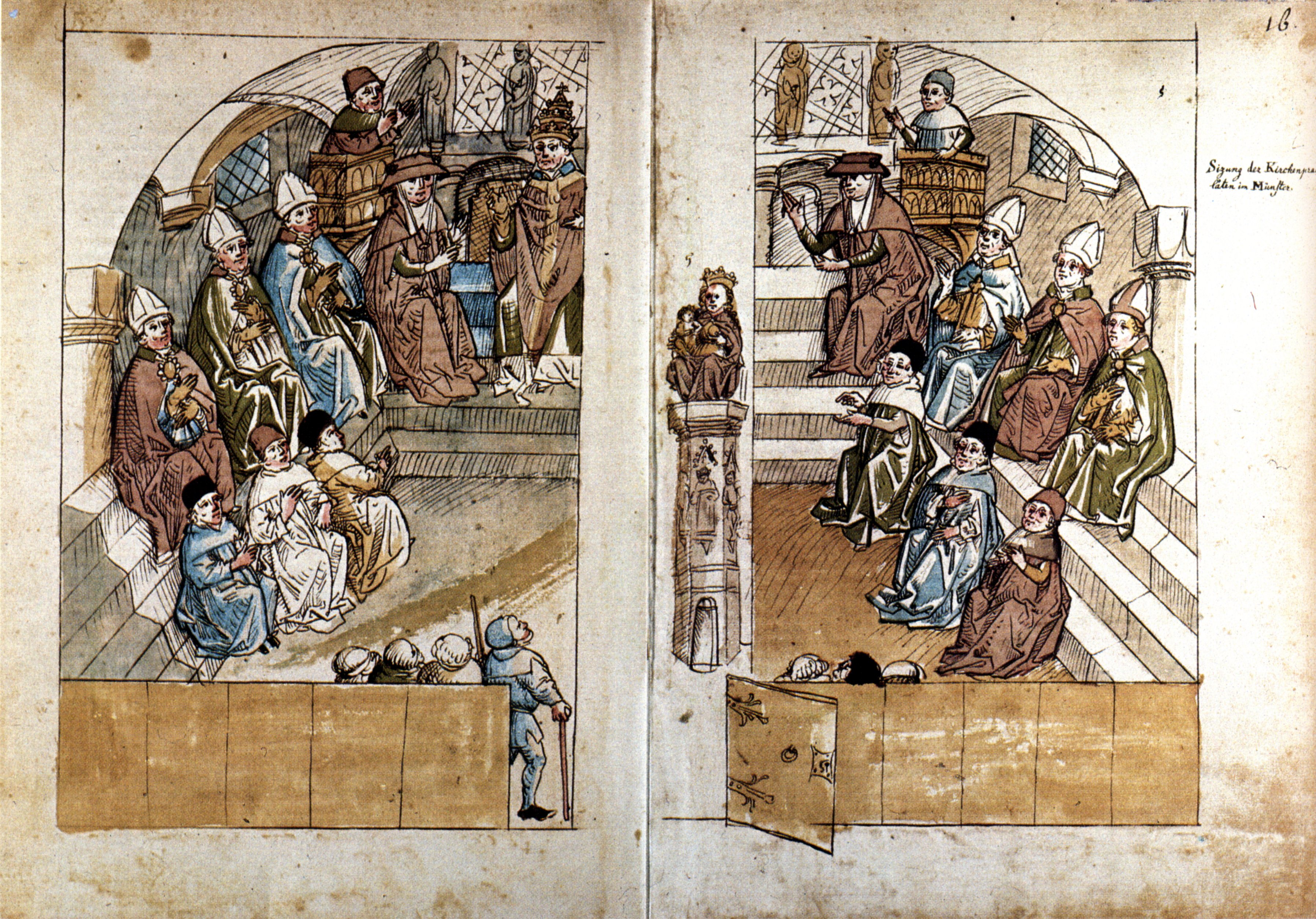
CouncilofConstance.jpg

Scene from the Council of Constance, the Sixteenth Ecumenical Council (Source)

Over at Notre Dame’s Church Life Journal, there are two important pieces worth your time. The first, Dr. Taylor Patrick O’Neill’s “A Defense of Ultramontanism Contra Gallicanism,” is a theological analysis of the recent use of “ultramontanism” as a pejorative in Catholic discourse. Dr. O’Neill, a Neo-Thomist theologian, suggests that Ultramontanism is “the golden mean” by which to preserve a healthy and authentically Catholic respect for the Papacy. He writes:

But how does the historical usage of the term “ultramontane” hold any significance for us today? Given that the term arose as an insult against those who challenged the claims of Gallicanism, and given that those who championed papal primacy over local kings and bishops were legitimized at Vatican I, the term ought not to be associated with heterodoxy but rather orthodoxy.

To equate ultramontanism and orthodoxy is an extraordinary claim. While Dr. O’Neill recognizes that there are some excessively papalist versions of ultramontanism – a phenomenon he would prefer to call “super-ultramontanism” or “ultra-ultramontanism” – he fails to escape the very alienation from the term’s “historical significance” that he attempts to address.

Benigni_Umberto

Umberto Benigni (1862-1934), Ultramontane church historian. (Source)

Take, for instance, his citation of Umberto Benigni’s article on “Ultramontanism” in the 1912 Catholic Encyclopedia. The passage O’Neill cites reads:

For Catholics it would be superfluous to ask whether Ultramontanism and Catholicism are the same thing: assuredly, those who combat Ultramontanism are in fact combating Catholicism, even when they disclaim the desire to oppose it.

If O’Neill had borrowed his words merely for a theological point, we might pass over the citation. But his is an historical judgment, not primarily a theological one. O’Neill doesn’t mention that Benigni is an out-dated, partisan, and sectarian Church historian whose article manifests those faults. It is hard to imagine any contemporary historian making much use of Benigni, whose other works include a volume entitled Ritual Murder Among the Jews (Belgrade, 1926-29).

Ultramontanism arose as a coherent and self-identified ecclesiological tendency under the pressures of post-Napoleonic Europe. While Papalism has always existed in the Church, the emergence of a self-consciously “Ultramontane” party before and after Vatican I was bound up with the Catholic response to modernity. And in some places – especially France – it was synonymous with less savory elements such as antisemitism. This fact alone hardly invalidates O’Neill’s theological point. But if we want to look at the term’s “historical significance,” I see little way to escape the actual history. “Historical significance” might just as well mean “connotations” as any sort of precise theological definition. O’Neill delimits ultramontanism by confining it to the realm of ideas as a functionally timeless truth. Yet he mires Gallicanism in the muck of human history. Ultramontanism is just the consistent teaching of the Church; Gallicanism, by contrast, is the small and fractious complaint of tendentious and self-interested minorities such as French kings and the Old Catholic schismatics. This discursive move may not be disingenuous, but it does set up a problematic historical imbalance. Ultramontanism is just as historically-conditioned as Gallicanism. Both involve something rather more than mere ideas – they enlisted social, political, and ecclesiastical movements, not always with very good results. And unfortunately, some of O’Neill’s history is simply incorrect.

At the same publication, the historian Dr. Shaun Blanchard’s “A Quasi-Defense of Gallicanism” provides some helpful correctives. It is a nuanced and well-argued piece (and well-sourced, too – Dr. Blanchard has seen fit to provide his readers with eight end-notes referring to reputable historical literature).

Against O’Neill’s suggestion that Gallicanism only arose after the Reformation, Blanchard correctly notes that the Medieval Conciliarist tradition most eloquently expressed by Jean Gerson (1368-1429) and the fathers of the Council of Constance (1414-18) provide ample groundwork for what would later be called “Gallicanism.” And Dr. Blanchard is right to point out that “Gallicanism” was never just one phenomenon, but a disparate tendency that crystallized into different forms of resistance to Papal centralization – not all of which were at play in Vatican I. Moreover, Blanchard correctly argues that, against Benigni and O’Neill’s interpretation, the Gallican minority at Vatican I preserved certain ecclesiological truths later vindicated by Vatican II. One could go on. Blanchard provides a great deal more historical background than O’Neill in support of his point.

blessed_neman_winter_cappa

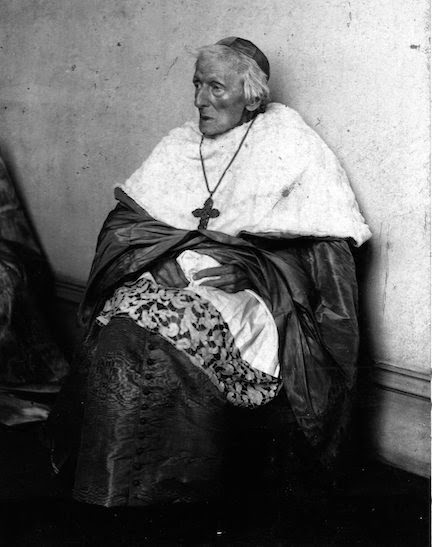
Cardinal Newman in his winter cappa. The man was no Ultramontanist. (Source)

Blanchard’s defense of Gallican thinkers such as Gerson, Bossuet, and Fleury is admirable. One could add to their names that of Cardinal Newman, whose soft-conciliarist ecclesiology earned the ire of ultramontanists like Cardinal Manning and W.G. Ward and Monsignor George Talbot, who famously wrote to Manning,

What is the province of the laity? To hunt, to shoot, to entertain? These matters they understand, but to meddle with ecclesiastical matters they have no right at all, and this affair of Newman is a matter purely ecclesiastical…Dr. Newman is the most dangerous man in England, and you will see that he will make use of the laity against your Grace.

None of this broader historical context appears in O’Neill’s piece. Perhaps it’s a little unfair to demand it, insofar as O’Neill is more interested in our contemporary debates than in the genealogy of the terms at play. But if we are to properly recognize “the historical significance” of ultramontanism, then we can’t really dodge the issue. If O’Neill is right to suggest that “the term ought not to be associated with heterodoxy but rather orthodoxy,” then men like Newman are beyond the pale of orthodoxy. And that seems like rather an impoverished vision of the Catholic intellectual life. I will conclude with Dr. Blanchard’s own measured words on the matter.

My point in this qualified defense of Gallicanism is not that we should “return” to Gallicanism, if such a thing were even possible. Neither must we equate ultramontanism with Catholic orthodoxy, simply because ultramontanes triumphed at Vatican I. Catholic orthodoxy is too big to be equated with either. The Catholic faith is big enough and dynamic enough to include what is good and true in ultramontanism and in Gallicanism, and likewise to reject what is harmful, false, or exaggerated in both.

Read them both.