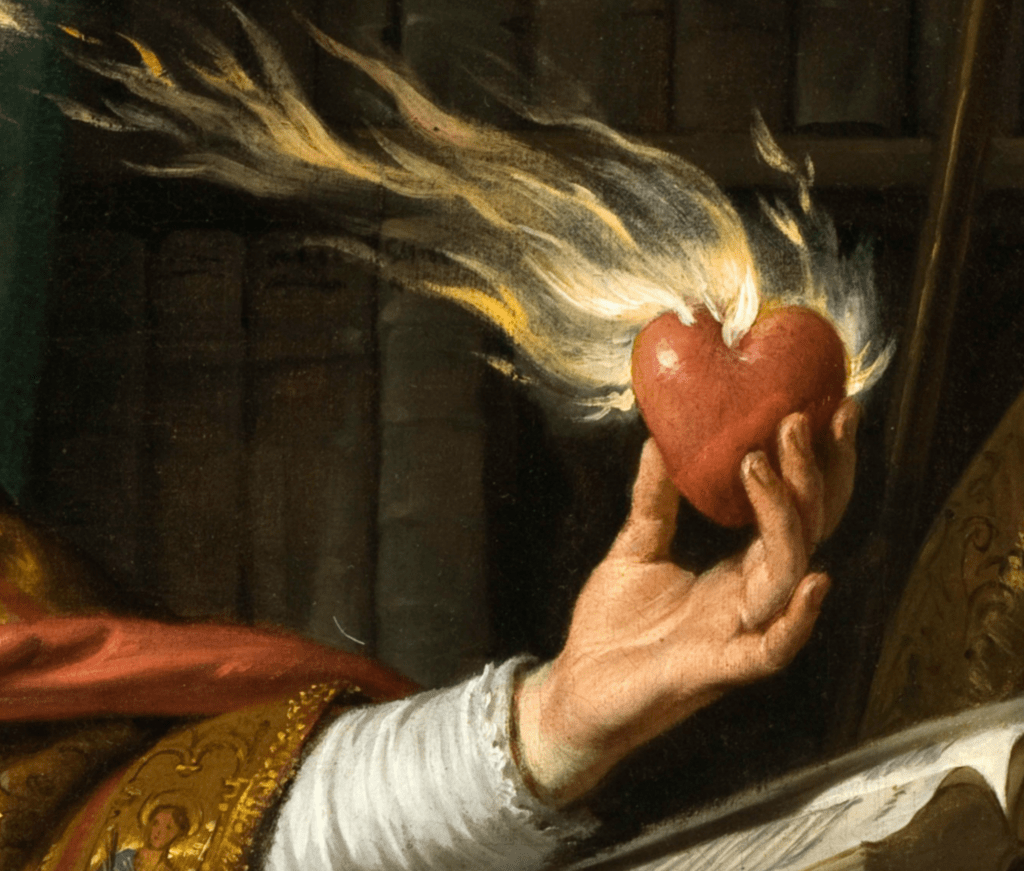
Saint Augustine, Philippe de Champaigne, c.1645-50 (Detail) – (Source)
On Saint Augustine – A Prayer of M. Hamon
O God, who, after having shown to us in Saint Augustine the very excess into which corrupt nature causes us to fall, hast also caused us to see in him the strength and the empire of Thy Grace over our hearts, grant us, we beseech thee, so perfect a knowledge of our extreme misery and of Thy infinite mercy, that, expecting everything from Thee, and nothing from ourselves, we might hope fully in Thee by defying ourselves completely.
O God, who in embracing Saint Augustine with Thy Love, and in elevating him above all men by the knowledge of Thy Truth, hast placed him in Thy Church as a fiery and shining lamp, so that he might illuminate and defend her by his doctrine, and console and edify her by his sanctity; grant, by the help of his charitable intercession, that we might imitate his virtues; and, at his example, rejoicing only in the truth, and having taste only for the fruits of charity, we might despise this mortal life by the hope and feeling of the all-divine life which Thou hast promised us; so that, loving Thee alone, we might also place all our happiness in Thee alone.
Thus we beseech thee by Jesus Christ our Lord. Amen.
(From Jean Hamon, Entretiens d’une âme avec Dieu, New Edition (Avignons, 1740), pp. 405-06; original translation by The Amish Catholic)
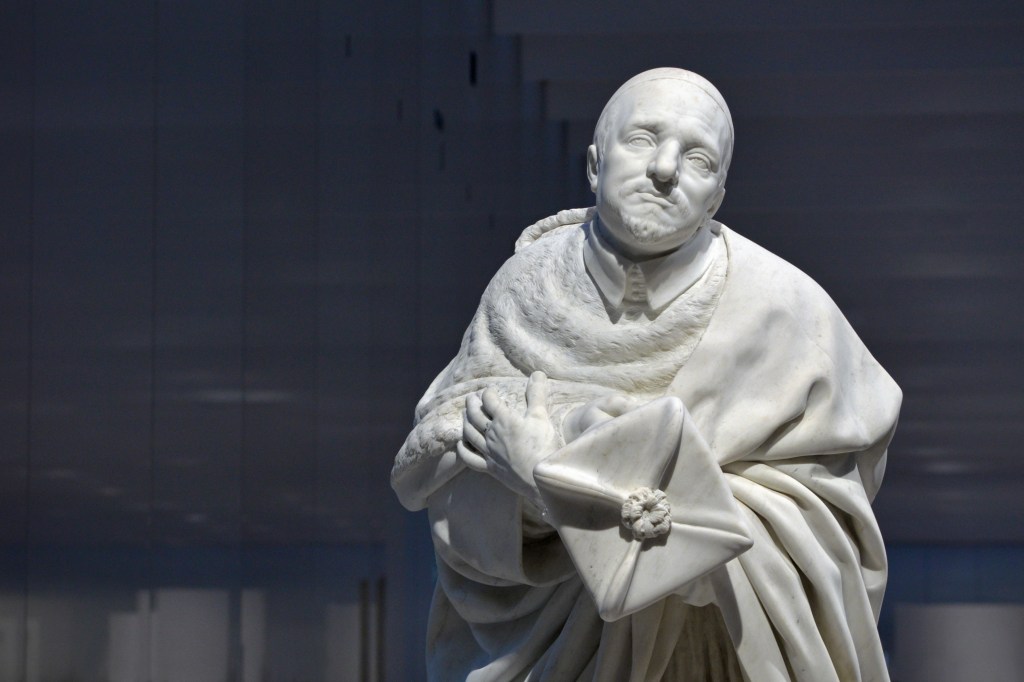
For this Friday in Passiontide, we have another offering in the Lenten Spirituality Series. This time it comes from the great Cardinal Pierre de Bérulle (1575-1629), mystic, founder of the French Oratory, and sponsor of the Carmelites of France. Immersed in the Fathers and dedicated to the reform of the clergy initiated at the Council of Trent, Bérullewas perhaps the most influential writer of the French School of Spirituality. His vast corpus has been rarely translated in English, so I present my own translation here from hisOeuvres Complètes, pg. 1045-46. In this excerpt from the “Opuscules Divers de Piété,” we encounter one of the key themes of the French School – the interior life of Christ.
Jacques Sarazin’s monument for Cardinal de Bérulle (1575 – 1629), formerly at the chapel of the Carmelite nuns of the Rue Saint-Jacques, and now in the Louvre (Source)
Of the Interior Sufferings of Jesus – Of the Sentiments of the Son of God in Regards to His Most Holy Passion
…
If so many holy souls have been sacredly occupied with pious, devout, and admirable sentiments with regards to the Cross, the Son of God, who is the source, the principle, and the exemplar of the life of His saints, will not have been removed therefrom. On the contrary, He will have been occupied and filled with the same advantage that His incomparable life has over the life of the saints.
We adore and admire in the Son of God two types of life: the life of glory and the life of the Cross; two lives in the Son of God, two very different lives, two very busy lives, without either one of these lives and occupations impeding the other. On the contrary, that [life] of glory dignifies the sufferings of Jesus, in that they are established in the self-same glory: that only belongs to Jesus and to His sufferings, that had had these two privileges, to be established in the divine life, in the glorious life; instead of the sufferings of the saints that are only established in human life, in the holy life. The life of the Cross testifies to His grandeur and His power of finding and taking the same place of glory.
Each life has its object, its knowledge, and its sentiment, as it appears in the human life of the senses; how much more in the spiritual and divine life? The life of glory has its object, its light, and its suffering, which is its sentiment. The life of the Cross also has its object, its light, its suffering. The devout life has its objects, its thoughts, its sentiments. Oh! What are the sentiments of the life of glory! What are the sentiments of the life of the Cross!
These sentiments of the Son of God, in regard to the Cross, had been, as soon as its arrival in the divine life, glorious and passible, continuing during the whole course of His life, even unto death; some of anguish and others of languor towards His cross: Baptismo habeo baptizari, et quomodo coarctor donec perficiatur! “And I have a baptism wherewith I am to be baptized: and how am I straitened until it be accomplished?” (Luke 12:50 DRA)
These sentiments had been universal as those of glory, which spread through the soul, the powers, and the glorified body. His agony is one the sentiments of the Cross that had occupied and filled all parts of the Son of God’s body; because, by this mystery, all the parts of His body had been rendered capable and sensitive in view of the Cross.
Besides this mystery of agony…these sentiments of the life of the Cross occupied the heart, the soul, and the spirit of Jesus; everything therein had been penetrated, His heart had not waited even to be pierced by the lance to be pierced by this pain; this pain had wounded it living and the lance had pierced it in death.
Until we be introduced into the sanctuary of the life of the Son of God, let us adore these sentiments – so divine and so vast – upon a subject so grand.
There are three different principles of these admirable sentiments: thought, light, and the powerful hand of God himself, imprinting these sentiments immediately upon the heart and the spirit of Jesus. The light of glory, clearly seeing God in His grandeur and His essence, had perhaps been employed in its efficacy to operate these divine sentiments. Thoughts at once devout, luminous, and efficacious, but ordinary for the Son of God, had also operated sentiments in His soul, albeit inferior to those that the light of glory and the immediate hand of God had worked there.
Abandonment on the Cross is one of these sentiments imprinted by the Eternal Father immediately.
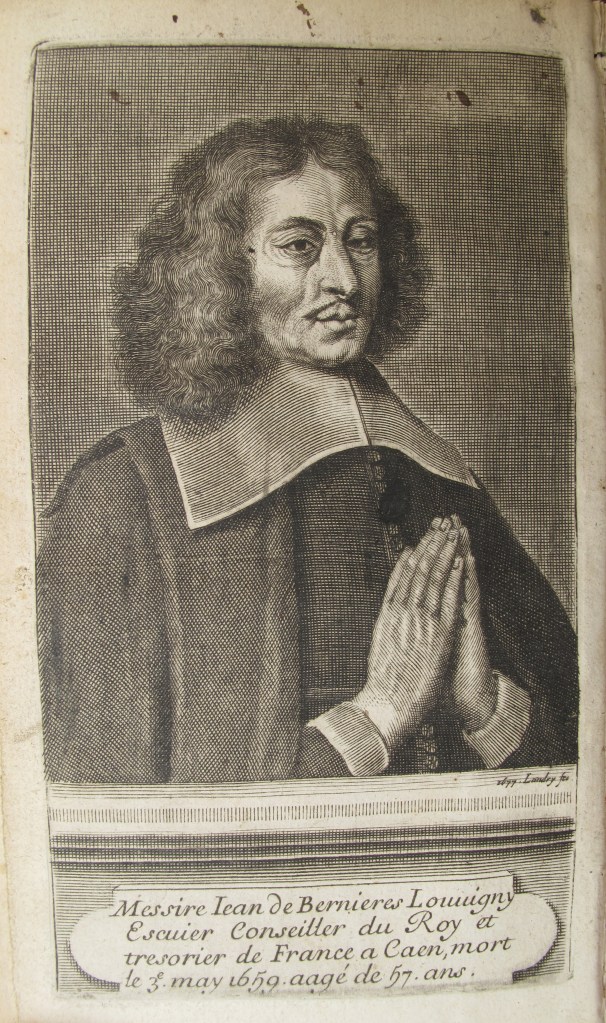
This week’s contribution to the Lenten Spirituality Series comes from Jean de Bernières-Louvigny (1602-1659), a pious lay mystic who lived and died in Caen. From his hermitage in this rainy Norman town, Jean de Bernières gave himself over to profound experiences of contemplative prayer. His spirituality, as expressed in the two volumes of his Le chrestien intérieur (Paris: 1661), was deeply indebted to the apophatic tradition of mystical theology. Although a solitaire, Jean de Bernières was engaged in ecclesiastical and charitable networks that included some of the greatest spiritual figures of his day. He was a member of the Compagnie du Saint-Sacrement in Caen and corresponded with such notable individuals as St. François de Montmorency-Laval, Bishop of Québec, and Mother Mectilde de Bar, Foundress of the Benedictines of Perpetual Adoration of the Most Blessed Sacrament of the Altar. He met the latter at Caen; she became, as it were, a dear friend. Translated into German in the eighteenth century, Jean de Bernières had an important influence on the trajectory of Pietism in that country. He has, as far as I can tell, never been fully translated into English. What I produce below is my own translation, in the hope it may offer some aid to pious souls in this time of temptation. The excerpt comes from the Second Volume, Book V, Chapter II of Le chrestien intérieur, pp. 6-11. I would add, for those who take an interest in such matters, that one of the extra difficulties in translating Jean de Bernières is that he uses Norman French vocabulary that no longer appears in standard French. I hope I have managed to capture his sense here.
May the Blessed Hermit Jean de Bernières pray for us in this time of penance. (Source)
To commune worthily, one must place oneself in a state conformed to that of Jesus, in the Blessed Sacrament.
Jesus Christ wishes to give Himself to us in this august mystery, in a state of death with respect to the life of the senses, but as a source of life with respect to the interior life, the divine life, the life of grace, the life of contemplation and continuous application to the grandeurs of God His Father; a life poor and annihilated [aneantie] in exteriors, but entirely brilliant with majesty, and infinitely rich under the veil of the species that hide it from the eyes of the world. It is with these dispositions that that He comes to present Himself to us, wishing as well that we too should present ourselves to Him with dispositions conformed to His.
The Humanity that He gives to you in Communion has been elevated to the divine life by the hypostatic union; we too must be such by grace, that our understanding would be elevated to a high knowledge, and our will to a sublime sentiment of love of God, and that our soul would live the life of grace. O sublimity of the life of grace, you are so admirable, you are so high, you are so ineffable! You raise man from earth to heaven, and you make him live in God, and even of God, because you dispose him to live on the earth from the same substance by which the Blessed live in heaven. O great life of grace, you are poor to the exterior, but very rich in the interior: you seem low, but you are most high: you have ravished me with you beauty, I can no longer live a moment without thee, who make [me] live from a divine life, who places the soul in the heart of God, and who disposes her to see God placed in her heart.
Since the beauty of this life manifests itself to the soul, she leaves everything to embrace it, and everything else seems to her naught but death and corruption; we abandon the world, honors, and riches; we condemn ourselves to penances, to mortifications, to poverty, so as to live this divine life; and we feel a holy hunger for this adorable food that nurtures the soul. O that I might know it, my God, and that I might follow it, this divine life, so little known to the world, practiced by so few in the world, that also does not find itself altered by the waters of Thy eternal fountains! O Jesus, draw me after Thee in the actions of the life of grace, which is in its full exercise in misery and scorn. Draw me, Lord, I run after Thee in the odor of Thy perfumes. What pleasure, my soul, to behold you walking as a giant in the ways of grace, nourished and fortified in your course with the bread of grace: Ambulavit in fortitudine cibi illius usque ad montem Dei.
To live in one’s own death, as Jesus seems to us in the Blessed Sacrament, to lose one’s glory in contempt, to be ravished when one is annihilated [aneanti] and sacrificed; this is proper to the life of grace. Making everything dead to the exterior, it brings life to the interior, and gives principally the spirit of prayer, putting it almost continuously in exercise in the soul, applying itself to this infinite and incomprehensible Being that it adores, unable to comprehend It, and annihilating itself [s’aneantit] before Him, unable even to admire His divine grandeurs, as annihilated [aneanties] in the Eucharist. O my soul, how great is your vileness, how extreme your poverty! What is man, that You should have remembrance of him, Lord, and that You should visit him, and that You should take Thy delight from coming to dwell personally with him? His soul is drawn from nothing, and his body is nothing but a little mud, and Thou deignest to set Thine eyes upon him! How is it that this creature, so dirty, so minuscule, so coarse, could receive the infinite majesty of God? Humble thyself to the bottom of thy nothingness, and confess thy baseness, my soul. Lower thine eyes, and swear that thou art unworthy to turn them only towards that formidable grandeur; but be still more moved with admiration, of recognition and love of such excessive goodness, which deigns well to annihilate itself [s’aneantir] in that incomprehensible mystery, to bring itself to you even unto your nothingness.
We must truly love the state of interior captivity, where the soul, bound and tied up, stays in the obscurity of its prison. This state will honor the captivity of Jesus enclosed under the little host. This divine Lord place himself in a little prison for our love. The King of Glory is restricted under these small species, and thereby a captive and prisoner of man, He renders Himself, it seems, his slave, giving Himself entirely to him; He suffers, so to speak, and dies for him, and communicates to him all the merits of His Precious Blood. O divine Captive, captivate my heart so strongly, that it may never more return to natural liberty; but that all destroyed and annihilated [aneanti], it may not live another life than the superhuman, nor may it enjoy any other liberty than that of Thy children.
Each time that one takes Communion, Jesus Christ giving Himself entirely to all, there are all new obligations that we contract to live entirely for Him, and to render all our actions divine. It is necessary therefore for a good soul not to say: I have not such time to prepare myself for Communion; because she must not aim at another thing by all the actions of her life, but to receive the Bread of Life, in order to live the life of Jesus, and to persevere perpetually in similar dispositions to those that appear to us in the Blessed Sacrament.
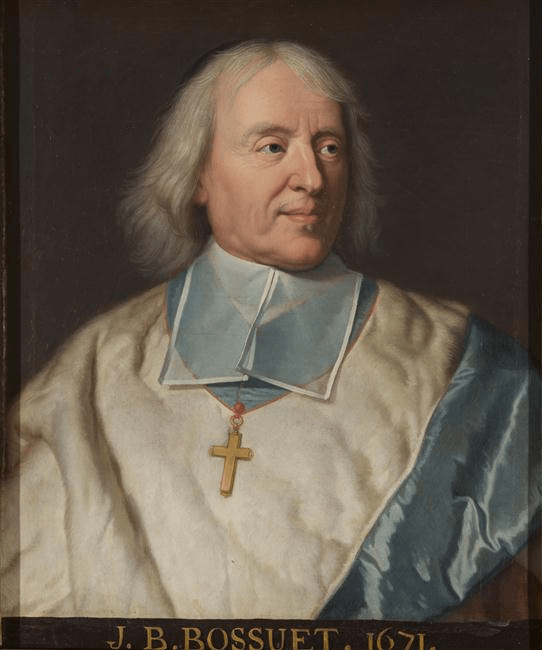
There are many candidates for the title of “Greatest Preacher in Christian History,” but my money’s on Jacques-Bénigne Bossuet (1627-1704), “The Eagle of Meaux,” Bishop and Tutor to the Grand Dauphin of France.Famed in his own day for the clarity of his doctrine, the incisive vigor of his spirituality, and the dazzling versatility of his oratorical skill, Bossuet stands as one of the late flowers of the Grand Siècle. Trumpet of the Gallicans and Hammer of Quietism, Bossuet nevertheless is not merely to be regarded as a relic of dusty seventeenth-century controversies. He still has much to teach us. In this excellent passage, excerpted from a recent translation and edited collection of hisMeditations for Lentby Christopher O. Blum (Sophia Institute Press, 2013), we can see the essentially ascetic cast of Bossuet’s mind. This was the same man who, in a felicitious turn of phrase, elsewhere referred to the Rule of St. Benedict as “a little abridgment of the Gospel.”The relevant passage can be found on pages 10-12 of the source text.
Portrait of Bossuet by Charles Sevin de la Penaye, after Hyacinthe Rigaud, c. early 18th century (Source)
“Lord, show us the Father, and we shall be satisfied” (John 14:8). God alone suffices, and all we need to possess him is to see him, because in seeing him, we see all his goodness, as he himself explained to Moses: “I will make all my goodness pass before you” (Ex. 33:19). We see all that attracts our love, and we love him beyond all limits. Let us join St. Philip in saying with all our heart, “Lord, show us the Father, and we shall be satisfied.” He alone can fill all our emptiness, satisfy all our needs, content us, and make us happy.
Let us then empty our heart of all other things, for if the Father alone suffices, then we have no need for sensible goods, less for exterior wealth, and still less for the honor of men’s good opinion. We do not even need this mortal life; how then can we need those things necessary to preserve it? We need only God. He alone suffices. In possessing him we are content.
How courageous are these words of St. Philip! To say them truthfully, we must also be able to say with the apostles: “Lord, we have left everything and followed you” (cf. Matt. 19:27). At the least we must leave everything by way of affection, desire, and resolution, that is, by an invincible resolution to attach ourselves to nothing, to seek no support except in God alone. Happy are they who carry this desire to its limit, who make the final, lasting, and perfect renunciation! But let them not leave anything for themselves. Let them not say: “This little thing to which I am still attached, it is a mere nothing.” We know the nature of the human heart. Whenever a little thing is left to it, there the heart will place all its desires. Strip it all away; break from it; let it go. To own things as though one had nothing, to be married as though one were not, to make use of this world as though one were not using it, but as though it did not exist, and as though we were not a part of it: this is the true good for which we should strive. We are not Christians if we cannot say sincerely with St. Philip, “Show us the Father, and we shall be satisfied.”
It is from the very depths of faith that these words are spoken, and it is in a certain sense from the very foundation of nature itself. For in the depths of our nature we sense our need to posses God, that he alone is capable of fulfilling our nature, and that we are anxious and tormented when separated from him…Man, abandoned to himself, does not know what to do, nor what to become. His pleasures carry him off, and these very same pleasures destroy him. With each sin of the senses he gives himself a killing blow, and he not only kills his soul by his intemperance, in his blindness and ignorance he kills the very body that he would flatter. Since the Fall, man is born to be unhappy…We do not know how to desire or ask for what we need.
St. Philip’s words teach us everything. He limits himself to what Jesus taught us is the one thing needful. Lord, you are the way.
‘Catholicity, Antiquity, and consent of the Fathers, is the proper evidence of the fidelity or Apostolicity of a professed Tradition’ J.H. Newman, Lectures on the Prophetical Office of the Church, 1837, p. 51
 The Amish Catholic


