A Wholesome Homily at Christmastide

The Return of the Prodigal Son, Rembrandt van Rijn, c. 1661-69 (Source)

I would like to refer my readers to a phenomenal sermon delivered by Mother Brit Frazier of St. Mark’s Episcopal Church, Philadelphia, PA. Some of you may know Mother Brit from Twitter, others from Earth & Altar, a very good Anglican blog. You can find the video here, starting at 24:00 and continuing for about eleven minutes. I found her meditation on the theme of God as a home for all, as a welcome for the spiritually homeless, to be quite moving.

For those who are curious, the poem from Chesterton that she discusses, “The House of Christmas,” runs as follows:

There fared a mother driven forth
Out of an inn to roam;
In the place where she was homeless
All men are at home.
The crazy stable close at hand,
With shaking timber and shifting sand,
Grew a stronger thing to abide and stand
Than the square stones of Rome.

For men are homesick in their homes,
And strangers under the sun,
And they lay their heads in a foreign land
Whenever the day is done.
Here we have battle and blazing eyes,
And chance and honor and high surprise,
But our homes are under miraculous skies
Where the yule tale was begun.

A Child in a foul stable,
Where the beasts feed and foam,
Only where He was homeless
Are you and I at home;
We have hands that fashion and heads that know,
But our hearts we lost – how long ago!
In a place no chart nor ship can show
Under the sky’s dome.

This world is wild as an old wives’ tale,
And strange the plain things are,
The earth is enough and the air is enough
For our wonder and our war;
But our rest is as far as the fire-drake swings
And our peace is put in impossible things
Where clashed and thundered unthinkable wings
Round an incredible star.

To an open house in the evening
Home shall men come,
To an older place than Eden
And a taller town than Rome.
To the end of the way of the wandering star,
To the things that cannot be and that are,
To the place where God was homeless
And all men are at home.

Although I am not much of a Chesterton fan anymore, I, too, was taken with this poem. I am grateful for having been introduced to it, though the strongest parts of the sermon move well beyond Chesterton. “The heart of Jesus is a secure place. There’s no need to defend it, no need to fear for our safety.” These words of Mother Brit’s bear further meditation. How often do we act as though the heart of Jesus were not secure, or as if His grace could move without His sovereign will – even when it appears to fail?

I chose Rembrandt’s famous Return of the Prodigal Son to illustrate this post because it perfectly captures the feelings of welcome, abundance, and divine homecoming that Mother Brit evokes. For our own return home to God always takes the form of repentance and devotion, even if just for a Providential instant before death.

However, I also thought of the work of another artist. Allan Rohan Crite (1910-2007) was a Black painter and illustrator whose work focused primarily on scenes of African American urban life. He was also an Anglo-Catholic. His religious corpus, which bears a favorable comparison to that of other Anglican artists such as Martin Travers, Enid Chadwick, Ninian Comper, and William Butterfield, combines transcendent solemnity with a keen attention to the realities of everyday life.

His 1948 painting of Our Lady of the Neighborhood is a good representation of what Mother Brit is talking about.
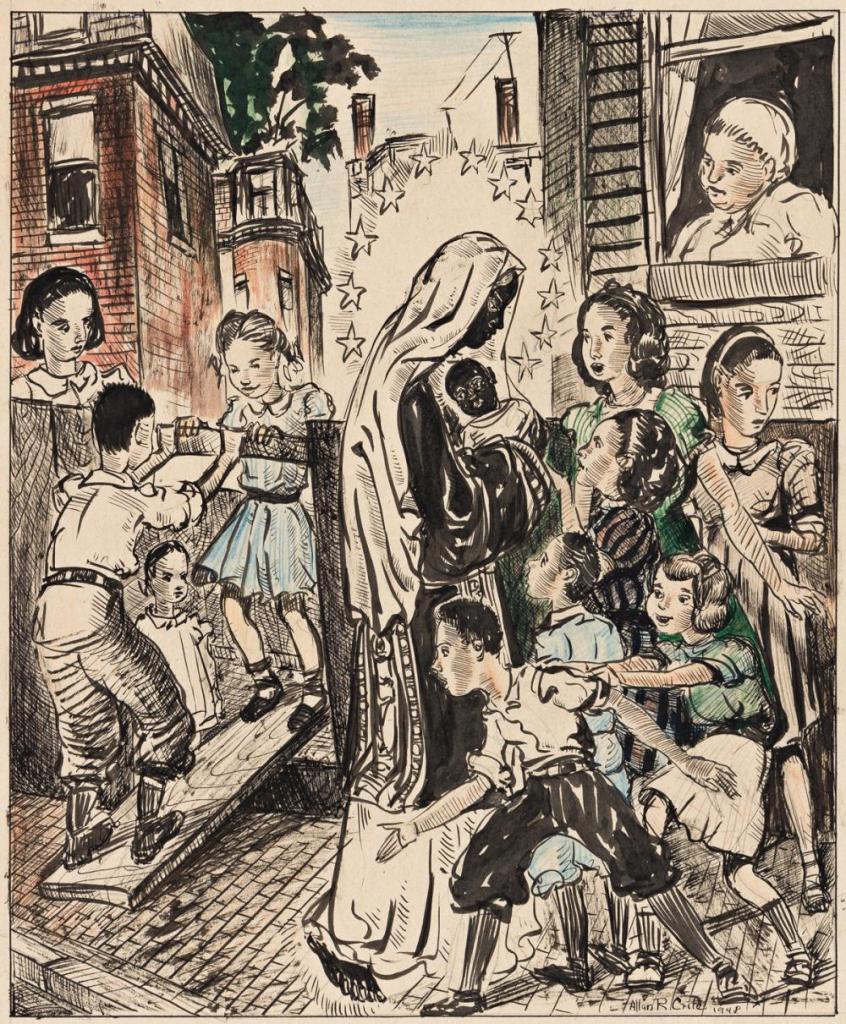
Our Lady of the Neighborhood, Allan Rohan Crite, 1948 (Source)

A Black Madonna carries Jesus through a crowd of dark-skinned children in an urban scene. Although she is crowned with twelve stars, she is entirely at home with these people; they in turn are entirely at home with her and her divine son. The children in this image exhibit an easy intimacy with the Mother and Child, the sort of intimacy that comes from long familiarity. This sense of “being at home with each other,” so like the prelapsarian life, is the very sentiment that the Christian aspires to enjoy with God.

Yet how hard it is to attain! And not just because our sins and temptations, which are distraction enough. Our whole religious apparatus is set up to warn us of these traps on the journey. But even our piety and our virtues can get in the way, ossifying into idols that demand more and more of our tribute, sapping more and more of our time and energy. Good things, when used in a disordered way, become snares. The incense we burn before those false gods clouds our love of God. Perhaps that is why a somewhat fanciful image like this one becomes so attractive. It shows us another way – life as an easy, peaceful, almost effortless communion with God. It shows us a tiny, imaginative glimpse of the communion of saints. This communion, surely, is what Mother Brit has in mind when she says that “Our true home is an eternal and abiding safety.” For these children manifestly feel safe next to the God-Man and His all-pure Mother. They are, for lack of a better term, friends.

Mother Brit also touches upon this grand theme of friendship with Christ. She says:

Our home in Christ is always a place of companionship and love. He is our Savior and Redeemer, yes, but He is, indeed, our Friend. This friendship of Jesus is no ordinary fellowship. He lives alongside of us: a confidant, a guide. His hand is in our hands, His heart is opened and always opening to us, soothing our uncertainties and making our pathways into places of peace. His company is always unconditional companionship and love. In our fellowship with Him, we are given a beloved family.

Mother Brit Frazier, Sermon for the First Sunday in Christmastide, 2021

Friendship with Christ – a mystery. But our mystery, our blessed mystery, the magnificent mystery at the heart of Christian life. How strange it is that Being Itself, the Uncreated Light, the Omnipotent and Omniscient One, should call humans, who are essentially nothing, His friends? Yes, it is a tremendous mystery.

Crite conjures something of this mystery in his illustrations for Three Spirituals from Earth to Heaven (1948), which give a distinctly Anglo-Catholic spin to the texts of old Negro spirituals. For instance, in his drawings for “Nobody Knows the Trouble I See,” Crite depicts a Black man being taken up by Jesus into the heavenly choirs.
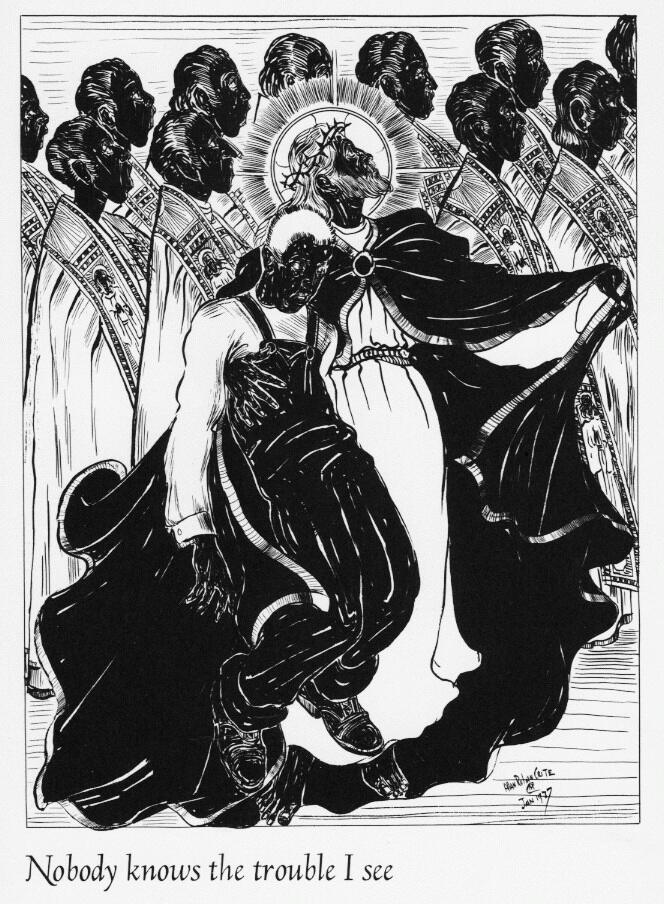
Illustration for “Nobody Knows the Trouble I See,” in Allan Rohan Crite, Three Spirituals from Earth to Heaven, 1948 (Source)

Perhaps it would be more apt to say that Jesus is carrying him. He’s not walking at all, but peacefully letting the Savior draw him into the realms of glory. A procession of coped figures streams by in the background, unnoticed by the poor and troubled man; yet this is no earthly liturgy, as the following illustrations make clear.

Illustration for “Nobody Knows the Trouble I See,” in Allan Rohan Crite, Three Spirituals from Earth to Heaven, 1948 (Source)

Christ Himself dons a cope of glory as well as a shining crown; He gently takes the troubled soul by the hand and shows him the scene he has hitherto missed. We sense his stunned joy. We can almost hear the otherworldly harmony of the singers. And look at the expression on Jesus’s face – not a stern look, but rather the concerned and kindly gaze of a friend who is attentive to the reaction of a dear companion whom He has just surprised.
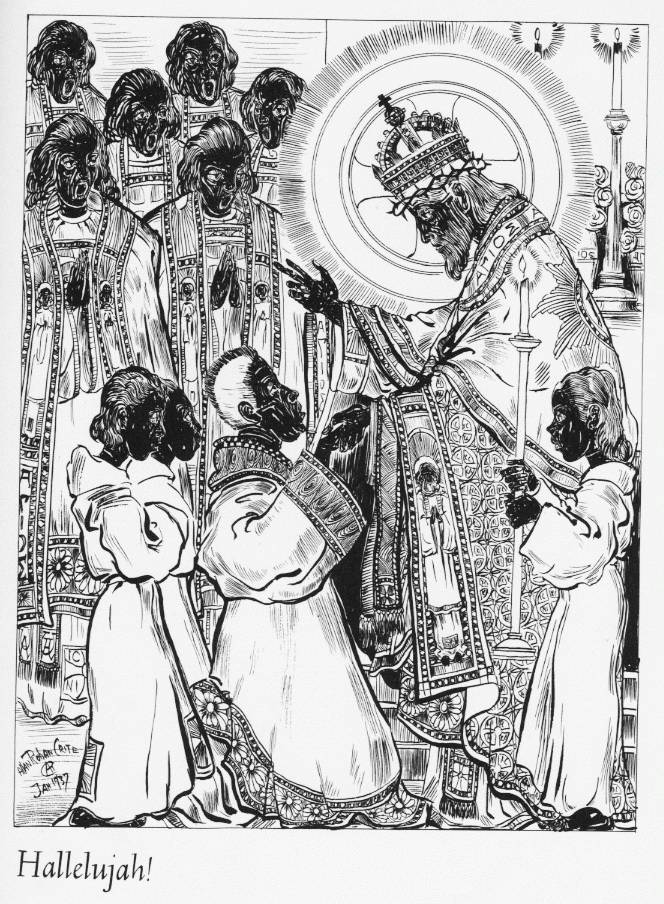
And what is the greatest surprise of all? That even a poor and outcast and troubled soul has a place in this glorious choir. Crite finishes by depicting the poor man’s reception into glory, with Christ vesting him in a beautiful robe. God does not look at us like the World does, for He sees the heart. As Mother Brit says in her homily, “even those whom the World have rejected are given places of beauty and intimacy and peace and security at the throne of grace.” Allan Rohan Crite knew that Truth, and it shone through so much of his art.

Christmas is about all these things – Christ as our true home, Christ as our true friend. Especially in this holy time of year, let us pray for the grace always to trust that His friendship will lead us home to His heart.
The Voice of Arthur Machen

GreatGodPanBeardsley.jp

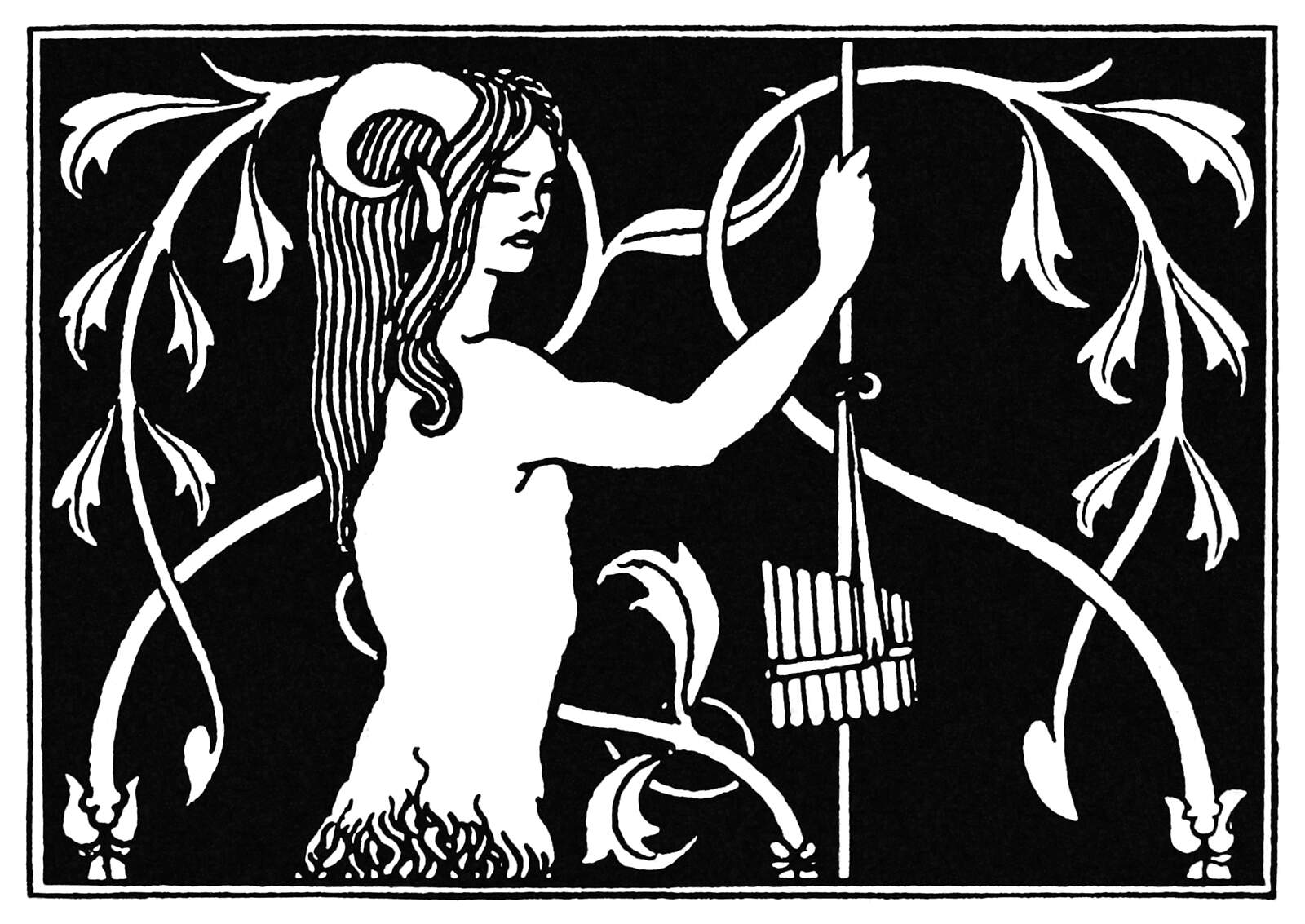
The title illustration of Machen’s The Great God Pan and the Inmost Light (1896), famously rendered by Aubrey Beardsley (Source)

Arthur Machen (1863-1947) was one of the greatest horror writers in the English language. His particular brand of esoteric paganism, the dangers of the occult, the sinister truth lurking behind folktales, and a highly-developed knack for evoking eldritch terror – all of these elements exerted a profound influence on the development of weird literature. Those who enjoy Lovecraft will recognize much in Machen that later made its way into Lovecraft’s own corpus. The dark bard of Providence held Machen in high esteem.

Machen was also a deeply spiritual Christian, best but imperfectly classed as an Anglo-Catholic. His strong sense of the mystical life found its fullest expression not in his horror stories, which do indeed bear some mark of his sacramental worldview, but in his later writings. A Welshman, he was fascinated by the Grail legend and connected it with his idea of an ancient, vividly supernatural “Celtic” Christianity.

AMachen.jpg

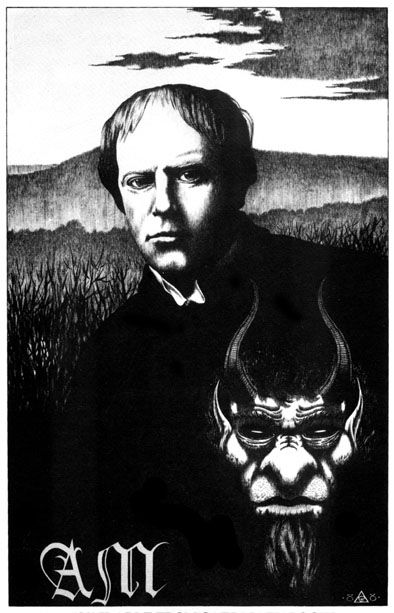
Portrait of Arthur Machen (Source)

Machen is a favourite of mine. I cannot recommend his stories highly enough – especially The Great God Pan, “The Novel of the White Powder,” “The Shining Pyramid,” “The Ceremony,” and “The Lost Club.” He is far scarier than some of his better-known contemporaries such as M.R. James or Sir Arthur Conan Doyle.

He also figures prominently in some of my research. I recently came upon a recording of his voice from 1937, in which he speaks of Chesterton, Dickens, Thackeray, and the art of fiction more broadly. Some of my readers may find this as enjoyable as I do, and so I provide a link here.

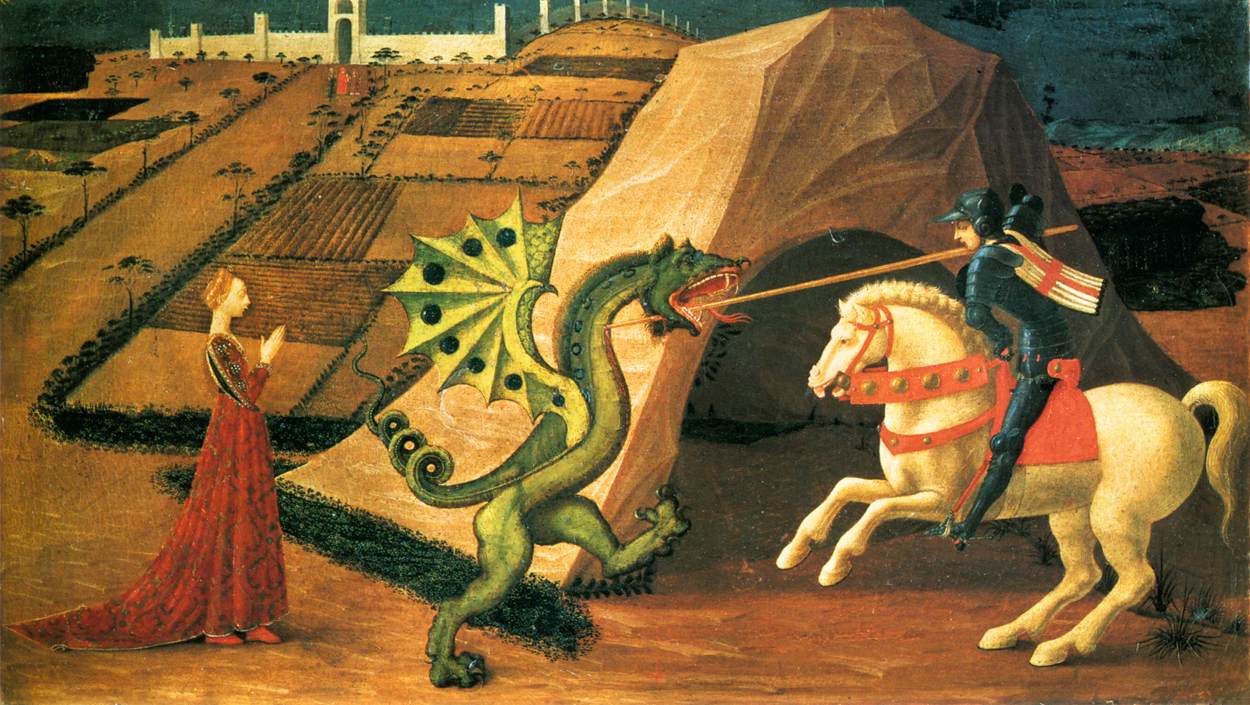
Chesterton’s St. George

Saint_George_and_the_Dragon_by_Paolo_Uccello_(Paris)_01.jpg

“Saint George and the Dragon,” Paolo Uccello, c. 1459 (Source)

The Englishman

G.K. Chesterton

St George he was for England,
And before he killed the dragon
He drank a pint of English ale
Out of an English flagon.
For though he fast right readily
In hair-shirt or in mail,
It isn’t safe to give him cakes
Unless you give him ale.

St George he was for England,
And right gallantly set free
The lady left for dragon’s meat
And tied up to a tree;
But since he stood for England
And knew what England means,
Unless you give him bacon
You mustn’t give him beans.

St George he is for England,
And shall wear the shield he wore
When we go out in armour
With battle-cross before.
But though he is jolly company
And very pleased to dine,
It isn’t safe to give him nuts
Unless you give him wine.

Mea Culpa, Mea Culpa, Mea Scholastica Culpa

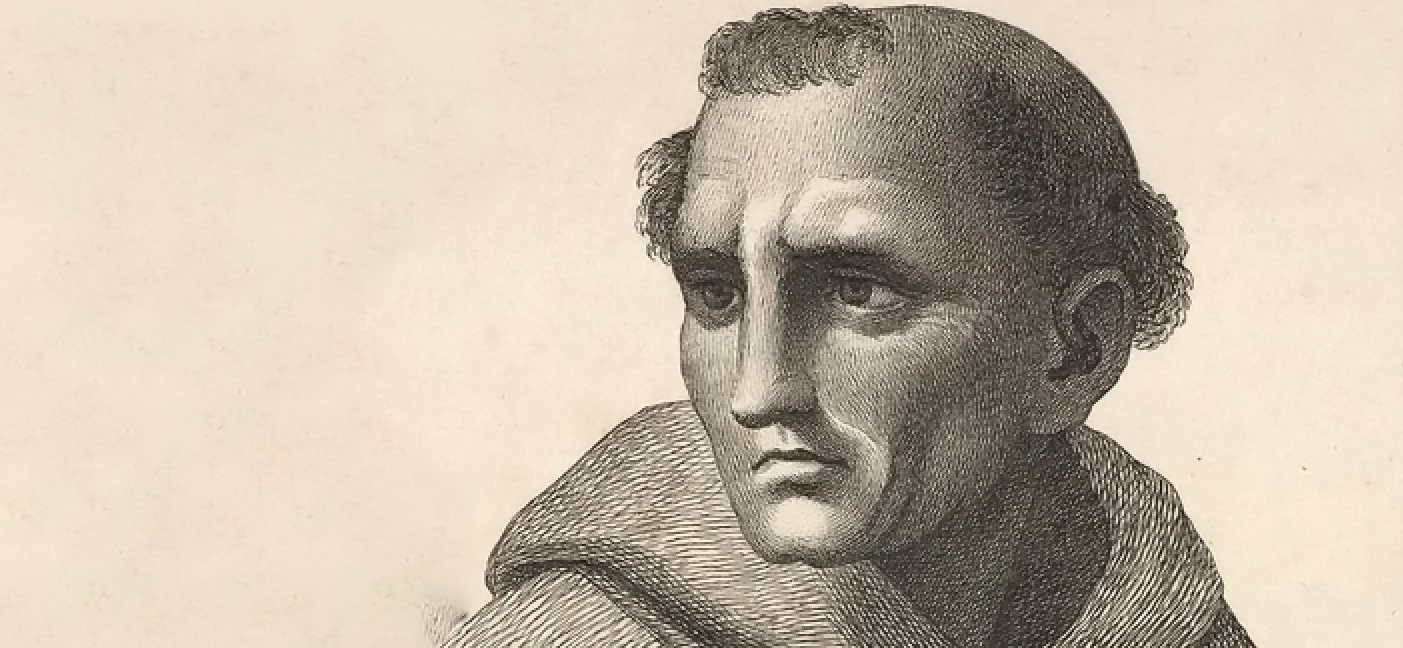
BlessedJohnDunsScotus

The Blessed John Duns Scotus (Source).

In my review of Rod Dreher’s The Benedict Option, I wrote the following:

I’m not suggesting that Dreher is necessarily wrong in his various judgments. He may well be correct in accusing the nominalists of a kind of cultural deicide (although it overlooks the Christian nominalist tendency, closely tied to empiricism, that numbers Berkeley, Burke, Hamann, Newman, and Chesterton among its ranks).

I subsequently received some pushback for making such a claim. After all, eminent philosophers and theologians had long made nominalism the villain of their narratives about the rise of an anti-Christian modernity. Others questioned my assertion about Newman in particular.

At that time, I defended myself by suggesting that, while I may be off in ascribing a specifically nominalist tendency to these thinkers, that nevertheless, they all do share, inter alia, a suspicion of universalizing abstraction, a respect for concrete particularity in its various forms, and a trust in prudence gained from experience. I interpreted this tendency as akin to the nominalist rejection of substantively existent universals. I also thought that one of the reasons this way of thinking might matter is in our dialogue with postmodernity, which is itself so suspicious of universals and grand narratives.

Nevertheless, I erred. I was mistaken to use that label of nominalism. I must thank my critics for pointing this out. In the many months since then, I have learned what would be the proper term to tie together these particular thinkers – not to mention Gerard Manley Hopkins and J.R.R. Tolkien.

The “nominalist tendency” is really a Scotist tendency. (The fact that I could make such an ironic error is, perhaps, a sign of my own ignorance. I own that. Scholasticism isn’t really my thing.) Chastened by my previous mistake, I hesitate to delve too deeply into the technical depths of Scotist philosophy. I will state briefly that a belief in the idea of haecceity as the unique thisness of each particular sums up the tendency’s core point. If I had time, I’d like to investigate if any firmer affinities could be found.

However, I believe I am now on much sounder territory. The Franciscan Daniel Horan’s work has focused on a postmodern engagement with Scotus, and the Scotism of Newman and Hopkins have been well-attested in the literature. Tolkien took up the theological note behind Hopkins’s ideas of inscape and instress, themselves poetic derivations of Scotist haecceity. More work still needs to be done in English on Hamann, but the image that is emerging is of a figure passionately devoted to the disruptive nature of ordinary, particular experience. His willingness to contest the established narratives of the Aufklärung predates postmodernism by a century and a half. Chesterton is cut from the same cloth. Bishop Berkeley, though perhaps not quite so colorful as either of these two, stakes his empiricism on the particularity of the thing perceived (ultimately, by God). And Burke transposes the idea into the realm of politics, tempered by a healthy respect for natural law.

Two observations come to mind. The first is that nearly all of these thinkers are English or Anglophone. An enquiry into the reasons behind English Scotism would be useful. In its absence, I will merely note that Scotus, that medieval Oxford theologian, seems to have been directly reintroduced into the life of modern English spirituality by another Oxford theologian, John Henry Newman. It was Newman’s influence that defined intellectual Catholicism in England until the conclusion of Vatican II.

The second is that several of these thinkers are literary figures in their own right. Hopkins is principally remembered as a poet, Chesterton as a journalist, novelist, and poet, and Tolkien as a novelist. Newman was a prolific writer across genres. He exerted a personal influence over Hopkins, Matthew Arnold, and Oscar Wilde. And Hamann’s own deeply bizarre output constantly blurs the rigid lines of 18th century drama (yet another way he foreshadows our own postmodern era).

I must wonder if Scotist thought is particularly apt for the production of theology in a poetic mode, as the Catholic Sophiologists of our own day are seeking to do. I certainly have friends who think so. At the very least, Scotus’s high Mariology accords well with the extremely high Mariology of some Sophiologists.

If I had more time, I should like to dive more deeply into these questions. For now, I seek only to explain myself a bit, and apologize for what was clearly a serious error.

ADDENDUM: I also meant to say that Delleuze’s appropriation of haecceity as a fundamental concept lends support to my own impulse of putting these thinkers in conversation with postmodernism.

A Norbertine Poem for the Sacred Heart

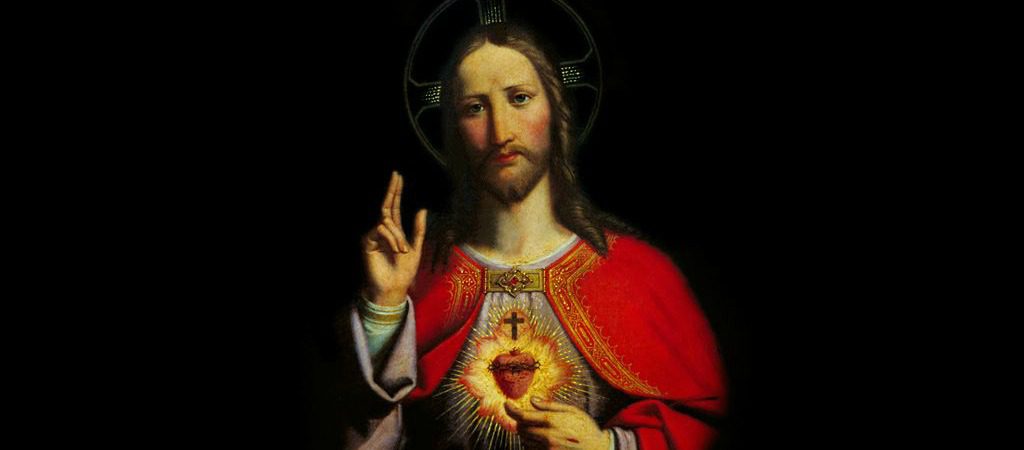
SacredHeartBlackBackground

Most Sacred Heart of Jesus, have mercy on us. (Source).

I happened upon this wonderful poem by one Frater Simeon Charles Goodwin, O.Praem., a seminarian at St. Michael’s Abbey. It’s always a delight to find good rhyming verse with a tightly-wound meterand rich theology to boot! Throughout the text, we can detect hints of Chesterton and, in the very last couplet, the sensual, baroque Richard Crashaw. I offer it here for your enjoyment on this solemnity of the Sacred Heart.

The Sacred Heart

    by Simeon Charles Goodwin, O.Praem.

There is a heart that beat with love
When time could mark no beat.
It echoed with a triple-pulse
And surged in thunders sweet.

Too happy not to overflow
It laughed and all was made.
It sighed and angel hosts came forth
In myriad parade.

It sang the seas and skies to be,
Hummed forth the rolling hills.
It beamed out beast and bird in love,
A sweet and mighty will.

It breathed into the mire and muck,
Sweet nothings to the earth;
And clay was made creation’s crown,
Man made with God’s own worth.

And how that heart did pound with peace
When he and man would walk
In silent love in evening winds
Too full of love for talk.

Oh man was glad and God was glad
And all creation too,
But man in madness pierced God’s heart
And rent the world in two.

There is a secret hideaway
Where cosmoi come to cry,
With atrium no bigger than
The needle’s narrow eye.

And there the mighty waters wait
To burst on arid wastes.
Men need but kiss the lance-made lips
To learn how sweet blood tastes.

Chesterton on Cheese

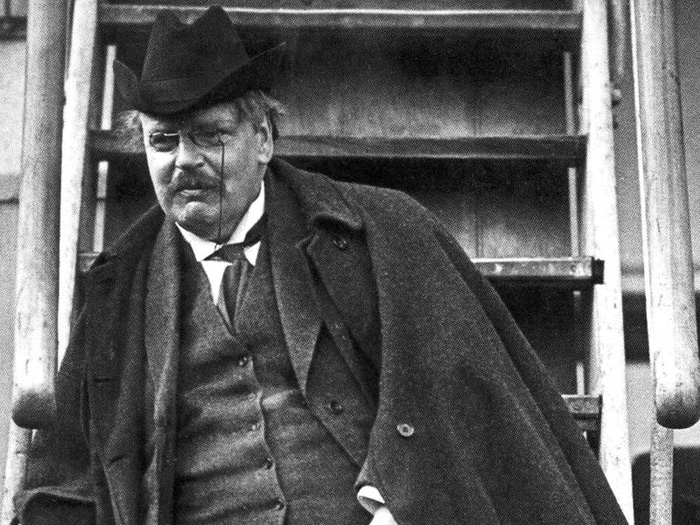
ChestertonCape

G.K. Chesterton died June 14, 1936. (Source).

In honor of the anniversary of his death, I reproduce for you here G.K. Chesterton’s marvelous essay, “Cheese.” I have taken the text from G.K. Chesterton Daily.

MY forthcoming work in five volumes, “The Neglect of Cheese in European Literature,” is a work of such unprecedented and laborious detail that it is doubtful if I shall live to finish it. Some overflowings from such a fountain of information may therefore be permitted to sprinkle these pages.  I cannot yet wholly explain the neglect to which I refer.  Poets have been mysteriously silent on the subject of cheese.  Virgil, if I remember right, refers to it several times, but with too much Roman restraint. He does not let himself go on cheese.  The only other poet I can think of just now who seems to have had some sensibility on the point was the nameless author of the nursery rhyme which says: “If all the trees were bread and cheese” — which is, indeed a rich and gigantic vision of the higher gluttony.  If all the trees were bread and cheese there would be considerable deforestation in any part of England where I was living.  Wild and wide woodlands would reel and fade before me as rapidly as they ran after Orpheus.  Except Virgil and this anonymous rhymer, I can recall no verse about cheese. Yet it has every quality which we require in exalted poetry. It is a short, strong word; it rhymes to “breeze” and “seas” (an essential point); that it is emphatic in sound is admitted even by the civilisation of the modern cities.  For their citizens, with no apparent intention except emphasis, will often say, “Cheese it!” or even “Quite the cheese.”  The substance itself is imaginative. It is ancient — sometimes in the individual case, always in the type and custom.  It is simple, being directly derived from milk, which is one of the ancestral drinks, not lightly to be corrupted with soda-water. You know, I hope (though I myself have only just thought of it), that the four rivers of Eden were milk, water, wine, and ale. Aerated waters only appeared after the Fall.

But cheese has another quality, which is also the very soul of song. Once in endeavouring to lecture in several places at once, I made an eccentric journey across England, a journey of so irregular and even illogical shape that it necessitated my having lunch on four successive days in four roadside inns in four different counties. In each inn they had nothing but bread and cheese; nor can I imagine why a man should want more than bread and cheese, if he can get enough of it.  In each inn the cheese was good; and in each inn it was different.  There was a noble Wensleydale cheese in Yorkshire, a Cheshire cheese in Cheshire, and so on. Now, it is just here that true poetic civilisation differs from that paltry and mechanical civilisation which holds us all in bondage. Bad customs are universal and rigid, like modern militarism. Good customs are universal and varied, like native chivalry and self-defence. Both the good and bad civilisation cover us as with a canopy, and protect us from all that is outside. But a good civilisation spreads over us freely like a tree, varying and yielding because it is alive.  A bad civilisation stands up and sticks out above us like an umbrella — artificial, mathematical in shape; not merely universal, but uniform. So it is with the contrast between the substances that vary and the substances that are the same wherever they penetrate. By a wise doom of heaven men were commanded to eat cheese, but not the same cheese.  Being really universal it varies from valley to valley. But if, let us say, we compare cheese with soap (that vastly inferior substance), we shall see that soap tends more and more to be merely Smith’s Soap or Brown’s Soap, sent automatically all over the world.  If the Red Indians have soap it is Smith’s Soap. If the Grand Lama has soap it is Brown’s soap.  There is nothing subtly and strangely Buddhist, nothing tenderly Tibetan, about his soap. I fancy the Grand Lama does not eat cheese (he is not worthy), but if he does it is probably a local cheese, having some real relation to his life and outlook.  Safety matches, tinned foods, patent medicines are sent all over the world; but they are not produced all over the world.  Therefore there is in them a mere dead identity, never that soft play of slight variation which exists in things produced everywhere out of the soil, in the milk of the kine, or the fruits of the orchard.  You can get a whisky and soda at every outpost of the Empire: that is why so many Empire-builders go mad.  But you are not tasting or touching any environment, as in the cider of Devonshire or the grapes of the Rhine. You are not approaching Nature in one of her myriad tints of mood, as in the holy act of eating cheese.

When I had done my pilgrimage in the four wayside public-houses I reached one of the great northern cities, and there I proceeded, with great rapidity and complete inconsistency, to a large and elaborate restaurant, where I knew I could get many other things besides bread and cheese.  I could get that also, however; or at least I expected to get it; but I was sharply reminded that I had entered Babylon, and left England behind.  The waiter brought me cheese, indeed, but cheese cut up into contemptibly small pieces; and it is the awful fact that, instead of Christian bread, he brought me biscuits.  Biscuits — to one who had eaten the cheese of four great countrysides!  Biscuits — to one who had proved anew for himself the sanctity of the ancient wedding between cheese and bread! I addressed the waiter in warm and moving terms.  I asked him who he was that he should put asunder those whom Humanity had joined. I asked him if he did not feel, as an artist, that a solid but yielding substance like cheese went naturally with a solid, yielding substance like bread; to eat it off biscuits is like eating it off slates. I asked him if, when he said his prayers, he was so supercilious as to pray for his daily biscuits.  He gave me generally to understand that he was only obeying a custom of Modern Society. I have therefore resolved to raise my voice, not against the waiter, but against Modern Society, for this huge and unparalleled modern wrong.