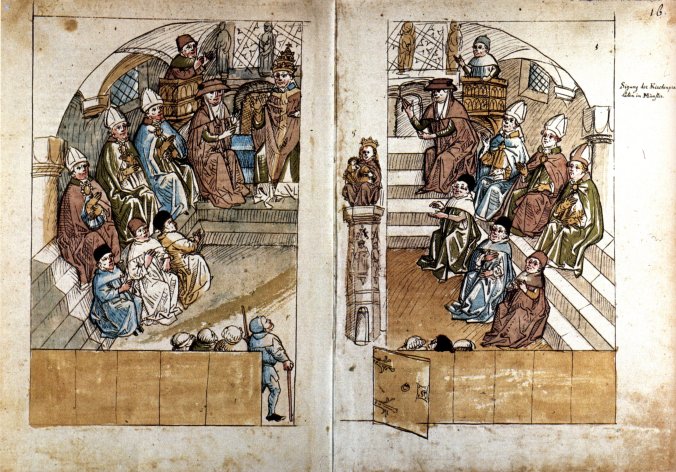
Scene from the Council of Constance, the Sixteenth Ecumenical Council (Source)
Over at Notre Dame’s Church Life Journal, there are two important pieces worth your time. The first, Dr. Taylor Patrick O’Neill’s “A Defense of Ultramontanism Contra Gallicanism,” is a theological analysis of the recent use of “ultramontanism” as a pejorative in Catholic discourse. Dr. O’Neill, a Neo-Thomist theologian, suggests that Ultramontanism is “the golden mean” by which to preserve a healthy and authentically Catholic respect for the Papacy. He writes:
But how does the historical usage of the term “ultramontane” hold any significance for us today? Given that the term arose as an insult against those who challenged the claims of Gallicanism, and given that those who championed papal primacy over local kings and bishops were legitimized at Vatican I, the term ought not to be associated with heterodoxy but rather orthodoxy.
To equate ultramontanism and orthodoxy is an extraordinary claim. While Dr. O’Neill recognizes that there are some excessively papalist versions of ultramontanism – a phenomenon he would prefer to call “super-ultramontanism” or “ultra-ultramontanism” – he fails to escape the very alienation from the term’s “historical significance” that he attempts to address.
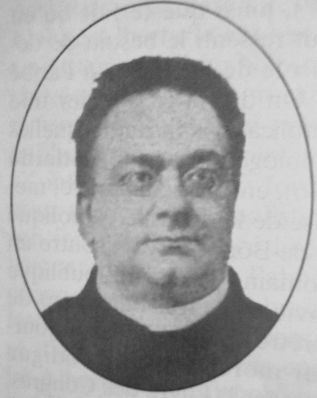
Umberto Benigni (1862-1934), Ultramontane church historian. (Source)
Take, for instance, his citation of Umberto Benigni’s article on “Ultramontanism” in the 1912 Catholic Encyclopedia. The passage O’Neill cites reads:
For Catholics it would be superfluous to ask whether Ultramontanism and Catholicism are the same thing: assuredly, those who combat Ultramontanism are in fact combating Catholicism, even when they disclaim the desire to oppose it.
If O’Neill had borrowed his words merely for a theological point, we might pass over the citation. But his is an historical judgment, not primarily a theological one. O’Neill doesn’t mention that Benigni is an out-dated, partisan, and sectarian Church historian whose article manifests those faults. It is hard to imagine any contemporary historian making much use of Benigni, whose other works include a volume entitled Ritual Murder Among the Jews (Belgrade, 1926-29).
Ultramontanism arose as a coherent and self-identified ecclesiological tendency under the pressures of post-Napoleonic Europe. While Papalism has always existed in the Church, the emergence of a self-consciously “Ultramontane” party before and after Vatican I was bound up with the Catholic response to modernity. And in some places – especially France – it was synonymous with less savory elements such as antisemitism. This fact alone hardly invalidates O’Neill’s theological point. But if we want to look at the term’s “historical significance,” I see little way to escape the actual history. “Historical significance” might just as well mean “connotations” as any sort of precise theological definition. O’Neill delimits ultramontanism by confining it to the realm of ideas as a functionally timeless truth. Yet he mires Gallicanism in the muck of human history. Ultramontanism is just the consistent teaching of the Church; Gallicanism, by contrast, is the small and fractious complaint of tendentious and self-interested minorities such as French kings and the Old Catholic schismatics. This discursive move may not be disingenuous, but it does set up a problematic historical imbalance. Ultramontanism is just as historically-conditioned as Gallicanism. Both involve something rather more than mere ideas – they enlisted social, political, and ecclesiastical movements, not always with very good results. And unfortunately, some of O’Neill’s history is simply incorrect.
At the same publication, the historian Dr. Shaun Blanchard’s “A Quasi-Defense of Gallicanism” provides some helpful correctives. It is a nuanced and well-argued piece (and well-sourced, too – Dr. Blanchard has seen fit to provide his readers with eight end-notes referring to reputable historical literature).
Against O’Neill’s suggestion that Gallicanism only arose after the Reformation, Blanchard correctly notes that the Medieval Conciliarist tradition most eloquently expressed by Jean Gerson (1368-1429) and the fathers of the Council of Constance (1414-18) provide ample groundwork for what would later be called “Gallicanism.” And Dr. Blanchard is right to point out that “Gallicanism” was never just one phenomenon, but a disparate tendency that crystallized into different forms of resistance to Papal centralization – not all of which were at play in Vatican I. Moreover, Blanchard correctly argues that, against Benigni and O’Neill’s interpretation, the Gallican minority at Vatican I preserved certain ecclesiological truths later vindicated by Vatican II. One could go on. Blanchard provides a great deal more historical background than O’Neill in support of his point.
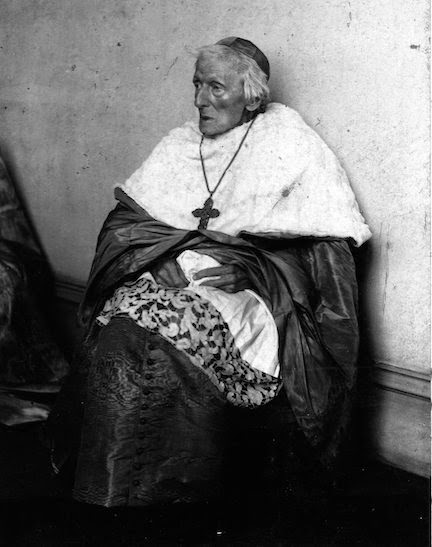
Cardinal Newman in his winter cappa. The man was no Ultramontanist. (Source)
Blanchard’s defense of Gallican thinkers such as Gerson, Bossuet, and Fleury is admirable. One could add to their names that of Cardinal Newman, whose soft-conciliarist ecclesiology earned the ire of ultramontanists like Cardinal Manning and W.G. Ward and Monsignor George Talbot, who famously wrote to Manning,
What is the province of the laity? To hunt, to shoot, to entertain? These matters they understand, but to meddle with ecclesiastical matters they have no right at all, and this affair of Newman is a matter purely ecclesiastical…Dr. Newman is the most dangerous man in England, and you will see that he will make use of the laity against your Grace.
None of this broader historical context appears in O’Neill’s piece. Perhaps it’s a little unfair to demand it, insofar as O’Neill is more interested in our contemporary debates than in the genealogy of the terms at play. But if we are to properly recognize “the historical significance” of ultramontanism, then we can’t really dodge the issue. If O’Neill is right to suggest that “the term ought not to be associated with heterodoxy but rather orthodoxy,” then men like Newman are beyond the pale of orthodoxy. And that seems like rather an impoverished vision of the Catholic intellectual life. I will conclude with Dr. Blanchard’s own measured words on the matter.
My point in this qualified defense of Gallicanism is not that we should “return” to Gallicanism, if such a thing were even possible. Neither must we equate ultramontanism with Catholic orthodoxy, simply because ultramontanes triumphed at Vatican I. Catholic orthodoxy is too big to be equated with either. The Catholic faith is big enough and dynamic enough to include what is good and true in ultramontanism and in Gallicanism, and likewise to reject what is harmful, false, or exaggerated in both.
Read them both.
 The Amish Catholic