Mea Culpa, Mea Culpa, Mea Scholastica Culpa

BlessedJohnDunsScotus

The Blessed John Duns Scotus (Source).

In my review of Rod Dreher’s The Benedict Option, I wrote the following:

I’m not suggesting that Dreher is necessarily wrong in his various judgments. He may well be correct in accusing the nominalists of a kind of cultural deicide (although it overlooks the Christian nominalist tendency, closely tied to empiricism, that numbers Berkeley, Burke, Hamann, Newman, and Chesterton among its ranks).

I subsequently received some pushback for making such a claim. After all, eminent philosophers and theologians had long made nominalism the villain of their narratives about the rise of an anti-Christian modernity. Others questioned my assertion about Newman in particular.

At that time, I defended myself by suggesting that, while I may be off in ascribing a specifically nominalist tendency to these thinkers, that nevertheless, they all do share, inter alia, a suspicion of universalizing abstraction, a respect for concrete particularity in its various forms, and a trust in prudence gained from experience. I interpreted this tendency as akin to the nominalist rejection of substantively existent universals. I also thought that one of the reasons this way of thinking might matter is in our dialogue with postmodernity, which is itself so suspicious of universals and grand narratives.

Nevertheless, I erred. I was mistaken to use that label of nominalism. I must thank my critics for pointing this out. In the many months since then, I have learned what would be the proper term to tie together these particular thinkers – not to mention Gerard Manley Hopkins and J.R.R. Tolkien.

The “nominalist tendency” is really a Scotist tendency. (The fact that I could make such an ironic error is, perhaps, a sign of my own ignorance. I own that. Scholasticism isn’t really my thing.) Chastened by my previous mistake, I hesitate to delve too deeply into the technical depths of Scotist philosophy. I will state briefly that a belief in the idea of haecceity as the unique thisness of each particular sums up the tendency’s core point. If I had time, I’d like to investigate if any firmer affinities could be found.

However, I believe I am now on much sounder territory. The Franciscan Daniel Horan’s work has focused on a postmodern engagement with Scotus, and the Scotism of Newman and Hopkins have been well-attested in the literature. Tolkien took up the theological note behind Hopkins’s ideas of inscape and instress, themselves poetic derivations of Scotist haecceity. More work still needs to be done in English on Hamann, but the image that is emerging is of a figure passionately devoted to the disruptive nature of ordinary, particular experience. His willingness to contest the established narratives of the Aufklärung predates postmodernism by a century and a half. Chesterton is cut from the same cloth. Bishop Berkeley, though perhaps not quite so colorful as either of these two, stakes his empiricism on the particularity of the thing perceived (ultimately, by God). And Burke transposes the idea into the realm of politics, tempered by a healthy respect for natural law.

Two observations come to mind. The first is that nearly all of these thinkers are English or Anglophone. An enquiry into the reasons behind English Scotism would be useful. In its absence, I will merely note that Scotus, that medieval Oxford theologian, seems to have been directly reintroduced into the life of modern English spirituality by another Oxford theologian, John Henry Newman. It was Newman’s influence that defined intellectual Catholicism in England until the conclusion of Vatican II.

The second is that several of these thinkers are literary figures in their own right. Hopkins is principally remembered as a poet, Chesterton as a journalist, novelist, and poet, and Tolkien as a novelist. Newman was a prolific writer across genres. He exerted a personal influence over Hopkins, Matthew Arnold, and Oscar Wilde. And Hamann’s own deeply bizarre output constantly blurs the rigid lines of 18th century drama (yet another way he foreshadows our own postmodern era).

I must wonder if Scotist thought is particularly apt for the production of theology in a poetic mode, as the Catholic Sophiologists of our own day are seeking to do. I certainly have friends who think so. At the very least, Scotus’s high Mariology accords well with the extremely high Mariology of some Sophiologists.

If I had more time, I should like to dive more deeply into these questions. For now, I seek only to explain myself a bit, and apologize for what was clearly a serious error.

ADDENDUM: I also meant to say that Delleuze’s appropriation of haecceity as a fundamental concept lends support to my own impulse of putting these thinkers in conversation with postmodernism.
A Theological Primer on Emblems

emblematasacravivo

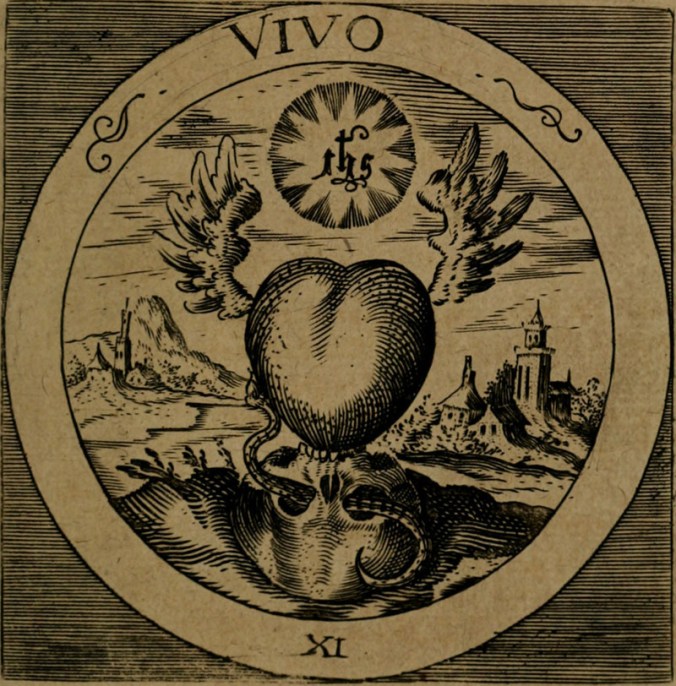
“I Live,” from the Emblemata Sacra (1618)

Of all the myriad forms of visual theology that draw upon the Western traditions of art history, perhaps no medium is quite as neglected as the emblem. The books that contained these small, symbolically rich images constituted a prolific genre in the early modern period. They had a fairly standard format. Usually, the emblems sat alongside a few moral or sacred verses in Latin, Greek, or a European language. Daniel Cramer’s Emblemata Sacra (1618), from which the image above was taken, is a good example of this polyglot tendency. On the verso, one can find a quatrain in Latin, German, French, and Italian, always connecting the symbolism of the emblem with a French and Italian verse of the Scriptures. On the recto, the emblem sits under the same verse, this time in Latin and German. The page concludes with an epigrammatic prayer in Latin.

It seems that emblem books were popular in early modern Europe. Mara R. Wade of the University of Illinois Urbana-Champaign writes, “In the preface to his Companion to Emblem Studies (2006) Peter Daly estimates that ca. 6,500 emblem books were published during the Renaissance, with an individual volume containing anywhere from 15 to 1,500 emblems.” Wikipedia lists no fewer than 54 representative titles, though there were certainly many more produced between 1500 and 1800 (as any cursory review of UIUC’s  Emblematica Online or the French Emblems at Glasgow archives can show). The fact that these books were often printed with multiple languages of text side by side suggests that they were documents with cross-cultural appeal. They were meant to speak not only to the elites who knew Latin, but also to the literate bourgeoisie. All of that makes their emergence as a genre at a time of religious strife even more remarkable.

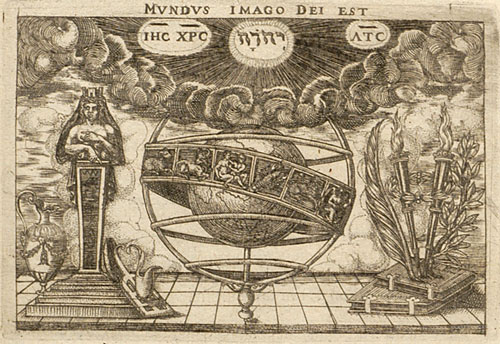
LeMondeLImagedeDieu

“Le Monde est L’Image de Dieu,” one of the more explicit expressions of esoteric philosophy, in Boissard’s Emblemes latins […] avec l’interpretation Francoise (1588). It anticipates Boehme’s De Signatura Rerum by nearly 40 years.

Of course, not all emblem books were targeted for mass appeal. Occult works often made rich use of emblems. The chief virtue of the emblem is its capacity of succinct complexity. It can communicate a lot by saying very little. It obscures by revealing; it hides by manifestation. As one source puts it, “Emblems are concise yet potent combinations of texts and images that invite, and require, decoding.” This makes the emblem the perfect vehicle for the esoteric proliferation of ideas. “He who has ears to hear, let him hear,” says the Lord. If He had come in the age of Gutenberg, perhaps He would have delivered His parables in emblem books. Of course, to say so is to implicitly claim Christ as a Protestant. Catholics did produce emblem books; indeed, one of the latest examples I have found is the 1780 French reprint of Dom Bonifaz Gallner’s earlier Regula Emblematica Sancti Benedicti. However, it would seem that the majority of important emblem books flowed from Protestant presses.

Michael-Maïer-Atalanta-Fugiens-1618-Emblème-XXI1-e1435998180296

Emblem XXI from the alchemical text Atalanta Fugiens (1617), by the Lutheran Rosicrucian Michael Maier

There is a good historical and aesthetic reason for this. The emblem functions by setting up a symbol or a system of symbols independent of any text. While text was sometimes used to elucidate the meaning of those symbolic networks, it was always secondary to the image itself. The emblem book is one of the last gasps of the primacy of image over text in European thought. Along with the Wunderzeichenbuchen, the emblem book is one of the main genres mobilized by Continental Protestants to rediscover a non-iconographic (and, to their mind, a non-idolatrous) use of image in moral and spiritual development. Instead of an image asserting its “auratic” power to the exclusion of text, the emblem book suggests a way that text and image can mutually illuminate each other. As Mara Wade writes, the emblem books engendered “a process of reciprocal reading of texts and images, whereby the back and forth between the words and the pictures creates meaning. The picture presents the reader with a recognizable scene or symbolic collage, and the text then reorients the reader’s understanding of that scene to present a new and unexpected message.” In this sense, the emblem book clearly partakes of a distinctly Humanist and Protestant heritage. Note again that emblem books were very often the chosen medium for the quasi-scientific magical teachings of the Rosicrucians and alchemists. Those strange laborers were also, in their own quixotic way, seeking to reclaim something of the sacramental worldview thrown away by the iconoclastic Reformers (see Henry 2015).

The triumph of discursive reason over image in the Enlightenment led to the decline of the emblem book as a genre (there are surely other reasons tied to shifting book markets, but my capacities to do research into textual history are limited at this time). After that, the record has been rather sparse. Hamann occasionally used emblems in his philosophical works. More recent theologians have largely overlooked the emblem book as a theological genre. The single counterexample I can readily think of is Valentin Tomberg’s Meditations on the Tarot, which can only count as an emblem book when we ignore its departures from the traditional form. Yet the renewal of esoteric Catholicism by reliably orthodox publishing houses like Angelico Press suggests that the emblem book may have a place in the theology of the future.

Its revival seems particularly apropos in an age when memes have become topics of serious political discourse, when visual self-representation has been amplified through various social media, and when new norms of communication emphasize brevity over detail. An epoch is defined, in large part, by the relation of its people to their media. The development of the printing press launched early modernity by helping to bring about new conceptions of subjectivity, as well as new questions about the relationship of text and image. Consequently, the emblem book arose to grapple with some of those questions. The next great civilizational step in communication arrived with the internet, accompanying nascent postmodernity. Perhaps we shall see a revival of the emblem book for theologians to navigate this “brave new world.”