I am for the most part uninterested in the internal politics of ACNA. I have friends in that communion, and after all, it is neither my circus nor my monkeys. I am, however, keenly interested in the issue at stake: what kinds of language sexual-minority Christians use, why, and what this says about their broader place within Christianity. Especially as some of these same issues have come up repeatedly in the Catholic context as well. That relevance to my own situation moves me to write, when I might otherwise keep silence.
When the original statement came out last month (no pun intended), a gay Christian friend of mine wrote, “I am starting to think that this tired conversation about sexual identity language is actually *designed* to keep the Church from caring for sexual minorities by addressing its pervasive homophobia.” Much of what follows therefore comes from what I wrote in reply, with a few edits and additions here and there.
It seems to me that this debate about language – the alleged moral valences of words like “homosexual” or “gay,” and whether or not it is appropriate for Christians to self-identify with these words – serves a multipronged function:
(3) It puts the entire onus of subjectivity-formation on the gay Christian individual and thus places them in a defensive posture which prevents them from making further demands. It does this in three ways:
(4) It deprives them of a language in which to articulate their own subjectivity and needs.
(5) It isolates them by preventing them from using the language by which they can form bonds of solidarity with other sexual minorities.
(6) It further isolates them by cutting them off from the history of other sexual minorities, whatever terms they may have used (sodomites, inverts, homosexuals, fairies, queers, gays, LGBT, etc.).
(7) All of which is to say, the debate mainly functions to control sexual minority Christians by making their own experience more and more illegible to them.
(8) It works very well because it exhausts a lot of emotional energy from LGBTQ+ Christians. This is intrinsic to the debate’s function as a mechanism of control.
(9) It is doubly effective when, as in the ACNA document, it reverts to the most clinical and pathologized language imaginable. “Christians afflicted with” or “who struggle with same-sex attraction” is not only unwieldy, it’s obviously stigmatizing. SSA might as well be leprosy.
(10 This is not to say that gay Christians who feel that the language of “same-sex attraction” or SSA best expresses their experience shouldn’t use it. We should all use the language that best fits our own embodied story. But when straight Christians use it this way, they are robbing them of the freedom to make that decision for themselves.
(13) The most insidious thing about the ACNA statement, though, isn’t even the matter of terminology. It’s the deeper point from which the terminological discussion grew: a claim that homosexuals can become straight again.
(14) If this were coming from an old-school queer theorist or even second-wave feminist who insisted on the radical flexibility of gender and sexuality, I wouldn’t have too much of an issue. But the obvious problem here is the latent moral imperative that moves from is to ought (also the erasure of bisexuals, but that’s a bit of a tangent).
(15) Going from “some people can move between kinds of attraction” to “you must become attracted to the opposite sex,” as this document does implicitly, is an awful lapse into conversion-therapy thinking. And we know how harmful this is, especially to queer youth.
(16) But this pathologization is itself, once again, a mechanism of control. Religions are social bodies that require adherents in order to survive. And like it or not, gays have historically been a major part of the Christian fold – including in Anglicanism!
(17) The reasoning advanced by ACNA is thus, quite precisely, an ideology. It is a logic that helps the oppressed buy into their own oppression. They are hardly unique in this; many in our own Church of Rome offer the same false narrative for the same ends.
(18) I would like to end this thread on a hopeful note, though I have very little hope to speak of. The best I can say is that LGBT Christians need to make their own communities. We need to use the terms that best express our own subjectivity. This is quite apart from the issue of sexual ethics, which does not hinge on what we call ourselves.
(19) Straight Christians, including Catholics, should accept that we are going to use the terms that we choose. It is not up to them. Their time would be better spent helping on the very urgent issues I outlined earlier. And maybe trying to understand what it’s like for (Christian) sexual minorities in the Church and in society at large.
(20) Finally – the best thing to help on the issues of terminology is for sexual-minority Christians, where it is safe to do so, to come out. Even clergy. Articulating your own experience is truly liberating, even as it opens up a new vulnerability. But freedom is worth it. Honesty is worth it. Visibility is worth it. Life is worth it.
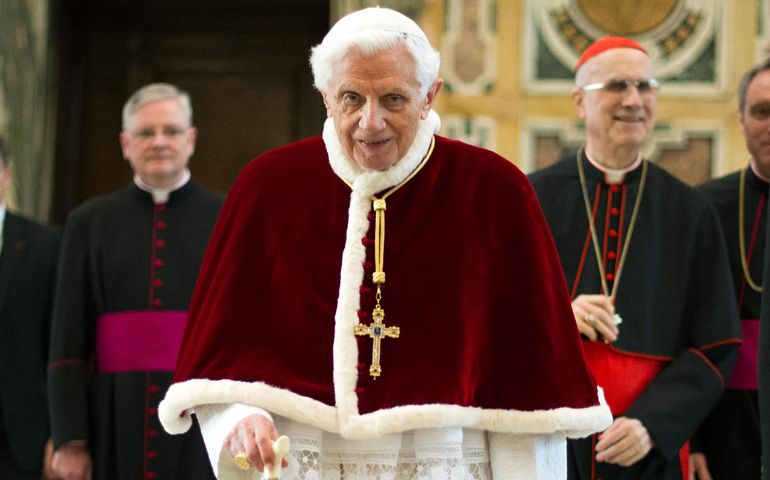
The Pope-Emeritus’s letter was a deeply unhelpful document on the whole. (Source)
In the ongoing sexual abuse crisis that has wracked the Roman Catholic Church, it is helpful to remember that the evil transpires on both spiritual and historical planes. That is to say, we can productively speak of sexual abuse as a spiritual attack upon the Church’s absolute purity, a purity she receives from Christ, her spouse and head. The violations committed by priests and religious is a stain upon that purity but nevertheless leaves the fundamental holiness of the Church intact. And this because the Church has no holiness that is not primarily the holiness of Jesus. All that is good in her flows from Him.
However, we can maintain this truth while simultaneously recognizing deep underlying structural problems in the Church’s culture and modus operandi. The holiness of the Church comes from above, not below; in the course of human history, we have often seen great evils nurtured within the very breast of the Church as a human institution. The sex abuse crisis is one such horror. Only a realistic attitude can bring us the reform that we so desperately need.
It’s because of this that I was disappointed to read Benedict XVI’s recent letter on the subject. There are certain passages that show the Pope-Emeritus’s continuing theological acumen. He writes movingly about the primacy of Faith, especially Faith in the Blessed Sacrament, as a foundational principle of renewal in our time. He also calls for a deeper ecclesial sensibility among the faithful. Catholics should meditate on these passages, which have a good deal of insight and even consoling power. His words on martyrdom are particularly profound and poignant, given his own impending mortality.
However, as a response to the egregious crimes committed by priests and other clerical personnel against innocents, the document represents a major failure.
This letter is a turgid, historically specious bit of sleight of hand. In treating the abuse crisis as a problem of laxity in moral teaching, the Pope turns sex abuse into a theological problem. He is closer to the heart of things when he discusses the evolution of the disciplinary measures in Canon Law and the various difficulties thrown up by legal “reforms” in the middle of the century. However, he also dissolves the very real psychological and social factors that permitted a culture of tolerance for pedophilia within the church to flourish for so long. Ratzinger writes, “Why did pedophilia reach such proportions? Ultimately, the reason is the absence of God.” This is, strictly speaking, a spiritual truth. Had the Pope-Emeritus treated this as a statement about the souls of the pedophiles, for whom God must be in some way ultimately unreal, the statement would be entirely defensible. However, Ratzinger is speaking historically. He immediately seems to attribute to the spread of pedophilia to secularization in Europe.
After the upheaval of the Second World War, we in Germany had still expressly placed our Constitution under the responsibility to God as a guiding principle. Half a century later, it was no longer possible to include responsibility to God as a guiding principle in the European constitution. God is regarded as the party concern of a small group and can no longer stand as the guiding principle for the community as a whole.
Joseph Ratzinger
The problem is relativism – namely, secular relativism as an other, as something outside the life of the Church. We read, “The long-prepared and ongoing process of dissolution of the Christian concept of morality was…marked by an unprecedented radicalism in the 1960s.” According to the Pope, “Part of the physiognomy of the Revolution of ‘68 was that pedophilia was then also diagnosed as allowed and appropriate…It was theorized only a short time ago as quite legitimate, but it has spread further and further.” He takes the cause of recent pedophilia, and thus of the scandals within the Church, to be the sexual revolution.
But apart from Gayle Rubin, the filmmakers who got Jodie Foster and Brooke Shields naked, and the perverts at NAMBLA, who exactly were the people trying to normalize pedophilia? C.C. Pecknold suggests it might be those activists in favor of “abolishing age-of-consent laws since the 1970s.” Possibly. At any rate, the Pope provides neither names nor sources. It’s a serious enough claim that he owes us that courtesy. To what extent were these efforts merely marginal phenomena? He seems to take them as a synecdoche of the broader movement, however implausibly.
By appealing to an established right-wing boogeyman (sixties revolutionaries), he dissolves the problem into a theological haze. He makes no mention of the complex psychological reasons for abuse, simply posits that relativism leads to sexual license. Nor does he prove any causes to tie together his case studies. He just asserts that various phenomena are connected without supplying proof. Given the genre of the piece, perhaps this brevity is to be expected. But is this schema really representative of Ratzinger’s mentality as he handled sex abuse cases in his tenure as head of the CDF and, later, as Pope? If so, no wonder things were so long mismanaged and so often minimized. Sex abuse is not a matter of which moral theologians you’re reading, and to treat it as such is profoundly irresponsible.
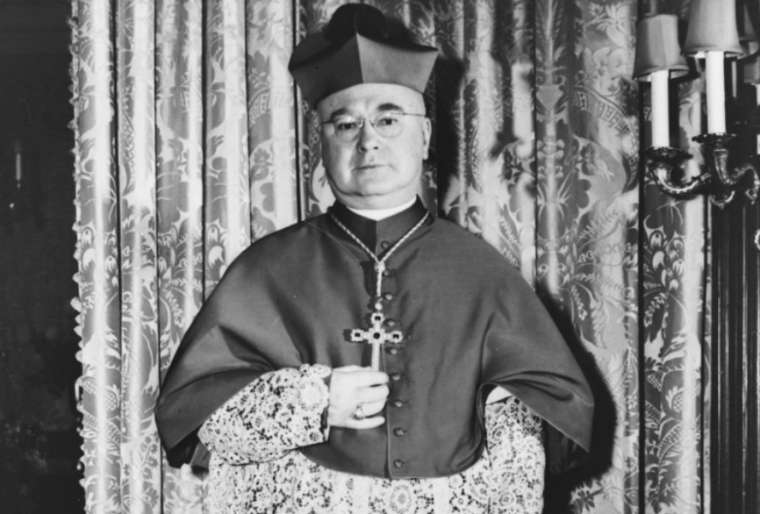
Francis Cardinal Spellman of New York, a voracious, predatory, and hypocritical homosexual who fostered a culture of abuse in his diocese in the 1950’s. Reports of him groping a West Point cadet during an interview have recently emerged. (Source)
The fact that Francis asked Benedict to prepare this statement suggests to me that it represents an attempt by both Popes to shoot the elephant (and scapegoat) in the room, namely, the homosexuality of the clergy. This phenomenon has become the cause célèbre of conservative and traditional Catholics trying to understand the sex abuse crisis. It has also been recently highlighted in a largely credible if somewhat sensationalist way by the gay activist Frédéric Martel, whose book on clerical homosexuality Catholics should read (if with a grain of salt). Too sharp a focus on homosexuality (a) doesn’t actually solve the problem of clerical sex abuse and (b) is too dangerous for all ideological camps (no pun intended) within the clerical establishment. Ratzinger’s letter here shifts the focus away from that particular systemic and more or less quantifiable phenomenon and onto an amorphous if politically-charged abstract. While I can’t be sure, the missive seems to be designed to influence Ratzinger’s own partisans and lead them away from the gay issue.
After all, the one narrative that Ratzinger doesn’t tell us is the one most favored by conservatives. Namely, as Pecknold puts it, “by the late 1980s the homosexual hierarchies that ruled now were descending, with greater frequency, into pedophilia.” But this is not what the Pope writes. In a passage worth quoting at length, Ratzinger tells us,
In various seminaries homosexual cliques were established, which acted more or less openly and significantly changed the climate in the seminaries. In one seminary in southern Germany, candidates for the priesthood and candidates for the lay ministry of the pastoral specialist [Pastoralreferent] lived together. At the common meals, seminarians and pastoral specialists ate together, the married among the laymen sometimes accompanied by their wives and children, and on occasion by their girlfriends. The climate in this seminary could not provide support for preparation to the priestly vocation. The Holy See knew of such problems, without being informed precisely. As a first step, an Apostolic Visitation was arranged of seminaries in the United States. As the criteria for the selection and appointment of bishops had also been changed after the Second Vatican Council, the relationship of bishops to their seminaries was very different, too. Above all, a criterion for the appointment of new bishops was now their “conciliarity,” which of course could be understood to mean rather different things. Indeed, in many parts of the Church, conciliar attitudes were understood to mean having a critical or negative attitude towards the hitherto existing tradition, which was now to be replaced by a new, radically open relationship with the world. One bishop, who had previously been seminary rector, had arranged for the seminarians to be shown pornographic films, allegedly with the intention of thus making them resistant to behavior contrary to the faith. There were — not only in the United States of America — individual bishops who rejected the Catholic tradition as a whole and sought to bring about a kind of new, modern “Catholicity” in their dioceses. Perhaps it is worth mentioning that in not a few seminaries, students caught reading my books were considered unsuitable for the priesthood. My books were hidden away, like bad literature, and only read under the desk. The Visitation that now took place brought no new insights, apparently because various powers had joined forces to conceal the true situation. A second Visitation was ordered and brought considerably more insights, but on the whole failed to achieve any outcomes. Nonetheless, since the 1970s the situation in seminaries has generally improved. And yet, only isolated cases of a new strengthening of priestly vocations came about as the overall situation had taken a different turn.
Joseph Ratzinger
That first line is the only explicit reference to homosexuality in the entire letter. In his his forceful First Things follow-up, Archbishop Chaput confirms this point:
He remains silent on what many see as the continuing resistance of Rome to candidly name the core issue of the clergy abuse problem, which is not primarily a matter of clerical privilege but rather a pattern of predatory homosexuality.
Archbishop Charles Chaput
Ratzinger is quick to move from the various gay circles among the seminarians of yesteryear to the presence of women in seminaries, and then on to theological liberalism in general. This is not the argument, put forward by so many, that homosexuality in the priesthood leads to sex abuse. It’s a broader case, one that sees homosexuality as only one part in a constellation of radicalism.
And it’s a radicalism that emphatically has its origins outside of the Church. Archbishop Chaput builds on Benedict, writing,
But priests and bishops have no miraculous immunity to the abnormality bubbling around them. Ratzinger locates the seed of the current crisis in the deliberate turn toward sexual anarchy that marked much of Europe in the 1960s, and the complete failure of Catholic moral theologians to counter it—a failure that more often resembled fellow-traveling.
Archbishop Charles Chaput
This is nothing less than an abdication of moral responsibility. The 1960’s did not produce pedophilia, ephebophilia, or the longstanding culture of omertà among the hierarchy (see the extensive research carried out by, inter alia, Richard Sipe). Indeed, predatory sexuality has been in the Church for a long time. I refer the reader to the cultures created by Cardinal Spellman in New York, Cardinal O’Connell in Boston, and Cardinal Wright in Worcester. The permissiveness in these dioceses was in place before the sexual revolution hit, and in each we see major flare-ups of the child sex abuse crisis. We could look back even further. There were pedophiles in the circle of St. Joseph Calasanz, and he died in 1648!
The cover-up, too, has a long life. As Ulrich Lehner has pointed out, the old practice used to be that religious orders had to destroy any incriminating files every five years; the use of special prisons for clergy and religious only added to the secrecy of the early modern ecclesiastical disciplinary apparatus. All of these points undermine the basic historical narrative Ratzinger tells us – namely, that the sexual revolution and subsequent buckling of Catholic moral theology lead to a simultaneous spread of pedophilia and a complete failure of the ecclesiastical establishment to respond.
One of the less edifying elements in the letter is that Ratzinger took the time to engage in subtle if unmistakeable academic score-settling throughout. Speaking of an ethicist he disagreed with, Ratzinger writes,
I shall never forget how then-leading German moral theologian Franz Böckle, who, having returned to his native Switzerland after his retirement, announced in view of the possible decisions of the encyclical Veritatis splendor that if the encyclical should determine that there were actions which were always and under all circumstances to be classified as evil, he would challenge it with all the resources at his disposal. It was God, the Merciful, that spared him from having to put his resolution into practice; Böckle died on July 8, 1991.
Joseph Ratzinger
Leaving aside the question of whether Böckle was right (and he wasn’t), the slight chuckle with which Benedict describes his death is extraordinarily petty. What a tawdry, sorry, cynical intervention from the ailing pontiff.
The letter fails in its description of the sources of pedophilia and ephebophilia. Yet at least Ratzinger attempts to make a case for why the priesthood has seen such widespread sexualization, with such prominent lapses, over the course of the last few decades. His letter does not, however, address the cover-up at all. If anything, he seems to end the letter on a rather troubling note:
Today, the accusation against God is, above all, about characterizing His Church as entirely bad, and thus dissuading us from it. The idea of a better Church, created by ourselves, is in fact a proposal of the devil, with which he wants to lead us away from the living God, through a deceitful logic by which we are too easily duped. No, even today the Church is not just made up of bad fish and weeds. The Church of God also exists today, and today it is the very instrument through which God saves us.
Joseph Ratzinger
I suppose that, on the spiritual level, the Pope is not wrong here. But it does rather seem to me that he is perhaps too concerned with the reputation of the Church – a holy body, yes, but also one riddled with both sexual predators and the venal men who protect them. In trying to end on a hopeful message, the Pope sounds a false note. He seems to have erased the mysterium iniquitatis. The effect is one of minimization of grave evil rather than a proper and reforming zelus domus Domini.
Yet the most frustrating feature of this letter, beyond its occasional historical errors and indulgence in the petty sparring of academia, is that it feeds into a narrative that conservative Catholics have used for years to exonerate themselves in the sex abuse crisis. That narrative chalks up clerical sex abuse to post-conciliar laxity alongside the sexual revolution. If only, these conservatives and traditionalists say, if only we hadn’t gone off the rails in 1968. Sex abuse becomes the exclusive property of ecclesiastical liberals.
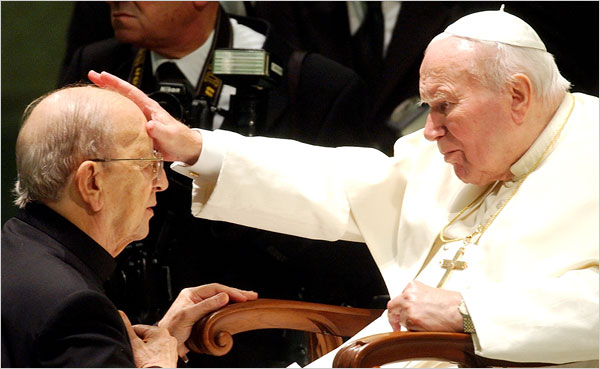
Fr. Marcial Maciel and Pope St. John Paul II, who admired and protected the Mexican sexual predator for years. (Source)
But this is a false narrative. It’s a lie – a half-truth, perhaps, but still a lie – that conceals the suffering of victims prior to that age as well as all those who have suffered abuse at the hands of conservative and traditionalist clergy. Men for whom the Revolution did not transpire. There are many examples of this kind of thing. One only needs to point to Marcial Maciel, Carlos Urrutigoity, Tony Anatrella, Fernando Karadima…the list goes on. None of these men were liberals. Some worked closely with John Paul II and Benedict XVI. Yet the narrative in this letter cheapens the experience of their victims and lulls conservatives and traditionalists into a false sense of self-righteous security – exactly the opposite of what we need if we are ever to get a handle on the problem of clerical sex abuse wherever it should rear its ugly head. It’s a narrative that helps us look the other way as more and more innocents get hurt. And it’s gravely irresponsible for the Pope-Emeritus to propagate this lie.
I’m working on a big blog post that’s running rather long. In the meantime, I wanted to refer two posts that, although different in some ways, have a common center.
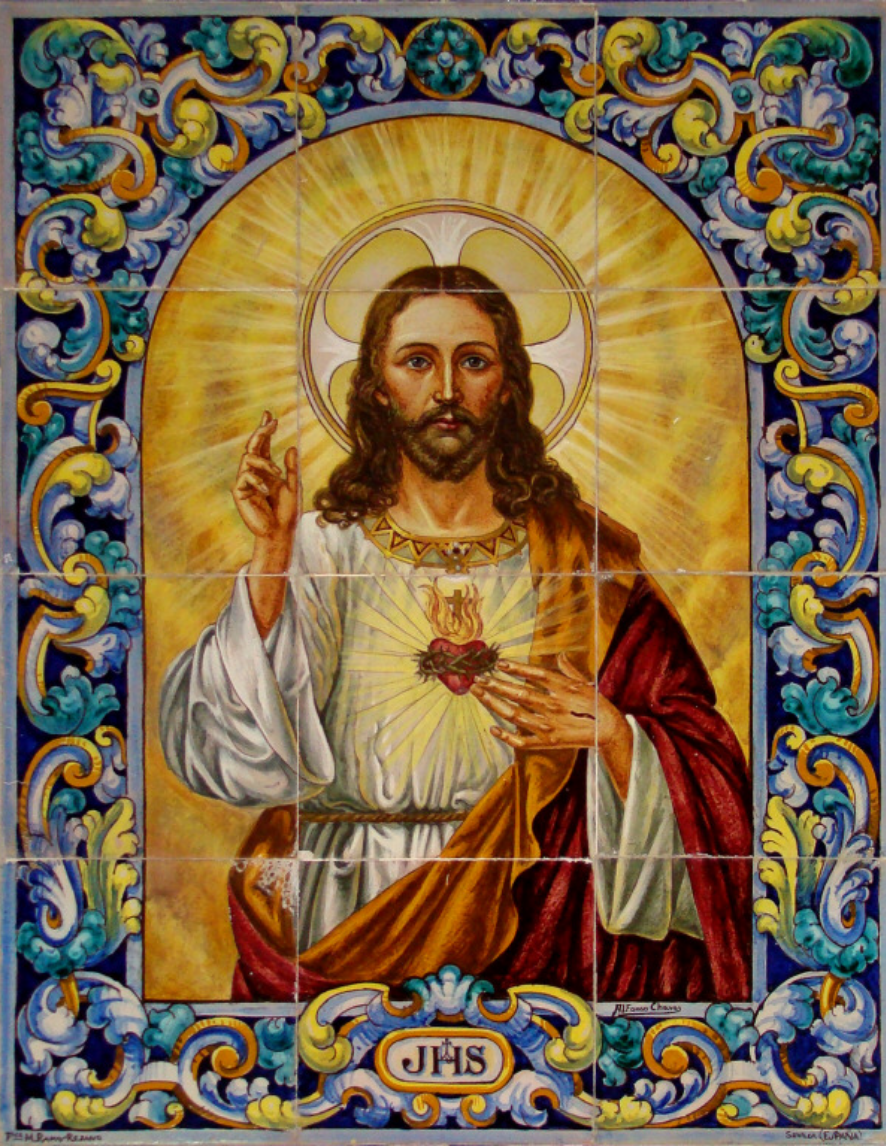
The first is a little old, though I rather sheepishly confess I only just read it. John Monaco has a very good post over at Inflammate Omnia on how the Sacred Heart devotion can help those struggling with mental illness. John goes over the history of the scrupulous, doubtful view of God’s love, most egregiously enshrined in the heresy of Jansenism. But he also looks at the ways that the Sacred Heart can lead those who suffer from scrupulosity and obsessive-compulsive disorder to approach a healthier, more accurate relationship with God.
The second is from an acquaintance of mine named Patrick McCoy who is both a fairly traditional Catholic and same-sex attracted. Over at his blog, O Crux Ave, he relates his recent experience engaging in street evangelism at St. Louis PrideFest, where he led a small team with the goal of sharing the Love of God with the LGBT community. Appropriately enough, he calls this ministry #SacredHeartLoves Outreach.
Although the two posts deal with different topics, together they form a kind of diptych about the Sacred Heart. Both are honest, even vulnerable personal narratives. Both proclaim the unconditional Love of God for stigmatized groups: the mentally ill and sexual minorities. Thus, both are fitting to read on this first Friday of July, the month of the Precious Blood of Jesus, spilled for all mankind.
As I mentioned in my last post, during the month of August, I am dedicating myself to daily acts of creativity in honor of Mary’s Immaculate and Sophianic Heart. As Providence would have it, the Holy Father’s intentions for August include prayers for artists. Thus, I’m going to make my blog especially aesthetic for the rest of the month.
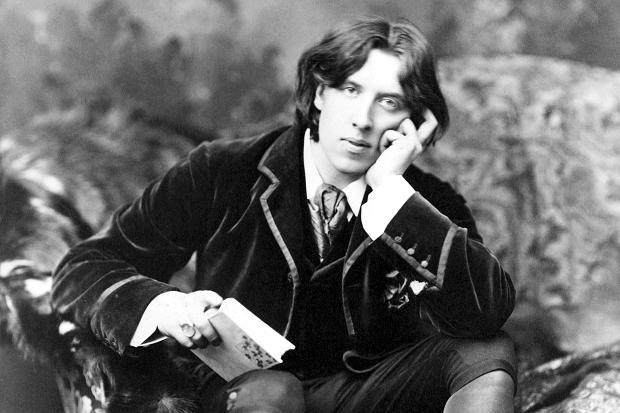
And what better way to start than examining work by one of the modern era’s great philosophers of art, Oscar Wilde? It is not often remembered today that Oscar Wilde was a Catholic. True, he was only formally received on his death bed. But Wilde maintained a lifelong flirtation with the faith. Catholicism infused his imagination from very early on in his productive career. When he was a student at Oxford, he visited Rome and wrote quasi-Catholic poetry that even Cardinal Newman admired.In some of the work, the influence of Dante is manifest.The aesthetics and romance of Catholicism appealed to Wilde, and he was nearly converted by Fr. Sebastian Bowden of the London Oratory. Only much later did he definitively turn to the Lord, in his last hour.However, many members of his circle also converted…a topic I shall, perhaps, explore some other day.
Ave Maria Gratia Plena
Was this His coming! I had hoped to see
A scene of wondrous glory, as was told
Of some great God who in a rain of gold
Broke open bars and fell on Danae:
Or a dread vision as when Semele
Sickening for love and unappeased desire
Prayed to see God’s clear body, and the fire
Caught her white limbs and slew her utterly:
With such glad dreams I sought this holy place,
And now with wondering eyes and heart I stand
Before this supreme mystery of Love:
A kneeling girl with passionless pale face,
An angel with a lily in his hand,
And over both with outstretched wings the Dove.
Sonnet on Approaching Italy
I reached the Alps: the soul within me burned
Italia, my Italia, at thy name:
And when from out the mountain’s heart I came
And saw the land for which my life had yearned,
I laughed as one who some great prize had earned:
And musing on the story of thy fame
I watched the day, till marked with wounds of flame
The turquoise sky to burnished gold was turned,
The pine-trees waved as waves a woman’s hair,
And in the orchards every twining spray
Was breaking into flakes of blossoming foam:
But when I knew that far away at Rome
In evil bonds a second Peter lay,
I wept to see the land so very fair.
Urbs Sacra Æterna
Rome! what a scroll of History thine has been
In the first days thy sword republican
Ruled the whole world for many an age’s span:
Then of thy peoples thou wert crownèd Queen,
Till in thy streets the bearded Goth was seen;
And now upon thy walls the breezes fan
(Ah, city crowned by God, discrowned by man!)
The hated flag of red and white and green.
When was thy glory! when in search for power
Thine eagles flew to greet the double sun,
And all the nations trembled at thy rod?
Nay, but thy glory tarried for this hour,
When pilgrims kneel before the Holy One,
The prisoned shepherd of the Church of God.
Sonnet on Hearing the Dies Irae Sung in the Sistine Chapel
Nay, Lord, not thus! white lilies in the spring,
Sad olive-groves, or silver-breasted dove,
Teach me more clearly of Thy life and love
Than terrors of red flame and thundering.
The hillside vines dear memories of Thee bring:
A bird at evening flying to its nest
Tells me of One who had no place of rest:
I think it is of Thee the sparrows sing.
Come rather on some autumn afternoon,
When red and brown are burnished on the leaves,
And the fields echo to the gleaner’s song,
Come when the splendid fulness of the moon
Looks down upon the rows of golden sheaves,
And reap Thy harvest: we have waited long.
Holy Week at Genoa
I wandered through Scoglietto’s far retreat,
The oranges on each o’erhanging spray
Burned as bright lamps of gold to shame the day;
Some startled bird with fluttering wings and fleet
Made snow of all the blossoms; at my feet
Like silver moons the pale narcissi lay:
And the curved waves that streaked the great green bay
Laughed i’ the sun, and life seemed very sweet.
Outside the young boy-priest passed singing clear,
‘Jesus the son of Mary has been slain,
O come and fill His sepulchre with flowers.’
Ah, God! Ah, God! those dear Hellenic hours
Had drowned all memory of Thy bitter pain,
The Cross, the Crown, the Soldiers and the Spear.
San Miniato
See, I have climbed the mountain side
Up to this holy house of God,
Where once that Angel-Painter trod
Who saw the heavens opened wide,
And throned upon the crescent moon
The Virginal white Queen of Grace,–
Mary! could I but see thy face
Death could not come at all too soon.
O crowned by God with thorns and pain!
Mother of Christ! O mystic wife!
My heart is weary of this life
And over-sad to sing again.
O crowned by God with love and flame!
O crowned by Christ the Holy One!
O listen ere the searching sun
Show to the world my sin and shame.
Madonna Mia
A lily-girl, not made for this world’s pain,
With brown, soft hair close braided by her ears,
And longing eyes half veiled by slumberous tears
Like bluest water seen through mists of rain:
Pale cheeks whereon no love hath left its stain,
Red underlip drawn in for fear of love,
And white throat, whiter than the silvered dove,
Through whose wan marble creeps one purple vein.
Yet, though my lips shall praise her without cease,
Even to kiss her feet I am not bold,
Being o’ershadowed by the wings of awe.
Like Dante, when he stood with Beatrice
Beneath the flaming Lion’s breast, and saw
The seventh Crystal, and the Stair of Gold.
E Tenebris
Come down, O Christ, and help me! reach thy hand,
For I am drowning in a stormier sea
Than Simon on thy lake of Galilee:
The wine of life is spilt upon the sand,
My heart is as some famine-murdered land,
Whence all good things have perished utterly,
And well I know my soul in Hell must lie
If I this night before God’s throne should stand.
‘He sleeps perchance, or rideth to the chase,
Like Baal, when his prophets howled that name
From morn to noon on Carmel’s smitten height.’
Nay, peace, I shall behold before the night,
The feet of brass, the robe more white than flame,
The wounded hands, the weary human face.
At Verona
How steep the stairs within Kings’ houses are
For exile-wearied feet as mine to tread,
And O how salt and bitter is the bread
Which falls from this Hound’s table,–better far
That I had died in the red ways of war,
Or that the gate of Florence bare my head,
Than to live thus, by all things comraded
Which seek the essence of my soul to mar.
‘Curse God and die: what better hope than this?
He hath forgotten thee in all the bliss
Of his gold city, and eternal day’–
Nay peace: behind my prison’s blinded bars
I do possess what none can take away,
My love, and all the glory of the stars.
On the Massacre of the Christians in Bulgaria
Christ, dost Thou live indeed? or are Thy bones
Still straitened in their rock-hewn sepulchre?
And was Thy Rising only dreamed by her
Whose love of Thee for all her sin atones?
For here the air is horrid with men’s groans,
The priests who call upon Thy name are slain,
Dost Thou not hear the bitter wail of pain
From those whose children lie upon the stones?
Come down, O Son of God! incestuous gloom
Curtains the land, and through the starless night
Over Thy Cross a Crescent moon I see!
If Thou in very truth didst burst the tomb
Come down, O Son of Man! and show Thy might
Lest Mahomet be crowned instead of Thee!
Queen Henrietta Maria
In the lone tent, waiting for victory,
She stands with eyes marred by the mists of pain,
Like some wan lily overdrenched with rain:
The clamorous clang of arms, the ensanguined sky,
War’s ruin, and the wreck of chivalry,
To her proud soul no common fear can bring:
Bravely she tarrieth for her Lord the King,
Her soul a-flame with passionate ecstasy.
O Hair of Gold! O Crimson Lips! O Face
Made for the luring and the love of man!
With thee I do forget the toil and stress,
The loveless road that knows no resting place,
Time’s straitened pulse, the soul’s dread weariness,
My freedom and my life republican!
On Easter Day
The silver trumpets rang across the Dome:
The people knelt upon the ground with awe:
And borne upon the necks of men I saw,
Like some great God, the Holy Lord of Rome.
Priest-like, he wore a robe more white than foam,
And, king-like, swathed himself in royal red,
Three crowns of gold rose high upon his head:
In splendor and in light the Pope passed home.
My heart stole back across wide wastes of years
To One who wandered by a lonely sea,
And sought in vain for any place of rest:
“Foxes have holes, and every bird its nest,
I, only I, must wander wearily,
And bruise My feet, and drink wine salt with tears.”
Wilde did just that until he lost his duel with the wallpaper on November 30th, 1900. But having received the last rites of the Church, perhaps he is already in heaven as a saint. One can only imagine what he would think of his portrait bedecked with a golden halo.
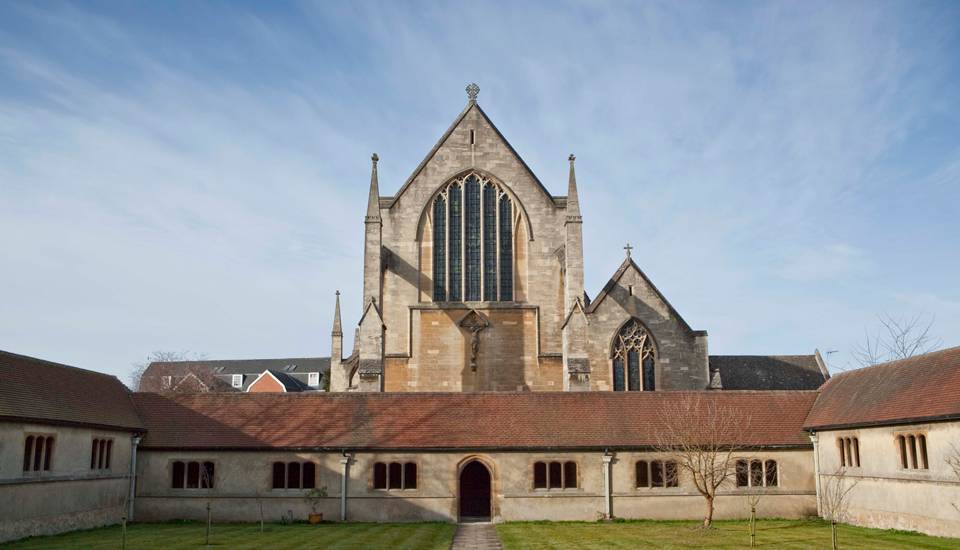
This won’t come as a surprise to those of you who know me personally, but in the interest of honesty, archiving, and my own historical interests, I thought I’d post here that I have decided to attend the University of Oxford next year in pursuit of an M.Phil. in Theology, with a concentration in Ecclesiastical History. I will be living at St. Stephen’s House.
The coat of arms of St. Stephen’s House. It incorporates elements of the coat of arms of its founder, Bishop Edward King. (Source)
I’m very happy to be at St. Stephen’s. It is the Anglo-Catholic seminary in Oxford. I am guaranteed to be around people who are seeking ordination in the Church of England. And very high Anglo-Catholics at that. I’m really looking forward to morning and evening prayer every day. While it may not be the prayer of the whole Church in the Divine Office, the Book of Common Prayer is nevertheless a fine, beautiful way to pray and meditate on Scripture in community. I also think that the liturgical rhythms of life at “Staggers,” as it’s called, will be salutary on the whole. It’s even motivated me to try to memorize a few of the old collects, as Peter Hitchens demonstrates in this debate.
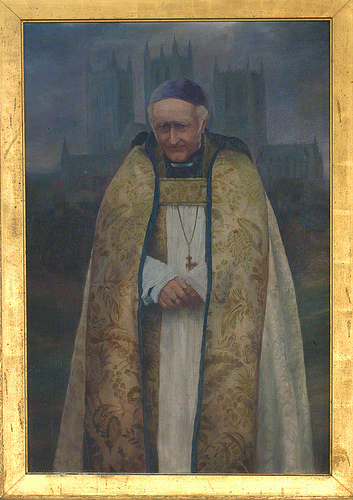
While I realize it has changed a great deal over time, the history of St. Stephen’s House is one of the reasons I’m happy to be here. It may not be one of the well-known colleges (it doesn’t even seem to have very much merchandising in the way of scarves, ties, pins, cufflinks, etc., like all the other ones). But Staggers did play its part in the history of Anglo-Catholicism. Founded by Bishop Edward King of Lincoln in 1876, the house soon became a major center of Anglo-Catholicism. It started to produce Tractarian priests by the dozens, and eventually gained a reputation as a factory of bishops and deans of cathedrals. This prolific connection to the Church of England’s highest chambers has continued into its more recent years.
Its relationship with Oxford, on the other hand, has varied. It only attained Permanent Private Hall status in 2003. In moving to that arrangement, it joined other historically religious foundations at Oxford: Blackfriars for the Dominicans, St. Benet’s for the Benedictines of Ampleforth, Wycliffe Hall for Evangelicals, Campion Hall for the Jesuits, and Regent’s Park (nominally) for the Baptists. It was at that time that the House broadened its emphasis to include those who were not seeking ordination in the C of E.
Moreover, Staggers has moved around Oxford. It started as a small community near the heart of town, and only much later moved to its present location across the Cherwell. To wit:
For the House’s first years, it was situated near the centre of Oxford, where the New Bodleian Library now stands. From 1919, the House had a site in Norham Gardens, near to the University Parks. In 1980 it moved to the current site…(St. Stephen’s House Blog).
The accommodations that the House took up were built by the Society of St. John the Evangelist, named alongside the parish church they ran (although it is now largely a concert venue, the House clergy still conduct liturgies there each week). The Society priests were also known as the Cowley Fathers. T.S. Eliot conducted at least one retreat there, although he was generally closer to the Benedictines at Nashdom and the Society of the Sacred Mission at Kelham (see Spurr’s biography, Anglo-Catholic in Religion).
In the mid 20th century, the House prospered under the benevolent influence of Father Arthur Couratin, allegedly referred to by some as “Noël Coward in a clerical collar.”
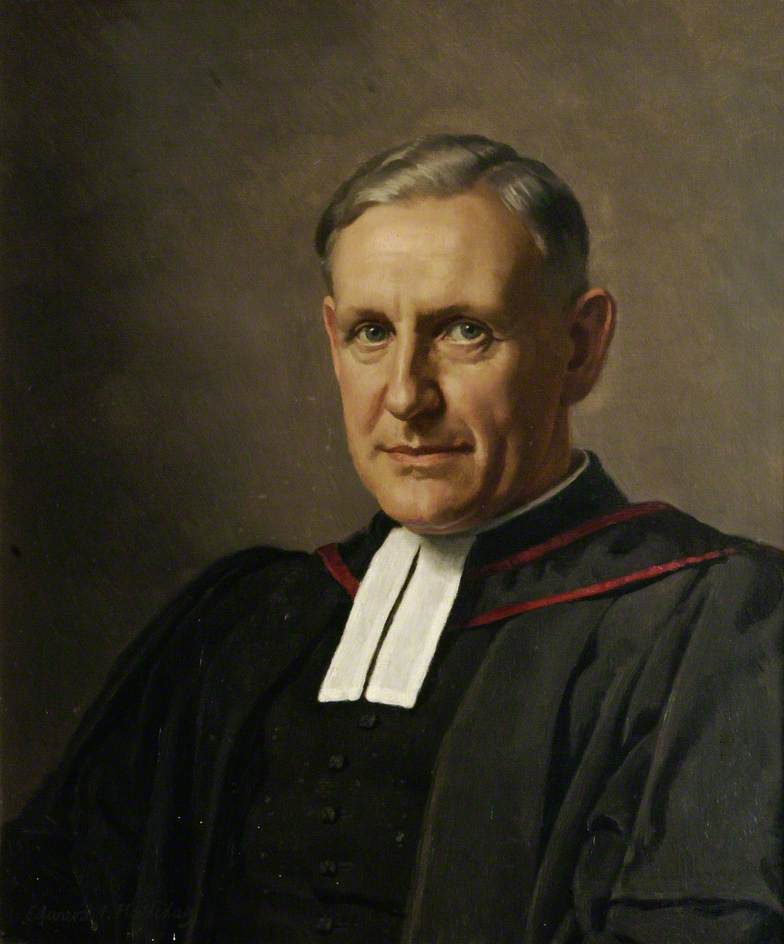
Canon Arthur Couratin, Principal of St. Stephen’s House. (Source)
Although its ethos remains largely Anglican, the House has offered a few important alumni to the Church of Rome. Balthasar scholar and theologian Father John Saward graduated there, as did the one-time Bishop of Ebbsfleet and current priest of the English Ordinariate, Monsignor Andrew Burnham. Indeed, they’ve even produced the Primate of the Western Diocese of the Armenian Church of North America, Hovnan Derderian. He is the youngest Armenian archbishop.
Staggers also gave the Church of England Fr. Kenneth Leach, an important Christian Socialist priest. He was trained at St. Stephen’s when it had become a rather homoerotic place, and Leach would famously sum up his time there as “gin, lace, and backbiting.” The writer and Staggers alum A.N. Wilson composed a bitingly comedic satire of the House in those years, entitled Unguarded Hours—which, as Ignatius Press’s reviewer puts it, is decidedly “not a Catholic novel.” Alas. Wilson, who would eventually return to Christianity after years of very public atheism, would later recall the custom formerly in vogue at Staggers of taking “religious names” that were actually rather saucy nicknames, often of the opposite sex. If Father Couratin was “Noël Coward in a clerical collar,” it seems that by the 1970’s, you were more likely to find Julian and Sandy in soutanes.
I seriously doubt that any of that persists. Women’s ordination in the C of E means that, while many Anglo-Catholics have become more liberal, their seminaries no longer smack of the kinds of homoerotic associations that fueled so many stereotypes (see Cousin Jasper’s famous quip in Brideshead Revisited). Staggers seems to remain as a pillar of sensible, ornate, properly Anglo-Catholic liturgy at its best.
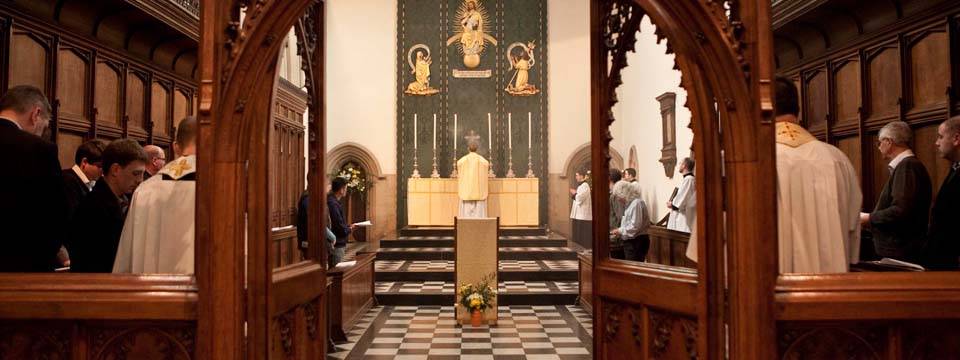
A liturgy at the parish church of St. John the Evangelist, St. Stephen’s House, Oxford. (Source).
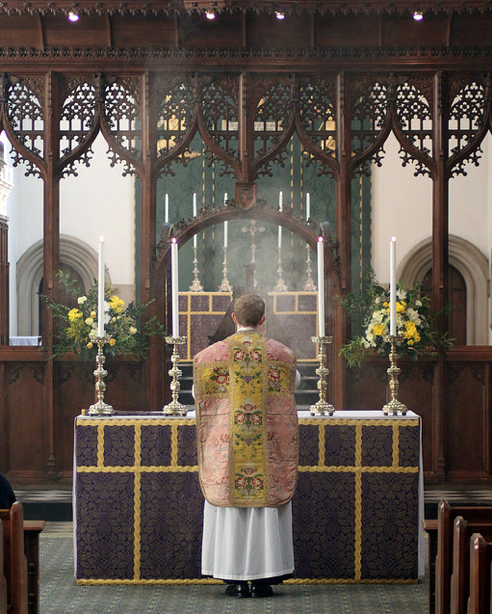
A priest says a Mass at St. Stephen’s House. I highly recommend the source I took this from, Merrily On High. An excellent source for all things Anglo-Catholic.
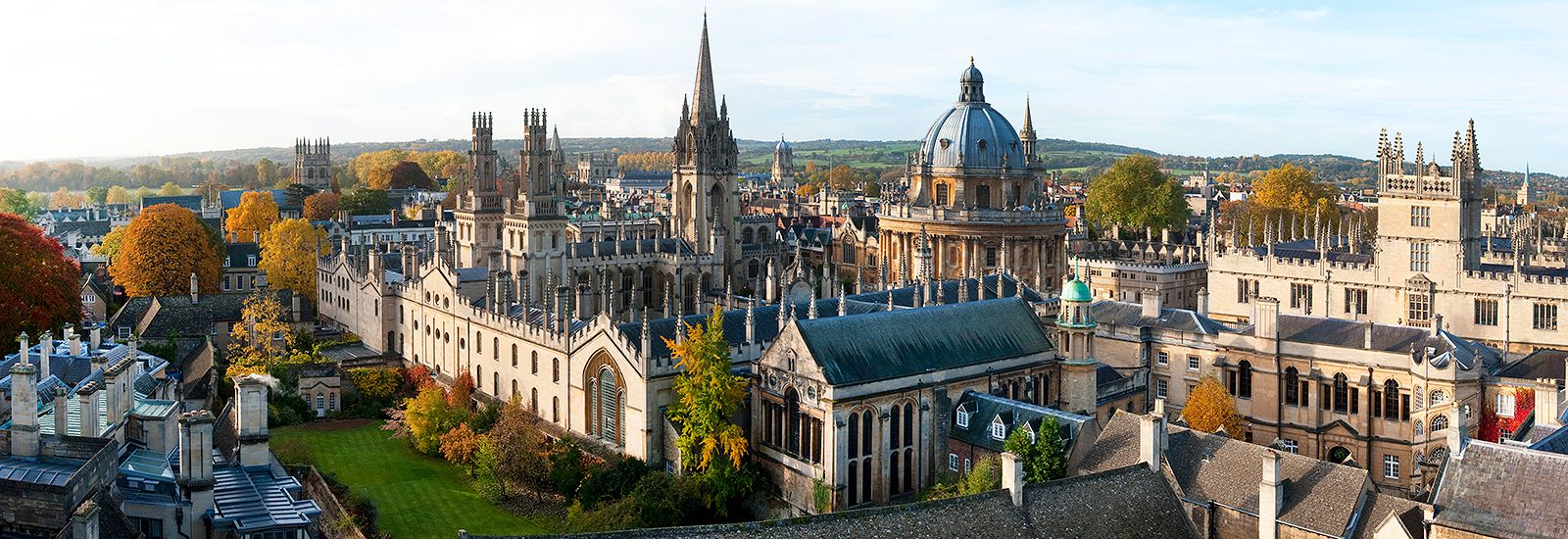
I could name more ways in which Oxford has played a special role in the life of the Catholic Church. Perhaps I will do so in another post, or a series of posts. For now, I’m just happy to say that I’ll be in a place with a lot of Catholic history, learning about that history. And thank God for that.
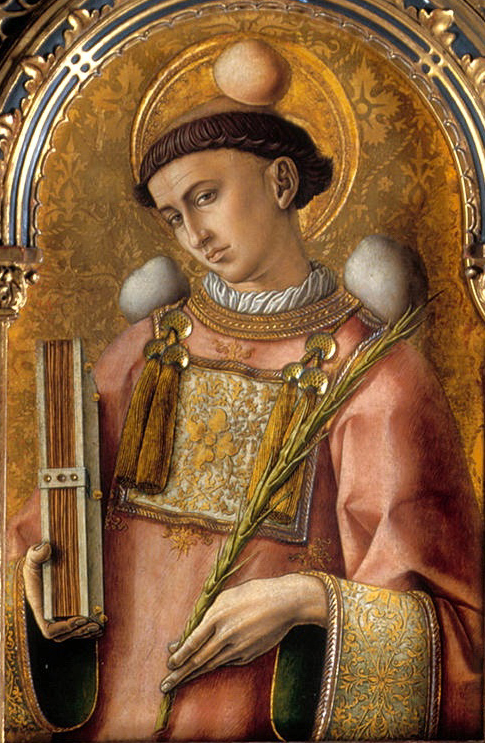
“Saint Stephen,” by Carlo Crivelli. Proto-martyr and patron of St. Stephen’s House, Oxford (and perhaps a rather wan patron at that, by the look of this painting—is that asparagus in his hand?). (Source)
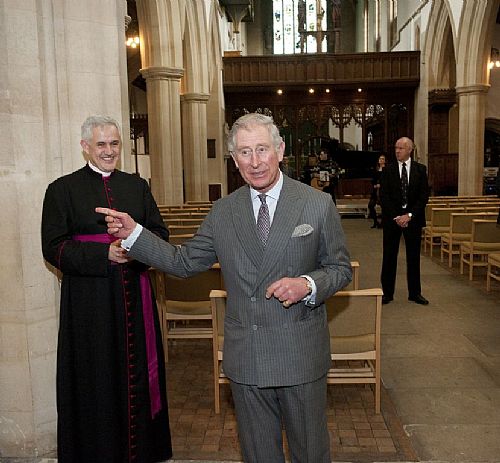
Also, apparently the Prince of Wales sometimes visits. (Source)
‘Catholicity, Antiquity, and consent of the Fathers, is the proper evidence of the fidelity or Apostolicity of a professed Tradition’ J.H. Newman, Lectures on the Prophetical Office of the Church, 1837, p. 51

 The Amish Catholic


