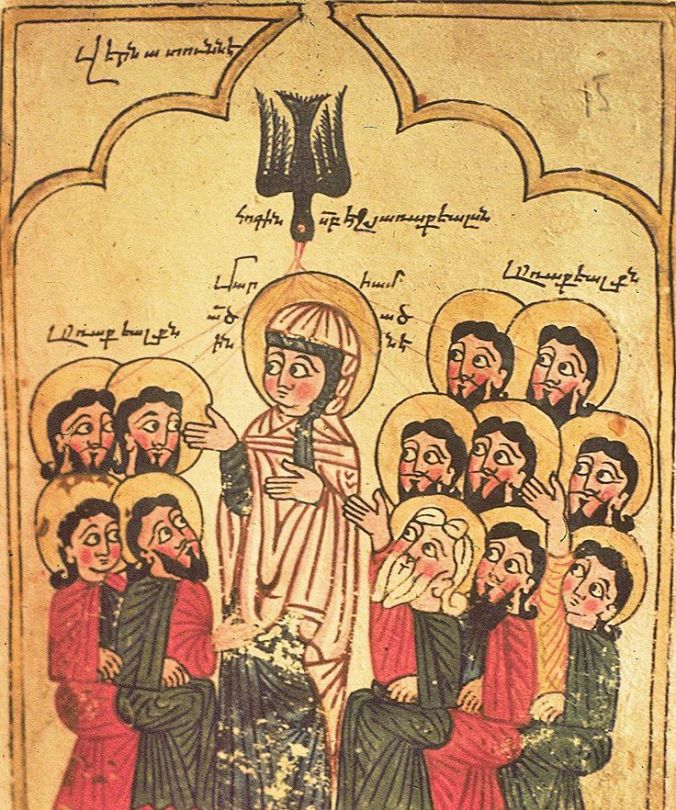
Figure A. Our Lady of the Cenacle, pray for us. From the source: “MINIATURES – Erevan, Matenadaran, MS 8772, Gospel, Aght’amar, Vaspurakan, 1391, artist Dzerun, Pentecost. Photo: Dickran Kouymjian.” (Source)
Throughout the Latin Church, Saturday in the Ascension Octave is kept as the Feast of Our Lady of the Cenacle. On this holy day, we remember the Mother of God keeping vigil with the Apostles in the Upper Room, or “Cenacle.” The place is significant. Here, Christ gathered the Twelve on the night of his betrayal, Maundy Thursday. At that time, He instituted the priesthood and the Eucharist. Later, on Pentecost, the Holy Spirit will descend upon the congregation and truly constitute the Church as such, confirming its sacramental essence and mission in the world of time.
Mary’s position in this unique place at this unique time is captured in the title, “Our Lady of the Cenacle.” But that name conceals a much deeper mystery. What, precisely, was she doing in the Cenacle? Why was she there? And does her presence, never mentioned in the Bible, nevertheless retain important meaning for us today?
As with any mystery unspoken in Scripture but passed on to us by the Tradition, we can approach it by many paths. One of the wonderful things about the Church is that, in her sacramentality, she recasts everything in the light of Christ and opens all things to a deeper meaning than we ordinarily encounter. So today, I’d like to consider Our Lady of the Cenacle through art. Specifically, iconography. Even more specifically, Armenian illuminated manuscripts.
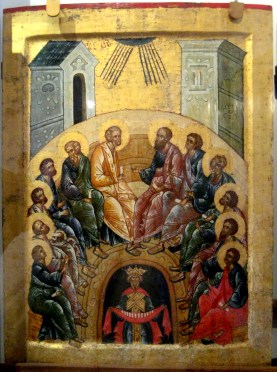
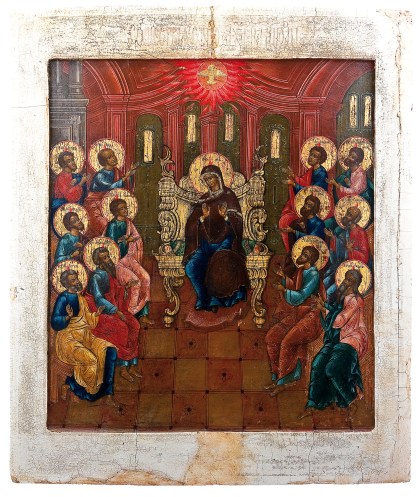
Figure B. A Greek-style Russian icon of 1497. Note the emptimess of the “Teacher’s Seat” at center. (Source)
In the Greek iconographic tradition, Pentecost is usually depicted with an empty seat in the center…the place of Christ the King and Teacher, who has ascended and sent the Holy Spirit in his stead. The icon for the feast of mid-Pentecost dovetails with this custom, as it depicts Jesus the youth instructing the teachers of the Law in an arrangement that approximates that of Pentecost proper. The Russian and Slavic iconographic tradition largely copies this model, with one notable exception. Many Russian iconographers include the Mother of God in what would ordinarily be the empty “Teacher’s Seat.” As one writer puts it, “Mary is therefore shown in the ‘teacher’s seat’ as the best example we have, and the person on earth who most resembled Jesus Christ (both physically, as His mother, and spiritually as His disciple).” Indeed.
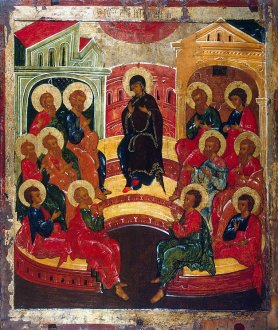
Figure C. A Russian-style icon with the Mother of God in the “Teacher’s Seat,” date unknown. (Source).
The Armenian iconographic tradition differs from both the Greek and Russian streams in important ways, not all of which we can get into here. For our purposes, it is enough for us to observe that the Armenians have a tendency to place the Mother of God at the center of the Pentecostal scene.
Examine, if you will, the illumination at the top of this essay—Figure A.
Mary is, by far, the largest character. The Apostles crowd around her on both sides expectantly. Her hands are lifted in the orans position of prayer. She stands in a red mantle and a dark blue robe that matches the hue of the Holy Spirit alighting above her. Every one of the bird’s tongues of flame move through her nimbus to reach the Apostles, some of whom even raise their own hands as if to reach out and take hold of the mystical fire.
A similar placement and posture is written into the following icon:
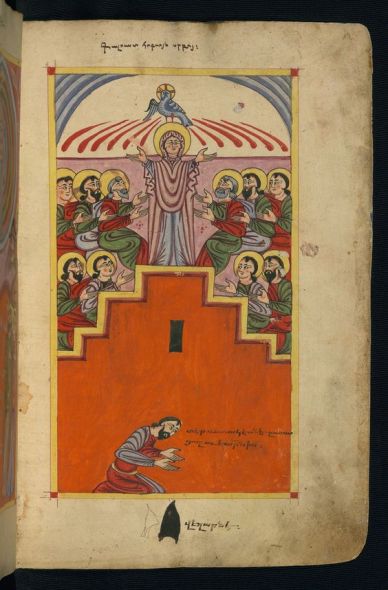
Figure D. Description from source: “This Armenian Gospel book was produced in 904 of the Armenian era (1455 CE) at the monastery of Gamałiēl in Xizan by the scribe Yohannēs Vardapet, son of Vardan and Dilšat, and was illuminated by the priest Xačʿatur.” (Source)
Mary is the central pillar of the icon. The Holy Spirit does not just descend, but rests upon her as He sends forth his tongues of flame. Here, too, their colors match. We can see that the Holy Spirit is customarily written in blue for this festal icon.
Blue is an interesting color, one with mystical associations. I won’t attempt a full symbolic analysis here, but it is worth contemplating the range of natural and supernatural meanings which Christianity has invested in this delicate shade. It suffices to say that blue is a sophianic color, calling to mind the wisdom and beauty of God (see the pertinent chapter in The Pillar and Ground of the Truth, by the great Russian theologian Father Pavel Florensky). The iconographic tradition is of great help in this subject as well; besides gold, blue is the only other color allowed for the background of icons in the Greek and Slavic canons.
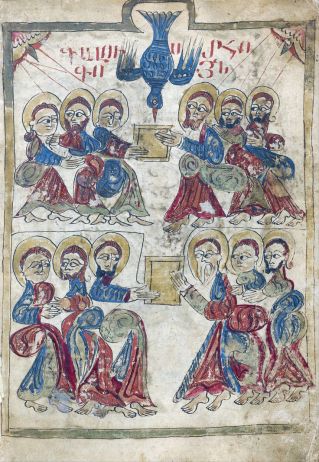
Figure E. An Armenian Pentecost icon without Mary, but with a blue dove of the Spirit. (Source)
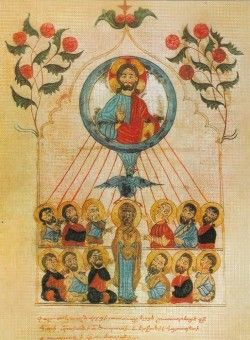
Figure F. Pentecost icon of unconfirmed but probably Armenian origin. Same blue Spirit, roughly the same placement of the Theotokos. (Source).
It is also perhaps worthy of note that in Figure D, Mary doesn’t just match the hue of the Spirit. The colors she wears also match the architecture of the Cenacle. She is one with the Cenacle; the Cenacle is hers, and hers alone. The Cenacle is the Church, the Cenacle is every tabernacle in the world, the Cenacle is Heaven, the Cenacle is the New Jerusalem, the Cenacle is the Throne of God, the Cenacle is the Eschaton, the Cenacle is the final consummation of sophianic being brought about by Christ’s gloriously triumphant Incarnation, sacrifice, and Resurrection.
And in all these mystical dimensions of the Cenacle, Our Lady is Queen.
Mary is the woman who bears the Holy Spirit, the living icon of the Church. When we look at Mary, we are to think of the Spirit. The Mother of God always points us to her son, but also to the Holy Spirit, and through both, to the Father. She is never apart from the Holy Spirit. They abide together, and the Cenacle is where her truly Eucharistic and sophianic state of being is manifested for the awe-struck view of the whole Church. She is the consummation of what is accomplished by the Trinity in the Cenacle, the woman who fully cooperates in the salvation of the world, the Co-Redemptrix and Mediatrix of All Graces. Indeed, do we not read the latter title in the first illumination above? Do we not see it in the slim orange lines of fire that move through her halo to the Apostles below? They only receive the Spirit as it passes through Mary.
Mary does nothing of her own effort. God does all in her, and she freely agrees to accept and work for God’s will. St. Paul can speak of “those things that are wanting of the sufferings of Christ, in my flesh” (Col. 1:24 DRA). Not so with Mary. In her, the cross’s victory is complete. In her, it has become the Tree of Life, “so that the birds of the air,” such as the blue bird of the icons, “come and lodge in the branches thereof” (Matt. 13:32 KJV).
On this feast day, let us remember the manifold graces that Our Lady showers upon us from her throne in the eternal Cenacle. Let us also take heart that, with so powerful an advocate at the heart of the Church, no controversies or troubles can ever overwhelm the Barque of Peter. Finally, let us pray to Our Lady of the Cenacle for the Benedictines of Silverstream on this, their patronal feast.
 The Amish Catholic

.jpg)