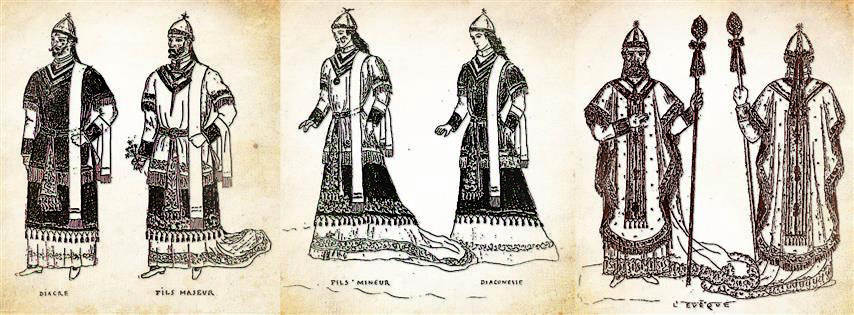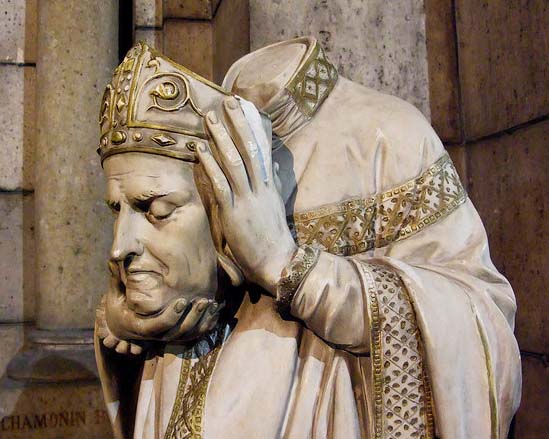
St. Denys, pray for us! (Source)
Canticum Salomonis has a great little piece on the Sequence of St. Denys. Liturgical nerds will find it of particular interest. It mainly attracts my own attention due to a fascinating tidbit:
Beginning with the new Parisian missal promulgated by the Lord Archbishop François de Harlay in 1684, the neo-Gallican liturgical books that festered in France during the Enlightenment Age altered this sequence to expunge any connection between St Dionysius the Areopagite and St Dionysius of Paris. The Abbey of St-Denys, however, remained firm in defending the Greek origins of its patron, and sung the original text until the Revolution.
I’m unaware of any serious scholarship so far that has plunged into the liturgical dynamics of the Revolution – though certainly, the Gallicans, Jansenists, and Cisalpines all had ideas about liturgical reform. What an intriguing project a deeper study might be. Perhaps John McManners has looked at it all already, and I simply haven’t gotten to that part of his famous and positively rococo two-volume study, Church and Society in Eighteenth-Century France.
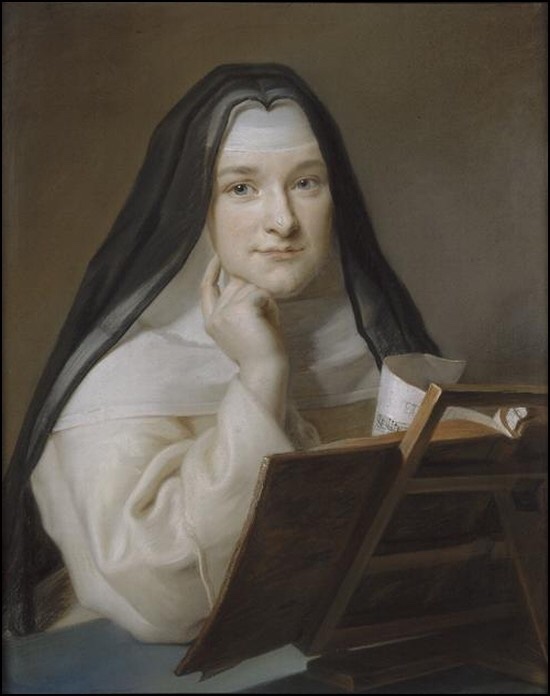
Madame Louise, Prioress of Saint-Denis. (Source)
Saint-Denis was an important place in the 1780’s. Madame Louise, daughter of Louis XV and aunt of Louis XVI, entered the Carmel of Saint-Denis while her father was still alive. As Sister Thérèse de Saint-Augustin, she eventually rose to the rank of Prioress. Saint-Denis thus became a center of the Parti Dévot, the most conservative (some would say reactionary) part of the French court and church. It’s hardly surprising that the great Abbey there would likewise remain a bastion of liturgy that might otherwise be regarded as “superstitious” or “backwards” by the more radical portions of the French church.
 The Amish Catholic