On Joy

Le Christ aux outrages, Philippe de Champaigne, 17th c. (Source)

“Jesus Christ will be in agony until the end of the world” – Blaise Pascal

We shall not be blamed for not having worked miracles, or for not having been theologians, or not having been rapt in divine visions. But we shall certainly have to give an account to God of why we have not unceasingly mourned.” – St John Climacus

Recently I have had occasion to consider the role of joy in the Christian life. While I don’t believe that any particular emotions as such are intrinsic to Christianity, I sometimes feel that there is in the Church’s culture a kind of low-level idolatry of affective joy that makes it a good in itself and, more poisonously, demonizes those who do not share in it. This rather shallow (and ultimately false) view of joy as relentless and mandatory happiness has at times eclipsed the demands of the Cross, and has little to offer the suffering, the infirm, the distressed, the depressed, the sorrowful, the anxious, and the temperamentally gloomy. Are they to be excluded from heaven if they cannot force a smile? This soft and implicit Pelagianism of the emotions is a greater discouragement to souls than an honest reckoning with the sorrows of life and the terrible demands of the Cross.[1]

So, I thought I would put down a few very brief meditations on true and false joy. I would not wish to speak in absolute and general terms, but rather, out of the fullness of my heart, and all that I – a mere layman – have gleaned from seven years in the faith, the reading of Scripture, and the study of the Church’s spiritual history.

St. Paul tells us that joy is a fruit of the Spirit; he does not promise us that we shall have all those fruits at all times, or that they grow in us for own profit alone.[2] If I may alter the metaphor a bit for illustrative purposes (without in any way denying the truth St. Paul teaches), I would say that joy is the flower, and not the root or the fruit, of the Christian life as such.[3] It is chiefly given to us by God so that we might advance His Kingdom. Like the pleasant blooms of spring, joy is meant to attract souls who do not yet know the grace of God, and thereby to spread the life of the spirit. As soon as we have it, we must give it away. It is like an ember in our hands – giving light and heat, but liable to burn us if we hold on to it. For who are we to keep it, we who are nothing? And so, we should not be surprised if even this true joy is fleeting, and given to us only in rare occasions as a special grace. For the joy of God is not like the joy of the world. The former is rare as gold, and the latter as common as fool’s gold.

And as fool’s gold will not purchase what true gold can buy, so does a false joy fail in this paramount duty of conversion. We should not force ourselves to seem happier than we really are; a certain virtuous attempt at good cheer in the face of sorrow is always welcome, and we generally should not air our griefs too freely. I believe this virtue, built upon a detachment from our worldly disposition, is what the Apostle refers to when he tells us to “Rejoice always.”[4] But let us not delude ourselves into thinking that this human cheer can ever compare with the supernatural joy that comes only from God, and which many just souls have not been granted. To do so approaches dishonesty, both to ourselves and to our neighbor. Let us not pretend that our faith cheers us more than it really does; let us instead recognize that it promises us suffering, and a yoke that, though light, is nevertheless still a yoke.[5] And under that yoke, someone else will lead us where we do not wish to go.[6]

Joy is only true if it comes from, is ordered to, and brings us back to the Cross. The joy that God gives is always stained with the Precious Blood. But even then, we are not entitled even to this joy in our present life; rather, we are given the Cross as our inheritance. For what is the world if not a land of false joys? They come from nothing, they come to nothing; in their essence, they are nothing. Well and truly does the Sage condemn it all as vanity.[7] Well and truly does the Psalmist speak of it as “the valley of the shadow of death.”[8] Well and truly do we address the Mother of God from “this valley of tears.” We can do no other.

This life of the Cross is a gradual annihilation – what the French call anéantissement – a fearsome but salutary tutelage in humility and in the growing recognition of our own nothingness. To live and die on the Cross is to say every day with St. John the Baptist that “He must increase, I must decrease.”[9] Yet how hard this is! We lose sight of the fact that at the end, when we are nothing again, we can grasp the God who is No-Thing, the One who is beyond the traps, illusions, trinkets, clutter, disappointments, and, indeed, the joys of this world. We efface ourselves now so we may one day face Him. We mourn our sins today so we may rejoice in attaining God on the last day.

That is the true joy of the Cross – that, in mounting it, we can see God. But how rare is such a grace in this life! Most of us are caught up into the business of the world. Most of our lives are a long distraction. Most of us will only achieve the vision of God after the sorrows of this life and the pains of purgatory. And so, let us never forget that to be a Christian is to let Christ suffer and die in us, so that one day, we too may rise with Him.[10]


[1] James 4:4.

[2] Galatians 5:22-23.

[3] The root is faith, and the fruits are redemptive suffering and acts of charity.

[4] 1 Thessalonians 5:16.

[5] Matthew 11:28-30.

[6] John 21:18.

[7] Ecclesiastes 1:2.

[8] Psalm 22 (23): 4.

[9] John 3:30.

[10] Galatians 2:20; 2 Corinthians 4:11; 2 Timothy 2:11; Philippians 1:21

Jean de Bernières on Humility and Communion

This week’s contribution to the Lenten Spirituality Series comes from Jean de Bernières-Louvigny (1602-1659), a pious lay mystic who lived and died in Caen. From his hermitage in this rainy Norman town, Jean de Bernières gave himself over to profound experiences of contemplative prayer. His spirituality, as expressed in the two volumes of his Le chrestien intérieur (Paris: 1661), was deeply indebted to the apophatic tradition of mystical theology. Although a solitaire, Jean de Bernières was engaged in ecclesiastical and charitable networks that included some of the greatest spiritual figures of his day. He was a member of the Compagnie du Saint-Sacrement in Caen and corresponded with such notable individuals as St. François de Montmorency-Laval, Bishop of Québec, and Mother Mectilde de Bar, Foundress of the Benedictines of Perpetual Adoration of the Most Blessed Sacrament of the Altar. He met the latter at Caen; she became, as it were, a dear friend. Translated into German in the eighteenth century, Jean de Bernières had an important influence on the trajectory of Pietism in that country. He has, as far as I can tell, never been fully translated into English. What I produce below is my own translation, in the hope it may offer some aid to pious souls in this time of temptation. The excerpt comes from the Second Volume, Book V, Chapter II of Le chrestien intérieur, pp. 6-11. I would add, for those who take an interest in such matters, that one of the extra difficulties in translating Jean de Bernières is that he uses Norman French vocabulary that no longer appears in standard French. I hope I have managed to capture his sense here.

May the Blessed Hermit Jean de Bernières pray for us in this time of penance. (Source)

To commune worthily, one must place oneself in a state conformed to that of Jesus, in the Blessed Sacrament.

Jesus Christ wishes to give Himself to us in this august mystery, in a state of death with respect to the life of the senses, but as a source of life with respect to the interior life, the divine life, the life of grace, the life of contemplation and continuous application to the grandeurs of God His Father; a life poor and annihilated [aneantie] in exteriors, but entirely brilliant with majesty, and infinitely rich under the veil of the species that hide it from the eyes of the world. It is with these dispositions that that He comes to present Himself to us, wishing as well that we too should present ourselves to Him with dispositions conformed to His.

The Humanity that He gives to you in Communion has been elevated to the divine life by the hypostatic union; we too must be such by grace, that our understanding would be elevated to a high knowledge, and our will to a sublime sentiment of love of God, and that our soul would live the life of grace. O sublimity of the life of grace, you are so admirable, you are so high, you are so ineffable! You raise man from earth to heaven, and you make him live in God, and even of God, because you dispose him to live on the earth from the same substance by which the Blessed live in heaven. O great life of grace, you are poor to the exterior, but very rich in the interior: you seem low, but you are most high: you have ravished me with you beauty, I can no longer live a moment without thee, who make [me] live from a divine life, who places the soul in the heart of God, and who disposes her to see God placed in her heart.

Since the beauty of this life manifests itself to the soul, she leaves everything to embrace it, and everything else seems to her naught but death and corruption; we abandon the world, honors, and riches; we condemn ourselves to penances, to mortifications, to poverty, so as to live this divine life; and we feel a holy hunger for this adorable food that nurtures the soul. O that I might know it, my God, and that I might follow it, this divine life, so little known to the world, practiced by so few in the world, that also does not find itself altered by the waters of Thy eternal fountains! O Jesus, draw me after Thee in the actions of the life of grace, which is in its full exercise in misery and scorn. Draw me, Lord, I run after Thee in the odor of Thy perfumes. What pleasure, my soul, to behold you walking as a giant in the ways of grace, nourished and fortified in your course with the bread of grace: Ambulavit in fortitudine cibi illius usque ad montem Dei.

To live in one’s own death, as Jesus seems to us in the Blessed Sacrament, to lose one’s glory in contempt, to be ravished when one is annihilated [aneanti] and sacrificed; this is proper to the life of grace. Making everything dead to the exterior, it brings life to the interior, and gives principally the spirit of prayer, putting it almost continuously in exercise in the soul, applying itself to this infinite and incomprehensible Being that it adores, unable to comprehend It, and annihilating itself [s’aneantit] before Him, unable even to admire His divine grandeurs, as annihilated [aneanties] in the Eucharist. O my soul, how great is your vileness, how extreme your poverty! What is man, that You should have remembrance of him, Lord, and that You should visit him, and that You should take Thy delight from coming to dwell personally with him? His soul is drawn from nothing, and his body is nothing but a little mud, and Thou deignest to set Thine eyes upon him! How is it that this creature, so dirty, so minuscule, so coarse, could receive the infinite majesty of God? Humble thyself to the bottom of thy nothingness, and confess thy baseness, my soul. Lower thine eyes, and swear that thou art unworthy to turn them only towards that formidable grandeur; but be still more moved with admiration, of recognition and love of such excessive goodness, which deigns well to annihilate itself [s’aneantir] in that incomprehensible mystery, to bring itself to you even unto your nothingness.

We must truly love the state of interior captivity, where the soul, bound and tied up, stays in the obscurity of its prison. This state will honor the captivity of Jesus enclosed under the little host. This divine Lord place himself in a little prison for our love. The King of Glory is restricted under these small species, and thereby a captive and prisoner of man, He renders Himself, it seems, his slave, giving Himself entirely to him; He suffers, so to speak, and dies for him, and communicates to him all the merits of His Precious Blood. O divine Captive, captivate my heart so strongly, that it may never more return to natural liberty; but that all destroyed and annihilated [aneanti], it may not live another life than the superhuman, nor may it enjoy any other liberty than that of Thy children.

Each time that one takes Communion, Jesus Christ giving Himself entirely to all, there are all new obligations that we contract to live entirely for Him, and to render all our actions divine. It is necessary therefore for a good soul not to say: I have not such time to prepare myself for Communion; because she must not aim at another thing by all the actions of her life, but to receive the Bread of Life, in order to live the life of Jesus, and to persevere perpetually in similar dispositions to those that appear to us in the Blessed Sacrament.

How to Celebrate Lent like a French Princess

Mesdames Victoire, Adélaide, and Louise, three of the pious daughters of Louis XV, known collectively as “Mesdames de France” or “Mesdames Tantes” after the accession of Louis XVI. Only Adélaide married; Louise later became a Carmelite prioress at Saint-Denis before having the extremely good fortune to die in 1787. Source

The inimitable John McManners, late Regius Professor of Ecclesiastical History at the University of Oxford, provides a window into the world of late Ancien Régime piety (or, rather, its dearth) in his monumental Church and Society in Eighteenth-Century France. He writes:

“To what extent was the fast of Lent observed? It was commonly said that the austerities of the penitential season were endured only by the poor. According to the Lenten pastoral letter of the archbishop of Sens in 1779, the rich often obtained medical certificates allowing them to eat what they liked. This was the fashionable thing to do. ‘Look at our bourgeois citizen and his wife in their (draper’s) shop, observing Lent strictly,’ said teh Jesuit Père Croisset in his Parallel des moeurs de ce siècle et la morale de Jesus-Christ (1727): ‘their fortune changes…and scarcely has the tape measure dropped from their hands than you see them putting on airs like people of quality and asking for dispensations from fasting.’ This class distinction was observed even in the kitchens of the Bastille: on the first Friday of his imprisonment, Marmontel gloomily at the meatless meal provided, not knowing that it had been meant for his servant. In any case, there were plenty of succulent dishes within the rules, for those who could afford them.

Empress Maria Theresa of Austria in the garb of a penitent (Source)

“Lent was the season to have tubs of fresh butter sent in from the countryside, and to ensure plentiful supplies of fish and water birds (the tes of an allowable fowl was: did the gravy remain uncongealed after fifteen minutes? – so a bishop gravely advised Mme Victoire, Louis XV’s pious but comfortable daughter). The peasant, whose existence is a perpetual Lent anyway, said Voltaire, awaits episcopal permission to eat his farmyard eggs, while the bishop himself looks forward to expensive dishes of soles. Certainly, things were well organized at Versailles. ‘A ray of grace has descended on us,’ wrote the duc de la Vallière in April 1756; ‘we fasted for three days a week during the whole of Lent, but on condition that we suffered no deprivations.’ Preachers were well aware that those with money and leisure could organize an attractive Lent for themselves: an occasional walk in a procession (a penitent’s garb was no disadvantage to a good-looking woman), extra time in bed to recuperate from privations, and food more delicately cooked and served than usual. ‘For some – God grant that there are none in my congregation today,’ thundered the Oratorian Surian, ‘Lent is a more agreeable time, in a sophisticated way, than the other seasons of the year.'”

(Vol. I, pg. 86-87).

Ah, the trials of the penitential season!

100 Edifying Lenten Penances

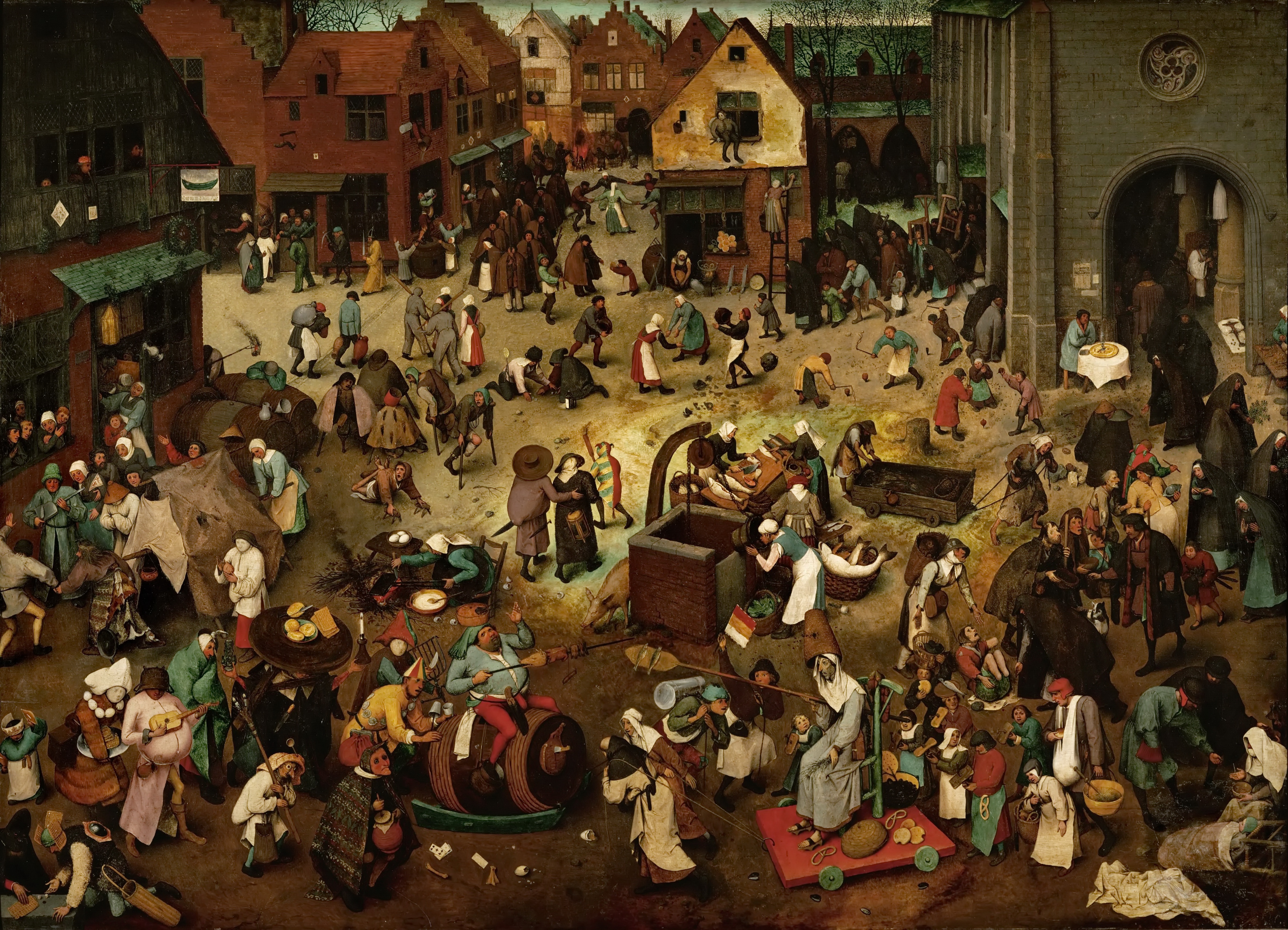
“The Fight Between Carnival and Lent,” Pieter Bruegel the Elder. Recently seen by the author in Brussels. (Source)

The pious among my readers will no doubt be aware that Lent will soon be upon us. Here are 100 ideas for how to have a successful and most fruitful season of penance.

  1. Give up meat
  2. Give up chocolate
  3. Give up alcohol
  4. Give up social media
  5. Give up being a social media influencer
  6. Give up films
  7. Give up naughty films
  8. Give up films that are very naughty but not the ones that are naughty while also being either smart or funny or historically dramatic in a passingly educational sort of way
  9. Give up comic books
  10. Give up music
  11. Give up secular music
  12. Give up Christian praise and worship music (for the love of God and all that is holy)
  13. Give up lobster, though not on Fridays
  14. Give up dairy
  15. Give up various soft cheeses
  16. Give up all cheeses from Poitou-Charente but not anywhere else in France
  17. Give up Netflix
  18. Give up “Netflix”
  19. Give up petting zoos
  20. Give up marsupials
  21. Give up giraffes of any kind
  22. Give up your ignorance of the various kinds of giraffe
  23. Give up spy novels
  24. Give up surprising all of your friends by suddenly screaming at them, apropos of nothing, “No, Mr. Bond, I expect you to die!”
  25. Give up your longstanding telenovela addiction
  26. Give up trying to learn Portuguese in favor of Esperanto
  27. Give up learning Esperanto
  28. Give up reading the poetry of William McGonagall, the Apollo of Dundee
  29. Give up the various birds, stuffed and otherwise, that you are hoarding in your attic and basement
  30. Give up your deeply-rooted habit of eating little fragments of ceramic statues
  31. Give up your swimming lessons
  32. Give up your avoidance of Luton, Slough, and Swindon
  33. Give up the American news cycle
  34. Give up the Busby Berkeley marathons you play in your living room every Friday evening
  35. Give up pretending you are, in fact, the reincarnation of Senhor Doutor Plinio Corrêa de Oliveira
  36. Give up whining
  37. Give up long walks in the park
  38. Give up spitting in public
  39. Give up gossip
  40. Give up gossip about me, please
  41. Give up your general wanton demeanor and frowsy mien
  42. Give up the chips
  43. Give up all professional sports
  44. Give up your various simultaneous affairs with the members of the Swazi National Curling Team
  45. Give up the ghost
  46. Give up your collection of Rococo snuff boxes depicting various prince-bishops in ermine
  47. Give up practicing the kazoo at inappropriate hours of the night
  48. Give up Morris dancing
  49. Give up peanut butter and eel jelly sandwiches
  50. Give up your place in line
  51. Give up the furious Mah-Jong tournaments you regularly host for gangs of aged nuns
  52. Give up reciting the poetry of William McGonagall, Bard of Dundee
  53. Give up your participation in the capitalist system enslaving us all
  54. Give up toast
  55. Give up the secret alien knowledge you acquired through highly illegal methods of infiltrating government files
  56. Give up felonies in general
  57. Give up all the Skittles you have hoarded in your closet
  58. Give up the various coffee table books of early brutalist architecture that you have received from work colleagues, many of whom have since passed on
  59. Give up on modern architecture in toto
  60. Give up writing emoji haikus
  61. Give up your shoegaze band, Emoji Haiku
  62. Give up on romance
  63. Give up on romantic comedies
  64. Give up those trashy bodice-rippers they sell in the supermarket book aisle (you know the ones)
  65. Give up your seat in the Académie française
  66. Give up your seat on the train to Timbuktu
  67. Give up your seat on the Parish Council (here’s looking at you, Susan)
  68. Give up your operatic emotional troubles
  69. Give up addressing everyone in song
  70. Give up asserting that you are, in fact, Madama Butterfly
  71. Give up counting time in anything but the Mayan calendar
  72. Give up your general estrangement from Mesoamerican culture
  73. Give up your allergies
  74. Give up your obstinate refusal to learn the Sasquatch language
  75. Give up your unreliable narration
  76. Give up your postmodern metairony
  77. Give up your Twitter account
  78. Give up treating your dogs like children
  79. Give up treating your children like dogs
  80. Give up treating your children better than your cats
  81. Give up your claim to the long-defunct throne of the Polish-Lithuanian Commonwealth
  82. Give up your alarming habit of musical flatulence
  83. Give up your covert addiction to locomotive erotica
  84. Give up your understated unibrow
  85. Give up your long-awaited nose job
  86. Give up your embittered attempt to remain Dean of a prominent English Cathedral
  87. Give up memorizing the poetry of William McGonagall, the Orpheus of Dundee
  88. Give up any expectations of amusement
  89. Give up the pipe dream of tenure
  90. Give up your position to the various paramilitary forces that are hunting you through the tundra
  91. Give up break-dancing in public parks
  92. Give up attending Hare Krishna services
  93. Give up any association with the Libertarian Party
  94. Give up all hope, ye who enter here.
  95. Give up the secret recipe
  96. Give up the art your late uncle Oswald took from various museums over the course of his long and chequered career as a forger and art thief
  97. Give up approximately 1/4 of your bone marrow
  98. Give up being lame
  99. Give up all the excuses you always make for not keeping your Lenten penance
  100. Just give up

Fr. Bowden’s Meditations for Lent

870px-Kramskoi_Christ_dans_le_désert

Christ in the Desert, Ivan Kramskoi, 1872. (Source)

Some of my readers will no doubt recognize the name of Fr. Sebastian Bowden of the London Oratory. He achieved some small notoriety as the priest who nearly converted Oscar Wilde in the 1870’s. He was also a well-respected spiritual teacher, though sadly neglected today. I would like to make some of his wisdom available, especially as it bears on the season we enter on this Ash Wednesday.

Here’s Fr. Bowden’s advice for Lent:

Consider the bearing that Lent has upon Death. Lent is given us as a time of preparation, and the way it is spent has great influence on the times that follow it: a carefully spent Lent will bring about a careful month after it, and the influence of that may go on through the year. So, we may look upon each Lent as a bringing us nearer to a good state for death, by making a fresh mark on our life:—for as we live so we must die. Therefore enter fully into this spirit: withdraw as far as you possibly can from all outer things, in thought, during this season: let the things of Time go to a distance, and be as nothing to you. Be alone with God, and try simply to learn more and more where you are, and what you are worth, in His eyes only; and thus prepare yourself for joining Him in Eternity.

Give yourself thoroughly to the Spirit of the Passion. Do not look, in anything you do, for success, pleasantness, or comfort: expect crosses, failures, disappointments, and take all these readily:go to meet them, receive all with perfect resignation from God’s handstake their impress on your soul. Aim, in preparation for death, at caring for nothing so much that you will not be ready in a moment to give it up.

Remember that, perfect and infinite as are the merits of Christ’s Passion and Death, there is one thing still wanting to them:that is, our part in them: our taking and accepting His sufferings as ours, and bearing them with Him. Without this, His Passion remains worthless. To what purpose is the Head crowned with thorns, if the Members remain dead, paralyzed, mortified and motionless? And so it is if we, who are Christ’s Members, will not enter with Him into His Passion, and will to suffer with Him. Let us, therefore, now, go in with Him into the life of suffering, giving ourselves to Him completely. It is difficult and painful to human nature to face the thought of a penitential life, but it must be done if we would be His true followers. And at this season it should be done specially by some outward thing:no lessening of food or sleep for those who need strength to work; but, still, in some wayif it is only by restraint of attitude, by some posture at times different from the ordinaryno matter what, but by some meanswe should daily remind ourselves that it is Lent.

Of course, it is hard to realize the good of the Cross: it often seems to our eyes so purposelessso gratuitousas well as so hard. It is in Faith alone that we can bear it; human nature must feel and suffer by it,. Let us try, during Holy Week, for a “broken heart”: that is, not feeling, but the certain conviction of our own nothingness and the nothingness of everything but God’s will. It is not merely the having, or the not having, to suffer this or the other thing: it is in all that we must be crushed: it is that there is absolutely nothing of importance except to do the Will of God: and this is the Cross.

The Sacrifice [acceptance of crosses or voluntary renunciation] always seems greater than we expected: when the Cross presses inward it must take hold of us. But we must treat it by looking beyond, remembering that, after all, it is all, in reality, but nothing; living in daily Faith in God, and Hope; and reminding ourselves that all will pass. Feeling, at the moment, we cannot help. (Spiritual Teaching of Fr. Sebastian Bowden of the London Oratory, 1921, pp. 17-20)

Screen Shot 2018-02-14 at 3.25.35 AM.png

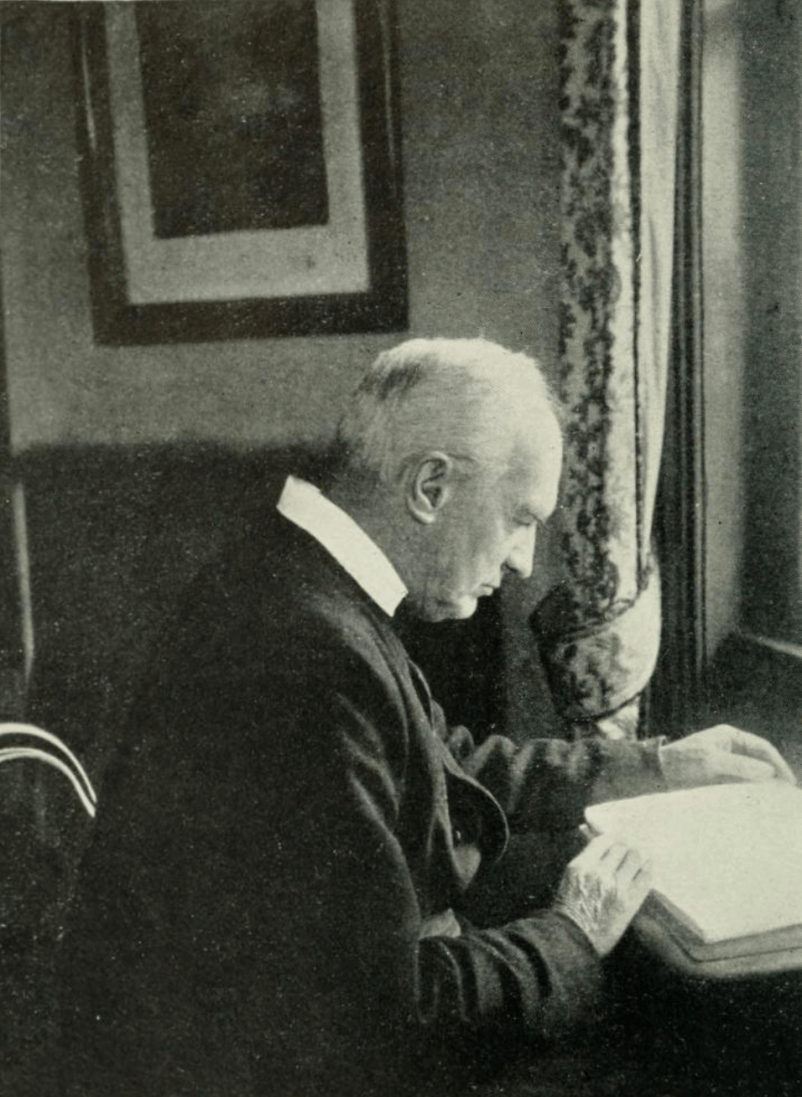
Fr. Sebastian Bowden of the London Oratory. (Source)

I would add two brief thoughts that come from a later portion of the book. They seem admirably suited to our meditation on this penitential day, the start of a journey of penance that will not end until we face the cross.

The best way of realizing our Free Will is St. Philip’s way: “Lord, keep Thy hand on my head, or I shall betray Thee.” This consciousness of how easily we may at any moment commit any sin, however great, is simply the truth. It is the experience of everyone who knows anything of human nature, and especially of every priest. He knows it first for himself, and then for others. This it is that fills our prisons with criminals: the sinfulness of human naturegreed and avarice, lust and passion. To know our own weakness is our only safeguard. (p. 98)

Recollect that it was Christ on the Cross that redeemed the world: not His miraclesnot His life of preachingbut His naked body offered on the Cross to God. And so it must be with us if we would follow Him: the will simply to suffer must be oursto this our whole lives must be bent. It is not by great and heroic deeds that we are to succeed in Eternity: it is by the daily round of silent, humble suffering of whatever God sends. We are to become what He was: holocausts: to be stripped of Self on all sides:of our will, of our powers, of our very individuality if He chooses, so as simply to be in His hands to do what He likes with. Remember that here we see everything exactly as it is not: to us, success seems to lie in what showsin active deeds, in energy, in strength and power. But this is not so before God; and when we die we shall see it all in its right light. Let us live, therefore, for the things which are great in Eternity, though not in Time, and be patient. (pp. 79-80)

May we all learn from Fr. Bowden’s sound practical wisdom and make a well and holy Lent.

temptation1824.jpg

The Temptation in the Wilderness, John St. John Long, 1824. (Source)

And After the Fire

the-morning-after-the-deluge

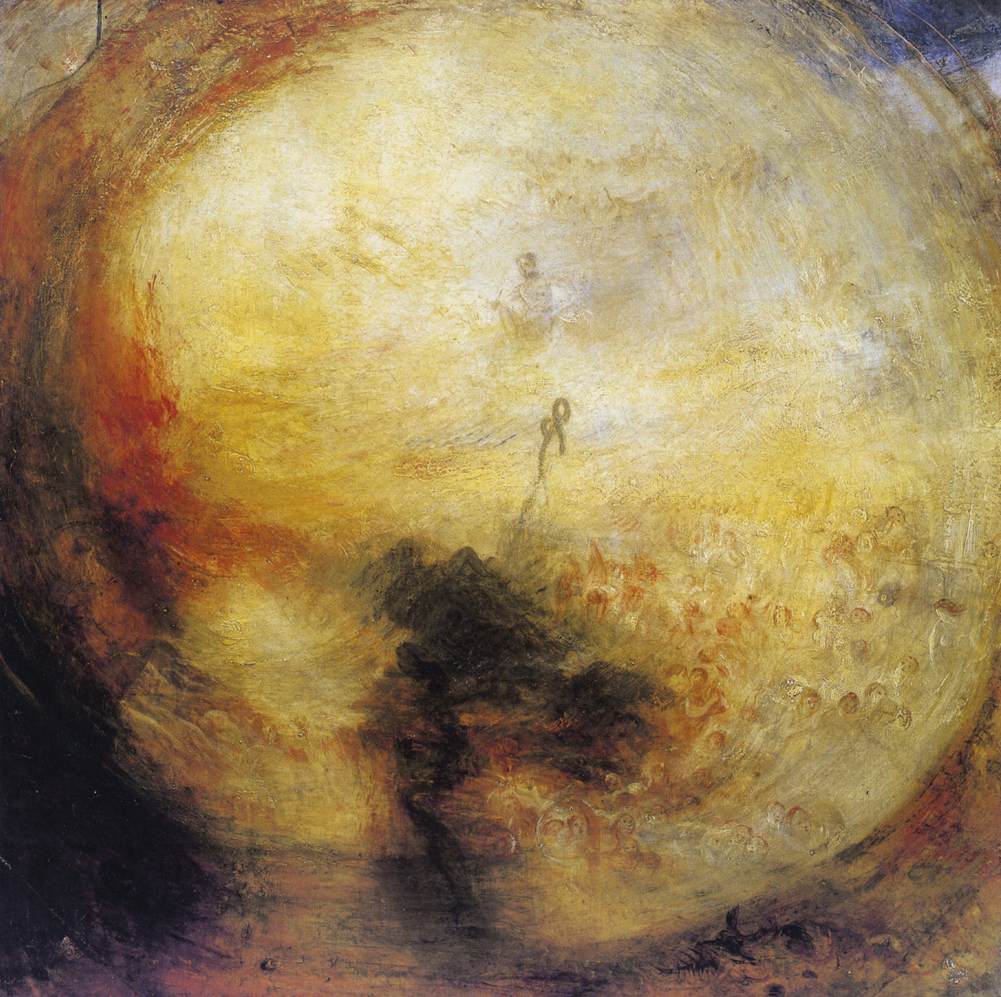
“The Morning After the Deluge,” J.M.W. Turner, c. 1843. (Source).

I am still shocked and furious about the events of the last few days. Fascists of various sorts have descended upon Charlottesville, Virginiaa town I loved and called home for four years—and caused immense pain for the entire community. One woman, a Wobbly protester, died at the hands of a Neo-Nazi who rammed his car into a crowded alley. I had friends in the counter-protest. I had friends who feared for their lives. And all I could do was watch and pray. The Rosary, the Imprecatory Psalms, Invocations to St. Michael. But how I wish I could have done so much more.

I was following the news across Facebook, CNN television, and Twitter. I observed mixed responses. Some, even among baptized Catholics, sympathize with the Alt-Right fascists. They point the finger of blame at Antifa, the several Socialists who showed up in counterprotest, the Media, and Black Lives Matter activists. Likewise, some Christians equivocated. They were happy to condemn the Alt-Right briefly, while also complaining at length about how the Media wasn’t focusing on Antifa, or the Police didn’t do enough, or, incredibly, how all of this is really just the fault of the Democratic Party (here’s looking at you, John Zmirak and Dinesh D’Souza). Then, there were those brave Catholics like Chad Pecknold, Robert George, and Bishop Barron who condemned white supremacy and racism outright. And they received backlashshameful!from those who should know better.

But I haven’t lost hope.

The Liturgical Providence of God is so calibrated to our salvation that we receive the graces we need at precisely the moment we need them, even when we could never have anticipated needing them in the first place. It works even through a deficient calendar, such as we have in the Novus Ordo. For today, we read and hear about a great many disruptions and turbulent tumults. We turn first to the Prophet Elijah at Sinai where, having cast down fire from heaven upon the Prophets of Baal, he hides and waits for the Lord to speak.

At the mountain of God, Horeb,
Elijah came to a cave where he took shelter.
Then the LORD said to him,
“Go outside and stand on the mountain before the LORD;
the LORD will be passing by.”
A strong and heavy wind was rending the mountains
and crushing rocks before the LORD—
but the LORD was not in the wind.
After the wind there was an earthquake—
but the LORD was not in the earthquake.
After the earthquake there was fire—
but the LORD was not in the fire.
After the fire there was a tiny whispering sound.
When he heard this,
Elijah hid his face in his cloak
and went and stood at the entrance of the cave.

1 Kgs 19:9a, 11-13a

The wind rises high all about Elijah; it howls and screams like the very demons of Hell. It rushes up the mountain like the chariots of the wicked King who sought the prophet’s life. But the Lord was not in the wind.

The earthquake causes the whole mountain to tremble. Rocks shake as if they are about to be torn asunder by invisible hands. The trees seem to dance in an unholy rhythm, threaten to crack and topple over. But the Lord was not in the earthquake.

The fire courses across the plain and up the slopes, hungrily devouring the short desert grasses that line the path to Horeb’s cave. The smoke fills the air; the sweltering heat traps Elijah, and threatens to make a furnace of his narrow cell. But the Lord was not in the fire.

The Lord came, instead, in a “tiny whispering sound” that followed all that tumult and trial. The frightful violence of nature may have been sublime, and it may have sorely threatened Elijah. But it was empty. God does not dwell in the frenzy of the wind, the earthquake, and the fire. He comes in peace, and He meets His servant in peace.

This week’s Psalm takes up the same theme.

R. (8) Lord, let us see your kindness, and grant us your salvation.
I will hear what God proclaims;
the LORD — for he proclaims peace.
Near indeed is his salvation to those who fear him,
glory dwelling in our land.
R. Lord, let us see your kindness, and grant us your salvation.
Kindness and truth shall meet;
justice and peace shall kiss.
Truth shall spring out of the earth,
and justice shall look down from heaven.
R. Lord, let us see your kindness, and grant us your salvation.
The LORD himself will give his benefits;
our land shall yield its increase.
Justice shall walk before him,
and prepare the way of his steps.
R. Lord, let us see your kindness, and grant us your salvation.

Ps 85:9, 10, 11-12, 13-14

The peace and salvation of God is near to those who fear Him. A great mystery hovers within these lines: “Kindness and truth shall meet; justice and peace shall kiss. Truth shall spring out of the earth, and justice shall look down from heaven.”

Justice. Peace. Those are words that scare a lot of us traditionalists. After all, haven’t so many abuses of doctrine and the liturgy occurred precisely in the name of “social justice?” Haven’t whole orders been gutted by their worldly capitulation to liberal standards of “social justice” work? And aren’t the proverbial “Social Justice Warriors” the very people who most oppose the Church’s teachings on abortion, marriage, gender, and so many other issues?

All of these criticisms are valid. But they are not complete. Justice is a cardinal virtue. To quote one of the better Anglican principles, “The abuse of a thing doth not take away the good use of it.” Consider what the Psalm teaches us of God’s Justice. Here is a picture of the Last and Eternal Day, when the New Heavens and the Earth will united at the Wedding Feast of the Lamb. But we also find a practical insight for the here and now. When we read, “Justice shall walk before him, and prepare the way of his steps,” we recognize in this a prophecy of Christ. Our Lord, whose way was prepared by St. John the Baptist (that man so like an icon of Justice), is never far from Justice. The wind and earthquake and fire of injustice will one day yield to the peace of Christ. But in the meantime, we must do what we can to realize that justice in our own communities. Indeed, in our own hearts.

This can only begin when we faithfully repair to the sacrament of penance, confessing our sins with compunction, and seek to live always as Christ would have us. For some, this may mean abandoning deep bigotries like white supremacy or a hatred of the poor. It will be difficult for those caught in such snares to relinquish their demonic ideologies, so we must pray for them. But is there anyone among us who does not cherish some prejudice, some little parasite of pride, some vice that blinds us to the manifold ways we are complicit in the oppression of our brethren? Even I am no saint in this respect, and I pray that God’s mercy might change me to better reflect His love for all people.

For some, direct action may be the right course. I am not an activist. I started this essay confessing that I wish I could have done more to help those standing against white supremacists yesterday. Yet I recognize that I have a temperamental aversion to any kind of on-the-ground activism. The task of marching, picketing, and chanting songs of justice may be what some are called to. Dorothy Day provides a wonderful Catholic example of this kind of work.

And there are other strategies, which theologians and activists have pursued for years, that aim at incarnating Justice. It would be redundant to attempt any kind of review here. But no matter how we go about the task of Justice, we musn’t lose hope. Let us hear the commiserating words of St. Paul to the Romans:

Brothers and sisters:
I speak the truth in Christ, I do not lie;
my conscience joins with the Holy Spirit in bearing me witness
that I have great sorrow and constant anguish in my heart.
For I could wish that I myself were accursed and cut off from Christ
for the sake of my own people,
my kindred according to the flesh.
They are Israelites;
theirs the adoption, the glory, the covenants,
the giving of the law, the worship, and the promises;
theirs the patriarchs, and from them,
according to the flesh, is the Christ,
who is over all, God blessed forever. Amen.

Rom 9:1-5

Even amidst the anguish we feel for our brethren, we must not lose sight of the Holy Face triumphant. Nor must we forget that Justice is not itself the highest good. God is. With these two truths in mind, we turn to the Gospel.

After he had fed the people, Jesus made the disciples get into a boat
and precede him to the other side,
while he dismissed the crowds.
After doing so, he went up on the mountain by himself to pray.
When it was evening he was there alone.
Meanwhile the boat, already a few miles offshore,
was being tossed about by the waves, for the wind was against it.
During the fourth watch of the night,
he came toward them walking on the sea.
When the disciples saw him walking on the sea they were terrified.
“It is a ghost,” they said, and they cried out in fear.
At once Jesus spoke to them, “Take courage, it is I; do not be afraid.”
Peter said to him in reply,
“Lord, if it is you, command me to come to you on the water.”
He said, “Come.”
Peter got out of the boat and began to walk on the water toward Jesus.
But when he saw how strong the wind was he became frightened;
and, beginning to sink, he cried out, “Lord, save me!”
Immediately Jesus stretched out his hand and caught Peter,
and said to him, “O you of little faith, why did you doubt?”
After they got into the boat, the wind died down.
Those who were in the boat did him homage, saying,
“Truly, you are the Son of God.”

Mt 14:22-33

We learn from the Psalm that “Justice shall walk before him, and prepare the way of his steps.” So Our Lord sends forth His Apostles, His Church, to “precede him to the other side” of the sea. The Church mystically incarnates Justice at every Mass. And it can only hope to sustain Justice, a Cardinal Virtue, with Faith. For when Peter, Prince of the Apostles, goes out of the boat to walk towards His Lord, he only sinks when he loses his Faith in fear.

But all is not lost. Christ comes through the storm and shows that He is master of it. He walks on water. No tempest can withstand Him, just as no wind, earthquake, fire, flood, protest, or violence of this world can drown out His voice. No slogan of oppression, no act of terrorism, no brawl in the summer streets can overcome the peace that Christ alone brings in and to and through His Church.

I hope that my friends in Charlottesville will take heart. The last few days have been tempestuous, to say the least. But Christ will conquer the waves of this world. Have faith, and He will grant us both justice and peace.