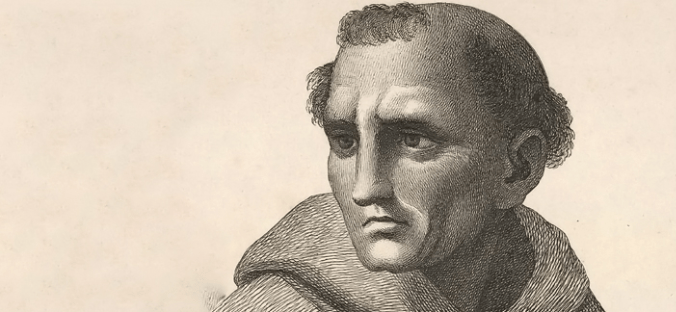
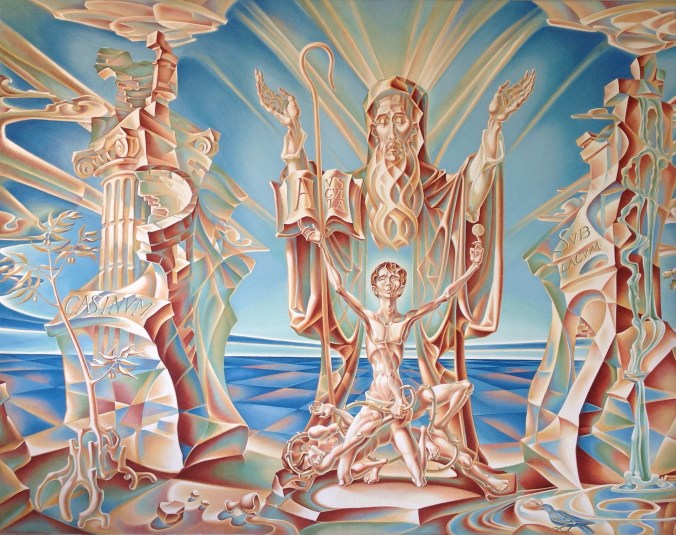
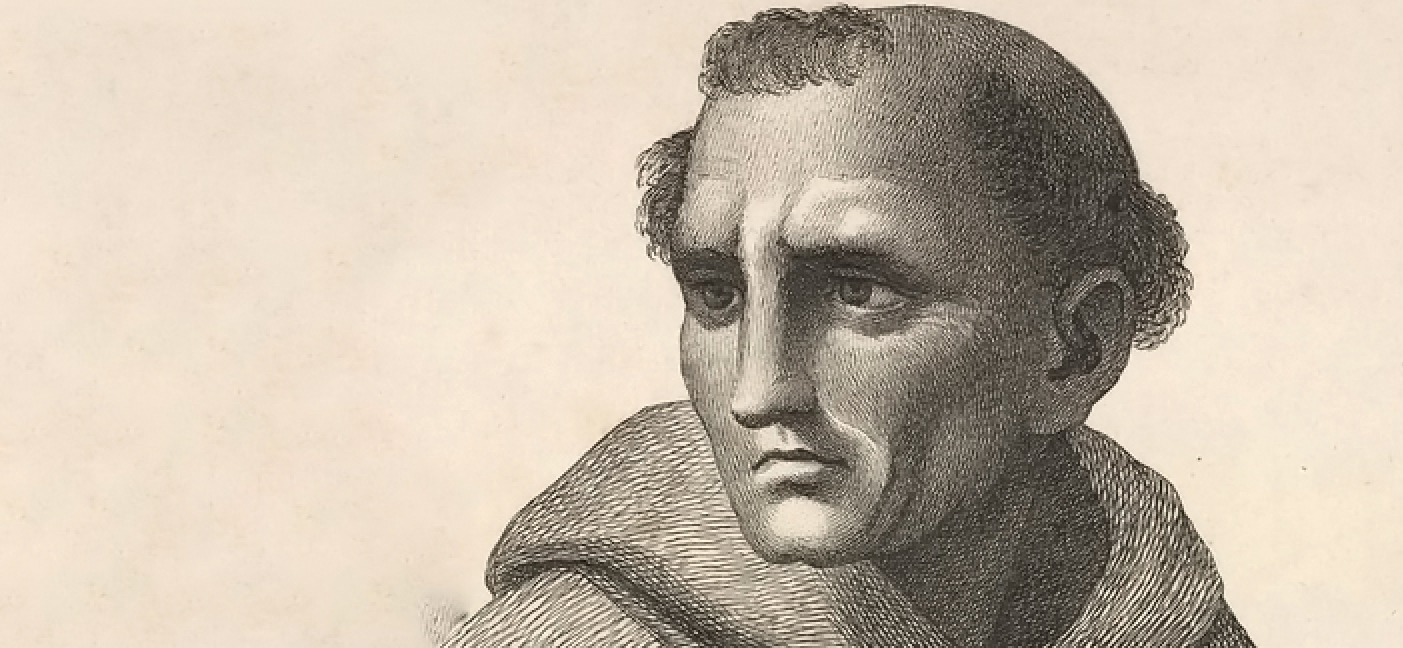
The Blessed John Duns Scotus (Source).
In my review of Rod Dreher’s The Benedict Option, I wrote the following:
I’m not suggesting that Dreher is necessarily wrong in his various judgments. He may well be correct in accusing the nominalists of a kind of cultural deicide (although it overlooks the Christian nominalist tendency, closely tied to empiricism, that numbers Berkeley, Burke, Hamann, Newman, and Chesterton among its ranks).
I subsequently received some pushback for making such a claim. After all, eminent philosophers and theologians had long made nominalism the villain of their narratives about the rise of an anti-Christian modernity. Others questioned my assertion about Newman in particular.
At that time, I defended myself by suggesting that, while I may be off in ascribing a specifically nominalist tendency to these thinkers, that nevertheless, they all do share, inter alia, a suspicion of universalizing abstraction, a respect for concrete particularity in its various forms, and a trust in prudence gained from experience. I interpreted this tendency as akin to the nominalist rejection of substantively existent universals. I also thought that one of the reasons this way of thinking might matter is in our dialogue with postmodernity, which is itself so suspicious of universals and grand narratives.
Nevertheless, I erred. I was mistaken to use that label of nominalism. I must thank my critics for pointing this out. In the many months since then, I have learned what would be the proper term to tie together these particular thinkers – not to mention Gerard Manley Hopkins and J.R.R. Tolkien.
The “nominalist tendency” is really a Scotist tendency. (The fact that I could make such an ironic error is, perhaps, a sign of my own ignorance. I own that. Scholasticism isn’t really my thing.) Chastened by my previous mistake, I hesitate to delve too deeply into the technical depths of Scotist philosophy. I will state briefly that a belief in the idea of haecceity as the unique thisness of each particular sums up the tendency’s core point. If I had time, I’d like to investigate if any firmer affinities could be found.
However, I believe I am now on much sounder territory. The Franciscan Daniel Horan’s work has focused on a postmodern engagement with Scotus, and the Scotism of Newman and Hopkins have been well-attested in the literature. Tolkien took up the theological note behind Hopkins’s ideas of inscape and instress, themselves poetic derivations of Scotist haecceity. More work still needs to be done in English on Hamann, but the image that is emerging is of a figure passionately devoted to the disruptive nature of ordinary, particular experience. His willingness to contest the established narratives of the Aufklärung predates postmodernism by a century and a half. Chesterton is cut from the same cloth. Bishop Berkeley, though perhaps not quite so colorful as either of these two, stakes his empiricism on the particularity of the thing perceived (ultimately, by God). And Burke transposes the idea into the realm of politics, tempered by a healthy respect for natural law.
Two observations come to mind. The first is that nearly all of these thinkers are English or Anglophone. An enquiry into the reasons behind English Scotism would be useful. In its absence, I will merely note that Scotus, that medieval Oxford theologian, seems to have been directly reintroduced into the life of modern English spirituality by another Oxford theologian, John Henry Newman. It was Newman’s influence that defined intellectual Catholicism in England until the conclusion of Vatican II.
The second is that several of these thinkers are literary figures in their own right. Hopkins is principally remembered as a poet, Chesterton as a journalist, novelist, and poet, and Tolkien as a novelist. Newman was a prolific writer across genres. He exerted a personal influence over Hopkins, Matthew Arnold, and Oscar Wilde. And Hamann’s own deeply bizarre output constantly blurs the rigid lines of 18th century drama (yet another way he foreshadows our own postmodern era).
I must wonder if Scotist thought is particularly apt for the production of theology in a poetic mode, as the Catholic Sophiologists of our own day are seeking to do. I certainly have friends who think so. At the very least, Scotus’s high Mariology accords well with the extremely high Mariology of some Sophiologists.
If I had more time, I should like to dive more deeply into these questions. For now, I seek only to explain myself a bit, and apologize for what was clearly a serious error.
ADDENDUM: I also meant to say that Delleuze’s appropriation of haecceity as a fundamental concept lends support to my own impulse of putting these thinkers in conversation with postmodernism.
 The Amish Catholic

_-_Sacristy_-_triptych_by_Giovanni_Bellini_-_Saint_Benedict_of_Nursia_and_Saint_Mark.jpg)


