Saint Augustine, Philippe de Champaigne, c.1645-50 (Detail) – (Source)
On Saint Augustine – A Prayer of M. Hamon
O God, who, after having shown to us in Saint Augustine the very excess into which corrupt nature causes us to fall, hast also caused us to see in him the strength and the empire of Thy Grace over our hearts, grant us, we beseech thee, so perfect a knowledge of our extreme misery and of Thy infinite mercy, that, expecting everything from Thee, and nothing from ourselves, we might hope fully in Thee by defying ourselves completely.
O God, who in embracing Saint Augustine with Thy Love, and in elevating him above all men by the knowledge of Thy Truth, hast placed him in Thy Church as a fiery and shining lamp, so that he might illuminate and defend her by his doctrine, and console and edify her by his sanctity; grant, by the help of his charitable intercession, that we might imitate his virtues; and, at his example, rejoicing only in the truth, and having taste only for the fruits of charity, we might despise this mortal life by the hope and feeling of the all-divine life which Thou hast promised us; so that, loving Thee alone, we might also place all our happiness in Thee alone.
Thus we beseech thee by Jesus Christ our Lord. Amen.
(From Jean Hamon, Entretiens d’une âme avec Dieu, New Edition (Avignons, 1740), pp. 405-06; original translation by The Amish Catholic)
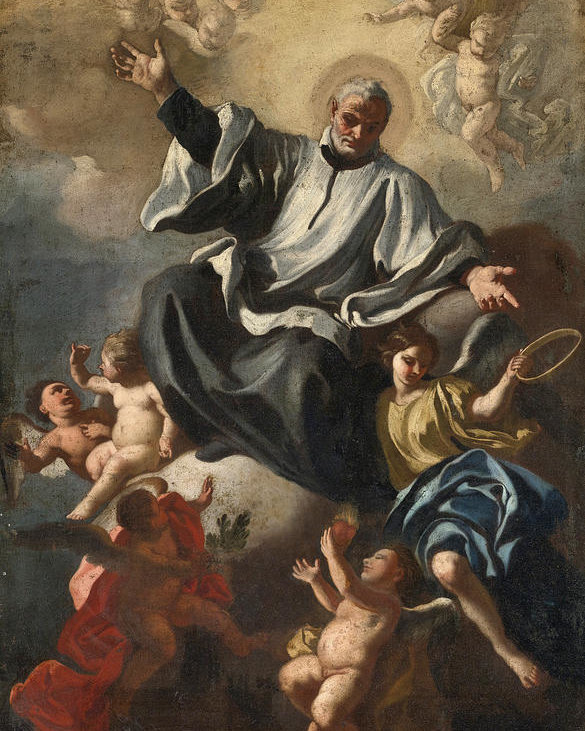
San Filippo Neri in Glory, Francesco da Mura (Source)
In this year of pestilence, I am reminded that St. Philip Neri began his good works in Rome by, among things, tending to the sick. The hospitals of sixteenth-century Italy were houses of profound mortification and little hope, not much more than palaces of death. They were chronically understaffed and overwhelmed with the indigent and the ill, who rarely recovered. The conditions were extremely unsanitary: the beds were filthy, the air putrid, the din of agony unremitting. Into these seething crowds of the desperate came St. Philip. He assisted the sick as best he could. His first biographer reports that, once he began to gather a following of disciples,
It was Philip’s custom on weekdays to divide his children in Christ into three or four groups and send them to the city hospitals. To begin with, he would himself go after dinner [lunch – RTY] to visit the sick in hospitals, to enkindle by his example in his followers a great desire to do this work; he would speak to the patients, tend them and do all sorts of things for them, which encouraged in his disciples an ardent desire to do the same. One example will serve to show you how devoted they were to the sick. Giovan Battista Salviati, being very dedicated, was in the hospital called the Consolazione, and headed straight for a patient intending to make his bed, asking him politely to get up so that he could do so. The patient thought he was being mocked. “No, my Lord,” he said, “don’t make fun of me, I’m a poor man.” He knew all about Giovan Battista’s licentious way of life, but was unaware of his marvellous change of character, by which he had wholeheartedly turned away from material concerns to the love of heaven. But what next? Giovan Battista urged him most earnestly, and the sick man was struck not only by his air of authority but even more so by his humility, and got out of bed, lost in admiration. Giovan Battista retained that style of life with an unwavering intent until the day of his death, and having once put his hand to the plough, he never looked behind him.
Antonio Gallonio, The Life of St. Philip Neri Trans. Fr. Jerome Bertram Cong.Orat.
St. Philip inspired others to help the sick in whatever way the could manage. These works of mercy were the fruit of the genuine conversion he wrought in their hearts by that peculiar influence he possessed. The palpable indwelling of the Holy Ghost in his heart turned him into a living fountain of graces whose streams brought miracles to many souls. Some of these miracles healed the sick and even raised the dead. Yet we must never forget that it was not these extraordinary moments but, rather, the graces of repentance, of conversion, and of final perseverance that were truly the greatest fruits of St. Philip’s particular sanctity. St. Philip’s true fame rests in those whom he carried with him to Heaven, not in the strange and marvelous works that he effected while on earth. The story of Giovan Battista Salviati is one example among many of those who tasted of such sweet fruits. He actualized the grace of his conversion through works of charity towards the sick.
Subsequent writers have retained this act as a sine qua non of the Oratorian life, and then only because St. Philip so clearly demonstrates how essential it is to the Christian life per se.
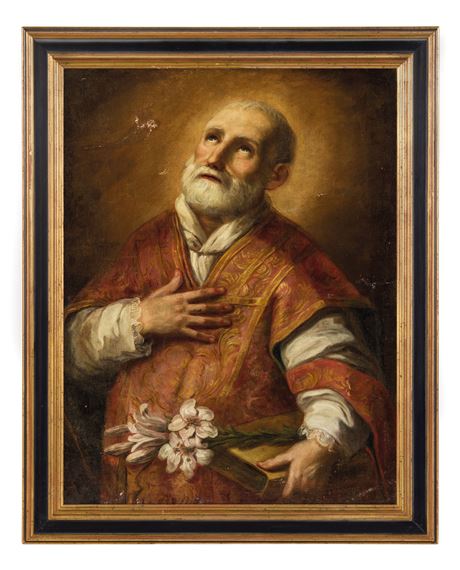
The Vision of St. Philip Neri, Florentine School, 17th c. (Source)
And it seems to me that on this, St. Philip’s feast day, we would be well-advised to do the same. We find ourselves in the midst of a new and terrifying pandemic. Death is everywhere. In the United States alone we have lost 100,000 souls with almost no public mourning. Many of these people have died alone, afraid, in pain, and deprived of the comfort of God’s Church. The nature of the disease means that most of us cannot actively assist in the hospitals for fear of transmission. All we can do is show kindness to our neighbors, help each other obtain the necessary supplies to stop the spread of the disease, and give blood if we have survived the sickness ourselves. That’s as far as practical action goes for most of us. So much for the corporal works of mercy.
But a Christian is never without a way to directly help his brethren. The first and last resort of the faithful must be prayer. Here, too, we can take St. Philip as our model. Lest we place too much emphasis on St. Philip’s merely material acts in visiting the sick, let us turn to the testimony of Giuseppe Crispino,
When we enter a sick-chamber, let us imitate the holy Father Philip, who was accustomed, immediately upon his arrival, to pray for the patients in their own room and to make the bystanders do the same, especially in the case of the dying. The Saint was also accustomed to retire into another room, and there to pray for the sufferer.
Giuseppe Crispino, The School of Saint Philip Neri, pg. 174 Trans. Frederick William Faber
As I have written elsewhere, we must offer intercession for our suffering fellows now more than ever. And we must do so in union with the whole communion of saints. Indeed, one small blessing of this crisis is that it can, if we let it, draw us closer to the “great cloud of witnesses” ever ready to help us. One of St. Philip’s spiritual sons, Fr. Agostino Manni, made special prayers to the Blessed Virgin whenever he went to the hospitals; the Blessed Juvenal Ancina likewise sought the prayers of the living when he ministered to the sick (Crispino 174-76). And that most perfectly Philippine of English Oratorians, Fr. Faber, conceives of intercession for the dying as an intrinsically Marian act. He tells us that
We learn [a lesson] from Mary about the deaths of others. It is, that devotion for those in their last agony is a Mary-like devotion, and most acceptable to her Immaculate Heart. There is not a moment of day or night in which that dread pomp of dying is not going on. There are persons like ourselves, or better than ourselves, and whose friends have with reason loved them more than ever ours have loved us, who are now straitened in their agony, and whose eternal sight of God is trembling anxiously in the balance. Can any appeal to our charity be more piteously eloquent than this?…Are not the dying our brothers and our sisters in the sweet motherhood of Mary? The family is concerned. We must not coldly absent ourselves. We must assist in spirit at every death that is died in the whole world over, deaths of heretics and heathens as well as Christians. For they, too, are our brothers and sisters; they have souls; they have eternities at stake; Mary has an interest in them…How much more must they need prayers, who have no sacraments!…How much more earnest must be the prayers, when not ordinary grace, but a miracle of grace, must be impetrated for them!
Fr. Frederick William Faber, The Foot of the Cross
I cannot help but hear a ringing call to intercession for our own times in these words of Fr. Faber. A greater and more fearsome calamity of general death demands a greater and more dedicated oblation of prayer. Especially when even our brethren in the Faith are so often deprived of the Sacraments that should be their final stay and consolation. Yet the power of God to furnish extraordinary grace is far mightier than any earthly sickness. Healing, protection, mercy, conversion, and consolation: let us boldly ask for these gifts on behalf of the ill, the dying, the dead, their caregivers, and their families…while we still can. The hour is late. Tomorrow we may be struck ill with the dread and deadly pestilence. And then, our every thought diverted, our breath failing, our bodies plunged into the depths of a fatigue from which we shall never rise again, we will be grateful for those pious souls who lift us up to the face of the Father in prayer.
So let us pray while we still can. If we do this in a spirit of charity, we will become true Sons and Daughters of St. Philip and more perfectly emulate the Divine Physician who desires to heal us in soul as well as in body.
May St. Philip Neri pray for us all in this troubled time.
A depiction of the Madonna and Child with Patron Saints against the Plague. Colored engraving by T. Van Merlen. (Source)
“Is it my will that a sinner should die, saith the Lord God, and not that he should be converted from his ways, and live?” – Ezekiel 18:23 DRA.
In Nomine Patris et Filii et Spiritus Sancti, Amen.
Stella Caeli extirpavit, quae lactavit Dominum: mortis pestem quam plantavit primus parens hominum. Ipsa stella nunc dignetur sidera compescere quorum bella plebem caedunt dirae mortis ulcere. O piisima Stella Maris, a peste succurre nobis. Audi nos, Domina, nam filius tuus nihil negans te honorat. Salva nos, Jesu, pro quibus virgo mater te orat.
Kyrie Eleison Christe Eleison Kyrie Eleison
God the Father Almighty, Maker of Heaven and Earth, have mercy on us. God the Son, Redeemer of the World, have mercy on us. God the Holy Ghost, Sanctifier and Vivifier of All Things, have mercy on us.
Holy Mary, Mother God, pray for us. Our Lady, Queen of Heaven, pray for us. Our Lady of Sorrows, pray for us. Our Lady, Help of Christians, pray for us. Our Lady, Health of the Sick, pray for us. Our Lady, Salvation of the Roman People, pray for us. Our Lady, Star of the Sea, pray for us. Our Lady, Untier of Knots, pray for us. St. John the Baptist, pray for us. St. Joseph, pray for us. St. Mary Magdalene, pray for us. St. Michael and All Angels, pray for us. St. Thecla, pray for us. St. Valerian, pray for us. St. Corona, pray for us. SS. Cosmas and Damian, pray for us. St. Zacharias of Jerusalem, pray for us. St. Roch, pray for us. St. Sebastian, pray for us. St. Christopher, pray for us. St. Adrian, pray for us. St. Blaise, pray for us. St. Macarius of Ghent, pray for us. St. Patrick, pray for us. St. Pantaleon, pray for us. St. Dymphna, pray for us. St. Rosalia, pray for us. St. Anthony of Egypt, pray for us. St. Benedict, pray for us. St. Gregory, pray for us. St. Bernardine of Siena, pray for us. St. Anthony of Padua, pray for us. St. Philip Neri, pray for us. St. John Nepomuk, pray for us. St. Charles Borromeo, pray for us. St. Camillus of Lellis, pray for us. St. Aloysius Gonzaga, pray for us. St. Damien of Molokai, pray for us. St. Thérèse of Lisieux, pray for us.
O Sacred Heart, Furnace of Charity, have mercy on us. Lamb of God, Who takest away the sins of the world, spare us, O Lord. Lamb of God, Who takest away the sins of the world, graciously hear us, O Lord. Lamb of God, Who takest away the sins of the world, have mercy on us.
O Crux, ave spes unica hoc Passionis tempore! Piis adauge gratiam reisque dele crimina.
We beseech Thee O Lord, in Thy compassion, to turn away from Thy People Thy wrath, which indeed we deserve for our sins, but which in our human frailty we cannot endure; therefore embrace us with that tenderness which Thou art wont to bestow on the unworthy; through Jesus Christ our Lord.
Gloria Patri, et Filio, et Spiritui Sancto, Sicut erat in principio, et nunc, et semper, et in saecula saeculorum. Amen.
In Lent, I often return to the words of the great Bishop of Cambrai, François de Salignac de la Mothe-Fénelon. He is a perennially refreshing source of spiritual wisdom and guidance. Since we are finally in Passiontide, I thought this excerpt from Fénelon’s sermon on prayer, “The Saints Converse with God,” would be greatly edifying for all those of my readers keeping up with the Lenten Spirituality Series.
A portrait of Fénelon in excellent blue-purple episcopal garb (Source)
We must pray with perseverance. The perfect heart is never weary of seeking God. Ought we to complain if God sometimes leaves us to obscurity, and doubt, and temptation? Trials purify humble souls, and they serve to expiate the faults of the unfaithful. They confound those who, even in their prayers, have flattered their cowardice and pride. If an innocent soul, devoted to God, suffer from any secret disturbance, it should be humble, adore the designs of God, and redouble its prayers and its fervor. How often do we hear those who every day have to reproach themselves with unfaithfulness toward God complain that He refuses to answer their prayers! Ought they not to acknowledge that it is their sins which have formed a thick cloud between Heaven and them, and that God has justly hidden Himself from them? How often has He recalled us from our wanderings! How often, ungrateful as we are, have we been deaf to His voice and insensible to His goodness! He would make us feel that we are blind and miserable when we forsake Him. He would teach us, by privation, the value of the blessings that we have slighted. And shall we not bear our punishment with patience? Who can boast of having done all that he ought to have done; of having repaired all his past errors; of having purified his heart, so that he may claim as a right that God should listen to his prayer? Most truly, all our pride, great as it is, would not be sufficient to inspire such presumption! If then, the Almighty do not grant our petitions, let us adore His justice, let us be silent, let us humble ourselves, and let us pray without ceasing. This humble perseverance will obtain from Him what we should never obtain by our own merit. It will make us pass happily from darkness to light; for know, says St. Augustine, that God is near to us even when He appears far from us.
Let the Gentleman Saint help you this Lent. (Source)
SHOULD it happen sometimes, my daughter, that you have no taste for or consolation in your meditation, I entreat you not to be troubled, but seek relief in vocal prayer, bemoan yourself to our Lord, confess your unworthiness, implore His Aid, kiss His Image, if it be beside you, and say in the words of Jacob, “I will not let Thee go, except Thou bless me;” or with the Canaanitish woman, “Yes, Lord, I am as a dog before Thee, but the dogs eat of the crumbs which fall from their master’s table.”
Or you can take a book, and read attentively till such time as your mind is calmed and quickened; or sometimes you may find help from external actions, such as prostrating yourself folding your hands upon your breast, kissing your Crucifix,—that is, supposing you are alone. But if, after all this, you are still unrelieved, do not be disturbed at your dryness, however great it be, but continue striving after a devout attitude in God’s Sight. What numbers of courtiers appear a hundred times at court without any hope of a word from their king, but merely to pay their homage and be seen of him. Just so, my daughter, we ought to enter upon mental prayer purely to fulfil our duty and testify our loyalty. If it pleases God’s Divine Majesty to speak to us, and discourse in our hearts by His Holy Inspirations and inward consolations, it is doubtless a great honour, and very sweet to our soul; but if He does not vouchsafe such favours, but makes as though He saw us not,—as though we were not in His Presence,—nevertheless we must not quit it, but on the contrary we must remain calmly and devoutly before Him, and He is certain to accept our patient waiting, and give heed to our assiduity and perseverance; so that another time He will impart to us His consolations, and let us taste all the sweetness of holy meditation. But even were it not so, let us, my child, be satisfied with the privilege of being in His Presence and seen of Him.
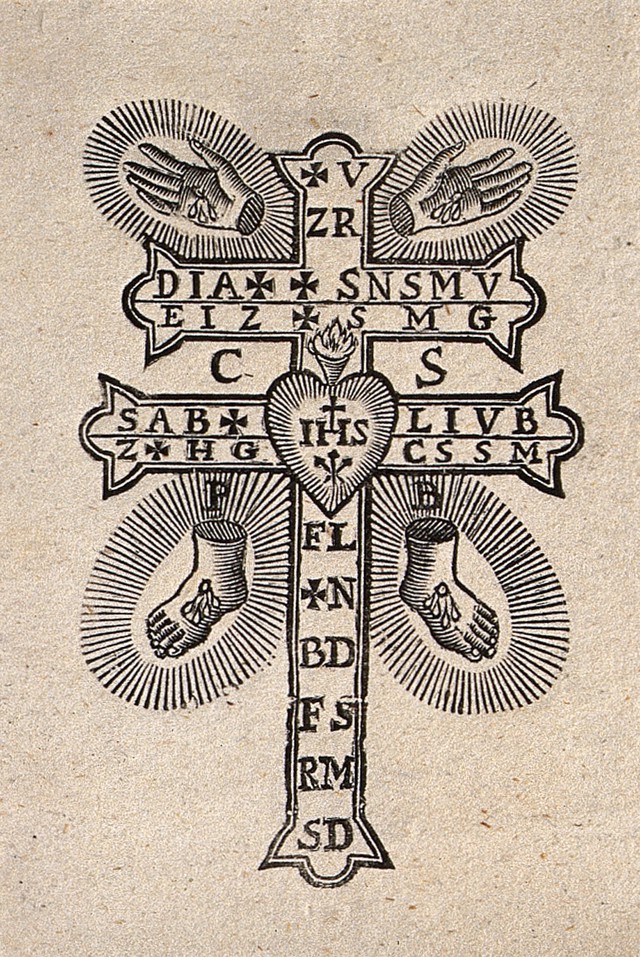
The holy side-wound of Christ, from a Book of Hours (Source)
Today is the Anglican commemoration of George Herbert, the great English cleric and metaphysical poet of the 17th century. He died on March 1st, 1633. In honor of this bard of the spirit, I offer to my readers one of my favorite Herbert poems. Every time I return to it, I find new edification.
“Prayer (1)”
George Herbert
Prayer the church’s banquet, angel’s age, God’s breath in man returning to his birth, The soul in paraphrase, heart in pilgrimage, The Christian plummet sounding heav’n and earth Engine against th’ Almighty, sinner’s tow’r, Reversed thunder, Christ-side-piercing spear, The six-days world transposing in an hour, A kind of tune, which all things hear and fear; Softness, and peace, and joy, and love, and bliss, Exalted manna, gladness of the best, Heaven in ordinary, man well drest, The milky way, the bird of Paradise, Church-bells beyond the stars heard, the soul’s blood, The land of spices; something understood.
O Wisdom, be enthroned in my heart, O Adonai, inflame my heart, O Root of Jesse, bloom in my heart, O Key of David, unlock my heart, O Dayspring, shine in my heart, O King of Nations, reign in my heart, O Emmanuel, abide in my heart, Now and forevermore.
Glory be to the Father, and to the Son, and the Holy Spirit, As it was in the beginning, is now, and ever shall be, world without end.
A print from The Holy Twins by Tomie dePaola, depicting SS Benedict and Scholastica. (Source)
I hope my readers will join me on a novena to the Patriarch of Western Monks, starting today (July 3rd) and ending on the Feast of St. Benedict, the 11th of July. Here is the prayer I will use, taken from EWTN’s website:
Glorious Saint Benedict, sublime model of virtue, pure vessel of God’s grace! Behold me humbly kneeling at your feet. I implore you in your loving kindness to pray for me before the throne of God. To you I have recourse in the dangers that daily surround me.
Shield me against my selfishness and my indifference to God and to my neighbor.
Inspire me to imitate you in all things. May your blessing be with me always, so that I may see and serve Christ in others and work for His kingdom. Graciously obtain for me from God those favors and graces which I need so much in the trials, miseries and afflictions of life. Your heart was always full of love, compassion and mercy toward those who were afflicted or troubled in any way. You never dismissed without consolation and assistance anyone who had recourse to you. I therefore invoke your powerful intercession, confident in the hope that you will hear my prayers and obtain for me the special grace and favor I earnestly implore.
{mention your petition}
Help me, great Saint Benedict, to live and die as a faithful child of God, to run in the sweetness of His loving will, and to attain the eternal happiness of heaven.
Some of my readers will no doubt remember that very strange fellow I once wrote about, the Rev. Montague Summers. I have had to look at quite a lot of his orchidaceous writings recently for my research, including his poetry. Here is one such poem he wrote in Antinous and Other Poems (1907). It was written while he was still an Anglican, though it anticipates the lusciously Baroque spirituality that would mark his later writings.
Madonna Delle Grazie
Montague Summers
In the fane of grey-robed Clare
Let me bow my knee in prayer,
Gazing at thy holy face
Gentle Mary, Queen of Grace.
Thou who knowest what I seek,
Ere I unlock my lips to speak,
For I am thine in every part
And thou knowest what my heart,
Yearning in my fervid breast,
Ere it be aloud confessed,
Longeth for exceedingly,
Mamma cara, pity me!
By the dearth of childlorn years,
By thy mother Anna’s tears,
By the cry of Joachim,
When the radiant seraphim,
Girdled with eternal light,
Blazed upon the patriarch’s sight
With the joyous heraldry
Of thy sinless infancy.
By the bridal of the Dove,
By thy God’s ecstatic love,
By the home of Nazareth,
When the supernatural breath
Of God enfolded thee, and cried:
“Open to me, love, my bride,
Come to where the south winds blow,
Whence the mystic spices flow,
Calamus and cinnamon,
Living streams from Lebanon.
Fresh flowers upon the earth appear
The time of singing birds is near,
The turtle-dove calls on his mate,
The fruit is fragrant at our gate.
Thy lips are as sweet-smelling myrrh,
When the odorous breezes stir
Amid the garden of the kings;
As incense burns at thanksgivings.
Thy lips are as a scarlet thread,
Like Carmèl is they comely head,
Thou art all mine, until the day
Break, and the shadows flee away!”
Mother, by thy agony
‘Neath the rood of Calvary,
When the over-piteous dole
Pierced through thy very soul
With a sevenfold bitter sword
According to the prophet’s word.
By the sweat and spiny caul,
By the acrid drink of gall,
By the aloes and the tomb,
By thy more than martyrdom,
Dolorosa, give to me
The thing I lowly crave of thee.
By thy glory far above,
Mother, Queen of heavenly love,
By thy crown and royal state,
By thy Heart Immaculate,
Consort of the Deity,
Withouten whose sweet assent He
May nothing deign to do or move
Bound by ever hungered love,
God obedient to thee!
Mother, greatly condescending,
To thy humblest suitor bending,
From thy star-y-pathen throne,
Since it never hath been known
Whoso to this picture hied,
Whoso prayed thee was denied,
Mamma bella, give to me,
The boon I supplicate of thee!
In Santa Chiara, Napoli.
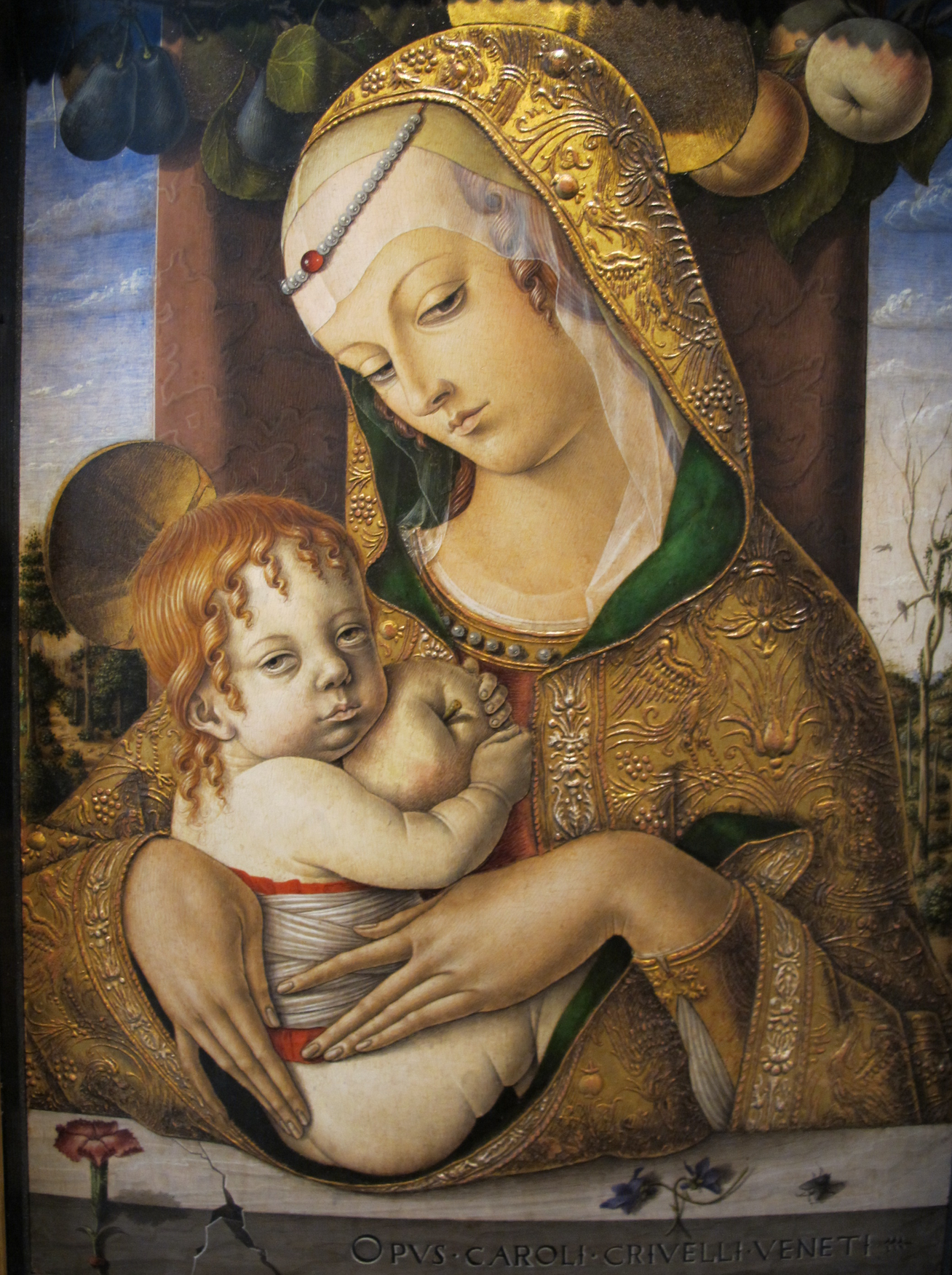
“Madonna and Child,” Carlo Crivelli, c. 1480 (Source)
Over at Vultus Christi, you can find a series of Chapter Talks on the Rule of Saint Benedict. Today’s commentary concludes with the story of a mighty prayer of deliverance given by the Blessed Virgin Mary to a French priest of the nineteenth century, Bl. Louis-Edoard Cestac. Here it is:
August Queen of Heaven, sovereign Mistress of the Angels, thou who from the beginning hast received from God the power and the mission to crush the head of Satan, we humbly beseech thee to send thy holy legions, that under thy command and by thy power they may pursue the evil spirits, encounter them on every side, resist their bold attacks, and drive them hence into eternal woe.
Who is like unto God?
O good and tender Mother, thou willest always to be our love and our hope.
O Mother of God, send thy holy Angels to defend us and drive far from us the cruel enemy.
Holy Angels and Archangels, defend us and keep us. Amen.
Go read the whole thing. In fact, all of the commentaries are edifying; read them all.
‘Catholicity, Antiquity, and consent of the Fathers, is the proper evidence of the fidelity or Apostolicity of a professed Tradition’ J.H. Newman, Lectures on the Prophetical Office of the Church, 1837, p. 51









 The Amish Catholic


