
I would like to refer my readers to a phenomenal sermon delivered by Mother Brit Frazier of St. Mark’s Episcopal Church, Philadelphia, PA. Some of you may know Mother Brit from Twitter, others from Earth & Altar, a very good Anglican blog. You can find the video here, starting at 24:00 and continuing for about eleven minutes. I found her meditation on the theme of God as a home for all, as a welcome for the spiritually homeless, to be quite moving.
For those who are curious, the poem from Chesterton that she discusses, “The House of Christmas,” runs as follows:
There fared a mother driven forth
Out of an inn to roam;
In the place where she was homeless
All men are at home.
The crazy stable close at hand,
With shaking timber and shifting sand,
Grew a stronger thing to abide and stand
Than the square stones of Rome.
For men are homesick in their homes,
And strangers under the sun,
And they lay their heads in a foreign land
Whenever the day is done.
Here we have battle and blazing eyes,
And chance and honor and high surprise,
But our homes are under miraculous skies
Where the yule tale was begun.
A Child in a foul stable,
Where the beasts feed and foam,
Only where He was homeless
Are you and I at home;
We have hands that fashion and heads that know,
But our hearts we lost – how long ago!
In a place no chart nor ship can show
Under the sky’s dome.
This world is wild as an old wives’ tale,
And strange the plain things are,
The earth is enough and the air is enough
For our wonder and our war;
But our rest is as far as the fire-drake swings
And our peace is put in impossible things
Where clashed and thundered unthinkable wings
Round an incredible star.
To an open house in the evening
Home shall men come,
To an older place than Eden
And a taller town than Rome.
To the end of the way of the wandering star,
To the things that cannot be and that are,
To the place where God was homeless
And all men are at home.
Although I am not much of a Chesterton fan anymore, I, too, was taken with this poem. I am grateful for having been introduced to it, though the strongest parts of the sermon move well beyond Chesterton. “The heart of Jesus is a secure place. There’s no need to defend it, no need to fear for our safety.” These words of Mother Brit’s bear further meditation. How often do we act as though the heart of Jesus were not secure, or as if His grace could move without His sovereign will – even when it appears to fail?
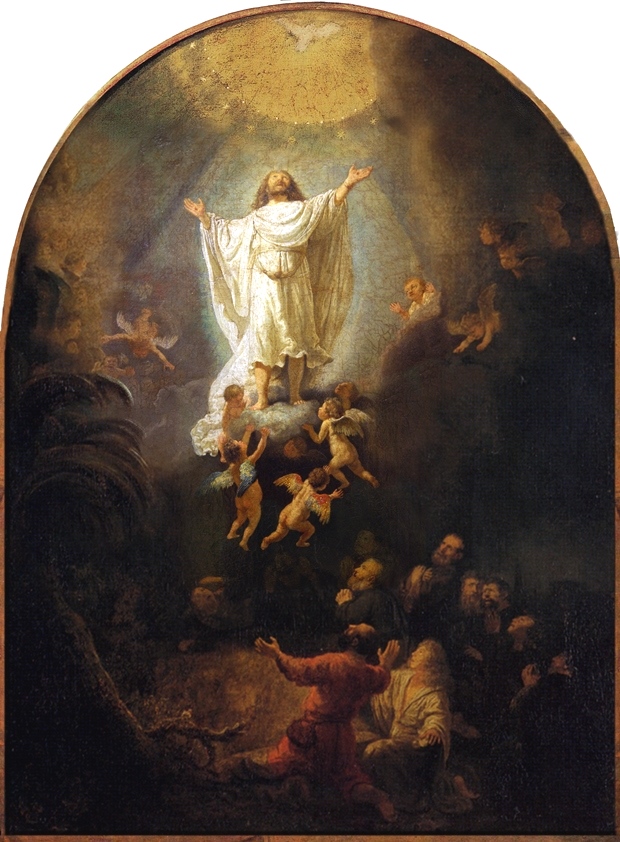
I chose Rembrandt’s famous Return of the Prodigal Son to illustrate this post because it perfectly captures the feelings of welcome, abundance, and divine homecoming that Mother Brit evokes. For our own return home to God always takes the form of repentance and devotion, even if just for a Providential instant before death.
However, I also thought of the work of another artist. Allan Rohan Crite (1910-2007) was a Black painter and illustrator whose work focused primarily on scenes of African American urban life. He was also an Anglo-Catholic. His religious corpus, which bears a favorable comparison to that of other Anglican artists such as Martin Travers, Enid Chadwick, Ninian Comper, and William Butterfield, combines transcendent solemnity with a keen attention to the realities of everyday life.
His 1948 painting of Our Lady of the Neighborhood is a good representation of what Mother Brit is talking about.
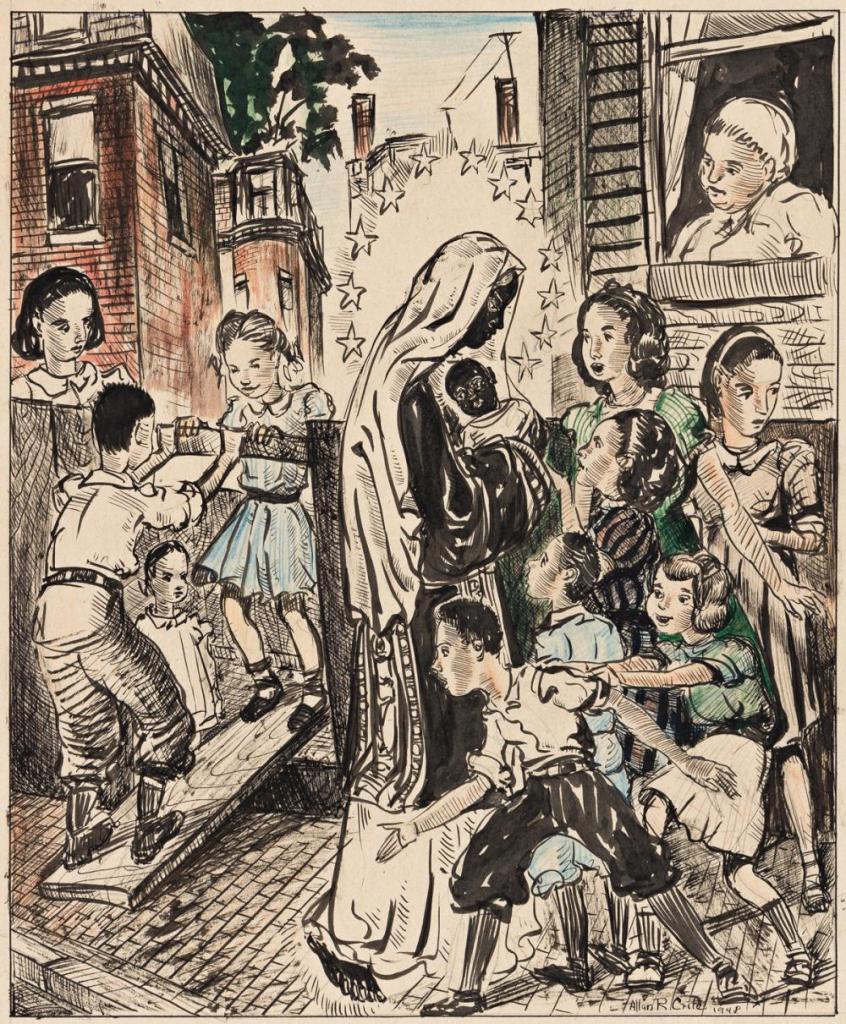
A Black Madonna carries Jesus through a crowd of dark-skinned children in an urban scene. Although she is crowned with twelve stars, she is entirely at home with these people; they in turn are entirely at home with her and her divine son. The children in this image exhibit an easy intimacy with the Mother and Child, the sort of intimacy that comes from long familiarity. This sense of “being at home with each other,” so like the prelapsarian life, is the very sentiment that the Christian aspires to enjoy with God.
Yet how hard it is to attain! And not just because our sins and temptations, which are distraction enough. Our whole religious apparatus is set up to warn us of these traps on the journey. But even our piety and our virtues can get in the way, ossifying into idols that demand more and more of our tribute, sapping more and more of our time and energy. Good things, when used in a disordered way, become snares. The incense we burn before those false gods clouds our love of God. Perhaps that is why a somewhat fanciful image like this one becomes so attractive. It shows us another way – life as an easy, peaceful, almost effortless communion with God. It shows us a tiny, imaginative glimpse of the communion of saints. This communion, surely, is what Mother Brit has in mind when she says that “Our true home is an eternal and abiding safety.” For these children manifestly feel safe next to the God-Man and His all-pure Mother. They are, for lack of a better term, friends.
Mother Brit also touches upon this grand theme of friendship with Christ. She says:
Our home in Christ is always a place of companionship and love. He is our Savior and Redeemer, yes, but He is, indeed, our Friend. This friendship of Jesus is no ordinary fellowship. He lives alongside of us: a confidant, a guide. His hand is in our hands, His heart is opened and always opening to us, soothing our uncertainties and making our pathways into places of peace. His company is always unconditional companionship and love. In our fellowship with Him, we are given a beloved family.
Mother Brit Frazier, Sermon for the First Sunday in Christmastide, 2021
Friendship with Christ – a mystery. But our mystery, our blessed mystery, the magnificent mystery at the heart of Christian life. How strange it is that Being Itself, the Uncreated Light, the Omnipotent and Omniscient One, should call humans, who are essentially nothing, His friends? Yes, it is a tremendous mystery.
Crite conjures something of this mystery in his illustrations for Three Spirituals from Earth to Heaven (1948), which give a distinctly Anglo-Catholic spin to the texts of old Negro spirituals. For instance, in his drawings for “Nobody Knows the Trouble I See,” Crite depicts a Black man being taken up by Jesus into the heavenly choirs.
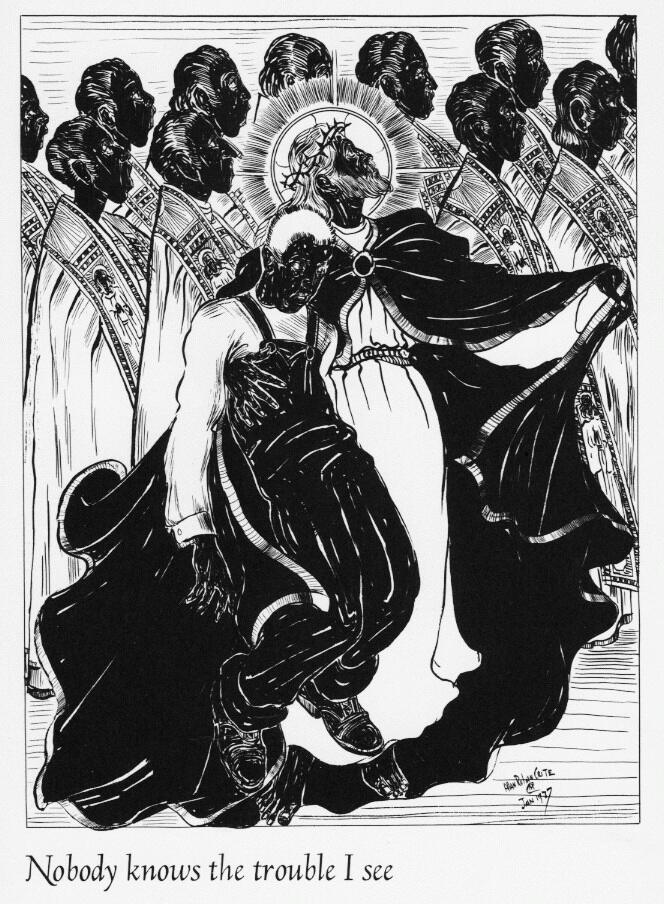
Perhaps it would be more apt to say that Jesus is carrying him. He’s not walking at all, but peacefully letting the Savior draw him into the realms of glory. A procession of coped figures streams by in the background, unnoticed by the poor and troubled man; yet this is no earthly liturgy, as the following illustrations make clear.

Christ Himself dons a cope of glory as well as a shining crown; He gently takes the troubled soul by the hand and shows him the scene he has hitherto missed. We sense his stunned joy. We can almost hear the otherworldly harmony of the singers. And look at the expression on Jesus’s face – not a stern look, but rather the concerned and kindly gaze of a friend who is attentive to the reaction of a dear companion whom He has just surprised.
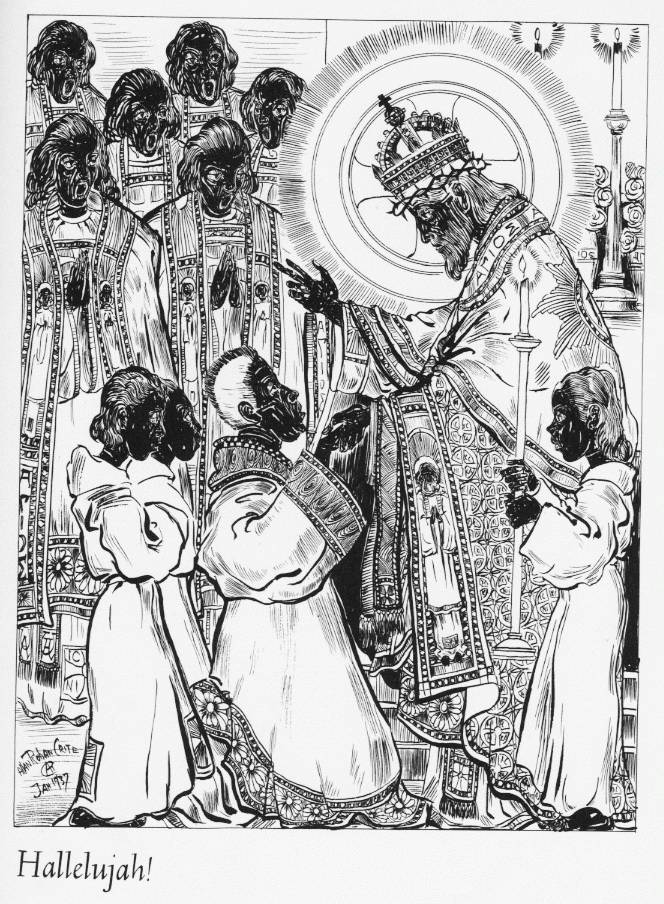
And what is the greatest surprise of all? That even a poor and outcast and troubled soul has a place in this glorious choir. Crite finishes by depicting the poor man’s reception into glory, with Christ vesting him in a beautiful robe. God does not look at us like the World does, for He sees the heart. As Mother Brit says in her homily, “even those whom the World have rejected are given places of beauty and intimacy and peace and security at the throne of grace.” Allan Rohan Crite knew that Truth, and it shone through so much of his art.
Christmas is about all these things – Christ as our true home, Christ as our true friend. Especially in this holy time of year, let us pray for the grace always to trust that His friendship will lead us home to His heart.

 The Amish Catholic
#/media/File:Rembrandt_Harmensz_van_Rijn_-_Return_of_the_Prodigal_Son_-_Google_Art_Project.jpg)
