Benedict Shrugged

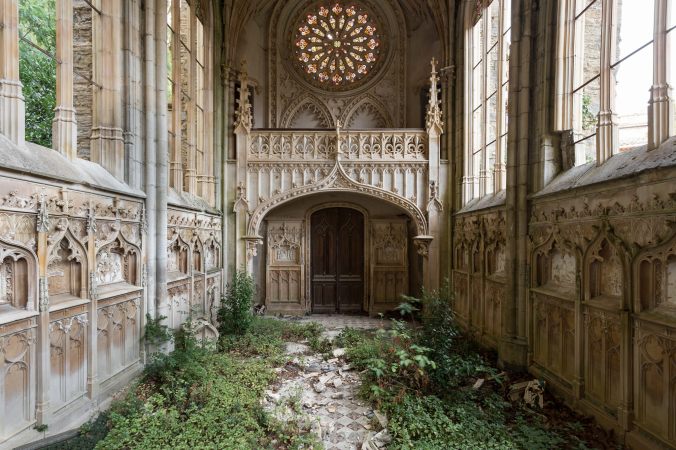
AbandonedCatholicChurch

“Bare ruin’d choirs, where late the sweet birds sang…”—Shakespeare, Sonnet LXXIII. (Source).

For the kingdom of heaven is as a man travelling into a far country, who called his own servants, and delivered unto them his goods. And unto one he gave five talents, to another two, and to another one; to every man according to his several ability; and straightway took his journey. Then he that had received the five talents went and traded with the same, and made them other five talents. And likewise he that had received two, he also gained other two. But he that had received one went and digged in the earth, and hid his lord’s money. After a long time the lord of those servants cometh, and reckoneth with them. And so he that had received five talents came and brought other five talents, saying, Lord, thou deliveredst unto me five talents: behold, I have gained beside them five talents more. His lord said unto him, Well done, thou good and faithful servant: thou hast been faithful over a few things, I will make thee ruler over many things: enter thou into the joy of thy lord. He also that had received two talents came and said, Lord, thou deliveredst unto me two talents: behold, I have gained two other talents beside them. His lord said unto him, Well done, good and faithful servant; thou hast been faithful over a few things, I will make thee ruler over many things: enter thou into the joy of thy lord. Then he which had received the one talent came and said, Lord, I knew thee that thou art an hard man, reaping where thou hast not sown, and gathering where thou hast not strawed: And I was afraid, and went and hid thy talent in the earth: lo, there thou hast that is thine. His lord answered and said unto him, Thou wicked and slothful servant, thou knewest that I reap where I sowed not, and gather where I have not strawed: Thou oughtest therefore to have put my money to the exchangers, and then at my coming I should have received mine own with usury. Take therefore the talent from him, and give it unto him which hath ten talents. For unto every one that hath shall be given, and he shall have abundance: but from him that hath not shall be taken away even that which he hath. And cast ye the unprofitable servant into outer darkness: there shall be weeping and gnashing of teeth.
(Matt. 25: 14-30 KJV).

“There are two sides to every issue: one side is right and the other is wrong, but the middle is always evil.” (Ayn Rand, Atlas Shrugged 1054).

In every age, the relationship of the Church and the world is a fraught issue. The particular vicissitudes of politics, society, and spirituality always bring up new challenges for the Body of Christ in hac lacrimarum valle. Rod Dreher’s new book, The Benedict Option, recently released by Sentinel, is a contribution to the question as we must face it in our own time. Dreher says in the book that he hopes to “sound the alarm for conservative Christians in the West,” so that they can survive “the greatest danger” of our age, “the liberal secular order itself” (The Benedict Option 236). He envisions Christians forming counter-cultural communities to sustain the life of the Faith through “modern repaganization” (197).

Insofar as Dreher wanted to start a conversation, the book is a smashing success. It has been praised and pilloried in the Christian blogosphere and beyond. Over the course of the last three and a half years, Dreher has even inspired rival “options” such as Chad Pecknold’s Dominican Option, Michael Martin’s Sophia Option, John Mark Reynolds’s Constantine Project, Dr. Carrie Gress’s Marian Option, and more. I may get into some of those reactions over the course of this essay. What I will not do is make much reference to Dreher’s authorial meddling, including his obsessive and often highly vindictive reactions to reviews he dislikes. It is enough to acknowledge that Dreher is partaking of the conversation he wanted to start. Considered solely as a social phenomenon, the Benedict Option has succeeded at beginning those important conversations about the Church’s place in the (post)modern west.

But books cannot be reduced to the conversations they inspire. They are texts, and eventually we need to evaluate them as texts. Under that demand, the record is much murkier. There are many good things about The Benedict Option, but also many bad things. Throughout, the book’s noble aspirations are frustrated by poor style, errors of content, and a palpable, hand-wringing fear.

In the interest of charity, however, I’ll begin with a few of the positives.

Dreher is concerned with the right problems: individualism, hedonism, consumerism, liberalism, secularism, relativism, etc. In short, the toxic cocktail of capitalist modernity. Of course, Dreher hardly bothers to point out that these issues are intimately bound up with the economic system as such. But I digress.

Dreher follows upon greater scholars like, inter alia, Alasdair MacIntyre and Charles Taylor. There has been some controversy over Dreher’s reading of MacIntyre, but ultimately, I’m not sure it matters. Dreher was inspired by a line in After Virtue and came up with his own project (sorta…Gabriel Sanchez, among others, rightly points out that Dreher’s vision isn’t all that original anyway). So be it. The fact remains that, insofar as the book is a polemic, Dreher is aiming at the right kinds of cultural forces. It also helps that Dreher specifically limits his scope to the West. Any attempt to integrate the cultural experience of Christians in, say, Sub-Saharan Africa or the Far East would no doubt lead to an extremely different set of conclusions than those which Dreher has offered. His command of social science and ethnographic work (if not historiography) about our own situation is impressive.

Moreover, Dreher is right to mine the wisdom of the monastic tradition. Monasticism, where rightly practiced, stands as a sign of contradiction to the world’s banality, vices, and distractions. He attempts to draw something like a social doctrine out of the Rule of St. Benedict, a project I’ve long thought might be worthwhile if attempted with more systematic rigor. Dreher writes, “Because it dictates how Benedictine virtues are to be lived by monastic communities, the Rule is political” even while he recognizes that “The telos…of a monastic life is not the same as the telos of life in a secular state” (The Benedict Option 88). His Third Chapter, describing the life and spirituality of the Monks of Norcia, is a loving testament to this inspiring young order. Dreher also advocates for Christian families to turn their homes into “domestic monaster[ies]” and attempt a genuine ascetic life (124-26). In fact, his overriding goalto bring up the next generation as faithful Christians, and thereby preserve Christianity as suchis an indisputably admirable one.

I might add that some of his thoughts on education are sensible. While I’m more skeptical than Dreher is when it comes to Classical Education, and the canon of Great Books in particular, I think the model works best at the pre-collegiate levels he imagines. I also don’t think he’s right to totally write off secular academe, but I know from the experience of friends that the academy can be a sometimes unjustly punishing place for practicing Christians. My own view is that this places an even greater urgency on Christians to contribute to intellectual life in America inside the universities, wherever and whenever possible. Rowan Williams is right to point out that

The Benedict Option…confronts the prevailing consensus about how far the majority is willing to make room for principled dissent and public argument – yet at the same time shows a rather dispiriting lack of confidence in public argument.

I can understand why Dreher and his allies don’t have high hopes for America’s educational system, but I also think surrendering our place in the universities would be a disastrously bad idea. I’ll get into that in my follow-up to this review, when I hope to put forward some of my own suggestions.

Dreher also includes a really great, extended shout-out to the Center for Christian Study in Charlottesville. Having spent the better part of my Sunday afternoons at “the Stud” for meetings of the G.K. Chesterton Society, I can vouch for its excellence. I have friends who have lived there, and it’s done wonders for their personal faith lives. In fact, I first saw Dreher speak at the Stud, when he visited in February (or was it January?) of 2016. He wasn’t half bad, either. The room was packed, and he gave a pretty good pitch for what he was, even then, calling “the Benedict Option.”

But I also remember a niggling doubt about the whole thing, which I couldn’t quite identify, much less express, at that early stage. Now, having read the book, I feel more confident in my objectionsbut once again, I digress. I wanted to start off with the praiseworthy parts of the book.
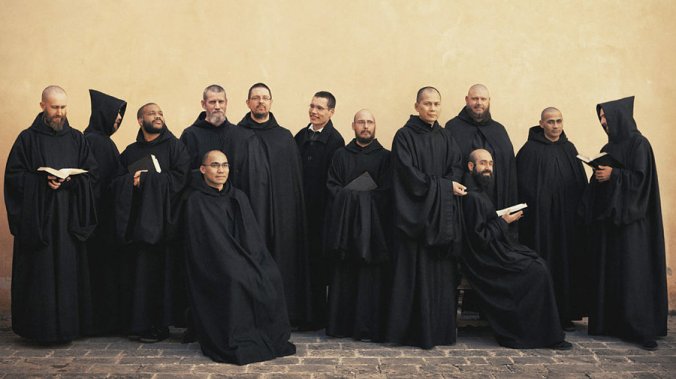
NorciaMonks

The Benedictine monks of Norcia, one of the greatest religious families in the Church today. I had occasion to hear their spiritual father and founder, Dom Cassian Folsom, say Mass at my fist parish, St. Brigid’s in Johns Creek, Georgia. I believe I was even blessed by him at Communion, since he came before I was received. A genuine saint. (Source).

Dreher’s “anti-politics” are timely and wise. He makes good use of the examples left to us by Czech dissidents during the Communist years. While I have a few qualms about some of his proposalssuch as his insistence that Christians focus all of their energy on Religious Liberty activism and legislation—I share his disillusionment with the organized forces of both right and left.

I also commend him on his total disdain for Donald Trump. Dreher writes,

IdolatrousTrump

Trumpolatry. Unless you read it, as I do, as Jesus telling Trump to resign. (Source).

Though Donald Trump won the presidency in part with the strong support of Catholics and Evangelicals, the idea that someone as robustly vulgar, fiercely combative, and morally compromised as Trump will be an avatar for the restoration of Christian morality and social unity is beyond delusional. He is not a solution to the problem of America’s cultural decline, but a symptom of it. (The Benedict Option 79).

Amen. As someone who did not vote for Donald Trump and hopes never to do so, I acclaim Dreher for putting those words in print. Too many Conservatives who once thought much more clearly about the morals of their leaders have since bowed and done homage to the Golden-Coiffed Calf.

There were other positive moments. The whole idea of reinforcing Christian community in the face of cultural and political opposition is a worthy goaland a surprisingly risky one at that. Any communitarian project is necessarily fraught with certain dangers, particularly in a world already defined by stark social divisions across race, class, and other categories. As I read, I was repeatedly and pleasantly surprised by objections Dreher headed off at the proverbial pass. He hopes that Benedict Option communities can come together across ethnic and racial divides, and he recognizes the dangerous tendencies of tight-knit communities to become closed, coercive, and cultish (81, 138-143). He also gives a few really great examples from the Mormon experience (132, 34-35). While Dreher doesn’t provide any practical advice for, say, Benedict Option parents whose children come out to them as gay or lesbian, one gets the sense that he’s not in favor of shunning, shaming, and disinheritence. Which is sensible.

(And yes, I realize that as an Amish Catholic, I ought to be in favor of shunning generally. Like Whitman, “I contain multitudes”).

I think his chapter on sexual ethics is probably one of the more sensible passages of the book. The very day that I finished the chapter, I came across this article on the possibility of a new liturgy to mark gender transitions (possibly even rebaptism) in the C of E. When Dreher says that sexual teaching is a lot closer to the heart of the faith than liberals might claim, he’s not wrong.

Finally, I’ll say that he’s right to pin his hopes on beauty. Building on Joseph Ratzinger and Matthew Crawford, Dreher writes,
God'sNotDead

That’s enough, David A.R. White. (Source)

…the most effective way to evangelize is by helping people experience beauty and goodness. From that starting point, we help them to grasp the truth that all goodness and beauty emerge from the eternal God, who loves us and wants to be in relationship with us. For Christians, this might mean witnessing to others through music, theater, or some other form of art [if only they could produce something that isn’t deeply, obnoxiously cringey, but that’s not a problem  worth getting into here]. Mostly, though, it will mean showing love to others through building and sustaining genuine friendships and through the example of service to the poor, the weak, and the hungry. (The Benedict Option 119).
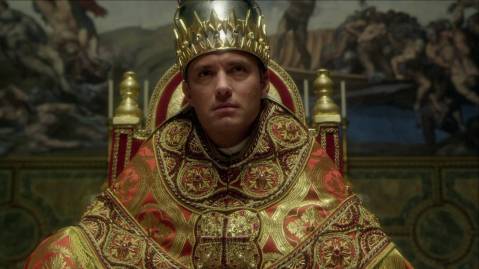
YoungPopeChair

Christian art done well: The Young Pope. (Source).

There are hardly any words in the book which earn my stronger approbation. Dreher is simply correct when he argues that we should “[do] activities that are pleasurable, not merely dutiful” (142). Indeed.
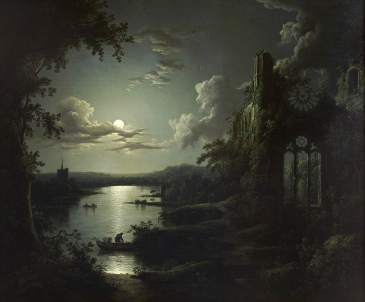
Pether, Sebastian, 1790-1844; Moonlit Lake with a Ruined Gothic Church, a Church and Boatmen

“Moonlit Lake with a Ruined Gothic Church, a Church and a Boatmen.” Sebastian Pether. (Source).

In spite of all these positives, I remain a BenOp skeptic. The book is rather flimsy, riddled with numerous problems. Dreher’s style never manages to break free of the chatty and occasionally shrill blogger’s voice that marks his online fare. Yet it lacks much of the humor that characterizes so much of what he writes at The American Conservative. I could overlook that sin, however, if his content were not similarly flawed. Dreher is dangerously allergic to the one thing that can save his text from its inner contradictions: nuance.

That failure colors every chapter in the book to a greater or lesser degree.

Religion is a famously thorny and multilayered subject. A religious writer aiming at the popular market can be forgiven for simplifying complex ideas to reach a broad audience. But Dreher’s approach veers away from educational simplicity and into outright reductionism.

For the sake of brevity, however, I will only get into the three very specific problems that I found most troubling to Dreher’s project and the quality of his text.

Bad Historiography

First, a somewhat pedantic point.

Dreher’s lack of nuance is most egregious in his historical narrative, given fully in chapter two and sporadically throughout other parts of the book. He argues that the Middle Ages were a time of order and devotion, in which European Christians believed in objective truths under the happy aegis of Scholastic Realism. Everyone had their place, and everyone knew the essential truths of salvation under God’s cosmic rule. Into this pastoral capriccio storms the wicked Nominalists, led by William of Ockham (1285-1347). By suggesting that universals were not real, but merely notional, the Nominalists inadvertently led to the centuries-long collapse of the sacramental worldview and all of Christendom with it.
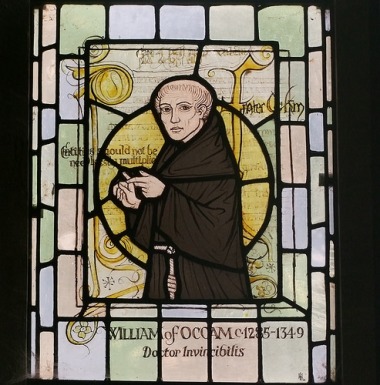
OckhamStainedGlassWindow

William of Ockham, the great bogeyman of Dreher’s historical narrative. (Source).

Then came the Reformation, which is bad because it “destroyed…unity and stripped those under its sway of many symbols, rituals, and concepts that had structured the inner lives of Christians” (32). Admittedly, Dreher never mentions anything about the deficient theologies of the Reformers, nor the historical fact that Christendom had been divided since 1054 and, even before that, the Council of Chalcedon—but more on that point later.

Dreher then leads us along a whirlwind tour of Western intellectual history, leaping from one period to another with unsupported assumptions of causality. He cursorily mentions political developments such as the Wars of Religion, the American and French Revolutions, and the World Wars. Interestingly enough, he never discusses Imperialism, Colonialism, Anglo-American efforts to end slavery, or the Holocaustyet surely all of these phenomena had a significant impact on the construction of Western religion and subjectivity.

Eventually, the reader lands in the desiccated and desecrated landscape of sociologist Zygmunt Bauman’s “liquid modernity,” our own godless world, still reeling from the Sexual Revolution.

Put another way, it’s Richard Weaver warmed over, history stripped of everything but ideas and spilled blood. There are a few problems with this approach.

First, it totally fails to account for the complexity of actual history. Even an intellectual historian doesn’t just deal with ideas as such. Ideas don’t float in the ether; they don’t make their way from one thinker to another by force of osmosis. They are transmitted via books, and through those books, to different communities of readers. Intellectual history is ultimately incomplete without its companion sciences: reception history, textual history, history of the book, economic history, political history, art history, and a tremendous dollop of cultural history. Not all of these need to be present in a given textand certainly not in a book aimed at the popular market!

But we oughtn’t let Dreher off the hook so easily.

Dreher knows that “Ideas don’t occur in a vacuum,” but his slovenly method leads to dubious lineages of causality (28). Without providing a shred of evidence, Dreher boldly asserts that “Most leaders of the Scientific Revolution were professing Christians, but the revolution’s grounding lay undeniably in nominalism” (33). What were they reading? Was the consensus among scholastic metaphysicians noticeably more nominalist in the 17th century than in prior years? Does that consensus cover all of Europe, or just certain important cultural centers? And if so, why should we believe that said consensus applied to the work of natural philosophers?

Or take another example: “[The term ‘Renaissance’] contains within it the secular progressive belief that the religiously focused medieval period was a time of intellectual and artistic sterilitya ludicrous judgment but an influential one” (emphasis mine, 30). Dreher does nothing to justify this assertion. Almost none of what he has told us up to this point suggests that he’s right. We read nothing about Medieval art or literature. We’ve only learned about the disputes of the Scholastics on a very particular question (no pun intended) and heard how great most people’s worldview was at that time.
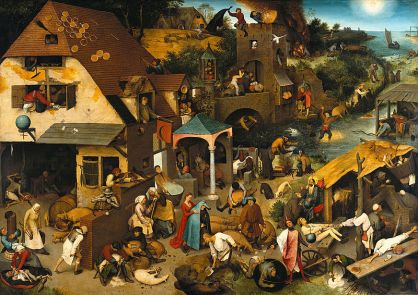
Pieter_Brueghel_the_Elder_-_The_Dutch_Proverbs_-_Google_Art_Project

Dreher doesn’t take account of the complexities of Medieval life. (Source).

And let’s take a look at that alleged worldview. In a paragraph which (correctly!) begins, “Medieval Europe was no Christian utopia,” Dreher then goes on to write that, “despite the radical brokenness of their world, medievals carried within their imagination a powerful vision of integration. In the medieval consensus, men construed reality in a way that empowered them to harmonize everything conceptually and find meaning amid the chaos” (25). Who exactly are these “medievals?” Just the scholars who sparred in Paris and Oxford, or the nobility, or the knights, or the bishops, or the monastics, or the vast and often perverse majority of illiterate peasants? And which culture? Anglo-Saxons, Franks, Angevins, Normans, Iberians, or the denizens of any of the myriad German or Italian or Celtic fiefdoms? How far West is he spreading his view? Do the Slavs count? And what centuries does he want us to look at? He’s working with an almost thousand year span from St. Benedict to the dastardly Nominalists. If, in fact, the worldview of that Christian civilization was immutable and homogeneous throughout such a wide variety of time and societies, then doesn’t that feed the very criticism that Dreher so stridently rejects, that the Middle Ages were a “time of intellectual and artistic sterility?” (30).

This point matters, insofar as Dreher elevates (read, “romanticizes”) the Medieval Era as his cultural ideal. The Benedict Option is nothing if not a way of thinking about community. So, which community? What are its limits?

burningofjews-744x566

The enforcement of Christendom’s social boundaries; the burning of Jews. (Source).

Case in point: what about the Jews? Certainly, they were thought to interrupt that “powerful vision of integration,” which emphatically never included them. Dreher periodically returns to Modern Orthodox Jews as a great example of community-building in the face of modernity (and is right to do so). He goes so far as to call them “our…elder brothers in the faith” (124).

But his praise sits uneasily with his historiography. Only twice does he come close to acknowledging that their survivalindeed, the survival of Judaism as a wholehappened not because of, but in spite of, the Age of Faith. It is not sufficient to recognize that the Jews “have faced horrifying attempts over millennia to destroy their families and communities” (124). We must be clear that, at least in the Medieval era, the chief persecutor was precisely the Christian order that Dreher takes as his model. The one time Dreher does, in fact, mention that it’s Christian persecution, he only does so to discuss how the Jews were forced into the moneylending business. Here then is another historical difficulty that Dreher fails to adequately acknowledge or reconcile with his greater narrative.

Of course, Dreher doesn’t need to answer all of these questions, since he’s not writing an academic history of how modernityor more properly, modernitiesemerged. My point is precisely that, due to the constraints of his form and audience, his historical narrative is naturally going to paper over important, substantive nuances. And those nuances are where the truth is to be found. A project so heavily predicated on a particular way of understanding our historical moment at least ought to get its history right.

As a side-note, I’ll add that Dreher also stakes his claim pretty heavily on readers accepting his comparison of our own age to the advent of the Dark Ages (hence the whole St. Benedict thing). That’s a comparison I’m not willing to make. If anything, our times more closely resemble early modernitya point I hope to explain more fully in my follow-up to this article. Suffice to say, Sam Rocha is correct to point out that Dreher’s view of the Middle Ages is, at best, incoherent:

On the one hand, he sees the Middle Ages as the period that required a radical retreat in the face of the fall of Rome. On the other hand, he sees the Middle Ages as a period of enchantment and deep faith. These two stories are both vastly oversimplified, but they are quite off when they are both said to be true simultaneously. How can it be the case that when Rome fell the Benedictines endured the Middle Ages guided by their Rule and, also, that the fall of Christianity happened, like Rome, after the end of the Middle Ages? Anyone can see that this story makes no sense logically. Historically, it makes even less sense.

I’m not suggesting that Dreher is necessarily wrong in his various judgments. He may well be correct in accusing the nominalists of a kind of cultural deicide (although it overlooks the Christian nominalist tendency, closely tied to empiricism, that numbers Berkeley, Burke, Hamann, Newman, and Chesterton among its ranks). Greater thinkers than him have made a similar claim. But as written, I have no reason to believe Dreher’s  intellectual history. He has made a defensible claim, and subsequently decided not to defend it. He has not shown his readers the courtesy of providing evidence.

Dreher’s citations are woefully inadequate. He makes some use of MacIntyre and Taylor, who are smart, respectable philosophers. But they are not historians. To his credit, he does draw upon C.S. Lewis’s The Discarded Image, David Bentley Hart (although it’s his religious philosophy and not his church historical work) and Brad Gregory, an honest-to-God historian working with an honest-to-God historical method. But he incorporates Gregory to make a point that’s barely substantive, that different ideas about Christianity led to different ways of living out Christianity. Did we really need the authority of an historian to make a point that is already so blindingly obvious? Moreover, all of these citations come in the first two parts of his history: the Middle Ages and the Renaissance/Reformation. But whither Eamon Duffy? Whither Richard Rex? Whither Alexandra Walsham?

If Dreher generally fetishizes the Middle Ages, he commits the opposite sin in his treatment of modernity. He sees only the negative. Dreher’s readers would be forgiven for forgetting that, in fact, the Church has endured and ameliorated the conditions of modern life for 500 years, and that it has given the world innumerable saints during that time. Leaving aside Church history, I’ve already mentioned that Dreher omits the various emancipatory struggles of the 19th and 20th centuries. Why? Perhaps because it troubles his claim that we have arrived at a uniquely bad moment for the Church, a time in which there is essentially nothing to be gained from the culture at large.

Here, too, he lacks nuance or evidence. See his description of Freud:

Sigmund Freud, the founder of psychoanalysis, found his true genius not as a scientist but as a quasi-religious figure who discerned and proclaimed the Self as a deity to replace the Christian religion. (41).

This is a huge interpretive move that Dreher never justifies. At all. He just asserts it as if it’s fact, not a highly contextual evaluation of a complicated historical figure whose legacy has been very mixed. None of the two paragraphs that follow even mention any of Freud’s writings.

Transhumanist1

Transhumanism gets no mention in The Benedict Option. (Source)

Dreher’s view of modern technology is equally dim. Here, the problem is not that he’s overly negative, but that he’s misplaced that negativity. The book closes with an oddly stunted chapter that launches an hysterical criticism of smartphones, social media, and the Internet as such without ever bothering to mention transhumanism, AI, automation, or any of the other very possible threats looming on the horizon. Nor does he devote any space to environmental concerns. Here, too, Dreher’s failure to provide proper nuance or evidence leads to sentences like this: “The seed that was planted in the fourteenth century with the triumph of nominalism reaches its full ripeness in Technological Man” (223). Or, later, “The most radical, disruptive, and transformative technology ever created is the Internet” (224). Besides providing zero historical evidence to support either of these statements, Dreher couples his paragraphs of hysteria with passages like this:

And guess what? It’s wonderful. It has made my life better in more ways than I can count, including making it possible for me to live where I want to live because I can work from home. The Internet has given me a great deal and does every day. (224).

The effect achieved is stylistic and tonal whiplash, not thoughtful nuance.

I mentioned earlier that this criticism is somewhat pedantic. I own that. But I do think it matters. Dreher stakes his project on an historical claim about our own times. He wants to persuade us of his project’s urgency by telling a story about Christianity in the West. Failing to provide much evidence and ignoring the essential complexity of nuances means that his narrative just doesn’t come off as all that convincing.

Bad Theology

Enough of the historical criticism. The book’s deeper problem lies in its spiritual and theological defects.
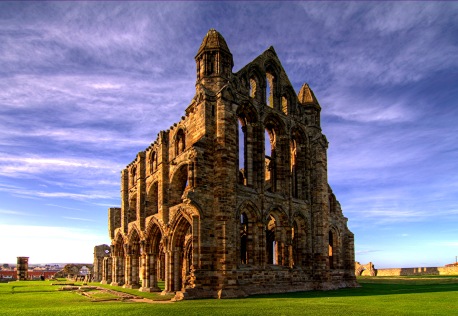
WhitbyAbbey

The ruins of Whitby Abbey. (Source).

There are a few minor theological problems, such as his lamentable claim that the Rule of St. Benedict is “simply a training manual. Modern readers who turn to it looking for mystical teaching of fathomless spiritual depth will be disappointed” (15). While I would hate to presume, I think that statement would probably shock someone like Dom Mark Daniel Kirby, whose own commentaries on the Rule have brought out a rich mystical dimension in the text (see this example, in which he draws upon even more commentators who have done precisely what Dreher denies is possible for the “modern reader”). Ultimately, an error like this is forgivable. If it was the only one in the book, I’d be happy to overlook it.

Alas, there are more fatal problems.

Dreher takes a deeply ecumenical approach in The Benedict Option. By itself, this isn’t an issue. Insofar as his book can serve as an ethnography of American conservative Christianity, it’s probably a good idea. Practically, ecumenism can be helpful when it works towards the bridging of boundaries for strategic, intellectual, or conciliatory ends. Groups like my own aforementioned G.K. Chesterton Society or Dreher’s Eighth Day Books are doing small-scale, fellowship-based ecumenism well (136-37). Chuck Colson and Father Richard John Neuhaus modeled political ecumenism in Evangelicals and Catholics Together, much to the ire of fundamentalists. Similarly, intellectual fora for cross-traditional encounter can be especially productive. Journals like First Things do an excellent job facilitating that kind of positive ecumenism.

But ecumenism that ignores critical, substantive, or normative differences can be dangerous. The churches are separate for important reasons, and the stories and arguments they use to justify those differences are not to be taken lightly. For Dreher’s ostensible project, these differences ought to be of paramount importance. One cannot cooperate with someone to preserve a shared value when laboring under a false unity. Moreover, each ecclesial community will, of necessity, have a different response to the conditions of (post)modernity. They will have to draw upon their own unique resources and traditions. Their strategies will vary based on what they understand the Church to be. We can all agree that the Churchunderstood correctlyhas its own paramount mission, the salvation and sanctification of souls. But our understandings of how the Church is meant to do that job could not be more different. Losing sight of the singularity and urgency of the Church’s salvific mission and character is the greatest danger of all ecumenical work.
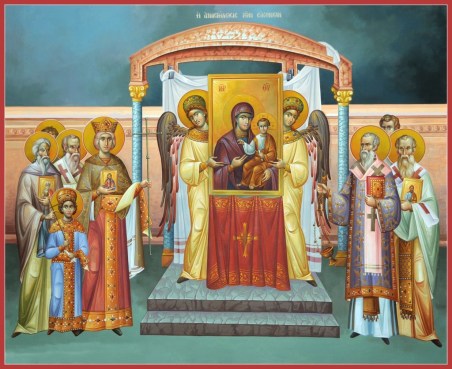
sun-of-orthodoxy-2

Icon of the Sunday of Orthodoxy, which commemorates the triumph of iconodulic Christianity over the heresy of iconoclasm (Source).

I had hoped to find an ecumenism of encounter in Dreher’s book. Sometimes, I did. When he’s at his journalistic and sociological best, he provides some great anecdotes and insights across all types of American conservative Christianity. Unfortunately, the text is also riddled with a false ecumenism.

Dreher is very fond of speaking of “small-o orthodox,” as if such a thing could ever be anything more than a notional, or, at best, a situational construct. Sam Rocha, once again, puts the point well:

A second confusion is Dreher’s abstraction of Christianity. The book uses Roman Catholic sources and characters, but also includes a smattering of Protestants and a few Orthodox. By the end of the book, Dreher begins to sound like he’s written a manifesto, calling his new order “Benedict Option Christians.” Earlier he calls these “Benedict Option Churches” and “Benedict Option believers.” Just what are these churches? And what are the tenets of this belief? The book itself, with no ecclesiastical authority whatsoever and no scholarly credibility to speak of? This is tremendously abstract because there is obviously a real Benedictine Order that follows the real Rule of St. Benedict, which includes a lay apostolate for people like Dreher.

Rocha doesn’t explore the issue in all of its implications, but he’s on the money.

Dreher signals early on that his ecclesiology is, frankly, heretical. Dreher hopes to speak for and to “faithful orthodox Christians—that is, theological conservatives within the three main branches of historic Christianity” (18, emphasis mine). What revealing diction. Dreher’s working model is essentially branch theory, the heretical idea that Orthodoxy, Catholicism, and Anglicanism are all equally valid expressions of the “One, Holy, Catholic, and Apostolic Church” founded by Christ. In fact, Dreher seems perfectly content to go beyond the Anglo-Catholics who were and are Branch Theory’s most staunch defenders. He is happy to lump in a much wider net of Protestants, including figures like, inter alia, the pastor of “a small fundamentalist church in Minnesota” (112). No Catholic can sign on to this ecclesiology.

If Dreher had merely intended to use the theory as a shorthand for “Christians who are doctrinally and culturally conservative,” then “Dissident Christians” is a much better moniker, one that Dreher should have used throughout the book. It’s brief, it’s political, and it captures the posture towards contemporary culture that animates his entire project. It’s also ecumenical in the right waysomething like the “Ecumenism of Blood” described by Pope Francis—and doesn’t lead to the confusion of important theological and ecclesiological distinctions. 
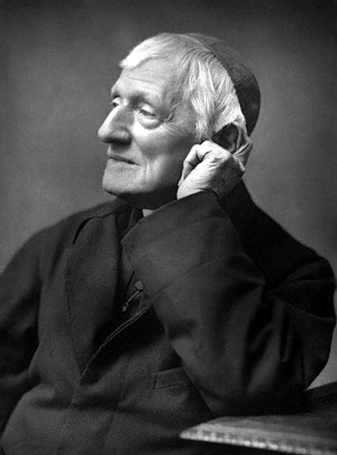
JohnHenryCardinalNewman1

John Henry Newman; Ex-Branch Theorist. (Source).

True, Dreher says “Christianity,” not “Church,” but there’s other evidence of his branch theorizing throughout the book. He includes a quote by Leah Libresco Sargeant that sums up the Benedict Option as “just the church being what the church is supposed to be, but if you give it a name, that makes people care” (142). What is this small-c church? What is it “supposed to be?” In the context of Dreher’s ecumenical approach, we cannot say with any degree of certainty. Or consider Dreher’s defense of Evangelicals adopting “traditional liturgies” (what could that possibly mean in such a context?) on pages 112-13, where he seems to suggest that Protestants can have “communion with the Lord in Word and Sacrament” while remaining Protestant (I leave aside the question of the “Dutch Touch,” which is its own kettle of fish) (112-13).

Now we are confronted with a much deeper problem. Ecclesiology is always inseparable from sacramentology.

The Benedict Option is insufficiently sacramental. The trouble begins early on. Take this line from chapter one:

[Moralistic Therapeutic Deism] has little to do with the Christianity of Scripture and tradition, which teaches repentance, self-sacrificial love, and purity of heart, and commends sufferingthe Way of the Crossas the pathway to God. (10-11).

What’s absent from this list? The sacraments, and above all, the Eucharist. Indeed, the Blessed Sacrament does not enter the text until page 24, in the second chapter, when Dreher describes the worldview of the Middle Ages; Christ’s presence in the Eucharist, however, goes unmentioned (24). Nor does the Mass appear in Dreher’s chapter-long profile of the Monks of Norcia. These monks gained fame in the Catholic world first and foremost by their loving devotion to the solemn celebration of the traditional Mass. Why would Dreher omit the most important feature of their common life?

The Eucharist hardly plays any role in the entire book except for an extended section in chapter five, where Dreher argues that “contemporary Christians” should “Recover Liturgy” (105). No argument from me there. Insofar as Dreher is working against the “strange fire” of light shows, projection screens, and a whole range of modern instruments from guitars to tambourines, he has my undivided sympathy. He also makes a good point about the need for reverence at the liturgy, even going so far as to state that

Jesus is just as present in the Eucharist at Our Lady of Pizza Hut as at St. Patrick’s. Chances are, though, that you had to work harder to conjure a sense of the true holiness of the mass in the suburban church than in the cathedral. (106).

What a refreshing dose of sacramental realism! Finally, on page 106, we hear the sweet truth that Christ is really present among us in the Sacrament of the Altar. A few pages later, he adds this exquisite paragraph:

The contemporary Reformed theologian Hans Boersma identifies the loss of sacramentality as the key reason why the modern church is falling apart. If there is no real participation in the eternalthat is, if we do not regard matter, and even time itself, as rooted firmly in God’s beingthen the life of the church can scarcely withstand the torrents of liquid modernity. (108).

That passage contains the germ of what should have been the book’s central thesis, that a return to reverent sacramentality, and to the Eucharistic Christ in particular, will be our salvation. Even from a (very well respected) Reformed theologian, this insight is nearer to the truth than a good quarter of the book.

Similarly, Dreher hits the right note when he says:

All worship is in some sense liturgical, but liturgies that are sacramental both reflect Christ’s presence in the divine order and embody it in a concrete form accessible to worshipers. (108).

Bravo! If he had kept on sounding this note through to the end of the chapter, I would have applauded the whole way. Instead, he continues:

Liturgy is not magic, of course, but if it is intended and received sacramentally, it awakens the sense that worshipers are communing with the eternal, transcendent realm through the ritual and its elements. The liturgy feeds the sacramental imagination, reweaving the connection between body and spirit. (108).

The phrase “intended and received sacramentally” is a bit too vague for comfort. Who intends and receives the sacrament? By what authority do they intend and receive: the legitimate successors of the Apostles, or scripture alone? We see again the intimate connection between sacramentology and ecclesiology. Dreher’s words mean and imply very different things to Catholic, Orthodox, and Protestant readers. His stylistic imprecision speaks to deeper theological vagaries.

What’s more, Dreher ought to know better. He has read Benedict XVI. He knows that “the Eucharist makes the Church.” One of the leading thinkers of his own communion, Metropolitan John Zizioulas, has built his entire career on the careful elucidation of a similarly Eucharistic ecclesiology. Theologians like the Armenian Orthodox Vigen Guroian and the Roman Catholic Bill Cavanaugh, though disagreeing in some important respects, nevertheless come together on this point. Their insights suggest that the very essence of the Church is bound up with the Eucharist. And if they are correct, it troubles Dreher’s entire approach to ecumenism and the liturgy.
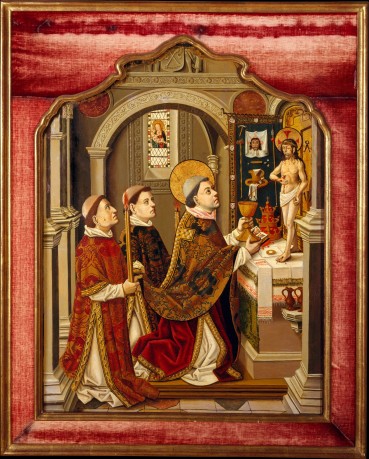
MassofSt.Gregory

The Mass of St. Gregory. (Source).

Dreher includes unavoidably non-sacramental communities in his project in the name of ecumenism and (probably) book sales. After all, he goes so far as to state outright, “It is beyond the scope of this book to tell other Christians how they should celebrate their liturgies while still being faithful to their theological tradition,” even if that means omitting central dogmas of the Faith (112). So, what does Dreher do instead? He pivots to James K. A. Smith’s philosophy of “cultural liturgies,” an anthropologically useful concept. Dreher takes it up as his main way of selling liturgy to Evangelicals.

Unfortunately, in Dreher’s hands, the idea of “cultural liturgies” becomes a force for the very relativism he is attempting to combat (incidentally, Smith has since disavowed The Benedict Option). In Dreher’s telling, the liturgy is primarily a good thing because of what it does to us. While no serious Catholic or Orthodox theologian can deny that the liturgy is the preeminent means by which we are divinized, Dreher’s liturgical model is overly anthropocentric. It is—dare I say it?—strikingly emotivist and subjectivist. He places his emphasis on the way repetition and chanting and incense and community can orient our desires towards the life of transcendent order. Dreher instrumentalizes the Mass to an unhealthy degree. In a strikingly Maurassian note, he seems to think that “the form worship takes” matters primarily because it can “[build] a bulwark against” modernity (113). Once again, he writes that in a good liturgy, “worshipers are communing with the eternal, transcendent realm through the ritual and its elements” (108).

The reduction of the liturgy to quasi-Confucian social theurgy is a scandal. Nowhere do we read that, even if none but the priest were there, the Mass would still be the holiest and most important ceremony on earth. Nowhere do we read of Christ’s holy sacrifice made present in the Mass, nor of the way the liturgy opens up the eschaton to mere mortal worshipers. Nowhere do we even find the words “Real Presence,” itself originally a Lutheran formulation that has since gained ground among Catholics and Orthodox. There is no need to get overly academic with any of this. Much of it already fits well with the social science he is trying to use. But in failing to rise above his own anthropological method, Dreher likewise fails to do justice to his subject.
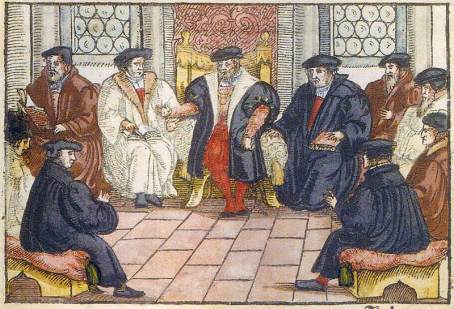
Marburger-Religionsgespräch

The Marburg Colloquy, where Luther and Zwingli argued about the Eucharist and failed to come up with a Protestant consensus on the sacraments. Dreher is an accidental Zwinglian. (Source).

The result? Dreher protestantizes the Mass. But not in the way that Luther or Cranmer or even Calvin might, those men who thought well and hard about God’s work in our worship. Dreher aims lower. He writes, “liturgy is primarily, though not exclusively, about what God has to say to us” (108). To be precise, no, it is not. Liturgy is primarily about what God does to us through the Eucharist. We do not go to Mass just to learn, though that is one of its most important benefits. We go to Mass to offer the sacrifice of Christ and to receive God’s supernatural life in the Blessed Sacrament. Dreher’s pedagogical model is not wrong in itself, but without a robust sacramental realism, it devolves into Zwinglianism. Liturgy is a tool for preserving “cultural memory,” not a point of real contact with the Living and Ineffable God (109). Dreher writes, “Along with helping us remember Christ, liturgy also reminds us that Christianity isn’t just a philosophy but a way of life that demands everything” (109-10). Not wrong, just banal.

Dreher follows it up with, a few pages later, “We are supposed to feel that gathering in a church as a community to offer worship to our God is something set apart from ordinary life. This is what gives rich liturgies their power” (113). Did Dom Anthony Ruff ghost-write this passage? Christ the priest and victim is whator rather, whogives rich liturgies their power. The actions of the congregation are entirely secondary. That’s part of the reason that there are no rubrics for those hearing the Mass.

None of these problematic statements compare to a paragraph towards the end of his section on recovering liturgy:

Now, low-church Evangelicals are absolutely right to say that liturgy won’t save you. Only conversion of heart will. Liturgy is necessary for worship to do what it must do to fulfill its potential, but liturgy alone is not sufficient, for the same reason a Bach concerto performance means nothing to a deaf man. If a believer’s body is worshiping but his mind and body are elsewhere, what good does that do? The goal is to integrate all parts of the Christian person. It takes faith and reason to form and disciple a Christian. (113).

The first two sentences are perilously close to explicit heresy (specifically, Donatism). The Tradition of the undivided Church tells us that indeed we are saved by liturgy, because we are saved by the Eucharistic Christ’s cosmic and eternal liturgy. If Dreher meant that a mortal sinner cannot receive the sacrament without committing sacrilege, then he would be correct. But he doesn’t describe sin in the rest of the paragraph. He describes ordinary distractionvenially sinful at most. Dreher seems to suggest that our own disposition is more important than the objective work of the Trinity in the Sacrament. A great deal more precision would have been tremendously helpful.

I need not appeal to Catholic dogma to hold Dreher accountable for his shoddy sacramentology. Dreher, after all, is a convert to Eastern Orthodoxy. And by the standards of his own communion, Dreher’s book is very clearly heretical. It is impossible to imagine a serious Orthodox thinker endorsing any of the incoherent liturgical propositions that Dreher puts forward. We can also see the fissure between Dreher and his own tradition when it comes to his ecumenism.

st-mark-of-ephesus-3

There is a 100% certainty that this guy would anathematize Rod Dreher. But also me, so go figure. (Source).

The Orthodox are far more jealous of doctrinal purity than us Catholics. They are even canonically forbidden from praying with heretics. That protective tendency is one of their more admirable traits, although it has exerted a heavy pricethe nearly 1000-year schism that has separated the Christian East and West. Consider the words of Mark of Ephesus, who scuppered a scheme of reunion at the Council of Florence (AD 1438-45) by his outspoken criticism. Here are just a few of his ecumenical gems:

“The Latins are not only schismatics but heretics…we did not separate from them for any other reason other than the fact that they are heretics. This is precisely why we must not unite with them unless they dismiss the addition from the Creed filioque and confess the Creed as we do.”

“It is impossible to recall peace without dissolving the cause of the schism—the primacy of the Pope exalting himself equal to God.”

“The Symbol of the Faith must be preserved inviolate, as at its origin. Since all the holy doctors of the Church, all the Councils and all the Scriptures put us on our guard against heterodoxy, how dare I, in spite of these authorities, follow those who urge us to unity in a deceitful semblance of union—those who have corrupted the holy and divine Symbol of Faith and brought in the Son as second cause of the Holy Spirit.”

A model of Dreher-style ecumenical engagement, he is not. Consider a more recent example, such as the widely revered monks of Mount Athos. The recently canonized Elder Paisios, one of the Holy Mountain’s more famous residents of the late twentieth century, once said,

There’s no need for us to tell Christians who aren’t Orthodox that they’re going to hell or that they’re antichrists; but we also mustn’t tell them that they’ll be saved, because that’s giving them false reassurances, and we’ll be judged for it. We have to give them a good kind of uneasiness – we have to tell them that they’re in error.

And, along with most of the other monks on Mount Athos, Elder Paisios stopped remembering the Patriarch at the Divine Liturgy due to the latter’s perceived “dangerous overtures” to Rome.

That’s not to say that I agree with Mark of Ephesus, Elder Paisios, or the Athonites. I think all of them are dead wrong. My point in bringing them up is merely to note that Dreher’s approach looks mighty strange through the lens of his own tradition. Perhaps that’s why there are so few references to Eastern Orthodoxy, both in the sub-chapter on the liturgy and in the text more widely.

SchemaMonks

Schemamonks. (Source).

Eastern Christian spirituality is full of riches. My own study of authors like Metropolitan John Zizioulas, Archpriest Sergius Bulgakov, Paul Evdokimov, and Vladimir Lossky was a major turning point in my theological and spiritual journey. I date the start of my conversion to my first encounter with iconography at an Orthodox monastery deep in Transylvania. I have repeatedly found the simple wisdom of the startsy a useful corrective to my own selfishness and pride. And the Divine Liturgy of St. John Chrysostom is a truly beautiful act of the Apostolic Church at prayer.

The thing is, I suspect that Dreher would probably say much the same, too. But he doesn’t. With the exception of one reference to Father Alexander Schmemann quite late in the book, Dreher mostly brings up Eastern Orthodoxy in anecdotes describing his own faith journey. I found the absence of Eastern Orthodoxy in the book more broadly to be a particular disappointment. If there are faith communities that have dealt with cultural hostility, surely they are the Eastern churches. Observe the Greeks and Armenians under Ottoman and Turkish rule, or the Russians suffering the yoke of Communism. Why doesn’t he mention these examples? They seem directly pertinent to his project.

Dreher also explicitly references another Orthodox figure, one who proves that, at the end of the day, his ecumenical vision is just as incoherent as his historical narrative and his liturgical theology. On page 136, in chapter six, we read the following passage:

Times have changed, and so have some of the issues conservative Evangelicals and Catholics face. But the need for an ecumenism of the trenches is stronger than ever…To be sure, the different churches should not compromise their distinct doctrines, but they should nevertheless seize every opportunity to form friendships and strategic alliances in defense of the faith and the faithful. (136).

So far, so good. Here, Dreher is at his ecumenical best. He recognizes the strategic nature of ecumenism, doesn’t try to confound sacramentally distinct boundaries, and orients the reader towards positive cooperation. What a welcome volte-face from chapter five.

The problem, however, lies in that ellipsis. Because in between these two passages, Dreher inserts a toxic little sentence:

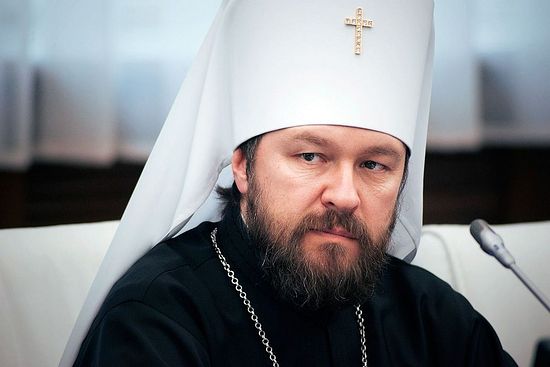
Metropolitan Hilarion Alfeyev, a senior bishop in the Russian Orthodox Church, has on several occasions appealed to traditionalists in the West to form a “common front” against atheism and secularism. (136).

The sheer audacity.

With one sentence, Dreher undermines the actual goodwill that his muddled and misbegotten ecumenical effort might have borne out among informed Catholics. Metropolitan Hilarion Alfeyev is one of the great persecutors of the Church today, a man who has repeatedly, mendaciously, and viciously attacked the Ukrainian Greek Catholic Church, even at the Vatican itself. His lies in the service of the Moscow Patriarchate’s power plays disqualify him as any kind of ecumenical model. Dreher knows this, has commented on it before, and yet still saw fit to include that sentence in the final draft of his book. I consider it the one truly unconscionable sentence in the entire text, and it makes all of his ecumenical platitudes ring hollow.
MetropolitanHilarion

Metropolitan Hilarion Alfeyev of Volokolamsk, implacable and perennial foe of the Ukrainian Greek Catholic Church. (Source).

The Benedict Option inadvertently manages to present us with a model of ecumenism that, on the one hand, would be anathematized by the Hyperdox, and on the other, cites one of the most rhetorically violent Orthodox partisans in the official dialogue today. The result is an unsatisfactory and unsacramental chimera, a quasi-church, not the One, Holy, Catholic, and Apostolic Body of Christ.

Bad Ethos

My final criticism of Dreher is, I hope, both less pedantic and less denominational than my previous two points. I recognize that the issues I have brought up may not seem so terrible to those who a) aren’t Catholic or Orthodox, or b) don’t particularly know or care all that much about intellectual and church history. These are very specific criticisms that, I acknowledge, may run the risk of asking too much of a book written for the popular press.

galleryrievaulx20090520171048

The ruins of Rievaulx Abbey. (Source).

But there is a third problem, and it lies with the book’s ethos.

Every volume of cultural criticism is, by its very nature, critical. It would be unreasonable to look at a book like The Benedict Option and expect to see all kittens and rosebuds, particularly in our polemical climate. But Christians who engage in cultural criticism bear special responsibilities. Particularly if they make it their business to preach and prophesy.

First and foremost, they must speak the truth. Leaving aside the nuance issues I’ve already identified, I think Dreher is pretty good about this. He constantly slips into the confessional mode, which insures the appearance of honesty. I don’t think anyone but the most suspicious reader could walk away from the book feeling hoodwinked. The Benedict Option is, if nothing else, a compendium of Rod Dreher’s honest assessments.

A Christian cultural critic, however, must also try his damnedest to persevere in charity. He fails, and fails scandalously, if he lapses into despair.

Now, there are two relevant kinds of despair. The first is a despair of one’s own cause, a kind of bleak, Spenglerian pessimism and bellyaching. Dreher has no problems with this attitude. At his most poetic moments, he is able to see the light at the end of the tunnel. His conclusion includes a few masterfully hopeful passages.

But then there’s a far more subtle and far more tempting despair, the despair over the salvation of one’s enemies. Our culture and our political system have gone mad on this kind of despair. It polarizes and dehumanizes. Why? Because ultimately, it is a despair of God’s mercy.

Dreher is guilty of precisely this kind of despair.
3_bosch_christs-descent-into-hell_mma

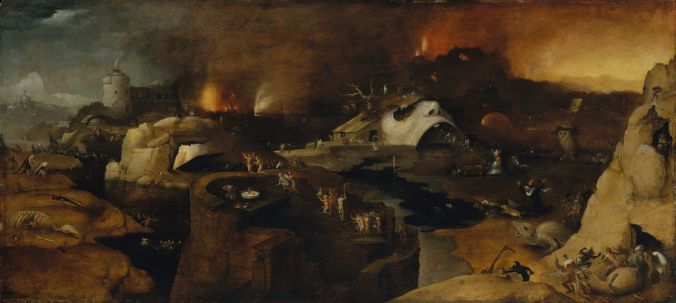
“Christ’s Descent Into Hell,” Hieronymous Bosch, c. 1550. A painting that resembles Dreher’s view of the world, where a few fragile saints huddle against the overwhelming hellscape – and as in The Benedict Option, you can hardly see Christ at all. (Source).

He paints a neo-noir landscape in black and white. Unlike the world that you and I inhabit, it is merely the stage for a Manichaean spiritual and cultural drama. The villains of Dreher’s narrative are not individuals with souls in need of salvation, but dark and impersonal forces closing in on a haggard band of True Believers. The most important of these demonic forces is the LGBT movement. Dreher returns to it ad nauseum. No other threat to mankind, the West, or the Churchnot war, not Jihad, not environmental collapse, not racism, not economic downturn, not secularism as such, not consumerism, not Transhumanism, not euthanasia, not even abortionoccupies such a shadowy and potent throne in Dreher’s imagination. Everywhere looms the deadly threat of the Great Gay Menace.

Rowan Williams, among others, is right to call out the book’s single-minded obsession with this issue. Over at The New Statesmen, he writes,

Yet there are aspects of his rhetoric that leave a deep unease. “The LGBT agenda” is a phrase that appears on the third page of  the first chapter, and the prominence given to same-sex relations reinforces the common perception that the only ethical issues that interest traditional Christians are those involving sexual matters. In recent interviews, Dreher has been rather less vocally negative about same-sex relations in general than he seems to be in this book, but the phraseology (as in the derogatory use of “transgenderism”), here and elsewhere, sounds a note of angry anxiety and contempt typical of some voices prominent in conservative American religious circles, and somehow jarring with the commendation of Benedictine hospitality and equanimity.

Indeed, some of Dreher’s liberal interlocutors have written potent criticisms on just this point. Alan Levinovitz calls The Benedict Option, as well as Anthony Esolen’s Out of the Ashes, “spiritual pornography,” which he defines as literature that is

…designed to arouse climactic cries of Yes! Yes! in its readers, pleasing the soul’s darker parts by swapping a hollow fantasy of physical union for an equally hollow fantasy of moral warfare…a virtuous few battling mightily against everyone else…Calling spiritual pornography a fantasy helps to evoke its psychological appeal, but the world it conjures up is closer to that of the fairy tale. Both genres are built on two foundational features: dramatic arcs that proceed from Order to Disorder to Order, and clearly defined roles and rules that map neatly onto good and evil. It’s a world that trades humans for archetypes, nuance for simplicity, and the tangled skein of history for the orderly vectors of myth — but if you’re on the side of the angels, living in it feels really, really good.

I won’t go so far as Levinovitz, whose own polemical rhetoric has bordered on the illiberal in the past. What Levinovitz does capture, however, is Dreher’s sometimes hysterical distress over LGBT activism and liberal modernity generally. Levinovitz argues that “the soul of these books is not love of God; it is bitter loathing of those who do not share it.” He isn’t far off the mark.

But liberals who write off Dreher as nothing more than a cantankerous homophobe are doing him and the text a great injustice. To understand Dreher’s approach, we also need to look at one of his better moments. Late in the book, Dreher includes a profile of Spiritual Friendship, and specifically Ron Belgau. Some of what he writes about the experience of gay and lesbian Christians attempting to live a life of chastity is genuinely empathetic. Dreher wouldn’t have bothered to include their inspiring ascetic example if he had some lurking bigotry. Dreher isn’t a homophobe. By all accounts, he never advocates for any hatred or fear of individual LGBT people.

What he does fearor, more precisely, what the book fearsis all LGBT people and all liberals in the abstract. This fear entails a convenient rhetorical move. It lets Dreher confound and occlude the individual personhood of his ideological opponents in such a way that it is easier to consign them to the outer darkness en masse. For if they are not out there, then it will be us, the few, the faithful. Here we can see the ripple of dread that runs through the text.

SeraphimRose.jpg

Hieromonk Seraphim Rose had a similarly dark view of modernity, but his ethos is more respectable. A homosexual who repented, converted, and entered a monastery, Rose is now widely revered by many Orthodox as a saint. (Source).

For instance, Dreher writes that “we in the modern West are living under barbarism, though we do not recognize it” (17). At one point in the book, Dreher calls the LGBT movement “the tip of the spear at our throats in the culture war” (alas, I could not find the page, so I offer you the quote via David Brooks’s review in the New York Times). Dreher suggests that

In the wake of Obergefell, Christian beliefs about the sexual complementarity of marriage are considered to be an abominable prejudiceand in a growing number of cases, punishable. The public square has been lost. (9).

He also writes,

…the day is coming when the kind of thing that happened to Christian bakers, florists, and wedding photographers will be much more widespread. And many of us are not prepared to suffer deprivation for our faith. (63).

Or this passage in his chapter on Christian labor:

We may not (yet) be at the point where Christians are forbidden to buy and sell in general without state approval [!!!], but we are on the brink of entire areas of commercial and professional life being off-limits to believers whose consciences will not allow them to burn incense to the gods of our age. (179).

Followed up shortly by the statement that “the only thing standing between an employer or employee and a court action is the imagination of LGBT plaintiffs and their lawyers”(181).

The reader can make his or her own judgment about these words. For my own part, I consider Dreher’s contempt a profound, if understandable, failure of Christian charity. At Easter, his own Church sings, “Let us call brothers even those who hate us and forgive all by the Resurrection.” That spirit never enters into The Benedict Option in any sustained way. Others have discerned in it a lack of Benedictine hospitality. Levinovitz finds in it a certain resemblance to Jack Chick’s tracts. That’s probably unfair. Dreher’s contempt isn’t sectarian or vicious enough.

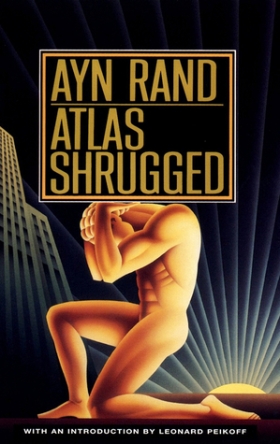
The book shares far more important affinities with Atlas Shrugged.
AtlasShrugged

Atlas Shrugged (Source).

In both, we read of a few stalwarts fending off the gathering darkness of cartoonish, straw-man villains. In both, we encounter a worldview that is increasingly binary, predicated not on the messiness of actual reality but on the black and white imperatives of abstraction. In both, the heroes must enter some kind of retreat (is there any literary analogy to your unfriendly local “Benedict Option community” so apropos as Galt’s Gulch?). In both, we get the sense that the author is entirely self-assured of their own rectitude. And in both, we find the same attitude of contempt for the world, an attitude that is, to borrow the words of Nostra aetate, “foreign to the mind of Christ.”

When Whittaker Chambers famously reviewed Atlas Shrugged for National Review, he wrote that,

Dissent from revelation so final (because, the author would say, so reasonable) can only be willfully wicked. There are ways of dealing with such wickedness, and, in fact, right reason itself enjoins them. From almost any page of Atlas Shrugged, a voice can be heard, from painful necessity, commanding: “To a gas chamber–go!”

He wasn’t wrong. John Galt declares,

All the men who have vanished, the men you hated, yet dreaded to lose, it is I who have taken them away from you. Do not attempt to find us. We do not choose to be found. Do not cry that it is our duty to serve you. We do not recognize such duty. Do not cry that you need us. We do not consider need a claim. Do not cry that you own us. You don’t. Do not beg us to return. We are on strike, we, the men of the mind. (For the New Intellectual 131).

At its worst, this is what the Benedict Option becomes. If there are communities that seek to build on Dreher’s more positive and productive suggestions, I wish them well. But I also pray that they leave aside his own venom. It is the final, toxic fruit of forgetting the Eucharistic love of Christ.
AynRand2

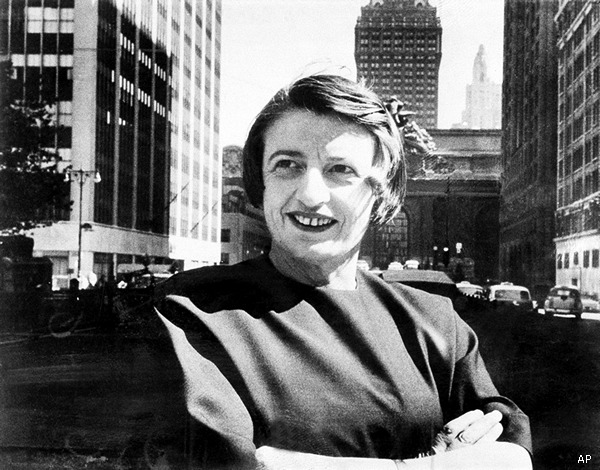
With The Benedict Option, Rod Dreher confirms his place as the Ayn Rand of conservative Christianity. (Source).

Conclusion

I hope to explore my own propositions in my next post. The Church does furnish an excellent example of a saint who dealt with cultural conditions much like our own. I, too, have an “option” I’d like to offer for your consideration, one which is congruent with some parts of Dreher’s book. I’d also like to correct what I see as some of the problems of The Benedict Option.

But not without an important acknowledgement first.

In her review of The Benedict Option, Elizabeth Stoker Bruenig points out the fundamental cultural flaw in Dreher’s project; we have been irrevocably formed by modernity. She observes,

There never will be another Medieval subject. All of us in the Anglophone world see with liberal eyes and hear with liberal ears, and to some degree think with liberal minds: Indeed, the lament that we’re no longer Medieval is a comically typical liberal refrain (think of the Romantics, with their Gothic revivalism, or the pre-Raphaelites, with their knights in shining armor). The will to be Medieval subjects again is the desire to return to an age of faith, but this is not an option.

I think it is perhaps this quality that, to paraphrase the remark of a friend, makes The Benedict Option such a great call to conversation and such a poor call to conversion. But it was also, for me, a serious cause for introspection.

And I have to thank Rod Dreher for that.

Reading and reflecting on The Benedict Option made me confront several of the pretensions that I have carried around for a very long time: my ostensible anti-modernism, my belief in the fundamental importance of community, my traditionalism. It didn’t cause me to abandon them all, per se, but to see their limits, refracted and magnified through Dreher’s problematic project.
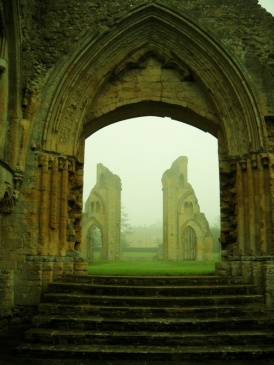
GlastonburyAbbey

Glastonbury Abbey. (Source).

The Benedict Option helped me realize that I don’t really think the world was better before modernity. Every age has been full of tyrants and heretics, massacres and miracles, heroes and hysteria. No epoch is ever really better than any of the others, for what one may lose, another may gain in some unforeseen way. Human nature remains the same. Only the Incarnation of Christ marked a real departure, an intervention that radically transfigured the course of history.

But since then, God graciously allows us to live with our own cultural era’s particular troubles for reasons that remain cloaked in mystery. Perhaps we are meant to “Redeem the time.” The secret animating principle of history is the work of the Holy Spirit in the Church. Let us trust in Providence. If we are given this moment, with all of its challenges, then let us praise God for that gift.

I am a creature of modernity. If you are reading this, so are you. That is an unavoidable fact. As T.S. Eliot writes of the Christian relationship with history,

It is not to ring the bell backward
Nor is it an incantation
To summon the spectre of a Rose.
We cannot revive old factions
We cannot restore old policies
Or follow an antique drum.
(“Little Gidding” III).

It is for these reasons that I cannot go where Dreher goes. I’ll admit, finding “The point of intersection of the timeless/With time” is always difficult. But let us never fear! “This is the day which the Lord hath made: let us be glad and rejoice therein” (Psalm 118: 24 DRA). With the Eucharist in our midst, we can and must live “for the life of the world” (John 6:52 DRA). Only by cleaving to the Eucharistic Christ can we fulfill our duty to be “the Word within/The world and for the world,” in the words of T.S. Eliot. Let us learn to love the worldtragic, sinful, broken though it may beat the foot of the Eucharistic God. We can never love it more than He does.
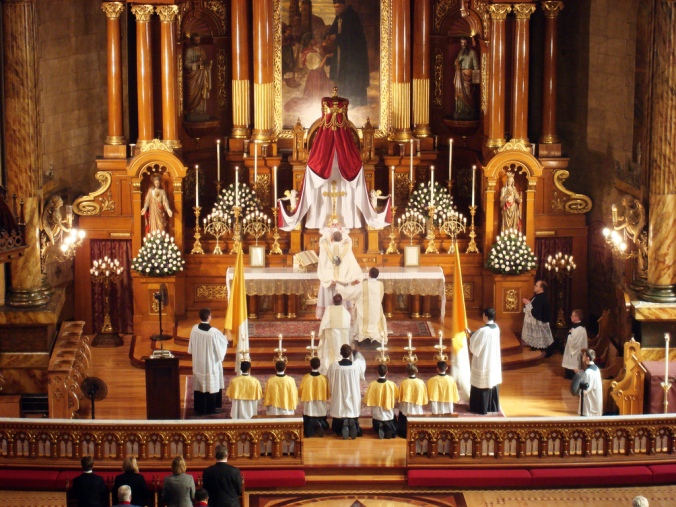
TraditionalMass

The Traditional Mass is not Medieval, but Modern. Yet that does not stop it from also being timeless. (Source).

Three Poems for Whitsunday

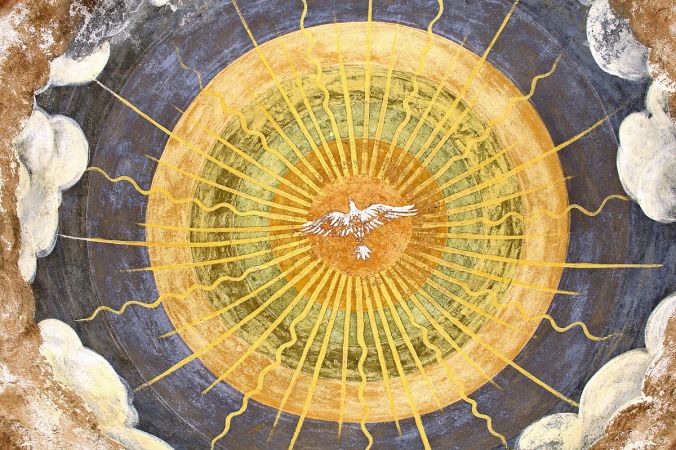
Fresco-Zica

The Dove Descending…(Source)

Inspired by and borrowing from Artur Rosman’s similar post, I offer you some Pentecostal poetry.

“Little Gidding” IV, by T.S. Eliot

The dove descending breaks the air
With flame of incandescent terror
Of which the tongues declare
The one discharge from sin and error.
The only hope, or else despair
Lies in the choice of pyre of pyre-
To be redeemed from fire by fire.

Who then devised the torment? Love.
Love is the unfamiliar Name
Behind the hands that wove
The intolerable shirt of flame
Which human power cannot remove.
We only live, only suspire
Consumed by either fire or fire.

“God’s Grandeur,” by Gerard Manley Hopkins S.J.

The world is charged with the grandeur of God.
    It will flame out, like shining from shook foil;
    It gathers to a greatness, like the ooze of oil
Crushed. Why do men then now not reck his rod?
Generations have trod, have trod, have trod;
    And all is seared with trade; bleared, smeared with toil;
    And wears man’s smudge and shares man’s smell: the soil
Is bare now, nor can foot feel, being shod.
And for all this, nature is never spent;
    There lives the dearest freshness deep down things;
And though the last lights off the black West went
    Oh, morning, at the brown brink eastward, springs —
Because the Holy Ghost over the bent
    World broods with warm breast and with ah! bright wings.


“Epigrammata Sacra XIII” – The descent of the Holy Spirit – Richard Crashaw

Bear, o bosoms, bear ye what Heaven’s vintage showers,
Sacred clusters pouring from ethereal bowers.
Too happy, surely, ye who drink of wine so good;
It comes into your bosoms a sparkling, cooling flood.
Behold, with nectar’d star, each head is shining, shining;
Around your purpl’d locks a crown of life entwining.
O Spirit of all flesh, to drink who’d be denied,
Since Thou, lest they should falter, mak’st wine a torch to guide?

HolySpiritCeiling

Veni Sancte Spiritus! (Source)

The Seven Sacraments in Flannery O’Connor

image.jpeg

Flannery O’Connor at her farm, Andalusia, with one of her beloved peacocks. (Source).
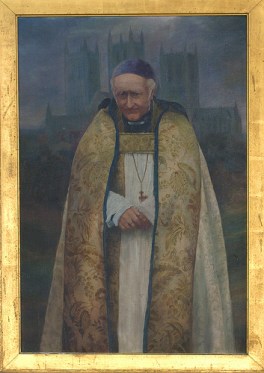
Flannery O’Connor’s name is synonymous with the American short story tradition. What sets her apart from her peers, besides her mastery of plot and her succinct, grotesque style, is the deep concern for issues of faith and grace that animates all of her stories. As O’Connor once put it, “All my stories are about the action of grace on a character who is not very willing to support it, but most people think of these stories as hard, hopeless, brutal, etc.” There is a certain delicious cruelty to her work. The nasty fates she metes out to children, let alone the adults who deserve what they get, rank her with the best of the gothic writers (and a humorous one at that—we can only imagine the hysterical laughter that something like Der Struwwelpeter would have provoked in her).

Yet O’Connor never show us violence for its own sake, nor for mere moralizing, nor as a ploy for cheap entertainment. Violence is the only outlet for grace in a fallen, “Christ-haunted” world. Her pages are choked and sodden with the precious blood that flows from the Cross.

Seven_Sacraments_Rogier

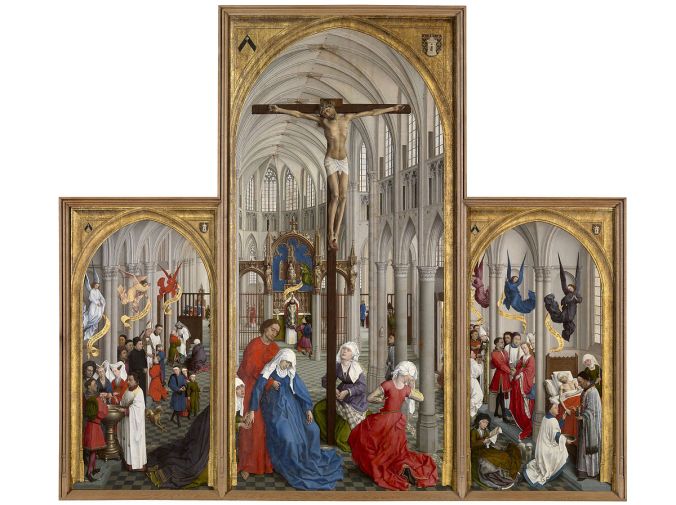
The Seven Sacraments, Rogier van der Weyden, c. 1448. O’Connor provides us with a (southern) gothic view of the sacraments. (Source)

It is a commonplace among critics that O’Connor’s writing is deeply sacramental. But to my knowledge, no author who has made that claim has also tried to find the fullness of the sacramental system present in her work.

I maintain that all seven sacraments appear in her fiction under different guises. Very often, we are given only implicit or twisted versions. It is common in O’Connor’s dark narratives to find flashes of grace in the inverse of sacraments; the truth emerges through its own negationhence her heavy use of violence. But all seven are all there, for those who “hath ears to hear” (Matt. 13:9 KJV).

In giving short descriptions of the following stories, my effort is not to justify my choices so much as to provoke further reading. As such, I will keep my descriptions succinct and relatively spoiler-free. Those who have read them may be able to see where I’m coming from. Those who haven’there’s some summer reading for you.

Baptism“The River”

This is one of O’Connor’s more overtly sacramental stories. The young son of irreligious parents accidentally gets himself baptized by a preacher in a Southern riverwith lethal consequences.

Honorable mention: The Violent Bear It Away. O’Connor thought about baptism a lot, probably because, as a rite of initiation, it is so centrally connected with questions of faith.

Confirmation“The Enduring Chill”

A sick and snobbish intellectual. A garrulous Jesuit. An overt reference to “A Simple Life” by Flaubert. Sometimes, the descent of the Holy Spirit doesn’t feel quite the way we expect.

Eucharist“A Temple of the Holy Ghost”

The only short story I know by any author that quotes the Tantum Ergo at length. There’s a good example of the “Red, Eucharistic Sun” motif that O’Connor was so fond of using. And lovers of the weird O’Connor will find her incarnational vision at a particularly grotesque note in this story.

The thinkpiece that uses “Temple” to discuss contemporary gender identity issues, sadly, has yet to be written.

ChurchDevilSign.jpg

O’Connor knew how to use a Protestant idiom to communicate Catholic doctrine. (Source).
Confession“The Lame Shall Enter First”

At one point, the liberal main character’s office is compared to a confessional. In confession, however, you hope that a good priest will comfort those who need comfort and afflict those who need affliction, for the edification and sanctification of all. Not so in Sheppard’s benevolently atheist bubble.

Marriage“Parker’s Back”

In this remarkable narrative, one of O’Connor’s most Catholic stories, we read the story of a marriage broken apart by a dramatically visible expression of extraordinary grace. Theological and moral Puritans won’t be pleased by the implications.

Holy OrdersWise Blood

What happens when you really, really, really don’t want to accept your vocation? You end up like Hazel Motes, and chase after a “Holy Church of Christ Without Christ.” The last chapter can be read as a meditation on the Imago Dei.

Unction“A Good Man is Hard to Find”

If only for that incredible, climactic line spoken by the Misfit, “She would of been a good woman…”

I may try to expand this list into a real academic work some day. For now, take this list for what it isa few reading suggestions for those of you who, like me, enjoy O’Connor, Southern Lit generally, and Catholicism.

Also peacocks.

Lots of peacocks.

CompleteStoriesFO

Cover of The Complete Stories. (Source).
Our Lady of the Cenacle in Armenian Iconography

ArmenianOLCenacle

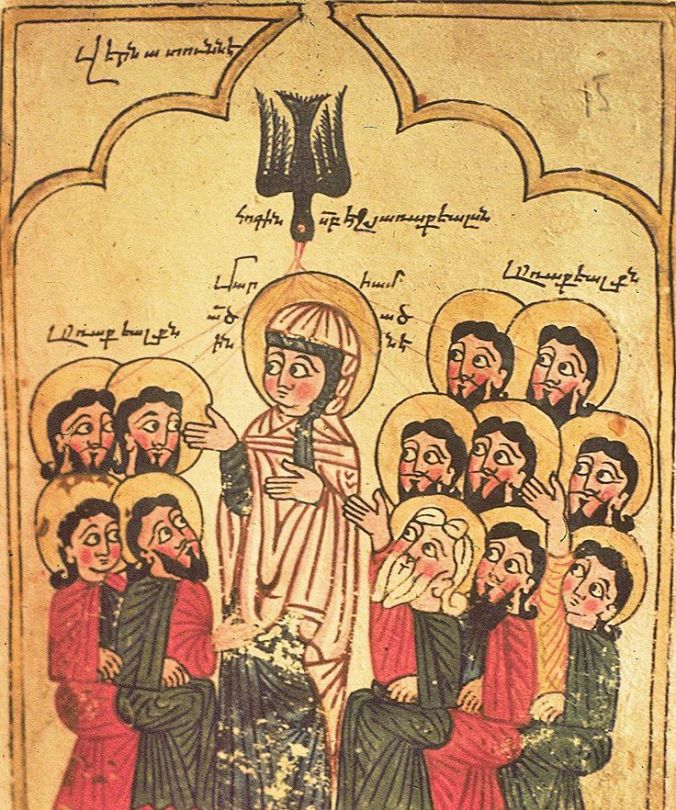
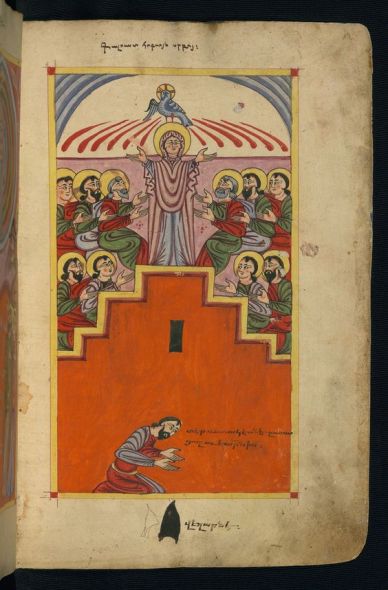
Figure A. Our Lady of the Cenacle, pray for us. From the source: “MINIATURES – Erevan, Matenadaran, MS 8772, Gospel, Aght’amar, Vaspurakan, 1391, artist Dzerun, Pentecost. Photo: Dickran Kouymjian.” (Source)

Throughout the Latin Church, Saturday in the Ascension Octave is kept as the Feast of Our Lady of the Cenacle. On this holy day, we remember the Mother of God keeping vigil with the Apostles in the Upper Room, or “Cenacle.” The place is significant. Here, Christ gathered the Twelve on the night of his betrayal, Maundy Thursday. At that time, He instituted the priesthood and the Eucharist. Later, on Pentecost, the Holy Spirit will descend upon the congregation and truly constitute the Church as such, confirming its sacramental essence and mission in the world of time.

Mary’s position in this unique place at this unique time is captured in the title, “Our Lady of the Cenacle.” But that name conceals a much deeper mystery. What, precisely, was she doing in the Cenacle? Why was she there? And does her presence, never mentioned in the Bible, nevertheless retain important meaning for us today?

As with any mystery unspoken in Scripture but passed on to us by the Tradition, we can approach it by many paths. One of the wonderful things about the Church is that, in her sacramentality, she recasts everything in the light of Christ and opens all things to a deeper meaning than we ordinarily encounter. So today, I’d like to consider Our Lady of the Cenacle through art. Specifically, iconography. Even more specifically, Armenian illuminated manuscripts.

pentecost_kirillo-belozersk-c-1497.jpg

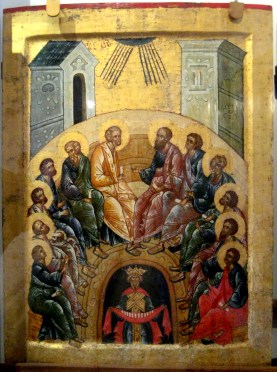
Figure B. A Greek-style Russian icon of 1497. Note the emptimess of the “Teacher’s Seat” at center. (Source)

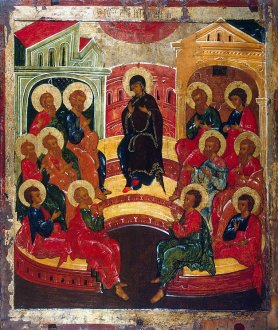
In the Greek iconographic tradition, Pentecost is usually depicted with an empty seat in the center…the place of Christ the King and Teacher, who has ascended and sent the Holy Spirit in his stead. The icon for the feast of mid-Pentecost dovetails with this custom, as it depicts Jesus the youth instructing the teachers of the Law in an arrangement that approximates that of Pentecost proper. The Russian and Slavic iconographic tradition largely copies this model, with one notable exception. Many Russian iconographers include the Mother of God in what would ordinarily be the empty “Teacher’s Seat.” As one writer puts it, “Mary is therefore shown in the ‘teacher’s seat’ as the best example we have, and the person on earth who most resembled Jesus Christ (both physically, as His mother, and spiritually as His disciple).” Indeed.

Icon-The-Descent-of-the-Holy-Spirit

Figure C. A Russian-style icon with the Mother of God in the “Teacher’s Seat,” date unknown. (Source).
The Armenian iconographic tradition differs from both the Greek and Russian streams in important ways, not all of which we can get into here. For our purposes, it is enough for us to observe that the Armenians have a tendency to place the Mother of God at the center of the Pentecostal scene.

Examine, if you will, the illumination at the top of this essayFigure A.

Mary is, by far, the largest character. The Apostles crowd around her on both sides expectantly. Her hands are lifted in the orans position of prayer. She stands in a red mantle and a dark blue robe that matches the hue of the Holy Spirit alighting above her. Every one of the bird’s tongues of flame move through her nimbus to reach the Apostles, some of whom even raise their own hands as if to reach out and take hold of the mystical fire.

A similar placement and posture is written into the following icon:

Pentecost2

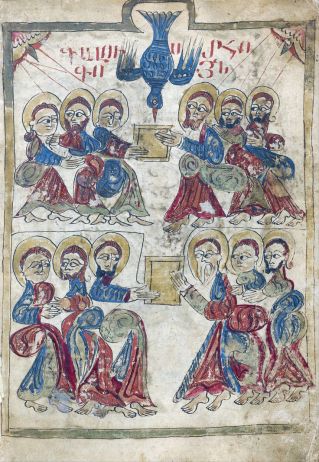
Figure D. Description from source: “This Armenian Gospel book was produced in 904 of the Armenian era (1455 CE) at the monastery of Gamałiēl in Xizan by the scribe Yohannēs Vardapet, son of Vardan and Dilšat, and was illuminated by the priest Xačʿatur.” (Source)

Mary is the central pillar of the icon. The Holy Spirit does not just descend, but rests upon her as He sends forth his tongues of flame. Here, too, their colors match. We can see that the Holy Spirit is customarily written in blue for this festal icon.

Blue is an interesting color, one with mystical associations. I won’t attempt a full symbolic analysis here, but it is worth contemplating the range of natural and supernatural meanings which Christianity has invested in this delicate shade. It suffices to say that blue is a sophianic color, calling to mind the wisdom and beauty of God (see the pertinent chapter in The Pillar and Ground of the Truth, by the great Russian theologian Father Pavel Florensky). The iconographic tradition is of great help in this subject as well; besides gold, blue is the only other color allowed for the background of icons in the Greek and Slavic canons.

DarkDove1

Figure E. An Armenian Pentecost icon without Mary, but with a blue dove of the Spirit. (Source)

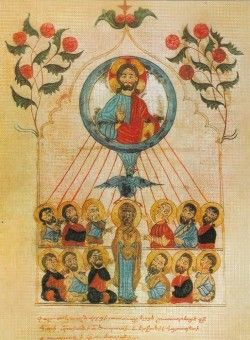
SmallIcon

Figure F. Pentecost icon of unconfirmed but probably Armenian origin. Same blue Spirit, roughly the same placement of the Theotokos. (Source).
It is also perhaps worthy of note that in Figure D, Mary doesn’t just match the hue of the Spirit. The colors she wears also match the architecture of the Cenacle. She is one with the Cenacle; the Cenacle is hers, and hers alone. The Cenacle is the Church, the Cenacle is every tabernacle in the world, the Cenacle is Heaven, the Cenacle is the New Jerusalem, the Cenacle is the Throne of God, the Cenacle is the Eschaton, the Cenacle is the final consummation of sophianic being brought about by Christ’s gloriously triumphant Incarnation, sacrifice, and Resurrection.

And in all these mystical dimensions of the Cenacle, Our Lady is Queen.

Mary is the woman who bears the Holy Spirit, the living icon of the Church. When we look at Mary, we are to think of the Spirit. The Mother of God always points us to her son, but also to the Holy Spirit, and through both, to the Father. She is never apart from the Holy Spirit. They abide together, and the Cenacle is where her truly Eucharistic and sophianic state of being is manifested for the awe-struck view of the whole Church. She is the consummation of what is accomplished by the Trinity in the Cenacle, the woman who fully cooperates in the salvation of the world, the Co-Redemptrix and Mediatrix of All Graces. Indeed, do we not read the latter title in the first illumination above? Do we not see it in the slim orange lines of fire that move through her halo to the Apostles below? They only receive the Spirit as it passes through Mary.

Mary does nothing of her own effort. God does all in her, and she freely agrees to accept and work for God’s will. St. Paul can speak of “those things that are wanting of the sufferings of Christ, in my flesh” (Col. 1:24 DRA). Not so with Mary. In her, the cross’s victory is complete. In her, it has become the Tree of Life, “so that the birds of the air,” such as the blue bird of the icons, “come and lodge in the branches thereof” (Matt. 13:32 KJV).

On this feast day, let us remember the manifold graces that Our Lady showers upon us from her throne in the eternal Cenacle. Let us also take heart that, with so powerful an advocate at the heart of the Church, no controversies or troubles can ever overwhelm the Barque of Peter. Finally, let us pray to Our Lady of the Cenacle for the Benedictines of Silverstream on this, their patronal feast.

Heat, Song, Sweetness: A Meditation on the Benedictine Life of St. Philip Neri

spn-indies

“Rome will be your Indies.” St. Philip receives his vocation from a Cistercian. (Source)

It has not been remarked upon very often that St. Philip loved the Benedictines. Monks played an important part in his life at two critical moments: first, when he decided to go to Rome, and second, when he decided to stay in Rome.

While working with his uncle Romolo in San Germano, near Naples, St. Philip would go to pray at Monte Cassino. As one author has it, “From [the Benedictines], he developed a profound love of the liturgy, the Bible and the ancient Church Fathers.” Their rich spiritual life helped cultivate a sense of God’s will, which led him to his first conversion. St. Philip quit his lucrative mercantile career with Romolo and set off for the Holy City. We shall examine his second run-in with the sons of St. Benedict later.

In considering St. Philip, we start to find similarities with other saints. Father Faber likened him unto St. Francis of Assisi; just as St. Francis was the “representative saint” of the middle ages, so was St. Philip the true saint of modernity. Cardinal Newman took another approach, tracing the influence of S.s Benedict, Dominic, and Ignatius Loyola,  thereby arriving at something like a portrait by comparison. My strategy and emphases will differ somewhat from both of theirs.

Among the “great cloud of witnesses” who make up the Church Triumphant, there are an infinite number of likenesses and connections between the saints. Here and there, one spies a similarity in outlook, or devotion, or manner of life between figures who lived across centuries and continents. The eternal coinherence, the “dance” that binds them all, is the ineffable life of the Trinity in Unity. Thus, it is not surprising that when we observe similarities between Philip Neri and that great father among the saints, Benedict of Nursia, we should also find a deeper, Trinitarian resemblance.

I would like to offer a meditation on the life and spirituality of St. Philip through the lens of the Benedictine vows. In doing so, I hope to shed light on the Trinitarian character of the three vows as well as St. Philip’s remarkable interior life. His Trinitarian spirituality was distinguished by the threefold experience of God that the great English mystic Richard Rolle describes in The Fire of Love: “ghostly heat, heavenly song and godly sweetness” (Rolle I.5).

Keeping all of these disparate lenses in mind, let us commence.

I. The Warmth of the Father’s Stability

St-Philip-NeriBoys

St. Philip Neri was especially popular among the young men of Rome. (Source)

St. Philip was the spiritual father of many men in his own day. Palestrina, Animuccia, St. Camillus of Lellis, and others received forgiveness from him in the confessional. He was particularly kind to youth. Once, when the scholarly Baronius complained that the children with whom St. Philip was playing in the yard were too loud for his studies, St. Philip replied that he’d let them chop wood off his own back, if only they might not sin. The long-suffering Baronius accepted St. Philip’s paternal will. It was a salutary and exemplary mortification, and St. Philip knew that. It was also a lesson. St. Philip intended for his sons to live out spiritual fatherhood in the world. And they were to do it, following his own example, with intense joy.

When we contemplate the Fatherhood of God, we are struck dumb with wonder at the abyss of Being abiding in His fullness. God the Father is the immovable, the unshakeable, the indefinable One. It is from God the Father that we learn that fatherhood can only be cultivated upon presence…rootedness…constancy. And it must also blaze with the heat of love. The two qualities are mutually reinforcing. Put briefly, the warmest paternity will cool, harden, and falter if it is not sustained by stability.

St. Benedict understood this dynamic, and when he sought to compose a rule for his spiritual family, he knew that he had to incorporate it into his model. In the very first chapter of the Rule, we read of the different kinds of monks. The worst are those whom St. Benedict calls “Gyrovagues,” men who

…spend their whole lives tramping from province to province, staying as guests in different monasteries for three or four days at a time. Always on the move, with no stability, they indulge their own wills and succumb to the allurements of gluttony (Rule of St. Benedict I).

Instead, St. Benedict calls for his monks to pass their lives in one place, at one task—seeking God. Stability is so central to his vision that he doesn’t even bother writing a chapter about it. Instead, he assumes it as a necessary condition from the very beginning and lets it color his prescriptions from then on.

St. Philip was equally adamant about stability. The organization of the Oratory is a great testament to his idea of stability. Even in the early days, when he first sent some priests to San Giovanni dei Fiorentini, he required that they return to his chamber above San Girolamohis “cenacle,” if you willand continue with the exercises of the Oratory.  When the priests finally left both parishes and moved to Santa Maria in Vallicella, the Chiesa Nuova, St. Philip imagined that his religious family would never grow beyond its four walls. He was deeply reluctant to grant the foundation of an Oratory in Naplesthough it would furnish the Church with great saints such as the Blessed Giovanni Juvenal Ancina.

The basic grain of St. Philip’s idea has endured in those lands where the Oratory has flourished. Oratorians spend their whole priestly lives in one community. They can travel and work more freely than vowed religious, since they are truly secular priests, but their range of motion is restricted by the value of stability that St. Philip imposes on his sons. The quality of that stability differs from the asceticism which marked the experience of the early monks. As Newman puts it:

The Congregation is to be the home of the Oratorian. The Italians, I believe, have no word for homenor is it an idea which readily enters into the mind of a foreigner, at least not so readily as into the mind of an Englishman. It is remarkable then that the Oratorian Fathers should have gone out of their way to express the idea by the metaphorical word nido or nest, which is used by them almost technically. (Newman, qtd. by Robinson).

As Newman said elsewhere:

…the objective standard of assimilation is not simply the Rule or any abstract idea of an Oratory, but the definite local present body, hic et nunc, to which [the novice] comes to be assimilated (Newman, qtd. on the Toronto Oratory Vocations page).

The stability of the Oratory is enlivened with a certain warmth, a familial domesticity that is adequately captured in the Italian nido. The Oratorian has his “nest” in his cell, and beyond that, his house, and beyond that, the city where God has led him. None of these becomes his “nest” by matter of location, but by the network of sacramental relationships he enters there. He is begotten anew by the paternity of St. Philip, by his immediate superiors, and ultimately, by God. The same spirit prevails in the very best monastic houses, as any visitor to Silverstream Priory or the Monastero di San Benedetto in Monte or Stift Heiligenkreuz or Clear Creek Abbey or L’Abbaye Sainte-Madeleine du Barroux can attest. Dom Aelred Carlyle’s Caldey Island had just such a sensibility, as did Nashdom Abbey before its decline. The Oratory and the Benedictine Monastery keep alive the fire of God’s paternal love by their community life and stability in prayer.

II. The Son’s Obedient Song

StPhilipNeriMadonna

The Madonna Appearing to Saint Philip Neri, Sebastian Conca. (Source)

Up to now, I have not addressed the peculiar irony in my approach. The model that St. Philip left for his sons is singular among all others in the Church in its total rejection of vowssuch as those that mark the Benedictine vocation. The constitutions of the Congregation are very clear. Even if all the members around the world should take vows and only one abstain, the true Oratory would rest with that lone dissenter, and not the majority. Instead, Newman tells us, “Love is his bond, he knows no other fetter.” St. Philip trusted that bond of charity to sustain the common life he envisioned for the Oratory.

St. Philip hoped that his sons, through mortification of the intellect and an easy, friendly concord, would persevere in the love that was their peculiar vocation. Just as voices unite in harmony for no better end than beauty, so might we describe the Oratorian ideal as a kind of “song”Rolle’s second experience of God. The liturgy for the Sixth Sunday in Easter illustrates this point admirably. The Introit (Vocem iucunditatis annuntiate), Psalm (Let all the earth cry out to God with joy), and Offertory (Benedicite gentes Dominum) all refer to song as the properly obedient response to God’s grace. The truth and beauty of that good song is attractive to souls made weary by the heavy dross of the world. St. Philip knew this fact well, and he employed some of the leading composers of the timePalestrina and Animucciato write music for the exercises of the Oratory.

Moreover, one could almost imagine that the first reading, which mentions the Apostle Philip, was really intended to tell us something about the life of the Joyful Saint:

Philip went down to the city…and proclaimed the Christ to them. With one accord, the crowds paid attention to what was said by Philip when they heard it and saw the signs he was doing…There was great joy in that city. (Acts 8: 5-8 NAB)

Similarly, the Epistle calls to mind St. Philip’s singular mystical life. We read, “Sanctify Christ as Lord in your hearts,” (1 Pet. 3: 15-18 NAB). And how are we, like St. Philip, to go about sanctifying Christ in our hearts? The Gospel tells us:

If you love me, you will keep my commandments. And I will ask the Father, and he will give you another Advocate to be with you always, the Spirit of truth, whom the world cannot accept, because it neither sees nor knows him. But you know him, because he remains with you, and will be in you. (John 14:15-17 NAB)

Christ is preeminently the man who responds with a song of obedience, and St. Philip follows his lead. And what do St. Philip and his sons sing in their common life? What but the praise of God? What but the Divine Word, the Logos, Christ made present in prayer and scripture and sacrament? Indeed, Eliot’s description of “every phrase/And sentence that is right” could apply just as well to the Oratorian life:

…where every word is at home,
Taking its place to support the others,
The word neither diffident nor ostentatious,
An easy commerce of the old and the new,
The common word exact without vulgarity,
The formal word precise but not pedantic,
The complete consort dancing together
(Little Gidding V)

The life of the Benedictine monk is not so seemingly free. He has one work, the liturgy, the Opus Dei. This one task is the first and final way that the Benedictine fulfills his vow of obedience to Christ. As Chapter 5 of the Holy Rule has it: “The first degree of humility is obedience without delay. This is the virtue of those who hold nothing dearer to them than Christ” (Rule of St. Benedict V). The eleven degrees that follow build upon this cornerstone, marked as it is by the love of Christ. It is a love that conforms the monk to the obedience of Christ crucified. The wicked Sarabaites that St. Benedict describes in Chapter 1 are chiefly marked by their unwillingness to obey:

They live in twos or threes, or even singly, without a shepherd, in their own sheepfolds and not in the Lord’s. Their law is the desire for self-gratification: whatever enters their mind or appeals to them, that they call holy; what they dislike, they regard as unlawful. (Rule of St. Benedict I).

St. Philip knew how to obey. When he was under suspicion of heresy, he immediately ceased his labors in submission to the Papal investigators until he knew the outcome. He only resisted when it came to the cardinalate, which he always resolutely refused. Once, upon receiving the Red Hat, he made jokes about the honor and laughed it off as if it were nothingin the very presence of the Pope! Exasperated, the Holy Father decided to grant St. Philip’s wish, and did not insist on the appointment.

But he also obeyed the voice of God through other figures, such as when he formally received his vocation. Hearing the many stories of St. Francis Xavier in the East, St. Philip determined to set out for India. But he decided to wait and test the calling with the advice of another man he trusted.

In Rome, there is a Cistercian monastery called the Tre Fontane, which takes its name from the legend that when St. Paul was martyred, his head bounced three times. It is said that three fountains miraculously sprang up from the earth where his head fell. Later, a house of religion was founded there. It was to this monastery that St. Philip went to consult a well-respected monk known for his spiritual insights. The monk listened to St. Philip’s situation, and told him to return later. When St. Philip came back to the Tre Fontane, he had his answer“Rome will be your indies.” He never again desired to leave the Holy City. Cardinal Newman tells us that the monk did this under the spiritual guidance of St. John. How appropriate that the Apostle so intimately tied to the Second Person of the Trinity should teach St. Philip to imitate Christ’s obedient humility!

III. The Sweetness of the Spirit’s Conversatio Morum

StPhilipNeriFlamingHeart

The Holy Spirit made the heart of St. Philip sacramental while on this earthly journey. (Source)

Few saints have such a manifest intimacy with the Holy Spirit as St. Philip Neri. Biographers and commentators throughout the centuries have always noted the peculiar affinity between St. Philip and the Third Person of the Holy Trinity.

When St. Philip first came to Rome, he spent most of his nights praying in the catacombs. He drew surpassing sweetness from this salutary solitude. For him, Rome was not just a (recently sacked) city of decadent palaces, picturesque ruins, and opulent vices. Rome was a landscape marked by the work of the Holy Spirit through human history. The catacombs reminded St. Philip of the Church of the martyrs.

It was on one of these vigils that St. Philip experienced a visitation by the Holy Spirit. He came to the catacomb of St. Sebastian on the night before Pentecost. While praying, the Holy Spirit descended upon him. Fr. Philip G. Bochanski of the Oratory describes the scene well:

As the night passed, St Philip was suddenly filled with great joy, and had a vision of the Holy Spirit, who appeared to him as a ball of fire. This fire entered into St Philip’s mouth, and descended to his heart, causing it to expand to twice its normal size, and breaking two of his ribs in the process.  He said that it filled his whole body with such joy and consolation that he finally had to throw himself on the ground and cry out, “No more, Lord!  No more!” (Source).
Throughout his life, St. Philip would report an unremitting heat throughout all of his body, though always most intense around his heart. Even in the dead of winter, he’d be so warm as to freely unbutton his collar when everyone else was shivering. Pressing someone’s head to his breast, letting him hear his heartbeat and feel the miraculous warmth, was enough to convert even the most hardened and impenitent sinners. We can say with no exaggeration that the Holy Spirit made St. Philip a living sacrament. He became a fountain issuing forth graces. He bore all of the sweet fruits of the Holy Spirit. As Fr. Bochanski puts it, “St Philip was convinced and constantly aware of the presence and action of the Holy Spirit in him and through him…He was sure that he had received the gifts of the Holy Spirit, and this assurance set him free to bear the Spirit’s fruits.”

St. Philip’s special relationship with the Holy Spirit drew him into an almost uncontrollable ardor of love for the Eucharist. He was a great mystic of the Blessed Sacrament. Under St. Philip’s direction, the Roman Oratory popularized the Forty Hours Devotion of Eucharistic Adoration, an important precursor for later efforts at Perpetual Adoration. In spite of his wise suspicion of visions and miracles, he was granted innumerable ecstasies. These would usually come in some connection with the Eucharist. St. Philip had jokes read to him in the sacristy as he vested, as he had a very realistic fear of entering a sweet trance of joy before the Mass even began.

In his old age, St. Philip was allowed to give free reign to these Eucharistic ecstasies. By special permission of the Pope, he would say his Mass only in a private chapel on the top floor of the Vallicella. At the consecration, he would kneel down before the altar. The servers would close the windows, shut the door, and place a sign on the handle which read, “Silence! The Father is saying Mass.” Then, in darkness and silence, St. Philip would commune with the Eucharistic God for upwards of two hours. When he was done, the servers would ring a bell, the sign on the door would be removed, and he would continue the Mass as if nothing had happened.

In all of these phenomena, we may be tempted to draw a contrast with the staid, rhythmic, simple spirituality of St. Benedict’s Rule. Not sofor we must examine why St. Philip was given the singular graces that marked his life in the Holy Spirit.

The third vow that St. Benedict demands of his sons is Conversatio Morum, the conversion of manners (Rule of St. Benedict LVIII). The monk enters the monastery that he might “seeketh God,” and seek Him fully (Rule of St. Benedict LVIII). Like all Christians, he is after deification. But unlike most of us, he is called to theosis by shunning the distractions of the World. He can only do this by entering into the sacrifice of the Eucharistic Christ, whom he adores in the liturgy that marks the hours of every day. The Benedictine vocation is, at its heart, life made explicitly Eucharistic.

Dom Mark Daniel Kirby of Silverstream, building upon the work of the Blessed Abbot Columba Marmion and Mother Mectilde de Bar, has put the point admirably. Among many other similar passages, we find in a poem from 2011:

The Eucharistic Humility of God
is inseparable from His Eucharistic Silence.
This Saint Benedict understood,
for in his Rule, the silent are humble,
and the humble silent.
This our Mother Mectilde understood
for she wanted her Benedictine adorers to bury themselves
in the silence of the hidden God,
the ineffably humble God
in the Most Holy Sacrament of the Altar. 
(Source)

In the Eucharist, we find the consummation of all God’s sweetness. “O taste, and see that the Lord is sweet: blessed is the man that hopeth in him” (Psalm 33:9 DRA). It is the grand work of the Spirit, the crown of the sacraments, the dawn of the new and everlasting life. Just as Richard Rolle passed into “the most delectable sweetness of the Godhead,” so too does the monk return each day to the Eucharist to drink of the Spirit’s epicletic sweetness (Rolle I.5).

And St. Philip, with his Eucharistic ecstasies and his intimacy with the Spirit, knew that sweetness better than we can possibly imagine. The sweetness of the Holy Spirit transformed him into an instrument of grace, a human sacrament whose own manners were deeply converted and who aided many along the same journey. It is little wonder that Oratories and Benedictine monasteries remain centers of reverent and beautiful celebration of the Holy Sacrifice of the Mass.

Conclusion

Ritratto di San Filippo-b

Portrait of St. Philip Neri. (Source)

St.-Benedict-81

Portrait of St. Benedict. (Source)

Many writers have found in St. Philip Neri the likeness of other saints, including those predecessors whom he admired, the contemporaries whom he loved, and the innumerable great saints who followed in the generations since he went on to immortal glory.

Yet is any resemblance so striking, and so Trinitarian, as that between the Father of the Oratory and the Father of Monks? In both, we find the very image of the Father, the Son, and the Holy Spirit. In both, we can see the marks of stability, obedience, and conversion of manners. And in both, we detect the surpassing heat, song, and sweetness which Richard Rolle describes as indicative of a true encounter with God.

By their prayers, may we someday share that eternal encounter.

Solimena, Francesco, 1657-1747; The Holy Trinity with St Philip Neri in Glory

The Holy Trinity with St. Philip Neri in Glory, Francesco Solimena. The figure at left is probably the Benedictine Oblate, St. Francesca Romana. The painting, originally intended for the Naples Oratory, now hangs in the Ashmolean Museum of Art and Archaeology at Oxford (Source).
Saint-Benedict-in-Glory-1500-58b5a7553df78cdcd88ab39f

St. Benedict in Glory, c. 1500. Artist unknown. (Source)

A Poem for Ascension Day

AscensionWindow

A stained glass window depicting the Ascension of the Lord. (Source).
Salute the last, and everlasting day,

Joy at the uprising of this Sun, and Son,

Ye whose true tears, or tribulation

Have purely wash’d, or burnt your drossy clay.

Behold, the Highest, parting hence away,

Lightens the dark clouds, which He treads upon;

Nor doth he by ascending show alone,

But first He, and He first enters the way.

O strong Ram, which hast batter’d heaven for me!

Mild lamb, which with Thy Blood hast mark’d the path!

Bright Torch, which shinest, that I the way may see!

O, with Thy own Blood quench Thy own just wrath;

And if Thy Holy Spirit my Muse did raise,

Deign at my hands this crown of prayer and praise.

(John Donne)

Four Luminous Days

ascension-header

From an Icon of the Ascension. (Source)

This week, we are about to enter a truly remarkable liturgical sequence.

MariaAuxiliadoracuadro

Our Lady, Help of Christians. (Source)

Wednesday is Our Lady, Help of Christians, patroness of my parish here in South Carolina.

Thursday is the Ascension (sadly moved to Sunday in my province of Atlanta).

Friday is St. Philip Neri, and then on Saturday comes Our Lady of the Cenacle.

We could extend our reckoning to Sunday, but for now, I think it is appropriate for us to hesitate on the threshold of the Mystical Sabbath. Let us instead examine only these four days and their import.

We begin and end the progression with Mary. First, we see her in her relation to humanity. She is the help of Christians. Then, we see her in relation to God. She receives the Holy Spirit. Taking both feasts together, we see Our Lady participating in God-humanity; she becomes the perfect emblem of Divine Wisdom.

StPhilipHS

St. Philip Neri, who received the Holy Spirit in the catacombs. (Source)

Studying Sophiology has made me appreciate Our Lady of the Cenacle even more. There is a deep connection, I think, between the manifestation of Divine Wisdom in the creation of the Cosmos, at the Baptism of Christ, and at the descent of the Spirit upon Our Lady at Pentecost. They are mutually illuminating events. I wonder if we can find that connection at the level of the propers for each liturgy, a project I may try to engage in before Saturday.

And how appropriate that St. Philip, who experienced his own Pentecost in the catacombs of St. Sebastian, should go forth as a herald for Our Lady of the Cenacle! It is a kind of liturgical proof of the hierarchical principle, that we are led by lower things to higher things. St. Philip received the Holy Spirit into his heart as a ball of fire in the catacombs under the city of Rome, once a place of persecution, the mythical “Babylon” of Revelation. He guides us to Our Lady as she waits and prays in the Cenacle, the Upper Room in Jerusalem where the sacraments of the Eucharist and Orders were instituted and where the Holy Spirit descended upon the Church in tongues of fire on Pentecost. What a picture of the historical Church in pilgrimage! From the darkness of the Roman catacombs to the heights of the upper room in Zion. We could read an eschatology out of these mystical days.

RussianPentecostIcon

Russian Icon of Pentecost, 18th century. The Slavs are unique among the Eastern Orthodox in placing Our Lady in the scene. (Source).
 

Nevertheless, this week’s procession is easy to overlook, since its central diamond, the Ascension, has been misplaced by so many bishops. Celebrating the feast on Sunday robs it of its truly Eucharistic meaning, for the Ascension’s traditional place on a Thursday meant that it could only be read through the texts of Maundy Thursday. Ascension Day is to Maundy Thursday as Pentecost is to Easter, the initiator of a new liturgical season and a reminder of the Mystical Priesthood of Christ. All of this is admirably explained by Dom Mark Daniel Kirby OSB in his podcasted homilies and in his blog, Vultus Christi.

The Eucharistic and Priestly meaning of the Ascension matters for the rest of the four-day sequence insofar as the Eucharist represents, sustains, and completes every instantiation of Sophianic being. The Sophianic character of the four days can only be discerned in the light of Christ’s face as He ascends into his cosmic priesthood on Thursday. This would be true even if St. Philip were not there to complete the set. This is, after all, a fairly uniqueE situation. Ever spry, St. Philip moves around the sacred calendar with the bustling rhythms of profane time. But in this auspicious year, so full of historical resonances and providential patterns, let us rejoice in the days that the Lord has made (Psalm 118).


Life Update: Graduate School

SSHChurchView

St. Stephen’s House, Oxford. Source.

This won’t come as a surprise to those of you who know me personally, but in the interest of honesty, archiving, and my own historical interests, I thought I’d post here that I have decided to attend the University of Oxford next year in pursuit of an M.Phil. in Theology, with a concentration in Ecclesiastical History. I will be living at St. Stephen’s House.

StaggersCrest.jpg

The coat of arms of St. Stephen’s House. It incorporates elements of the coat of arms of its founder, Bishop Edward King. (Source)

I’m very happy to be at St. Stephen’s. It is the Anglo-Catholic seminary in Oxford. I am guaranteed to be around people who are seeking ordination in the Church of England. And very high Anglo-Catholics at that. I’m really looking forward to morning and evening prayer every day. While it may not be the prayer of the whole Church in the Divine Office, the Book of Common Prayer is nevertheless a fine, beautiful way to pray and meditate on Scripture in community. I also think that the liturgical rhythms of life at “Staggers,” as it’s called, will be salutary on the whole. It’s even motivated me to try to memorize a few of the old collects, as Peter Hitchens demonstrates in this debate.

While I realize it has changed a great deal over time, the history of St. Stephen’s House is one of the reasons I’m happy to be here. It may not be one of the well-known colleges (it doesn’t even seem to have very much merchandising in the way of scarves, ties, pins, cufflinks, etc., like all the other ones). But Staggers did play its part in the history of Anglo-Catholicism. Founded by Bishop Edward King of Lincoln in 1876, the house soon became a major center of Anglo-Catholicism. It started to produce Tractarian priests by the dozens, and eventually gained a reputation as a factory of bishops and deans of cathedrals. This prolific connection to the Church of England’s highest chambers has continued into its more recent years.

edward-king

Edward King, Bishop of Lincoln. (Source)

Its relationship with Oxford, on the other hand, has varied. It only attained Permanent Private Hall status in 2003. In moving to that arrangement, it joined other historically religious foundations at Oxford: Blackfriars for the Dominicans, St. Benet’s for the Benedictines of Ampleforth, Wycliffe Hall for Evangelicals, Campion Hall for the Jesuits, and Regent’s Park (nominally) for the Baptists. It was at that time that the House broadened its emphasis to include those who were not seeking ordination in the C of E.

Moreover, Staggers has moved around Oxford. It started as a small community near the heart of town, and only much later moved to its present location across the Cherwell. To wit:

For the House’s first years, it was situated near the centre of Oxford, where the New Bodleian Library now stands. From 1919, the House had a site in Norham Gardens, near to the University Parks. In 1980 it moved to the current site…(St. Stephen’s House Blog).

The accommodations that the House took up were built by the Society of St. John the Evangelist, named alongside the parish church they ran (although it is now largely a concert venue, the House clergy still conduct liturgies there each week). The Society priests were also known as the Cowley Fathers. T.S. Eliot conducted at least one retreat there, although he was generally closer to the Benedictines at Nashdom and the Society of the Sacred Mission at Kelham (see Spurr’s biography, Anglo-Catholic in Religion).

In the mid 20th century, the House prospered under the benevolent influence of Father Arthur Couratin, allegedly referred to by some as “Noël Coward in a clerical collar.”

Halliday, Edward Irvine, 1902-1984; Reverend Canon Arthur Couratin, Former Principal of St Stephen's House

Canon Arthur Couratin, Principal of St. Stephen’s House. (Source)

Although its ethos remains largely Anglican, the House has offered a few important alumni to the Church of Rome. Balthasar scholar and theologian Father John Saward graduated there, as did the one-time Bishop of Ebbsfleet and current priest of the English Ordinariate, Monsignor Andrew Burnham. Indeed, they’ve even produced the Primate of the Western Diocese of the Armenian Church of North America, Hovnan Derderian. He is the youngest Armenian archbishop.

Staggers also gave the Church of England Fr. Kenneth Leach, an important Christian Socialist priest. He was trained at St. Stephen’s when it had become a rather homoerotic place, and Leach would famously sum up his time there as “gin, lace, and backbiting.” The writer and Staggers alum A.N. Wilson composed a bitingly comedic satire of the House in those years, entitled Unguarded Hourswhich, as Ignatius Press’s reviewer puts it, is decidedly “not a Catholic novel.” Alas. Wilson, who would eventually return to Christianity after years of very public atheism, would later recall the custom formerly in vogue at Staggers of taking “religious names” that were actually rather saucy nicknames, often of the opposite sex. If Father Couratin was “Noël Coward in a clerical collar,” it seems that by the 1970’s, you were more likely to find Julian and Sandy in soutanes.

I seriously doubt that any of that persists. Women’s ordination in the C of E means that, while many Anglo-Catholics have become more liberal, their seminaries no longer smack of the kinds of homoerotic associations that fueled so many stereotypes (see Cousin Jasper’s famous quip in Brideshead Revisited). Staggers seems to remain as a pillar of sensible, ornate, properly Anglo-Catholic liturgy at its best.

StStephensLiturgy1

A liturgy at the parish church of St. John the Evangelist, St. Stephen’s House, Oxford. (Source).
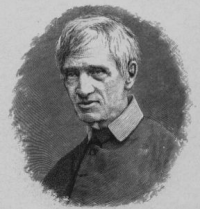
Requiem

A requiem for the founders of the House. (Source)

StStephensHouseRose.jp

A priest says a Mass at St. Stephen’s House. I highly recommend the source I took this from, Merrily On High. An excellent source for all things Anglo-Catholic.

Of course, I could also emphasize the importance of Oxford in general as a center of CatholicismRoman and otherwise. Here, the Subtle Doctor “fired France for Mary without spot.” Here, Cardinal Wolsey established a college named for his office and, later, all of Christ’s Body on earth. Here, Archbishop Laud attempted to bring back devotion to Our Lady through a little portico on her church in town. Here, Charles I took refuge while his queen heard the Mass of Ages in Merton Chapel. Here, Keble railed against a “National Apostasy.” Here, Newman battled the liberals, and in doing so, broke ground for the Second Spring. Here, Gerard Manley Hopkins served briefly as curate. Here, Oscar Wilde flirted with men and the Church for the first time. Here, Monsignor Ronald Knox cut his clerical teeth as the chaplain of Trinity College. Here, Montague Summers was first haunted by the Vampyre’s shadow. Here, Tolkien and Lewis and Williams and their friends spoke about God long into the stout-softened night. Here, T.S. Eliot studied briefly before going on to greatness in London. Here, Evelyn Waugh thought up a story about two men and a teddy bear. Here, Father Martin D’Arcy pondered the ways of divine and human love. Here, the Oratory finally arrived in 1990 to fulfill Newman’s dream. Here, the late Stratford Caldecott wrote of God’s undying beauty in all things.

OxfordSkyline1

An Oxford morning. (Source).
I could name more ways in which Oxford has played a special role in the life of the Catholic Church. Perhaps I will do so in another post, or a series of posts. For now, I’m just happy to say that I’ll be in a place with a lot of Catholic history, learning about that history. And thank God for that.
CrivelliStephen

“Saint Stephen,” by Carlo Crivelli. Proto-martyr and patron of St. Stephen’s House, Oxford (and perhaps a rather wan patron at that, by the look of this paintingis that asparagus in his hand?). (Source)

PrinceofWalesatStaggers

Also, apparently the Prince of Wales sometimes visits. (Source)

Newman’s Novena to St. Philip Neri

StPhilipFlorence

Articles of devotion to St. Philip Neri, Florence. Photo taken by the author in June of 2015.

St. Philip Neri is my favorite saint. I came to his acquaintance during the summer after my second year in college, when I studied abroad in locations marked by the presence of Oratories. I believe that I was, so to speak, “introduced” to St. Philip by his famous son, the Blessed Cardinal Newman, whose work I had already read and admired. It is also perhaps of some significance that I had devoted that year of my Catholic life to the Holy Spirit. Desiring a deeper friendship with St. Philip, I followed along with Newman’s novena to St. Philip last May. Having read several biographies and having started a blog, I thought I might try my own hand at offering some small act of devotion to St. Philip in the form of nine brief meditations on his life and virtues.

Unfortunately, it seems that the frenzy of graduation week has crept up on me, and I was unable to complete this task. I do, however, offer my own biography of the saint. My sources are chiefly the various Oratorian materials produced by the London and Oxford houses, Good Philip, by Alfonso Cardinal Capecelatro, the biographies by V.J. Matthews, Louis Bouyer, Anne Hope, and Theodore Maynard, and finally, sundry writings by Cardinal Newman, Fr. Faber, Fr. Jonathan Robinson, and Monsignor Knox. All are excellent resources, and I would be happy to provide more details about them in the comments section if asked.

The actual text of the novena will be taken from the Newman Reader, which is my go-to source for all things Newman. I claim no authorship of these texts and am entirely in debt to that great theologian, the Blessed Cardinal of the Birmingham Oratory. I have decided to do this, rather than simply link to the Newman Reader, in part because I am starting my novena a day later than Newman does. Newman began his novena to St. Philip on the 17th and ended it on the 25th, presumably because of the various festivities that the 26th would usher in. However, as I do not live in an Oratory, I will be starting and ending a day later, so that the readings of the ninth day fall on the feast proper. There is a certain liturgical grace that comes with the feast this year, but I will discuss that in another post.

NewmanasanOratorian

John Henry Newman as an Oratorian. (Source)

For now, I’ll say that I will be offering this novena for the vocation of X.

St. Philip, as we shall see, is a very good heavenly guide for young men. He is especially helpful for those who are trying to discern the will of God in their lives.

FNeri

A famous image of St. Philip. He is customarily depicted in a red or rose chasuble in iconography. (Source).

Each day, start by reading the meditation and prayer, and then say the prayer of Cardinal Baronius:

Look down from heaven, Holy Father, from the loftiness of that mountain to the lowliness of this valley; from that harbour of quietness and tranquillity to this calamitous sea.  And now that the darkness of this world hinders no more those benignant eyes of thine from looking clearly into all things, look down and visit, O most diligent keeper, this vineyard which thy right hand planted with so much labour, anxiety and peril.  To thee then we fly; from thee we seek for aid; to thee we give our whole selves unreservedly.  Thee we adopt as our patron  and defender; undertake the cause of our salvation, protect thy clients.  To thee we appeal as our leader; rule thine army fighting against the assaults of the devil.  To thee, kindest of pilots, we give up the rudder of our lives; steer this little ship of thine, and, placed as thou art on high, keep us off all the rocks of evil desires, that with thee for our pilot and guide, we may safely come to the port of eternal bliss. Amen.

Those of you who prefer Latin can find it at this link.

On the ninth day, conclude by adding on the Collect and Litany at the very end of this post.

St. Philip’s Life

DolciPhilipNeri

Saint Philip Neri (1515-1595), by Carlo Dolci, c. 1645. The finest portrait of the saint was painted long after he died. In his own life, St. Philip was patron of the arts, and was even Palestrina’s confessor. (Image Source).

St. Philip Romolo Neri was born in Florence to a loving father and stepmother and brought up in the faith by the Dominicans of San Marco. The embers of Savonarola’s fiery spirit still burned in the memories of the Florentines, and for the rest of his life, St. Philip would hold the reformer in a high regard. But his temperament was as different from Savonarola’s as day is from night. St. Philip was always good-natured, kind, and generous. He was not overly pious, with play-acting the Mass or anything of that sort. Instead, he cultivated a winning personality that earned him the nickname “Pippo Buono.” He was remarkably humble, never giving much weight to the things of this world. Once, he was shown a beautiful diagram of his family tree; he promptly tore it up.

When he reached adulthood, St. Philip went to seek his fortune with his uncle Romolo, a merchant in San Germano. He found that the life of commerce was not conducive to his temperament, and so, after praying at the shrines of the Benedictines at Monte Cassino and Gaeta, he left for Rome almost penniless. The city had just been sacked by the soldiers of the Emperor, and work was hard to come by. Nevertheless, St. Philip was soon employed as a tutor for the Caccia family. The boys he taught would later go on to lives of holiness as priests. St. Philip made few friends in this period of his life. Like a hermit, he would hardly eat anything and spent his nights in the catacombs, remembering and praying to the martyrs of the early Church. On one such occasion, while he was in the catacombs of San Sebastiano, he had a mystical experience that would forever change his life. The Holy Spirit descended into his heart as a ball of fire. For the rest of his life, he would report heart palpitations, an incredible heat, and physical shaking – sometimes enough to move the chair in which he sat. Upon occasion, it was enough to convert a sinner only to draw their head to his Spirit-infused breast. Only in very old age did he confide his secret. When he died, his heart was found to be considerably enlarged. Several ribs were dislocated by its growth.

But in youth, he kept all this under wraps. He slowly started to gain a following. He would frequent the Seven Stational Churches, even leading bands of pilgrims on picnics. As he got older, these journeys grew in size and festivity. But in the early days, he was followed only by a few young men who were attracted to a charismatic tutor. He would also visit and help in the hospitals, perhaps the most common form of charitable work in Renaissance Italy. He would later exert a great influence on that marvelous saint of the hospitals, St. Camillus of Lellis.

St. Philip and his friends moved into the Church of San Girolamo, where, every afternoon, they would have a time of prayer, hymn-singing, recitation of the Bible, public commentary on the Scriptures, and some lesson from the history of the Church or the lives of the saints. This was the first Oratory. St. Philip’s way of life looked mighty suspicious to the authorities in a Rome still reeling from the Reformation, and he was investigated and opposed by several figures – namely an irate cardinal close to the Pope. But that cardinal died before the end of his investigation into St. Philip, an event whispered to be the wrath of God. Every other opposition fell away, and in time, St. Philip became an established figure in Rome. He was eventually persuaded to seek ordination. While never a Doctor of the Church, St. Philip learned his theology well, and was able to put it to good use in his later pastoral life.

When the Church of the St. John of the Florentines requested that St. Philip move to their community, he balked. Instead, he sent some of his best disciples, including Cesare Baronius, later to become a great cardinal and historian of the Church. However, all of the priests he sent were required to return to San Girolamo every day for the Oratory sessions. In this practice, we can perceive the seeds of the Congregation that would later flourish throughout the Catholic world.

Obejscie 0170

The Chiesa Nuova, Rome. (Source)

When St. Philip was given the chance to build a new church, Santa Maria in Vallicella, he stunned the architects by boldly demanding a much larger structure than expected. Yet build it he did, and the “Chiesa Nuova,” or “New Church,” became the nerve center for the entire Oratorian family. St. Philip always resisted turning the Oratory into a religious order; today, it is still no such thing. Oratorians take no vows, but are bound to each other by a promise of charity. Love (and, one must assume, a tremendous amount of patience) holds each Oratory together. The closest parallel would be the Benedictines, who live in one place their entire life and belong to a wide, loose, familial confederation.

St. Philip Neri made friends with a great many Romans, and more than a few saints. He was on close terms with many of the Popes of his day, and more than one went to him for confession. Two great cardinals came from his immediate circle, Baronius the historian and Tarugi the politician. St. Philip was particularly intimate with the great Capuchin mystic, St. Felix of Cantalice. He also sent so many men to the Jesuits that St. Ignatius took to calling him “the Bell of the Society,” always bringing in more, but never entering himself. All in all, it was for the best. St. Philip’s temperament and spirituality were thoroughly un-Jesuit. Where St. Ignatius was hard, St. Philip was soft; where St. Ignatius was demanding, St. Philip was persuasive; where St. Ignatius sent his sons to a thousand works, St. Philip allowed them but one. But the two saints always held each other in a high, slightly bemused regard. St. Philip was the confessor of St. Camillus of Lellis as well as the composers Palestrina and Animuccia. Their compositions for St. Philip’s afternoon meetings became the first oratorios. St. Philip was always trying to draw souls to Christ by way of holy beauty. This quality, along with so many others, would make him a particularly apt spiritual father for the revival of Catholicism in 19th century Britain.

St. Philip could be a very hard confessor. He could tell if someone was holding back a sin, and he’d often relate the substance of that sin to the penitent himself. Yet his demands were always tempered by a certain tenderness. He was never inclined to endorse any kind of extreme asceticism, and positively distrusted anyone who claimed special visions and ecstasies.

Nevertheless, the Lord did grant him many such graces anywayand usually when saying Mass. St. Philip was a mystic of the Eucharist. Just in order to get through the process of vesting, let alone the Mass itself, he would have his server read jokes to him in the sacristy. In his old age, he would go into ecstasies at the Masses he celebrated, sometimes taking a few hours to say the entire liturgy. He also popularized the devotion of the Forty Hours of Adoration, a tradition that still takes place in so many of the Oratories of the world.

St. Philip was known as a joker, and he would teach his disciples to mortify their reason through his many practical jokes. Along with the Laudi of Jacopone da Todi, the joke books then popular in Florence and Rome were some of his favorite reading. He once showed up to a formal function with half of his beard shaved off. At another solemn occasion, he started to stroke the beard of a Swiss guard for no apparent cause. At yet another time, he made his aristocratic disciple Tarugi follow and carry a little lapdog through the city, to the jeers of the crowds. He is known as the “Joyful Saint” for very good reasons.

He effected such a change in the devotions and morals of the broken, decadent, and dispirited city, that he became known as the Third Apostle of Rome. When he died, he was immediately the subject of widespread devotion. The official workings of the Vatican could not proceed quickly enough for the people of Rome, who prayed to the departed priest with all the zeal they could muster. When he was finally elevated to sainthood in 1622, the Romans took to saying that the Pope had canonized “four Spaniards and a saint.”

Yet Spain would not receive the Florentine’s spiritual heritage in its fullness. Nor would France, where Cardinal de Bérulle heard of the Oratory, liked the idea, and started his own order with a very different organization and spirituality. The French Oratorians may be considered St. Philip’s nephews, but not his sons. For many centuries, only Italy bore the mark of what St. Philip really wanted from his sons – holy, independent houses of secular priests bound together by nothing more than the bond of charity.

And the Italian Oratories persevered valiantly until a convert from Anglicanism came to Rome to study for the priesthood: John Henry Newman. It was Newman, along with Fr. Frederick William Faber and Fr. Ambrose St. John, who brought the Oratory to England, where it thrived as almost nowhere else. The Oratories of Birmingham and London were the great centers of English Catholicism, leavening all the other efforts of the Church in that land. Oratorians played a significant role in the lives of Gerard Manley Hopkins, Oscar Wilde, and J.R.R. Tolkien, to mention but a few. The Oratory has seen an explosion in the United Kingdom over the last few decades, with new houses in Oxford, York, Manchester, Cardiff, and Bournemouth having opened or set to open in the near future. It seems that in these troubled times, the Holy Spirit is multiplying their numbers for some great work. More and more Oratories are starting in the United States, many on the lines of the English and Italian models. In Toronto, Pittsburgh, Cincinnati, Washington, Kalamazoo, and so many more cities, St. Philip is making his home. In these days of preparation for his feast, let us remember the great works God has wrought through him and his sons.

Day 1: Philip’s Humility

santa-maria-in-vallicella-2

The famous effigy of St. Philip in the Roman Oratory, made while he was still living. It would go around to the Seven Churches when he could no longer make the pilgrimage. (Source)

If Philip heard of anyone having committed a crime, he would say, “Thank God that I have not done worse.”

At confession he would shed abundance of tears, and say, “I have never done a good action.”

When a penitent showed that she could not bear the rudeness shown towards him by certain persons who were under great obligations to him, he answered her, “If I were humble, God would not send this to me.”

When one of his spiritual children said to him, “Father, I wish to have something of yours for devotion, for I know you are a Saint,” he turned to her with a face full of anger, and broke out into these words: “Begone with you! I am a devil, and not a saint.”

To another who said to him, “Father, a temptation has come to me to think that you are not what the world takes you for,” he made answer: “Be sure of this, that I am a man like my neighbours, and nothing more.”

If he heard of any who had a good opinion of him, he used to say, “O poor me! how many poor girls will be greater in Paradise than I shall be!”

He avoided all marks of honour. He could not bear to receive any signs of respect. When people wished to touch his clothes, and knelt as he passed by, he used to say, “Get up! get out of my way!” He did not like people to kiss his hand; though he sometimes let them do so, lest he should hurt their feelings.

He was an enemy to all rivalry and contention. He always took in good part everything that was said to him. He had a particular dislike of affectation, whether in speaking, or in dressing, or in anything else.

He could not bear two-faced persons; as for liars, he could not endure them, and was continually reminding his spiritual children to avoid them as they would a pestilence.

He always asked advice, even on affairs of minor importance. His constant counsel to his penitents was, that they should not trust in themselves, but always take the advice of others, and get as many prayers as they could.

He took great pleasure in being lightly esteemed, nay, even despised.

He had a most pleasant manner of transacting business with others, great sweetness in conversation, and was full of compassion and consideration.

He had always a dislike to speak of himself. The phrases “I said,” “I did,” were rarely in his mouth. He exhorted others never to make a display of themselves, especially in those things which tended to their credit, whether in earnest or in joke.

As St. John the Evangelist, when old, was continually saying, “Little children, love one another,” so Philip was ever repeating his favourite lesson, “Be humble; think little of yourselves.”

He said that if we did a good work, and another took the credit of it to himself, we ought to rejoice and thank God.

He said no one ought to say, “Oh! I shall not fall, I shall not commit sin,” for it was a clear sign that he would fall. He was greatly displeased with those who made excuses for themselves, and called such persons. “My Lady Eve,” because Eve defended herself instead of being humble.

Prayer

PHILIP, my glorious patron, who didst count as dross the praise, and even the good esteem of men, obtain for me also, from my Lord and Saviour, this fair virtue by thy prayers. How haughty are my thoughts, how contemptuous are my words, how ambitious are my works. Gain for me that low esteem of self with which thou wast gifted; obtain for me a knowledge of my own nothingness, that I may rejoice when I am despised, and ever seek to be great only in the eyes of my God and Judge.

Prayer of Cardinal Baronius (above)

Day 2: Philip’s Devotion

filippo-neriandmadonna

St. Philip had a tender devotion to Our Lady, and she gave him many outstanding graces. (Source).

The inward flame of devotion in Philip was so intense that he sometimes fainted in consequence of it, or was forced to throw himself upon his bed, under the sickness of divine love.

When he was young he sometimes felt this divine fervour so vehemently as to be unable to contain himself, throwing himself as if in agony on the ground and crying out, “No more, Lord, no more.”

What St. Paul says of himself seemed to be fulfilled in Philip: “I am filled with consolation—I over-abound with joy.”

Yet, though he enjoyed sweetnesses, he used to say that he wished to serve God, not out of interest—that is, because there was pleasure in it—but out of pure love, even though he felt no gratification in loving Him.

When he was a layman, he communicated every morning. When he was old, he had frequent ecstacies during his Mass.

Hence it is customary in pictures of Philip to paint him in red vestments, to record his ardent desire to shed his blood for the love of Christ.

He was so devoted to his Lord and Saviour that he was always pronouncing the name of Jesus with unspeakable sweetness. He had also an extraordinary pleasure in saying the Creed, and he was so fond of the “Our Father” that he lingered on each petition in such a way that it seemed as if he never would get through them.

He had such a devotion to the Blessed Sacrament that, when he was ill, he could not sleep till he had communicated.

When he was reading or meditating on the Passion he was seen to turn as pale as ashes, and his eyes filled with tears.

Once when he was ill, they brought him something to drink. He took the glass in his hand, and when he was putting it to his mouth stopped, and began to weep most bitterly. He cried out, “Thou, my Christ, Thou upon the Cross wast thirsty, and they gave Thee nothing but gall and vinegar to drink; and I am in bed, with so many comforts around me, and so many persons to attend to me.”

Yet Philip did not make much account of this warmth and acuteness of feeling; for he said that Emotion was not Devotion, that tears were no sign that a man was in the grace of God, neither must we suppose a man holy merely because he weeps when he speaks of religion.

Philip was so devoted to the Blessed Virgin that he had her name continually in his mouth. He had two ejaculations in her honour. One, “Virgin Mary, Mother of God, pray to Jesus for me.” The other, simply “Virgin Mother,” for he said that in those two words all possible praises of Mary are contained.

He had also a singular devotion to St. Mary Magdalen, on whose vigil he was born, and for the Apostles St. James and St. Philip; also for St. Paul the Apostle, and for St. Thomas of Aquinum, Doctor of the Church.

Prayer

PHILIP, my glorious Patron, gain for me a portion of that gift which thou hadst so abundantly. Alas! thy heart was burning with love; mine is all frozen towards God, and alive only for creatures. I love the world, which can never make me happy; my highest desire is to be well off here below. O my God, when shall I learn to love nothing else but Thee? Gain for me, O Philip, a pure love, a strong love, and an efficacious love, that, loving God here upon earth, I may enjoy the sight of Him, together with thee and all saints, hereafter in heaven.

Prayer of Cardinal Baronius (above)

Day 3: Philip’s Exercise of Prayer

MODERN IMAGE OF ST. PHILIP NERI ONE OF 550 IMAGES IN BOOK ON THE PRIESTHOOD

A depiction of St. Philip by the contemporary Italian artist, Salvo Russo. (Source).

From very boyhood the servant of God gave himself up to prayer, until he acquired such a habit of it, that, wherever he was, his mind was always lifted up to heavenly things.

Sometimes he forgot to eat; sometimes, when he was dressing, he left off, being carried away in his thought to heaven, with his eyes open, yet abstracted from all things around him.

It was easier for Philip to think upon God, than for men of the world to think of the world.

If anyone entered his room suddenly, he would most probably find him so rapt in prayer, that, when spoken to, he did not give the right answer, and had to take a turn or two up and down the room before he fully came to himself.

If he gave way to his habit of prayer in the most trifling degree, he immediately became lost in contemplation.

It was necessary to distract him lest this continual stretch of mind should be prejudicial to his health.

Before transacting business, however trivial, he always prayed; when asked a question, he never answered till he had recollected himself.

He began praying when he went to bed, and as soon as he awoke, and he did not usually sleep more than four, or at the most five hours.

Sometimes, if anyone showed that he had observed that Philip went to bed late or rose early in order to pray, he would answer, “Paradise is not made for sluggards.”

He was more than ordinarily intent on prayer at the more solemn feasts, or at a time of urgent spiritual necessities; above all, in Holy Week.

Those who could not make long meditations he advised to lift up their minds repeatedly to God in ejaculatory prayers, as “Jesus, increase my faith,” “Jesus, grant that I may never offend Thee.”

Philip introduced family prayer into many of the principal houses of Rome.

When one of his penitents asked him to teach him how to pray, he answered, “Be humble and obedient, and the Holy Ghost will teach you.”

He had a special devotion for the Third Person of the Blessed Trinity, and daily poured out before Him most fervent prayers for gifts and graces.

Once, when he was passing the night in prayer in the Catacombs, that great miracle took place of the Divine presence of the Holy Ghost descending upon him under the appearance of a ball of fire, entering into his mouth and lodging in his breast, from which time he had a supernatural palpitation of the heart.

He used to say that when our prayers are in the way of being granted, we must not leave off, but pray as fervently as before.

He especially recommended beginners to meditate on the four last things, and used to say that he who does not in his thoughts and fears go down to hell in his lifetime, runs a great risk of going there when he dies.

When he wished to show the necessity of prayer, he said that a man without prayer was an animal without reason.

Many of his disciples improved greatly in this exercise—not religious only, but secular persons, artisans, merchants, physicians, lawyers, and courtiers—and became such men of prayer as to receive extraordinary favours from God.

Prayer

PHILIP, my holy Patron, teach me by thy example, and gain for me by thy intercessions, to seek my Lord and God at all times and in all places, and to live in His presence and in sacred intercourse with Him. As the children of this world look up to rich men or men in station for the favour which they desire, so may I ever lift up my eyes and hands and heart towards heaven, and betake myself to the Source of all good for those goods which I need. As the children of this world converse with their friends and find their pleasure in them, so may I ever hold communion with Saints and Angels, and with the Blessed Virgin, the Mother of my Lord. Pray with me, O Philip, as thou didst pray with thy penitents here below, and then prayer will become sweet to me, as it did to them.

Prayer of Cardinal Baronius (above)

Day 4: Philip’s Purity

PhilipNeriTiles

St. Philip in tiles. Although I don’t know where this photo was taken, I am reminded of the thriving tradition of decorative tiling in Portugal. (Source).

Philip well knowing the pleasure which God takes in cleanness of heart, had no sooner come to years of discretion, and to the power of distinguishing between good and evil, than he set himself to wage war against the evils and suggestions of his enemy, and never rested till he had gained the victory. Thus, notwithstanding he lived in the world when young, and met with all kinds of persons, he preserved his virginity spotless in those dangerous years of his life.

No word was ever heard from his lips which would offend the most severe modesty, and in his dress, his carriage, and countenance, he manifested the same beautiful virtue.

One day, while he was yet a layman, some profligate persons impudently tempted him to commit sin. When he saw that flight was impossible, he began to speak to them of the hideousness of sin and the awful presence of God. This he did with such manifest distress, such earnestness, and such fervour, that his words pierced their abandoned hearts as a sword, and not only persuaded them to give up their horrible thought, but even reclaimed them from their evil ways.

At another time some bad men, who are accustomed to think no one better than themselves, invited him on some pretext into their house, under the belief that he was not what the world took him to be; and then, having got possession of him, thrust him into a great temptation. Philip, in this strait, finding the doors locked, knelt down and began to pray to God with such astonishing fervour and heartfelt heavenly eloquence, that the two poor wretches who were in the room did not dare to speak to him, and at last themselves left him and gave him a way to escape.

His virginal purity shone out of his countenance. His eyes were so clear and bright, even to the last years of his life, that no painter ever succeeded in giving the expression of them, and it was not easy for anyone to keep looking on him for any length of time, for he dazzled them like an Angel of Paradise.

Moreover, his body, even in his old age, emitted a fragrance which, even in his decrepit old age, refreshed those who came near him; and many said that they felt devotion infused into them by the mere smell of his hands.

As to the opposite vice. The ill odour of it was not to the Saint a mere figure of speech, but a reality, so that he could detect those whose souls were blackened by it; and he used to say that it was so horrible that nothing in the world could equal it, nothing, in short, but the Evil Spirit himself. Before his penitents began their confession he sometimes said, “O my son, I know your sins already.”

Many confessed that they were at once delivered from temptations by his merely laying his hands on their heads. The very mention of his name had a power of shielding from Satan those who were assailed by his fiery darts.

He exhorted men never to trust themselves, whatever experience they might have of themselves, or however long their habits of virtue.

He used to say that humility was the true guard of chastity; and that not to have pity for another in such cases was a forerunner of a speedy fall in ourselves; and that when he found a man censorious, and secure of himself, and without fear, he gave him up for lost.

Prayer

PHILIP, my glorious Patron, who didst ever keep unsullied the white lily of thy purity, with such jealous care that the majesty of this fair virtue beamed from thine eyes, shone in thy hands, and was fragrant in thy breath, obtain for me that gift from the Holy Ghost, that neither the words nor the example of sinners may ever make any impression on my soul. And, since it is by avoiding occasions of sin, by prayer, by keeping myself employed, and by the frequent use of the Sacraments that my dread enemy must be subdued, gain for me the grace to persevere in these necessary observances.

Prayer of Cardinal Baronius (above)

Day 5: Philip’s Tenderness of Heart

StPhilipNeriandthePope.jpg

St. Philip Neri and Pope Clement VIII. (Source).

Philip could not endure the very sight of suffering; and though he abhorred riches, he always wished to have money to give in alms.

He could not bear to see children scantily clothed, and did all he could to get new clothes for them.

Oppressed and suffering innocence troubled him especially; when a Roman gentleman was falsely accused of having been the death of a man, and was imprisoned, he went so far as to put his cause before the Pope, and obtained his liberation.

A priest was accused by some powerful persons, and was likely to suffer in consequence. Philip took up his cause with such warmth that he established his innocence before the public.

Another time, hearing of some gipsies who had been unjustly condemned to hard labour, he went to the Pope, and procured their freedom. His love of justice was as great as his tenderness and compassion.

Soon after he became a Priest there was a severe famine in Rome, and six loaves were sent to him as a present. Knowing that there was in the same house a poor foreigner suffering from want of food, he gave them all to him, and had for the first day nothing but olives to eat.

Philip had a special tenderness towards artisans, and those who had a difficulty of selling their goods. There were two watchmakers, skilful artists, but old and burdened with large families. He gave them a large order for watches, and contrived to sell them among his friends.

His zeal and liberality specially shone forth towards poor girls. He provided for them when they had no other means of provision. He found marriage dowries for some of them; to others he gave what was sufficient to gain their admittance into convents.

He was particularly good to prisoners, to whom he sent money several times in the week.

He set no limits to his affection for the shrinking and bashful poor, and was more liberal in his alms towards them.

Poor students were another object of his special compassion; he provided them not only with food and clothing, but also with books for their studies. To aid one of them he sold all his own books.

He felt most keenly any kindness done to him, so that one of his friends said: “You could not make Philip a present without receiving another from him of double value.”

He was very tender towards brute animals. Seeing someone put his foot on a lizard, he cried out, “Cruel fellow! what has that poor animal done to you?”

Seeing a butcher wound a dog with one of his knives, he could not contain himself, and had great difficulty in keeping himself cool.

He could not bear the slightest cruelty to be shown to brute animals under any pretext whatever. If a bird came into the room, he would have the window opened that it might not be caught.

Prayer

Philip, my glorious Advocate, teach me to look at all I see around me after thy pattern as the creatures of God. Let me never forget that the same God who made me made the whole world, and all men and all animals that are in it. Gain me the grace to love all God’s works for God’s sake, and all men for the sake of my Lord and Saviour who has redeemed them by the Cross. And especially let me be tender and compassionate and loving towards all Christians, as my brethren in grace. And do thou, who on earth was so tender to all, be especially tender to us, and feel for us, bear with us in all our troubles, and gain for us from God, with whom thou dwellest in beatific light, all the aids necessary for bringing us safely to Him and to thee.

Prayer of Cardinal Baronius (above)

Day 6: Philip’s Cheerfulness

StPhilipNeriAngels

St. Philip and an angel. (Source)

Philip welcomed those who consulted him with singular benignity, and received them, though strangers, with as much affection as if he had been a long time expecting them. When he was called upon to be merry, he was merry; when he was called upon to feel sympathy with the distressed, he was equally ready.

Sometimes he left his prayers and went down to sport and banter with young men, and by this sweetness and condescension and playful conversation gained their souls.

He could not bear anyone to be downcast or pensive, because spirituality is always injured by it; but when he saw anyone grave and gloomy, he used to say, “Be merry.” He had a particular and marked leaning to cheerful persons.

At the same time he was a great enemy to anything like rudeness or foolery; for a buffooning spirit not only does not advance in religion, but roots out even what is already there.

One day he restored cheerfulness to Father Francesco Bernardi, of the Congregation, by simply asking him to run with him, saying, “Come now, let us have a run together.”

His penitents felt that joy at being in his room that they used to say, Philip’s room is not a room, but an earthly Paradise.

To others, to merely stand at the door of his room, without going in, was a release from all their troubles. Others recovered their lost peace of mind by simply looking Philip in the face. To dream of him was enough to comfort many. In a word, Philip was a perpetual refreshment to all those who were in perplexity and sadness.

No one ever saw Philip melancholy; those who went to him always found him with a cheerful and smiling countenance, yet mixed with gravity.

When he was ill he did not so much receive as impart consolation. He was never heard to change his voice, as invalids generally do, but spoke in the same sonorous tone as when he was well. Once, when the physicians had given him over, he said, with the Psalmist, “Paratus sum et non sum turbatus” (“I am ready, and am not troubled”). He received Extreme Unction four times, but with the same calm and joyous countenance.

Prayer

PHILIP, my glorious Advocate, who didst ever follow the precepts and example of the Apostle St. Paul in rejoicing always in all things, gain for me the grace of perfect resignation to God’s will, of indifference to matters of this world, and a constant sight of Heaven; so that I may never be disappointed at the Divine providences, never desponding, never sad, never fretful; that my countenance may always be open and cheerful, and my words kind and pleasant, as becomes those who, in whatever state of life they are, have the greatest of all goods, the favour of God and the prospect of eternal bliss.

Prayer of Cardinal Baronius (above)

Day 7: Philip’s Patience

SanFilippoBW

St. Philip’s otherworldly spirituality was infused with a hard and cutting common sense. (Source).

Philip was for years and years the butt and laughing-stock of all the hangers-on of the great palaces of the nobility at Rome, who said all the bad of him that came into their heads, because they did not like to see a virtuous and conscientious man.

This sarcastic talk against him lasted for years and years; so that Rome was full of it, and through all the shops and counting-houses the idlers and evil livers did nothing but ridicule Philip.

When they fixed some calumny upon him, he did not take it in the least amiss, but with the greatest calmness contented himself with a simple smile.

Once a gentleman’s servant began to abuse him so insolently that a person of consideration, who witnessed the insult, was about to lay hands on him; but, when he saw with what gentleness and cheerfulness Philip took it, he restrained himself, and ever after counted Philip as a saint.

Sometimes his own spiritual children, and even those who lay under the greatest obligations to him, treated him as if he were a rude and foolish person; but he did not show any resentment.

Once, when he was Superior of the Congregation, one of his subjects snatched a letter out of his hand; but the saint took the affront with incomparable meekness, and neither in look, nor word, nor in gesture betrayed the slightest emotion.

Patience had so completely become a habit with him, that he was never seen in a passion. He checked the first movement of resentful feeling; his countenance calmed instantly, and he reassumed his usual modest smile.

Prayer

PHILIP, my holy Advocate, who didst bear persecution and calumny, pain and sickness, with so admirable a patience, gain for me the grace of true fortitude under all the trials of this life. Alas! how do I need patience! I shrink from every small inconvenience; I sicken under every light affliction; I fire up at every trifling contradiction; I fret and am cross at every little suffering of body. Gain for me the grace to enter with hearty good-will into all such crosses as I may receive day by day from my Heavenly Father. Let me imitate thee, as thou didst imitate my Lord and Saviour, that so, as thou hast attained heaven by thy calm endurance of bodily and mental pain, I too may attain the merit of patience, and the reward of life everlasting.

Prayer of Cardinal Baronius (above)

Day 8: Philip’s Care for the Salvation of Souls

philip1chasuble

St. Philip Neri’s flame-red chasuble is one of the hallmarks of his iconography, such as in this portrait by Guido Reni, 1619. (Source)

When he was a young priest, and had gathered about him a number of spiritual persons, his first wish was to go with them all to preach the gospel to the heathen of India, where St. Francis Xavier was engaged in his wonderful career—and he only gave up the idea in obedience to the holy men whom he consulted.

As to bad Christians at home, such extreme desire had he for their conversion, that even when he was old he took severe disciplines in their behalf, and wept for their sins as if they had been his own.

While a layman, he converted by one sermon thirty dissolute youths.

He was successful, under the grace of God, in bringing back almost an infinite number of sinners to the paths of holiness. Many at the hour of death cried out, “Blessed be the day when first I came to know Father Philip!” Others, “Father Philip draws souls to him as the magnet draws iron.”

With a view to the fulfilment of what he considered his special mission, he gave himself up entirely to hearing confessions, exclusive of every other employment. Before sunrise he had generally confessed a good number of penitents in his own room. He went down into the church at daybreak, and never left it till noon, except to say Mass. If no penitents came, he remained near his confessional, reading, saying office, or telling his beads. If he was at prayer, if at his meals, he at once broke off when his penitents came.

He never intermitted his hearing of confessions for any illness, unless the physician forbade it.

For the same reason he kept his room-door open, so that he was exposed to the view of everyone who passed it.

He had a particular anxiety about boys and young men. He was most anxious to have them always occupied, for he knew that idleness was the parent of every evil. Sometimes he made work for them, when he could not find any.

He let them make what noise they pleased about him, if in so doing he was keeping them from temptation. When a friend remonstrated with him for letting them so interfere with him, he made answer: “So long as they do not sin, they may chop wood upon my back.”

He was allowed by the Dominican Fathers to take out their novices for recreation. He used to delight to see them at their holiday meal. He used to say, “Eat, my sons, and do not scruple about it, for it makes me fat to watch you;” and then, when dinner was over, he made them sit in a ring around him, and told them the secrets of their hearts, and gave them good advice, and exhorted them to virtue.

He had a remarkable power of consoling the sick, and of delivering them from the temptations with which the devil assails them.

To his zeal for the conversion of souls, Philip always joined the exercise of corporal acts of mercy. He visited the sick in the hospitals, served them in all their necessities, made their beds, swept the floor round them, and gave them their meals.

Prayer

PHILIP, my holy Patron, who wast so careful for the souls of thy brethren, and especially of thy own people, when on earth, slack not thy care of them now, when thou art in heaven. Be with us, who are thy children and thy clients; and, with thy greater power with God, and with thy more intimate insight into our needs and our dangers, guide us along the path which leads to God and to thee. Be to us a good father; make our priests blameless and beyond reproach or scandal; make our children obedient, our youth prudent and chaste, our heads of families wise and gentle, our old people cheerful and fervent, and build us up, by thy powerful intercessions, in faith, hope, charity, and all virtues.

Prayer of Cardinal Baronius (above)

Day 9: Philip’s Miraculous Gifts

cropped-saint-philippe-neri-welcome2

The veneration of St. Philip has spread around the world. (Source)

PHILIP’S great and solid virtues were crowned and adorned by the divine Majesty with various and extraordinary favours, which he in vain used every artifice, if possible, to hide.

It was the good-pleasure of God to enable him to penetrate His ineffable mysteries and to know His marvellous providences by means of ecstasies, raptures, and visions, which were of frequent occurrence during the whole of his life.

A friend going one morning to confession to him, on opening the door of his room softly, saw the Saint in the act of prayer, raised upon his feet, his eyes looking to heaven, his hands extended. He stood for a while watching him, and then going close to him spoke to him—but the saint did not perceive him at all. This state of abstraction continued about eight minutes longer; then he came to himself.

He had the consolation of seeing in vision the souls of many, especially of his friends and penitents, go to heaven. Indeed, those who were intimate with him held it for certain, that none of his spiritual children died without his being certified of the state of their souls.

Philip, both by his sanctity and experience, was able to discriminate between true and false visions. He was earnest in warning men against being deluded, which is very easy and probable.

Philip was especially eminent, even among saints, for his gifts of foretelling the future and reading the heart. The examples of these gifts which might be produced would fill volumes. He foretold the deaths of some; he foretold the recovery of others; he foretold the future course of others; he foretold the births of children to those who were childless; he foretold who would be the Popes before their election; he had the gift of seeing things at a distance; and he knew what was going on in the minds of his penitents and others around him.

He knew whether his penitents had said their prayers, and for how long they were praying. Many of them when talking together, if led into any conversation which was dangerous or wrong, would say: “We must stop, for St. Philip will find it out.”

Once a woman came to him to confession, when in reality she wished to get an alms. He said to her: “In God’s name, good woman, go away; there is no bread for you”—and nothing could induce him to hear her confession.

A man who went to confess to him did not speak, but began to tremble, and when asked, said, “I am ashamed,” for he had committed a most grievous sin. Philip said gently: “Do not be afraid; I will tell you what it was”—and, to the penitent’s great astonishment, he told him.

Such instances are innumerable. There was not one person intimate with Philip who did not affirm that he knew the secrets of the heart most marvellously.

He was almost equally marvellous in his power of healing and restoring to health. He relieved pain by the touch of his hand and the sign of the Cross. And in the same way he cured diseases instantaneously—at other times by his prayers—at other times he commanded the diseases to depart.

This gift was so well known that sick persons got possession of his clothes, his shoes, the cuttings of his hair, and God wrought cures by means of them.

Prayer

PHILIP, my holy Patron, the wounds and diseases of my soul are greater than bodily ones, and are beyond thy curing, even with thy supernatural power. I know that my Almighty Lord reserves in His own hands the recovery of the soul from death, and the healing of all its maladies. But thou canst do more for our souls by thy prayers now, my dear Saint, than thou didst for the bodies of those who applied to thee when thou wast upon earth. Pray for me, that the Divine Physician of the soul, Who alone reads my heart thoroughly, may cleanse it thoroughly, and that I and all who are dear to me may be cleansed from all our sins; and, since we must die, one and all, that we may die, as thou didst, in the grace and love of God, and with the assurance, like thee, of eternal life.

Prayer of Cardinal Baronius (above)

filippo.neri.19

St. Philip Neri, remember thy congregation. (Source)

Collect for the Feast of St. Philip Neri

O God, who never cease to bestow the glory of holiness
on the faithful servants you raise up for yourself,
graciously grant
that the Holy Spirit may kindle in us that fire
with which he wonderfully filled
the heart of Saint Philip Neri.
Through our Lord Jesus Christ, your Son,
who lives and reigns with you in the unity of the Holy Spirit,
one God, for ever and ever.

(Collect for the Feast of St. Philip)

Newman’s Litany to St. Philip Neri
(source)

saints5-23ePhilipNeriGlass

A stained glass depiction. (Source)

Lord, have mercy.
Lord, have mercy.
Christ, have mercy.
Christ, have mercy.
Lord, have mercy.
Lord, have mercy.
Christ, hear us.
Christ, graciously hear us.
God the Father of Heaven,
Have mercy on us.
God the Son, Redeemer of the world, 
Have mercy on us.
God the Holy Spirit,
Have mercy on us.
Holy Trinity, One God,
Have mercy on us.

FourSpaniardsandaSaint

St. Philip with (l-r): St. Ignatius Loyola, St. Francis Xavier, St. Teresa of Avila, and St. Isidore the Farmer. All five were canonized on the same day in 1622. The people of Rome said that, on that day, the Church canonized “Four Spaniards and a Saint.” (Source).

Holy Mary,
pray for us.
Holy Mother of God, 
pray for us. 
Holy Virgin of Virgins, etc.

Saint Philip,
Vessel of the Holy Spirit,
Child of Mary,
Apostle of Rome,
Counselor of Popes,
Voice of Prophecy,
Man of Primitive Times,
Winning Saint,
Hidden Hero,
Sweetest of Fathers, 
Martyr of Charity,
Heart of Fire,
Discerner of Spirits,
Choicest of Priests,
Mirror of the Divine Life,
Pattern of humility,
Example of Simplicity,
Light of Holy Joy,
Image of Childhood,
Picture of Old Age,
Director of Souls,
Gentle Guide of Youth,
Patron of thine Own,

saints5-23dPhilipNeri

“The Ecstasy of St. Philip Neri,” Gaetano Lapis, 1754. (Source)

Thou who observed chastity in thy youth,
Who sought Rome by Divine guidance,
Who hid so long in the catacombs,
Who received the Holy Spirit into thy heart,
Who experienced such wonderful ecstasies,
Who so lovingly served the little ones,
Who washed the feet of pilgrims,
Who ardently thirsted after martyrdom,
Who distributed the daily word of God,
Who turned so many hearts to God,
Who conversed so sweetly with Mary,
Who raised the dead,
Who set up thy houses in all lands,

Lamb of God, Who takest away the sins of the world,
Spare us, O Lord.
Lamb of God, Who takest away the sins of the world, 
Graciously hear us, O Lord.
Lamb of God, Who takest away the sins of the world, 
Have mercy on us.

Christ, hear us.
   Christ, graciously hear us.

V. Remember thy congregation.
R. Which thou hast possessed from the beginning.

Let us Pray.

   O God, Who hast exalted blessed Philip, Thy confessor, in the glory of Thy Saints, grant that, as we rejoice in his commemoration, so may we profit by the example of his virtues, through Christ Our Lord. 
R. Amen.

St+Philip+NeriAlvinOng

“St. Philip Neri,” by contemporary artist Alvin Ong. Acrylic on wood. 2014. Commissioned by the Oxford Oratory. (Source)

The Fifteen Most Important Films I Have Watched at UVA

In my time at the University of Virginia, I’m grateful to have received an unofficial aesthetic education parallel to (and sometimes part of) what I was learning in class. As part of a series of somewhat nostalgic posts, I’d like to revisit some of these and perhaps leave you with a few recommendations.

Some of this will be review. A great deal will be personal narrative. “Important” here is not an absolute quality, but rather a relative one. These films have been the most important to me over my four years. Moreover, there will be occasional spoilersthough, as with No. 5 and No. 4 on my list, I don’t spoil very much.

Keeping those disclaimers in mind, let’s begin.

15. What We Do in the Shadows

WhatWeDointheShadows

I watched this New Zealand horror comedy with a friend (whom I will call here and throughout by the name “Sherman Pine”). And I’m glad I did. What We Do in the Shadows is one of the best depictions of male friendship I have ever seen. Not only is the film by turns hilarious and macabre, it also manages to evoke the unique social pressures facing (post)modern man. It deals with issues of difference, acceptance, competition, and more.

And for anyone with a taste for blood – or at the very least, a good vampire story – the number of playfully subverted classic genre tropes in the film will certainly please.

WWDITS was also my introduction to Taika Waititi, whom some of you may recognize as the director of the upcoming Thor: Ragnarok.

14. Doctor Strange

null

Before I came to UVA, I wasn’t a fan of the Marvel universe. While I wasn’t exactly a DC partisan, I never paid much attention to the Avengers. I disliked the only Iron Man movie I had seen, and I had never bothered to watch any of the Thor or Captain America films.

But then came Guardians of the Galaxy, The Avengers: Age of Ultron, and Captain America: Civil War. Those three films and the conversations with friends that they engendered drastically changed my perspective on Marvel.

None of those, however, reached the artistic or philosophical heights of Doctor Strange. The beautifully kaleidoscopic special effects never drown out the excellent performances by Benedict Cumberbatch, Tilda Swinton, Mads Mikkelsen, and Chiwetel Ejiofor. And the plot contains a number of religious themes. It’s one of the few superhero movies I’ve seen that embraces a quasi-Christian worldview (the climax involves a kind of harrowing of hell).

In short, I guess I can now say that I’m a fan of the Marvel universe. Doctor Strange is just the best reason why.

13. Silence

Screen Shot 2017-03-23 at 1.35.41 PM

Wrenching, problematic, and beautiful, Silence is the only Martin Scorsese film on this list. I saw it with friends from one of my oratorical societies. We all went in with different perspectives, and came out with different reactions. Mostly, I just felt numb. I couldn’t find any words at all, but like Job, felt it necessary to “lay mine hand upon my mouth” in awe (Job 40:4 KJV).

I could probably write at length about the various theological issues, cultural questions, and cinematic gems that the film poses. I won’t. I’ll merely say that, while I found it emotionally crushing, I appreciate that art doesn’t abide by the rules we try to set it. Good Christian art – even Sophianic art – never loses sight of the essential brokenness of our fallen world. If anything, perhaps the great take-away from Silence is something like the advice I was once given by a very holy priest: “Never despair of the mercy of God.”

I’ll add briefly that, as someone who wants to focus on early modern Catholicism, I found the film a helpful occasion to raise awareness about the history of Christian persecution in Japan. The reconstructed world of 17th century Japan is sumptuously simple. Every aesthetic note is perfectly put. It will almost certainly be remembered as Scorsese’s masterpiece.

12. Mulholland Drive

Screen Shot 2017-03-23 at 1.32.01 PM

We move from Silence to “Silencio.”

Last Fall, I decided to watch Twin Peaks. That process entailed a general inquiry into the works of David Lynch, whom I had long admired. I told Sherman Pine, who shares my appreciation of Lynch, that I had yet to see the director’s famous neo-noir Mulholland Drive, and he was kind enough to watch it with me.

I still don’t understand this movie. I won’t pretend to. But boy, is it a ride.

I’ll add that Lynch really smartly contrasts different musical styles, which mirrors the doubling in the plot (but I won’t spoil those details). I know of no other director who is so committed to staged performance as a portrayal of themes. Particularly as they relate to the underlying tensions of sex and gender present in much of his work.

11. Days of Heaven

DaysofHeaven

My first Terrence Malick movie, but not the only one on this list. Watching Days of Heaven was like stepping into an Edward Hopper or Andrew Wyeth painting. Like a few other films – say, August: Osage County or NebraskaDays of Heaven stands as one of the quietly towering cinematic monuments of Midwestern life.

I also happened to watch the film with a friend (the aforementioned Sherman Pine) wile I was enrolled in an Anthropology class called “Language and Cinema,” which meant that I was particularly attuned to the way Malick crafts his story through sound. No other film that I know of uses such a wide range of realistic sounds so artfully. You can’t hear all the dialogue, and what you can hear, you can’t always understand. The voice-over narration is spoken by a child in the working-class accent of 1916 Chicago.

Of course, being a Malick film, the visuals are also gorgeous. A swarm of locusts is an inherently mythic phenomenon, but I think that only Malick could make them as beautiful as the sunlight they block and the fields they devour.

10. Do the Right Thing

DoTheRightThing

Because I was in that “Language and Cinema” class, I had the opportunity to watch several films I had never seen before. A few worth mentioning include Zoot Suit, the 1939 edition of Stagecoach, and Smoke Signals. Of all of the films we watched, one that really stood out to me as an exceptional piece of art was Spike Lee’s famous 1989 movie, Do the Right Thing.

The script offers a remarkable variety of linguistic turns that make it a rich field of social analysis. The film also impressed me as a bitingly relevant commentary on racism and policing. As someone with no prior awareness of the issues surrounding police brutality in 1980’s New York City, the movie made me want to learn more about a dark and overlooked chapter of our history. Given the recent spate of police brutality incidents over the last few years, it seems to me that more people should return to this film, a movie that carefully treads the line between the two social values on Radio Raheem’s fists: love and hate.

9. Becket

Becket

Becket is not the greatest Catholic film ever made, but it comes close. Gorgeously fabricated costumes, historically-conscious sets, a richly Romanesque liturgical sensibility, copious use of Gregorian Chant, and an excommunication scene that thrills the cockles of every cold Traditionalist heartwhat’s there not to love?

Beyond these largely aesthetic factors, Becket has two unique strengths. First, the movie lacks any of the problematic theology or complicated nuances that has marked more artistically impressive Catholic films (such as Silence and Calvary). Of course, there’s nothing wrong with art engaging in these questions, but occasionally a more affirming film can be helpful. Becket, like A Man for All Seasons, manages to unite faithfulness to the Church’s teachings with genuine artistry. The titular bishop often defends “the Honor of God” against a rapacious monarch. And that brings us to the movie’s second great strength: its depiction of a friendship gone awry. This is a theme that isn’t treated as often as it should be in movies.

Of course, I may be mistaking my own reading of the film and its objective strengths. I first saw Becket when I was in a similar situation. A friend had quickly and completely become an enemy, and I could relate to St. Thomas’s exasperated struggle against a corrupt king.

And on top of that, it’s about St. Thomas Becket, who is one of the coolest British saints.

8. The Witch

TheWitch1

If you know me personally, you know that I adore The Witch (aka The VVitch). It may well be one of the finest horror movies ever made. It features all the tropes of early modern witch lore, a soundtrack that evokes the terrors of the Puritan frontier, and dialogue in 17th century dialect (my jam). Its understated visual style allows the actors’ performances to shine through. And the goat! The goat! Just look at it!

This film rekindled my interest in the tradition of horror in New England, which I’ve blogged about before in relation to Lovecraft. It was also the first horror movie I had ever seen in a cinema. The Witch also established A24 in my mind as one of the leaders of the new horror, a genre trend that I hope it continues with the upcoming It Comes at Night.

I consider The Witch to be the greatest Protestant film ever made. Yes, the Satanic Temple really liked it. Yes, A24 consciously hyped the film’s satanic themes as part of its publicity efforts. Fine. But the movie’s horror works by letting us into the world of Puritan New England, a world where the devil is real, witches kill babies, and the livestock aren’t always what they seem. And we are meant to sympathize with these people. They’re not the dupes of McCarthyesque hysteria. They’re the victims of supernatural evil.

I also read The Witch as a cinematic meditation on original sin in its Calvinist interpretation. Everything in the movie happens because of the father’s pride. He’s unwilling to repent and submit to the colonial community, and as a result, the whole family is expelled into the wilderness. The subsequent deterioration and damnation mirrors our own condition under Adam.

Also, if you like Goya’s Black Paintings, you’ll really like The Witch.

7. Herz aus Glas

HerzausGlas

I saw Herz aus Glas (Heart of Glass) while on a Nietzsche kick in my second year. It messed with my head and made me want to read obscure Continental writers. I’ve always seen it as somehow quintessentially German. At the very least, Herz aus Glas introduced me to the remarkable oeuvre of Werner Herzog, who is my favorite European nihilist director. Not quite as grim as Béla Tarr, not quite as operatically depraved as Lars von Trier.

The film itself tells the story of a glass-producing village in Bavaria that descends into madness after the death of its chief glassblower. A highland prophet delivers cryptic messages throughout. The conclusion comes out of nowhere. At the end of the day, it’s probably a commentary on the German experience of capitalism and fascism, but who knows? Don’t question it.

6. Curse of the Golden Flower

CurseoftheGoldenFlower1

I first saw Curse of the Golden Flower with fourth-year friends when I was a lowly first-year. For me, it will always be a symbol of the similarly golden days between Spring finals and graduation.

The film struck me then as one of the most visually striking movies I had ever seen. The highly stylized recreation of Tang Dynasty China probably speaks to that part of me that also takes a guilty pleasure in the orientalist paintings of Gérôme and Delacroix. Each shot is saturated with a carefully chosen array of colors. The costumes and set design work together to fashion a stunning aesthetic experience. Think Beijing Olympics Opening Ceremony, but with more swords and cloth-of-gold.

Everyone to whom I have showed it since has agreed with my own assessment. The action thrills, and all the actors put in excellent performances. I’d also highly recommend Curse of the Golden Flower to fans of Game of Thrones. The palace intrigue that makes up the bulk of the plot resonates with much of what goes on in Westeros.

5. The Great Beauty

TheGreatBeautyhammock

When I started composing this list, The Great Beauty was down several places. But the longer I’ve thought about it, the higher I’ve ranked this film by Paolo Sorrentino. Readers of this blog will know that I kinda have a thing for his recent HBO limited series, The Young Pope. That show prompted me to look at Sorrentino’s cinematic work. The Great Beauty was the first of his movies that I watched. I’ve had the chance to watch it twice, and I may go back for round three in the next few weeks.

The film depicts the life of Jep Gambardella, a fictional Italian author who moves through the boozy and hedonistic world of the Roman intelligentsia. We see his interactions with other writers, strippers, a floundering performance artist, the wreck of the Costa Concordia, and more. He searches for the titular “grande bellezza,” only to find it after encountering love, suffering, and simplicity.

There isn’t much plot, but there is a whole lot of character development. Ensconced in a party lifestyle, Jep can’t produce any more books; he feels stuck. When he receives word that his first love has died, he goes through a period of intense introspection. As he looks back upon his life, he realizes that he’s lost any meaningful sense of joy. He’s caught in a malaise of memory. Only the wise words of a Mother Theresa-like nun whom everyone refers to as “the Saint” unlocks his situation.

She asks, “Do you know why I only eat roots?” Jep replies that he doesn’t know. She turns back, and without even a smile, says to him, “Because roots are important.” The terse, spiritual one-liners of The Great Beauty are typical Sorrentino fare. Similar lines appear throughout The Young Pope.

I first saw the film in February. I’ve been ruminating on it ever since. It has stayed with me and fermented in my soul like few other films. I can’t help but relate to the protagonistand not just because we share a similar sleep cycle. Jep Gambardella, played masterfully by Tony Servillo, strikes me as a character who could relate to the strange feelings of nostalgia and loss that I’ve had in the Spring of my fourth year. So much so, that along with the next two films, I consider it one of the triad of movies that has defined my final year at the University.

Also, the music in this film is totally gorgeous, and has given me a renewed appreciation of the Holy Minimalists. The soundtrack features both of the songs I described in a recent post on the Light of Tabor and Lent.

So go see it, because it really is too great a beauty to pass up.

4. The Mission

TheMission

Although I had heard of The Mission years ago, I only became really determined to watch it as the result of a class I took last fall, “Reformation Europe.” I’m glad I did. It also had a profound impact on me. I don’t think I know of a Catholic film that more perfectly depicts the difficult realities of balancing missionary work and the demands of Christian peace. The tension between the Jesuits played by Robert de Niro and Jeremy Irons is only undone through the reconciliation implicit in the climactic scene. It is the Eucharist, and the Eucharist alone, which can effect true peace – especially in the face of martyrdom.

A few ancillary personal notes. First, as an aspiring early modernist, I found that the film disposed me to take a much deeper interest in colonial South America. It also made me take a much more serious look into Christian pacifism. The best art should do that. It captures the imagination and lead us on from the beautiful to the true or the good. Secondly, “Gabriel’s Oboe” is also, for my money, the most uplifting music from any of the films I have listed in this post. Finally, it confirmed Jeremy Irons in my mind as the Most Catholic Non-Catholic currently acting in Hollywood (see Brideshead Revisited, The Borgias).

3. The Tree of Life

TheTreeofLife

For years, friends told me that I had to watch The Tree of Life. That it was an incredible piece of art. That it could never be adequately described. That it might just induce a religious experience.

Having watched it recently, I concur. The film is too vast to try and capture in any depth here. I’ll simply say that it is the most sophianic piece of cinema I have ever seen, and that if I have any time in the future, I may try to analyze it from a sophiological perspective. But not without one more viewing.

2. Into Great Silence

IntoGreatSilence.jpg

For a while, I made it a practice to watch Into Great Silence at least once per semester. I believe I first saw the film in the Fall of my First Year, and in that sense, it was my first real introduction to monastic spirituality. The simplicity and manifest holiness of the Carthusians in the movie captured my imagination. Their silence spoke to me.

Nothing happens. Insofar as there is a narrativeand I must emphasize, there really isn’t oneit’s the first year in the monastery of a newly-professed novice. But we don’t focus on him. Instead, we watch many of the monks as they go about life. We are brought into the rhythms of their own silence, the particular ways they fill it with prayer and work. When the monks do speak, they often drop deep little lines. The only interview in the documentary is conducted with an ancient, blind monk. At one point, he says,

The past, the present, these are human. In God there is no past. Solely the present prevails. And when God sees us, He always sees our entire life. And because He is an infinitely good being, He eternally seeks our well-being. Therefore there is no cause for worry in any of the things which happen to us.

These words are good theology, spoken by a saint, given for our practical sanctification. Or consider an even better, briefer quip spoken by a monk at recreation:

The symbols are not to be questionedwe are.

Words to live by.

If you are Catholic, the hauntingly beautiful scene that depicts the Carthusian night office will make you want to go to adoration at midnight. If you are not religious, the film will make you take the ascetic life more seriously. And if you are pondering the Catholic life, I can’t think of a better cinematic introduction to the Church’s spirituality.

Well, I suppose there’s Bishop Barron’s Catholicism series. But that’s a show, not a film.

  1. Baraka

Baraka

Without a doubt, this film has defined my time at UVA. I discovered Baraka by accident, and it stirred something in me that has never quite settled.

One part nature documentary, one part travelogue, one part blistering social criticism, Baraka can be summed up in one word: transcendent. Everything in the film points towards what is beyond it, towards what it dare not express in words. There is no dialogue. The central theme is that ritual and nature connect mankind with the mystery of his existence, and it proceeds to show how the way we break, deform, and reconstruct ritual in modernity has led to untold suffering. The film suggests that a return to the ancient wisdom of religion can restore the meaning we have lost in the 20th century.

Whether you buy into that traditionalist interpretationor its postmodernist, ecofeminist, anti-colonialist, or anti-capitalist variantsthe film will stun you. Director Ron Fricke cut his teeth as director of photography for Koyaanisqatsi (1982) and director of Chronos (1985), the film’s spiritual antecedents. He would later go on to direct a sequel to Baraka, another beautiful film called Samsara (the featured image at the top of this article is a still from that movie). While all are worth seeing, Baraka is the best of the lot. It has the most coherent spiritual vision, the best music, and the most striking visuals.

I encountered Baraka my third year, at a time in my life when I was under tremendous personal stress, as I alluded to in my discussion of Becket. Maybe that slight desperation opened me to a film of Baraka‘s sensibilities. I don’t know. But I don’t think I watched a film while at UVA that more profoundly shaped my worldview and aesthetic. I’d say that everyone who studies or practices religion should see it, but that would be a lie. Everyone should see itperiod.