In Defense of the “Twice-Blessed Asparagus”

AsparagusLiturgy

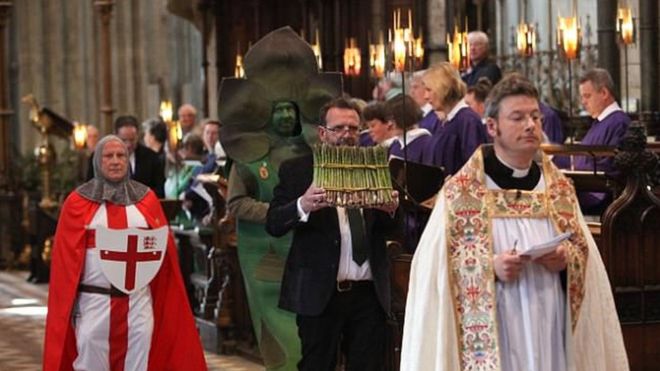
There’s a punchline here somewhere. Source.

Recently, a minor storm of controversy has erupted over an unusual proceeding at Worcester Cathedral. For those of us blissfully unaware of the agrarian culture of the British Isles, the local Asparagus Festival celebrating the fine crop of the Vale of Evesham just opened to considerable acclaim. While there are, admittedly, a few suspect elements of the Festival, it does seem to be rather harmless on the whole. The kind of thing that would make a nice weekend in the country.

The rustic peace of the celebration was soon shattered. As The Telegraph reports, organizers of the Festival asked the Dean of the Cathedral if they might have a blessing of the asparagus to kick off the harvest season. And so, at evensong on Sunday, the 23rd of April, in the Year of Our Lord Two Thousand and Seventeen, a block of the stuff was carried in a procession up the chancel alongside two costumèd festival mascots, St. George and Gus the Asparagus Man. While it was indeed St. George’s Day, we can only imagine that this is the first liturgical appearance of the humanoid Asparagacea. As we read in The Telegraph:

Angela Tidmarsh, co-founder of the festival and tourism officer for Wychavon, said the cathedral’s management had been “really enthusiastic” about the idea. “We had the asparagus blessed by the vicar of Bretforton and then we took it to the cathedral, so it’s twice-blessed asparagus,” she said. 

This really did happen in real life.

The reactions have been fairly predictable. Archbishop Cranmer has led the chorus of detractors, writing in an extremely English timbre,

Would the Church of England permit a man dressed up as a baked bean to process behind a Heinz tin of the things, and sanctify the mummery with a facade of thanksgiving? And why only adoration of asparagus? Where’s the sprout liturgy, or equality for mushrooms? Would the Dean really permit a walking fungus to participate in an act of divine worship?

In a note of (understandable) exasperation, he writes, “This is church, for God’s sake. Really, for His sake, can the Church of England not offer something clean and undefiled in the worship of God?”

While I would not normally wish to disagree with His Grace on issues of the liturgy (except, of course, when it comes to the validity of Anglican Orders), I must dissent from his wholesale condemnation of the procession. Yes, the costumes were silly in the extreme. Both St. George and Gus the Asparagus Man should have been excluded from any kind of religious ritual within the Cathedral. Insofar as His Grace and others assail the ceremony on those grounds, I agree.

Nevertheless, on principle, I think the blessing of the asparagusnay, even its double blessing!is a good thing. Along with Rod Dreher, I say, “Still, I am in my heart of hearts an Asparagus-Blesser; here I stand, I can do nothing other.”

There is good Biblical precedent for precisely this kind of rite. In the twenty sixth chapter of the Book of Deuteronomy, we read,

And when thou art come into the land which the Lord thy God will give thee to possess, and hast conquered it, and dwellest in it: Thou shalt take the first of all thy fruits, and put them in a basket, and shalt go to the place which the Lord thy God shall choose, that his name may be invocated there: And thou shalt go to the priest that shall be in those days, and say to him: I profess this day before the Lord thy God, that I am come into the land, for which he swore to our fathers, that he would give it us. And the priest taking the basket at thy hand, shall set it before the altar of the Lord thy God…And therefore now I offer the firstfruits of the land which the Lord hath given me. And thou shalt leave them in the sight of the Lord thy God, adoring the Lord thy God.

As a matter of Biblical principle, the good people of the Vale of Evesham ought to be allowed to bring their own first fruits to the Cathedral, the seat of their bishop, and receive the Lord’s blessing. Moreover, similar practices are not unknown in the Church Universal. Byzantine Catholics and Eastern Orthodox bring forth their first-fruits on Transfiguration Day to be blessed. Indeed, Orthodox priests have been caught blessing all manner of strange articles. And within Anglicanism, the Book of Common Prayer (1928) allows for the following pious sentence to be recited at the beginning of Morning Prayer on occasions of thanksgiving:

Honour the LORD with thy substance, and with the first-fruits of all thine increase: so shall thy barns be filled with plenty, and thy presses shall burst out with new wine. Prov. iii. 9,10.

It is unclear whether the same can be said of the Ordinariate, which inherited so much of the 1928 Prayer Book’s “patrimony.” Within the Roman Ritual, we find all kinds of blessings – including some for herbs and seeds, though these are tied to specific, Marian days in the Church kalendar. One could write an intriguing sophiological meditation on this liturgical feature – but I digress. I will merely say that, all in all, it makes perfect theological sense to offer the crop to God. The cosmic character of the liturgy, the way it gathers in all the world in the offertory, was an insight suggested by the C of E’s own Dom Gregory Dix and brought to fruition in the work of theologians like, inter alia, Alexander Schmemann, Joseph Ratzinger, and William T. Cavanaugh, though of course it is a much older idea. While this procession did not occur at the offertory of a Mass, its placement during evensong suggests the deeper implications of the Eucharistic liturgy.

There are, as I can tell, only a few concerns worth considering here:

1) Those ridiculous costumed figures in the procession – or even in the Cathedral to begin with. I wouldn’t want either at a liturgical function.

2) The blessing wasn’t tied to any liturgical date, such as the blessing of Roses on the Feast of St. Rita or the blessing of animals on the Feast of St. Anthony the Abbot.

3) It’s not clear that the blessing should have taken place at Choral Evensong, within the nave of the Cathedral, during a procession. Most of the similar traditions don’t seem to involve that kind of performative element within the temple.

Point 1 stands. The photo above speaks for itself.

AsparagusVicar

The least Gus the Asparagus Man could have done is make sure he was properly vested in cassock and surplice, which Rev. Gilbert has attempted with only partial success in this shot from “An Easter Carol.” Source.

However, I do think Points 2 and 3 can be open to discretion. Priests bless things all the time when they are asked, and while there are some regulations governing that act (such as those surrounding the imposition of the Brown Scapular), most priests bless freely and willingly. Nor am I convinced it’s a problem that the good folk of Worcestershire wanted to incorporate the Church into their festival. Indeed, they went so far as to have their prize vegetable blessed twice! After all, ought not the Church stand as an institution blessing the communal life of the people, correcting their morals, teaching them the Way of Life, and communicating sanctifying grace to them in the sacraments? While it is certainly an open question as to whether the Church of England does this effectively (or even has the power to do so), the principle remains one that the English have always cherished in their own, peculiar way. There is an earthiness to English communal spirituality. One cannot imagine the same scene happening in Ireland or France or even Spain (though possibly in Italy, as English Christianity since the 19th century has approximated Italian spirituality in various unexpected ways; as Dreher notes, the Church of Siena blesses the horses before the Palio, and within the temple!). I confess, my immediate reaction to the blessing of the asparagus was laughter. The whole thing struck me as, well, so very Chestertonian. G.K. even devoted a 1914 essay to the plant.

Of course, I ought to come clean about one of my own biases. Asparagus is my favorite vegetable. Steamed, grilled, or baked, I find it a surpassing delight. I suppose that the Good Lord, who so lovingly and approvingly gave it to us on the third day of creation, agrees with me. Whether He shares my amusement at the procession of the blessed asparagus is another matter, and one I don’t presume to find out any time soon.
ChestertonFat

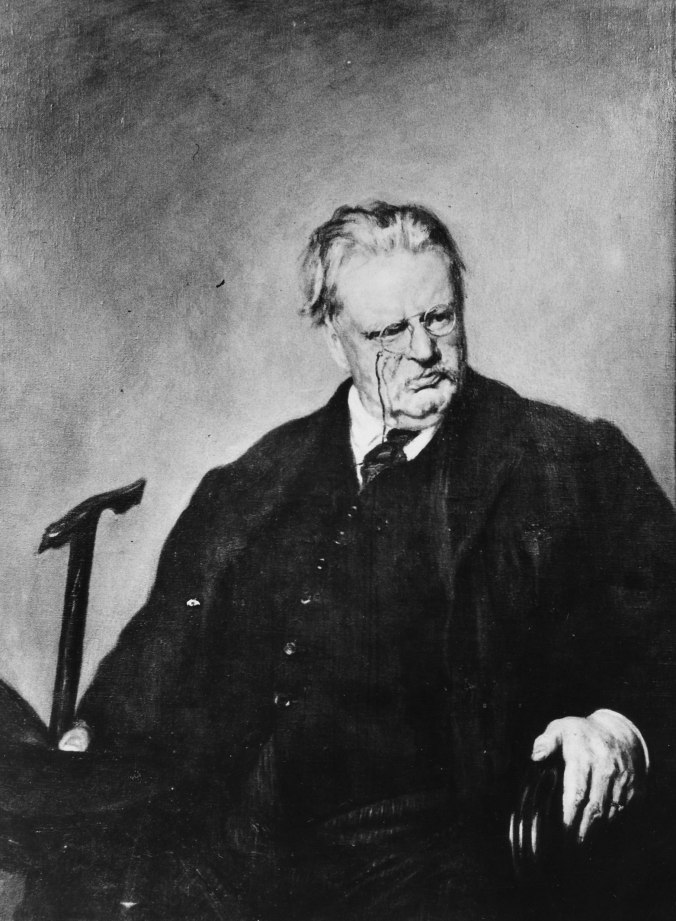
G.K. Chesterton: 100% would eat asparagus that has been blessed twice. Source.
A Poem for the First of May

OLWasinghamFlowers

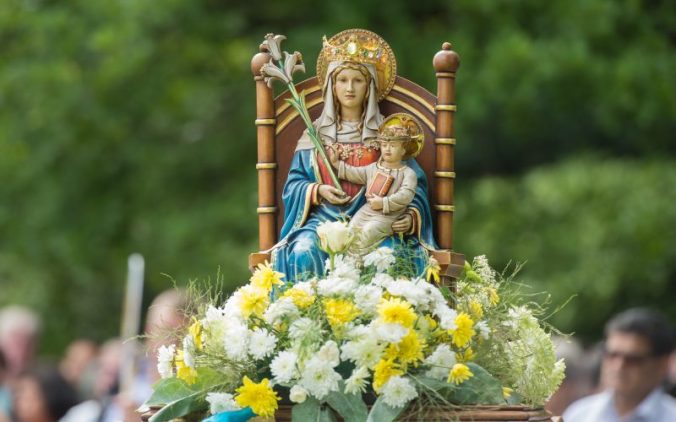
Our Lady of Walsingham, borne aloft by the faithful in a procession. Source.

May is Mary’s month, and I
Muse at that and wonder why:
Her feasts follow reason,
Dated due to season—

Candlemas, Lady Day;
But the Lady Month, May,
Why fasten that upon her,
With a feasting in her honour?

Is it only its being brighter
Than the most are must delight her?
Is it opportunest
And flowers finds soonest?

Ask of her, the mighty mother:
Her reply puts this other
Question: What is Spring?—
Growth in every thing—

Flesh and fleece, fur and feather,
Grass and greenworld all together;
Star-eyed strawberry-breasted
Throstle above her nested

Cluster of bugle blue eggs thin
Forms and warms the life within;
And bird and blossom swell
In sod or sheath or shell.

All things rising, all things sizing
Mary sees, sympathising
With that world of good,
Nature’s motherhood.

Their magnifying of each its kind
With delight calls to mind
How she did in her stored
Magnify the Lord.

Well but there was more than this:
Spring’s universal bliss
Much, had much to say
To offering Mary May.

When drop-of-blood-and-foam-dapple
Bloom lights the orchard-apple
And thicket and thorp are merry
With silver-surfed cherry

And azuring-over greybell makes
Wood banks and brakes wash wet like lakes
And magic cuckoocall
Caps, clears, and clinches all—

This ecstasy all through mothering earth
Tells Mary her mirth till Christ’s birth
To remember and exultation
In God who was her salvation.

– “May Magnificat,” by Gerard Manley Hopkins, SJ

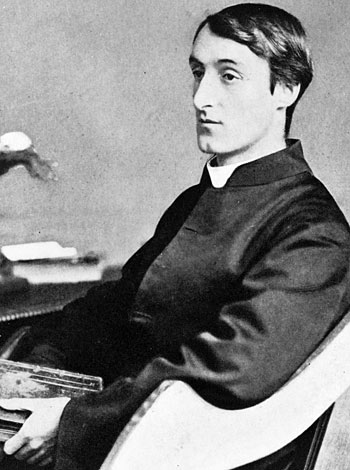
GerardManleyHopkins2

Gerard Manley Hopkins, SJ. Source


A Poem for Good Friday

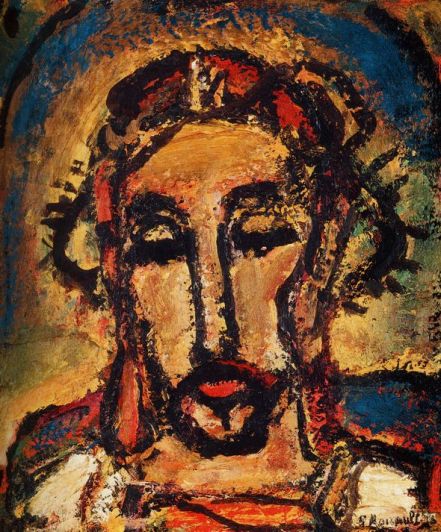
GeorgesRouaultEcceHomo

“Ecce Homo,” Georges Rouault. Vatican Museum. Rouault is an artist totally captivated by the beauty of the Holy Face.

Good Friday, 1613. Riding Westward
Let mans Soule be a Spheare, and then, in this,
The intelligence that moves, devotion is,
And as the other Spheares, by being growne
Subject to forraigne motion, lose their owne,
And being by others hurried every day,
Scarce in a yeare their naturall forme obey:
Pleasure or businesse, so, our Soules admit
For their first mover, and are whirld by it.
Hence is’t, that I am carryed towards the West
This day, when my Soules forme bends toward the East.
There I should see a Sunne, by rising set,
And by that setting endlesse day beget;
But that Christ on this Crosse, did rise and fall,
Sinne had eternally benighted all.
Yet dare I’almost be glad, I do not see
That spectacle of too much weight for mee.
Who sees Gods face, that is selfe life, must dye;
What a death were it then to see God dye?
It made his owne Lieutenant Nature shrinke,
It made his footstoole crack, and the Sunne winke.
Could I behold those hands which span the Poles,
And tune all spheares at once peirc’d with those holes?
Could I behold that endlesse height which is
Zenith to us, and our Antipodes,
Humbled below us? or that blood which is
The seat of all our Soules, if not of his,
Made durt of dust, or that flesh which was worne
By God, for his apparell, rag’d, and torne?
If on these things I durst not looke, durst I
Upon his miserable mother cast mine eye,
Who was Gods partner here, and furnish’d thus
Halfe of that Sacrifice, which ransom’d us?
Though these things, as I ride, be from mine eye,
They’are present yet unto my memory,
For that looks towards them; and thou look’st towards mee,
O Saviour, as thou hang’st upon the tree;
I turne my backe to thee, but to receive
Corrections, till thy mercies bid thee leave.
O thinke mee worth thine anger, punish mee,
Burne off my rusts, and my deformity,
Restore thine Image, so much, by thy grace,
That thou may’st know mee, and I’ll turne my face.

Source

Eulogy For My Grandmother

SunsetApril122017

Sunset on the day of the funeral – 12 April, 2017

This was the eulogy I delivered at the funeral of Arline Grace Bence (29 Oct. 1929 – 5 Apr. 2017), my beloved Grandmother. The Requiem Mass was celebrated by the Rev. Fr. Gregory Wilson of St. Mary, Help of Christians, Aiken, SC. I also sang the Salve Regina during the Offertory. I’d like to thank everyone who has been so kind to express their concern and commiseration during this difficult time. I decided to put this rather personal document on my blog for those family and friends who could not attend the funeral, as well as to honor my grandmother’s memory.

I confess, when I learned last Wednesday that my Grandma Arline had finally passed away, I did not immediately feel the sorrow or grief I was expecting. Instead, I felt a twofold relief. First, I was relieved that after years of battling dementia and various other painful disorders, my grandmother was finally at peace. And secondly, I was glad that, having been consoled and fortified by the last rites of the Church, she would soon plunge through the cleansing fires of Purgatory and arrive safely in, as our Psalm today so beautifully puts it, “the land of the living” (Psalm 27:13).

And when the sadness came, it was mingled with tremendous gratitude. For when I remember my grandmotherwhen I see her coffin hereI am reminded of a woman who was one of the greatest blessings in my life. Few people more profoundly molded my character and dispositions. I’m sure that so many of us here can say much the same.

Arline Grace Bence, born the day the stock market crashed, a proud New Yorker and Italian to the end, was known to all as a simple and generous soul. In my own life, she expressed these virtues in different ways. She gave unstintingly of her time. For many years, we would both look forward to Friday nights. After the school week had concluded, I would mount the short staircase to her apartment above our garage, and the two of us would share a meal together. This was a precious time for both of us – if only there were more such time now! But in the years we passed in each other’s company, my Grandmother also fed my desire for learning. We spent many a weekend or summer’s day going out to lunchusually pizzafollowed by an outing to Barnes and Noble. She would let me roam the stacks for what seemed like hours, never complaining as she sat and read a magazine or two.

But this pattern of happy memories fails to capture the most important gift she gave me – the gift of faith. My grandmother was the first person to take me to Mass. She was the first person to buy me a book of saints. She was the first person to teach me the blessed words of the Ave Maria. And when I began my conversion in the last years of high school, she was the first to accompany me to weekly services. Although we were no longer spending Friday nights together, we both started to look forward to Sunday mornings instead. And we found a new closeness in doing so.

These giftsher steadfast love, the time we shared, the faith that sustained us in different ways – these happy memories are what will bring me something of her presence in her absence.

For now, she is gone. Thoughperhaps not in all ways.

The faithful departed are not really gone. They are, instead, much closer to us than they ever were before, for they have loosed the petty chains of time and space. In God, they are near to us – nearer than we can imagine. All those who have died in Christ and gone before us are waiting to help us as we, too, seek Heaven. And I can say with confidence that Arline Bence, our dear grandmother, aunt, cousin, in-law, friend, and mother, will very soon be interceding for us. Let us intercede for her now.

Everyone here loved her so very much. Perhaps even in ways that you could never quite express. I believe that I speak for us all when I say that my grandmother loved us deeply, if imperfectly. In this, she always proved her essential humanity. But now, as she enters her eternal life, she can love us all more perfectly, at last.

Eternal rest grant unto her, O Lord, and let perpetual light shine upon her. May she rest in peace.

Amen.

GrandmaWedding

My grandmother’s wedding. She was a beautiful woman in her youth.

GrandmaBaby

My grandmother and me, 1995. We both lived in Florida then.

GrandmaCooking

Cooking with Grandma, c. 1998. Georgia.

Screen Shot 2017-04-13 at 11.20.16 PM

Grandma with Eeyore, Disney World, 1997.

GrandmaPluto

Grandma with Pluto, Disney World, 1997.

GrandmaBirthdayCake

Grandma and me eating birthday cake. I don’t know if it’s my birthday or hers, but I’m sure the cake was satisfactory. c. 1998. Georgia.

GrandmaPool

My grandmother on a trip to Florida. c. 2000.

GrandmaMomFlorida

My mother and grandmother together in Florida, c. 2000.

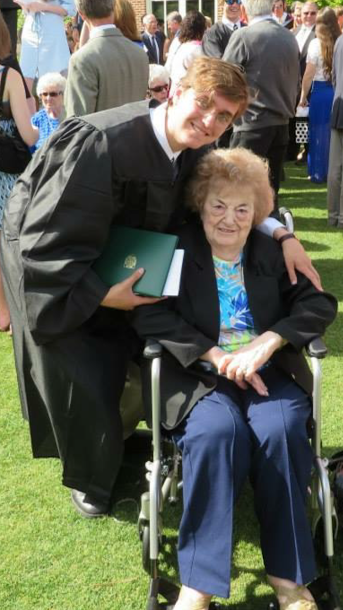
GrandmaGraduation

Grandma and me at my high school graduation, May 2013. Peachtree Corners, Georgia.


Four Years a Catholic

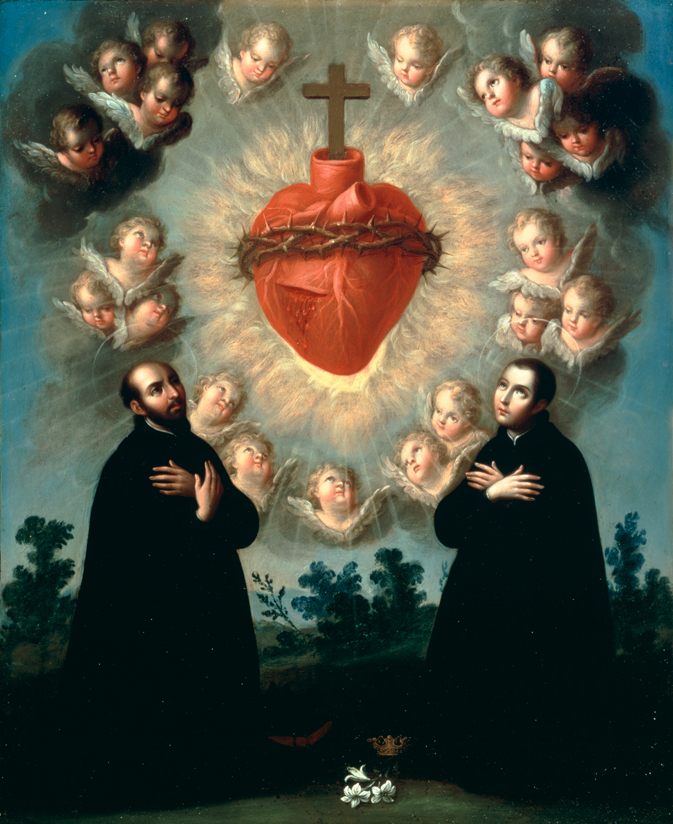
Sacred_Heart_1770

Sacred Heart of Jesus with Saint Ignatius of Loyola and Saint Louis Gonzaga, by Jose de Paez, Mexico, c. 1770

Four years ago today, I was received into the Roman Catholic Church. It’s been quite a journey since. I have often stumbled, often tarried, often limped along the way. My early zeal has often shattered under the pressure of my own bad habits and the various little demons of life. My idealism has been shaken by failures – my own and those of others. My faith has been sorely tested by this pontificate.

But I would never go back. There have been so many blessings and graces given to me over the course of my sacramental life that to abandon ship would be nothing less than the crassest betrayal. I have grown in spite of myself. I must express my gratitude to all those friends, in Heaven and earth, who have helped me along the way. Through the caked and crusted carapace of sin, I can still feel the heart of my faith beating strong. I have hope.

And it is with that hope that I entrust the next year of my life as a Catholic to the most Sacred Heart of Jesus. I had earlier given my second year to Our Lady, the third year to the Holy Spirit, and the fourth to the Holy Name. Now, I think it best to give over all that I may encounter, all that I may do, and all that I may suffer to the Heart which bleeds for me. In doing this, I hope to draw nearer to the God who abides temporally in the Tabernacles of the world and eternally in the Tabernacle of unapproachable light.

Lord, have mercy.
Christ, have mercy.
Lord, have mercy.

Most Sacred Heart of Jesus, Furnace of Charity, Tabernacle of the Most High, Desire of the Everlasting Hills, pray for me.

Gloria Patri, et Filio, et Spiritui Sancto, sicut erat in principio, et nunc, et semper, et in saecula saeculorum.

Amen.

Some Occasional Thoughts on the Holy Minimalists and the Light of Tabor

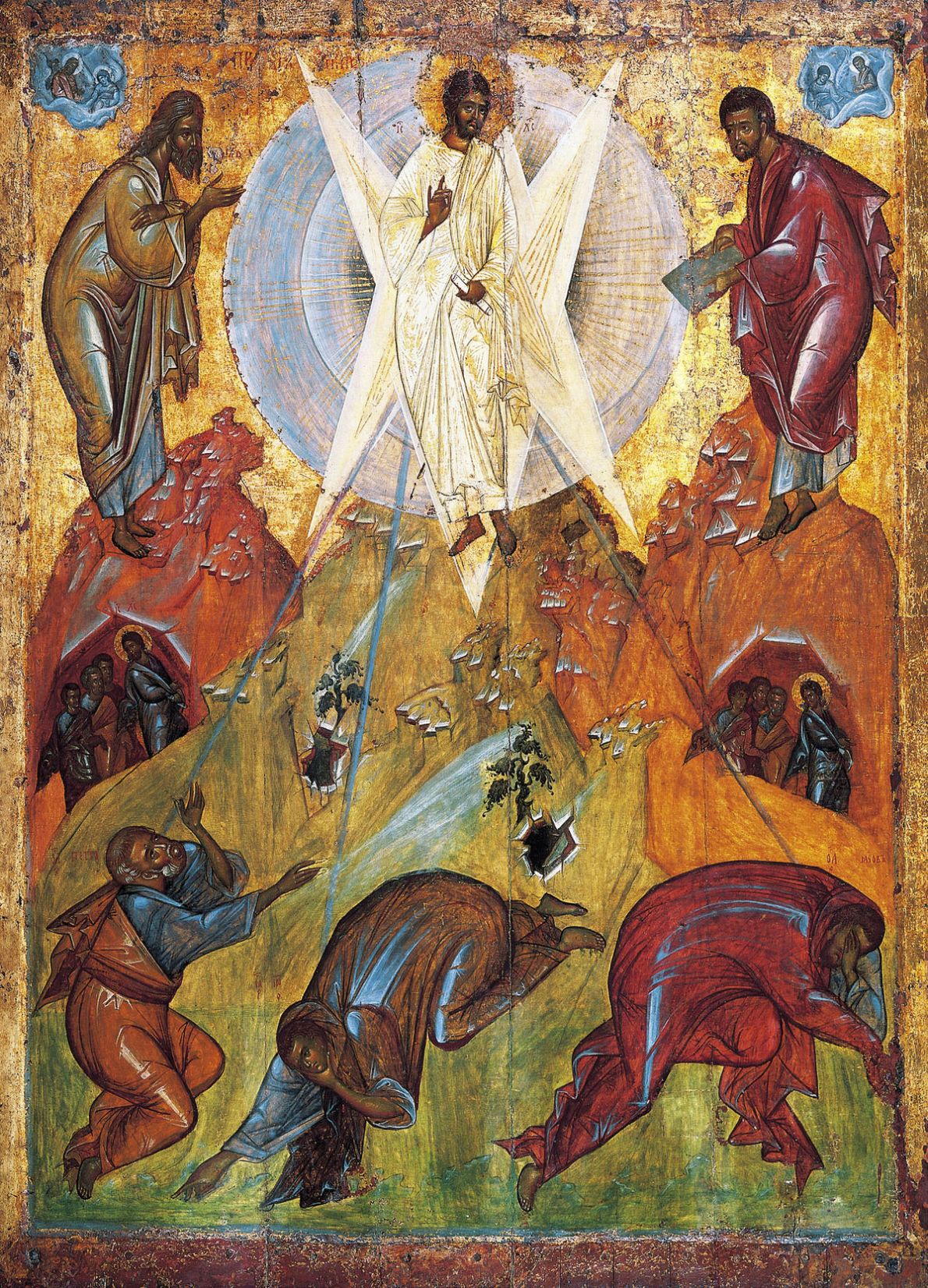
IconTransfigurationFeofanGrek

Icon of the Transfiguration, by the hand of the great 15th century iconographer of Moscow, Theophanes the Greek.

Jesus took Peter, James, and John his brother, and led them up a high mountain by themselves. And he was transfigured before them; his face shone like the sun and his clothes became white as light. And behold, Moses and Elijah appeared to them, conversing with him. Then Peter said to Jesus in reply, “Lord, it is good that we are here. If you wish, I will make three tents here, one for you, one for Moses, and one for Elijah.” While he was still speaking, behold, a bright cloud cast a shadow over them, then from the cloud came a voice that said, “This is my beloved Son, with whom I am well pleased; listen to him.” When the disciples heard this, they fell prostrate and were very much afraid. But Jesus came and touched them, saying, “Rise, and do not be afraid.” And when the disciples raised their eyes, they saw no one else but Jesus alone.

As they were coming down from the mountain, Jesus charged them,”Do not tell the vision to anyone until the Son of Man has been raised from the dead.”

These words from St. Matthew were the Gospel reading at Mass last night. Yesterday was the second weekend of Lent, and the Church directs our eyes, alongside those of the holy apostles, to the face of Our Lord in His Transfiguration. And in the Eastern Churches, today is St. Gregory Palamas Sunday. Palamas is most famous for his articulation of the Essence-Energies distinction as part of a broader polemic against the Byzantine Scholastic attacks on Hesychasm carried out by Barlaam of Seminara. One of Palamas’ key Scriptural examples of God’s energies is the “uncreated light” of Christ’s glory in the Transfiguration. St. Gregory is celebrated to this day by the Eastern Orthodox and by Eastern Catholics on their Lenten calendars; yet in the post-Scholastic West, he still holds no place on the calendar. I must wonder whether or not the readings for the Second Sunday of Lent were chosen at the revision of the Lectionary in part as an ecumenical gesture to the Orthodox, though my knowledge of 20th century liturgical innovations is shallow at best. Regardless, those who, to adapt a phrase of Pope St. John Paul II, “breathe with both lungs” of the Church can recognize the Providential coincidence of these two celebrations.

The Light of Tabor is, in a Palamite reading, the eternal Glory of God made manifest in, with, and through Christ’s created humanity. The Transfiguration is therefore an archetypal moment for every mysticnot just the Hesychasts whom St. Gregory was defending. In view of all this, while I listened to the priest reading the Gospel this evening, a song came to mind: “My Heart’s in the Highlands,” by Arvo Pärt. The lyrics are taken from a poem by Robert Burns. Here’s the chorus:

My heart’s in the Highlands, my heart is not here,
My heart’s in the Highlands, a-chasing the deer;
Chasing the wild-deer, and following the roe,
My heart’s in the Highlands, wherever I go.

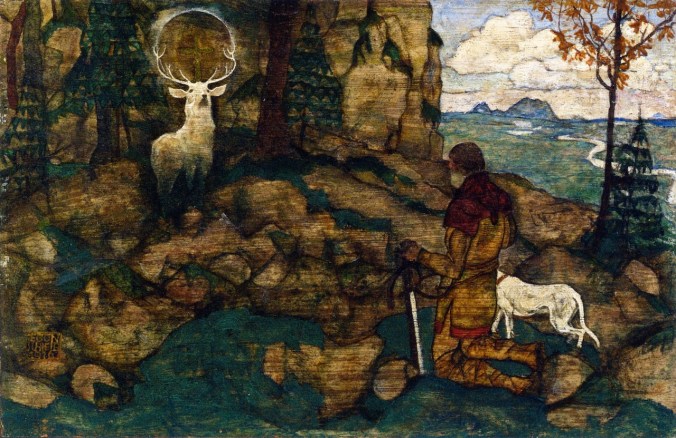
A few weeks ago, when I first listened to the song, it immediately struck me as a potent metaphor for the contemplative life. Is not the contemplative’s heart set in the “high lands” of the spirit, like St. John of the Cross’s Mount Carmel? And has the Divine not been associated with wild deer throughout history, from the panting hart of Psalm 42 to the vision of St. Hubert to the White Stag of Narnia? The Apostles, like the mystics, like the chanting voice in Pärt’s song, are “led…up a high mountain by themselves.” There, they find Christ’s true glory, the energy of His divinity totally interpenetrating all they can perceive of him. The created rises into the divine, and the uncreated bends towards the creaturely; the two meet in the transfigured Christ. The dual presence of the heavenly Elijah and the Sheol-bound Moses demonstrates the moment of radiant communion between God and His creation, manifested perfectly in Christ, the Word made flesh.

Pärt’s song describes the experience of the mystic, not because Burns’ words actually refer to contemplation, but because of the way he takes up the verse and stretches it against an agonizingly poignant organ composition. He sets secular words to sacred music. Thus he accomplishes in miniature the assumption of the creaturely by the divine that comes before our vision in the Transfiguration. Art at its finest is called to participate in this lesser Transfiguration, and Pärt is a consummate master of what Tolkien might call “sub-creation.”

But Pärt is not alone in this; one of his colleagues, John Tavener, arguably a finer and more mystically-oriented composer, also transfigured profane writings into sacred pieces of music. I can think of no better example of this than his brief and delightful motet, “The Lamb.” Tavener took the lyrics from William Blake’s poem of the same name. In full, it reads:

Little lamb, who made thee
 Dost thou know who made thee,
Gave thee life, and bid thee feed
By the stream and o’er the mead;
Gave thee clothing of delight,
Softest clothing, woolly, bright;
Gave thee such a tender voice,
Making all the vales rejoice?
 Little lamb, who made thee?
 Dost thou know who made thee?

 Little lamb, I’ll tell thee;
 Little lamb, I’ll tell thee:
He is callèd by thy name,
For He calls Himself a Lamb.
He is meek, and He is mild,
He became a little child.
I a child, and thou a lamb,
We are callèd by His name.
 Little lamb, God bless thee!
 Little lamb, God bless thee!

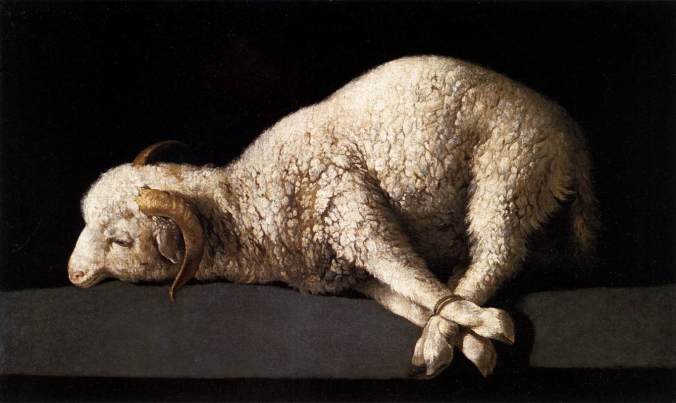
Here too, we might glimpse the transfigured Lamb of God between the lines of Blake’s verse. The lamb’s “clothing of delight/Softest clothing, woolly, bright” seems to echo the robe rendered “white as light” on Mt. Tabor. Blake speaks of “the vales” when Scripture instead would bring us up to the peaks. And the question that ends the first verse is fundamentally the same as that which must have run through the minds of the bewildered apostles; who is this man? The answer, of course, comes from the voice in the cloud: “This is my beloved Son, with whom I am well pleased; listen to him.” And Tavener’s eerily beautiful choral setting imbues the lyrics with a dimension hitherto unimagined. Many of his works remind one of candlelight on ritual gold, or the smell of incense flying forth with the rhythm of thurible bells, or the echo that thins out asymptotically under the glittering mosaic of a high dome. “The Lamb” is all of this, presented compactly. It stands as one of his finest works, and one of his most spiritually rich.

I recently wrote about the Holy Minimalists in a piece on the music of The Young Pope. They’ve been on my mind. But I didn’t connect their artistic project to the Transfiguration until tonight. We Christians are to become “little Christs,” imitating Jesus in all things by adoption and deification. Sometimes, that takes the form of contemplation. The apostles model that path for us in their behavior on Mt. Tabor. But at other times, and in other ways, we are called to live the life of Christ more directly. The Transfiguration provides a mystical glimpse of what happensand indeed, what will happenwhen the uncreated Light of God assumes, permeates, and glorifies the creation. Of course, the energies of God are not found in the artifices of men; but artists can practice their own, creaturely form of transfiguration. The pieces of music I have discussed are shot through with an awareness of the divine presence, and the words that began as profane poetry become something altogether different, something sacred, something nearly liturgical.

At the beginning of Lent, T.S. Eliot tells us to “Redeem/The time.” On this, the Second Sunday of the penitential season, Christ reveals in Himself how we might do soa transfiguration that Arvo Pärt and John Tavener have achieved, in some small way, through their own creative work.


A Theological Primer on Emblems

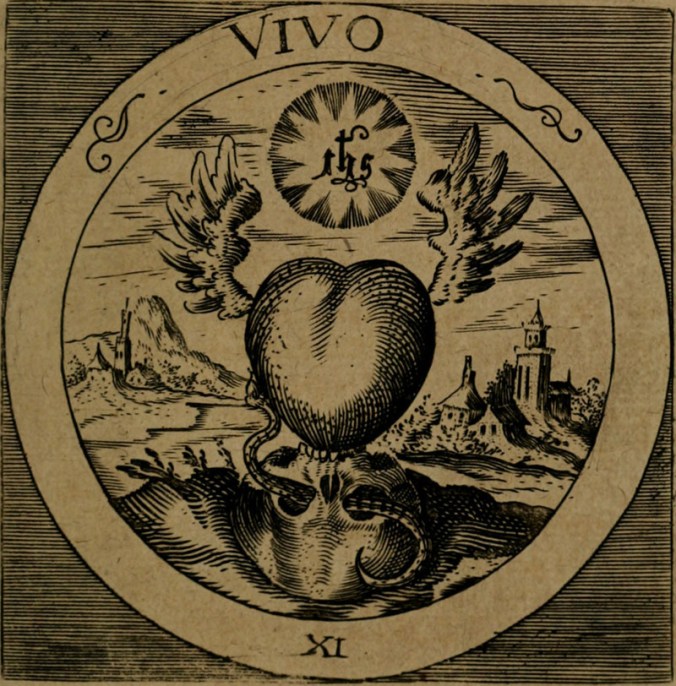
emblematasacravivo

“I Live,” from the Emblemata Sacra (1618)

Of all the myriad forms of visual theology that draw upon the Western traditions of art history, perhaps no medium is quite as neglected as the emblem. The books that contained these small, symbolically rich images constituted a prolific genre in the early modern period. They had a fairly standard format. Usually, the emblems sat alongside a few moral or sacred verses in Latin, Greek, or a European language. Daniel Cramer’s Emblemata Sacra (1618), from which the image above was taken, is a good example of this polyglot tendency. On the verso, one can find a quatrain in Latin, German, French, and Italian, always connecting the symbolism of the emblem with a French and Italian verse of the Scriptures. On the recto, the emblem sits under the same verse, this time in Latin and German. The page concludes with an epigrammatic prayer in Latin.

It seems that emblem books were popular in early modern Europe. Mara R. Wade of the University of Illinois Urbana-Champaign writes, “In the preface to his Companion to Emblem Studies (2006) Peter Daly estimates that ca. 6,500 emblem books were published during the Renaissance, with an individual volume containing anywhere from 15 to 1,500 emblems.” Wikipedia lists no fewer than 54 representative titles, though there were certainly many more produced between 1500 and 1800 (as any cursory review of UIUC’s  Emblematica Online or the French Emblems at Glasgow archives can show). The fact that these books were often printed with multiple languages of text side by side suggests that they were documents with cross-cultural appeal. They were meant to speak not only to the elites who knew Latin, but also to the literate bourgeoisie. All of that makes their emergence as a genre at a time of religious strife even more remarkable.

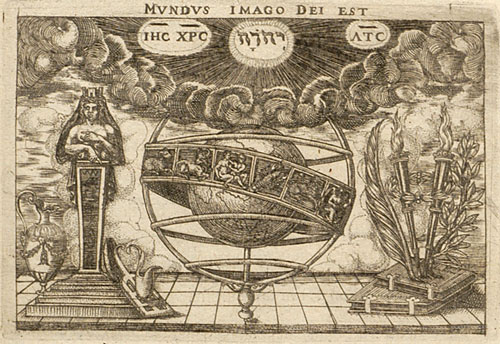
LeMondeLImagedeDieu

“Le Monde est L’Image de Dieu,” one of the more explicit expressions of esoteric philosophy, in Boissard’s Emblemes latins […] avec l’interpretation Francoise (1588). It anticipates Boehme’s De Signatura Rerum by nearly 40 years.

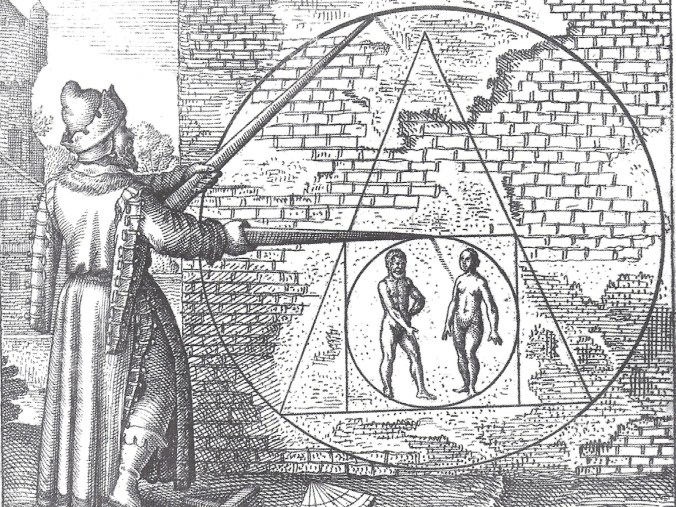
Of course, not all emblem books were targeted for mass appeal. Occult works often made rich use of emblems. The chief virtue of the emblem is its capacity of succinct complexity. It can communicate a lot by saying very little. It obscures by revealing; it hides by manifestation. As one source puts it, “Emblems are concise yet potent combinations of texts and images that invite, and require, decoding.” This makes the emblem the perfect vehicle for the esoteric proliferation of ideas. “He who has ears to hear, let him hear,” says the Lord. If He had come in the age of Gutenberg, perhaps He would have delivered His parables in emblem books. Of course, to say so is to implicitly claim Christ as a Protestant. Catholics did produce emblem books; indeed, one of the latest examples I have found is the 1780 French reprint of Dom Bonifaz Gallner’s earlier Regula Emblematica Sancti Benedicti. However, it would seem that the majority of important emblem books flowed from Protestant presses.

Michael-Maïer-Atalanta-Fugiens-1618-Emblème-XXI1-e1435998180296

Emblem XXI from the alchemical text Atalanta Fugiens (1617), by the Lutheran Rosicrucian Michael Maier

There is a good historical and aesthetic reason for this. The emblem functions by setting up a symbol or a system of symbols independent of any text. While text was sometimes used to elucidate the meaning of those symbolic networks, it was always secondary to the image itself. The emblem book is one of the last gasps of the primacy of image over text in European thought. Along with the Wunderzeichenbuchen, the emblem book is one of the main genres mobilized by Continental Protestants to rediscover a non-iconographic (and, to their mind, a non-idolatrous) use of image in moral and spiritual development. Instead of an image asserting its “auratic” power to the exclusion of text, the emblem book suggests a way that text and image can mutually illuminate each other. As Mara Wade writes, the emblem books engendered “a process of reciprocal reading of texts and images, whereby the back and forth between the words and the pictures creates meaning. The picture presents the reader with a recognizable scene or symbolic collage, and the text then reorients the reader’s understanding of that scene to present a new and unexpected message.” In this sense, the emblem book clearly partakes of a distinctly Humanist and Protestant heritage. Note again that emblem books were very often the chosen medium for the quasi-scientific magical teachings of the Rosicrucians and alchemists. Those strange laborers were also, in their own quixotic way, seeking to reclaim something of the sacramental worldview thrown away by the iconoclastic Reformers (see Henry 2015).

The triumph of discursive reason over image in the Enlightenment led to the decline of the emblem book as a genre (there are surely other reasons tied to shifting book markets, but my capacities to do research into textual history are limited at this time). After that, the record has been rather sparse. Hamann occasionally used emblems in his philosophical works. More recent theologians have largely overlooked the emblem book as a theological genre. The single counterexample I can readily think of is Valentin Tomberg’s Meditations on the Tarot, which can only count as an emblem book when we ignore its departures from the traditional form. Yet the renewal of esoteric Catholicism by reliably orthodox publishing houses like Angelico Press suggests that the emblem book may have a place in the theology of the future.

Its revival seems particularly apropos in an age when memes have become topics of serious political discourse, when visual self-representation has been amplified through various social media, and when new norms of communication emphasize brevity over detail. An epoch is defined, in large part, by the relation of its people to their media. The development of the printing press launched early modernity by helping to bring about new conceptions of subjectivity, as well as new questions about the relationship of text and image. Consequently, the emblem book arose to grapple with some of those questions. The next great civilizational step in communication arrived with the internet, accompanying nascent postmodernity. Perhaps we shall see a revival of the emblem book for theologians to navigate this “brave new world.”

“Although I Do Not Hope to Turn Again” : Two Poets for Ash Wednesday

t-s-_elliot_ash_wednesday_cover

T.S. Eliot’s “Ash Wednesday,” first edition cover. Source: Wikimedia.

Today is Ash Wednesday, and once again my thoughts turn to T.S. Eliot. Later, I will listen, as I used to do after all my confessions, to the Pope of Russell Square intone “Ash Wednesday” (1930) in a vatic voice. Like Eliot, I am a convert. And for all converts, Ash Wednesday offers a reminder of the life we have left behind. Converts feel, perhaps more powerfully than those raised in the faith, the strange liminal state of the Christian life. We are dead to sin, but not yet fully alive. The ashes imposed on our foreheads are merely the outward sign of an ever-fragile conversion. Ash Wednesday is the reminder of our weakness, of our constant need for mercy, of the vast landscapes of heaven and hell that open for us beyond the febrile veil of our brief hours on earth. On Ash Wednesday, we remember our death. Reversing all natural order, the penitential season begins with death and ends with the triumph of life. Let it never be said that the liturgical calendar lacks paradox. “Although I do not hope to turn again,” the liturgy leads me to do so.

As much as I love Eliot’s work, I don’t think his fine poem is the only one worth reading today. I might also consider the work of another great Anglican writer, George Herbert.


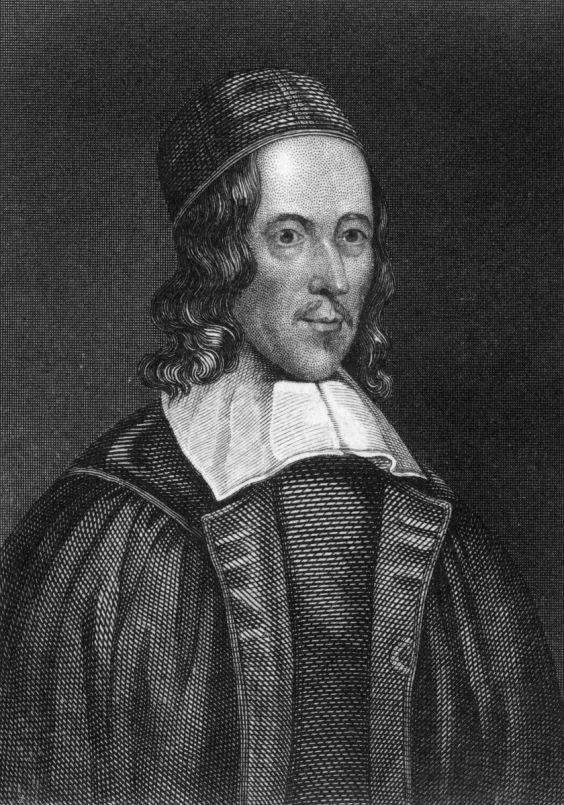
georgeherbert

George Herbert (1593-1633). Source: New Statesman

In The Temple (1633), Herbert devotes one of his poems to Ash Wednesday. He writes, in a detached style that marks him as perhaps the preeminent pastor-poet of Anglicanism:

Welcome deare feast of Lent: who loves not thee,

He loves not Temperance, or Authoritie,

But is compos’d of passion.

The Scriptures bid us fast; the Church sayes, now:

Give to thy Mother, what thou wouldst allow

To ev’ry Corporation.

Herbert, like Eliot so many centuries later, is a writer of deeply ecclesial sensibilities. His poetic is shaped by the language of the Prayer Book and the Bible, at once homely and  hieratic. Yet his moral vision clearly grows from his practical experience as a vicar. One could be forgiven for mistaking the poem for a sermon in verse.

True Christians should be glad of an occasion

To use their temperance, seeking no evasion,

When good is seasonable;

Unlesse Authoritie, which should increase

The obligation in us, make it lesse,

And Power it self disable.

Besides the cleannesse of sweet abstinence,

Quick thoughts and motions at a small expense,

A face not fearing light:

Whereas in fulnesse there are sluttish fumes,

Sowre exhalations, and dishonest rheumes,

Revenging the delight.

Throughout, he tempers his characteristic calls for conversion with a profound humility before the perfection of Christ. To conclude:

Who goeth in the way which Christ hath gone,

Is much more sure to meet with him, than one

That travelleth by-ways:

Perhaps my God, though he be far before,

May turn, and take me by the hand, and more

May strengthen my decays.

Yet Lord instruct us to improve our fast

By starving sin and taking such repast

As may our faults control:

That ev’ry man may revel at his door,

Not in his parlor; banqueting the poor,

And among those his soul.

Elsewhere: Daniel Mitsui’s New Blog

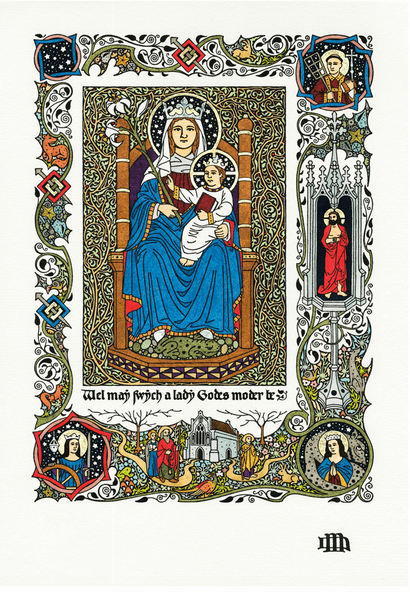
screen-shot-2017-02-28-at-8-20-29-pm

“Our Lady of Walsingham,” by Daniel Mitsui. Available at http://www.danielmitsui.com

Exciting news for anyone who follows the Catholic art world. Daniel Mitsui, the artist famous for his intricate, lively drawings of Christ and the Saints, has just announced that he has a new blog. The new site promises to be aesthetically and spiritually enriching. Check out his new, great project, the Summula Pictoria. I look forward to seeing what Mr. Mitsui will produce for us in the future.

And his new piece depicting St. Philip Neri is lovely, as always.