On Sexuality, Christianity, and Language

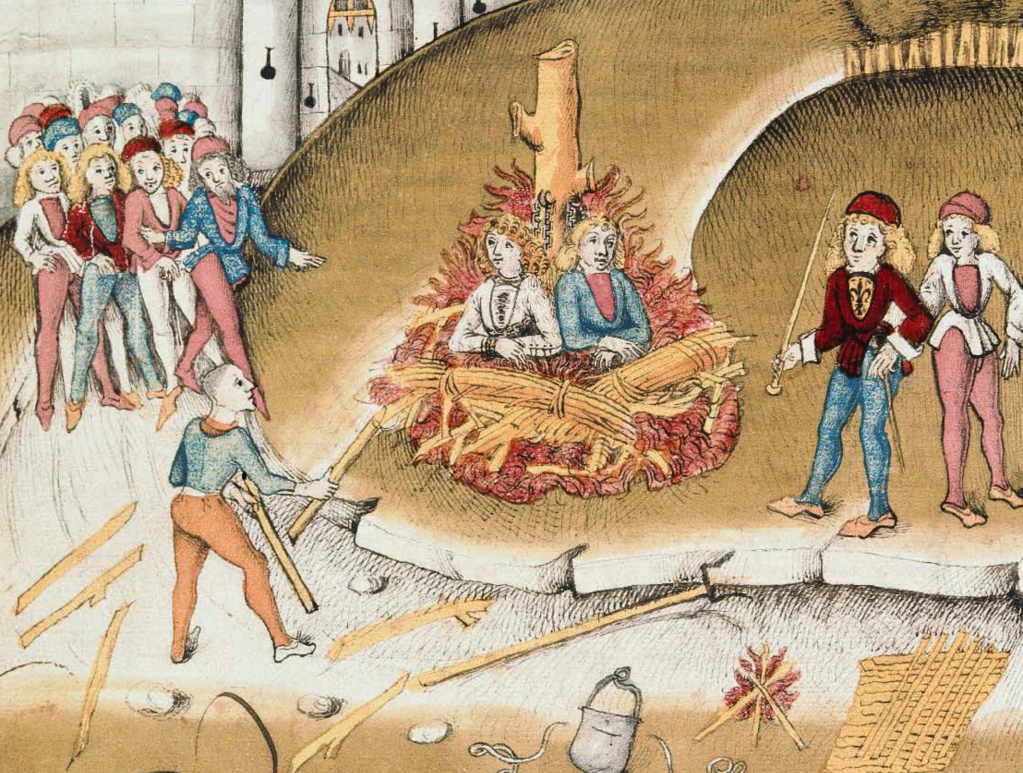
The knight Richard Puller von Hohenburg and his servant, burned before the walls of Zürich for sodomy, 1482. (Source)

The recent controversy in ACNA about the language of homosexuality has been deeply unedifying. It has been aggravated in the last few days by an open, co-signed letter that, while doing the bare minimum, nevertheless was far more affirming than the original pastoral statement to which it replied. In a move I can only describe as scandalous, the principal author’s bishop then stepped in and ordered him to take it down.

I am for the most part uninterested in the internal politics of ACNA. I have friends in that communion, and after all, it is neither my circus nor my monkeys. I am, however, keenly interested in the issue at stake: what kinds of language sexual-minority Christians use, why, and what this says about their broader place within Christianity. Especially as some of these same issues have come up repeatedly in the Catholic context as well. That relevance to my own situation moves me to write, when I might otherwise keep silence.

When the original statement came out last month (no pun intended), a gay Christian friend of mine wrote, “I am starting to think that this tired conversation about sexual identity language is actually *designed* to keep the Church from caring for sexual minorities by addressing its pervasive homophobia.” Much of what follows therefore comes from what I wrote in reply, with a few edits and additions here and there.

It seems to me that this debate about language – the alleged moral valences of words like “homosexual” or “gay,” and whether or not it is appropriate for Christians to self-identify with these words – serves a multipronged function:

(1) It distracts from urgent issues, like sexual minorities being disproportionately subject to homelessness, political oppression, intimidation, healthcare discrimination, targeted murder, and suicide.

(2) It subsequently distracts from the historical and ongoing complicity of heterosexual Christians in these phenomena, and absolves them of any effort to help fix it.

(3) It puts the entire onus of subjectivity-formation on the gay Christian individual and thus places them in a defensive posture which prevents them from making further demands. It does this in three ways:

(4) It deprives them of a language in which to articulate their own subjectivity and needs.

(5) It isolates them by preventing them from using the language by which they can form bonds of solidarity with other sexual minorities.

(6) It further isolates them by cutting them off from the history of other sexual minorities, whatever terms they may have used (sodomites, inverts, homosexuals, fairies, queers, gays, LGBT, etc.).

(7) All of which is to say, the debate mainly functions to control sexual minority Christians by making their own experience more and more illegible to them.

(8) It works very well because it exhausts a lot of emotional energy from LGBTQ+ Christians. This is intrinsic to the debate’s function as a mechanism of control.

(9) It is doubly effective when, as in the ACNA document, it reverts to the most clinical and pathologized language imaginable. “Christians afflicted with” or “who struggle with same-sex attraction” is not only unwieldy, it’s obviously stigmatizing. SSA might as well be leprosy.

(10 This is not to say that gay Christians who feel that the language of “same-sex attraction” or SSA best expresses their experience shouldn’t use it. We should all use the language that best fits our own embodied story. But when straight Christians use it this way, they are robbing them of the freedom to make that decision for themselves.

(11) In the Roman Catholic Church, there is the added rigmarole around vocations. No man with “deep-seated homosexual tendencies” can be ordained…but what does this mean? If you have sex with men (or at least want to) but don’t call yourself gay, do you have these tendencies? What are we to make of the considerable number of gay priests that are already ordained? It hides hypocrisy.

(12) I am reminded, for instance, of what Roy Cohn says in Angels in America.

(13) The most insidious thing about the ACNA statement, though, isn’t even the matter of terminology. It’s the deeper point from which the terminological discussion grew: a claim that homosexuals can become straight again.

(14) If this were coming from an old-school queer theorist or even second-wave feminist who insisted on the radical flexibility of gender and sexuality, I wouldn’t have too much of an issue. But the obvious problem here is the latent moral imperative that moves from is to ought (also the erasure of bisexuals, but that’s a bit of a tangent).

(15) Going from “some people can move between kinds of attraction” to “you must become attracted to the opposite sex,” as this document does implicitly, is an awful lapse into conversion-therapy thinking. And we know how harmful this is, especially to queer youth.

(16) But this pathologization is itself, once again, a mechanism of control. Religions are social bodies that require adherents in order to survive. And like it or not, gays have historically been a major part of the Christian fold – including in Anglicanism!

(17) The reasoning advanced by ACNA is thus, quite precisely, an ideology. It is a logic that helps the oppressed buy into their own oppression. They are hardly unique in this; many in our own Church of Rome offer the same false narrative for the same ends.

(18) I would like to end this thread on a hopeful note, though I have very little hope to speak of. The best I can say is that LGBT Christians need to make their own communities. We need to use the terms that best express our own subjectivity. This is quite apart from the issue of sexual ethics, which does not hinge on what we call ourselves.

(19) Straight Christians, including Catholics, should accept that we are going to use the terms that we choose. It is not up to them. Their time would be better spent helping on the very urgent issues I outlined earlier. And maybe trying to understand what it’s like for (Christian) sexual minorities in the Church and in society at large.

(20) Finally – the best thing to help on the issues of terminology is for sexual-minority Christians, where it is safe to do so, to come out. Even clergy. Articulating your own experience is truly liberating, even as it opens up a new vulnerability. But freedom is worth it. Honesty is worth it. Visibility is worth it. Life is worth it.

Reflections on Leaving Oxford

Sweet dreams are made of this… (Source)

I have, by the merciful grace of God, passed my M.Phil in Theology at Oxford. I could not have done so without the abundant help of my supervisors and tutors, principally Dr. Sarah Apetrei, as well as the many friends and family who supported me throughout the course of my studies there. Latterly this endeavor has caused me to neglect my blogging, for which I must beg pardon of my readers. Editing, submissions, an examination, travelling, and the arduous business of moving back across the Atlantic has distracted me. So has the bittersweet task of saying goodbye to so many friends, men and women I will miss in the years to come.

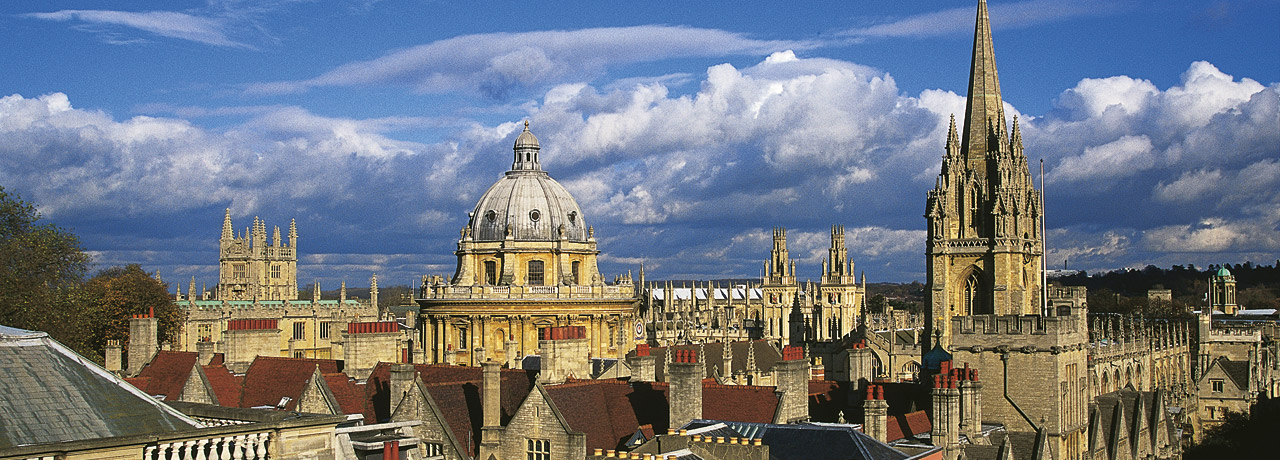
Oxford is most beautiful in the Spring. Photo taken by author.

I can understand why our soon-to-be-Saint Newman had so much trouble getting Oxford out of his blood. The place is a mirage in silver and stone. To have dwelt in such a dream-city for so long a time, to have been part of its inner life, to have shaped it according to one’s own character and to be shaped by it in turn, to watch the sun and the rain succeed in their seasons over streets imbued everywhere with a boundless sense of eternity…yes, I can see why Newman was always looking for a path back to this northern Eden. A Papal angel kept him from the gate. More prosaic barriers have turned me aside, namely, the prospects of an academic career in America.

But, in some way, the greater grief is leaving the United Kingdom. Shakespeare called Albion a swan’s nest in a stream. Having traveled from London to Birmingham, from Cardiff to York, from Tenby to Bournemouth, from Cambridge to Edinburgh, from Bath to Stratford, from Walsingham to Wakefield, in short, across the whole face of this country, I can start to see what he means. Britain possesses a peculiar beauty in grey-green and gold, something delicate and immortal that only reveals itself to an attentive foreigner. I shall miss it.

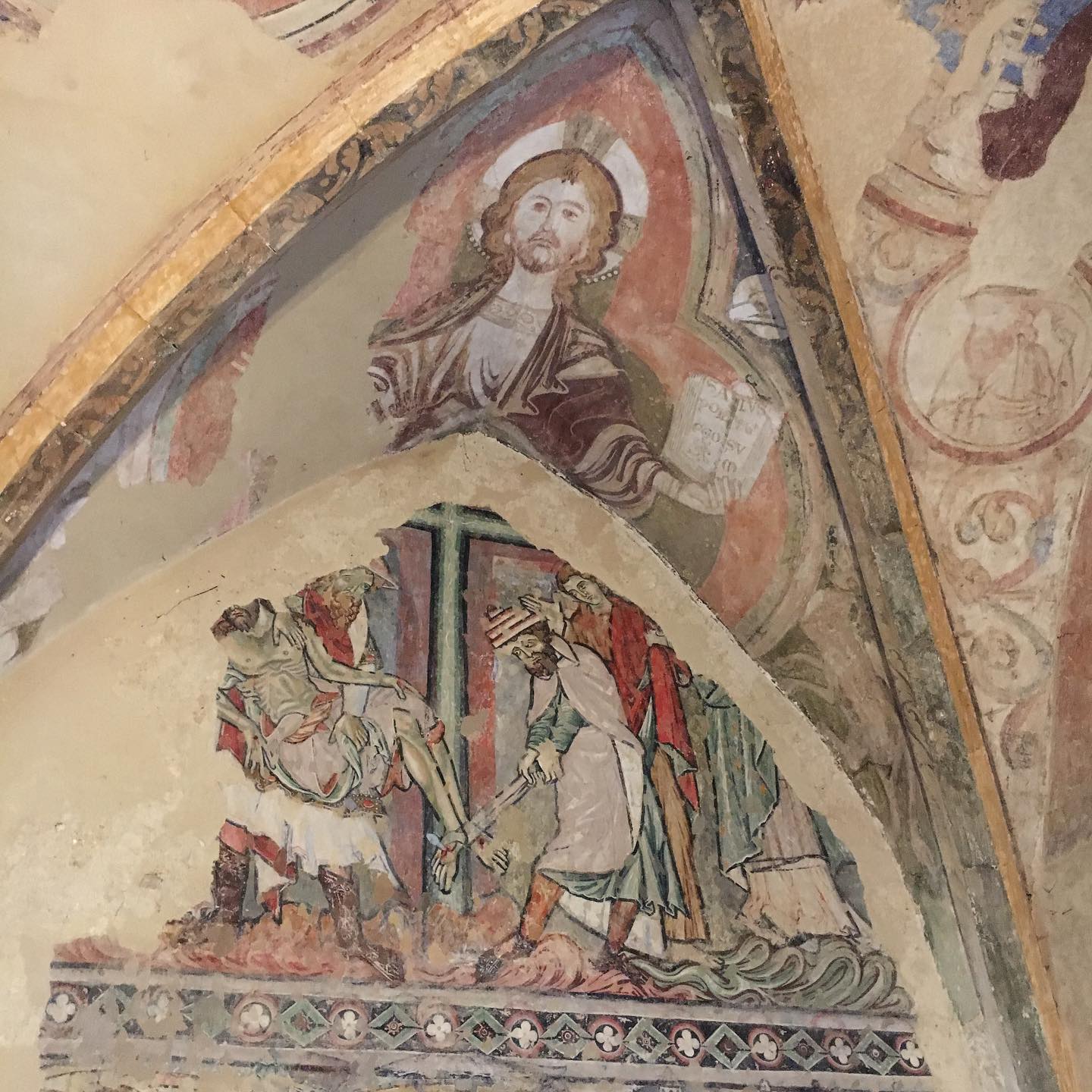
The St. Sepulchre Chapel, Winchester Cathedral. Photo taken by author.

More than that, I’ll miss the many friends I made in my two years abroad. Not just English either, though there were plenty of those – but also Canadians, Russians, Australians, Irish (both orange and green), French, Armenians, Italians, Romanians, Scots, Sri Lankans, Welsh, Poles, Chinese, and even some of my fellow countrymen. The story of my time in Oxford would not be complete without them. I will feel the absence of each, some more keenly than others.

St. Stephen’s House in the snow, January 2019. Photo taken by author.

I suppose this is as good a time as ever to take stock of some of my travels through life at large. I am 24 years old. I have visited 12 countries beyond the borders of the United States:

The United Kingdom
France
Ireland
Belgium
The Netherlands
Italy
Austria
The Czech Republic
Hungary
Romania
Bermuda
Vatican City

And 14 if one includes layovers and train connections in Germany and Switzerland. I have stood at the banks of the following rivers:

The Thames in London
The Thames in Oxford (Isis)
The Thame in Dorchester (before it becomes the Thames)
The Cherwell
The Liffey
The Seine
The Amstel
The Arno
The Rhône
The Saône
The Tiber
The Danube
The Lys
The Usk
The Avon in Bath
The Loire
The Cam

I have spent quite a lot of time in churches. A few favorites in England include the Oxford Oratory, the York Oratory, the Birmingham Oratory, Magdalen College Chapel, Worcester College Chapel, Oriel College Chapel, Merton College Chapel, St. Stephen’s House Chapel, St. Etheldreda’s, Holborn, and the Anglican Shrine of Our Lady of Walsingham. My single favorite church in England remains the Brompton Oratory, as it has been since that first June day I stepped into its vast and holy darkness, four years ago.

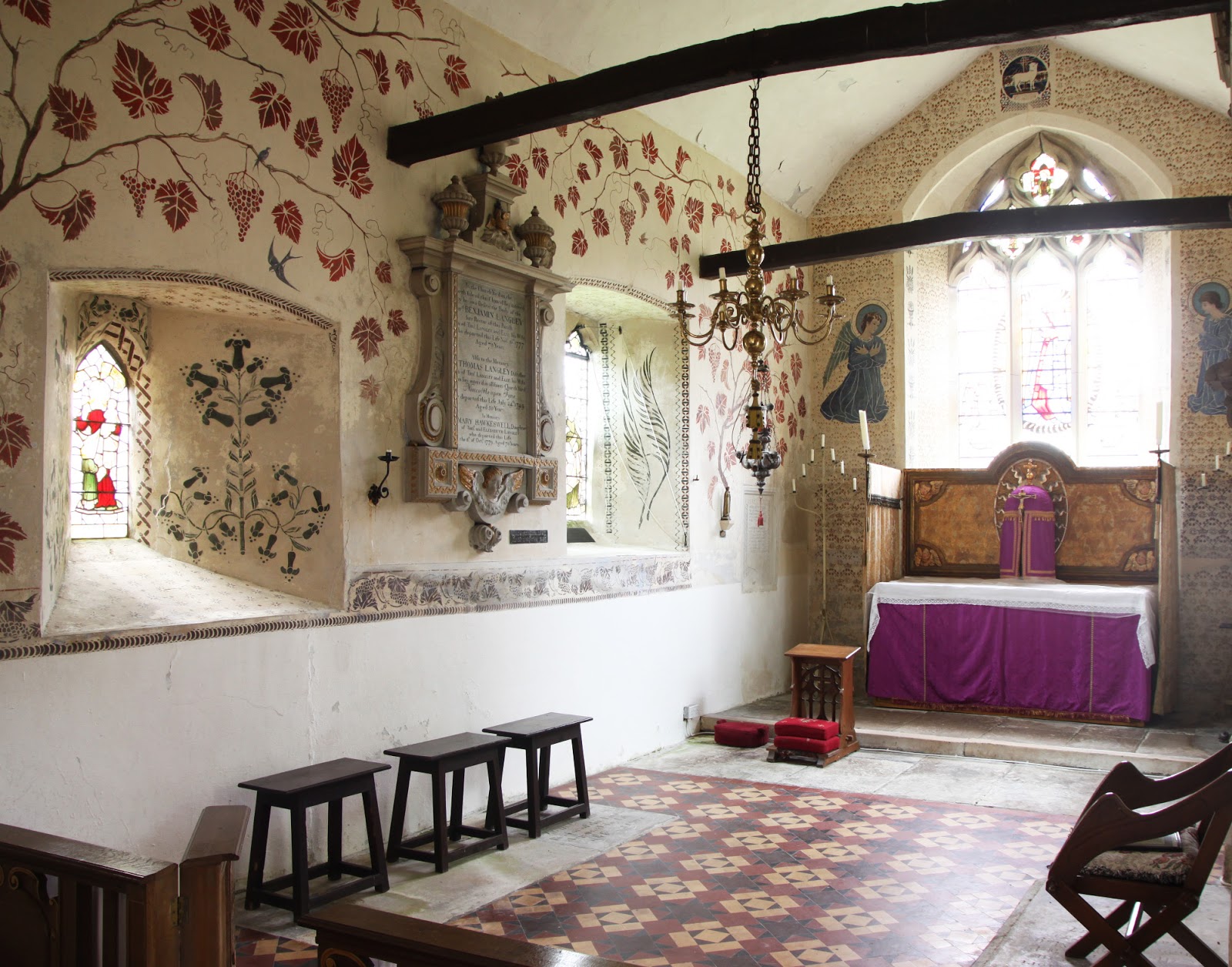
A favorite country church – St. Swithun’s, Compton Beauchamp. Full of delightfully ironic Georgian monuments and a complete refurbishment by Martin Travers in the 1930s. The setting is beautiful, too. (Source)

I have so far managed to get to the following Cathedrals (and Abbeys) in England, of which the first two are my favourites:

Winchester Cathedral
Gloucester Cathedral
Norwich Cathedral
Oxford Cathedral
St. Paul’s Cathedral
York Minster
Wakefield Cathedral
Salisbury Cathedral
St. Giles’s, Edinburgh
Westminster Cathedral
Westminster Abbey
Bath Abbey
Malmesbury Abbey

Plus some lovely country churches – East Coker, Burford, Stow-on-the-Wold, Binsey, and my very favorite, St. Swithun’s, Compton Beauchamp.

In Ireland, Silverstream Priory remains the most spiritually nourishing place I have ever been; its beauty and its holiness are always palpable.

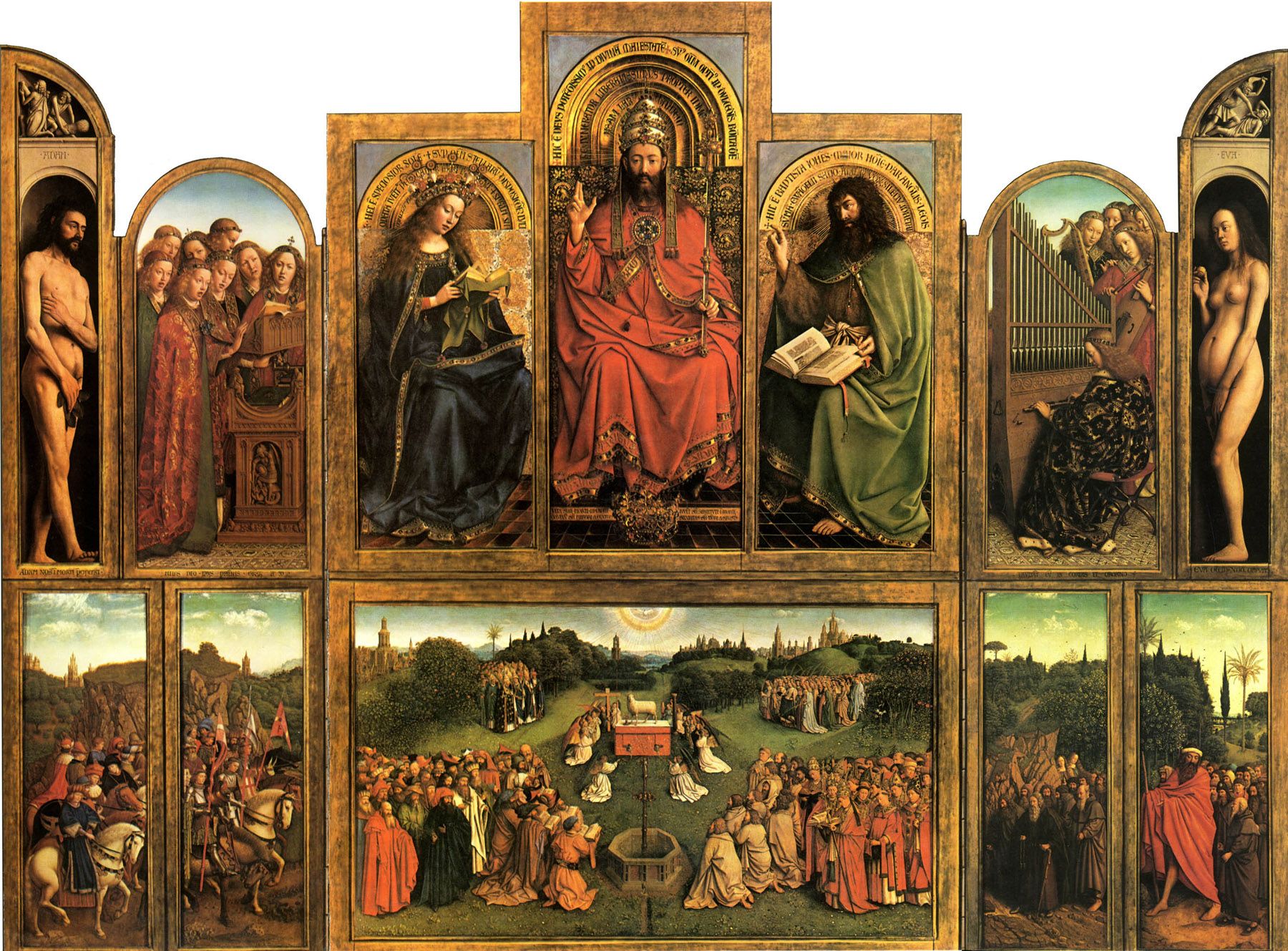
The Ghent Altarpiece. Seeing this for the first time last February in Saint Bavo’s Cathedral was one of the best moments of my two years abroad. (Source)

My travels on the Continent have been full of their own various ecclesiastical delights, so I’ll only mention a few highlights. My favorite cathedral in the world is St. Bavo’s, Ghent, which represents the perfect fusion of Gothic, Baroque, Rococo, and 19th Century styles. In France, the Chapel of the Miraculous Medal in the Rue du Bac, Saint-Étienne-du-Mont, Lyon Cathedral, Notre-Dame de Fourvière, and Saint-Just in Lyon are a few holy places I will not easily forget. Recently, I visited De Krijtberg in Amsterdam, which is the best example of painted Neo-Gothic I have seen beyond the Sainte-Chapelle. Italy is too full of wonderful churches to count, as are the old Hapsburg lands. If I were to choose a favorite in each, I suppose I would have to list the Chiesa Nuova (St. Philip Neri’s home and final resting place) in Italy, as well as Stift Heiligenkreuz in Austria, the Matthias Church in Hungary, and St. Vitus Cathedral in the Czech Republic. Though, to be fair, I visited several of these a few years ago rather than on this late sojourn in Europe.

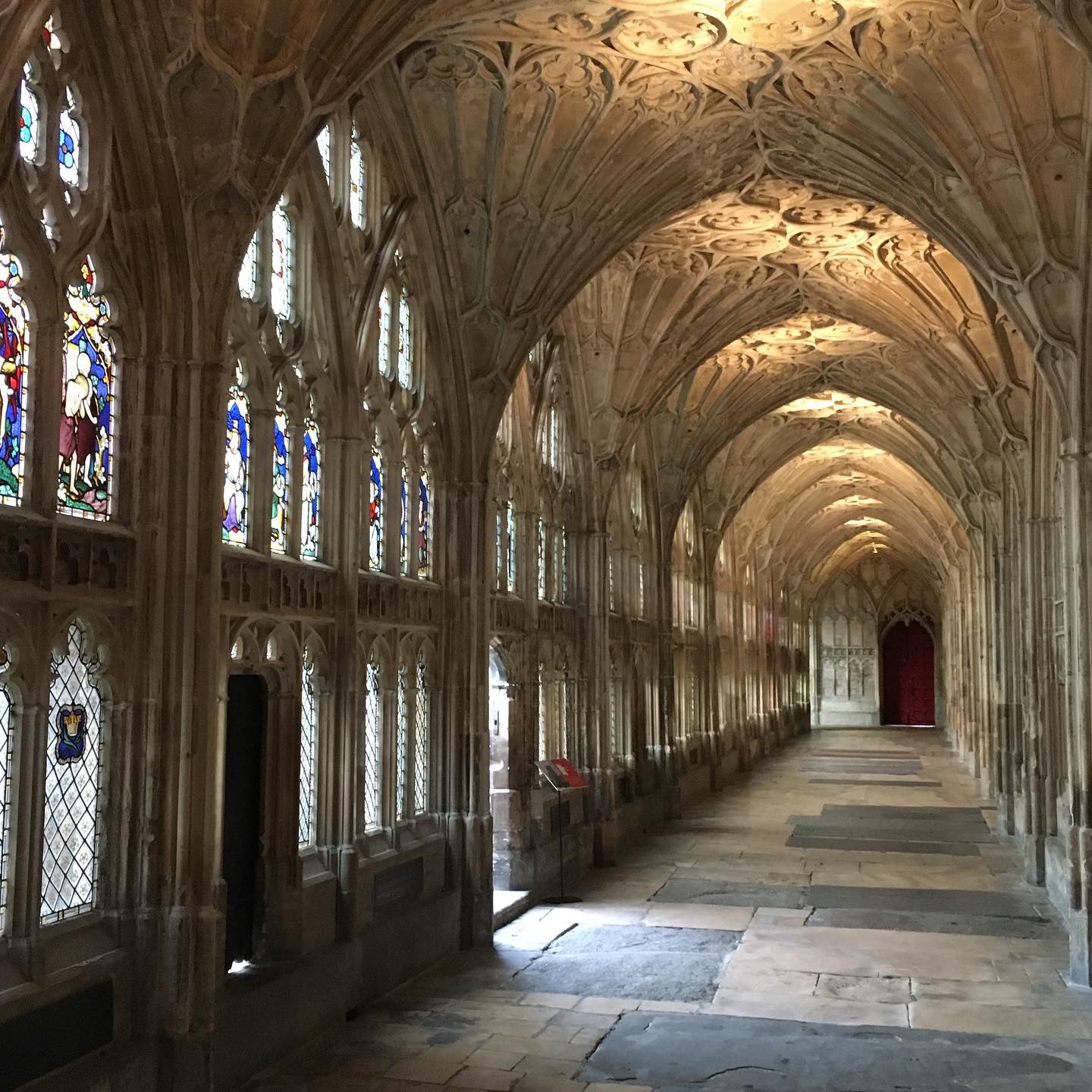
The cloisters, Gloucester Cathedral. America’s greatest fault probably lies in having no Medieval structures in situ. Photo taken by author.

I list these travels not out of any boasting, and, perhaps, not even for my readers. If anything, I do it for myself. I am more interested in remembering these places; writing about them has given me occasion to reminisce, to try and recapture something of the pleasure they gave me once.

I have been very blessed in life. I praise the Good Lord for allowing me the chance to see a bit of the world, to have done useful work, to have read interesting books, to have seen beautiful things, to have drank some good wine, and to have known such wonderful people. What more can one ask for in this brief life?

The Funerary Rites of James II

sacraexequialiai00aqui_00062.jpg

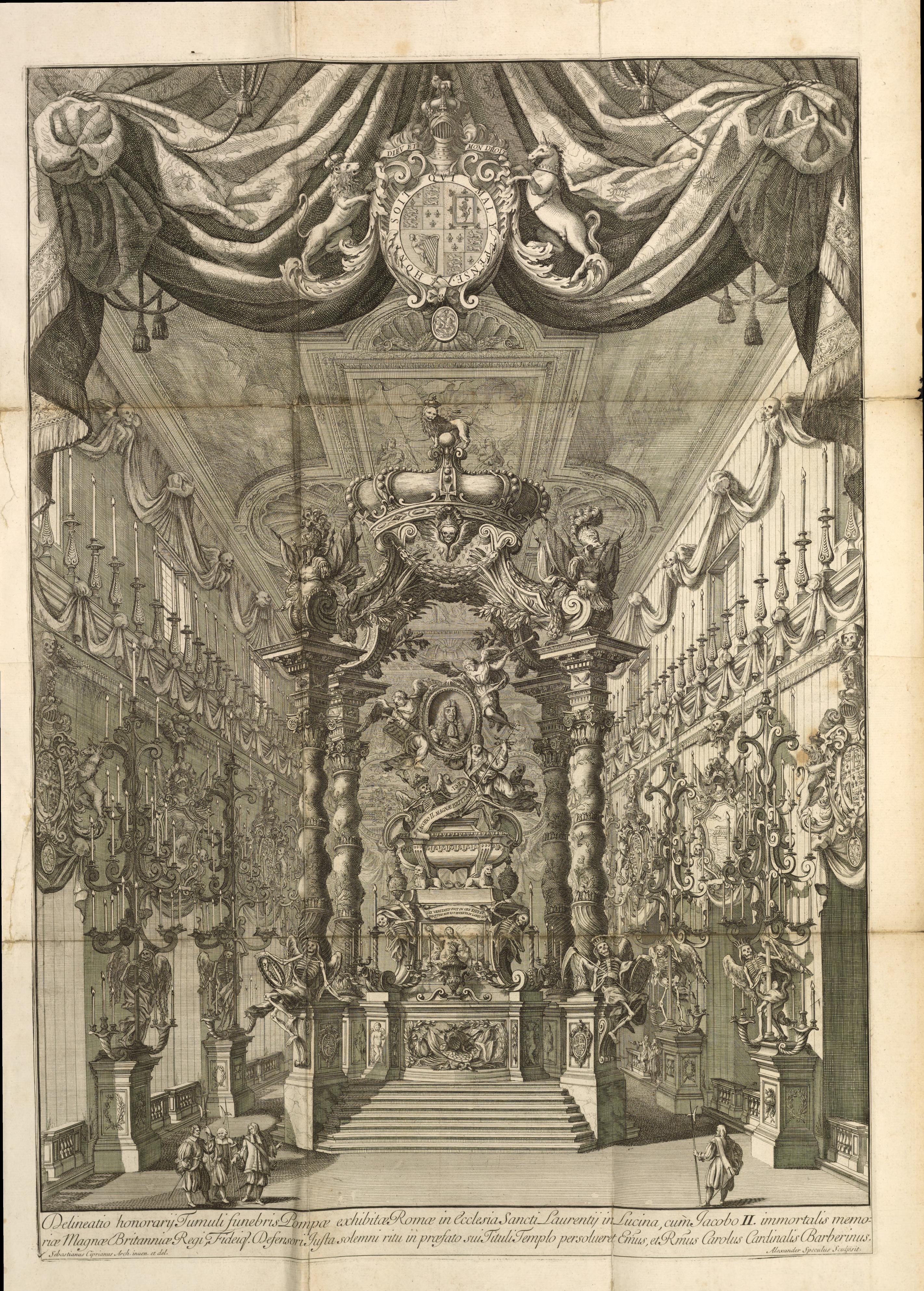
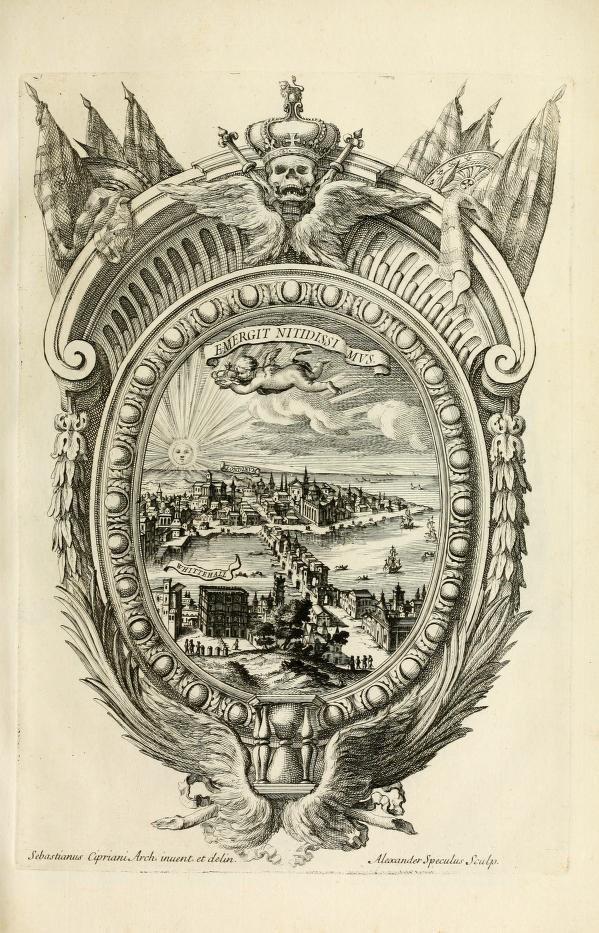
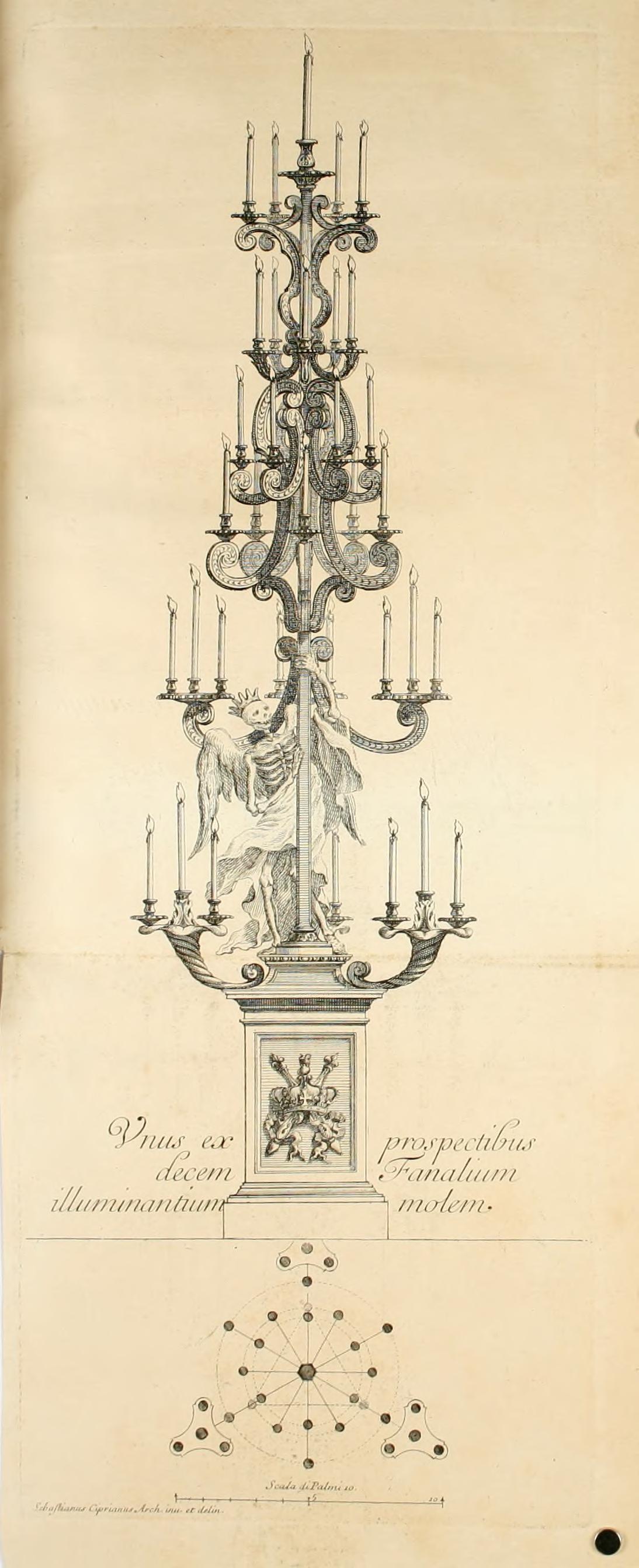
Frontispiece of the Sacra Exequialia. Note the skeletons at the base of the candelabra and baldachin columns. (Source)

A forgotten Latin text of 1702, the Sacra Exequialia in Funere Jacobi II, provides some wonderful views of early modern Catholic funerary rites. Or at least, as those rites were employed for dead monarchs. The central text is Cardinal Barberini’s funeral oration for the king at Rome. Fun fact: if you Google “Exequialia,” it’s the first and one of the only results. While it may not be a hapax legomenon, it’s the sort of rare word that makes epeolaters and logophiles drool.

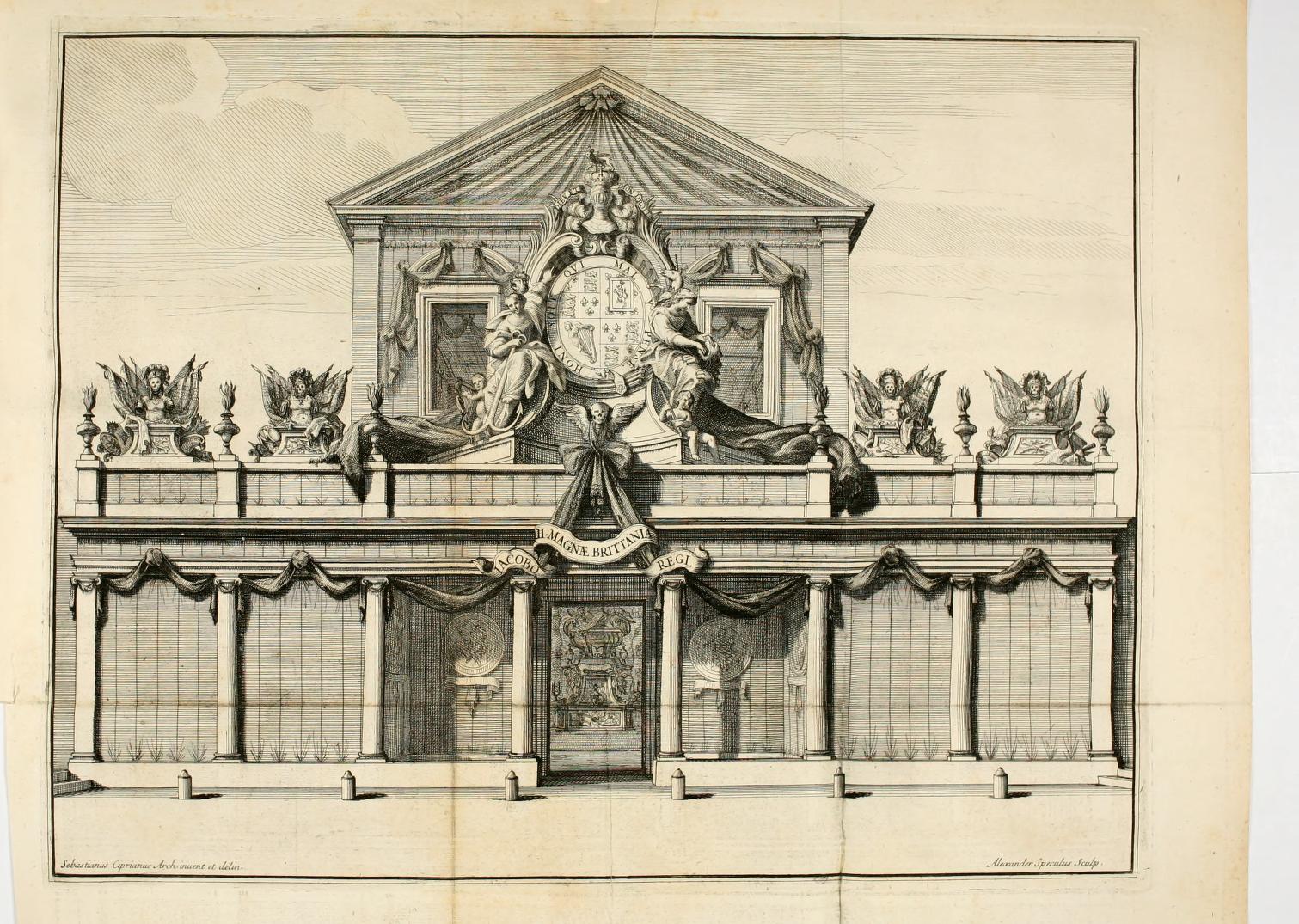
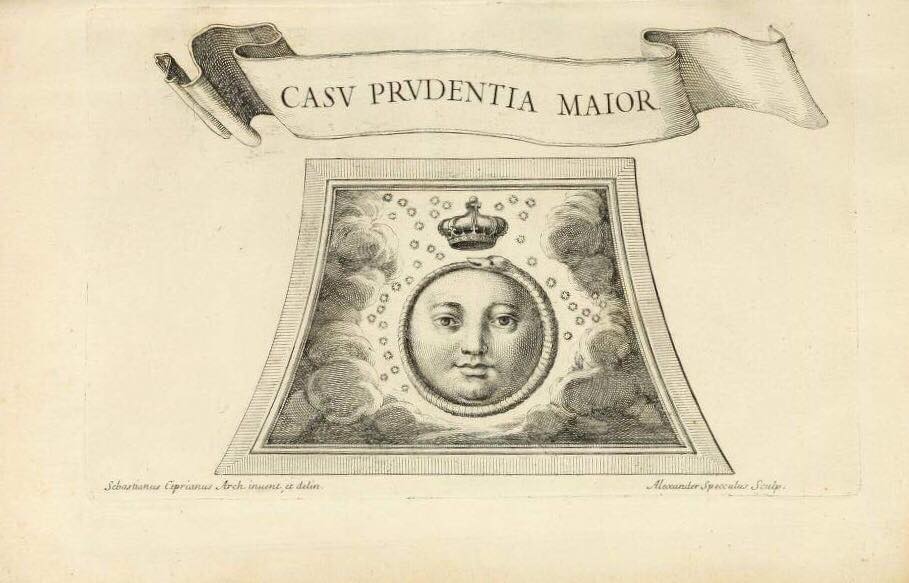
At any rate, I’m not writing this post because of Barberini’s text. The book’s more delicious feature is its several illustrations, including the wild Baroque decoration of the church of San Lorenzo in Lucina as well as several emblems.

sacraexequialiai00aqui_0032

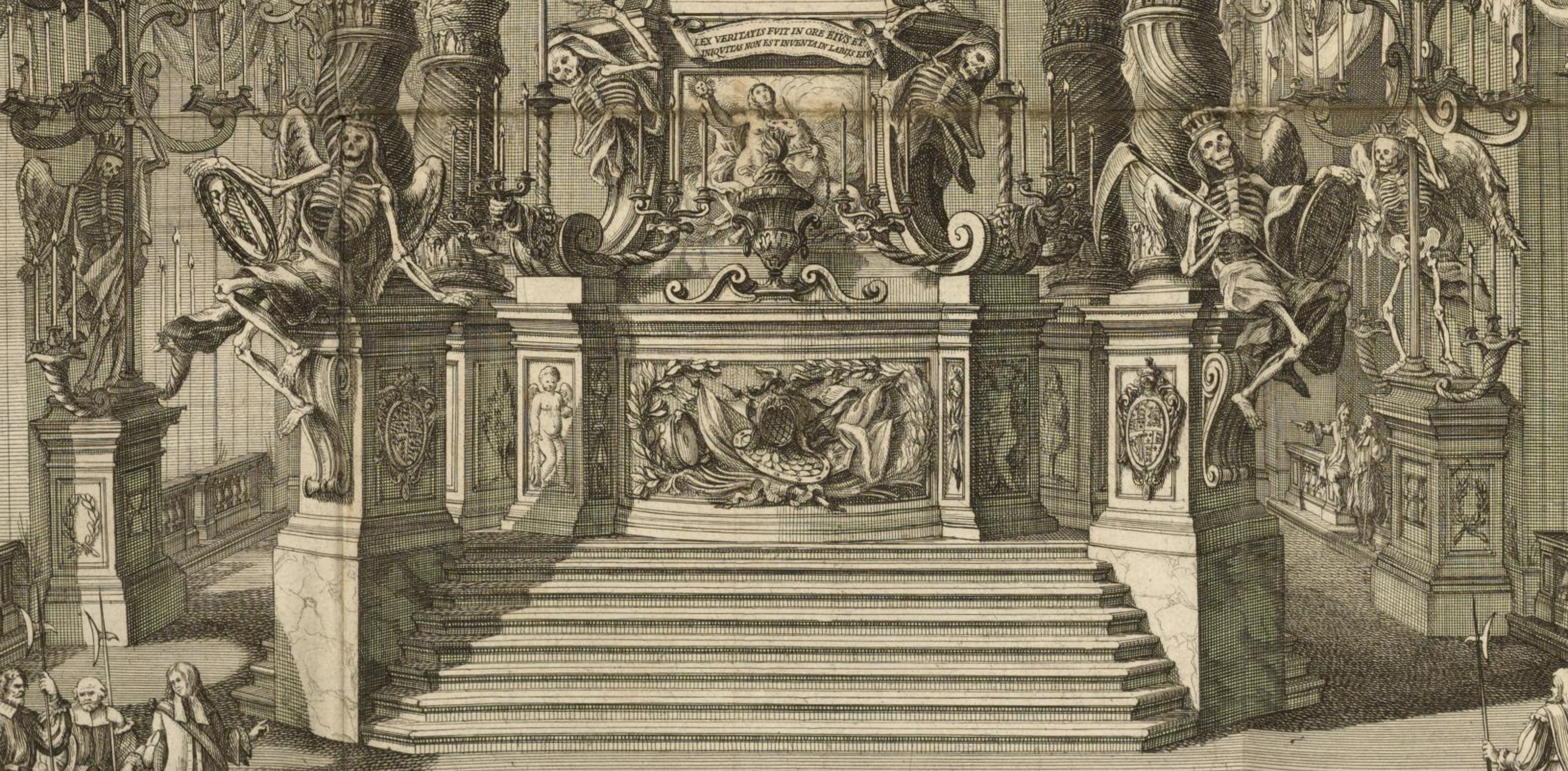
The decorations of San Lorenzo in Lucina for the occasion. (Source)

Of course, James II died in Paris and buried in the English Benedictine church there. It is a testament to the respect he was held in by the Papal court that a Cardinal of such standing as Carlo Barberini, Archpriest of the Vatican Basilica, should preach an oration for him in Rome.

SacraExequialiaSunOurobouros

One of the marvellous emblems in the text. Note the Ouroboros. (Source)

sacraexequialiai00aqui_0041

An image of London. There are similar views of Paris and Rome. All were at hung at the high altar behind the catafalque and its baldachin. (Source)

sacraexequialiai00aqui_0061

Another moral emblem. I’m particularly fond of this one as the harp recalls not only the exile in Babylon (and thus the Jacobite exile) but also the valiant Irish defense of James’s claim to the throne in 1689. These also would have adorned the walls of the church alongside the King’s arms. (Source)

sacraexequialiai00aqui_0066

A closer view of the skeletal flambeaux. One can never have too many at a funeral. (Source)

Screen Shot 2018-11-02 at 10.07.34 AM.png

Jacobite emblem accompanying the text of the Oration. (Source)

Screen Shot 2018-11-02 at 10.10.05 AM.png

A closer view of the frontispiece. Note the Pope flying over the catafalque. (Source)

Screen Shot 2018-11-02 at 10.12.19 AM.png

Here you can see the spooky scary skeletons all around the room. (Source)


Five Years a Catholic

ImmaculateHeartCard

May the Sorrowful and Immaculate Heart of Mary pray for us. (Source)

“To begin and end well, devotion to our Blessed Lady, the Mother of God, is nothing less than indispensable.” – St. Philip Neri, Maxims.

Five years ago, I was received into the Roman Catholic Church at the Easter Vigil. The journey since then has been an adventure, to say the least. Not all of it has been good. I’ve continued to make lots of mistakes, often failing in faith, hope, charity, and all the other virtues. Individual Catholics have often disappointed me. There were moments of doubt along the way, and, like the infamous Pillar of Salt, I am no stranger to the occasional backwards glance.

But in reflecting on those five years, the overwhelming feeling is one of gratitude. The many wonderful people I have met – and, more importantly, the graces I have received – have confirmed for me the essential soundness of my choice. I have no regrets. I only wish more people could know the abiding peace that comes with conversion to the Church that Christ established on St. Peter. And having consecrated myself to Mary, I feel as if I have had a new strength in the spiritual life since last Summer.

Thus far, I have dedicated each year to some mystery of the Faith. It is in that same spirit that I consecrate this sixth year of my Catholic life to the Sorrowful and Immaculate Heart of Mary. I pray that by her triumphant heart, she will continue to guide me to a more perfect knowledge of Her Father, Son, and Spouse. As St. Philip says, “Our Blessed Lady ought to be our love and consolation.” I hope that she ever will be mine.

And thus on this Good Friday, I beg your prayers and those of the saints, that I might persevere in the faith and grow in the love of God.

Most Sacred Heart of Jesus, pray for us.
Our Lady Immaculate, pray for us.
St. Joseph, pray for us.
St. Philip Neri, pray for us.

Amen.

HolyCardMary

The Queen of Heaven. (Source)

Thoughts on Converting the Young

New-format-for-Coke-Zero-Cherry

The official drink of the movement. (Source)

By now, it has become a commonplace among the Catholic literati that, as one reporter put it, “The Kids are Old Rite.” Traditionalism is on the rise among Millennial Catholics. Several overlapping clans of young, traditional Catholicism have arisen over social media, especially Twitter. Traditional orders get more and younger vocations; older, more progressive orders face extinction in the near future. The Pope himself has taken notice and expressed concerns about this trend. Of course, most of the young trads prefer a pope closer to their own age.

Several unrelated items recently have come up in my news-feed that have collectively crystallized the issue for me.

I

First, a three-part study of FOCUS (The Fellowship of Catholic University Students) has just appeared in the National Catholic Reporter. While I’m often wary of NCR’s coverage on just about anything, I’d encourage you to read it. Sometimes the magazine’s liberal bias gets the best of it, as in a mostly uninteresting examination of FOCUS’s ties to Neo-Conservative and generally right-wing organizations in Part II.

But there are also genuine insights. A lot of the issues raised reminded me of my own somewhat mixed experience with a FOCUS-dominated campus ministry. I certainly made friends, some of whom I still consider important mentors. My first-year Bible Study leader, a fellow student who had been “discipled” by the FOCUS missionaries, was a great influence in my first year of Catholicism (and beyond). But I more or less left the ministry fairly early on, like most of my trad or trad-lite friends. The NCR study gets into some of the reasons why.

For instance, in Part 1, we read:

A FOCUS women’s Bible study group gave Elisa Angevin purpose and strengthened her values — at first. As a freshman at New York University, she met a missionary, who became a mentor and a friend.

But as she met different people outside that community — some of whom were “rubbed the wrong way” by FOCUS — Angevin began to distance herself from the group because it felt exclusionary, rigid and not open to different ways of being Catholic.

“Once you become part of FOCUS, it has a very structured approach,” recalled Angevin, now 25 and a social worker in New York. “It created a lot of passion. But a lot of student leaders looked down on other people who didn’t have the same passion.”

Angevin attended some of FOCUS’ mega-conferences, such as the Student Leadership Summit, and was inspired by the speakers and sense of community. “It was empowering to see people my age who were as excited as I was,” Angevin recalled. “But as I started to get older, the newness had worn off … and it felt very closed.”

A lot of this rings true. Speaking from my own experience, I always got the very strong impression that FOCUS represented a fairly “mainstream” form of Catholicism, the JP2 consensus. Banal liturgy coupled with social conservatism. But there really isn’t any room for traditionalists – or even just those who are friendly to the Old Mass and the piety it sustained. I remember being called “judgmental” for my views. Other trads were  sidelined as well.

I also think that the program’s reliance on *very young* missionaries often leads to a dumbing-down of the vast spiritual and intellectual inheritance that is Catholicism. There’s some call for this at a campus ministry, where ministers have to reach as many people as possible. Not everyone can or even should be St. Thomas Aquinas. Undergraduates don’t often go to ministries looking for lectures, but for some escape from the academic life. Still, must it all be so infantilizing? Perhaps you can see what I mean here:

At the Chicago event, held at the sprawling McCormick Place convention center, FOCUS founder Curtis Martin struts onto the stage, hands in the air, shouting “Woo!” and “Awesome!” to the applauding summit attendees who had been enjoying a contemporary Christian band before his keynote address. Two days earlier, actor Jim Caviezel — Jesus in the Mel Gibson film “The Passion of the Christ” — made a surprise visit to the conference.

“This is how awesome you are,” Martin said. “When the guy who pretended to be Jesus walked in the room, you all stood up and clapped, but when Jesus showed up, you all fell down and knelt. You know the difference. How cool is that?”

What an ineffably stupid way of addressing adults. Mr. Martin manages to strike at once a patronizing and self-congratulatory tone, a true rhetorical feat.
FOCUSavemaria

One thing I learned in the NCR articles is that FOCUS missionaries only get four weeks of training the summer before they begin. And some of that is dedicated to learning how to fund-raise. (Source)

Yet my unease with FOCUS wasn’t just with that sort of standard, if irritating, campus ministry procedure. As a recent convert who had grown up in an Evangelical Protestant school, I found a lot of FOCUS’s Protestant-lite discourse unsatisfying. It was more than just the use of emotivist praise and worship music at Benediction (as grating as that was). It was more than just the way FOCUS mission trips seemed to mirror the sort of make-work vacation mission trips I recognized from my time in the Evangelical world. I got the distinct sense that FOCUS borrowed heavily from the discourse of Evangelicalism, even down to the language it deployed when talking about conversion. Here’s an example from Part III:

As former FOCUS employees (called “missionaries”) or as students involved with the organization on their college campuses, they were taught its “Win, build, send” formula.

“Win” means to build “authentic friendships” with people, with the ultimate purpose of evangelization, while “build” requires helping those friends grow in faith and virtue through what FOCUS calls “the big three” virtues: chastity, sobriety and excellence.

First, we have the shallow reduction of evangelization to a business-like slogan, as if the work of the Holy Ghost could be charted like a marketing campaign. This type of lingo is, in my experience, very common in Evangelical discourse. Paired with it we find the language of authenticity. The first step in FOCUS’s three-part strategy is to “build ‘authentic friendships.'” Authenticity is like obscenity – you can’t define it, but you know it when you see it. The problem, of course, is that you can’t actually plan an “authentic friendship.” The planning is precisely what makes it artificial. Friendships come about organically, and no two look alike. The same can be said of conversions. At best, FOCUS should rather resemble what St. Philip Neri imagined the Oratory to be, though he never constructed any firm plans for the Congregation’s foundation or development. At worst, students get the sense of entering faux, farmed, and framed friendships. Those attract precisely no one.

In the emphasis on “chastity, sobriety, and excellence” as, risibly, “‘the big three’ virtues,” we find a synecdoche of the very strong note of philistine, puritanical prudery ensconced in FOCUS. Encountering this tendency also made me recall the moralistic Calvinism of my youth. Everything in Christianity seemingly came back to sex, drinking, and drugs. No one who ponders the state of American students could seriously suggest that these issues don’t matter, but to hammer on about them to the exclusion of two other triads – Faith, Hope, and Charity, and the Good, the True, and the Beautiful – makes Christianity dull.


FOCUSprots

Protestant Sunday worship, or Catholic conference? Hard to tell…and therein lies the rub. (Source)

But why does FOCUS make “chastity, sobriety, and excellence” its threefold mantra? The FOCUS promotional video in Part 1 offers some insight into their worldview. The narrative told there is one of nostalgia and decline. Various clips from the 1950’s are shown in contrast to the sex, drugs, technology, and mass media of today. The message is obvious: society was better back then, and it’s worse now. But it’s not fundamentally true. First of all, evil has always existed. FOCUS’s Manichaean view of the past may not be unusual, but it’s also deeply lopsided. All the terrible things FOCUS decries about our modern society – pornography, addiction, suicide, the disenchantment of consumerist technology – all of these things existed prior to the 1960’s. And lots of bad things about the society of the 1950’s have disappeared or been greatly mitigated in various ways (need I point out segregation as the elephant in the room?). Yet none of those advances are mentioned. It’s not surprising that social justice Catholics, like trads, find themselves ill at ease with FOCUS. Is it all that shocking that “a lack of racial, ethnic and economic diversity among students served by FOCUS is another criticism?”

The FOCUS video also fails to note the role the Church herself played in clearing the way for, hastening, and abetting the worst changes. Nary a peep do we hear about how leaders of the postconciliar Church abandoned her sacred mission to convert a sinful world, nor the way that such a surrender was intimately tied to the loss of the Mass of Ages.

I don’t intend for this post to be a simple laundry-list of my grievances with FOCUS, philosophical and otherwise. After all, I know plenty of wonderful people who got a lot out of their connection with the organization. The FOCUS missionaries themselves were always perfectly pleasant, and seemed orthodox enough. But I also knew others who felt excluded and patronized by the model they brought to campus ministry. I confess a very deep ambivalence about their hopes to expand ministry to parishes (though the veritable clerisy of middle-class lay ministers that Marti Jewell envisions in Part III of the report is hardly any better).

YoungTrads

An alternative. (Source)

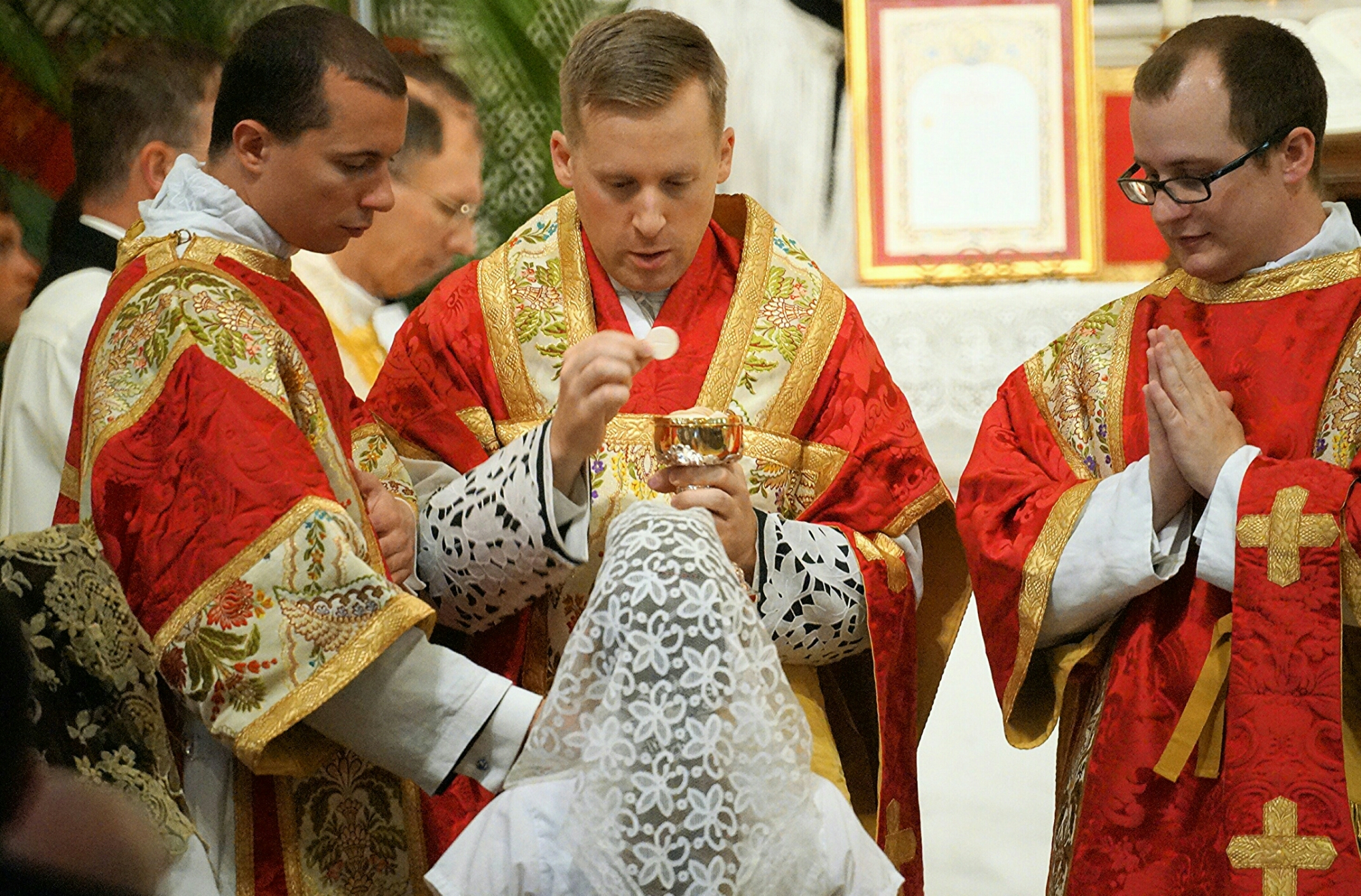
If we want to win the youth with “authenticity,” then look no further than the Latin Mass. Or even just the Novus Ordo celebrated according to Fortescue, as you see at the English Oratories. That which is unmistakably Catholic and orthodox has the best chance of bringing about conversion of heart. I would be curious to know how Juventutem compares to FOCUS in terms of outreach, vocations, etc. Regardless, my own view of how this program of evangelization might best function is in my essay, “The Oratorian Option.” Nothing has changed since then, except that I’ve gotten the chance to attend an Oratorian parish consistently, an experience that has corroborated my original theories. The Eucharist and the worthy celebration of the Mass are at the heart of it all.

It’s just unfortunate that FOCUS, at least as I’ve known them, aren’t interested.

II

The New York Times published a piece on the Trappists of Mepkin, monks in my own home Diocese of Charleston. They’re good, quiet priests who farm mushrooms on a prime piece of real estate next to the Cooper River. The Times profile is nice enough, though I think its central flaws are aptly pointed out by my friend, Fr. Joseph Koczera SJ, in his response over at The City and the World. To wit:

Despite the NYT‘s suggestion that the Mepkin “affiliate program” represents “a new form of monasticism,” the monks themselves realize that it does not. As NYT reporter Stephen Hiltner observes, “the monks at Mepkin are cleareyed about the likelihood that their new initiatives — which will probably attract young, interfaith and short-term visitors — will fail to attract Roman Catholics who are interested in a long-term commitment with the core monastic community.” Mepkin’s abbot also frankly admits that the monastery may not survive: “I’d rather be in a community that has a vital energy and a good community life. And if that means closing Mepkin, that means closing Mepkin.”

“New” and dubiously monastic programs substituted for genuine, old-fashioned monasticism? We’ve seen this before. Mepkin’s well-intended program differs even from, say, the Quarr internship insofar as it isn’t primarily targeted to candidates who might plausibly have a vocation, single Catholic men from the ages of 18 to 25. And unlike Quarr, a monastery which retains its Solesmes heritage, Mepkin seems to be failing in part because it holds too tightly to the Spirit of the Council. Mepkin’s new affiliate program is open to women as well as men, “of any faith tradition.” It seems that the solution they’ve come up with to their vocational crisis is to become less Catholic, not more.

Fr. Koczera continues at length:

As Terry Mattingly points out at GetReligion, the NYT article is very one-sided, focusing on monasteries that are dying without ever asking questions about monasteries that actually are drawing vocations. Most Trappist monasteries in the United States seem to be in straits similar to those of Mepkin, at least judging by yearly statistics published by the Trappist Order. On the other hand, it isn’t difficult to find monasteries in the United States (albeit those of other orders) that continue to attract (and retain) young vocations: one thinks of the Benedictines at Our Lady of Clear Creek Abbey in Oklahoma or Saint Louis Abbey in Missouri, or of the Cistercian Abbey of Our Lady of Dallas (a monastery I’ve written about once or twice before)…Despite the evident sincerity of the monks at Mepkin Abbey, their sense of what young people want belies data about what young Catholics in particular are looking for. As the monks acknowledge, seeking to provide a haven for ‘spiritual but not religious’ types will not lead to an influx of new vocations. The monks may realize, too, that Millennial Catholics who take their faith seriously are also serious about commitment and likely to be unimpressed by a strategy that is specifically tailored to seekers who are “interested in the spiritual life journey, but not in institutional religion.” In this sense, it’s interesting to contrast the NYT story on Mepkin Abbey with a NBC News story from just last week that highlighted the rising number of American Millennials who are choosing to enter religious orders – and who enter looking for a solid sense of identity and commitment that is countercultural. They represent a generation of Catholics who find themselves, as Tracey Rowland writes, “in full rebellion from the social experiments of the contemporary era” as they seek “to piece together elements of a fragmented Christian culture.” Some will find the resources they need to assemble those fragments in one or another of America’s remaining monasteries – but not, it seems, at Mepkin Abbey.

temporary-transfer-to-rome

A 2016 photo of the community of Norcia. The monastery is unlike Mepkin in many ways: young, international, augmented by regular vocations, and above all, Traditional. (Source)

Of the new monasteries that do seem to get vocations (and lots of them), two stand out: Norcia and Silverstream. The lives of these two monasteries are so attractive to young American Catholic men that, though they are in Italy and Ireland respectively, they are mostly inhabited by Americans willing to make the move to Europe. Both are old-rite monasteries. And I would wager that neither Dom Cassian Folsom nor Dom Mark Daniel Kirby went about planning their monastic ventures with catchy slogans or even a very programmatic sense of action. They celebrated the Mass reverently, preached orthodoxy, and, with the help of the internet, they achieved widespread fame. They shared the trust in Divine Providence that St. Philip had as he – or, in his own words, Our Lady – founded the Oratory.

III

My friend John Monaco has just published an excellent personal narrative at his blog, Inflammate Omnia. It describes his Catholic upbringing, difficulties in seminary, extended flirtation with liberalism, and final reversion to a basically Traditionalist position. Parts of it reminded me of my own story: my natural religious sentiment as a child, my vituperative liberalism in High School, my conversion and eventual move towards a more or less Traditionalist orientation, in part through the beneficent influence of the Christian East.

cropped-Sacre-Coeur-940x450

Christ offers us His heart freely and fully. (Source)

I was particularly taken with the way that the Act of Reparation to the Sacred Heart of Jesus, as traditional a devotion as you can get, gently shaped John’s sensibilities over time. His original resistance to the Sacred Heart gave way to the a love of Jesus in precisely this mystery. And by the infallible rule of Lex Orandi, Lex Credendi, the prayer also led him to adhere more perfectly to the Faith as enshrined in Tradition. He writes,

You see, the more I prayed to the Sacred Heart, the more I began to really think about what I was actually praying. Prayer of Reparation? “For what?” I asked. My sins. What does it mean to “resist the rights and teaching authority of the Church which Thou hast founded?” That must obviously mean that the Church has authority, and that Christ founded the Church. The more and more I prayed these prayers, the more I began to question its essence. And even more so, I began to question my own conduct and dispositions.

You see, none of this “mercy” stuff makes sense if we don’t believe that sin actually harms. If all sin is simply personal weaknesses that do not affect our relationship with God and each other, then why do we need forgiveness? Or, in response to some moral theologians, if it is impossible to sin, then what is the purpose of grace? If the Church doesn’t have authority, then why do we consider the command to preach the Gospel? If Christ didn’t found the Church, then why should we bother following it? I also wondered why I was skipping all of the “hard-sayings” of Jesus, such as His words on divorce and remarriage, purity, suffering, obedience, and the promise that the “world” would hate me for preaching the truth. I started examining the fact that people would tell me, “I like you because you’re not talking about Hell and all of that sin stuff all the time”, and that had less to do with me balancing the Christian message than it did with me picking & choosing which parts to speak about.

John also captures the essence of the new, young Traditionalism:

Delving beyond the contemporary face of Catholicism, I was able to re-discover Tradition- not through EWTN or Rorate Caeli, nor through PrayTell or Crux, but rather through a true experience of the sacred liturgy, prayer, and study.

A future church historian will take that line as summative of the entire experience of a generation. The only thing I would add is that in my own case, as with many others, beauty was the central thing. Community, tradition, stability, a sense of history; all these are goods that the Church offers her children. But it was supernatural beauty that captured my imagination and led me to a genuine encounter with the Living God. The Church has the chance to re-present that “beauty ever ancient, ever new” each week at the Mass. It is Christ Himself in the Eucharist who will convert the world. Not our misbegotten, if earnest, attempts to plan out the advance of His Kingdom. If anything, we too often get in His way.

TYPsedia

More of this, please. (Source)
St. Alphonsus on Christ’s Suffering

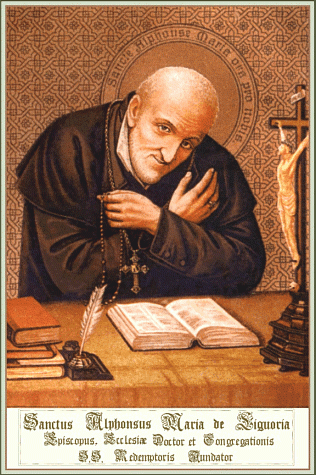
S_Alfonso02.jp

May St. Alphonsus pray for us always. (Source)

This Wednesday’s spiritual teacher is St. Alphonsus Liguori, Doctor of the Church and founder of the Redemptorists. He was known for his moral theology as well as his Mariological and devotional writings. Here is something Lenten by St. Alphonsus drawn, paradoxically, from The Incarnation, Birth, and Infancy of Jesus Christ (trans. 1927). The bibliographic information can be found on the page from which I took this text. 

The Desire that Jesus Had to Suffer for Us

Baptismo habeo baptizari; et quomodo coarctor, usquedum perficiatur?
“I have a baptism wherewith I am to be baptized; and how am I straitened until it be accomplished?”
—Luke, xii. 50.

I.
Jesus could have saved us without suffering; but He chose rather to embrace a life of sorrow and contempt, deprived of every earthly consolation, and a death of bitterness and desolation, only to make us understand the love which He bore us, and the desire which He had that we should love Him. He passed His whole life in sighing for the hour of His death, which He desired to offer to God, to obtain for us eternal salvation. And it was this desire which made Him exclaim: I have a baptism wherewith I am to be baptized; and how am I straitened until it be accomplished? He desired to be baptized in His Own Blood, to wash out, not, indeed, His Own, but our sins. O infinite Love, how miserable is he who does not know Thee, and does not love Thee!

II.
This same desire caused Him to say, on the night before His death, With desire I have desired to eat this pasch with you. By which words He shows that His only desire during His whole life had been to see the time arrive for His Passion and death, in order to prove to man the immense love which He bore him. So much, therefore, O my Jesus, didst Thou desire our love, that to obtain it Thou didst not refuse to die. How could I, then, deny anything to a God Who, for love of me, has given His Blood and His life?

III.
St. Bonaventure says that it is a wonder to see a God suffering for the love of men; but that it is a still greater wonder that men should behold a God suffering so much for them, shivering with cold as an infant in a manger, living as a poor boy in a shop, dying as a criminal on a Cross, and yet not burn with love to this most loving God; but even go so far as to despise this love, for the sake of the miserable pleasures of this earth. But how is it possible that God should be so enamoured with men, and that men, who are so grateful to one another, should be so ungrateful to God?

Alas! my Jesus, I find myself also among the number of these ungrateful ones. Tell me, how couldst Thou suffer so much for me, knowing the injuries that I should commit against Thee? But since Thou hast borne with me, and even desirest my salvation, give me, I pray Thee, a great sorrow for my sins, a sorrow equal to my ingratitude. I hate and detest, above all things, my Lord, the displeasure which I have caused Thee. If, during my past life, I have despised Thy grace, now I value it above all the kingdoms of the earth. I love Thee with my whole soul, O God, worthy of infinite love, and I desire only to live in order to love Thee. Increase the flames of Thy love, and give me more and more love. Keep alive in my remembrance the love that Thou hast borne me, so that my heart may always burn with love for Thee, as Thy heart burns with love for me. O burning heart of Mary, inflame my poor heart with holy love.

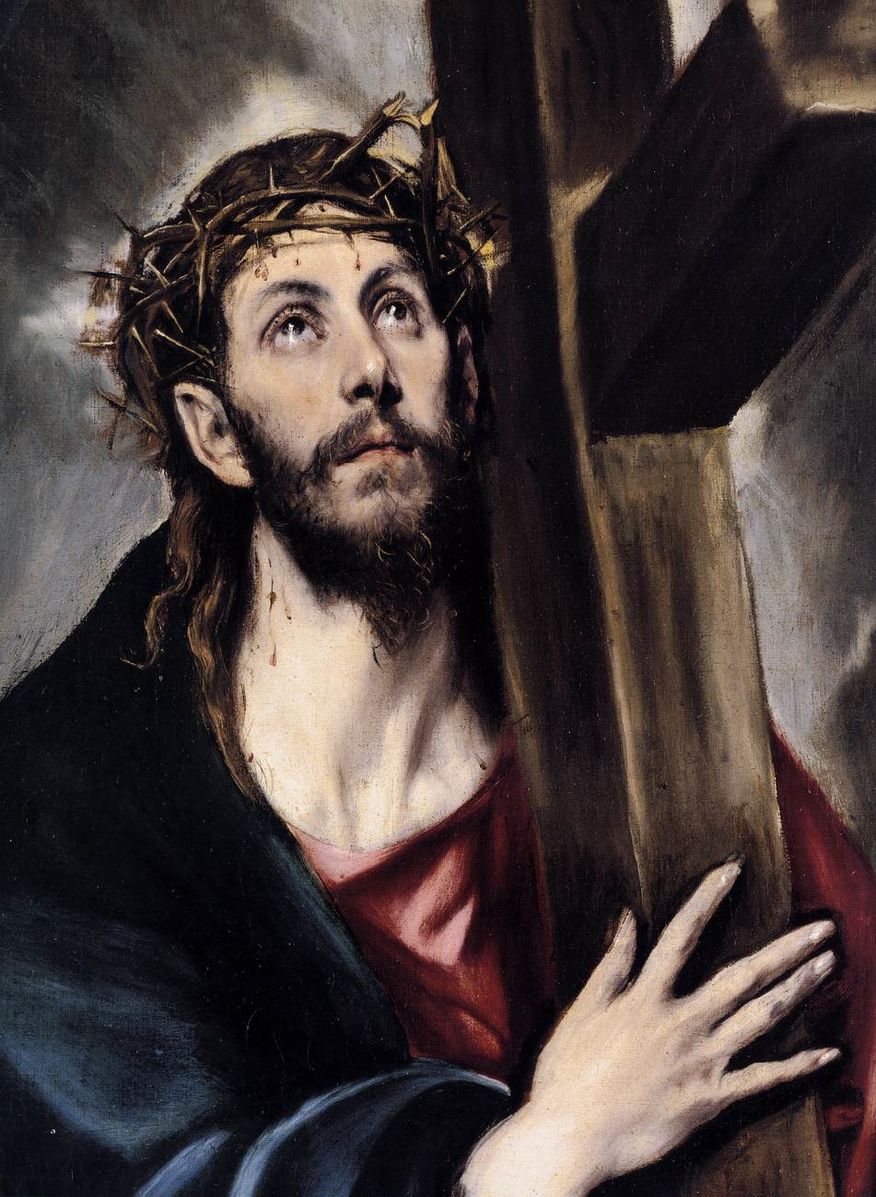
Christ_Carrying_the_Cross_1580.jpg

Detail of Christ Carrying the Cross, El Greco, 1580. (Source)

A Benedictine Prayer to St. Philip Neri in Lenten Time

gueranger4-150dpi

Ven. Dom Prosper Guéranger. (Source)

Many of my readers will know the Venerable Dom Prosper Guéranger (1805-1875) for his monumental work of sacramentology and liturgical exegesis, The Liturgical Year. I happened to be perusing a 1908 French edition of the text and came upon Dom Guéranger’s homage to St. Philip Neri in Volume 3 of his Easter writings. Naturally, this discovery was of great interest to me, as I have written before on the similarities between the Oratorian and Benedictine vocations. I thus present to you my own translation of the prayer, found on pages 548-50 in the edition I was using. I hope it may be thought a fair translation of the great monk’s words. At any rate, I have tried to render his prayer in an elevated style worthy to the subject.

Thou didst love the Lord Jesus, O Philip, and thy whole life was nothing but a continuous act of love; but thou didst not wish to enjoy the highest good alone. All thine efforts tended to make Him known by all men, such that all might love Him with thee and thus reach their supreme end. For forty years, thou wast the indefatigable apostle of the holy city, and nothing could subtract from the action of the divine fire that burned in thee. We who are the posterity of those who heard thy words and admired the celestial gifts in thee, we dare to beg of thee to cast thy gaze upon us as well. Teach us to love our Jesus resurrected. It does not suffice for us to adore Him and to rejoice in His triumph; we must love Him: for the train of His mysteries from His Incarnation to His Resurrection have no other aim but revealing to us, in an ever growing light, His divine kindness. It is by loving him ever more that we shall succeed in elevating ourselves to the mystery of His Resurrection, which fulfills in us the revelation of all the riches of His heart. The more He lifts Himself into the new life that He won in leaving His tomb, the more He appears full of love for us, and the more He desires that our hearts should be joined with His. Pray, O Philip, and beg that “our heart and our flesh might quake for the living God” [Ps. 83:2]. After the mystery of Easter, introduce us to that of the Ascension; dispose our hearts to receive the divine Spirit of Pentecost; and when the august mystery of the Eucharist shines before our eyes with all its fires in the solemnity that approaches, thou, O Philip, who didst celebrate it one last time here below, who didst rise at the end of the day to that eternal rest where Jesus shows Himself unveiled, do thou prepare our souls to receive and to taste “the living bread which giveth life to the world” [John 6:33].

The sanctity that shone in thee, O Philip, had as its character the momentum of thy soul towards God, and all those who approached thee soon participated in this disposition that alone could respond to the call of the divine Redeemer. Thou didst know that thou took hold of souls, and thou drovest them to perfection by the way of trust and generosity of heart. In this great work thy method was never to have any method at all, imitating the Apostles and the ancient Fathers, and thou didst trust in the virtue proper to the word of God. By thee the fervent frequenting of the sacraments reappeared as the surest sign of the Christian life. Pray for the faithful, and come to the aid of so many souls who grow restless and exhaust themselves in the paths that the hand of man hast traced, and that too often retard or prevent the intimate union of Creator and creature.

Thou didst most ardently love the Church, O Philip; and this love of the Church is the indispensable sign of sanctity. Thine elevated contemplation did not distract thee from the dolorous lot of this holy Bride of Christ, so tested in the century when thou wast born and died. The efforts of triumphant heresy in so many countries enkindled zeal in thy heart: obtain for us from the Holy Ghost this living sympathy for Catholic Truth that renders us sensible to its defeats and victories. It does not suffice for us to save our souls; we must desire with ardor and aid with all our means the advancement of the Reign of God on earth, the extirpation of heresy, and the exaltation of our mother the holy Church: it is in this condition that we are children of God. By thine examples, O Philip, inspire in us this ardor by which we must totally associate ourselves with the sacred interests of our common mother. Pray as well for the Church Militant which counted thee in her ranks as one of her best soldiers. Serve valiantly the cause of Rome, which holds as an honor the debt owed to thee for so many of thy services. You sanctified her during thy mortal life; hallow her again and defend her from heaven on high.

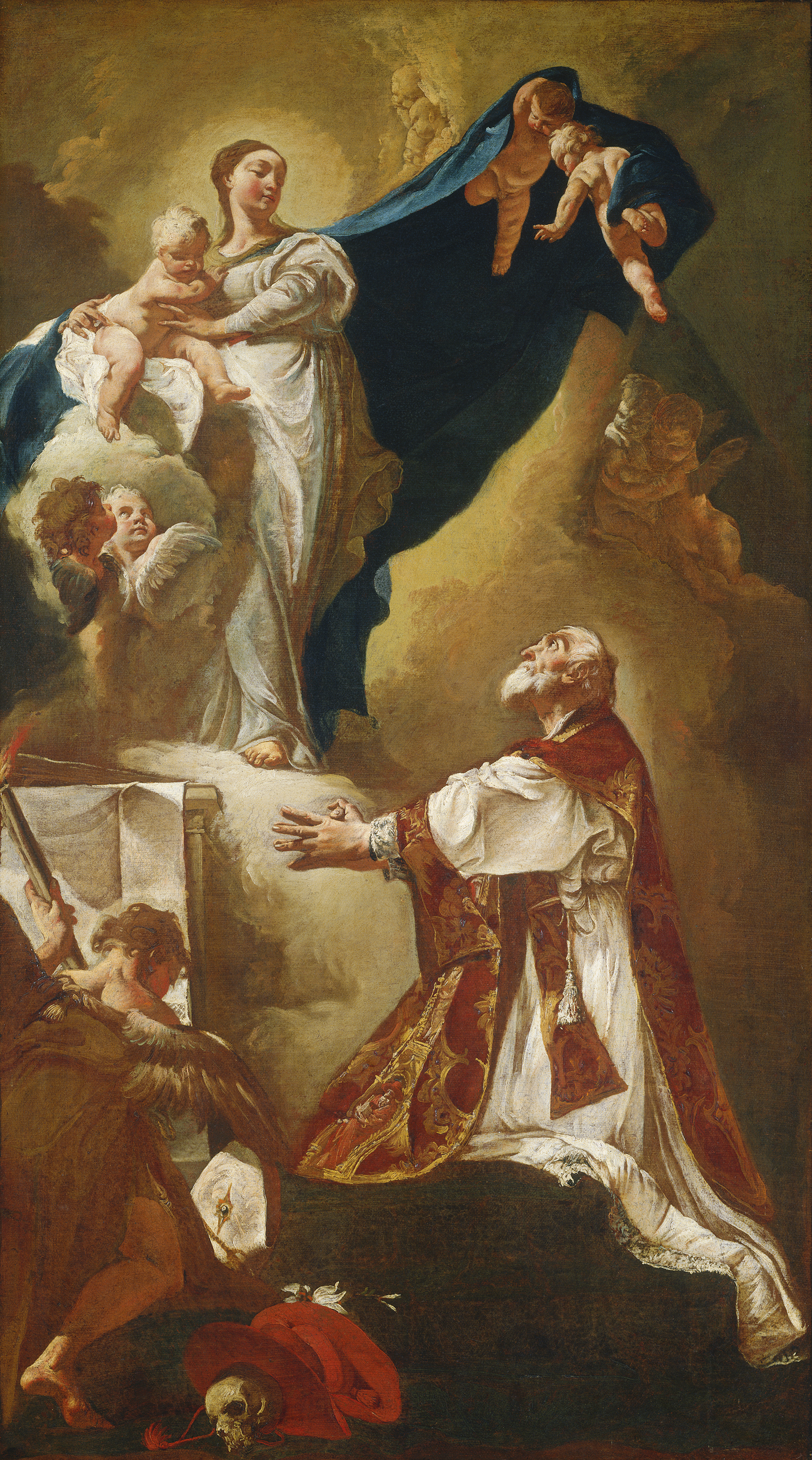
sc1119.jpg

Madonna and Child Appearing to St. Philip Neri, Giovanni Battista Piazzetti, c. 1725. (Source)


Elsewhere: Two New Blogs on Mystics

lazzari+print

A stigmatic, c. 1840. (Source)

Recently two very worthy endeavors have come to my attention. The first is the blog of the Stigmatics Project at the Ruusbroec Institute, University of Antwerp. The project “studies the promotion and devotion of the hundreds of stigmatics reported in five European countries during the nineteenth and early twentieth century.” It takes a scholarly, non-confessional approach to its subject. No doubt this new venture will yield greater insights into the stigmata as a social phenomenon.

The second is a much more theological blog called Littlest Souls, and it presents a veritable treasure trove of mystic spirituality. The blogger has clearly read widely in the library of the soul passed on to us from age to age by the Church. He seems to place a special emphasis on the 19th and early 20th century mystics, much like the Stigmatics Project. In fact, they probably cover some of the same figures. But unlike the recently-founded work of the Ruusbroec Institute, Littlest Souls has been up and running since May 2012. There is consequently much more material here to review and contemplate. Fans of that other great blog, Mystics of the Church, will find much here to admire.

In my first post on Father Faber, I noted that he represented a kind of lost world of the faith. Today, it is hard to imagine a Catholicism that once supported the kind of imaginatively baroque and overtly sentimental spirituality that oozes from his pages. Father Faber looks odd to our cynical, postmodern eyes. But in exploring his writings now, I find much in them that’s salutary and beautiful. My hope is that I can play some small part in recovering those gems for our times.

Both of these blogs seem to do precisely that; one at the level of scholarship, and one at the level of spirituality. Both set out to investigate and present a spiritual school that often seems morbid, unhealthy, or slightly daft – certainly one that has little place in our age. But there are real values here, real impressions of humanity in communion with the divine. I can only commend their efforts as important contributions to the memory and mystical life of the Church Militant.

I’ve said it before, and I’ll say it again. The Church is weird because she is supernatural, and the supernatural is always strange. We should embrace that fact.