The Best Monastic Documentaries: Eastern Edition

A few months ago, I published a post entitled “The Best Monastic Documentaries.” It was quickly pointed out to me that, although I had covered several good features, they were all about Western monks. So I decided that, once I had the time, I would assemble a review of the best documentaries covering Eastern Monasticism. That time has finally arrived! So buckle up, get out your chotki, and watch some of these films.

60 Minutes Goes to Mount Athos
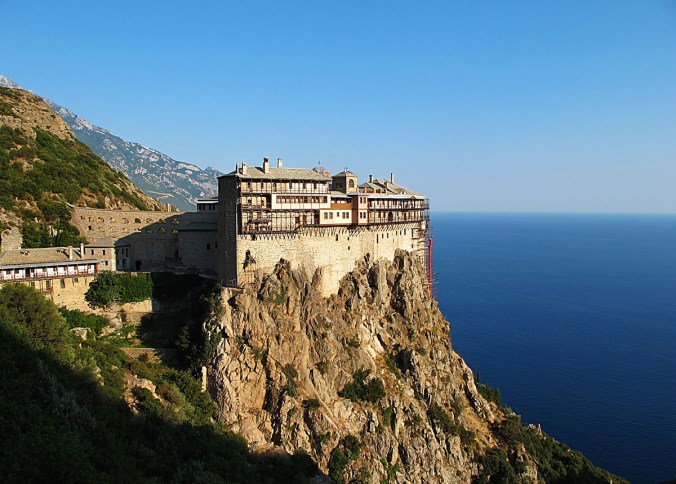
Simonopetra.jpg

Simonopetra Monastery, Mount Athos, one of the monasteries profiled by 60 Minutes. (Source)

In 2011, viewers who tuned into the Christmas episode of CBS’s popular weekly news-documentary series, 60 Minutes, were greeted with an extraordinarily rare treat. For the first time in thirty years, the monks of Mount Athos had opened up their peninsula to a television crew. I remember when it premiered; this was one of my earliest encounters with the monastic tradition of the East. Bob Simon layers on the journalistic smarm, clearly stunned by and slightly distasteful at the various sacrifices and remnants of Medieval life on the Holy Mountain. Nevertheless, the holy simplicity of the monks that he interviews nevertheless shines through. I’m particularly impressed with the testimony to perpetual prayer – the prayer of the heart – given in this film. And luckily enough for us, both Part 1 and Part 2 can both be found online.

One Day in the Life of a Men’s Monastery
Screen Shot 2018-08-10 at 11.02.02 PM

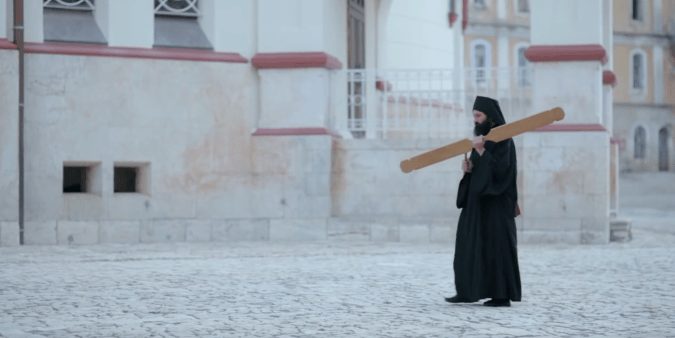
The sound of the wooden doaca awakens the monks from their sleep and calls them to prayer. (Source)

This quiet, reverent film covers the daily routine of a monastery in Georgia. There is no dialogue and no plot, per se. We don’t follow the actions of any single monk. But the viewer does gain an insight into the feeling of the monastic rhythm in this little, faraway community of Abkhazia. Viewers who have seen Into Great Silence will recognize a very similar style in this film. My only criticism is that there’s rather too much focus on the work of the monks, and not enough on their prayer. Still, those moments of prayer we do see are also noteworthy for clearly showing the larger lay community that depends upon the monastery for spiritual sustenance. This short film is thus perhaps the most poetic production on our list.

The Brethren
Screen Shot 2018-08-05 at 7.48.52 PM

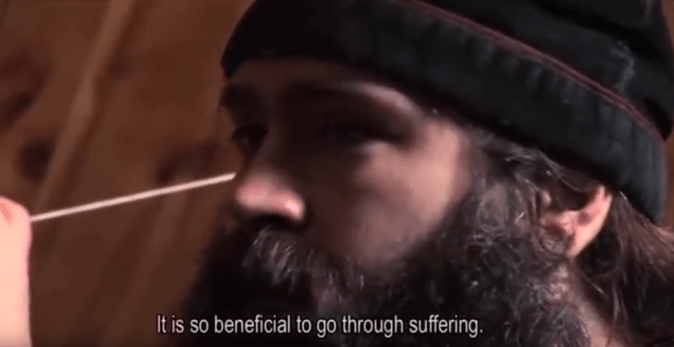
They’re pretty hard core. (Source)

Monks have always sought “the desert,” though sometimes that desert takes the form of tundra. The monks of Trifonov Pechengsky monastery, Kolsky Peninsula, Russia, must be some of the northernmost monastics on earth. This intimate portrait of the community  gives insight not only into the externals of ascetic life at the edge of the world, but also the reasons why men become and remain monks. It also shows, in a more explicit way than One Day in the Life of a Men’s Monastery, that the monks play an important role in their small town’s life and history.

“Hermits of Our Times – Orthodox Christian Monasticism (Hesychasm)”
Screen Shot 2018-08-05 at 8.03.09 PM

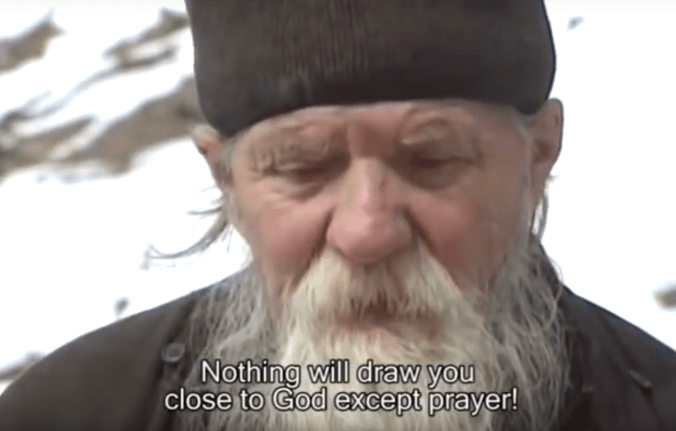
Monastic wisdom. (Source)

To be fair, this isn’t really a documentary. It seems to be footage from a Romanian Orthodox news service taken in the late 1990’s. But it does shine a helpful spotlight on modern anchorites (then) living in the Romanian forest. Anchorites are not monks per se; at least, they are not cenobites, living in cells within a larger community. They are hermits who may once have been attached to a community but now seek God in solitude. I always find myself deeply impressed by the simplicity and manifest wisdom of these holy men whenever I return to this clip. I am reminded of the sayings of the Optina Elders, the Desert Fathers, or even my good St. Philip Neri.

“The Motorbike Rider Who Became a Monk”
Screen Shot 2018-08-10 at 11.27.49 PM.png

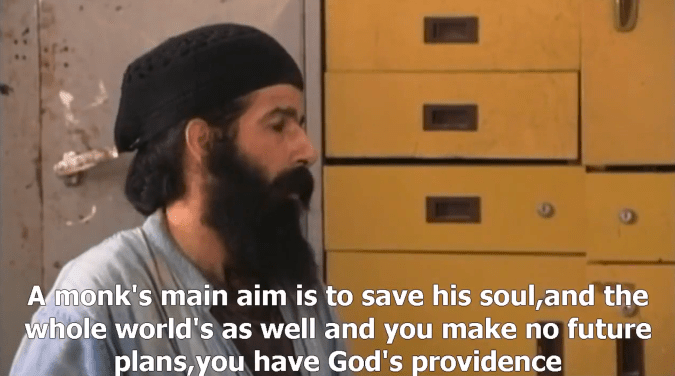
The basics of monastic life, as communicated by a monk in Israel. (Source)

Again, I’m not sure this technically counts as a documentary. But it’s a good interview with a Cypriot who became a monk in Israel, at St. Gerasimos Monastery. One of the great strengths of this film, besides relating a vocation story, is the emphasis it places on the role of the Elder or Spiritual Father. For the Eastern Orthodox, and especially for monks, there is a spiritual lineage passed on from one old monk to younger ones (or to those in the world). In the West, we have mostly lost the sense of Spiritual Fatherhood by dividing its roles between the confessor and the spiritual director, neither of which carries the same weight as the Spiritual Father. But this short and helpful film is a good reminder of what still persists in the monastic tradition.

Behind the Monastery Walls
Screen Shot 2018-08-11 at 12.42.37 AM.png

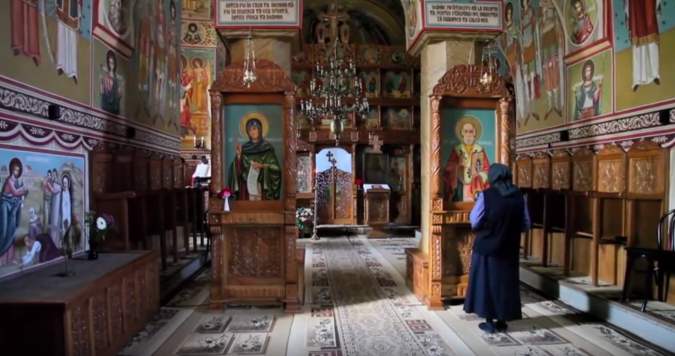
Inside a Romanian monastery. (Source)

This 2011 documentary looks at the personal stories of various monks and nuns in Romania. It’s an artfully made piece, with a very good choral track throughout. But I admire its spiritual insights more than its aesthetic notes. Although the filmmaker does not seem to take a definitively Christian standpoint, she allows the monastics to speak for themselves. They provide a remarkable testimony to the strength of Orthodox traditions in the wake of Communism. We see not only the monks and nuns themselves, but  also the devotional practices of ordinary believers who come to the monasteries. There are, for instance, many prostrations before icons. I also enjoyed the film for my own personal reasons. Romanian monasticism will always hold a special place in my heart, as it was a trip to a Transylvanian monastery that started my conversion, about seven years ago.

I’m sure there are other examples one could point to, but for now, these are some good places to start. They cover a wide range of Orthodox practices and values, all refracted through the lens of its monastic tradition.


The Music of the Holy Ghost

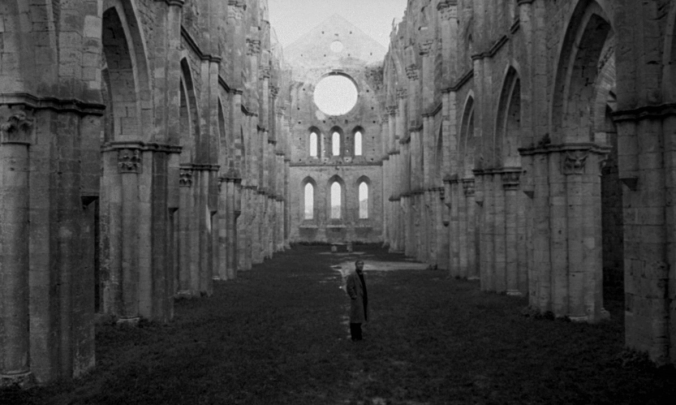
TarkovskyNostalghia.jpg

A still from Andrei Tarkovsky’s Nostalghia (1983). Clips from Tarkovsky’s films are often incorporated into the Rev Army’s music videos. (Source)

Not long ago, I came across a new band. What a singular group it is. Their music crosses and confuses genres. They produce content at a far scarcer rate than other musical acts. Even their name, taken from a Buñuel film, sets them apart from most of the offerings one comes across today.

Little did I know that I had stumbled upon a cult gem. The Revolutionary Army of the Infant Jesus has been on the scene for quite a while. Almost thirty years ago, they released their first album, The Gift of Tears (1987). Since then, they have only come out with sporadic releases, such as 1990’s Mirror and 2015’s Beauty Will Save the World. The long hiatus has well earned them the title of “One of music’s most elusive and enigmatic acts,” as we can read on their BandCamp site.

Tim Cooper has a great review of their work over at The Quietus:

…the attention-averse trio, who regard themselves as a creative collective rather than a band, make wildly eclectic music rooted in liturgical texts and ecclesiastical iconography, contrasting ethereal beauty with stark brutalism. Celestial choirs rub their cassocked shoulders with squalls of industrial noise, political speeches are interwoven with celluloid dialogue, instrumentation ranges from sombre neo-classical piano to pounding dance beats by way of folk, free-form jazz and experimental psychedelia.

They draw together a variety of spiritual and cultural influences: folk Catholicism, peasant mysticism, Russian Orthodoxy, the experience of post-Soviet Europe, Simone Weil, Welsh poetry. Their work can, I think, be described as sophianic, but it is a sophanicity carefully drawn through the harried cracks of the fallen world. The truth that the Rev Army grips and holds up to the light gleams all the more for being refracted in the shards of our earthly mirror.

Here are some favorite songs with their proper music videos, many of which are just as important for the meaning of the piece as the score itself.

Come Holy Spirit” – the very first Rev Army song I discovered. A bit too much flute and too many drums for me, but it was different enough from anything I had ever heard that it caught my attention.

Bright Field” – the first one that captivated me. The upward lift of the music combined with R.S. Thomas’s stirring paraphrase of the Gospel, not to mention Tarkovsky’s silken, dreamlike visuals, all together inspire something like wonder. Whenever I listen to it, I am reminded of a poem by Rilke.

After the End” – a simple and haunting French ditty set to the grainy images of villagers at prayer. They seem to be visionaries.

Psalm” – a few women chant in English against an increasingly dissonant shower of quasi-industrial background noise. The juxtaposition strikes me as an artistic model of transcendence through persistent prayer.

Repentance” – the most Flannery O’Connor thing you will ever see or hear. I’ll just leave it at that.

Théme de l’homme qui n’a pas cru en lui méme” – a Latin-flavored and occasionally jazzy piece featuring footage from a (staged?) Spanish Lenten procession. In case you hadn’t already noticed, the band is extremely Catholic.

Joy of the Cross” – another Lenten procession, but this time with a soft-edged folk music that makes me think of Fleet Foxes.

Before the Ending of the Day” – the Compline hymn surrounded and supported by an airy yet pulsing larger song. Tarkovsky’s Andrei Rublev provides the meditative visuals. Note that one of the commenters on YouTube wrote, “Please keep making more of these. This helped still my soul.”

Something epicletic moves through their music. But one can find that quality in lots of other work. What sets the Rev Army apart isn’t just their obsession with the Holy Ghost, nor their stylistic eclecticism. It’s their powerful sense of mystery. They never shy away from the divine darkness with which the Holy Ghost enshrouds His manifold works of grace. How refreshing, in an age of “Spirit of the Council” muzak and shallow “praise and worship,” to find music that is overtly Christian and even mystical without ever becoming preachy, dated, or emotivist. They treat their subject, the perennial and universal longing of the human heart for God, with a rare artistic and spiritual sophistication.

Caught up in marvel at the saving mystery of the Holy Ghost, the Revolutionary Army of the Infant Jesus is the real Catholic charismatic revival.

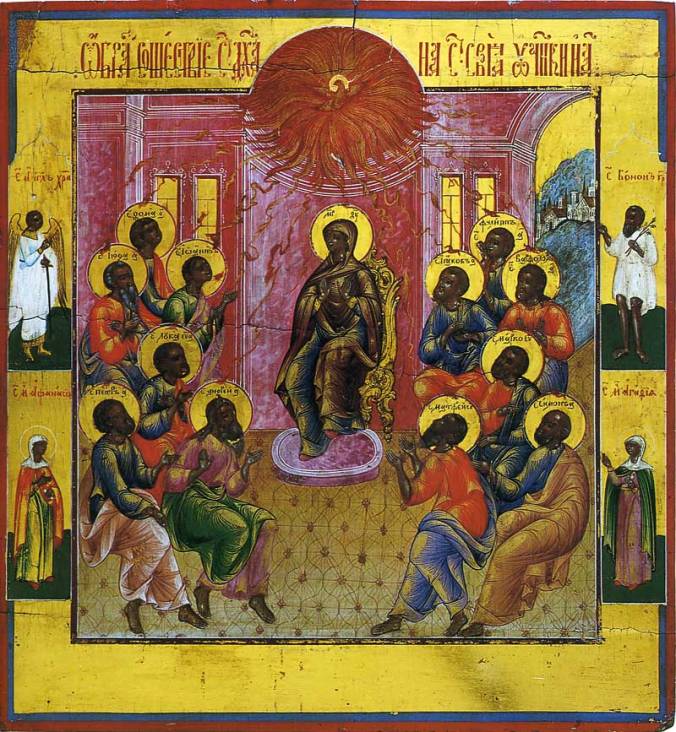
DescentoftheHolySpiritIcon

An icon of the Descent of the Holy Ghost. (Source)

Our Lady of the Cenacle in Armenian Iconography

ArmenianOLCenacle

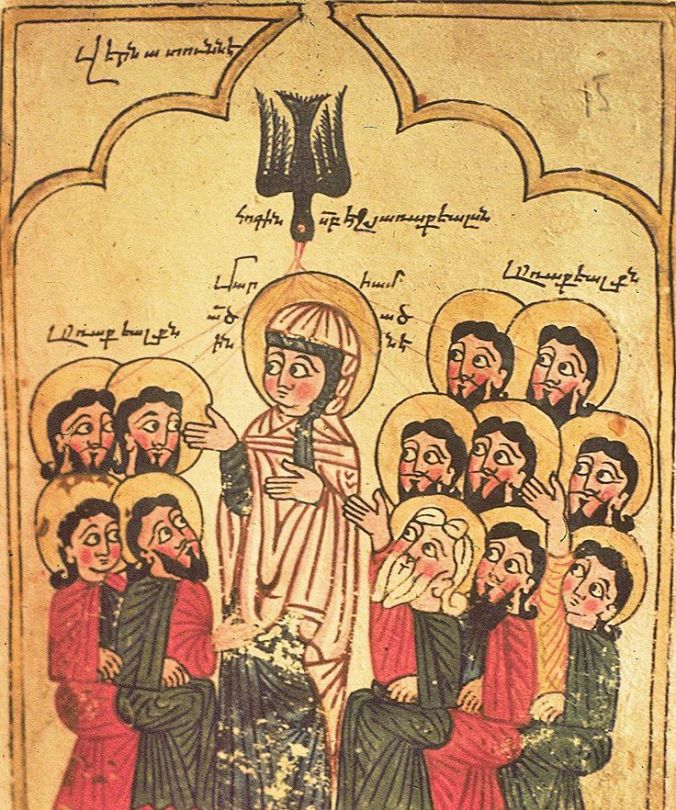
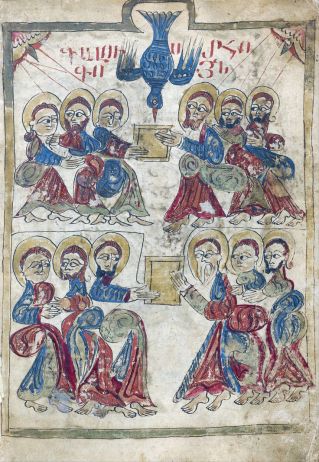
Figure A. Our Lady of the Cenacle, pray for us. From the source: “MINIATURES – Erevan, Matenadaran, MS 8772, Gospel, Aght’amar, Vaspurakan, 1391, artist Dzerun, Pentecost. Photo: Dickran Kouymjian.” (Source)

Throughout the Latin Church, Saturday in the Ascension Octave is kept as the Feast of Our Lady of the Cenacle. On this holy day, we remember the Mother of God keeping vigil with the Apostles in the Upper Room, or “Cenacle.” The place is significant. Here, Christ gathered the Twelve on the night of his betrayal, Maundy Thursday. At that time, He instituted the priesthood and the Eucharist. Later, on Pentecost, the Holy Spirit will descend upon the congregation and truly constitute the Church as such, confirming its sacramental essence and mission in the world of time.

Mary’s position in this unique place at this unique time is captured in the title, “Our Lady of the Cenacle.” But that name conceals a much deeper mystery. What, precisely, was she doing in the Cenacle? Why was she there? And does her presence, never mentioned in the Bible, nevertheless retain important meaning for us today?

As with any mystery unspoken in Scripture but passed on to us by the Tradition, we can approach it by many paths. One of the wonderful things about the Church is that, in her sacramentality, she recasts everything in the light of Christ and opens all things to a deeper meaning than we ordinarily encounter. So today, I’d like to consider Our Lady of the Cenacle through art. Specifically, iconography. Even more specifically, Armenian illuminated manuscripts.

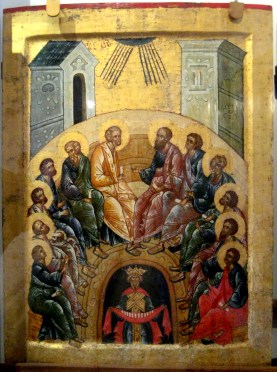
pentecost_kirillo-belozersk-c-1497.jpg

Figure B. A Greek-style Russian icon of 1497. Note the emptimess of the “Teacher’s Seat” at center. (Source)

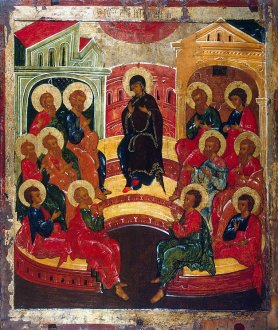
In the Greek iconographic tradition, Pentecost is usually depicted with an empty seat in the center…the place of Christ the King and Teacher, who has ascended and sent the Holy Spirit in his stead. The icon for the feast of mid-Pentecost dovetails with this custom, as it depicts Jesus the youth instructing the teachers of the Law in an arrangement that approximates that of Pentecost proper. The Russian and Slavic iconographic tradition largely copies this model, with one notable exception. Many Russian iconographers include the Mother of God in what would ordinarily be the empty “Teacher’s Seat.” As one writer puts it, “Mary is therefore shown in the ‘teacher’s seat’ as the best example we have, and the person on earth who most resembled Jesus Christ (both physically, as His mother, and spiritually as His disciple).” Indeed.

Icon-The-Descent-of-the-Holy-Spirit

Figure C. A Russian-style icon with the Mother of God in the “Teacher’s Seat,” date unknown. (Source).

The Armenian iconographic tradition differs from both the Greek and Russian streams in important ways, not all of which we can get into here. For our purposes, it is enough for us to observe that the Armenians have a tendency to place the Mother of God at the center of the Pentecostal scene.

Examine, if you will, the illumination at the top of this essayFigure A.

Mary is, by far, the largest character. The Apostles crowd around her on both sides expectantly. Her hands are lifted in the orans position of prayer. She stands in a red mantle and a dark blue robe that matches the hue of the Holy Spirit alighting above her. Every one of the bird’s tongues of flame move through her nimbus to reach the Apostles, some of whom even raise their own hands as if to reach out and take hold of the mystical fire.

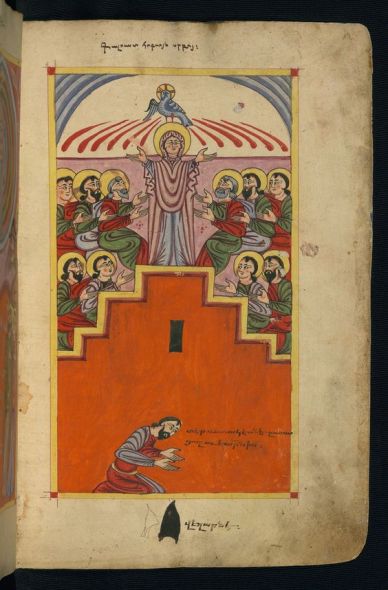
A similar placement and posture is written into the following icon:

Pentecost2

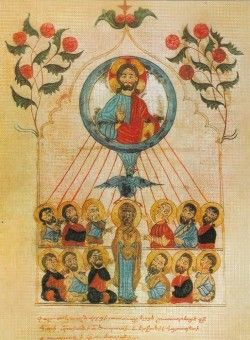
Figure D. Description from source: “This Armenian Gospel book was produced in 904 of the Armenian era (1455 CE) at the monastery of Gamałiēl in Xizan by the scribe Yohannēs Vardapet, son of Vardan and Dilšat, and was illuminated by the priest Xačʿatur.” (Source)

Mary is the central pillar of the icon. The Holy Spirit does not just descend, but rests upon her as He sends forth his tongues of flame. Here, too, their colors match. We can see that the Holy Spirit is customarily written in blue for this festal icon.

Blue is an interesting color, one with mystical associations. I won’t attempt a full symbolic analysis here, but it is worth contemplating the range of natural and supernatural meanings which Christianity has invested in this delicate shade. It suffices to say that blue is a sophianic color, calling to mind the wisdom and beauty of God (see the pertinent chapter in The Pillar and Ground of the Truth, by the great Russian theologian Father Pavel Florensky). The iconographic tradition is of great help in this subject as well; besides gold, blue is the only other color allowed for the background of icons in the Greek and Slavic canons.

DarkDove1

Figure E. An Armenian Pentecost icon without Mary, but with a blue dove of the Spirit. (Source)

SmallIcon

Figure F. Pentecost icon of unconfirmed but probably Armenian origin. Same blue Spirit, roughly the same placement of the Theotokos. (Source).

It is also perhaps worthy of note that in Figure D, Mary doesn’t just match the hue of the Spirit. The colors she wears also match the architecture of the Cenacle. She is one with the Cenacle; the Cenacle is hers, and hers alone. The Cenacle is the Church, the Cenacle is every tabernacle in the world, the Cenacle is Heaven, the Cenacle is the New Jerusalem, the Cenacle is the Throne of God, the Cenacle is the Eschaton, the Cenacle is the final consummation of sophianic being brought about by Christ’s gloriously triumphant Incarnation, sacrifice, and Resurrection.

And in all these mystical dimensions of the Cenacle, Our Lady is Queen.

Mary is the woman who bears the Holy Spirit, the living icon of the Church. When we look at Mary, we are to think of the Spirit. The Mother of God always points us to her son, but also to the Holy Spirit, and through both, to the Father. She is never apart from the Holy Spirit. They abide together, and the Cenacle is where her truly Eucharistic and sophianic state of being is manifested for the awe-struck view of the whole Church. She is the consummation of what is accomplished by the Trinity in the Cenacle, the woman who fully cooperates in the salvation of the world, the Co-Redemptrix and Mediatrix of All Graces. Indeed, do we not read the latter title in the first illumination above? Do we not see it in the slim orange lines of fire that move through her halo to the Apostles below? They only receive the Spirit as it passes through Mary.

Mary does nothing of her own effort. God does all in her, and she freely agrees to accept and work for God’s will. St. Paul can speak of “those things that are wanting of the sufferings of Christ, in my flesh” (Col. 1:24 DRA). Not so with Mary. In her, the cross’s victory is complete. In her, it has become the Tree of Life, “so that the birds of the air,” such as the blue bird of the icons, “come and lodge in the branches thereof” (Matt. 13:32 KJV).

On this feast day, let us remember the manifold graces that Our Lady showers upon us from her throne in the eternal Cenacle. Let us also take heart that, with so powerful an advocate at the heart of the Church, no controversies or troubles can ever overwhelm the Barque of Peter. Finally, let us pray to Our Lady of the Cenacle for the Benedictines of Silverstream on this, their patronal feast.