Five Years a Catholic

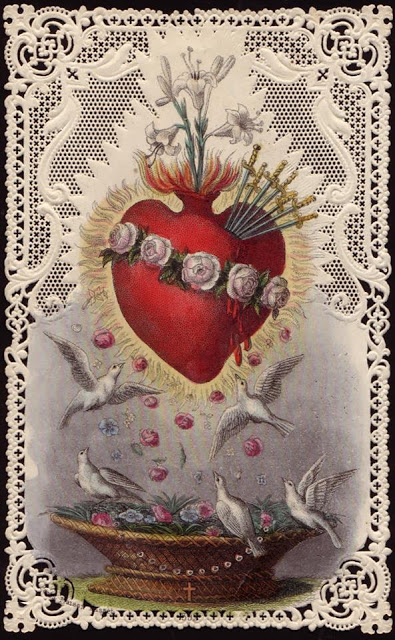
ImmaculateHeartCard

May the Sorrowful and Immaculate Heart of Mary pray for us. (Source)

“To begin and end well, devotion to our Blessed Lady, the Mother of God, is nothing less than indispensable.” – St. Philip Neri, Maxims.

Five years ago, I was received into the Roman Catholic Church at the Easter Vigil. The journey since then has been an adventure, to say the least. Not all of it has been good. I’ve continued to make lots of mistakes, often failing in faith, hope, charity, and all the other virtues. Individual Catholics have often disappointed me. There were moments of doubt along the way, and, like the infamous Pillar of Salt, I am no stranger to the occasional backwards glance.

But in reflecting on those five years, the overwhelming feeling is one of gratitude. The many wonderful people I have met – and, more importantly, the graces I have received – have confirmed for me the essential soundness of my choice. I have no regrets. I only wish more people could know the abiding peace that comes with conversion to the Church that Christ established on St. Peter. And having consecrated myself to Mary, I feel as if I have had a new strength in the spiritual life since last Summer.

Thus far, I have dedicated each year to some mystery of the Faith. It is in that same spirit that I consecrate this sixth year of my Catholic life to the Sorrowful and Immaculate Heart of Mary. I pray that by her triumphant heart, she will continue to guide me to a more perfect knowledge of Her Father, Son, and Spouse. As St. Philip says, “Our Blessed Lady ought to be our love and consolation.” I hope that she ever will be mine.

And thus on this Good Friday, I beg your prayers and those of the saints, that I might persevere in the faith and grow in the love of God.

Most Sacred Heart of Jesus, pray for us.
Our Lady Immaculate, pray for us.
St. Joseph, pray for us.
St. Philip Neri, pray for us.

Amen.

HolyCardMary

The Queen of Heaven. (Source)

The God Who Loves to Be Unknown

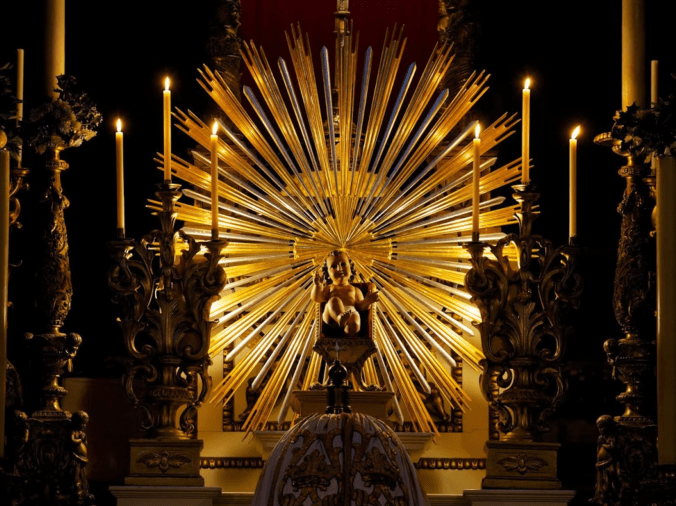
Screen Shot 2017-12-24 at 12.11.38 AM

Christmas at the Brompton Oratory. (Source)

We come at last to the feast of the Incarnation, the brilliant night of the Godhead’s triumphal entry into creation. But the mysteries here are too vast and too bright for our untrained eyes. Let us therefore ascend to higher things by way of lower ones.

A phrase that St. Philip Neri was always repeating to his disciples was Amare Nesciri—”to love to be to unknown.” This injunction lies at the heart of St. Philip’s idiosyncratic sense of mortification. The chief thing was not to punish the body through long fasts and arduous ascesis. Far better was the mortification of the “razionale,” that proud and self-commanding reason common to us all. How often would St. Philip say to his penitents, “The sanctity of a man lies in the breadth of three fingers,” and pointedly lay those fingers on his forehead.

ConcaPhilipMadonna

The Madonna Appearing to St. Philip Neri, Sebastiano Conca, 1740. It is no accident that the vast majority of St. Philip’s iconography shows him in an ecstasy, venerating the Virgin and Christ Child. (Source)

The outlandish practical jokes, the daily confessions, the severe and thankless workload he imposed on his sons; everything tended to mortify the intellect and cultivate humility. Like T.S. Eliot, St. Philip knew that “The only wisdom we can hope to acquire/Is the wisdom of humility: humility is endless” (East Coker II). And for St. Philip, humility found its greatest expression in “loving to be unknown.” 

In a certain sense, this fact hardly strikes us as noteworthy. All the greatest saints were humble and taught humility to other, lesser souls. But how marvelously unique is St. Philip’s via humilitatis! To better grasp his singular path of perfection, it would behoove us to turn briefly to other saints first.

St. Benedict makes perfection in humility a physical, and even visible, matter. The monk who has achieved the Twelfth Degree of humility goes about with his head and eyes ever downcast, pondering his guilt and preparing himself for Judgment (Regula VII). In this state, the monk is spiritually united to Christ on the cross. As one eminent and trustworthy commentator has it, “The bowed head of the crucified Jesus, and of the monk in whom the Holy Ghost reproduces the image of His death, signifies a total adhesion to the will of the Father.” The monk’s humility is cruciform, stained by the Precious Blood as it flows freely from the holy wound in Christ’s side.

St. Ignatius stands apart as well. Ever spurring his sons on with a single battle cry Magis! Magis!“Greater! Greater!”he demands a humility that can only grow in the self-effacing pursuit of excellence for God. Jesuits must act. Like Christ in His ministry, they have no place to lay their heads (Luke 9:58). But Christ was not always going to and fro. His active life was marked by a profound interiority. He was often withdrawing for times of recollection and prayer. And thus the Jesuit humbles himself like Christ through his Examen, a conscious effort at humbling one’s self before God in an honest review of the day. The Jesuit’s proper humility thus bears a striking resemblance to that of Our Lord during those three momentous years.

We could find similar likenesses all through the glorious garden of the Church. Consider the contemplative humility of Carmel, drawn doubly from Christ on Tabor and Christ in Nazareth. Or ponder the humility of St. Dominic, by which we disappear entirely in the singular and all-absorbing Truth of the Word. How like Christ the preacher is the Dominican in his humility! And need we point to the way in which Franciscans draw their model of humility from the unremitting poverty of Our Lord? Thus, the Holy Ghost has showered the Church with various views of Christ’s one inexhaustible humility.

What, then, is left to St. Philip? How may his peculiar spirit and sense of humility draw us closer to Christ’s own humility? In what way can we find the God of the Universe in the simple words, Amare Nesciri?

Barocci1597

Nativity, Federico Barocci, 1597. Now in the Prado, Madrid. Barocci was St. Philip’s favorite artist. (Source)

St. Philip would have us love to be unknown. And so he leads us to the God who loves to be unknown, the God who willingly entered into human obscurity, who put off His glory, who was content to sleep under the watch of peasants and shepherds and beasts of burden. St. Philip brings us, gently but firmly, to gaze upon the face of the Infant Christ, true icon of humility. In the newborn Deity of Bethlehem, there are no clear signs of divinityonly the ineffable sweetness that seems to mark His features, a sweetness He will impart to the hearts of all His saints.

St. Philip is eminently the saint of the Divine Arrival. His whole life was marked by Pentecost, and his devotion to the Eucharist was legendary. So, too, is he invisibly bound to the conception and birth of the God-Man. His own deeply domestic spirituality drew its core of humble charity from the life of the Holy Family in Bethlehem. See the characters laid out before us: silent St. Joseph, the all-meek Virgin, the wakeful and overawed shepherds. At the heart of it all lies the sleeping babe, “Verbum infans, the Word without a word; the eternal Word not able to speak a word” as Lancelot Andrewes puts it. What a picture of humility! Here is a delightful paradox. God has entered the world in darkness and obscurity, that He might commune more profoundly with those few quiet souls. Here we have no mere abasement, but a stripping away of everything extraneous so that a deeper knowledge might follow. The God who is self-diffusive Goodness nevertheless hides and loves to be unknown, that He might savor the intimacy which only true humility can find.

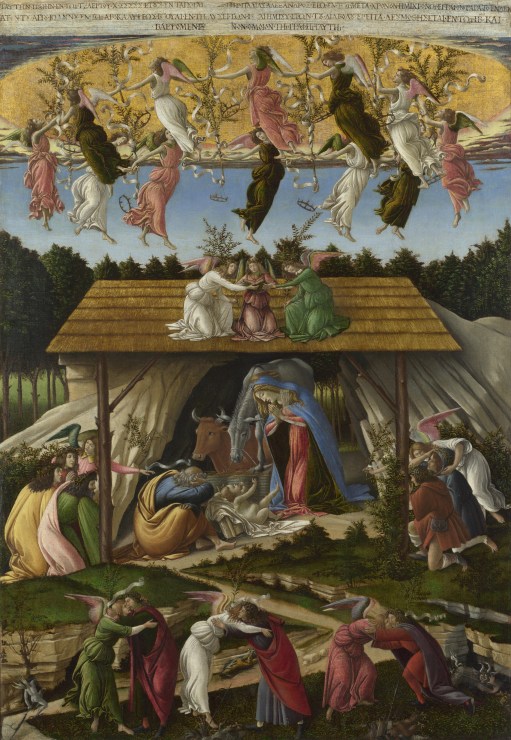
Let Angel choirs sound their celestial praises; let powers and principalities quake with awe; let even the sky hail a new champion among the sidereal host; yet “let all mortal flesh keep silence,” for here lies the newborn God asleep. Above, music. Below, silence. Christmas is not just about the joyful manifestation of God. It is just as much about the astounding paradox at the heart of our faith, the way that the Infinite and Omnipotent God deepened the mystery of all things by robing himself in lowly humanity. Neither Jew nor pagan could have conceived of such a scandalous humility.
Mystic_Nativity,_Sandro_Botticelli.jpg

The Mystical Nativity, Sandro Botticelli, c. 1500-1501. National Gallery, London. (Source)

And that is the humility that St. Philip Neri taught. We love to be unknown so that we might reach a deeper communion with God and with each other, free of pretense or distraction. That is why Cardinal Newman’s motto, Cor ad Cor Loquitur, breathes of a peculiarly Oratorian spirit. Heart truly can speak to heart when both are freed by humility. The remarkable life of St. Philip Neri is testament to that truth.

But where did St. Philip learn to emulate the humility of the Infant Christ? I think we can infer two chief sources.

It is the distinctive mark of the Oratory to discourse daily upon the Word of God in a free and familiar manner. Indeed, the very first exercises of the Oratory at San Girolamo always took the reading and discussion of Scripture as their central object. It stands to reason that St. Philip’s profound engagement with the Gospels would have shaped his sense of Christ’s own humility.

But perhaps a more important source can be glimpsed in St. Philip’s intensely Eucharistic life. Surely St. Philip would have entered into the mystery of Christ’s birth precisely as he encountered Him in the Mass. The Eucharistic silence of the Host is but an echo of the silence Christ kept that first Christmas night. God’s hiddenness upon the altar comes from the obscurity in which He enmantled himself on that first night of His human life.

inexhaustiblechalice.jpg

Icon of The Inexhaustible Chalice. (Source)

Christmas is here, reminding us of God’s wondrous love. But that love calls us to contemplation as well as jubilation. Amidst the lessons and carols, amidst the bells and laughter, amidst the exuberance of family conversations, let us recall the silence of the Holy Infant. He was willing to cloak his Godhead for us. That love of being unknown seems utterly foreign to us, proud and vain as we are. So let this Christmastide see our entry into the mystery of God’s humility. Perhaps St. Philip Neri can help us find what we have missed.
 

For Blessed John Henry Newman

john-henry-newman

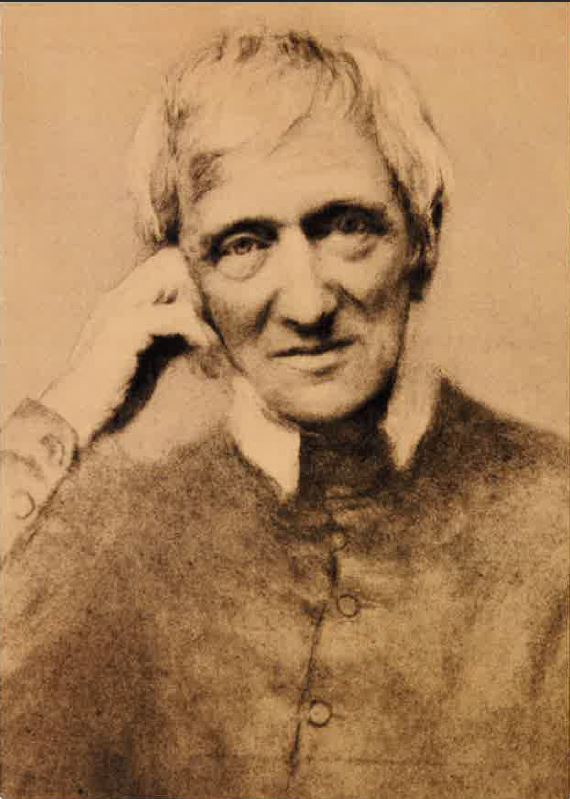
Bl. Newman in his Oratorian habit (Source).

There is so much I could write about Cardinal Newman, on this, his feast day. I have, indeed, already written posts about him many times in the past. But now that courses are starting, I don’t find that I can say as much as I would perhaps like. I also write this essay in some state of exhaustion, having just completed the walking pilgrimage from the Oxford Oratory to Littlemore in honor of Newman’s reception into the Church by the Blessed Dominic Barberi.

So instead of making this a terribly erudite post about a point in Newman’s life or theology, I thought I’d just express my profound gratitude. It can be gauche to make any feast of the Church about one’s self. That is not at all my intention, and I hope I will not be thought self-seeking in writing of my own experience. I don’t pretend that my story is terribly uniquebut it is mine, and no one else can tell it. I am emboldened to relate the history of my own friendship with Blessed John Henry because, as I was taught by Dom Mark Daniel Kirby, “a grace remembered is a grace renewed.” And of course, it’s not really about me. It’s about God, and what He has mercifully done for me through Blessed John Henry Newman.

Saints come to us at many stages of our life. They are always timely, making their appointments according to Heaven’s clock. The mysterious intervention of the saints provides us with one of the many beautiful aspects under which we might consider the manifold glories of providence. They are, as they were in life, God’s instruments; only now, in beatitude, they are eternally and perfectly so. By their intercession, they fill their afterlife with comings and goings, always about God’s business.

Like so many Catholics, I have known the prayers of a saint. Blessed John Henry Newman entered my life when I was still very young in the faith. Of course, I had heard of him before. His name looms large in the history of conversion, and as a convert myself, I found his story interesting if not overly compelling. All that was to change in the spring of my second year, when, in a class entitled, “The University, God, and Reason,” I had the chance to read the first half of his famous educational treatise, The Idea of a University. His magnificent prose and bold defense of knowledge for its own sake thrilled me. I made him my Lenten companion that spring. And in May, I tried (not entirely successfully) to go through all of his Marian meditations for the entire month. A few weeks later, I left for my study abroad.

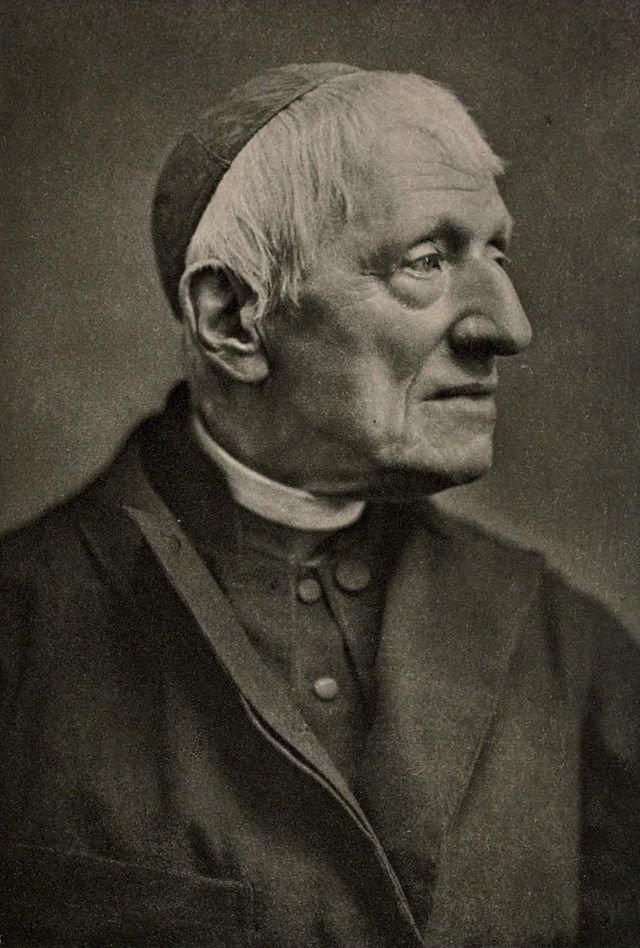
John-Henry-Newman-2.jpg

Newman in later years. (Source)

This venture is, I think, one of the great privileges and turning-points of my life. The more I reflect on it, and where I have been since, the more I thank God for allowing me that study which was more a pilgrimage than anything else. On my very first day away from home, I had the chance to visit the Brompton Oratory. Leaving the hustle and bustle of Kensington in the late afternoon, stepping into that dark and immense well of stillness, I immediately thought, “This is God’s house.” I had never had that reaction in any other church before, and never yet have since. It was unbidden, unlooked-for, unimagined. Yet there, in the vast twilight of Fr. Faber’s church, I felt the unmistakable presence of God. And whose altar should I find, off in a niche, under a low-hanging balcony? Whose but Cardinal Newman’s? And from Cardinal Newman’s altar I walked up to the transeptsand found the effigy-altar of St. Philip Neri. To this day, it is still my firm conviction that I was led to befriend St. Philip by Blessed John Henry, his son.

That was my first introduction to the Oratory. While I had heard of it and understood some of its distinctives, these were merely academic realities to me until that long journey. Throughout the rest of my travels that summer, my mind turned constantly to Blessed John Henry and St. Philip. In Rome, the presence of the latter seeped from the very walls. I had the grace of visiting the Chiesa Nuova twice, and San Giovanni dei Fiorentini once (though at the time I did not know its history). And when I returned to England to complete the course I had signed up for, I started to find Cardinal Newman everywhere. Across the street from my college in Oxford was the Church of St. Mary the Virgin, where Newman was vicar. I visited Oriel and passed by Trinity, his two colleges. I worshiped weekly at the Oratoryyet another house of St. Philipwhere Newman had preached in his own life. I bought a small portrait of the man himself in the little church shop there. And while on a brief retreat with the monks of Silverstream, I providentially purchased a short biography of St. Philip Neri. It was the first I ever read, and I devoured it in a few days.

I have little to say of the time since my return to the United States in August of 2015. The year that followed was very bad, and my faith suffered greatly. But when I came back after so long a spiritual exile, I once again felt the prayers of Cardinal Newman moving me in the right direction. Slowly but surely, my sense of the presence of God healed. By this point, I was writing a thesis on Newman. I was also seriously pondering my future. I knew I wanted to continue my studies, but the question of where to do so was subject to a number of considerations. So I offered up the issue in prayer to a number of saints, including Our Lady of Walsingham and Bl. Cardinal Newman.

And now I am at Oxford, Newman’s beloved university. Indeed, I am at a college guided by the spirituality of the Anglican movement he began. Cardinal Newman has not failed me by his prayers. I have read so many works by and about him, yet still I feel I have so much more to learn from his life and teaching. He is for me many things at once: intellectual mentor, friend in Heaven, father in God. For someone training for the scholarly life, Newman is a model Catholic academic. He pursued Truth until he found it, and, not resting therein, never ceased following it until his death. I pray that I, too, may follow him out of shadows and images and into the “kindly light” of Truth.

Blessed John Henry Cardinal Newman, Pray for Us.

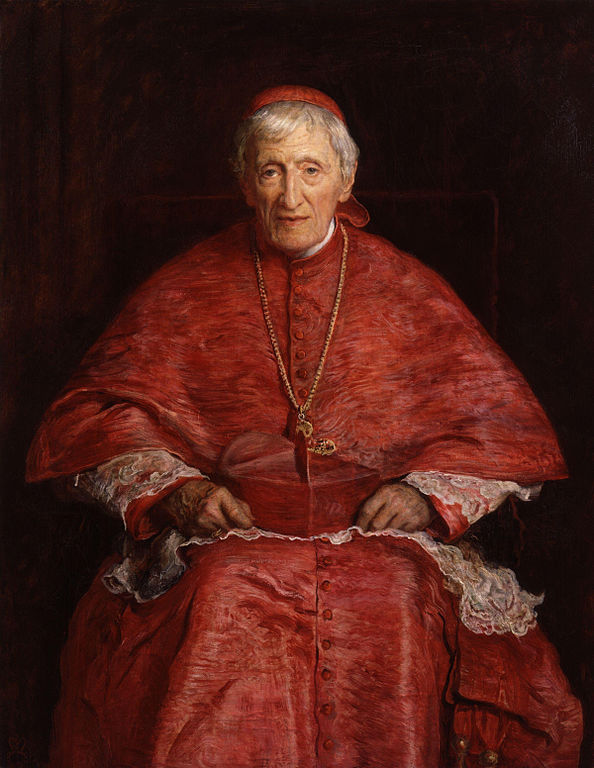
MIllaisNewman

The Millais portrait of Cardinal Newman. (Source)