Advice from a French Nun

Screen Shot 2018-10-28 at 10.13.24 PM.png

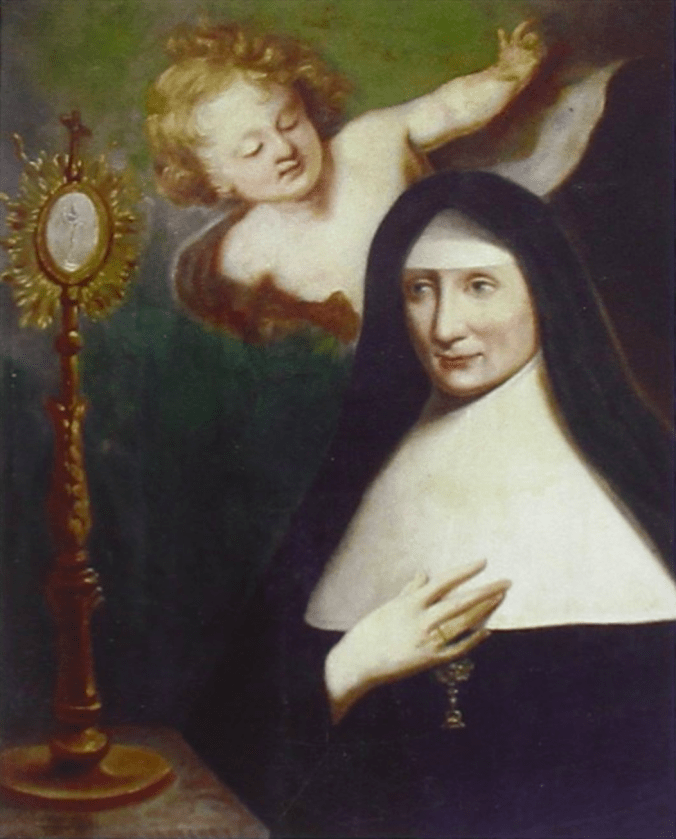
A portrait of Mother Mectilde de Bar adoring the Blessed Sacrament. (Source)

Sometimes readers ask me about more information on Mother Mectilde de Bar (1614-1698), the saintly foundress of the Benedictine Nuns of Perpetual Adoration of the Most Blessed Sacrament of the Altar. I would of course direct those who read French or Italian to any of the several biographical studies about Mother Mectilde that have come out in those languages. However, I would perhaps more eagerly urge my readers to a series of recent posts at Vultus Christi presenting what is, I believe, the first English translations of some of Mother Mectilde’s spiritual letters. Here they are with the titles the translator has given them at VC.

I. “So that I might begin to live in simplicity, like a child.”

II. “On the Meaning of Desolation and Sufferings.”

III. “The state in which you find yourself is of God.”

IV. “The divine labourer who works in you.”

V. “Yet ever thou art at my side.”

VI. “Nothingness doesn’t even attach itself to nothingness.”

VII. “Some sayings of Mother Mectilde.”

VIII. “He sets fire everywhere.”

IX. “All our discontent comes from self-will.”

And on top of all that, there’s a letter from the lay mystic Jean de Bernières to Mother Mectilde. Bernières is a good example of someone who, though posthumously condemned as a “Quietist,” is now being recovered as a source of valuable mystical insight. We have seen the same happen to Benet Canfield before, and it may yet occur to someone like Pietro Matteo Petrucci. More work needs to be done in this area. At any rate, translation of these early modern mystical works is badly needed.

Both as a practicing Catholic and as an historian of early modern Catholicism, I am encouraged that these works are being put into English for the first time. The English-speaking world is now getting a much better sense of the importance of this unique tradition within the Benedictine family. More translations, we are told, are coming. I eagerly await their publication.


Elsewhere: Two Links on the Rosary

Screen Shot 2018-10-07 at 11.46.00 PM

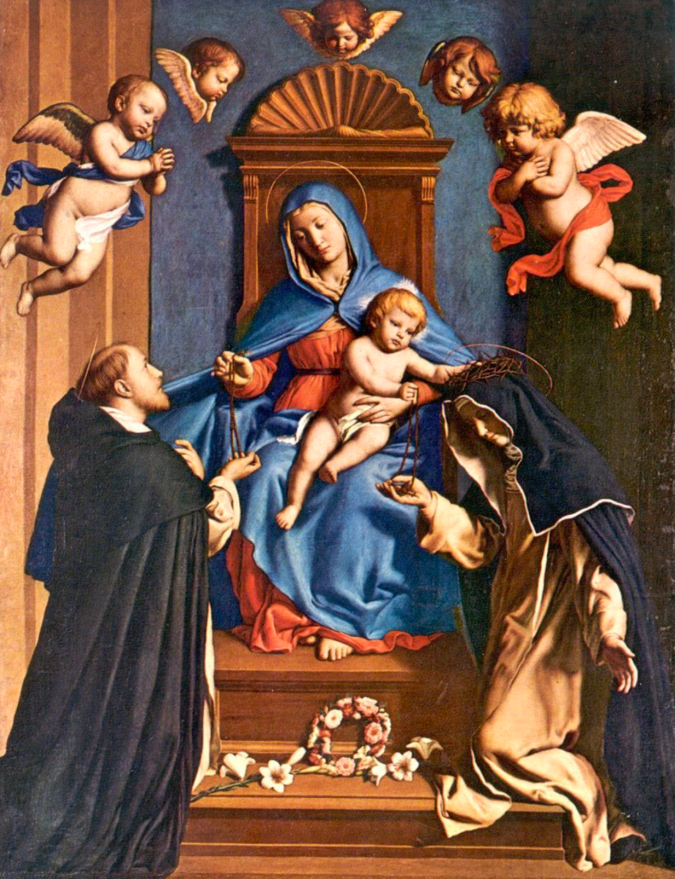
May Our Lady of the Rosary pray for us. (Source)

Over on Twitter, I refer my readers to an incredible thread from Joshua Jennings, who has posted images from an antique book on the fifteen mysteries of the Rosary. The illustrations are delightful, the devotion is manifest, and the typology is sound. Do give it a look.

At Vultus Christi, there is an excellent meditation on the spiritual power of the Rosary. Here’s an excerpt:

The Rosary confounds complexity and decapitates spiritual pride. There is no problem or difficulty that cannot be solved or resolved by faithful persevering recourse to Mary’s Psalter. The Rosary is the gift of the Mother of God to the poor and the powerless, who alone are capable of hearing the Gospel in all its purity, and of responding to it with a generous heart. It is to such as these — the childlike and the weak, the poor and the trusting — that the Rosary is given. It is to such as these that the Rosary belongs.

Read the whole thing.

Elsewhere: Mother Mectilde de Bar and the Prayer of Devekut

One of the great works of Vultus Christi has been the exposure of many English-speaking Catholics to the spiritual treasures of the continental Benedictine tradition, especially the life and work of Mother Mectilde de Bar. The good nun was a profound mystic of the Eucharist and a spiritual heir to the French School. Anyone with any interest in Benedictine life, Catholicism in early modern France, or spirituality generally should take note.
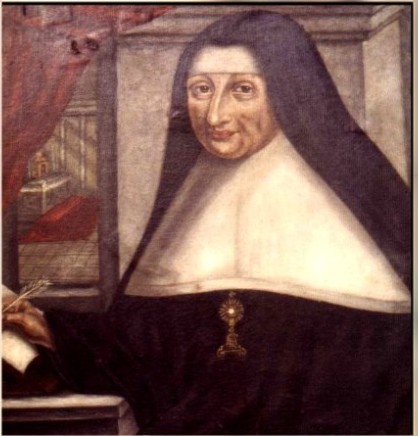
MechtildeBNF.jpg

Mother Mectilde de Bar (1614-1698), foundress of the Benedictines of Perpetual Adoration of the Most Blessed Sacrament of the Altar. (Source)

I am very happy to refer my readers to an excellent translation of one of Mother Mectilde’s letters of spiritual direction. The translator, an Oblate of Silverstream, has rendered the 17th century French into elegant and very readable English. A job well done!

Here’s a particularly potent excerpt:

The whole of Christian perfection consists in continual attention to Jesus Christ, and a constant adherence or submission to His good pleasure. These two points contain everything, and their faithful practice will lead you to the highest degree of perfection. Blessed is the soul who observes them.

The first point consists in seeing Jesus Christ in everything; in all events and in all our dealings; in such way that this divine sight removes from us the sight of creatures, ourselves, and our interests, in order to see nothing except Jesus Christ. In a word, it is to have the presence of God continually.

The second point consists in being constantly submissive to His holy will; in being so much subject to His good pleasure that we no longer have any return, at least voluntarily, by which we can withdraw from this respectful obedience.

I am reminded, in reading this passage, of a concept in Jewish mysticism called devekut. To practice devekut is to cleave to God constantly, even in the midst of everyday, profane activities. The Rabbis who founded and nurtured Hasidism in the 18th century made it a central feature of their mystical praxis, though the idea has roots in the Temple traditions of the Old Testament (vide Barker 2004, 37). Dr. Margaret Barker notes that, according to the older, priestly understanding of the word “cleaving” in Hebrew, “to cleave” meant quite literally to join. However, this sense was displaced when the Moses-focused Deuteronomist tradition came to ascendance. The new meaning of “cleaving” was, instead, obedience (Ibid. 37). Mother Mectilde has here joined both meanings in a salutary way.

Holy-Eucharist-Icon.jpg

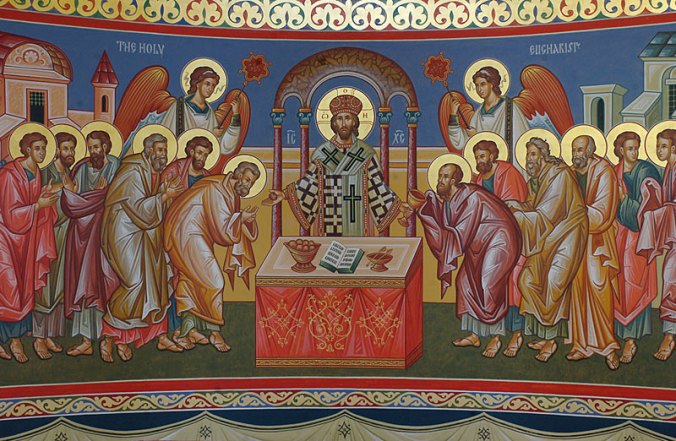
An icon of the Holy Eucharist, showing Christ the High Priest in the Holy of Holies. (Source)

However, I think she places a bit more emphasis on the first, as the primary and indispensable basis of the second. She goes on to write,

Have Jesus Christ imprinted and carved on the center of your soul. Have him in all the faculties of your mind. May your heart be able to think of and long for nothing except Jesus Christ.  May your whole inclination be to please Him. Attach all your fortunes and your happiness to knowing and loving Jesus Christ.[1] May nothing on earth, however great it seems, prevail in you against the constant union you should have with Jesus Christ. May neither heaven, nor earth, nor hell, nor any power, ever separate you from Him.[2]

She continues on and apostraphizes Divine Love, writing

O Jesus all powerful and all love, work in us these two effects of mercy: attract us by your omnipotence and transform us by your love into Yourself.

O love, O love divine, may you burn in us, and that you may consume in us everything that is contrary to you and opposed to your workings.

O life that is not animated by love, how can you be called life? You are a hideous death, and most terrible.

O pure and holy love of Jesus Christ, do not allow a single moment of my life to be spent without love; make me die and throw me into hell a thousand times rather than not to love Jesus Christ.

The first line here is the key; this is the loving and even conjugal language of devekut, not simple obedience. But obedience is implied as the sustaining force and natural result of such attentive love.

Hesychast.jpg

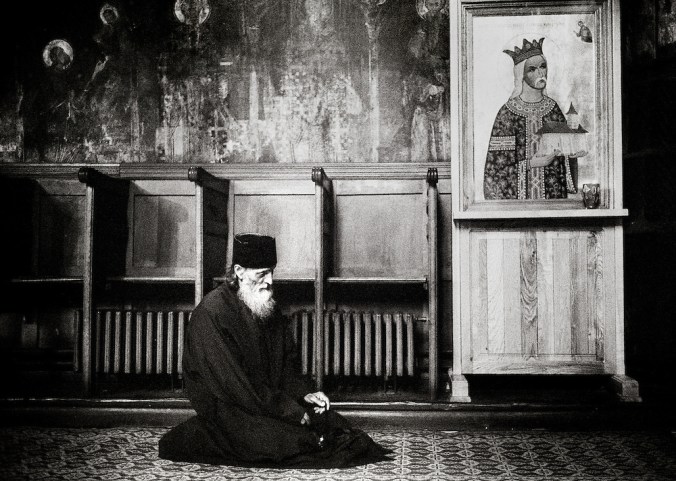
A hesychast at prayer. (Source)

It seems appropriate to me that Mother Mectilde, a Benedictine, should advocate for this kind of “cleaving” prayer, vigilant love in every moment. It has always been the task of the monastic throughout history to preserve this kind of remembrance of God that is itself a form of His presence in the heart. Precisely this “cleaving” constitutes the positive good underlying hesychasm in the East, but it can also be found in many monastic writers of both East and West. Mother Mectilde is not speaking alone. Indeed, she expresses the perennial Wisdom that has always infused the monastic life and made it fruitful.

Read the whole thing over at Vultus Christi.
Four Luminous Days

ascension-header

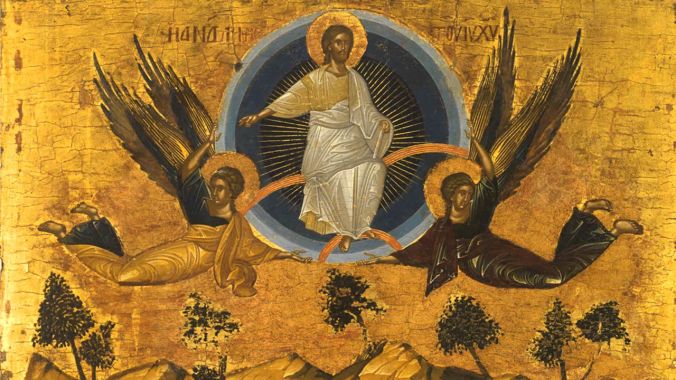
From an Icon of the Ascension. (Source)

This week, we are about to enter a truly remarkable liturgical sequence.

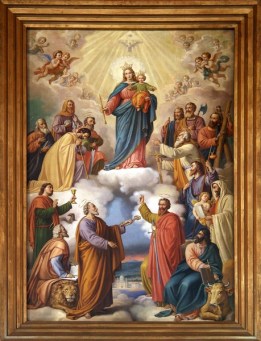
MariaAuxiliadoracuadro

Our Lady, Help of Christians. (Source)

Wednesday is Our Lady, Help of Christians, patroness of my parish here in South Carolina.

Thursday is the Ascension (sadly moved to Sunday in my province of Atlanta).

Friday is St. Philip Neri, and then on Saturday comes Our Lady of the Cenacle.

We could extend our reckoning to Sunday, but for now, I think it is appropriate for us to hesitate on the threshold of the Mystical Sabbath. Let us instead examine only these four days and their import.

We begin and end the progression with Mary. First, we see her in her relation to humanity. She is the help of Christians. Then, we see her in relation to God. She receives the Holy Spirit. Taking both feasts together, we see Our Lady participating in God-humanity; she becomes the perfect emblem of Divine Wisdom.

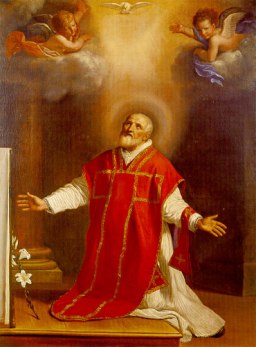
StPhilipHS

St. Philip Neri, who received the Holy Spirit in the catacombs. (Source)

Studying Sophiology has made me appreciate Our Lady of the Cenacle even more. There is a deep connection, I think, between the manifestation of Divine Wisdom in the creation of the Cosmos, at the Baptism of Christ, and at the descent of the Spirit upon Our Lady at Pentecost. They are mutually illuminating events. I wonder if we can find that connection at the level of the propers for each liturgy, a project I may try to engage in before Saturday.

And how appropriate that St. Philip, who experienced his own Pentecost in the catacombs of St. Sebastian, should go forth as a herald for Our Lady of the Cenacle! It is a kind of liturgical proof of the hierarchical principle, that we are led by lower things to higher things. St. Philip received the Holy Spirit into his heart as a ball of fire in the catacombs under the city of Rome, once a place of persecution, the mythical “Babylon” of Revelation. He guides us to Our Lady as she waits and prays in the Cenacle, the Upper Room in Jerusalem where the sacraments of the Eucharist and Orders were instituted and where the Holy Spirit descended upon the Church in tongues of fire on Pentecost. What a picture of the historical Church in pilgrimage! From the darkness of the Roman catacombs to the heights of the upper room in Zion. We could read an eschatology out of these mystical days.

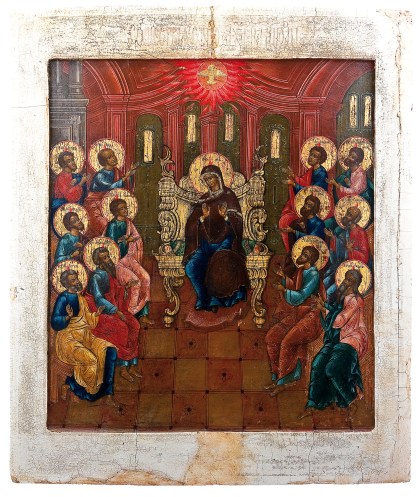
RussianPentecostIcon

Russian Icon of Pentecost, 18th century. The Slavs are unique among the Eastern Orthodox in placing Our Lady in the scene. (Source).


Nevertheless, this week’s procession is easy to overlook, since its central diamond, the Ascension, has been misplaced by so many bishops. Celebrating the feast on Sunday robs it of its truly Eucharistic meaning, for the Ascension’s traditional place on a Thursday meant that it could only be read through the texts of Maundy Thursday. Ascension Day is to Maundy Thursday as Pentecost is to Easter, the initiator of a new liturgical season and a reminder of the Mystical Priesthood of Christ. All of this is admirably explained by Dom Mark Daniel Kirby OSB in his podcasted homilies and in his blog, Vultus Christi.

The Eucharistic and Priestly meaning of the Ascension matters for the rest of the four-day sequence insofar as the Eucharist represents, sustains, and completes every instantiation of Sophianic being. The Sophianic character of the four days can only be discerned in the light of Christ’s face as He ascends into his cosmic priesthood on Thursday. This would be true even if St. Philip were not there to complete the set. This is, after all, a fairly uniqueE situation. Ever spry, St. Philip moves around the sacred calendar with the bustling rhythms of profane time. But in this auspicious year, so full of historical resonances and providential patterns, let us rejoice in the days that the Lord has made (Psalm 118).