Newman on the Cross of Christ

image

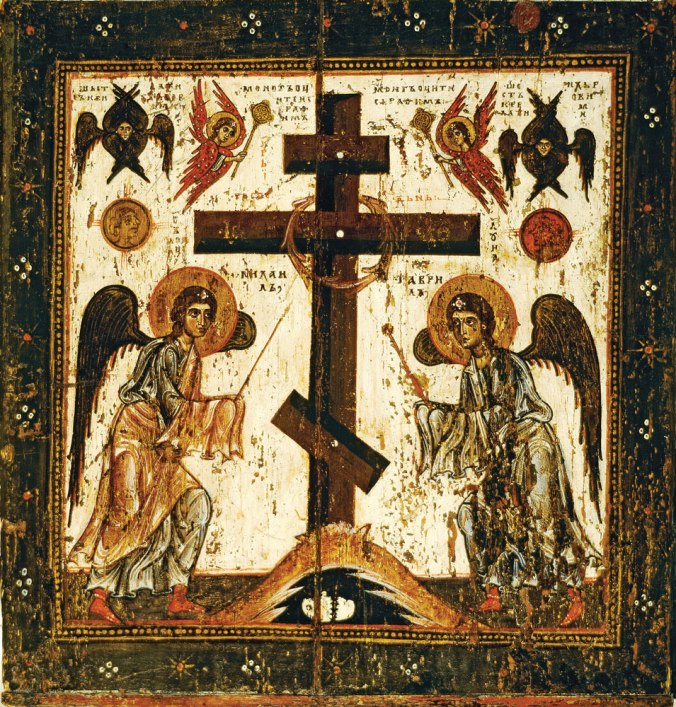
An icon of the Holy Cross. (Source)

My favorite sermon by John Henry Newman is directly germane to our feast today. He preached it at St. Mary the Virgin, Oxford, while still an Anglican. Though originally delivered on the sixth Sunday of Lent, the text fits admirably for today’s mystery, I take it from the Newman Reader, which makes available all of his writings for free online.

The Cross of Christ the Measure of the World

“And I, if I be lifted up from the earth, will draw all men unto Me.” John xii. 32.

A GREAT number of men live and die without reflecting at all upon the state of things in which they find themselves. They take things as they come, and follow their inclinations as far as they have the opportunity. They are guided mainly by pleasure and pain, not by reason, principle, or conscience; and they do not attempt to interpret this world, to determine what it means, or to reduce what they see and feel to system. But when persons, either from thoughtfulness of mind, or from intellectual activity, begin to contemplate the visible state of things into which they are born, then forthwith they find it a maze and a perplexity. It is a riddle which they cannot solve. It seems full of contradictions and without a drift. Why it is, and what it is to issue in, and how it is what it is, and how we come to be introduced into it, and what is our destiny, are all mysteries.

In this difficulty, some have formed one philosophy of life, and others another. Men have thought they had found the key, by means of which they might read what is so obscure. Ten thousand things come before us one after another in the course of life, and what are we to think of them? what colour are we to give them? Are we to look at all things in a gay and mirthful way? or in a melancholy way? in a desponding or a hopeful way? Are we to make light of life altogether, or to treat the whole subject seriously? Are we to make greatest things of little consequence, or least things of great consequence? Are we to keep in mind what is past and gone, or are we to look on to the future, or are we to be absorbed in what is present? How are we to look at things? this is the question which all persons of observation ask themselves, and answer each in his own way. They wish to think by rule; by something within them, which may harmonize and adjust what is without them. Such is the need felt by reflective minds. Now, let me ask, what is the real key, what is the Christian interpretation of this world? What is given us by revelation to estimate and measure this world by? The event of this season,—the Crucifixion of the Son of God.

It is the death of the Eternal Word of God made flesh, which is our great lesson how to think and how to speak of this world. His Cross has put its due value upon every thing which we see, upon all fortunes, all advantages, all ranks, all dignities, all pleasures; upon the lust of the flesh, and the lust of the eyes, and the pride of life. It has set a price upon the excitements, the rivalries, the hopes, the fears, the desires, the efforts, the triumphs of mortal man. It has given a meaning to the various, shifting course, the trials, the temptations, the sufferings, of his earthly state. It has brought together and made consistent all that seemed discordant and aimless. It has taught us how to live, how to use this world, what to expect, what to desire, what to hope. It is the tone into which all the strains of this world’s music are ultimately to be resolved.

Look around, and see what the world presents of high and low. Go to the court of princes. See the treasure and skill of all nations brought together to honour a child of man. Observe the prostration of the many before the few. Consider the form and ceremonial, the pomp, the state, the circumstance; and the vainglory. Do you wish to know the worth of it all? look at the Cross of Christ.

Go to the political world: see nation jealous of nation, trade rivalling trade, armies and fleets matched against each other. Survey the various ranks of the community, its parties and their contests, the strivings of the ambitious, the intrigues of the crafty. What is the end of all this turmoil? the grave. What is the measure? the Cross.

Go, again, to the world of intellect and science: consider the wonderful discoveries which the human mind is making, the variety of arts to which its discoveries give rise, the all but miracles by which it shows its power; and next, the pride and confidence of reason, and the absorbing devotion of thought to transitory objects, which is the consequence. Would you form a right judgment of all this? look at the Cross.

Again: look at misery, look at poverty and destitution, look at oppression and captivity; go where food is scanty, and lodging unhealthy. Consider pain and suffering, diseases long or violent, all that is frightful and revolting. Would you know how to rate all these? gaze upon the Cross.

Thus in the Cross, and Him who hung upon it, all things meet; all things subserve it, all things need it. It is their centre and their interpretation. For He was lifted up upon it, that He might draw all men and all things unto Him.

But it will be said, that the view which the Cross of Christ imparts to us of human life and of the world, is not that which we should take, if left to ourselves; that it is not an obvious view; that if we look at things on their surface, they are far more bright and sunny than they appear when viewed in the light which this season casts upon them. The world seems made for the enjoyment of just such a being as man, and man is put into it. He has the capacity of enjoyment, and the world supplies the means. How natural this, what a simple as well as pleasant philosophy, yet how different from that of the Cross! The doctrine of the Cross, it may be said, disarranges two parts of a system which seem made for each other; it severs the fruit from the eater, the enjoyment from the enjoyer. How does this solve a problem? does it not rather itself create one?

I answer, first, that whatever force this objection may have, surely it is merely a repetition of that which Eve felt and Satan urged in Eden; for did not the woman see that the forbidden tree was “good for food,” and “a tree to be desired”? Well, then, is it wonderful that we too, the descendants of the first pair, should still be in a world where there is a forbidden fruit, and that our trials should lie in being within reach of it, and our happiness in abstaining from it? The world, at first sight, appears made for pleasure, and the vision of Christ’s Cross is a solemn and sorrowful sight interfering with this appearance. Be it so; but why may it not be our duty to abstain from enjoyment notwithstanding, if it was a duty even in Eden?

But again; it is but a superficial view of things to say that this life is made for pleasure and happiness. To those who look under the surface, it tells a very different tale. The doctrine of the Cross does but teach, though infinitely more forcibly, still after all it does but teach the very same lesson which this world teaches to those who live long in it, who have much experience in it, who know it. The world is sweet to the lips, but bitter to the taste. It pleases at first, but not at last. It looks gay on the outside, but evil and misery lie concealed within. When a man has passed a certain number of years in it, he cries out with the Preacher, “Vanity of vanities, all is vanity.” Nay, if he has not religion for his guide, he will be forced to go further, and say, “All is vanity and vexation of spirit;” all is disappointment; all is sorrow; all is pain. The sore judgments of God upon sin are concealed within it, and force a man to grieve whether he will or no. Therefore the doctrine of the Cross of Christ does but anticipate for us our experience of the world. It is true, it bids us grieve for our sins in the midst of all that smiles and glitters around us; but if we will not heed it, we shall at length be forced to grieve for them from undergoing their fearful punishment. If we will not acknowledge that this world has been made miserable by sin, from the sight of Him on whom our sins were laid, we shall experience it to be miserable by the recoil of those sins upon ourselves.

It may be granted, then, that the doctrine of the Cross is not on the surface of the world. The surface of things is bright only, and the Cross is sorrowful; it is a hidden doctrine; it lies under a veil; it at first sight startles us, and we are tempted to revolt from it. Like St. Peter, we cry out, “Be it far from Thee, Lord; this shall not be unto Thee.” [Matt. xvi. 22.] And yet it is a true doctrine; for truth is not on the surface of things, but in the depths.

And as the doctrine of the Cross, though it be the true interpretation of this world, is not prominently manifested in it, upon its surface, but is concealed; so again, when received into the faithful heart, there it abides as a living principle, but deep, and hidden from observation. Religious men, in the words of Scripture, “live by the faith of the Son of God, who loved them and gave Himself for them:” [Gal. ii. 20.] but they do not tell this to all men; they leave others to find it out as they may. Our Lord’s own command to His disciples was, that when they fast, they should “anoint their head and wash their face.” [Matt. vi. 17.] Thus they are bound not to make a display, but ever to be content to look outwardly different from what they are really inwardly. They are to carry a cheerful countenance with them, and to control and regulate their feelings, that those feelings, by not being expended on the surface, may retire deep into their hearts and there live. And thus “Jesus Christ and He crucified” is, as the Apostle tells us, “a hidden wisdom;”—hidden in the world, which seems at first sight to speak a far other doctrine,—and hidden in the faithful soul, which to persons at a distance, or to chance beholders, seems to be living but an ordinary life, while really it is in secret holding communion with Him who was “manifested in the flesh,” “crucified through weakness,” “justified in the Spirit, seen of angels, and received up into glory.”

This being the case, the great and awful doctrine of the Cross of Christ, which we now commemorate, may fitly be called, in the language of figure, the heart of religion. The heart may be considered as the seat of life; it is the principle of motion, heat, and activity; from it the blood goes to and fro to the extreme parts of the body. It sustains the man in his powers and faculties; it enables the brain to think; and when it is touched, man dies. And in like manner the sacred doctrine of Christ’s Atoning Sacrifice is the vital principle on which the Christian lives, and without which Christianity is not. Without it no other doctrine is held profitably; to believe in Christ’s divinity, or in His manhood, or in the Holy Trinity, or in a judgment to come, or in the resurrection of the dead, is an untrue belief, not Christian faith, unless we receive also the doctrine of Christ’s sacrifice. On the other hand, to receive it presupposes the reception of other high truths of the Gospel besides; it involves the belief in Christ’s true divinity, in His true incarnation, and in man’s sinful state by nature; and it prepares the way to belief in the sacred Eucharistic feast, in which He who was once crucified is ever given to our souls and bodies, verily and indeed, in His Body and in His Blood. But again, the heart is hidden from view; it is carefully and securely guarded; it is not like the eye set in the forehead, commanding all, and seen of all: and so in like manner the sacred doctrine of the Atoning Sacrifice is not one to be talked of, but to be lived upon; not to be put forth irreverently, but to be adored secretly; not to be used as a necessary instrument in the conversion of the ungodly, or for the satisfaction of reasoners of this world, but to be unfolded to the docile and obedient; to young children, whom the world has not corrupted; to the sorrowful, who need comfort; to the sincere and earnest, who need a rule of life; to the innocent, who need warning; and to the established, who have earned the knowledge of it.

One more remark I shall make, and then conclude. It must not be supposed, because the doctrine of the Cross makes us sad, that therefore the Gospel is a sad religion. The Psalmist says, “They that sow in tears shall reap in joy;” and our Lord says, “They that mourn shall be comforted.” Let no one go away with the impression that the Gospel makes us take a gloomy view of the world and of life. It hinders us indeed from taking a superficial view, and finding a vain transitory joy in what we see; but it forbids our immediate enjoyment, only to grant enjoyment in truth and fulness afterwards. It only forbids us to begin with enjoyment. It only says, If you begin with pleasure, you will end with pain. It bids us begin with the Cross of Christ, and in that Cross we shall at first find sorrow, but in a while peace and comfort will rise out of that sorrow. That Cross will lead us to mourning, repentance, humiliation, prayer, fasting; we shall sorrow for our sins, we shall sorrow with Christ’s sufferings; but all this sorrow will only issue, nay, will be undergone in a happiness far greater than the enjoyment which the world gives,—though careless worldly minds indeed will not believe this, ridicule the notion of it, because they never have tasted it, and consider it a mere matter of words, which religious persons think it decent and proper to use, and try to believe themselves, and to get others to believe, but which no one really feels. This is what they think; but our Saviour said to His disciples, “Ye now therefore have sorrow, but I will see you again, and your heart shall rejoice, and your joy no man taketh from you.” … “Peace I leave with you; My peace I give unto you; not as the world giveth, give I unto you.” [John xvi. 22; xiv. 27.] And St. Paul says, “The natural man receiveth not the things of the Spirit of God; for they are foolishness unto him; neither can he know them, because they are spiritually discerned.” “Eye hath not seen, nor ear heard, neither have entered into the heart of man, the things which God hath prepared for them that love Him.” [1 Cor. ii. 9, 14.] And thus the Cross of Christ, as telling us of our redemption as well as of His sufferings, wounds us indeed, but so wounds as to heal also.

And thus, too, all that is bright and beautiful, even on the surface of this world, though it has no substance, and may not suitably be enjoyed for its own sake, yet is a figure and promise of that true joy which issues out of the Atonement. It is a promise beforehand of what is to be: it is a shadow, raising hope because the substance is to follow, but not to be rashly taken instead of the substance. And it is God’s usual mode of dealing with us, in mercy to send the shadow before the substance, that we may take comfort in what is to be, before it comes. Thus our Lord before His Passion rode into Jerusalem in triumph, with the multitudes crying Hosanna, and strewing His road with palm branches and their garments. This was but a vain and hollow pageant, nor did our Lord take pleasure in it. It was a shadow which stayed not, but flitted away. It could not be more than a shadow, for the Passion had not been undergone by which His true triumph was wrought out. He could not enter into His glory before He had first suffered. He could not take pleasure in this semblance of it, knowing that it was unreal. Yet that first shadowy triumph was the omen and presage of the true victory to come, when He had overcome the sharpness of death. And we commemorate this figurative triumph on the last Sunday in Lent, to cheer us in the sorrow of the week that follows, and to remind us of the true joy which comes with Easter-Day.

And so, too, as regards this world, with all its enjoyments, yet disappointments. Let us not trust it; let us not give our hearts to it; let us not begin with it. Let us begin with faith; let us begin with Christ; let us begin with His Cross and the humiliation to which it leads. Let us first be drawn to Him who is lifted up, that so He may, with Himself, freely give us all things. Let us “seek first the kingdom of God and His righteousness,” and then all those things of this world “will be added to us.” They alone are able truly to enjoy this world, who begin with the world unseen. They alone enjoy it, who have first abstained from it. They alone can truly feast, who have first fasted; they alone are able to use the world, who have learned not to abuse it; they alone inherit it, who take it as a shadow of the world to come, and who for that world to come relinquish it.
 

Some Saints on the Holy Name of Mary

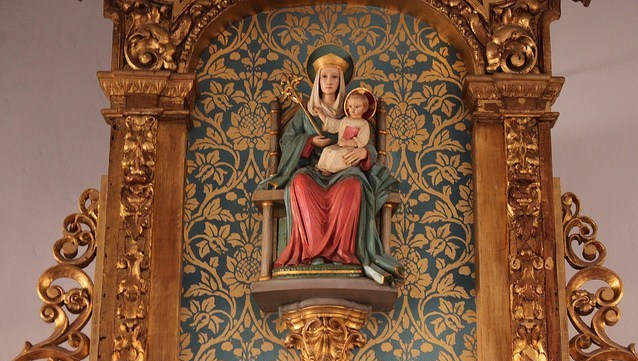
name-of-Mary

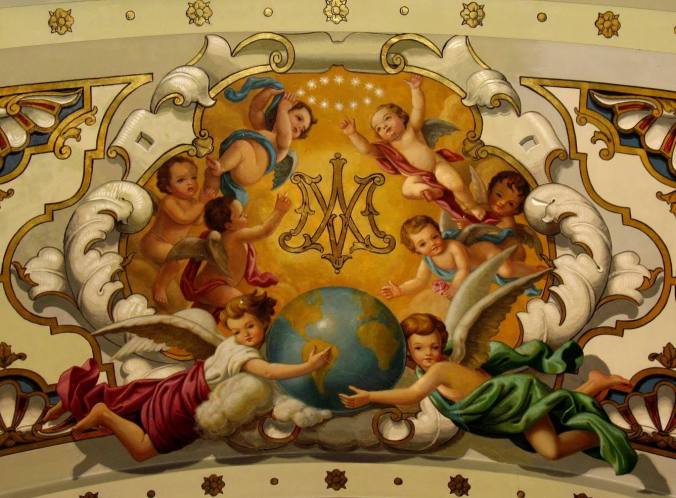
The Holy Name of Mary in a church mural. (Source)

The feast we celebrate today has moved around a bit. It only came to the kalendar in 1683, when Pope Innocent XI wished to commemorate the liberation of Vienna from the Ottoman siege. He originally placed it on the 17th, the Octave Day of Our Lady’s Nativity. The feast was later transferred to the 15th, and then done away with altogether by Archbishop Bugnini in one of his more obnoxious acts of liturgical vandalism. Pope St. John Paul II restored it in 2002, and now we celebrate it as an optional memorial on September 12th.

Accordingly, it behooves us to ponder the writings of the saints. For as it is a maxim in theology that we are led by lower things to higher, so we may pursue the heights of Our Lady’s throne only by the steps which our closer contemporaries have tread before us. Besides, while the feast may be relatively new in the life of the Church, the devotion it honors is much older. There is consequently much to choose from.

Consider the words of St. Bernard of Clairvaux.

Z_CAP005_052

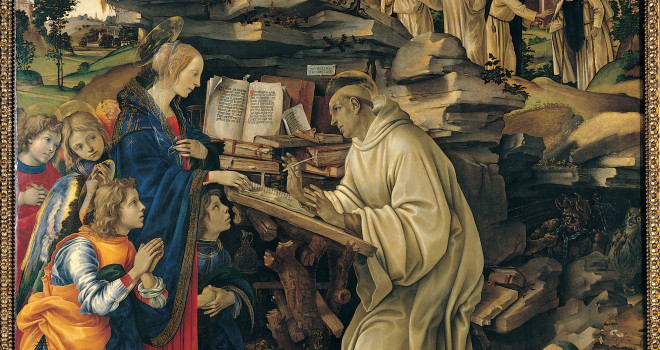
Apparition of the Virgin to St. Bernard, Detail. Filippino Lippi, 1480. (Source)

“And the Virgin’s name was Mary.” Let us speak a little about this name, which is said to mean “star of the sea,” and which so well befits the Virgin Mother. Rightly is she likened to a star. As a star emits a ray without being dimmed, so the Virgin brought forth her Son without receiving any injury. The ray takes naught from the brightness of the star, nor the Son from His Mother’s virginal integrity. This is the noble star risen out of Jacob, whose ray illumines the whole world, whose splendor shines in the heavens, penetrates the abyss, and, traversing the whole earth, gives warmth rather to souls than to bodies, cherishing virtues, withering vices. Mary is that bright and incomparable star, whom we need to see raised above this vast sea, shining by her merits, and giving us light by her example.

All of you, who see yourselves amid the tides of the world, tossed by storms and tempests rather than walking on the land, do not turn your eyes away from this shining star, unless you want to be overwhelmed by the hurricane. If temptation storms, or you fall upon the rocks of tribulation, look to the star: Call upon Mary! If you are tossed by the waves of pride or ambition, detraction or envy, look to the star, call upon Mary. If anger or avarice or the desires of the flesh dash against the ship o f your soul, turn your eyes to Mary. If troubled by the enormity of your crimes, ashamed of your guilty conscience, terrified by dread of the judgment, you begin to sink into the gulf of sadness or the abyss of despair, think of Mary. In dangers, in anguish, in doubt, think of Mary, call upon Mary. Let her name be even on your lips, ever in your heart; and the better to obtain the help of her prayers, imitate the example of her life:  “Following her, thou strayest not; invoking her, thou despairest not; thinking of her, thou wanderest not; upheld by her, thou fallest not; shielded by her, thou fearest not; guided by her, thou growest not weary; favored by her, thou reachest the goal. And thus dost thou experience in thyself how good is that saying: ‘And the Virgin’s name was Mary.'”

alphonsus_cross

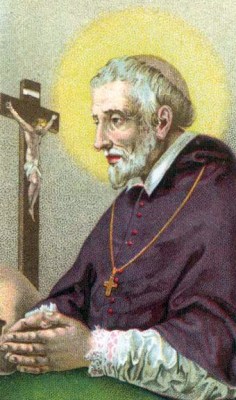
St. Alphonsus Liguori, author of The Glories of Mary. (Source)

St. Alphonsus Liguori, that Mariologist who so scrupulously records the thoughts of prior saints, affirms the antiquity and holiness of this devotion.

To begin with life, the holy anchorite, Honorius, says, that the name of Mary is [full] of all divine sweetness. And the glorious St. Anthony of Padua attributes to the name of Mary the same sweetness as St. Bernard attributed to the name of Jesus. The name of Jesus, said the latter, the name of Mary, said the former, is joy to the heart, honey to the mouth, melody to the ear of their devoted servants. It is related in the life of the venerable Father John Ancina, Bishop of Saluzzo, that when he pronounced the name of Mary, he experienced so great a sensible sweetness that he even tasted it on his lips. We also read that a certain woman in Cologne told the Bishop Marsillius, that whenever she pronounced the name of Mary she perceived in her mouth a taste sweeter than honey. Marsillius made the trial, and he also experienced the same sweetness. We read in the holy Canticles, that at the Assumption of the Virgin, the angels three times asked her name: “Who is she that goeth up by the desert as a pillar of smoke?” “Who is she that cometh forth as the morning rising?” And in another: “Who is this that cometh up from the desert, flowing with delights?” Richard of St. Laurence inquires why the angels so often asked the name of this queen, and answers: The sound of the name of Mary was so sweet to the angels, and they repeated the question that they might hear it repeated also.

But I do not hear speak of this sensible sweetness, since it is not commonly granted to all, but I speak of the salutary sweetness of consolation, love, joy, confidence, and strength, which the name of Mary universally gives to those who, with devotion, pronounce it. Speaking on this subject, Francone the Abbot says, that next to the holy name of Jesus, the name of Mary is so rich in blessings, that no other name is uttered on earth or in heaven from which devout souls receive so much grace, hope, and sweetness. For the name of Mary, he goes on to say, contains in itself something admirable, sweet, and divine, which, when it meets a friendly heart, breathes into it an odor of holy sweetness. And the wonder of this great name is, he concludes, that if heard a thousand times by the lovers of Mary, it is always heard as new, the sweetness they experience in hearing it spoken being always the same.

The blessed Henry Suso, also speaking of this sweetness, says, that in pronouncing the name of Mary, he felt his confidence so much increased, and his love so joyfully enkindled, that amidst the joy and tears with which he pronounced the beloved name, he thought his heart would have leaped from his mouth ; and he affirmed that this most sweet name, as honeycomb, melted into the depths of his soul. Whereat he exclaims: Oh most sweet name! oh Mary, what must thou thyself be, if thy name alone is so lovely and sweet?

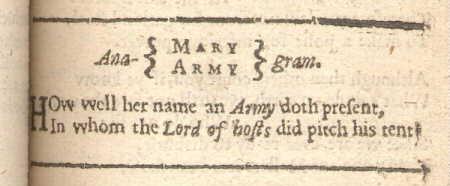
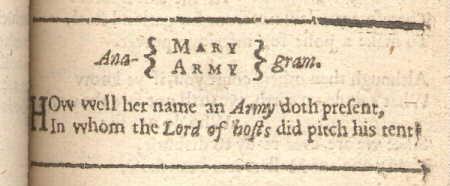
Nor is this devotion entirely absent outside the Church of Rome. One of George Herbert’s better epigrams runs as follows:

HerbertAnagram

“Anagram,” from The Temple. (Source)

Incidentally, the aforementioned Bishop of Saluzzo, Bl. John Juvenal Ancina, was a founder of the Naples Oratory and a personal disciple of St. Philip Neri. Can there be any doubt that the bishop learned his devotion at the side of his spiritual father?

img-Blessed-Giovanni-Giovenale-Ancina

Bl. Juvenal Ancina of the Oratory. (Source)

And we should learn it in turn from the saints who have gone before us, those holy men and women who now stand rejoicing in an eternal contemplation of Our Lady’s beatific name.

StPhilipNeriExhortinghtheYouth

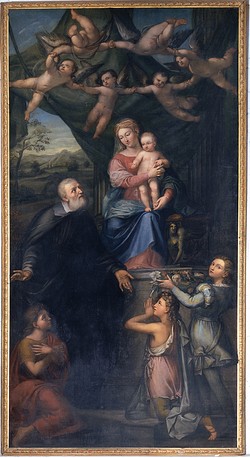
St. Philip Neri Exhorting the Youth to Pray to the Virgin, Pala Pietro. A good metaphor for how the saints instruct us in Marian devotion. (Source)


On the Coronation of the Coredemptrix

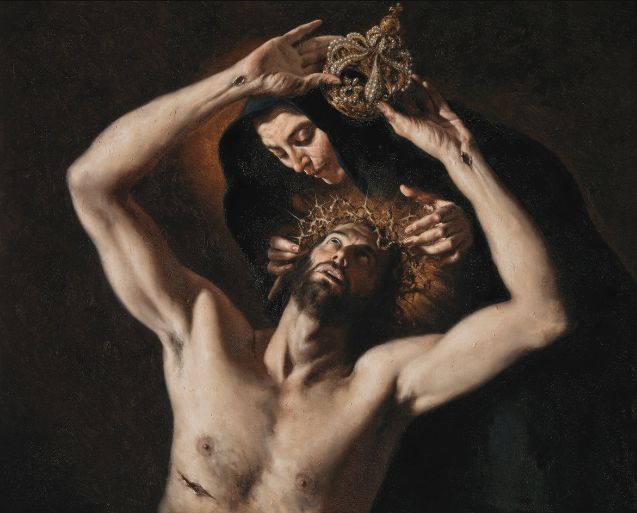
Corredenzione2

Corredenzione, by Giovanni Gasparro. This painting convinced my heart of the doctrine of the Co-Redemption of Mary. (Source).

It is appropriate on this Feast of Our Lady’s Coronation and Everlasting Queenship that we contemplate the fleeting thrones of this lesser world. Let us commemorate the loss of two great English dynasties, fixed on this day by Providence.

On Aug. 22, 1485, His Majesty King Richard III was defeated on Bosworth Field by a usurper from the House of the Tudors. The Red Dragon of Wales eclipsed the White Rose of York; years later, T.S. Eliot would wear the flower every 22nd of August.

RIII-Banner-RIIIF

The Personal Standard of Richard III. (Source).

On Aug. 22, 1642, His Majesty King Charles I raised the Royal Standard at Nottingham. This act has widely been considered the formal start of the English Civil War that would end in Puritan dictatorship, the slaughter of the Irish and Scots, and the martyrdom of the King himself for the doctrine of Episcopacy.

RoyalStandardStuarts.jpg

The Royal Standard of the Stuarts, 1603-1649. (Source).

Consider the leaden weight of these crowns. Worn by men alternately noble and feeble, loyal and inconstant, heroic and fearful, they rot away with the passage of time. The gilt of their craft and the earthly acclaim of their subjects have gone the way of all flesh. Those crowns are memories, but even in memory they do not earn the glory and affection they once inspired. Their reputations are occulted with cumbersome connotations. Richard has been much maligned ever since his death, in part by no less a personage than Shakespeare himself. Charles, a more complicated figure, has been swallowed up by his role as the symbolic center of Tory anxieties and Whig acrimony for the better part of four centuries. More bitterly, both kings “Accept the constitution of silence/And are folded in a single party.” They have become an unimportant datum of historical trivia for most people, even in England.

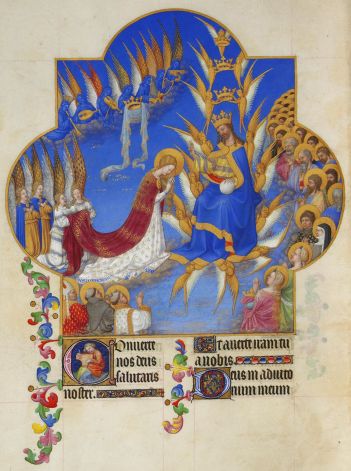
the-coronation-of-the-virginLimbourg.jpg

The Coronation of the Virgin, by the Limbourg Brothers. (Source)

How unlike those crowns is that won by Mary! She who was immaculately conceived and preserved from every stain of sin never sullies her crown by any failure of virtue. Having borne the Son of God in her womb, no other glory could ever outstrip what she has already known in her perpetually virginal maternity. Assumed into heaven, she is preserved from the terrible corruption of the grave. And now, as the Church celebrates the Octave Day of the Assumption, we contemplate the eternal joy which her coronation engenders in all the ranks of the blessed. All generations have called her blessed, and all will forevermore. She will never be reduced in the eyes of the world, because no one is more perfect in the eyes of God.

Has there ever been so marvelous a creature as Mary? Can we name, in the orderly chaos of the creation, a being more closely united to the Trinity? Who else among mere mortals has been lauded as “More honorable than the Cherubim, and more glorious beyond compare than the Seraphim?” In her burns the fire of charity; in her grows the ground of humility; in her flows the water of purity; in her soars the mighty wind of patience. She is the New and Sophianic Eve, in which the Wisdom of God is most clearly manifest.

And why? Because she is the threefold Mother of the Redeemer. First, by her Fiat, she assents to a physical maternity of the Word Incarnate. Second, by the sorrows of her Immaculate Heart at the Cross, she wins a sacramental maternity of Christ in the Eucharist. And third, by her prayer in the Cenacle on Pentecost, she gains a mystical maternity of Christ in the whole Church. This threefold motherhood is but one theandric maternityand thus we see the Trinitarian character of Our Lady’s co-redemption. She and she alone of all mankind is so favored and so bound to the work of Christ.

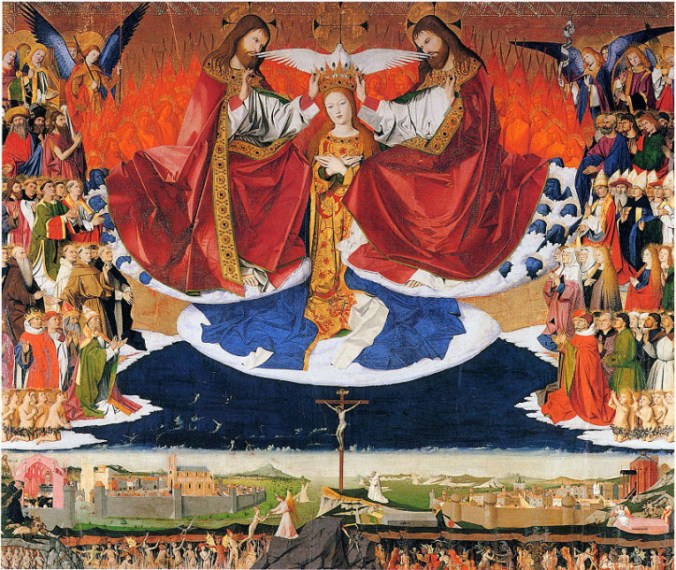
art-and-liturgy-enguerrand-quarton-coronation-of-the-virgin-1454

Coronation of the Virgin, Enguerrand Quarton. 1454. (Source). Mary crowned by the Trinity is surely an icon of the Eschaton.

A friend of mine passed on this passage from St. Amadeus of Lausanne, a Cistercian most famous for his eight homilies in praise of the Mother of God. He took it from Universalis, which gives the full liturgy of the hours online. Thus, the Church particularly commends these words to us on this holy day:

Observe how fitting it was that even before her assumption the name of Mary shone forth wondrously throughout the world. Her fame spread everywhere even before she was raised above the heavens in her magnificence. Because of the honour due her Son, it was indeed fitting for the Virgin Mother to have first ruled upon earth and then be raised up to heaven in glory. It was fitting that her fame be spread in this world below, so that she might enter the heights of heaven on overwhelming blessedness. Just as she was borne from virtue to virtue by the Spirit of the Lord, she was transported from earthly renown to heavenly brightness.

So it was that she began to taste the fruits of her future reign while still in the flesh. At one moment she withdrew to God in ecstasy; at the next she would bend down to her neighbours with indescribable love. In heaven angels served her, while here on earth she was venerated by the service of men. Gabriel and the angels waited upon her in heaven. The virgin John, rejoicing that the Virgin Mother was entrusted to him at the cross, cared for her with the other apostles here below. The angels rejoiced to see their queen; the apostles rejoiced to see their lady, and both obeyed her with loving devotion.

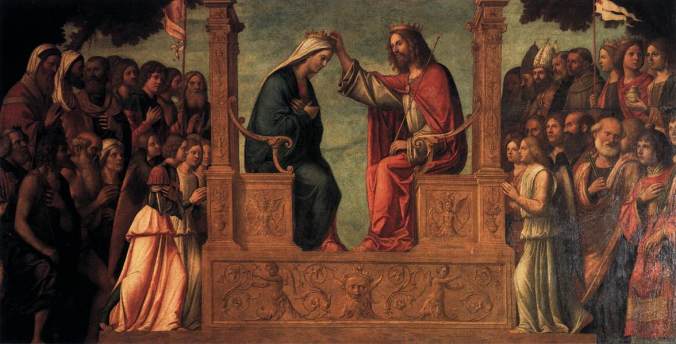
the-coronation-of-the-virginCimaThe Coronation of the Virgin, Cima da Conegliano. (Source).
Dwelling in the loftiest citadel of virtue, like a sea of divine grace or an unfathomable source of love that has everywhere overflowed its banks, she poured forth her bountiful waters on trusting and thirsting souls. Able to preserve both flesh and spirit from death she bestowed health-giving salve on bodies and souls. Has anyone ever come away from her troubled or saddened or ignorant of the heavenly mysteries? Who has not returned to everyday life gladdened and joyful because his request had been granted by the Mother of God?

She is a bride, so gentle and affectionate, and the mother of the only true bridegroom. In her abundant goodness she has channelled the spring of reason’s garden, the well of living and life-giving waters that pour forth in a rushing stream from divine Lebanon and flow down from Mount Zion until they surround the shores of every far-flung nation. With divine assistance she has redirected these waters and made them into streams of peace and pools of grace. Therefore, when the Virgin of virgins was led forth by God and her Son, the King of kings, amid the company of exulting angels and rejoicing archangels, with the heavens ringing with praise, the prophecy of the psalmist was fulfilled, in which he said to the Lord: At your right hand stands the queen, clothed in gold of Ophir.

WomanClothedWiththeSun

An illustration of “The Woman Clothed With the Sun.” (Source)

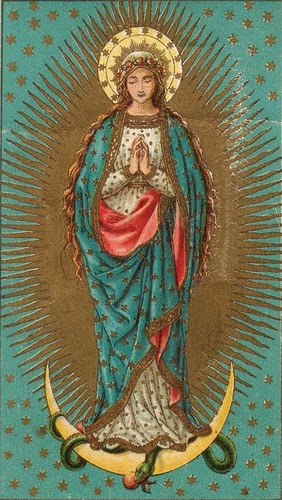
St. Amadeus is right; “Has anyone ever come away from her troubled or saddened or ignorant of the heavenly mysteries? Who has not returned to everyday life gladdened and joyful because his request had been granted by the Mother of God?” We who still struggle with sin on the path to beatitude cannot hope to achieve our goal if we will not be with and like Mary. We, too, are promised crowns. The scriptures mention five: the imperishable crown (1 Cor. 5:24-25), the crown of rejoicing (1 Thess. 2:19), the crown of righteousness (2 Tim. 4:8), the crown of glory (1 Pet. 5:4), and the crown of life (Rev. 2:10). Our Lady wears all these and seven more, for she is the “woman clothed with the sun, and the moon under her feet, and upon her head a crown of twelve stars” (Rev. 12:1 KJV). Are these other seven stars the seven gifts of the Holy Spirit, her spouse? Or the seven cardinal virtues? Or the seven sacraments that constitute the Church? Or the seven lesser ranks of the angels in praise of their queen? Impossible to say. Mary is not only the fountain of all holiness, but the mother of the Church’s deepest mysteries.

How might I end this praise of Our Lady that could properly continue ad infinitum? By returning to those lesser crowns with which I began.

Earthly splendor is no great thing. It can only be built on sufferingeither our own or that of others. Even when turned to good (as, I would argue, Charles I attempted to use his power), it reflects something of our fallen state. It is slippery, contingent, and as mortal as we are. But the glory of heaven is without end. Incorrupt and incorruptible, it abides in the gaze of the Father. Mary, above all creation, receives this kind of glory. She, the New Eve to the New Adam, mirrors Him in all things. Let us run after the course she trod before us, the course of Her Son’s redemption! Only by pursuing a life like Christ’s can we hope for a reward like Mary’s.

May she pray for us as we celebrate her feast today.

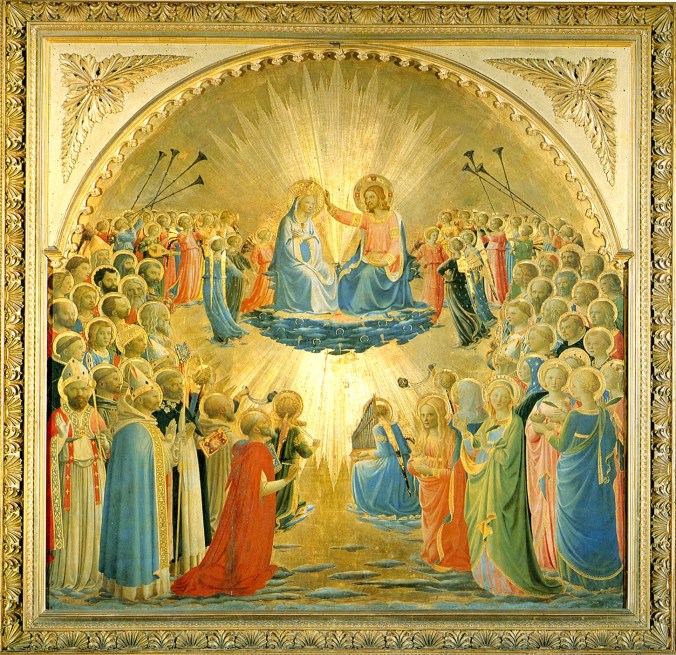
coronation-of-the-virgin-fra-angelico-big.jpg

“Coronation of the Virgin,” Fra Angelico. (Source). The Blessed Angelico returned to this subject throughout his career, but this version, hanging in the Uffizi Gallery, is my favorite.

A Prayer Request for St. Mary’s Day

OurLadyWalsinghamStBede

The National Shrine of Our Lady of Walsingham, St. Bede, Williamsburg, VA. (Source)

Of your charity, please pray for me. Today I begin a 33-day retreat for Marian Consecration. Normally I would not wish to broadcast such a spiritual undertaking on my blog, but since I know several of you, I would rather avail myself of your prayers than keep silent.

Astute Kalendar watchers will know that if I start today, on the Feast of Our Lady, Queen of Heaven, then the day of consecration will fall on September 24th. That’s the feast of Our Lady of Walsingham (well, technically not since it’s on a Sunday this year, but I don’t really care). I’ll be in London. Please pray that I might be able to pronounce the prayer at the Brompton Oratory if at all possible, and more importantly, that I might truly and obediently submit to Mary’s gentle guidance in all things.

Hail, holy Queen, Mother of mercy,
hail, our life, our sweetness and our hope.
To thee do we cry, poor banished children of Eve:
to thee do we send up our sighs,
mourning and weeping in this valley of tears.
Turn then, most gracious Advocate,
thine eyes of mercy toward us,
and after this our exile,
show unto us the blessed fruit of thy womb, Jesus.
O clement, O loving, O sweet Virgin Mary!

V. Pray for us, O Holy Mother of God,
R. That we might be made worthy of the promises of Christ.

Amen.

An Addendum on Charlottesville

LightShoneinDarkness

Fascists surrounding student protesters on the steps of the Rotunda, UVA, Charlottesville, Virginia. This photo was taken last Friday night, August 11th, 2017. (Source).

One last word.

Although it does not come from yesterday’s readings, a verse has been threading through my mind for the course of the weekend. Nazis brought burning torches onto the Lawn that was once my home, but those torches cast no light. They bristled with a darkness blacker and thicker than the shadows that lay all around in the night. The real illumination came from those few brave students under the statue of Jefferson, who resisted the onslaught of wicked men streaming down the steps of the Rotunda. Watching their courage, I can only think of those words from St. John the Divine:

“And the light shineth in darkness; and the darkness comprehended it not.

And After the Fire

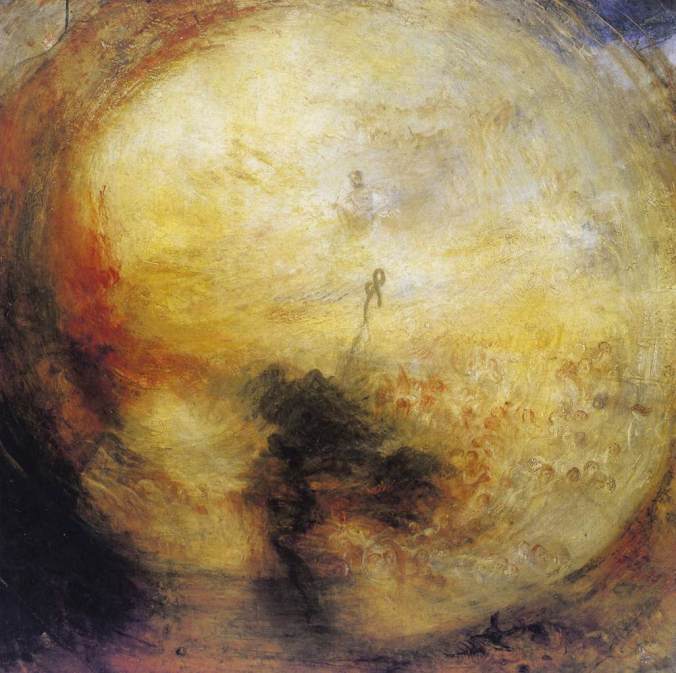
the-morning-after-the-deluge

“The Morning After the Deluge,” J.M.W. Turner, c. 1843. (Source).

I am still shocked and furious about the events of the last few days. Fascists of various sorts have descended upon Charlottesville, Virginiaa town I loved and called home for four years—and caused immense pain for the entire community. One woman, a Wobbly protester, died at the hands of a Neo-Nazi who rammed his car into a crowded alley. I had friends in the counter-protest. I had friends who feared for their lives. And all I could do was watch and pray. The Rosary, the Imprecatory Psalms, Invocations to St. Michael. But how I wish I could have done so much more.

I was following the news across Facebook, CNN television, and Twitter. I observed mixed responses. Some, even among baptized Catholics, sympathize with the Alt-Right fascists. They point the finger of blame at Antifa, the several Socialists who showed up in counterprotest, the Media, and Black Lives Matter activists. Likewise, some Christians equivocated. They were happy to condemn the Alt-Right briefly, while also complaining at length about how the Media wasn’t focusing on Antifa, or the Police didn’t do enough, or, incredibly, how all of this is really just the fault of the Democratic Party (here’s looking at you, John Zmirak and Dinesh D’Souza). Then, there were those brave Catholics like Chad Pecknold, Robert George, and Bishop Barron who condemned white supremacy and racism outright. And they received backlashshameful!from those who should know better.

But I haven’t lost hope.

The Liturgical Providence of God is so calibrated to our salvation that we receive the graces we need at precisely the moment we need them, even when we could never have anticipated needing them in the first place. It works even through a deficient calendar, such as we have in the Novus Ordo. For today, we read and hear about a great many disruptions and turbulent tumults. We turn first to the Prophet Elijah at Sinai where, having cast down fire from heaven upon the Prophets of Baal, he hides and waits for the Lord to speak.

At the mountain of God, Horeb,
Elijah came to a cave where he took shelter.
Then the LORD said to him,
“Go outside and stand on the mountain before the LORD;
the LORD will be passing by.”
A strong and heavy wind was rending the mountains
and crushing rocks before the LORD—
but the LORD was not in the wind.
After the wind there was an earthquake—
but the LORD was not in the earthquake.
After the earthquake there was fire—
but the LORD was not in the fire.
After the fire there was a tiny whispering sound.
When he heard this,
Elijah hid his face in his cloak
and went and stood at the entrance of the cave.

1 Kgs 19:9a, 11-13a

The wind rises high all about Elijah; it howls and screams like the very demons of Hell. It rushes up the mountain like the chariots of the wicked King who sought the prophet’s life. But the Lord was not in the wind.

The earthquake causes the whole mountain to tremble. Rocks shake as if they are about to be torn asunder by invisible hands. The trees seem to dance in an unholy rhythm, threaten to crack and topple over. But the Lord was not in the earthquake.

The fire courses across the plain and up the slopes, hungrily devouring the short desert grasses that line the path to Horeb’s cave. The smoke fills the air; the sweltering heat traps Elijah, and threatens to make a furnace of his narrow cell. But the Lord was not in the fire.

The Lord came, instead, in a “tiny whispering sound” that followed all that tumult and trial. The frightful violence of nature may have been sublime, and it may have sorely threatened Elijah. But it was empty. God does not dwell in the frenzy of the wind, the earthquake, and the fire. He comes in peace, and He meets His servant in peace.

This week’s Psalm takes up the same theme.

R. (8) Lord, let us see your kindness, and grant us your salvation.
I will hear what God proclaims;
the LORD — for he proclaims peace.
Near indeed is his salvation to those who fear him,
glory dwelling in our land.
R. Lord, let us see your kindness, and grant us your salvation.
Kindness and truth shall meet;
justice and peace shall kiss.
Truth shall spring out of the earth,
and justice shall look down from heaven.
R. Lord, let us see your kindness, and grant us your salvation.
The LORD himself will give his benefits;
our land shall yield its increase.
Justice shall walk before him,
and prepare the way of his steps.
R. Lord, let us see your kindness, and grant us your salvation.

Ps 85:9, 10, 11-12, 13-14

The peace and salvation of God is near to those who fear Him. A great mystery hovers within these lines: “Kindness and truth shall meet; justice and peace shall kiss. Truth shall spring out of the earth, and justice shall look down from heaven.”

Justice. Peace. Those are words that scare a lot of us traditionalists. After all, haven’t so many abuses of doctrine and the liturgy occurred precisely in the name of “social justice?” Haven’t whole orders been gutted by their worldly capitulation to liberal standards of “social justice” work? And aren’t the proverbial “Social Justice Warriors” the very people who most oppose the Church’s teachings on abortion, marriage, gender, and so many other issues?

All of these criticisms are valid. But they are not complete. Justice is a cardinal virtue. To quote one of the better Anglican principles, “The abuse of a thing doth not take away the good use of it.” Consider what the Psalm teaches us of God’s Justice. Here is a picture of the Last and Eternal Day, when the New Heavens and the Earth will united at the Wedding Feast of the Lamb. But we also find a practical insight for the here and now. When we read, “Justice shall walk before him, and prepare the way of his steps,” we recognize in this a prophecy of Christ. Our Lord, whose way was prepared by St. John the Baptist (that man so like an icon of Justice), is never far from Justice. The wind and earthquake and fire of injustice will one day yield to the peace of Christ. But in the meantime, we must do what we can to realize that justice in our own communities. Indeed, in our own hearts.

This can only begin when we faithfully repair to the sacrament of penance, confessing our sins with compunction, and seek to live always as Christ would have us. For some, this may mean abandoning deep bigotries like white supremacy or a hatred of the poor. It will be difficult for those caught in such snares to relinquish their demonic ideologies, so we must pray for them. But is there anyone among us who does not cherish some prejudice, some little parasite of pride, some vice that blinds us to the manifold ways we are complicit in the oppression of our brethren? Even I am no saint in this respect, and I pray that God’s mercy might change me to better reflect His love for all people.

For some, direct action may be the right course. I am not an activist. I started this essay confessing that I wish I could have done more to help those standing against white supremacists yesterday. Yet I recognize that I have a temperamental aversion to any kind of on-the-ground activism. The task of marching, picketing, and chanting songs of justice may be what some are called to. Dorothy Day provides a wonderful Catholic example of this kind of work.

And there are other strategies, which theologians and activists have pursued for years, that aim at incarnating Justice. It would be redundant to attempt any kind of review here. But no matter how we go about the task of Justice, we musn’t lose hope. Let us hear the commiserating words of St. Paul to the Romans:

Brothers and sisters:
I speak the truth in Christ, I do not lie;
my conscience joins with the Holy Spirit in bearing me witness
that I have great sorrow and constant anguish in my heart.
For I could wish that I myself were accursed and cut off from Christ
for the sake of my own people,
my kindred according to the flesh.
They are Israelites;
theirs the adoption, the glory, the covenants,
the giving of the law, the worship, and the promises;
theirs the patriarchs, and from them,
according to the flesh, is the Christ,
who is over all, God blessed forever. Amen.

Rom 9:1-5

Even amidst the anguish we feel for our brethren, we must not lose sight of the Holy Face triumphant. Nor must we forget that Justice is not itself the highest good. God is. With these two truths in mind, we turn to the Gospel.

After he had fed the people, Jesus made the disciples get into a boat
and precede him to the other side,
while he dismissed the crowds.
After doing so, he went up on the mountain by himself to pray.
When it was evening he was there alone.
Meanwhile the boat, already a few miles offshore,
was being tossed about by the waves, for the wind was against it.
During the fourth watch of the night,
he came toward them walking on the sea.
When the disciples saw him walking on the sea they were terrified.
“It is a ghost,” they said, and they cried out in fear.
At once Jesus spoke to them, “Take courage, it is I; do not be afraid.”
Peter said to him in reply,
“Lord, if it is you, command me to come to you on the water.”
He said, “Come.”
Peter got out of the boat and began to walk on the water toward Jesus.
But when he saw how strong the wind was he became frightened;
and, beginning to sink, he cried out, “Lord, save me!”
Immediately Jesus stretched out his hand and caught Peter,
and said to him, “O you of little faith, why did you doubt?”
After they got into the boat, the wind died down.
Those who were in the boat did him homage, saying,
“Truly, you are the Son of God.”

Mt 14:22-33

We learn from the Psalm that “Justice shall walk before him, and prepare the way of his steps.” So Our Lord sends forth His Apostles, His Church, to “precede him to the other side” of the sea. The Church mystically incarnates Justice at every Mass. And it can only hope to sustain Justice, a Cardinal Virtue, with Faith. For when Peter, Prince of the Apostles, goes out of the boat to walk towards His Lord, he only sinks when he loses his Faith in fear.

But all is not lost. Christ comes through the storm and shows that He is master of it. He walks on water. No tempest can withstand Him, just as no wind, earthquake, fire, flood, protest, or violence of this world can drown out His voice. No slogan of oppression, no act of terrorism, no brawl in the summer streets can overcome the peace that Christ alone brings in and to and through His Church.

I hope that my friends in Charlottesville will take heart. The last few days have been tempestuous, to say the least. But Christ will conquer the waves of this world. Have faith, and He will grant us both justice and peace.

The Catholic Poems of Oscar Wilde

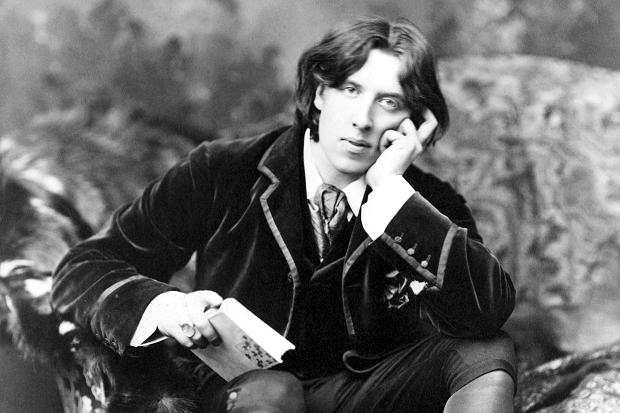
OscarWildeBook

Oscar Fingal O’Flahertie Wills Wilde (Source).

As I mentioned in my last post, during the month of August, I am dedicating myself to daily acts of creativity in honor of Mary’s Immaculate and Sophianic Heart. As Providence would have it, the Holy Father’s intentions for August include prayers for artists. Thus, I’m going to make my blog especially aesthetic for the rest of the month.

And what better way to start than examining work by one of the modern era’s great philosophers of art, Oscar Wilde? It is not often remembered today that Oscar Wilde was a Catholic. True, he was only formally received on his death bed. But Wilde maintained a lifelong flirtation with the faith. Catholicism infused his imagination from very early on in his productive career. When he was a student at Oxford, he visited Rome and wrote quasi-Catholic poetry that even Cardinal Newman admired. In some of the work, the influence of Dante is manifest. The aesthetics and romance of Catholicism appealed to Wilde, and he was nearly converted by Fr. Sebastian Bowden of the London Oratory. Only much later did he definitively turn to the Lord, in his last hour. However, many members of his circle also converted…a topic I shall, perhaps, explore some other day.

Ave Maria Gratia Plena

Was this His coming! I had hoped to see
A scene of wondrous glory, as was told
Of some great God who in a rain of gold
Broke open bars and fell on Danae:
Or a dread vision as when Semele
Sickening for love and unappeased desire
Prayed to see God’s clear body, and the fire
Caught her white limbs and slew her utterly:
With such glad dreams I sought this holy place,
And now with wondering eyes and heart I stand
Before this supreme mystery of Love:
A kneeling girl with passionless pale face,
An angel with a lily in his hand,
And over both with outstretched wings the Dove.

Sonnet on Approaching Italy

I reached the Alps: the soul within me burned
Italia, my Italia, at thy name:
And when from out the mountain’s heart I came
And saw the land for which my life had yearned,
I laughed as one who some great prize had earned:
And musing on the story of thy fame
I watched the day, till marked with wounds of flame
The turquoise sky to burnished gold was turned,
The pine-trees waved as waves a woman’s hair,
And in the orchards every twining spray
Was breaking into flakes of blossoming foam:
But when I knew that far away at Rome
In evil bonds a second Peter lay,
I wept to see the land so very fair.

Urbs Sacra Æterna

Rome! what a scroll of History thine has been
In the first days thy sword republican
Ruled the whole world for many an age’s span:
Then of thy peoples thou wert crownèd Queen,
Till in thy streets the bearded Goth was seen;
And now upon thy walls the breezes fan
(Ah, city crowned by God, discrowned by man!)
The hated flag of red and white and green.
When was thy glory! when in search for power
Thine eagles flew to greet the double sun,
And all the nations trembled at thy rod?
Nay, but thy glory tarried for this hour,
When pilgrims kneel before the Holy One,
The prisoned shepherd of the Church of God.

Sonnet on Hearing the Dies Irae Sung in the Sistine Chapel

Nay, Lord, not thus! white lilies in the spring,
Sad olive-groves, or silver-breasted dove,
Teach me more clearly of Thy life and love
Than terrors of red flame and thundering.
The hillside vines dear memories of Thee bring:
A bird at evening flying to its nest
Tells me of One who had no place of rest:
I think it is of Thee the sparrows sing.
Come rather on some autumn afternoon,
When red and brown are burnished on the leaves,
And the fields echo to the gleaner’s song,
Come when the splendid fulness of the moon
Looks down upon the rows of golden sheaves,
And reap Thy harvest: we have waited long.

Holy Week at Genoa

I wandered through Scoglietto’s far retreat,
The oranges on each o’erhanging spray
Burned as bright lamps of gold to shame the day;
Some startled bird with fluttering wings and fleet
Made snow of all the blossoms; at my feet
Like silver moons the pale narcissi lay:
And the curved waves that streaked the great green bay
Laughed i’ the sun, and life seemed very sweet.
Outside the young boy-priest passed singing clear,
‘Jesus the son of Mary has been slain,
O come and fill His sepulchre with flowers.’
Ah, God! Ah, God! those dear Hellenic hours
Had drowned all memory of Thy bitter pain,
The Cross, the Crown, the Soldiers and the Spear.

San Miniato

See, I have climbed the mountain side
Up to this holy house of God,
Where once that Angel-Painter trod
Who saw the heavens opened wide,

And throned upon the crescent moon
The Virginal white Queen of Grace,–
Mary! could I but see thy face
Death could not come at all too soon.

O crowned by God with thorns and pain!
Mother of Christ! O mystic wife!
My heart is weary of this life
And over-sad to sing again.

O crowned by God with love and flame!
O crowned by Christ the Holy One!
O listen ere the searching sun
Show to the world my sin and shame.

Madonna Mia

A lily-girl, not made for this world’s pain,
With brown, soft hair close braided by her ears,
And longing eyes half veiled by slumberous tears
Like bluest water seen through mists of rain:
Pale cheeks whereon no love hath left its stain,
Red underlip drawn in for fear of love,
And white throat, whiter than the silvered dove,
Through whose wan marble creeps one purple vein.
Yet, though my lips shall praise her without cease,
Even to kiss her feet I am not bold,
Being o’ershadowed by the wings of awe.
Like Dante, when he stood with Beatrice
Beneath the flaming Lion’s breast, and saw
The seventh Crystal, and the Stair of Gold.

E Tenebris

Come down, O Christ, and help me! reach thy hand,
For I am drowning in a stormier sea
Than Simon on thy lake of Galilee:
The wine of life is spilt upon the sand,
My heart is as some famine-murdered land,
Whence all good things have perished utterly,
And well I know my soul in Hell must lie
If I this night before God’s throne should stand.
‘He sleeps perchance, or rideth to the chase,
Like Baal, when his prophets howled that name
From morn to noon on Carmel’s smitten height.’
Nay, peace, I shall behold before the night,
The feet of brass, the robe more white than flame,
The wounded hands, the weary human face.

At Verona

How steep the stairs within Kings’ houses are
For exile-wearied feet as mine to tread,
And O how salt and bitter is the bread
Which falls from this Hound’s table,–better far
That I had died in the red ways of war,
Or that the gate of Florence bare my head,
Than to live thus, by all things comraded
Which seek the essence of my soul to mar.

‘Curse God and die: what better hope than this?
He hath forgotten thee in all the bliss
Of his gold city, and eternal day’–
Nay peace: behind my prison’s blinded bars
I do possess what none can take away,
My love, and all the glory of the stars.

On the Massacre of the Christians in Bulgaria

Christ, dost Thou live indeed? or are Thy bones
Still straitened in their rock-hewn sepulchre?
And was Thy Rising only dreamed by her
Whose love of Thee for all her sin atones?
For here the air is horrid with men’s groans,
The priests who call upon Thy name are slain,
Dost Thou not hear the bitter wail of pain
From those whose children lie upon the stones?
Come down, O Son of God! incestuous gloom
Curtains the land, and through the starless night
Over Thy Cross a Crescent moon I see!
If Thou in very truth didst burst the tomb
Come down, O Son of Man! and show Thy might
Lest Mahomet be crowned instead of Thee!

Queen Henrietta Maria

In the lone tent, waiting for victory,
She stands with eyes marred by the mists of pain,
Like some wan lily overdrenched with rain:
The clamorous clang of arms, the ensanguined sky,
War’s ruin, and the wreck of chivalry,
To her proud soul no common fear can bring:
Bravely she tarrieth for her Lord the King,
Her soul a-flame with passionate ecstasy.
O Hair of Gold! O Crimson Lips! O Face
Made for the luring and the love of man!
With thee I do forget the toil and stress,
The loveless road that knows no resting place,
Time’s straitened pulse, the soul’s dread weariness,
My freedom and my life republican!

On Easter Day

The silver trumpets rang across the Dome:
The people knelt upon the ground with awe:
And borne upon the necks of men I saw,
Like some great God, the Holy Lord of Rome.
Priest-like, he wore a robe more white than foam,
And, king-like, swathed himself in royal red,
Three crowns of gold rose high upon his head:
In splendor and in light the Pope passed home.
My heart stole back across wide wastes of years
To One who wandered by a lonely sea,
And sought in vain for any place of rest:
“Foxes have holes, and every bird its nest,
I, only I, must wander wearily,
And bruise My feet, and drink wine salt with tears.”

Wilde did just that until he lost his duel with the wallpaper on November 30th, 1900. But having received the last rites of the Church, perhaps he is already in heaven as a saint. One can only imagine what he would think of his portrait bedecked with a golden halo.

Elsewhere: A New Anglo-Catholic Blog

Ordination 1956 by Norman Blamey 1914-2000

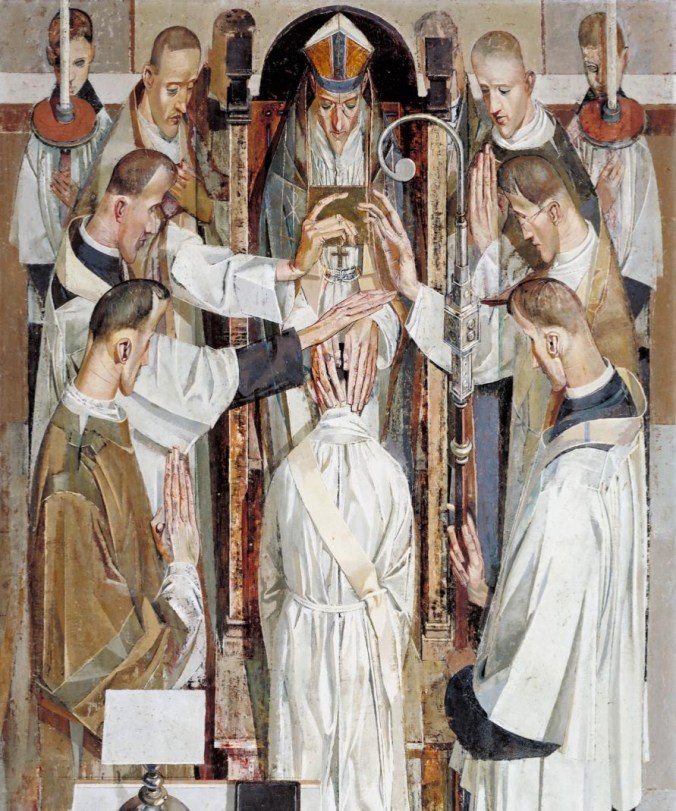
“Ordination,” by Norman Blamey, 1956. (Source)

My friend, Archbishop Mark Haverland, Primate of the Anglican Catholic Church, has just started a new blog called “Anglican Catholic Liturgy and Theology.” You really get what it says on the tin with this one. For those of us with an interest in Anglo-Catholic history, theology, and practice, Archbishop Haverland’s blog will no doubt prove to be a great resource.

A Poem for Trinity Sunday

TrinityThrones

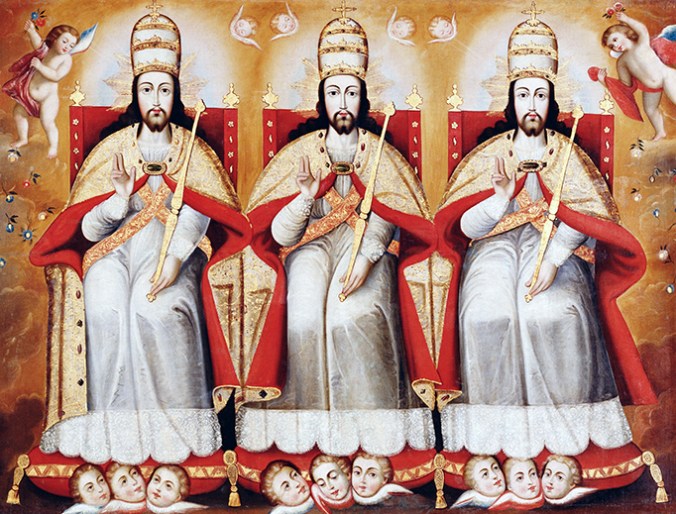
“The Enthroned Trinity.” Cuzco School. c. 1730. (Source).

Holy Sonnet XIV
John Donne

Batter my heart, three-person’d God, for you
As yet but knock, breathe, shine, and seek to mend;
That I may rise and stand, o’erthrow me, and bend
Your force to break, blow, burn, and make me new.
I, like an usurp’d town to another due,
Labor to admit you, but oh, to no end;
Reason, your viceroy in me, me should defend,
But is captiv’d, and proves weak or untrue.
Yet dearly I love you, and would be lov’d fain,
But am betroth’d unto your enemy;
Divorce me, untie or break that knot again,
Take me to you, imprison me, for I,
Except you enthrall me, never shall be free,
Nor ever chaste, except you ravish me.
TrifacialTrinityCuzcoSchool

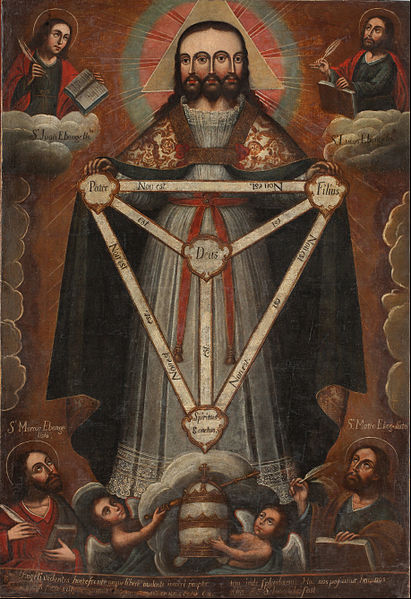
“Trifacial Trinity,” Cuzco School. c. 1750-70. (Source).

Three Poems for Whitsunday

Fresco-Zica

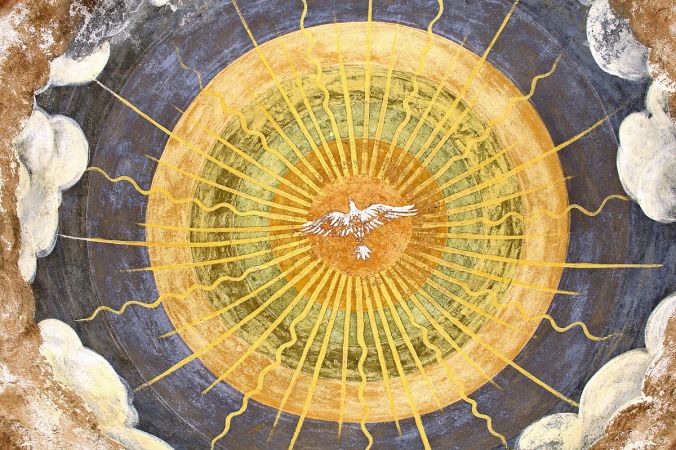
The Dove Descending…(Source)

Inspired by and borrowing from Artur Rosman’s similar post, I offer you some Pentecostal poetry.

“Little Gidding” IV, by T.S. Eliot

The dove descending breaks the air
With flame of incandescent terror
Of which the tongues declare
The one discharge from sin and error.
The only hope, or else despair
Lies in the choice of pyre of pyre-
To be redeemed from fire by fire.

Who then devised the torment? Love.
Love is the unfamiliar Name
Behind the hands that wove
The intolerable shirt of flame
Which human power cannot remove.
We only live, only suspire
Consumed by either fire or fire.

“God’s Grandeur,” by Gerard Manley Hopkins S.J.

The world is charged with the grandeur of God.
    It will flame out, like shining from shook foil;
    It gathers to a greatness, like the ooze of oil
Crushed. Why do men then now not reck his rod?
Generations have trod, have trod, have trod;
    And all is seared with trade; bleared, smeared with toil;
    And wears man’s smudge and shares man’s smell: the soil
Is bare now, nor can foot feel, being shod.
And for all this, nature is never spent;
    There lives the dearest freshness deep down things;
And though the last lights off the black West went
    Oh, morning, at the brown brink eastward, springs —
Because the Holy Ghost over the bent
    World broods with warm breast and with ah! bright wings.


“Epigrammata Sacra XIII” – The descent of the Holy Spirit – Richard Crashaw

Bear, o bosoms, bear ye what Heaven’s vintage showers,
Sacred clusters pouring from ethereal bowers.
Too happy, surely, ye who drink of wine so good;
It comes into your bosoms a sparkling, cooling flood.
Behold, with nectar’d star, each head is shining, shining;
Around your purpl’d locks a crown of life entwining.
O Spirit of all flesh, to drink who’d be denied,
Since Thou, lest they should falter, mak’st wine a torch to guide?

HolySpiritCeiling

Veni Sancte Spiritus! (Source)