Fr. James Martin and the Perils of Imaginative Religious Art

GuadalupeSeries.jpg

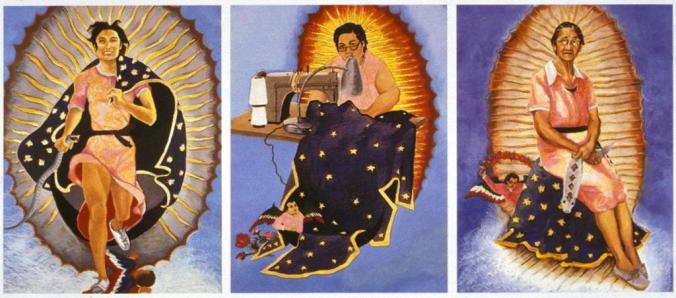
The Guadalupe Series, by Yolanda Lopez. 1978. (Source)

Recently, Fr. James Martin SJ posted these three images on his Facebook page with the following caption: “Mira! Look at these beautiful images of Our Lady of Guadalupe, reimagined as contemporary women. Remember that Our Lady lived a real life in Nazareth.” He then included a link to a website about the artist, Yolanda Lopez.

When some of his followers responded negatively, Fr. Martin wrote the following comment, quoted in full:

Some of the comments on this post are truly ridiculous. Yes, there is one beautiful and holy image, given by Our Lady, to Juan Diego at Tepeyac (which I posted earlier today). But reimagining Our Lady has been done since the earliest days of the church. Most of the images we are used to are images in which she was imagined as a woman of the Middle Ages and the Renaissance, in which the Blessed Mother is dressed in contemporary dress (not as a woman in first-century Galilee would have been dressed). The artist, as I see it, was trying to remind us that Mary (Our Lady) was a real woman. And that the artist sees her in those around her, especially in Mexican women. People need really need to calm down, stop picking apart her art, and stop using words like heresy and blasphemy. Of course you don’t have to like it (art is very subjective of course) but you also don’t have to hurl accusations. I’m as devoted to Our Lady as you are, and if I didn’t like something I’d just nod and move on. Not everything has to end up as a crusade.

There are all kinds of problems with the Jesuit’s post, from his Mariology to his aesthetic philosophy. And while he may have been annoyed that his followers dared to turn his humble offering into the occasion of “a crusade,” I’m afraid that he really leaves us no choice. His post is a scandal for a number of reasons.

It bears mentioning that Fr. Martin is right to suggest that our images of Mary are always shaped in part by culture. But there is a difference between the unconscious ethnocentrism of the Medieval imagination and deliberate efforts to portray Mary or Jesus as something other than what they were. If an artist is (a) going to go down that path, and (b) do so as a well-formed Catholic, then there are a few principles that he should probably stick to along the way.

First, all changes to the subject’s probable historic appearance or culture should serve to illustrate the subject’s deeper identity as well as to magnify his or her glory.

AfricanMadonna.jpg

African Madonna, Studio Muti, South Africa. c. 2013. (Source)

A good example of this kind of art is African Madonna, by Studio Muti. This Marian image works well both because it is constructed in dialogue with the tradition of Christian art – specifically, processional statues of the Virgin – and it powerfully captures the dignity of the sacred subject. We could probably guess who this is, even without some of the ordinary symbols of the Mother of God to aid us.

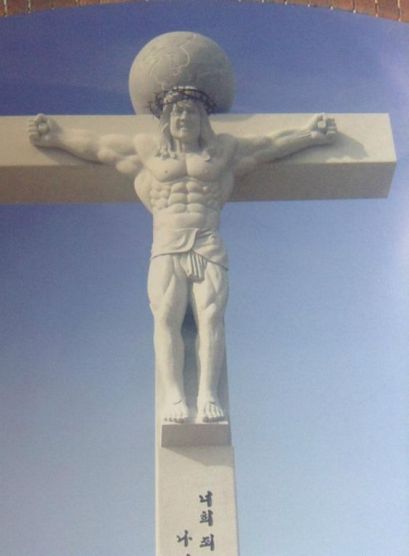
Second, kitsch should be avoided. If the work is devotional or liturgical in any sense (that is, destined for a worship space or context of veneration), then gimmicks become flatly inappropriate. Need we turn to the infamous “Korean Jesus” of 21 Jump Street?

KoreanJesus

Just….why? (Source)

Finally, these kinds of renditions should ordinarily come from the people themselves. Unfortunately, much of it has been produced by well-meaning white liberals like Br. Robert Lentz OFM or Fr. John Giuliani.

RobertLentzNavahoMadonna

Navaho Madonna, Br. Robert Lentz OFM. (Source)

When consciously non-white or non-Western depictions of Christ and the Virgin are created by white and Western artists, the danger of cultural appropriation is at its highest. See Lentz’s canned reduction of Navajo culture in his artist’s statement for the above “icon.” See also Fr. Giuliani’s statement that he “intends that his work celebrate the soul of the Native American as the original spiritual presence on this continent, thus rendering his images with another dimension of the Christian Faith.” One detects in these images a dollop of self-important White Savior mentality beneath the breathless exoticism. It’s all very patronizing.

A much better example comes from Daniel Mitsui, who draws upon the artistic traditions of his own Japanese heritage to lovingly craft intricate renditions of Jesus, Mary, and Biblical scenes in a distinctively Asian setting.

CanaMitsui.jpg

Wedding at Cana, Daniel Mitsui. (Source)

But all of this theorizing applies only to art which depicts sacred subjects. The art that Fr. Martin posted doesn’t do that. His interpretation is simply wrong. As some of the commenters noted, the very link he posted with the three images shows how off his view is. I will quote the source in full:

Yolanda Lopez has received the majority of her fame through the creation of her Guadalupe series. This groundbreaking series has transformed the way in which the iconic image of the Virgin of Guadalupe is viewed into a much more personal and political ideal. Lopez claims that in creating the Portrait of the Artist as the Virgin of Guadalupe she questioned this common icon of the ideal woman in the Chicano culture. The goal of Lopez was to demonstrate and consider the new types of role models Chicanas need and not simply adopt anything just because it is Mexican. Yolanda stated that by doing these portraits of her mother, grandmother, and herself she wanted to draw attention and pay homage to working class women, old women, middle-aged over weight women, young, and self assertive women. By naming each drawing individually Lopez emphasizes the uniqueness of each woman and accentuates the society that allows women of color to go unnoticed.

In the Portrait of the Artist as the Virgin of Guadalupe, Yolanda illustrates the strength and the power by the muscular legs and the long strides as well as the leap she has taking from the crescent moon. Through this long leap Lopez demonstrates that Chicanas are free from the oppressive social stigmas that limit women’s form of expression. In Margaret F. Stewart: Our Lady of Guadalupe, Lopez depicts her mother at work but proposes a new type of beauty. This new beauty is not the typical beauty that is depicted by others as the slender body type, white, young, and glamorous but as the older an fuller woman hard at work. Lastly in Guadalupe: Victoria F. Franco, Lopez illustrates her grandmother as a sad but strong old woman. In each portrait Lopez incorporates a serpent but the serpent in her grandmother’s portrait has been skinned and the grandmother holds the serpent skin in her left hand and the knife that was used in on her right hand. Lopez states “ She is holding the knife herself, because she’s no longer struggling with life and sexuality. She has her own power.” According to Dr. Davalos (author of Yolanda Lopez) the first two portraits represent lived realities of Chicana women and the last portrait address death.

(emphases in bold mine)

The Guadalupe paintings are not, as Fr. Martin insists, “beautiful images of Our Lady of Guadalupe, reimagined as contemporary women.” They are just portraits of the artist, her mother, and her grandmother incorporating the symbolism of Our Lady of Guadalupe. Lopez takes great pains to emphasize that, in her paintings, she is interrogating the received iconography of Guadalupe. The focus is on the poor Chicana as an icon in her own right, an icon that can surpass the role of Our Lady as a role model for contemporary women. This treatment of Guadalupe as an image of primarily moral and social significance is at odds with its presentation and reception by the Faithful. it is basically heretical. However, it’s hardly an uncommon practice today (though it must have been truly radical, if not exactly novel, in 1978). Our Lady of Guadalupe has become a symbolic nexus of all manner of discourses: Catholic, feminist, leftist, Immigrants’ Rights, Latinx, etc. But it doesn’t follow that every image of Guadalupe that engages those questions is properly understood as a “reimagining” of Our Lady.

Simply reading the source statement would have made all of this meaning clear. Fr. Martin must have either (a) not read the link he posted, (b) egregiously misunderstood it, or (c) willfully ignored it. In other words, his post was either lazy, imbecilic, or intellectually dishonest. Regardless, it was irresponsible. If he had bothered to look up some of Lopez’s other work, he might have avoided his grotesque mistake.

PortraitGuadalupe

Portrait of the Artist as the Virgin of Guadalupe, Yolanda Lopez, 1978. (Source)

But even assuming that we take him at his word and accept that he genuinely thought these were perfectly sound “reimaginings” of the Blessed Virgin, what kind of sensibility does that judgment betray? How does Fr. James Martin think Our Lady can and should be “imagined?” It seems that the overt eroticism of Portrait of the Artist as the Virgin of Guadalupe didn’t faze him. Nor did “Mary” trampling on the angel. Nor did her highly unusual connection with the serpent. It is incredible that a priest, particularly one as culturally sophisticated as Fr. Martin, would miss these blasphemous irregularities in an image of the Mother of God. At the very least, his post fails to inspire much confidence in his sense of the sacred.

Fr. Martin’s talk of “imagination” is revealing. Imagination is one of the central components of Ignatian spirituality, as Fr. Martin himself tells us in The Jesuit Guide to (Almost) Everything (2012). He writes of Ignatian contemplation:

Using my imagination wasn’t so much making things up, as it was trusting that my imagination could help to lead me to the one who created it: God. That didn’t mean that everything I imagined during prayer was coming from God. But it did mean that from time to time God could use my imagination as one way of communicating with me. (The Jesuit Guide 146)

St_Ignatius_of_Loyola_(1491-1556)_Founder_of_the_Jesuits

St. Ignatius of Loyola, Peter Paul Rubens. 17th century. (Source)

He then goes on to describe the practical method of Ignatian prayer.

There is much to recommend this spirituality, not least of which is the glorious roll call of Jesuit saints echoing down the centuries. But a danger lies hidden in Ignatian prayer. Grounded as it is upon the working of the individual psyche, it lacks the objectivity of, say, a liturgically-grounded spirituality. Without proper adherence to the mind of the Church, those engaged in Ignatian prayer can recede into a fuzzy personal relativism. In Fr. Martin’s case, it seems to have predisposed him to an overemphasis on the rights of imagination in the production of religious art. Note his use of vision discourse: “The artist, as I see it, was trying to remind us that Mary (Our Lady) was a real woman. And that the artist sees her in those around her, especially in Mexican women” (emphasis mine). Note that he never bothers to investigate the objective meaning encoded in the art itself – its formal characteristics, its use of symbols, its colors and patterns, etc.

Worse, his words imply a quietly Gnostic dissolution of both the meaningful category of physicality as well as the concrete propositions of dogma. Where does that leave us? It doesn’t matter if the Virgin Mary was a Jewish woman of the first century, nor if she was the Immaculately Conceived Mother of God. The imagination and spiritual vision of the artist is primary. Fr. Martin’s point, implicit at first and only later drawn out in reaction to his critics, is that Catholics should be affirming of those “reimaginings.”

But this is an untenable position in the face of actual art. The imagination is inevitably bound up in any artistic process, and it has often produced strange and wonderful innovations on older traditions (see, inter alia, the work of Giovanni Gasparro). But that fact does not isolate the pieces from serious criticism. We must judge; artistic discrimination is the very soul of good taste. And we must be even more critical for art that treats of the spiritual life, even at the cursory level of motifs. It aspires higher. As such, more is at stake. Fr. Martin’s banal pablum is a betrayal of the art he presents. It demands to be taken more seriously.

Terrible as An Army Set in Array

GuadalupeHead

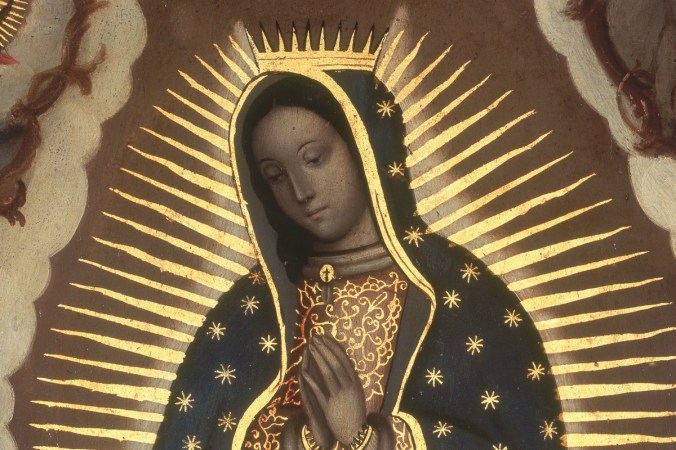
Our Lady of Guadalupe, pray for us. (Source)

“Your deed of hope will never be forgotten by those who tell of the might of God. You are the highest honor of our race.”

Thus does the whole Church sing at Mass today, on the Feast of Our Lady of Guadalupe. And no mean words are they! The Psalm is drawn from the Book of Judith – a frequent verse for feasts of Our Lady – and it lands on our ears like a shout of proleptic joy in this season of preparation and penance. The liturgy draws two special comparisons between Mary and the women of the Old Testament: Mary as the new Eve, and Mary as the second Judith. Today’s feast draws its special energy, its exegetical verve, from the mystical connection between Mary and Judith.

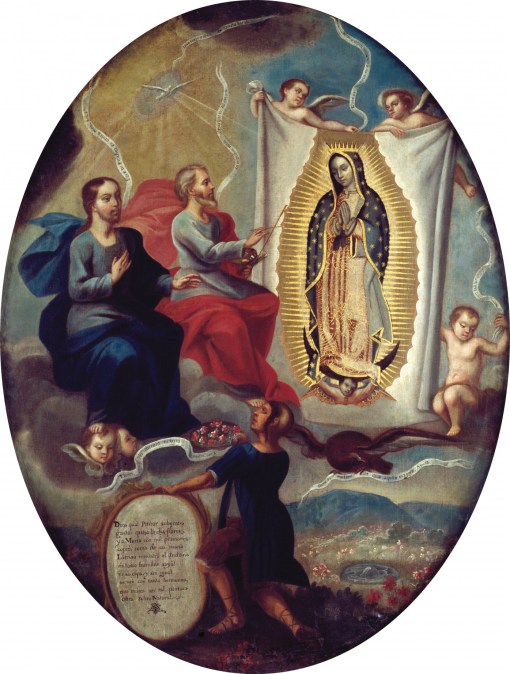
trinityguadalupe

Our Lady of Guadalupe painted by the Trinity. An image worth meditating on. (Source)

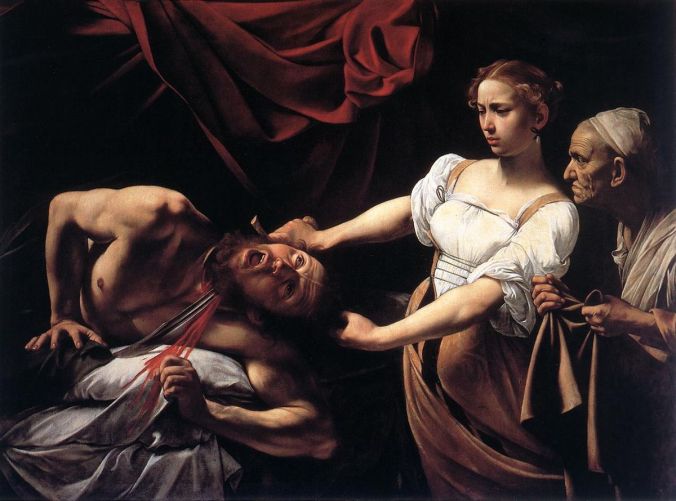
The particular verse that the Church applies to Mary comes from Uzziah’s praise of Judith after she has already beheaded Holofernes the Assyrian. Let us turn briefly to the immediately preceding passage.

Then she took the head out of the bag, showed it to them, and said: “Here is the head of Holofernes, the ranking general of the Assyrian forces, and here is the canopy under which he lay in his drunkenness. The Lord struck him down by the hand of a female! Yet I swear by the Lord, who has protected me in the way I have walked, that it was my face that seduced Holofernes to his ruin, and that he did not defile me with sin or shame.” All the people were greatly astonished. They bowed down and worshiped God, saying with one accord, “Blessed are you, our God, who today have humiliated the enemies of your people.” (Judith 13:15-17).

Then come our Psalm verses.

JudithBeheading

Judith Beheading Holofernes, Caravaggio, c. 1602. (Source)

Why would the Church draw our attention to this violent episode on a feast of Our Lady falling so soon after the Immaculate Conception? Haven’t we just contemplated her Sophianic existence? Haven’t we just basked in the light of the Holy Spirit resting upon her Immaculate Heart? Why must we leave those pleasant snow-caps of the spirit? Why turn instead to this grisly tale of murderous deliverance?

We must recall that, although Mary is all sweetness and concord to those who love her Son, she is the terror of demons. Her litanies and devotions include many titles that evoke the clamor of warfare: “Tower of David,” “Tower of Ivory,” even “Gate of Heaven.” She crushes the head of the Serpent. The sword that pierces her heart becomes, by the union of her suffering with that of her Son, a fearful weapon in her mighty hands.

MaryPunchingDevil

“Hail Mary, full of grace, punch the devil in the face.” (Source)

The story of Guadalupe is just one example of Our Lady exercising this power. Her appearance on Tepeyac, and the miracle wrought on the tilma of St. Juan Diego, was the beginning of the end of Aztec paganism. The demons that held that great people in thrall to the murderous rites of human sacrifice were totally vanquished. Like Judith, Mary rode out from Heaven into the  very camp of the enemy. Like Judith, she conquered. Like Judith, she proclaimed her victory with a visible sign – only, Our Lady’s sign was far more glorious. Judith held up the head of the vanquished foe, the bloody remains of a wicked oppressor. The Mother of God gave us her own image, miraculously imprinted into the convert’s cloak.

Judith delivered the Jews from the army of the Assyrians. Mary came forth to Tepeyac to convert the Mexican people, lifting from them the demonic yoke of a bloodthirsty paganism. What a glorious victory she won! Nine million Aztecs converted within the first ten years of the apparitions. Even today, she continues to spur us to conquer those terrible forces of injustice that oppress so many of God’s people. The collect prayer for today’s feast reads:

O God, Father of mercies, who placed your people under the singular protection of your Son’s most holy Mother, grant that all who invoke the Blessed Virgin of Guadalupe, may seek with ever more lively faith the progress of peoples in the ways of justice and of peace. (Source; emphasis mine)

These days it is rather in vogue to lament a certain kind of triumphalism that is built on self-centered pride. But too often we forget that there is another triumphalism, the shout of a people who have seen their salvation coming from the Lord:

Blessed are you, daughter, by the Most High God,
above all the women on earth;
and blessed be the LORD God,
the creator of heaven and earth
(Judith 13:18).

The Church herself enjoins us to celebrate the works and ways of God through His chosen instruments. And in today’s Mass, we are called to join that praise to the sacrifice of Christ in the Eucharist.

GuadalupeHeresy

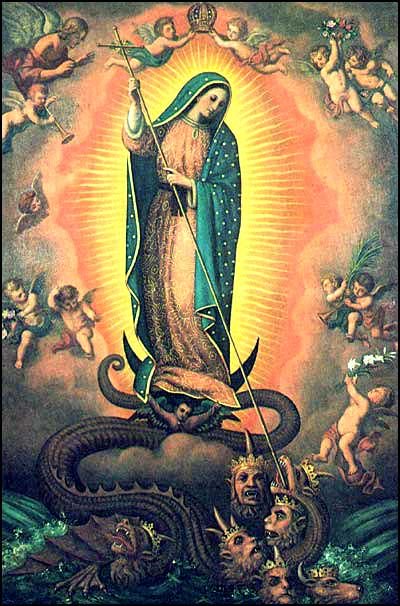
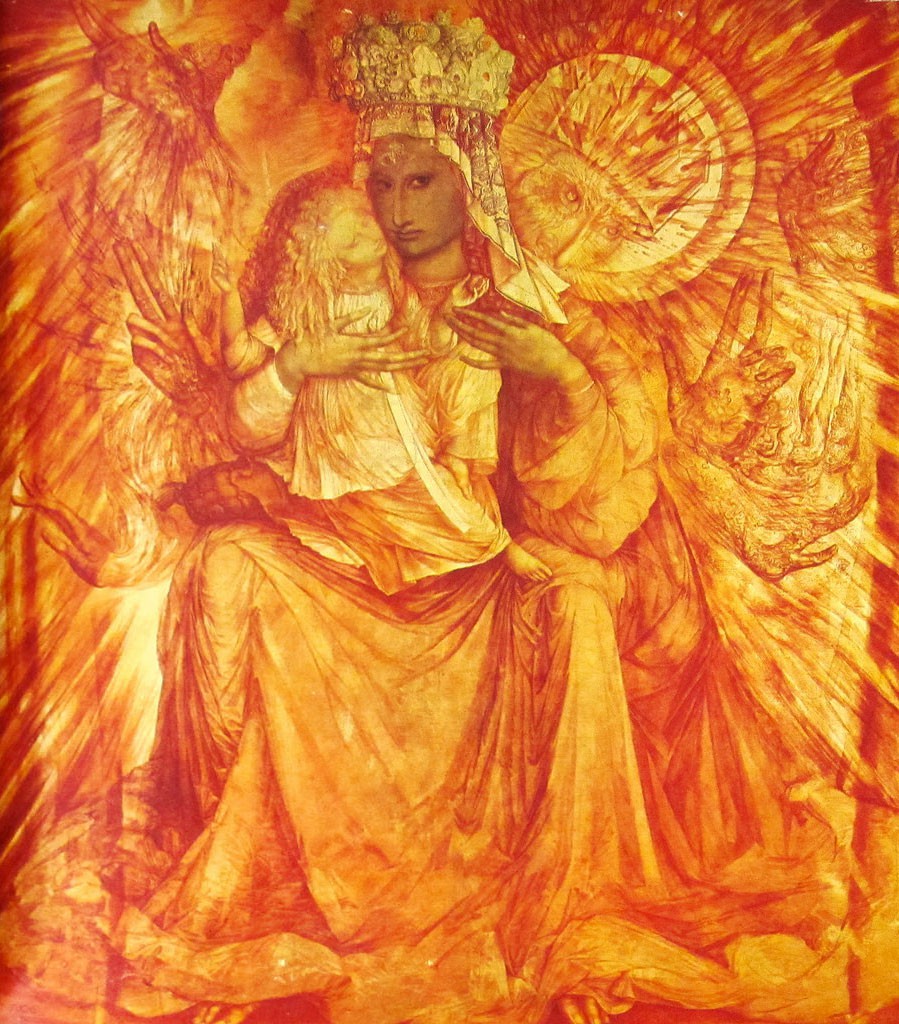
Our Lady of Guadalupe, Victrix over All Heresies and Demons. (Source)

In considering Our Lady of Guadalupe and the zeal with which she overcame the forces of evil and in contemplating the beauty of her miraculous portrait, a verse of Scripture comes to mind.

“Who is she that cometh forth as the morning rising, fair as the moon, bright as the sun, terrible as an army set in array?” (Cant. 6:10 DRA)

We who have seen the tilma through the eyes of faith know the answer.

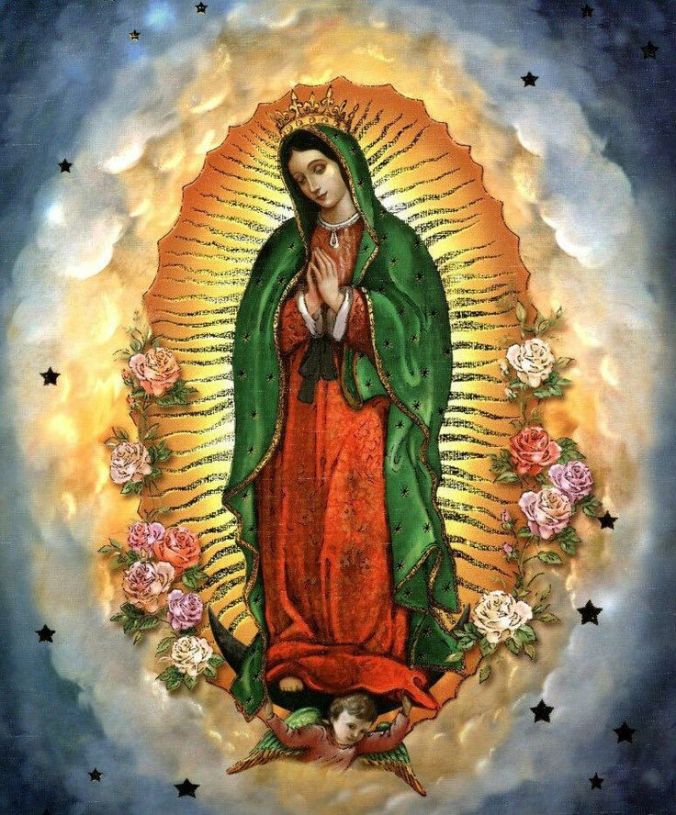
GuadalupeRoses

Our Lady of Guadalupe, Mystical Rose. (Source)

Prayer Request: Retreat

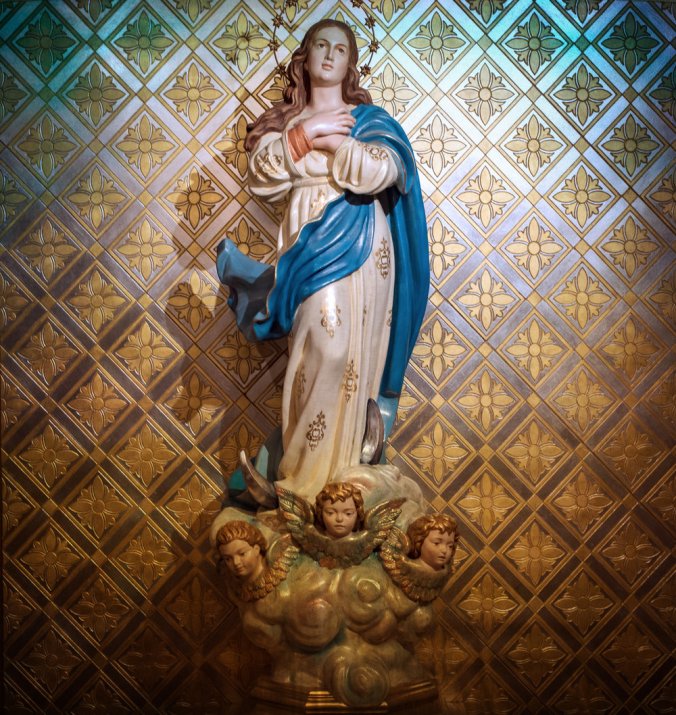
ImmaculateConceptionStatue

Maria Immaculata, Ora Pro Nobis. (Source)

I haven’t been as active on this blog as I had hoped for the last week or so, but I do have several good posts in store. In the meantime, please do pray for me. I’m off to Ireland for a retreat in honor of the Immaculate Conception, and I would appreciate your prayers as I spend this time unplugging and drawing near to Our Lord in His Blessed Infancy.

I noticed yesterday that I’ve accidentally timed the whole thing rather well. I leave England on the feast of St. Birinus, Bishop of Dorchester. He baptized Cynegils, King of the West Saxons, in what is now Dorchester on Thames, only a short bus ride from Oxford. I leave Ireland to return home to the United States on the feast of St. Juan Diego, the first indigenous saint of the Americas (and a deeply Marian one at that). And of course, the culmination of the retreat falls on the solemnity of the Immaculate Conception, America’s patronal feast. Providence works through these kinds of coincidences.

557px-The_Immaculate_Conception,_by_Giovanni_Battista_Tiepolo,_from_Prado_in_Google_Earth

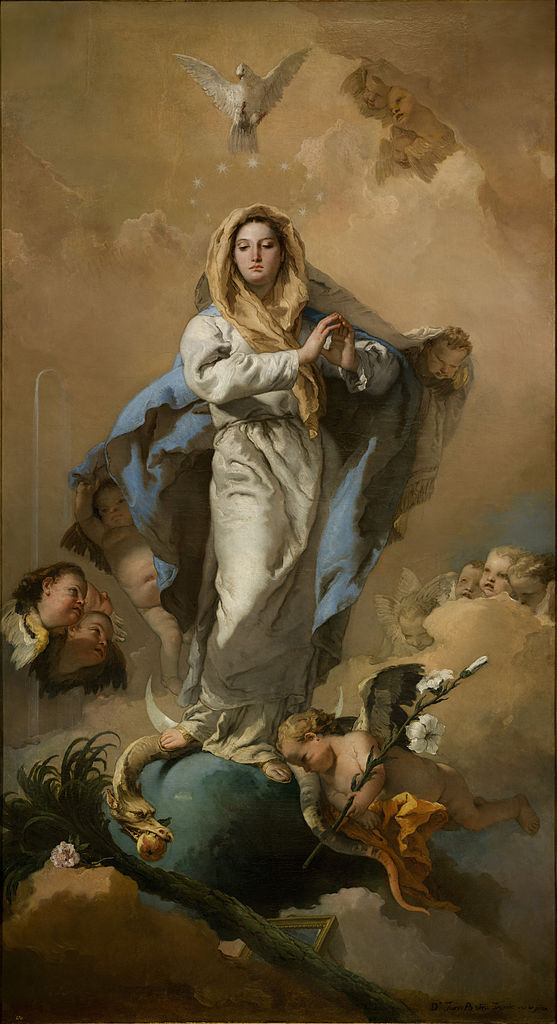
The Immaculate Conception, Giovanni Battista Tiepolo, c.1767. I love Our Lady’s expression –  a mixture of humility before the Spirit above and regal contempt for the Devil at her feet. (Source)

Additionally, by a quirk of the academic calendar, this year is the first time in my life that I will have a genuine Advent. Since seventh grade, I’ve had exams deep into December. Since I became Catholic four and a half years ago, I haven’t had the chance to experience this season for what it is, a time of profound peace, penance, and prayer in preparation for the Nativity of Christ. All of which prompts me to beg for your prayers.

Our Lady, Immaculate, pray for us.
Our Lady, Theotokos, pray for us.
Our Lady, Queen of Heaven, pray for us.

immaculb

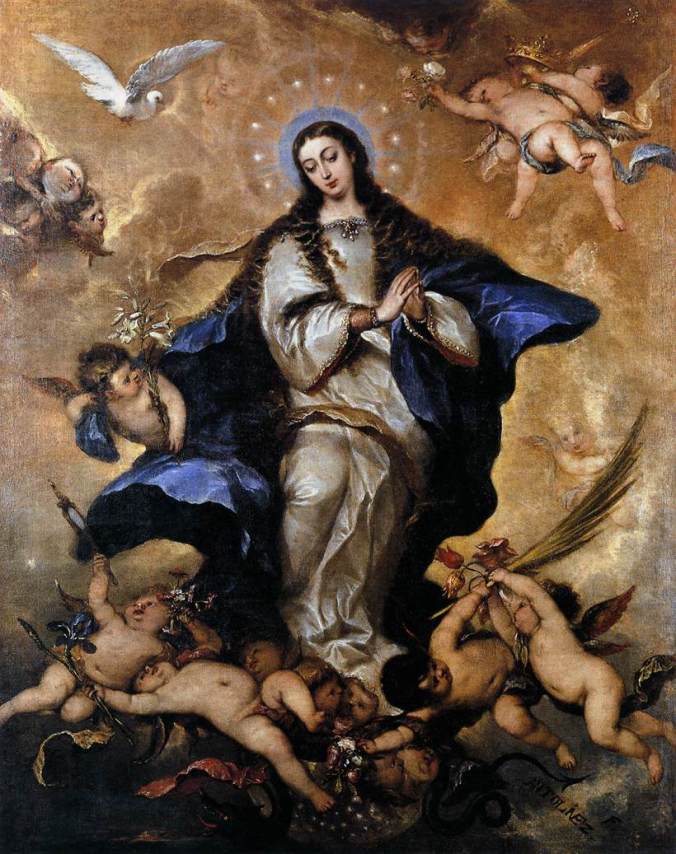
Immaculate Conception, José Claudio Antolinez, 17th century. (Source)

The Music of the Holy Ghost

TarkovskyNostalghia.jpg

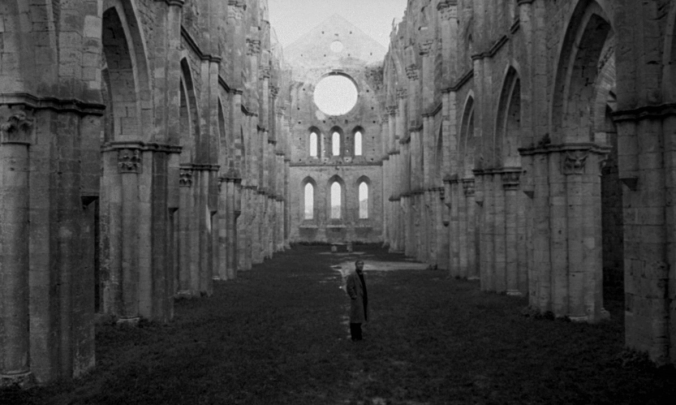
A still from Andrei Tarkovsky’s Nostalghia (1983). Clips from Tarkovsky’s films are often incorporated into the Rev Army’s music videos. (Source)

Not long ago, I came across a new band. What a singular group it is. Their music crosses and confuses genres. They produce content at a far scarcer rate than other musical acts. Even their name, taken from a Buñuel film, sets them apart from most of the offerings one comes across today.

Little did I know that I had stumbled upon a cult gem. The Revolutionary Army of the Infant Jesus has been on the scene for quite a while. Almost thirty years ago, they released their first album, The Gift of Tears (1987). Since then, they have only come out with sporadic releases, such as 1990’s Mirror and 2015’s Beauty Will Save the World. The long hiatus has well earned them the title of “One of music’s most elusive and enigmatic acts,” as we can read on their BandCamp site.

Tim Cooper has a great review of their work over at The Quietus:

…the attention-averse trio, who regard themselves as a creative collective rather than a band, make wildly eclectic music rooted in liturgical texts and ecclesiastical iconography, contrasting ethereal beauty with stark brutalism. Celestial choirs rub their cassocked shoulders with squalls of industrial noise, political speeches are interwoven with celluloid dialogue, instrumentation ranges from sombre neo-classical piano to pounding dance beats by way of folk, free-form jazz and experimental psychedelia.

They draw together a variety of spiritual and cultural influences: folk Catholicism, peasant mysticism, Russian Orthodoxy, the experience of post-Soviet Europe, Simone Weil, Welsh poetry. Their work can, I think, be described as sophianic, but it is a sophanicity carefully drawn through the harried cracks of the fallen world. The truth that the Rev Army grips and holds up to the light gleams all the more for being refracted in the shards of our earthly mirror.

Here are some favorite songs with their proper music videos, many of which are just as important for the meaning of the piece as the score itself.

Come Holy Spirit” – the very first Rev Army song I discovered. A bit too much flute and too many drums for me, but it was different enough from anything I had ever heard that it caught my attention.

Bright Field” – the first one that captivated me. The upward lift of the music combined with R.S. Thomas’s stirring paraphrase of the Gospel, not to mention Tarkovsky’s silken, dreamlike visuals, all together inspire something like wonder. Whenever I listen to it, I am reminded of a poem by Rilke.

After the End” – a simple and haunting French ditty set to the grainy images of villagers at prayer. They seem to be visionaries.

Psalm” – a few women chant in English against an increasingly dissonant shower of quasi-industrial background noise. The juxtaposition strikes me as an artistic model of transcendence through persistent prayer.

Repentance” – the most Flannery O’Connor thing you will ever see or hear. I’ll just leave it at that.

Théme de l’homme qui n’a pas cru en lui méme” – a Latin-flavored and occasionally jazzy piece featuring footage from a (staged?) Spanish Lenten procession. In case you hadn’t already noticed, the band is extremely Catholic.

Joy of the Cross” – another Lenten procession, but this time with a soft-edged folk music that makes me think of Fleet Foxes.

Before the Ending of the Day” – the Compline hymn surrounded and supported by an airy yet pulsing larger song. Tarkovsky’s Andrei Rublev provides the meditative visuals. Note that one of the commenters on YouTube wrote, “Please keep making more of these. This helped still my soul.”

Something epicletic moves through their music. But one can find that quality in lots of other work. What sets the Rev Army apart isn’t just their obsession with the Holy Ghost, nor their stylistic eclecticism. It’s their powerful sense of mystery. They never shy away from the divine darkness with which the Holy Ghost enshrouds His manifold works of grace. How refreshing, in an age of “Spirit of the Council” muzak and shallow “praise and worship,” to find music that is overtly Christian and even mystical without ever becoming preachy, dated, or emotivist. They treat their subject, the perennial and universal longing of the human heart for God, with a rare artistic and spiritual sophistication.

Caught up in marvel at the saving mystery of the Holy Ghost, the Revolutionary Army of the Infant Jesus is the real Catholic charismatic revival.

DescentoftheHolySpiritIcon

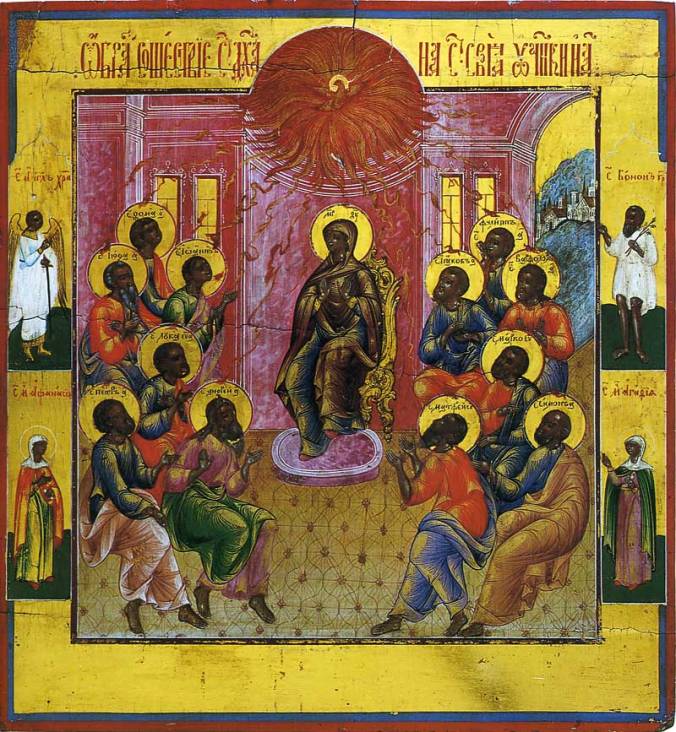
An icon of the Descent of the Holy Ghost. (Source)

Father Faber on Extraterrestrials

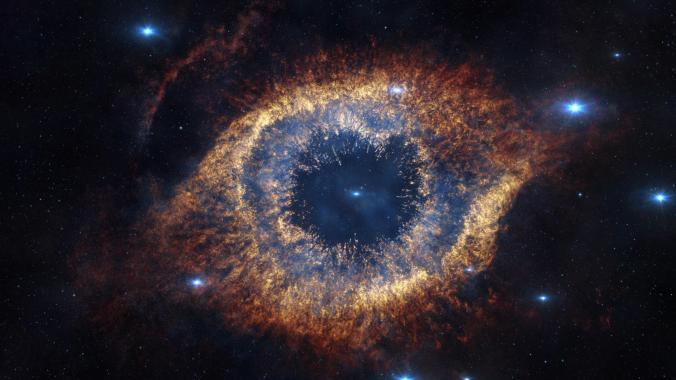
HelixNebula.jpg

The Helix Nebula, also known as “The Eye of God.” (Source)

When I was an undergraduate, I spent an afternoon in one of my theological societies discussing how Christians should respond to the discovery of alien life, should it ever happen. Our group split between those who believed the question was null anyway, as there were no aliens, and those, like me, who held that if they did exist, we should baptize and catechize them anyway.

It seems that no less a figure than Father Faber himself should have something to say on the matter. Imagine my shock when, quite unexpectedly, I came across the following passage yesterday in Faber’s The Precious Blood (1860/1959):

God made the angels and the stars. The starry world is an overwhelming thing to think of. Its distances are so vast that they frighten us. The number of its separate worlds is so enormous that it bewilders us. Imagine a ray of light, which travels one hundred and ninety-two thousand miles in a second; and yet there are stars whose light would take a million of years to reach the earth. We know of two hundred thousand stars down to the ninth magnitude. In one single cluster of stars, eighteen millions of stars have been discovered between the tenth and eleventh magnitudes. Of these clusters men have already discovered more than four thousand. Each of these stars is not a planet, like earth; but a sun, like our sun, and perhaps with planets round it, like ourselves. Of these suns we know of some which are one hundred and forty-six times brighter than our sun. What an idea all this gives us of the grandeur and magnificence of God! Yet we know that all these stars were created for Jesus and because of Jesus. Mary’s Son is the King of the stars. His Precious Blood has something to do with all of them. Just as it merited graces for the angels, so does it merit blessings for the stars. If they have been inhabited before we were, or are inhabited now, or will at some future time begin to be inhabited, their inhabitants, whether fallen and redeemed, or unfallen and so not needing to be redeemed, will owe immense things to the Precious Blood. Yet earth, our little, humble earth, will always have the right to treat the Precious Blood with special endearments, because it is its native place. When the angels, as they range through space, see our little globe twinkling with its speck of colored light, it is to them as the little Holy House in the hollow glen of Nazareth, more sacred and more glorious than the amplest palaces in starry space. (The Precious Blood 20-21).

The passage stood out to me for a few reasons. First, we might note Fr. Faber’s charming vision of angels flying through outer space. It strikes me as typical of his imaginatively poetic spirituality to find all of reality brimming with several orders of hidden and divine life. Secondly, Faber anticipates the very sentiments that astronauts would feel and describe over a century later. But perhaps most strikingly, Faber seems to suggest both the plausibility of extraterrestrial life and its capacity for redemption, presumably through the sacramental work of the Church. I would never have anticipated this idea from a Victorian priest most famous for his effervescent devotions and moralizing sermons. Evidently Faber was well read in the scienceand possibly the science fictionof his day.

On this Feast of Christ the King, I also find Faber’s words particularly apt. There is no part of reality to which the sovereignty of Christ does not extend: “Mary’s Son is the King of the stars.” One imagines that Faber would have enthused over today’s solemnity, had he lived long enough to see its institution.

The whole chapter is a spiritual gem, but this strange little paragraph seemed particularly worthy of consideration. The more I read, the more disconsolate I am that Faber has been so widely neglected by today’s Catholics.

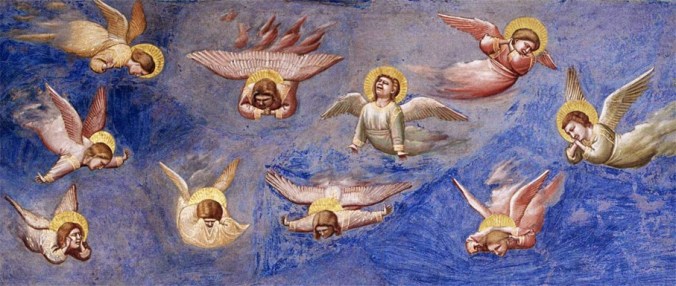
Giotto 1

Angels by Giotto in the Scrovegni Chapel. (Source)

Father Faber on the Holy Souls in Purgatory

OLYMPUS DIGITAL CAMERA

We should always remember to pray for the Holy Souls in Purgatory, especially in this, their month. (Source)

Today is Remembrance Sunday here in the U.K. We had a splendid Solemn High Requiem Mass at the Oxford Oratory, complete with black vestments. The setting was a Requiem by Haydn, which seem to draw us on the journey of a holy soul. From an Introit that sounds like the mournful ghosts of the dead, we proceed to a communion that is full of airy light and calm joy – with a great deal of drama in between. 

I realized that I had not posted anything for All Souls’ Day. Since today is yet another day set aside, at least by British Catholics, for praying on behalf of the dead, I decided I’d post something by that spiritual master, Father Frederick William Faber of the London Oratory. In his own life, Fr. Faber was known for his great devotion to the Holy Souls. One of his more famous texts deals with prayer for those in Purgatory. I have selected the following passage from that work, Fr. Faber’s Purgatory. You can also find it on this website. I offer it here for your consideration and in the hope that the good priest’s words might kindle in us a fonder and more steadfast devotion to the Faithful Departed.

Both views [of Purgatory within Catholicism] agree again in holding that what we in the world call very trivial faults are most severely visited in purgatory. St. Peter Damian gives us many instances of this, and others are collected and quoted by Bellarmine. Slight feelings of self-complacency, trifling inattentions in the recital of the Divine Office, and the like, occur frequently among them. Sister Francesca mentions the case of a girl of fourteen in purgatory, because she was not quite conformed to the will of God in dying so young: and one soul said to her: Ah men little think in the world how dearly they are going to pay here for faults they hardly note there. She even saw souls that were immensely punished only for having been scrupulous in this life; either, I suppose, because there is mostly self-will in scruples, or because they did not lay them down when obedience commanded. Wrong notions about small faults may thus lead us to neglect the dead, or leave off our prayers too soon, as well as lose a lesson for ourselves.

Then, again, both views agree as to the helplessness of the Holy Souls. They lie like the paralytic at the pool. It would seem as if even the coming of the angel were not an effectual blessing to them, unless there be some one of us to help them Some have even thought they cannot pray. Anyhow, they have no means of making themselves heard by us on whose charity they depend. Some writers have said that Our Blessed Lord will not help them without our co-operation; and that Our Blessed Lady cannot help them, except in indirect ways, because she is no longer able to make satisfaction; though I never like to hear anything our dearest mother cannot do; and I regard such statements with suspicion. Whatever may come of these opinions, they at least illustrate the strong way in which theologians apprehend the helplessness of the Holy Souls. Then another feature in their helplessness is the forgetfulness of the living, or the cruel flattery of relations who will always have it that those near or dear to them die the deaths of Saints. They would surely have a scruple, if they knew of how many Masses and prayers they rob the souls, by the selfish exaggeration of their goodness. I call it selfish, for it is nothing more than a miserable device to console themselves in their sorrow. The very state of the Holy Souls is one of the most unbounded helplessness. They cannot do penance; they cannot merit; they cannot satisfy; they cannot gain indulgences; they have no Sacraments; they are not under the jurisdiction of God’s Vicar, overflowing with the plentitude of means of grace and manifold benedictions. They are a portion of the Church without either priesthood or altar at their own command.

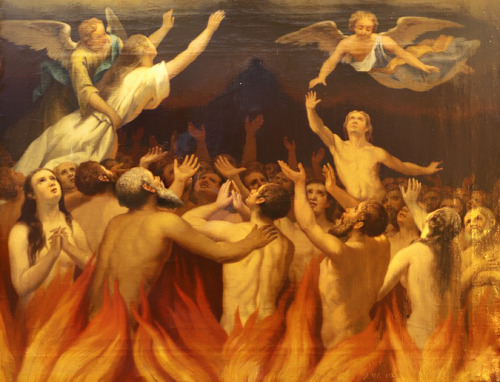
holy-souls._jpg

Pray for the Holy Souls in Purgatory. (Source)

Those are the points common to both views of purgatory; and how manifold are the lessons we learn from them, on our own behalf as well as on behalf of the Holy Souls. For ourselves, what light does all this throw on slovenliness, lukewarmness, and love of ease? What does it make us think of performing our devotions out of a mere spirit of formality, or a trick of habit? What diligence in our examens, confessions, Communions, and prayers! It seems as if the grace of all graces for which we should ever be importuning our dear Lord, would be to hate sin with something of the hatred wherewith He hated it in the garden of Gethsemane. Oh, is not the purity of God something awful, unspeakable, adorable? He, who is Himself a simple act, has gone on acting, multiplying acts since creation, yet he has incurred no stain! He is ever mingling with a most unutterable condescension with what is beneath Him-yet no stain! He loves His creatures with a love immeasurably more intense than the wildest passion of earth- yet no stain! He is omnipotent, yet it is beyond the limits of His power to receive a stain. He is so pure that the very vision of Him causes eternal purity and blessedness. Mary’s purity is but a fair thin shadow of it, and yet we, even we, are to dwell in His arms for ever, we are to dwell amid the everlasting burnings of that uncreated purity! Yet, let us look at our lives; let us trace our hearts faithfully through but one day, and see of what mixed intentions, human respects, self-love, and pusillanimous temper our actions, nay, even our devotions, are made up of; and does not purgatory, heated seven-fold and endured to the day of doom, seem but a gentle novitiate for the Vision of the All-holy?

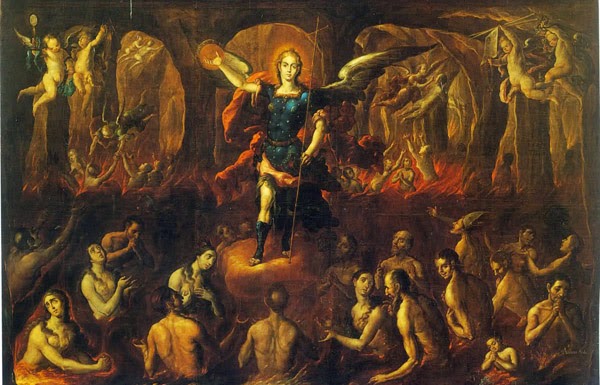
St.-Michael-the-Archangel-and-the-Souls-in-Purgatory

St. Michael the Archangel has traditionally been closely associated with the Holy Souls of Purgatory in the Church’s devotional life. (Source)

But some persons turn in anger from the thought of purgatory, as if it were not to be endured, that after trying all our lives long to serve God, we should accomplish the tremendous feat of a good death, only to pass from the agonies of the death-bed into fire, long, keen, searching, triumphant, incomparable fire. Alas! my dear friends, your anger will not help you nor alter facts. But have you thought sufficiently about God? Have you tried to realise His holiness and purity in assiduous meditation? Is there a real divorce between you and the world which youknow is God’s enemy? Do you take God’s side? Are you devoted to His interests? Do you long for His glory? Have you put sin alongside of our dear Saviours’ Passion, and measured the one by the other? Surely, if you had, purgatory would but seem to you the last, unexpected, and inexpressibly tender invention of an obstinate love, which was mercifully determined to save you in spite of yourself. It would be a perpetual wonder to you, a joyous wonder, fresh every morning, a wonder that would be meat and drink to your soul, that you, being what you know yourself to be, what God knows you to be, should be saved eternally. Remember what the suffering soul said so simply, yet with such force, to Sister Francesca: ‘ Ah! those on that side of the grave little reckonhow dearly they will pay on this side for the lives they live! To be angry because you are told you will go to purgatory! Silly, silly people Most likely it is a great false flattery, and that you will never be good enough to go there at all. Why, positively, you do not recognise your own good fortune, when you are told of it. And none but the humble go there. I remember Maria Crocifissa was told that although many of the Saints while on earth loved God more than some do even in heaven, yet that the greatest Saint on earth was not so humble as are the souls in purgatory. I do not think I ever read anything in the lives of the Saints which struck me so much as that. You see it is not well to be angry; for those only are lucky enough to get into purgatory who sincerely believe themselves to be worthy of hell.

Purgatory_Mass._jpg

Masses and indulgences can be tremendously helpful to the souls suffering in Purgatory. (Source)

But we not only learn lessons for our own good, but for the good of the Holy Souls. We see that our charitable attention towards them must be far more vigorous and persevering than they have been; for men go to purgatory for very little matters, and remain there an unexpectedly long time. But their most touching appeal to us lies in their helplessness; and our dear Lord, with His usual loving arrangement, has made the extent of our power to help them more than commensurate with their ability to help themselves. Some theologians have said that prayer for the Holy Souls is not infallibly answered. I confess their arguments on this head do not convince me; but, conceding the point, how wonderful still is the power which we can exercise in favour of the departed! St. Thomas has at least taught us that prayer for the dead is more readily accepted with God than prayer for the living. We can offer and apply for them all the satisfactions of Our Blessed Lord. We can do vicarious penance for them. We can give to them all the satisfactions of our ordinary actions, and of our sufferings. We can make over to them, by way of suffrage, the indulgences we gain, provided the Church has made them applicable to the dead. We can limit and direct to them, or any one of them, the intention of the Adorable Sacrifice. The Church, which has no jurisdiction over them, can yet make indulgences applicable or inapplicable to them by way of suffrage; and by means of liturgy, commemoration, incense, holy water, and the like, can reach efficaciously to them, and most of all by her device of privileged altars. The Communion of Saints furnishes the veins and channels by which all these things reach them in Christ. Heaven itself condescends to act upon them through earth. Their Queen helps them by setting us to work for them, and the Angels and the Saints bestow their gifts through us, whom they persuade to be their almoners; nay, we are often their almoners without knowing that we are so. Our Blessed Lord vouchsafes to look to us, as if He would say: Here are my weapons, work for me! just as a father will let his child do a portion of his work, in spite of the risk he runs in having it spoiled. To possess such powers, and not to use them, would be the height of irreverence towards God, as well as of want of charity to men. There is nothing so irreverent, because nothing so unfilial, as to shrink from God’s gifts simply because of their exhuberance. Men have a feeling of safety in not meddling with the supernatural; but the truth is, we cannot stand aloof on one side and be safe. Naturalism is the unsafe thing. If we do not enter the system, and humbly take our place in it, it will draw us in, only to tear us to pieces when it has done so. The dread of the supernatural is the unsafest of feelings. The jealousy of it is a prophecy of eternal loss.

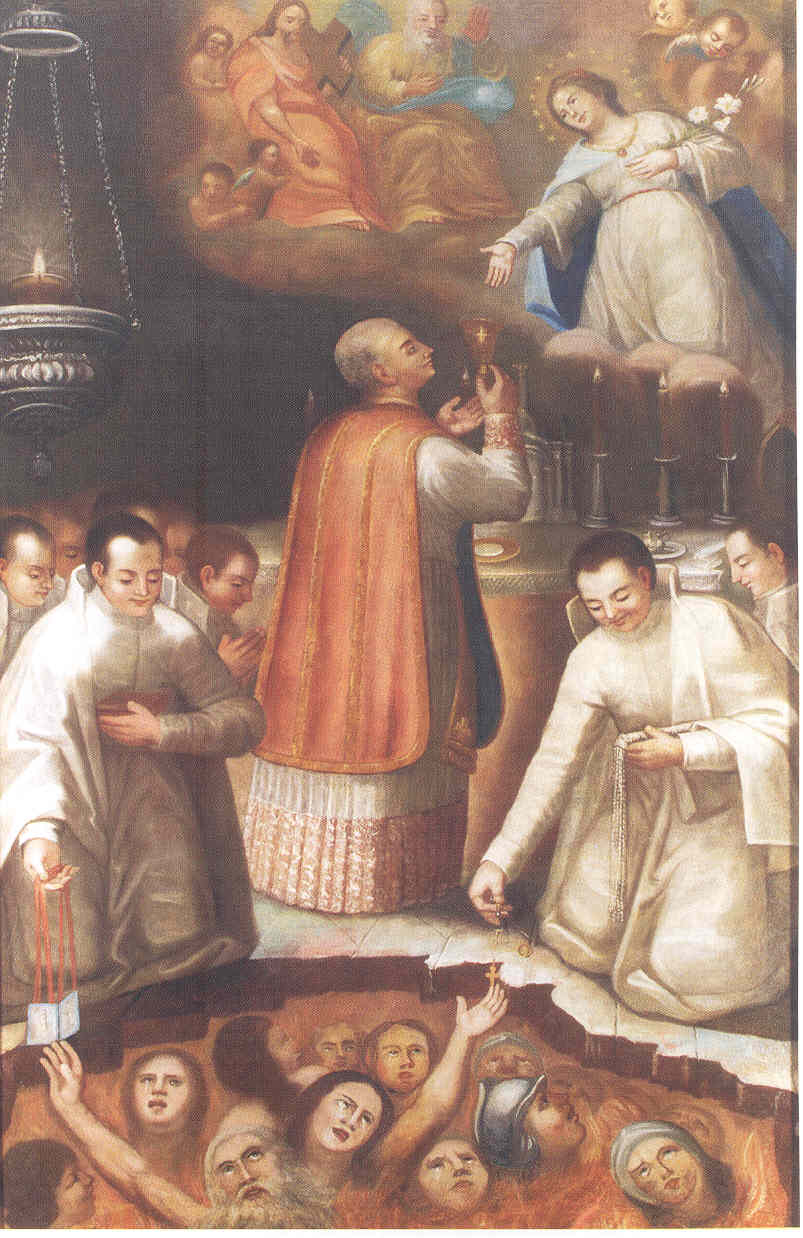
It is not saying too much to call devotion to the Holy Souls a kind of centre in which all Catholic devotions meet, and which satisfies more than any other single devotion our duties in that way; because it is a devotion all of love, and of disinterested love. If we cast an eye over the chief Catholic devotion, we shall see the truth of this. Take the devotion of St. Ignatius to the glory of God. This, if we may dare to use such an expression of Him, was the special and favourite devotion of Jesus. Now, purgatory is simply a field white for the harvest of God’s glory. Not a prayer can be said for the Holy Souls, but God is at once glorified, both by the faith and the charity of the mere prayer.

Brooklyn_Museum_-_Virgin_of_Carmel_Saving_Souls_in_Purgatory_-_Circle_of_Diego_Quispe_Tito_-_overall

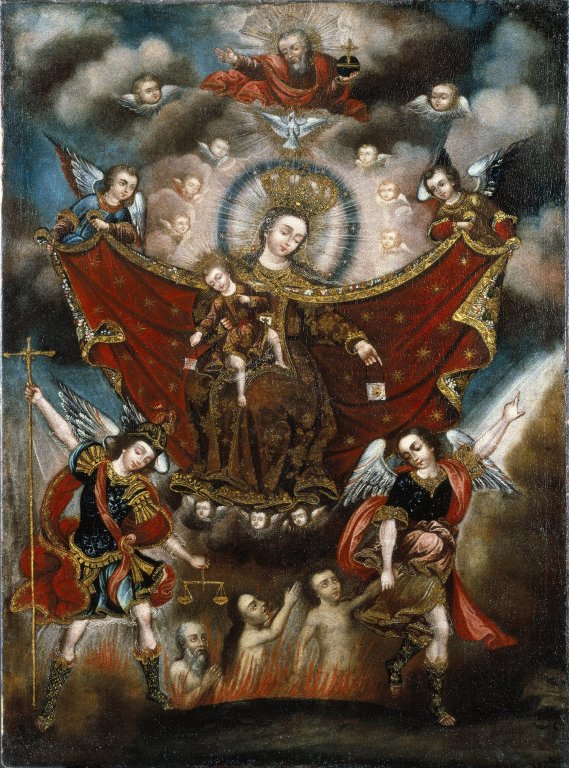
The Virgin of Carmel Saving Souls in Purgatory, Circle of Diego Quispe Tito, c. 17th century. Brooklyn Museum. (Source)

When the Sacred is Strange: The Art of Giovanni Gasparro

Screen Shot 2017-11-11 at 11.25.56 PM.png

St. John Damascene and the St. Virgin Tricherusa, Giovanni Gasparro. Here we see Gasparro depicting a legend from the Saint’s life that is particularly appropriate for an artist. The work also represents the unity of Western and Eastern visual traditions in the transcendent Divinity. (Source)

UPDATE 4/2/20: It has recently come to my attention that Giovanni Gasparro, the artist profiled here, whose work I have admired at this blog on several occasions, has just produced a painting that reproduces the vicious anti-Semitic trope of Jewish ritual murder. This lie has historically led to violence against the Jews and, to put it lightly, is a subject unbecoming of a Christian painter. I condemn it in the strongest possible terms. While I used to look to Mr. Gasparro as a prime example of what Christian art could be in our postmodern era, his embrace of imagery more fit for the pages of Der Stürmer means that I can no longer endorse him. Nevertheless, I have decided to keep this essay up online because it enunciates certain principles about art that I think remain important. I hope that my readers will understand that they reflect an assessment of Mr. Gasparro’s value as religious art that I no longer hold. 

Recently there came into my newsfeed an article by Hilary White Obl.S.B. of What’s Up with Francischurch?. The piece was an extended criticism of Giovanni Gasparro, an Italian artist whose paintings inspired a few of the meditations I have written before on this blog. As someone who has long admired Mr. Gasparro’s Neo-Baroque art, I was happy to see that Rorate Caeli recently profiled one of his pieces. Ms. White was, it seems, partially responding to this attention. However, the more I read of her article, the more I found myself in stark disagreement with her analysis and broader philosophy.

While I have in the past appreciated her reporting as well as the monastic spirit she brings to her work, I confess that I was surprised at the poor quality of her post. I would not ordinarily seek out controversy, but as it seems that Ms. White’s post is making the rounds of the Tradisphere, I felt it imperative to offer a counter perspective.

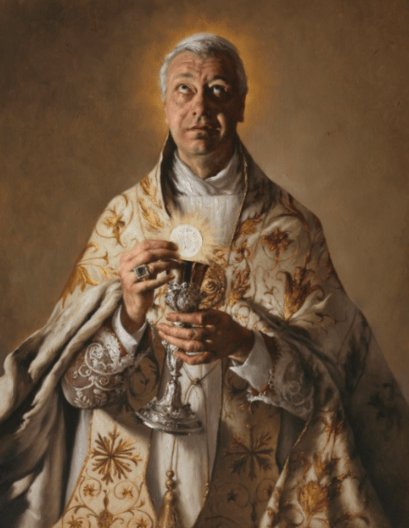
There are many problems with the article. It is a textbook example of how not to write about art and theology, failing comprehensively at description, prescription, and imagination. She focuses too heavily on one work, Gasparro’s St. Pius X Pontifex Maximus. When she looks at other examples of his art, her analysis – if that is the right word for her summary denunciations – always remains far too cursory to do justice to such a talented artist. And while she notes that Gasparro is a master draughtsman, she follows up this comment with the presumptive assertion that Gasparro “is someone who still approaches sacred subjects with a distinctly modernist mindset.”
Screen Shot 2017-11-11 at 7.07.49 PM

St. Pius X Pontifex Maximus, Giovanni Gasparro. (Source)

There are overarching philosophical problems with Ms. White’s argument. But I’d prefer to begin with her shoddy treatment of the material itself.

To start with a small, but, I think, a representative example; Ms. White claims that in Gasparro’s portrait of Pope St. Pius X, the light falls on the Pope’s face in a sinister way. She writes,

But the painting of Pius X is underlit, a type of lighting that we associate with evil. If you see horror movies, the light is often placed this way on a face to give it a frightening, even demonic effect. It’s what springs to mind: where does a light come from if it’s up from below? Still, is hell’s light this white, electric glare?

This effect, illuminating the facial structure from an odd and unnatural angle – light doesn’t usually come from the ground up, still less heavenly light – the underside of the brow ridge lit up, giving the eye sockets a sickly, sunken appearance, etc… None of that is going to be found in genuine devotional sacred art.

An interesting idea, but one that misses the mark.

For one thing, the Pope is not underlit. It would be more accurate to say that he’s side-lit. There is a striking similarity in the way the light falls in Gasparro’s piece and the photograph of St. Pius to which Ms. White compares it. Nor is side-lighting unusual in Catholic art. Zubarán’s famous St. Francis in Meditation (1635-39) uses almost exactly the same angle for a much more sinister effect.

Screen Shot 2017-11-11 at 9.57.24 PM.png

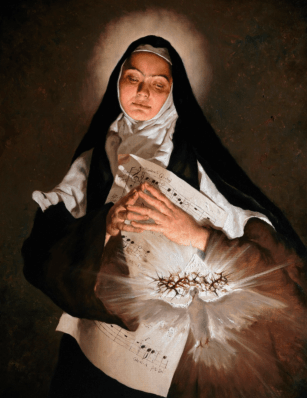
St. Elizabeth of the Trinity, Giovanni Gasparro. In which a saint is underlit, and with good reason. (Source)

Her rather contrived interpretation requires one of two presuppositions: first, that the symbolic lexicon of sacred, or, indeed, Western art is so narrow as to entail only a very limited range of connotations in the use of light, and secondly, that Gasparro’s work is intrinsically profane, deceptive, or downright evil. Neither of these assumptions is fair to the the artwork. They obscure its meaning rather than illuminate it.

But this point is relatively minor compared to some of Ms. White’s other egregious analysis. She dismisses Gasparro’s oeuvre as “surrealist, not sacred art,” with particular attention to his common motif of multiplied hands. She takes exception to the way he depicts faces, as well. Once again, we can see this tendency on display in her take on the Pius X portrait:

Giuseppe Sarto – even in death – had a very “beatific” face, handsome and always with a very assured and calm expression. I can’t imagine him ever making a face like the one in the painting. In fact, it looks more like what you’d get if you cloned Pius X and added a few drops of Nigel Farage.

She goes on to suggest that the “lumps and bumps” on the face of Gasparro’s Pius X are unsound, and that his expression inappropriately reflects “apprehension, not adoration.”

I’ll admit, the likeness is imperfect. She’s not totally off to note the resemblance with Nigel Farage, an unfortunate quality of the painting. Nevertheless, these indignant statements reflect more on Ms. White’s failure of imagination than they do Mr. Gasparro’s art. Moreover, mightn’t the Pope’s face also convey a whole range of emotions? Instead of apprehension, couldn’t the Pope’s expression show humble supplication? Or simply the holy Fear of God that priests ought to hold in their hearts as they offer the Most Holy Sacrifice of the Mass? And might not Pope Sarto have made much the same face at the altar as he spoke the sacred and secret words to the Almighty? Is she really incapable of imagining him “ever making a face like the one in the painting?” Sure it’s not that hard.

Ms. White continues in this vein at some length.

The “light” from the Eucharist isn’t actually light. It illuminates nothing, there is no reflection of it on the face or hands or vestments. The halo is equally dead as a light source, since it falls on nothing. The only light on the figure is from this lower left white source – like a stage light. The non-light from the Eucharist could be a signal; is he saying, “This is NOT the light of the world”?

One gets the impression that the message of the painting is that Eucharistic theology is deception; there is no light from the Host, the celebrant does not believe; his face says “this is all theatre & flummery”

In fact, the more you look at it, the more the feeling grows that this is actually a parody of sacred art. As a friend of mine commented, “His face in no way looks beatific.” There’s something in this hyperrealism, all the lumpiness and the harsh white lighting, that doesn’t say heavenly to me, but psychotic. They seem like subtle corruptions of reality.

What an extraordinary concatenation of assertions.

A few questions come to mind immediately. First, why must the Eucharist necessarily illumine anything? There are, of course, discernible rays of light emanating from it, and any ordinary viewer who sees the painting would probably understand what is meant spiritually. But why should that light be seen to rest on anything in particular, when it’s already an unearthly light to begin with? Secondly, why do halos need to be light sources at all? David Clayton has argued at New Liturgical Movement that:

…the art of the High Renaissance and Baroque is aiming to portray historical man (and not as with the icon eschatological man united with God in heaven), what the artists are doing might in fact be consistent with this. One might propose that because the aura of uncreated light, the nimbus, would not be as visible (to the same degree at any rate) in fallen man, even if that man is a saint. So it would seem that the artist might choose not to portray a halo very faintly, as a slight glow, or even not at all.

Madonna_Benois

The Madonna Benois, Leonard da Vinci. One of the paintings to which Clayton draws our attention – note that the halos of both are just golden circles, not lights. (Source).

Clayton’s division between iconography and art is an important, to which we will return, in a certain sense, later. For now, I’ll merely note two facts: a) it is extraordinarily commonplace in Western art to find halos that don’t function as any kind of light source, and b) the halo in Gasparro’s painting of the Pope is a diffuse but definite illumination. I can’t help but feel I am looking at an altogether different image than Ms. White, based on how badly she has described it. Instead of attempting to determine what the artist is actually communicating with what he has shown, Ms. White has given us a testimony of her own reactions.

Where she does attend to the painting as such, she uses the overly suspicious hermeneutic of a conspiracy theorist. The least probable and most malignant of interpretations come to the fore. Instead of merely asserting, as she is free to do, that Gasparro has painted a bad bit of sacred art, she instead goes so far as to accuse the artist of parodying the sacred.

There may be something grotesque, kitschy, or even campy about Gasparro’s oeuvre. But the grotesque, kitsch, and camp are three typical Catholic idioms. Look at the little prints of the Sacred and Immaculate Hearts surrounded by roses of all colors, adored by angels in little white gowns. Look at the gargoyles that grow like frightful stone pimples from the corners of our Cathedral spires. Look at the contorted muscles and thorn-choked skin of the Isenheim Altarpiece. Look at the Rococo churches that dot the landscape of the old Hapsburg Lands. Look at the Spanish processions of Holy Week, with all those peaked hoods and gilt statues in the streets. Look for the buskins and buckles of the pre-conciliar clerics. Look at the huge folds of watered silk enshrouding cardinals and archbishops and all manner of monsignori in that more confident age of the Church’s triumph. Look indeed at the splendid choir dress of the Institute of Christ the King, Sovereign Priest in our day! Look at Cardinal Burke in his glorious cappa magna (incidentally, Gasparro has done a charming portrait of him, too).

There is something delightfully other, delightfully weird, delightfully over-the-top about our religion. And surely, all of this is meet and right. The priest is other. The Church is other, and should appear mad in a world gone mad. Flannery O’Connor (probably) said, “You shall know the truth, and the truth shall make you odd.” Whatever its actual provenance, I take this saying as a true maxim of Catholic life in the modern world. I don’t mind if our art reflects that tendency for the strange, even if it disturbs us a little. I would be more suspicious if it didn’t.

We are all of us living as strangers, both to the world and to heaven. Gasparro’s art confronts us with this quality of strangeness, throws it back in our face – and startles us. Good. The Gospel is a very startling tale indeed.
Screen Shot 2017-11-11 at 10.19.19 PM

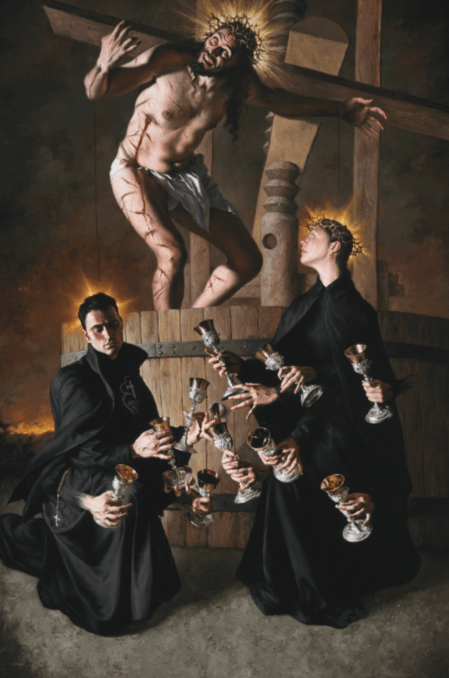
Torculus Christi. Mystic press with St. Gabriele dell’Addolorata and St. Gemma Galgani, Giovanni Gasparro. One of his more overtly weird pieces, but one that is deeply rooted in Catholic mystical and artistic tradition. (Source)

Moving on to a few of Ms. White’s other statements, we come to her distinction between surrealist and sacred art. I happen to be working on a piece right now that will argue that surrealism is an artistic movement that, purged of its original anticlerical animus, can open up plenty of new avenues for a specifically Catholic spiritual art. Indeed, there is already quite a corpus of work that we might reasonably call Catholic surrealism, and I hope to incorporate it into that argument. In the meantime, I refute her argument thus.

Ms. White also takes exception with Gasparro’s very common use of multiplied hands in his paintings. She writes in one of her more patronizing captions,

He seems to be really big into this creepy thing with the multiple floating hands. This is what I would call “schtick” and it is common among highly trained younger artists who think that having a schtick will get them brand-recognition.

This wholesale dismissal is maybe the worst part of the essay. Once again, it evinces a refusal to engage with what Mr. Gasparro has put on the canvas for our consideration, summarizing it tidily in order to condemn it tout court.

Gasparro’s multiplication of hands – or, in some cases, other body parts – serves two functions in his art. First, it can express the passing of time. In The Miracles of St. Francis of Paola (2015), the doubled set of hands represent discreet acts. Secondly, it can express numerous levels of spiritual meaning that otherwise might be missed through a more conventional image. Manipulating gesture opens up the image. This is particularly true in Gasparro’s Speculum Iustitiate (2014), St. Nicholas of Bari (2016), and his deeply moving portrait of Pius VII, Quum memoranda (Servant of God, Pope Pius VII Chiaramonti) (2014).

Screen Shot 2017-11-11 at 10.28.22 PM.png

The Miracles of St. Francis of Paola, Giovanni Gasparro. (Source)

The doubling invites the viewer to consider each act or spiritual meaning in turn and to ponder how the subject may be acting in each case. The multiplication of hands invites us into a secondary, meditative dimension of the work. As I mentioned at the beginning of this essay, I have found his work a very fruitful spur to precisely this kind of spiritual meditation.

Screen Shot 2017-11-11 at 10.35.58 PM.png

Transunstanziazione, Giovanni Gasparro. This image would be perfectly at home in a church. (Source)

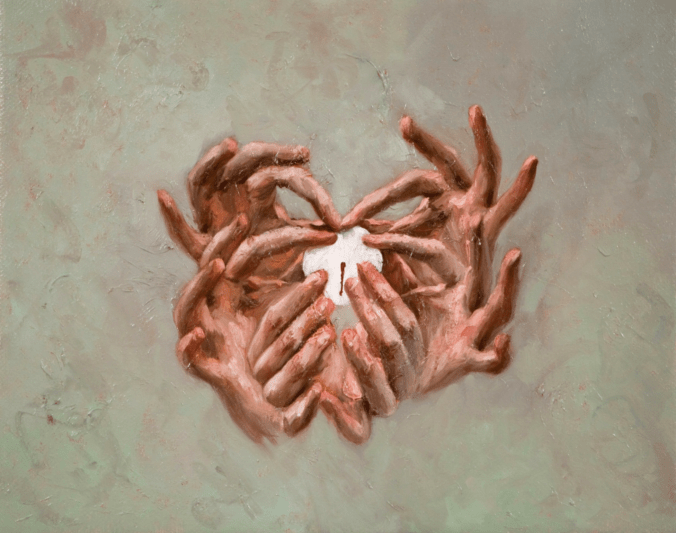
Take one of Gasparro’s finest pieces, Transunstanziazione (2009). I will repeat here what I wrote about it in my Corpus Christi piece:

Three pairs of hands, like the three pairs of wings on the seraphim and cherubim, bear aloft a bleeding host in undifferentiated space. The three sets of hands appear the samethey are, perhaps, the hands of the same priest captured over the lapse of time. This distortion of time and space lends the image a sense of eternity. We are viewing something transcendent. The Eucharist is not just an earthly event. It is also a rite which happens forever in the cosmic liturgy of heaven. And who is the Great High Priest offering that liturgy for us mortals? Who but Christ? In Gasparro’s image, Christ is present as priest and victim.

The three pairs of hands also remind us of the Trinity. When we approach the Eucharist, we truly approach the Triune God. At every Mass, the act of Transubstantiation only happens because of the work of the whole Trinity. Christ offers Himself to the Father in the Holy Spirit, through the hands of His priests and the prayer of His bride, the Church. It is meet and right that we should consider the painting at this point between the Ordinary Form celebrations of Trinity Sunday and Corpus Christi.

The painting has a certain sacramentality, in that, like the liturgy, it captures something of the invisible and manifests it to our earthbound senses. Looking at Gasparro’s painting, we have the sense that we are glimpsing something profound, unsettling, and sacredsomething ordinarily hidden from us. Do we not hear the words of St. Thomas’s Corpus Christi hymn, Lauda Sion?

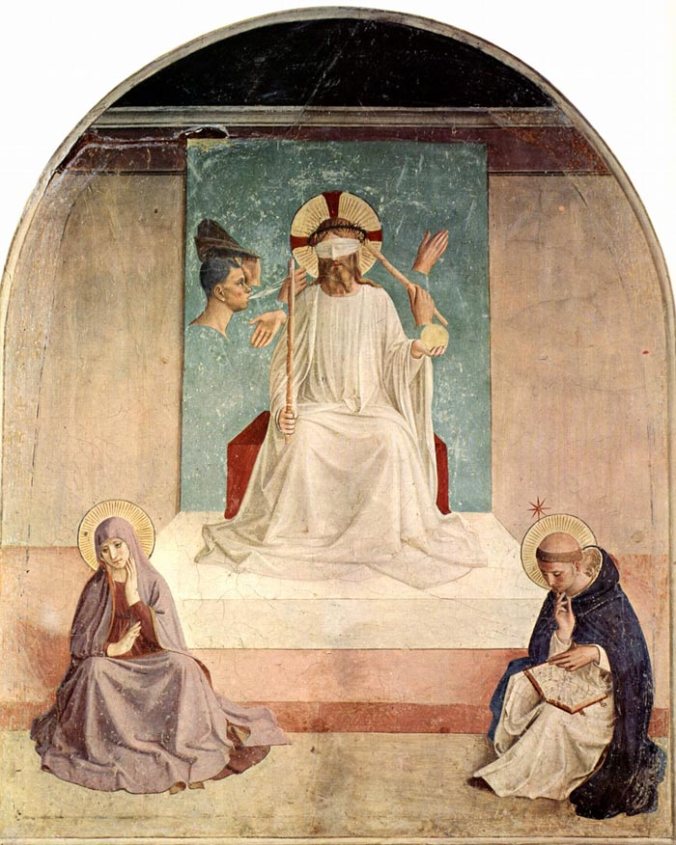
Every time I return to this painting, I find something deeper in it. I’ll add that the multiplication of hands is a trope that exists in the work of that most unimpeachable of Catholic Artists, the Blessed Fra Angelico, who uses it in virtually the same way as Gasparro.
mockingofchrist700

The Mocking of Christ, Fra Angelico. Here he uses hands in the same ways that Gasparro does – to telescope sequential events into one image, to provide an insight into hidden action, and to lead us into meditation. Two of my Facebook friends noticed the formal and spiritual kinship between the two artists. (Source)

Of course, I don’t expect Ms. White or anyone else to have the same approach to every work of art as I do. If she finds Gasparro “creepy,” that is her right. But it is not an argument against Gasparro’s Catholicity. It is a subjective and affective assessment of his art, and thus it lies more in the realm of taste than aesthetic theology. And there’s nothing intrinsically wrong with having and describing a visceral reaction to a work of art. I’m perfectly happy to say de gustibus and leave it at that.

Unfortunately, Ms. White expatiates about what constitutes “sacred art,” which, she claims, is emphatically not what Mr. Gasparro is doing.

She writes,

Knowing nothing about him other than what he paints, I have no idea what this artist intends – and that right there should tell you that he’s NOT doing sacred art – but it seems that in general hyperrealism simply isn’t going to work for devotional art. It’s always going to come across as strange and parodic, because the purpose of devotional painting is not to depict ordinary earthly reality – with all its “warts” – but a supernaturalised, idealised and perfected reality, a redeemed reality, that can only be occasionally glimpsed in this life by seeing the saints.

Sacred art is devotional art. If it isn’t devotional, it’s a parody of the sacred.

Where do I begin?

First of all, it doesn’t matter what the artist intends. We emphatically don’t need to know the artist’s intentions to appreciate what exists in the constructed world of the art-object. It can be helpful, but it really isn’t necessary. “Intention” is one of those terms that is always so heterogeneous and slippery as to be virtually meaningless. Consider the range of “intentions” that might be implicit in any work of art. Most artists of the Renaissance probably intended to produce images that would please their wealthy patrons so that they could keep eating. Moreover, it seems that a great deal of eros generated quite a lot of the Western canon. No doubt at times the souls of the artists were illuminated by the grandeur of their work. But we can’t possibly know to what extent the deeply fallible men (and they were almost all men) intended to invest their work with a consciously spiritual meaning.

What’s more, Ms. White’s dislike for “hyperrealism” as well as “surrealism” leads her to miss the fact that Gasparro’s work strikes an incarnational balance between the two. His subjects are recognizably human, but in the strange art-world he depicts, they are charged with the heavy presence of a mystery far beyond their humanity. They share our condition while pointing towards a world that stands beyond it.

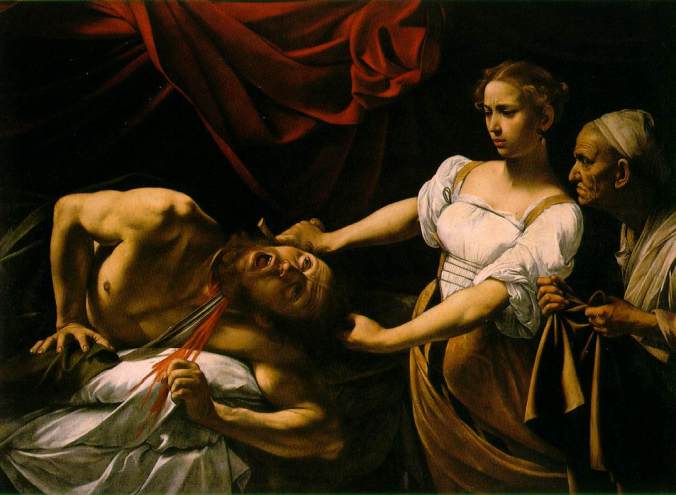
It bears mentioning that her dislike of “ordinary earthly reality – with all its ‘warts'” would necessarily strike Caravaggio from the canon of Catholic masters. Of course, Gasparro resembles Caravaggio more than any other artist. Perhaps she would be glad to see him go. Who else would disappear under Ms. White’s discriminating eye? Rubens and his corpulent maidens? Matthias Grunewald and his unpleasant crucifixions? How about Carlo Crivelli and the sly, malevolent eyes he gives to his saints? What are we to do with the Mannerists and all the distended limbs that litter their canvases? And although he was no Catholic, are we to write off the value of Rembrandt’s religious work because he dares to show the uneven surface of human flesh? Would this not be precisely the least Catholic impulse of all – to fly from the corporeality of our existence, and of the way God uses it?
Judith_Beheading_Holofernes_by_Caravaggio

Judith Beheading Holofernes, Caravaggio. This magnificent portrayal of Judith’s triumph over the wicked general is apparently not “sacred art” under Ms. White’s criteria. (Source)

Ms. White insists on idealism and devotionalism in sacred art. Anything that fails in either of these qualities must be consigned to the great heap of Modernist parody.

Yet both of these are deeply misbegotten efforts. First, when she speaks of “supernaturalised, idealised and perfected reality, a redeemed reality,” she is using the language of iconography. There is indeed much to commend the hallowed iconographic traditions of the Greeks and Slavs (not to mention the Armenians). But Byzantine icons are subject to strict canons, types, and lineages. An iconographer’s process and material are, to a certain extent, determined for him. Longstanding customs surround the production and ritual use of the icons. Part of the reason that theologians can work from the icons as a source in their writing is that those customs safeguard and guarantee the orthodoxy of the images. And the spirituality they have fostered over the centuries is one I admire; it has quickened my own Christian life.
TheMostChasteHeartofStJoseph

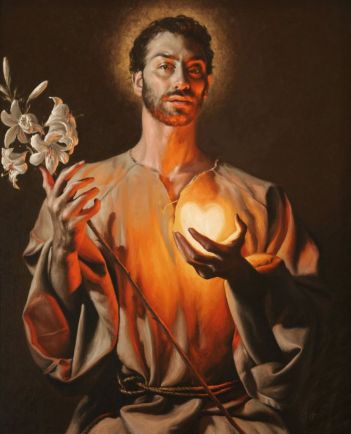
The Most Chaste Heart of St. Joseph, Giovanni Gasparro. Something nigh-unprecedented like this devotional image would be impossible if Western art followed strict canons like the Byzantines do. (Source)

Nevertheless, that’s not what we do in the West. While some artists have managed to give us glimpses of a transcendent realm of sophianic glory (one thinks of the Cusco School and some of those Catholic surrealists I was talking about), they are certainly not obliged to do so by force of tradition. One can lament the fact that we developed a much freer sense of sacred art. I don’t, both because I like statues and because I think the relative freedom of artists has been an enormous boon to civilization and the Church.

We can definitely learn from icons, in part because they remind us of where our own tradition has been. Before this year’s terrible earthquake, Ms. White’s own monastery had a wonderful fresco that captured precisely this quality of enrichment from the East that can and should be productively pursued by Catholic artists. But we ought not make the spiritual vision of the East normative in the West, just as we would decry any effort to impose Western forms on the East. And so I entirely reject her attempt to foist on Western Catholic art the strict confines of the icons.

Secondly, I’m bothered by instrumentalist approaches to art, including an assessment that rests heavily on whether the piece in question is “edifying” or “devotional.” That’s a largely meaningless standard – much more indistinct than the question of whether something is beautiful – since it places the center of the art’s meaning and quality in the affective response of the viewer rather than its own constructed reality and the way that construction interacts with transcendental standards. Namely, beauty.

The idea that specifically sacred art should be a) “devotional,” and b) in a church is a narrow, limiting, overly contextual approach to art. It is only helpful in the strict sense of guidance for church decoration. If Ms. White had limited the purview of her argument to what should count as specifically Liturgical Art, that is, what type of art should be placed in a church for the public veneration and instruction of the faithful in a ritual context, she might have a point. But she doesn’t write within that important qualifier. Instead, she uses Mr. Gasparro’s oeuvre to think about sacred art in general, and arrives at the rather flattening dictum that “Sacred art is devotional art. If it isn’t devotional, it’s a parody of the sacred.”
Screen Shot 2017-11-12 at 1.27.39 AM.png

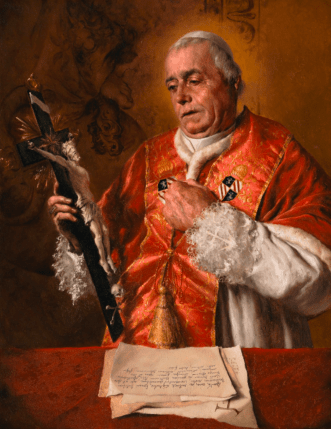
Blessed Pius IX Pontifex Maximus, Giovanni Gasparro. Because artists who are really modernist heretics are drawn to depicting Pio Nono in prayer. (Source)

The conclusions she draws are totally unworkable as a Catholic approach to aesthetics. Imagine how much poetry and how much music we would have to surrender if we tried to carry the standards of idealism and devotionalism into the other arts in any kind of normative way.

Catholics should be concerned about the quality and orthodoxy of their sacred art. Insofar as Ms. White’s article represents that concern, it is an admirable effort. I’ll add that Ms. White and I probably share a similar exasperation with some of the trends in poor church art and architecture that are so maddening today. Likewise, we no doubt share a desire for a renewal of the Catholic arts. But Ms. White’s artistic philosophy smacks too much of Savonarola. While she is willing to summarily cast Gasparro’s art into the bonfire of the vanities, I contend that he is one of the Church’s most important living artists, alongside Daniel Mitsui, Matthew Alderman, Raúl Berzosa, Ken Woo, Alvin Ong, and others. I also share Rebecca Bratten Weiss’s views on the arts more broadly. We Catholics, and especially those of us who consider ourselves fairly Traditional, are sometimes too “self-referential” (if I may borrow a term favored by the Pope). As Weiss notes:

Toni Morrison, for instance, is a Catholic Nobel laureate whose works are filled with themes of community and redemption. But the Catholic critics who enthuse over Flannery O’Connor and Graham Greene regard Morrison only as a controversial writer on race relations. “She’s not practicing,” they might say, as an excuse to ignore her. And yet, C.S. Lewis, who is revered in their circles, was never even Catholic at all.

Mary Karr – the keynote speaker at the conference – not only is a Catholic convert, but wrote extensively about her conversion, but is deemed by some not to be a “real” Catholic writer, because of her openness about certain sexual issues. And yet Graham Greene was a notorious womanizer who slept with over 300 prostitutes, was condemned by church spokespersons in his time, and closed The End of the Affair with the prayer: “O God, You’ve done enough, You’ve robbed me of enough, I’m too tired and old to learn to love, leave me alone for ever.”

Perhaps the critics who are timid about these powerful Catholic writers working right now in our midst are waiting for someone else to “baptize” them? Perhaps they are waiting for someone else to say “I heard God there” – because they, themselves, have not learned to open the inner chambers of the ear? Because we do not have a robust Catholic arts culture that teaches us to open all the portals for reception, but instead have embraced a misnamed “Benedict Option” which is all about putting up walls and barriers, drawing those lines in the sand.

I concur, and would extend the same sort of criticism to Ms. White and those who support her view of the arts. Let us not fall into that old trap of mistaking the modern for Modernism. Christ is King over all. Let Catholic artists explore the plenitude of that Kingship over all, in all, and through all – even if looks strange to our worldly eyes.
Screen Shot 2017-11-11 at 10.00.45 PM

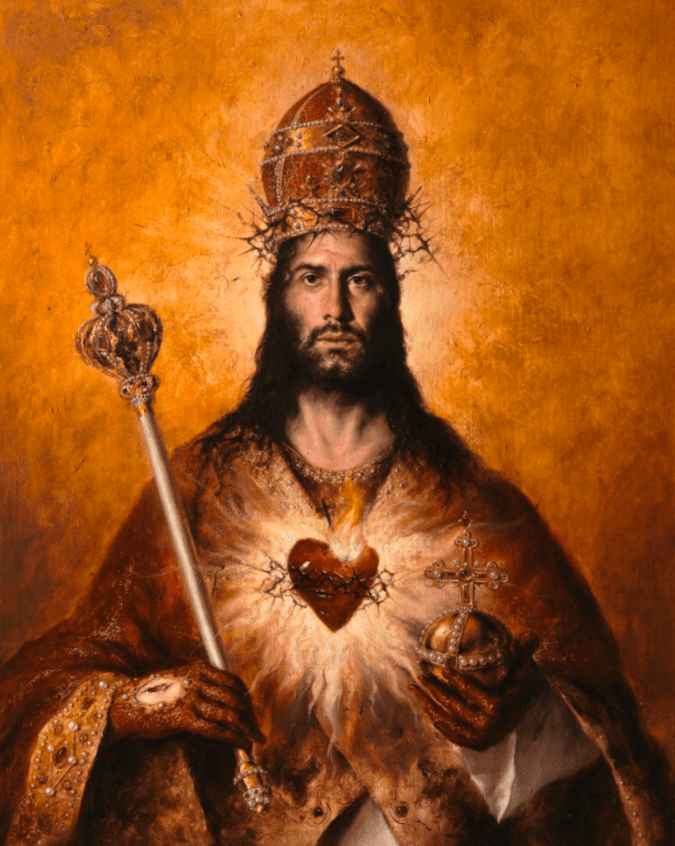
Christ the King, Giovanni Gasparro. May we always serve Him with ardent charity and zeal for the beauty of His house. (Source)
The Best Depictions of the Subtle Doctor

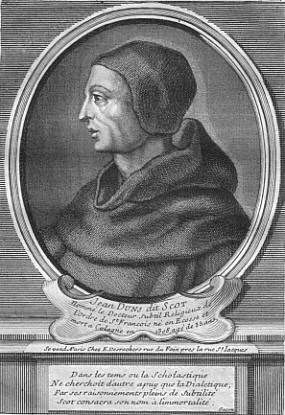
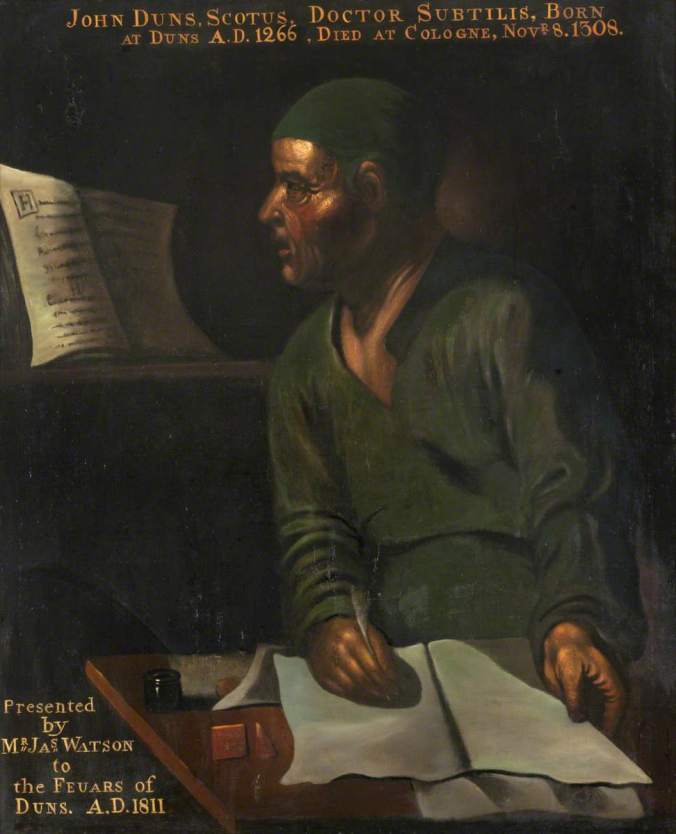
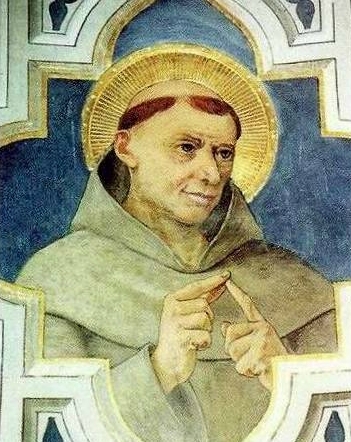
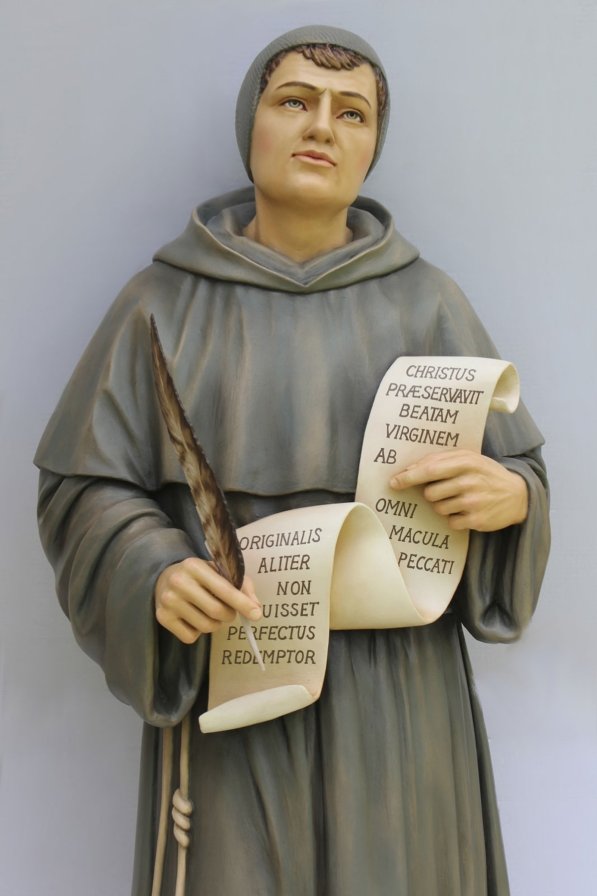
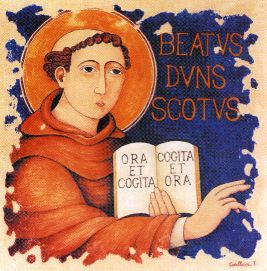
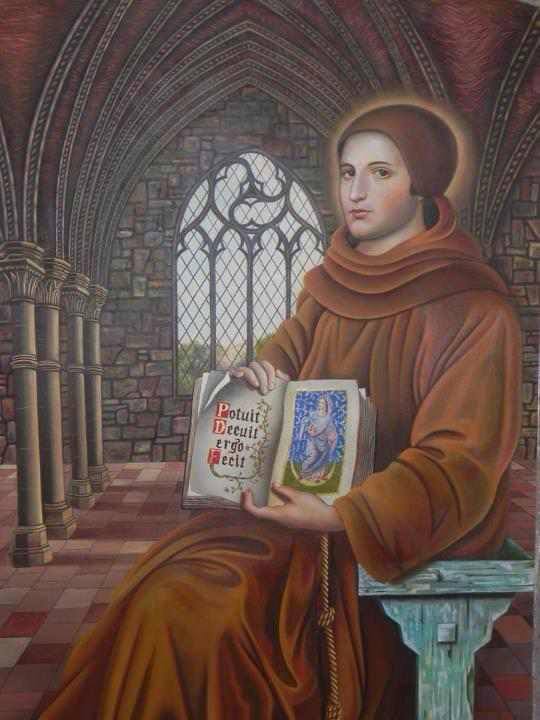
I’ve taken a major interest in Scotus recently. His Christology and Mariology seem to be treasures that remain largely unexploited by contemporary theologians, in part because he was recognized as being in the right about a doctrine that became dogma almost two hundred years ago. He is at the center of ongoing debates about the advent of secularism and modernity, debates which I am not competent to comment on at this time. Nevertheless, I thought it might be fun to examine some of the ways that Catholics (mostly Franciscans) have memorialized him in art over the course of the last several centuries. In some sense, the variety of depictions here tell a story of a lineage long overshadowed by other, more influential streams of thought. Thomism in particular has had a near perennial appeal within the Church, whereas Scotism, it seems, has largely been a niche concern. After all, Scotus has not yet been canonized or joined the ranks of the Doctors of the Church. This inequity arose from a variety of factors. No doubt, the fate of Scotism has come partially from Scotus’s own difficult style and vast intelligence. There’s a reason he’s called the “Subtle Doctor.”

May my small collection here help rectify that oversight on this, his feast day.

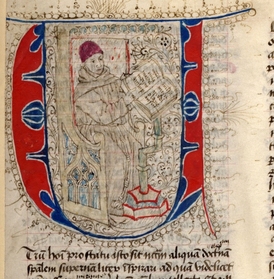
Bl John Duns Scotus-thumb-275x279-4957

John the Scot (c. 1266 – 8 Nov. 1308), appearing in what must be one of his earliest depictions: an illuminated capital. (Source)

bl-john-duns-scotus

A Renaissance portrait of the Blessed John Duns Scotus. One point that people forget about Scotus is that he defended the rights of the Church against Philip IV, who had wanted to tax church properties. For his bold stance, he was exiled for a few years from Paris. (Source)

JohnDunsScotus_-_full

Perhaps the most famous, a late-Medeival, early-Renaissance portrait of Scotus. The name of the artist escapes me. (Source)
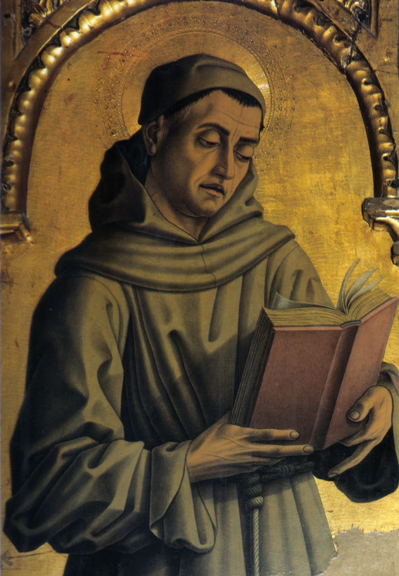
Beato_Giovanni_Duns_Scoto_B

An early modern engraving of Scotus, probably early to mid 15th century. (Source)
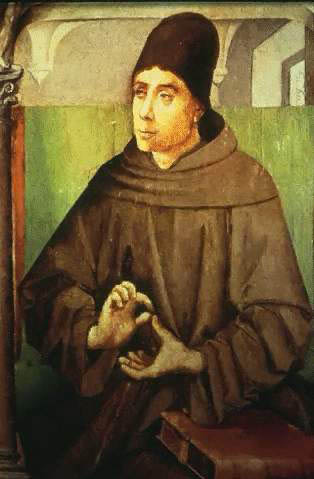
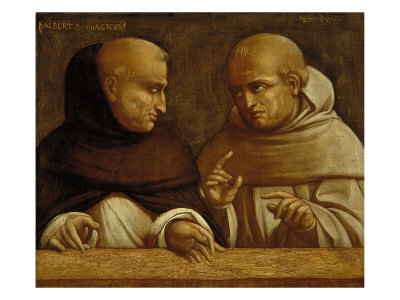
St Albert the Great & Bl John Duns Scotus

Here he is with St. Albert the Great, one of the Dominican Doctors. (Source)
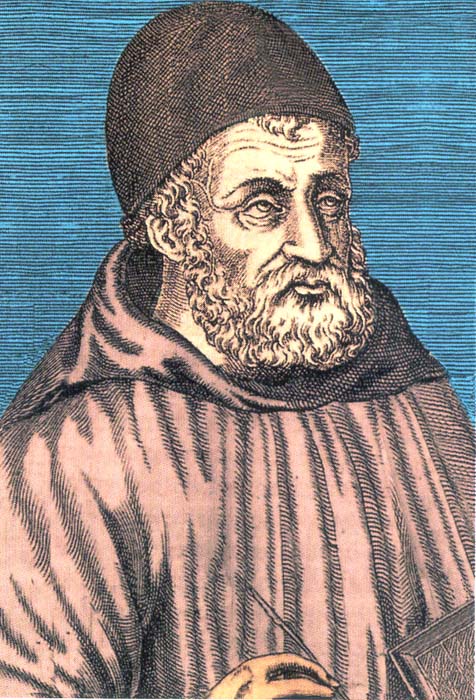
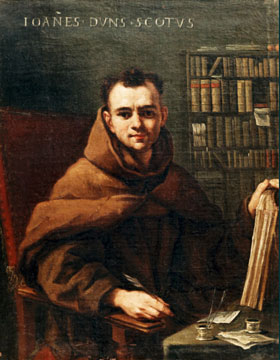
duns-scotus1

Scotus the Scholar. Age and provenance unclear; my guess is late 17th century, though it may be later. (Source)
Scotus17thcentury

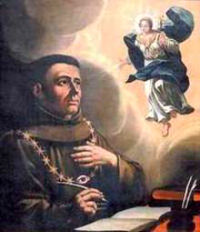
Scotus receiving a vision of the Christ Child, 17th or 18th century. Although chiefly remembered for his metaphysics and Mariology, Scotus made major contributions to Christology, defending the Patristic idea of Christ’s Absolute Primacy. (Source)
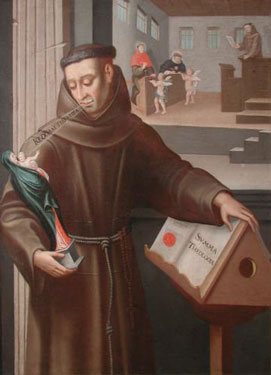
scotusstatue1

From the early modern period, it became typical to depict Scotus with representations of the Virgin Mary, whose Immaculate Conception he famously defended. This piece, probably from the 18th century, is one such example. It also contains a pretty clear criticism of Aquinas – Scotus looks away from the Summa to gaze lovingly at Mary (Source: this very friendly take on Scotus by a prominent popular Thomist)

11_08_duns_scotus2

A slightly more dramatic iteration of the same theme. Scotus is inspired by the Immaculate Conception. (Source)
ScotusChariot

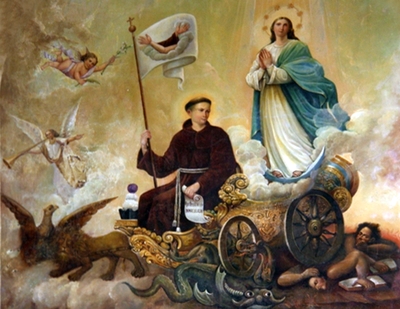
My single favorite image of Scotus is this ludicrously over-the-top Rococo depiction of Scotus and the Immaculate Conception triumphing over heresy and sin. He holds the arms (no pun intended) of the Franciscan order. His defense of the Immaculate Conception surpassed the doubts of even his own order’s great luminary, St. Bonaventure. And what a marvellously simple argument it was, too. Remember: POTVIT DECVIT ERGO FECIT. (Source).

Izamal Duns Scotus Adopte rest

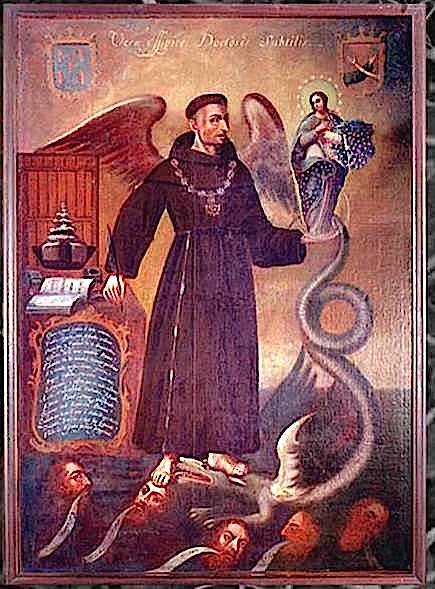
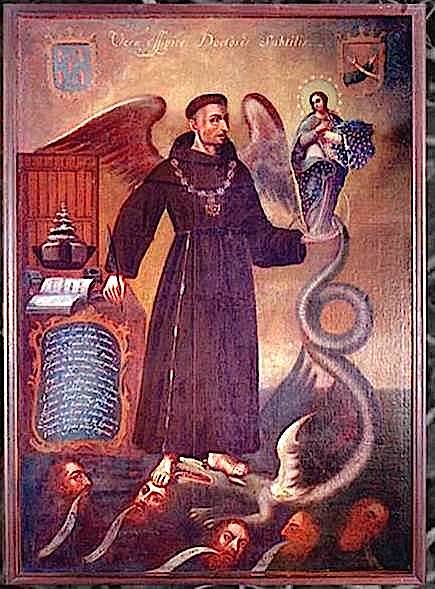
Likewise, this totally marvelous Colonial Mexican painting from the Franciscan monastery of Izamal, Yucatan, is something else. Rare is the saint granted wings in traditional iconography, though the trend was not uncommon in early modern Mexican art (Source)
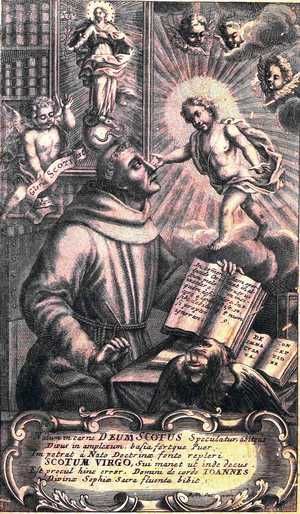
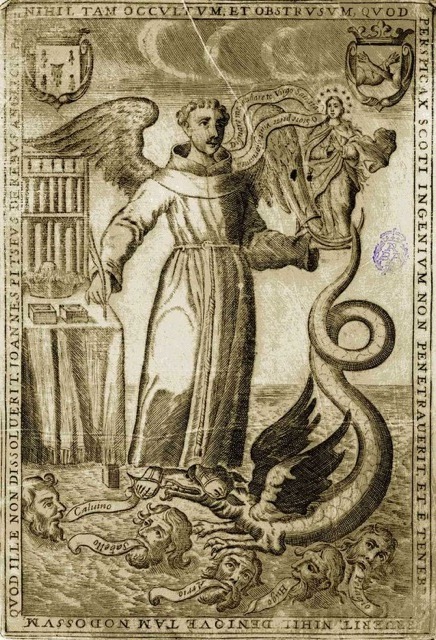
Joannes Pitseus, Scotus 1619

The mystery solved! This version by Johannes Pitseus comes from 1619, and served as a model for the Izamal piece. Here, it’s clearer that the heads represent various heretics, including Pelagius, Arius, and Calvin. (Source)
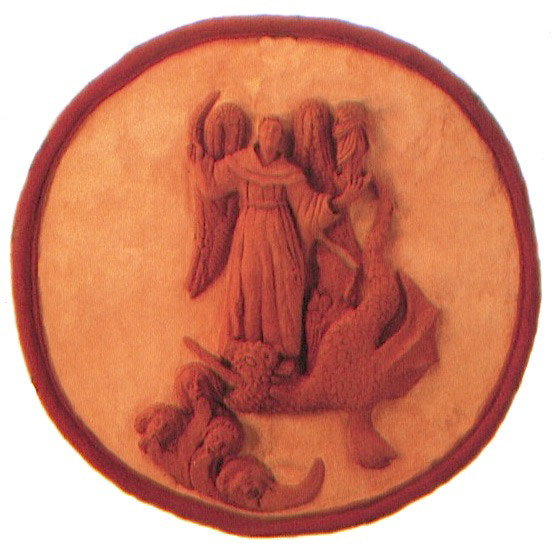
Landa Duns Scotus

This ceiling relief from Landa, Querétaro, uses the same iconographic lexicon. It seems that the Franciscans of colonial Mexico had a set of stock images to propagate devotion to their own saints. (Source)
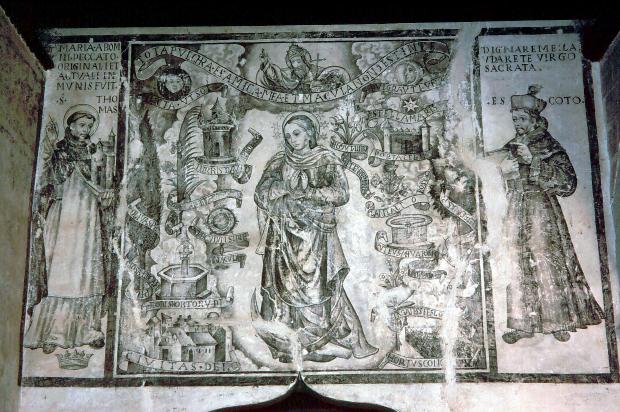
huej purisima

Here’s another unusual image of Scotus. In this mural of Mary Immaculate, or La Purísima, we see Scotus alongside St. Thomas Aquinas…and wearing a biretta! A remarkable addition, unique among all other depictions of the Subtle Doctor that I know of. (Source)
SCOTUS

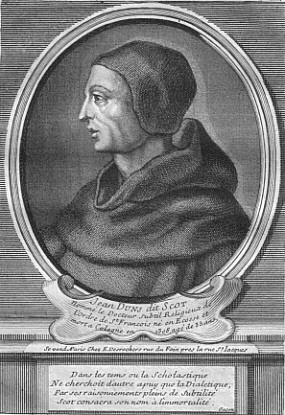
Moving away from Mexico, we come to this rather uninteresting French portrait of Scotus. Not all 18th century portraits of the man are elaborate bits of Franciscan propaganda. (Source)
 

unknown artist; John Duns Scotus (1266-1308)

A late 18th or early 19th century depiction of Bl. John Duns Scotus. If this is in fact an English painting, its creation at a time of high and dry Anglican Protestantism poses interesting questions about the use of Scotus as a figure of national pride. (Source)

john-duns-scotus

I’m unsure of how old this image is; my guess, however, is that it represents a 19th century imitation of late Medieval and Renaissance style. (Source)

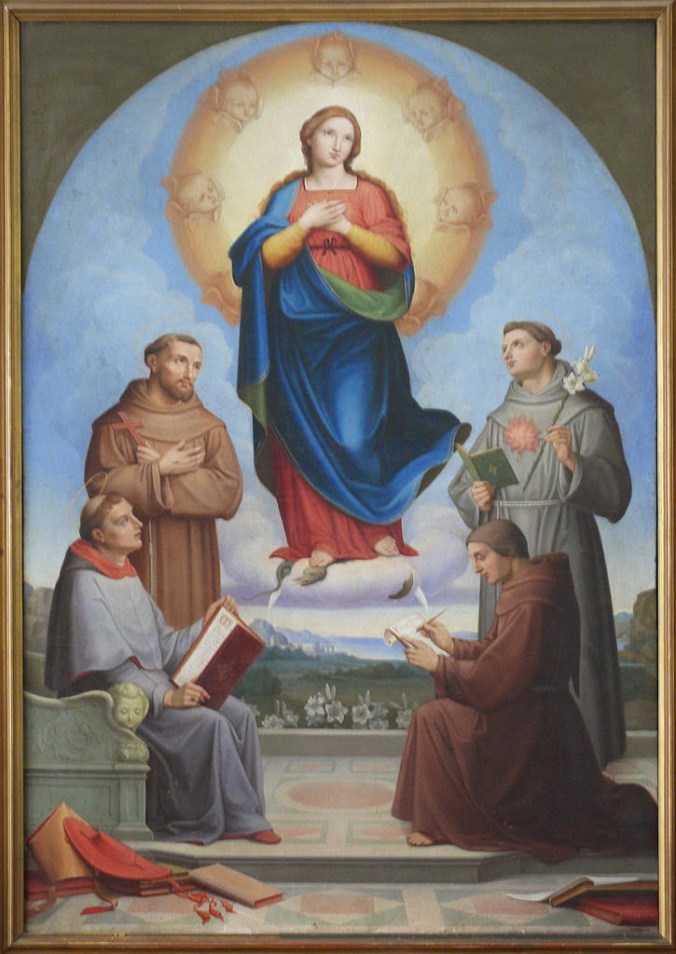
Albert Küchler (Brother Peter of Copenhagen) - Immaculate Conception with St. Bonaventure, Francis, Anthony and Blessed John Duns Scotus - Rome - Pontifical University Antonianum

A great 19th century painting of the Immaculate Conception by Danish Franciscan Albert Küchler. Scotus, who is on the bottom right, is here depicted alongside other Franciscan saints – S.s. Francis of Assisi, Anthony of Padua, and Bonaventure. (Source)

Immaculate_Conception_Church_(Columbus,_Ohio)_-_stained_glass,_Blessed_Duns_Scotus

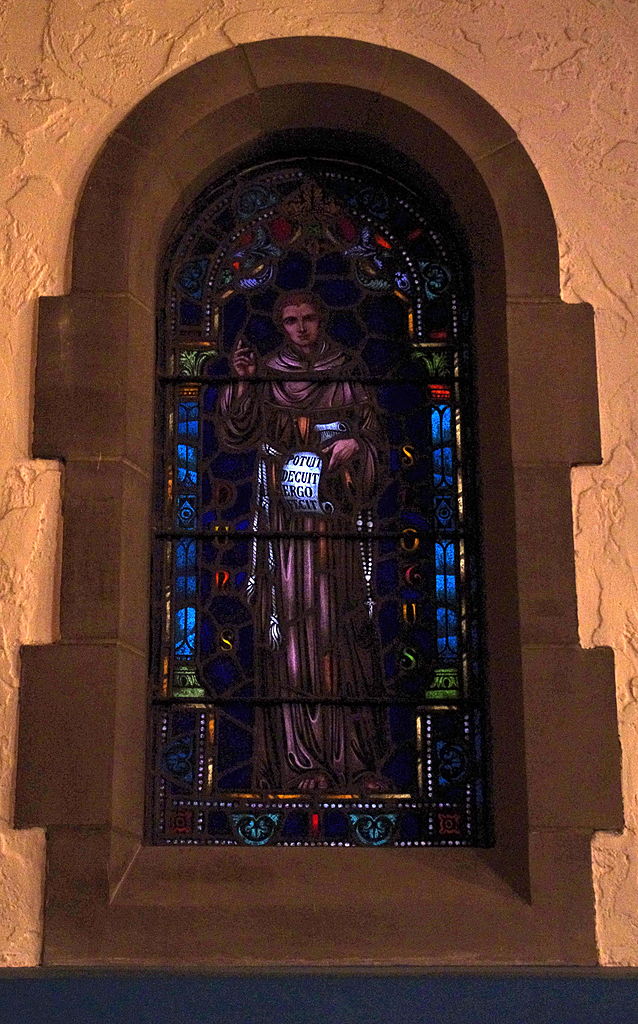
This looks like a Harry Clarke window, though it may just resemble his style. In anyway, we see here Scotus holding a scroll with his famous argument for the Immaculate Conception epitomized – “He could do it, It was fitting He should do it, so He did it.” (Source)

JohnDunsScotusImmaculata

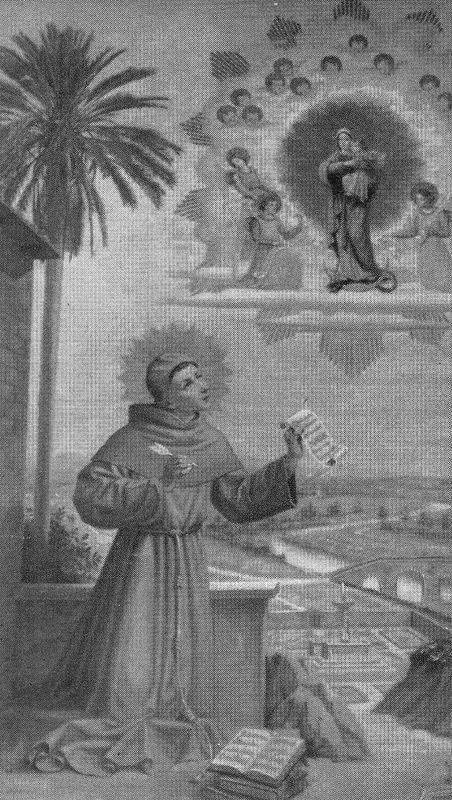
John Duns Scotus, once again contemplating the Immaculate Virgin and offering his mighty works to her. (Source)

dunsscot.2

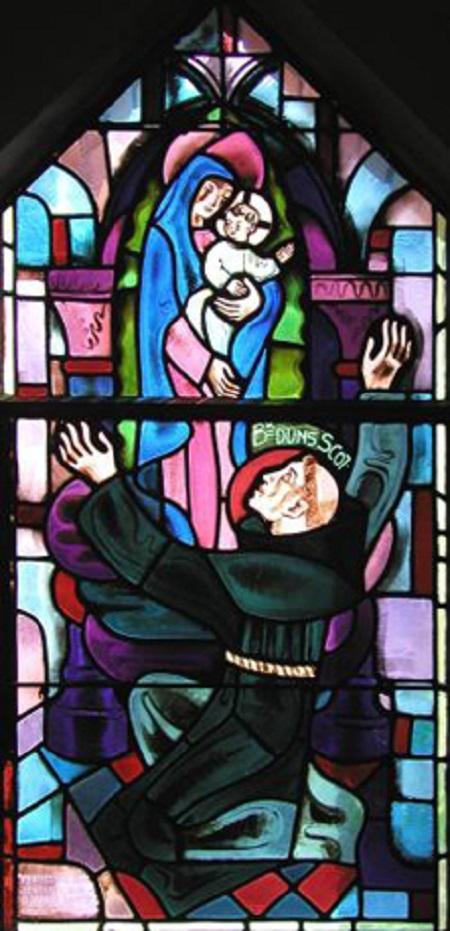
Another stained glass window, this time indubitably from the 20th century. We see here Scotus worshiping the Christ Child and his Immaculate Mother. (Source)

Johannes_duns_scotus_20060501

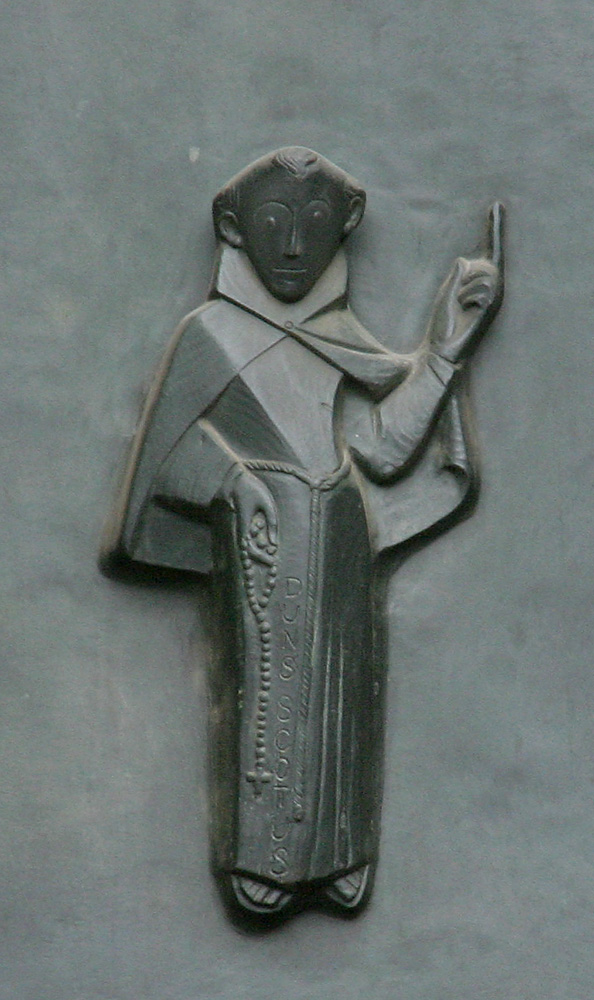
Scotus depicted in on the door of a Cologne Cathedral, 1948. He represents the supernatural gift of Understanding. (Source)

duns-scott_01

A contemporary statue of Scotus. (Source)

Scoto-2

Scotus with a modification of the Benedictine phrase. “Pray and Think. Think and Pray.” Not a bad motto. (Source)


20thCScotus

A 20th or 21st century image of the Blessed Scotus (Source).