A Poem by Montague Summers

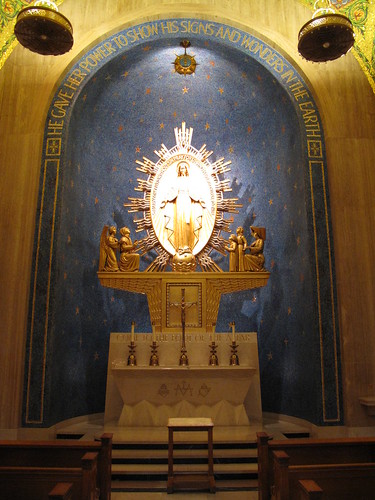
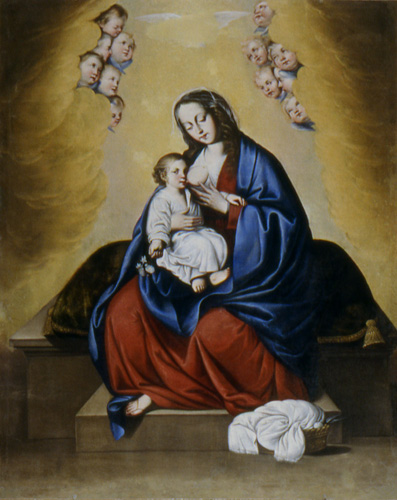
madonna-delle-grazie-santa-chiara-giuseppe-marullo

Madonna delle Grazie, Naples (Source)

Some of my readers will no doubt remember that very strange fellow I once wrote about, the Rev. Montague Summers. I have had to look at quite a lot of his orchidaceous writings recently for my research, including his poetry. Here is one such poem he wrote in Antinous and Other Poems (1907). It was written while he was still an Anglican, though it anticipates the lusciously Baroque spirituality that would mark his later writings.

Madonna Delle Grazie

Montague Summers

In the fane of grey-robed Clare
Let me bow my knee in prayer,
Gazing at thy holy face
Gentle Mary, Queen of Grace.
Thou who knowest what I seek,
Ere I unlock my lips to speak,
For I am thine in every part
And thou knowest what my heart,
Yearning in my fervid breast,
Ere it be aloud confessed,
Longeth for exceedingly,
Mamma cara, pity me!

By the dearth of childlorn years,
By thy mother Anna’s tears,
By the cry of Joachim,
When the radiant seraphim,
Girdled with eternal light,
Blazed upon the patriarch’s sight
With the joyous heraldry
Of thy sinless infancy.

By the bridal of the Dove,
By thy God’s ecstatic love,
By the home of Nazareth,
When the supernatural breath
Of God enfolded thee, and cried:
“Open to me, love, my bride,
Come to where the south winds blow,
Whence the mystic spices flow,
Calamus and cinnamon,
Living streams from Lebanon.
Fresh flowers upon the earth appear
The time of singing birds is near,
The turtle-dove calls on his mate,
The fruit is fragrant at our gate.
Thy lips are as sweet-smelling myrrh,
When the odorous breezes stir
Amid the garden of the kings;
As incense burns at thanksgivings.
Thy lips are as a scarlet thread,
Like Carmèl is they comely head,
Thou art all mine, until the day
Break, and the shadows flee away!”

Mother, by thy agony
‘Neath the rood of Calvary,
When the over-piteous dole
Pierced through thy very soul
With a sevenfold bitter sword
According to the prophet’s word.
By the sweat and spiny caul,
By the acrid drink of gall,
By the aloes and the tomb,
By thy more than martyrdom,
Dolorosa, give to me
The thing I lowly crave of thee.

By thy glory far above,
Mother, Queen of heavenly love,
By thy crown and royal state,
By thy Heart Immaculate,
Consort of the Deity,
Withouten whose sweet assent He
May nothing deign to do or move
Bound by ever hungered love,
God obedient to thee!

Mother, greatly condescending,
To thy humblest suitor bending,
From thy star-y-pathen throne,
Since it never hath been known
Whoso to this picture hied,
Whoso prayed thee was denied,
Mamma bella, give to me,
The boon I supplicate of thee!

In Santa Chiara, Napoli.
Screen Shot 2018-06-04 at 11.43.14 PM.png

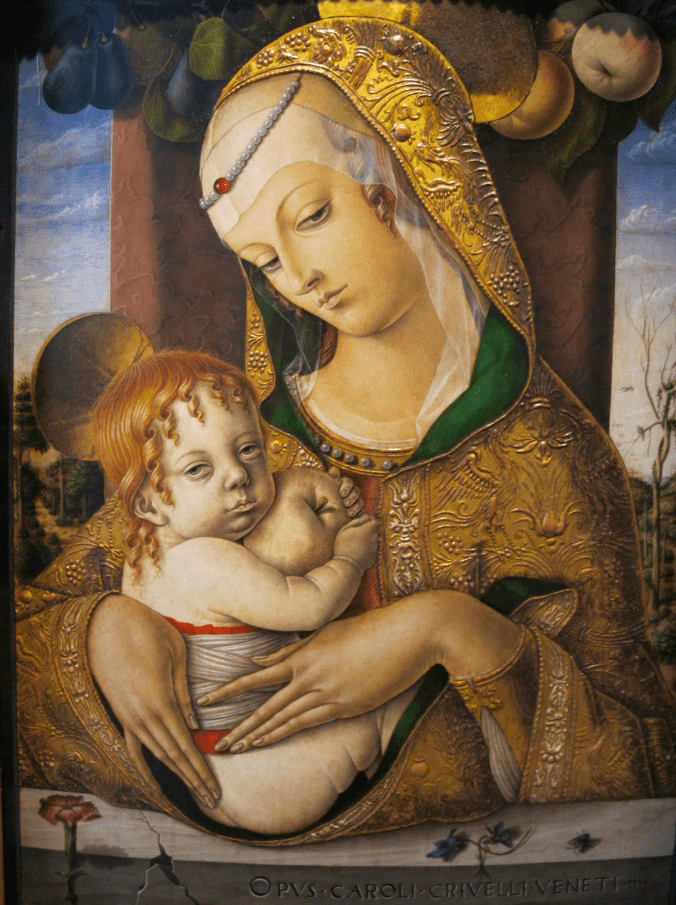
“Madonna and Child,” Carlo Crivelli, c. 1480 (Source)
Elsewhere: A Powerful Prayer of Deliverance

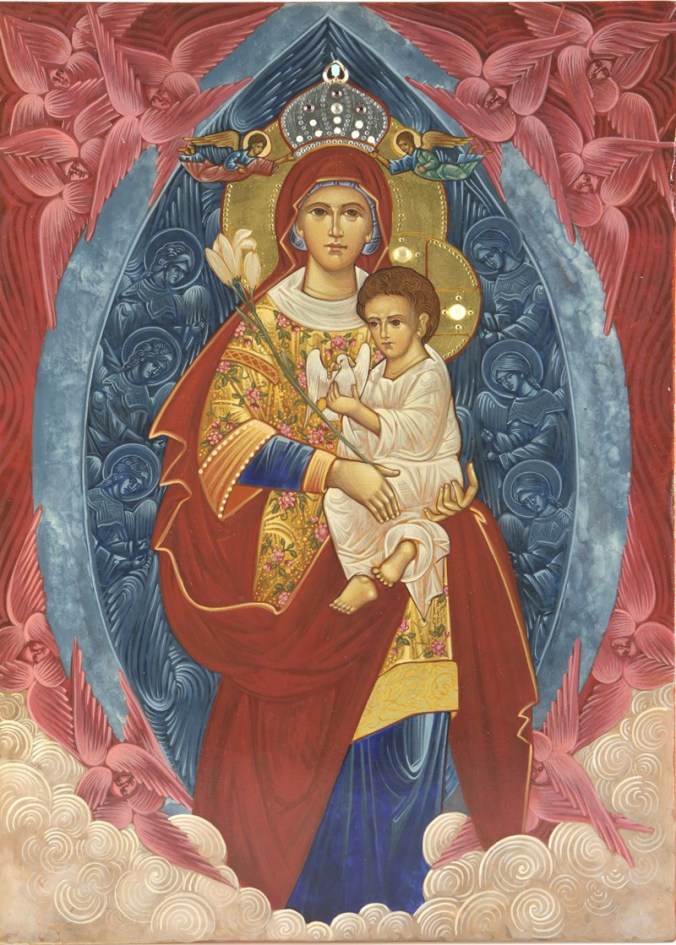
Our Lady of Angels

Icon of Our Lady of Angels. (Source)

Over at Vultus Christi, you can find a series of Chapter Talks on the Rule of Saint Benedict. Today’s commentary concludes with the story of a mighty prayer of deliverance given by the Blessed Virgin Mary to a French priest of the nineteenth century, Bl. Louis-Edoard Cestac. Here it is:

August Queen of Heaven, sovereign Mistress of the Angels, thou who from the beginning hast received from God the power and the mission to crush the head of Satan, we humbly beseech thee to send thy holy legions, that under thy command and by thy power they may pursue the evil spirits, encounter them on every side, resist their bold attacks, and drive them hence into eternal woe.

Who is like unto God?

O good and tender Mother, thou willest always to be our love and our hope.
O Mother of God, send thy holy Angels to defend us and drive far from us the cruel enemy.
Holy Angels and Archangels, defend us and keep us. Amen.

Go read the whole thing. In fact, all of the commentaries are edifying; read them all.

“Love is His Bond”

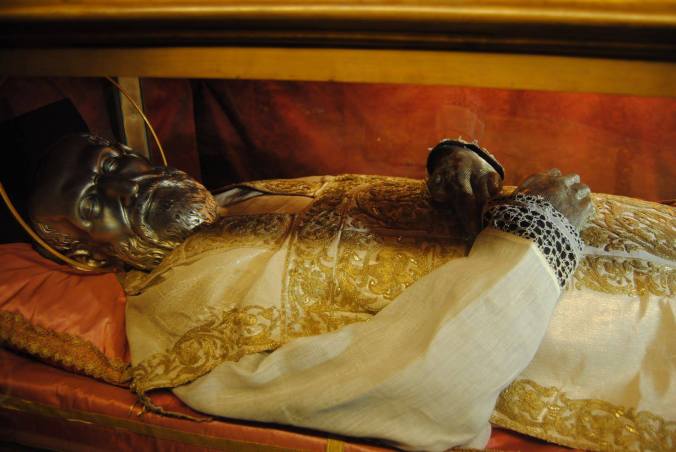
stphilipneribody

St. Philip, pray for us. (Source)

The Mass of St. Philip Neri is a little lesson in joy. The propers again and again stress a common theme: namely, the great saint’s joy, built upon his constant and fiery communion with the Holy Ghost. Holy Mother Church lifts her voice and sings in the Introit, “The love of God is shed abroad in our hearts by the Holy Ghost which dwelleth in us. Praise the Lord, O my soul; and all that is within me praise His holy name.” At the Collect, we pray to God to “mercifully grant that we, who rejoice in his solemnity, may be profited by the example of his virtues.” When, in the third reading, we hear of the saint’s overpowering love of “the spirit of wisdom,” we learn as well that “All good things together came to me with her…and I rejoiced in them all” (from Wisdom 7). The Offertory likewise proclaims with the Psalmist, “I will run the way of Thy commandments, when Thou hast set my heart at liberty” (Ps. 118). Everywhere we turn, we find the joy and freedom that alone springs from communion with the Holy Ghost.

And then we come to a remarkable moment. In the Secret, the priest prays over the offerings,

We beseech Thee, O Lord, favorably to regard these present sacrifices: and grant that the Holy Spirit may inflame us with that fire, wherewith he wondrously penetrated the heart of blessed Philip.

The Church has here enshrined a stunning and highly instructive truth. Yet it is easy to miss.

The very heart of St. Philip – that organ claimed so powerfully by the Holy Ghost in the catacombs of St. Sebastian, ever converting those sinners with the happy fortune of touching Philip’s breast, inflaming the saint with the deathless ardor of love, bearing such close likeness to those sacred hearts of Christ, Our Lady, and St. Joseph, beloved by generations upon generations – that heart is set up for us here in parallel to the Eucharist. For just as it is the Spirit who will so shortly transform bread into the most holy and eternal heart of Jesus, so it is that same Spirit who made of St. Philip’s heart a “hostia pura, hostia sancta, hostia immaculata.” Christ gives himself entirely to us by the Holy Ghost in the Liturgy, and St. Philip Neri became entirely Christ’s by the arrival of the Holy Ghost in those dark catacombs. To possess the heart is to possess the whole man.

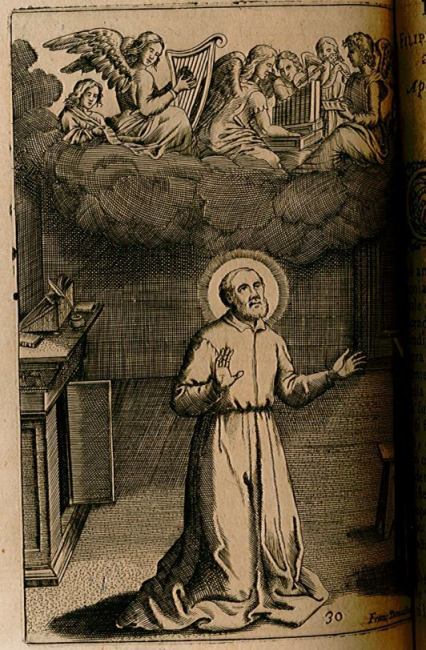
RarePlatePNCardiff

A plate illustrating the life of St. Philip from a rare 1699 Vita, kindly shown to me and since publicly shared by the Cardiff Oratorians. (Source)

This mutual possession of God and man animates everything for the Christian. The more we are given over to it, the more God allows us to partake of His own life. The more we are His, the more He becomes ours. This spiritual truth was well understood by St. Philip, who enshrined it as the principal of unvowed community life in the Oratory. In the words of Bl. John Henry Newman, “Love is his bond, he knows no other fetter.” This line, written of St. Philip, could apply just as well to Our Savior, Jesus Christ. For it is by His indwelling love that we come to love Him. It is by love that we can join our hearts to His in the Eucharist. It is truly by love that we share “that fire, wherewith [the Holy Spirit] wondrously penetrated the heart of blessed Philip.”

The 83rd Psalm comes to the Church’s lips at the Communion. She sings, “My heart and my flesh rejoice in the living God.” These are not only St. Philip’s words, but those of every soul who gives herself over to the indwelling love of God. And at the Postcommunion, the Church prays,

O Lord, who hast fulfilled us with Thy heavenly delights: we beseech Thee, that by the merits of blessed Philip Thy Confessor, and by following him, we may ever earnestly seek after those things whereby we truly live.

filippo-neri

St Philip lived a preeminently liturgical life. (Source)

What are “those things whereby we truly live?” The Holy Ghost, the Eucharist, and prayer – those things, if it be not too blasphemous to speak of them as “things,” which were ever St. Philip’s “heavenly delights.” Or, more properly, that mystic unity of the three in the Liturgy. In his own words, “A man without prayer is like an animal without the use of reason.” And it is surely the grand and orderly and perfect prayer of Christ the Priest and Victim that St. Philip means when he speaks of our super-sensual reason.

What, then, does it mean to “truly live?” If I may be permitted to tie together a few of St. Philip’s maxims, we can discern his own answer to this question:

In the spiritual life there are three degrees: the first may be called the animal life; this is the life of those who run after sensible devotion, which God generally gives to beginners, to allure them onwards by that sweetness to the spiritual life, just as an animal is drawn on by a sensible object. The second degree may be called the human life; this is the life of those who do not experience any sensible sweetness, but by the help of virtue combat their own passions. The third degree may be called the angelic life; this is the life which they come to, who, having been exercised for a long time in the taming of their own passions, receive from God a quiet, tranquil, and almost angelic life, even in this world, feeling no trouble or repugnance in anything. Of these three degrees it is well to persevere in the second, because the Lord will grant the third in His own good time.

A departure from the passions and a cleaving to virtue; mortification mixed with convivial, holy companionship; and above all, an overriding joy.  These are the manifestations of the indwelling love of God. These constitute a life “truly lived.” These are the fragrant flowers accompanying the fruits of the Holy Ghost. “Thou hast set my heart at liberty;” the saint embodies the song of the Offertory.

St. Philip’s life was marked in every way by such a communion with the Holy Ghost, first in a singular and miraculous way in the catacombs, and then again at every Mass. The love of God made him the most perfect model of the very “angelic life” he described to his sons and companions. Those of us privileged enough to count him among our heavenly friends may, by his merciful intercession, hope to share that one Divine Joy he knew so well. May he so pray for us on this, his feast.

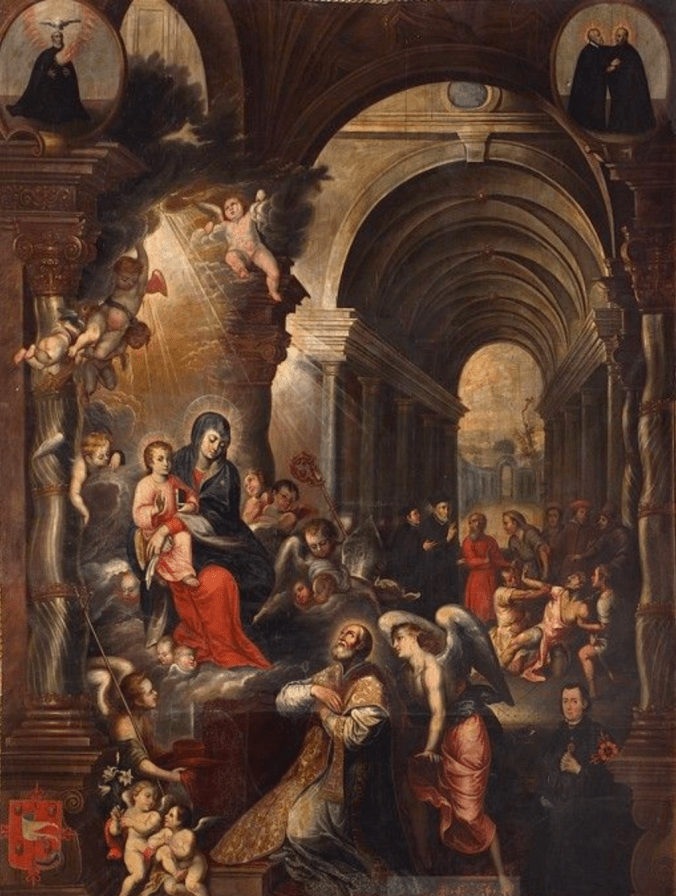
Screen Shot 2018-05-22 at 11.27.28 PM.png

Aparición de la Virgen a San Felipe Neri, Mexico, detail. (Source)


A Hymn for St. Philip’s Day

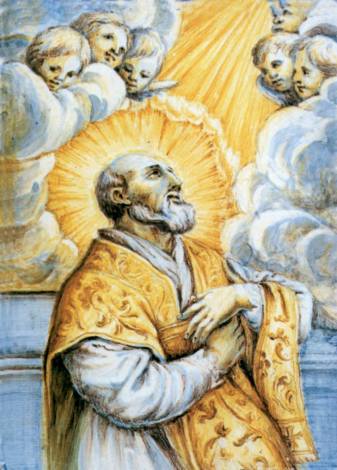
StPhilipNeridolci

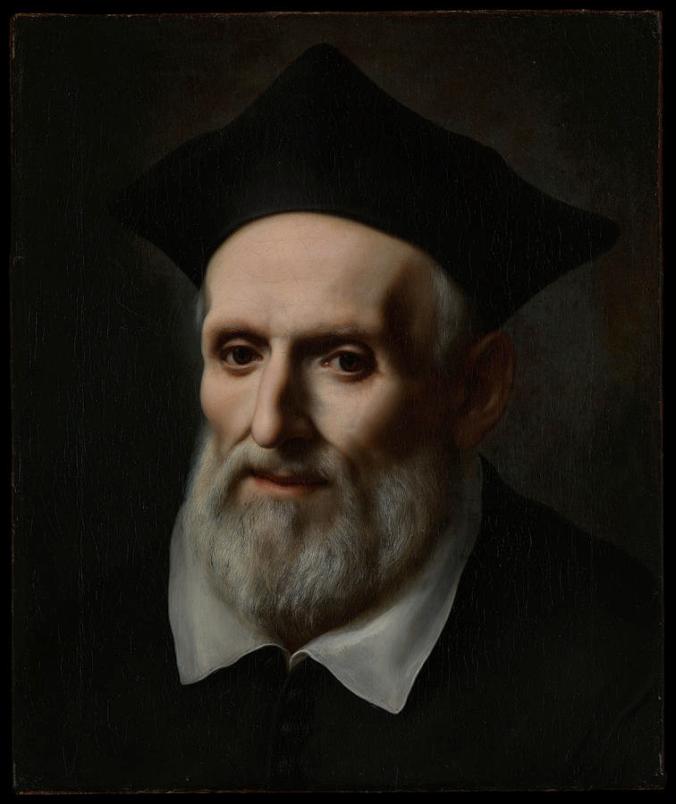
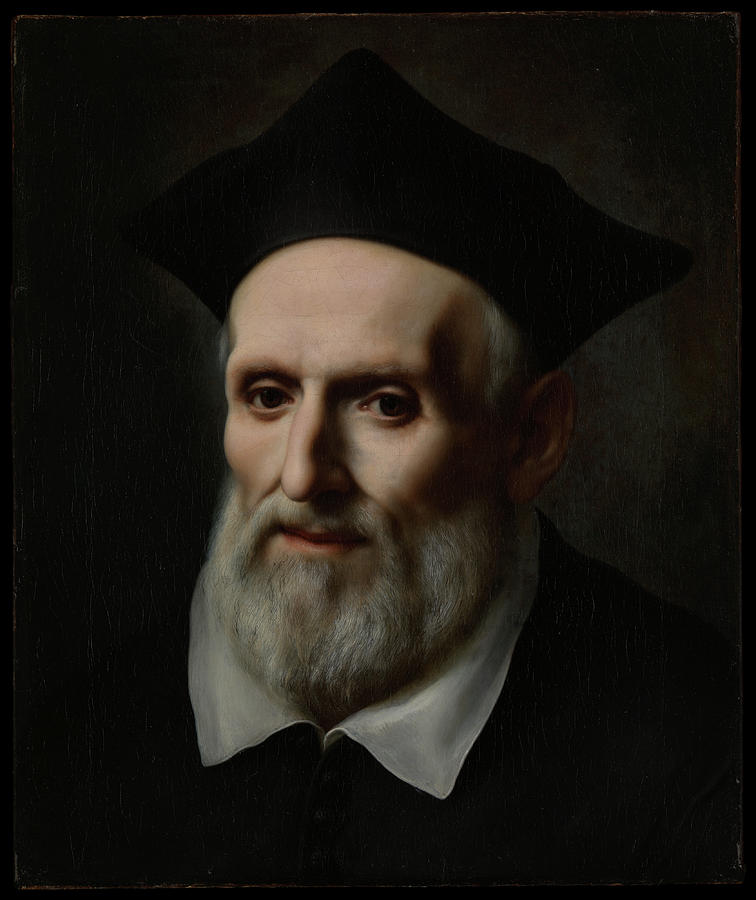
The Carlo Dolci portrait of St. Philip, now in the Metropolitan Museum of Art, New York. (Source)

St. Philip’s Picture

Fr. Frederick William Faber of the London Oratory

I.

Saint Philip! I have never known
A Saint as I know thee;
For none have their wills and ways
So plain for men to see.
I live with thee; and in my toil
All day thou hast my part;
And then I come at night to learn
Thy picture off by heart.

II.

O what a prayer thy picture is!
Was Jesus like to thee?
Whence hast thou caught that lovely look
That preaches so to me?
Sermon and prayer thy picture is,
And music to the eye;
Song to the soul, a song that sings
Of whitest purity!

III.

A blessing on thy name, dear Saint!
Blessing from young and old,
Whom thou in Mary’s gallant band
Hast winningly enrolled!
If ever there were poor man’s Saint,
That very Saint art thou!
If ever time were fit for thee,
Dear Saint! That time is now!

IV.

Philip! Strange missioner thou art,
Biding so still at home,
Content if with the evening star
Souls to thy nets will come!
If ever spell could make hard work
Profit and pastime be,
That spell is in thy coaxing ways,
That magic is in thee.

V.

Sweet-faced old Man! For so I dare,
Saint though thou be on high,
To name thee, for thou temptest love
By thy humility.
Sweet-faced old Man! What are thy wiles
With which thou winnest men?
Art thou all saints within thyself?
If not, what art thou then?

VI.

John’s love of Mary thou hast got,
Thy house is Mary’s home;
And then thou hast Paul’s love of souls
With Peter’s love of Rome.
Thy heart, that was so large and strong,
It could not quiet bide;
O was it not like his that beats
Within a wounded side?

VII.

Saint of the over-worked and poor!
Saint of the sad and gay!
Jesus and Mary be with those
Who keep to thy true way!
O bless us, Philip! Saint most dear!
Thine Oratory bless;
And gain for those who seek thee there
The gift of holiness!

An Employment Triduo to St. Joseph

Recently, several people I know have been looking for jobs. Some were just fired. Others have had a long struggle seeking work. A few have been injured in ways that required them to take time off. All are in need of prayer.

Bearing these troubles in mind, I thought I would make a Triduo – a prayer of three days’ length – to St. Joseph the Worker, asking for his potent intercession, along with that of SS Anthony of Padua, Dymphna, Cecilia, John of God, Thomas More, Philip Neri, Thomas of Canterbury, Fiacre, and Martin of Tours. I hope my readers will join me in this intention.

The text comes from Bl. John Henry Newman’s Meditations and Devotions. I have also attached the Litany of St. Joseph for the last day.

Cuzco-School-18th-century.jpog.jpg

St. Joseph, Ora Pro Nobis (Source)

A Triduo to St. Joseph

First Day
Consider the Glorious Titles of St. Joseph

He was the true and worthy Spouse of Mary, supplying in a visible manner the place of Mary’s Invisible Spouse, the Holy Ghost. He was a virgin, and his virginity was the faithful mirror of the virginity of Mary. He was the Cherub, placed to guard the new terrestrial Paradise from the intrusion of every foe.

V. Blessed be the name of Joseph.
R. Henceforth and forever. Amen.

LET US PRAY

God, who in Thine ineffable Providence didst vouchsafe to choose Blessed Joseph to be the husband of Thy most holy Mother, grant, we beseech Thee, that we may be made worthy to receive him for our intercessor in heaven, whom on earth we venerate as our holy Protector: who livest and reignest world without end. Amen.
(Vide “The Raccolta.”)

Second Day
Consider the Glorious Titles of St. Joseph

His was the title of father of the Son of God, because he was the Spouse of Mary, ever Virgin. He was our Lord’s father, because Jesus ever yielded to him the obedience of a son. He was our Lord’s father, because to him were entrusted, and by him were faithfully fulfilled, the duties of a father, in protecting Him, giving Him a home, sustaining and rearing Him, and providing Him with a trade.

V. Blessed be the name of Joseph.
R. Henceforth and for ever. Amen.

LET US PRAY

God, who in Thine ineffable Providence didst vouchsafe, &c.

Third Day
Consider the Glorious Titles of St. Joseph

He is Holy Joseph, because according to the opinion of a great number of doctors, he, as well as St. John Baptist, was sanctified even before he was born. He is Holy Joseph, because his office, of being spouse and protector of Mary, specially demanded sanctity. He is Holy Joseph, because no other Saint but he lived in such and so long intimacy and familiarity with the source of all holiness, Jesus, God incarnate, and Mary, the holiest of creatures.

V. Blessed be the name of Joseph.
R. Henceforth and for ever. Amen.

LET US PRAY

God, who in Thine ineffable Providence didst vouchsafe, &c.

The Litany of Saint Joseph

 For public or private use.

Lord, have mercy on us.
Christ, have mercy on us.
Lord, have mercy on us.
Christ, hear us.
Christ, graciously hear us.
God the Father of Heaven, Have mercy on us.
God the Son, Redeemer of the world, Have mercy on us.
God the Holy Spirit, Have mercy on us.
Holy Trinity, One God, Have mercy on us.
Holy Mary, pray for us .
Saint Joseph, pray for us.
Illustrious son of David, etc.
Light of the patriarchs,
Spouse of the Mother of God,
Chaste guardian of the Virgin,
Foster-father of the Son of God,
Watchful defender of Christ,
Head of the Holy Family,
Joseph most just,
Joseph most chaste,
Joseph most prudent,
Joseph most valiant,
Joseph most obedient,
Joseph most faithful,
Mirror of patience,
Lover of poverty,
Model of workmen ,
Glory of domestic life,
Guardian of virgins,
Pillar of families,
Solace of the afflicted,
Hope of the sick,
Patron of the dying,
Terror of demons,
Protector of Holy Church,

Lamb of God, Who takest away the sins of the world,
Spare us, O Lord.
Lamb of God, Who takest away the sins of the world,
Graciously hear us, O Lord.
Lamb of God, Who takest away the sins of the world,
Have mercy on us.

V. He made him the lord of His household,
R. And prince over all His possessions.

Let Us Pray.

O God, Who in Thine ineffable providence didst choose Blessed Joseph to be the spouse of Thy most Holy Mother, grant that as we venerate him as our protector on earth, we may deserve to have him as our intercessor in Heaven, Thou Who livest and reignest forever and ever. R. Amen.


The Best Monastic Documentaries

The monastic life is about as far as one can get from the flashy world of the entertainment industry. And yet, it has been the subject of some very good documentaries over the last fifteen years or so. For those curious about the various monks (and nuns) of the world, I thought I would provide a list of a few films with which to start.

Into Great Silence (2006)

Screen Shot 2018-05-16 at 10.05.16 PM.png

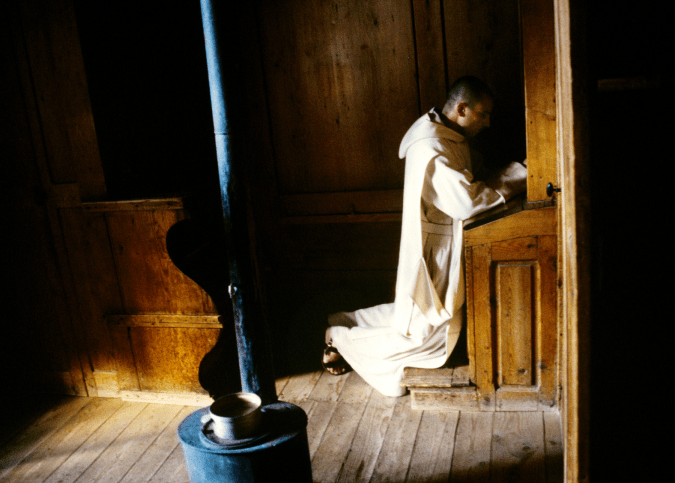
A Carthusian prays in his cell, from Into Great Silence (Source)

This stirring art film by Philip Gröning was produced over several years. Every shot is deeply meditative. We, the viewers, are drawn into a contemplative pose along with the monks themselves. As might be expected, there is very little dialogue – indeed, very little sound at all. We get a powerful sense of the holy silence that envelops the Carthusians of La Grande Chartreuse. Yet when the monks do speak, such as in an interview with an ancient, blind monk that comes towards the end of the film, the words mean something. The chant of the night office given prominent place in the film evokes all the centuries of virtually unchanged monastic life that have come down to us from St. Bruno. This film is hands down the most important and most spiritually insightful documentary about monasticism, and it has continued to exert a powerful influence on most such documentaries since.

Veilleurs dans la nuit (2011)

LeBarrouxMass

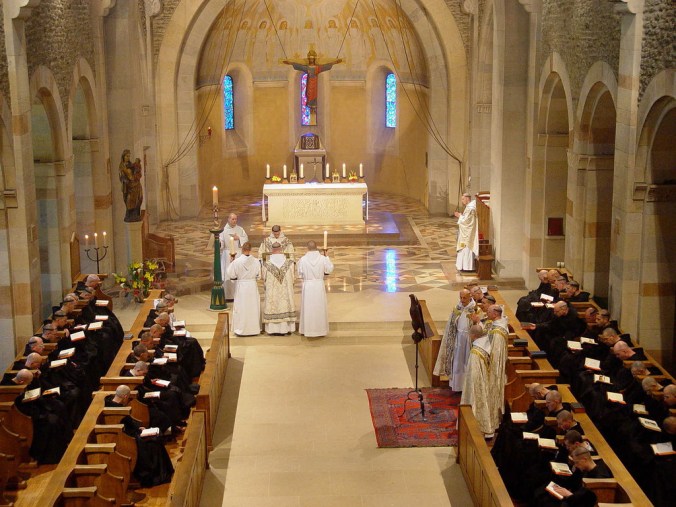
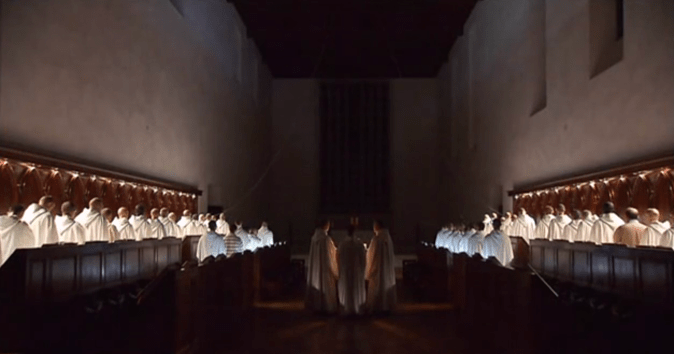
A liturgy at Le Barroux (Source)

The monastery of Sainte Marie-Madeleine du Barroux, founded in the wake of the Second Vatican Council, preserves much of the great tradition of French Benedictine life. It is one of the very few monasteries on earth which has preserved the form of tonsure once known as “the monastic crown.” It is also famous for its grand and elegant celebration of the liturgy, as well as the great holiness of its founder, Dom Gérard Calvet. This French documentary does a good job depicting their life through a mix of commentary and interviews. It is of an entirely different style than Into Great Silence, but it relates more actual information about the monks themselves.

Quaerere Deum (2011)

NorciaBeer

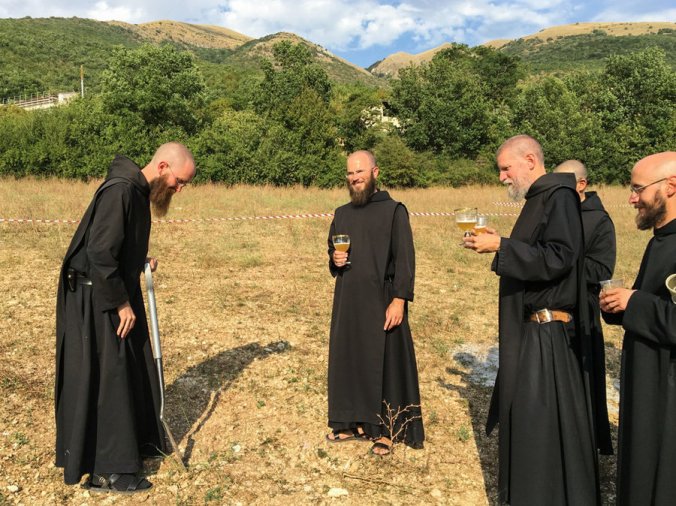
Some of the monks of Norcia with their famous beer (Source)

Filmmaker Peter Hayden of Wilderland Media has done some great and poetic work publicizing the various new monasteries founded in the old world by Americans. The first of these was the Monastero di San Benedetto in Norcia, established in 2000. It is only appropriate then that Hayden should have looked at them first. He produced a “day in the life” style documentary bearing clear influences from Into Great Silence. The slow pace, lack of commentary, and meditative minimalism all recall the best parts of that earlier work. Norcia itself – or what it was before the terrible earthquake of 2016 destroyed much of the town – emerges as a living community “seeking God.” A subdued sense of joy shines throughout.

Benedictine Monks, Ireland (2017)


BrJBAdoration

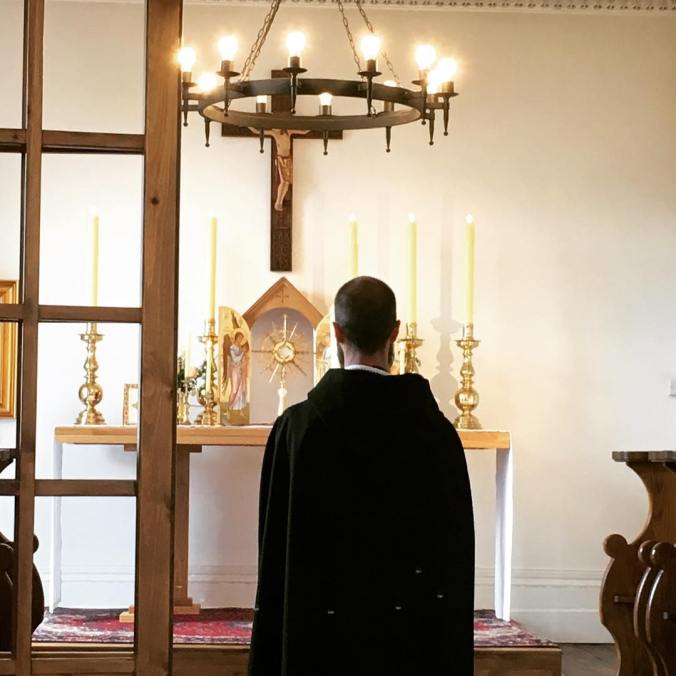
Br. John Baptist in adoration before the Blessed Sacrament, Silverstream. Photo taken by the author.

Peter Hayden’s second work on the monastic renewal is a more obviously promotional piece of filmmaking than Quaerere Deum. A profile of Silverstream Priory, Benedictine Monks, Ireland depicts the community life of adoration and reparation led by the monks there. Scenes from Mass, chapter, and refectory alternate with candid shots of the monks at work and leisure. Interviews with the Prior and Subprior provide spiritual as well as historical context. As someone who knows the monks personally, I found it a pretty good exposition of their spirit. That peculiarly Benedictine sense of place is evoked through gentle Irish music at various points. And the combined wisdom of Dom Mark and Dom Benedict is a great grounding to the beautiful visuals. I was very taken with the image of Dom Cassian, then only a postulant, in prayer at the pillar and candle.

My only criticism is that, in spite of all these good features, the film fails to capture the overwhelming sense of the supernatural that hangs about Silverstream. I’m not sure if it was the darkness of the year during filming, or the slightly uneven cinematography, or the lack of scenic order that scuttled it for me.  Benedictine Monks, Ireland needs a heavier dose of the contemplative stillness that so strongly marks both Into Great Silence and Quaerere Deum. Still, it’s a nice introduction to the place for those curious about the Benedictine Monks of Perpetual Adoration.

Présence à Dieu (2015)

Screen Shot 2018-05-16 at 10.39.43 PM.png

Matins at Sept-Fons, from Présence à Dieu (Source)

This short film, first brought to my attention by Fr. Joseph Koczera SJ, does a good job showing what a traditional monastery can look like, even if it embraces the new Mass and the vernacular office. Notre Dame de Sept-Fons is currently the largest Trappist monastery in the world, at least in terms of membership – it is also manifestly young and diverse. The film shows why the Abbey keeps getting vocations. A near constant soundtrack of chant carries the viewer along. Présence à Dieu is also full of the Abbot’s exposition of the Rule, which is a nice plus.

God is the Bigger Elvis (2011)

GodistheBiggerElvis

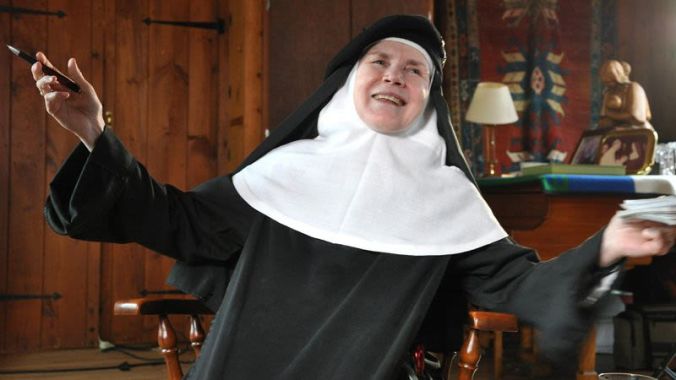
Mother Dolores Hart, wearing her trademark beret, from God is the Bigger Elvis (Source)

This one differs from the others in a few key respects. First, it’s an HBO production, rather than an Indie film. Secondly, it’s about nuns rather than monks. And third, there is a delicate sense of humor throughout that is a refreshing change from the other movies. It tells the story of Mother Dolores Hart, a starlet of the 1950’s who appeared in several features alongside Elvis before becoming a nun at the Benedictine monastery of Regina Laudis in Connecticut. She is now the prioress of the community. The documentary looks at her life and vocation as well as the daily ins and outs of the monastery. Not to be missed!

Life in Hidden Light (2016)

LifeinHIddenLight

A scene in the refectory from Life in Hidden Light (Source)

Monasticism is not confined to the Benedictine family. As Life in Hidden Light reminds us, the Carmelites also have a great tradition of contemplative monasticism. Clearly influenced by Into Great Silence, this film does a great job balancing meditative cinematography and interviews with the Discalced Carmelite sisters of Wolverhampton. One in particular that stands out is the old, mostly deaf nun who speaks about the “mess” of the world and the love of God. I was reminded of Into Great Silence‘s blind Carthusian (not to mention the slightly grotesque Jesuit in “The Enduring Chill,” by Flannery O’Connor). The old nun’s message is a sound, salutary one that we should all hearken to in this day and age.

There are probably other such films out there, but these are a few that might be a good starting place for those interested in the monastic life.

The Threefold Maternity of Mary

OurLadyCenacle.jpg

Our Lady of the Cenacle, pray for us. Photo by Lawrence Lew O.P. (Source)

God seems very fond of doing things in a Trinitarian way. Everywhere we look, in nature, in our lives, in the life of the Church, it seems that we constantly come upon things that speak of threeness-in-oneness. So it is with God’s finest creation, Our Lady. Or rather, with her maternity. She has but one singular motherhood – her highest title, Theotokos, means “Mother of God.” Nothing can surpass this supreme gift. Nothing greater can be said of the Lord’s chosen. Nothing can reveal more about Our Lady’s life and mission. Yet we detect a certain triune quality to this one eminent dignity. We can speak of the threefold maternity of Mary.

Screen Shot 2018-05-12 at 12.17.34 AM.png

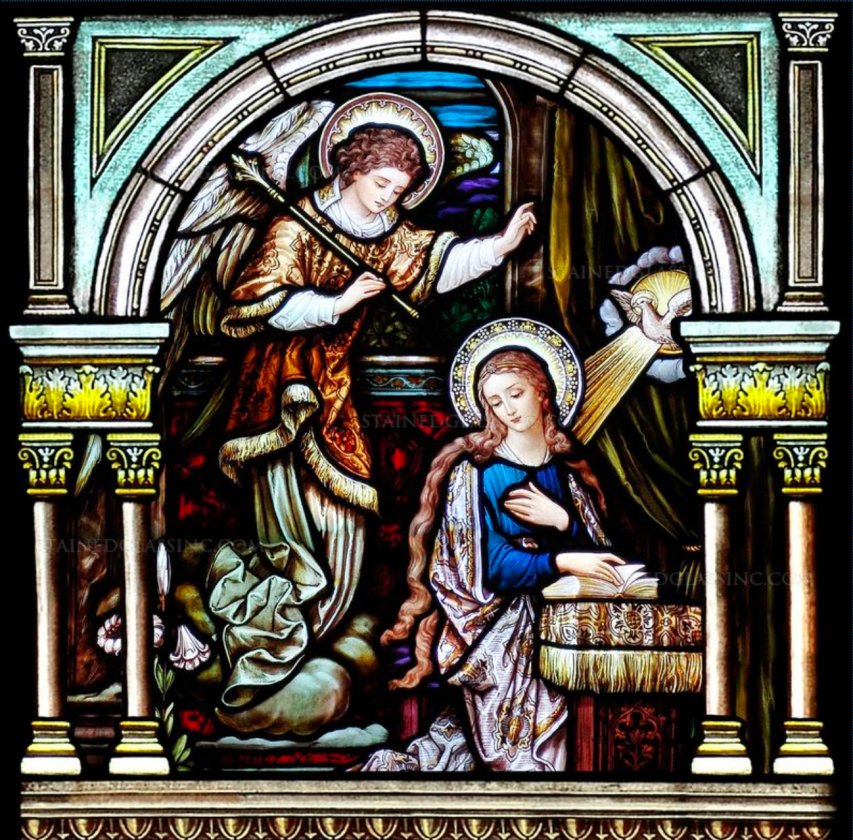
Our Lady of the Annunciation (Source)

First, we encounter Mary’s basic, physical motherhood of Jesus at the Annunciation. In welcoming the will of God into her life, she becomes the mother of the Most High, God Incarnate in Jesus Christ. The Holy Ghost, her divine spouse, conceives the Son in her womb. Her mystical partner and guardian in this parentage is St. Joseph. And in the joy of that maternity, we see Mary and Joseph as two models of chastity. Everything in those joyful mysteries becomes a parable of purity. The sanctity of the Holy Family consists in no small part in the innocence that pervades the hearts of each member. For that innocence is an opening to charity.

sorrowfulmotherwindow

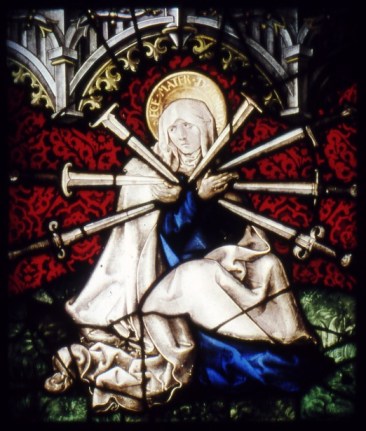
Our Lady of Sorrows (Source)

Then, after the three and thirty years, Mary stands mournful beneath the cross. It was there that she became Mother of the Eucharistic Christ. For, offering up the sorrow of her own Immaculate Heart in union with her son’s High Priestly sacrifice, she bound herself to all the altars of the world as first adorer and co-redemptrix. Gone is St. Joseph; in his stead we find St. John, the figure of all priests under Christ. He would share the Eucharistic life with Mary forever after, entrusted with her care. Here, the great virtue uniting both of the hearts below the Cross is obedience. Our Lady obeys the paramount Providence of God in consenting to the sacrifice of her son, and St. John obeys the words of Our Lord in taking responsibility for the Sorrowful Mother.

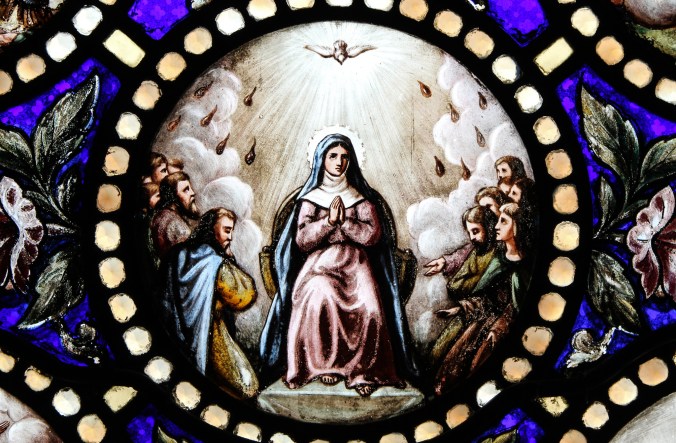
But it is today’s feast of Our Lady of the Cenacle that points to the full and final extension of these two prior forms of motherhood. It falls on a most interesting point in the calendar, Saturday in the Octave of the Ascension. It is as if we are standing in the middle of a bridge between two shining cities, and can hear the mingled music of both. This liminal quality is important. For the feast we celebrate today has a double meaning. Two feasts of different but equal importance and dignity seem to unite in this celebration.

We have just left Christ in his Ascension. The Ascension is a memorial of Christ’s High Priesthood. It is like the prayers at the foot of the altar in the Cosmic Liturgy. Pentecost is a glorious theophany, the arrival of the Holy Ghost. We are thus mid-way between a mystery of veiling, and mystery of unveiling. And who do we turn to, but Mary, she who both hid and manifested God in her person?

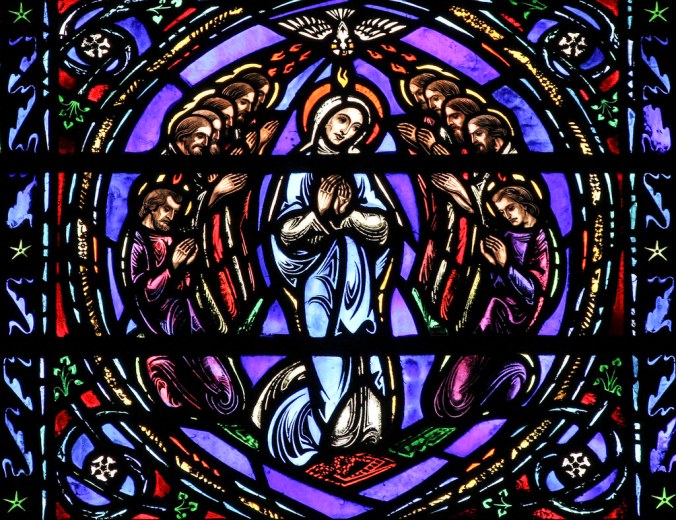
When we celebrate Our Lady of the Cenacle, we commemorate her vigil of silent prayer with the Apostles in the upper room in those intense days following Our Lord’s Ascension. But we also remember the descent of the Holy Ghost into her own Immaculate Heart and into those of her companions. At the deepest level of reality, these constitute a single event in the History of Salvation. And they give us a sense of Mary’s deepening, widening maternity.

MaryCenacleSpirit.jpg

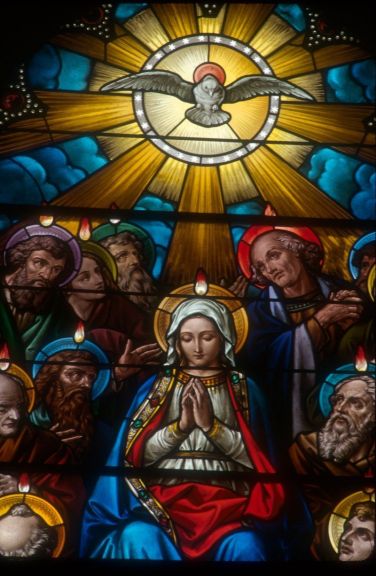
Our Lady of the Cenacle (Source)

Wherever Mary communes with her divine spouse, the Holy Ghost, there is conceived the Body of Christ. First, that meant the physically Incarnate Word. Then it was the Eucharist extended throughout all time. And finally, as a consequence of these two forms of motherhood, we come to Mary’s maternity of the Church. This maternity is the crown of the other two, for it has never ended. The Holy Spirit came to that silver throne, the Immaculate Heart of Mary, and has never left. In all the rest of Mary’s earthly life and eternal existence in beatitude, she has never been deprived of that intimate union begun in Pentecost. And so the Church remains. Mary’s union with the Holy Ghost is at the very heart of the Church’s being. That union brought forth Christ once. It brings forth the Eucharist at every Mass. And now, at Pentecost, it brings forth the Eucharistic community, Christ in His members.

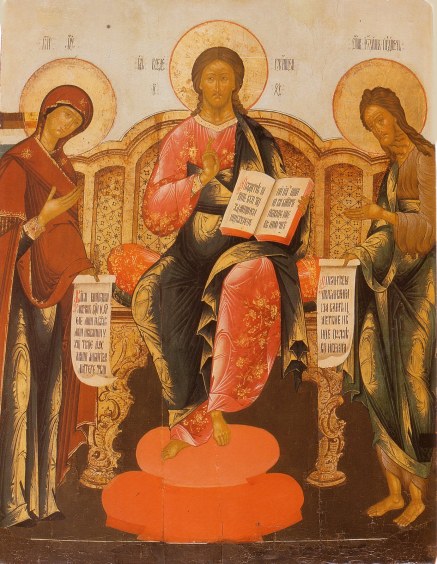
Yet in what does this exalted maternity consist? Prayer, offered perfectly in the Immaculate Heart united to the Holy Ghost. Contemplation, adoration, reparation, intercession – in all its forms, prayer rises from Mary’s heart like huge storms of incense blowing across a desert plain, raining down graces to make it fertile. Yet one form of prayer does not. Mary cannot be contrite. She has never sinned. But we turn to her mystic partner in this maternity, and find a pillar of penance. Who else shares in the life of the Spirit in such a fiery way, but St. John the Baptist? Such is the heavenly reality expressed by the Deisis icon. It shows the Blessed Virgin Mary, paragon of prayer, and St. John the Baptist, archetype of penance, adoring Christ the Lord. Both Our Lady and St. John represent the twin realities of the Ecclesial life – prayer and penance – ordered to Christ – the Sacraments. We might thus speak of Mary’s motherhood of the Church as her Sophianic Maternity, for it is entirely drawn from and oriented to the Divine Wisdom.

Deisis.jpg

A typical deisis. (Source)

The feast of Our Lady of the Cenacle is thus a profoundly maternal day in the Church’s liturgy. Let us join her in prayer. Perhaps we shall taste something of that everlasting life granted to her in the Cenacle.

CenacleRound.jpg

Monstra Te Esse Matrem (Source)

“God is Gone Up With a Merry Noise”

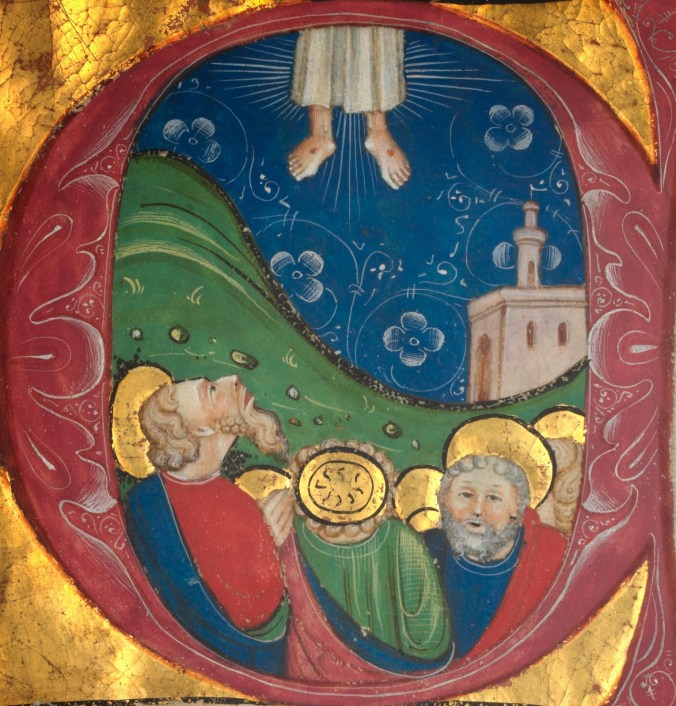
AscensionLetter.jpg

Ascendit Deus in iubilatione, alleluia (Source)

God is Gone Up With a Merry Noise

Rick Yoder

Rear a hill in my heart, O God,
from which Thou might ascend.
But o! How swift I overshoot
and rush on to the end.
For first Thou must come hallow it
with that most kingly flood,
the pearls surpassing every price,
Thine own most precious blood.
And though I wander far, O Lord,
from Thy most holy fount,
yet never shall I lose the sight
of Thine eternal mount.
The shadows of the day grow long
and silence takes the land;
still do I hope in Thy sweet song
and Thy high priestly hand.
“The Lord ascends with gladsome noise
and hath taken the better part.”
So runs the word, so I rejoice,
for He rises there in my heart.

Monsieur Olier on the Ascension

QueensCollegeAscension.jpg

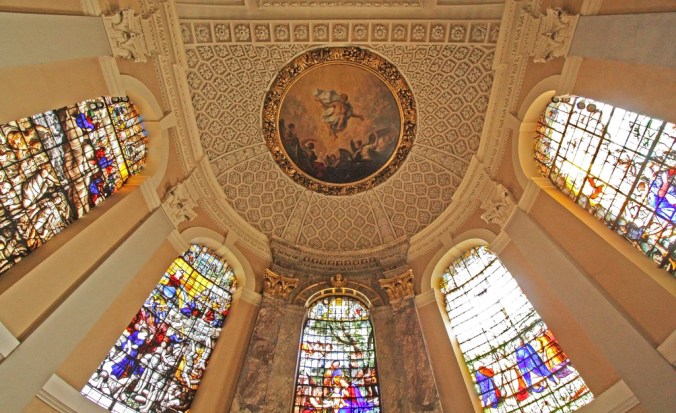
The Ascension fresco at Queen’s College Chapel, Oxford – perhaps my favorite chapel in the entire University. Photo by Fr. Lawrence Lew OP. (Source)

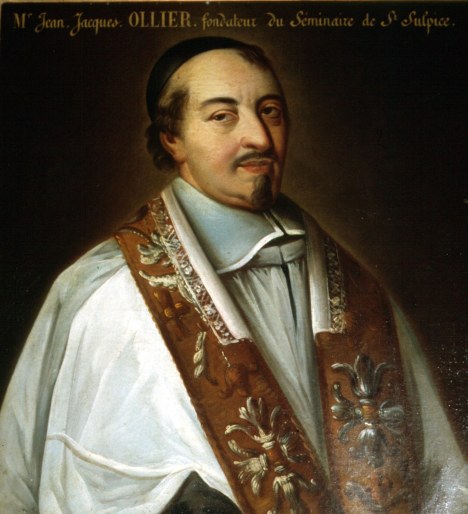
One of the greatest luminaries of the French Church in the 17th century, that period known as the Grand Siècle, was Jean-Jacques Olier. Though barely read today, he exerted a profound influence upon the formation of the French School of Spirituality through his work in founding the Sulpician Order. He was a close associate of St. Vincent de Paul, who always regarded him as a saint.

M.Olier.jpg

M. Olier, priez pour nous! (Source)

I have excerpted here his short chapter on the Ascension from his book, The Interior Life of the Most Holy Virgin. I must ask my readers to forgive me for not translating this edifying work, as I did not have the time. Those with French, however, will appreciate the depth of M. Olier’s insight.

***

Le sacrifice de Jésus-Christ étant offert pour l’Église, qui est visible, devait être visible lui-même dans toutes ses parties, afin de nous donner une certitude parfaite de notre réconciliation avec Dieu. Marie, dans le jour de la Purification, avait paru à l’offrande de la victime, en présentant elle-même, au nom de l’Église, Jésus-Christ notre hostie, et en le dévouant à l’immolation. Elle avait aussi été présente à la deuxième partie du sacrifice, à l’immolation réelle de Jésus-Christ sur la croix. La troisième, qui était la consommation ou le transport de la victime en Dieu, avait eu lieu dans le mystère de la Résurrection. Mais cette consommation s’était opérée d’une manière invisible; et la bonté de Dieu voulait que, pour notre consolation, cette partie du sacrifice devînt visible aussi bien que les deux autres, ou plutôt que Notre-Seigneur montât au ciel pour aller se perdre dans le sein de Dieu non-seulement à la vue de la très-sainte Vierge sa mère, mais encore sous les yeux de tous les apôtres par qui l’Église était représentée. C’est ce qu’avait figuré autrefois Élie montant au ciel dans un char de feu à la vue d’Élisée ; et ce prophète avait déclaré expressément à son disciple que, s’il le voyait monter, il aurait son double esprit. Don mystérieux, qui exprimait le fruit du sacrifice, c’est-à-dire l’esprit de mort et de résurrection ou de vie divine, que Jésus-Christ devait laisser à l’Église figurée par Élisée.

Après sa résurrection, il communiquait toutes les dispositions et tous les sentiments de son âme à sa bénite Mère. Il lui exprimait spécialement les désirs ardents qui le pressaient d’aller enfin se réunir à Dieu son Père, pour le louer et le glorifier dans le ciel. Marie, de son côté, éprouvait un véhément désir d’y accompagner son Fils, pour s’unir à ses louanges; et sans doute qu’elle eût terminé alors sa vie et l’eût suivi dans les cieux, s’il n’eût voulu se servir d’elle pour aider l’Église dans ses commencements.

L’oeuvre de cette divine Mère était encore incomplète. Après avoir donné, par Marie, naissance au chef, Dieu voulait procurer aussi, par elle, la formation de tout le corps. Il voulait la rendre mère de sa famille entière, de Jésus-Christ et de tous ses enfants d’adoption. Par zèle pour la gloire de Dieu et par charité pour nous, elle accepte avec joie la commission que Notre-Seigneur lui laisse de travailler à faire honorer son Père par les hommes, et de demeurer sur la terre jusqu’à ce que l’Église ait été bien affermie.

Le quarantième jour après la Résurrection étant donc venu, Jésus-Christ- se rend à Béthanie avec sa sainte Mère et ses apôtres; là élevant les mains et les bénissant, il se sépare d’eux, et en leur présence s’élève vers le ciel. Ils l’y suivirent des yeux, jusqu’à ce qu’enfin une nuée le dérobe à leur vue; et comme néanmoins ils tenaient toujours leurs regards fixés au ciel, deux anges vêtus de blanc leur apparurent et leur dirent : Pourquoi vous arrêtez-vous à regarder le ciel? Ce Jésus, qui a été attiré du milieu de vous dans le ciel, viendra de la même manière que vous l’avez vu monter au ciel. Ainsi Dieu voulut-il que l’acceptation solennelle qu’il faisait de notre hostie, eût pour témoins non-seulement tous les apôtres et la très-sainte Vierge, qui l’avait produite de sa propre substance, mais les anges eux-mêmes.

En montant dans les cieux, Jésus-Christ élève avec lui tous les saints patriarches et les autres justes qu’il avait retirés des limbes, et va les offrir à son Père, comme les premières dépouilles qu’il a ravies au démon par sa mort. Enfin, dérobé par la nuée à la vue de ses disciples, il laisse rejaillir la splendeur de sa gloire, qu’ils n’auraient pu soutenir et dont il avait retenu l’éclat dans ses diverses apparitions.

Comme les enfants des rois donnent des présents à leurs sujets, en faisant leur entrée dans leur royaume, Jésus-Christ, montant à la droite de son Père pour prendre possession de son trône, voulait envoyer à ses apôtres son esprit et ses dons, c’est-à-dire dilater son coeur en faisant entrer les hommes dans ses sentiments de religion envers Dieu son Père, et achever ainsi son ouvrage. Dans ce dessein et par son commandement, les disciples s’assemblèrent à Jérusalem avec la très-sainte Vierge et plusieurs saintes femmes; et là ils étaient en prière, louant, bénissant le nom de Dieu, et attendant la venue de l’Esprit-Saint. Marie était au milieu d’eux et présidait ce sacré concile, comme ayant, pour aviser à établir la gloire de Dieu dans le monde, une grâce qui excellait par-dessus celle de tous les apôtres. Quoique Jésus-Christ n’eût pas voulu qu’elle fût présente à la Cène, ni qu’elle offrît extérieurement le saint sacrifice, ni qu’elle fût prêtre selon l’ordre de Melchisédech, il voulait néanmoins que Marie, destinée à être la mère des vivants, se trouvât dans le Cénacle avec les apôtres, afin de verser la plénitude de son esprit en elle, comme dans le réservoir de la vie divine, et de la distribuer par elle à tous ses enfants, et aussi pour apprendre à l’Église que jamais elle ne serait renouvelée qu’en la société de sa divine Mère et en participant à son esprit.

rococoascensionaltar

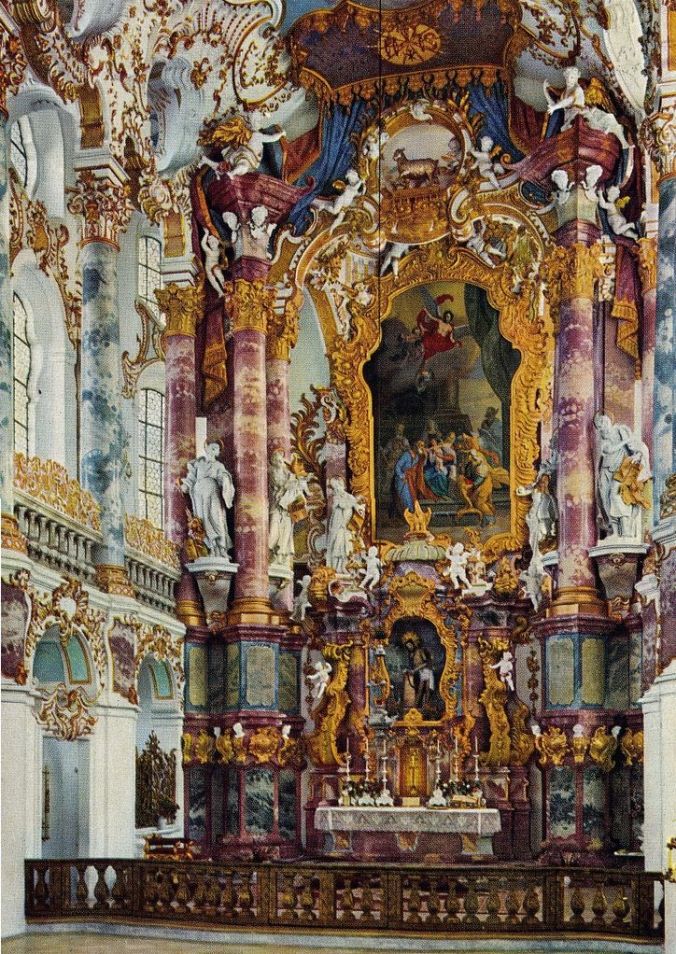
A rococo altar depicting the Ascension, Ottobeuren, Germany. (Source)

A Relic of the 1965 Liturgy

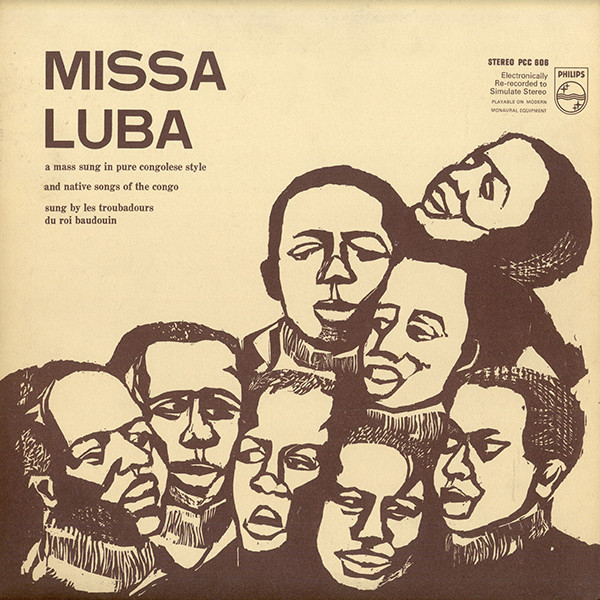
MissaLuba

Album cover of the Missa Luba. (Source)

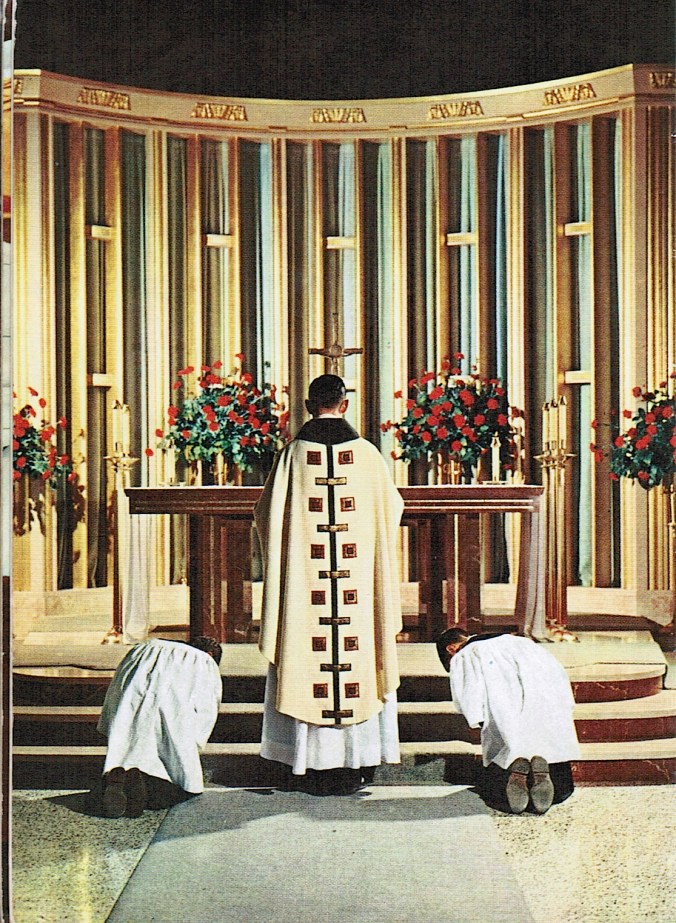
That strange Mass produced by the Council in 1965, an interim liturgy somewhere between the Usus Antiquior and the Novus Ordo, was often accompanied by a distinctive style – at once traditional and fresh, what has been called by some “The Other Modern.” Think of the decoration of the National Shrine of the Immaculate Conception in Washington, D.C – especially its many side-chapels. Think of the delightful, dignified, but very vernacular liturgical music of Fr. Clarence Rivers (at least his early material). Think of the ornate but often geometric vestments that emerged from that time. Indeed, just think of Paul VI’s space-age papal tiara.

1965 Mass.jpg

The hybrid Mass of 1965. Not ideal, but considerably better than what followed. (Source)

Recently I discovered a reminder of this strange time in the Church’s history. I was watching a 1968 movie called If… with friends. It’s a disturbing (if artful) film about an uprising at a traditional British public school, and was clearly made in conversation with the student protests that erupted that fateful Spring, fifty years ago. I was surprised to find that one of the major musical motifs was liturgical. Looking it up, I discovered it was the “Sanctus” of the 1965 Congolese Missa Luba. The song is in many ways a synecdoche of the 1965 rite. It starts off with on French Gregorian foot, quickly introduces drums, and ends with an extremely Congolese bit of improvised singing. And, it must be said, it’s very beautiful.

The poignant song, coming from a country and Church in turmoil, strikes me as emblematic of the crushed hopes of that era. So much was anticipated of Congolese independence, so bitterly contested in the five years since. Already, the forces of reaction were coalescing around an upstart colonel who would soon assume control of the country as its first home-grown dictator, Mobutu Sese Seko. And in the Church, those reformers who genuinely tried to bring about a more perfect sense of the divine in the modern world found their position betrayed by a coterie of unorthodox radicals who perverted the sense of the Council’s documents.

Yet we can still hear that bright, fleeting moment of hope in the voices of the Congolese joining their praises to those of the angels.

UPDATE: It has been pointed out to me, correctly, that I have erred in attributing the Missa Luba to 1965 proper. The Mass setting was actually first recorded in 1958. It was in 1965 that the first US release of the album came out. So I suppose that, insofar as we consider its Western reception, the Missa Luba does remain part of the 1965 liturgical landscape. And “The Other Modern” certainly existed in the 1950’s; the aesthetics of 1965 were the culmination of a few decades’ of development.

I suppose my final point, about the parallels in the Church and the Congo, wouldn’t work as well as I had hoped. But at the very least, the Congo in 1958 was indeed a place of tremendous hope for the future. That aspiration manifest in the music was soon crushed by the turmoil of five years of war following Belgium’s official withdrawal in 1960. And the Church? Well, in 1958, I’m not sure anyone really saw what was coming…