A Startling Passage out of Peter Anson

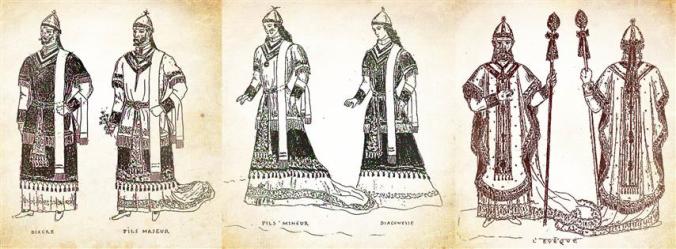
GnosticVestments

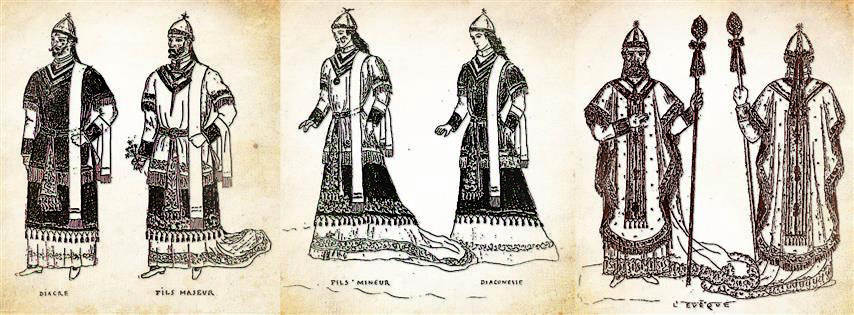
“Gnostic Catholic” vestments from Third Republic France. Note in particular the episcopal vesture at right. (Source)

In Peter Anson’s remarkable volume, Bishops at Large: Some Autocephalous Churches of the Past Hundred Years and their Founders (1964), we learn of many episcopi vagantes and their kindred spirits. It seems that several of these strange fellows dabbled (or more than dabbled) in the occult. Many also coupled that occultism with an interest in ancient heresies, which they sought to resurrect. In a chapter on the succession from René Vilatte, we stumble across a shocking little paragraph:

Mgr. Giraud and most of the priests and layfolk of the Gallican Church, even if not Gnostics themselves, were closely associated with them. Gnosticism was very much in the air fifty or sixty years ago. Even the Benedictine monks of Solesmes felt it worth their while to study what are known as the ‘Magic Vowels’ used in Gnostic rites and ceremonies. In 1901 they published a book entitled Le chant gnostico-magique. (Anson 309)

What an extraordinary claim. The monks of Solesmes, Dom Prosper Gueranger’s own sons, publishing studies of Gnostic chants! Dear readers, do any of you have any information on this bizarre note? I have been able to find evidence, however scanty, that the book Anson mentions was indeed published. But it surely must count as one of the rarest volumes in the assembled miscellanea of liturgical history. I would appreciate any leads whatsoever. Might some of my liturgically minded friends have any clue? Whatever comes of it, there is no doubt a very interesting story lurking behind this utterly unique publication.

A Poem for the Feast of the Blessed John Duns Scotus

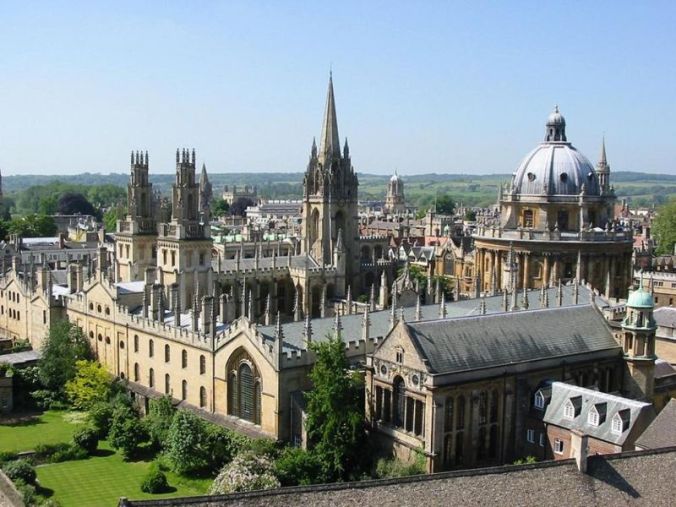
Oxford

Scotus preached and prayed at the University Church of St. Mary the Virgin, now an Anglican parish – there is now a plaque commemorating him on one of the walls. I have heard differing accounts of where his house of Greyfriars would have stood, either near St. Aldate’s or in what is now Brasenose College. (Source)

Duns Scotus’s Oxford

Gerard Manley Hopkins SJ

Towery city and branchy between towers;
Cuckoo-echoing, bell-swarmed, lark-charmed, rook-racked, river-rounded;
The dapple-eared lily below thee; that country and town did
Once encounter in, here coped and posed powers;

Thou hast a base and brackish skirt there, sours
That neighbour-nature thy grey beauty is grounded
Best in; graceless growth, thou hast confounded
Rural rural keeping — folks, flocks, and flowers.

Yet ah! this air I gather and I release
He lived on; these weeds and waters, these walls are what
He haunted who of all men most sways my spirits to peace;

Of realty the rarest-veined unraveller; a not
Rivalled insight, be rival Italy or Greece;
Who fired France for Mary without spot.

scotuseyes.jpg

Blessed John Duns Scotus, Pray for Us. (Source)

The Best Depictions of the Subtle Doctor

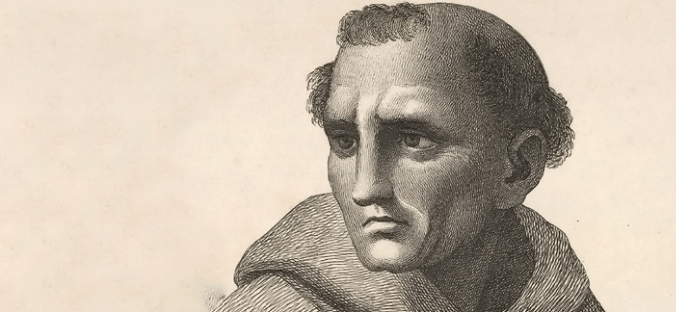
I’ve taken a major interest in Scotus recently. His Christology and Mariology seem to be treasures that remain largely unexploited by contemporary theologians, in part because he was recognized as being in the right about a doctrine that became dogma almost two hundred years ago. He is at the center of ongoing debates about the advent of secularism and modernity, debates which I am not competent to comment on at this time. Nevertheless, I thought it might be fun to examine some of the ways that Catholics (mostly Franciscans) have memorialized him in art over the course of the last several centuries. In some sense, the variety of depictions here tell a story of a lineage long overshadowed by other, more influential streams of thought. Thomism in particular has had a near perennial appeal within the Church, whereas Scotism, it seems, has largely been a niche concern. After all, Scotus has not yet been canonized or joined the ranks of the Doctors of the Church. This inequity arose from a variety of factors. No doubt, the fate of Scotism has come partially from Scotus’s own difficult style and vast intelligence. There’s a reason he’s called the “Subtle Doctor.”

May my small collection here help rectify that oversight on this, his feast day.

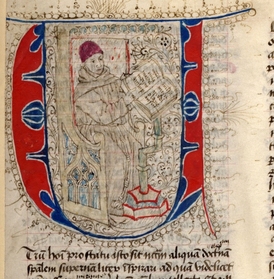
Bl John Duns Scotus-thumb-275x279-4957

John the Scot (c. 1266 – 8 Nov. 1308), appearing in what must be one of his earliest depictions: an illuminated capital. (Source)

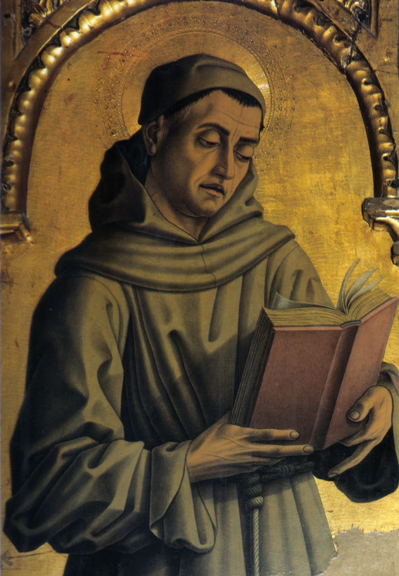
bl-john-duns-scotus

A Renaissance portrait of the Blessed John Duns Scotus. One point that people forget about Scotus is that he defended the rights of the Church against Philip IV, who had wanted to tax church properties. For his bold stance, he was exiled for a few years from Paris. (Source)

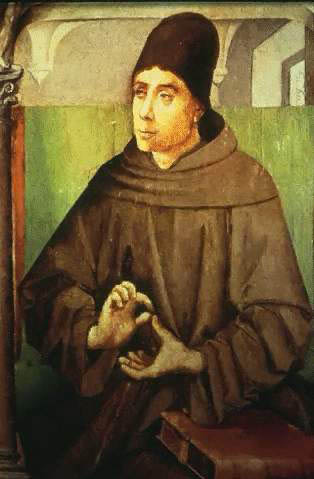
JohnDunsScotus_-_full

Perhaps the most famous, a late-Medeival, early-Renaissance portrait of Scotus. The name of the artist escapes me. (Source)

Beato_Giovanni_Duns_Scoto_B

An early modern engraving of Scotus, probably early to mid 15th century. (Source)

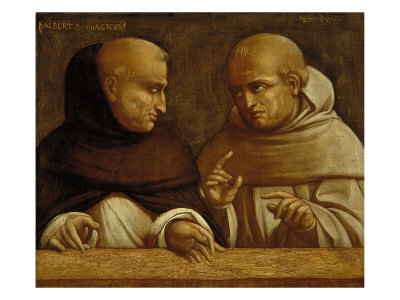
St Albert the Great & Bl John Duns Scotus

Here he is with St. Albert the Great, one of the Dominican Doctors. (Source)

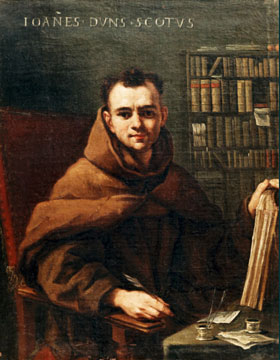
duns-scotus1

Scotus the Scholar. Age and provenance unclear; my guess is late 17th century, though it may be later. (Source)

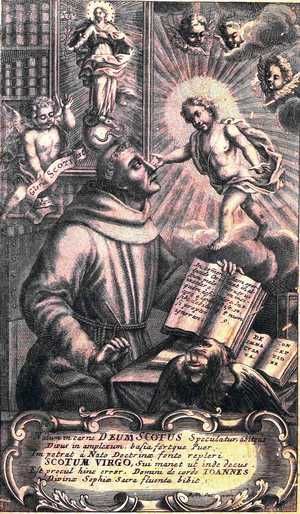
Scotus17thcentury

Scotus receiving a vision of the Christ Child, 17th or 18th century. Although chiefly remembered for his metaphysics and Mariology, Scotus made major contributions to Christology, defending the Patristic idea of Christ’s Absolute Primacy. (Source)

scotusstatue1

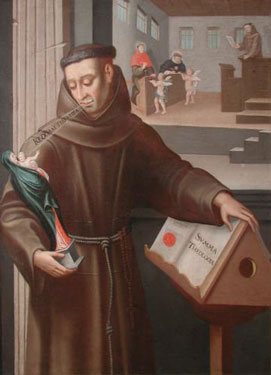
From the early modern period, it became typical to depict Scotus with representations of the Virgin Mary, whose Immaculate Conception he famously defended. This piece, probably from the 18th century, is one such example. It also contains a pretty clear criticism of Aquinas – Scotus looks away from the Summa to gaze lovingly at Mary (Source: this very friendly take on Scotus by a prominent popular Thomist)

11_08_duns_scotus2

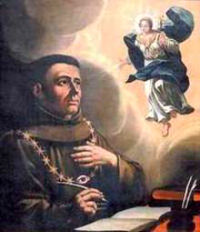
A slightly more dramatic iteration of the same theme. Scotus is inspired by the Immaculate Conception. (Source)

ScotusChariot

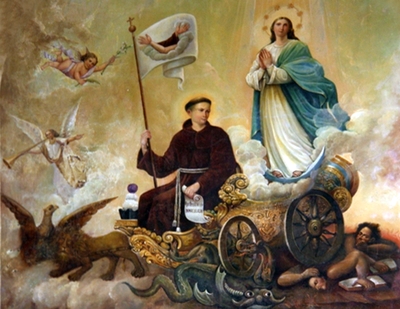
My single favorite image of Scotus is this ludicrously over-the-top Rococo depiction of Scotus and the Immaculate Conception triumphing over heresy and sin. He holds the arms (no pun intended) of the Franciscan order. His defense of the Immaculate Conception surpassed the doubts of even his own order’s great luminary, St. Bonaventure. And what a marvellously simple argument it was, too. Remember: POTVIT DECVIT ERGO FECIT. (Source).

Izamal Duns Scotus Adopte rest

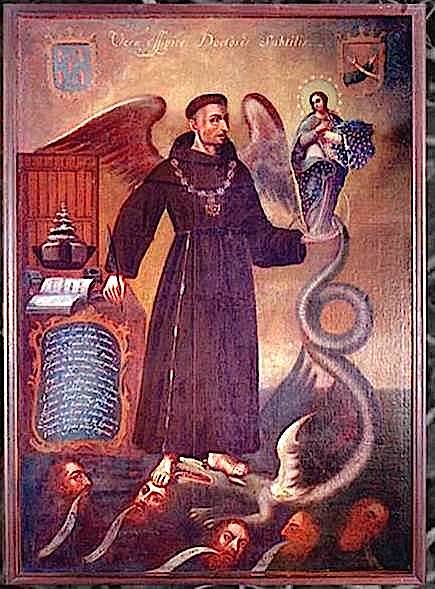
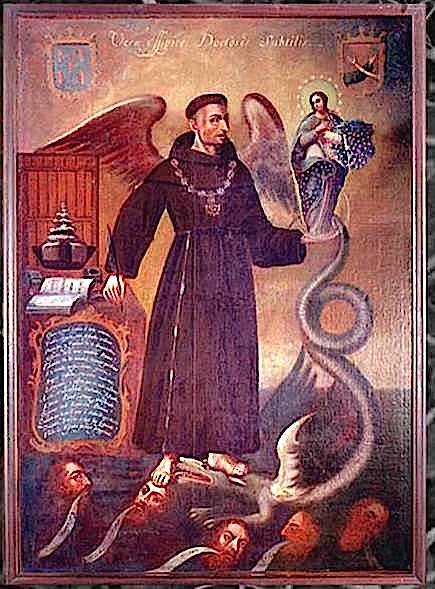
Likewise, this totally marvelous Colonial Mexican painting from the Franciscan monastery of Izamal, Yucatan, is something else. Rare is the saint granted wings in traditional iconography, though the trend was not uncommon in early modern Mexican art (Source)

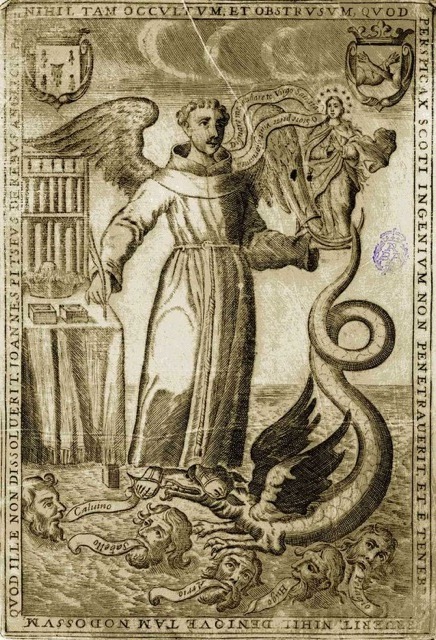
Joannes Pitseus, Scotus 1619

The mystery solved! This version by Johannes Pitseus comes from 1619, and served as a model for the Izamal piece. Here, it’s clearer that the heads represent various heretics, including Pelagius, Arius, and Calvin. (Source)

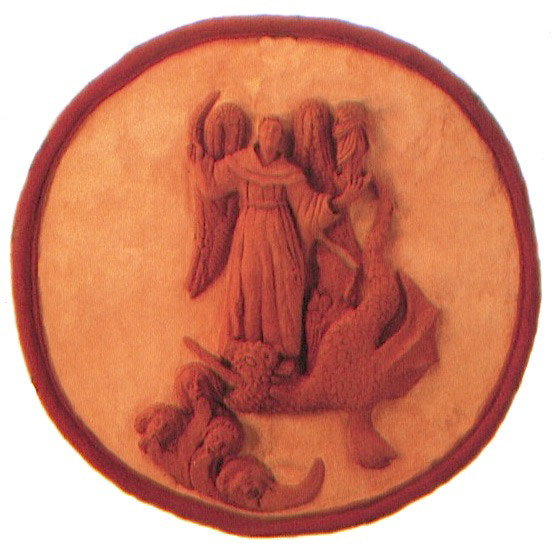
Landa Duns Scotus

This ceiling relief from Landa, Querétaro, uses the same iconographic lexicon. It seems that the Franciscans of colonial Mexico had a set of stock images to propagate devotion to their own saints. (Source)

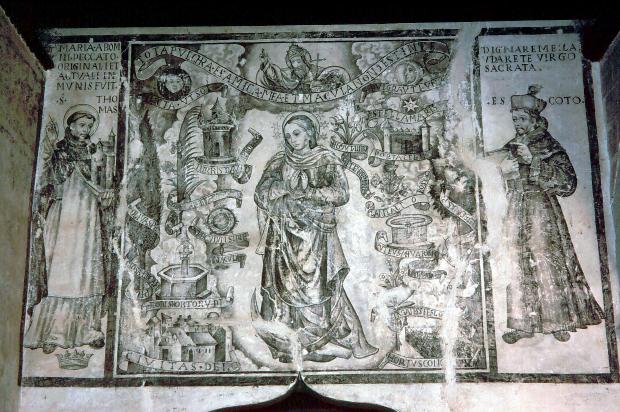
huej purisima

Here’s another unusual image of Scotus. In this mural of Mary Immaculate, or La Purísima, we see Scotus alongside St. Thomas Aquinas…and wearing a biretta! A remarkable addition, unique among all other depictions of the Subtle Doctor that I know of. (Source)

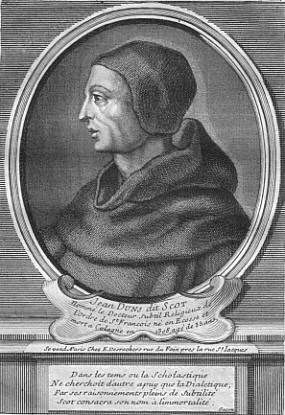
SCOTUS

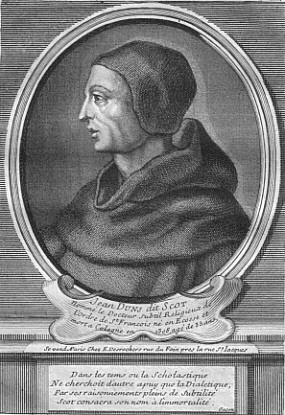
Moving away from Mexico, we come to this rather uninteresting French portrait of Scotus. Not all 18th century portraits of the man are elaborate bits of Franciscan propaganda. (Source)


unknown artist; John Duns Scotus (1266-1308)

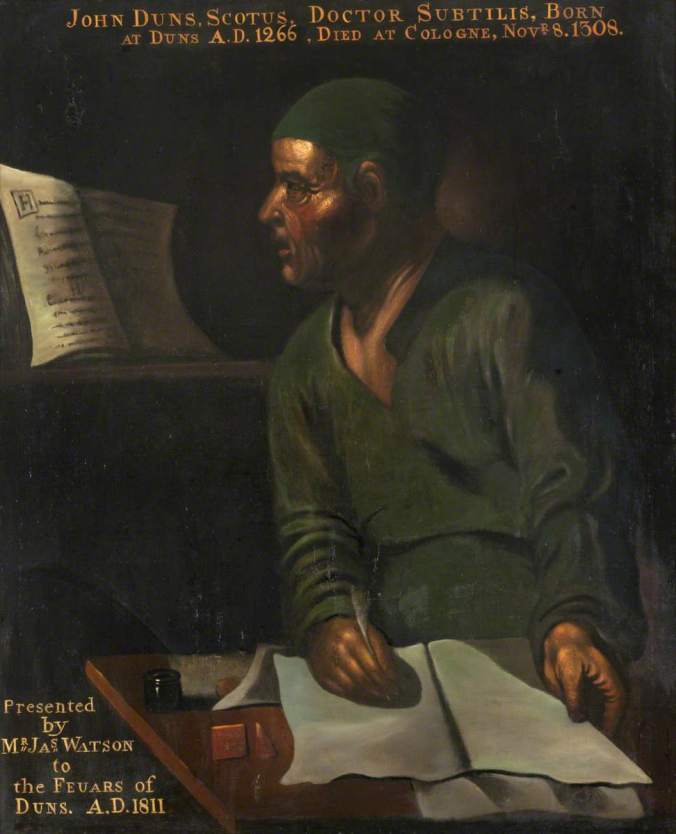
A late 18th or early 19th century depiction of Bl. John Duns Scotus. If this is in fact an English painting, its creation at a time of high and dry Anglican Protestantism poses interesting questions about the use of Scotus as a figure of national pride. (Source)

john-duns-scotus

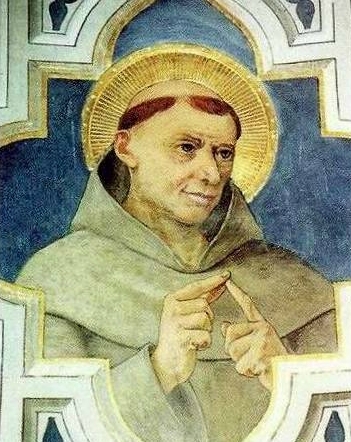
I’m unsure of how old this image is; my guess, however, is that it represents a 19th century imitation of late Medieval and Renaissance style. (Source)

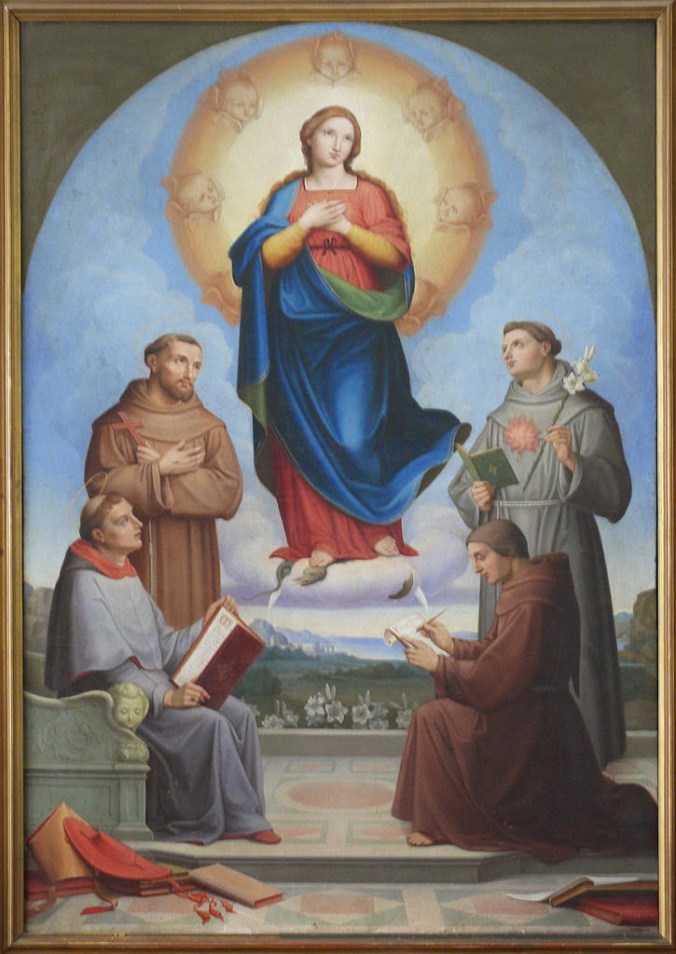
Albert Küchler (Brother Peter of Copenhagen) - Immaculate Conception with St. Bonaventure, Francis, Anthony and Blessed John Duns Scotus - Rome - Pontifical University Antonianum

A great 19th century painting of the Immaculate Conception by Danish Franciscan Albert Küchler. Scotus, who is on the bottom right, is here depicted alongside other Franciscan saints – S.s. Francis of Assisi, Anthony of Padua, and Bonaventure. (Source)

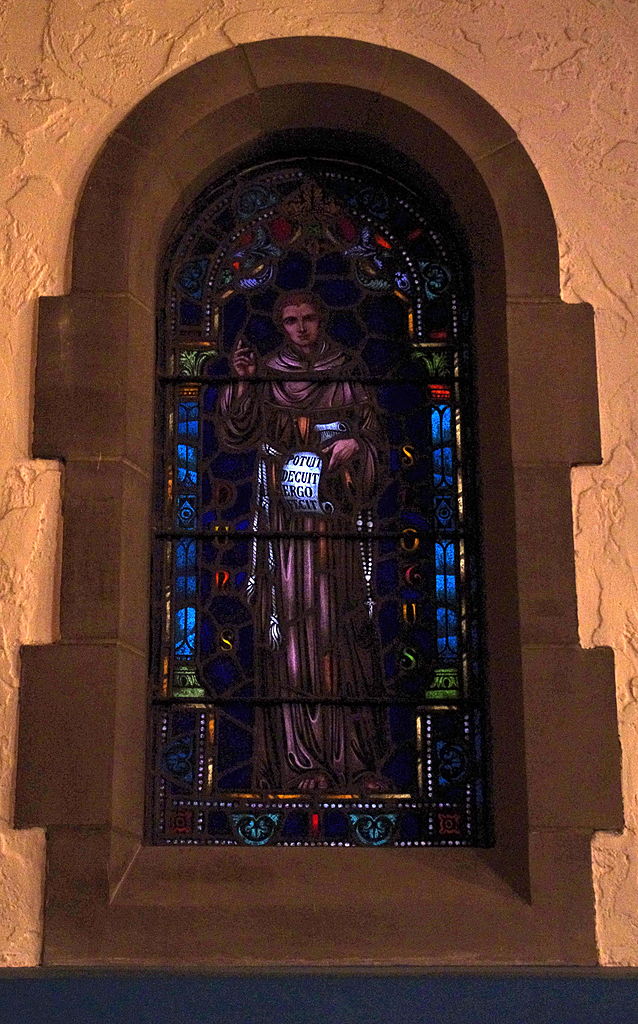
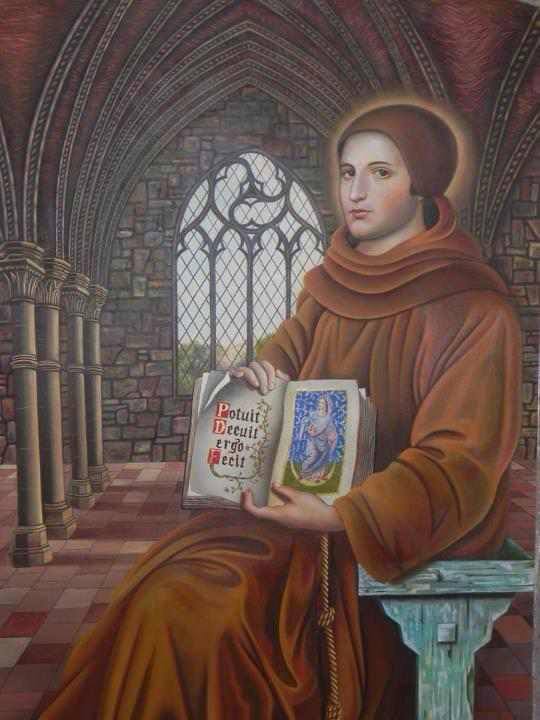
Immaculate_Conception_Church_(Columbus,_Ohio)_-_stained_glass,_Blessed_Duns_Scotus

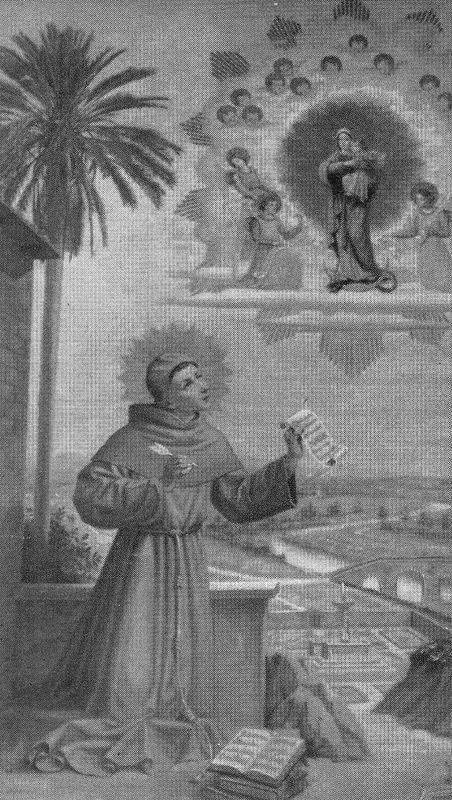
This looks like a Harry Clarke window, though it may just resemble his style. In anyway, we see here Scotus holding a scroll with his famous argument for the Immaculate Conception epitomized – “He could do it, It was fitting He should do it, so He did it.” (Source)

JohnDunsScotusImmaculata

John Duns Scotus, once again contemplating the Immaculate Virgin and offering his mighty works to her. (Source)

dunsscot.2

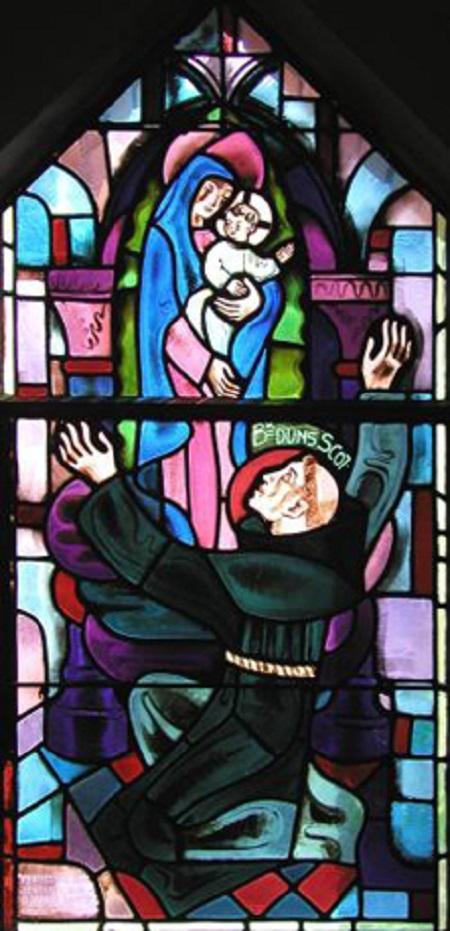
Another stained glass window, this time indubitably from the 20th century. We see here Scotus worshiping the Christ Child and his Immaculate Mother. (Source)

Johannes_duns_scotus_20060501

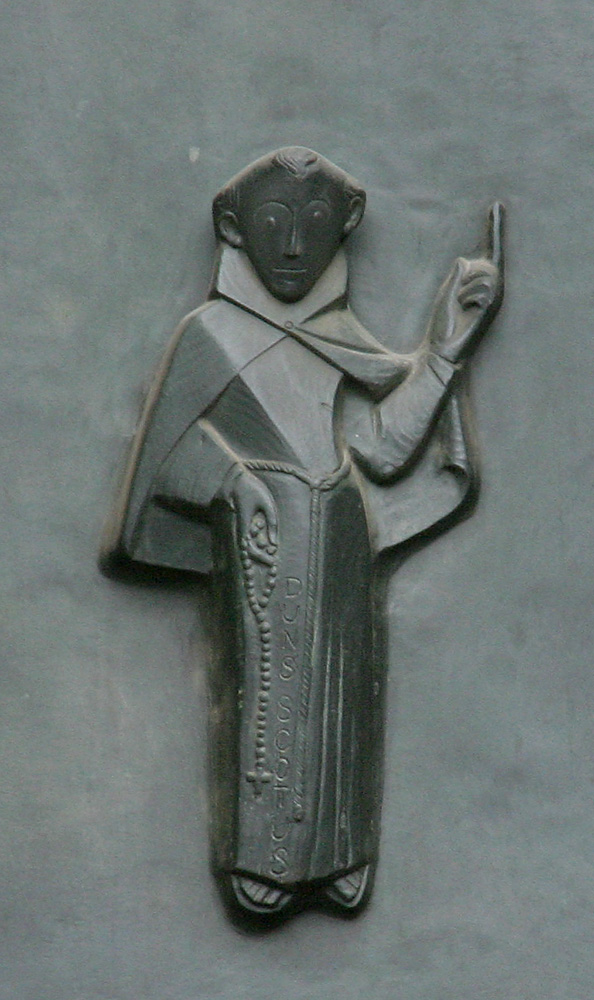
Scotus depicted in on the door of a Cologne Cathedral, 1948. He represents the supernatural gift of Understanding. (Source)

duns-scott_01

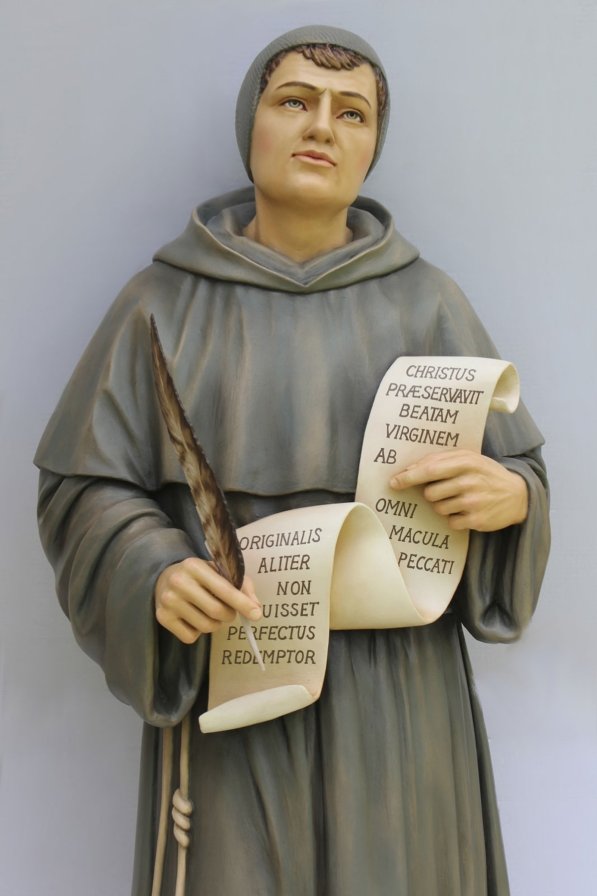
A contemporary statue of Scotus. (Source)

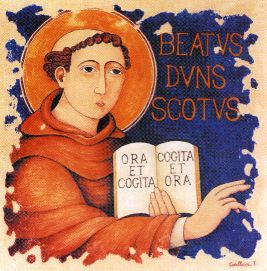
Scoto-2

Scotus with a modification of the Benedictine phrase. “Pray and Think. Think and Pray.” Not a bad motto. (Source)


20thCScotus

A 20th or 21st century image of the Blessed Scotus (Source).

Elsewhere: Fr. Hunwicke on Liturgical Wigs

image

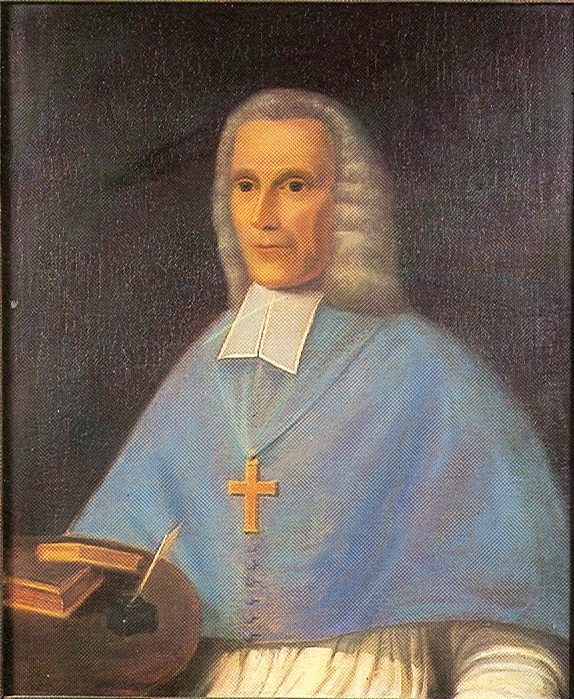
The famous portrait of Bishop Challoner to which Fr. Hunwicke refers in his piece. (Source)

I haven’t written much this week, as I’ve been traveling. However, on this beautiful  St. Bernard’s Day, I thought I’d share this brief and wonderful gem of a piece by Fr. John Hunwicke of the Ordinariate.

An excerpt:

I’m sure there are zillions of you out there who have the following sort of information right at your snuff-stained finger tips: did prelates eo fere tempore wear their wigs all through Mass? Even after their zucchetto had been removed as they approached the Consecration? When did Catholic bishops stop wearing wigs? (I think it went out of fashion in Anglican cicles in the 1830s.)

He also gets into the question of blue episcopal choir dress, mainly used in France and Ireland. Read the whole thing.

Clerical dress is one of my longstanding interests, as is the history of 18th century Catholicism. I’m glad Fr. Hunwicke is using his formidable celebrity to draw attention to these matters. While some may dismiss clerical fashion (particularly that of the Ancien Régime) as a trivial matter, I beg to differ. Clerical dress both during and outside of the liturgy is one more aesthetic component by which we can present “the beauty of holiness.” The nondescript threads worn by so many clergy and religious today are, alas, one more surrender to the cult of stark utility, false equality, failed individuality, and, in the end, boring homogeneity.

At the moment, I don’t have the time or capacity to research the questions Fr. Hunwicke raises. But The Amish Catholic will follow this story with all due attention and gravity. You can count on that. In the meantime, I’ll feast my eyes on this doozy of a cappa magna.

The Vampirologist: Dom Augustin Calmet OSB

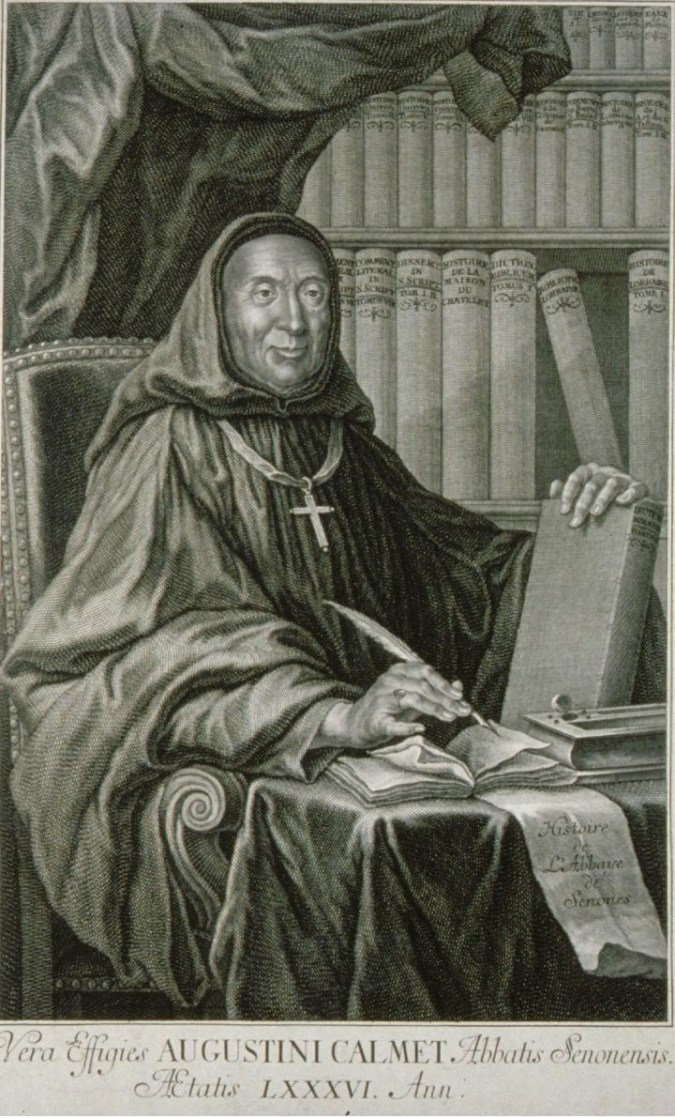
DomAugustinCalmet.jpg

Vera Effigies Augustini Calmet Abbatis Senonensis. (Source).

I was recently asked by the administrator of Catholics from the Crypt to write a brief introduction to Dom Augustin Calmet, Abbot-General of the Congregation of St. Vanne. My qualifications for this task are minimal but, I think, sufficient. First, I know a little about Calmet, which is, sadly, more than many can say. He is an unfairly overlooked figure in our religious and cultural landscape. Secondly, I hope to write my Master’s Thesis on Calmet’s Histoire Universelle, though of course the actual process of research might change my direction. For the time being, I am glad of the challenge, and will likely turn this into the first of a series of short biographies of weird religious figures.

Dom Calmet, born on the 26th of February, 1672, in the then-Duchy of Bar (now Lorraine, France) had a long and impressive career. Entering religious life at the Benedictine Priory of Breuil, he moved around over the years to obtain his education at various abbeys. His itinerary reads like an honor roll of some of the finest establishments of the Franco-German monastic intelligentsia: St. Mansuy, St. Èvre, Munster, Mouyenmoutier, Lay-Saint-Christophe, St. Leopold. Yet the two monasteries most closely associated with his career are Senones Saint-Pierre and Vosges, where he eventually died a holy death.

He achieved widespread scholarly respect for his work in three different fields. First, Calmet distinguished himself as an Exegete. His Biblical method differed from more classical forms of exegesis by focusing entirely on the literal meaning of the text; this exposed him to criticism, even amidst the general acclaim which the book and its abridgements garnered.
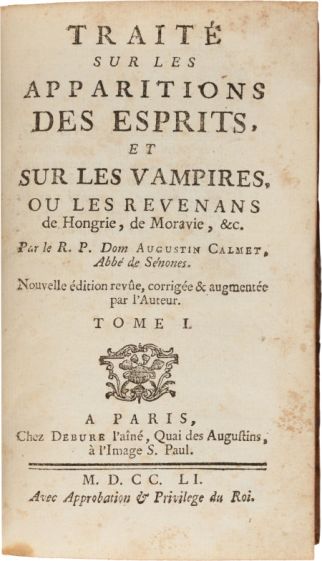
DomCalmetTitlePageVampires

Title page of Book I of his most famous work on Vampires. (Source).

Second, he became an eminent author of sacred and profane history. While my own interest lies most heavily with his Histoire Universelle (1735-47), Calmet also devoted considerable attention to more specific topics. It should come as no surprise, given the libraries to which he had access, that he devoted special care to the region which bore him. His titles include History of the Famous Men of Lorraine (1750), Dissertation on the Highways of Lorraine (1727), Genealogical History of the House of Châtelet (1741), and posthumous histories of both Senones (1877-81) and Munster (1882).

However, Calmet achieved lasting fame for his extremely popular work on Vampires: first, Dissertations on the Apparitions of Angels, Demons, and Spirits, and on the Revenants and Vampires of Hungary, Bohemia, Moravia, and Silesia (1746) He later expanded the text into his famous Treatise on the Apparitions of Spirits and on the Vampires or Revenants of Hungary, of Moravia, &c. in 1752. These texts were, to the best of my knowledge, the first attempt to apply scientific rigor to the tales of the undead then current throughout Europe.

The books were a huge hit, and remain widely respected by occult writers today. To quote one source:

Re-released in 1748, with the most complete edition in 1751, this book is considered to be [the] authoritative treatment on the subject, containing an unprecedented collection of ghostly stories of revenants. It was a best seller for the period, quickly translated into German and Italian for a broader audience. Calmet’s tone considers the possibility of vampires with a certain ambiguity, possibly in light of the larger body of his publications for the church. Still, this is widely regarded as the starting point of all vampiric literature.


The work garnered critical attention from no less a figure than Voltaire. As that eminent source, Wikipedia, relates, Voltaire wrote of Calmet with no small astonishment:

What! It is in our 18th century that there have been vampires! It is after the reign of Locke, of Shaftesbury, of Trenchard, of Collins; it is under the reign of d’Alembert, of Diderot, of Saint-Lambert, of Duclos that one has believed in vampires, and that the Reverend Priest Dom Augustin Calmet, priest, Benedictine of the Congregation of Saint-Vannes and Saint-Hydulphe, abbot of Senones, an abbey of a hundred thousand livres of rent, neighbor of two other abbeys of the same revenue, has printed and re-printed the History of Vampires, with the approbation of the Sorbonne, signed by Marcilli!

[NB: translation is my own]

We can only imagine what conversation transpired between the two thinkers when Voltaire stayed at Senones in 1754, only a few years before the abbot’s death.

It is perhaps unusual that a monk who was, by all accounts, part of the same intellectual circles as the Maurist Enlighteners and the Philosophes would take to such a strange subject. Calmet certainly saw himself as partaking of that wider project. He writes in his preface to the Treatise,

My goal is not at all to foment superstition, nor to maintain the vain curiosity of Visionaries, and of those who believe without examination all that one tells them, as soon as they find therein the marvelous and the supernatural. I do not write but for those reasonable and unprejudiced spirits, who examine things seriously and with sang-froid; I do not speak but for those who do not give their consent to known truths but with maturity, who know to doubt things uncertain, to suspend their judgment in things doubtful, and to refute that which is manifestly false. (Calmet ii).

[NB: translation is my own]

Perhaps we should not be so surprised. After all, the religious history of Europe is peppered with eccentric and erudite men drawn to esoteric studies. And by the time that Dom Calmet died in 1757, the French monastics had not yet reached the height of their oddity. That would come later, with the well-traveled and thoroughly bizarre Swedenborgian and Martinist monk Antoine-Joseph Pernety, whom I hope to someday investigate more thoroughly.

The Revolution changed all that. No longer could monks live their lives freely, let alone attempt serious academic inquiry. It would take the genius of men like Dom Prosper Guéranger to restore the French Benedictines to their former glory.
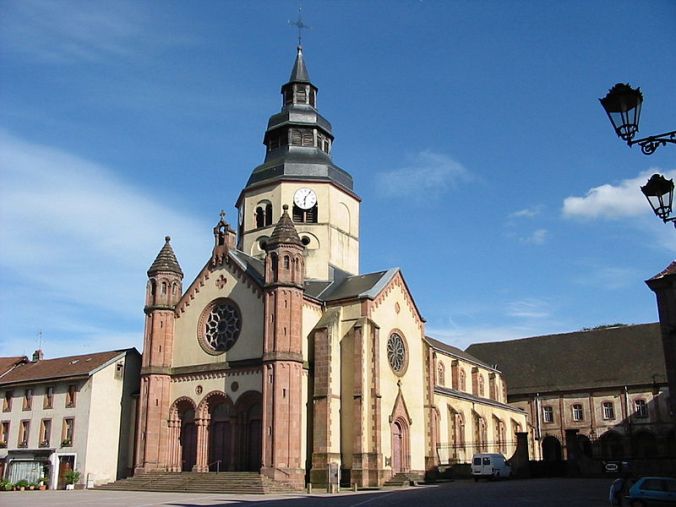
800px-Senones_88_Saint-Gondelbert.jpg

Senones Abbey today. The monastery was dissolved by Revolutionary forces in 1793, then later sold off as State Property and converted into a textile mill. This desecration continued until 1993, when what was left of the abbey became a Monument historique. (Source).
The Orange Pope

Yesterday was the 327th anniversary of the Battle of the Boyne, when the forces of Protestant Britain defeated the Catholic Irishmen fighting for James II, rightful king of England, Scotland, and Ireland. It is a black day for many Catholics, in no small part because many of them descend from Irish communities that remember the oppression that followed under the penal laws. In Northern Ireland today, July 12th remains a divisive date marked by sectarian tensions and the triumphalist pageantry of the native Scotch-Irish Protestants. One wonders whether the new Conservative-DUP alliance in the Commons will have had any affect on the infamous marches of the Orange Order, founded in remembrance of today’s events.As cursed as the memory of the Boyne remains for Catholics today, it’s worth remembering that things were a bit more complex in the 17th century. I enjoy a good bit of Jacobite nostalgia as much as the next trad, but I also think a more honest assessment of history is worth exploring. Human life is a complicated thing, and the strange story of the Williamite War is riddled with contradictions.

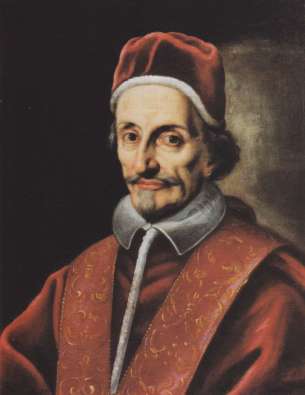
Tremendous irony lies at the heart of the Boyne and what it represents. William of Orange, the stalwart champion of Protestantism, overthrew the Catholic James while secretly in league with Pope Innocent XI.

InnocentXI

His Holiness, Innocent XI P.M. (Source).
Innocent’s political priorities centered on maintaining the balance of power in Europe. In 1690, that meant checking the bellicose Louis XIV. Ever since the marriage of Charles I and Henrietta Maria, the British Crown had been in an ever-closer relationship with France. James II was Louis’s only real ally, and Innocent knew it. The Pope also seems to have considered James a bit dull. He is known to have found his methods in the re-conversion of England more than a little imprudent (it was, in short, a massive failure of triangulation between the vitriolically anti-Catholic Whigs and the pro-Establishment Tories. James was not shrewd enough to manage the two, and ended up pleasing no one).

There was another threat on the table. The future of Catholic France was at stake. Louis XIV had, on the one hand, made moves designed to give him the appearance of Catholic zeal. The revocation of the Edict of Nantes, though not approved by the Pope, is perhaps the greatest example. More troublingly, Louis had rammed through the Four Articles that so antagonized the Papacy by more or less establishing Gallicanism throughout the land. Innocent fought against these measures.

Things came to a boiling point when the Pope, in league with almost all the crowned heads of Europe, clashed with Louis over who would fill the see of Cologne. When the election proved inconclusive, Innocent decided in favor of his own candidate. To quote the Catholic Encyclopedia: “Louis XIV retaliated by taking possession of the papal territory of Avignon, imprisoning the papal nuncio and appealing to a general council. Nor did he conceal his intention to separate the French Church entirely from Rome. The Pope remained firm.”

Enter the Dutch.

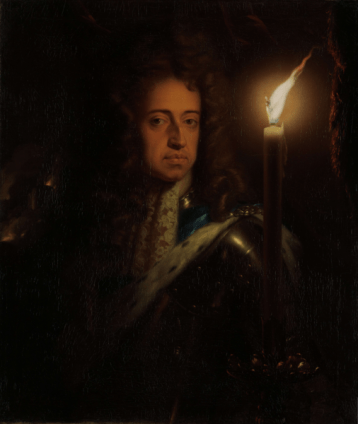
image.png
Willem III, Prince of Orange, King of England and Stadtholder, by Godfried Schalcken. c. 1692-97. (Source)

It is unclear to what extent Innocent might have aided William of Orange. An old legend current at the time asserts that the Pope had financed the expedition with a secret loan of 150,000 scudi. As one reporter puts it, “The sum, equivalent to more than £3.5 million today, equalled the Vatican’s annual budget deficit.” There is, it seems, some truth to this statement. The legend has been supported by more recent research, such as that conducted by the fiction authors Rita Monaldi and Francesco Sorti. They uncovered evidence that corroborated the longstanding claims of other historians.

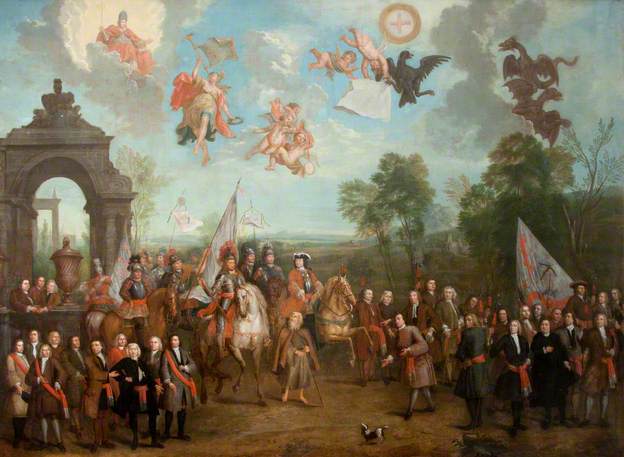
Which leads us to a singular painting by Pieter van der Meulen, The Entry of King William Into Ireland. It has played a controversial role in Northern Irish history. Purchased by the Unionist government of Ulster in 1933, it originally hung in the Great Hall of Stormont. After shifting locations several times, eventually the Rev. Dr. Ian Paisley (of all people) hung it in his office. It is presumably the only picture of the Pope in glory that Dr. Paisley ever liked.

(c) Northern Ireland Assembly; Supplied by The Public Catalogue Foundation

The Entry of King William Into Ireland, Pieter van der Meulen. (c) Northern Ireland Assembly; Supplied by The Public Catalogue Foundation. (Source).
So, why would a Pope act against a Catholic monarcheven covertly?

It seems that he sold Britain and Ireland to save France…and by extension, continental Catholicism. It was a gamble, and a costly one at that. But it seems to have worked in the short run. Although France would later see a terrible anti-Catholic upheaval of its own, Louis was forced to abandon his immediate moves towards schism. He did not become a French Henry VIII. Among all the terrible things that followed the Boyne, at least that one very important good came of it.