Flannery O’Connor and the Protestant Ex Voto Tradition

Recently I came across a very strange song from an equally bizarre album. The song was “I’m Not Handicapped, Just Inconvenienced,” by Gary Dee Bradford. It was on his 1979 album of the same title. The piece is a chilling mix of bad ventriloquism, preachy Carter-era Evangelicalism, and awkwardly poor singing. Which means, of course, that I loved it.

BradfordHandi.jpg

I’m curious what’s on the full album. (Source)

I soon found out that Bradford, who suffers from a rare physical disability called phocomelia (he lacks arms and has hands at his shoulders), produced a few other albums. Although he produced his most recent work in 2002, most of his output came in the 1970’s and 80’s. In one of the only other songs by Bradford I can find online, 1977’s “Good Ole Gospel Music,” we can hear the prepubescent Bradford sing in a high and eerie voice about the superiority of his chosen genre:

It is the sweetest love song
Ever heard by mortal man.
If we had more Gospel Music
We’d have a better land…a better land!

GaryDeeBradfordGOGM.jpg

Gotta love that 70’s montage work. (Source)

It’s catchy, I have to admit. Even if it’s not exactly Mozart.

It would be easy to make fun of the sheer cheesiness of Bradford’s records and write them off as one more episode in the history of odd music. But in fact, Bradford’s albums deserve more respect than that. They tell us something about the history and spirituality of mid-20th century American Christianity. Bradford wasn’t working in a vacuum.

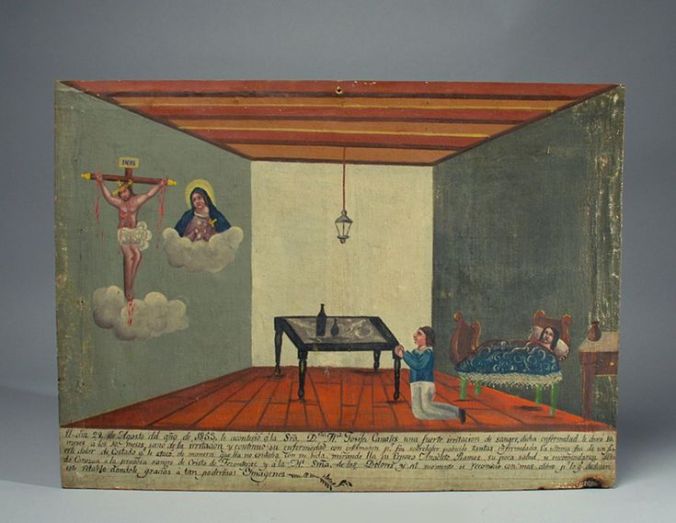
American Gospel music, particularly that brand of Gospel that flourished in the predominately white churches of the mid-century South, has roots in the musical traditions of Appalachia. One of the most common and longstanding song forms found there is the ballad. Appalachian ballads often tell stories of woe and redemption, sadness and hope. When given a religious inflection, they become the musical versions of faith-sharing, testifying to the work of God in redeeming poor sinners. They are also the Protestant equivalents of the Catholic world’s longstanding folk ex voto tradition.
ExVoto1.jpg

An example of a Mexican ex voto, 1853. (Source)

The ex voto is a little painted image offered by a devotee in thanksgiving to Christ, the Virgin, or a saint for a perceived blessing. Usually, the scene of the miracle is depicted in fairly simple (or what the art critics would call “naive”) terms, with a short, handwritten narrative describing the incident below. They are emphatically not “fine art.” Ex votos are the result of folk piety, and they depict the most fundamental relationship of the worshiper and the supernatural, the body and the invisible world, faith and crisis.

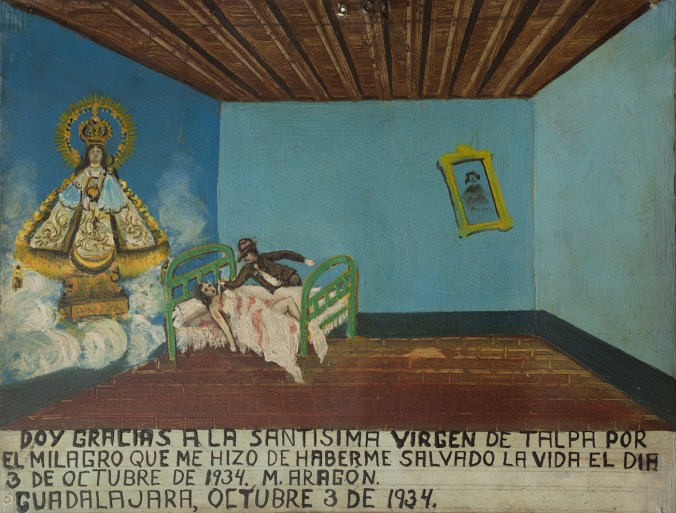
There’s also a uniquely New-World flavor to the ex voto form. While examples abound from most historically Catholic cultures, the most exemplary tradition of ex votos can be found in Mexico. Indeed, the ex voto has become one of the country’s national art forms, often stylized and reinterpreted by contemporary artists. Frida Kahlo even collected them.
exvotokahlo01.jpg

An ex-voto of a woman stabbed in bed, owned by Frida Kahlo and believed to have inspired her own painting, “A Few Small Nips.” (Source)

We can see the same kinds of spiritual impulses behind a whole wave of calamity-themed songs in mid-to-late-20th century Gospel. Perhaps we shouldn’t be surprised that, in a Protestant context, the ex voto takes an audible rather than visual form. Take, for example, Jerry D. Brown’s A Crippled Boy’s Prayer and The Fuller Family’s slightly earlier but almost identical A Little Crippled Girl’s Prayer.

CrippledBoysPrayer.jpg

Not a great song, but it makes sense as a sort of ex voto. (Source)

Sometimes, the album as a physical object mirrors the makeup of an ex voto. The back of the albums often carry long messages of praise and thanksgiving in spite of the various afflictions the artists suffer from. For example, on the back of A Little Crippled Girl’s Prayer, we read the words of wheelchair-bound Marsha Fuller:

It’s so great to be a Christian and serving such a great God. He has given so much to me, for most children with my disease lead a quiet life and never have the opportunities that I have had.  At the age of three He gave me a voice to sing with. And three years later God inspired me to write two songs. Since then, I have written four other songs and made two recordings. He has also blessed me in other ways. He gave me a wonderful Mom and Dad whom have loved and cared for me so much. He gave me a wonderful brother, Gene. You don’t find too many twenty-year-old men who loves to sing for the Lord the ways he does. As a family we have had rough times together. Sometimes we didn’t know where the next meal was going to come from because of hospital bills, but, God has always pulled us through. Our house might not be the biggest and our clothes might not be the finest, but as long as we stay true to Jesus someday we’ll have a mansion that outshines the sun. We truly hope that you will be blessed by our message in song to you. Yours in Christ, Marsha Fuller

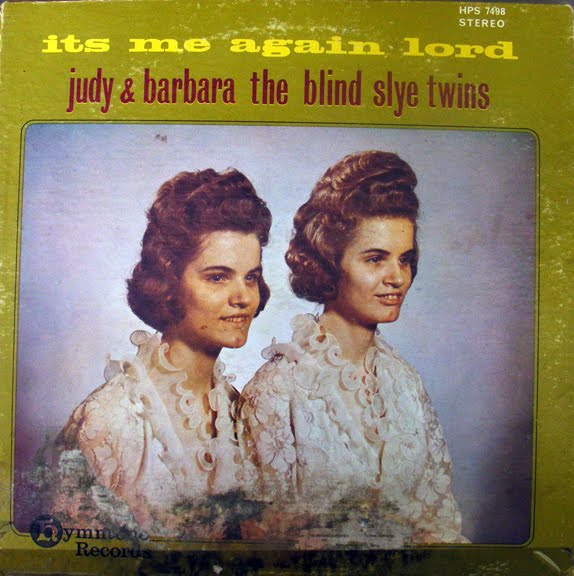
There was a veritable cottage industry of Christian albums by blind, amputee, or otherwise disabled artists that flourished in the middle of the twentieth century. To give a few examples:

ClosertotheSavior.jpg

Denise’s Closer to the Savior, probably from the 1960’s or 1970’s. (Source)
BlindSlye.jpg

Another blind album, It’s Me Again, Lord by Judy & Barbara, the Blind Slye Twins (Source)
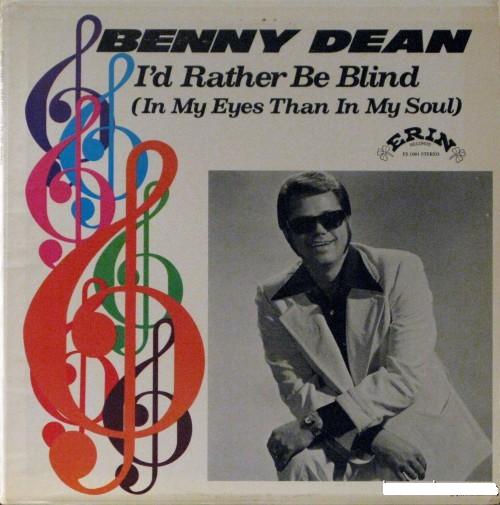
BennyDeanBlind.jpg

Benny Dean’s I’d Rather Be Blind (In My Eyes Than In My Soul). A bit on the nose. (Source)
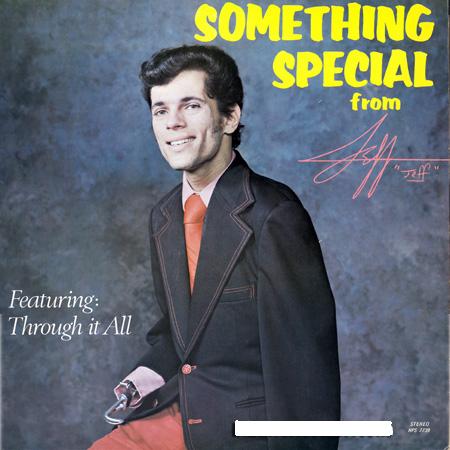
12 JEFF (STEINBERG).jpg

Here’s Something Special from Jeff Steinberg. Note the hook. (Source)
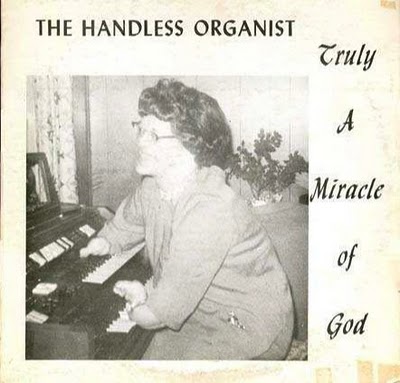
HandlessOrganist.jpg

“Truly a Miracle of God!” (Source)

GospelofLoveAmputee.jpg

Richard & Gail Miller Sing the Gospel of Love. (Source)
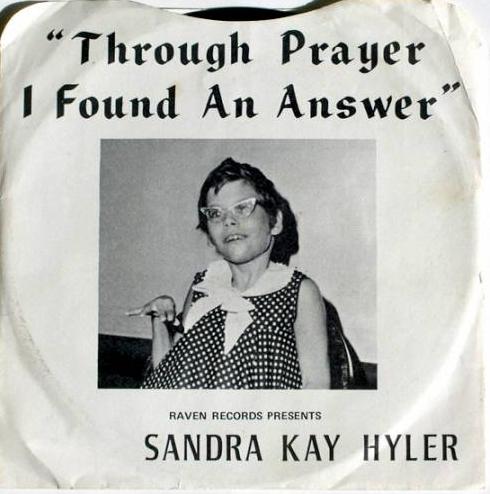
ThroughPrayer.jpg

Sandra Kay Hyler in “Through Prayer I Found An Answer.” (Source)
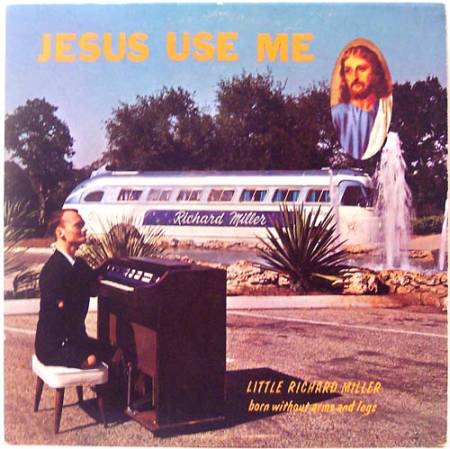
29 richard miller.jpg

Another offering from “Little Richard Miller,” this time with cover art that closely if unintentionally replicates the ex voto model. The full album is online for your listening pleasure. (Source)

These musical works differ from the mainstream of Protestant aural culture in that, even when the songs themselves are classic hymns or are just covers of more obscure songs by disabled artists, they take on a new, personal, and highly-charged meaning in the context of public disability. The artists are not just performing music, they are performing both disability and Christianity – indeed, they perform their disability precisely as the core of their Christianity, and their Christianity as intimately bound up with their disability. The singer born without arms or the blind crooner or the organist missing her hands can all achieve a new status as an icon of model Christian disability. Their performance points towards the hope of a transfiguration that surpasses disability in the kingdom of heaven. Moreover, their physical or mental incapacity is often an implicit analogy for the spiritual deformation, blindness, or weakness found in the more conventional Gospel ballad. The healing of both comes from Jesus.

Mary Douglas, among other anthropologists, has noted that the body physical is often used as an analogy of the body politic. The symbolic representation of the individual corpus speaks to the social body at large – culturally-coded anxieties about the limits of the physical body frequently point to an underlying anxiety about threats to the community. Should it surprise us that the most visible flowering of this disability-obsessed genre came at a time when the culture wars were starting to animate the full force of Southern and Midwestern Protestantism into a politically active bloc with an agenda for cultural change? Surely that socio-political context stands behinds Gary Bradford’s “better land.” The Evangelical doom song, with perhaps its best representatives in the Louvin Brothers, rose to prominence at much the same time.

The fundamentalist folk spirituality that these songs present are a major cultural context in the wonderfully disturbing, deeply Catholic work of Flannery O’Connor. In her short story “A Temple of the Holy Ghost,” she injects it into her description of a Southern freak show. An intersex person addresses two crowds – one made up of men, another of women – before displaying their unusual genitalia. The freak says,

“I’m going to show you this and if you laugh, God may strike you the same way.” The freak had a country voice, slow and nasal and neither high nor low, just flat. “God made me thisaway and if you laugh He may strike you the same way. This is the way He wanted me to be and I ain’t disputing His way. I’m showing you because I got to make the best of it. I expect you to act like ladies and gentlemen. I never done it to myself nor had a thing to do with it but I’m making the best of it. I don’t dispute hit.” Then there was a long silence on the other side of the tent and finally the freak left the men and came over onto the women’s side and said the same thing. (The Collected Stories of Flannery O’Connor 245).

Later, they lead a kind of religious service centered on their own experience of God’s Providence.

She could hear the freak saying, “God made me thisaway and I don’t dispute hit,” and the people saying, “Amen. Amen.”
“God done this to me and I praise Him.”
“Amen. Amen.”
“He could strike you thisaway.”
“Amen. Amen.”
“But he has not.”
“Amen.”
“Raise yourself up. A temple of the Holy Ghost. You! You are God’s temple, don’t you know? Don’t you know? God’s Spirit has a dwelling in you, don’t you know?”
“Amen. Amen.”
“If anybody desecrates the temple of God, God will bring him to ruin and if you laugh, He may strike you thisaway. A temple of God is a holy thing. Amen. Amen.”
“I am a temple of the Holy Ghost.”
“Amen.”
The people began to slap their hands without making a loud noise and with a regular beat between the Amens, more and more softly, as if they knew there was a child near, half asleep. (Ibid., 246)

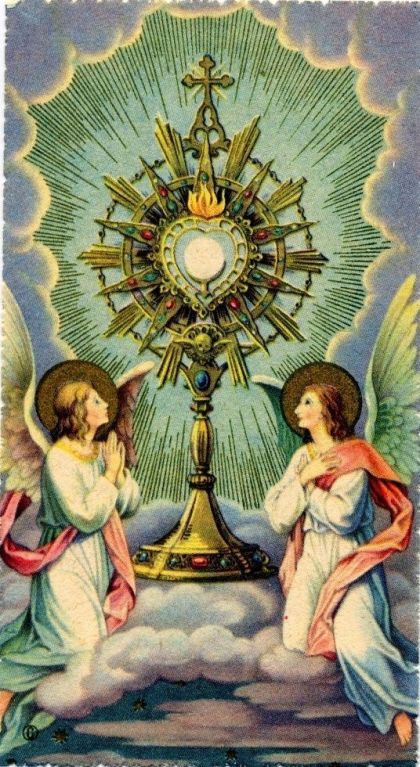
O’Connor, who suffered from lupus herself, draws a parallel between the freak’s preaching and Benediction of the Blessed Sacrament. In the two episodes, we can perceive both the sovereignty of God’s Providence and the sacramental capacity of matter to bear God.
eucharistmonstranceholycard.jpg

A holy card depicting a monstrance, used in Benediction. (Source)

It strikes me as intuitively sensible that O’Connor should have chosen precisely this story to contrast Protestant and Catholic music. Early on in the story, two young Church of God men try to woo a pair of Catholic sisters by singing a Gospel hymn, complete with guitar and harmonica. The girls, who have been educated at convent school, bite back their giggles and respond with the Tantum Ergo. One of their suitors is more right than he knows when, puzzled and slightly disapproving, he calls it “Jew singing.” The two forms of music, though standing in an apparent contradiction, together anticipate the underlying sacramental truth presented by both the Protestant and Catholic services that conclude the story.

O’Connor makes much of Protestant devotional culture in one of her novels, The Violent Bear It Away (1955). It is the story of a boy called to prophesy, of his skeptical schoolteacher cousin, and of the battle they wage for the soul of a mentally disabled child. At one point, we come to the performance of a family of traveling musical missionaries. The high point of the act comes when their little daughter emerges from behind the curtain to preach a rousing sermon. In the course of her preaching, she delivers what may be the book’s central message:

“I’ve seen the Lord in a tree of fire! The Word of God is a burning Word to burn you clean!…Burns the whole world, man and child…none can escape…Are you deaf to the Lord’s Word? The Word of God is a burning Word to burn you clean, burns man and child, man and child the same, you people! Be saved in the Lord’s fire or perish in your own! Be saved in…” (The Violent Bear It Away 134-35).

O’Connor is fond of granting the most clear-eyed spiritual vision to the children in her stories. Many have profound experiences of grace that mark them forever, or they bear testimony of the invisible world’s dangerous immediacy to more skeptical characters.
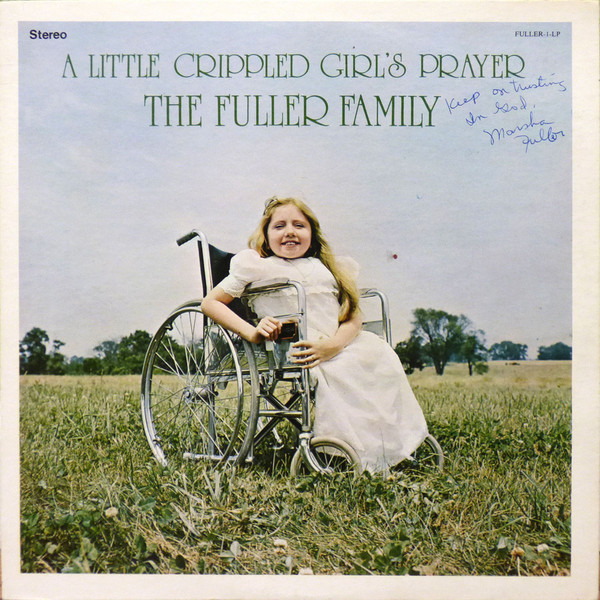
CrippledGirl

This album makes me think of O’Connor’s 1955 The Violent Bear It Away. (Source)

That includes O’Connor’s disabled children. “The Lame Shall Enter First,” one of O’Connor’s most emotionally crushing short stories, is a close companion to The Violent Bear It Away. It tells the story of a well-meaning social worker, Sheppard, who takes in a clubfooted juvenile delinquent, Rufus Johnson, hoping to steer him towards a productive life. Although he can overlook Rufus’s constant spite, Sheppard is exasperated by the fundamentalist beliefs he clings to. Rufus is convinced he is going to hell, and starts to talk about it with the social worker and his impressionable young son. He steadily grows into the role of preacher even as Sheppard tries desperately to “flush that out of [his] head.” I won’t get into any spoilers, as the story has a wrenching, unforeseen climax. I’ll just say that Sheppard finally realizes he has failed only when Rufus cries at him,

“I lie and I steal because I’m good at it! My foot don’t have a thing to do with it! The lame shall enter first! The halt’ll be gathered together. when I get ready to be saved, Jesus’ll save me, not that lying, stinking atheist, not that…” (The Collected Stories of Flannery O’Connor 480).

Sheppard attributes all of Rufus’s bad behavior to the emotional effect of his clubfoot. But Rufus finds his one hope of salvation in the fact that he has a disability that, according to the logic of heaven, will ensure that he enters the Kingdom first. For Rufus, as for so many of the artists mentioned above, it represents both faith and hope (if not yet charity). Sheppard is too blinded by his prejudice and his loneliness to see that. The results are calamitous.

Rufus’s underlying insight speaks to a truth often forgotten in the Church’s treatment of the disabled. Those with disabilities are not “problems.” It’s true that they may have some special needs with regards to access, attention, etc. But at the end of the day, they are people who have the same basic spiritual needs as any other human beings. They, too, can embody and image Christ – often better than those of us who are blessed enough to be of both sound mind and body.

Gary Bradford himself has spoken publicly about this issue before. Some time in the late 1980’s or early 1990’s, Bradford – by then an adult – gave an interview with a Christian television network. He says,

In the past…so many of our churches, and so many of our people in our church in the past, it’s been the place for the good, the well-bodied, and the abled…And the Church isn’t to be like that; the Church is to take all.

Of course, the other great danger is to place too much emphasis on the disability and not enough on the person who has it. The “magical disabled person” should not become a trope in Christian life. We can’t load our disabled brethren in Christ with that moral freight. It isn’t fair. The disability Gospel genre fosters precisely that kind of harmful thinking; perhaps that is its greatest cultural fault.

I think we can avoid either extreme – neglect or overemphasis – by focusing instead on the individuality and personhood of every disabled Christian. Insofar as the disability Gospel song is an ex voto, it may seem to correspond to a certain type. Catholic ex votos usually do. But that’s only to the outsider who beholds the ex voto. For the one who makes it (or commissions it), the story it tells carries intense and highly particular personal meaning. Put another way; Sheppard may not grasp the hidden meaning of Rufus’s club foot, but Rufus does.

The same goes for the Protestant ex votos we find in this genre. They may seem to correspond to the demands of a cottage industry, but they all epitomize and present individual experiences. That particularity is the best thing we can take from this strange, lost genre of Christian music. There are no generic souls, abled or otherwise.
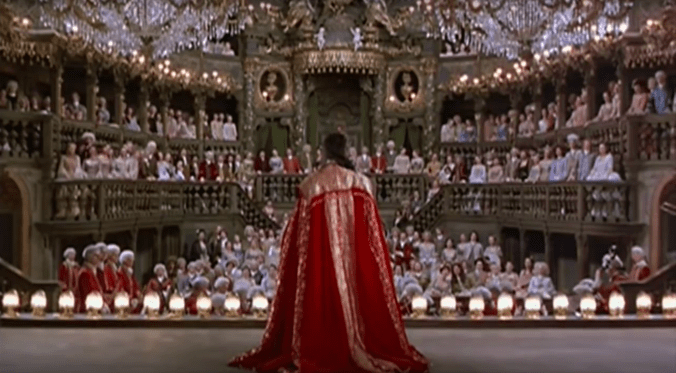
My First Year at Grad School in Twelve Musical Selections

Screen Shot 2018-06-22 at 2.00.39 AM.png

A still from Farinelli. This was the year I both became an 18th century scholar and discovered Castrato arias. (Source)

12. “Somebody That I Used to Know” only Vaporwave.

11. “Sumer is Icumen In,” from The Wicker Man (1973).

10. “Demons,” by Alex and “Sleep Games,” by Pye Corner Audio.

9. Tchaikovsky’s Swan Lake theme.

8. Psalm 129 from King’s College Choir, Cambridge.

7. The soundtrack from Le Roi Danse.

6. “Never Enough” from The Greatest Showman.

5. “Pur Ti Miro,” by Monteverdi.

4. The Little Match Girl Passion, by David Lang

3. The Farinelli soundtrack.

2. Michael Nyman’s “The Garden is Becoming a Robe Room,” “Prospero’s Magic,” and “Chasing Sheep is Best Left to Shepherds.”

1. Various Arias from Handel, especially Rinaldo‘s “Il Vostro Maggio” and “Lascia Ch’io Piangia” as well as most of “Ode for the Birthday of Queen Anne.”


The Voice of Arthur Machen

GreatGodPanBeardsley.jp

The title illustration of Machen’s The Great God Pan and the Inmost Light (1896), famously rendered by Aubrey Beardsley (Source)

Arthur Machen (1863-1947) was one of the greatest horror writers in the English language. His particular brand of esoteric paganism, the dangers of the occult, the sinister truth lurking behind folktales, and a highly-developed knack for evoking eldritch terror – all of these elements exerted a profound influence on the development of weird literature. Those who enjoy Lovecraft will recognize much in Machen that later made its way into Lovecraft’s own corpus. The dark bard of Providence held Machen in high esteem.

Machen was also a deeply spiritual Christian, best but imperfectly classed as an Anglo-Catholic. His strong sense of the mystical life found its fullest expression not in his horror stories, which do indeed bear some mark of his sacramental worldview, but in his later writings. A Welshman, he was fascinated by the Grail legend and connected it with his idea of an ancient, vividly supernatural “Celtic” Christianity.

AMachen.jpg

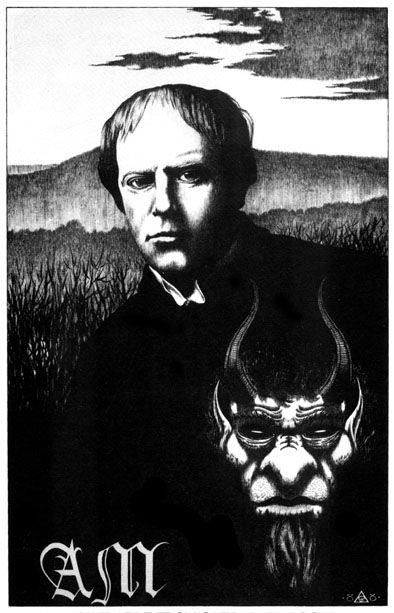
Portrait of Arthur Machen (Source)

Machen is a favourite of mine. I cannot recommend his stories highly enough – especially The Great God Pan, “The Novel of the White Powder,” “The Shining Pyramid,” “The Ceremony,” and “The Lost Club.” He is far scarier than some of his better-known contemporaries such as M.R. James or Sir Arthur Conan Doyle.

He also figures prominently in some of my research. I recently came upon a recording of his voice from 1937, in which he speaks of Chesterton, Dickens, Thackeray, and the art of fiction more broadly. Some of my readers may find this as enjoyable as I do, and so I provide a link here.

Monsieur Olier on the Ascension

QueensCollegeAscension.jpg

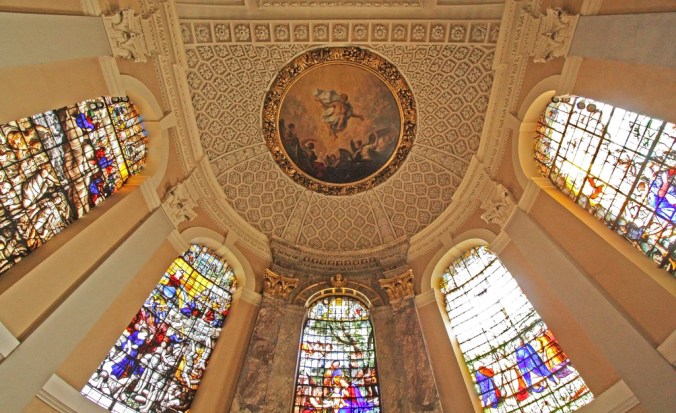
The Ascension fresco at Queen’s College Chapel, Oxford – perhaps my favorite chapel in the entire University. Photo by Fr. Lawrence Lew OP. (Source)

One of the greatest luminaries of the French Church in the 17th century, that period known as the Grand Siècle, was Jean-Jacques Olier. Though barely read today, he exerted a profound influence upon the formation of the French School of Spirituality through his work in founding the Sulpician Order. He was a close associate of St. Vincent de Paul, who always regarded him as a saint.

M.Olier.jpg

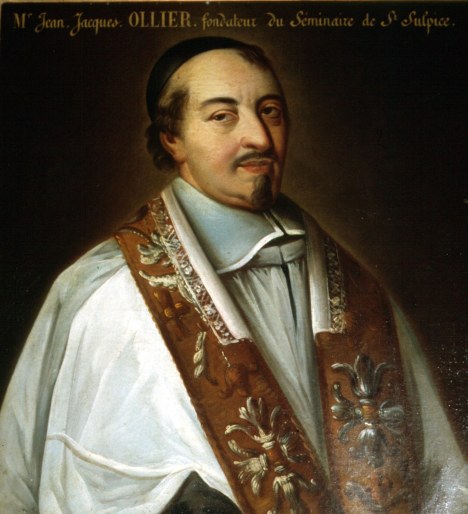
M. Olier, priez pour nous! (Source)

I have excerpted here his short chapter on the Ascension from his book, The Interior Life of the Most Holy Virgin. I must ask my readers to forgive me for not translating this edifying work, as I did not have the time. Those with French, however, will appreciate the depth of M. Olier’s insight.

***

Le sacrifice de Jésus-Christ étant offert pour l’Église, qui est visible, devait être visible lui-même dans toutes ses parties, afin de nous donner une certitude parfaite de notre réconciliation avec Dieu. Marie, dans le jour de la Purification, avait paru à l’offrande de la victime, en présentant elle-même, au nom de l’Église, Jésus-Christ notre hostie, et en le dévouant à l’immolation. Elle avait aussi été présente à la deuxième partie du sacrifice, à l’immolation réelle de Jésus-Christ sur la croix. La troisième, qui était la consommation ou le transport de la victime en Dieu, avait eu lieu dans le mystère de la Résurrection. Mais cette consommation s’était opérée d’une manière invisible; et la bonté de Dieu voulait que, pour notre consolation, cette partie du sacrifice devînt visible aussi bien que les deux autres, ou plutôt que Notre-Seigneur montât au ciel pour aller se perdre dans le sein de Dieu non-seulement à la vue de la très-sainte Vierge sa mère, mais encore sous les yeux de tous les apôtres par qui l’Église était représentée. C’est ce qu’avait figuré autrefois Élie montant au ciel dans un char de feu à la vue d’Élisée ; et ce prophète avait déclaré expressément à son disciple que, s’il le voyait monter, il aurait son double esprit. Don mystérieux, qui exprimait le fruit du sacrifice, c’est-à-dire l’esprit de mort et de résurrection ou de vie divine, que Jésus-Christ devait laisser à l’Église figurée par Élisée.

Après sa résurrection, il communiquait toutes les dispositions et tous les sentiments de son âme à sa bénite Mère. Il lui exprimait spécialement les désirs ardents qui le pressaient d’aller enfin se réunir à Dieu son Père, pour le louer et le glorifier dans le ciel. Marie, de son côté, éprouvait un véhément désir d’y accompagner son Fils, pour s’unir à ses louanges; et sans doute qu’elle eût terminé alors sa vie et l’eût suivi dans les cieux, s’il n’eût voulu se servir d’elle pour aider l’Église dans ses commencements.

L’oeuvre de cette divine Mère était encore incomplète. Après avoir donné, par Marie, naissance au chef, Dieu voulait procurer aussi, par elle, la formation de tout le corps. Il voulait la rendre mère de sa famille entière, de Jésus-Christ et de tous ses enfants d’adoption. Par zèle pour la gloire de Dieu et par charité pour nous, elle accepte avec joie la commission que Notre-Seigneur lui laisse de travailler à faire honorer son Père par les hommes, et de demeurer sur la terre jusqu’à ce que l’Église ait été bien affermie.

Le quarantième jour après la Résurrection étant donc venu, Jésus-Christ- se rend à Béthanie avec sa sainte Mère et ses apôtres; là élevant les mains et les bénissant, il se sépare d’eux, et en leur présence s’élève vers le ciel. Ils l’y suivirent des yeux, jusqu’à ce qu’enfin une nuée le dérobe à leur vue; et comme néanmoins ils tenaient toujours leurs regards fixés au ciel, deux anges vêtus de blanc leur apparurent et leur dirent : Pourquoi vous arrêtez-vous à regarder le ciel? Ce Jésus, qui a été attiré du milieu de vous dans le ciel, viendra de la même manière que vous l’avez vu monter au ciel. Ainsi Dieu voulut-il que l’acceptation solennelle qu’il faisait de notre hostie, eût pour témoins non-seulement tous les apôtres et la très-sainte Vierge, qui l’avait produite de sa propre substance, mais les anges eux-mêmes.

En montant dans les cieux, Jésus-Christ élève avec lui tous les saints patriarches et les autres justes qu’il avait retirés des limbes, et va les offrir à son Père, comme les premières dépouilles qu’il a ravies au démon par sa mort. Enfin, dérobé par la nuée à la vue de ses disciples, il laisse rejaillir la splendeur de sa gloire, qu’ils n’auraient pu soutenir et dont il avait retenu l’éclat dans ses diverses apparitions.

Comme les enfants des rois donnent des présents à leurs sujets, en faisant leur entrée dans leur royaume, Jésus-Christ, montant à la droite de son Père pour prendre possession de son trône, voulait envoyer à ses apôtres son esprit et ses dons, c’est-à-dire dilater son coeur en faisant entrer les hommes dans ses sentiments de religion envers Dieu son Père, et achever ainsi son ouvrage. Dans ce dessein et par son commandement, les disciples s’assemblèrent à Jérusalem avec la très-sainte Vierge et plusieurs saintes femmes; et là ils étaient en prière, louant, bénissant le nom de Dieu, et attendant la venue de l’Esprit-Saint. Marie était au milieu d’eux et présidait ce sacré concile, comme ayant, pour aviser à établir la gloire de Dieu dans le monde, une grâce qui excellait par-dessus celle de tous les apôtres. Quoique Jésus-Christ n’eût pas voulu qu’elle fût présente à la Cène, ni qu’elle offrît extérieurement le saint sacrifice, ni qu’elle fût prêtre selon l’ordre de Melchisédech, il voulait néanmoins que Marie, destinée à être la mère des vivants, se trouvât dans le Cénacle avec les apôtres, afin de verser la plénitude de son esprit en elle, comme dans le réservoir de la vie divine, et de la distribuer par elle à tous ses enfants, et aussi pour apprendre à l’Église que jamais elle ne serait renouvelée qu’en la société de sa divine Mère et en participant à son esprit.

rococoascensionaltar

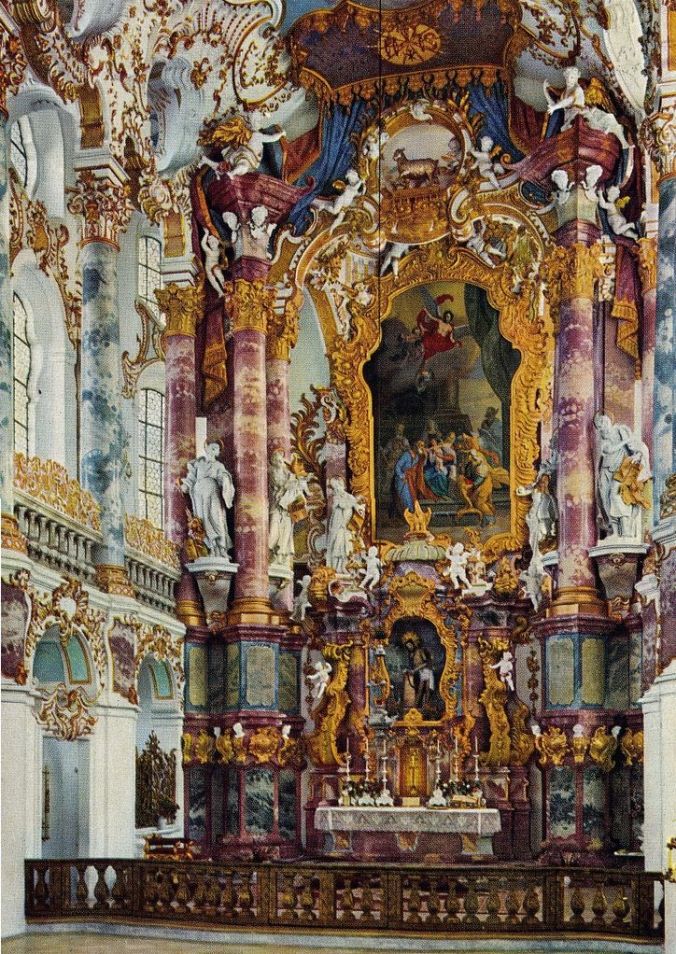
A rococo altar depicting the Ascension, Ottobeuren, Germany. (Source)

A Relic of the 1965 Liturgy

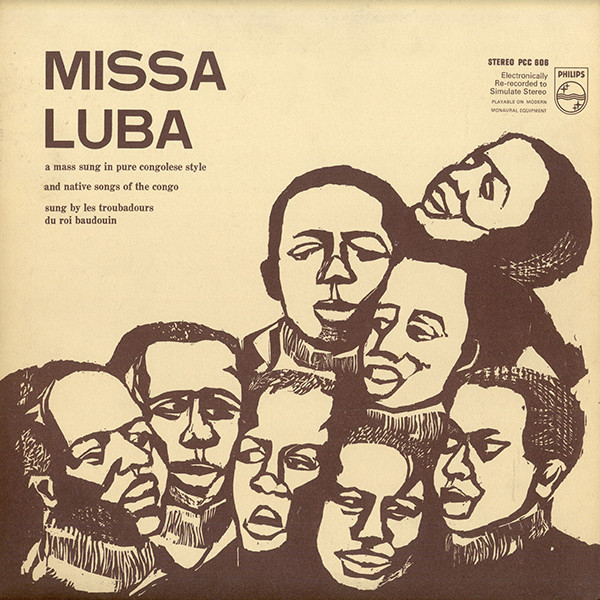
MissaLuba

Album cover of the Missa Luba. (Source)

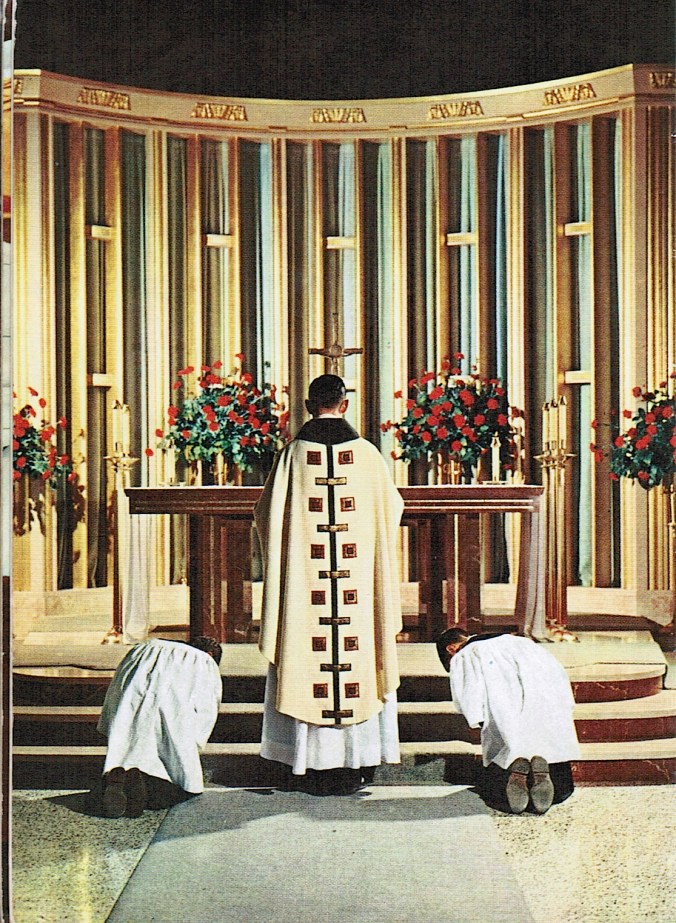
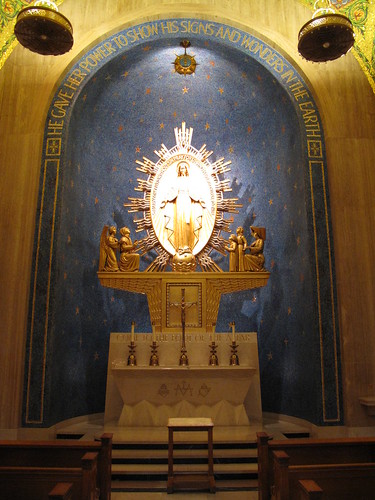
That strange Mass produced by the Council in 1965, an interim liturgy somewhere between the Usus Antiquior and the Novus Ordo, was often accompanied by a distinctive style – at once traditional and fresh, what has been called by some “The Other Modern.” Think of the decoration of the National Shrine of the Immaculate Conception in Washington, D.C – especially its many side-chapels. Think of the delightful, dignified, but very vernacular liturgical music of Fr. Clarence Rivers (at least his early material). Think of the ornate but often geometric vestments that emerged from that time. Indeed, just think of Paul VI’s space-age papal tiara.

1965 Mass.jpg

The hybrid Mass of 1965. Not ideal, but considerably better than what followed. (Source)

Recently I discovered a reminder of this strange time in the Church’s history. I was watching a 1968 movie called If… with friends. It’s a disturbing (if artful) film about an uprising at a traditional British public school, and was clearly made in conversation with the student protests that erupted that fateful Spring, fifty years ago. I was surprised to find that one of the major musical motifs was liturgical. Looking it up, I discovered it was the “Sanctus” of the 1965 Congolese Missa Luba. The song is in many ways a synecdoche of the 1965 rite. It starts off with on French Gregorian foot, quickly introduces drums, and ends with an extremely Congolese bit of improvised singing. And, it must be said, it’s very beautiful.

The poignant song, coming from a country and Church in turmoil, strikes me as emblematic of the crushed hopes of that era. So much was anticipated of Congolese independence, so bitterly contested in the five years since. Already, the forces of reaction were coalescing around an upstart colonel who would soon assume control of the country as its first home-grown dictator, Mobutu Sese Seko. And in the Church, those reformers who genuinely tried to bring about a more perfect sense of the divine in the modern world found their position betrayed by a coterie of unorthodox radicals who perverted the sense of the Council’s documents.

Yet we can still hear that bright, fleeting moment of hope in the voices of the Congolese joining their praises to those of the angels.

UPDATE: It has been pointed out to me, correctly, that I have erred in attributing the Missa Luba to 1965 proper. The Mass setting was actually first recorded in 1958. It was in 1965 that the first US release of the album came out. So I suppose that, insofar as we consider its Western reception, the Missa Luba does remain part of the 1965 liturgical landscape. And “The Other Modern” certainly existed in the 1950’s; the aesthetics of 1965 were the culmination of a few decades’ of development.

I suppose my final point, about the parallels in the Church and the Congo, wouldn’t work as well as I had hoped. But at the very least, the Congo in 1958 was indeed a place of tremendous hope for the future. That aspiration manifest in the music was soon crushed by the turmoil of five years of war following Belgium’s official withdrawal in 1960. And the Church? Well, in 1958, I’m not sure anyone really saw what was coming…

A Forgotten Feast

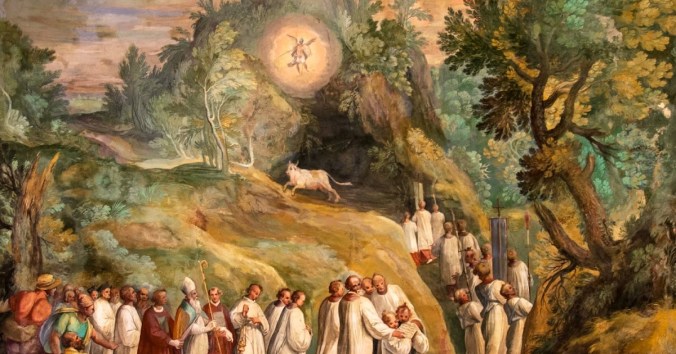
Aparición de San Miguel Arcángel en Monte Gargano

St. Michael, pray for us. (Source)

One of the great victims of the liturgical reform was a whole set of very odd, very particular feasts. The homogenizing, unpleasantly modern mindset of so many reformers back in the 1960’s and 70’s seems to have left no room for anything that could be remotely construed as anachronistic or legendary. Thus vanished the Invention of the Holy Cross, which would have fallen only a few days ago. Another feast lost to us is the one that would, in the old calendar, have come today: the Feast of the Apparition of St. Michael. How wonderful that the Liturgical Providence of God should grant us a feast simply to recall the visible presence of the Angelic Powers in our lives.

Allow me to quote Dom Gueranger at length:

Devotion to St. Michael was sure to spread through the Church, especially after the worship of idols had been banished from the various countries, and men were no longer tempted to give divine honor to creatures. Constantine built a celebrated Church called Michaelion in honor of the great Archangel, and at the time when Constantinople fell under the power of the Turks, there were no fewer than fifteen churches bearing the name of St. Michael, either in the city or the suburbs. In other parts of Christendom the devotion took root only by degrees; and it was through apparitions of the holy Archangel that the faithful were prompted to have recourse to him. These apparitions were local and for reasons which to us might seem of secondary importance; but God, Who from little causes produces great effects, made use of them whereby to excite Christians to have confidence in their heavenly protector. The Greeks celebrate the apparition that took place at Chone, the ancient Colossae in Phrygia. There was in that city a church dedicated to St. Michael and it was frequently visited by a holy man named Archippus, who was violently persecuted by the pagans. One day, when Archippus was at his devotions in his favorite St. Michael’s, his enemies resolved to destroy both him and the church. Hard by ran a brook which flowed into the river Lycus; they turned it aside and flooded the ground on which the church stood. Suddenly there appeared the Archangel St. Michael holding a rod in his hand; the water immediately receded, and flowed into a deep gulf near Colossae where the Lycus empties itself and disappears. The date of this apparition is not certain, but it occurred at the time when pagans were still numerous enough in Colossae to harass the Christians.

Another apparition which encouraged devotion to St. Michael in Italy, took place on Mount Gargano, in Apulia; it is the one honored by today’s Feast. A third happened on Mont Tombe (Mont Saint-Michel; see images at left and at bottom), on the coast of Normandy; it is commemorated on the 16th of October.

The Feast we are keeping today is not so solemn as the one of September 29th; it is, however, more exclusively in honor of St. Michael, inasmuch as the Autumn Feast includes all the choirs of the Angelic hierarchy. The Roman Breviary gives us the following account of the Apparition on Mount Gargano:

That the Blessed Archangel Michael has often appeared to men, is attested both by the authority of Sacred Scripture, and by the ancient tradition of the Saints. Hence, the memory of these apparitions is commemorated in divers places. As heretofore St. Michael was honored by the Synagogue of the Jews as Guardian and Patron, so is he now by the Church of God. A celebrated apparition of the Archangel took place, under the Pontificate of Gelasius I, in Apulia, on the top of Mount Gargano, at whose foot lies the town of Siponto.

A bull belonging to a man who lived on the mountain, having strayed from the herd, was, after much searching, found hemmed fast in the mouth of a cave. One of its pursuers shot an arrow, with a view to rouse the animal by a wound; but the arrow rebounding struck him that sent it. This circumstance excited so much fear in the bystanders and in them who heard of it, that no one dared to go near the cave. The inhabitants of Siponto, therefore, consulted the Bishop; he answered that in order to know God’s will, they must spend three days in fasting and prayer.

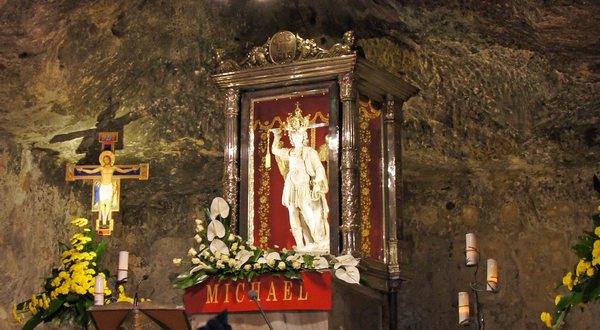
At the end of the three days, the Archangel Michael warned the Bishop that the place was under his protection, and that what had occurred was an indication of his will that God should be worshiped there, in honor of himself and the Angels. Whereupon the Bishop repaired to the cave, together with his people. They found it like a church in shape, and began to use it for the celebration of the divine offices (see image below). Many miracles were afterward wrought there. Not long after, Pope Boniface dedicated a church in honor of St. Michael in the great Circus of Rome, on the third of the Kalends of October (September 29), the day on which the Church celebrates the memory of all the Angels. But today’s Feast is kept in commemoration of the Apparition of St. Michael the Archangel.

gargano

The shrine to St. Michael on Monte Gargano (Source)

Yet these stories, reflecting Medieval devotional practice more than any Biblical story or the life of any particular saint, have no place in the new calendar. It is one thing to accept Our Lady of Guadalupe, beloved by millions. It is quite another to countenance a similar story which might only be of local interest. Yet the liturgy is never purely provincial. While there has always been great variety among local rites and practices, the Mind of the Church synthesizes this diversity into an underlying, supernatural harmony. There is only one High Priest, and the liturgy is His eternal prayer as shared by His bride and body, the Church.

The irony of course, is that the reformers seem to have grasped that principal, but then applied it perversely. They acknowledged the universality of the liturgy, but understood it with prejudice against the forest of particularities that had sprung up over the whole Catholic world over the course of nearly two millennia. They could stand on the precedent of Trent and the suppression of most other rites by Quo Primum (1570). Yet that bull at least allowed those liturgies in existence prior to 1370.

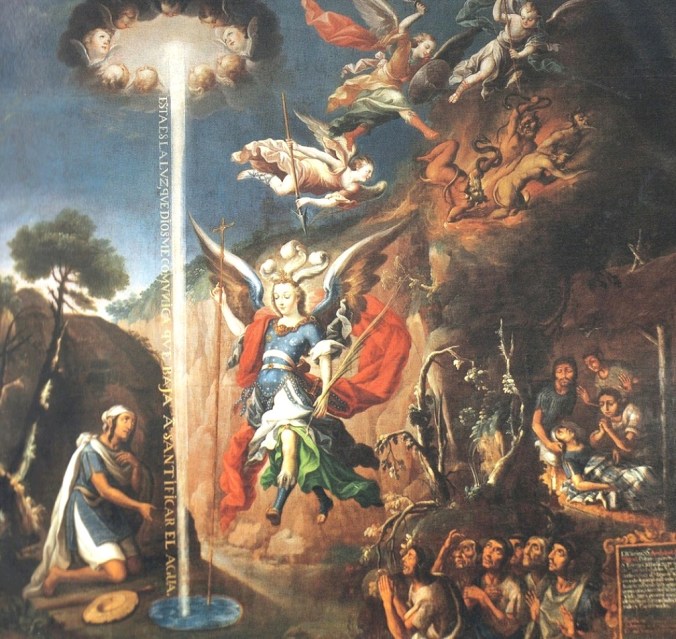
Apparition of St Michael the Archangel to Diego Lázaro, Santuario de San Miguel del Milagro, Nativitas, Tlaxcala

Apparition of St Michael the Archangel to Diego Lázaro, Santuario de San Miguel del Milagro, Nativitas, Tlaxcala, Mexico (Source)

It occurs to me that, in removing feasts like the Apparition of St. Michael, we have allowed ourselves to forget many of those little stories and details that were once part of a common Catholic heritage. That forgetting coincided with a general turn away from the supernatural in Western civilization. The middle of the twentieth century saw a retreat from those doctrines of the invisible world that today’s feast (and others like it) commemorate. The result? A proliferation of “new religious movements” seeking the transcendent in a host of spurious, unsound practices. The mumblings of Victorian cranks were garbled together with bastardized Buddhism and reconstructed paganism, garnished with a generous helping of hallucinogens. And that’s just the New Age.

The task that faces us now is to remember all those things we forgot. May St. Michael pray for us in this critical venture.

Another View of the Sacraments in the Eighteenth Century

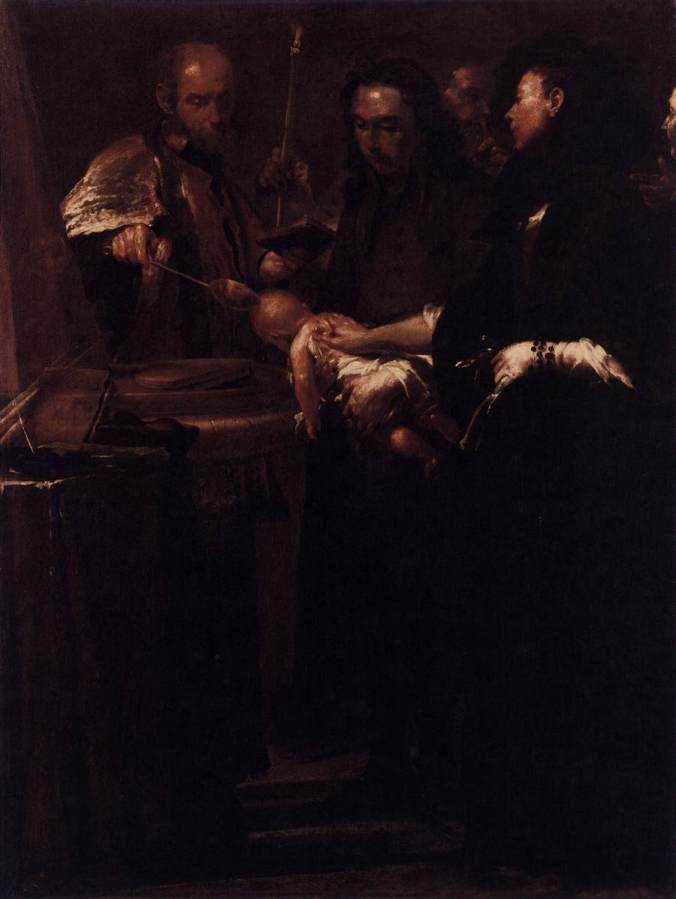
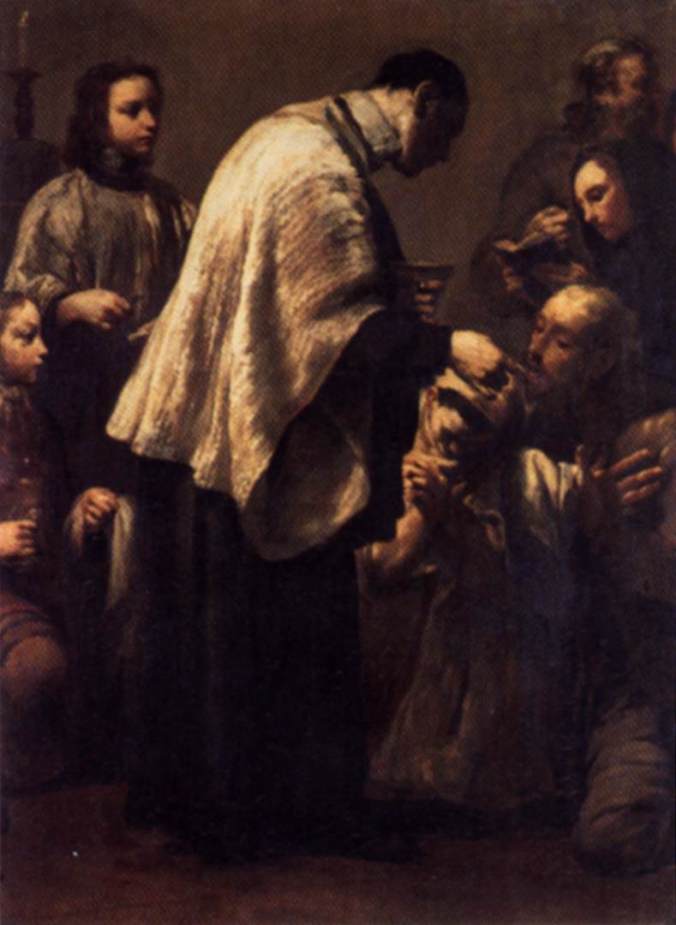
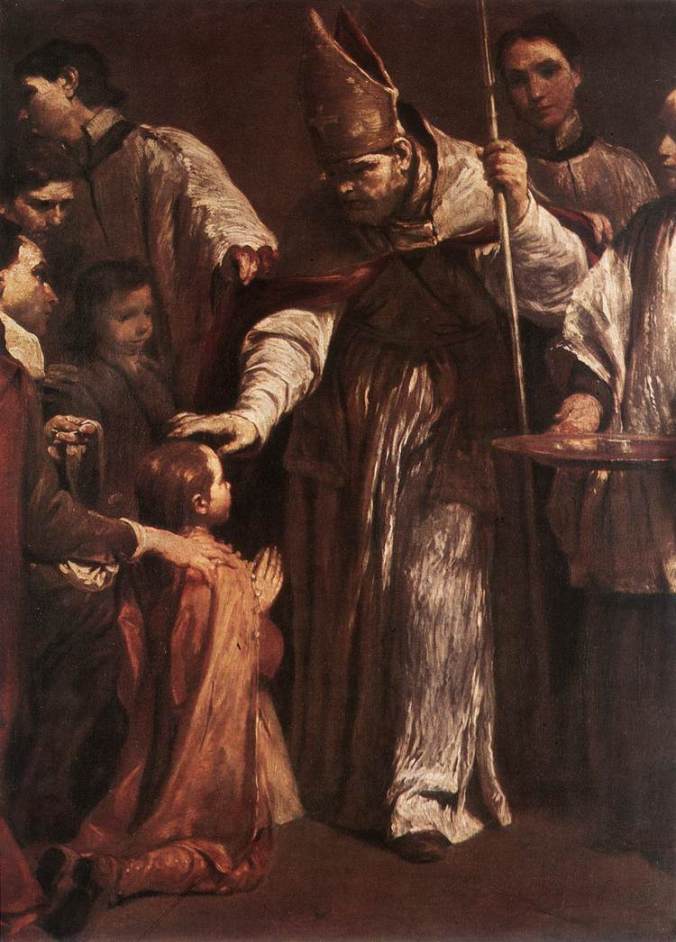
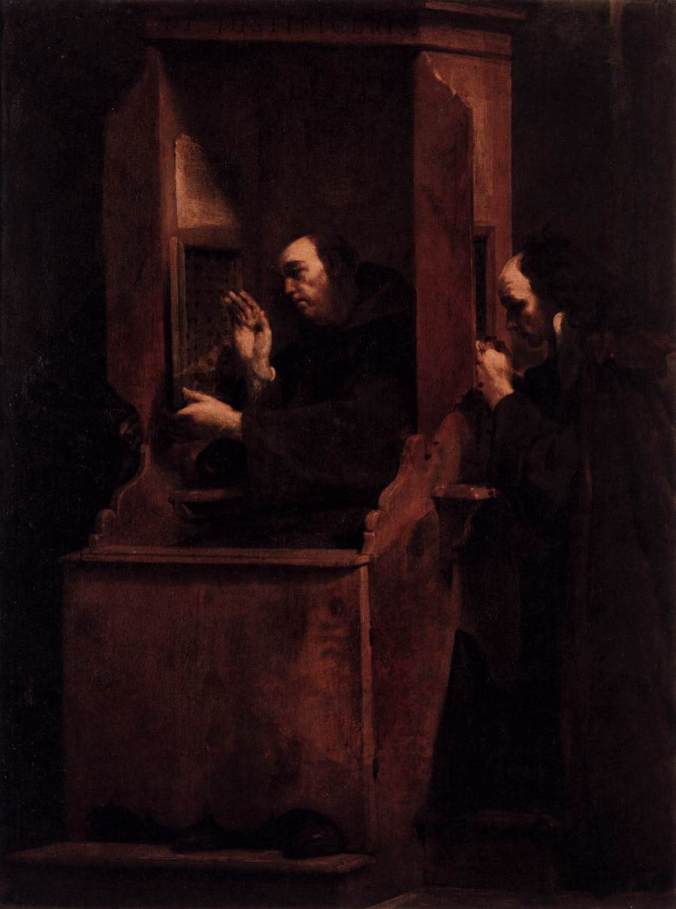
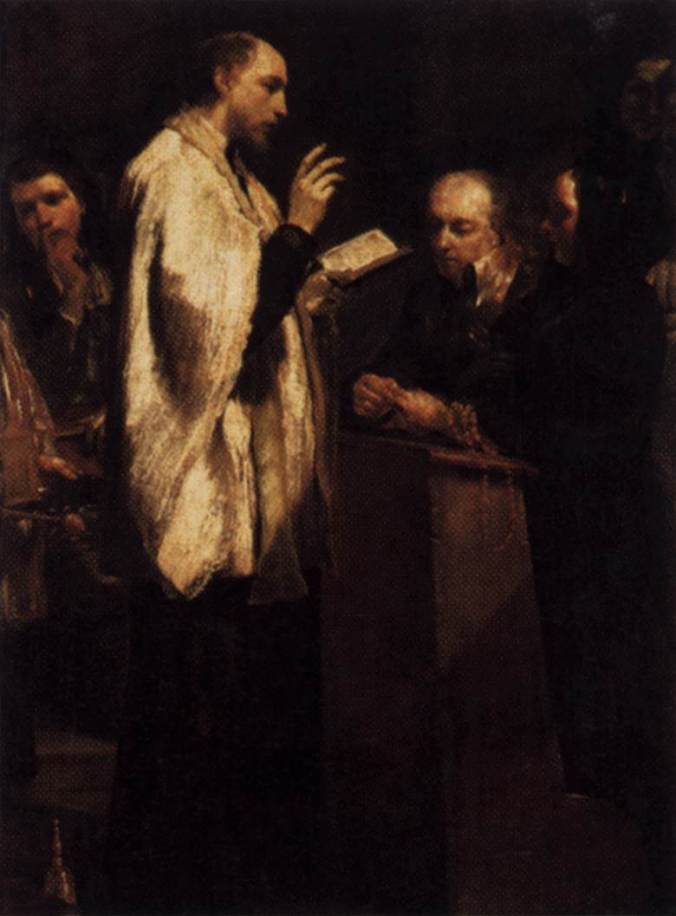
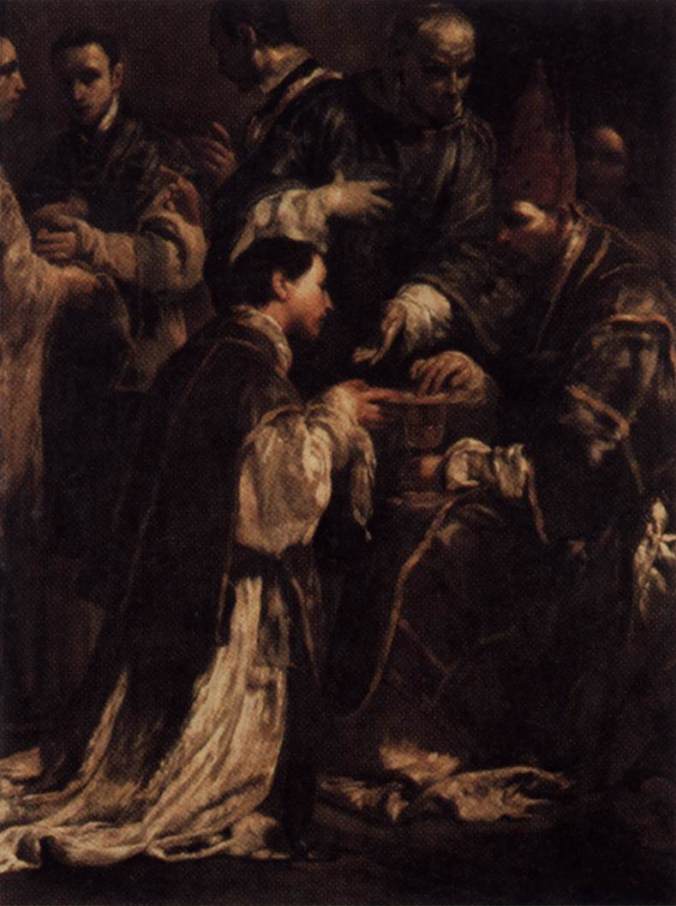
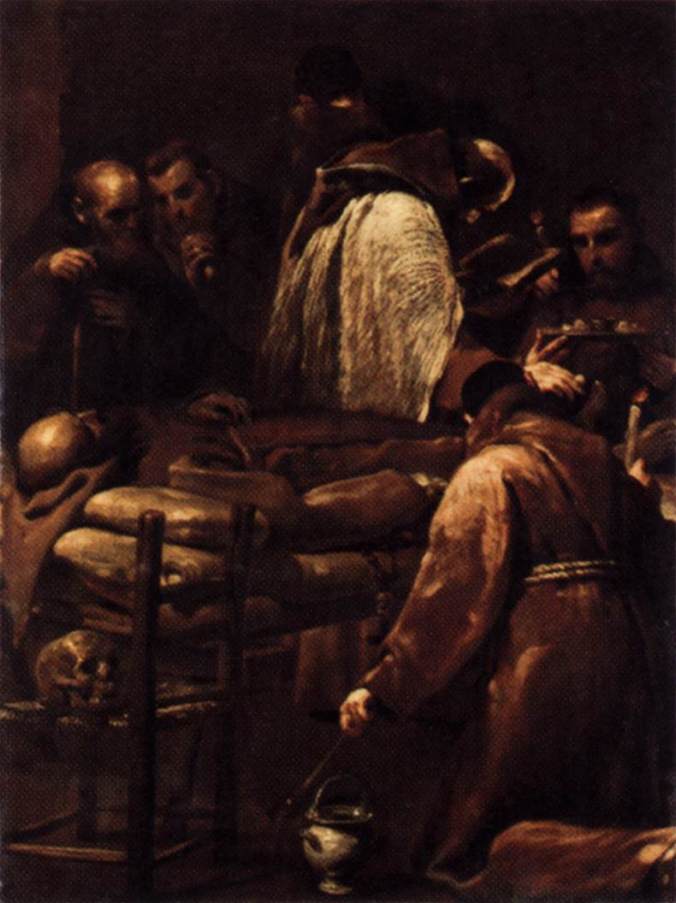
A while back I produced a short post entitled “A View of the Sacraments in the Age of Enlightenment.” Here I give you another series of similar images, this time from the hand of Giuseppe Maria Crespi, also known as “Lo Spagnuolo.” These paintings from 1712, so reminiscent of Rembrandt, hang in the Gemäldegalerie, Dresden. Originally commissioned by Cardinal Pietro Ottoboni, that towering figure of late Baroque culture, they passed posthumously up to Germany, where they made their way into collection of the Elector of Saxony.

Let me begin by saying that, as with the information in the above paragraph, all of the images can be found at Wikipedia.

Giuseppe_Maria_Crespi_-_Baptism_-_WGA05763

“Baptism.” Crespi’s sparing use of light demonstrates the central conjunction of the scene. Allowing our eyes to wander along the central line of illumination, we follow the arm of the priest pouring water on the head of the outstretched infant to the mother’s rosary-wrapped wrist just beyond. I am convinced that the use of light in all of these images is the key to their meaning. Crespi uses light to illustrate the work of sacramental grace, and darkness to emphasize the mortality, evanescence, and weariness of our ordinary world. “The people in darkness have seen a great light” – thus spake Isaiah.

Giuseppe_Maria_Crespi_-_Communion_-_WGA05766

“Communion.” The priest’s face is shrouded in darkness, and rightly so. It is not he who offers the bread of life, but Christ in him. Interesting collar, too. Sure looks familiar. Cardinal Ottoboni was patron of the Congregation of the Oratory at Rome for some time, and it’s entirely possible that Crespi would have taken the Oratorians as his model here. Besides that, the setting of the scene is strikingly barren. Crespi’s choice to leave out the probable altar rail lends the scene an intimacy that captures the very heart of the worship here portrayed.

Giuseppe_Maria_Crespi_-_Confirmation_-_WGA05765

“Confirmation.” Crespi’s lightest and most colorful piece in the series. The vivid red-orange of the boy’s robes call to mind the tongues of flame that appeared on Pentecost, as does the (relatively) diffuse light bathing the scene. The brightest part of the image is the Bishop’s arm, only just anointing the boy’s head.  The strong predominance of vertical and diagonal lines in this piece only reinforce the sense of descent. Like all the paintings, the scene here is crowded without being cramped. Crespi seems to have penetrated to the deeply ecclesial nature of the sacraments. The sacraments are what give the Christian community its underlying spiritual cohesion and form. To quote De Lubac, “The Eucharist makes the Church.”

Giuseppe_Maria_Crespi_-_Confession_-_WGA05764

“Confession.” Quite in contrast to “Confirmation,” we come to Crespi’s darkest piece in the series. The overwhelming color is black. Confession is the sacrament that deals most straightforwardly with the reality of sin. The narrow contraction of the light – it comes only from one side, and very weakly. The formal likeness between confessor and penitent reminds us of the condition of sin common to all men. This painting is also the only one in the series where we don’t see a crowd. Only two figures are visible. In the end, we are always “alone with the Alone.”

Giuseppe_Maria_Crespi_-_Matrimony_-_WGA05769

“Matrimony.” Perhaps the most human of Crespi’s scenes. But we find unusual notes, things I can’t quite interpret with satisfaction. For a painting of matrimony, we hardly see the couple. Indeed, the bride has almost been swallowed up by the shadows. Nigra sum sed formosa. Perhaps. The priest stands like a pillar of cloud before them, blessing their union. That seems straightforward enough. Yet why is the man on the left holding his hand to his mouth, as if to signal silence? Perhaps because the matter of this sacrament is always properly taken in secret…

Giuseppe_Maria_Crespi_-_Ordination_-_WGA05768

“Ordination.” This composition is a swirling mix of blacks, browns, subtle golds, and occasionally, whites. The point that stands out most is the break in this overall scheme – the youthful, rosy visage of the ordinand, coupled with the slightly ruddy shadows that fall across his hand. What a contrast with the other figures, all of whom are shrouded in darkness and invested with a manifest pallor. Here is an image of youth, a prospect of renewal against a backdrop of dignified decay.

Giuseppe_Maria_Crespi_-_Extreme_Unction_-_WGA05767

“Extreme Unction.” At last we come to the end, the place of the skull. It is only fitting that Crespi should choose to depict a collection of Franciscans for this sacrament. Religious life is always a preparation for death. Yet the bright patch of light improbably illuminating the shoulder of the attendant friar contrasts starkly with the shadowy body of the dying father and points to new hope.

Spring According to Pre-Raphaelites

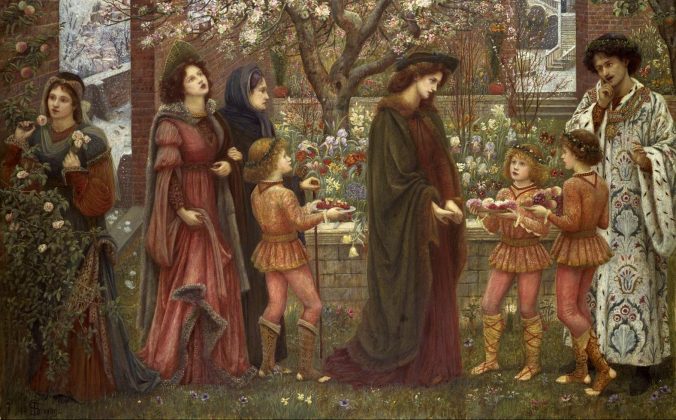
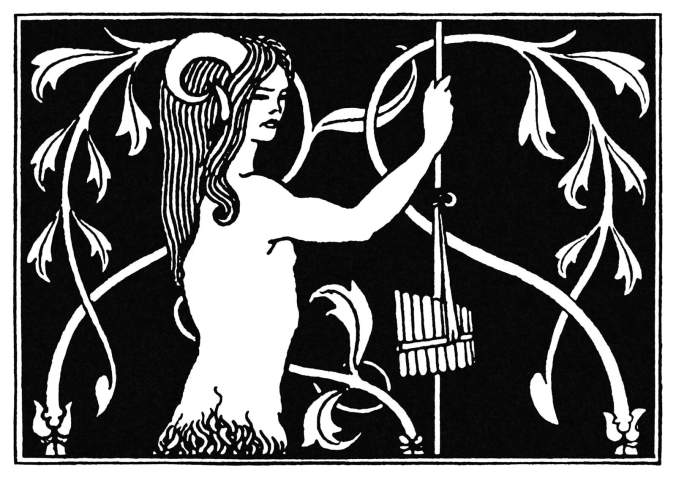
Spring is here, and the Pre-Raphaelites are going to tell you how to celebrate.

WalterCraneSpringIf you’re not just lying about languidly in a meadow, you’re not really doing it right, are you?
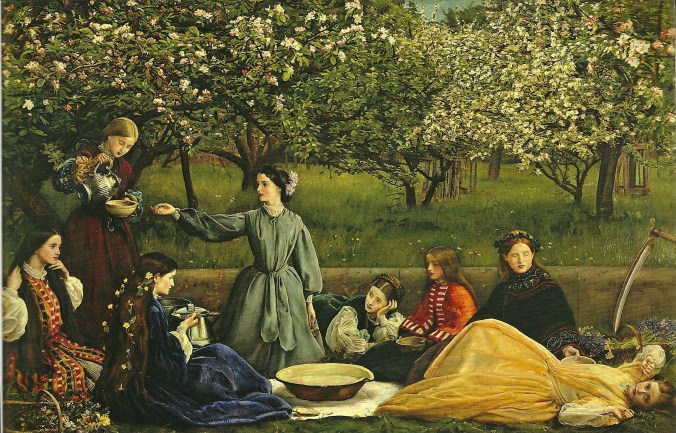
SpringAppleBlossoms.jpgIt is also acceptable to lie there with an audience, preferably one enjoying a lovely picnic. And everyone must be the same gender and should, if at all possible, be dressed in very uncomfortable clothing.
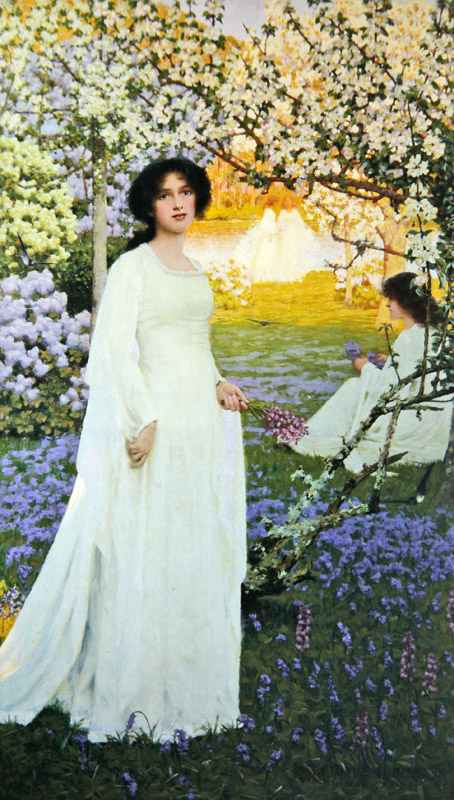
Spring_Buckland
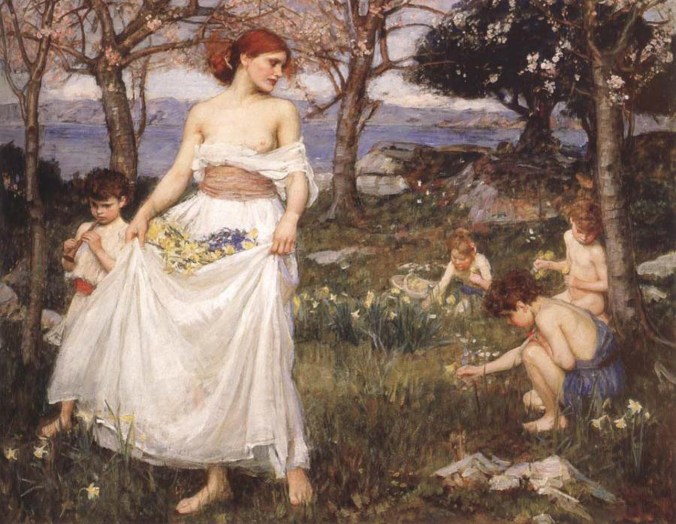
After you have wallowed in the flowers, be sure to pick some and stare vacantly into the middle distance.

john_william_waterhouse_10_a_song_of_springtime.jpg And of course, you should be arrayed in an artfully disheveled white dress. To get that shabby chic look, you know?
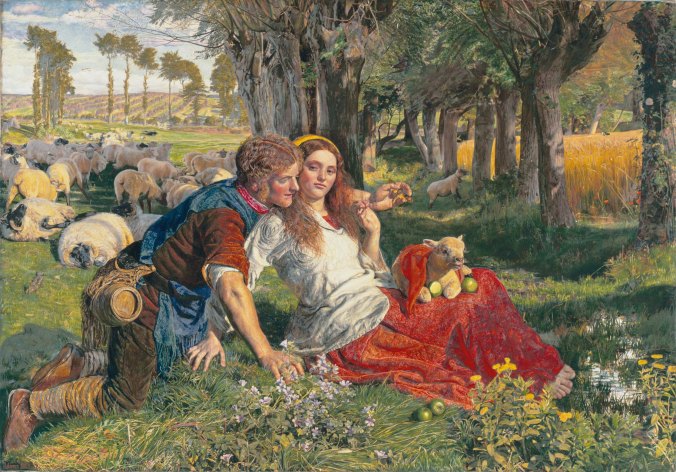
HirelingHolmanHunt.jpgHow you dishevel it is up to you.
InnerBeautyWaterhouse
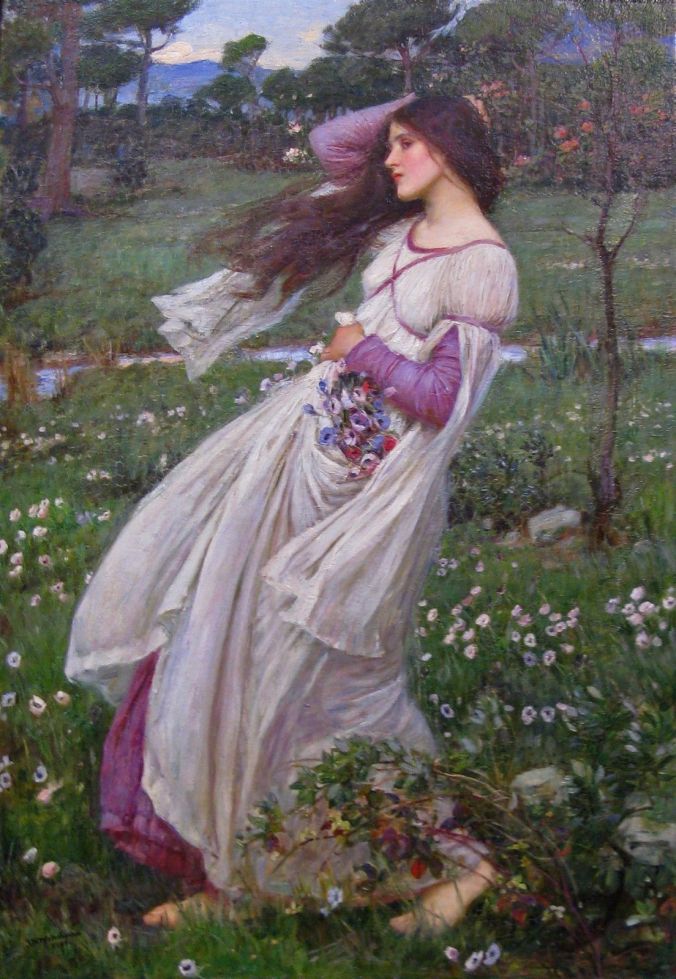
Never let a gust of wind pass without posing.

WalterCraneSignsofSpring
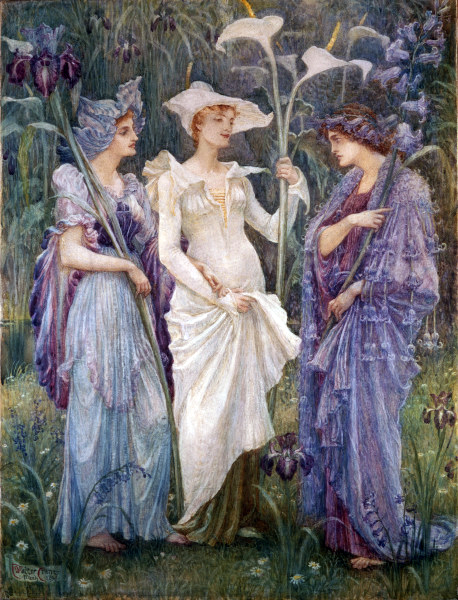
When it comes to flower-staffs, the bigger, the better.

the_fairy_wood
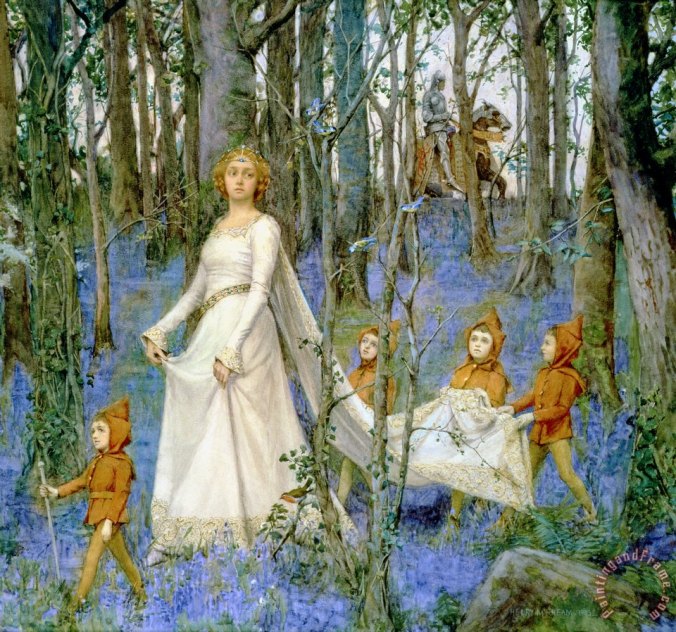
Only travel with an entourage of little people, so as better to accent your royal mien and bearing.

William_Holman_Hunt_-_May_Morning_on_Magdalen_Tower
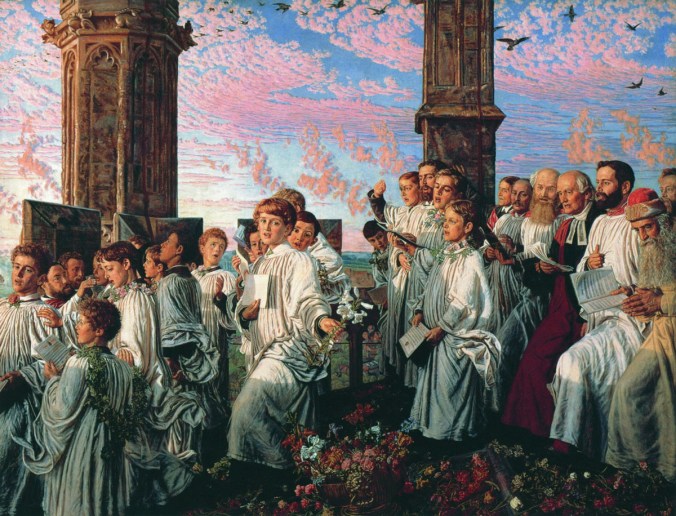
Choir boys will also do.

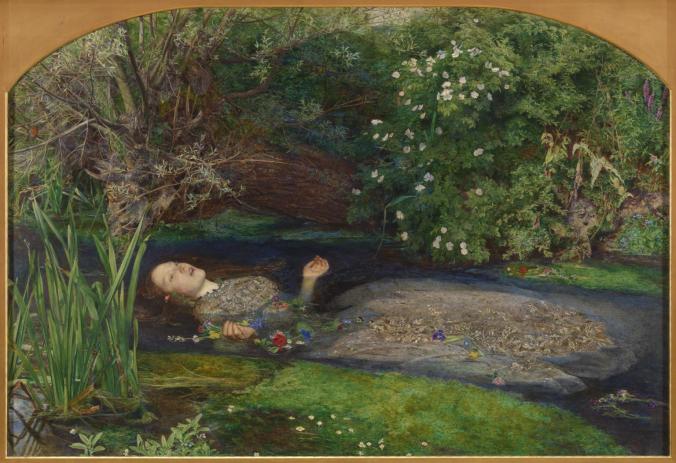
Ophelia 1851-2 by Sir John Everett Millais, Bt 1829-1896
Spring is a lovely time for a refreshing dip.

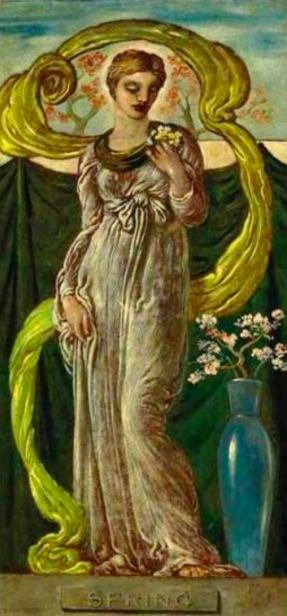
Screen Shot 2018-04-21 at 9.54.52 PM.png
You know you’re having a good Spring day when, so enraptured by the little blossoms you’re holding, you don’t even notice your long green scarf blowing away.

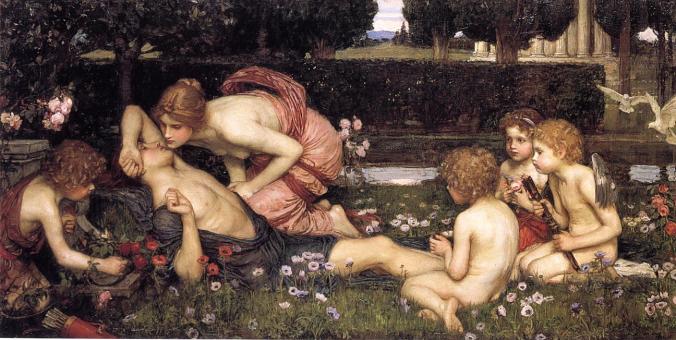
The_Awakening_of_Adonis_-_John_William_Waterhouse_(1899)
If you happen to find half-naked classical youths asleep in a garden, surrounded by putti and doves, and stuck in an extraordinarily improbable pose, don’t worry. This is normal in Spring.

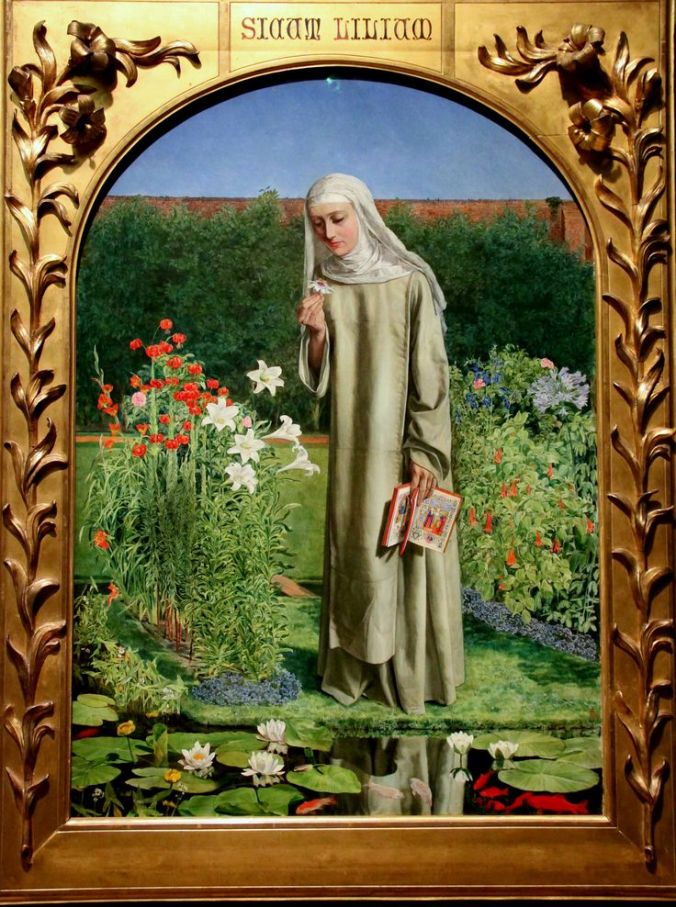
SicutLiliumPreRaph
Likewise, wild nuns emerge from hibernation and range freely again in the Spring.

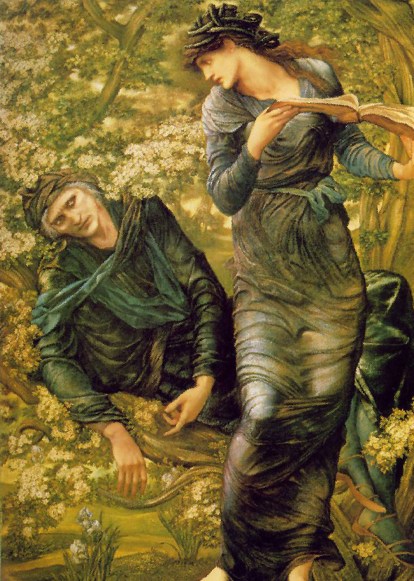
Edward_Burne-Jones_-_The_Beguiling_of_Merlin.jpg
While it’s important to enjoy the season, it’s even more important not to get too caught up in it. This time of the year is when people are most at risk of being sealed into trees by nymphs.

The-Enchanted-Garden-of-Messer-Ansaldo-1-e1480773352693
But surely the best thing about Spring is that it’s no longer Winter!

(Images from here, here, here, here, here, here, here, here, here, here, here, here, here, here, here)


A Ghastly Hymn for Good Shepherd Sunday

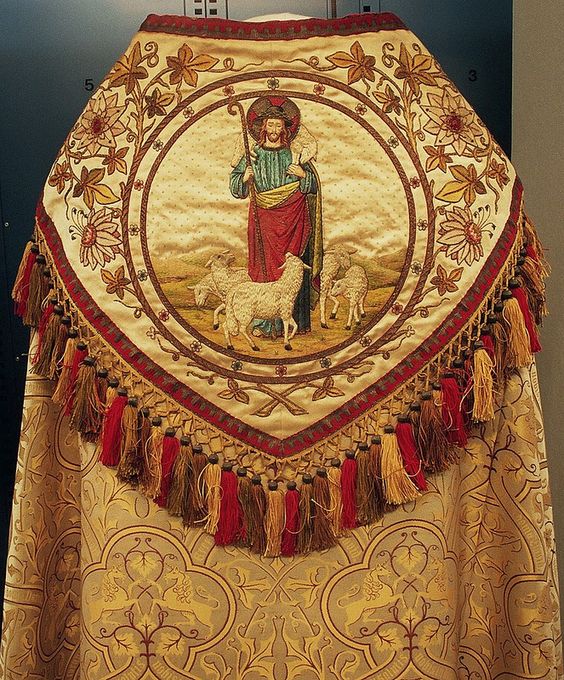
Cope2

A cope depicting the Good Shepherd. (Source)

I realize that technically last week was Good Shepherd Sunday in the traditional calendar, but as most of the Catholic world (alas) celebrates it tomorrow, I thought I’d offer up this truly dismal hymn from Fr. Faber. I have never yet heard it set to music, so if any of my readers happen to know of a recording, I would appreciate them kindly sharing it. Fr. Faber is one of my favorite spiritual writers and hymnodists…even when he’s outlandishly bad.

The True Shepherd

Fr. Frederick William Faber

I was wandering and weary
When my Saviour came unto me;
For the ways of sin grew dreary
And the world had ceased to woo me:
And I thought I heard Him say,
As He came along His way,
O silly souls! come near Me;
My sheep should never fear Me;
I am the Shepherd true.

At first I would not hearken,
And put off till the morrow;
But life began to darken,
And I was sick with sorrow;
And I thought I heard Him say,
As He came along His way,
O silly souls! come near Me;
My sheep should never fear Me;
I am the Shepherd true.

At last I stopped to listen,
His voice could not deceive me;
I saw His kind eyes glisten,
So anxious to relieve me:
And I thought I heard Him say,
As He came along His way,
O silly souls! come near Me;
My sheep should never fear Me;
I am the Shepherd true.

He took me on His shoulder,
And tenderly He kissed me;
He bade my love be bolder,
And said how He had missed me;
And I’m sure I heard Him say,
As He went along His way,
O silly souls! come near Me;
My sheep should never fear Me;
I am the Shepherd true.

Strange gladness seemed to move Him,
Whenever I did better;
And he coaxed me so to love Him,
As if He was my debtor;
And I always heard Him say,
As He went along His way,
O silly souls! come near Me;
My sheep should never fear Me;
I am the Shepherd true.

I thought His love would weaken,
As more and more He knew me;
But it burneth like a beacon;
And its light and heat go through me;
And I ever hear Him say,
As He goes along His way,
O silly souls! come near Me;
My sheep should never fear Me;
I am the Shepherd true.

Let us do then, dearest brothers!
What will best and longest please us,
Follow not the ways of others,
But trust ourselves to Jesus;
We shall ever hear Him say,
As He goes along His way,
O silly souls! come near Me;
My sheep should never fear Me;
I am the Shepherd true.

Nostalgia Without Illusions

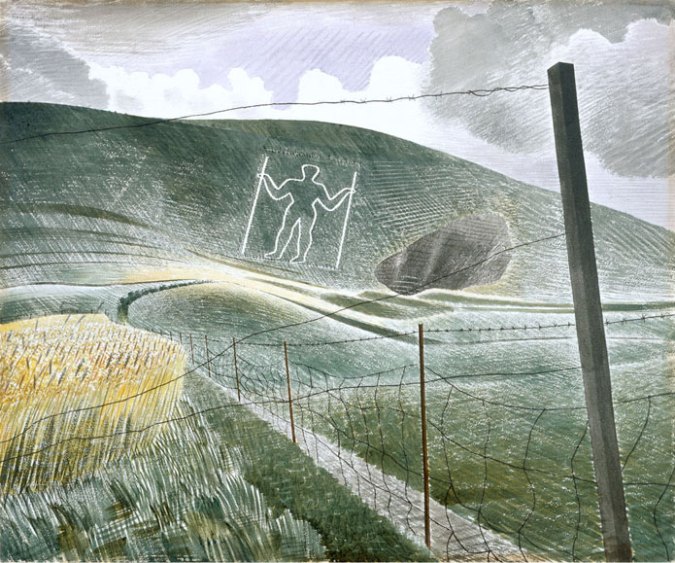
Ravilious-Wilmington-Giant

The Wilmington Giant, Eric Ravilious (Source)

Recently I read an article about a genre of music that had previously been unknown to me: Hauntology. In a nutshell, Hauntology is a throwback to the eerie, folksy world of British childhood in the 1970’s. The author summarizes the genre’s affective impact as “strange, melancholy disquiet.” Apparently music is being made today (and has been for some time) that conjures all at once that decade’s public broadcasting for children, the acoustic sounds of the English folk tradition, psychedelia, pagan chants, and synthesizers. Most of this material has been released through a few different labels: Ghost Box, Clay Pipe, and Trunk Records. Each specializes in a different variation of the general theme. On the whole, though, they all produce music that’s unsettling and evocative of a very particular place and time in the last century. There is something autumnal, something anachronistic, something broken in it all. In short, it’s music that’s haunted.

Many of the albums have cover art inspired by Eric Ravilious or John Nash or Sir Stanley Spencer or even Rex Whistler, those painters who so marvelously captured the quiet unease of the British landscape and its denizens. And the multimedia satirical phenomenon that is Scarfolk fits right into the broader movement. Hauntology is more than just a style of music. It’s an aesthetic.

In this respect, Hauntology is to the 1970’s what Vaporwave is to the late 1980’s and 90’s, or, for that matter, what David Lynch’s entire corpus is to the 1950’s.

vaporwavemall.jpg

Malls built in the early years of Bush I are the stuff of Vaporwave dreams. (Source)

Vaporwave derives its critical bite as well as its occasional airy ephemerality from a unifying sense of dread. Much the same could be said of Hauntology. Only instead of the zombie-like ascent of neoliberal late capitalism under the glittering haze of digital culture and advertising, Hauntology is still preoccupied with the anxieties of the analog age. Orwellian dystopia, the loss of the British countryside, and the destruction of innocence all hover under the surface. It’s drawing upon creepy public service announcements rather than Japanese soft drink commercials. Hauntology is to British Folk Horror as Vaporwave is to Cyberpunk.

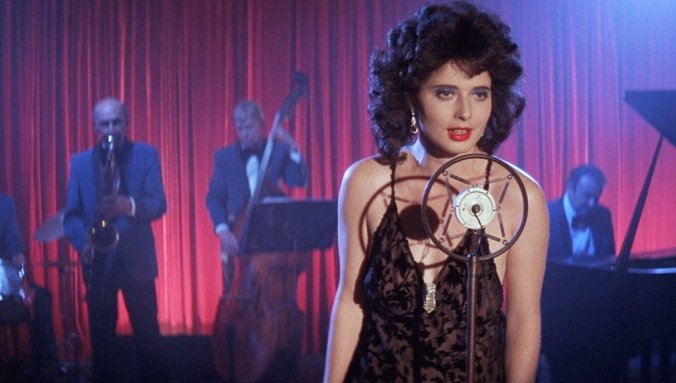
BlueVelvet

A scene from Blue Velvet (1986), one of David Lynch’s most distinctive films. It set the tone for much of what was to follow in its powerful evocation and ultimately ruthless subversion of mid-century norms (Source).

The common denominator is nostalgia, but a nostalgia free of illusions. Each of these aesthetic representations of a remembered decade – Lynch’s 1950’s, Hauntology’s 1970’s, and Vaporwave’s Digital Age – contains a degree of attachment to that particular time. Usually because the main creators involved in producing the aesthetic grew up then, and thus they draw upon the dreamlike haze which alternately gilds and clouds our world in youth. But it’s all shot through with the very real understanding that the past was not as wonderful as we would like to believe. Something nasty lurks just beyond our peripheral vision. We cannot help remember, but in that remembrance, terror awaits.

I’m an American, and only in my early twenties. 1970’s Britain wasn’t a world I ever knew. Nevertheless, I immediately connected with the emotional phenomenon behind Hauntology. Certain relics of that earlier time appeared every now and then in childhood, and even those that weren’t directly from the United Kingdom of the 1970’s often bring to mind that same feeling of remembered unease. Many of Don Bluth’s films animate precisely this strange, sensitive part of my memory. So do Stephen Gammell’s original illustrations of the Scary Stories to Tell in the Dark books. So does The October Country, Ray Bradbury’s wonderful short story collection (which itself significantly predates the main era of Hauntology). So does anything by Lynd Ward. So do parts of Pink Floyd’s The Wall. So does that horrible movie, The Plague Dogs. There are probably more examples I could summon up if I thought about it long enough. I am no stranger to “strange, melancholy disquiet.”

I’ve always liked that sensation, and I’ve always been drawn to other peoples’ nostalgia. As such, I’m super pleased to have discovered Hauntology.