The Demonologist: Montague Summers

Montague_Summers01.jpg

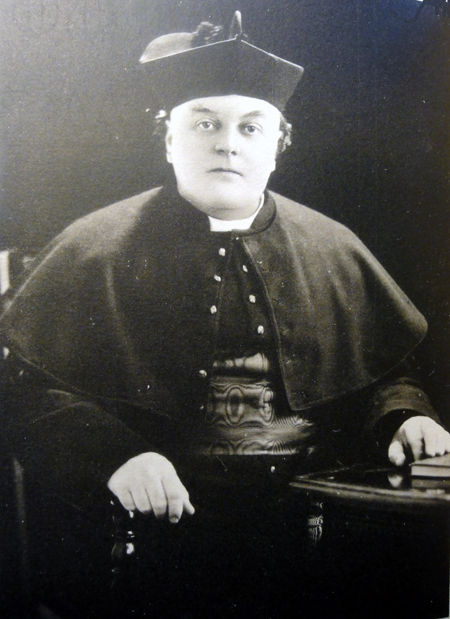
Montague Summers in clerical garb. (Source)

The history of the Church is a history of odd birds, but it is harder to find odder birds than those which inhabited the British Isles in the fruitful years of the Catholic Revival. The eccentricities of certain English clergy are well-known and well-beloved. One of the great flowers of this tendency was Montague Summers.
FlyingDevil

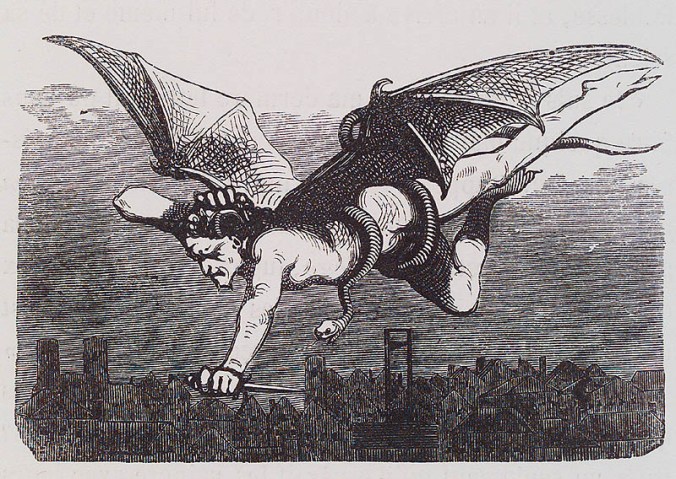
A flying devil. (Source)

Augustus Montague Summers was born in Bristol, the youngest of seven. Eventually he went on to study at Trinity College, Oxford, with the intent of seeking ordination in the Church of England. After some time at Lichfield Theological College, he was eventually deaconed and spent his curacy in Bath and the Bristol area. Even at this young stage, he garnered a reputation for eccentricity. In Ellis Hansen’s Decadent Catholicism, we learn the rather delicious fact that at seminary, “he was known to burn incense in his rooms and to wear purple silk socks during Lent” (qtd. by the Modern Medievalist).

This was as far as he made it in the ranks of the C of E, however. As the Oxford Dictionary of National Biography tersely puts it, “Rumours of studies in Satanism and a charge of pederasty, of which he was acquitted, terminated this phase of his career.” The latter charge may have had some truth to it. About this same time, he published a book of Uranian verse entitled Antinous and Other Poems (1907). His interest in pederastic and homosexual themes continued throughout his life. In 1940, he wrote a play about Edward II. Even more scandalously, “Despite his conservative religiosity, Summers was an active member of the British Society for the Study of Sex Psychology, to which he contributed an essay on the Marquis de Sade” (Source 1 and Source 2).

In 1907, though, Summers was out of a job. His hopes of becoming an Anglican clergyman seemed to have been quashed. But as they say, when the Lord closes one door, He opens another. We might imagine that Summers had something like this in mind when, two years later, he converted to Roman Catholicism. He also spent some time on the continent, allegedly for reasons relating to his health. Some have speculated that he might have received valid, if illicit, orders during this sojourn; others have said he spent his time exploring the black arts (vide the Modern Medievalist). We have almost nothing on which to base our speculations.

Now we see him coming to the full bloom of his later, famous eccentricity. It is in this formative period that he lays the foundation for the vivid persona that would make him such a cult literary and religious figure. I will quote the Oxford DNB at length:

On 19 July 1909 Summers was received into the Church of Rome and was granted the clerical tonsure on 28 December 1910; after this his clerical career became murky and remains so. He may have received minor orders as a deacon, but no record of his ordination has ever been found. During his lifetime, he was addressed as the Revd Montague Summers, celebrated mass in his own chapel and those of friends, adopted two names in religion, and invariably wore the dress pertaining to Roman priesthood; his appearance in soutane, buckled shoes, and shovel hat, later with an umbrella of the Sairey Gamp order, was familiar in London and Oxford. He became increasingly eccentric and was described as combining a manifest benignity with a whiff of the Widow Twankey. Some spoke of an aura of evil. It was charitably assumed by his friends that he was indeed a priest, and his devotion was never in question; his biographer Joseph Jerome (Father Broccard Sewell) records that all his life Summers wore the Carmelite scapular.

On a side-note, Fr. Brocard Sewell was a deeply strange man himself. But I digress.

If Summersor, as he was now calling himself, “Reverend Alphonsus Joseph-Mary Augustus Montague Summers”–had simply remained a slightly dubious cleric, we probably wouldn’t remember him. He might have become a little more than a footnote in the history of the Episcopi Vagantes so famous for dispensing illicit orders here and there. But he did not. Instead, he wrote. Prolifically.

Summers started off with genuine and important literary scholarship. Eventually, he even became a member of the Royal Society of Literature. He had certainly earned it with the sweat of his brow. He produced fairly good books on Restoration Drama, including major editions of previously neglected playwrights such as Aphra Behn. In this capacity, he had some connections with the world of the British stage; he was a founder of the Phoenix Theatre. He wrote an important monograph on Shakespeare.  In another work he also proved that the terrible Gothic novels that Jane Austen mentions in Northanger Abbey were all real books. Gothic literature remained a lifelong passion, in part because it dovetailed so well with his overriding obsessionthe occult.

vmps022

Montague Summers in clerical collar. (Source)

Summers is most famous today for his several books on witches, demons, vampires, ghosts, and other supernatural phenomena. He translated and edited the first English edition of the Malleus Maleficarum, that great tome of Medieval witch-hunting. He did the same with several other demonological manuals: The Demonality of Sinistrari, The Discovery of Witches by Hopkins, the Compendium Maleficarum of Guazzo, and the Demonolatry of Nicolas Remy. He wrote a text on The Physical Phenomena of Mysticism, in contrast with his somewhat headier and less decadent contemporary, Evelyn Underhill. He edited more than one collection of horror stories. He wrote three seminal texts on vampirism, one on lycanthropy, and four on various aspects of witchcraft. Following the best scholarship of the day, Summers endorsed the idea of the “Witch-Cult,” long suppressed by Christianity but operating sub rosa in Europe down the centuries (this hypothesis has long since been undermined by scholars across disciplines). He would often draw upon a huge range of historical, theological, ethnographic, and literary sources in constructing his arguments. All of his texts speak to his vast learning. It is probable that upon his death, Montague Summers knew more about the history and practice of the occult than any other Englishman then living.

The Modern Medievalist has preserved some charming anecdotes of the later, esoteric Summers over on his blog. We read, for example, the following passage from Ellis Hansen’s Decadent Catholicism:

…although Summers was a brilliant conversationalist, he had always a thick carapace of artificiality in his demeanor, a kind of mask that recalled the studied falsity of the classic dandy, not to mention the distrustful reserve of Walter Pater and John Gray. His style was decidedly aristocratic, Continental, and decadent, with the inevitable intimation of sexual impropriety. His friend writes of him, “He would often meet me with such an expression as Che! Che!, accompanied by a conspiratorial smile; or he would look closely at me and murmur, ‘Tell me strange things’.”

Or this remarkable scene drawn for us by Fr. Brocard Sewell:

Summers…could often have been seen entering or leaving the reading room of the British Museum, carrying a large black portfolio bearing on its side a white label, showing in blood-red capitals, the legend “VAMPIRES.”

Not to mention the fact that Summers went about town with a cane topped by a depiction of Leda and the Swan (vide the Modern Medievalist).
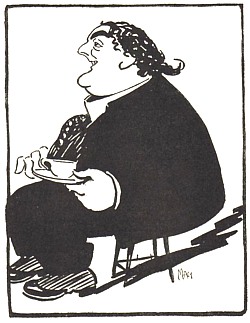
vmps011

A caricature of Summers from the Evening Standard, probably from 1925. (Source).

What distinguished Summers’ writing on these dark subjects is the absolute credulity with which he approaches his subject. Unlike his predecessor, Dom Calmet, who wrote about ghosts with ambivalence and vampires with manifest doubt, Summers did not hesitate to express his firm certainty about both (and much more). He believed in all the phenomena he wrote aboutthe whole ghastly parade of incubi and succubi, of witches dancing at the Sabbath, of vampires rising from the grave to seek the blood of the living, of werewolves stalking innocent Christians in the night. Everything that belonged to the netherworld was as real to him as the people you or I might meet in the street. His purple prose often slips into breathless passages of scholarly terror. Observe the following lines from Chapter Two of The Vampire: His Kith and Kin:

It has been said that a saint is a person who always cho[o]ses the better of the two courses open to him at every step. And so the man who is truly wicked is he who deliberately always cho[o]ses the worse of the two courses. Even when he does things which would be considered right he always does them for some bad reason. To identify oneself in this way with any given course requires intense concentration and an iron strength of will, and it is such persons who become vampires.

The vampire is believed to be one who has devoted himself during his life to the practice of Black Magic, and it is hardly to be supposed that such persons would rest undisturbed, while it is easy to believe that their malevolence had set in action forces which might prove powerful for terror and destruction even when they were in their graves. It was sometimes said, but the belief is rare, that the Vampire was the offspring of a witch and the devil.

Summers also stood apart from his thoroughly modern era in endorsing “Church-sanctioned methods of destroying” the monsters he wrote about (The Modern Medievalist).

And although his pages are littered with authoritative quotes from long-dead writers, Summers was not unaware of the dark streams that swirled about him in his own day. Richard Cavendish reports in a typically mordant passage from The Black Arts (1967) how Summers treated the claims of the twentieth century’s greatest occultist, Aleister Crowley:

Aleister Crowley could not pass over such an opportunity to scandalize his readers. ‘For the highest spiritual working one must accordingly choose that victim which contains the greatest and purest force. A male child of perfect innocence and high intelligence is the most satisfactory and suitable victim.’ Montague Summers took this seriously, as he took everything else, and quotes it with gratified horror, in spite of Crowley’s footnote in which he says that he performed this sacrifice an average of 150 times a year between 1912 and 1928! (Cavendish 238)

In spite of it all, Summers remained well-liked in certain circles. He moved among the literary elite of his own day, an eccentric among eccentrics. One of his friends, the actress Dame Sybil Thorndike, relates something of his personality:

I think that because of his profound belief in the tenets of orthodox Catholic Christianity he was able to be in a way almost frivolous in his approach to certain macabre heterodoxies. His humour, his “wicked humour” as some people called it, was most refreshing, so different from the tiresome sentimentalism of so many convinced believers.

His caricature in the Evening Standard captures something of this impish quality.

But although he was known and appreciated in his own day, he has been largely forgotten in the intervening decades. There have not been many books about Montague Summers, and he is not widely read. However, that will soon hopefully change. In recent years, Georgetown University has acquired Summers’ papers, once thought irrevocably lost. Fittingly, they have a peculiar provenance, having been “discovered languishing in an old farmhouse in Manitoba.” The story of how they got there is probably as strange as any of Summers’ own books. Georgetown’s collection has made possible a forthcoming biography by Matthew Walther that will hopefully rectify the longstanding neglect of this bizarre yet sincere writer.

But perhaps a question rises. Not every obscure author is worth reviving. Why bother with Montague Summers? A man of outdated style, of dubious subjects, and of very questionable morals to boot…what does he offer the modern reader?
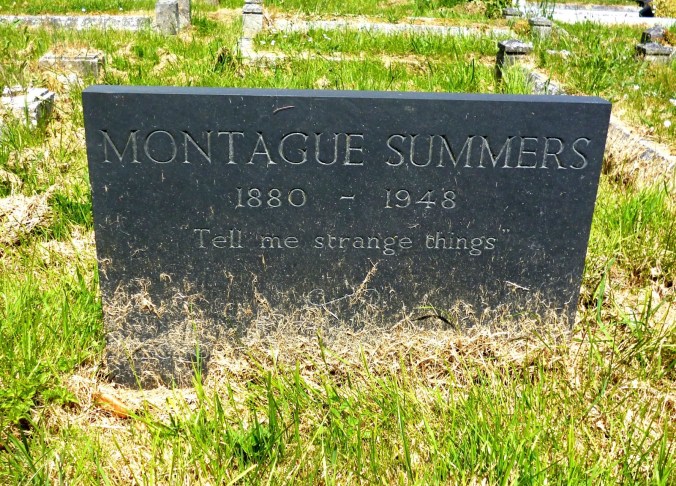
pope's grotto 082

The grave of Montague Summers. (Source)

The Modern Medievalist has a few thoughts on the matter.

Montague Summers is, at best, a good fit for the Institute of Christ the King and a throwback to an age when priests were also arbiters, makers, and preservers of high culture a la Antonio Vivaldi; at worst, a “daughter of Trent” who, if he ever actually was a priest to begin with, wasted his vocation on trivialities rather than the cure of souls.

Perhaps. I am not so convinced that Summers would have fit in any age. He was a decadent, and a great deal of decadence is contrarianism. Though the comparison with ICKSP is hilarious.

I think the message of Summers’s life and work can best be summed up in his epitaph.  On the black stone hat marks his grave in Richmond Cemetery, we read a simple phrase; “Tell me strange things.” These four words that he used to say to his friends encompass his whole life, packed as it was with “strange things.” Summers matters today not because he is a towering figure of literary talent, nor because his scholarly subjects are of vital importance, nor because he is a moral exemplar of impeccable religiosity. He matters because he can remind us to embrace the mystery of life. As we read in one of those plays that Summers so loved, “There are more things in heaven and earth, Horatio,/Than are dreamt of in your philosophy.” Summers lived by those words. The more I learn about the world, the more reason I see in them. And what better day to remember this humbling, bewildering, frightful truth than on All Hallows’ Eve?

My Favorite Scary Movies

Lloyd

What’ll ya have? (Source)

It’s nearly the Eve of All Hallows, and that means it’s time for some spooky stuff. I thought I’d offer up my top 10 favorite horror films for your viewing enjoyment.

I’ll begin with a few honorable mentions, including horror comedies. In no particular order: Sweeney Todd (2007), Halloween (1978), The Rocky Horror Picture Show (1975), The Exorcist (1973), Dracula: Dead and Loving It (1995), What We Do in the Shadows (2014), The Silence of the Lambs (1991), Young Frankenstein (1974), The Others (2001), and Shaun of the Dead (2004). All of these are pretty good films on their own terms, and you should watch them. But for the following list, I wanted to highlight a few I though were especially worth re-viewing this Halloween.

I generally dislike slashers and body horrors, so you won’t see any of the Saw, Grudge, Hostel, Alien, or Ring series here. My tastes run towards the Gothic, psychological, occult, Lovecraftian, and atmospheric. My list reflects that tendency. I don’t claim it will satisfy everyone. Finally, while I have generally tried to avoid SPOILERS, I think I may have left one or two. So abandon all hope, ye who enter here.

10. Jack Frost (1997)

jack-frost-1997-snowman-attack

When he kills this guy, he says, “I only axed ya for a smoke.” And chuckles. Really. (Source)

Admittedly, this is a very bad film. It holds a whopping 7% on Rotten Tomatoes, and I’ve never been able to get through the whole thing myself. But what I have seen makes me esteem Jack Frost as one of the corniest and campiest of horror B-movies. And I adore B-movies, so this one’s gonna stand in for all the crap I could have chosen instead.

The plot is pretty straightforward. A psychopathic serial killer is being transported to death row when his car gets in an accident with a massive container truck full of a biological reagent. He is burned by the acid and seemingly melts away. However, his DNA fuses with the snow and takes on a new form as a Killer Mutant Snowman, hell-bent on terrorizing the community that sentenced him. Hilarity ensues. Complete with over-the-top gore, the very cheapest of special effects, completely maladroit music, a ridiculous sex scene, some of the worst acting you will ever watch, and dad-level one-liners (no, but really), this Christmas-themed whopper of a flop will liven up your Halloween.

9. Les Yeux Sans Visage (1960)

yeux-sans-visage2_0

Les Yeux Sans Visage – a classic of French horror, with profound Feminist undertones. (Source)

Now on to something actually creepy. This French horror film by Georges Franju is not overly scary, in the sense that it lacks jump scares or the typical fare of, say, slashers or sex-crazed body horrors. But it’s definitely worth seeing, as at times it actually becomes a poignant exploration of power and acceptance. Also, it inspired an eponymous song by Billy Idol.

A mad scientist and his cohort of minions murder young girls in Paris so that he can steal their faces – literally. His daughter Christiane suffers from a terrible facial disfigurement after a motorcycle accident for which he was responsible, and in his guilt, he promises he will graft a new face onto her. Every attempt is unsuccessful. Christiane wanders the halls in an eerie white mask, and we are treated to a gruesome, close-up view of a face transplant. Ultimately, the story examines how men use female bodies as canvasses to represent and expiate their own guilt, especially for violence they have committed against women. It also examines the complicity of other women – the mad doctor’s closest assistant is a lady whom he successful healed after her own scarring accident.

A sensitive, beautiful, and tragic tale with a few disturbing scenes. Worth your time.

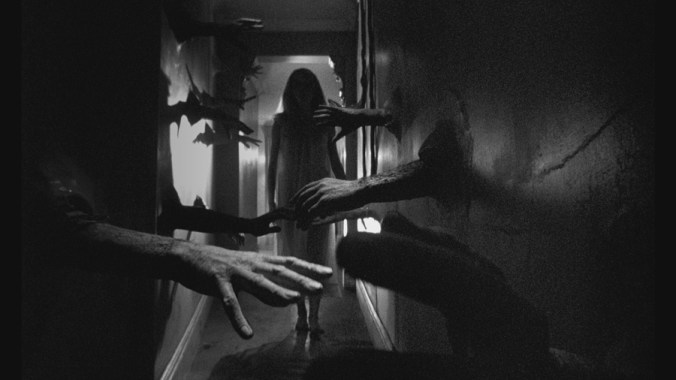
8. Repulsion (1965)

repulsion-hallway-copy

The famous hallway of hands sequence in Repulsion. (Source)

One of Roman Polanski’s early greats, Repulsion remains a standard of Psychological Thrillers. It features some of Polanski’s classic sequences and shots: the buskers, the hallway of hands, the decomposing rabbit. The film follows the mental breakdown of a young girl (played by a youthful Catherine Deneuve) on a weekend she spends alone in her apartment in Belgium. That may sound simple, but boy is there a lot going on. Sex, murder, insanity – not to mention painfully tight close-ups in an era when that was considered artistic. Repulsion is definitely one of the strangest and most harrowing films on this list.

7. Jaws (1975)

Jaws

Duh dum. Duh dum. (Source)

One of the greatest and most popular horror films ever made. Its instantly recognizable theme is one of the few horror scores to rise to the status of auditory icon. I would argue that it’s Steven Spielberg’s finest and scariest foray into the genre, much better than his trope-heavy Poltergeist (1982). The simplicity of Jaws is what makes it so effective as a nail-biter. There’s a murderous shark, and to hunt it, you have to become ever more isolated – and thus ever more vulnerable.

There are plenty of genuinely scary moments in the film, but I think one of the best is also one of the most understated: the tale of the USS Indianapolis. Here, too, the black magic is all in the simplicity. Quint tells a story. That’s it. But it’s one of the most disturbing stories ever told in a film (and what’s worse, it’s true). While all the cast give fantastic performances, Robert Shaw exceeds his peers by that one scene.

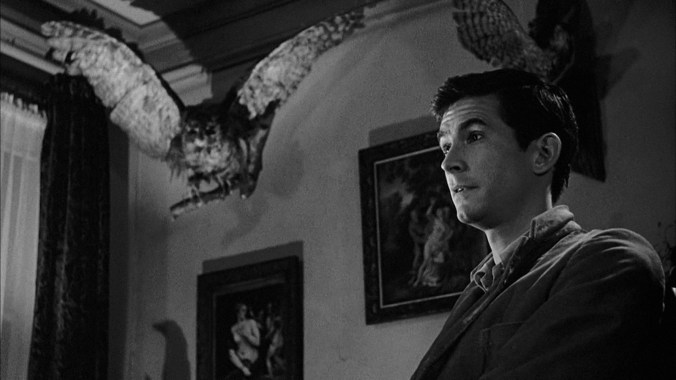
6. Psycho (1960)

psycho-3

“We all go a little mad sometimes…” (Source)

I probably could have chosen several of Hitchcock’s films for this list. Some of his thrillers are remarkably good. Particular favorites include Strangers on a Train (1951), Vertigo (1958), and Rope (1948). But as far as frights go, nothing in the prolific director’s oeuvre surpasses his horrific masterpiece, Psycho. Long before M. Nigh Shyamalan attempted (and subsequently wrecked) the art of the twist ending, Psycho showed generations of directors how it was done. Ans like Jaws, Psycho gave us an iconic score, forever associated with an iconic scene.

Psycho was among the first real horror films I saw, one Halloween night many years ago. I’ve loved it ever since.

5. Eraserhead (1977)

Eraserhead

The woeful Henry Spencer in David Lynch’s first movie, Eraserhead (Source).

David Lynch is one of my favorite directors (I sometimes joke that Twin Peaks is my “second religion”). His first film, Eraserhead, has an affinity with the New Wave horror of Polanski et al. As in Repulsion, we are constantly made to feel the limits of the space the characters inhabit. But Claustrophobia is only one of the fears that Lynch explores. Eraserhead is a great meditation on the terrors that attend some of the most common experiences of life: work, sex, marriage, fatherhood. Jack Nance’s performance as Henry Spencer is riveting as it is tense, and the eerie Lady in the Radiator sequences foreshadow much of what Lynch would later use in his more famous works like Twin Peaks and Mulholland Drive. The film also probably wins the award for creepiest baby in cinematic history; even today, Lynch won’t reveal how they made it. If you like surrealism, body horror, or pencils, I recommend this classic for your consideration.

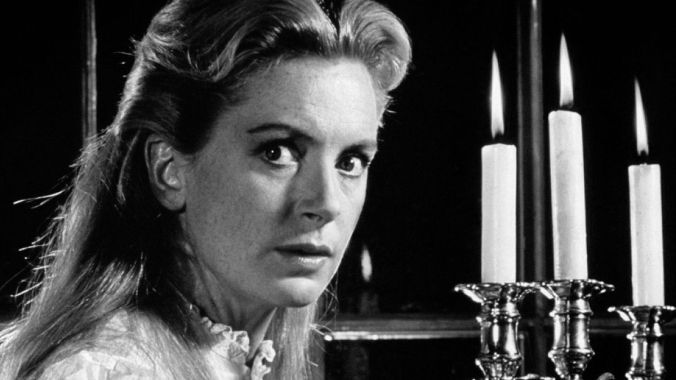
4. The Innocents (1961)

theinnocents

Deborah Kerr gives a masterful performance in this classic Gothic horror. (Source).

If you like your horror set in creepy old English manor homes, full of candlelight and the creak of ghosts on the stairs, then you’ll certainly love The Innocents. Based on Henry James’s classic novella, The Turn of the Screw, the film follows a governess, played by Deborah Kerr, who is sent to care for two orphans in the English countryside. As time passes, she starts to believe that the children are under the malign influence of ghosts. Is she insane? Or is she battling the forces of the supernatural?

While viewers still debate the meaning of the deeply ambivalent ending, one thing’s for certain; this film is a masterful example of mid-century Gothic horror. Not to be missed.

3. The Wicker Man (1973)

lord-summerisle-the-wicker-man2

Traditional British Values. (Source)

The Wicker Man, strictly speaking, really isn’t all that scary. But it is a very good story all the same, and Christopher Lee puts in a marvelous performance as Lord Summerisle. If you like folk-horror, a subgenre the English do better than anyone, you’ll enjoy this creepy little romp through a murderous, pagan island in Scotland. Arthur Machen would have loved it.

I find it somewhat amusing that Lee, a devout Anglo-Catholic, thought that the film was ultimately a Christian one in suggesting that even nice people can commit horrible acts if they are not within the fold of the Church. Maybe. But what a poor argument for Christianity it is! The protagonist is such an unlikable and censorious prude, and the villagers are such fun-loving heathens, that you end up not caring too much about the Christian policeman’s fate in the final showdown. Alas. I suppose I’m biased, though, as I’ve long thought that Catholics are just baptized pagans anyway. Incidentally, I think the community of Summerisle gives a pretty good picture of what the Benedict Option might look like in practice.

Don’t confuse this classic with the highly memeable 2006 sequel starring the one and only Nicolas Cage. There are creepy masks, but no full-on bear suits in Christopher Lee’s version. And definitely no bees.

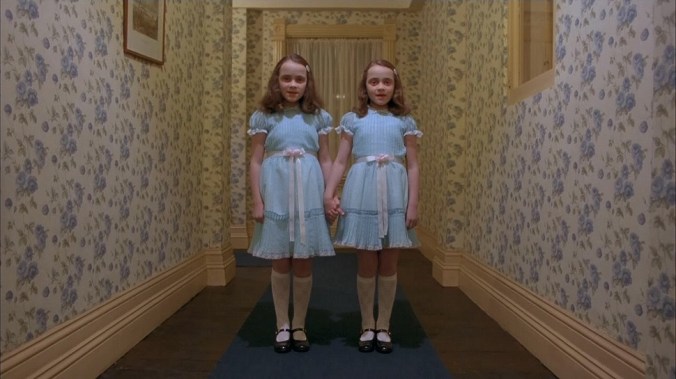
2. The Shining (1980)

the-shining-HD-Wallpapers

“Come play with us, Danny.” (Source)

Stanley Kubrick’s horror masterpiece. Considered in purely artistic terms, there are no better films on this list. It shows what kind of art can happen when a genius director works with a genius actor (Jack Nicholson in one of the best performances of his career). More to our point – the frights are just as potent today as they were in 1980. Unlike a number of other works from the same decade, The Shining has retained its creepiness. It terrified and disturbed me the first time I saw it, and while I mainly pay attention to its formal and aesthetic qualities now, I still jump now and then when I watch it. I will never not find that man in the dog/bear suit (you know the one) absolutely terrifying, and I will never not relish the conversations with Lloyd and Grady with a certain perverse glee.

I could probably go on and on about how great this film is. But why bother? Just watch it yourself. You won’t be disappointed.

1. The VVitch

WitchWoods

“What went we out into these woods to find?” (Source)

Horror has gotten much better lately, with genuinely artistic offerings from bold new directors. The Babadook (2014), Goodnight Mommy (2014), It Follows (2014), The Blackcoat’s Daughter (2015), The Eyes of My Mother (2016), It Comes at Night (2017), and Get Out (2017), among others, have all renewed the genre. But my favorite among the new horror is The Witch (2016). Genuinely creepy, trope-laden without being clichéd, atmospheric, Gothic, full of painstakingly reproduced sets and costumes from Puritan New England, and written entirely in 17th century English, The Witch represents an enthusiastic return to the old legends of Early Modern witchcraft. And it is beautifully shot. At times, it looks like the film that Goya would produce if he lived in our time. There is a black goat. It will change the way you look at the animals. In short, it is a cinematic triumph for A24, a studio that has proven itself to be one of the leaders of the new horror.

I love The Witch for all those reasons – but also because it presents a world in which Christianity is taken seriously. That rather startling quality has been in short supply among horror films since Terrence Fisher’s Hammer flicks of the 1960’s and 70’s. We see these characters as real, dignified people afflicted by indisputably real forces of the supernatural. In the world of The Witch, the Devil is real and so are his servants.

The film can also be read as a profound meditation on the doctrine of original sin. The ruin of the whole family follows from the pride of the father as we see it at the movie’s start. They are effectively damned as soon as they leave the village. There is perhaps some irony in the fact that the Church of Satan both endorsed and promoted the film. It is the only really Calvinist movie I’ve ever seen; no other has so deftly and deeply explored the Reformed idea of reprobation.

Halloween is naturally a time to seek out a good scare. If you’re looking to do that with a movie, I can think of no better option than The Witch. But you’ll get more than that. The Witch immerses us in a world we can hardly fathom, a world where supernatural evil lurks just behind the treeline and in the pale light of an attic. Dipping into that world can be salutary. After all, maybe it’s a good idea on the Eve of All Hallows – the night before the feasts of the Saints in Heaven and the Holy Souls in Purgatory – to spend some time first meditating on the damned.


Poem/Song: “On the Strange and Lamentable Tale of the Witches of Saluda”

Bonham_House_1

The Bonham House, Saluda, SC (Source).

It’s been a while since I posted any original wordcraft, so here’s a poem I wrote recently. The last part is a song. I wanted to hearken to the Scotch-Irish traditions of the poor folks who settled the Carolinas. You can hear me sing it on the embedded audio I have included.

On the Strange and Lamentable Tale of the Witches of Saluda

I. The Town

I saw them dancing at the old waterworks
with torchlight in their eyes, huge
gates to unseen countries
of the damned and dying.
Off in the woods, the fog
snaked through like a hungry hound bent
low over the scent
of some lesser beast.
The pines keep our secrets from us,
so we can forget.
Didn’t you know that even the
goats and horses have eyes, ears,
loose lips muttering imprecations
under their breath? Never
look over your shoulder
at a crossroads. Men have died,
petrified, for less.
Or else they shoot into space
and freeze in the rictus of their fathers,
grinning madly at the dead sun
below. I have drawn
salt from the shadow of your footsteps,
I have planted rows of teeth in my head.
What dragons will come
when I bring a scythe
to the harvest?

II. The Purlieu

You hardly know how dark
the young pine woods can be.
Not a patch of tall trees, mind you,
but ones that stand
just about twice your size.
Still plenty of silent life ahead of them.
You can see them at the edge of evening,
surrounding a field surrounding
a low crop of tombstones
all asunder and blurred
by the rain’s improvident hand.
The trees wait there, wordless,
dusk-bleached, lined up like so many
carious teeth. But they are not
what draws my eye
the fathomless
dark that spreads behind
like a growling and
hungry gullet.

III. The Back Yard

It will not go away.

Momma said to come to the table,
no use passing your life
by the back window
daydreaming.

But I could see it pacing the lawn as I ate.

Huge, black,
unblinking, white
of tooth.
I don’t think it ever sleeps.
The heat of the noonday and the
shadow that flies by night
do not afflict it
the stones in its shoes
and the rancid water it sips
out of our traschan lids
do not injure it—
the play of the neighbors
and the tumult of the street
do not distract it.
I have not yet seen it blink.
I have not yet seen it turn its gaze
from the house.
It watches.
I don’t think it ever sleeps.

Momma says
daddy woudn’t have tolerated
any such foolishness.
I don’t know.

It makes not a sound.
I think it knows what we talk about
in the house.
I think it knows when we rise and fall
to our prayers.
I think it listens to what we confess,
to our fights, to the whisper of the rain.

I don’t want to go out there.
I don’t want it to get it.
I don’t think it ever sleeps.

IV. Found in a Buried Notebook, Written in Red Ink

Don’t turn your back to the trees
or walk up the weed-cracked pavement
beneath the sign that reads
CAR  ASH CO N LAUNDRY
and don’t keep the pottery you dig up
in your garden
bonewhite under the red
clay and grey sand. Don’t
venture to the edge of the field that
smells like salt
and don’t keep your teeth in a shoebox
(it might become a skull)
and don’t knock on walls
where there should be a door
or take down the portraits
of the nameless.
Don’t ponder what might have
broken the sign from the fencepost
or written its replacement
in an unknown script.
Don’t let your children go to the post office alone.
Don’t let your daughter play with the dolls
she doesn’t remember receiving.

V. The Song of the Lost Daughters


The young girls singing thread silk in their hair
Io Hymen Hymenaee
Io Hymen Hymenaee
Discarding the rest of the clothes that they wear
Io Hymen Hymenaee
Io Hymen Hymenaee

They join with the voices of the torchbearing throng
Io Hymen Hymenaee
Io Hymen Hymenaee
And soon they forget every other sweet song
Io Hymen Hymenaee
Io Hymen Hymenaee

Songs that illumine the queer, darkened lands
Io Hymen Hymenaee
Io Hymen Hymenaee
Like the water you pour over bloody hands
Io Hymen Hymenaee
Io Hymen Hymenaee

Her lace crown covers her eyes as they lead
Io Hymen Hymenaee
Io Hymen Hymenaee
Her into a thicket that smells of ripe seed
Io Hymen Hymenaee
Io Hymen Hymenaee

To hide from the angels that watch in the trees
Io Hymen Hymenaee
Io Hymen Hymenaee
And teach her the sacred rites of the bees
Io Hymen Hymenaee
Io Hymen Hymenaee

“An will ye cam back to yer mother so fine?”
Io Hymen Hymenaee
Io Hymen Hymenaee
“Ah will ye return to me, daughter of mine?”
Io Hymen Hymenaee
Io Hymen Hymenaee

“Ah mother, dear mother, I can’t come at all”
Io Hymen Hymenaee
Io Hymen Hymenaee
“Until I’ve repeated our first mother’s fall”
Io Hymen Hymenaee
Io Hymen Hymenaee

“The Sabbath is waiting, the dance oh so dear”
Io Hymen Hymenaee
Io Hymen Hymenaee
“To teach us the meaning behind every fear”
Io Hymen Hymenaee
Io Hymen Hymenaee

They never did see her again in the day
Io Hymen Hymenaee
Io Hymen Hymenaee
But once on a new moon, as old people say
Io Hymen Hymenaee
Io Hymen Hymenaee

Seven years waiting and seven years won
Io Hymen Hymenaee
Io Hymen Hymenaee
Seven years burning, but far from the Sun
Io Hymen Hymenaee
Io Hymen Hymenaee

Beware, all me daughters, what hides in the air
Io Hymen Hymenaee
Io Hymen Hymenaee
And never thread silks so fine in your hair
Io Hymen Hymenaee
Io Hymen Hymenaee

The Vampirologist: Dom Augustin Calmet OSB

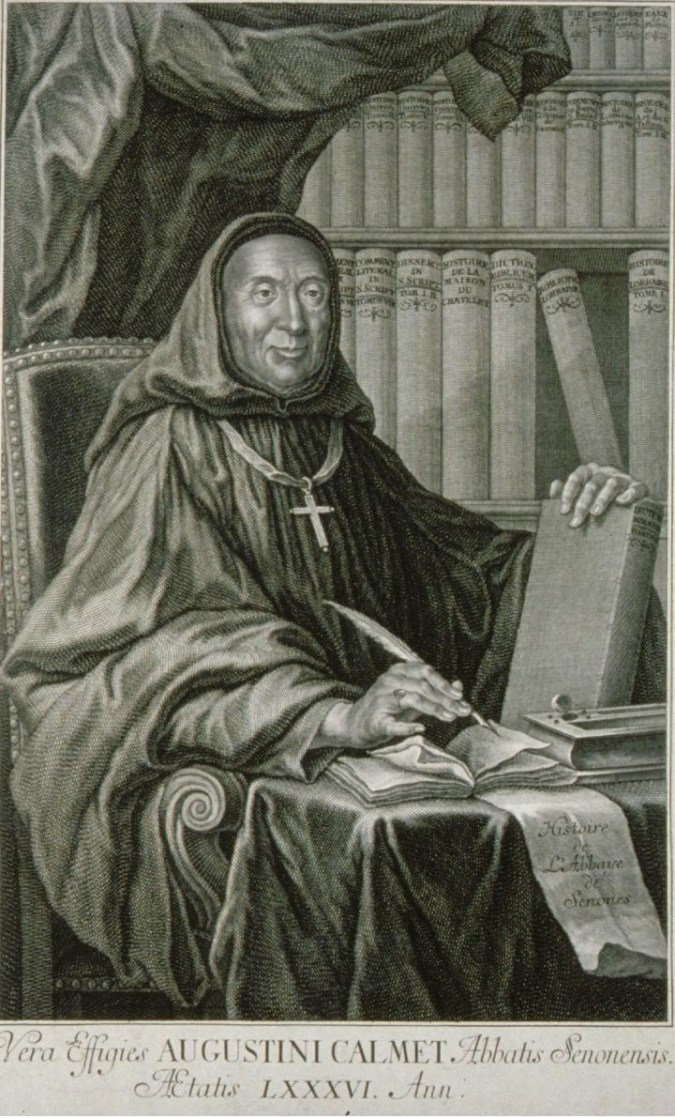
DomAugustinCalmet.jpg

Vera Effigies Augustini Calmet Abbatis Senonensis. (Source).

I was recently asked by the administrator of Catholics from the Crypt to write a brief introduction to Dom Augustin Calmet, Abbot-General of the Congregation of St. Vanne. My qualifications for this task are minimal but, I think, sufficient. First, I know a little about Calmet, which is, sadly, more than many can say. He is an unfairly overlooked figure in our religious and cultural landscape. Secondly, I hope to write my Master’s Thesis on Calmet’s Histoire Universelle, though of course the actual process of research might change my direction. For the time being, I am glad of the challenge, and will likely turn this into the first of a series of short biographies of weird religious figures.

Dom Calmet, born on the 26th of February, 1672, in the then-Duchy of Bar (now Lorraine, France) had a long and impressive career. Entering religious life at the Benedictine Priory of Breuil, he moved around over the years to obtain his education at various abbeys. His itinerary reads like an honor roll of some of the finest establishments of the Franco-German monastic intelligentsia: St. Mansuy, St. Èvre, Munster, Mouyenmoutier, Lay-Saint-Christophe, St. Leopold. Yet the two monasteries most closely associated with his career are Senones Saint-Pierre and Vosges, where he eventually died a holy death.

He achieved widespread scholarly respect for his work in three different fields. First, Calmet distinguished himself as an Exegete. His Biblical method differed from more classical forms of exegesis by focusing entirely on the literal meaning of the text; this exposed him to criticism, even amidst the general acclaim which the book and its abridgements garnered.

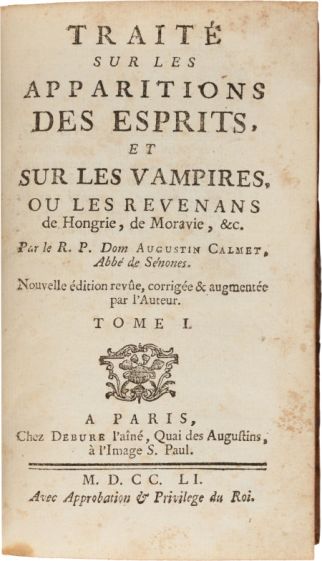
DomCalmetTitlePageVampires

Title page of Book I of his most famous work on Vampires. (Source).

Second, he became an eminent author of sacred and profane history. While my own interest lies most heavily with his Histoire Universelle (1735-47), Calmet also devoted considerable attention to more specific topics. It should come as no surprise, given the libraries to which he had access, that he devoted special care to the region which bore him. His titles include History of the Famous Men of Lorraine (1750), Dissertation on the Highways of Lorraine (1727), Genealogical History of the House of Châtelet (1741), and posthumous histories of both Senones (1877-81) and Munster (1882).

However, Calmet achieved lasting fame for his extremely popular work on Vampires: first, Dissertations on the Apparitions of Angels, Demons, and Spirits, and on the Revenants and Vampires of Hungary, Bohemia, Moravia, and Silesia (1746) He later expanded the text into his famous Treatise on the Apparitions of Spirits and on the Vampires or Revenants of Hungary, of Moravia, &c. in 1752. These texts were, to the best of my knowledge, the first attempt to apply scientific rigor to the tales of the undead then current throughout Europe.

The books were a huge hit, and remain widely respected by occult writers today. To quote one source:

Re-released in 1748, with the most complete edition in 1751, this book is considered to be [the] authoritative treatment on the subject, containing an unprecedented collection of ghostly stories of revenants. It was a best seller for the period, quickly translated into German and Italian for a broader audience. Calmet’s tone considers the possibility of vampires with a certain ambiguity, possibly in light of the larger body of his publications for the church. Still, this is widely regarded as the starting point of all vampiric literature.


The work garnered critical attention from no less a figure than Voltaire. As that eminent source, Wikipedia, relates, Voltaire wrote of Calmet with no small astonishment:

What! It is in our 18th century that there have been vampires! It is after the reign of Locke, of Shaftesbury, of Trenchard, of Collins; it is under the reign of d’Alembert, of Diderot, of Saint-Lambert, of Duclos that one has believed in vampires, and that the Reverend Priest Dom Augustin Calmet, priest, Benedictine of the Congregation of Saint-Vannes and Saint-Hydulphe, abbot of Senones, an abbey of a hundred thousand livres of rent, neighbor of two other abbeys of the same revenue, has printed and re-printed the History of Vampires, with the approbation of the Sorbonne, signed by Marcilli!

[NB: translation is my own]

We can only imagine what conversation transpired between the two thinkers when Voltaire stayed at Senones in 1754, only a few years before the abbot’s death.

It is perhaps unusual that a monk who was, by all accounts, part of the same intellectual circles as the Maurist Enlighteners and the Philosophes would take to such a strange subject. Calmet certainly saw himself as partaking of that wider project. He writes in his preface to the Treatise,

My goal is not at all to foment superstition, nor to maintain the vain curiosity of Visionaries, and of those who believe without examination all that one tells them, as soon as they find therein the marvelous and the supernatural. I do not write but for those reasonable and unprejudiced spirits, who examine things seriously and with sang-froid; I do not speak but for those who do not give their consent to known truths but with maturity, who know to doubt things uncertain, to suspend their judgment in things doubtful, and to refute that which is manifestly false. (Calmet ii).

[NB: translation is my own]

Perhaps we should not be so surprised. After all, the religious history of Europe is peppered with eccentric and erudite men drawn to esoteric studies. And by the time that Dom Calmet died in 1757, the French monastics had not yet reached the height of their oddity. That would come later, with the well-traveled and thoroughly bizarre Swedenborgian and Martinist monk Antoine-Joseph Pernety, whom I hope to someday investigate more thoroughly.

The Revolution changed all that. No longer could monks live their lives freely, let alone attempt serious academic inquiry. It would take the genius of men like Dom Prosper Guéranger to restore the French Benedictines to their former glory.

800px-Senones_88_Saint-Gondelbert.jpg

Senones Abbey today. The monastery was dissolved by Revolutionary forces in 1793, then later sold off as State Property and converted into a textile mill. This desecration continued until 1993, when what was left of the abbey became a Monument historique. (Source).

Books I Have Finished This Summer

OldBooks

Old volumes. (Source).

I intend to keep updating this post as a running list of the books I have completed (though not necessarily started and completed) over the summer. I will include a short blurb and review for each title. Thus far:

1. The Benedict Option. Rod Dreher. 2017. Non-fiction.
An argument for focusing on Christian community-building in the face of an increasingly hostile secular liberal order. And a very flawed argument at that. But the book got me thinking about a better option, so as a provocation to thought and discussion, it works pretty well.
Score: 3/5.

2. A Litany of Mary. Ann Ball. 1987. Non-Fiction.
A lovely exposition of and meditation on various titles of Mary. Would recommend for anyone seeking a deeper understanding of Our Lady, her role, and her apparitions in the modern world. Particular highlights are some of the rarer titles such as Our Lady of the Cenacle and Our Lady of the Most Blessed Sacrament. If you have (or want) a devotion to Mary under one of her titles, this is the book for you.
Score: 4/5

3. Free Women, Free Men. Camille Paglia. 2017. Non-fiction.
The dissident feminist’s newest collection of essays. Gives a great taste of her style and scholarly concerns over the course of her long career. Topics range from The Real Housewives, “Southern Women,” BDSM, Puritanism, and all kinds of feminist spats. Her essay “On Abortion” is one of the most idiosyncratic and provocative takes on the issue I have yet read. Paglia never tires of displaying her acid wit and crackling prose. Perhaps her greatest flaw, beyond those points where she is simply wrong, is her irritating autobiographical tendency. I could do without the seventh mention of her childhood Halloween costumes. But all in all, a read well worth the effort.
Score: 4.25/5

4. The Leopard. Giuseppe di Lampedusa. 1958. Fiction.
The decline and fall of a Sicilian noble family. There’s romance, history, and a dollop of nostalgia that Lampedusa sprinkles with acerbically cynical observations about his characters. It’s uncommon to find a class commentary that doubles as a sensitive psychological portrait. The Leopard is just such a rare gem. Lampedusa has a knack for evocation. You can feel the heat of the Sicilian sun radiating from the pages; with Lampedusa, you can almost catch a faint whiff of ambergris over the rot. His style is a slow-moving delight, well-suited to his subject. There’s also a Great Dane, which is always a plus.
Score: 4.5/5

5. The Black Arts. Richard Cavendish. 1967. Non-fiction.
A helpful, if perhaps somewhat dated, exposition of occult history and practice. Cavendish presents a thorough overview of dark magic. His wry, understated humor makes it a great read (one quote: “[Éliphas Lévi’s] later books are less interesting, including his History of Magic (1860) and The Key of the Mysteries (1861), which he himself translated into when he was reincarnated as Aleister Crowley…The learned English occultist A. E. Waite, who was not a reincarnation of Lévi, but succeeded in translating the secrets of the Doctine and Ritual all the same” pg. 29). Would strongly recommend to anyone with a love of horror fiction, the macabre, Christopher Lee, the Kabbalah, Latin, and batsh*t crazy characters from the Victorian and Edwardian periods (including Montague Summers). It made me want to read Valentin Tomberg’s Meditations on the Tarot and watch Penny Dreadful.
Score: 4/5

6. Chickamauga. Charles Wright. 1995. Poetry.
Remarkable, luminous poetry by a professor at my alma mater. T.S. Eliot’s spiritual and stylistic successor. Reading him is like reading a mystic in motionmore ornate that Wendell Berry, more apophatic than William Blake. I cannot recommend him highly enough.
Score: 5/5


Poem: “Southern Storm”

CloudsBW

Clouds. (Source).

Another original piece from the old notebook, spruced up a bit. As I mentioned in my earlier poem, at this point I don’t really plan on putting too much of my own stuff here. But in lieu of some other posts that are taking longer to finish than I had hoped, here you go.  

He is the ghost that fogs the mirror
before you rise to greet your Sunday face,
beer-swilling face with stubble like termites
tumbling through your grandmother’s antique chair
as she sings half-bred hymns to you in a
Gypsy tongue she learned off a carnival
barker. He stands before the black bookshelf,
pondering the glass veil between Word
and Man, wondering if sand or stone would
feel better in an old shoe, or like a
paper Mephistopheles, he leaps now
into the street, wild, un-tame and unkempt,
with matted hair drawn into a loose bun
or some pin-stuck old Indian style.
He offers you his body for consolation.
He offers you his tongue in lieu of words,
they are all tied up in leather behind
the shimmering partition like a
coquette calling from her Japanese screen.
And he dances lugubriously,
inebriate on the sound of
jazz funerals winding their way down dirt
roads to the noose-cackle of strings and the
lantern-glow of heat-lightning.

Twin Mashups of Twin Peaks

TwinPeaksWoodsman1

“Gotta light?” (Source)

If you’re a Twin Peaks fan like me, you watched what must be the strangest hour of material ever to air on television last Sunday. There are those who are also calling it one of the greatest episodes of any tv show in history. They may be right. In any case, Season Three, Part Eight has lingered with me (as with so many others). I thought I’d play around and make some mashups using footage from the new series and sound from the old. Don’t watch either if you don’t want spoilers. And remember to mute and expand the first video in each.

Here’s one using the “Twin Peaks Theme.”

And here’s one using “Laura Palmer’s Theme.

Enjoy.

“Black Seas of Infinity”: Cosmic Horror and the Racial Other

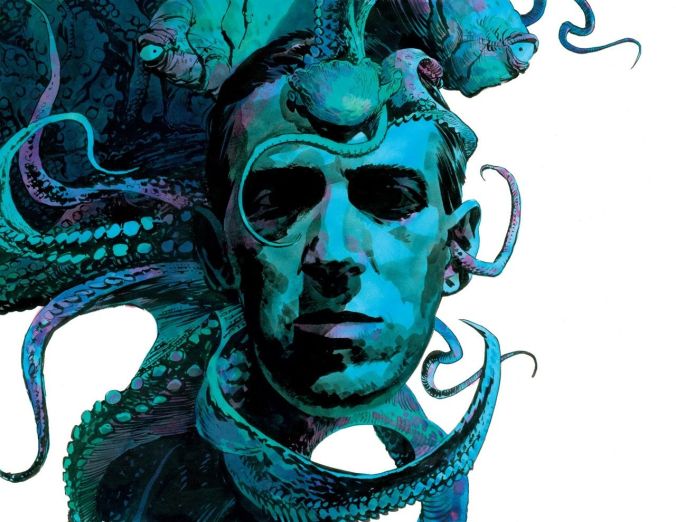
lovecraft

This is a speech I gave to two oratorical societies of which I am a member. It has been edited and augmented for this format.

Good Evening.

H.P. Lovecraft was a master of horror writing. Indeed, he was the first thinker to seriously treat horror as an independent genre, and his critical work went far towards delineating its boundaries and prospects for the next hundred years. His writings had a major impact on several writers and filmmakers who are virtually household names today: Stephen King, Guillermo del Toro, Jorge Luis Borges, Alan Moore, and Neil Gaiman are just a few who have drawn inspiration from his oeuvre. That said, I would like to speak less tonight about those who came after Lovecraft, and more about those who came before.

It is my contention that Lovecraft perfected a longstanding tradition in New England literature, and the result was cosmic horror. It is, moreover, my contention that cosmic horror up to and including Lovecraft’s own work depended upon a viscerally antagonistic representation of non-white peoples. Finally, it is my contention that the recent Lovecraft renaissance, while welcome in some respects, is tied to more disturbing developments in our contemporary political landscape.

First, I should probably define cosmic horror for those who have not yet had the pleasure of reading Howard Phillips Lovecraft. In brief, cosmic horror is the horror induced by the realization that the universe is totally and indescribably indifferent to mankind. Consequently, human life has no real meaning. Lovecraft expresses this idea repeatedly throughout his corpus. He begins his famous story, “The Call of Cthulhu,” with the following comments:

“The most merciful thing in the world, I think, is the inability of the human mind to correlate all its contents. We live on a placid island of ignorance in the midst of black seas of infinity, and it was not meant that we should voyage far. The sciences, each straining in its own direction, have hitherto harmed us little; but some day the piecing together of dissociated knowledge will open up such terrifying vistas of reality, and of our frightful position therein, that we shall either go mad from the revelation or flee from the deadly light into the peace and safety of a new dark age. Theosophists have guessed at the awesome grandeur of the cosmic cycle wherein our world and human race form transient incidents. They have hinted at strange survivals in terms which would freeze the blood if not masked by a bland optimism. But it is not from them that there came the single glimpse of forbidden aeons which chills me when I think of it and maddens me when I dream of it.”

Here, in brief, is cosmic horror. And here too is a description of what happens when Lovecraft’s doomed heroes discover the truth about the worldthey “go mad from the revelation.” They are unable to continue interacting with reality in any meaningful way, since any sense of underlying significance has been dissolved by their confrontation with that realitynormally as personified in the form of an eldritch monster. Here, we see the aesthetic influence of Burke and, more importantly, Kant. For Kant, the experience of the sublime involved reckoning with the subject’s imaginative impotence next to something whose magnitude surpasses comprehensionusually a feature of the natural world. Say, the sea. The Kantian subject experiences the sublime and reasserts his own rationality against the imposition of the sublime object. He does this by imagining the infinite. In Lovecraft, the subject experiences the sublime as well. But instead of strengthening his rationality, it destroys his reason entirely. To borrow a phrase from another admirer of Lovecraft, we might speak of a Lovecraftian “fanged” sublime.

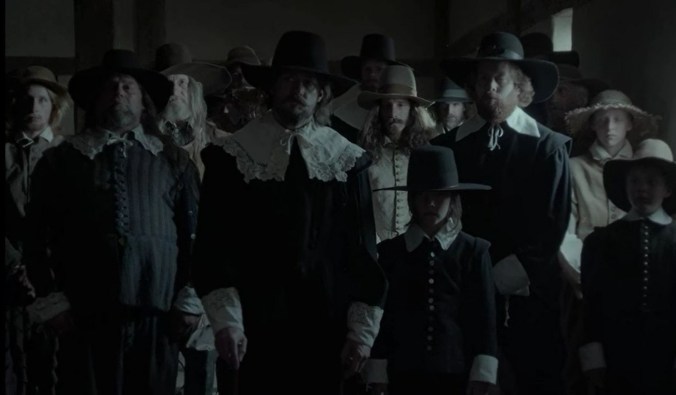
the-witch-puritans

Puritans, as depicted in The Witch (2015).

To understand the other intellectual influence on Lovecraft’s sense of horror, we need to trace the religious history of New England. Most people don’t realize quite how strange that story is. For instance, it may come as a surprise that most of the Calvinists in this country didn’t inherit their faith from the Puritans, but from Scottish and Dutch settlers south of Massachusetts. The reason for this is that the vast majority of the colonial congregations that once held to strict Puritan doctrine were Unitarian by the turn of the 19th century.

screen-shot-2017-02-11-at-2-36-27-pm

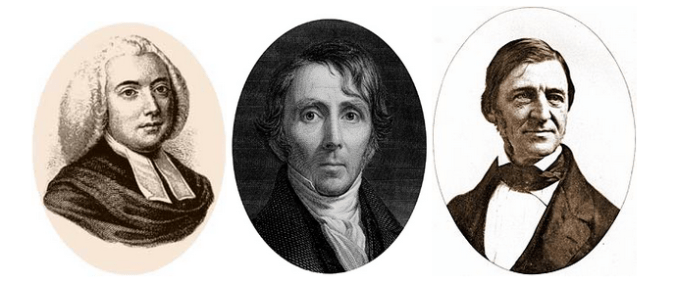
Unitarians: (l-r) Jonathan Mayhew, William Ellery Channing, Ralph Waldo Emerson

This evolution is an important shift. New England, and above all Massachusetts, began as the political project of men and women who hoped they were God’s elect. But the doctrine of predestination always allowed for some uncertainty. The marks of a holy life might signify election, but something as worldly as physical deformity or a bad harvest might communicate God’s wrath. And since God had already predetermined the elect and the damned from eternity, there was nothing anyone could do to ensure their salvation. God was indifferent to the prayers of the damned, if they prayed at all.

This Puritan preoccupation with God’s indifference finds expression in various examples of New England literature, but I would refer you to the work of Hawthorne, who managed to capture the darkness of the Puritan vision a century after it had been eclipsed by a new theology.

And that new theology was decidedly more optimistic. While it wasn’t a univocal orthodoxy, Unitarianism as preached by the likes of William Ellery Channing and Andrews Norton was perilously closely to Deism. Certainly by the mid-19th century, Unitarians were actively welcoming Deists into their congregations. Deism, of course, teaches that a single creator God established the world with order according to natural laws. Then, Deists claim, He stepped back from His creation to let free humans live and work within the bounds of natural law. Intercessory prayer was therefore meaningless since God would not intervene through miracles or any other supernatural measure. To quote that wayward Unitarian minister, Ralph Waldo Emerson,

Prayer that craves a particular commodity, — anything less than all good, — is vicious. Prayer is the contemplation of the facts of life from the highest point of view. It is the soliloquy of a beholding and jubilant soul. It is the spirit of God pronouncing his works good. But prayer as a means to effect a private end is meanness and theft. It supposes dualism and not unity in nature and consciousness.

I should note that Emerson, being something of a pantheist, put a distinctively positive spin on God’s indifference to the pleas of man.

His contemporary, Herman Melville, did not.

mobyfinalblue2

“To the last, I grapple with thee; from Hell’s heart I stab at thee; for Hate’s sake I spit my last breath at thee.” – Herman Melville, Moby Dick

Melville’s magnum opus, the classic novel Moby Dick, is fundamentally about mankind’s struggle against a God and a universe ultimately indifferent to his pain. Captain Ahab seeks revenge on the White Whale who stole his leg, and throughout the book there are hints that the creature is something more than merely natural.

There has been much debate about Melville’s personal beliefs, and many have claimed him as an atheist. But he still works within the New England tradition. At one point, Melville explicitly describes God as indifferent in a passage worth quoting at length. It takes place about ¾ of the way through the book, and it describes the fate of the black cabin boy, Pip, when he is left to float after falling overboard.

“But it so happened, that those boats, without seeing Pip, suddenly spying whales close to them on one side, turned, and gave chase; and Stubb’s boat was now so far away, and he and all his crew so intent upon his fish, that Pip’s ringed horizon began to expand around him miserably. By the merest chance the ship itself at last rescued him; but from that hour the little negro went about the deck an idiot; such, at least, they said he was. The sea had leeringly kept his finite body up, but drowned the infinite of his soul. Not drowned entirely, though. Rather carried down alive to wondrous depths, where strange shapes of the unwarped primal world glided to and fro before his passive eyes; and the miser-merman, Wisdom, revealed his hoarded heaps; and among the joyous, heartless, ever-juvenile eternities, Pip saw the multitudinous, God-omnipresent, coral insects, that out of the firmament of waters heaved the colossal orbs. He saw God’s foot upon the treadle of the loom, and spoke it; and therefore his shipmates called him mad. So man’s insanity is heaven’s sense; and wandering from all mortal reason, man comes at last to that celestial thought, which, to reason, is absurd and frantic; and weal or woe, feels then uncompromised, indifferent as his God.”

This passage, in addition to being my favorite in the entire book, serves to illustrate two other classic features of cosmic horror: the prophetic madness of those who survive the revelation of cosmic indifference, and more importantly, the use of racial others as symbols of that cosmic indifference.

agnes_sampson_and_witches_with_devil

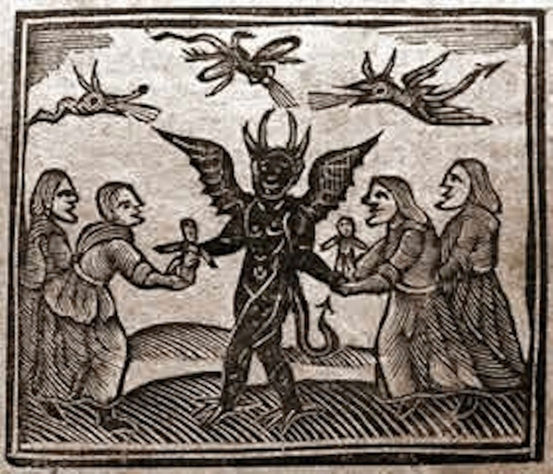
The Devil as a Black Man

In 17th century Europe, the Devil was often conceptualized as a man with black skin. The Puritans transported that vision with them to the New World, where they encountered a dark-skinned people living in the woods outside their enclosures. The wilderness, the Indians, and damnation form a nexus of signification in Puritan thought. To quote Aileen Agnew of the Maine Historical Society, “New England Puritans believed that the wilderness was the natural habitat of the devil. Since Native-Americans belonged to the wilderness, their familiarity with the ways of the devil seemed obvious to the settlers.” Washington Irving dramatizes this traditional chain of connotations in his short story, “The Devil and Tom Walker.” Tom Walker meets the Devil in a Massachusetts swamp, where the Prince of Lies says, “Oh, I go by various names. I am the Wild Huntsman in some countries; the Black Miner in others. In this neighbourhood I am known by the name of the Black Woodsman. I am he to whom the red men devoted this spot, and now and then roasted a white man by way of sweet smelling sacrifice.” Similarly, Hawthorne’s titular Young Goodman Brown meets witches in the Salem woods and refers to the devil as “the Black Man.”

Melville goes beyond this. He populates his novel with all kinds of non-white people, but two are worth mentioning. First, the aforementioned and unlucky Pip. After his ordeal in the waves, Pip loses his mind and speaks in gibberish that seems to bear prophetic weight on the doom of the crew. Ahab himself is mad, and the fond kinship they share at the end of the book is in part cemented by their common madness. This is precisely the move that Lovecraft makes repeatedly in his storiesstrange survivors who, though insane, grasp the awful reality of the world better than anyone else.

Melville’s other proto-Lovecraftian figure is a Parsee named Fedallah. Ahab’s private harpooner, Fedallah is smuggled as a stowaway on the Pequod and only emerges once the ship is well out at sea. The rest of the sailors distrust Fedallah, and repeatedly conjecture that he might be the Devil. Fedallah’s actions suggest a demonic identity, too. He prophesies to Ahab about the captain’s eventual death. When, in a pique of allegorical rage, Ahab destroys the quadrant that allows him to navigate by the Sun, Melville reports that “a sneering triumph that seemed meant for Ahab, and a fatalistic despair that seemed meant for himself—these passed over the mute, motionless Parsee’s face.” And during a storm, Fedallah addresses his idol, the “clear spirit of fire,” whose “right worship is defiance.” Melville’s Miltonian language suggests a demonic character.

As an important recent study of the authors convincingly demonstrates, Lovecraft is known to have read Moby Dick. And Lovecraft, to put it lightly, was a racist. I mean full-blown, hand-wringing “The Mongoloid Yellow Peril will drown the Teutonic Race if the Uppity Blacks and the Hook-Nosed Jews don’t kill us first” racist. Lovecraft had an unhealthy obsession with the racial purity of WASPS and was terrified of miscegenation. In one of his short stories, entitled “Facts Concerning the Late Arthur Jermyn and His Family,” the terrible reveal isspoilerthat an ancestral explorer married a white ape from Africa. The horror of miscegenation runs throughout many of his other works, notably his foundational story “The Shadow Over Innsmouth.” For Lovecraft, non-whites are always one step removed from the eldritch horror of the Elder Gods, essentially enormous and indescribably hideous aliens from the vast reaches of space who came to earth in the distant past and were worshiped in unholy rites that persist in atavistic communities on the edges of civilization. In “The Call of Cthulhu,” the most important story that deals with his mythos, Lovecraft tells the story of a kidnapping investigation in the Louisiana bayou. The narrator describes how the police must go to an area that, and I quote, “was one of traditionally evil repute, substantially unknown and untraversed by white men.” There, they discover a “voodoo orgy” scored by “tom-toms,” which proves to be the foul ceremony of a Cthulhu cult. Both voodoo and tom-toms are black racial markers. I could point to other examples from other stories, but I believe this one is sufficient. Lovecraft associates reason, order, and sanity with White Anglo-Saxon Protestant civilization. Racial others, especially blacks and Asians, threaten that civilization just as madness threatens those not yet initiated into the eldritch secrets of the Old Ones. The presence of the racial other is a reminder that the universe does not care about the rational subject, represented here by the white man. In this, Lovecraft is merely amplifying the tropes set down before him by more famous authors. He is eminently a New Englanderindeed, his epitaph in Rhode Island reads “I am Providence.”

cthulhu

Ph’nglui mglw’nafh Cthulhu R’lyeh wgah’nagl fhtagn

So, why does all this matter beyond the merely literary? As some of you may have noticed, over the past ten years or so there has been a Lovecraft renaissance. While Lovecraft never lacked a readership, the internet allowed for greater networking and discussion of his works than ever before. Cthulhu is now a cultural phenomenon as much as a cult classic of early 20th century horror literature. In particular, there are two related and troubling phenomena worth mentioning.

The first is a decision by some academics to treat Lovecraft as a philosopher. The most famous man to read Lovecraft in this way is Nick Land, a truly bizarre philosopher from England. Land is a hard nihilist, accelerationist, and antihumanist. His writings have influenced the Speculative Realists, a contemporary school of philosophy too arcane to merit much discussion here. It suffices to say that they, too, are treating Lovecraft as a philosopher in some of their writings.

Land’s greatest claim to fame, however, is as the intellectual godfather of the Neoreactionary movement. And it is this movement, tied to the internet, that has started to propel the Lovecraft renaissance into the realm of the political. The Neoreactionary concept of GNON is the objective state of reality which exists independently of liberal fantasies. To quote one Neoreactionary thinker at length:

“Neoreactionaries often speak of Gnon, the ‘crab-god’ they have created to embody the ideas of teleology, of consequences, of inevitability – no more and no less that the simple yet somehow, in the current age, revolutionary idea that implementing bad ideas will lead to bad consequences. The implications of the existence of Gnon, whose horrifying visage hangs heavy over the merry bustle of every civilization (whether they believe in him or not, for he is one of those realities that continues to exist no matter if you do or don’t), is that maintaining a civilization is hard, tireless work; that monsters are always waiting in the darkness to devour those who slack off in this task, whether it be because they have become soft and lazy, or incapable and feeble, or even (perhaps especially) due to the hubris of believing that they are so advanced that such drudgery is beneath them and they can instead devote their energies towards utopian schemes meant to perfect the human condition. Gnon – who is compatible with both a theistic and non-theistic worldview – punishes these sins: this sloth, this gluttony, this foolishness, this pride, this hubris. Gnon is seen both in the God who rained fire and brimstone down on Sodom and Gomorrah, and also in the collapse of Marxism in all of its supposed ‘inevitability’. Gnon is to be feared, for he is a destroyer god, and a merciless one. There is no bargaining with him, no reasoning with him, no begging for mercy with him. If you fail, if you slip, if you trust the wrong people or the wrong ideas, if you are foolish or careless, he will destroy you and everything you care about. He exists as a caution to you, and you had better take heed.”

Gnon, which stands for “The God of Nature or Nature,” is often implicitly or explicitly compared to Cthulhu (admittedly, across varying levels of irony). Moreover, Lovecraft briefly published a newspaper called “The Conservative” during the World War I years. A collection of Lovecraft’s newspapers has just been edited and republished by Arktos Media, Ltd., a major neoreactionary press. The book includes a foreword by Alex Kurtagic, a white nationalist known for his ties to Richard Spencer’s National Policy Institute. He has been featured several times in Spencer’s neofascist Radix Magazine.

gnon2

Gnon is sometimes portrayed as a giant, killer crab.

I don’t say any of this because I don’t want you to read Lovecraft. I do. I deeply enjoy Lovecraft’s fiction, and I think more people should read his work. But I also think his recent treatment by neoreactionary and alt-right racists deserves more exposure, even as I believe we need to situate his stories in the context of New England’s literary tradition. Also, let’s not forget something rather important. Lovecraft wrote what he did as a convinced atheist. His worldview is truly the opposite of the sacramental one we find in Christian horror writers like Arthur Machen and Charles Williams and Flannery O’Connor. Cosmic horror is horror indeed, but at the end of the day, it’s not true.

And thank the elder gods for that.