The Demonologist: Montague Summers

Montague_Summers01.jpg

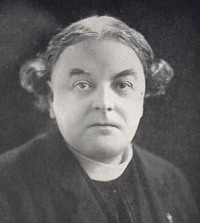
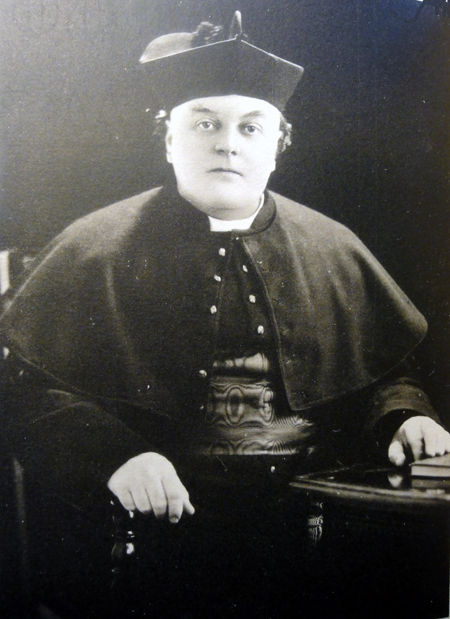
Montague Summers in clerical garb. (Source)

The history of the Church is a history of odd birds, but it is harder to find odder birds than those which inhabited the British Isles in the fruitful years of the Catholic Revival. The eccentricities of certain English clergy are well-known and well-beloved. One of the great flowers of this tendency was Montague Summers.
FlyingDevil

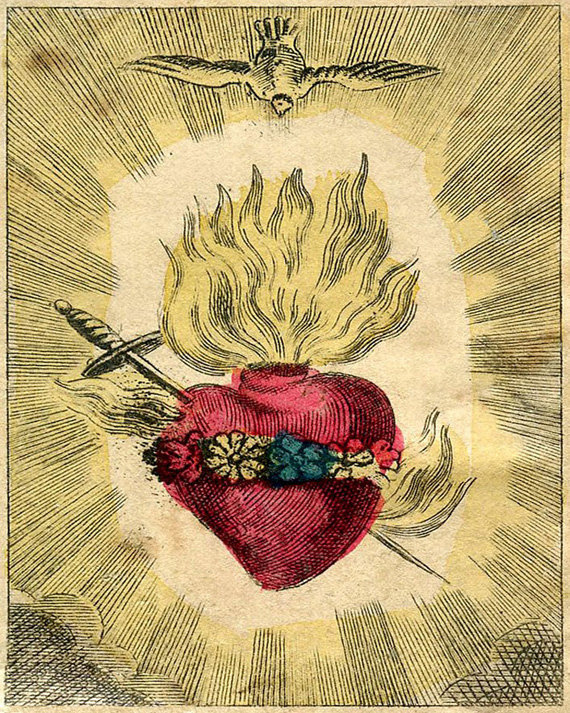
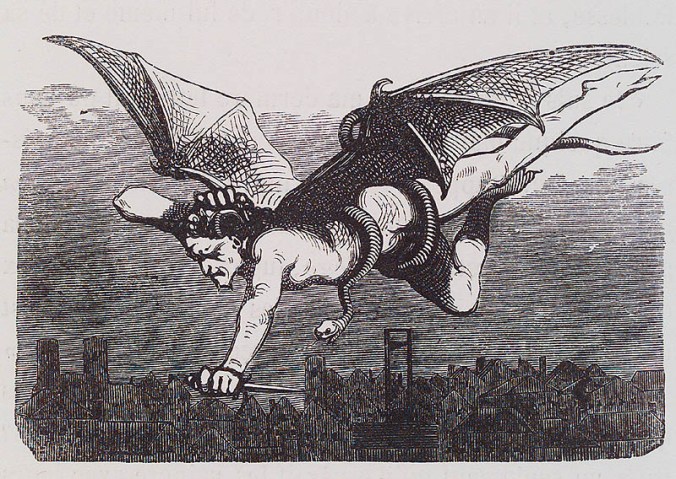
A flying devil. (Source)

Augustus Montague Summers was born in Bristol, the youngest of seven. Eventually he went on to study at Trinity College, Oxford, with the intent of seeking ordination in the Church of England. After some time at Lichfield Theological College, he was eventually deaconed and spent his curacy in Bath and the Bristol area. Even at this young stage, he garnered a reputation for eccentricity. In Ellis Hansen’s Decadent Catholicism, we learn the rather delicious fact that at seminary, “he was known to burn incense in his rooms and to wear purple silk socks during Lent” (qtd. by the Modern Medievalist).

This was as far as he made it in the ranks of the C of E, however. As the Oxford Dictionary of National Biography tersely puts it, “Rumours of studies in Satanism and a charge of pederasty, of which he was acquitted, terminated this phase of his career.” The latter charge may have had some truth to it. About this same time, he published a book of Uranian verse entitled Antinous and Other Poems (1907). His interest in pederastic and homosexual themes continued throughout his life. In 1940, he wrote a play about Edward II. Even more scandalously, “Despite his conservative religiosity, Summers was an active member of the British Society for the Study of Sex Psychology, to which he contributed an essay on the Marquis de Sade” (Source 1 and Source 2).

In 1907, though, Summers was out of a job. His hopes of becoming an Anglican clergyman seemed to have been quashed. But as they say, when the Lord closes one door, He opens another. We might imagine that Summers had something like this in mind when, two years later, he converted to Roman Catholicism. He also spent some time on the continent, allegedly for reasons relating to his health. Some have speculated that he might have received valid, if illicit, orders during this sojourn; others have said he spent his time exploring the black arts (vide the Modern Medievalist). We have almost nothing on which to base our speculations.

Now we see him coming to the full bloom of his later, famous eccentricity. It is in this formative period that he lays the foundation for the vivid persona that would make him such a cult literary and religious figure. I will quote the Oxford DNB at length:

On 19 July 1909 Summers was received into the Church of Rome and was granted the clerical tonsure on 28 December 1910; after this his clerical career became murky and remains so. He may have received minor orders as a deacon, but no record of his ordination has ever been found. During his lifetime, he was addressed as the Revd Montague Summers, celebrated mass in his own chapel and those of friends, adopted two names in religion, and invariably wore the dress pertaining to Roman priesthood; his appearance in soutane, buckled shoes, and shovel hat, later with an umbrella of the Sairey Gamp order, was familiar in London and Oxford. He became increasingly eccentric and was described as combining a manifest benignity with a whiff of the Widow Twankey. Some spoke of an aura of evil. It was charitably assumed by his friends that he was indeed a priest, and his devotion was never in question; his biographer Joseph Jerome (Father Broccard Sewell) records that all his life Summers wore the Carmelite scapular.

On a side-note, Fr. Brocard Sewell was a deeply strange man himself. But I digress.

If Summersor, as he was now calling himself, “Reverend Alphonsus Joseph-Mary Augustus Montague Summers”–had simply remained a slightly dubious cleric, we probably wouldn’t remember him. He might have become a little more than a footnote in the history of the Episcopi Vagantes so famous for dispensing illicit orders here and there. But he did not. Instead, he wrote. Prolifically.

Summers started off with genuine and important literary scholarship. Eventually, he even became a member of the Royal Society of Literature. He had certainly earned it with the sweat of his brow. He produced fairly good books on Restoration Drama, including major editions of previously neglected playwrights such as Aphra Behn. In this capacity, he had some connections with the world of the British stage; he was a founder of the Phoenix Theatre. He wrote an important monograph on Shakespeare.  In another work he also proved that the terrible Gothic novels that Jane Austen mentions in Northanger Abbey were all real books. Gothic literature remained a lifelong passion, in part because it dovetailed so well with his overriding obsessionthe occult.

vmps022

Montague Summers in clerical collar. (Source)

Summers is most famous today for his several books on witches, demons, vampires, ghosts, and other supernatural phenomena. He translated and edited the first English edition of the Malleus Maleficarum, that great tome of Medieval witch-hunting. He did the same with several other demonological manuals: The Demonality of Sinistrari, The Discovery of Witches by Hopkins, the Compendium Maleficarum of Guazzo, and the Demonolatry of Nicolas Remy. He wrote a text on The Physical Phenomena of Mysticism, in contrast with his somewhat headier and less decadent contemporary, Evelyn Underhill. He edited more than one collection of horror stories. He wrote three seminal texts on vampirism, one on lycanthropy, and four on various aspects of witchcraft. Following the best scholarship of the day, Summers endorsed the idea of the “Witch-Cult,” long suppressed by Christianity but operating sub rosa in Europe down the centuries (this hypothesis has long since been undermined by scholars across disciplines). He would often draw upon a huge range of historical, theological, ethnographic, and literary sources in constructing his arguments. All of his texts speak to his vast learning. It is probable that upon his death, Montague Summers knew more about the history and practice of the occult than any other Englishman then living.

The Modern Medievalist has preserved some charming anecdotes of the later, esoteric Summers over on his blog. We read, for example, the following passage from Ellis Hansen’s Decadent Catholicism:

…although Summers was a brilliant conversationalist, he had always a thick carapace of artificiality in his demeanor, a kind of mask that recalled the studied falsity of the classic dandy, not to mention the distrustful reserve of Walter Pater and John Gray. His style was decidedly aristocratic, Continental, and decadent, with the inevitable intimation of sexual impropriety. His friend writes of him, “He would often meet me with such an expression as Che! Che!, accompanied by a conspiratorial smile; or he would look closely at me and murmur, ‘Tell me strange things’.”

Or this remarkable scene drawn for us by Fr. Brocard Sewell:

Summers…could often have been seen entering or leaving the reading room of the British Museum, carrying a large black portfolio bearing on its side a white label, showing in blood-red capitals, the legend “VAMPIRES.”

Not to mention the fact that Summers went about town with a cane topped by a depiction of Leda and the Swan (vide the Modern Medievalist).
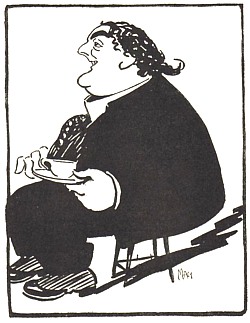
vmps011

A caricature of Summers from the Evening Standard, probably from 1925. (Source).

What distinguished Summers’ writing on these dark subjects is the absolute credulity with which he approaches his subject. Unlike his predecessor, Dom Calmet, who wrote about ghosts with ambivalence and vampires with manifest doubt, Summers did not hesitate to express his firm certainty about both (and much more). He believed in all the phenomena he wrote aboutthe whole ghastly parade of incubi and succubi, of witches dancing at the Sabbath, of vampires rising from the grave to seek the blood of the living, of werewolves stalking innocent Christians in the night. Everything that belonged to the netherworld was as real to him as the people you or I might meet in the street. His purple prose often slips into breathless passages of scholarly terror. Observe the following lines from Chapter Two of The Vampire: His Kith and Kin:

It has been said that a saint is a person who always cho[o]ses the better of the two courses open to him at every step. And so the man who is truly wicked is he who deliberately always cho[o]ses the worse of the two courses. Even when he does things which would be considered right he always does them for some bad reason. To identify oneself in this way with any given course requires intense concentration and an iron strength of will, and it is such persons who become vampires.

The vampire is believed to be one who has devoted himself during his life to the practice of Black Magic, and it is hardly to be supposed that such persons would rest undisturbed, while it is easy to believe that their malevolence had set in action forces which might prove powerful for terror and destruction even when they were in their graves. It was sometimes said, but the belief is rare, that the Vampire was the offspring of a witch and the devil.

Summers also stood apart from his thoroughly modern era in endorsing “Church-sanctioned methods of destroying” the monsters he wrote about (The Modern Medievalist).

And although his pages are littered with authoritative quotes from long-dead writers, Summers was not unaware of the dark streams that swirled about him in his own day. Richard Cavendish reports in a typically mordant passage from The Black Arts (1967) how Summers treated the claims of the twentieth century’s greatest occultist, Aleister Crowley:

Aleister Crowley could not pass over such an opportunity to scandalize his readers. ‘For the highest spiritual working one must accordingly choose that victim which contains the greatest and purest force. A male child of perfect innocence and high intelligence is the most satisfactory and suitable victim.’ Montague Summers took this seriously, as he took everything else, and quotes it with gratified horror, in spite of Crowley’s footnote in which he says that he performed this sacrifice an average of 150 times a year between 1912 and 1928! (Cavendish 238)

In spite of it all, Summers remained well-liked in certain circles. He moved among the literary elite of his own day, an eccentric among eccentrics. One of his friends, the actress Dame Sybil Thorndike, relates something of his personality:

I think that because of his profound belief in the tenets of orthodox Catholic Christianity he was able to be in a way almost frivolous in his approach to certain macabre heterodoxies. His humour, his “wicked humour” as some people called it, was most refreshing, so different from the tiresome sentimentalism of so many convinced believers.

His caricature in the Evening Standard captures something of this impish quality.

But although he was known and appreciated in his own day, he has been largely forgotten in the intervening decades. There have not been many books about Montague Summers, and he is not widely read. However, that will soon hopefully change. In recent years, Georgetown University has acquired Summers’ papers, once thought irrevocably lost. Fittingly, they have a peculiar provenance, having been “discovered languishing in an old farmhouse in Manitoba.” The story of how they got there is probably as strange as any of Summers’ own books. Georgetown’s collection has made possible a forthcoming biography by Matthew Walther that will hopefully rectify the longstanding neglect of this bizarre yet sincere writer.

But perhaps a question rises. Not every obscure author is worth reviving. Why bother with Montague Summers? A man of outdated style, of dubious subjects, and of very questionable morals to boot…what does he offer the modern reader?
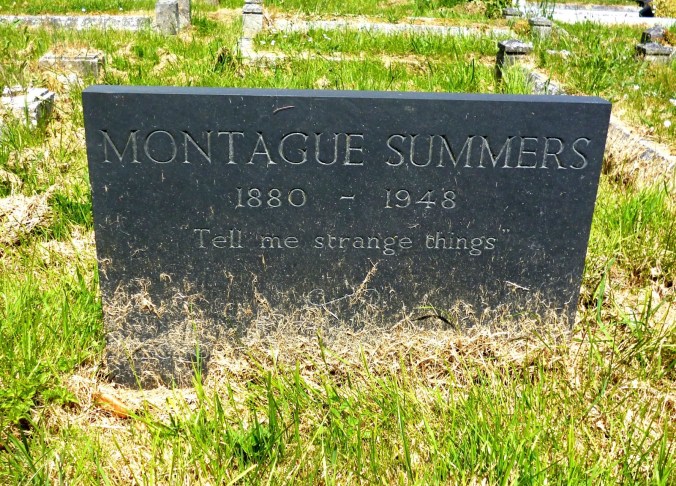
pope's grotto 082

The grave of Montague Summers. (Source)

The Modern Medievalist has a few thoughts on the matter.

Montague Summers is, at best, a good fit for the Institute of Christ the King and a throwback to an age when priests were also arbiters, makers, and preservers of high culture a la Antonio Vivaldi; at worst, a “daughter of Trent” who, if he ever actually was a priest to begin with, wasted his vocation on trivialities rather than the cure of souls.

Perhaps. I am not so convinced that Summers would have fit in any age. He was a decadent, and a great deal of decadence is contrarianism. Though the comparison with ICKSP is hilarious.

I think the message of Summers’s life and work can best be summed up in his epitaph.  On the black stone hat marks his grave in Richmond Cemetery, we read a simple phrase; “Tell me strange things.” These four words that he used to say to his friends encompass his whole life, packed as it was with “strange things.” Summers matters today not because he is a towering figure of literary talent, nor because his scholarly subjects are of vital importance, nor because he is a moral exemplar of impeccable religiosity. He matters because he can remind us to embrace the mystery of life. As we read in one of those plays that Summers so loved, “There are more things in heaven and earth, Horatio,/Than are dreamt of in your philosophy.” Summers lived by those words. The more I learn about the world, the more reason I see in them. And what better day to remember this humbling, bewildering, frightful truth than on All Hallows’ Eve?
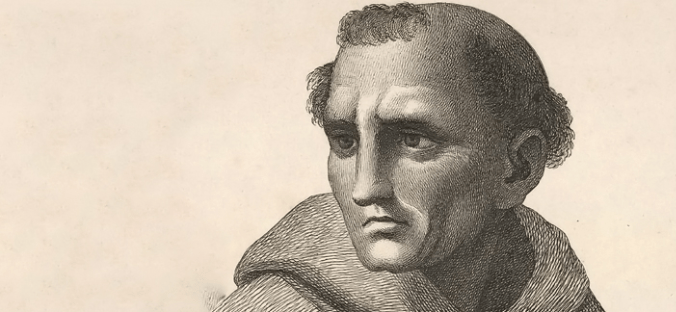
Mea Culpa, Mea Culpa, Mea Scholastica Culpa

BlessedJohnDunsScotus

The Blessed John Duns Scotus (Source).

In my review of Rod Dreher’s The Benedict Option, I wrote the following:

I’m not suggesting that Dreher is necessarily wrong in his various judgments. He may well be correct in accusing the nominalists of a kind of cultural deicide (although it overlooks the Christian nominalist tendency, closely tied to empiricism, that numbers Berkeley, Burke, Hamann, Newman, and Chesterton among its ranks).

I subsequently received some pushback for making such a claim. After all, eminent philosophers and theologians had long made nominalism the villain of their narratives about the rise of an anti-Christian modernity. Others questioned my assertion about Newman in particular.

At that time, I defended myself by suggesting that, while I may be off in ascribing a specifically nominalist tendency to these thinkers, that nevertheless, they all do share, inter alia, a suspicion of universalizing abstraction, a respect for concrete particularity in its various forms, and a trust in prudence gained from experience. I interpreted this tendency as akin to the nominalist rejection of substantively existent universals. I also thought that one of the reasons this way of thinking might matter is in our dialogue with postmodernity, which is itself so suspicious of universals and grand narratives.

Nevertheless, I erred. I was mistaken to use that label of nominalism. I must thank my critics for pointing this out. In the many months since then, I have learned what would be the proper term to tie together these particular thinkers – not to mention Gerard Manley Hopkins and J.R.R. Tolkien.

The “nominalist tendency” is really a Scotist tendency. (The fact that I could make such an ironic error is, perhaps, a sign of my own ignorance. I own that. Scholasticism isn’t really my thing.) Chastened by my previous mistake, I hesitate to delve too deeply into the technical depths of Scotist philosophy. I will state briefly that a belief in the idea of haecceity as the unique thisness of each particular sums up the tendency’s core point. If I had time, I’d like to investigate if any firmer affinities could be found.

However, I believe I am now on much sounder territory. The Franciscan Daniel Horan’s work has focused on a postmodern engagement with Scotus, and the Scotism of Newman and Hopkins have been well-attested in the literature. Tolkien took up the theological note behind Hopkins’s ideas of inscape and instress, themselves poetic derivations of Scotist haecceity. More work still needs to be done in English on Hamann, but the image that is emerging is of a figure passionately devoted to the disruptive nature of ordinary, particular experience. His willingness to contest the established narratives of the Aufklärung predates postmodernism by a century and a half. Chesterton is cut from the same cloth. Bishop Berkeley, though perhaps not quite so colorful as either of these two, stakes his empiricism on the particularity of the thing perceived (ultimately, by God). And Burke transposes the idea into the realm of politics, tempered by a healthy respect for natural law.

Two observations come to mind. The first is that nearly all of these thinkers are English or Anglophone. An enquiry into the reasons behind English Scotism would be useful. In its absence, I will merely note that Scotus, that medieval Oxford theologian, seems to have been directly reintroduced into the life of modern English spirituality by another Oxford theologian, John Henry Newman. It was Newman’s influence that defined intellectual Catholicism in England until the conclusion of Vatican II.

The second is that several of these thinkers are literary figures in their own right. Hopkins is principally remembered as a poet, Chesterton as a journalist, novelist, and poet, and Tolkien as a novelist. Newman was a prolific writer across genres. He exerted a personal influence over Hopkins, Matthew Arnold, and Oscar Wilde. And Hamann’s own deeply bizarre output constantly blurs the rigid lines of 18th century drama (yet another way he foreshadows our own postmodern era).

I must wonder if Scotist thought is particularly apt for the production of theology in a poetic mode, as the Catholic Sophiologists of our own day are seeking to do. I certainly have friends who think so. At the very least, Scotus’s high Mariology accords well with the extremely high Mariology of some Sophiologists.

If I had more time, I should like to dive more deeply into these questions. For now, I seek only to explain myself a bit, and apologize for what was clearly a serious error.

ADDENDUM: I also meant to say that Delleuze’s appropriation of haecceity as a fundamental concept lends support to my own impulse of putting these thinkers in conversation with postmodernism.

A Poem by Richard Crashaw for St. Teresa’s Day


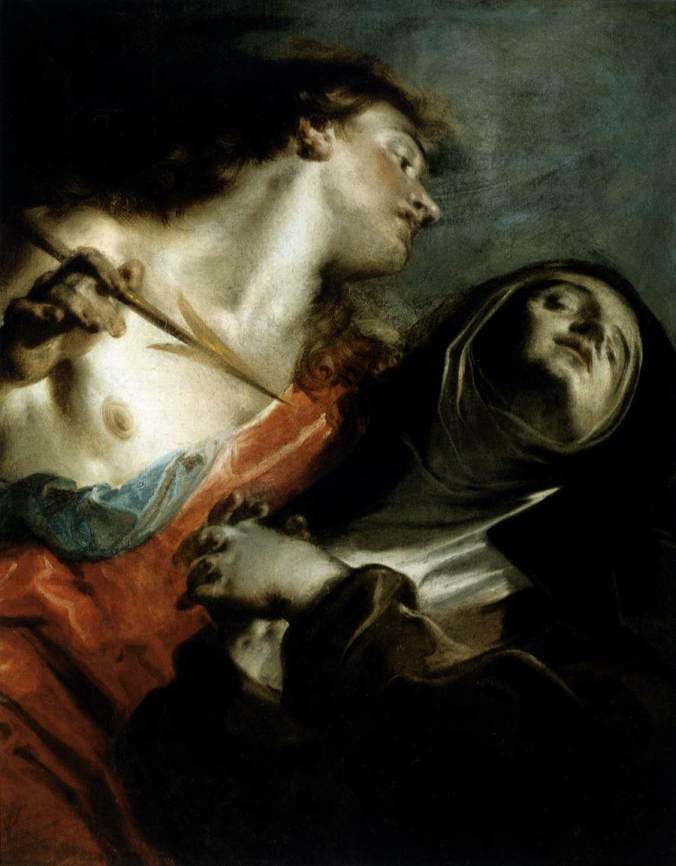
Giuseppe_Bazzani_-_The_Ecstasy_of_St_Therese_-_WGA01527

“The Ecstasy of St. Teresa,” Giuseppe Bazzani, c. 1747 (Source).

The Flaming Heart

VPON THE BOOK AND PICTURE OF THE SERAPHICAL SAINT TERESA, AS SHE IS VSVALLY EXPRESSED WITH A SERAPHIM BISIDE HER.

Well-meaning readers! you that come as friends
And catch the pretious name this piece pretends;
Make not too much hast to admire
That fair-cheek’t fallacy of fire.
That is a seraphim, they say
And this the great Teresia.
Readers, be rul’d by me; and make
Here a well-plact and wise mistake:
You must transpose the picture quite,
And spell it wrong to read it right;
Read him for her, and her for him,
And call the saint the seraphim.
Painter, what didst thou understand
To put her dart into his hand?
See, even the yeares and size of him
Showes this the mother seraphim.
This is the mistresse flame; and duteous he
Her happy fire-works here, comes down to see.
O most poor-spirited of men!
Had thy cold pencil kist her pen,
Thou couldst not so unkindly err
To show vs this faint shade for her.
Why, man, this speakes pure mortall frame;
And mockes with female frost Love’s manly flame.
One would suspect thou meant’st to paint
Some weak, inferiour, woman-saint.
But had thy pale-fac’t purple took
Fire from the burning cheeks of that bright booke,
Thou wouldst on her have heap’t up all
That could be found seraphicall;
What e’re this youth of fire, weares fair,
Rosy fingers, radiant hair,
Glowing cheek, and glistering wings,
All those fair and fragrant things
But before all, that fiery dart
Had fill’d the hand of this great heart.
Doe then, as equall right requires,
Since his the blushes be, and her’s the fires,
Resume and rectify thy rude design,
Undresse thy seraphim into mine;
Redeem this injury of thy art,
Give him the vail, give her the dart.
Give him the vail; that he may cover
The red cheeks of a rivall’d lover.
Asham’d that our world now can show
Nests of new seraphims here below.
Give her the dart, for it is she
(Fair youth) shootes both thy shaft, and thee;
Say, all ye wise and well-peirc’t hearts
That live and die amidst her darts,
What is’t your tastfull spirits doe prove
In that rare life of her, and Love?
Say, and bear witnes. Sends she not
A seraphim at every shott?
What magazins of immortall armes there shine!
Heavn’s great artillery in each love-spun line.
Give then the dart to her who gives the flame;
Give him the veil, who gives the shame.
But if it be the frequent fate
Of worst faults to be fortunate;
If all’s præscription; and proud wrong
Hearkens not to an humble song;
For all the gallantry of him,
Give me the suffring seraphim.
His be the bravery of all those bright things,
The glowing cheekes, the glistering wings;
The rosy hand, the radiant dart;
Leave her alone the flaming heart.
Leave her that; and thou shalt leave her
Not one loose shaft but Love’s whole quiver.
For in Love’s field was never found
A nobler weapon then a wound.
Love’s passives are his activ’st part,
The wounded is the wounding heart.
O heart! the æquall poise of Love’s both parts
Bigge alike with wound and darts.
Live in these conquering leaves; live all the same,
And walk through all tongues one triumphant flame.
Live here, great heart; and love and dy and kill;
And bleed and wound; and yield and conquer still.
Let this immortall life wherere it comes
Walk in a crowd of loves and martyrdomes.
Let mystick deaths wait on’t; and wise soules be
The love-slain wittnesses of this life of thee.
O sweet incendiary! shew here thy art,
Upon this carcasse of a hard, cold hart;
Let all thy scatter’d shafts of light, that play
Among the leaves of thy larg books of day.
Combin’d against this brest at once break in
And take away from me my self and sin;
This gratious robbery shall thy bounty be,
And my best fortunes such fair spoiles of me.
O thou undanted daughter of desires!
By all thy dowr of lights and fires;
By all the eagle in thee, all the dove;
By all thy lives and deaths of love;
By thy larg draughts of intellectuall day,
And by thy thirsts of love more large then they;
By all thy brim-fill’d bowles of fierce desire,
By thy last morning’s draught of liquid fire;
By the full kingdome of that finall kisse
That seiz’d thy parting soul, and seal’d thee His;
By all the Heau’n thou hast in Him
(Fair sister of the seraphim!)
By all of Him we have in thee;
Leave nothing of my self in me.
Let me so read thy life, that I
Unto all life of mine may dy.

(Richard Crashaw, Carmen Deo Nostro, with some orthographic editing).


Crashaw on Our Lady of Sorrows

Our-Lady-of-Oxford

Yesterday, we celebrated the Feast of the Holy Cross. Today, naturally, we follow that sorrowful glory of Jesus with the sorrowful glory of Mary. And Crashaw remains our companion. Here is his “Sancta Maria Dolorum; or The Mothers of Sorrows, A Pathetical Descant upon the Devout Plainsong of Stabat Mater Dolorosa.” You can also find the text over here.

1.

In shade of Deaths sad Tree
Stood doleful she,
Ah she! now by no other
Name to be known, alas, but Sorrow’s Mother.

Before her Eyes
Her’s and the whole World’s joyes,
Hanging all torn she sees; and in his woes
And Pains, her pangs and throes.
Each wound of his, from every part,
All, more at home in her own heart.

2.

What kind of Marble than
Is that cold man
Who can look on and see,
Nor keep such Noble sorrows company?
Sure even from you
(My Flints) some drops are due
To see so many unkind swords contest
So fast for one soft Brest.
While with a faithful, mutual, floud
Her Eyes bleed Tears, his wounds weep blood.

3.

O costly intercourse
Of deaths, and worse
Divided Loves: while Son and Mother
Discourse alternate wounds to one another;
Quick Deaths that grow
And gather, as they come and go:
His Nails write swords in her; which soon her heart
Pays back, with more then their own smart;
Her swords, still growing with his pain,
Turn Spears, and straight come home again;

4.

She sees her Son, her God,
Bow with a load
Of borrow’d sins; and swim
In woes that were not made for him.
Ah hard Command
Of Love! Here must she stand
Charg’d to look on, and with a stedfast Eye
See her life dye:
Leaving her only so much Breath
As serves to keep alive her death.

5.

O Mother Turtle-dove!
Soft sourse of Love,
That these dry Lids might borrow
Somthing from thy full seas of Sorrow!
O in that Brest
Of thine (the noblest Nest
Both of Love’s Fires and Flouds) might I recline
This hard, cold, Heart of mine!
The chil lump would relent, and prove
Soft Subject for the siege of Love.

6.

O teach those wounds to bleed
In me; me, so to read
This Book of Loves, thus writ
In lines of death, my life may copy it

With Loyal cares.
O let me here claim shares;
Yield something in thy sad prerogative
(Great Queen of griefs) and give
Me to my Tears; who, though all stone,
Think much that thou shouldst mourn alone.

7.

Yea let my life and me
Fix here with thee,
And at the Humble Foot
Of this fair Tree take our Eternal Root.
That so we may
At least be in Loves way;
And in these chaste wars while the wing’d wounds flee
So fast ‘twixt him and thee,
My Brest may catch the kiss of some kind Dart,
Though as at second hand, from either Heart.

8.

O you, your own best Darts,
Dear doleful hearts!
Hail; and strike home and make me see
That wounded bosomes their own weapons be.
Come Wounds! come Darts!
Nail’d hands! and pierced hearts!
Come your whole selves, Sorrow’s great Son and Mo∣ther.
Nor grudge a younger Brother
Of grief’s his portion, who (had all their due)
One single wound should not have left for you.

9.

Shall I set there
So deep a share
(Dear wounds) and onely now
In sorrows draw no dividend with you!
O be more wife,
If not more soft, mine Eyes!
Flow, tardy Founts! and into decent showrs
Dissolve my Days and Hours.
And if thou yet (faint soul!) defer
To bleed with him, fail not to weep with her.

10.

Rich Queen, lend some relief;
At least an alms of Grief
To’ a heart who by sad right of sin
Could prove the whole sum (too sure) due to him.
By all those stings
Of Love, sweet bitter things,
Which these torn hands transcrib’d on thy true Heart;
O teach mine too, the Art
To study him so, till we mix
Wounds, and become one Crucifix.

11.

O let me suck the Wine
So long of this chaste Vine,
Till, drunk of the dear wounds, I be
A lost thing to the World, as it to me.
O faithful friend
Of me and of my end!
Fold up my life in Love; and lay’t beneath
My dear Lord’s vital death.
Lo, heart, thy hopes whole Plea! her precious breath
Powr’d out in Prayers for thee; thy Lord’s in death.

Crashaw on the Holy Cross

ExaltationoftheHolyCrossBaroque

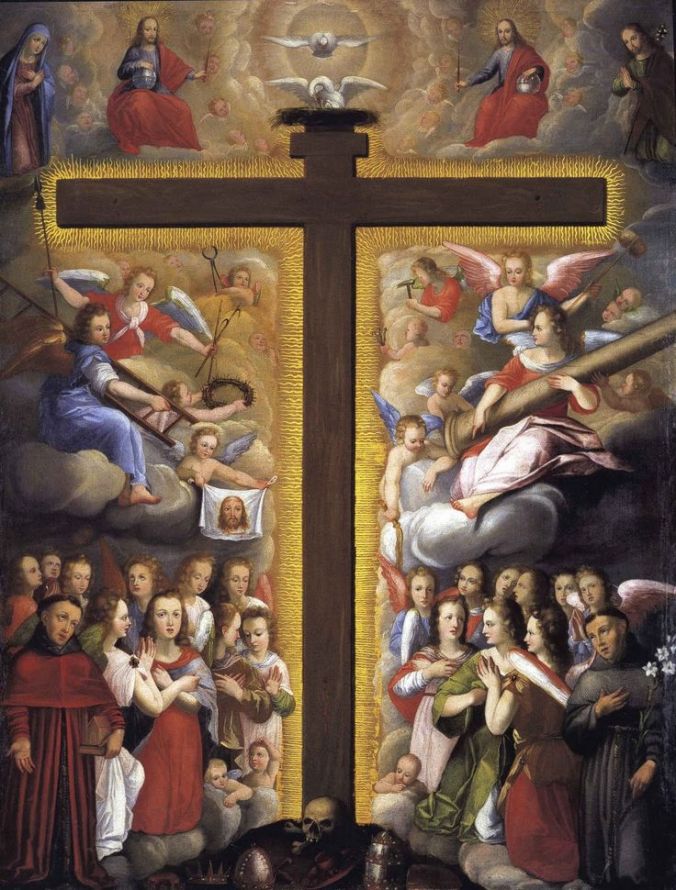
The veritable Tree of Life. (Source)

Today’s feast of the Exaltation of the Holy Cross deserves some poetic note…as will tomorrow’s Feast of Our Lady of Sorrows. Richard Crashaw, whose deeply somatic, extravagantly Baroque spirituality made him somewhat distasteful to an older generation of critics, fits our purpose for both days admirably. My source is the 2013 University of Minnesota Edition of The English Poems of Richard Crashaw, pages 204-05.

Here is his “Upon the Bleeding Crucifix, a Song.” I’d like to add as accompaniment my favorite English rendition of the Vexilla Regis.

Upon the Bleeding Crucifix, a Song

1.
Jesu, no more! It is full tide.
From thy head and from thy feet,
From thy hands and from thy side
All the purple rivers meet.

2.
What need thy fair head bear a part
In show’rs, as if thine eyes had none?
What need they help to drown thy heart,
That strives in torrents of its own?

3.
Thy restless feet now cannot go
For us and our eternal good,
As they were ever wont. What though?
They swim. Alas, in their own flood.

4.
Thy hands to give, thou canst not lift;
Yet will thy hand still giving be.
It gives but O, itself’s the gift.
It gives though bound; though bound ’tis free.

5.
But O thy side, thy deep-digged side!
That hath a double Nilus going.
Nor ever was the Pharian tide
Half so fruitful, half so flowing.

6.
No hair so small, but pays his river
To this red sea of thy blood,
Their little channels can deliver
Something to the general flood.

7.
But while I speak, whither are run
All the rivers named before?
I counted wrong. There is but one,
But O that one is one all o’er.

8.
Rain-swoll’n rivers may rise proud,
Bent all to drown and overflow.
But when indeed all’s overflowed
They themselves are drownèd too.

9.
Thy blood’s deluge, a drie chance
Dear Lord to thee, to us is found
A deluge of deliverance;
A deluge lest we should be drowned.

Ne’er wast thou in a sense so sadly true,
The well of living waters, Lord, till now.


The Catholic Poems of Oscar Wilde

OscarWildeBook

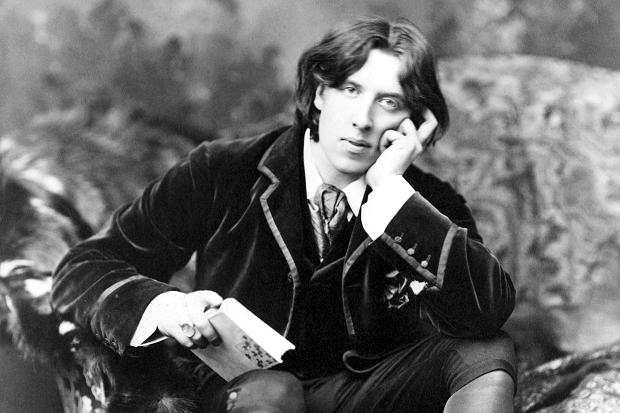
Oscar Fingal O’Flahertie Wills Wilde (Source).

As I mentioned in my last post, during the month of August, I am dedicating myself to daily acts of creativity in honor of Mary’s Immaculate and Sophianic Heart. As Providence would have it, the Holy Father’s intentions for August include prayers for artists. Thus, I’m going to make my blog especially aesthetic for the rest of the month.

And what better way to start than examining work by one of the modern era’s great philosophers of art, Oscar Wilde? It is not often remembered today that Oscar Wilde was a Catholic. True, he was only formally received on his death bed. But Wilde maintained a lifelong flirtation with the faith. Catholicism infused his imagination from very early on in his productive career. When he was a student at Oxford, he visited Rome and wrote quasi-Catholic poetry that even Cardinal Newman admired. In some of the work, the influence of Dante is manifest. The aesthetics and romance of Catholicism appealed to Wilde, and he was nearly converted by Fr. Sebastian Bowden of the London Oratory. Only much later did he definitively turn to the Lord, in his last hour. However, many members of his circle also converted…a topic I shall, perhaps, explore some other day.

Ave Maria Gratia Plena

Was this His coming! I had hoped to see
A scene of wondrous glory, as was told
Of some great God who in a rain of gold
Broke open bars and fell on Danae:
Or a dread vision as when Semele
Sickening for love and unappeased desire
Prayed to see God’s clear body, and the fire
Caught her white limbs and slew her utterly:
With such glad dreams I sought this holy place,
And now with wondering eyes and heart I stand
Before this supreme mystery of Love:
A kneeling girl with passionless pale face,
An angel with a lily in his hand,
And over both with outstretched wings the Dove.

Sonnet on Approaching Italy

I reached the Alps: the soul within me burned
Italia, my Italia, at thy name:
And when from out the mountain’s heart I came
And saw the land for which my life had yearned,
I laughed as one who some great prize had earned:
And musing on the story of thy fame
I watched the day, till marked with wounds of flame
The turquoise sky to burnished gold was turned,
The pine-trees waved as waves a woman’s hair,
And in the orchards every twining spray
Was breaking into flakes of blossoming foam:
But when I knew that far away at Rome
In evil bonds a second Peter lay,
I wept to see the land so very fair.

Urbs Sacra Æterna

Rome! what a scroll of History thine has been
In the first days thy sword republican
Ruled the whole world for many an age’s span:
Then of thy peoples thou wert crownèd Queen,
Till in thy streets the bearded Goth was seen;
And now upon thy walls the breezes fan
(Ah, city crowned by God, discrowned by man!)
The hated flag of red and white and green.
When was thy glory! when in search for power
Thine eagles flew to greet the double sun,
And all the nations trembled at thy rod?
Nay, but thy glory tarried for this hour,
When pilgrims kneel before the Holy One,
The prisoned shepherd of the Church of God.

Sonnet on Hearing the Dies Irae Sung in the Sistine Chapel

Nay, Lord, not thus! white lilies in the spring,
Sad olive-groves, or silver-breasted dove,
Teach me more clearly of Thy life and love
Than terrors of red flame and thundering.
The hillside vines dear memories of Thee bring:
A bird at evening flying to its nest
Tells me of One who had no place of rest:
I think it is of Thee the sparrows sing.
Come rather on some autumn afternoon,
When red and brown are burnished on the leaves,
And the fields echo to the gleaner’s song,
Come when the splendid fulness of the moon
Looks down upon the rows of golden sheaves,
And reap Thy harvest: we have waited long.

Holy Week at Genoa

I wandered through Scoglietto’s far retreat,
The oranges on each o’erhanging spray
Burned as bright lamps of gold to shame the day;
Some startled bird with fluttering wings and fleet
Made snow of all the blossoms; at my feet
Like silver moons the pale narcissi lay:
And the curved waves that streaked the great green bay
Laughed i’ the sun, and life seemed very sweet.
Outside the young boy-priest passed singing clear,
‘Jesus the son of Mary has been slain,
O come and fill His sepulchre with flowers.’
Ah, God! Ah, God! those dear Hellenic hours
Had drowned all memory of Thy bitter pain,
The Cross, the Crown, the Soldiers and the Spear.

San Miniato

See, I have climbed the mountain side
Up to this holy house of God,
Where once that Angel-Painter trod
Who saw the heavens opened wide,

And throned upon the crescent moon
The Virginal white Queen of Grace,–
Mary! could I but see thy face
Death could not come at all too soon.

O crowned by God with thorns and pain!
Mother of Christ! O mystic wife!
My heart is weary of this life
And over-sad to sing again.

O crowned by God with love and flame!
O crowned by Christ the Holy One!
O listen ere the searching sun
Show to the world my sin and shame.

Madonna Mia

A lily-girl, not made for this world’s pain,
With brown, soft hair close braided by her ears,
And longing eyes half veiled by slumberous tears
Like bluest water seen through mists of rain:
Pale cheeks whereon no love hath left its stain,
Red underlip drawn in for fear of love,
And white throat, whiter than the silvered dove,
Through whose wan marble creeps one purple vein.
Yet, though my lips shall praise her without cease,
Even to kiss her feet I am not bold,
Being o’ershadowed by the wings of awe.
Like Dante, when he stood with Beatrice
Beneath the flaming Lion’s breast, and saw
The seventh Crystal, and the Stair of Gold.

E Tenebris

Come down, O Christ, and help me! reach thy hand,
For I am drowning in a stormier sea
Than Simon on thy lake of Galilee:
The wine of life is spilt upon the sand,
My heart is as some famine-murdered land,
Whence all good things have perished utterly,
And well I know my soul in Hell must lie
If I this night before God’s throne should stand.
‘He sleeps perchance, or rideth to the chase,
Like Baal, when his prophets howled that name
From morn to noon on Carmel’s smitten height.’
Nay, peace, I shall behold before the night,
The feet of brass, the robe more white than flame,
The wounded hands, the weary human face.

At Verona

How steep the stairs within Kings’ houses are
For exile-wearied feet as mine to tread,
And O how salt and bitter is the bread
Which falls from this Hound’s table,–better far
That I had died in the red ways of war,
Or that the gate of Florence bare my head,
Than to live thus, by all things comraded
Which seek the essence of my soul to mar.

‘Curse God and die: what better hope than this?
He hath forgotten thee in all the bliss
Of his gold city, and eternal day’–
Nay peace: behind my prison’s blinded bars
I do possess what none can take away,
My love, and all the glory of the stars.

On the Massacre of the Christians in Bulgaria

Christ, dost Thou live indeed? or are Thy bones
Still straitened in their rock-hewn sepulchre?
And was Thy Rising only dreamed by her
Whose love of Thee for all her sin atones?
For here the air is horrid with men’s groans,
The priests who call upon Thy name are slain,
Dost Thou not hear the bitter wail of pain
From those whose children lie upon the stones?
Come down, O Son of God! incestuous gloom
Curtains the land, and through the starless night
Over Thy Cross a Crescent moon I see!
If Thou in very truth didst burst the tomb
Come down, O Son of Man! and show Thy might
Lest Mahomet be crowned instead of Thee!

Queen Henrietta Maria

In the lone tent, waiting for victory,
She stands with eyes marred by the mists of pain,
Like some wan lily overdrenched with rain:
The clamorous clang of arms, the ensanguined sky,
War’s ruin, and the wreck of chivalry,
To her proud soul no common fear can bring:
Bravely she tarrieth for her Lord the King,
Her soul a-flame with passionate ecstasy.
O Hair of Gold! O Crimson Lips! O Face
Made for the luring and the love of man!
With thee I do forget the toil and stress,
The loveless road that knows no resting place,
Time’s straitened pulse, the soul’s dread weariness,
My freedom and my life republican!

On Easter Day

The silver trumpets rang across the Dome:
The people knelt upon the ground with awe:
And borne upon the necks of men I saw,
Like some great God, the Holy Lord of Rome.
Priest-like, he wore a robe more white than foam,
And, king-like, swathed himself in royal red,
Three crowns of gold rose high upon his head:
In splendor and in light the Pope passed home.
My heart stole back across wide wastes of years
To One who wandered by a lonely sea,
And sought in vain for any place of rest:
“Foxes have holes, and every bird its nest,
I, only I, must wander wearily,
And bruise My feet, and drink wine salt with tears.”

Wilde did just that until he lost his duel with the wallpaper on November 30th, 1900. But having received the last rites of the Church, perhaps he is already in heaven as a saint. One can only imagine what he would think of his portrait bedecked with a golden halo.

A Challenge in Honor of the Sophianic Heart of Mary

ImmaculateHeartofMarySophianic

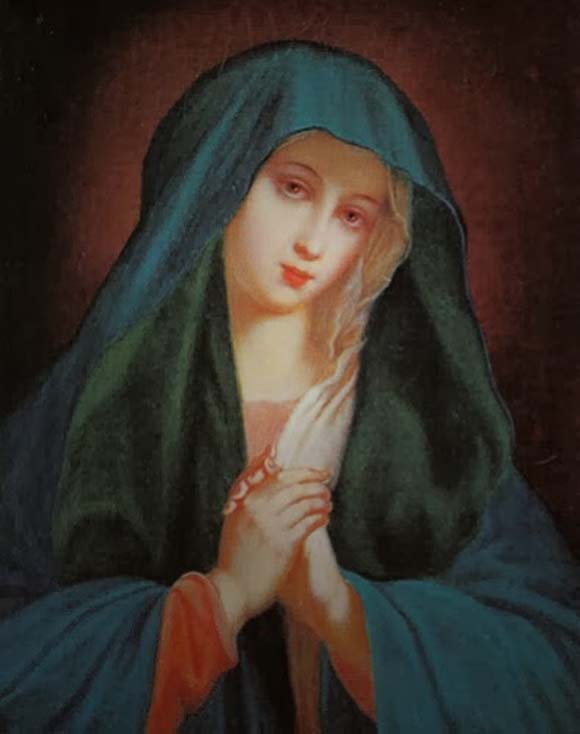
Sorrowful and Immaculate Heart of Mary, pray for us sinners. (Source).

August is consecrated to the Sorrowful and Immaculate Heart of Mary. Thus, it is a month in which the Church invites us to peer into the profound and luminous abyss of light at the very center of the Mother of God’s Sophianic life. In celebration of this occasion, I’ve decided to dedicate myself to producing or working on something creative every day for the rest of the month. Today, I have already written one poem and started an art project. The latter is especially exciting for me, as it’s been years since I last produced any real art. Too long, really. Pray for me in this sophiological endeavor! I would recommend the same challenge to any Catholic hoping to redeem this particular time.

On the Birthday of Cardinal Baronius

BaroniusPortraitbw

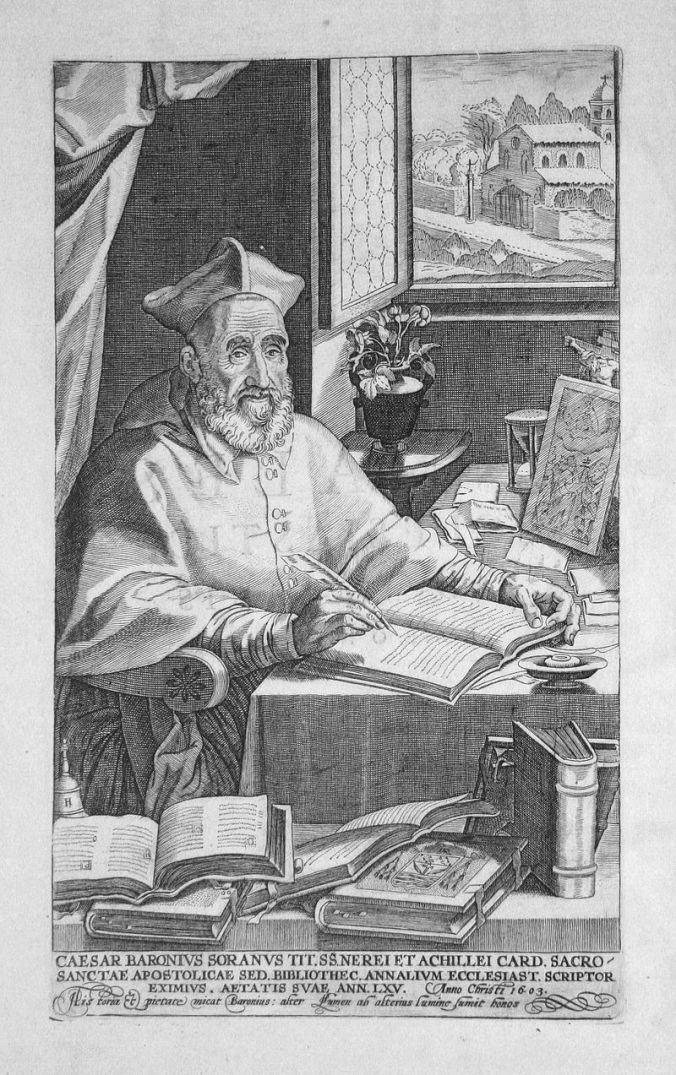
The Venerable Cardinal himself. This portrait is one of the few where his Cardinalatial arms can be glimpsed, on the cover of a book in the foreground. (Source).

Readers of this blog will learn with no surprise that, having finished Lady Amabel Kerr’s biography of the Venerable Cardinal Baronius, my admiration for this great Oratorian has increased tenfold. As I have concluded the volume, so lovingly edited and reprinted by Mediatrix Press, on the very birthday of the illustrious historian, I thought I might reproduce here two extended passages from Baronius’s correspondence that I found particularly edifying.

The first passage is taken from a letter that Baronius wrote to one Justin Calvin. I have thus far been unable to locate much further information about said Calvin, unrelated, I think, to the heresiarch Reformer. Baronius’s Annales and extended correspondence with Justin led to the latter’s eventual conversion. Calvin (or Justus Baronius Calvinus, as he was called once he added Baronius’s name to his own) went on to become a priest and author of, among other works, an Apologia that justified his conversion. God manifestly works in mysterious ways within the long lives of religious orders. He is inordinately fond of strange and unintended coincidences.

Baronius writes to the young convert:

I return many thanks to the great and most high God, whose tender mercies, as sings David, are over all His works, for having called you out of darkness into His marvellous light. No benefit, no grace can be greater than this, so see that you cherish it carefully and guard it jealously. Do not indulge in paeans of victory; but rather remember that exhortation of the Apostle to walk circumspectly, not as unwise but as wise, redeeming the time because the days are evil…When the devil has been overthrown, he is apt to rise up with renewed vigour, and assault his former conqueror more violently than ever. Our Lord tells us of the wicked spirit who, having gone out of a man, did not rest, but fetched seven other spirits more wicked than himself, and retook by fraud the soul whence he had been driven…Be sure that he will seek you who have escaped him and are now fighting in the ranks of the Church. He may not betray his designs, for he fears lest Saul-converted into Paul by his reconciliation to the Church-should by the first of divine love deal destruction on the lies by which he is wont to overcome men. You, a soldier of Jesus Christ, beware, and lose not hold on the shield of faith which you have taken up. Be master of yourself, overcome yourself, and take heed that you, who were once in the employ of the prince of darkness, be not ashamed of being enrolled under the banner of Christ your Captain…You have, however, no real cause for fear, but only for joy. Rejoice if you are found worthy to suffer anything for the Catholic faith and in defence of the truth. I showed your letter to our Supreme Pastor, who rejoiced to hear the bleating of his one-time lost sheep, who has been found worthy to hear the voice of the Shepherd. He is addressing to you an Apostolic letter, by which he embraces you as if with extended arms, and by his written words places you on his shoulders rejoicing. In him you will always find a true pastor and father. (Kerr 295-96).

There is much rich advice here for any convert. Baronius also displayed his perennial wisdom when he replied to a number of fellow Cardinals who censured the liberty with which he defended the independence of the Church against the claims of various princes and potentatesabove all, the King of Spain. His response is inspiring for anyone who hopes to engage in the life of the mind. We read:

It behoves me to imitate our Lord and Master Jesus Christ, of whom the Gospel says that He taught as one having authority and not as the scribes, which means that He preached with truth and liberty, whereas they, in their adulation of Herod, yielded to that king’s taste in everything. Far be it from me, I repeat, to write like the scribes, and not declare the truth freely as did Christ. After Him I turn to the holy fathers of the Church, whose example, in writing, it behoves me to follow. In their maintenance of the truth in the face of those who attacked it, they displayed unbending constancy of soul. They did not make use of cringing, diluted, soft expressions, but, on the contrary, employed a language both grand and strong, mingling with it a sharpness of censure which converted their sentences into so many flashes of lightning. If you look through the Annals you will find scarcely a year in which some such example is not cited.

By studying the fathers and relating their acts I have by habit adopted their manner of speaking, which should not, in my opinion, be despised, for such speech is bestowed as a gift of the Spirit rather than obtained by human learning. When dealing with heretic or schismatic innovators, or else with princes who corrupt ecclesiastical discipline by their violation of the laws of the Church, or endeavour by their tyranny to reduce her to servitude, I have acquired the habit of writing with the indiscretion which you censure. The words of the prophet, “Cry, cease not, lift up thy voice like a trumpet, and show my people their wicked doings,” keep resounding in my ears as if from heaven. When Eugenius IV was made Pope, St. Bernard exhorted him to nominate Cardinals who should act as John did towards Herod, Moses towards the Egyptians, Phineas towards the fornicators, Elias towards the idolaters, Eliseus towards misers, Peter towards liars, Paul towards blasphemers, and, finally, as our Lord Himself acted towards traffickers in the temple. In other words he urged the Pope to choose men armed with zeal against sinners, who should act everywhere and in every way in such a manner as to sweep away the workers of iniquity. Such is the model drawn for us by the Holy Ghost, and if we do not conform ourselves to it we shall be convicted of deformity. (Kerr 318-20).

These are just some of the words which the Venerable Cardinal let slip as so much nectar from his pen and tongue. He was truly one of the greatest scholars that the Church has ever produced, and he revolutionized the discipline of ecclesiastical history. Yet Baronius always saw the Annales as a secondary work to the simple task of salvation. His humility was legendary, and Kerr’s portrait of Baronius captures this peculiar virtue in all its many expressions.

Fénelon writes somewhere that we are all saved with our disposition. And Baronius’s scholarly predilections color his devotional life. Kerr tells us of one of his favorite prayers in a brief but vivid scene:

It may be said that he never wasted a moment of that rare though precious time when it was permitted him to turn his thoughts directly to God. While driving about in his coach he used to pull down the blinds and give himself over unrestrainedly to the things of the soul, bidding his companion recall him to himself if anything occurred which required his attention. When thus shut into darkness he usually repeated the Holy Name over and over again, or else dwelt lovingly on his favourite interjection, “Eternitas, eternitas,” words which were but the epitome of his ceaseless longing for death and the state beyond the grave. (Kerr 282).

Baronius teaches us to use time—that is, our place in historywell. May we follow in his glorious footsteps and one day enjoy with him the eternity he so ardently desired.

The Vampirologist: Dom Augustin Calmet OSB

DomAugustinCalmet.jpg

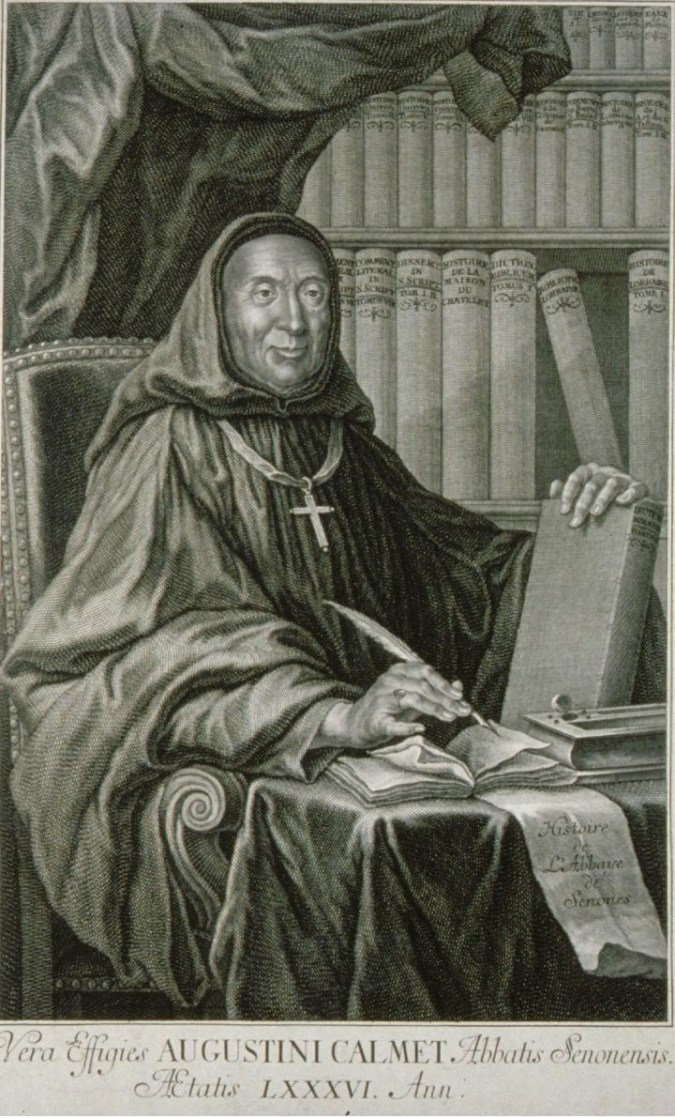
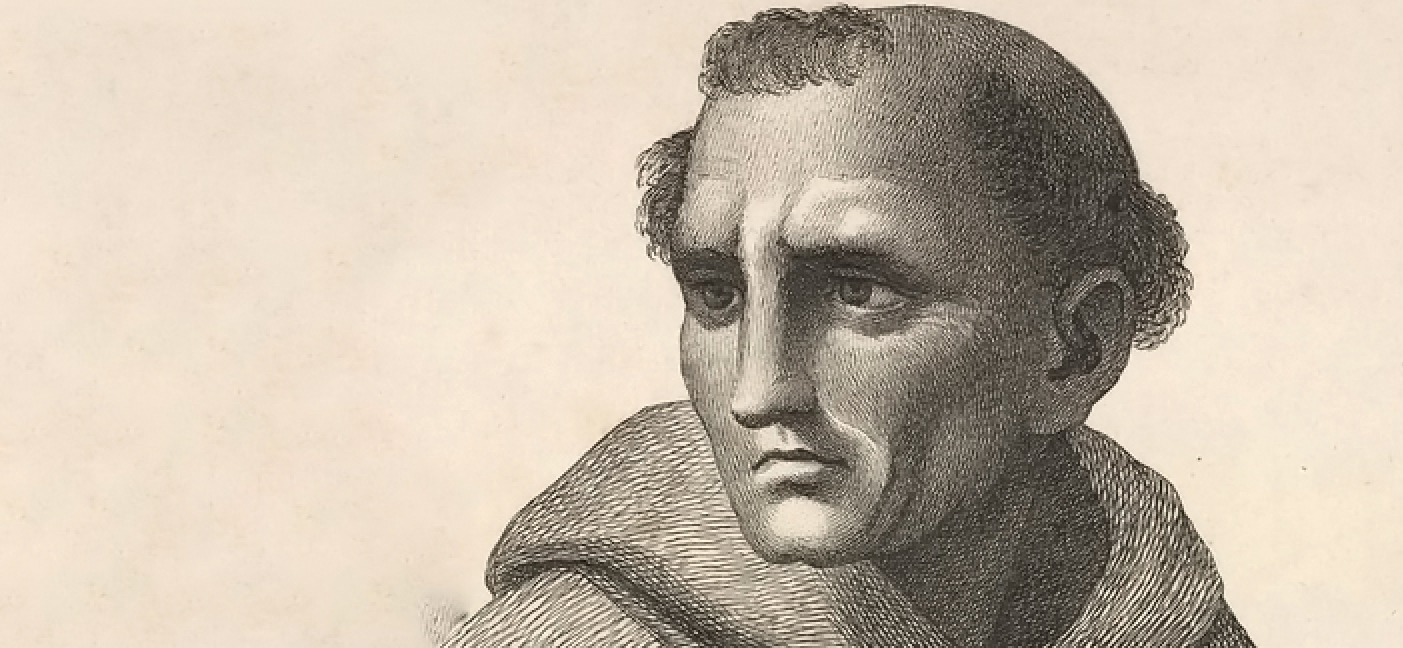
Vera Effigies Augustini Calmet Abbatis Senonensis. (Source).

I was recently asked by the administrator of Catholics from the Crypt to write a brief introduction to Dom Augustin Calmet, Abbot-General of the Congregation of St. Vanne. My qualifications for this task are minimal but, I think, sufficient. First, I know a little about Calmet, which is, sadly, more than many can say. He is an unfairly overlooked figure in our religious and cultural landscape. Secondly, I hope to write my Master’s Thesis on Calmet’s Histoire Universelle, though of course the actual process of research might change my direction. For the time being, I am glad of the challenge, and will likely turn this into the first of a series of short biographies of weird religious figures.

Dom Calmet, born on the 26th of February, 1672, in the then-Duchy of Bar (now Lorraine, France) had a long and impressive career. Entering religious life at the Benedictine Priory of Breuil, he moved around over the years to obtain his education at various abbeys. His itinerary reads like an honor roll of some of the finest establishments of the Franco-German monastic intelligentsia: St. Mansuy, St. Èvre, Munster, Mouyenmoutier, Lay-Saint-Christophe, St. Leopold. Yet the two monasteries most closely associated with his career are Senones Saint-Pierre and Vosges, where he eventually died a holy death.

He achieved widespread scholarly respect for his work in three different fields. First, Calmet distinguished himself as an Exegete. His Biblical method differed from more classical forms of exegesis by focusing entirely on the literal meaning of the text; this exposed him to criticism, even amidst the general acclaim which the book and its abridgements garnered.

DomCalmetTitlePageVampires

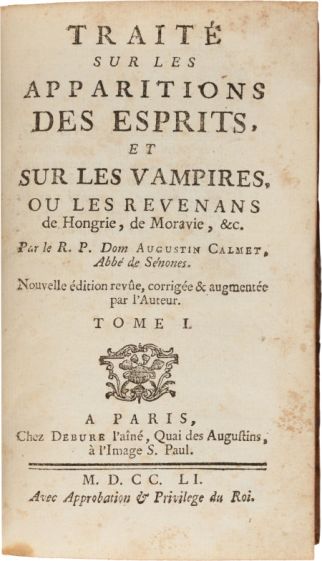
Title page of Book I of his most famous work on Vampires. (Source).

Second, he became an eminent author of sacred and profane history. While my own interest lies most heavily with his Histoire Universelle (1735-47), Calmet also devoted considerable attention to more specific topics. It should come as no surprise, given the libraries to which he had access, that he devoted special care to the region which bore him. His titles include History of the Famous Men of Lorraine (1750), Dissertation on the Highways of Lorraine (1727), Genealogical History of the House of Châtelet (1741), and posthumous histories of both Senones (1877-81) and Munster (1882).

However, Calmet achieved lasting fame for his extremely popular work on Vampires: first, Dissertations on the Apparitions of Angels, Demons, and Spirits, and on the Revenants and Vampires of Hungary, Bohemia, Moravia, and Silesia (1746) He later expanded the text into his famous Treatise on the Apparitions of Spirits and on the Vampires or Revenants of Hungary, of Moravia, &c. in 1752. These texts were, to the best of my knowledge, the first attempt to apply scientific rigor to the tales of the undead then current throughout Europe.

The books were a huge hit, and remain widely respected by occult writers today. To quote one source:

Re-released in 1748, with the most complete edition in 1751, this book is considered to be [the] authoritative treatment on the subject, containing an unprecedented collection of ghostly stories of revenants. It was a best seller for the period, quickly translated into German and Italian for a broader audience. Calmet’s tone considers the possibility of vampires with a certain ambiguity, possibly in light of the larger body of his publications for the church. Still, this is widely regarded as the starting point of all vampiric literature.


The work garnered critical attention from no less a figure than Voltaire. As that eminent source, Wikipedia, relates, Voltaire wrote of Calmet with no small astonishment:

What! It is in our 18th century that there have been vampires! It is after the reign of Locke, of Shaftesbury, of Trenchard, of Collins; it is under the reign of d’Alembert, of Diderot, of Saint-Lambert, of Duclos that one has believed in vampires, and that the Reverend Priest Dom Augustin Calmet, priest, Benedictine of the Congregation of Saint-Vannes and Saint-Hydulphe, abbot of Senones, an abbey of a hundred thousand livres of rent, neighbor of two other abbeys of the same revenue, has printed and re-printed the History of Vampires, with the approbation of the Sorbonne, signed by Marcilli!

[NB: translation is my own]

We can only imagine what conversation transpired between the two thinkers when Voltaire stayed at Senones in 1754, only a few years before the abbot’s death.

It is perhaps unusual that a monk who was, by all accounts, part of the same intellectual circles as the Maurist Enlighteners and the Philosophes would take to such a strange subject. Calmet certainly saw himself as partaking of that wider project. He writes in his preface to the Treatise,

My goal is not at all to foment superstition, nor to maintain the vain curiosity of Visionaries, and of those who believe without examination all that one tells them, as soon as they find therein the marvelous and the supernatural. I do not write but for those reasonable and unprejudiced spirits, who examine things seriously and with sang-froid; I do not speak but for those who do not give their consent to known truths but with maturity, who know to doubt things uncertain, to suspend their judgment in things doubtful, and to refute that which is manifestly false. (Calmet ii).

[NB: translation is my own]

Perhaps we should not be so surprised. After all, the religious history of Europe is peppered with eccentric and erudite men drawn to esoteric studies. And by the time that Dom Calmet died in 1757, the French monastics had not yet reached the height of their oddity. That would come later, with the well-traveled and thoroughly bizarre Swedenborgian and Martinist monk Antoine-Joseph Pernety, whom I hope to someday investigate more thoroughly.

The Revolution changed all that. No longer could monks live their lives freely, let alone attempt serious academic inquiry. It would take the genius of men like Dom Prosper Guéranger to restore the French Benedictines to their former glory.

800px-Senones_88_Saint-Gondelbert.jpg

Senones Abbey today. The monastery was dissolved by Revolutionary forces in 1793, then later sold off as State Property and converted into a textile mill. This desecration continued until 1993, when what was left of the abbey became a Monument historique. (Source).

Poem: “Passing a Cemetery Seen From a Train”

BellefonteCemetery

One of my ancestral cemeteries in Pennsylvania. (Source).

Alright, here’s another original piece. I think I’ve decided that I might as well publish a few things every now and then, since I seem to be getting a good response.

Passing a Cemetery Seen From a Train

We are not to count them,
the ones we make rare.
Nor should we come too close
stepping in would strip
the varnish from our eyes,
making us like them
too soon. No, let this hill
rise away from me,
spangled with the dead
and watered with the whispers
of those not yet able to speak.