A “Liturgical Voyage” to Port-Royal des Champs

Choral prayer at Port-Royal des Champs, Louise-Magdeleine Horthemels, Collection du Château de Versailles (Source)

Popular Catholic memory of Port-Royal, especially outside the Francophone world, is of a knot of disgruntled nuns who, in a spirit of disobedience to their lawful superior, refused to condemn the heresies of Cornelius Jansen. There are many problems with this unfair caricature, an inheritance of the final Ultramontane and Jesuit victory over Jansenism in the wake of the French Revolution. The truth is much more complicated, as truth tends to be. We too often forget that these nuns and the community of hermits, servants, and local peasants around them led a life of penance and prayer that was widely admired in their own time (even by saints, as Ellen Weaver notes, building on Louis Cognet and Augustin Gazier). The liturgical and devotional aspects of Port-Royal’s community life have too often been neglected by scholars and, especially, popular Catholic writers who turn their eyes to the Jansenists. We have fixated too much on the controversies of the 1640s-60s, and too little on what daily life was like for those who worked out their salvation in “fear and trembling” at Port-Royal.   

It is thus with great pleasure that I here co-publish an edifying and informative excerpt from the Voyages liturgiques of Jean-Baptiste Le Brun des Marettes, Sieur de Moléon, translated by the authors at Canticum Salomonis. They have already given an excellent overview of this text, in which they note that Marettes, educated at the Petites écoles de Port-Royal, retained something of a Jansenist liturgical sensibility. They sum up his work thus:

On the whole, the picture he paints is of a French people who are deeply engaged in their liturgical life and cathedral chapters that observe the whole office. His “taste” is for antiquity and ceremonial splendor, and this leads him to admire the pontifical liturgies of the middle ages. Admittedly, perhaps he does so because he believes them to be much more ancient than the extant source-books: expressions of the most ancient Gallic liturgies.

Aelredus Rievallensis, “The Voyages Liturgiques: A Roundup,” Canticum Salomonis

Their introduction to the translated chapter on Port-Royal, pages 234-43, follows with the text below. However, let me add a brief preface of my own.

The Voyages liturgiques offers several fascinating glimpses into the communal piety of Port-Royal des Champs. Marettes pays attention to the physical space of Port-Royal. He reports that the paintings in the church are by Philippe de Champaigne. The great French classicist had a daughter at the convent, Soeur Catherine de Saint-Suzanne, and seems to have provided the monastery with several portraits of both nuns and solitaires as well as several edifying works of art. The large altarpiece depicting the Last Supper is today in the Musée des Beaux-Arts de Lyon, with a copy in the Louvre. Marettes devotes particular attention to the epitaphs in and around the church. The epitaphs for the solitaires Emmanuel le Cerf, an Oratorian, and Jean Hamon, a medical doctor and mystic, are especially moving.

Yet it is the liturgical and communal details he provides here that are most exciting for the historian of Jansenism and which, in fact, force us to take the nuns more seriously as daughters of St. Benedict and St. Bernard. Following the egalitarian reform of Mère Angélique, the Abbey did not require dowries of its postulants. Singing the office according to the use of Paris, they prayed the whole Psalter every week. The first chapter of the Constitutions of Port-Royal is dedicated to veneration of the Blessed Sacrament, a significant organizational choice. There were in fact both communal and individual devotions to the Blessed Sacrament at Port-Royal; for, “in addition to engaging in perpetual adoration…they also have the custom of prostrating themselves before the Sacrament before going up to receive holy communion.” Following an ancient usage, they only exposed the Blessed Sacrament during the Octave of Corpus Christi, and even then, only after the daily High Mass. Usually, the Sacrament was reserved in a hanging pyx, “attached to the end of a veiled wooden fixture shaped like a crosier.” The French Jansenists seem to have had a fixation with hanging pyxes; both M. Saint-Cyran and M. Singlin wrote about “suspension” of the Blessed Sacrament in this form.
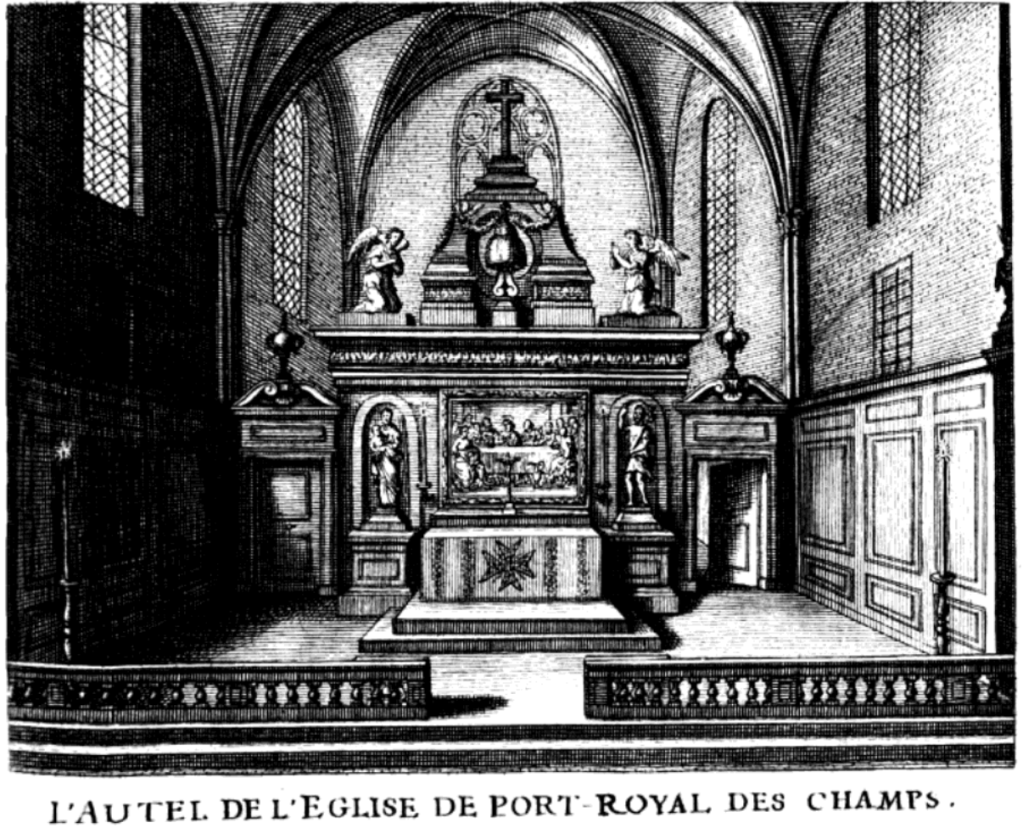
The High Altar at Port-Royal des Champs. You can see the hanging pyx at top. This engraving shows the depth of the apse, which was largely filled by a sacristy and which would have featured hidden stairs leading to the pyx. (Source)

The community would meet for chapter daily. The nuns engaged in an exacting and penitential adherence to the Rule, including silence, vegetarianism, abstinence from strong drink, and only a single meal per day in Lent. In their persons as in their ecclesiastical furniture, they followed the Cistercian spirit of holy simplicity; Marettes reports that “The nuns’ habits are coarse, and there is neither gold nor silver in their church vestments.” Yet they were not without the consolation of quiet reading in the garden during summertime.
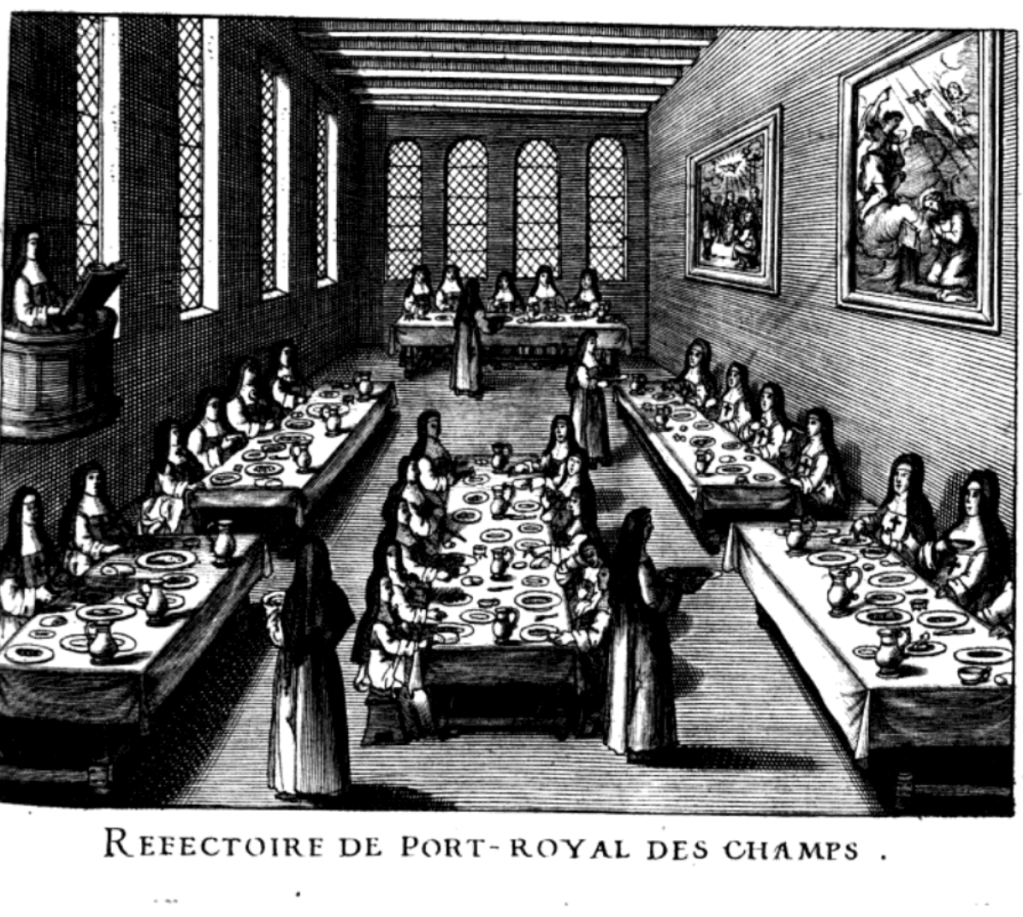
Although I have not been able to ascertain whether or not this engraving accurately reproduces the art on the walls of the monastery refectory, if it does, it evidences a strongly pneumatic spirituality. We see here twinned paintings of the Annunciation and the Descent of the Holy Spirit at Pentecost, including upon Our Lady of the Cenacle. (Source)

Marettes reminds us that Port-Royal was not just a community of nuns, but also included male hermits and domestics. He writes, “After the Credo, the priest descends to the bottom of the altar steps and blesses the bread offered by one of the abbey’s domestics.” These servants and workers seem to have had a special participation in the liturgy through this rite, so reminiscent of the blessing of bread found even today in the Eastern Churches. The Necrology of Port-Royal includes these men as well in its roll-call of the Abbey’s luminaries, confirming the sometimes-overlooked egalitarianism of Port-Royaliste spirituality.

One of the more striking moments in the text comes when Marettes writes that “On Sundays and feasts of abstention from servile work there is a general communion; at every Mass said in this church at least one of the nuns receives communion.” The practice of lay communion at every Mass contradicts the usual picture of the Jansenists receiving infrequently or as discouraging lay communion. The nuns themselves, at least, seem to have received the Sacrament daily.
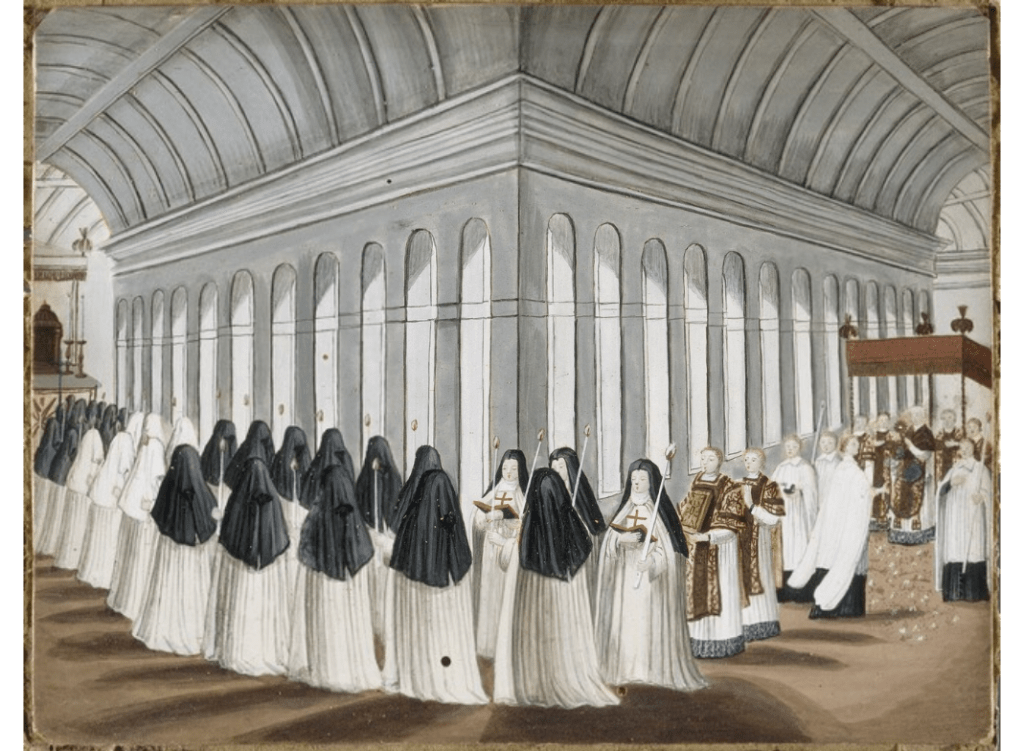
A Corpus Christi procession at Port-Royal des Champs, Louise-Magdeleine Horthemels, Collection du Château de Versailles (Source)

And I cannot help but see in one custom a potent metaphor for the troubled history of the monastery. Marettes writes, “On Holy Saturday, they extinguish the lights throughout the entire house, and during the Office they bring back the newly blessed fire.” The extraordinary and unjust persecution that the nuns endured under the authorities of the French Church and State – to the point of being deprived of communion during Easter, of being denied the last rites, of condemnation to a slow decline even after reconciliation with the Archbishop, and, at the very end, of having their bodies desecrated and even fed to the dogs – must have seemed like a very long Holy Saturday. Yet the blessed fire of the Holy Ghost does not abandon those who faithfully serve God in humble prayer and penitence. Where we find the Cross, Resurrection follows.

It is not for us to resurrect the nuns and solitaires of Port-Royal; historians can only do so much. But by taking the dead on their own terms, we can at least pay them the homage we owe any historical figure, and perhaps especially the defeated, the maligned, the powerless, and the forgotten. Only by doing so can we reckon with our implication in the longstanding myths that efface those voices. It is my hope that the publication of this important translation will help us in that process of revision.


In his monumental Institutions liturgiques, Dom Prosper Guéranger famously castigated the Neo-Gallican liturgies that proliferated in 17th and 18th century France for, inter alia, being products of Jansenist inspiration. Setting aside the question of whether these liturgies betray a heretical notion of predestination, it is true that many figures associated with the Jansenist movement did have a keen interest in the liturgy. Contrary to what one might expect given Dom Guéranger’s accusations, these “Jansenists” prized respect for ancient custom and repudiated needless novelty. 

The intellectual centre of Jansenism was the Abbey of Port-Royal, a community of Cistercian nuns who were reformed in the early 17th century by the formidable Abbess Angélique Arnauld and became noted for their exemplary religious observance and cultivation of liturgical piety. This attracted a number of intellectuals who chose to settle as solitaires on the abbey grounds, leading a retired life of study and simple manual labour, including Angélique’s brother Antoine, one of the most prominent Jansenist theologians. Both the nuns and solitaries set up schools to teach neighbouring children. 

One of those children was Jean-Baptiste Le Brun des Marettes, whom our readers will remember as the author of the Voyages liturgiques. His father had been sent to the galleys for publishing Jansenist works, and Jean-Baptiste himself once did a stint at the Bastille for his involvement in the controversy. His main interest, however, was not moral theology but liturgy. His Voyages evince his veneration for liturgical antiquity and opposition to modern developments in matters of ritual, furnishing, and vestments. Yet he found a way to reconcile such views with his enthusiasm for the Neo-Gallican reforms of the Mass and Office, ultimately sharing the hubristic certainty of most men of his age that their own putative enlightenment was able to improve upon “Gothic barbarism”. Our Aelredus has described and critiqued the seemingly contradictory tastes that Jean-Baptiste Le Brun shared with other Jansenist figures

With these remarks in mind, let us see how the liturgy was celebrated in the Jansenist stronghold of Port-Royal, in a chapter of the Voyages that Jean-Baptiste Le Brun wrote before the abbey’s suppression in 1708 and the destruction of most of its buildings. (Although the Voyages was published in 1718, Le Brun employs the present tense in this chapter.) 

We are obliged to the Amish Catholic for his help in translating this chapter.


Port-Royal-des-Champs is an abbey of nuns of the Order of Cîteaux lying between Versailles and the former monastery of Chevreuse.

The church is quite large, and its simplicity and cleanliness inspires respect and devotion. 

The main altar is not attached to the wall, since the ample and well-kept sacristy is located behind it. Above the altar hangs the holy pyx, attached to the end of a veiled wooden fixture shaped like a crosier. It is set under a large crucifix above a well-regarded painting of the Last Supper by Philippe de Champaigne.

There is nothing on the altar but a crucifix. The four wooden candlesticks are set on the ground at its sides.

The woodwork of the sanctuary and parquet floor is very well maintained, as is that of the nuns’ choir. Indeed, the stalls are kept in such good condition that one would think they were carved not twenty years ago, when in fact they are over 150 years old.1 

The church contains some paintings in the style of Champaigne, and a very well-kept holy water basin to the right of its entry.

Inside the cloister, there are several tombs of abbesses and other nuns. From these tombs one can garner

1. that the first abbesses of the Order of Cîteaux, following the spirit of St Bernard, did not have croziers. Even today, the Abbess of Port-Royal does not use one.

2. that in this monastery the nuns used to be consecrated by the bishop. Two of them are represented on the same tomb wearing a sort of maniple.2 See figure XIV. The inscription around the tomb reads:

“Here lie two blood-sisters, consecrated nuns of this abbey, Adeline and Nicole aux Pieds d’Estampes. May their souls rest in everlasting peace. Amen. Adeline died in the year of our Lord 1288.”3

There is an ancient necrology or obituary in this abbey that includes the ritual for the consecration or blessing of a nun. It describes how on these occasions the bishop celebrated Mass and gave communion to the nun he blessed. To this effect he consecrated a large host which he broke into eight particles, giving one as communion to the nun. He then placed the seven other particles of his host in her right hand, covered by a Dominical or small white cloth. During the eight days after her consecration or blessing, she gave herself these particles as communion. Priests also used to give themselves communion during the forty days after their ordination or consecration.4

Under the lamp by the baluster lies a tomb dated 1327, if I remember correctly, which is worthy of description, especially given that its most interesting aspect is misreported in the Gallia Christiana of the brothers de Sainte-Marthe. 

It used to be the custom for devout noble ladies to take up the nun’s habit during their last illness, or at least to be clothed in it after their death. See, for example, the tomb of Queen Blanche, mother of King St Louis, at Maubuisson Abbey near Pontoise. Here in Port-Royal we find the tomb of one Dame Marguerite de Levi—wife of Matthew V de Marly of the illustrious House of Montmorency, Grand-Chamberlain of France—buried in a nun’s habit, with this inscription: 

“Here rested, whose name thou shalt have there hereafter. Marguerite was the wife of Matthew de Marly, and daughter of the noble Guy de Levi. She bore six boys. After her husband died, she went to the nuns. Amongst the claustral sisters she chose to make her home. In her long rest, may she be buried in nun’s clothing. May eternal light shine upon her in peace everlasting. Year 1327.”5

By the door of the church, in the vestibule, is the tomb of a priest vested in his vestments. His chasuble is rounded in all corners, not cut or clipped, gathered up over his arms, and hanging down below and behind him in points. His maniple is not wider below than it is on top, and he does not wear his stole crossed over his breast, but straight down like bishops, Carthusians, and the ancient monks of Cluny, who have rejected innovation on this point. His alb has apparels on the bottom matching the vestments: this is what the manuscripts call the alba parata. They are still used in cathedral churches and ancient abbeys.

Next to the church door and the clock tower lies the small cemetery of domestics, where two epitaphs are worthy of note. 

“To God the Best and Greatest.

“Here lies Emmanuel le Cerf, who, after dedicating most of his life to the education of the people, deemed the evangelical life superior to evangelical preaching and, in order that he who had lived only for others should die to himself, embraced a penitential life in his old age as eagerly as he did seriously. He embraced the weight of old age, more conducive to suffering than aught else, and various diseases of the body as remedy for his soul and advantageous provision for the journey to eternity. Humbly he awaited death in this port of rest, living no longer as a priest but as a layman, and attained it nearly ninety years old. He died on 8 December 1674, and wished to be buried in this cemetery near the Cross. May he rest in peace.”6

And the other:

“Here rests Jean Hamon, doctor, who, having spent his youth in the study of letters, was eminently learned in the Greek and Latin tongues. Seeing that he flourished in the University of Paris by the renown of his eloquence, and that his fame grew daily for his skill of medicine, he feared the lure of flattery and fame and the haughtiness of life. Suddenly stirred by the prompting of the Holy Spirit, he quickly poured out the value of his inheritance into the bosom of the poor and, in the thirty-third year of his age, he dragged himself into this solitude, as he had long pondered doing. First he applied himself to the labour of the fields, then to serving the ministers of Christ, and soon returned to his original profession, healing the wounded members of the Redeemer in the person of the poor, among whom he honoured the handmaidens of Christ as the spouses of the Lord. He wore the coarsest garments, fasting nearly every day, slept on a board, spent day and night in nearly perpetual vigils, prayer, and meditation, nocturnal works everywhere breathing the love of God. For thirty-seven years he accumulated the toils of medicine, walking some twelve leagues every day, very often while fasting, to visit the sick in the villages, providing them what they might need, helping them by counsel, by hand, with medicines, with food whereof he deprived himself, living for twenty-two years on eating bran bread and water, which he ate secretly and alone, while standing up. As wisely as he had lived, considering every day his last, thus he departed this life in the Lord, amidst the prayers and tears of his brethren, in deep silence and sweet meditation of the Lord’s mercies, with his eyes, mind, and heart fixed on Jesus Christ, mediator between God and man, rejoicing that he obtained the tranquil death for which he had prayed, that he might gain eternal life, at the age of 69, on 22 February 1687.”7

Heeding the spirit of St Bernard, the nuns are subject to the Lord Archbishop of Paris, who is their superior. They also sing the office according to the use of Paris, except that they sing the ferial psalms every day in order to fulfill the Rule of St Benedict which they follow, and which binds them to saying the entire psalter every week. This they do with the approbation of the late M. de Harlay, Archbishop of Paris.
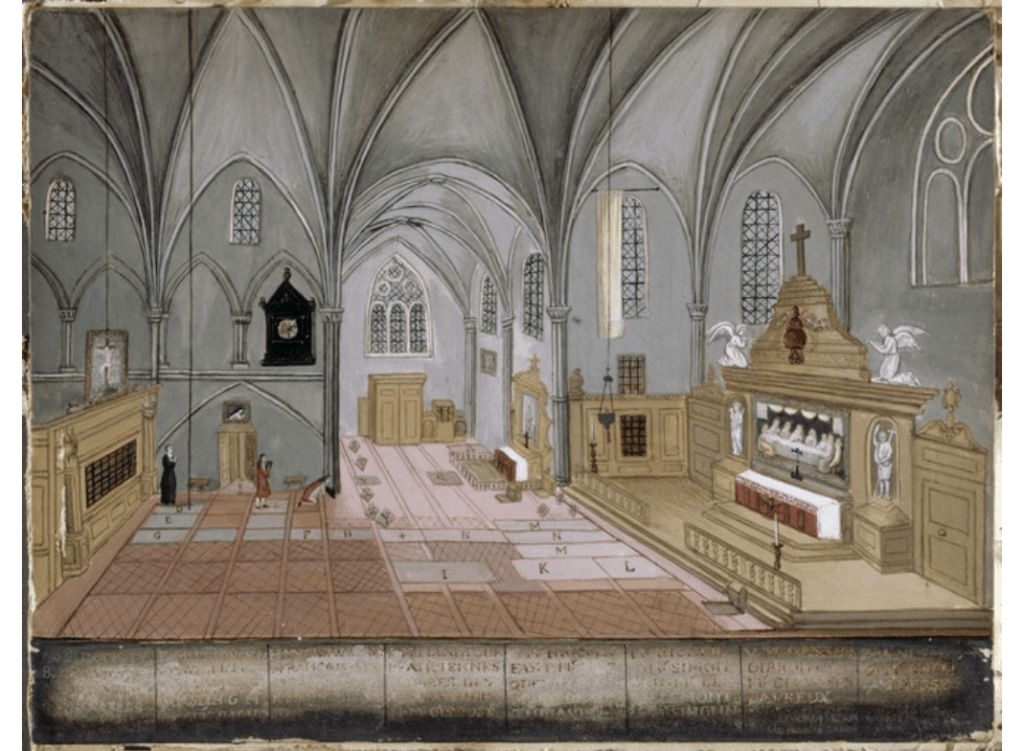
The High Altar, the chapel of St. Lawrence, and the front of the choir-grille at Port-Royal des Champs. Note the solitaires standing and kneeling in prayer – though there seem to be a few prie-Dieu here and there, there were no pews in this ancient church. Note as well the various burials in the floor of the church. Louise-Magdeleine Horthemels, Collection du Château de Versailles (Source)

At the blessing and aspersion of holy water on Sundays, the abbess and her nuns come forward to receive it at the grill from the priest’s hand. 

After the Credo, the priest descends to the bottom of the altar steps and blesses the bread offered by one of the abbey’s domestics. He then announces any feasts or fasting days during the coming week, and gives a short exhortation or explanation of the day’s Gospel.

At every High Mass of the year, the sacristan or thurifer goes to the nuns’ grill at the end of the Credo to receive, through a hatch in the screen, a box from the sister sacristan containing the exact number of hosts needed for the sisters who are to receive communion. He brings them to the altar and gives them the celebrant.

At High Masses for the Dead, the sacristan goes to the grill to receive the bread, a large host, and the wine in a cruet, and brings them to the altar. He gives the host to the priest on the paten, kissing it on the inside edge, and the cruet of wine to the deacon, who pours the wine into the chalice.

At the Agnus Dei, the nuns embrace and give each other the kiss of peace.

On Sundays and feasts of abstention from servile work there is a general communion; at every Mass said in this church at least one of the nuns receives communion.

Devotion for the most blessed Sacrament is so great in this monastery that in addition to engaging in perpetual adoration as part of the Institute of the Blessed Sacrament (it is for this reason that they have exchanged their black scapular for a white one charged with a scarlet cross over the breast, about two fingers in width and a half-foot tall), they also have the custom of prostrating themselves before the Sacrament before going up to receive holy communion. 

Nevertheless, the Blessed Sacrament is only exposed during the Octave of Corpus Christi, and this every day after High Mass. For here Mass is never said at an altar where the Blessed Sacrament is exposed. We will come back to this point.

The nuns of this monastery observe an exact and rigorous silence. Except in cases of illness, they never eat meat, and fish only rarely, about twelve or fifteen times a year. They solely drink water, and observe the great fast of Lent in its full rigour, as in the age of St Bernard, eating only at five in the evening after Vespers, which they usually say at 4 p.m., even though they wake up at night to sing Matins and perform manual labour during the day. 

A spiritual conference is held after lunch, during which they continue to work, and during which it is not permitted to speak aloud. 

During the summer, the nuns are sometimes allowed to go into the garden after dinner, but many refrain from doing so, and those that go do so separately, taking a book to read or some work to do.
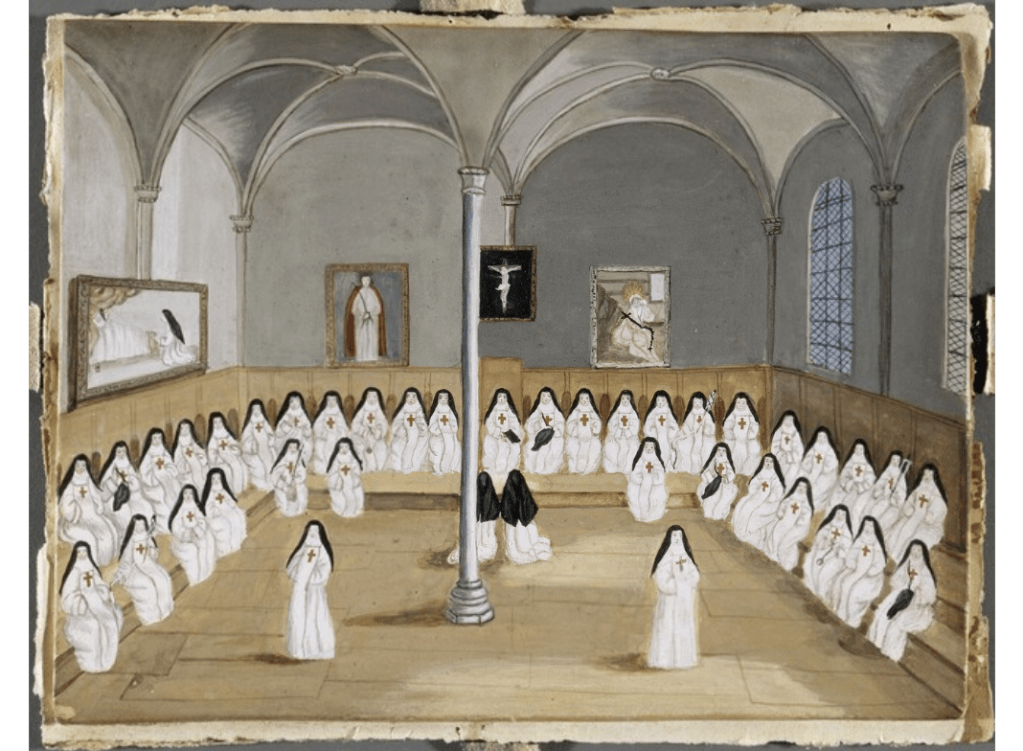
Daily chapter at Port-Royal. Note the various nuns knitting. M. Hamon likewise fond of knitting, and the later Jansenist “saint,” François de Pâris, was often depicted in his usual labor of weaving socks for the poor of Paris. Louise-Magdeleine Horthemels, Collection du Château de Versailles (Source)

Matins are said here at 2 a.m. together with Lauds, but in winter Lauds are said separately at 6 a.m, and then a Low Mass is celebrated between Lauds and Prime. During the rest of the year, Prime is said at 6 a.m., followed by a Conventual Low Mass. Chapter follows with a reading from the Martyrology, the Necrology, and the Rule, some chapter of which the Abbess explicates once or twice a week. Then they hold the proclamation of faults, and appropriate penances are imposed.

Terce is said at 8:30 a.m., followed by High Mass. Sext is at 11 a.m., and on ecclesiastical fast days at 11:45, after which they go to lunch, except in Lent when they do not dine, for in the Rule of St Benedict to lunch means not to fast. None is at 2 p.m. in winter and at 2:30 in summer.

The first bell for Vespers rings at 4 p.m., and the office begins some fifteen minutes later. It finishes at 5 or 5:15, for they sing very unhurriedly and distinctly. After Vespers in Lent, they sound the refectory bell, and the nuns go there to lunch and dine together. One sees nuns following this regime until they are 72 or 75 or even older. Not too long ago there was a priest who, in Lent, only ate in the evening, even though he was 87 years old, and lived till he was 92.

On Holy Saturday, they extinguish the lights throughout the entire house, and during the Office they bring back the newly blessed fire.

The nuns’ habits are coarse, and there is neither gold nor silver in their church vestments.

The Abbey receives girls without a dowry, and makes neither pacts or conventions for the reception of nuns, following the primitive spirit of their monastery, as is clear from the following acts:

“Be it known to all men that I, Eudes de Thiverval, esquire, and Thècle my wife gave in pure and perpetual alms, for the salvation of our souls and those of our ancestors, two bushels of corn, that is, one of winter-crop and the other of oats from our tithe-district of Jouy, to the Church of Our Lady of Port-Royal and the nuns serving God therein, to be collected every day on the feast of St Remigius. Be it known that the Abbess and Convent of the said place freely received one of our daughters into their society of nuns. Not wishing to incur the vice of ingratitude, we have given the said two bushels of corn in alms to the said House of our will without any pact. Which, that it may remain ratified and fixed, we have made to be confirmed by the support of our seal. Done in the year of grace 1216.”8

Another:

“Renaud, by the grace of God bishop of Chartres, to all who would earlier or later inspect the present page, in the Lord greeting. We make it known to all future and present that by these presents that the Abbess and Convent of Nuns of Porrois [i.e. Port-Royal] freely received in charity Asceline, daughter of Hugues de Marchais, esquire, as a sister and nun of God. Thereafter the said esquire, lest he should give away his said daughter to be betrothed to Christ without a dowry from part of his patrimony, standing in our presence did give and grant to the Church of Porrois and the nuns serving God therein in perpetual alms for the portion of his said daughter the return of one annual bushel of corn in his grange of Marchais or Lonville to be collected every year in the Paris measure of Dourdan, and three firkins of wine in his vineyard of Marchais to be collected yearly, and ten shillings in his census-district of Marchais. That his gift may remain ratified and fixed, at the petition of the same Hugues we have made the present letters to be confirmed by our seal in testimony. Done at Chartres in the year of the Incarnation of Our Lord 1217, in the month of April.”9

Another:

“Be it known to all them that I, Odeline de Sèvre, gave in pure and perpetual alms to the house of Port-Royal for the soul of my late husband Enguerrand of happy memory, and for the salvation of my soul, and of all my children and ancestors, and especially for the salvation and love of my daughter Marguerite who received the religious habit in the same house, four arpents of vine in my clos of Sèvre to be possessed in perpetuity. My sons Gervais the eldest, Roger, and Simon praised, willed, and granted this donation, to whom it belonged by hereditary right. And further we offered the same donation with the book upon the altar of Port-Royal. In testimony and perpetual confirmation whereof, since by said sons Gervais, Roger, and Simon were not yet esquires and did not yet have seals, I the said Odeline confirmed the present charter by the support of my seal with their will and convent. Done on the year of our Lord 1228.”10

  1. Author’s note: [After the Abbey’s suppression] the altar and choir stalls were purchased by the Cistercian nuns of Paris and placed in their church, where one can see them.
  2. Translators’ note: As did Carthusian nuns.
  3. Hic jacent duae sorores germanae, hujus praesentis Abbatiae Moniales Deo sacratae, Adelina et Nicholaa dictae ad Pedem, de Stampis quondam progenitae: quarum animae in pace perpetua requiescant. Amen. Obiit dicta Adelina anno Domini M. C. C. octog. octavo.
  4. Author’s note: See Fulbert. Epist. 2 ad Finard. Rituale Rotomag. ann. 1651.
  5. Hic requievit, ibi post cujus nomen habebis.
    Margareta fuit Matthæi Malliancensis
    Uxor; & hanc genuit generosus Guido Levensis.
    Sex parit ista mares. Vir obit. Petit hæc Moniales.
    Intra claustrales elegit esse lares.
    In requie multa sit Nonnæ veste sepulta;
    Luceat æterna sibi lux in pace suprema.
    Anno M. C. bis, LX. bis, V. semel, I. bis. 
  6. D. O. M.
    Hic jacet Emmanuel le Cerf, qui cum majorem vitæ partem erudiendis populis consumpsisset, vitam evangelicam evanglicæ prædicationi anteponendam ratus, ut sibi moreretur, qui aliis tantum vixerat, ad pœnitentiam accurrit senex eo festinantius, quo serius; pondusque ipsum senectutis, quo nihil ad patiendum aptius, et varios corporis morbos in remedium animæ conversos, tanquam opportunum æternitatis viaticum amplexus; mortem humilis, nec se jam sacerdotem, sed laicum gerens, in hoc quietis portu expectavit, quæ obtigit fere nonagenario. Obiit 8 Decembris 1674 et in Cœmeterio prope Crucem sepeliri voluit. Requiescat in pace.
  7. Hic quiescit Joannes Hamon Medicus, qui adolescentia in studiis litterarum transacta, latine græceque egregie doctus, cum in Academia Parisiensi eloquentiæ laude floreret, et medendi peritia in dies inclaresceret, famae blandientis insidias et superbiam vitæ metuens, Spiritus impetu subito percitus, patrimonii pretio in sinum pauperum festinanter effuso, anno ætatis xxxiij in solitudinem hanc, quam diu jam meditabatur, se proripuit. Ubi primum opere rustico exercitus, tum Christi ministris famulatus, mox professioni pristinæ redditus, membra Redemptoris infirma curans in pauperibus, inter quos ancillas Christi quasi sponsas Domini sui suspexit; veste vilissima, jejuniis prope quotidianis, cubatione in asseribus, pervigiliis, precatione, et meditatione diu noctuque fere perpetua, lucubrationibus amorem Dei undique spirantibus, cumulavit ærumnas medendi quas toleravit per annos xxxvj quotidiano pedestri xij plus minus milliarum itinere, quod sæpissime jejunus conficiebat, villarum obiens ægros, eorumque commodis serviens consilio, manu, medicamentis, alimentis, quibus se defraudabat, pane furfureo et aqua, idque clam et solus, et stando per annos xxij. sustentans vitam, quam ut sapienter duxerat, quasi quotidie moriturus, ita inter fratrum preces et lacrymas in alto silentio, misericordias Domini suavissime recolens; atque in Mediatorem Dei et hominum Jesum Christum, oculis, mente, t corde defixus, exitu ad votum suum tranquillo lætus, ut æternum victurus clausit in Domino, annos natus 69 dies 20 viij Kalend. Mart. anni 1687.
  8. Noverint universi quod ego Odo de Tiverval miles et Thecla uxor mea dedimus in puram et perpetuam eleemosynam, pro remedio animarum nostrarum et antecessorum nostrorum, Ecclesiae beatae Mariae de Portu-Regio et Monialibus ibidem Deo servientibus duos modios bladi, unum scilicet hibernagii, et alterum avenae in decima nostra de Joüy, singulis annis in festo S. Remigii percipiendos. Sciendum vero est quod Abbatissa et ejusdem loci Conventus unam de filiabus nostris in societatem Monialium benigne receperunt. Nos vero ingratudinis vitium incurrere nolentes, praedictos duos modios dictae jam domui de voluntate nostra sine aliquo pacto eleemosynavimus. Quod ut ratum et immobile perseveret, sigilli nostri munimine fecimus roborari. Actum anno gratiae M. CC. xvj.
  9. Reginaldus Dei gratia Cartonensis Episcopus, universis primis et posteris praesentem paginam inspecturis salutem in Domino. Notum facimus omnibus tam futuris quam praesentibus quod, quoniam Abbatissa et Conventus Sanctimonialium de Porregio Acelinam filiam Hugonis de Marchesio militis in sororem et sanctimonialiem Dei et caritatis intuitu gratis receperant, postmodum dictus miles in nostra constitutus praesentia, ne dictam filiam suam nuptam Christi parte sui patrominii relinqueret indotatam, Ecclesiae de Porregio et Monialibus ibi Deo servientibus dedit et concessit in perpetuam eleemosynam, pro portione dictae filiae suae unum modium bladi annui redditus in granchia sua de Marchesio vel de Lonvilla singulis annis percipiendum ad mensuram Parisiensem de Dordano, et tres modios vini in vinea sua de Marchesio annuatim percipiendos, et decem solidos in censu suo de Marchesio. Ut autem donum ejus ratum et stabile permaneret, ad petitionem ipsius Hugonis praesentes Litteras in testimonium sigillo nostro fecimus roborari. Actum Carnoti anno Dominicae Incarnationis M. CC. septimo decimo, mense Aprili.
  10. Noverint universi quod ego Odelina de Sèvre donavi in puram et perpetuam eleemosynam domui Portus-Regis pro anima bonae memoriae Ingeranni quondam mariti mei, et pro salute animae meae, et omnium liberorum et progenitorum meorum; et maxime pro salute et amore Margaretae filiae meae quae in eadem domo religionis habitum assumpserat, quatuor arpentos vineae in clauso meo de Sèvre jure perpetuo possidendos. Hanc autem donationem laudaverunt, voluerunt et concesserunt filii mei Gervasius primogenitus, Rogerus et Simon, ad quos eadem donatio jure hereditario pertinebat. Immo et ipsi eandem donationem obtulimus cum libro super altare Portus Regis. In cujus rei testimonium et conformationem perpetuam ego praedicta Odelina, quia praedicti filii mei G. R. et Simon necdum milites erant, et necdum sigilla habebant, de voluntate eorum et assensu praesentem Chartam sigilli mei munimine roboravi. Actum anno Domini M. CC. vigesimo octavo.
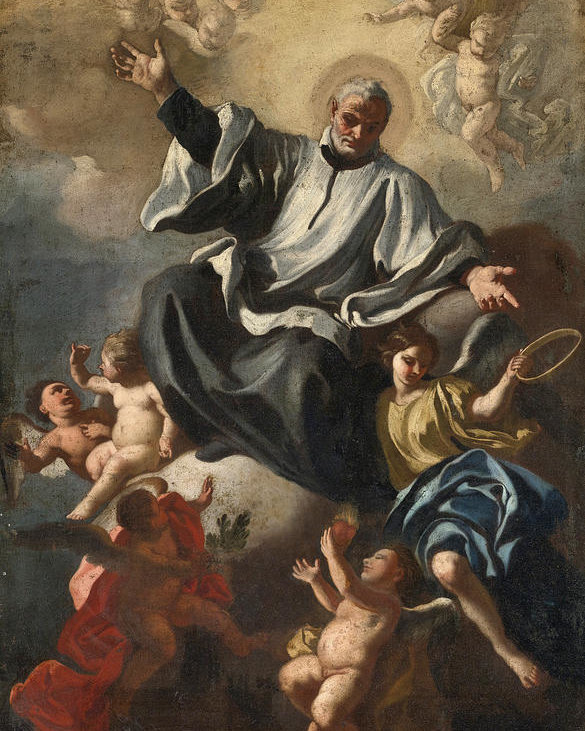

St Philip Neri and the Sick

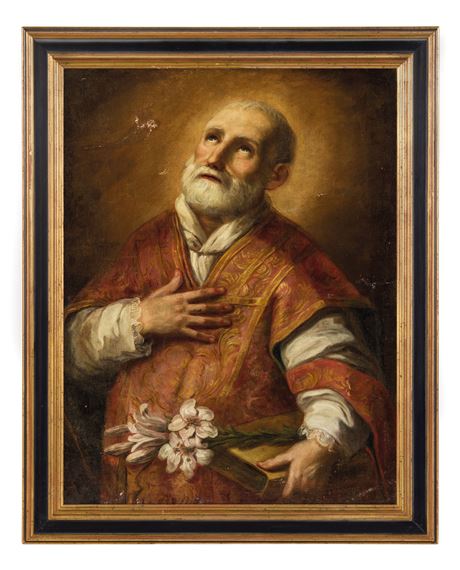
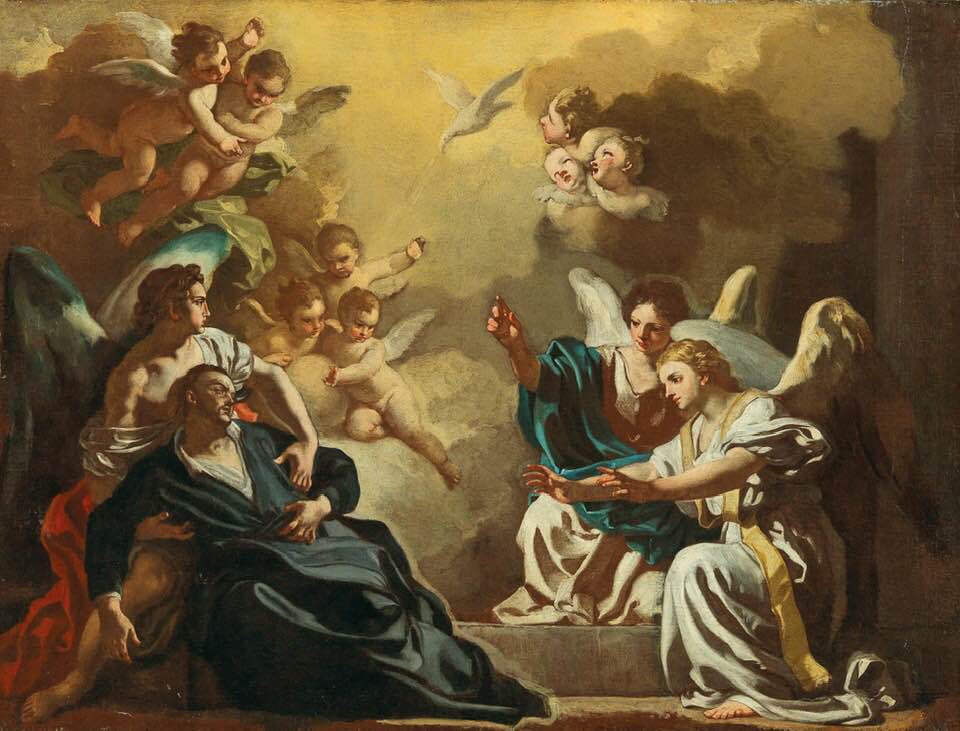
San Filippo Neri in Glory, Francesco da Mura (Source)

In this year of pestilence, I am reminded that St. Philip Neri began his good works in Rome by, among things, tending to the sick. The hospitals of sixteenth-century Italy were houses of profound mortification and little hope, not much more than palaces of death. They were chronically understaffed and overwhelmed with the indigent and the ill, who rarely recovered. The conditions were extremely unsanitary: the beds were filthy, the air putrid, the din of agony unremitting. Into these seething crowds of the desperate came St. Philip. He assisted the sick as best he could. His first biographer reports that, once he began to gather a following of disciples,

It was Philip’s custom on weekdays to divide his children in Christ into three or four groups and send them to the city hospitals. To begin with, he would himself go after dinner [lunch – RTY] to visit the sick in hospitals, to enkindle by his example in his followers a great desire to do this work; he would speak to the patients, tend them and do all sorts of things for them, which encouraged in his disciples an ardent desire to do the same. One example will serve to show you how devoted they were to the sick. Giovan Battista Salviati, being very dedicated, was in the hospital called the Consolazione, and headed straight for a patient intending to make his bed, asking him politely to get up so that he could do so. The patient thought he was being mocked. “No, my Lord,” he said, “don’t make fun of me, I’m a poor man.” He knew all about Giovan Battista’s licentious way of life, but was unaware of his marvellous change of character, by which he had wholeheartedly turned away from material concerns to the love of heaven. But what next? Giovan Battista urged him most earnestly, and the sick man was struck not only by his air of authority but even more so by his humility, and got out of bed, lost in admiration. Giovan Battista retained that style of life with an unwavering intent until the day of his death, and having once put his hand to the plough, he never looked behind him.

Antonio Gallonio, The Life of St. Philip Neri
Trans. Fr. Jerome Bertram Cong.Orat.

St. Philip inspired others to help the sick in whatever way the could manage. These works of mercy were the fruit of the genuine conversion he wrought in their hearts by that peculiar influence he possessed. The palpable indwelling of the Holy Ghost in his heart turned him into a living fountain of graces whose streams brought miracles to many souls. Some of these miracles healed the sick and even raised the dead. Yet we must never forget that it was not these extraordinary moments but, rather, the graces of repentance, of conversion, and of final perseverance that were truly the greatest fruits of St. Philip’s particular sanctity. St. Philip’s true fame rests in those whom he carried with him to Heaven, not in the strange and marvelous works that he effected while on earth. The story of Giovan Battista Salviati is one example among many of those who tasted of such sweet fruits. He actualized the grace of his conversion through works of charity towards the sick.

Subsequent writers have retained this act as a sine qua non of the Oratorian life, and then only because St. Philip so clearly demonstrates how essential it is to the Christian life per se.

The Vision of St. Philip Neri, Florentine School, 17th c. (Source)

And it seems to me that on this, St. Philip’s feast day, we would be well-advised to do the same. We find ourselves in the midst of a new and terrifying pandemic. Death is everywhere. In the United States alone we have lost 100,000 souls with almost no public mourning. Many of these people have died alone, afraid, in pain, and deprived of the comfort of God’s Church. The nature of the disease means that most of us cannot actively assist in the hospitals for fear of transmission. All we can do is show kindness to our neighbors, help each other obtain the necessary supplies to stop the spread of the disease, and give blood if we have survived the sickness ourselves. That’s as far as practical action goes for most of us. So much for the corporal works of mercy.

But a Christian is never without a way to directly help his brethren. The first and last resort of the faithful must be prayer. Here, too, we can take St. Philip as our model. Lest we place too much emphasis on St. Philip’s merely material acts in visiting the sick, let us turn to the testimony of Giuseppe Crispino,

When we enter a sick-chamber, let us imitate the holy Father Philip, who was accustomed, immediately upon his arrival, to pray for the patients in their own room and to make the bystanders do the same, especially in the case of the dying. The Saint was also accustomed to retire into another room, and there to pray for the sufferer.

Giuseppe Crispino, The School of Saint Philip Neri, pg. 174
Trans. Frederick William Faber

As I have written elsewhere, we must offer intercession for our suffering fellows now more than ever. And we must do so in union with the whole communion of saints. Indeed, one small blessing of this crisis is that it can, if we let it, draw us closer to the “great cloud of witnesses” ever ready to help us. One of St. Philip’s spiritual sons, Fr. Agostino Manni, made special prayers to the Blessed Virgin whenever he went to the hospitals; the Blessed Juvenal Ancina likewise sought the prayers of the living when he ministered to the sick (Crispino 174-76). And that most perfectly Philippine of English Oratorians, Fr. Faber, conceives of intercession for the dying as an intrinsically Marian act. He tells us that

We learn [a lesson] from Mary about the deaths of others. It is, that devotion for those in their last agony is a Mary-like devotion, and most acceptable to her Immaculate Heart. There is not a moment of day or night in which that dread pomp of dying is not going on. There are persons like ourselves, or better than ourselves, and whose friends have with reason loved them more than ever ours have loved us, who are now straitened in their agony, and whose eternal sight of God is trembling anxiously in the balance. Can any appeal to our charity be more piteously eloquent than this?…Are not the dying our brothers and our sisters in the sweet motherhood of Mary? The family is concerned. We must not coldly absent ourselves. We must assist in spirit at every death that is died in the whole world over, deaths of heretics and heathens as well as Christians. For they, too, are our brothers and sisters; they have souls; they have eternities at stake; Mary has an interest in them…How much more must they need prayers, who have no sacraments!…How much more earnest must be the prayers, when not ordinary grace, but a miracle of grace, must be impetrated for them!

Fr. Frederick William Faber, The Foot of the Cross

I cannot help but hear a ringing call to intercession for our own times in these words of Fr. Faber. A greater and more fearsome calamity of general death demands a greater and more dedicated oblation of prayer. Especially when even our brethren in the Faith are so often deprived of the Sacraments that should be their final stay and consolation. Yet the power of God to furnish extraordinary grace is far mightier than any earthly sickness. Healing, protection, mercy, conversion, and consolation: let us boldly ask for these gifts on behalf of the ill, the dying, the dead, their caregivers, and their families…while we still can. The hour is late. Tomorrow we may be struck ill with the dread and deadly pestilence. And then, our every thought diverted, our breath failing, our bodies plunged into the depths of a fatigue from which we shall never rise again, we will be grateful for those pious souls who lift us up to the face of the Father in prayer.

So let us pray while we still can. If we do this in a spirit of charity, we will become true Sons and Daughters of St. Philip and more perfectly emulate the Divine Physician who desires to heal us in soul as well as in body.

May St. Philip Neri pray for us all in this troubled time.

St. Philip Neri, Italian School, 18th c. (Source)

New Chant from Silverstream

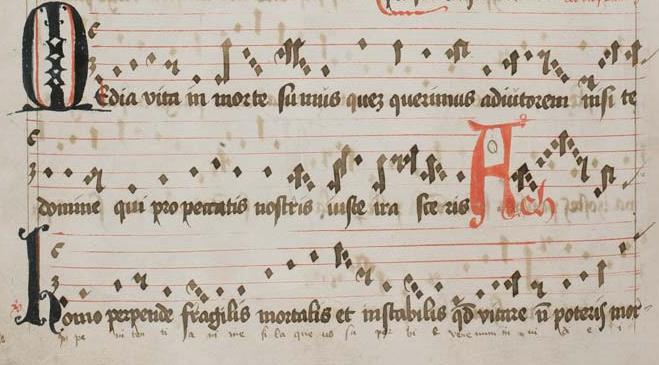
“In the midst of life we are in death” (Source)

I must refer my readers to a new recording of some Gregorian chant from Silverstream Priory. The beautiful responsory, Media Vita, is very timely during this pandemic. Here is the translation, passed on by the Prior:

In the midst of life we are in death; from whom shall we seek help, save Thee, O Lord? Who for our sins art justly angered. * Holy God, Holy mighty One, Holy merciful Saviour, hand us not over to the bitterness of death.

1. In Thee our fathers hoped; they hoped, and Thou hast liberated them. * Holy God, Holy mighty One, Holy merciful Saviour, hand us not over to the bitterness of death.

2. To Thee our fathers cried; they cried and were not confounded. * Holy God, Holy mighty One, Holy merciful Saviour, hand us not over to the bitterness of death.

3. Glory be to the Father, and to the Son, and to the Holy Ghost. * Holy God, Holy mighty One, Holy merciful Saviour, hand us not over to the bitterness of death.

Translation of the Media Vita

I know I speak for the monks when I encourage you to give it a listen and take some comfort from this ancient prayer of the Church in a time when death is all around.

I would particularly note the highly idiosyncratic harmonic arrangement used here. I have not heard any other renditions of this chant like it. I grew up listening to the Benedictines of Santo Domingo do Silos, and although I like their hauntingly pure Media Vita, the Silverstream version has a complexity and depth that feels very different, if just as moving.

The accompanying film is also of very high quality. I have known the monks of Silverstream for six years. This is by far the best video I’ve seen from them. It does a good job capturing the peculiar beauty of that monastery in Springtime, as well as the powerful sense of holiness that radiates throughout the house and grounds from the Blessed Sacrament. And for those who care about such things, there’s a lovely conical requiem chasuble from 3:23 on.

Give it a listen, and please consider supporting the monks through a donation or by shopping at their excellent online store. The monks are streaming their masses and some of their offices throughout this crisis, and I recommend following them for what will no doubt be a stirring and holy Paschal Triduum (albeit at a distance).

A Litany in Time of Plague

A depiction of the Madonna and Child with Patron Saints against the Plague. Colored engraving by T. Van Merlen. (Source)

“Is it my will that a sinner should die, saith the Lord God, and not that he should be converted from his ways, and live?” – Ezekiel 18:23 DRA.

In Nomine Patris et Filii et Spiritus Sancti, Amen.

Stella Caeli extirpavit, quae lactavit Dominum:
mortis pestem quam plantavit primus parens hominum.
Ipsa stella nunc dignetur sidera compescere
quorum bella plebem caedunt dirae mortis ulcere.
O piisima Stella Maris, a peste succurre nobis.
Audi nos, Domina, nam filius tuus nihil negans te honorat.
Salva nos, Jesu, pro quibus virgo mater te orat.

Kyrie Eleison
Christe Eleison
Kyrie Eleison

God the Father Almighty, Maker of Heaven and Earth, have mercy on us.
God the Son, Redeemer of the World, have mercy on us.
God the Holy Ghost, Sanctifier and Vivifier of All Things, have mercy on us.

Holy Mary, Mother God, pray for us.
Our Lady, Queen of Heaven, pray for us.
Our Lady of Sorrows, pray for us.
Our Lady, Help of Christians, pray for us.
Our Lady, Health of the Sick, pray for us.
Our Lady, Salvation of the Roman People, pray for us.
Our Lady, Star of the Sea, pray for us.
Our Lady, Untier of Knots, pray for us.
St. John the Baptist, pray for us.
St. Joseph, pray for us.
St. Mary Magdalene, pray for us.
St. Michael and All Angels, pray for us.
St. Thecla, pray for us.
St. Valerian, pray for us.
St. Corona, pray for us.
SS. Cosmas and Damian, pray for us.
St. Zacharias of Jerusalem, pray for us.
St. Roch, pray for us.
St. Sebastian, pray for us.
St. Christopher, pray for us.
St. Adrian, pray for us.
St. Blaise, pray for us.
St. Macarius of Ghent, pray for us.
St. Patrick, pray for us.
St. Pantaleon, pray for us.
St. Dymphna, pray for us.
St. Rosalia, pray for us.
St. Anthony of Egypt, pray for us.
St. Benedict, pray for us.
St. Gregory, pray for us.
St. Bernardine of Siena, pray for us.
St. Anthony of Padua, pray for us.
St. Philip Neri, pray for us.
St. John Nepomuk, pray for us.
St. Charles Borromeo, pray for us.
St. Camillus of Lellis, pray for us.
St. Aloysius Gonzaga, pray for us.
St. Damien of Molokai, pray for us.
St. Thérèse of Lisieux, pray for us.

O Sacred Heart, Furnace of Charity, have mercy on us.
Lamb of God, Who takest away the sins of the world, spare us, O Lord.
Lamb of God, Who takest away the sins of the world, graciously hear us, O Lord.
Lamb of God, Who takest away the sins of the world, have mercy on us.

O Crux, ave spes unica
hoc Passionis tempore!
Piis adauge gratiam
reisque dele crimina.

We beseech Thee O Lord, in Thy compassion, to turn away from Thy People Thy wrath, which indeed we deserve for our sins, but which in our human frailty we cannot endure; therefore embrace us with that tenderness which Thou art wont to bestow on the unworthy; through Jesus Christ our Lord.

Gloria Patri, et Filio, et Spiritui Sancto,
Sicut erat in principio, et nunc, et semper, et in saecula saeculorum.
Amen.

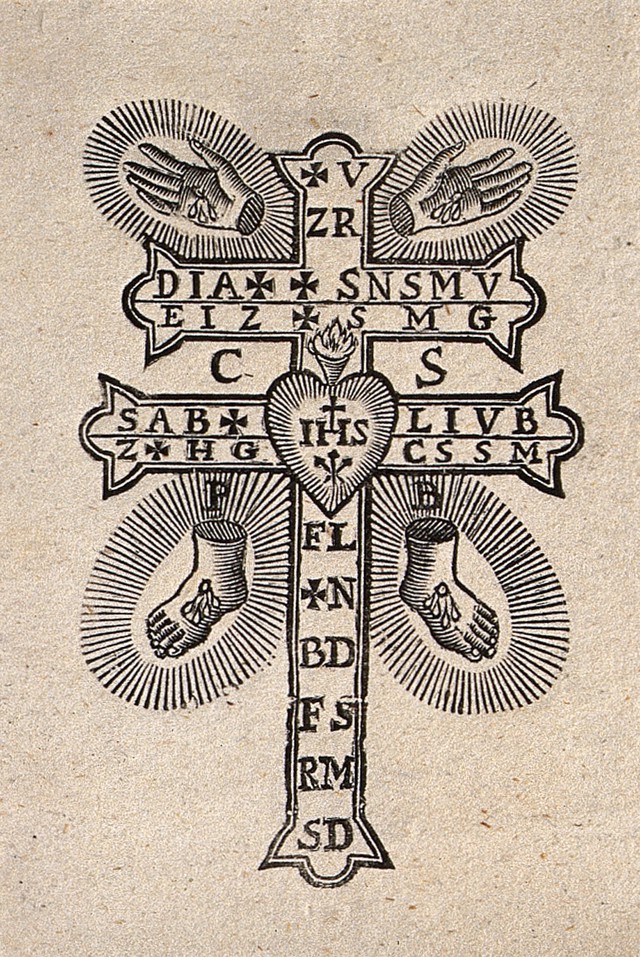
A plague cross. (Source)

St. Philip Neri and the God Who Dwells With Men

The Vision of St. Philip Neri, Giovanni Camillo Sagrestani (Source)

“Behold the tabernacle of God with men, and he will dwell with them. And they shall be his people; and God himself with them shall be their God.” – Revelation 21:3

St. Philip’s feast always falls within that sunny period of the Church’s year when, passing from Easter to Ascensiontide and following on to Pentecost and Corpus Christi, we find our days running over with the majesty of these great mysteries. The days grow longer, and so they seem to grow more golden with the ever-descending light of the Holy Ghost. We are in a season of peculiar glory. The culminating lesson of these mysteries is clear: God has made his dwelling among men, and in the midst of His people shall He reign.

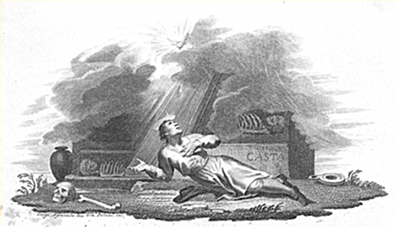
St. Philip receives the Holy Ghost while at prayer in the catacombs. (Source)

St. Philip knew this truth well. His whole life could well be described as a journey between Pentecost and Corpus Christi, the two feasts that most clearly teach us of God’s enduring presence in His Church. It was on the Vigil of Pentecost, 1544, that St. Philip received the grace that would define his vocation and the character of his sanctity. While praying in the catacombs of San Sebastiano, the Holy Ghost descended into St. Philip’s heart visibly and sensibly in the form of a ball of fire. This experience, which provided as much heat and pain as rapturous joy, marked the true beginning of St. Philip’s active ministry. In St. Philip, the Holy Ghost once again made His dwelling among men.

St. Philip Neri Receiving the Holy Spirit in the Catacombs of St. Sebastian, Francesco Solimena (Source)

From then on, St. Philip’s whole life would be marked by a singular union with the Holy Ghost. He became the “tabernacle of the Most High” and a living fountain of graces. His many miracles testify to the indwelling of the Spirit within him. So does his manifest oddity, his clear and salutary estrangement from the ways and works of ordinary men. The prophet writes, “For my thoughts are not your thoughts: nor your ways my ways, saith the Lord.” So does the Holy Ghost speak from the heart of St. Philip. For this reason, the Church applies the words of St. Paul to the new Apostle of Rome:

The love of God has been poured into our hearts
through the Spirit of God dwelling within us

Introit for the Feast of St. Philip Neri

St. Philip’s priestly life was marked by the overwhelming presence of God. Everything about him spoke to the present reality of the supernatural. This reality took two chief forms. The most famous were the astounding miracles wrought by St. Philip – most notably the raising of Prince Paolo Massimo from the dead. But there was also St. Philip’s profound adoration of the Eucharist. His popularization of the Forty Hours’ Devotion was but the visible extension of his love of the Blessed Sacrament. So too were the Eucharistic ecstasies to which he was increasingly susceptible as he became older. St. Philip knew no sweeter hours than those that he spent at Mass as an old man, kneeling in darkness before the altar, lost in the rarefied heights of a contemplation we can barely begin to fathom.

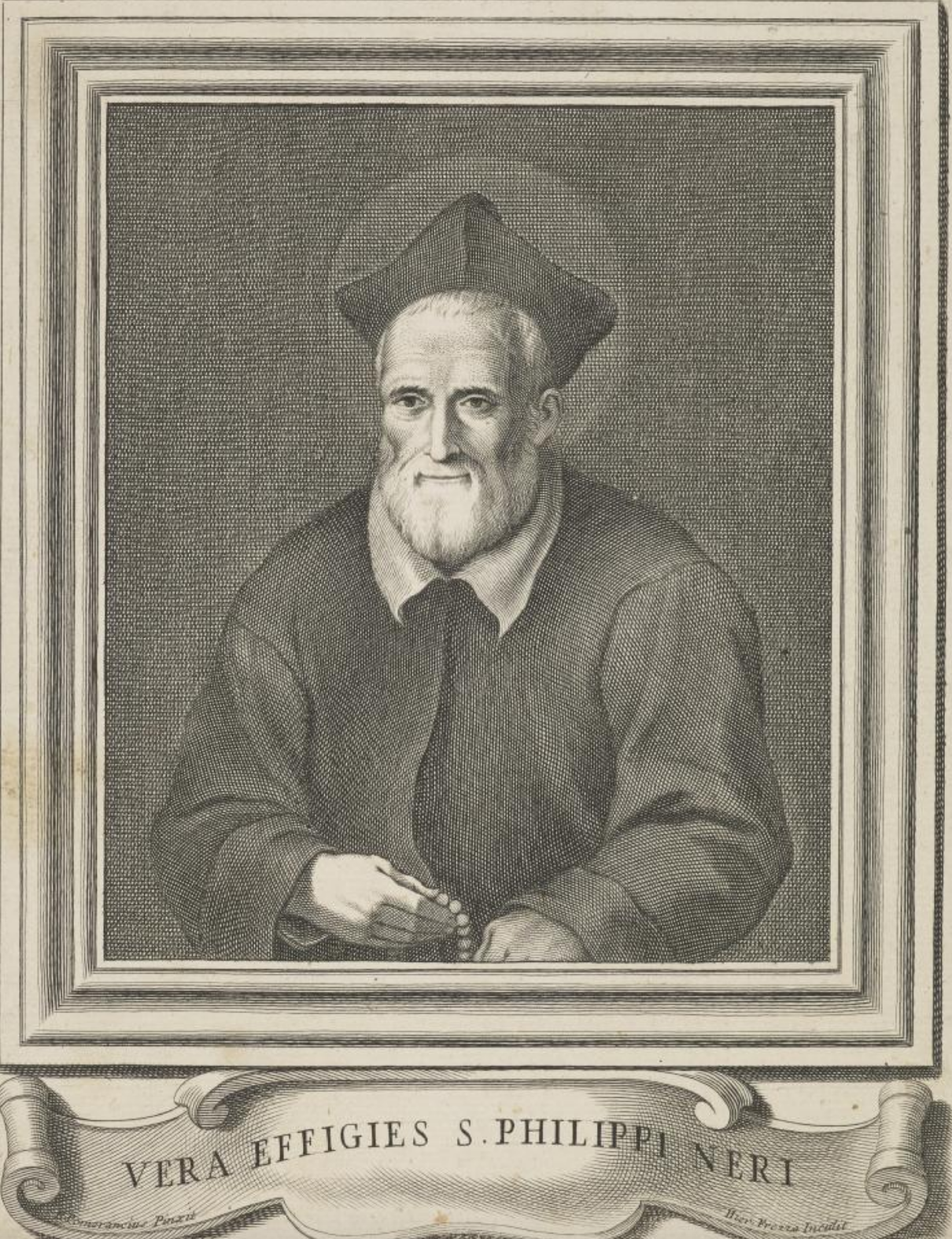
Engraving of St. Philip Neri, Hieronymus Frezza (Source)

One particularly perceptive observer has written:

In recalling the holiness of Saint Philip, it occurs to me that it was essentially this: he was all priest. He was always and everywhere a priest. His priesthood suffused his very being, making him incandescent with the fire of the Cross and of the altar.

Vultus Christi

St. Philip’s extraordinary endowment with the Spirit was ordered towards his life as a priest – namely, towards the glory of God in the Eucharist. This is the case with all of us. The Spirit, God in us, is given precisely for us to receive the Eucharist, God with us. Confirmation, like all the other sacraments, exists with the Eucharist as its proper telos.

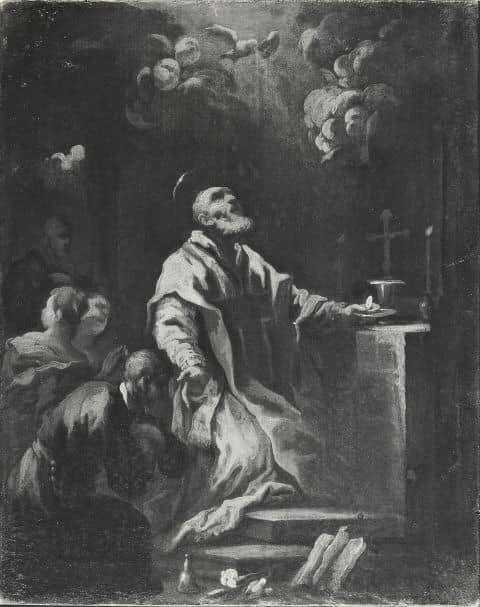
The Mass of St. Philip Neri, Circle of Giovanni Battista Piazzetta (Source)

How fitting, then, that St. Philip should pass into eternal life when he did. May the 25th, 1595, was the feast of Corpus Christi. As Fr. Faber has it,

Day set on Rome! its golden morn
Had seen the world’s Creator borne
Around St. Peter’s square
Trembling and weeping all the way,
God’s Vicar with his God that day
Made pageant brave and rare!

“St. Philip’s Death,” F.W. Faber

Providence often grants the saints a Christ-like death. It is a sign that, even in suffering and death, God is still dwelling with us. St. Benedict died in choro during a liturgy, just as Christ died in the fulfillment of His high priesthood. Many martyrdoms were accompanied by strange signs and mystical evocations of the Sacrifice of Christ. It should be no surprise that God would take St. Philip in a similarly edifying manner.

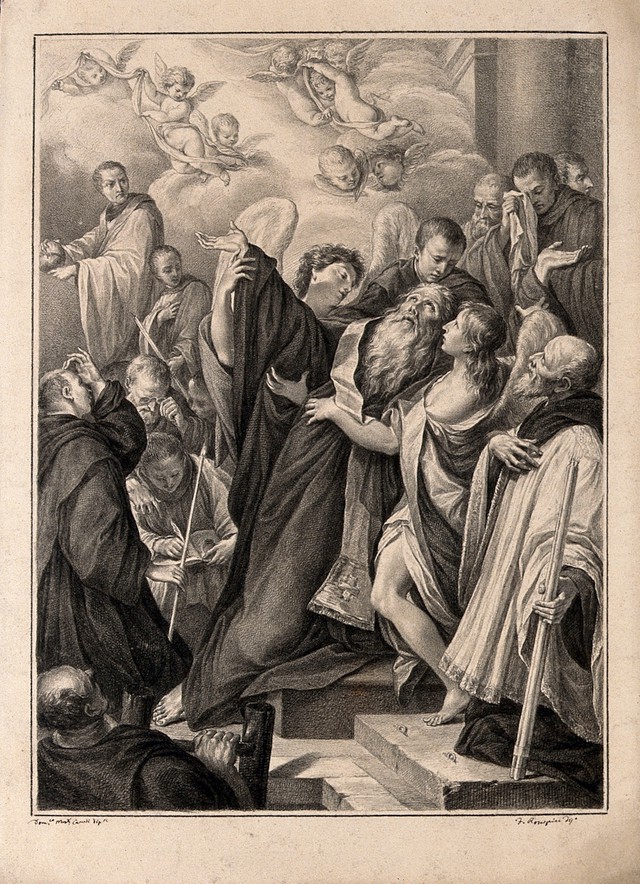
The Death of St. Benedict, F. Rosaspina, 1830, after D.M. Canuti. (Source)

In his death, St. Philip reminds us that we are all meant to imitate Christ in His Sacrifice, that is, in the Blessed Sacrament. There is no more perfect pedagogue in the life of the Spirit than the Son, who has presented Himself to us on all the altars of the world. Would that we might take this lesson to heart!

St. Philip died when he did because, by a singular grace of Providence, God was pleased to mark His servant’s passing with the Church’s celebration of the Most Holy Sacrament of the Altar. Just as St. Philip honored the Eucharistic God in his life, so did the Eucharistic God honor him in his death.

We, too, can honor the saint best by cleaving to the Lord. St. Philip’s words to a spiritual daughter are as true today as they once were:

“Let us concentrate ourselves so completely in the divine love, and enter so far into the living fountain of wisdom, through the wounded Side of our Incarnate God, that we may deny ourselves and our self-love, and so be unable to find our way out of that Wound again.”

St. Philip Neri

God dwells with us just as He once dwelt in the blessed heart of St. Philip. He comes to us just as He came once to the priestly hands of St. Philip. Let us abide in Him, just as St. Philip did once and does forevermore in the heights of Heaven.

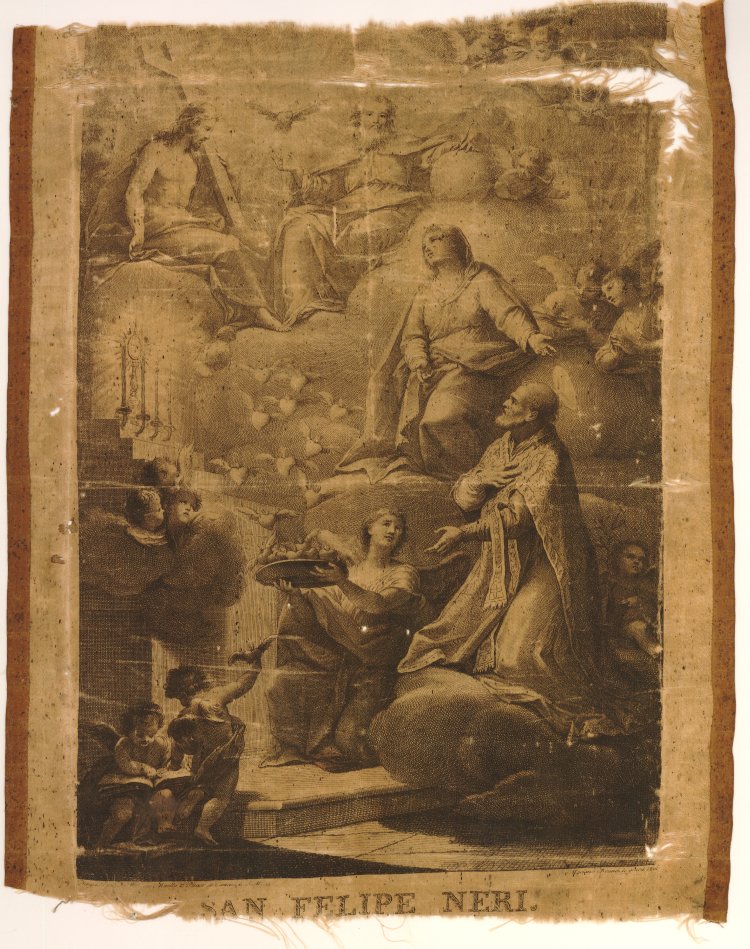
Votive image of St. Philip Neri from the British Museum. As they have it: “St Philip Neri kneeling on a cloud in front of altar; angel to right holding tray with burning hearts and ascending towards Holy Trinity; Virgin Mary mediating surrounded by angels, after Maella. 1801 Engraving, printed on silk.” Note the Eucharist enthroned in a monstrance. (Source)

The Funerary Rites of James II

sacraexequialiai00aqui_00062.jpg

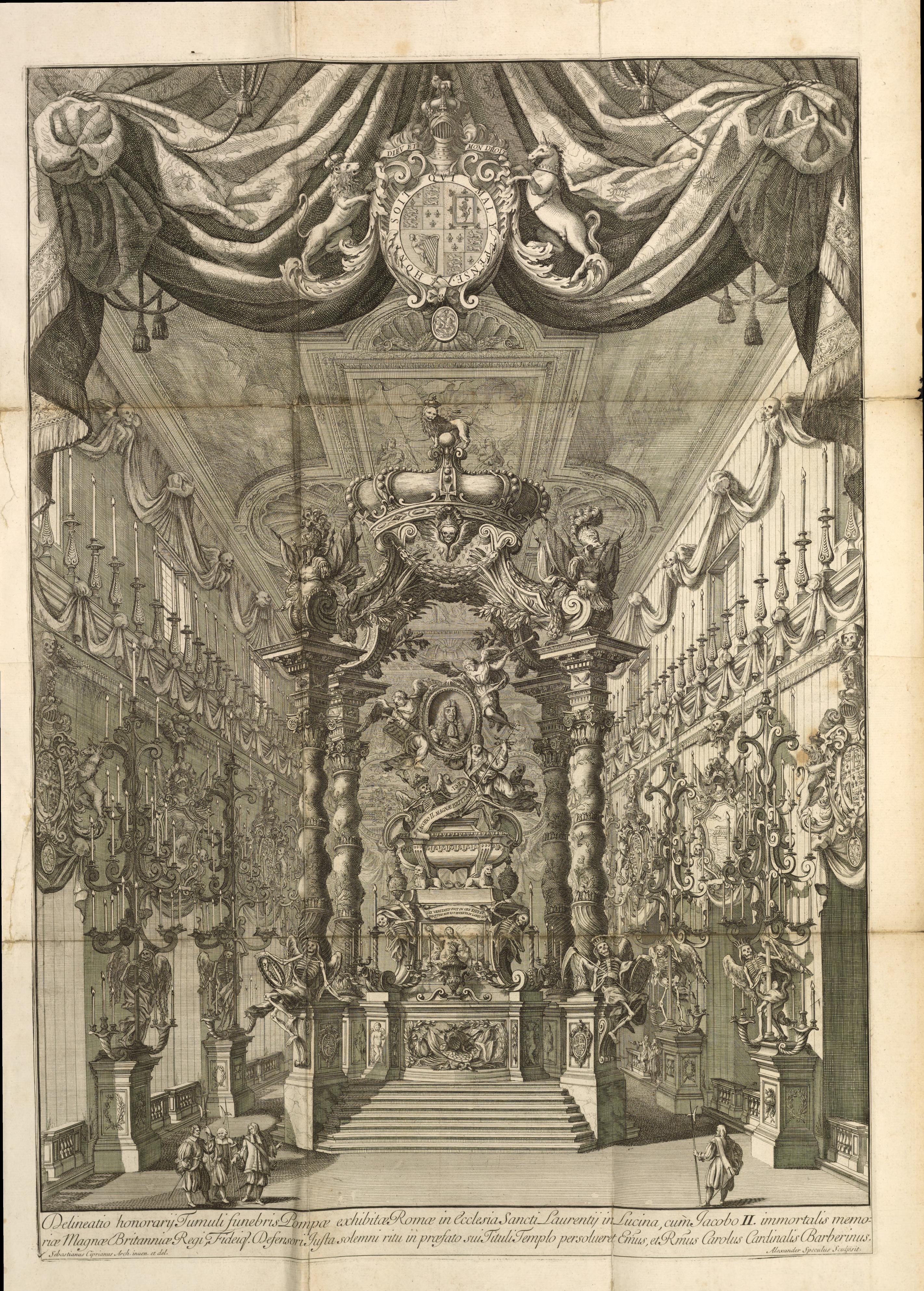
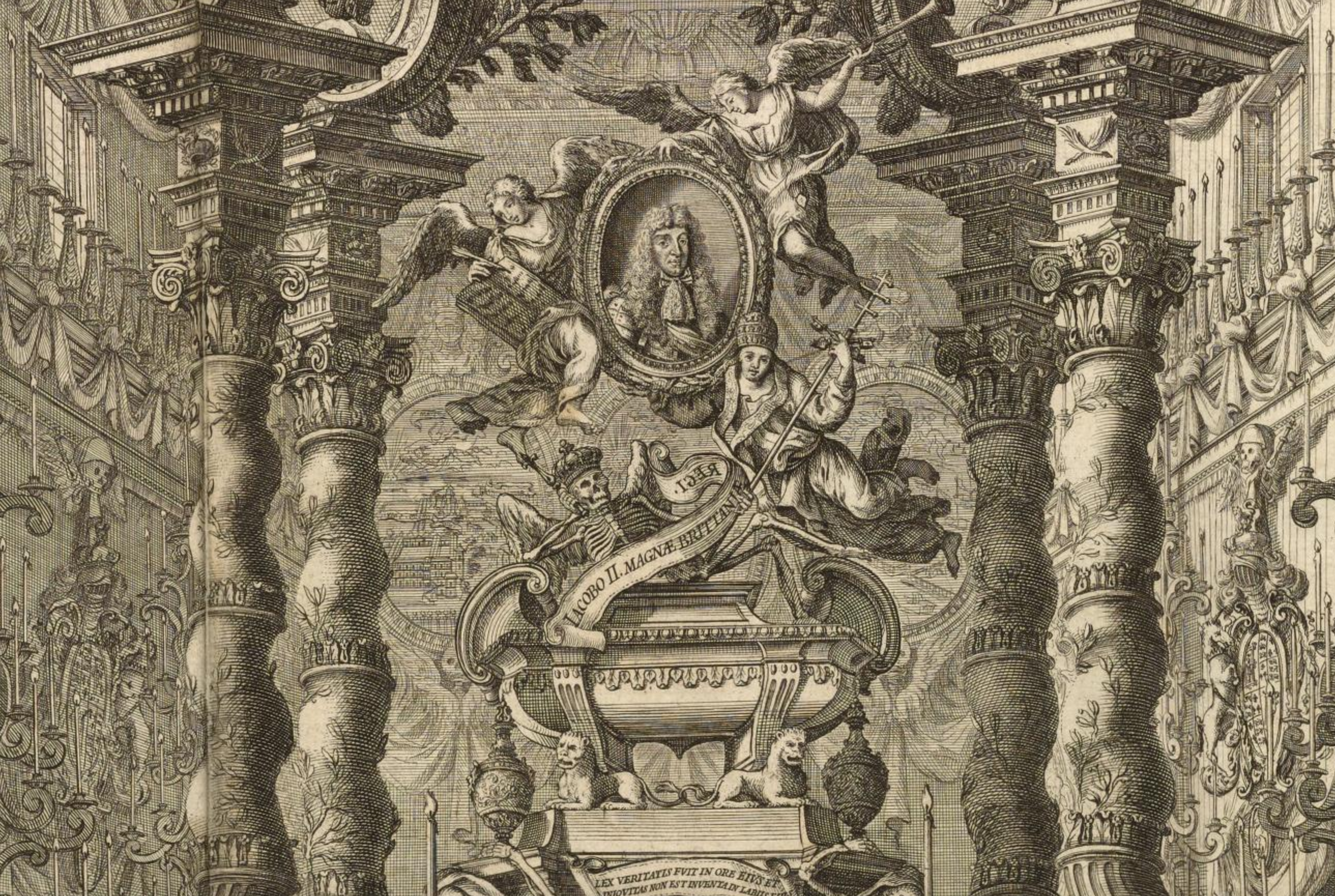
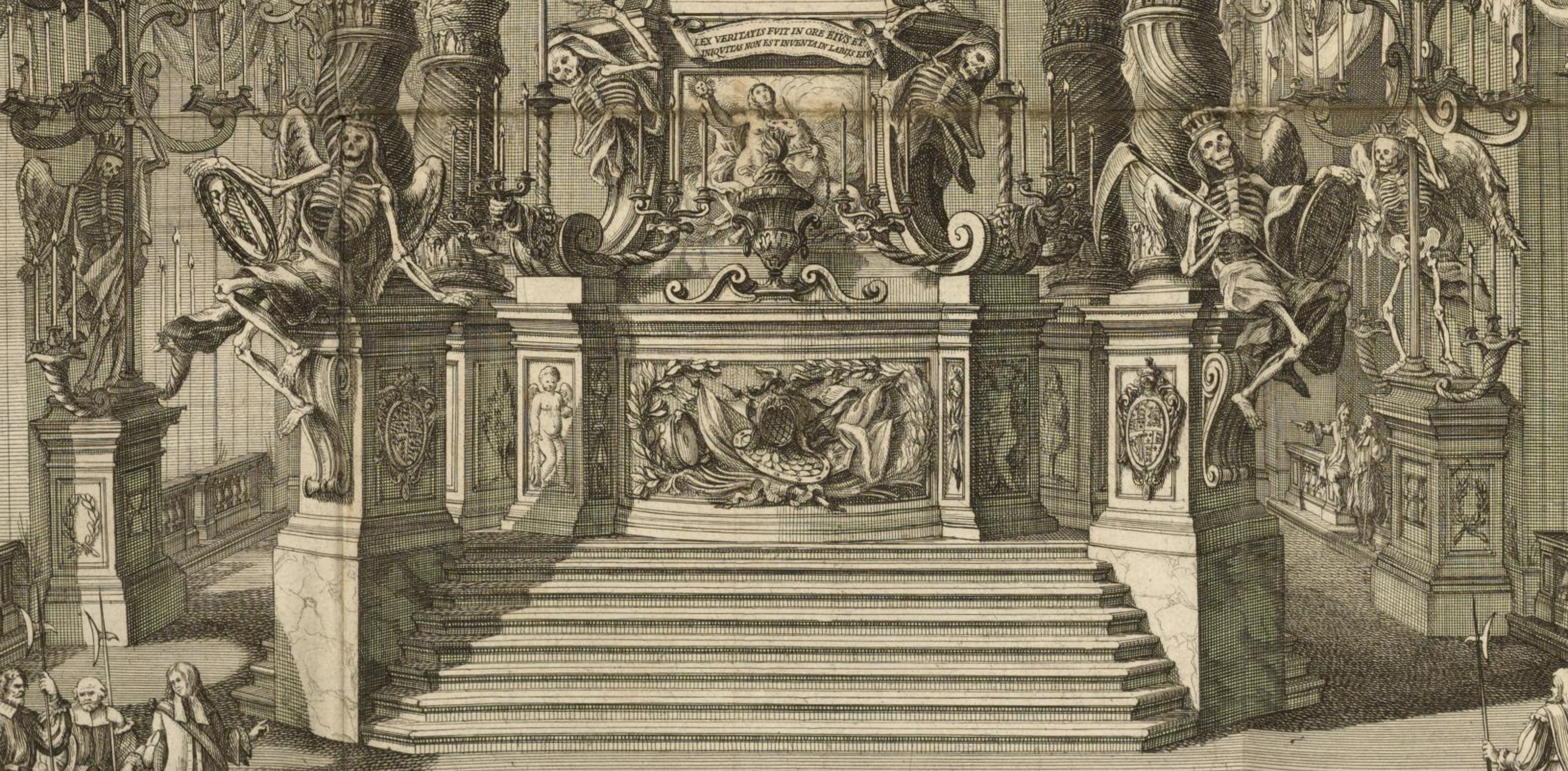
Frontispiece of the Sacra Exequialia. Note the skeletons at the base of the candelabra and baldachin columns. (Source)

A forgotten Latin text of 1702, the Sacra Exequialia in Funere Jacobi II, provides some wonderful views of early modern Catholic funerary rites. Or at least, as those rites were employed for dead monarchs. The central text is Cardinal Barberini’s funeral oration for the king at Rome. Fun fact: if you Google “Exequialia,” it’s the first and one of the only results. While it may not be a hapax legomenon, it’s the sort of rare word that makes epeolaters and logophiles drool.

At any rate, I’m not writing this post because of Barberini’s text. The book’s more delicious feature is its several illustrations, including the wild Baroque decoration of the church of San Lorenzo in Lucina as well as several emblems.

sacraexequialiai00aqui_0032

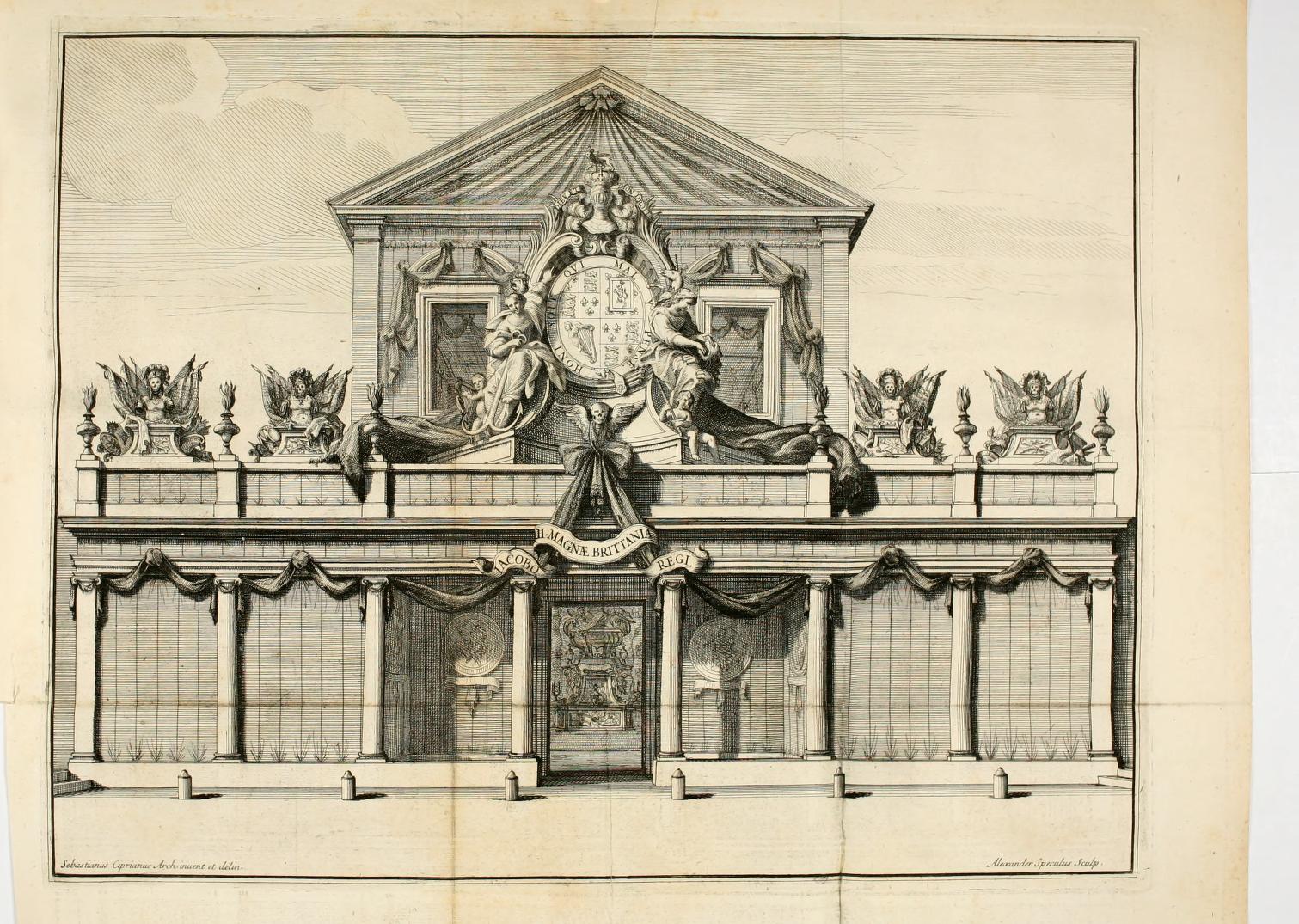
The decorations of San Lorenzo in Lucina for the occasion. (Source)

Of course, James II died in Paris and buried in the English Benedictine church there. It is a testament to the respect he was held in by the Papal court that a Cardinal of such standing as Carlo Barberini, Archpriest of the Vatican Basilica, should preach an oration for him in Rome.

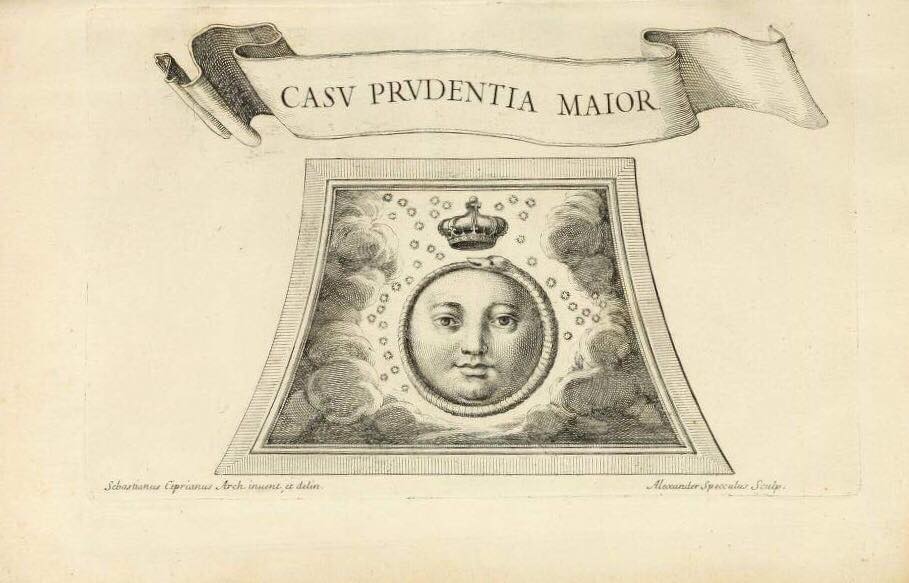
SacraExequialiaSunOurobouros

One of the marvellous emblems in the text. Note the Ouroboros. (Source)

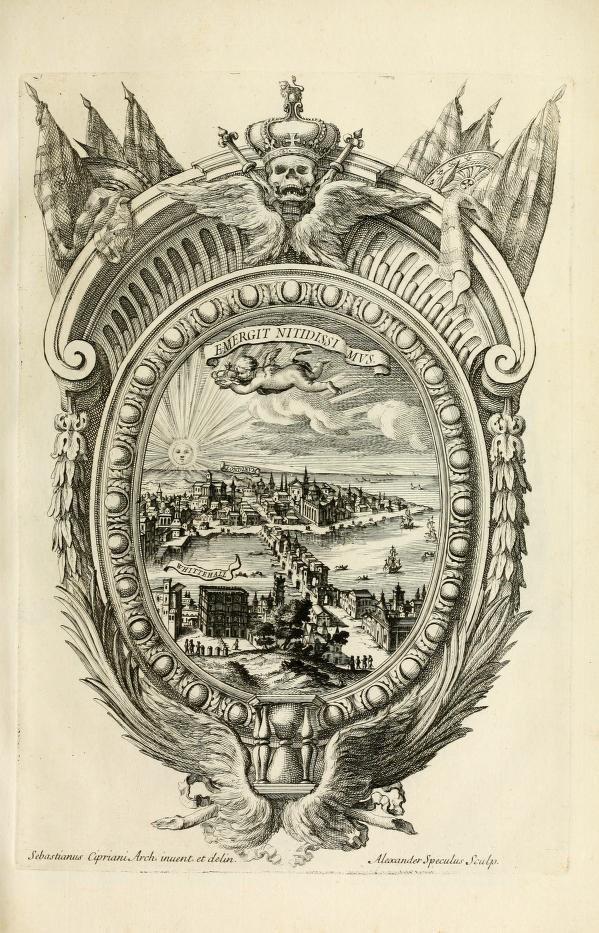
sacraexequialiai00aqui_0041

An image of London. There are similar views of Paris and Rome. All were at hung at the high altar behind the catafalque and its baldachin. (Source)

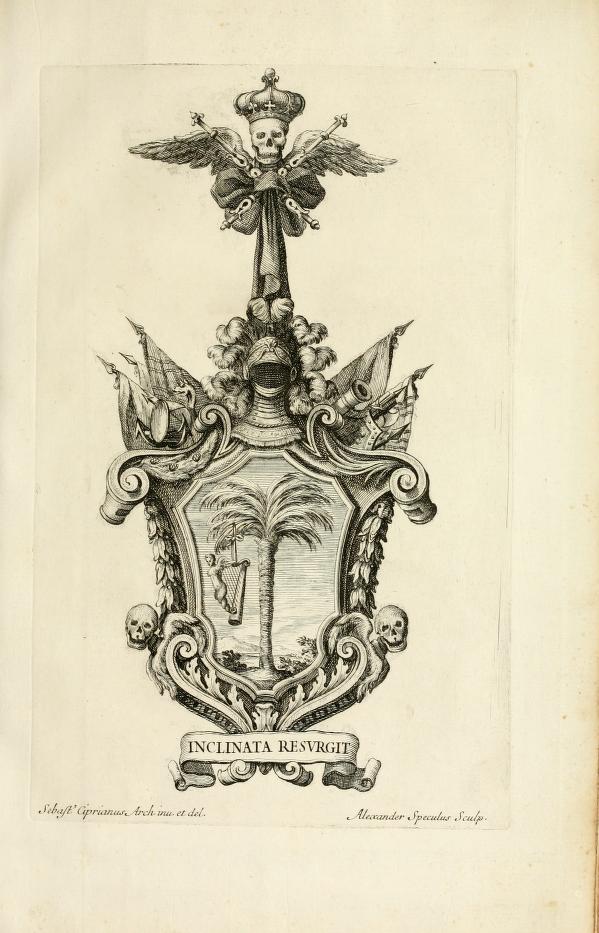
sacraexequialiai00aqui_0061

Another moral emblem. I’m particularly fond of this one as the harp recalls not only the exile in Babylon (and thus the Jacobite exile) but also the valiant Irish defense of James’s claim to the throne in 1689. These also would have adorned the walls of the church alongside the King’s arms. (Source)

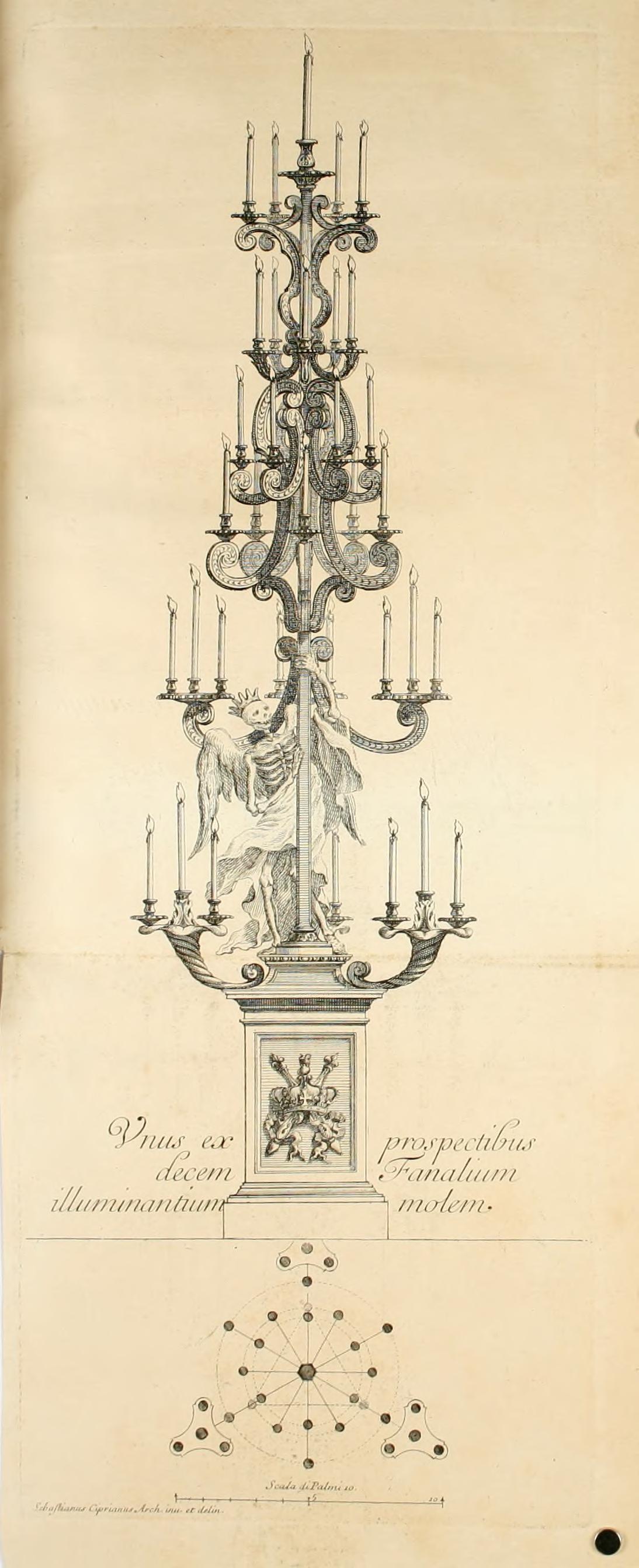
sacraexequialiai00aqui_0066

A closer view of the skeletal flambeaux. One can never have too many at a funeral. (Source)

Screen Shot 2018-11-02 at 10.07.34 AM.png

Jacobite emblem accompanying the text of the Oration. (Source)

Screen Shot 2018-11-02 at 10.10.05 AM.png

A closer view of the frontispiece. Note the Pope flying over the catafalque. (Source)

Screen Shot 2018-11-02 at 10.12.19 AM.png

Here you can see the spooky scary skeletons all around the room. (Source)


Elsewhere: Benedictine Mementos from England

caldey-5

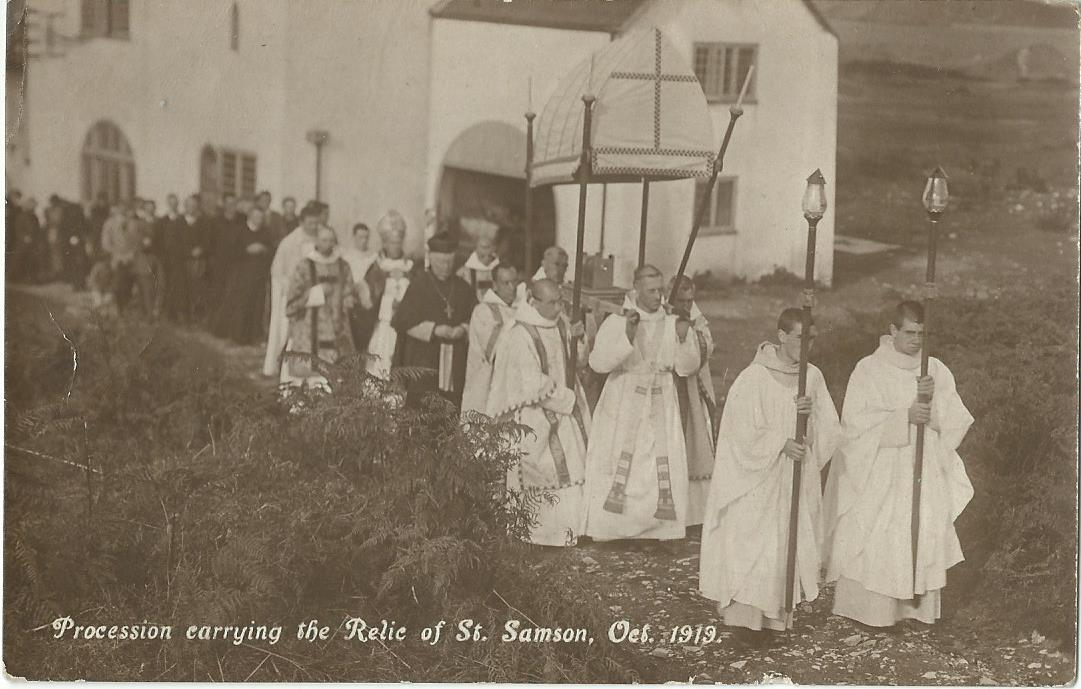
A procession on Caldey Island. (Source)

I’m not sure how I missed this astounding collection of photos of old Caldey, Prinknash, Pershore, Nashdom, and Farnborough when it came out last year, but I’m very glad to have discovered the trove yesterday. Some highlights include:

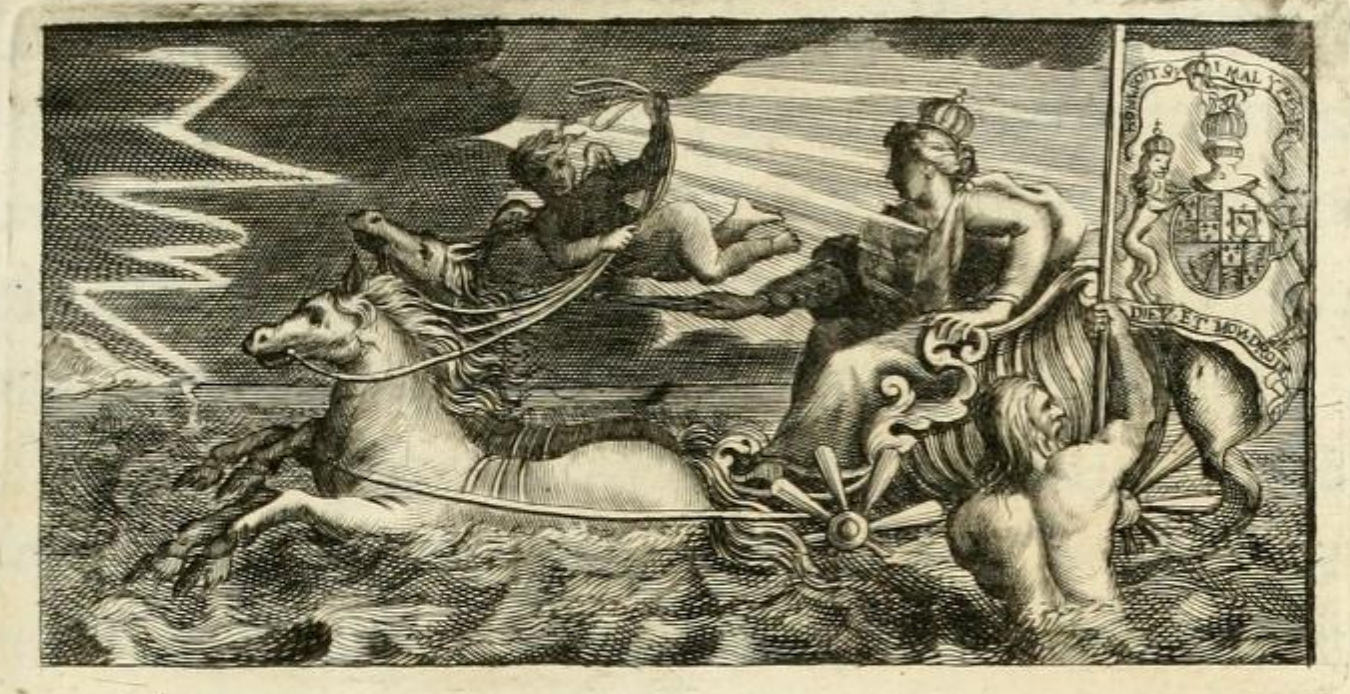
1. The barge fitted with heraldic devices that Peter Anson describes in Abbot Extraordinary, which was used specifically for the translation of St. Samson’s relics.

2. The silver sanctuary lamp in the shape of a galleon at full sail – once in Aelred Carlyle’s abbatial house (read: palace), now in the main oratory at Prinknash.

3. The various stones of dissolved abbeys brought to Caldey and placed into a single altar. If I’m not mistaken, Fr. Hope Patten must have gotten the idea for the Shrine at Walsingham from Caldey, as he knew Aelred Carlyle quite well.

4. Some lovely images of St. Samson and the Holy Face of Jesus used on printed material from the monasteries.

5. One or two excellent frontals, especially the one embroidered with seraphim at Prinknash.

6. An abbess of Kylemore Abbey in Ireland.

7. Peter Anson’s several drawings of Prinknash.

8. A procession for the 1964 Nashdom jubilee.

9. F.C. Eden’s terrifically English reredos at Caldey.

10. Scenes of the community’s collective reception into Rome in 1914 – including a shot of the Bl. Columba Marmion, who was an enthusiastic supporter of old Caldey.

Those who like Anglo-Catholic or monastic history will no doubt be as excited about this collection as I am.

UPDATE: A reader has kindly reminded me that, of course, Caldey Island is off the coast of Wales. So my title is perhaps a little misleading.

Prosaic Relics

Earlier this week, I went to the Birmingham Oratory for the Feast of Bl. John Henry Newman. Fr. Ignatius Harrison, the Provost, was kind enough to open up the Oratory house to me. I must offer him my tremendous thanks for his hospitable willingness to let me see such an incredible (and, it must be said, holy) place. Likewise, I thank Br. Ambrose Jackson of the Cardiff Oratory for taking time out of his busy schedule to give me what was an extraordinarily memorable tour. I went away from the experience with a rekindled devotion to Cardinal Newman.

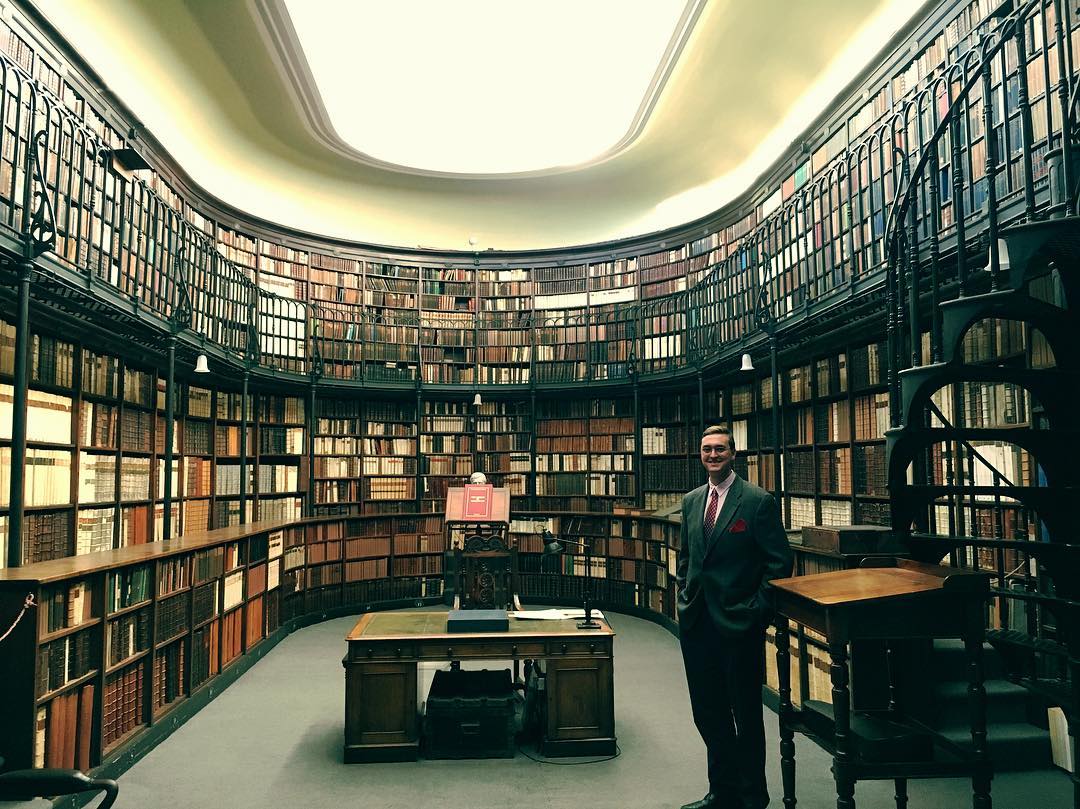
InNewmansLibrary

Your humble servant in Cardinal Newman’s own library. Photo taken by Br. Ambrose Jackson of the Cardiff Oratory. You can see Cardinal Newman’s violin case on the lower shelf of his standing desk at right.

There were many striking and beautiful sights at the Oratory – not the least of which was the Pontifical High Mass in the Usus Antiquior, celebrated by His Excellency, Bishop Robert Byrne. Even from so short an experience, I can tell that the Birmingham Oratory is one of the places where Catholicism is done well, where the Beauty of Holiness is made manifest for the edification of all the faithful. I walked away from that Mass feeling drawn upwards into something supernal, something far beyond my ken. This place that so palpably breathes the essence of Cardinal Newman is, as it were, an island of grace and recollection amidst a worldand, sadly, a Churchso often inimical to things of the spirit.

Screen Shot 2018-10-10 at 10.44.57 PM.png

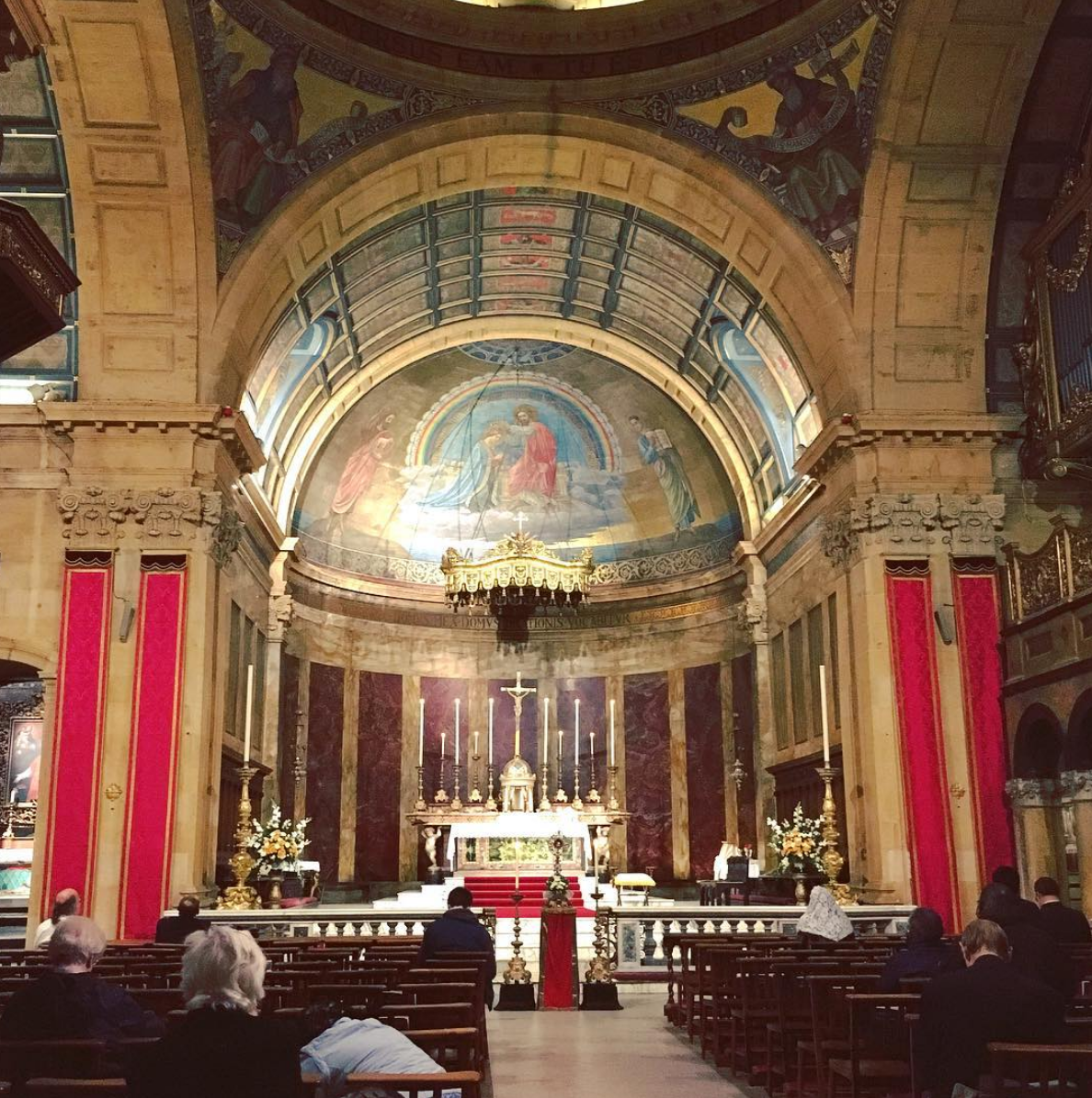
The Birmingham Oratory with the relics of the Blessed Cardinal displayed for veneration by the faithful. This photo was taken by the author shortly before Mass.

Yet amidst all this splendor, I found myself peculiarly drawn to one very quiet, very easy-to-miss relic. It lies in the little chapel to St. Philip Neri to the left of the altar; in this placement, one can see the influence of the Chiesa Nuova on Newman and his sons, who modeled their house’s customs on Roman models. And so it is only appropriate to find relics of St. Philip there in that small and holy place, so evocative of the great father’s final resting place.

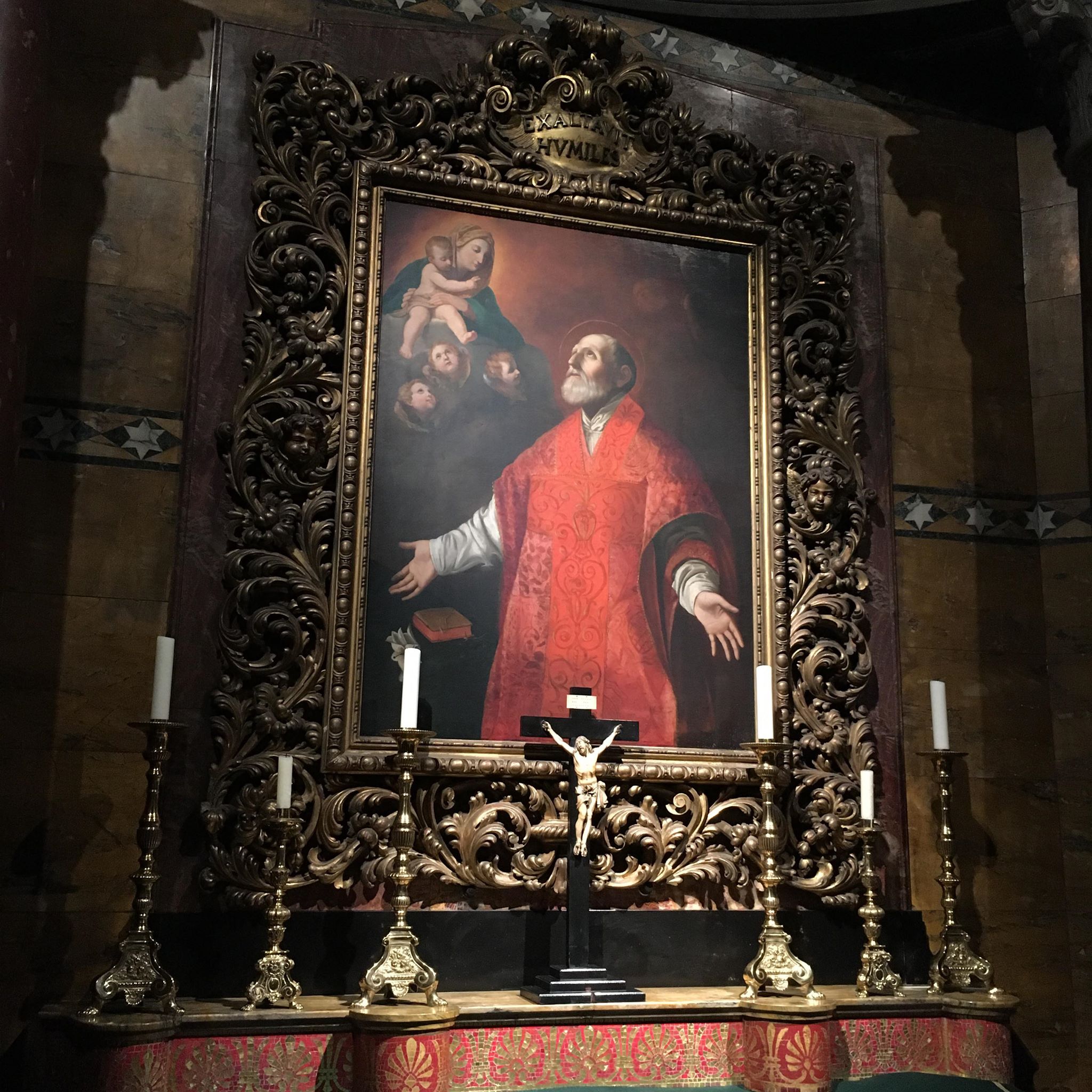
StPhilipNeriPortraitBrum

The altar of St. Philip Neri, Birmingham Oratory. Photo taken by the author.

The collection of relics in the chapel are mostly second-class. These are not pieces of the body, but materials that touched St. Philip either in his life or after his death. One of these small items spoke to me in an especially strong way.

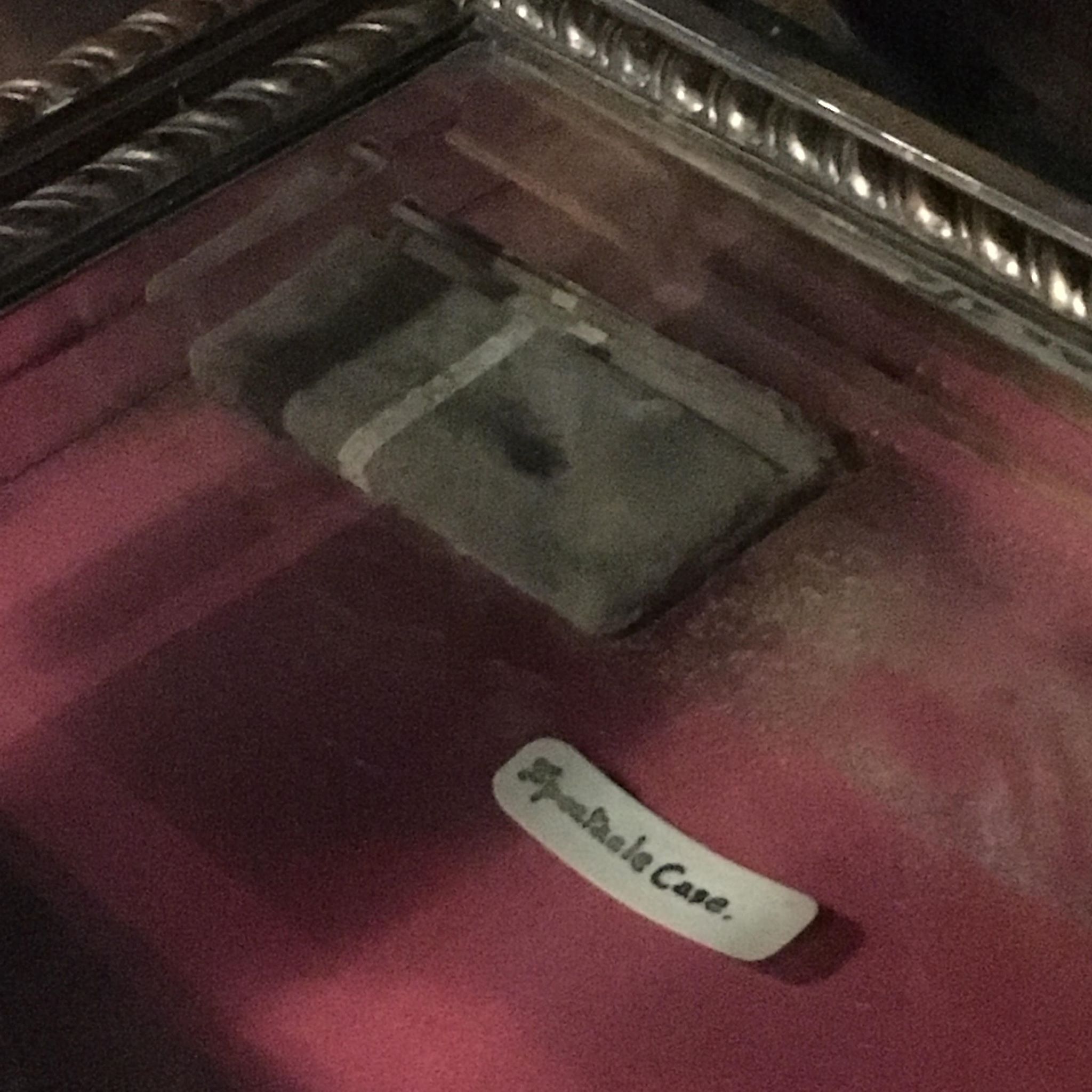
StPhilipsSpectacleCase

The little grey pouch you see to the left is St. Philip’s spectacle case. There is nothing terribly remarkable about it. It may not even be entirely intact, for all I know. A visible layer of dust covers the case, and a hard-to-read, handwritten label is all that identifies its use and provenance. No one comes to the Birmingham Oratory to see what once held St. Philip’s glasses. But of all the glorious relics I saw that day some encrusted in gold, some taken from rare and holy men, some evoking the perilous lives of saints who lived in a more heroic ageit was this humble artifact that most fired my imagination.

A spectacle case is no great thing. It does not shift the balance of empires or change the course of history. But humility and nobility are close cousins all the same. Here we come upon St. Philip in his quotidian life. A saint so marvelously strange, so crammed with the supernatural, so flame-like in darting from one miracle to another, nevertheless bent his fingers to the perfectly ordinary task of opening this case and taking out his spectacles so that he might see just a little better. It is a true maxim that grace builds upon nature. We have been told of St. Philip’s many graces. Here we find him in his nature; frail and imperfect and in need of just a little aid, so like our own.

The supernatural never erases the natural, and God is never more glorified than in our weakness. The hands that took up this case and opened it and drew forth its contents, perhaps a little fumblingly from time to time, are the very same thaumaturgic hands that lifted a prince out of death and Hell so that he might make his final confession. We know the story of the miracle. How rarely do we ponder the everyday conditions of its operation! How rarely do we consider those hands in their ordinary life.

There is a tendency with St. Philipas with many saints, and with Our Lord Himselfto reduce his life to one or two features. Some would make him an avuncular chap, always happy to laugh and thoroughly pleasant to be around, a jokester, a picture of joy and friend to all. On the other hand, we can get lost in the extraordinarily colorful miracles that mark St. Philip’s life, losing him in a fog of pious pictures and pablum. Neither captures his essence. The true middle way is to maintain a healthy sense of the bizarrean approach that recognizes the extraordinary in-breaking of the supernatural precisely because it appreciates the ordinary material of St. Philip’s day-to-day existence. It was this view that Fr. Ignatius himself recommended, though perhaps with a greater emphasis on the “weird,” in his homily delivered last St. Philip’s day.

I was reminded of this double reality when I saw St. Philip’s spectacle case. Prosaic relics carry this two-fold life within them more vividly than those upon which our ancestors’ piety has elaborated in glass and gold. Even Cardinal Newman’s violin case is not so markedly dual in this way; after all, every instrument belongs to that human portion of the supernatural we call “art.” Music, paintings, and other aesthetic forms all lift the human soul out of itself and into another world. In some ways, they are cousins both to Our Lady and to the Sacraments, God’s masterpieces of the sensible creation. Yet a spectacle casehow utilitarian. How plain. How merely functional. There is no poetry in a spectacle case. One can imagine writing a poem about a violinthe sinuous form of the wood almost suggests it, and more so when it carries a connection with so great a man as Newmanbut a spectacle case? Drab as this one is, its beauty comes only from the story it tells, from the life it once served, from the little help it gave its owner in his acquisition of beatitude.

Too often we wish to be God’s violins. In our quest for holiness, we wish to be admired, to cast our voice abroad, to give and seek beauty. These are not necessarily unworthy goals. But they are not the most important thing. Too infrequently do we turn our mind to the spectacle case. All too rarely do we seek our holiness in the gentle, quiet, everyday task of being useful, unnoticed, and present to God precisely when He needs us.

St. Philip knew how to be both, when he needed to be. May we learn to be like him in this as in so many respects.

StPhilipEffigyBrum

The effigy of Holy Father Philip, Chapel of St. Philip Neri, Birmingham Oratory. Photo taken by author.


Saint-Denis, Liturgy, and a Royal Nun

StDenis

St. Denys, pray for us! (Source)

Canticum Salomonis has a great little piece on the Sequence of St. Denys. Liturgical nerds will find it of particular interest. It mainly attracts my own attention due to a fascinating tidbit:

Beginning with the new Parisian missal promulgated by the Lord Archbishop François de Harlay in 1684, the neo-Gallican liturgical books that festered in France during the Enlightenment Age altered this sequence to expunge any connection between St Dionysius the Areopagite and St Dionysius of Paris. The Abbey of St-Denys, however, remained firm in defending the Greek origins of its patron, and sung the original text until the Revolution.

I’m unaware of any serious scholarship so far that has plunged into the liturgical dynamics of the Revolution – though certainly, the Gallicans, Jansenists, and Cisalpines all had ideas about liturgical reform. What an intriguing project a deeper study might be. Perhaps John McManners has looked at it all already, and I simply haven’t gotten to that part of his famous and positively rococo two-volume study, Church and Society in Eighteenth-Century France.

Madame Louise, Prioress of Saint-Denis. (Source)

Saint-Denis was an important place in the 1780’s. Madame Louise, daughter of Louis XV and aunt of Louis XVI, entered the Carmel of Saint-Denis while her father was still alive. As Sister Thérèse de Saint-Augustin, she eventually rose to the rank of Prioress. Saint-Denis thus became a center of the Parti Dévot, the most conservative (some would say reactionary) part of the French court and church. It’s hardly surprising that the great Abbey there would likewise remain a bastion of liturgy that might otherwise be regarded as “superstitious” or “backwards” by the more radical portions of the French church.

Elsewhere: Keanu Heydari on Conversion

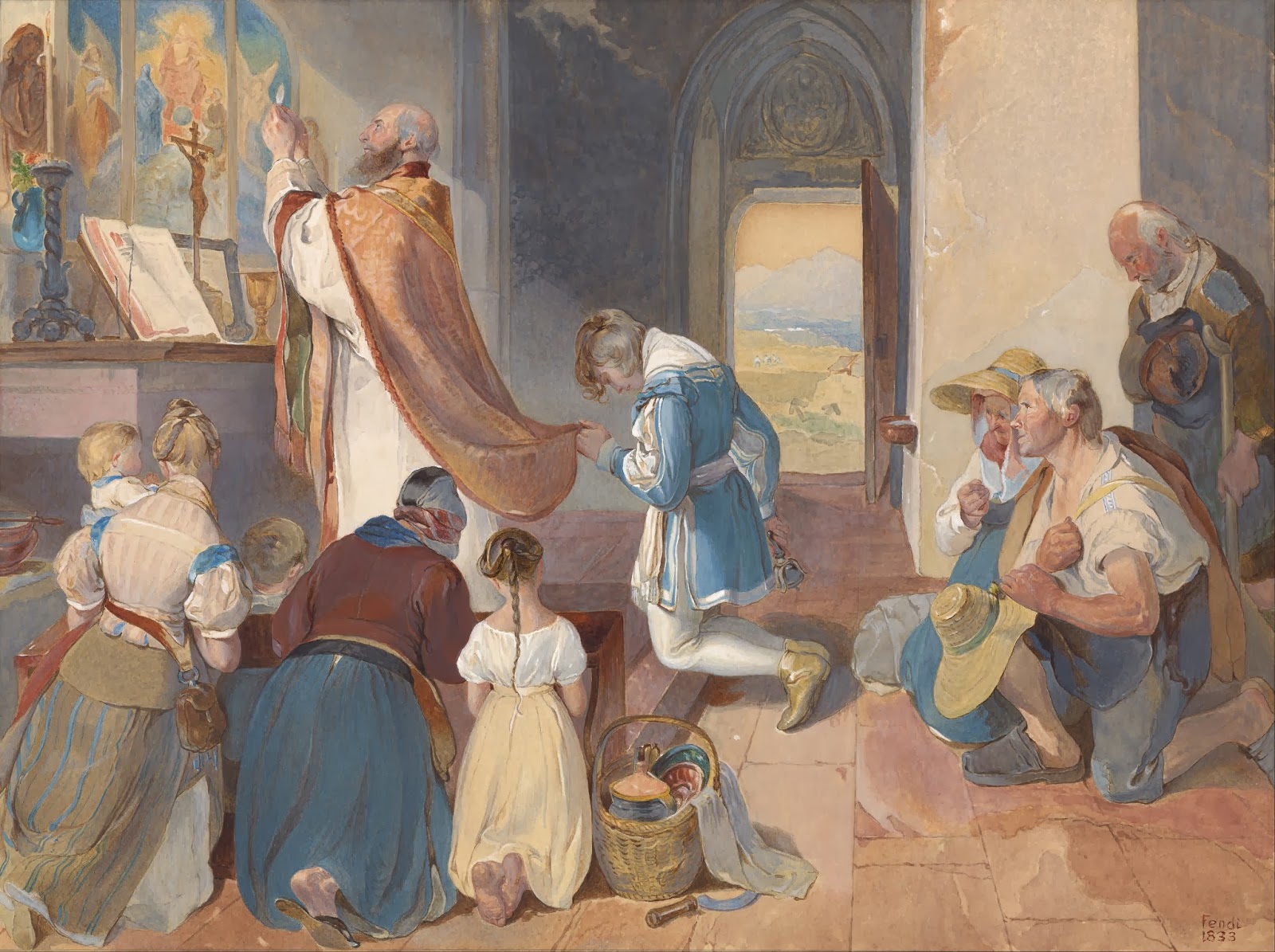
Peter_Fendi_(Austrian_-_Fridolin_Assists_with_the_Holy_Mass_-_Google_Art_Project

Fridolin Assists with the Holy Mass, Peter Fendi. (Source)

Earlier this month, my friend Keanu Heydari penned what is, I think, a very good essay about his own conversion and about conversion in general. I thought these two paragraphs were especially poignant:

If Jesus is the slain Lamb of God, the content of reconciliation is substantial rather than conceptual, or even primarily juridical. Forgiveness is freely given by God, but rather than bestowed, it is—like a substance—dealt with. It is held, beheld, and shared. I am speaking, of course, of understanding reconciliation as a sacramental event rather than as (primarily) juridical proclamation. The removal of our guilt is a free gift of the gracious God, yet it is not as a word, spoken in a booming voice. It is the material, densely textured experience of Jesus Christ, the Word, the Lamb of God, as he dies on Calvary, by the Church community, in the reception of the sacraments, wherein we receive God. The Psalmist implores, “O taste and see that the Lord is good!” (Ps. 34:8, RSV2CE). We taste and see, we behold, the forgiveness of God.

But pictures say more than words ever can. The Catholic artistic paradigm overflows with meaning. It is effusive, dynamic, and embodied. It is densely textured, thickly self-describing, multi-dimensional, and frankly excessive. But it is precisely in these Rabelaisian excesses that Catholic aesthetics gesture, even more powerfully, towards the ineffable, over and above the words themselves that are used in the liturgy. Sacramentally, we can truly say “Ecce homo.” Artistically, we are reminded that things are really happening outside of us, that we aren’t automata aimlessly generating profit for managers and selling our productivity to survive. We are more than the sum of our extrinsically imposed reductive component parts. The liturgy revels in its (in Cartesian terms) obscene uselessness. The defiance of the mass is its strongest selling point, as it were.

Read the whole thing. In what is proving to be an extraordinarily dark time for the Church, Keanu’s essay brings a good deal of hope in the fundamental promise of salvation.