Some Saints on the Holy Name of Mary

name-of-Mary

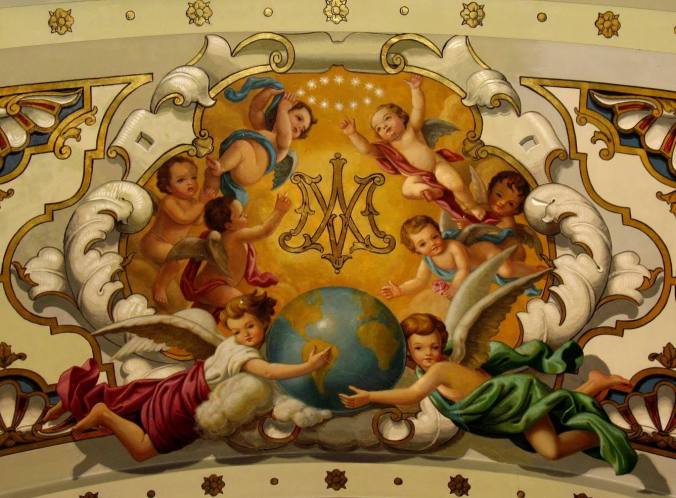
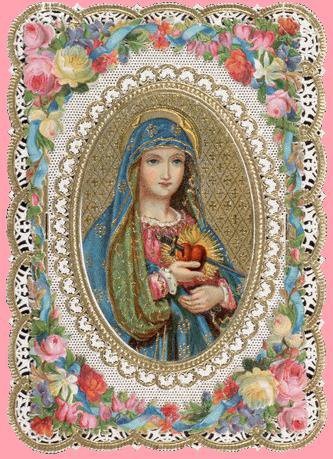
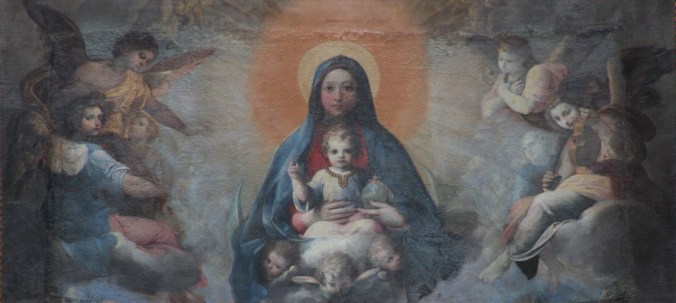
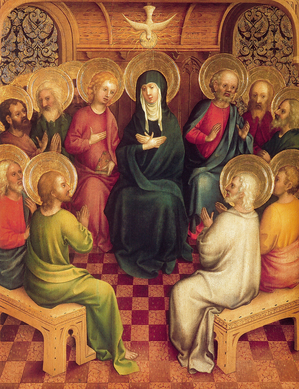
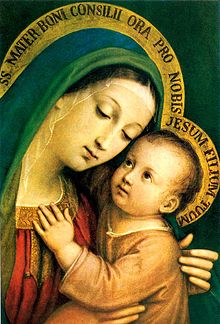
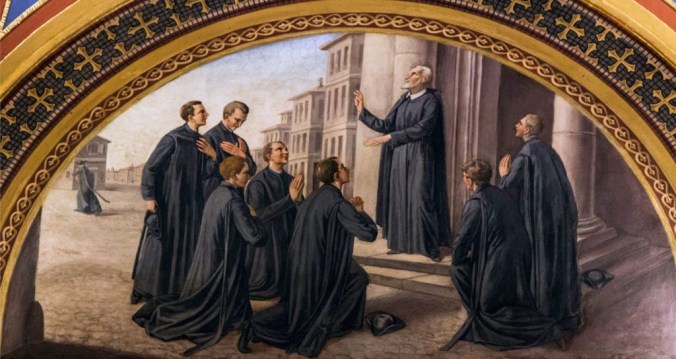
The Holy Name of Mary in a church mural. (Source)

The feast we celebrate today has moved around a bit. It only came to the kalendar in 1683, when Pope Innocent XI wished to commemorate the liberation of Vienna from the Ottoman siege. He originally placed it on the 17th, the Octave Day of Our Lady’s Nativity. The feast was later transferred to the 15th, and then done away with altogether by Archbishop Bugnini in one of his more obnoxious acts of liturgical vandalism. Pope St. John Paul II restored it in 2002, and now we celebrate it as an optional memorial on September 12th.

Accordingly, it behooves us to ponder the writings of the saints. For as it is a maxim in theology that we are led by lower things to higher, so we may pursue the heights of Our Lady’s throne only by the steps which our closer contemporaries have tread before us. Besides, while the feast may be relatively new in the life of the Church, the devotion it honors is much older. There is consequently much to choose from.

Consider the words of St. Bernard of Clairvaux.

Z_CAP005_052

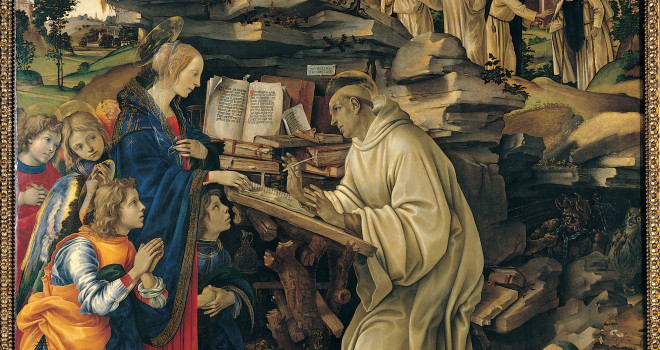
Apparition of the Virgin to St. Bernard, Detail. Filippino Lippi, 1480. (Source)

“And the Virgin’s name was Mary.” Let us speak a little about this name, which is said to mean “star of the sea,” and which so well befits the Virgin Mother. Rightly is she likened to a star. As a star emits a ray without being dimmed, so the Virgin brought forth her Son without receiving any injury. The ray takes naught from the brightness of the star, nor the Son from His Mother’s virginal integrity. This is the noble star risen out of Jacob, whose ray illumines the whole world, whose splendor shines in the heavens, penetrates the abyss, and, traversing the whole earth, gives warmth rather to souls than to bodies, cherishing virtues, withering vices. Mary is that bright and incomparable star, whom we need to see raised above this vast sea, shining by her merits, and giving us light by her example.

All of you, who see yourselves amid the tides of the world, tossed by storms and tempests rather than walking on the land, do not turn your eyes away from this shining star, unless you want to be overwhelmed by the hurricane. If temptation storms, or you fall upon the rocks of tribulation, look to the star: Call upon Mary! If you are tossed by the waves of pride or ambition, detraction or envy, look to the star, call upon Mary. If anger or avarice or the desires of the flesh dash against the ship o f your soul, turn your eyes to Mary. If troubled by the enormity of your crimes, ashamed of your guilty conscience, terrified by dread of the judgment, you begin to sink into the gulf of sadness or the abyss of despair, think of Mary. In dangers, in anguish, in doubt, think of Mary, call upon Mary. Let her name be even on your lips, ever in your heart; and the better to obtain the help of her prayers, imitate the example of her life:  “Following her, thou strayest not; invoking her, thou despairest not; thinking of her, thou wanderest not; upheld by her, thou fallest not; shielded by her, thou fearest not; guided by her, thou growest not weary; favored by her, thou reachest the goal. And thus dost thou experience in thyself how good is that saying: ‘And the Virgin’s name was Mary.'”

alphonsus_cross

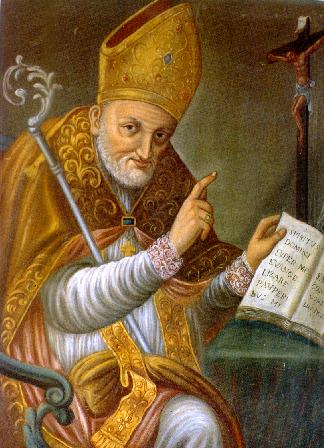
St. Alphonsus Liguori, author of The Glories of Mary. (Source)

St. Alphonsus Liguori, that Mariologist who so scrupulously records the thoughts of prior saints, affirms the antiquity and holiness of this devotion.

To begin with life, the holy anchorite, Honorius, says, that the name of Mary is [full] of all divine sweetness. And the glorious St. Anthony of Padua attributes to the name of Mary the same sweetness as St. Bernard attributed to the name of Jesus. The name of Jesus, said the latter, the name of Mary, said the former, is joy to the heart, honey to the mouth, melody to the ear of their devoted servants. It is related in the life of the venerable Father John Ancina, Bishop of Saluzzo, that when he pronounced the name of Mary, he experienced so great a sensible sweetness that he even tasted it on his lips. We also read that a certain woman in Cologne told the Bishop Marsillius, that whenever she pronounced the name of Mary she perceived in her mouth a taste sweeter than honey. Marsillius made the trial, and he also experienced the same sweetness. We read in the holy Canticles, that at the Assumption of the Virgin, the angels three times asked her name: “Who is she that goeth up by the desert as a pillar of smoke?” “Who is she that cometh forth as the morning rising?” And in another: “Who is this that cometh up from the desert, flowing with delights?” Richard of St. Laurence inquires why the angels so often asked the name of this queen, and answers: The sound of the name of Mary was so sweet to the angels, and they repeated the question that they might hear it repeated also.

But I do not hear speak of this sensible sweetness, since it is not commonly granted to all, but I speak of the salutary sweetness of consolation, love, joy, confidence, and strength, which the name of Mary universally gives to those who, with devotion, pronounce it. Speaking on this subject, Francone the Abbot says, that next to the holy name of Jesus, the name of Mary is so rich in blessings, that no other name is uttered on earth or in heaven from which devout souls receive so much grace, hope, and sweetness. For the name of Mary, he goes on to say, contains in itself something admirable, sweet, and divine, which, when it meets a friendly heart, breathes into it an odor of holy sweetness. And the wonder of this great name is, he concludes, that if heard a thousand times by the lovers of Mary, it is always heard as new, the sweetness they experience in hearing it spoken being always the same.

The blessed Henry Suso, also speaking of this sweetness, says, that in pronouncing the name of Mary, he felt his confidence so much increased, and his love so joyfully enkindled, that amidst the joy and tears with which he pronounced the beloved name, he thought his heart would have leaped from his mouth ; and he affirmed that this most sweet name, as honeycomb, melted into the depths of his soul. Whereat he exclaims: Oh most sweet name! oh Mary, what must thou thyself be, if thy name alone is so lovely and sweet?

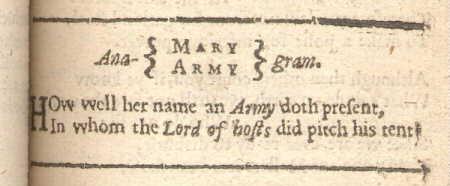
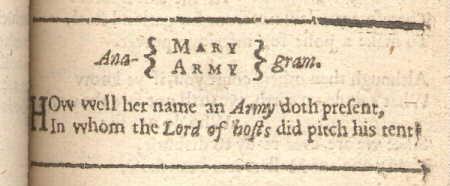
Nor is this devotion entirely absent outside the Church of Rome. One of George Herbert’s better epigrams runs as follows:

HerbertAnagram

“Anagram,” from The Temple. (Source)

Incidentally, the aforementioned Bishop of Saluzzo, Bl. John Juvenal Ancina, was a founder of the Naples Oratory and a personal disciple of St. Philip Neri. Can there be any doubt that the bishop learned his devotion at the side of his spiritual father?

img-Blessed-Giovanni-Giovenale-Ancina

Bl. Juvenal Ancina of the Oratory. (Source)

And we should learn it in turn from the saints who have gone before us, those holy men and women who now stand rejoicing in an eternal contemplation of Our Lady’s beatific name.

StPhilipNeriExhortinghtheYouth

St. Philip Neri Exhorting the Youth to Pray to the Virgin, Pala Pietro. A good metaphor for how the saints instruct us in Marian devotion. (Source)


The Prince of Papist Purple Prose

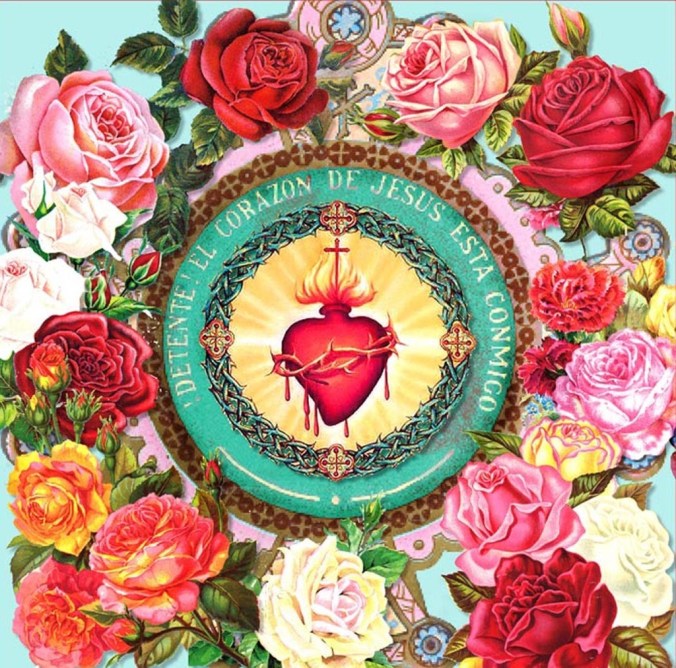
SacredHeartRoses

Faberesque religious art. (Source)

The Church offers us the way of salvation. She declares the destination, Heaven; she notes our provenance, the bondage of our sinful nature. And she furnishes a route from the latter up to the former. Or, I might say, “routes.” For while the Cruciform road to Heaven may appear singular from afar, anyone who enters the Journey will find that it is in fact composed of many different paths. The holy diversity of the Church is one testament of its Catholicity. Like a great Cathedral or Basilica that appears as one massive edifice from the street but harbors dozens of little side-altars within, each distinctly the Table of the Lord, the Church offers more streams of spirituality than we can discern. Some flow still in our midst, giving life to multitudes. Others run dry. And some thought long-extinct may suddenly spring forth in new vim and vigor.

It is only a natural and concurrent fact that the Church should likewise offer her children a diverse array of spiritual writers. There is the beautiful, mysterious Areopagite; the mighty, noble St. Augustine; the dazzlingly imaginative St. Ephrem the Syrian; the logical, pacific Aquinas; the bloody consolations of Dame Julian; the gleaming shadows of St. John of the Cross; the brooding brilliance of Pascal; the soaring eloquence of Bossuet; the roseate cheer of St. Thérèse of Lisieux; the luminous fragmentation of T.S. Eliot; the Gothic grotesquerie of Flannery O’Connor.  The list goes on and on.

The English Catholic Revival was a fertile time for spiritual writers. At the fountainhead of the entire movement stands Cardinal Newman, whose massive influence is still being felt by theologians and writers today. The founder of the English Oratory was a masterful stylist, so much so that James Joyce considered him the greatest master of English prose. Every ecclesiastical development proves that Newman’s theology is more timely than ever. He has been lauded by subsequent generations, and rightly so. When he is eventually canonized, he will certainly be declared a Doctor of the Church for his labors.

But he has, sadly, overshadowed another figure, one no less deserving of praise for his own work on behalf of the Gospel. That man is Fr. Frederick William Faber, the founder of the London Oratory.

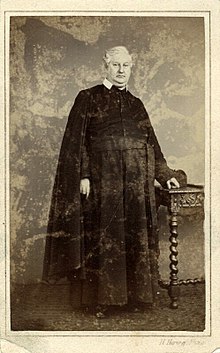
Faber1860

Fr. Frederick William Faber, Father of the Brompton Oratory. (Source)

Faber was an Oxford convert like Newman. After leaving the University, he first served as an Anglican parish priest in Northamptonshire. He would later bring eleven men with him across the Tiber when he resigned his post. After shepherding the community for a short time, he eventually joined forces with Newman and co-founded the English Oratory. They split the country. Newman went to Birmingham, and Faber went to London. In the course of his time there, he gained notoriety as a preacher of remarkable versatility and power, a widely-respected hymnodist, a constant friend of the poor, and an authoritative teacher of the spiritual life. As one source has it, his written works

…are a mine of spiritual gold of the highest purity, refined and drawn from Faber’s deep understanding of Catholic spiritual theology. For he had delved deeply, not only into the standard Scholastic philosophy and theology, but especially into the mystical schools. Father Faber was a brilliant man whose theology of the Absolute Primacy of Christ and Mary is grounded in that of the Subtle Doctor, Blessed John Duns Scotus (1266-1308), all recast in simple ordinary English. (174).

When he died, all the great Catholics of England honored his memory. In France, even the formidable abbot of Solesmes, Dom Prosper Guéranger, admired his writings and wrote of him fondly.

But Faber is a largely forgotten figure today, at least among American Catholics. While most have probably heard at least one or two of his hymns, such as “Faith of Our Fathers,” few read more deeply into his life or thought. Why? What has caused this lacuna in our collective memory?

There are, I think, two primary reasons.

The first is that he is eclipsed by Newman. The two had differences in their own day. Newman was resolutely opposed to the pretensions of Ultramonatism; Faber, like Cardinal Manning, was a strong advocate of Rome’s prerogatives. Newman always wanted to return to Oxford and restore some traces of his old, academic life; Faber was content to build the finest church of Great Britain in London, to better minister to the poor. Newman was always a little wary about Marian titles and devotions; Faber practically bathed in them. As Monsignor Rondald Knox writes in 1945,

While Faber is introducing the British public to the most luscious legends of the Counter-Reformation, Newman is still concerned over the difficulties of Anglicans, still asking how and in what sense Catholic doctrine has developed, still cautiously delimiting the spheres of faith and reason. (“The Conversions of Newman and Faber,” Pastoral and Occasional Sermons, 875).

The tensions surrounding Faber’s spirituality eventually led Newman to formally, judicially separate the two houses. Sadly, “While Newman visited Faber shortly before his death, the two men were not able to fully resolve their differences.”

The second, related to the first, is part stylistic, part spiritual. Consider an analogy. Among the Metaphysical Poets, the meditative Donne has always outshone the ebullient Crashaw. Logos is easy to parse. Its analysis is a straightforward, if sometimes arduous task. Pathos, however, is a more slippery beast altogether, and one less communicable and less persistent than we should like to think. It may fire one breast and repel another. Not all hearts chime the same tune in the same wind. Likewise, Newman’s depth, intellect, and style have garnered more attention than Faber’s flowery devotions. His devotional prose is as purple as it gets. Consider the following passage, taken from Part I of “The Mystery of the Precious Blood.”

SALVATION! What music is there in that word – music that never tires but is always new, that always rouses yet always rests us! It holds in itself all that our hearts would say. It is sweet vigor to us in the morning, and in the evening it is contented peace. It is a song that is always singing itself deep down in the delighted soul. Angelic ears are ravished by it up in Heaven; and our Eternal Father Himself listens to it with adorable complacency. It is sweet even to Him out of Whose mind is the music of a thousand worlds. To be saved! What is it to be saved? Who can tell? Eye has not seen, nor ear heard. It is a rescue, and from such a shipwreck. It is a rest, and in such an unimaginable home. It is to lie down forever in the bosom of God in an endless rapture of insatiable contentment. (“The Mystery of the Precious Blood“)

Or, later in the same volume, when he writes the following passage.

Green Nazareth was not a closer hiding-place than the risen glory of the Forty Days. As of old, the Precious Blood clung round the sinless Mother. Like a stream that will not leave its parent chain of mountains, but laves them incessantly with many an obstinate meandering, so did the Blood of Jesus, shed for all hearts of men, haunt the single heart of Mary. Fifteen times, or more in those Forty Days, it came out from under the shadow of Mary’s gladness and gleamed forth in beautiful apparitions. Each of them is a history in itself, and a mystery, and a revelation. Never did the Sacred Heart say or do such ravishing things as those Forty Days of its Risen Life. The Precious Blood had almost grown more human from having been three days in the keeping of the Angels. But, as it had mounted Calvary on Good Friday, so now it mounts Olivet on Ascension Thursday, and disappears into Heaven amidst the whiteness of the silver clouds. It had been but a decree in Heaven before, a Divine idea, an eternal compassion, an inexplicable complacency of the life of God. It returns thither a Human Life, and is throned at the Right Hand of the Father forever in right of its inalienable union with the Person of the Word. There is no change in the Unchangeable. But in Heaven there had never been change like this before, nor ever will be again. The changes of the Great Doom can be nothing compared to the exaltation of the Sacred Humanity of the Eternal Word. The very worship of the glorious spirits was changed, so changed that the Angels themselves cannot say how it is that no change has passed on God. Somehow the look of change has enhanced the magnificence of the Divine immutability, and has given a new gladness to their adoration of its unspeakable tranquility (“The History of the Precious Blood“).

Or this passage from The Blessed Sacrament, taken from a friend who posted it on Facebook for the Nativity of Mary.

Let us mount higher still. Earth never broke forth with so gay and glad fountain as when the Babe Mary, the infant who was the joy of the whole world, the flower of God’s invisible creation, and the perfection of the invisible and hitherto queenless angels of His court, came like the richest fruit, ready-ripe and golden, of the world’s most memorable September. There is hardly a feast in the year so gay and bright as this of her Nativity, right in the heart of the happy harvest, as though she were, as indeed she was, earth’s heavenliest growth, whose cradle was to rock to the measures of the worlds vintage songs; for she had come who was the true harvest-home that homeless world.

His devotion to Our Lady was legendary. He was, in fact, the first English translator of St. Louis de Montfort’s famous text, True Devotion to Mary…and that even before he had become an Oratorian! He was also probably the first English author to think of Mary as Co-Redemptrix. In one of his hymns, he declares:

Mother of God! we hail thy heart,
Throned in the azure skies,
While far and wide within its charm
The whole creation lies.
O sinless heart, all hail!
God’s dear delight, all hail!
Our home, our home is deep in thee,
Eternally, eternally.
(Source)

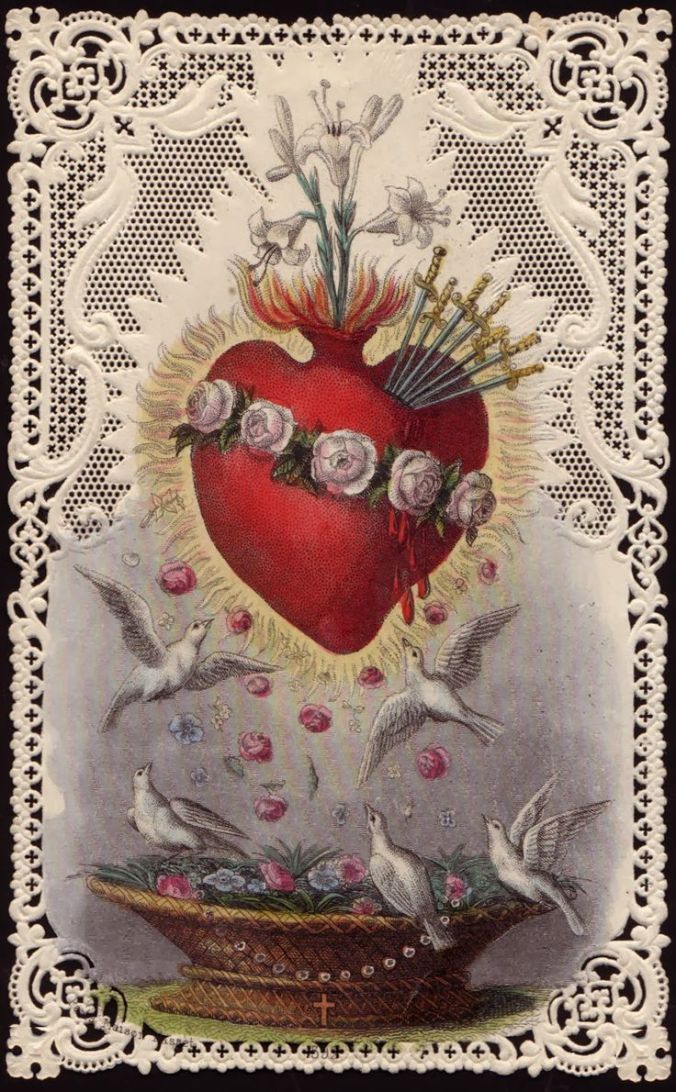
ImmaculateheartRosesDoves

Lace holy card of the Immaculate Heart of Mary. Extremely Fr. Faber’s aesthetic. (Source)

Fr. Faber’s devotion to Our Lady extended beyond his prolific writings. He not only translated St. Louis’s book. In 1846, he undertook his own Marian consecration in the Holy House of Loreto. He had a tendency to refer to the Mother of God as “Mama.” A famous episode related by Monsignor Knox depicts Fr. Faber at one of his more florid moments. After a particularly high Marian procession at the Oratory, he was observed weeping. Without any care for who heard, he cried out, “Won’t Mamma be pleased?” (“The Conversion of Faber,” Pastoral and Occasional Sermons, 891).

None of this spirituality or the writing in which it comes to us fits our modern tastes. It is too perfumed, too sickly-sweet, too campy, too Victorian, too decadent, too redolent of pastel holy cards mouldering in antique prayer books. One critic puts it thus:

There are great slabs of passages, sometimes chapters at a time, which glow with ethereal light but have little content. Hypnotized by his own fluency Faber flows on and on, melodious and tedious…There are awful lapses of taste. (Chapman, quoted here).

And certainly, Faber cared not one shred for taste. The only thing that mattered was the salvation and sanctification of souls. Knox tells us that “‘Art for art’s sake’ had no meaning for him…if a bad verse would have more chance of winning souls than a good verse, down the bad verse would go” (“The Conversion of Faber,” Pastoral and Occasional Sermons, 891). There is much to criticize in this tendency from a purely aesthetic standpoint. Christians should commit themselves to the highest standards in all artistic and literary endeavors.

But it is hard not to like the man weeping after the procession; it is harder still to feel totally averse to passages that glow purple as the evening sky. One has the sense that Fr. Faber would have been a remarkable presence today, if only because his emotionalism and baroque, slightly kitschy aesthetic would have made him an ironic celebrity on Weird Catholic Twitter. Imagine what he would have done with memes!

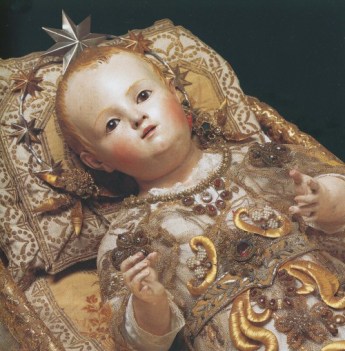
SantaMariaBambina1

Santa Maria Bambina, Southern Italy. (Source)

Yet he would also be a sign of contradiction. We have seen a renewed emphasis on Muscular Christianity, with a proliferation of websites, associations, and thinkpieces all dedicated to restoring “authentic masculinity” and resisting the “feminization” of the liturgy. This is a particularly popular movement within the larger Traditionalist wing of the Church. In brief, the narrative usually runs as follows:

1) After Vatican II, the Novus Ordo initiated a new, “feminine” form of the Mass.
2) This innovation was a substantive capitulation to the Sexual Revolution.
3) Men don’t want to serve a feminized Church in a feminized liturgy, with altar girls, felt banners, versus populum, happy-clappy music, etc.
4) The vocations crisis of the last 30-40 years ensues.
5) As such, we need to restore more pronounced gender binaries and hierarchies along with the Usus Antiquior.

Some of this narrative may be correct. I refrain from judging its particular historical claims, social implications, or theological presuppositions.

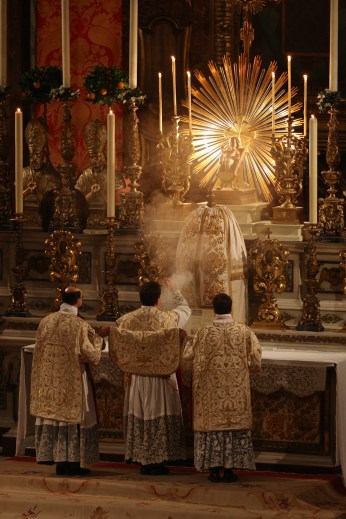
midnightmass3

Midnight Mass at the Brompton Oratory. (Source)

Nevertheless, Fr. Faber confounds that entire way of thinking. He was anything but a “Muscular” Christian. His personality, style, and spirituality were so clearly “feminine” that his own nephew, the publisher Geoffrey Faber, considered him a probable closet case (see David Hilliard’s famous essay “UnEnglish and Unmanly,” page 5). Whether or not his (disputed) conclusions about the priest (and all the leaders of the Oxford Movement) are true, it suffices to say that Fr. Faber was far from the “authentically masculine” man fetishized by the new Muscular Christianity.  Yet liturgically he was known as one of the highest of the high, and his sons at the Brompton Oratory continue that admirable tradition. If nothing else, Fr. Faber’s legacy is the Oratory that still stand as a landmark of reverence, beauty, and transcendent holiness in the midst of postconciliar banality.


What’s more, Fr. Faber is not just a fine hymnodist and devotional writer. He penetrated deep mysteries of the faith. A thoroughgoing Scotist, he advocated the thesis (shared by this author) that Christ probably would have been incarnated anyway even if Adam had never fallen. And as the Church’s Mariology continues to develop, his arguments on behalf of Our Lady’s Co-Redemption may yet prove invaluable. Sophiologists should take note. Here is a man after our own heart.

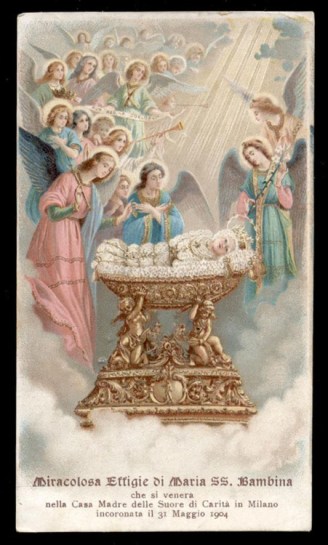
SantaMariaBambina2

A holy card of Santa Maria Bambina. (Source)

Fr. Faber writes of Our Lady’s suffering in a passage worth quoting at length:

But this is not all. She co-operated with our Lord in the redemption of the world in quite a different sense, a sense which can never be more than figuratively true of the Saints. Her free consent was necessary to the Incarnation, as necessary as free will is to merit according to the counsels of God. She gave Him the pure blood, out of which the Holy Ghost fashioned His Flesh and bone and Blood. She bore Him in her womb for nine months, feeding Him with her own substance. Of her was He born, and to her He owed all those maternal offices which, according to common laws, were necessary for the preservation of His inestimable life. She exercised over Him the plenitude of parental jurisdiction. She consented to His Passion; and if she could not in reality have withheld her consent, because it was already involved in her original consent to the Incarnation, nevertheless she did not in fact withhold it, and so He went to Calvary as her free-will offering to the Father. Now, this is co-operation in a different sense from the former, and if we compare it with the co-operation of the Saints, their own co-operation, in which Mary herself alone surpassed them all, we shall see that this other peculiar co-operation of hers was indispensable to the redemption of the world as effected on the Cross. Souls could be saved without the co-operation of the Saints. The soul of the penitent thief was saved with no other co-operation than that of Mary, and, if our Blessed Lord had so willed it, could have been saved without even that. But the co-operation of the Divine Maternity was indispensable. Without it our Lord would not have been born when and as He was; He would not have had that Body to suffer in; the whole series of the Divine purposes would have been turned aside, and either frustrated, or diverted into another channel. It was through the free will and blissful consent of Mary that they flowed as God would have them flow. Bethlehem, and Nazareth, and Calvary, came out of her consent, a consent which God did in no wise constrain. But not only is the co-operation of the Saints not indispensable of itself, but no one Saint by himself is indispensable to that co-operation. Another Apostle might have fallen, half the Martyrs might have sacrificed to idols, the Saints in each century might have been a third fewer in number than they were, and yet the co-operation of the Saints would not have been destroyed, though its magnificence would have been impaired. Its existence depends on the body, not on the separate individuals. No one Saint who can be named, unless perhaps it were in some sense St. Peter, was necessary to the work, so necessary that without him the work could not have been accomplished. But in this co-operation of Mary she herself was indispensable. It depended upon her individually. Without her the work could not have been accomplished. Lastly, it was a co-operation of a totally different kind from that of the Saints. Theirs was but the continuation and application of a sufficient redemption already accomplished, while hers was a condition requisite to the accomplishment of that redemption. One was a mere consequence of an event which the other actually secured, and which only became an event by means of it. Hence it was more real, more present, more intimate, more personal, and with somewhat of the nature of a cause in it, which cannot in any way be predicated of the co-operation of the Saints. And all this is true of the co-operation of Mary, without any reference to the dolors at all…Our Lord had taken a created nature, in order that by its means He might accomplish that great work; so it seemed as if the highest honor and the closest union of a sinless creature with Himself should be expressed in the title of co-redemptress. In fact, there is no other single word in which the truth could be expressed; and, far off from His sole and sufficient redemption as Mary’s co-operation lies, her co-operation stands alone and aloof from all the co-operation of the elect of God. This, like some other prerogatives of our Blessed Lady, cannot have justice done it by the mere mention of it. We must make it our own by meditation before we can understand all that it involves. But neither the Immaculate Conception nor the Assumption will give us a higher idea of Mary’s exaltation than this title of co-redemptress, when we have theologically ascertained its significance. Mary is vast on every side, and, as our knowledge and appreciation of God grow, so also will grow our knowledge and appreciation of her His chosen creature. No one thinks unworthily of Mary, except because he thinks unworthily of God. Devotion to the Attributes of God is the best school in which to learn the theology of Mary; and the reward of our study of Mary lies in a thousand new vistas that are opened to us in the Divine Perfections, into which except from her heights we never could have seen at all.
(“The Compassion of Mary,” emphases in source.)

There is much in this text, and in so many like it, to warm a Catholic’s flagging devotion to the Mother of God. For that treasure alone, we should be grateful.

KitschyMaryCard

A Marian Holy Card. (Source)

As his writing on this subject demonstrates, Father Faber was in all things the most enthusiastic and the most Roman of Catholics. Yet his prodigious work on behalf of the Gospel, and the ardor with which he was wont to express himself, made him a popular figure even among Protestants. His hymns are sung by traditional and mainline Protestant churches even today.

A.W. Tozer held him in high esteem, going so far as to write:

Spinoza wrote of the intellectual love of God, and he had a measure of truth there; but the highest love of God is not intellectual, it is spiritual. God is spirit and only the spirit of man can know Him really. In the deep spirit of a man the fire must glow or his love is not the true love of God. The great of the Kingdom have been those who loved God more than others did. We all know who they have been and gladly pay tribute to the depths and sincerity of their devotion. We have but to pause for a moment and their names come trooping past us smelling of myrrh and aloes and cassia out of the ivory palaces. Frederick Faber was one whose soul panted after God as the roe pants after the water brook, and the measure in which God revealed Himself to his seeking heart set the good man’s whole life afire with a burning adoration rivaling that of the seraphim before the throne. His love for God extended to the three Persons of the Godhead equally, yet he seemed to feel for each One a special kind of love reserved for Him alone. The Pursuit of God, p. 40 (quoted here)

If a modern master of Protestant spirituality can appreciate the peculiar wisdom of this effusive little man, then what excuse do we have? The Church has entrusted him to our memory and will, I hope, some day do so formally at the altar of God.

I began this essay describing the various spiritualities that have animated the Church from its earliest days. Some remain vital, others have disappeared, and some may yet come back from quietude. The strange and fragrant spirituality Father Faber let out into the world may appear as one of those dried-up streams, never again to impart life to the desert of our world. We are not Victorians. Yet this great Oratorian offers his gift to us still. We are the ones who must accept it. I have little doubt that his life, example, and thought are welcome aids in our pursuit of Heaven.

Our Lady of the Vallicella

MadonnaoftheVallicella1

Our Lady of the Vallicella. I don’t know who painted this version. (Source)

Today is the Feast of Our Lady’s nativity. Nine months after the Immaculate Conception, we celebrate the luminous and holy birth of the one who would some day give birth to God Himself. As the Church rejoices with S.s. Anne and Joachim, perhaps we should consider the manifold titles under which Mary has come to be known over the centuries.

Some religious orders have devotions to Our Lady under particular titles. The Cenacle Sisters are devoted to Our Lady of the Cenacle, the Institute of the Incarnate Word takes as its patron the Virgin of Luján, and most famously, the Redemptorists were commissioned by Pope Pius IX to care for and propagate devotion to Our Lady of Perpetual Help. The Dominicans appeal to Our Lady of the Rosary, the Augustinians to Our Lady of Good Counsel, and the Franciscans to Our Lady, Queen of Angels.

But what of the Congregation of the Oratory of St. Philip Neri? Is there a Marian image, title, or devotion proper to the Oratorians? Since the Oratory is not a religious order, the question may seem ill-put. Nevertheless, some research shows that there is in fact a specifically Oratorian icon of the Mother of God: Our Lady of the Vallicella.

It is related in various lives of St. Philip that, during the construction of the Chiesa Nuova, Our Lady miraculously saved the church. As Gallonio relates in his Vita:

In the following year, 1576, something happened during the building works, which I must not pass over in silence. When the old church had been demolished, along with other buildings on the site of the new construction, one little hovel remained roofed, after the others had been levelled. Suddenly one day Philip had Giovan Antonio, the clerk of works, summoned, and as soon as he arrived he told him to have the roof taken off the hovel immediately. “Last night,” he explained, “I saw the Holy Mother of God, who was holding it up with her own hands.” (The place was being used as a chapel to say Mass and administer the sacraments to the people, for the old church had the responsibility of souls attached to it.) Giovan Antonio went back and ordered the workmen to demolish the roof. As soon as they set to, they noticed that the beam which supported the roof had no support for itself; one of its ends (what they call the beam’s head) was quite out of the wall, which quite astonished those who saw it [Gallonio, Para. 112 – trans. Fr. Jerome Bertram CO].

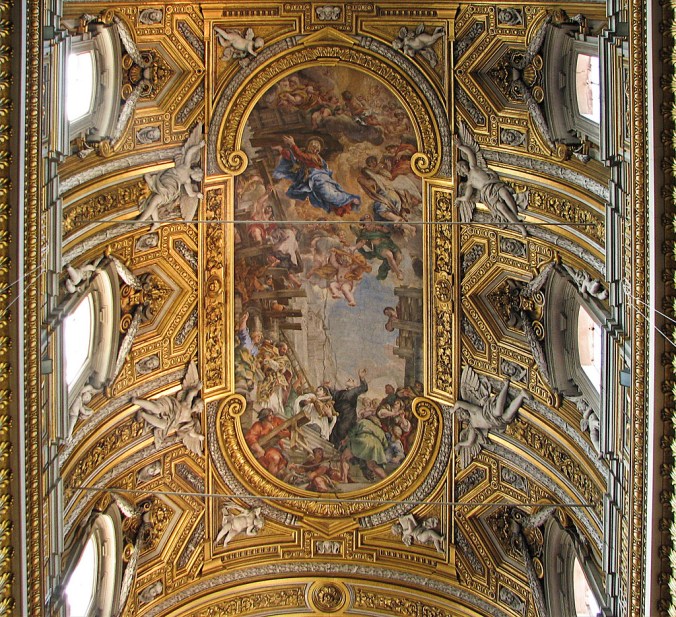
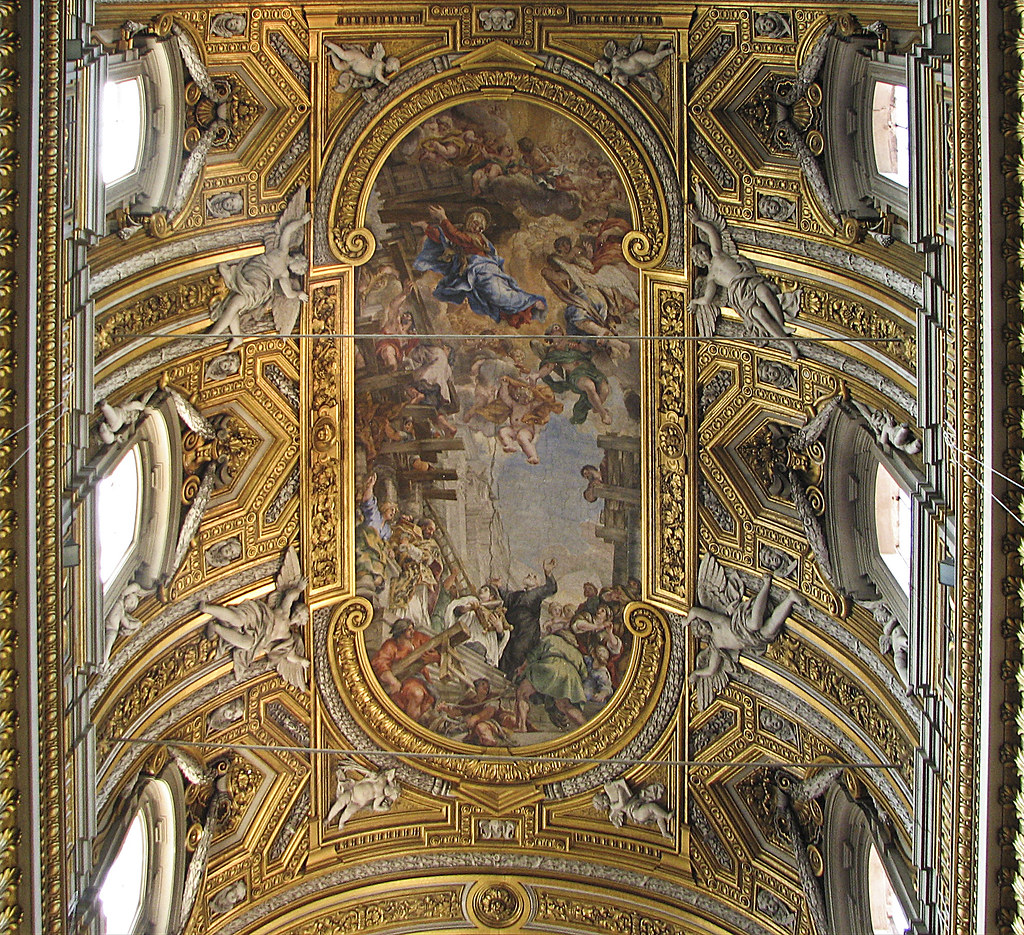
This incident is memorialized in the ceiling of the Chiesa Nuova.

CNCeiling.jpg

The ceiling of the Chiesa Nuova, in which is depicted the scene of Our Lady preserving the Vallicella from collapse and ruin. (Source)

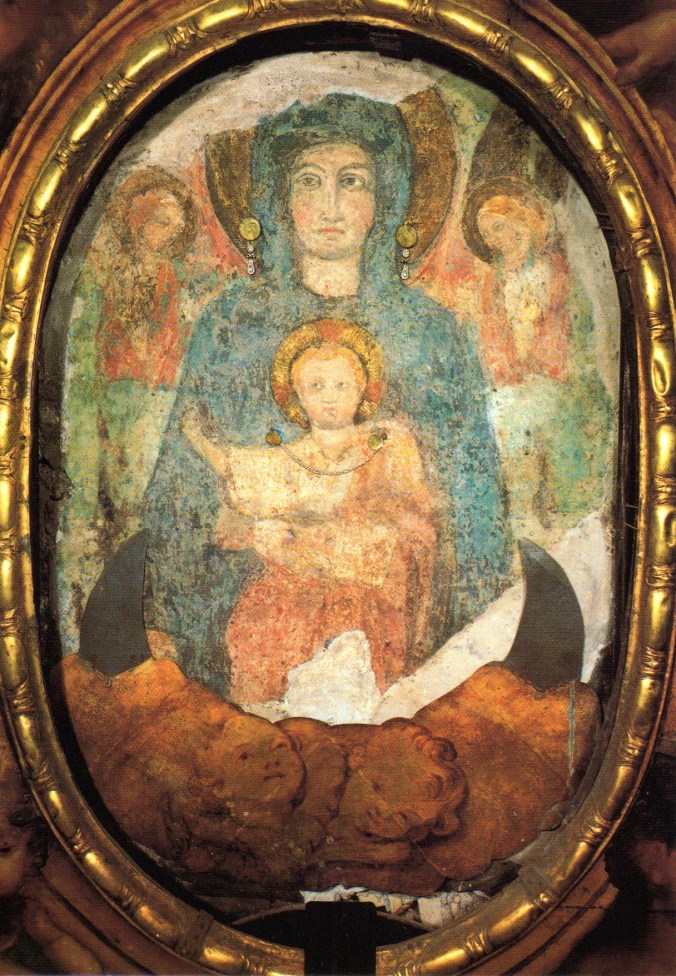
It is my understanding that the Saint and his sons attributed the miraculous intervention of Our Lady to an ancient fresco they uncovered during construction. The image depicts Our Lady in blue holding the Infant Christ. Jesus raises his hand in blessing. Both are seated in the moon, while three adoring cherubs look up with rapt attention. These are the essentials of the icon, which canonically follows the “Nicopeia (bringer of victory) or Kyriotissa (enthroned) type.”

This conjunction suggests something about the icon’s meaning. The Mother of God brings us the ultimate victory, Christ Himself; His victory over death is truly her victory and, by extension, ours. What’s more, their relationship is a mutual enthronement. She takes all of her dignity as Queen of Heaven from Christ, and He is most magnified in Her Heart.

It seems appropriate that an image that bears such a meaning would fall to St. Philip and his sons as a kind of special inheritance. After all, Cardinal Newman’s motto encapsulates the entirety of Oratorian life: Cor ad Cor Loquitur, “Heart Speaks to Heart.” This phrase of the Psalmist describes God’s Liturgical communion with us, our spiritual communion with each other, the key process of evangelizationbut also the intimacy between the Sacred Heart of Jesus and the Immaculate Heart of Mary. And let us not forget that third heart, the Flaming Heart of St. Philip Neri. All in all, communion and reciprocity are key to Oratorian spirituality in a way that is perhaps more pronounced than in other religious families.

12-vallicelliana

The ancient, miraculous fresco-icon of Our Lady of the Vallicella. Currently hidden in the Chiesa Nuova behind the Rubens rendition. (Source)

The story of Our Lady of the Vallicella is not just theological, though. It also winds through some of the more important chapters of Art History.

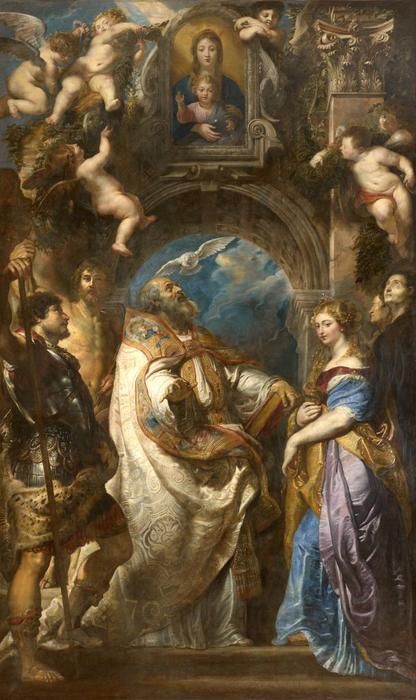
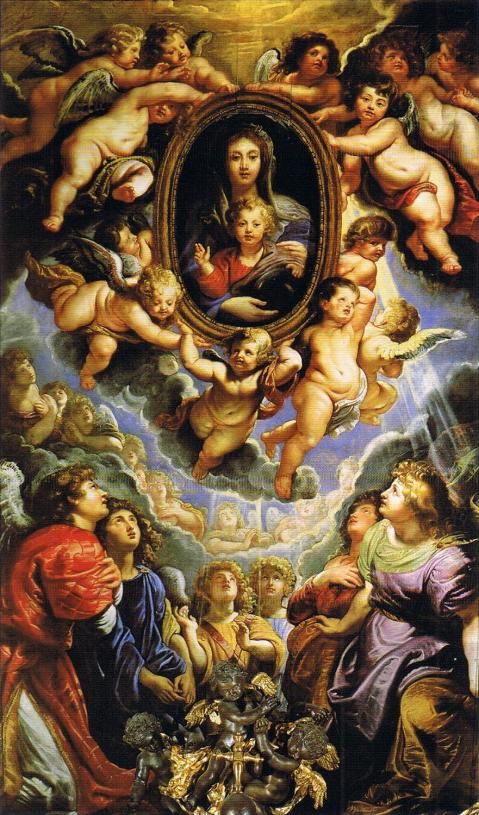
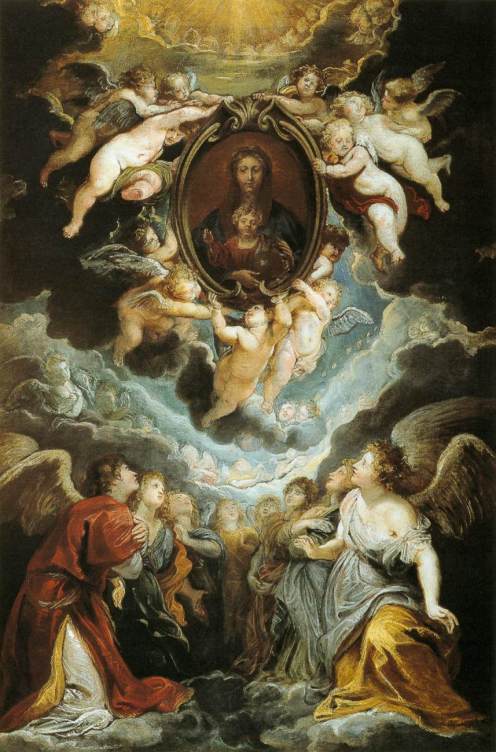
The great Baroque artist Peter Paul Rubens was commissioned by the fathers of the Roman Oratory to paint the church’s high altar. He ended up painting a few. The first, a canvas, was rejected because it was too reflective and is now in a museum at Grenoble. The second, a painting on slate, remains in situ. He later painted a somewhat rougher third version that now hangs in the Academy of Fine Arts in Vienna.

RubensVallicella1

Pope St. Gregory, Surrounded by Saints, Venerating the Miraculous Image of the Virgin and Infant, called Santa Maria of the Vallicella, Rubens, c. 1606-07. The first altarpiece of the Chiesa Nuova, now in Grenoble. (Source)

RubensVallicella2

Madonna della Vallicella, Rubens, 1606-08. The second altarpiece, now in situ at the Roman Oratory. The central image of the Madonna is removable and covers the miraculous fresco. (Source).

RubensValicella3

The Madonna della Vallicella Adored by Seraphim and Cherubim, Rubens, 1608. Now in Vienna. (Source)

Of course, devotion to Our Lady of the Vallicella is, like so many other elements of Oratoriana, not restricted to the sons of St. Philip. As the whole city of Rome is imbued with his spirit, we find her image among the many picturesque street shrines that stand as one of the Eternal City’s most distinctive forms of public piety.

AleteiaValicella.jpg

Our Lady of the Vallicella in a Roman street shrine. Note the way the hands are positioned; Our Lord’s left hand on the Orbis Mundi, with Our Lady’s right. Conversely, His right hand rises in blessing as her left seems to hold or even crown him. This posture is consistent with earlier renditions. (Source).

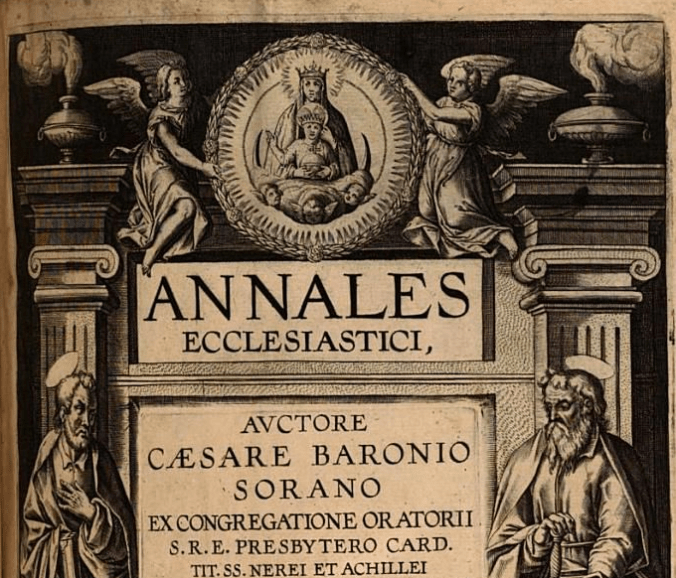
Regardless, Our Lady of the Vallicella quickly became a major emblem of the Congregation. She adorns most of the first-edition title pages of Baronius’s Annales Ecclesastici, as you can seen in this image from the Twelfth Volume.

Screen Shot 2017-09-08 at 2.02.58 AM.png

The title page of the Twelfth Volume of the Ecclesiastical Annals of Cardinal Baronius. (Source)

image.jpeg

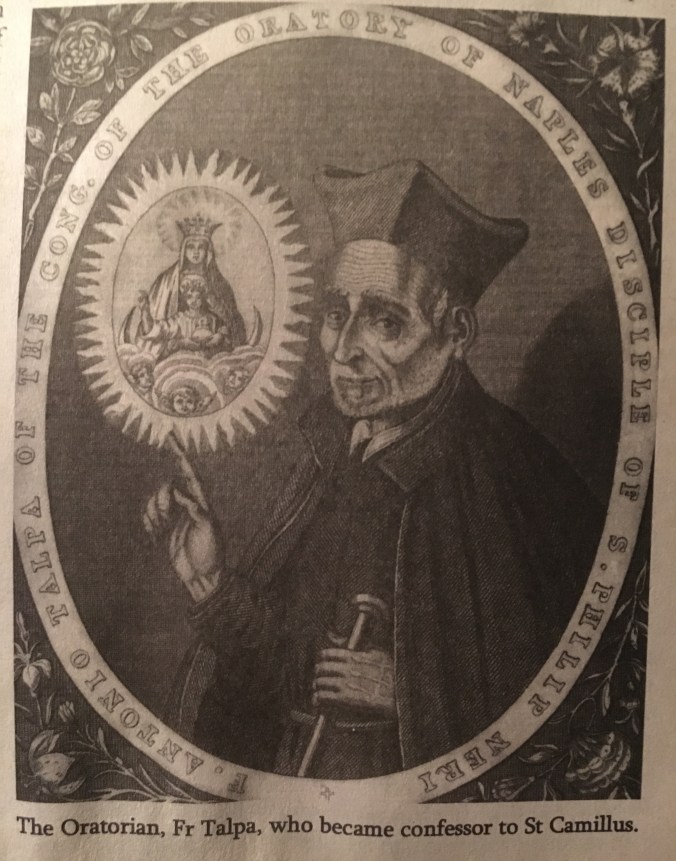
Our Lady of the Vallicella in a portrait of Fr. Antonio Talpa, one of the founders of the Naples Oratory and the confessor of St. Camillus of Lellis. I don’t know how old the image originally is. Photo taken from the 2008 English Edition of Cardinal Capecelatro’s Good Philip, produced by The Desert Will Bloom Press. Page 111.

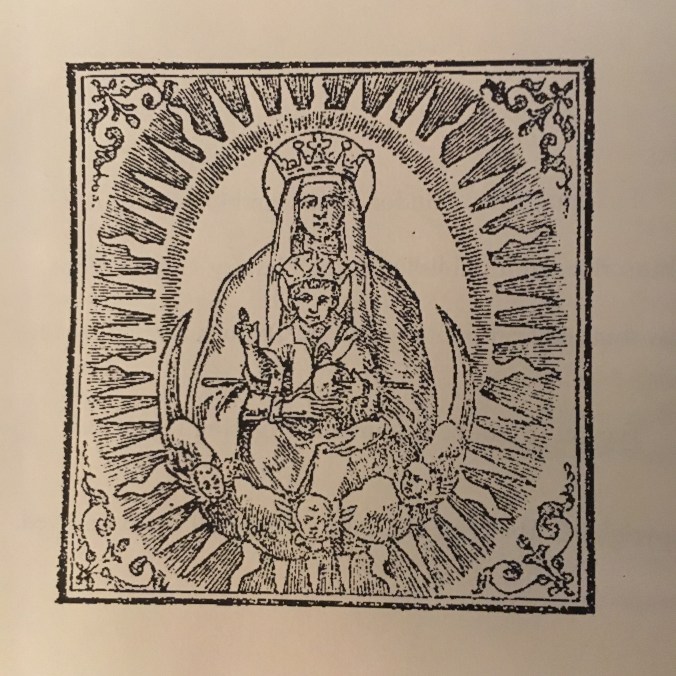
Later Oratorians also made use of the icon in their publications. This was particularly true of works brought out by the Fathers of the London Oratory. A publication of Fr. Faber’s Spiritual Conferences from 1859 includes the following sigil on its title page:

Screen Shot 2017-09-08 at 2.11.38 AM.png

Our Lady of the Vallicella in one of Father Faber’s many books (Source).

More recent Oratorians have also included this image of the Mother of God on the volumes they have published. For example:

image

Our Lady of the Vallicella as seen on the title page of my copy of Agnelli’s The Excellences of the Congregation of the Oratory of St. Philip Neri, Third Edition (Oxford 2012).

What I have not found yet is any evidence that Our Lady of the Vallicella was enshrined or venerated as an icon anywhere outside of the Roman Oratory. Further research may prove otherwise. Nevertheless, it is my sincere hope on this Feast of the Nativity of Mary that, as we are living in an Oratorian age, devotion to Mary under her Oratorian title will continue to spread.


Excerpts for St. Austin’s Day

Saint-Augustine-Doctor-of-the-Church

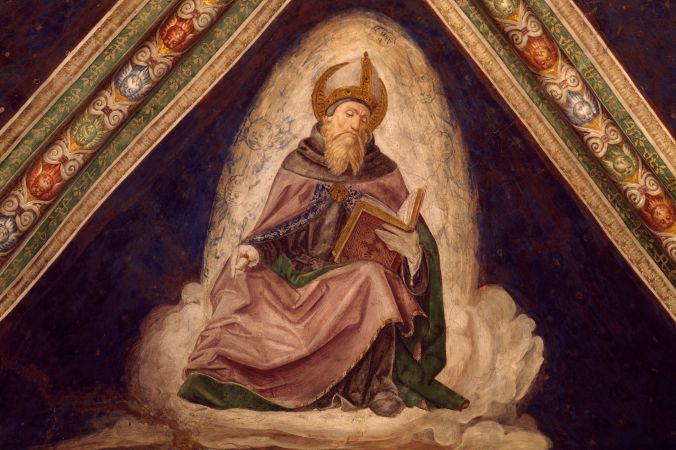
St. Augustine, Ora Pro Nobis. (Source)

I read this passage from the Confessions today and it instantly became one of my favorites selections from St. Augustine. The translation by Maria Boulding OSB is much prettier, but it’s not public domain. What follows is Book X, Chapters 6-7 (Para. 8-11).

Not with uncertain, but with assured consciousness do I love You, O Lord. You have stricken my heart with Your word, and I loved You. And also the heaven, and earth, and all that is therein, behold, on every side they say that I should love You; nor do they cease to speak unto all, so that they are without excuse. Romans 1:20 But more profoundly will You have mercy on whom You will have mercy, and compassion on whom You will have compassion, otherwise do both heaven and earth tell forth Your praises to deaf ears. But what is it that I love in loving You? Not corporeal beauty, nor the splendour of time, nor the radiance of the light, so pleasant to our eyes, nor the sweet melodies of songs of all kinds, nor the fragrant smell of flowers, and ointments, and spices, not manna and honey, not limbs pleasant to the embracements of flesh. I love not these things when I love my God; and yet I love a certain kind of light, and sound, and fragrance, and food, and embracement in loving my God, who is the light, sound, fragrance, food, and embracement of my inner man— where that light shines unto my soul which no place can contain, where that sounds which time snatches not away, where there is a fragrance which no breeze disperses, where there is a food which no eating can diminish, and where that clings which no satiety can sunder. This is what I love, when I love my God.

And what is this? I asked the earth; and it answered, I am not He; and whatsoever are therein made the same confession. I asked the sea and the deeps, and the creeping things that lived, and they replied, We are not your God, seek higher than we. I asked the breezy air, and the universal air with its inhabitants answered, Anaximenes was deceived, I am not God. I asked the heavens, the sun, moon, and stars: Neither, say they, are we the God whom you seek? And I answered unto all these things which stand about the door of my flesh, You have told me concerning my God, that you are not He; tell me something about Him. And with a loud voice they exclaimed, He made us. My questioning was my observing of them; and their beauty was their reply. And I directed my thoughts to myself, and said, Who are you? And I answered, A man. And lo, in me there appear both body and soul, the one without, the other within. By which of these should I seek my God, whom I had sought through the body from earth to heaven, as far as I was able to send messengers— the beams of my eyes? But the better part is that which is inner; for to it, as both president and judge, did all these my corporeal messengers render the answers of heaven and earth and all things therein, who said, We are not God, but He made us. These things was my inner man cognizant of by the ministry of the outer; I, the inner man, knew all this— I, the soul, through the senses of my body. I asked the vast bulk of the earth of my God, and it answered me, I am not He, but He made me.

Is not this beauty visible to all whose senses are unimpaired? Why then does it not speak the same things unto all? Animals, the very small and the great, see it, but they are unable to question it, because their senses are not endowed with reason to enable them to judge on what they report. But men can question it, so that the invisible things of Him . . . are clearly seen, being understood by the things that are made; Romans 1:20 but by loving them, they are brought into subjection to them; and subjects are not able to judge. Neither do the creatures reply to such as question them, unless they can judge; nor will they alter their voice (that is, their beauty), if so be one man only sees, another both sees and questions, so as to appear one way to this man, and another to that; but appearing the same way to both, it is mute to this, it speaks to that— yea, verily, it speaks unto all but they only understand it who compare that voice received from without with the truth within. For the truth declares unto me, Neither heaven, nor earth, nor any body is your God. This, their nature declares unto him that beholds them. They are a mass; a mass is less in part than in the whole. Now, O my soul, you are my better part, unto you I speak; for you animate the mass of your body, giving it life, which no body furnishes to a body but your God is even unto you the Life of life.

What then is it that I love when I love my God? Who is He that is above the head of my soul? By my soul itself will I mount up unto Him. I will soar beyond that power of mine whereby I cling to the body, and fill the whole structure of it with life. Not by that power do I find my God; for then the horse and the mule, which have no understanding, might find Him, since it is the same power by which their bodies also live. But there is another power, not that only by which I quicken, but that also by which I endow with sense my flesh, which the Lord has made for me; bidding the eye not to hear, and the ear not to see; but that, for me to see by, and this, for me to hear by; and to each of the other senses its own proper seat and office, which being different, I, the single mind, do through them govern. I will soar also beyond this power of mine; for this the horse and mule possess, for they too discern through the body.

And I’ll add this paragraph from Chapter 17 (Para. 26), which strongly reminds me of Cardinal Newman’s project in the Apologia Pro Vita Sua:

Great is the power of memory; very wonderful is it, O my God, a profound and infinite manifoldness; and this thing is the mind, and this I myself am. What then am I, O my God? Of what nature am I? A life various and manifold, and exceeding vast. Behold, in the numberless fields, and caves, and caverns of my memory, full without number of numberless kinds of things, either through images, as all bodies are; or by the presence of the things themselves, as are the arts; or by some notion or observation, as the affections of the mind are, which, even though the mind does not suffer, the memory retains, while whatsoever is in the memory is also in the mind: through all these do I run to and fro, and fly; I penetrate on this side and that, as far as I am able, and nowhere is there an end. So great is the power of memory, so great the power of life in man, whose life is mortal. What then shall I do, O Thou my true life, my God? I will pass even beyond this power of mine which is called memory— I will pass beyond it, that I may proceed to You, O Thou sweet Light. What sayest Thou to me? Behold, I am soaring by my mind towards You who remainest above me. I will also pass beyond this power of mine which is called memory, wishful to reach You whence You can be reached, and to cleave unto You whence it is possible to cleave unto You. For even beasts and birds possess memory, else could they never find their lairs and nests again, nor many other things to which they are used; neither indeed could they become used to anything, but by their memory. I will pass, then, beyond memory also, that I may reach Him who has separated me from the four-footed beasts and the fowls of the air, making me wiser than they. I will pass beyond memory also, but where shall I find You, O Thou truly good and assured sweetness? But where shall I find You? If I find You without memory, then am I unmindful of You. And how now shall I find You, if I do not remember You?


Elsewhere: A New Blog on English Catholicism

image

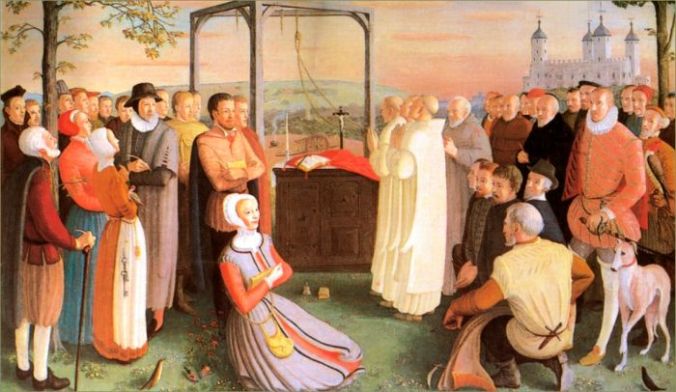
All ye holy English Martyrs, pray for us. (Source)

Anglo-Catholic readers will no doubt have mourned the demise of Conner McNeill’s Merrily on High, what was once among the best and most prolific AC blogs on the web. Never fear! Connor McNeill rides again. He’s back with a new blog called Mary’s Dowry. It looks as tasteful, reverent, and aesthetically sophisticated as the project that preceded it.

Mr. McNeill has decided to depart from the Church of England and join the Roman Communion. As he had been pursuing ordination with the C of E, this conversion is no small undertaking. Pray for him! And check out Mary’s Dowry while you’re at it.


Elsewhere: Fr. Hunwicke on Liturgical Wigs

image

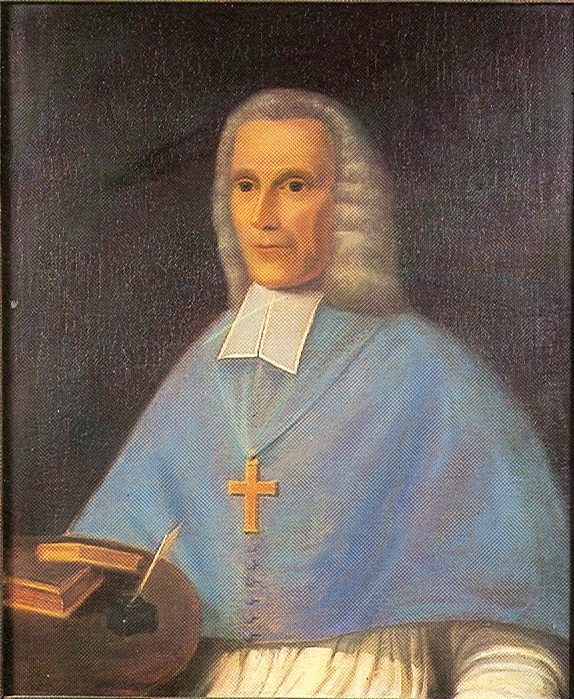
The famous portrait of Bishop Challoner to which Fr. Hunwicke refers in his piece. (Source)

I haven’t written much this week, as I’ve been traveling. However, on this beautiful  St. Bernard’s Day, I thought I’d share this brief and wonderful gem of a piece by Fr. John Hunwicke of the Ordinariate.

An excerpt:

I’m sure there are zillions of you out there who have the following sort of information right at your snuff-stained finger tips: did prelates eo fere tempore wear their wigs all through Mass? Even after their zucchetto had been removed as they approached the Consecration? When did Catholic bishops stop wearing wigs? (I think it went out of fashion in Anglican cicles in the 1830s.)

He also gets into the question of blue episcopal choir dress, mainly used in France and Ireland. Read the whole thing.

Clerical dress is one of my longstanding interests, as is the history of 18th century Catholicism. I’m glad Fr. Hunwicke is using his formidable celebrity to draw attention to these matters. While some may dismiss clerical fashion (particularly that of the Ancien Régime) as a trivial matter, I beg to differ. Clerical dress both during and outside of the liturgy is one more aesthetic component by which we can present “the beauty of holiness.” The nondescript threads worn by so many clergy and religious today are, alas, one more surrender to the cult of stark utility, false equality, failed individuality, and, in the end, boring homogeneity.

At the moment, I don’t have the time or capacity to research the questions Fr. Hunwicke raises. But The Amish Catholic will follow this story with all due attention and gravity. You can count on that. In the meantime, I’ll feast my eyes on this doozy of a cappa magna.

And After the Fire

the-morning-after-the-deluge

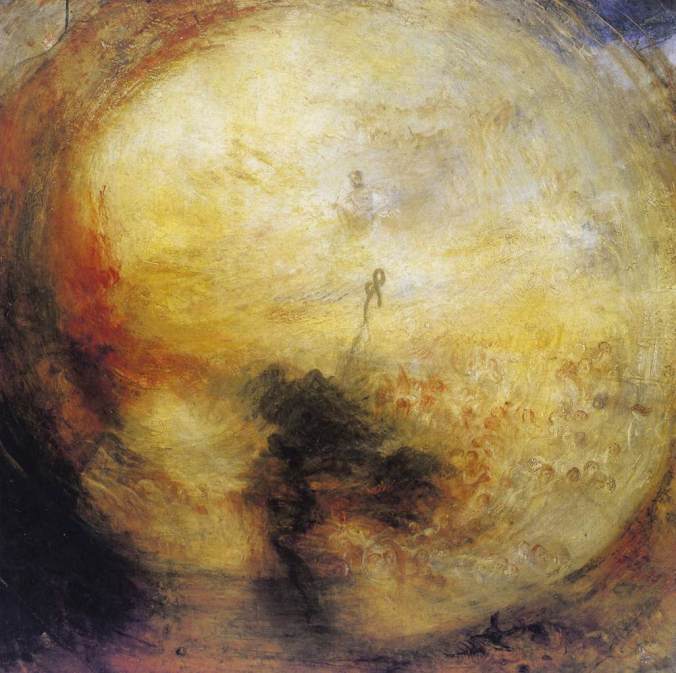
“The Morning After the Deluge,” J.M.W. Turner, c. 1843. (Source).

I am still shocked and furious about the events of the last few days. Fascists of various sorts have descended upon Charlottesville, Virginiaa town I loved and called home for four years—and caused immense pain for the entire community. One woman, a Wobbly protester, died at the hands of a Neo-Nazi who rammed his car into a crowded alley. I had friends in the counter-protest. I had friends who feared for their lives. And all I could do was watch and pray. The Rosary, the Imprecatory Psalms, Invocations to St. Michael. But how I wish I could have done so much more.

I was following the news across Facebook, CNN television, and Twitter. I observed mixed responses. Some, even among baptized Catholics, sympathize with the Alt-Right fascists. They point the finger of blame at Antifa, the several Socialists who showed up in counterprotest, the Media, and Black Lives Matter activists. Likewise, some Christians equivocated. They were happy to condemn the Alt-Right briefly, while also complaining at length about how the Media wasn’t focusing on Antifa, or the Police didn’t do enough, or, incredibly, how all of this is really just the fault of the Democratic Party (here’s looking at you, John Zmirak and Dinesh D’Souza). Then, there were those brave Catholics like Chad Pecknold, Robert George, and Bishop Barron who condemned white supremacy and racism outright. And they received backlashshameful!from those who should know better.

But I haven’t lost hope.

The Liturgical Providence of God is so calibrated to our salvation that we receive the graces we need at precisely the moment we need them, even when we could never have anticipated needing them in the first place. It works even through a deficient calendar, such as we have in the Novus Ordo. For today, we read and hear about a great many disruptions and turbulent tumults. We turn first to the Prophet Elijah at Sinai where, having cast down fire from heaven upon the Prophets of Baal, he hides and waits for the Lord to speak.

At the mountain of God, Horeb,
Elijah came to a cave where he took shelter.
Then the LORD said to him,
“Go outside and stand on the mountain before the LORD;
the LORD will be passing by.”
A strong and heavy wind was rending the mountains
and crushing rocks before the LORD—
but the LORD was not in the wind.
After the wind there was an earthquake—
but the LORD was not in the earthquake.
After the earthquake there was fire—
but the LORD was not in the fire.
After the fire there was a tiny whispering sound.
When he heard this,
Elijah hid his face in his cloak
and went and stood at the entrance of the cave.

1 Kgs 19:9a, 11-13a

The wind rises high all about Elijah; it howls and screams like the very demons of Hell. It rushes up the mountain like the chariots of the wicked King who sought the prophet’s life. But the Lord was not in the wind.

The earthquake causes the whole mountain to tremble. Rocks shake as if they are about to be torn asunder by invisible hands. The trees seem to dance in an unholy rhythm, threaten to crack and topple over. But the Lord was not in the earthquake.

The fire courses across the plain and up the slopes, hungrily devouring the short desert grasses that line the path to Horeb’s cave. The smoke fills the air; the sweltering heat traps Elijah, and threatens to make a furnace of his narrow cell. But the Lord was not in the fire.

The Lord came, instead, in a “tiny whispering sound” that followed all that tumult and trial. The frightful violence of nature may have been sublime, and it may have sorely threatened Elijah. But it was empty. God does not dwell in the frenzy of the wind, the earthquake, and the fire. He comes in peace, and He meets His servant in peace.

This week’s Psalm takes up the same theme.

R. (8) Lord, let us see your kindness, and grant us your salvation.
I will hear what God proclaims;
the LORD — for he proclaims peace.
Near indeed is his salvation to those who fear him,
glory dwelling in our land.
R. Lord, let us see your kindness, and grant us your salvation.
Kindness and truth shall meet;
justice and peace shall kiss.
Truth shall spring out of the earth,
and justice shall look down from heaven.
R. Lord, let us see your kindness, and grant us your salvation.
The LORD himself will give his benefits;
our land shall yield its increase.
Justice shall walk before him,
and prepare the way of his steps.
R. Lord, let us see your kindness, and grant us your salvation.

Ps 85:9, 10, 11-12, 13-14

The peace and salvation of God is near to those who fear Him. A great mystery hovers within these lines: “Kindness and truth shall meet; justice and peace shall kiss. Truth shall spring out of the earth, and justice shall look down from heaven.”

Justice. Peace. Those are words that scare a lot of us traditionalists. After all, haven’t so many abuses of doctrine and the liturgy occurred precisely in the name of “social justice?” Haven’t whole orders been gutted by their worldly capitulation to liberal standards of “social justice” work? And aren’t the proverbial “Social Justice Warriors” the very people who most oppose the Church’s teachings on abortion, marriage, gender, and so many other issues?

All of these criticisms are valid. But they are not complete. Justice is a cardinal virtue. To quote one of the better Anglican principles, “The abuse of a thing doth not take away the good use of it.” Consider what the Psalm teaches us of God’s Justice. Here is a picture of the Last and Eternal Day, when the New Heavens and the Earth will united at the Wedding Feast of the Lamb. But we also find a practical insight for the here and now. When we read, “Justice shall walk before him, and prepare the way of his steps,” we recognize in this a prophecy of Christ. Our Lord, whose way was prepared by St. John the Baptist (that man so like an icon of Justice), is never far from Justice. The wind and earthquake and fire of injustice will one day yield to the peace of Christ. But in the meantime, we must do what we can to realize that justice in our own communities. Indeed, in our own hearts.

This can only begin when we faithfully repair to the sacrament of penance, confessing our sins with compunction, and seek to live always as Christ would have us. For some, this may mean abandoning deep bigotries like white supremacy or a hatred of the poor. It will be difficult for those caught in such snares to relinquish their demonic ideologies, so we must pray for them. But is there anyone among us who does not cherish some prejudice, some little parasite of pride, some vice that blinds us to the manifold ways we are complicit in the oppression of our brethren? Even I am no saint in this respect, and I pray that God’s mercy might change me to better reflect His love for all people.

For some, direct action may be the right course. I am not an activist. I started this essay confessing that I wish I could have done more to help those standing against white supremacists yesterday. Yet I recognize that I have a temperamental aversion to any kind of on-the-ground activism. The task of marching, picketing, and chanting songs of justice may be what some are called to. Dorothy Day provides a wonderful Catholic example of this kind of work.

And there are other strategies, which theologians and activists have pursued for years, that aim at incarnating Justice. It would be redundant to attempt any kind of review here. But no matter how we go about the task of Justice, we musn’t lose hope. Let us hear the commiserating words of St. Paul to the Romans:

Brothers and sisters:
I speak the truth in Christ, I do not lie;
my conscience joins with the Holy Spirit in bearing me witness
that I have great sorrow and constant anguish in my heart.
For I could wish that I myself were accursed and cut off from Christ
for the sake of my own people,
my kindred according to the flesh.
They are Israelites;
theirs the adoption, the glory, the covenants,
the giving of the law, the worship, and the promises;
theirs the patriarchs, and from them,
according to the flesh, is the Christ,
who is over all, God blessed forever. Amen.

Rom 9:1-5

Even amidst the anguish we feel for our brethren, we must not lose sight of the Holy Face triumphant. Nor must we forget that Justice is not itself the highest good. God is. With these two truths in mind, we turn to the Gospel.

After he had fed the people, Jesus made the disciples get into a boat
and precede him to the other side,
while he dismissed the crowds.
After doing so, he went up on the mountain by himself to pray.
When it was evening he was there alone.
Meanwhile the boat, already a few miles offshore,
was being tossed about by the waves, for the wind was against it.
During the fourth watch of the night,
he came toward them walking on the sea.
When the disciples saw him walking on the sea they were terrified.
“It is a ghost,” they said, and they cried out in fear.
At once Jesus spoke to them, “Take courage, it is I; do not be afraid.”
Peter said to him in reply,
“Lord, if it is you, command me to come to you on the water.”
He said, “Come.”
Peter got out of the boat and began to walk on the water toward Jesus.
But when he saw how strong the wind was he became frightened;
and, beginning to sink, he cried out, “Lord, save me!”
Immediately Jesus stretched out his hand and caught Peter,
and said to him, “O you of little faith, why did you doubt?”
After they got into the boat, the wind died down.
Those who were in the boat did him homage, saying,
“Truly, you are the Son of God.”

Mt 14:22-33

We learn from the Psalm that “Justice shall walk before him, and prepare the way of his steps.” So Our Lord sends forth His Apostles, His Church, to “precede him to the other side” of the sea. The Church mystically incarnates Justice at every Mass. And it can only hope to sustain Justice, a Cardinal Virtue, with Faith. For when Peter, Prince of the Apostles, goes out of the boat to walk towards His Lord, he only sinks when he loses his Faith in fear.

But all is not lost. Christ comes through the storm and shows that He is master of it. He walks on water. No tempest can withstand Him, just as no wind, earthquake, fire, flood, protest, or violence of this world can drown out His voice. No slogan of oppression, no act of terrorism, no brawl in the summer streets can overcome the peace that Christ alone brings in and to and through His Church.

I hope that my friends in Charlottesville will take heart. The last few days have been tempestuous, to say the least. But Christ will conquer the waves of this world. Have faith, and He will grant us both justice and peace.

The Uncreated Splendor of this Day

Transfiguration-of-the-Lord-Jesus-Christ-FraAngelioc

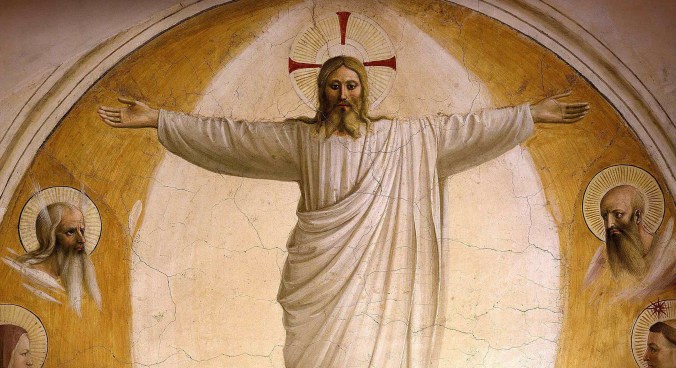
Transfiguration, Fra Angelico. Convento di San Marco, Florence. (Source)

I am currently engaged in an argument on Facebook over whether the Transfiguration or Pentecost is the most Sophiological Feast of the Church. Although I hold that the Descent of the Holy Spirit upon Our Lady and the Apostles in the Cenacle is, in fact, the most Sophiological event commemorated on the Kalendar, I’m willing to concede that today’s liturgy is refulgent with the splendor of Eternal Wisdom. I had the opportunity to attend a Solemn High Mass, complete with asperges and vesting at the chair. All the propers, all the readings, and all the prayers were as so many lights set one by one upon the altar, until their glow was consumed in the Uncreated Light of the Eucharist.

Consider the Propers. At the Introit, we pray:

Illuxerunt coruscationes tuae orbi terrae: commota est et contremuit terra. Quam dilecta tabernacula tua, Domine virtutum! concupiscit, et deficit anima mea in atria Domini.

Your lightening illumined the world; the earth quivered and quaked. How lovely is your dwelling place, O Lord of Hosts! My soul years and pines for the courts of the Lord.

Here, the Church introduces us to one of the great motifs of this holy feast: light. And not just any light. A totally beautiful, all-pervading illumination. The whole of creation responds to this light, and we who have the grace of observing it are inspired to think of the eternal “dwelling place” and “courts of the Lord” [Ps. 82:2-3].

St. Peter takes up this theme, writing to us in his epistle:

And we have the word of prophecy, surer still, to which you do well to attend, as to a lamp shining in a dark place, until the day dawns and the morning star rises in your hearts. [2 Peter 1:19]

The Prince of the Apostles knows that the Light of Lights, glimpsed first on Tabor, enkindles the hearts of all Prophets. That is why Our Lord appears there with two of the greatest Prophets. That is why the Holy Ghost, “who has spoken through the Prophets,” descends upon the assembly to announce the voice of the Father [Nicene Creed]. Yet even the light of Tabor will fade before the dawn of the Eschatonthe “morning star” of the Holy Spirit that “rises in your hearts” [2 Peter 1:19].

Moving on, we come to a Gradual in which the words of David are taken up by the whole Church as she addresses her Spouse with intimate delight:

Speciosus forma prae filiis hominum: diffusa est gratia in labiis tuis.
V. Eructavit cor meum verbum bonum: dico ego opera mea Regi.

Fairer in beauty are You than the sons of men; grace is poured out upon Your lips.
V. My heart overflows with a goodly theme; as I sing my ode to the King.

If you wanted to make the argument that the Transfiguration is the most Sophianic feast, the Alleluia would be particularly pertinent. For we pray the words of the Seventh Chapter of the Book of Wisdom (words, I might add, that are usually read in the feminine and applied to Our Lady):

Alleluia, alleluia. V. Candor est lucis aeternae, speculum sine macula, et imago bonitatis illius. Alleluia.

Alleluia, alleluia. V. He is the refulgence of eternal light, the spotless mirror, and the image of His goodness. Alleluia.

These prayers are like steps to the Temple. For, can we not see in all of these verses the very picture of the Last and Glorious Day? Are we not cast off into a vision of the Heavenly Courts, and of the Everlasting House of God? The Offertory confirms our path and calls to mind our mystical destination, where, by the Epiclesis and Consecration, we shall soon worship the Eucharistic God. We pray the words of Psalm 111:

Gloria et divitiae in domo eius: et iustitia eius manet in saeculum saeculi, alleluia.

Wealth and riches shall be in His house; His generosity shall endure forever. Alleluia.

But the Communion Verse warns us with a passage from St. Matthew:

Visionem, quam vidistis, nemini dixeritis, donec a mortuis resurgat Filius hominis.

Tell the vision you have seen to no one, till the Son of Man has risen from the dead.

Whenever we are privileged enough to enter into a Sophianic mystery, the Blessed Mother is never far away. Nor can she be ignored in this, the month of her Sorrowful and Immaculate Heart, the month in which we celebrate her Glorious Assumption and her Queenship over all Heaven. We should be extra attentive to her quiet presence. Thus, in this Communion verse, we learn to be like Mary. For, “Mary treasured up all these things, pondering them in her heart” [Luke 2:19 ESV]. That is the rule Jesus teaches to the Apostles who witnessed His Transfiguration. This, too, is an expression of Holy Wisdom, in the virtue of Prudence. An experience of such mystical consolation, like the Mustard Seed we learned about in Monday’s Gospel, would one day grow into an enormous tree where “the birds of the air come, and dwell in the branches thereof,” [Matt. 13:32]. But first, it had to be watered by the Blood of Christ.

So must we. If we are to make good use of the many graces we receive, we must offer them back up to Christ to receive His Blessing. Only He can make our hearts Eucharistic like His own; only He can send the Spirit to enkindle our souls with charity and wisdom; only He can impart the Uncreated Light that He first manifested on Mount Tabor.


Elsewhere: A New Anglo-Catholic Blog

Ordination 1956 by Norman Blamey 1914-2000

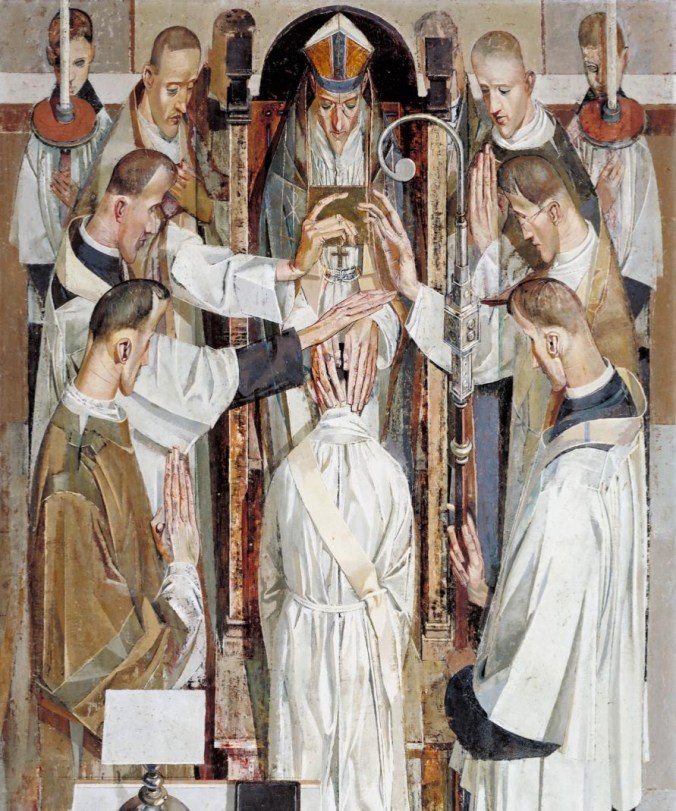
“Ordination,” by Norman Blamey, 1956. (Source)

My friend, Archbishop Mark Haverland, Primate of the Anglican Catholic Church, has just started a new blog called “Anglican Catholic Liturgy and Theology.” You really get what it says on the tin with this one. For those of us with an interest in Anglo-Catholic history, theology, and practice, Archbishop Haverland’s blog will no doubt prove to be a great resource.

The Oratorian Option

StPhilipNeriandEnglishSeminarians

St. Philip Neri blessing the departing seminarians of the English College. Fr. V.J. Matthews tells us that St. Philip would hail the seminarians, whose college is directly across from San Girolamo, with the words Salvete Flores Martyrum, “Hail, flowers of the Martyrs” (Matthews 85). Edited photo by Fr. Lawrence Lew, OP.  (Source).

In a recent post, I suggested that Rod Dreher’s The Benedict Option is a flawed, if well-intentioned, strategy for the Church in our times. I stand by that opinion. I also would like to offer my own “option,” as so many others have done. I will refrain from detailing specific suggestions and strategies, as I have neither the time nor the knowledge nor the experience to profitably contribute to any discussion of specifics. Nonetheless, I think I can say a few things about the general spirit and principles of what we might choose instead of The Benedict Option.

For starters, it would be called something different. Although St. Benedict is an eminent and powerful patriarch, I submit to you that, for our purposes, we must look at another man in an era far more like our own, a man whose spiritual sons also offer powerful examples. That man, of course, is St. Philip Neri.

Early Modernity as Proto-Postmodernity

Like Dreher, I choose my patron saint in part because I think the unique conditions of our own moment deeply resonate with those which St. Philip faced. Any comparison between different periods of time are naturally going to fall flat in certain specifics. But consider, if you will, the following phenomena.

The rise of the Internet, like the advent of printing, has opened up new models of knowledge and new conceptions of the self. Our lives are ever more global, even as new forms of nationalism emerge. We are increasingly aware of various forms of religious difference. Some are extremist, and even violent (see, inter alia, the Münster Rebellion and the sects of the Interregnum). Within the Church, we face public in-fighting among the Cardinals, dangerous sacramental, moral, and doctrinal laxism, a German Church that is falling apart, and a Pope whom the Roman People themselves dislike. We face serious problems with the climate. Our educational aspirations and models are increasingly oriented towards social climbing, even as our specialties are becoming narrower. Literary and textual criticism set the terms of debate in the academy. More broadly, sexual mores have changed considerably, and culture war is the order of the day. Homosexuality and gender nonconformity have emerged as increasingly widely-recognized social phenomena. Our civilizational relationship with Islam is complicated, to say the least. Class divisions and structural inequality have led to political instability. Indeed, unthinkable political events, stemming in large part from those class frictions, have jettisoned any sense of certainty we might hope to sustain.

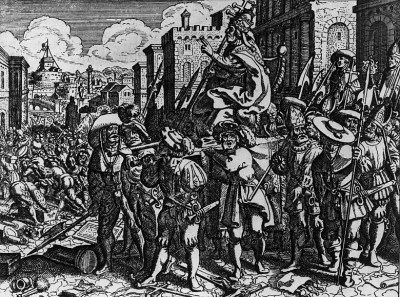
St. Philip arrived in Rome shortly after just such an unthinkable event. In 1527, the armies of the Emperor descended upon the Papal States and launched a horrifyingly brutal sack of the Eternal City. Both Lutheran andmore scandalouslyCatholic soldiers raped, pillaged, and desecrated their way through Rome. It was the second and last sack of Rome committed by civilized Christians, and it put an effective end to the Renaissance in that great city.

Alfonso Cardinal Capecelatro, one of St. Philip’s nineteenth century biographers, describes the event as:

…the terrible sack of Rome in 1527, which had no parallel in the history of the Church, whether regarded as a warning or a chastisement. We must go back to Attila and Genseric to find any event which even distantly approaches it in horror; and even those barbarians were civilized and even reverent in comparison with the soldiers of the most Catholic king and emperor, Charles V. A drunken, furious horde of Lutherans and Catholics together was let loose upon Rome…there were…unutterable outrages not to be thought of without a shudder. (Capecelatro 23).

Pertinent to our purposes, however, is the effect that this calamity left on the culture of Rome. Here, too, Capecelatro is a helpful resource.

To enter into the city of the Holy Apostles Peter and Paul at a time when their authority was spurned, vilified, and trampled into the mire by a terrible heresy; to visit the spots hallowed by the blood of martyrs when all around were the hideous traces of their recent profanation; to live in the holy city when the lives of the clergy themselves were dissolute or unbecoming, when paganism in science and letters and art was alone in honours must have been, to the heart of a saint such as Philip’s, an anguish inconceivably bitter. (Capecelatro 24).
SackofRome1527

A blasphemous mock-Papal procession during the 1527 Sack of Rome. (Source).

If, like Dreher, we wish to compare our own times to the sack of Rome, we ought to look a thousand years later than he does. As with Rome circa 1535, we live in a culture riddled with “a terrible heresy,” Dreher’s “Moralistic Therapeutic Deism” (among others). We Christians in America have witnessed the martyrdoms of our Coptic and Middle Eastern brethren over mass media. The Church is still reeling from a time when “the lives of the clergy themselves were dissolute [and] unbecoming.” The sins of clerical sex abuse continue. And insofar as there is a pagan tendency in our culture today (Camille Paglia certainly thinks there is), it resides in our “science and letters and art.”

While I don’t wish to belabor the point too much, I’ll add that not all is cause for alarm. Many of the good things about early modernity are also true today.

In 1850, Fr. Faber gave a series of lectures to his spiritual sons at the London Oratory. His subject was “The Spirit and Genius of St. Philip Neri.” The second lecture includes a long consideration of St. Philip as the “representative saint of modern times” (Faber 38). Faber argues,

The very essence of heresy and schism is constantly found in the disobedient and antiquarian worship of some pet past ages of the Church, in contradistinction to the present age, in which a man’s duties lie, and wherein the spirit and vigour of the living Church are in active and majestic energy. The Church of a heretic or schismatic is in books and on paper…A Catholic, on the contrary, belongs to the divine, living, acting, speaking, controlling Church, and recognizes nothing in past ages beyond and edifying and instructive record of a dispensation, very beautiful and fit for its day, but under which God has not cast his lot, and which, therefore, he has no business to meddle with or to endeavour to recall. One age may evoke his sympathies, or harmonize with his taste, more than another. Yet he sees beauty in all and fitness in all, because his faith discerns Providence in all. (Faber 40-41).

Dreher would do well to note Fr. Faber’s point. The uncharitable pessimism that animates so much of The Benedict Option is not entirely misbegotten, but certainly falls short of the truth. And why? In part, because Dreher never mentions Church history. His historical narrative of Christianity in Western culture overlooks the actual ways that Christians have responded to modernity since the 16th century. Fr. Faber does not. Instead, he writes,

…it is plain that we are in possession of a great many more doctrinal definitions than we were; the limits of theological certainty are immensely extended. Just as verified observations have extended the domain of the physical sciences, so the number of truths which a believer cannot, without impiety, or in some cases formal heresy, reject, has added to the domain of theology…Now this greater body of certain dogmatic teaching must necessarily influence the whole multitude of believers. It it tells upon literature; it tells upon popular devotion; it tells upon practice…and lastly, it tells upon ecclesiastical art…Neither, in speaking of Modern Times, must we omit to notice the natural connection there is between an increased knowledge of dogma, and the spirit of reverent familiarity in devotion, which has been so prominent a feature in the later Saints.  The more extended the vision of faith becomes, th more familiar a man necessarily grows with the sacred objects of which that faith so infallibly assures him…We must not omit then to name the increase and greater universality of mental prayer, the more generally adopted systematic methods of self-examination, the more common practice of spiritual reading, the ways of hearing mass, the obligation of meditation made the condition in most cases of gaining the indulgences of the Rosary, and other things which are all so many marks of what is called nowadays the increased “subjectivity” of the Modern Mind.(Faber 44-46, 49-50).

FatherFaber2

Fr. Frederick William Faber, founder of the Brompton Oratory in London. (Source)

Faber adds that anyone who would ignore this latter tendency towards “subjectivity” when seeking to evangelize would inevitably “find himself miserably out in his reckoning…The experiment would correct itself” (Faber 50). While Fr. Faber’s optimism is perhaps just as simplistic as Dreher’s pessimism, his perspective helps us attain the proper, prudential, balanced orientation towards modernity that The Benedict Option flatly misses.

Faber offers his historical assessment as a prelude to the consideration of St. Philip Neri’s life and spirituality. For Fr. Faber, St. Philip combines in his person and example the very best of what modernity has to offer. After all, Faber notes, Pippo Buono was ordained while the Council of Trent met. His movement began in an urban setting, “the very capital of Christendom itself,” and he managed to meet and influence “people of all nations” (Faber 51).

Even St. Philip’s personality was that of

…a modern gentleman, of scrupulous courtesy, sportive gaiety, acquainted with what was going on in the world, taking a real interest in it, giving and getting information, very neatly dressed, with a shrewd common sense always alive about him, in a modern room with modern furniture, plain, it is true, but with no marks of poverty about it; in a word, with all the ease, the gracefulness, the polish, of a modern gentleman of good birth, considerable accomplishments, and very various information. (Faber 52).

Fair enough. But why bother applying the example of this modern saint to our peculiar cultural and religious circumstances? It is one thing to say that a saint might have something to teach us. It is another thing altogether to say that a saint’s teaching might prepare us for the peculiarly harsh cultural conditions which seem to loom on the horizon (Dreher wasn’t wrong about all of it).

Faber answers this question, too. He writes of St. Philip:

He came to Rome at one of the most solemn crises of the Church; the capital was full of Saints, and full of corruption too. He was the quietest man at his hard work that ever was seen; yet he magnetized the whole city; and when he died he left it quite a different city from what it was, nay, with the impress of his spirit and genius so deep upon it, that it was called his city, and he the apostle of it, second only to St. Peter. It was no man clothed in camel’s hair, with the attractive paraphernalia of supernatural austerities upon him, no St. Francis, with his Chapter of Mats all round the Porziuncula, that the city and its foreign visitants went so anxiously to see; it was simply an agreeable gentleman, in a comfortable little room, apparently doing and saying just what any one else might do or say as well. He had come at his right time; he suited his age; men were attracted; he fulfilled his mission. (Faber 53).

St. Philip’s example is pertinent to our present debate insofar as he reformed late Renaissance Rome, a society much like ours, by means far more achievable and far more charitable than the contorted stratagems of The Benedict Option.

“Roots Are Very Important”

Admittedly, those words weren’t spoken by St. Philip. They’re actually the climactic revelation from Paolo Sorrentino’s La Grande Bellezza (2013), one of my favorite filmsa story that takes place in Rome. And as with all things Roman, St. Philip is never far away.

Two very singular facts stand out about St. Philip. One is that he was deeply attached to the Eternal City. And, relatedly, he never wished to start a religious order. He always claimed that the Congregation was entirely the work of Mary and the Holy Spirit. St. Philip was even reluctant to permit some of his sons to begin a house in Naples, a decision which would ultimately yield the harvest of many saints. Long before that, St. Philip required those priests he sent to San Giovanni dei Fiorentini to return to San Girolamo every day for the exercises of the Oratoryeven in sweltering heat and downpours of rain.

Borromini Facade of Oratorio dei Filippini (as drawn by Barriere, 1720 engraving)

Borromini’s facade of the Roman Oratory, sketched 1720’s. (Source).

In my recent post on St. Philip’s Benedictine tendencies, I noted that St. Philip understood that spiritual fatherhood can only be built upon a certain degree of stability. Along with that comes a strong sense of place, an immersion in the particular life of any given community. This decentralized localism is why every house of the Oratory throughout the world has its own unique spirit and apostolate. The Congregation only unites under the general aegis of St. Philip’s inspiration, not the ordinary vows of a religious order. To use a somewhat hackneyed analogy—if the Jesuits are the global corporations of the ecclesiastical world, then Oratorians are the folks who run mom & pop shops. However, there is a deeper meaning to this organizational quirk that we will have occasion to examine soon.

That domestic spirit can be summed up by the Oratorian conception of nido, or “nest.” As one source has it,

St Philip’s disciples and penitents sometimes sought him out in his room, where the Exercises of the Oratory were held in the early days. The Oratorian does not emulate a monastic detachment which would periodically surrender one’s very bedroom in manifestation of the premise that material goods are merely ad usum. The Oratorian identifies his room as a nido, a “nest.”

Strong Christian community requires roots. Dreher, as well as the good folks over at places like Front Porch Republic and Solidarity Hall, has frequently made this point over the last several years. It is not a new idea. The Benedict Option is peppered with quotes from Wendell Berry, the godfather of all American localist movements today. If Dreher’s Christian communitarianism is to succeed, then it must be predicated on something very much like the Oratorian sense of place. We would be wise to draw upon the domestic spirit of St. Philip’s nido.

santa-maria-in-vallicella-2

The effigy of St. Philip Neri, created from life once he could no longer lead the pilgrimage to the Seven Churches. Currently in possession of the Roman Oratory. (Source).

And that very sense of local domesticity often leads to precisely the kind of worldly engagement that Dreher’s book tends to overlook and minimize. Although St. Philip was by no means a polemicist, he took an active interest in the affairs of the worldas they transpired within the walls of Rome. He intervened in affairs of state only once, when he required Baronius to withhold absolution from the Pope until the latter had reversed the excommunication of Henri IV. This successful bit of string-pulling on St. Philip’s part probably kept the French crown Catholic for the duration of the Bourbon dynasty.

Of course, there is more to Oratorian domesticity than that. St. Philip’s genius lies not only in his stability, but in the way he invested so much of his spiritual ministry with romanità (in every sense of the word). He drew his principle practices from the sun-baked stones and the boiling air of the Eternal City, as if by some secret alchemy. He was famous for leading ever-more popular pilgrimages along the path of the Seven Churches. And all this, to compete with and vitiate the heathen delights of the Carnival. Where else but in Rome could a saint freely lead and care for such masses of pilgrims along such a venerable route? Where else in the history of modern Europe do we see such a providential alignment of personality, place, and practice against the pagans? The established traditions of spirituality which had already formed Rome were in turn re-formed by St. Philip. It is for this reason that he has been given the honorific title of “Apostle of Rome,” alongside Saints Peter and Paul.

As long as Christianity remains tied to the parish structure, it will always be a local religion. Consequently, St. Philip Neri’s unique resourcefulness will always be relevant. Especially today. As one writer puts it, “The mission of an Oratorian is to work at ‘home’; the Oratory is thus an apt instrument of the New Evangelization, re-proposing the gospel in formerly Christian societies.” God furnishes us with opportunities all around, if only we wish to see with “the eyes of the dove” (Cant. 1:15 paraphrased).

Illumine the Intellect

Such sight will be clearer and more invigorating if sharpened by the intellect. St. Philip’s exercises in the Oratory constituted a kind of holy pedagogy for the men of Rome. In his biography of the saint, the French Oratorian Louis Bouyer describes it well:

The programme of their meetings took some ten years to crystallize into the following form: reading with commentary, the commentary taking the form of a conversation, followed by an exhortation by some other speaker. This would be followed in turn by a talk on Church History, with finally, another reading with a commentary, this time from the life of a saint. All this was interspersed with short prayers, hymns and music, and the service always finished with the singing of a new motet or anthem. It was taken for granted that everyone could come and go as they chose, as Philip himself did. He and the other speakers used to sit quite informally on a slightly raised bench facing the gathering. (Bouyer 54).

Another author gives us a more detailed understanding of the kinds of materials that St. Philip and his sons were reading, hearing, and discussing in the exercises:

In St Philip’s time, the most important of his Exercises, which came to be known as the Secular Oratory, or in some places the Little Oratory, was a daily practice spread out over two to three hours during the leisurely Roman siesta and consisting of (1) a period of mental prayer; (2) a reading from the Scriptures or some spiritual book (e.g., Denys the Carthusian, John Climacus, Cassian, Richard of St Victor, Gerson, Catherine of Siena, Innocent III’s De Contemptu Mundi, Serafino da Fermo’s Pharetra Divini Amoris—St Philip’s favourite readings were the Laudi of Jacopone da Todi and The Life of Blessed Colombini by Feo Belcari), followed by a “discourse on the book,” a commentary and dialogue on the subject of the reading; (3) a discourse on the life of a saint; (4) a moral exhortation—a discourse on the virtues and vices; (5) a discourse on the history of the Church; and finally (6) an oratorio or spiritual canticle. (Source).

Herein we find the germ of Oratorian life, “the daily use of the Word of God” (Talpa, quoted here). St. Philip’s model is eminently conversational. The Oratory converts and sanctifies, not only through its stated arms of the sacraments, prayer, and preaching, but through discussionand, as well shall see, aesthetics.

St. Philip was not, however, given to ostentatious and idle chatter. He well understood the words of St. James, that “the tongue is a fire, a world of iniquity” (James 3:6 KJV). Consequently, he always urged his sons to mortify their speech as well as their reason and intellect. The Oratorians were to be wise, intelligent, even scholarly. But they were not to speak freely of the arts and sciences, nor were they to flaunt their learning. One Oratorian father went so far as to feign ignorance of Latin; another would always try to change the subject when any scholarly or humanistic matter came up in conversation. Amare nesciri“to love to be unknown”these words were ever on St. Philip’s lips.
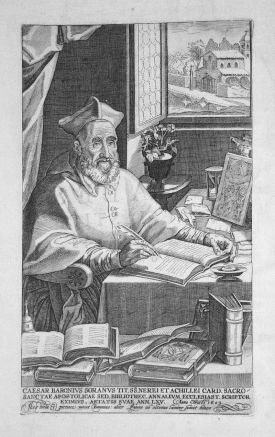
CaesarBaronius

The Venerable Cardinal Caesar Baronius, author of the Annales Ecclesiastici, father of Church history. (Source).

None of this is to suggest that St. Philip was actively anti-intellectual. Far from it! After all, St. Philip was a devoted student of theology and philosophy in his younger days, and Father Faber calls even the mature St. Philip a “great student of history” (Faber 53).  Those words could perhaps be more truly applied to St. Philip’s spiritual son, the Venerable Cardinal Caesar Baronius. It was St. Philip who commanded Baronius to write the Annales Ecclesiastici, the first great work of church history in modern times. The project served a few functions. First, it got Baronius off of preaching, as he had the unpleasant but slightly amusing habit of turning every sermon into a lengthy and vivid discourse on the everlasting torments of hell (I hope that, when he is eventually canonized, the good Cardinal becomes the patron saint of horror writers). The project also productively occupied Baronius’s prodigious intellect, which St. Philip mortified in many other ways. For instance, Baronius was given kitchen duty so frequently that St. Philip playfully wrote above the stove, “Baronius, Coquus Perpetuus.” Finally, St. Philip and Baronius conceived of the book, which unexpectedly became a decades-long enterprise, as a way of challenging the then-dominant historiography of Protestant authors, as exemplified by the Magdeburg Centuries.  A cynic might call this bias. In context, it’s perhaps more fair to interpret Baronius’s motive as one very much akin to those that animate the scholarly disputes of our own day. And because of Baronius’s thoroughgoing method, academic rigor, and meticulous attention to detail, the Annales were received with respect even by those who disputed its claims. It was so impressive a work that several centuries later, Lord Acton could honestly call it “the greatest history of the Church ever written” (Source).
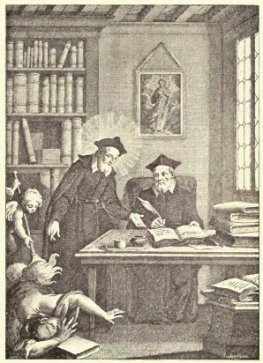
baronius2

St. Philip urging Baronius to write the Annales. (Source).

Nor was Baronius the only model of learning in the Oratory. His fellow cardinal, the aristocratic Francesco Maria Tarugi, was the fox to his hedgehog. Louis Bouyer writes that Tarugi “captivated everyone with his natural eloquence and was never at a loss, no matter what the topic of the moment might be” (Bouyer 64). Here again we see the mark of what we may call the specifically Oratorian geniuserudition crowned with beautiful style and fluency in speech.

If St. Philip stands for an appropriate humility of the intellect, Baronius for a rigorous love of truth, and Tarugi for eloquence in discourse, then we must turn to a fourth figure, the greatest scholar ever to enter the Oratorian life. I speak, of course, of John Henry Cardinal Newman.

In Newman’s long, productive, and complicated life, a few key themes emerge. Three are worth examining in connection with the intellectual tradition of the Oratory. First, we may duly note that Newman always exhibited a great love of knowledge for its own sake, and thus of Truth as such. As he writes in The Idea of a University,

Useful Knowledge then, I grant, has done its work; and Liberal Knowledge as certainly has not done its work,—that is, supposing, as the objectors assume, its direct end, like Religious Knowledge, is to make men better; but this I will not for an instant allow, and, unless I allow it, those objectors have said nothing to the purpose. I admit, rather I maintain, what they have been urging, for I consider Knowledge to have its end in itself. For all its friends, or its enemies, may say, I insist upon it, that it is as real a mistake to burden it with virtue or religion as with the mechanical arts. Its direct business is not to steel the soul against temptation or to console it in affliction, any more than to set the loom in motion, or to direct the steam carriage; be it ever so much the means or the condition of both material and moral advancement, still, taken by and in itself, it as little mends our hearts as it improves our temporal circumstances. And if its eulogists claim for it such a power, they commit the very same kind of encroachment on a province not their own as the political economist who should maintain that his science educated him for casuistry or diplomacy. Knowledge is one thing, virtue is another; good sense is not conscience, refinement is not humility, nor is largeness and justness of view faith. Philosophy, however enlightened, however profound, gives no command over the passions, no influential motives, no vivifying principles. Liberal Education makes not the Christian, not the Catholic, but the gentleman. (The Idea of a University 120-21).

CARDINAL JOHN HENRY NEWMAN PICTURED IN 1865 PHOTO

Newman never abandoned the life of the mind. (Source).

Along with this purity of vision, we naturally find in Newman a perennial appreciation of academic engagement, and when necessary, controversy. Indeed, Newman rose to fame and eventually converted because of his involvement in the ecclesiastical turmoil of the 1830’s and 40’s. He produced his first two great works, Tracts for the Times (1833-1841, in collaboration with others) and The Arians of the Fourth Century (1833) in light of those disputes. Likewise, Newman articulated his great theories of doctrinal development (Essay on the Development of Doctrine, 1845) and the important role of the laity (“On Consulting the Faithful,” 1859) in texts occasioned by ongoing controversies within the Anglican and Roman Catholic churches respectively. And although he could be terribly sensitive to even the slightest criticism, Newman took pains to respond with courtesy, as he did to Charles Kingsley in his famous Apologia Pro Vita Sua (1865). While Newman never sought out polemics and controversies, he was willing to engage in them when the Truth and Honor of God was at stake.

Finally, we ought to remember that Newman was always animated by a sincere love of that singular matrix of the intellectual lifeacademic community. His experience at Oxford profoundly shaped his worldview. He is, of course, still widely regarded as one of the great theorists of higher learning. The Idea of a University (1852, 1858) remains one of the most influential texts on Catholic education in modern times. But the impression that Oxford left on Newman is deeper and more subtle. Newman was drawn to the Oratory in part because he recognized in it the same collegiality that defined the best of the houses at Oxford. Newman writes,

Now I will say in a word what is the nearest approximation in fact to an Oratorian Congregation that I know, and that is, one of the Colleges in the Anglican Universities. Take such a College…change the religion from Protestant to Catholic, and give the Head and Fellows missionary and pastoral work, and you have a Congregation of St Philip before your eyes. (Newman, quoted here).

Newman first considered the Oratory in part because he hoped to offer a ministry to the intellectuals of Britain:

The local bishop, Nicholas Wiseman, invited them to the former seminary at Old Oscott while they decided what to do. Newman named it “Maryvale” and planned some sort of Catholic educational institute there. But then Wiseman sent them off to Rome for ordination. While there, they examined various religious congregations, and realised that St Philip’s Oratory was the most suitable. The Birmingham Oratory was accordingly set up in Maryvale (2 February 1847), before settling on its present site, with another Oratory in London. (Oxford Oratory).

Sadly, Newman was unable to achieve his dream of an Oratory in Oxford during his lifetime. Fr. Jerome Bertram CO has a monograph on the subject, worth looking into. Suffice it to say, Newman looked upon the university as a major and potentially ripe field for an intellectual, aesthetically sensitive Catholic missionary presence. There is a reason why Catholic ministries to university students are very often called Newman Centers.
RobinsonBook

The Oratorian tradition of scholarship continues today, as with, inter alia, the work of Fr. Jonathan Robinson of the Toronto Oratory. Here is the cover of his 2015 book, In No Strange Land: The Embodied Mysticism of Saint Philip Neri. (Source).

Insofar as we are trying to draw out principles that might be of use to the Church in the face of the various cultural challenges which prompted Dreher to write The Benedict Option, I think the Oratorian example, particularly as reflected in Newman’s life and work, may be of use. What lesson we should take? That we ought not abandon the universities and all that they stand for. Yes, there are failures of free speech, episodes of intimidation, and other serious problems at many institutions of higher learning. Dreher, to his credit, has done a good job reporting on the recent madness at Middlebury and Evergreen State.

But the universities overwhelmingly remain the central locations of serious intellectual exchange in this country and the world. While there are some impressive institutions of higher learning outside of or parallel to the formal university system, these are few and far between (see, inter alia, the Maryvale Institute and the Institute for Advanced Studies in Culture). For what it’s worth, Alasdair MacIntyre has explicitly argued for a retrenchment of our position within the academy, both in Three Rival Versions of Moral Enquiry (1990) and elsewhere. As Rowan Williams notes in his review of the book, Dreher seems to write off public discourse entirely. Dreher’s decision to do so is very foolish, more likely to hurt than help the position of Christians in our culture. Moreover, it is alien to the quintessentially Oratorian spirit of a man like Newman.

Contemplate Beauty

One of the marks of the Oratorian charism is a devoted attention to aesthetics. Perhaps it is only appropriate that a vocation emerging from and responding to the Neo-Platonist Renaissance should share its love of beauty. The Florentine St. Philip seems to have known instinctively that beauty evangelizes well and widely.
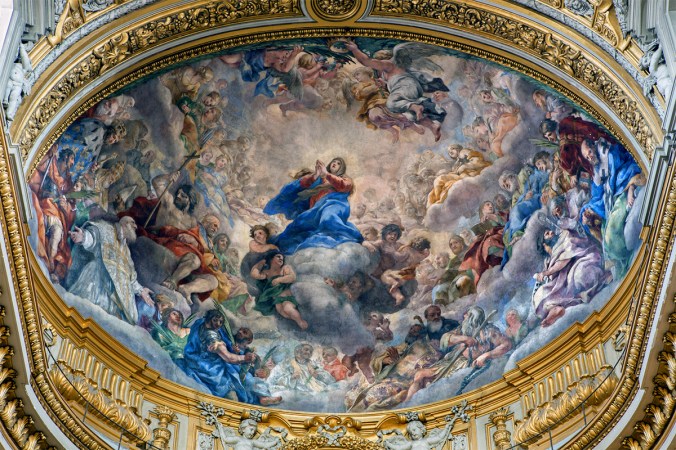
Rome - fresco of Assumption of Virgin Mary in Chiesa Nuova

Baroque apse of Santa Maria in Vallicella, by Pietro da Cortona (Source).

The exercises of the Oratory were never complete without a great deal of music. Louis Bouyer tells us that St. Philip “liked the conversations to be interspersed with music and the meetings to be brought to a close by some singing, so that the evening was filled with harmony” (Bouyer 54). St. Philip engaged the talents of some of the greatest Roman composers of his day. Giovanni Pierluigi da Palestrina took St. Philip as his confessor, and Giovanni Animuccia was so frequently involved that Bouyer tells us, “In all truth nothing but one of Animuccia’s lovely motets could distill the essence of the Oratory and pass it on undiluted” (Bouyer 55). That same essence continued in the Congregation even after St. Philip’s death. Emilio de’ Cavalieri’s Rappresentatione di Anima et di Corpo premiered at the house of the Roman Oratorians in 1600, and as a result, is generally considered the first oratorio.

St. Philip did not limit his careful deployment of beautiful and holy music to the formal exercises of the Oratory. He also knew that the long walks and pilgrimages he conducted around Rome would more easily win souls if they were elevated by sweet harmony. As Bouyer reports,

On such occasions music played a more important role than ever. Animuccia would bring along Rome’s best musicians, and the ‘Adoremus te Christe’ by Orlando de Lassus, or the ‘O vos omnes’ by Vittoria, would mingle with the sound of the fountains’ silvery cascades, of the leaves rustling in the sea breeze…On their way in the freshness of those early summer mornings on the Roman Campagna, Serafino Razzi’s Laudi would alternate with Gregorian Litanies.

At San Sebastiano…would follow a fine Polyphonic Mass, perhaps Palestrina’s wonderful ‘Mass of Pope Marcellus’ or his ‘Ecce Sacerdos magnus’…On their return to the centre of the city they would visit Santa Maria Maggiore on the heights of the Esquiline. Beneath the ceiling which Alexander VI had just decorated with the first American gold to be brought by Christopher Columbus from Peru, and among the Ionic columns of pure white marble, the day would draw to a close in an outburst of Palestrina music, and a ‘Salve Regina’ would fill the falling night with its loveliness gathered from the rivers and the stars. (Bouyer 57-60).

Nor was St. Philip insensible to the appeal of visual beauty. He was fond of Federico Barocci. We can detect in Barocci’s work a certain light sfumato, an airy other-worldliness that hovers over the strikingly intimate scenes the artist depicts. In the works of Barocci, there is something of the spirit of St. Philip, in whom the presence of God was so manifest and so exemplary in one so strangely human.

Federico_Barocci_-_Virgin_and_Child_with_Sts_Simon_and_Jude_(Madonna_di_San_Simone)

Madonna di San Simone, by Federico Barocci, c. 1567. (Source).

Some years after St. Philip’s death, the Oratorian fathers commissioned Caravaggio to create a sizeable painting for a side-altar. The result was the famous “Entombment of Christ (1603-04), now hanging in the Vatican Museums.
CaravaggioDeposition

The Entombment of Christ, Caravaggio, c. 1603-04. (Source).

These artistic traditions have not fallen away in later houses of the Congregation. The Brompton Oratory in London is renowned for its architecture as well as its world-class Schola Cantorum. Its founder, Fr. Faber, gained wide respect as a hymnodist and poet. Newman also wrote some excellent verse, though he is more commonly regarded as a master prose stylist; Joyce considered him the greatest prose writer in the English language. St. Philip wrote some poetry too, though he destroyed most of his verses before he died. All that survive are a few religious sonnets. As one Italian author puts it,

Philip was perhaps the first who, after the reform in our poetry effected by Bembo and other distinguished men, treated religion with that fine poetic taste with which Petrarch treated the philosophy of Plato. Philip flourished as a poet about 1540; and then he forsook literature and gave himself wholly to God, and flourished far more in holiness, until his death. But though he no longer wrote poetry, he did not set it altogether aside. He well knew its great uses when guided by a christian spirit, and therefore he made a great point of it in his Congregation. He read poetry himself, and ordered that it should be always read and used by his followers in the way described in our previous notes. (Crescimbeni, quoted by Capecelatro, here).

St. Philip frequently found ways of incorporating the Laudi of Jacopone da Todi into the spiritual reading that formed such an important part of the exercises of the Oratory. It was one of only two books we know he brought with him from Florence. The Laudi was a text to which St. Philip returned frequently throughout his life, and one that always bore new graces (Bouyer 53).
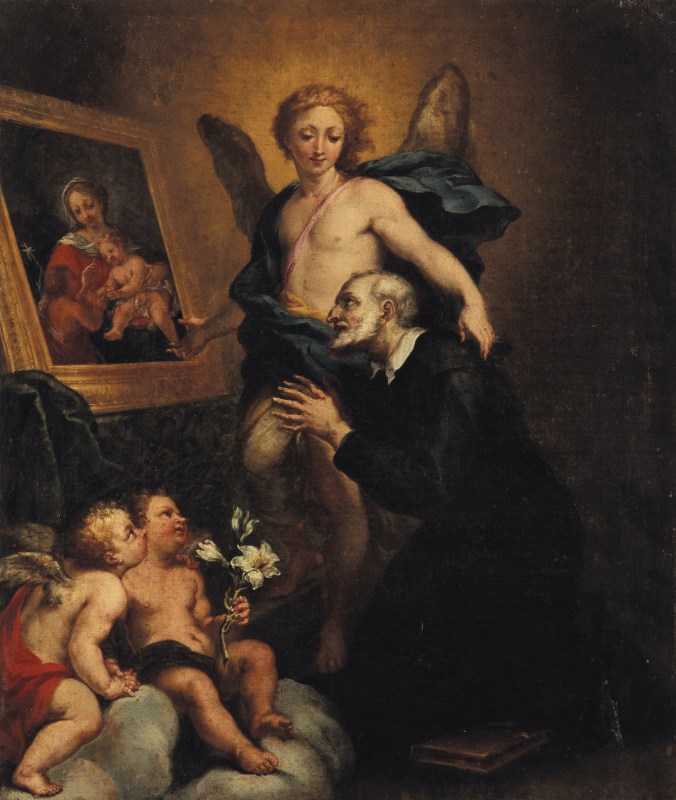
AngelStPhilip

“L’Angelo mostra a San Filippo Neri un dipinto della Vergine con Bambino e San Giovannino,” Circle of Carlo Maratti (Source).

All of this goes to say that St. Philip and his sons were no philistines. They appreciated and, in some cases, produced fine art across a variety of disciplines. While their vocation was never primarily or deliberately aesthetic, Oratorians throughout history have understood the spiritual importance of beauty.

Dreher hits this point pretty well in The Benedict Option. In that sense, my dissent from his recommendation may be more a matter of emphasis than of substance. Insofar as we differ at all, I think my issue is summed up well by Rebecca Bratten Wise:

Perhaps the critics who are timid about these powerful Catholic writers working right now in our midst are waiting for someone else to “baptize” them? Perhaps they are waiting for someone else to say “I heard God there” – because they, themselves, have not learned to open the inner chambers of the ear? Because we do not have a robust Catholic arts culture that teaches us to open all the portals for reception, but instead have embraced a misnamed “Benedict Option” which is all about putting up walls and barriers, drawing those lines in the sand.

Nevertheless, I do strongly criticize Dreher for lacking a sufficiently sacramental vision. The Oratorian aesthetic makes up for this failure, in that it is primarily liturgical.

Live and Love Eucharistically

And thus, we finally turn to the most important feature of St. Philip’s life and charism, the feature which made him a saint and a father of saintshis burning, Eucharistic charity. We can find evidence of St. Philip’s Eucharistic life in the peculiar and highly somatic form of mysticism that we encounter in his vitae. St. Philip never trusted ecstasies and visions, though he was granted such graces himselfusually in connection with the celebration of the Holy Sacrifice.

Capecelatro depicts the scene for us:

But now, in his 76th year, he could no longer restrain the impetuosity of Divine love which glowed within his heart, and he resolved to say Mass in private that he might give free course to his devotion.
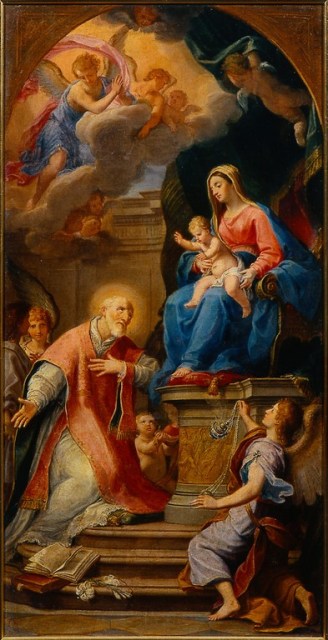
MassofSanFilippo

“Madonna con Bambino in trono e san Filippo Neri,” Giacomo Zoboli (Source)

From that time his usual method of saying Mass was this: up to the Domine, non sum dignus, everything went on as before; but at the solemn moment which precedes the priest’s communion, those who were in the chapel withdrew, the server lighted a lamp, put out the altar candles, closed the shutters of the windows, locked both doors, and left the Saint alone with God. Philip would have none to witness the raptures of his love, or to check the freedom of his sighs, words, and tears. A notice was then hung on the door, with these words: “Silence—the Father is saying Mass.” He would remain alone with Jesus in the Adorable Sacrament for two hours, hours of contemplation and of prayer with many tears, and urgent intercession for the Holy Church, the Bride of Jesus Christ, that He would render it as holy in the life of its children as it is in its faith and teaching. After two hours the server came back and knocked gently at the door; if the Saint answered, he opened the door, relighted the candles on the altar, opened the window-shutters, and Philip finished his Mass in the usual way. If the server received no answer, he went away for some time longer, nor did he enter the chapel until the Saint gave some sign that he might do so. What passed in those hours is known to God alone; those who saw Philip when his Mass was over were struck with amazement and awe, until his countenance was pale and wasted, as of one about to die. (Capecelatro 131-32).

And this in the immediate age of Trent! What are we to make of these irregularities?

St. Philip’s Mass is not a model of liturgical praxis, but of liturgical spirituality. In his own highly idiosyncratic prayer, St. Philip becomes a universal model of the soul in adoration of the Eucharistic God. St. Philip was, indeed, one of the great apostles of adoration in his time, as he popularized the Forty Hours’ devotion in Rome. Today, the Quarant’Ore remains a tradition of the Church and the Oratory throughout the world.
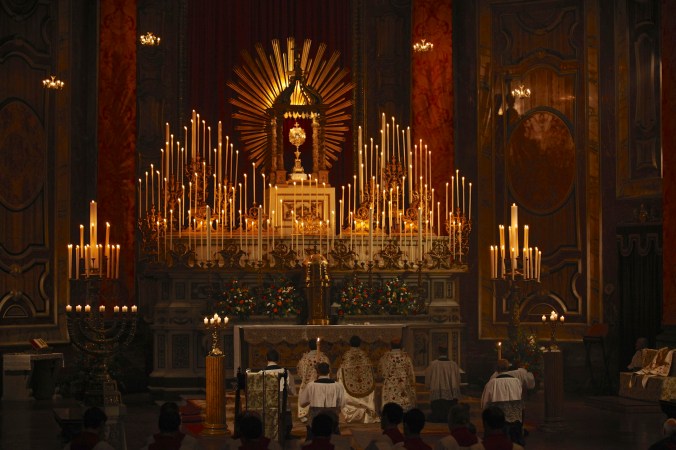
QuarantOreLondon

The Forty Hours’ Devotion at the London Oratory. (Source).

St. Philip’s sons are known for their tender devotion to the liturgical rubrics. In fact, I draw my title from a line in Fr. Jonathan Robinson’s foreword to Resurgent in the Midst of Crisis: Sacred Liturgy, the Traditional Latin Mass, and Renewal in the Church (2014), by Dr. Peter Kwasniewski. Fr. Robinson speaks of an “Oratorian option” not in relation to the early stages of the Benedict Option controversy, but as “a Reform-of-the-Reform ars celebrandi” (Robinson, in Kwasniewski 3). Indeed, the Oratories of the Anglophone world have a particularly strong reputation for their reverent and careful celebration of the Holy Sacrifice of the Mass. As with the best monasteries, the best Oratories exhibit “dignity and magnificence of the liturgical ars celebrandi” (source). In London, Birmingham, Oxford, Toronto, Vienna, Cincinnati, Pittsburgh, Washington, Brisbane, York, Manchesterin short, wherever the spirit of St. Philip prevails over all rivals and distractionswe find a true Domus Orationis, a “House of Prayer” (Matt. 21:13).

The chief fruit of this discipline is supernatural charity. St. Philip sought to found his congregation on this virtue, not the vows which have historically defined the religious state. There is a Trinitarian logic to this plan. For, just as the superabundant love in the heart of the Trinity impels the Three Divine Persons freely to create, redeem, and sanctify, so too should the love of the Oratory overflow into the streets and lead its members to good works. The love of God descends to a love of brethren, which descends in turn to a love of neighbor. Each of these lesser loves ought to confirm, extend, and refine the higher loves. This chain of charity, then, is a veritable Jacob’s ladder, for those in the angelic state are called ever to climb up and down until their passage into beatitude.

Of course, the basic pattern here is not unique to the Oratory. What sets the Oratory apart is its love of the world. A kind of holy worldliness distinguishes the Oratorian spirit, even as St. Philip’s own outlandish behavior earned him a reputation for other-worldliness. I don’t mean to suggest that St. Philip and his sons were given over to the permissive and pagan times in which they lived. Rather, I mean that St. Philip and the Oratorians are characterized by two separate but related qualities that proceed from their Eucharistic life.

First, St. Philip was renowned for prudence. After all, he was a much sought-after confessor. The irony at the heart of so many of his jokes is that, by mocking his own and others’ pretensions, he demonstrated how utterly divorced so many of our lives are from good Christian common sense. In this respect, he was a true fool for Christ very much after the Eastern model. St. Philip’s prudence did indeed appear foolish to those whose vision could not penetrate to the mysteries of God.
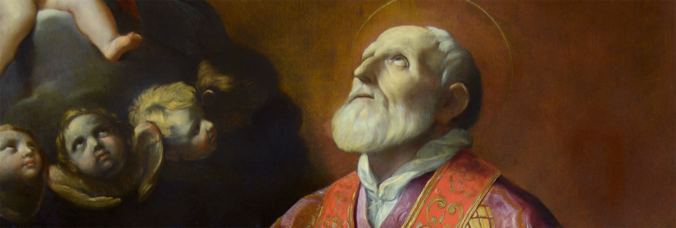
San-Filippo-in-estasi-Guido-Reni-001

From Guido Reni. It seems only appropriate that St. Philip should be so frequently depicted fully vested for Mass. (Source).

While in other ages, prudence led some saints to undertake and advise great hardships for the kingdom, that same virtue taught St. Philip a different path. He drew his own strength from fastidious and hidden rigors, but he always counseled his penitents to avoid excessive asceticism. Once, when the future Cardinal Tarugi, still young and wealthy and vain, came to him for confession, he asked St. Philip if he might wear a hairshirt. St. Philip saw through the man’s pride. He assentedbut only allowed Tarugi to wear the hairshirt on top of all his other garments! For such an admirer of Savonarola, St. Philip could hardly have been farther from his practice when it came to matters of mortification. What little he did urge he usually salted with his own brand of humor. He famously took the Dominican novices of the Minerva out on long picnics and urged them to eat and grow fat. So, too, his pleasant indulgence of children was legendary. And what of those long walks with the crowds under the Roman sky?

St. Philip loved the world. He hated its lies and vices, but he was ever able to peer beyond that sordid stratum and into God’s glory. As one source puts it, “St. Philip was the Apostle of Rome, who by means of the ‘counter-fascination of purity and truth’ reconverted both clerics and laymen in the city at the centre of the Church.” Or, as Louis Bouyer tells us,

Does not Philip, in fact, merely yield to Renaissance optimism? Does he not ignore original sin when he bases his apostolate on freedom and confidence? His ‘religion without tears’ surely expects from undisciplined nature what the discipline of grace alone can produce?

…There is no doubt that it was dangerous to go out against the new paganism with no other arms save love, and just as dangerous to expose his apparently vulnerable simplicity to its disturbing influence, yet his outrageous method made him the victorious apostle of neo-pagan Rome. (Bouyer 28-29).

The love that conquered Rome was the fruit of St. Philip’s sacramental interior life. The unique grace of his special relationship with the Holy Spirit was a cardinal element of that life, but so was his ardent devotion to the Eucharist.

It was this element that I found so disturbingly absent in Dreher’s book. There is no properly Christ-like love of the lost in The Benedict Option, only one angry jeremiad after another. And why? Perhaps because Dreher hardly ever mentions the Eucharist. Dreher writes as if Christ’s presence on earth is an afterthought, one tool among many to be deployed in the quest for community. The result is a spiritually crabbed book, insufficiently sacramental and brimming with self-righteous anxiety.

St. Philip shows us another way.

Conclusion

At the end of the day, there is no silver bullet to halt the various troubles that the Church faces in what seems like an increasingly hostile, secular West. Christ never abandons us to the narrow limits of our own imagination and resources. Instead, He furnishes the Church with untold gifts, charisms, and holy exemplars among the saints. In this sense, the recent proliferation of “Options”to which this essay contributesis probably a blessing.

But we musn’t forget one ineradicable fact. Christ never raises these lesser creations over His own Body, Blood, Soul, and Divinity. There is no blessing, no vocation, and no grace that can go beyond the work of the Adorable Sacrament. If we forsake the one rock of the Altar and instead build upon the sand of the innumerable personal graces and unique charisms spread throughout the Church Universal, then all of our works will shatter beneath the hammer of the storm.

St. Philip Neri understood this truth and lived it out across the long span of his ministry. Those qualities which distinguish the Oratorian charismdomesticity, localism, intellectual rigor, humility, collegiality, aesthetics, urbanity, prudence, and love of the worldcan only be integrated and understood in the light of the sanctuary lamp. St. Philip’s entire life was a ceaseless testament to the power of the Eucharist “for the life of the world” (John 6:52 KJV). In keeping close to the Sacrament and to the example of St. Philip, we may just make it after all.