The Five Idols of Christmas

ChristmasScene

A beautiful Christmas scene. (Source)

Five Golden Rings

Christmas is a time of great joy. At the heart of it all is the birth of our savior, Jesus Christ, true God and true man. Yet often, we let lesser things get in the way of the worship we owe to Him in this privileged season of grace. I don’t believe it would be too much to call these distractions “idols.” As the Catholic Encyclopedia puts it, “Idolatry etymologically denotes Divine worship given to an image, but its signification has been extended to all Divine worship given to anyone or anything but the true God.” Many of us unknowingly allow a number of idols into our lives during the holiday season. All of them are good things in themselves, but taken out of proportion, they distort our sense of the feast’s true message as well as our connection with the Living God. I’d like to examine five of these idols, “five golden rings” that often form the chain of our seasonal bondage.

Material Goods

Of all the idols, this one is perhaps the most readily apparent. It seems like each year, we hear new complaints of the commercialization of Christmasonly to watch the process get worse with every passing holiday. Advent washes upon us as a season of cluttered ads rather than prayerful penance. Sacred carols have been reduced to shopping mall muzak. Charlie Brown’s 1965 complaint rings just as true today as it did in the years of the Johnson Administration. For many, Christmas seems to be a time to show off their wealth to the neighbors, to cook and consume lavish amounts of food, or to receive a whole panoply of toys and giftsand little else.

After all, isn’t this what most children look forward to each Christmas? Santa isn’t popular because he’s a jolly old man who likes milk, cookies, and Coca-Cola. He brings gifts! Of course kids love Christmas. The unfortunate thing is that this mentality is extremely hard to break, even for those well advanced in age. Nor does the culture help. After all, Christmas is a nearly half-trillion dollar industry. There’s no reason to think that commercialism in all its forms will go away any time soon.

Happiness

Beneath the idol of material goodswhether that means gifts, food, or all the decorations that beautify our houseshides another idol. Perhaps you’ve seen it elsewhere, at other times and places.

I was blessed enough to go to Disney World a few times as a child. When I later went back as a teenager, though, I noticed something. A kind of frantic, urgent energy pervaded the place. Everyone smiles a bit too widely. Everyone rushes from one amusement to another. And here and there, a tantrum erupts like a tiny pool of scalding water. Why? Because everyone who comes to Disney comes to have a good timeor else. If you don’t enjoy yourself, then something is wrong with you. You must have fun.

The regime of forced fun becomes universal at Christmas time. How many of us come away from the holidays in a state of utter exhaustion? How often have we stopped to think that maybe, just maybe, we’re trying too hard? The Christmas narrative is blissful. But we have substituted the quietly abiding “comfort and joy” of Christ for the plastic and fleeting pleasures of our own culture.

Our fruitless pursuit of happiness is one of the reasons that holiday depression is so rampant. The endless pageants and parades and parties, not to mention all of the work that goes into them, can be such a drain that it leaves us with little energy left for the spiritual life of the holiday. And that’s just when our plans succeed! We’re even more distraught and distracted when things don’t work out as we hoped. How greatly we differ from Mary and Joseph, who dealt with the disappointment of being turned away at the inn with a calm trust in Providence.

Traditions

One thing that bolsters the idol of forced happiness is the idol of tradition. Perhaps more than any other American holiday, Christmas is about the way traditions bring us together. But too often, those traditions can become unbalanced and rigid. Surely we all have one or two thoughts like this upon occasion. If the tree is not up and decorated by a certain day, all is lost! If we don’t make Christmas cookies on Christmas Eve, all is lost! If we don’t do the Elf on the Shelf this year, all is lost! And so on. Instead of a time of refreshment, Christmas becomes a daunting list of tasks and chores. Our freedom and ease vanish.

As Catholics, we need to remember that the only really necessary thing is Mass. That is the still point at the base of our lives and holiday. Taking a step back and detaching from our seasonal traditions can be a salutary reminder that we are not in control. God is. And if our traditions don’t serve His glory, then we should rework them and reclaim our freedom. Chances are, we’ll be saner (and happier) if we do so.

Family

Perhaps the easiest idol to miss is the one that often generates all the others: family. Surely, we may think, there can be nothing wrong with putting our families at the center of the holiday? Isn’t being with family one of the greatest and purest joys known to man? And isn’t the meaning of Christmas bound up with God entering into a human family?

These are all natural notions. But the truth is, we often have a disordered affection for our families. This disorder is frequently expressed in counter-intuitive manifestations. The holiday is poisoned by all the evident ways our own families don’t live up to our (possibly quite unrealistic) standards. So many of us use Christmas to penalize those in our families who are different from us, and who thus shatter our little ideal of what family should be. We make Christmas the occasion of settling scores or sniping about our petty differences. Or, on the other hand, we altogether ignore issues that might be very important. A kind of artificial peace may prevail, even though deep cracks open below the surface. But this is not the “peace on earth” that Christmas promises.

Families are always sites of intense friction and drama, as even the most cursory review of Western literature shows (not to mention our satires). Making family the center of Christmas merely injects that propensity for drama into a holy day where it doesn’t belong. Moreover, our ideological insistence on making Christmas all about family has been particularly hard on single people. Those with no family are left out in the proverbial, and sometimes literal, cold. One poisonous fruit of humanizing the divine holiday in this way is the terrible loneliness we have needlessly exacerbated for thousands.

Family is a high good, but not the highest good. When we forget that, we do an injustice to God. And we cannot love our families (or our lonely neighbors) properly if we don’t love God first.

Spiritual Consolations

I suspect that most of us idolize family at some level. It’s become such a dominant cultural value that even non-Christians who celebrate Christmas are susceptible to its malignant influence. But one idol may only occur to those who see Christmas as a time of potential spiritual gain.

Every Christian runs the risk of valuing God only insofar as he grants us His gifts. Sometimes, this takes fairly low forms. The Prosperity Gospel, for instance, is essentially a quasi-Christian materialism that equates the love of God with his financial blessings. They turn God into a sugar daddy. More subtly, some of us act like God’s fair-weather friends. We’re perfectly happy offering Him our heart as long as we feel we’re receiving some kind of spiritual consolation. It’s almost as if we think that God owes us something if we keep praying through the season, and we’re unnerved when nothing comes. No one likes aridity in prayer. That feeling can be even harder, and an even greater temptation, when it comes to us at Christmas time.

As Catholics, we shouldn’t worry if Christmas isn’t a time of tremendous spiritual growth. Just because at Christmas you’re not experiencing profound graces or consolations, doesn’t necessarily mean that you are doing anything wrong. Even a well-kept Advent may not produce discernible feelings of anticipation or contrition. Too much of a focus on the interior life can distract us from the objective glory of the feast.

God has come down to earth in the Incarnation. He has seen fit to take up human nature for our salvation, transfiguring all by the light of His face. And we who were born so many centuries after Him can nevertheless meet that same Incarnate God at the altar. But none of this depends on us. It doesn’t matter what we feel; the marvelous truth of it all is that God has done this work in an entirely gratuitous way.

That is why Christmas Mass is so important. It grounds our devotions in Christ. And as He did at His first coming, He still sweeps away all of our idols from His new home on the altar.

The Eucharistic Alternative

Christmas doesn’t have to be like this. All of the “idols” I have listed above are good in themselves. It is only our inordinate attachment to them that has twisted them into ugly perversions and distractions from the Incarnate God.

True, our culture has pressed many of these idols onto us, or at least exacerbated them. But we are complicit. We go along with the whole rigmarole. We have made these five golden rings into five golden calves. It follows that in our own small ways as Catholics, we can and should resist.

Instead of focusing on material gain, let us contemplate the poverty of the babe at Bethlehem; instead of mindlessly pursuing happiness at all costs, let us seek a healthy and realistic equilibrium; instead of rigidly clinging to our traditions, let us run in the freedom and flexibility of the Gospel; instead of taking a disordered view of our families, let us love them as creatures of the Most High; and instead of pining for a flood of sensible graces, let us be content to dwell adoringly at the side of the Infant God asleep.

It may all be more easily said than done. But the spiritual life is always a challenge for those who truly seek God. And what aid does Our Lord offer us in the Sacraments! If we avail ourselves of confession and the Eucharist, we will have made a very powerful start. Only then, to paraphrase Dickens, may we honor Christmas in our hearts, and keep it all the year.
The Music of the Holy Ghost

TarkovskyNostalghia.jpg

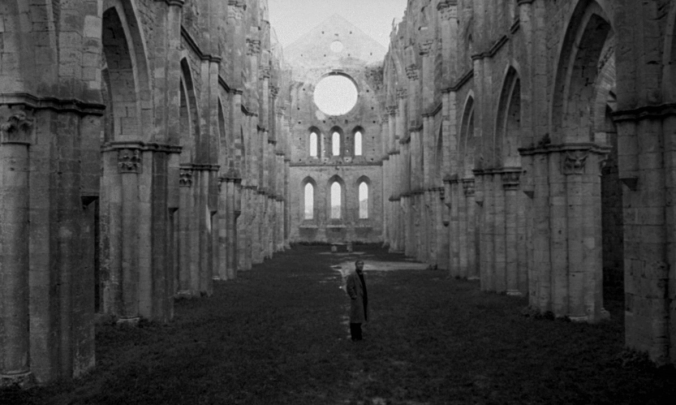
A still from Andrei Tarkovsky’s Nostalghia (1983). Clips from Tarkovsky’s films are often incorporated into the Rev Army’s music videos. (Source)

Not long ago, I came across a new band. What a singular group it is. Their music crosses and confuses genres. They produce content at a far scarcer rate than other musical acts. Even their name, taken from a Buñuel film, sets them apart from most of the offerings one comes across today.

Little did I know that I had stumbled upon a cult gem. The Revolutionary Army of the Infant Jesus has been on the scene for quite a while. Almost thirty years ago, they released their first album, The Gift of Tears (1987). Since then, they have only come out with sporadic releases, such as 1990’s Mirror and 2015’s Beauty Will Save the World. The long hiatus has well earned them the title of “One of music’s most elusive and enigmatic acts,” as we can read on their BandCamp site.

Tim Cooper has a great review of their work over at The Quietus:

…the attention-averse trio, who regard themselves as a creative collective rather than a band, make wildly eclectic music rooted in liturgical texts and ecclesiastical iconography, contrasting ethereal beauty with stark brutalism. Celestial choirs rub their cassocked shoulders with squalls of industrial noise, political speeches are interwoven with celluloid dialogue, instrumentation ranges from sombre neo-classical piano to pounding dance beats by way of folk, free-form jazz and experimental psychedelia.

They draw together a variety of spiritual and cultural influences: folk Catholicism, peasant mysticism, Russian Orthodoxy, the experience of post-Soviet Europe, Simone Weil, Welsh poetry. Their work can, I think, be described as sophianic, but it is a sophanicity carefully drawn through the harried cracks of the fallen world. The truth that the Rev Army grips and holds up to the light gleams all the more for being refracted in the shards of our earthly mirror.

Here are some favorite songs with their proper music videos, many of which are just as important for the meaning of the piece as the score itself.

Come Holy Spirit” – the very first Rev Army song I discovered. A bit too much flute and too many drums for me, but it was different enough from anything I had ever heard that it caught my attention.

Bright Field” – the first one that captivated me. The upward lift of the music combined with R.S. Thomas’s stirring paraphrase of the Gospel, not to mention Tarkovsky’s silken, dreamlike visuals, all together inspire something like wonder. Whenever I listen to it, I am reminded of a poem by Rilke.

After the End” – a simple and haunting French ditty set to the grainy images of villagers at prayer. They seem to be visionaries.

Psalm” – a few women chant in English against an increasingly dissonant shower of quasi-industrial background noise. The juxtaposition strikes me as an artistic model of transcendence through persistent prayer.

Repentance” – the most Flannery O’Connor thing you will ever see or hear. I’ll just leave it at that.

Théme de l’homme qui n’a pas cru en lui méme” – a Latin-flavored and occasionally jazzy piece featuring footage from a (staged?) Spanish Lenten procession. In case you hadn’t already noticed, the band is extremely Catholic.

Joy of the Cross” – another Lenten procession, but this time with a soft-edged folk music that makes me think of Fleet Foxes.

Before the Ending of the Day” – the Compline hymn surrounded and supported by an airy yet pulsing larger song. Tarkovsky’s Andrei Rublev provides the meditative visuals. Note that one of the commenters on YouTube wrote, “Please keep making more of these. This helped still my soul.”

Something epicletic moves through their music. But one can find that quality in lots of other work. What sets the Rev Army apart isn’t just their obsession with the Holy Ghost, nor their stylistic eclecticism. It’s their powerful sense of mystery. They never shy away from the divine darkness with which the Holy Ghost enshrouds His manifold works of grace. How refreshing, in an age of “Spirit of the Council” muzak and shallow “praise and worship,” to find music that is overtly Christian and even mystical without ever becoming preachy, dated, or emotivist. They treat their subject, the perennial and universal longing of the human heart for God, with a rare artistic and spiritual sophistication.

Caught up in marvel at the saving mystery of the Holy Ghost, the Revolutionary Army of the Infant Jesus is the real Catholic charismatic revival.

DescentoftheHolySpiritIcon

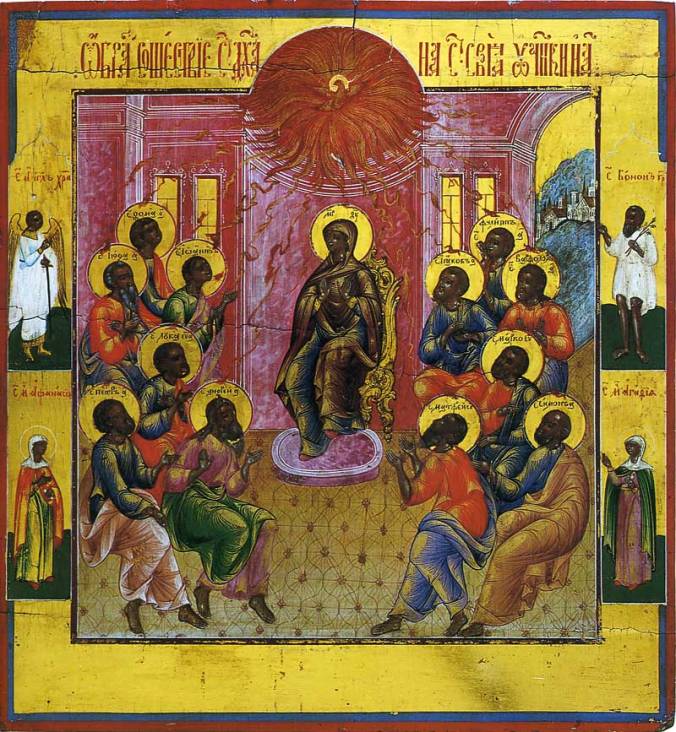
An icon of the Descent of the Holy Ghost. (Source)

My Favorite Scary Movies

Lloyd

What’ll ya have? (Source)

It’s nearly the Eve of All Hallows, and that means it’s time for some spooky stuff. I thought I’d offer up my top 10 favorite horror films for your viewing enjoyment.

I’ll begin with a few honorable mentions, including horror comedies. In no particular order: Sweeney Todd (2007), Halloween (1978), The Rocky Horror Picture Show (1975), The Exorcist (1973), Dracula: Dead and Loving It (1995), What We Do in the Shadows (2014), The Silence of the Lambs (1991), Young Frankenstein (1974), The Others (2001), and Shaun of the Dead (2004). All of these are pretty good films on their own terms, and you should watch them. But for the following list, I wanted to highlight a few I though were especially worth re-viewing this Halloween.

I generally dislike slashers and body horrors, so you won’t see any of the Saw, Grudge, Hostel, Alien, or Ring series here. My tastes run towards the Gothic, psychological, occult, Lovecraftian, and atmospheric. My list reflects that tendency. I don’t claim it will satisfy everyone. Finally, while I have generally tried to avoid SPOILERS, I think I may have left one or two. So abandon all hope, ye who enter here.

10. Jack Frost (1997)

jack-frost-1997-snowman-attack

When he kills this guy, he says, “I only axed ya for a smoke.” And chuckles. Really. (Source)

Admittedly, this is a very bad film. It holds a whopping 7% on Rotten Tomatoes, and I’ve never been able to get through the whole thing myself. But what I have seen makes me esteem Jack Frost as one of the corniest and campiest of horror B-movies. And I adore B-movies, so this one’s gonna stand in for all the crap I could have chosen instead.

The plot is pretty straightforward. A psychopathic serial killer is being transported to death row when his car gets in an accident with a massive container truck full of a biological reagent. He is burned by the acid and seemingly melts away. However, his DNA fuses with the snow and takes on a new form as a Killer Mutant Snowman, hell-bent on terrorizing the community that sentenced him. Hilarity ensues. Complete with over-the-top gore, the very cheapest of special effects, completely maladroit music, a ridiculous sex scene, some of the worst acting you will ever watch, and dad-level one-liners (no, but really), this Christmas-themed whopper of a flop will liven up your Halloween.

9. Les Yeux Sans Visage (1960)

yeux-sans-visage2_0

Les Yeux Sans Visage – a classic of French horror, with profound Feminist undertones. (Source)

Now on to something actually creepy. This French horror film by Georges Franju is not overly scary, in the sense that it lacks jump scares or the typical fare of, say, slashers or sex-crazed body horrors. But it’s definitely worth seeing, as at times it actually becomes a poignant exploration of power and acceptance. Also, it inspired an eponymous song by Billy Idol.

A mad scientist and his cohort of minions murder young girls in Paris so that he can steal their faces – literally. His daughter Christiane suffers from a terrible facial disfigurement after a motorcycle accident for which he was responsible, and in his guilt, he promises he will graft a new face onto her. Every attempt is unsuccessful. Christiane wanders the halls in an eerie white mask, and we are treated to a gruesome, close-up view of a face transplant. Ultimately, the story examines how men use female bodies as canvasses to represent and expiate their own guilt, especially for violence they have committed against women. It also examines the complicity of other women – the mad doctor’s closest assistant is a lady whom he successful healed after her own scarring accident.

A sensitive, beautiful, and tragic tale with a few disturbing scenes. Worth your time.

8. Repulsion (1965)

repulsion-hallway-copy

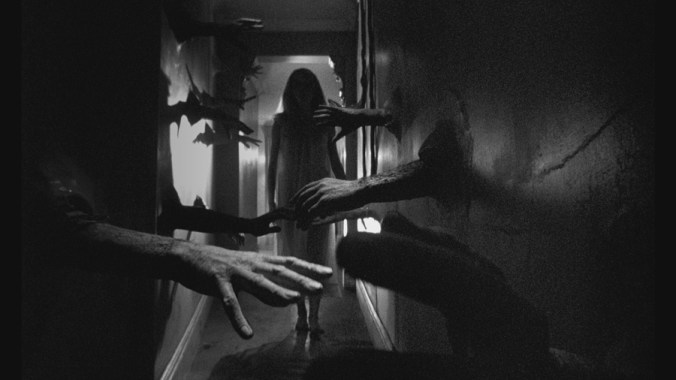
The famous hallway of hands sequence in Repulsion. (Source)

One of Roman Polanski’s early greats, Repulsion remains a standard of Psychological Thrillers. It features some of Polanski’s classic sequences and shots: the buskers, the hallway of hands, the decomposing rabbit. The film follows the mental breakdown of a young girl (played by a youthful Catherine Deneuve) on a weekend she spends alone in her apartment in Belgium. That may sound simple, but boy is there a lot going on. Sex, murder, insanity – not to mention painfully tight close-ups in an era when that was considered artistic. Repulsion is definitely one of the strangest and most harrowing films on this list.

7. Jaws (1975)

Jaws

Duh dum. Duh dum. (Source)

One of the greatest and most popular horror films ever made. Its instantly recognizable theme is one of the few horror scores to rise to the status of auditory icon. I would argue that it’s Steven Spielberg’s finest and scariest foray into the genre, much better than his trope-heavy Poltergeist (1982). The simplicity of Jaws is what makes it so effective as a nail-biter. There’s a murderous shark, and to hunt it, you have to become ever more isolated – and thus ever more vulnerable.

There are plenty of genuinely scary moments in the film, but I think one of the best is also one of the most understated: the tale of the USS Indianapolis. Here, too, the black magic is all in the simplicity. Quint tells a story. That’s it. But it’s one of the most disturbing stories ever told in a film (and what’s worse, it’s true). While all the cast give fantastic performances, Robert Shaw exceeds his peers by that one scene.

6. Psycho (1960)

psycho-3

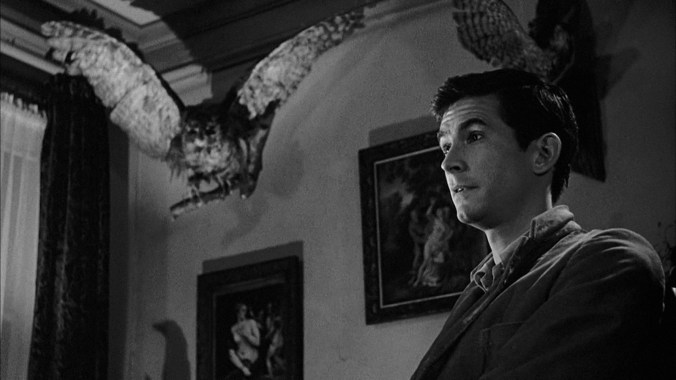
“We all go a little mad sometimes…” (Source)

I probably could have chosen several of Hitchcock’s films for this list. Some of his thrillers are remarkably good. Particular favorites include Strangers on a Train (1951), Vertigo (1958), and Rope (1948). But as far as frights go, nothing in the prolific director’s oeuvre surpasses his horrific masterpiece, Psycho. Long before M. Nigh Shyamalan attempted (and subsequently wrecked) the art of the twist ending, Psycho showed generations of directors how it was done. Ans like Jaws, Psycho gave us an iconic score, forever associated with an iconic scene.

Psycho was among the first real horror films I saw, one Halloween night many years ago. I’ve loved it ever since.

5. Eraserhead (1977)

Eraserhead

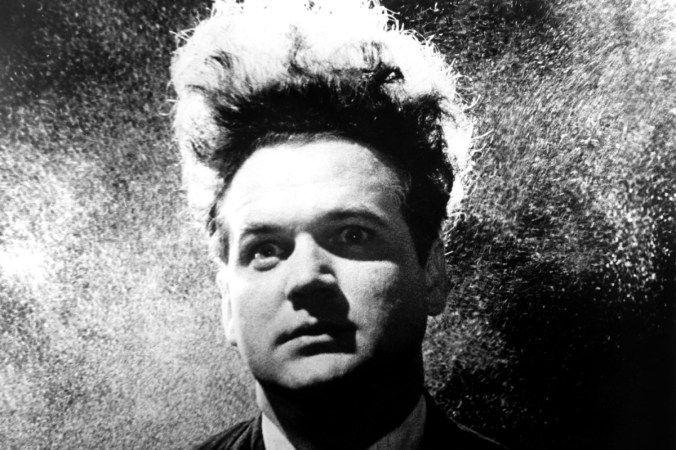
The woeful Henry Spencer in David Lynch’s first movie, Eraserhead (Source).

David Lynch is one of my favorite directors (I sometimes joke that Twin Peaks is my “second religion”). His first film, Eraserhead, has an affinity with the New Wave horror of Polanski et al. As in Repulsion, we are constantly made to feel the limits of the space the characters inhabit. But Claustrophobia is only one of the fears that Lynch explores. Eraserhead is a great meditation on the terrors that attend some of the most common experiences of life: work, sex, marriage, fatherhood. Jack Nance’s performance as Henry Spencer is riveting as it is tense, and the eerie Lady in the Radiator sequences foreshadow much of what Lynch would later use in his more famous works like Twin Peaks and Mulholland Drive. The film also probably wins the award for creepiest baby in cinematic history; even today, Lynch won’t reveal how they made it. If you like surrealism, body horror, or pencils, I recommend this classic for your consideration.

4. The Innocents (1961)

theinnocents

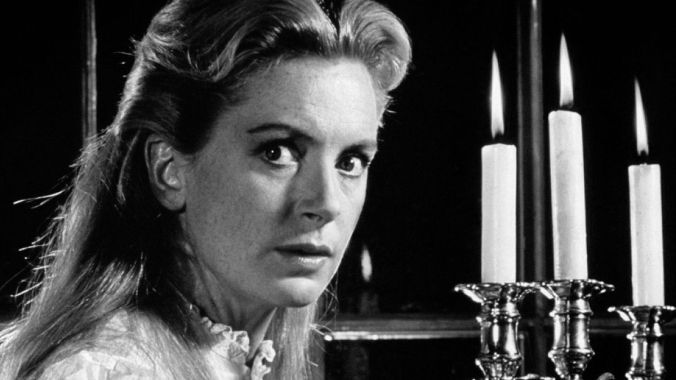
Deborah Kerr gives a masterful performance in this classic Gothic horror. (Source).

If you like your horror set in creepy old English manor homes, full of candlelight and the creak of ghosts on the stairs, then you’ll certainly love The Innocents. Based on Henry James’s classic novella, The Turn of the Screw, the film follows a governess, played by Deborah Kerr, who is sent to care for two orphans in the English countryside. As time passes, she starts to believe that the children are under the malign influence of ghosts. Is she insane? Or is she battling the forces of the supernatural?

While viewers still debate the meaning of the deeply ambivalent ending, one thing’s for certain; this film is a masterful example of mid-century Gothic horror. Not to be missed.

3. The Wicker Man (1973)

lord-summerisle-the-wicker-man2

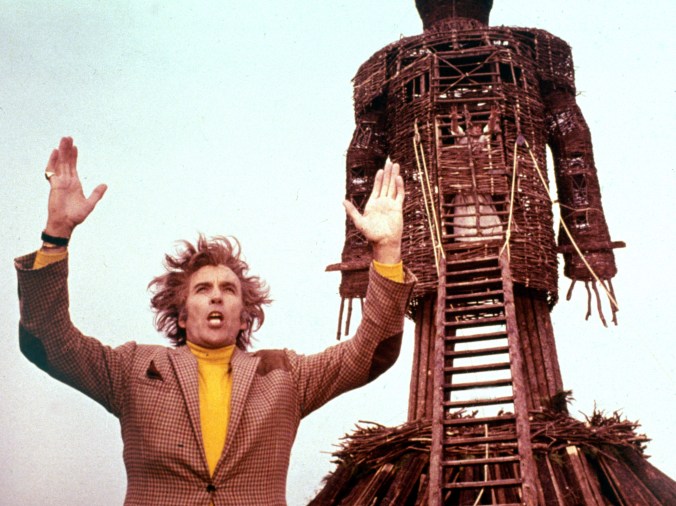
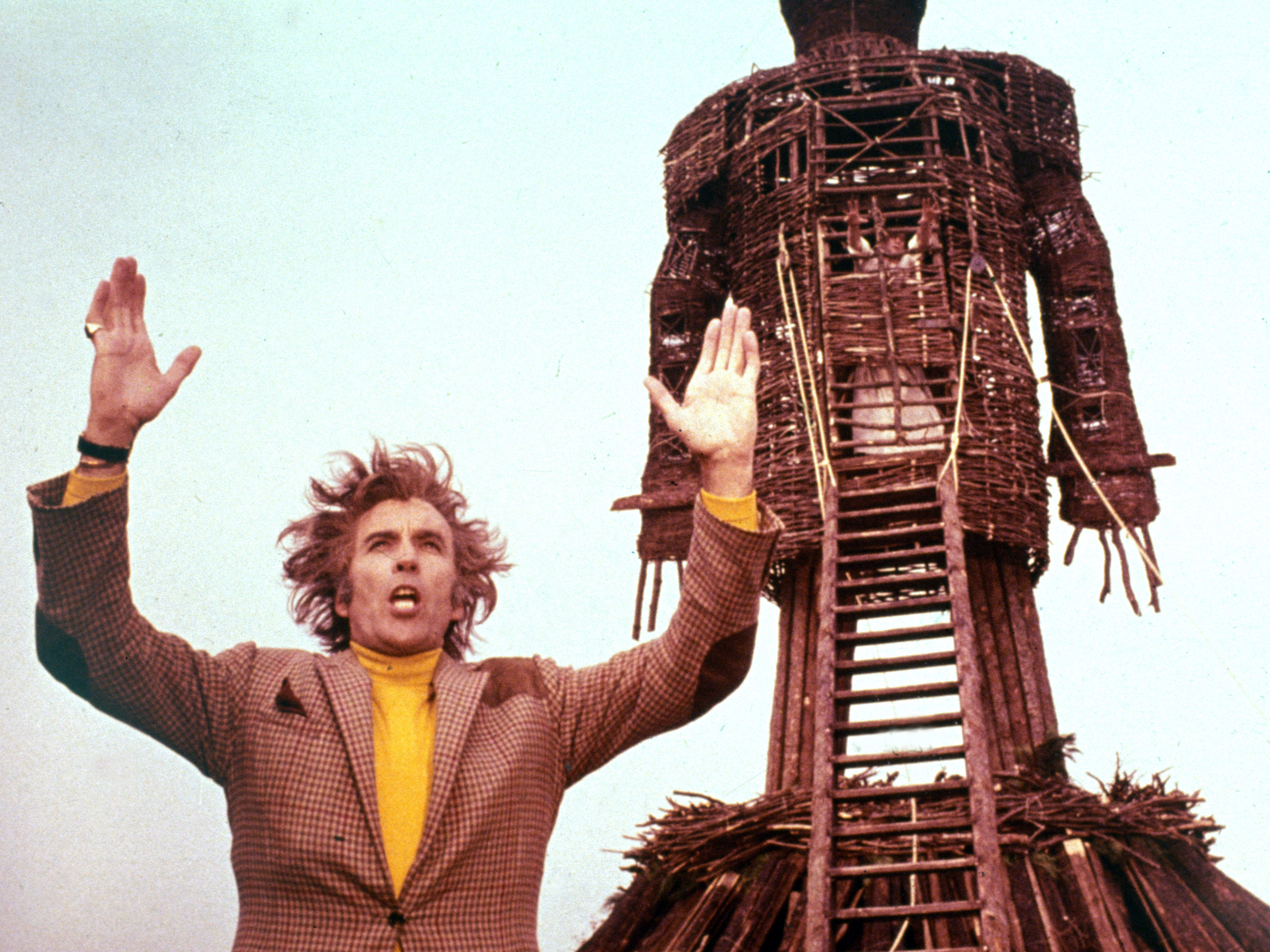
Traditional British Values. (Source)

The Wicker Man, strictly speaking, really isn’t all that scary. But it is a very good story all the same, and Christopher Lee puts in a marvelous performance as Lord Summerisle. If you like folk-horror, a subgenre the English do better than anyone, you’ll enjoy this creepy little romp through a murderous, pagan island in Scotland. Arthur Machen would have loved it.

I find it somewhat amusing that Lee, a devout Anglo-Catholic, thought that the film was ultimately a Christian one in suggesting that even nice people can commit horrible acts if they are not within the fold of the Church. Maybe. But what a poor argument for Christianity it is! The protagonist is such an unlikable and censorious prude, and the villagers are such fun-loving heathens, that you end up not caring too much about the Christian policeman’s fate in the final showdown. Alas. I suppose I’m biased, though, as I’ve long thought that Catholics are just baptized pagans anyway. Incidentally, I think the community of Summerisle gives a pretty good picture of what the Benedict Option might look like in practice.

Don’t confuse this classic with the highly memeable 2006 sequel starring the one and only Nicolas Cage. There are creepy masks, but no full-on bear suits in Christopher Lee’s version. And definitely no bees.

2. The Shining (1980)

the-shining-HD-Wallpapers

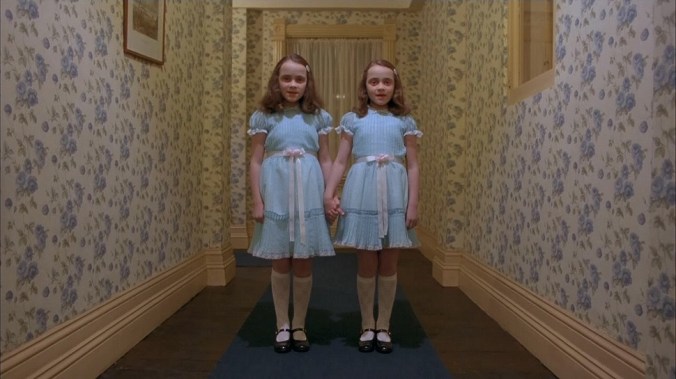
“Come play with us, Danny.” (Source)

Stanley Kubrick’s horror masterpiece. Considered in purely artistic terms, there are no better films on this list. It shows what kind of art can happen when a genius director works with a genius actor (Jack Nicholson in one of the best performances of his career). More to our point – the frights are just as potent today as they were in 1980. Unlike a number of other works from the same decade, The Shining has retained its creepiness. It terrified and disturbed me the first time I saw it, and while I mainly pay attention to its formal and aesthetic qualities now, I still jump now and then when I watch it. I will never not find that man in the dog/bear suit (you know the one) absolutely terrifying, and I will never not relish the conversations with Lloyd and Grady with a certain perverse glee.

I could probably go on and on about how great this film is. But why bother? Just watch it yourself. You won’t be disappointed.

1. The VVitch

WitchWoods

“What went we out into these woods to find?” (Source)

Horror has gotten much better lately, with genuinely artistic offerings from bold new directors. The Babadook (2014), Goodnight Mommy (2014), It Follows (2014), The Blackcoat’s Daughter (2015), The Eyes of My Mother (2016), It Comes at Night (2017), and Get Out (2017), among others, have all renewed the genre. But my favorite among the new horror is The Witch (2016). Genuinely creepy, trope-laden without being clichéd, atmospheric, Gothic, full of painstakingly reproduced sets and costumes from Puritan New England, and written entirely in 17th century English, The Witch represents an enthusiastic return to the old legends of Early Modern witchcraft. And it is beautifully shot. At times, it looks like the film that Goya would produce if he lived in our time. There is a black goat. It will change the way you look at the animals. In short, it is a cinematic triumph for A24, a studio that has proven itself to be one of the leaders of the new horror.

I love The Witch for all those reasons – but also because it presents a world in which Christianity is taken seriously. That rather startling quality has been in short supply among horror films since Terrence Fisher’s Hammer flicks of the 1960’s and 70’s. We see these characters as real, dignified people afflicted by indisputably real forces of the supernatural. In the world of The Witch, the Devil is real and so are his servants.

The film can also be read as a profound meditation on the doctrine of original sin. The ruin of the whole family follows from the pride of the father as we see it at the movie’s start. They are effectively damned as soon as they leave the village. There is perhaps some irony in the fact that the Church of Satan both endorsed and promoted the film. It is the only really Calvinist movie I’ve ever seen; no other has so deftly and deeply explored the Reformed idea of reprobation.

Halloween is naturally a time to seek out a good scare. If you’re looking to do that with a movie, I can think of no better option than The Witch. But you’ll get more than that. The Witch immerses us in a world we can hardly fathom, a world where supernatural evil lurks just behind the treeline and in the pale light of an attic. Dipping into that world can be salutary. After all, maybe it’s a good idea on the Eve of All Hallows – the night before the feasts of the Saints in Heaven and the Holy Souls in Purgatory – to spend some time first meditating on the damned.


Mea Culpa, Mea Culpa, Mea Scholastica Culpa

BlessedJohnDunsScotus

The Blessed John Duns Scotus (Source).

In my review of Rod Dreher’s The Benedict Option, I wrote the following:

I’m not suggesting that Dreher is necessarily wrong in his various judgments. He may well be correct in accusing the nominalists of a kind of cultural deicide (although it overlooks the Christian nominalist tendency, closely tied to empiricism, that numbers Berkeley, Burke, Hamann, Newman, and Chesterton among its ranks).

I subsequently received some pushback for making such a claim. After all, eminent philosophers and theologians had long made nominalism the villain of their narratives about the rise of an anti-Christian modernity. Others questioned my assertion about Newman in particular.

At that time, I defended myself by suggesting that, while I may be off in ascribing a specifically nominalist tendency to these thinkers, that nevertheless, they all do share, inter alia, a suspicion of universalizing abstraction, a respect for concrete particularity in its various forms, and a trust in prudence gained from experience. I interpreted this tendency as akin to the nominalist rejection of substantively existent universals. I also thought that one of the reasons this way of thinking might matter is in our dialogue with postmodernity, which is itself so suspicious of universals and grand narratives.

Nevertheless, I erred. I was mistaken to use that label of nominalism. I must thank my critics for pointing this out. In the many months since then, I have learned what would be the proper term to tie together these particular thinkers – not to mention Gerard Manley Hopkins and J.R.R. Tolkien.

The “nominalist tendency” is really a Scotist tendency. (The fact that I could make such an ironic error is, perhaps, a sign of my own ignorance. I own that. Scholasticism isn’t really my thing.) Chastened by my previous mistake, I hesitate to delve too deeply into the technical depths of Scotist philosophy. I will state briefly that a belief in the idea of haecceity as the unique thisness of each particular sums up the tendency’s core point. If I had time, I’d like to investigate if any firmer affinities could be found.

However, I believe I am now on much sounder territory. The Franciscan Daniel Horan’s work has focused on a postmodern engagement with Scotus, and the Scotism of Newman and Hopkins have been well-attested in the literature. Tolkien took up the theological note behind Hopkins’s ideas of inscape and instress, themselves poetic derivations of Scotist haecceity. More work still needs to be done in English on Hamann, but the image that is emerging is of a figure passionately devoted to the disruptive nature of ordinary, particular experience. His willingness to contest the established narratives of the Aufklärung predates postmodernism by a century and a half. Chesterton is cut from the same cloth. Bishop Berkeley, though perhaps not quite so colorful as either of these two, stakes his empiricism on the particularity of the thing perceived (ultimately, by God). And Burke transposes the idea into the realm of politics, tempered by a healthy respect for natural law.

Two observations come to mind. The first is that nearly all of these thinkers are English or Anglophone. An enquiry into the reasons behind English Scotism would be useful. In its absence, I will merely note that Scotus, that medieval Oxford theologian, seems to have been directly reintroduced into the life of modern English spirituality by another Oxford theologian, John Henry Newman. It was Newman’s influence that defined intellectual Catholicism in England until the conclusion of Vatican II.

The second is that several of these thinkers are literary figures in their own right. Hopkins is principally remembered as a poet, Chesterton as a journalist, novelist, and poet, and Tolkien as a novelist. Newman was a prolific writer across genres. He exerted a personal influence over Hopkins, Matthew Arnold, and Oscar Wilde. And Hamann’s own deeply bizarre output constantly blurs the rigid lines of 18th century drama (yet another way he foreshadows our own postmodern era).

I must wonder if Scotist thought is particularly apt for the production of theology in a poetic mode, as the Catholic Sophiologists of our own day are seeking to do. I certainly have friends who think so. At the very least, Scotus’s high Mariology accords well with the extremely high Mariology of some Sophiologists.

If I had more time, I should like to dive more deeply into these questions. For now, I seek only to explain myself a bit, and apologize for what was clearly a serious error.

ADDENDUM: I also meant to say that Delleuze’s appropriation of haecceity as a fundamental concept lends support to my own impulse of putting these thinkers in conversation with postmodernism.

30,000 Views

30000words

Huzzah. (Source)

Today, I hit 30,000 views on my blog. I’ve also nearly reached 20,000 discreet visitors. I can’t say I ever envisioned The Amish Catholic getting this big, especially within the first year of starting.

Thank you to everyone who has taken the time to read what I write and publish here. And thank you especially to all those who have publicized, responded to, or written about my work. There are so many of you that I would fear to leave anyone out if I named names. Please know that I am aware of your generosity and consideration. I hope I can continue to produce content that piques your interest.

For Blessed John Henry Newman

john-henry-newman

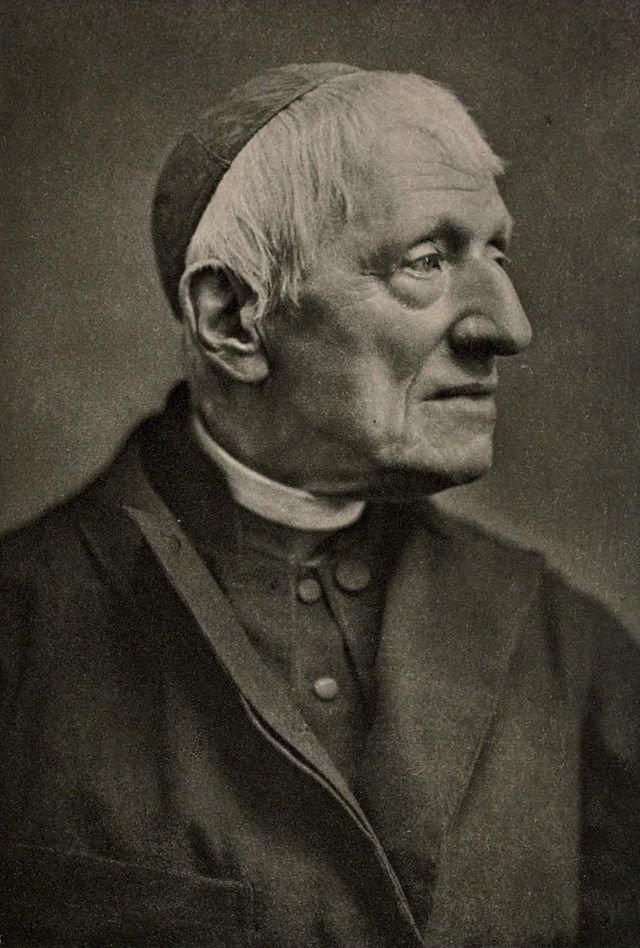
Bl. Newman in his Oratorian habit (Source).

There is so much I could write about Cardinal Newman, on this, his feast day. I have, indeed, already written posts about him many times in the past. But now that courses are starting, I don’t find that I can say as much as I would perhaps like. I also write this essay in some state of exhaustion, having just completed the walking pilgrimage from the Oxford Oratory to Littlemore in honor of Newman’s reception into the Church by the Blessed Dominic Barberi.

So instead of making this a terribly erudite post about a point in Newman’s life or theology, I thought I’d just express my profound gratitude. It can be gauche to make any feast of the Church about one’s self. That is not at all my intention, and I hope I will not be thought self-seeking in writing of my own experience. I don’t pretend that my story is terribly uniquebut it is mine, and no one else can tell it. I am emboldened to relate the history of my own friendship with Blessed John Henry because, as I was taught by Dom Mark Daniel Kirby, “a grace remembered is a grace renewed.” And of course, it’s not really about me. It’s about God, and what He has mercifully done for me through Blessed John Henry Newman.

Saints come to us at many stages of our life. They are always timely, making their appointments according to Heaven’s clock. The mysterious intervention of the saints provides us with one of the many beautiful aspects under which we might consider the manifold glories of providence. They are, as they were in life, God’s instruments; only now, in beatitude, they are eternally and perfectly so. By their intercession, they fill their afterlife with comings and goings, always about God’s business.

Like so many Catholics, I have known the prayers of a saint. Blessed John Henry Newman entered my life when I was still very young in the faith. Of course, I had heard of him before. His name looms large in the history of conversion, and as a convert myself, I found his story interesting if not overly compelling. All that was to change in the spring of my second year, when, in a class entitled, “The University, God, and Reason,” I had the chance to read the first half of his famous educational treatise, The Idea of a University. His magnificent prose and bold defense of knowledge for its own sake thrilled me. I made him my Lenten companion that spring. And in May, I tried (not entirely successfully) to go through all of his Marian meditations for the entire month. A few weeks later, I left for my study abroad.

John-Henry-Newman-2.jpg

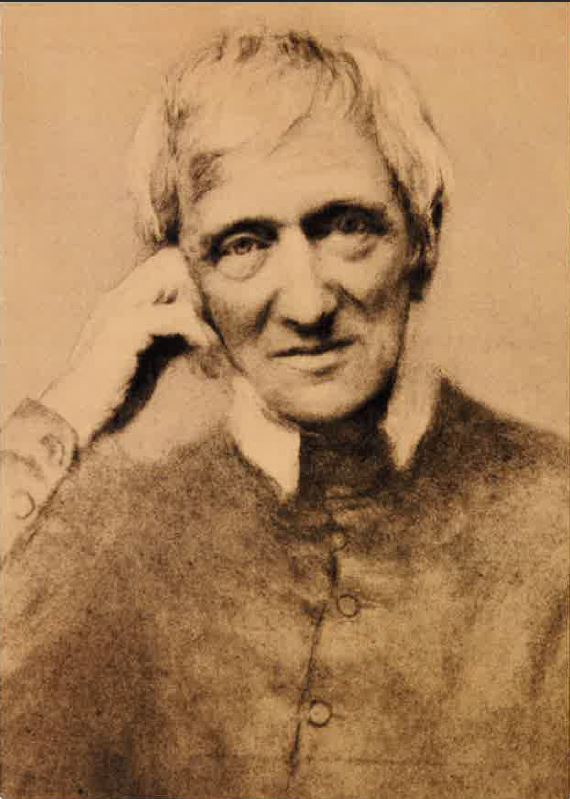
Newman in later years. (Source)

This venture is, I think, one of the great privileges and turning-points of my life. The more I reflect on it, and where I have been since, the more I thank God for allowing me that study which was more a pilgrimage than anything else. On my very first day away from home, I had the chance to visit the Brompton Oratory. Leaving the hustle and bustle of Kensington in the late afternoon, stepping into that dark and immense well of stillness, I immediately thought, “This is God’s house.” I had never had that reaction in any other church before, and never yet have since. It was unbidden, unlooked-for, unimagined. Yet there, in the vast twilight of Fr. Faber’s church, I felt the unmistakable presence of God. And whose altar should I find, off in a niche, under a low-hanging balcony? Whose but Cardinal Newman’s? And from Cardinal Newman’s altar I walked up to the transeptsand found the effigy-altar of St. Philip Neri. To this day, it is still my firm conviction that I was led to befriend St. Philip by Blessed John Henry, his son.

That was my first introduction to the Oratory. While I had heard of it and understood some of its distinctives, these were merely academic realities to me until that long journey. Throughout the rest of my travels that summer, my mind turned constantly to Blessed John Henry and St. Philip. In Rome, the presence of the latter seeped from the very walls. I had the grace of visiting the Chiesa Nuova twice, and San Giovanni dei Fiorentini once (though at the time I did not know its history). And when I returned to England to complete the course I had signed up for, I started to find Cardinal Newman everywhere. Across the street from my college in Oxford was the Church of St. Mary the Virgin, where Newman was vicar. I visited Oriel and passed by Trinity, his two colleges. I worshiped weekly at the Oratoryyet another house of St. Philipwhere Newman had preached in his own life. I bought a small portrait of the man himself in the little church shop there. And while on a brief retreat with the monks of Silverstream, I providentially purchased a short biography of St. Philip Neri. It was the first I ever read, and I devoured it in a few days.

I have little to say of the time since my return to the United States in August of 2015. The year that followed was very bad, and my faith suffered greatly. But when I came back after so long a spiritual exile, I once again felt the prayers of Cardinal Newman moving me in the right direction. Slowly but surely, my sense of the presence of God healed. By this point, I was writing a thesis on Newman. I was also seriously pondering my future. I knew I wanted to continue my studies, but the question of where to do so was subject to a number of considerations. So I offered up the issue in prayer to a number of saints, including Our Lady of Walsingham and Bl. Cardinal Newman.

And now I am at Oxford, Newman’s beloved university. Indeed, I am at a college guided by the spirituality of the Anglican movement he began. Cardinal Newman has not failed me by his prayers. I have read so many works by and about him, yet still I feel I have so much more to learn from his life and teaching. He is for me many things at once: intellectual mentor, friend in Heaven, father in God. For someone training for the scholarly life, Newman is a model Catholic academic. He pursued Truth until he found it, and, not resting therein, never ceased following it until his death. I pray that I, too, may follow him out of shadows and images and into the “kindly light” of Truth.

Blessed John Henry Cardinal Newman, Pray for Us.

MIllaisNewman

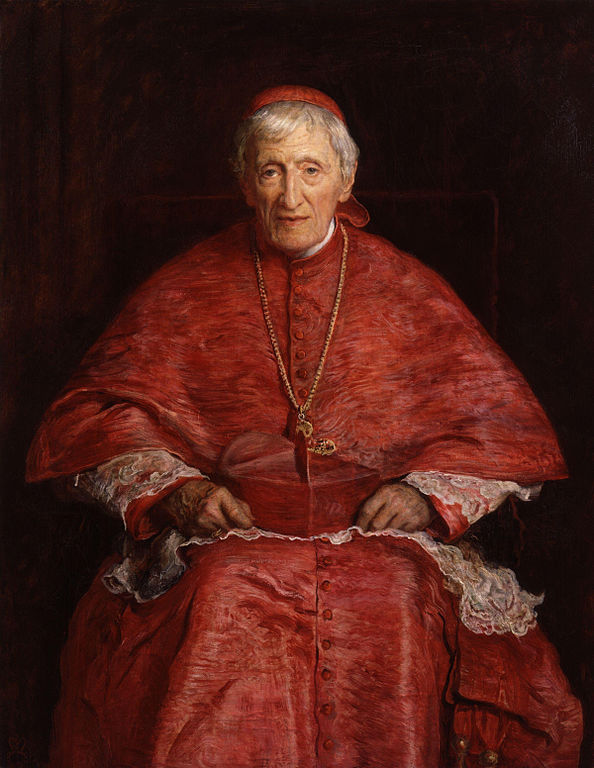
The Millais portrait of Cardinal Newman. (Source)

A Word of Thanksgiving

image

Our Lady of Walsingham, pray for us. (Source).

Today, on the double feast of Our Lady of Ransom and Our Lady of Walsingham, I was blessed to consecrate myself totally to the Mother of God at the Church of her Immaculate Heart, otherwise known as the Brompton Oratory. Thank you to everyone who prayed for me en route to this wonderful occasion. I look upon it as a momentous date, a renewal of my entrance into the Church four years ago,

The date and place are especially meaningful to me. I have long had a devotion to Our Lady of Walsingham, Patroness of England. During the stresses of my final year at Virginia, I entrusted all my major projects–in particular my thesis and my graduate school applications–to her. And over the course of the last few years, my love for St. Philip Neri and his sons has grown into a true devotion to the Oratorian way. Brompton was where that began for me, almost two and a half years ago. I date the start of my friendship with St. Philip to my first overawed trip to the Oratory in 2015. And I pronounced my vow of consecration at the altar of Our Lady of the Rosary, a grace that reminded me of all the wonderful Dominicans I have known over the short course of my life as a Catholic.

So thank you to all those who have prayed for me. And please pray still, that I might not forget my vow as the inevitable distractions, delights, and stresses of grad school set in.