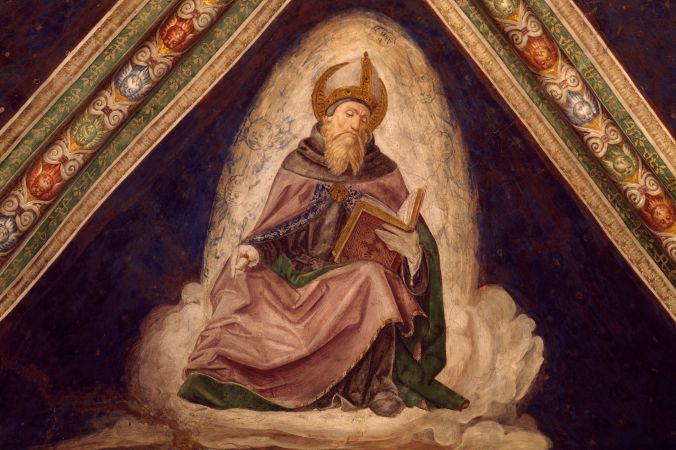
Excerpts for St. Austin’s Day

Saint-Augustine-Doctor-of-the-Church

St. Augustine, Ora Pro Nobis. (Source)

I read this passage from the Confessions today and it instantly became one of my favorites selections from St. Augustine. The translation by Maria Boulding OSB is much prettier, but it’s not public domain. What follows is Book X, Chapters 6-7 (Para. 8-11).

Not with uncertain, but with assured consciousness do I love You, O Lord. You have stricken my heart with Your word, and I loved You. And also the heaven, and earth, and all that is therein, behold, on every side they say that I should love You; nor do they cease to speak unto all, so that they are without excuse. Romans 1:20 But more profoundly will You have mercy on whom You will have mercy, and compassion on whom You will have compassion, otherwise do both heaven and earth tell forth Your praises to deaf ears. But what is it that I love in loving You? Not corporeal beauty, nor the splendour of time, nor the radiance of the light, so pleasant to our eyes, nor the sweet melodies of songs of all kinds, nor the fragrant smell of flowers, and ointments, and spices, not manna and honey, not limbs pleasant to the embracements of flesh. I love not these things when I love my God; and yet I love a certain kind of light, and sound, and fragrance, and food, and embracement in loving my God, who is the light, sound, fragrance, food, and embracement of my inner man— where that light shines unto my soul which no place can contain, where that sounds which time snatches not away, where there is a fragrance which no breeze disperses, where there is a food which no eating can diminish, and where that clings which no satiety can sunder. This is what I love, when I love my God.

And what is this? I asked the earth; and it answered, I am not He; and whatsoever are therein made the same confession. I asked the sea and the deeps, and the creeping things that lived, and they replied, We are not your God, seek higher than we. I asked the breezy air, and the universal air with its inhabitants answered, Anaximenes was deceived, I am not God. I asked the heavens, the sun, moon, and stars: Neither, say they, are we the God whom you seek? And I answered unto all these things which stand about the door of my flesh, You have told me concerning my God, that you are not He; tell me something about Him. And with a loud voice they exclaimed, He made us. My questioning was my observing of them; and their beauty was their reply. And I directed my thoughts to myself, and said, Who are you? And I answered, A man. And lo, in me there appear both body and soul, the one without, the other within. By which of these should I seek my God, whom I had sought through the body from earth to heaven, as far as I was able to send messengers— the beams of my eyes? But the better part is that which is inner; for to it, as both president and judge, did all these my corporeal messengers render the answers of heaven and earth and all things therein, who said, We are not God, but He made us. These things was my inner man cognizant of by the ministry of the outer; I, the inner man, knew all this— I, the soul, through the senses of my body. I asked the vast bulk of the earth of my God, and it answered me, I am not He, but He made me.

Is not this beauty visible to all whose senses are unimpaired? Why then does it not speak the same things unto all? Animals, the very small and the great, see it, but they are unable to question it, because their senses are not endowed with reason to enable them to judge on what they report. But men can question it, so that the invisible things of Him . . . are clearly seen, being understood by the things that are made; Romans 1:20 but by loving them, they are brought into subjection to them; and subjects are not able to judge. Neither do the creatures reply to such as question them, unless they can judge; nor will they alter their voice (that is, their beauty), if so be one man only sees, another both sees and questions, so as to appear one way to this man, and another to that; but appearing the same way to both, it is mute to this, it speaks to that— yea, verily, it speaks unto all but they only understand it who compare that voice received from without with the truth within. For the truth declares unto me, Neither heaven, nor earth, nor any body is your God. This, their nature declares unto him that beholds them. They are a mass; a mass is less in part than in the whole. Now, O my soul, you are my better part, unto you I speak; for you animate the mass of your body, giving it life, which no body furnishes to a body but your God is even unto you the Life of life.

What then is it that I love when I love my God? Who is He that is above the head of my soul? By my soul itself will I mount up unto Him. I will soar beyond that power of mine whereby I cling to the body, and fill the whole structure of it with life. Not by that power do I find my God; for then the horse and the mule, which have no understanding, might find Him, since it is the same power by which their bodies also live. But there is another power, not that only by which I quicken, but that also by which I endow with sense my flesh, which the Lord has made for me; bidding the eye not to hear, and the ear not to see; but that, for me to see by, and this, for me to hear by; and to each of the other senses its own proper seat and office, which being different, I, the single mind, do through them govern. I will soar also beyond this power of mine; for this the horse and mule possess, for they too discern through the body.

And I’ll add this paragraph from Chapter 17 (Para. 26), which strongly reminds me of Cardinal Newman’s project in the Apologia Pro Vita Sua:

Great is the power of memory; very wonderful is it, O my God, a profound and infinite manifoldness; and this thing is the mind, and this I myself am. What then am I, O my God? Of what nature am I? A life various and manifold, and exceeding vast. Behold, in the numberless fields, and caves, and caverns of my memory, full without number of numberless kinds of things, either through images, as all bodies are; or by the presence of the things themselves, as are the arts; or by some notion or observation, as the affections of the mind are, which, even though the mind does not suffer, the memory retains, while whatsoever is in the memory is also in the mind: through all these do I run to and fro, and fly; I penetrate on this side and that, as far as I am able, and nowhere is there an end. So great is the power of memory, so great the power of life in man, whose life is mortal. What then shall I do, O Thou my true life, my God? I will pass even beyond this power of mine which is called memory— I will pass beyond it, that I may proceed to You, O Thou sweet Light. What sayest Thou to me? Behold, I am soaring by my mind towards You who remainest above me. I will also pass beyond this power of mine which is called memory, wishful to reach You whence You can be reached, and to cleave unto You whence it is possible to cleave unto You. For even beasts and birds possess memory, else could they never find their lairs and nests again, nor many other things to which they are used; neither indeed could they become used to anything, but by their memory. I will pass, then, beyond memory also, that I may reach Him who has separated me from the four-footed beasts and the fowls of the air, making me wiser than they. I will pass beyond memory also, but where shall I find You, O Thou truly good and assured sweetness? But where shall I find You? If I find You without memory, then am I unmindful of You. And how now shall I find You, if I do not remember You?

 

Poem/Song: “On the Strange and Lamentable Tale of the Witches of Saluda”

Bonham_House_1

The Bonham House, Saluda, SC (Source).

It’s been a while since I posted any original wordcraft, so here’s a poem I wrote recently. The last part is a song. I wanted to hearken to the Scotch-Irish traditions of the poor folks who settled the Carolinas. You can hear me sing it on the embedded audio I have included.

On the Strange and Lamentable Tale of the Witches of Saluda

I. The Town

I saw them dancing at the old waterworks
with torchlight in their eyes, huge
gates to unseen countries
of the damned and dying.
Off in the woods, the fog
snaked through like a hungry hound bent
low over the scent
of some lesser beast.
The pines keep our secrets from us,
so we can forget.
Didn’t you know that even the
goats and horses have eyes, ears,
loose lips muttering imprecations
under their breath? Never
look over your shoulder
at a crossroads. Men have died,
petrified, for less.
Or else they shoot into space
and freeze in the rictus of their fathers,
grinning madly at the dead sun
below. I have drawn
salt from the shadow of your footsteps,
I have planted rows of teeth in my head.
What dragons will come
when I bring a scythe
to the harvest?

II. The Purlieu

You hardly know how dark
the young pine woods can be.
Not a patch of tall trees, mind you,
but ones that stand
just about twice your size.
Still plenty of silent life ahead of them.
You can see them at the edge of evening,
surrounding a field surrounding
a low crop of tombstones
all asunder and blurred
by the rain’s improvident hand.
The trees wait there, wordless,
dusk-bleached, lined up like so many
carious teeth. But they are not
what draws my eye
the fathomless
dark that spreads behind
like a growling and
hungry gullet.

III. The Back Yard

It will not go away.

Momma said to come to the table,
no use passing your life
by the back window
daydreaming.

But I could see it pacing the lawn as I ate.

Huge, black,
unblinking, white
of tooth.
I don’t think it ever sleeps.
The heat of the noonday and the
shadow that flies by night
do not afflict it
the stones in its shoes
and the rancid water it sips
out of our traschan lids
do not injure it—
the play of the neighbors
and the tumult of the street
do not distract it.
I have not yet seen it blink.
I have not yet seen it turn its gaze
from the house.
It watches.
I don’t think it ever sleeps.

Momma says
daddy woudn’t have tolerated
any such foolishness.
I don’t know.

It makes not a sound.
I think it knows what we talk about
in the house.
I think it knows when we rise and fall
to our prayers.
I think it listens to what we confess,
to our fights, to the whisper of the rain.

I don’t want to go out there.
I don’t want it to get it.
I don’t think it ever sleeps.

IV. Found in a Buried Notebook, Written in Red Ink

Don’t turn your back to the trees
or walk up the weed-cracked pavement
beneath the sign that reads
CAR  ASH CO N LAUNDRY
and don’t keep the pottery you dig up
in your garden
bonewhite under the red
clay and grey sand. Don’t
venture to the edge of the field that
smells like salt
and don’t keep your teeth in a shoebox
(it might become a skull)
and don’t knock on walls
where there should be a door
or take down the portraits
of the nameless.
Don’t ponder what might have
broken the sign from the fencepost
or written its replacement
in an unknown script.
Don’t let your children go to the post office alone.
Don’t let your daughter play with the dolls
she doesn’t remember receiving.

V. The Song of the Lost Daughters


The young girls singing thread silk in their hair
Io Hymen Hymenaee
Io Hymen Hymenaee
Discarding the rest of the clothes that they wear
Io Hymen Hymenaee
Io Hymen Hymenaee

They join with the voices of the torchbearing throng
Io Hymen Hymenaee
Io Hymen Hymenaee
And soon they forget every other sweet song
Io Hymen Hymenaee
Io Hymen Hymenaee

Songs that illumine the queer, darkened lands
Io Hymen Hymenaee
Io Hymen Hymenaee
Like the water you pour over bloody hands
Io Hymen Hymenaee
Io Hymen Hymenaee

Her lace crown covers her eyes as they lead
Io Hymen Hymenaee
Io Hymen Hymenaee
Her into a thicket that smells of ripe seed
Io Hymen Hymenaee
Io Hymen Hymenaee

To hide from the angels that watch in the trees
Io Hymen Hymenaee
Io Hymen Hymenaee
And teach her the sacred rites of the bees
Io Hymen Hymenaee
Io Hymen Hymenaee

“An will ye cam back to yer mother so fine?”
Io Hymen Hymenaee
Io Hymen Hymenaee
“Ah will ye return to me, daughter of mine?”
Io Hymen Hymenaee
Io Hymen Hymenaee

“Ah mother, dear mother, I can’t come at all”
Io Hymen Hymenaee
Io Hymen Hymenaee
“Until I’ve repeated our first mother’s fall”
Io Hymen Hymenaee
Io Hymen Hymenaee

“The Sabbath is waiting, the dance oh so dear”
Io Hymen Hymenaee
Io Hymen Hymenaee
“To teach us the meaning behind every fear”
Io Hymen Hymenaee
Io Hymen Hymenaee

They never did see her again in the day
Io Hymen Hymenaee
Io Hymen Hymenaee
But once on a new moon, as old people say
Io Hymen Hymenaee
Io Hymen Hymenaee

Seven years waiting and seven years won
Io Hymen Hymenaee
Io Hymen Hymenaee
Seven years burning, but far from the Sun
Io Hymen Hymenaee
Io Hymen Hymenaee

Beware, all me daughters, what hides in the air
Io Hymen Hymenaee
Io Hymen Hymenaee
And never thread silks so fine in your hair
Io Hymen Hymenaee
Io Hymen Hymenaee

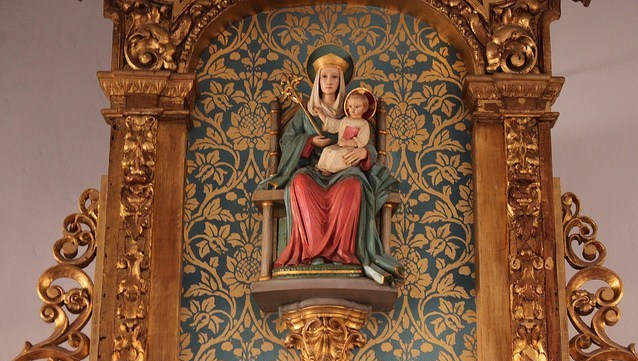
A Prayer Request for St. Mary’s Day

OurLadyWalsinghamStBede

The National Shrine of Our Lady of Walsingham, St. Bede, Williamsburg, VA. (Source)

Of your charity, please pray for me. Today I begin a 33-day retreat for Marian Consecration. Normally I would not wish to broadcast such a spiritual undertaking on my blog, but since I know several of you, I would rather avail myself of your prayers than keep silent.

Astute Kalendar watchers will know that if I start today, on the Feast of Our Lady, Queen of Heaven, then the day of consecration will fall on September 24th. That’s the feast of Our Lady of Walsingham (well, technically not since it’s on a Sunday this year, but I don’t really care). I’ll be in London. Please pray that I might be able to pronounce the prayer at the Brompton Oratory if at all possible, and more importantly, that I might truly and obediently submit to Mary’s gentle guidance in all things.

Hail, holy Queen, Mother of mercy,
hail, our life, our sweetness and our hope.
To thee do we cry, poor banished children of Eve:
to thee do we send up our sighs,
mourning and weeping in this valley of tears.
Turn then, most gracious Advocate,
thine eyes of mercy toward us,
and after this our exile,
show unto us the blessed fruit of thy womb, Jesus.
O clement, O loving, O sweet Virgin Mary!

V. Pray for us, O Holy Mother of God,
R. That we might be made worthy of the promises of Christ.

Amen.

Original Art: Some Recent Work

Here are some more of my August projects.

image.jpeg

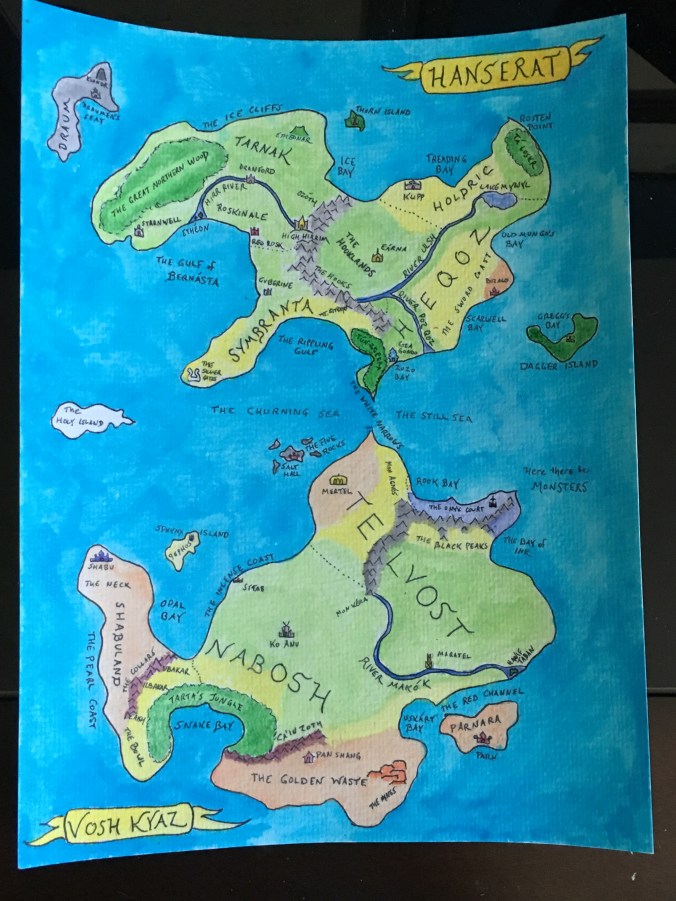
“Map of Hanserat, Vosh Kyaz, and the Isles.” Photo by artist. An imaginary map I came up with a while ago and wanted to see in color.

image

“Under the Sycamore Trees.” Photo by artist. We are like the dreamer…

image.jpeg

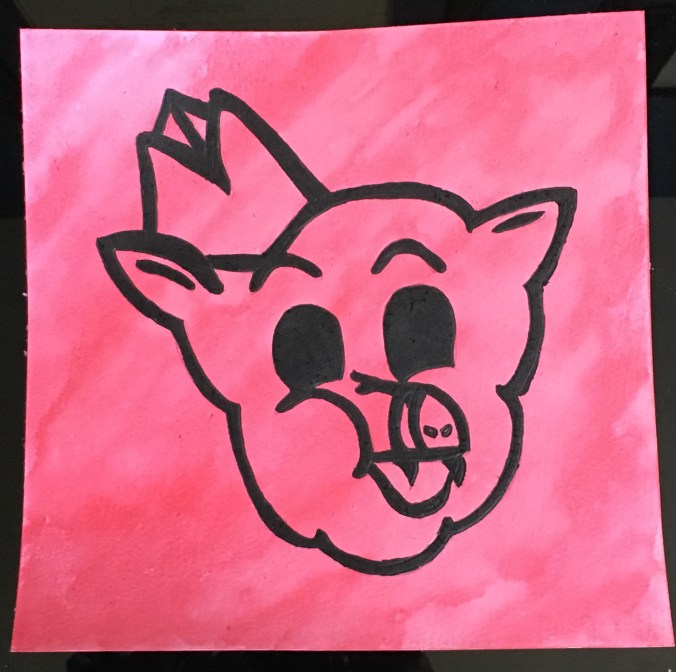
“Gluttony.” Photo by artist. I may do a series on the seven deadly sins.

An Addendum on Charlottesville

LightShoneinDarkness

Fascists surrounding student protesters on the steps of the Rotunda, UVA, Charlottesville, Virginia. This photo was taken last Friday night, August 11th, 2017. (Source).

One last word.

Although it does not come from yesterday’s readings, a verse has been threading through my mind for the course of the weekend. Nazis brought burning torches onto the Lawn that was once my home, but those torches cast no light. They bristled with a darkness blacker and thicker than the shadows that lay all around in the night. The real illumination came from those few brave students under the statue of Jefferson, who resisted the onslaught of wicked men streaming down the steps of the Rotunda. Watching their courage, I can only think of those words from St. John the Divine:

“And the light shineth in darkness; and the darkness comprehended it not.

And After the Fire

the-morning-after-the-deluge

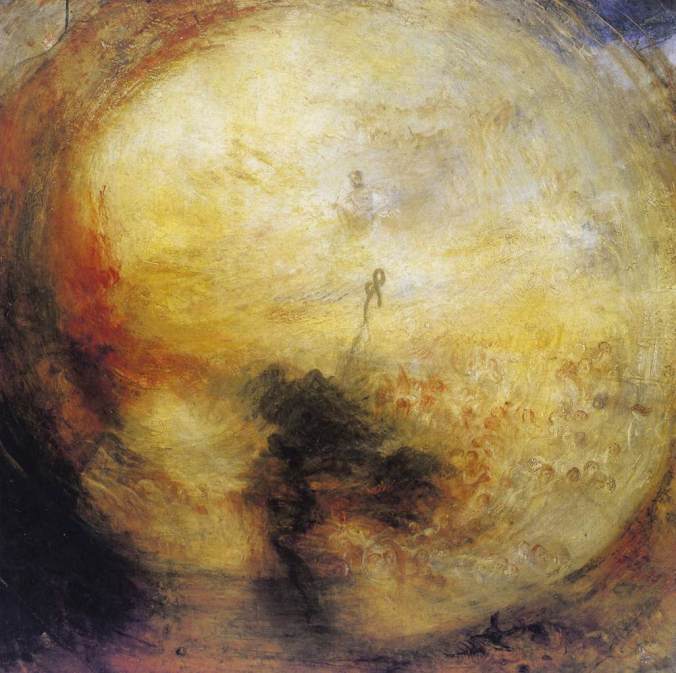
“The Morning After the Deluge,” J.M.W. Turner, c. 1843. (Source).

I am still shocked and furious about the events of the last few days. Fascists of various sorts have descended upon Charlottesville, Virginiaa town I loved and called home for four years—and caused immense pain for the entire community. One woman, a Wobbly protester, died at the hands of a Neo-Nazi who rammed his car into a crowded alley. I had friends in the counter-protest. I had friends who feared for their lives. And all I could do was watch and pray. The Rosary, the Imprecatory Psalms, Invocations to St. Michael. But how I wish I could have done so much more.

I was following the news across Facebook, CNN television, and Twitter. I observed mixed responses. Some, even among baptized Catholics, sympathize with the Alt-Right fascists. They point the finger of blame at Antifa, the several Socialists who showed up in counterprotest, the Media, and Black Lives Matter activists. Likewise, some Christians equivocated. They were happy to condemn the Alt-Right briefly, while also complaining at length about how the Media wasn’t focusing on Antifa, or the Police didn’t do enough, or, incredibly, how all of this is really just the fault of the Democratic Party (here’s looking at you, John Zmirak and Dinesh D’Souza). Then, there were those brave Catholics like Chad Pecknold, Robert George, and Bishop Barron who condemned white supremacy and racism outright. And they received backlashshameful!from those who should know better.

But I haven’t lost hope.

The Liturgical Providence of God is so calibrated to our salvation that we receive the graces we need at precisely the moment we need them, even when we could never have anticipated needing them in the first place. It works even through a deficient calendar, such as we have in the Novus Ordo. For today, we read and hear about a great many disruptions and turbulent tumults. We turn first to the Prophet Elijah at Sinai where, having cast down fire from heaven upon the Prophets of Baal, he hides and waits for the Lord to speak.

At the mountain of God, Horeb,
Elijah came to a cave where he took shelter.
Then the LORD said to him,
“Go outside and stand on the mountain before the LORD;
the LORD will be passing by.”
A strong and heavy wind was rending the mountains
and crushing rocks before the LORD—
but the LORD was not in the wind.
After the wind there was an earthquake—
but the LORD was not in the earthquake.
After the earthquake there was fire—
but the LORD was not in the fire.
After the fire there was a tiny whispering sound.
When he heard this,
Elijah hid his face in his cloak
and went and stood at the entrance of the cave.

1 Kgs 19:9a, 11-13a

The wind rises high all about Elijah; it howls and screams like the very demons of Hell. It rushes up the mountain like the chariots of the wicked King who sought the prophet’s life. But the Lord was not in the wind.

The earthquake causes the whole mountain to tremble. Rocks shake as if they are about to be torn asunder by invisible hands. The trees seem to dance in an unholy rhythm, threaten to crack and topple over. But the Lord was not in the earthquake.

The fire courses across the plain and up the slopes, hungrily devouring the short desert grasses that line the path to Horeb’s cave. The smoke fills the air; the sweltering heat traps Elijah, and threatens to make a furnace of his narrow cell. But the Lord was not in the fire.

The Lord came, instead, in a “tiny whispering sound” that followed all that tumult and trial. The frightful violence of nature may have been sublime, and it may have sorely threatened Elijah. But it was empty. God does not dwell in the frenzy of the wind, the earthquake, and the fire. He comes in peace, and He meets His servant in peace.

This week’s Psalm takes up the same theme.

R. (8) Lord, let us see your kindness, and grant us your salvation.
I will hear what God proclaims;
the LORD — for he proclaims peace.
Near indeed is his salvation to those who fear him,
glory dwelling in our land.
R. Lord, let us see your kindness, and grant us your salvation.
Kindness and truth shall meet;
justice and peace shall kiss.
Truth shall spring out of the earth,
and justice shall look down from heaven.
R. Lord, let us see your kindness, and grant us your salvation.
The LORD himself will give his benefits;
our land shall yield its increase.
Justice shall walk before him,
and prepare the way of his steps.
R. Lord, let us see your kindness, and grant us your salvation.

Ps 85:9, 10, 11-12, 13-14

The peace and salvation of God is near to those who fear Him. A great mystery hovers within these lines: “Kindness and truth shall meet; justice and peace shall kiss. Truth shall spring out of the earth, and justice shall look down from heaven.”

Justice. Peace. Those are words that scare a lot of us traditionalists. After all, haven’t so many abuses of doctrine and the liturgy occurred precisely in the name of “social justice?” Haven’t whole orders been gutted by their worldly capitulation to liberal standards of “social justice” work? And aren’t the proverbial “Social Justice Warriors” the very people who most oppose the Church’s teachings on abortion, marriage, gender, and so many other issues?

All of these criticisms are valid. But they are not complete. Justice is a cardinal virtue. To quote one of the better Anglican principles, “The abuse of a thing doth not take away the good use of it.” Consider what the Psalm teaches us of God’s Justice. Here is a picture of the Last and Eternal Day, when the New Heavens and the Earth will united at the Wedding Feast of the Lamb. But we also find a practical insight for the here and now. When we read, “Justice shall walk before him, and prepare the way of his steps,” we recognize in this a prophecy of Christ. Our Lord, whose way was prepared by St. John the Baptist (that man so like an icon of Justice), is never far from Justice. The wind and earthquake and fire of injustice will one day yield to the peace of Christ. But in the meantime, we must do what we can to realize that justice in our own communities. Indeed, in our own hearts.

This can only begin when we faithfully repair to the sacrament of penance, confessing our sins with compunction, and seek to live always as Christ would have us. For some, this may mean abandoning deep bigotries like white supremacy or a hatred of the poor. It will be difficult for those caught in such snares to relinquish their demonic ideologies, so we must pray for them. But is there anyone among us who does not cherish some prejudice, some little parasite of pride, some vice that blinds us to the manifold ways we are complicit in the oppression of our brethren? Even I am no saint in this respect, and I pray that God’s mercy might change me to better reflect His love for all people.

For some, direct action may be the right course. I am not an activist. I started this essay confessing that I wish I could have done more to help those standing against white supremacists yesterday. Yet I recognize that I have a temperamental aversion to any kind of on-the-ground activism. The task of marching, picketing, and chanting songs of justice may be what some are called to. Dorothy Day provides a wonderful Catholic example of this kind of work.

And there are other strategies, which theologians and activists have pursued for years, that aim at incarnating Justice. It would be redundant to attempt any kind of review here. But no matter how we go about the task of Justice, we musn’t lose hope. Let us hear the commiserating words of St. Paul to the Romans:

Brothers and sisters:
I speak the truth in Christ, I do not lie;
my conscience joins with the Holy Spirit in bearing me witness
that I have great sorrow and constant anguish in my heart.
For I could wish that I myself were accursed and cut off from Christ
for the sake of my own people,
my kindred according to the flesh.
They are Israelites;
theirs the adoption, the glory, the covenants,
the giving of the law, the worship, and the promises;
theirs the patriarchs, and from them,
according to the flesh, is the Christ,
who is over all, God blessed forever. Amen.

Rom 9:1-5

Even amidst the anguish we feel for our brethren, we must not lose sight of the Holy Face triumphant. Nor must we forget that Justice is not itself the highest good. God is. With these two truths in mind, we turn to the Gospel.

After he had fed the people, Jesus made the disciples get into a boat
and precede him to the other side,
while he dismissed the crowds.
After doing so, he went up on the mountain by himself to pray.
When it was evening he was there alone.
Meanwhile the boat, already a few miles offshore,
was being tossed about by the waves, for the wind was against it.
During the fourth watch of the night,
he came toward them walking on the sea.
When the disciples saw him walking on the sea they were terrified.
“It is a ghost,” they said, and they cried out in fear.
At once Jesus spoke to them, “Take courage, it is I; do not be afraid.”
Peter said to him in reply,
“Lord, if it is you, command me to come to you on the water.”
He said, “Come.”
Peter got out of the boat and began to walk on the water toward Jesus.
But when he saw how strong the wind was he became frightened;
and, beginning to sink, he cried out, “Lord, save me!”
Immediately Jesus stretched out his hand and caught Peter,
and said to him, “O you of little faith, why did you doubt?”
After they got into the boat, the wind died down.
Those who were in the boat did him homage, saying,
“Truly, you are the Son of God.”

Mt 14:22-33

We learn from the Psalm that “Justice shall walk before him, and prepare the way of his steps.” So Our Lord sends forth His Apostles, His Church, to “precede him to the other side” of the sea. The Church mystically incarnates Justice at every Mass. And it can only hope to sustain Justice, a Cardinal Virtue, with Faith. For when Peter, Prince of the Apostles, goes out of the boat to walk towards His Lord, he only sinks when he loses his Faith in fear.

But all is not lost. Christ comes through the storm and shows that He is master of it. He walks on water. No tempest can withstand Him, just as no wind, earthquake, fire, flood, protest, or violence of this world can drown out His voice. No slogan of oppression, no act of terrorism, no brawl in the summer streets can overcome the peace that Christ alone brings in and to and through His Church.

I hope that my friends in Charlottesville will take heart. The last few days have been tempestuous, to say the least. But Christ will conquer the waves of this world. Have faith, and He will grant us both justice and peace.

Original Art: Four More Pieces

Here are the fruits of my labor for the last week or so.

image

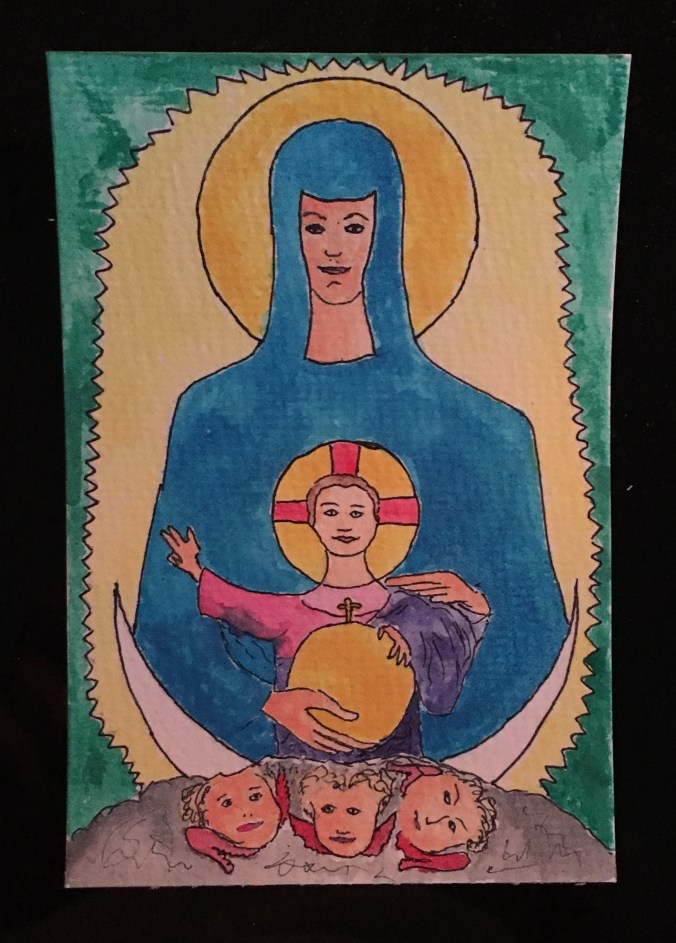
“The Madonna of the Vallicella,” photo taken by artist. The chief Marian icon associated with the Oratory of St. Philip Neri. This is a smaller study for what I hope will one day be a larger piece.

image

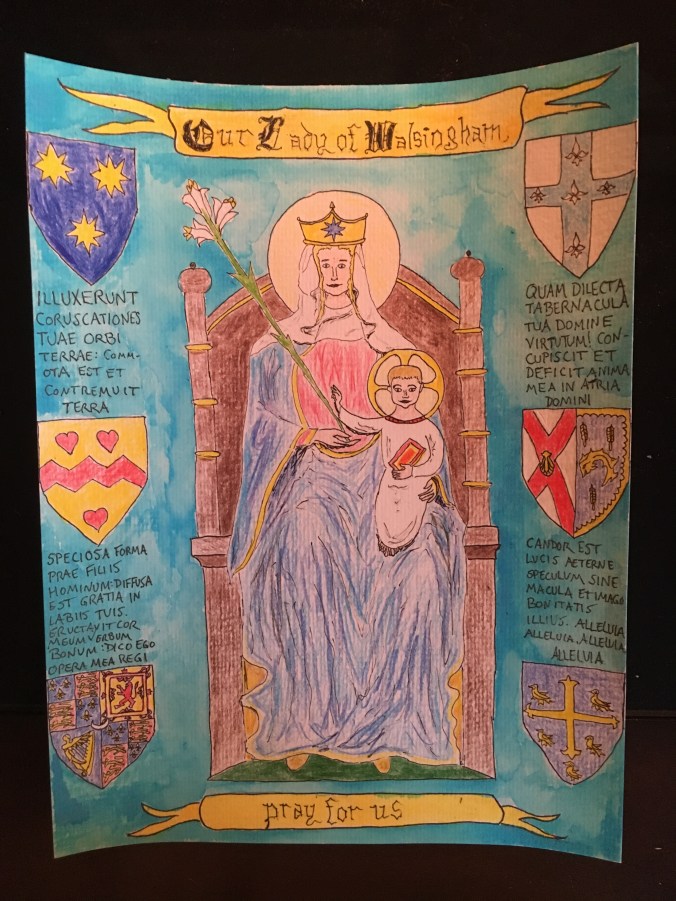
“Our Lady of Walsingham,” photo taken by artist. Included are the arms of (top to bottom): on the left, the Oxford Oratory, Cardinal Newman, and the Cardinal Duke of York, and on the right, Our Lady of Walsingham, St. John Fisher, and St. Edward the Confessor.

image

“St. Dominic,” photo taken by artist. Dedicated to all the wonderful Dominicans in my life.

image

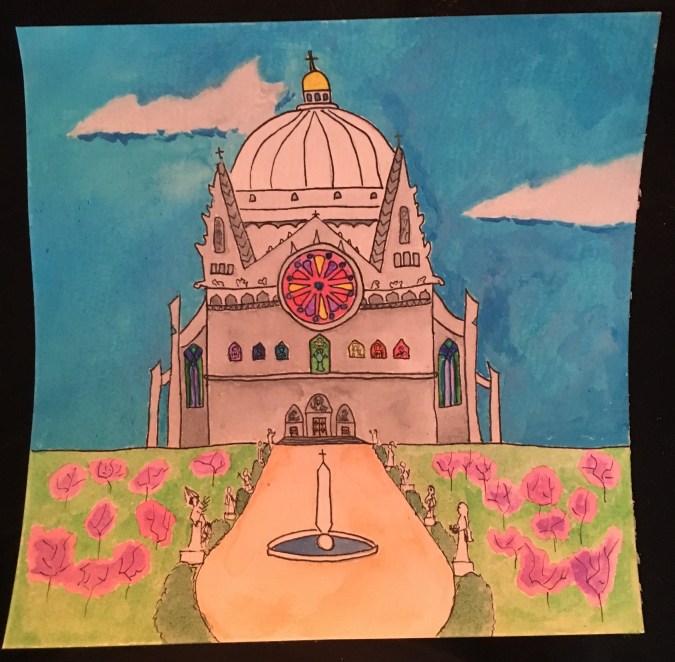
“The Basilica of Saints Catherine and Lucy,” photo taken by artist. Very pleased with how this turned out, as it’s my first largely free-drawn project, and my first without any use of a model.

Original Art: First Four Pieces

As part of my August challenge, I’ve gone back to painting. It’s been wonderful. Here are the first four works I have created. Apologies for the skewed black borders – some of the pages are a little warped from the watercolors. At this point, I’m primarily trying to get back my sea-legs, so to speak. Hopefully soon I’ll be able to move away from models and into more imaginative, creative territory. For now, I’m happy with the start I’ve made.

image

“Guardian Angel.” Photo taken by artist.

image

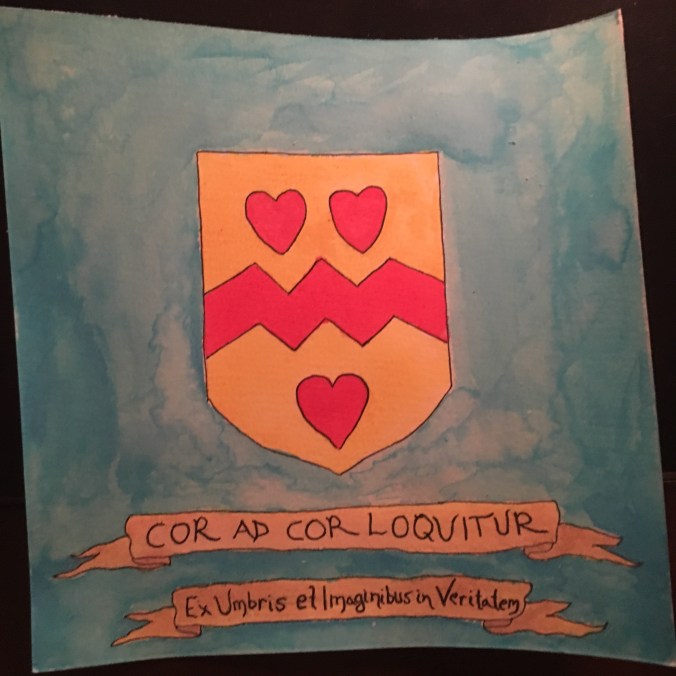
“Cardinal Newman’s Coat of Arms.” Photo taken by artist.

image

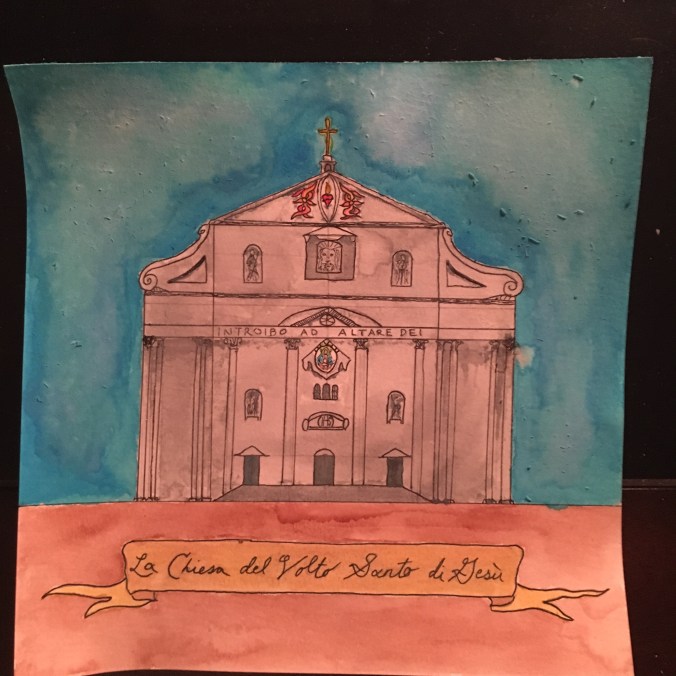
“La Chiesa del Volto Santo di Gesù.” Photo taken by artist. A riff on the Gesù proper. I worked from a photo and added my own design details.

image.jpeg

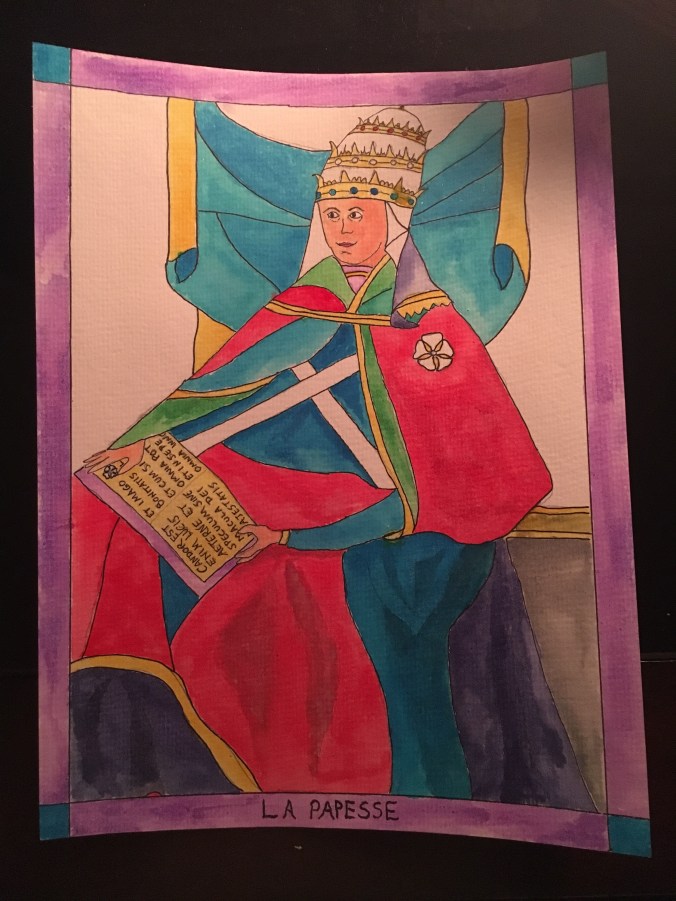
“The Papess.” Photo taken by artist. I used the Marseilles Tarot as my starting model, and made various changes. The Papess is one of my favorite cards, and I prefer the earlier, Christian versions to the orientalist pagan “High Priestess” that Pamela Colman Smith and A.E. Waite bequeathed to us.

A Challenge in Honor of the Sophianic Heart of Mary

ImmaculateHeartofMarySophianic

Sorrowful and Immaculate Heart of Mary, pray for us sinners. (Source).

August is consecrated to the Sorrowful and Immaculate Heart of Mary. Thus, it is a month in which the Church invites us to peer into the profound and luminous abyss of light at the very center of the Mother of God’s Sophianic life. In celebration of this occasion, I’ve decided to dedicate myself to producing or working on something creative every day for the rest of the month. Today, I have already written one poem and started an art project. The latter is especially exciting for me, as it’s been years since I last produced any real art. Too long, really. Pray for me in this sophiological endeavor! I would recommend the same challenge to any Catholic hoping to redeem this particular time.

10,000 Views and Counting

image.jpeg

Hopefully many more posts will come. (Source)

I have just reached 10,000 views on this blog. Deo Gratias! Never in my wildest hopes did I anticipate breaking this milestone…let alone within a year of starting. To God be the glory, and may He continue to guide my steps in this venture. Thank you to everyone who has given their time and consideration to read and share what I have written.