Thoughts on “The New Pope”

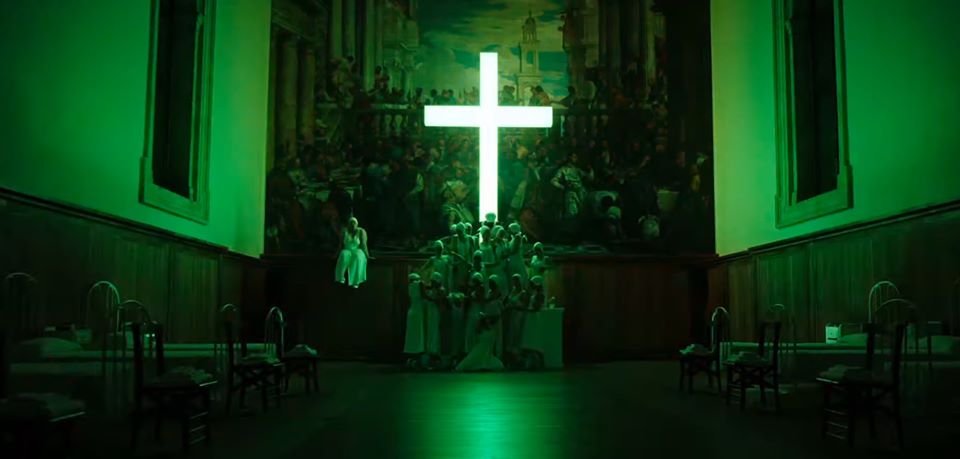
The Neon Nuns will remain as perhaps the most striking visual component of this season. (Source)

I reproduce below an adaptation of the notes I took after each episode of The New Pope, which were then posted in a private Facebook group of like-minded Catholics dedicated to the series. Rather than give a full summary evaluation of The New Pope, I thought readers would find this more process-based approach to be interesting, as it shows how my reactions changed over time. That said, I may post something a bit more all-encompassing later. A word of warning: what follows is spoiler-heavy.

Thoughts on Episode 1:

1) It’s gorgeous as ever.
2) Somehow I don’t get the impression that Paolo Sorrentino is very impressed with this pontificate.
3) I guffawed at the video game scene.
4) Looks like this season is going to be, at least in part, an homage to Hadrian the Seventh.
5) I was surprised by how rooted this season is in Italy’s migration crisis
6) The music continues to be brilliant.
7) Silvio Orlando really is an underrated actor.
8) Honestly I thought to myself “Neon Baroque could be my new aesthetic.”
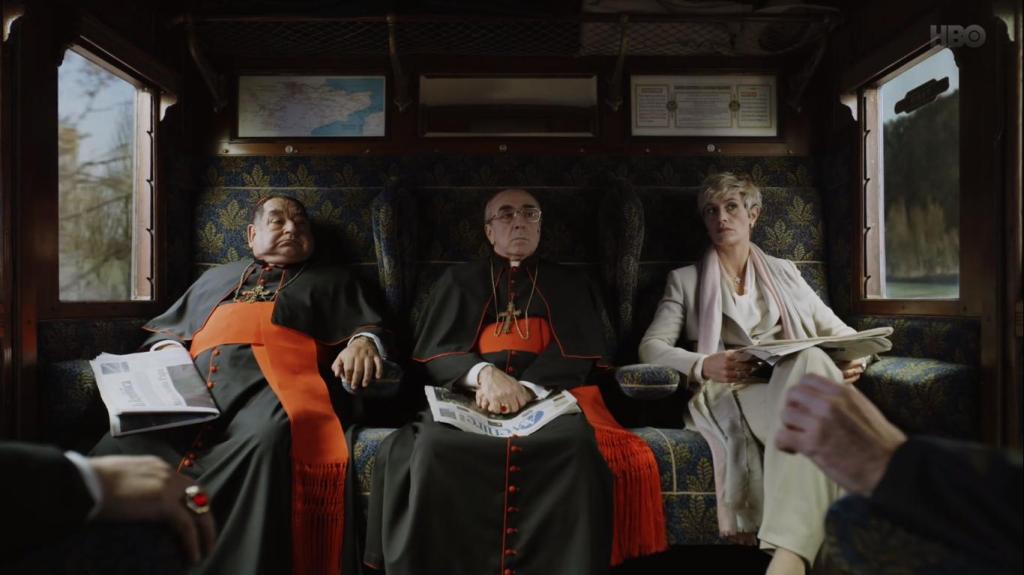
Voiello and companions on an uncharacteristically antique and ornate British train (Source)

Thoughts on Episode 2:

1) Sorrentino doesn’t understand the English. He has made Brannox into a French decadent, not an English ecclesiastical peer. Though this episode makes me want to see Malkovich as Huysmans.
2) Gutierrez remains the best character.
3) We start to see again Sorrentino’s spiritual tendency for short, sometimes aphoristic enunciations of truth.
4) The continuing importance of the terrorist message makes me suspect Brannox will end like Hadrian VII, only with a jihadist in place of an Ulsterman.
5) Speaking of which, interesting echoes of a lot of English Catholic literary tradition here: Hadrian the Seventh, Newman, Brideshead, even arguably Oscar Wilde.
6) I can’t tell whether the line about the Church “thinking” is a criticism or not. I suspect it’s like Greenland’s ice.
7) Loneliness remains one of the central themes of the series.

Thoughts on Episode 3:

1) The last scene(s) manage at once to be extremely Baroque and extremely Gothic. I was reminded of Ann Radcliffe and Matthew Lewis.
2) Malkopope has arrived, he’s screaming, and I am so here for it.
3) I remain surprised by Sorrentino’s political imagery here. The massacre in Somalia is not the sort of thing one is used to seeing on HBO.
4) Fabiano looks like Michael Jackson and reminded me of the Purple Man in The Violent Bear It Away.
5) It’s still all about loneliness.
6) JP3 is an interesting choice of name. In view of his two speeches, I wonder if the emphasis on “fragility” is in some sense evoking JP2 specifically. Regardless, I suspect it foreshadows something yet to come, or perhaps some secret we have yet to learn.
7) The Meghan Markle jokes were great. Sorrentino’s much funnier – or rather, telling a lot more jokes – in this season.
8 ) Love the dwarf abbess. I wonder if the scene where she’s smoking is a reference to Nasty Habits?

Thoughts on Episode 4:

1) Kind of a boring episode overall.
2) We’re in the slump of sin, where all the characters are at their lowest. Or at least will soon be.
3) Cardinal Assente dancing at the end was fun, but also strangely sad. He’s dancing alone. There is a poignant metaphor here – I was reminded of some of the sadder passages in Frédéric Martel.
4) The Marilyn Manson bit and the further Meghan Markle jokes were hilarious.
5) Return of the Willendorf Venus!
6) This is such a continental show.
7) Malkopope is really starting to grow on me.
8) Gutierrez remains the best because he repents of his sin immediately and receives sacramental absolution.
9) The scene with the gropey priest is like something out of a bad French novel of the 1760s.
10) With Sister Lisette et al., I think Sorrentino is satirizing activist nuns.
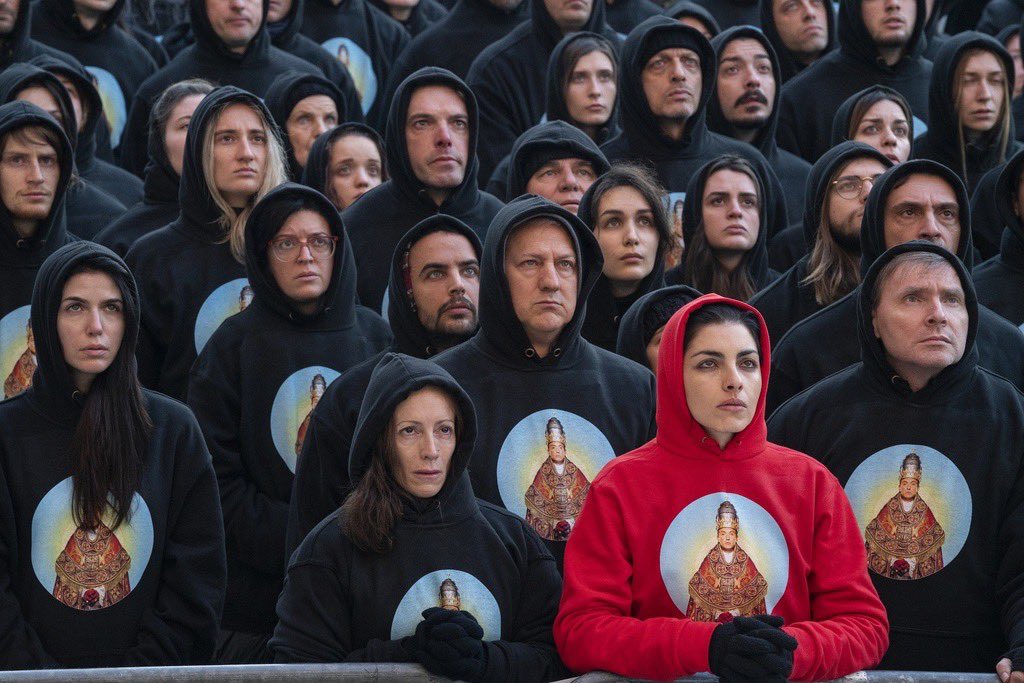
Not gonna lie, I want one of those hoodies. (Source)

Thoughts on Episode 5:

1) Really getting the impression that Sorrentino is a low-key reactionary. Giving a fair explanation of Catholic teaching on homosexuality, implicitly deriding the banality of contemporary Catholic artistic culture, discussion of jihadist attacks on Christians in Europe? Obviously this might reverse in future episodes, but it’s noticeable at this point.
2) Finally getting some proper Sorrentinean surrealism at last.
3) Favorite line in the whole episode came from Sophia – “The Pope produces symbols. The vulgar act of interpretation must fall to others.”
4) The scene with Girolamo and Don Mimmo was beautiful, and I thought, quite moving.
5) I just noticed that Sophia’s name is…well, Sophia. I’m starting to wonder if this is meaningful.
6) Pursuant to point (1) above, I think it’s telling that Gutierrez’s ongoing fling (affair?) with Freddy coincides with a relapse in his alcoholism. This is astounding, given that today the normal depiction of such a relationship would be as a celebration of liberation. Sorrentino suggests it’s the opposite.
7) Disappointed that the strategy is not to “punish” pedophiles, though perhaps the emphasis there was more on adult sexual scandals…?
8) Also Gutierrez in general has been sorely neglected on the whole. He’s not moving the plot anywhere. At all.
9) Based on what I’ve seen so far, I do think Sorrentino is commenting on church politics a good deal more here than he did in The Young Pope. Francis II, Sr. Lisette’s strike, JP3’s elevation of a manifestly corrupt Cardinal…these all have wider resonances in recent church history. And I do wonder whether the cult of Lenny Belardo is in some sense a moment where Sorrentino is reflecting on some of the reception of the show itself.
10) The “No!” at Lourdes reminds me of John Paul II’s “We want God” moment in Poland.
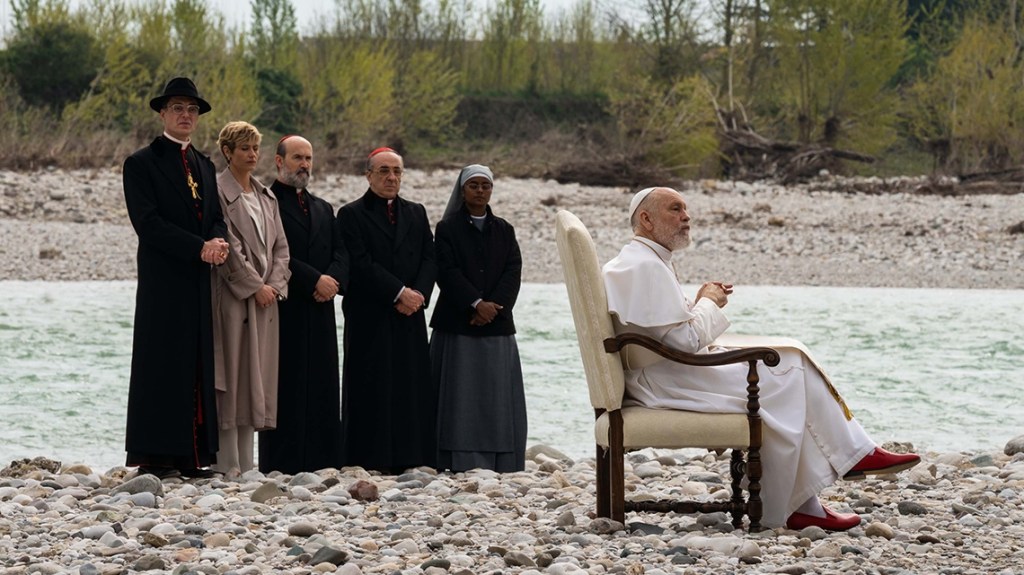
“Hey, hey, hey, the gang’s all here!” (Source)

Thoughts on Episode 6:

1) Fr Leopold Essence is probably the devil but he mainly reminded me of the Cowboy from Mulholland Drive. He’s literally an accuser, and he accuses by drawing attention to distorted love.
2) He’s an American, too. The only other major American character in this show, without Sister Mary, is Lenny. Is Lenny then the most intelligent man on earth?
3) Wasn’t there some 19th c. Ultramontane who made a comment about the Pope being the most intelligent man on earth because of the charism of infused infallible knowledge?
4) So God is a millipede and the devil is a cockroach?
5) Relatedly, that opening scene is so well shot. It’s just a master class in cinematic art.
6) The dancing midget nun is giving Cardinal Essente a run for his money
7) Creepy old incest mom has a German accent. This seems potentially significant. Atanasio (interesting, unusual name) has had “Nature turn against him.” All of Esther’s storyline, up to now largely detached from the main plot, feels increasingly like a parable. In any other hands it would all seem really very trite like some cheap Victorian novel. But Sorrentino somehow elevates it.
8) Voiello’s sidelining under JP3 reminds me of the similarly disastrous personnel decisions made by JP2
9) The Kabul exile of Hernandez reminds me of Bugnini
10) “There is no room left for poetry” – a great line and a cutting diagnosis. Also, the fact that this line comes where it does in that scene confirms my hypothesis about the broader point of the nuns being a satire of activist sisters as well as liberal/feminist Catholics more generall
11) I wonder if that same line can be taken as a Sorrentinean commentary on gender relations writ large? The struggle for rights has deprived us of poetry…
12) What a surprise; wealthy incest lady is also a racist. She also has a perverse vision of sanctity based on “human warmth.” Interesting.
13) There’s an interesting parallel between Brannox’s interview and Lenny’s Venice speech. Both collapse in their separate ways while their disapproving parents are (potentially) watching.
14) I called the drug addiction early on.
15) This addiction puts Brannox in an interesting parallel with Gutierrez.
16) The moment when Atanasio embraces Esther is I think when that storyline really changed. It was such a terribly sad moment…one could suddenly see past the sexuality of it and instead perceive the fundamental tragedy of the situation, the total lack of human connection and the joyous simplicity of human touch. And yet it also reinforces the underlying loneliness of all parties involved.
17) Good to see Lenny’s still a Saint.
18) Spalletta, thy name is Dziwisz.
19) Increasingly I think Hernandez was invented to de-Sodanoize Voiello for the Italian audience. Voiello in Season 2 gets to engage in the heroic acts that Voiello in Season 1 (clearly modeled on Sodano and Bertone) never could.
20) Voiello really kinda is the center of the whole series isn’t he? In sort of the same way that the bureaucracy or the civil service outlasts pontificates.
21) Brannox on evil, like Brannox on tenderness, really reminds me of JP2 in his more anti-communist and moralistic moments.
22) Sex is so sad in this show.
23) It occurred to me for the first time how silly those Lenny sweatshirts are. He never allowed himself to be photographed, so how did they get a photo of him in cope and tiara? Little details that get overlooked…
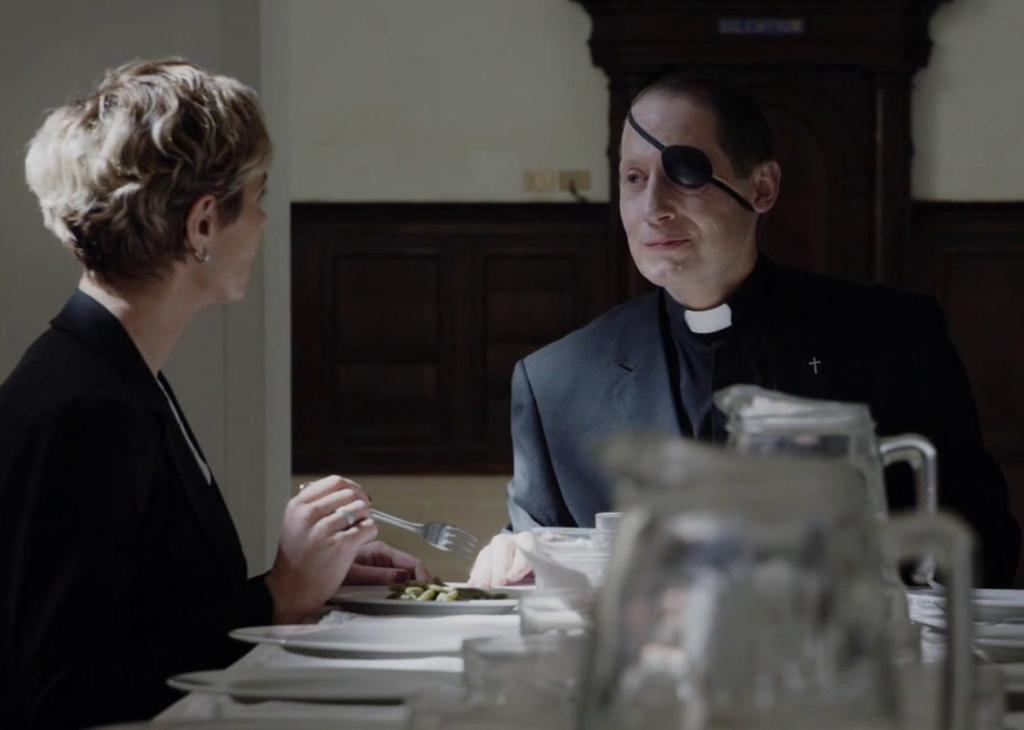
“Follow the looove” – Leopold Essence’s arrival is Sorrentino at his most Lynchian, and his most enthralling. (Source)

Thoughts on Episode 7:

1) I was struck by how Sorrentino uses motion and stillness in this episode. When we meet the doctor’s wife, she is rigid and almost lifeless. As she becomes more open to happiness again, she’s able to walk like a model again – to walk beautifully, even artistically. Yet upon her return to her son, she returns to a statuesque stillness. The difference is that now, her stillness is itself artistic – a close imitation of the Pietà, seen a few times throughout the episode. It’s as if there’s a return to suffering, but now it has been transfigured into a kind of beauty (by grace?).
2) A Pope paralyzed by his own physiological problems, surrounded by evil counselors, and unable or unwilling to respond to crimes in the church? No wonder they named Malkopope John Paul III.
3) I’m somehow strangely reassured by the fact that Lenny is the same old Lenny.
4) Really getting tired of all the magical disabled people tropes. Eric is the fourth or fifth this season alone.
5) Venice at night is so typically Sorrentinean. I was reminded of “Youth.”
6) Gutierrez remains the soundest bearer of truth. His words in the confessional were, I thought, quite moving.
7) The “Purification” scene was aesthetically stunning. It was as if Gustav Klimt and Anselm Kiefer had collaborated on a film. The second time I watched it, I struggled not to get emotional. The silent desperation, the simplicity, the beauty – it’s all so moving.
8) Eric’s miracle is the inverse of Sister Antonia’s, I think – both find death at Lenny’s prayers, but one achieves heaven.
9) The opening scene on the heavenly beach was very funny. I also think it was a kind of reverse foreshadowing of the “Purification” scene, the other moment on a beach in this episode.
10) It occurred to me for the first time how fixated Sorrentino is with the upper classes. Almost all of his work focuses on elites. One wonders if he chooses such stories in part just to film in such gorgeous locations as the doctor’s palace.
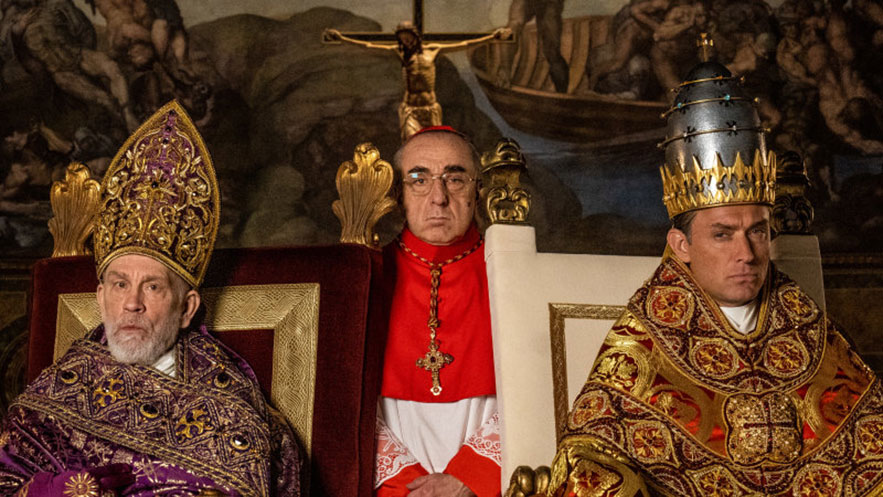
Sorrrentino never skimps on ecclesiastical finery. Would that our own prelates would take note! (Source)

Thoughts on Episode 8:

1) I applaud everything Lenny says to the nuns, which is absolutely spot-on. Sorrentino deserves more credit for his understanding of Catholicism.
2) Brannox’s comments on loneliness are one of the more movingly human moments of the series – as are the strange, not-quite-erotic snatches of intimacy between him and Sophia.
3) Voiello’s eulogy was a bit saccharine. Of all the three “speeches” in this episode, his was the weakest. But it was sort of a nice moment of growth for Voiello overall.
4) Assente is awful and I’m glad he got what was coming to him. Voiello proves himself to be that immortal archetype of Italian literature, the crafty, pragmatic priest who snatches victory from the jaws of defeat (I am reminded of Father Pirrone in “Il Gattopardo”).
5) I have reversed my evaluation of Essence. He and Bauer may instead be avenging angels rather than devils, especially in view of their ambush of Spalletta and Co.
6) Why does Bauer use such an outdated phone?
7) Sorrentino really manages to get some beautiful rooms as sets.
8) It really bothers me that the clergy were all wearing the wrong color at the funeral. Requiems – except for Popes – don’t use red! Also, the Latin was incorrect (right?), though I appreciated the effort.
9) One of the key motifs of this episode was the tease. We see moments of relational, almost erotic, teasing from Sophia in her interactions with Brannox at the chalet. Don Camillo’s trick with Assente is a kind of emotional teasing. Lenny teases Voiello with ostensible knowledge about the upcoming football season. There were, I think, a few other examples. I don’t know why Sorrentino relies upon this motif here, but it was really noticeable.
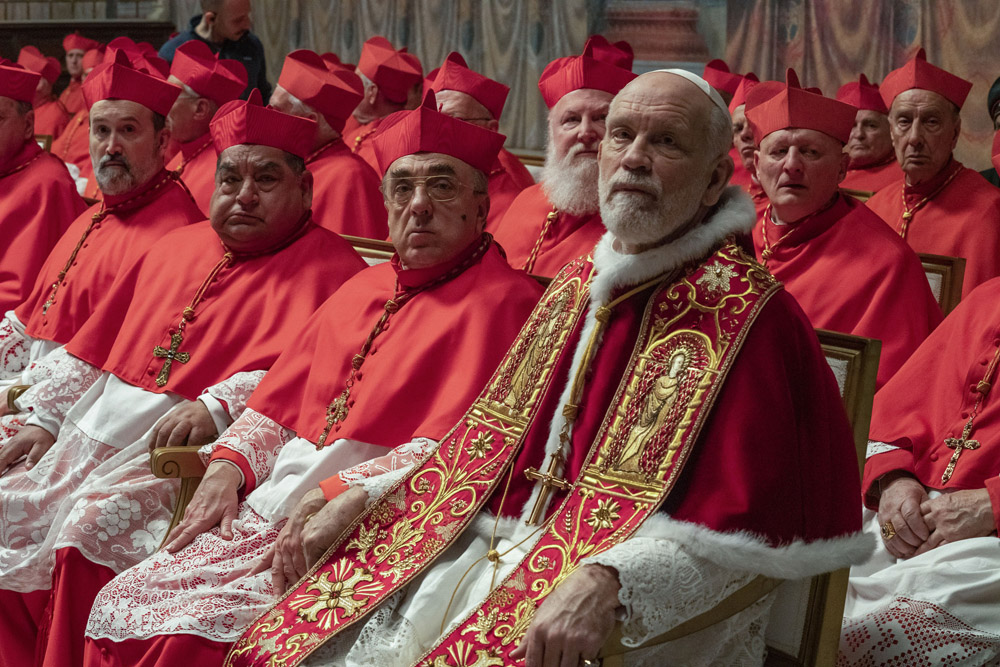
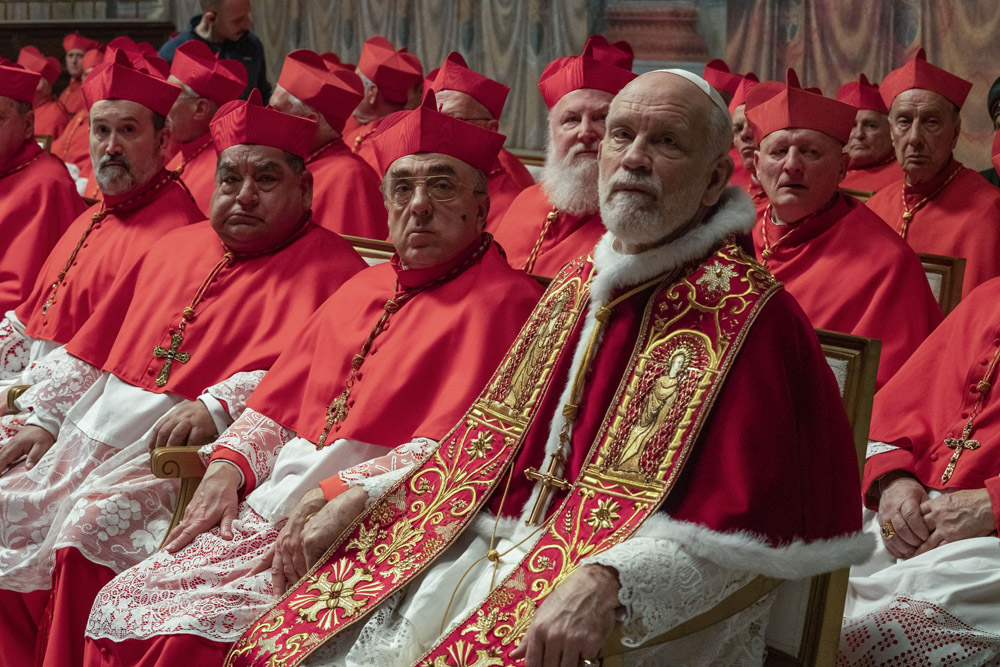
Malkopope and Cardinals in The New Pope, Episode 9. Featuring (l-r) Javier Camara, Ramon Garcia, Silvio Orlando, John Malkovich. (Source)

Thoughts on Episode 9:

1) That scene in the Sistine Chapel when Pius XIII is lined up with all the cardinals and John Paul III – an extremely powerful aesthetic. Matched only by the Neon Nuns in this season.
2) I really loved Malkovich’s speech from the balcony, which was the strongest in the episode. It was theologically rich, poetic, and delivered in that certain screaming je ne sais quoi that only Malkovich possesses.
3) It occurs to me that there are, as it were, four titular “New Popes” in this series. Francis II, John Paul III, the reformed Pius XIII, and Voiello.
4) The twist with the terrorists is a kind of inversion of Hadrian VII’s ending, which is interesting given the extent to which this season draws upon that narrative throughout.
5) Unclear to me whether Gutierrez (criminally underutilized in this season on the whole) and Brannox have in fact ended up betraying their vows of chastity? We can probably presume the young nun has. Is Sorrentino taking a left turn and endorsing love and sex for all? I don’t know. It would be uncharacteristic and a huge leap from the rest of the series. But perhaps the whole point is in the ambiguity. Isn’t that, after all, the ultimate message of Lenny’s last speech? We don’t have all the answers, and worrying about them too much spoils things.
6) Speaking of speeches, it seems that Sorrentino still doesn’t quite grasp how rhetorical binaries work. Lenny’s “Am I x or am I y” bit echoed the “Are we a or are we b” in the Venice speech on the Blessed Juana. And as then, I’m not sure it really worked.
7) Esther’s story was deeply sad. I’m not totally sure what to make of it – I no longer think it’s a parable (at least not from Episode 7 onward). But it does seem like a critique of a certain kind of an especially Italian devotionalism. It rhymes with his treatment of Tonino Pettola in Season 1, just as Francis II rhymes with Sister Antonia. Sorrentino seems to hate fanaticism.
8) On that note, I absolutely loved the Tonino Pettola call-back at the last shot.
9) I would have liked one last appearance from Leopold Essence since we got so much from Bauer. The scene with the American general was quite funny, though.
10) It seems that, in the end, most of the main characters ended their arc with some kind of love. Brannox gets his parents back. Lenny gets the love of the people, then dies and becomes a real saint. Sophia gets the love of a man she admires (though it’s unclear whether or not their love is sexual). Voiello has a new child to care for, the only love he really knows how to show. Gutierrez may be back with Freddy, but if nothing else, he seems to have kicked his alcoholism and is very happy. Our Romeo and Juliet of the Vatican are reunited with their child. The doctor and his wife are expecting a new baby. Even Bauer is going to marry his escort, like Hosea marrying a prostitute. Perhaps this is the point – the chief thing, the real happy ending, is love. If the question of the series is loneliness, the answer, insofar as we can find one (and Lenny would say the answer belongs to God), is love.
11) And thus, no one except Esther ends up lonely in the end. There seems to be a kind of narrative cruelty in this. But then again, don’t kill priests if you don’t want to go to prison.
12) What the hell was on the walls when Brannox and Lenny have their final confrontation? Very weird, disturbing art.
13) The insistence upon Don Antonio being a “good priest” is encouraging and, I think, representative of Sorrentino’s particular take on Catholicism. Alongside all the aestheticism and insistence on mystery (Pius XIII), there’s both a certain moderation when it comes to the rules (represented by both Voiello and John Paul III) as well as a recognition of real heroism and sacrifice (the various martyrs throughout this season).
14) That said, I think what I most missed in The New Pope was the witty spirituality, that sort of esprit d’escalier of the soul that Sorrentino peppered throughout The Young Pope. There were, to be sure, a few great zingers this season, but nothing that matches “The weight of God” or “Absence is presence” or “What’s under all that ice?” from The Young Pope. Which is odd, I think, since John Paul III seems like an aphoristic character.
15) I guess my other criticism of the season as a whole is that it was, at times, a little too diffuse. Part of what made TYP so powerful was the network of relations radiating out of the fascinatingly complex central character: the agon with his mentor, Cardinal Spencer, the loss of his brother, Dussolier, the foster-motherhood of Sister Mary, the rivalry with Voiello, the unfolding friendship with Gutierrez, and of course, the pain of his abandonment by the parents who leave him again in Venice. Although TYP hardly possesses a linear plot, it at least managed to dive deeply into the psychology and spiritual development of one character. It had a shape. It easily became iconic. But as good as The New Pope is, it doesn’t quite cohere in the same way. It loses itself at times, in part because it’s never quite clear whose story it is.
16) Even the surrealism has been weaker throughout. Remember, the very first scene of TYP is Lenny crawling out of a pyramid of babies at St. Mark’s Square. Where was the equivalent of the kangaroo? A dog doesn’t rise to nearly the same oddity and is thus a far weaker visual and narrative symbol. No one was lusting after the Willendorf Venus this time. No one saw all the Popes of history lined up in a semi-dream sequence (again, another great zinger – “Power is a banal platitude”), or anything like it. The closest we ever got was that absolutely wonderful, Lynchian scene with Leopold Essence and Sophia in the Vatican cantina. More of that would have been salutary.
17) On the whole, though, this was the best thing on television for the last few months, bar none. And even in view of its imperfections, I do think the show says something valuable about Catholicism, about loneliness, and about love. Although COVID certainly complicates this – and I’m not sure it’s strictly necessary – I think I would like to see a third season about Voiello’s papacy. We shall see.

Proceedings of the 27th Annual Conference for Wonka Studies

Problematic. (Source)

Editor’s Introduction

When the definitive cultural history of our late capitalist political moment is written, much will be said about the seminal influence of Willy Wonka and the Chocolate Factory. This 1971 film, emerging in the context of the Nixon administration, the War in Vietnam, and an ongoing reassessment of America’s place in the social, political, and ecological world, is still as fresh and potent as the first day it opened in theaters. Taken collectively with its originating text by Roald Dahl and subsequent re-make by Tim Burton, the Wonka Cycle constitutes one of the fundamental cinematic expressions of postmodern anxiety and self-reflexivity. Can it be any surprise that this complex contemporary fable has spawned a burgeoning field of scholarship?

While none of this will surprise Wonka specialists who seek out this volume, the lay reader may be surprised to know the extent to which Wonka as a text has risen to its prominent status in such a short time. For the benefit of such a reader, I will provide a brief literature review of the field.

Wonka Studies was initiated in 1987 with the publication of Jonathan Mortman’s “Oompa-Loompas of the World Unite: A Marxist Reading of Willy Wonka and the Chocolate Factory” (Forth 03, Fall 1987). Much has transpired since Mortman’s widely-acclaimed essay; the field has since evolved into an important sub-discipline of cultural and critical studies. The convening of the first Conference for Wonka Studies at Blippensbild College in 1992 disseminated various advances in Wonka scholarship made in the wake of Mortman’s intervention. Yet it was not until the following year that we start to see the first Wonka Studies seminars open on a test-case basis in various major research universities.

Scholars are divided as to the true political position of the Wonka Cycle. Heidi Zolker and Brian Stafford-Jones famously argued in their 1994 missive, “Oompa-Loompa Rights are Human Rights” (Force 17, Spring 1994) that the musical sequences of the film contain a carnivalesque critique of capitalist labor relations. This view would have become the established orthodoxy had not Leopold Öngg published his magisterial “Of Wonka and Wankers: The Golden Ticket as Phallocentric Signifier of Biopower” (Oberflächlichenstudien 03, Summer 1996). Drawing upon the insights of Foucault and Derrida, Öngg argued that the incentive-structure inscribed into the plot of Willy Wonka took an inherently apologetic stance towards the forces of patriarchal capital. Without denying the subversive elements identified by Zolker and Stafford-Jones, Öngg suggested that the anti-capitalist performances were akin to the economic logic of early National Socialism. “Wonka is a Strasserite. Behind and, indeed, beneath the Chocolate Factory, lurks the gas chamber,” wrote Öngg in a memorable and much-quoted phrase.

This central question – whether Wonka is a communist or a fascist – occupied much of the debate throughout the nineties. The important interventions by Julia Linley (Forts 16, Summer 1997), Oswald Glover (Forks 28, Fall 1998) and Eric Breedlove (Folks 30, Winter 1999) all respond to this controversy in some way.

Yet starting in 2002 with the rediscovery of early middle French theory, Wonka scholars began to move away into more reflexive and less strictly partisan approaches to the material. At the same time, more attention was given to the gender and class dynamics outside the Factory itself. Ernest Grenouille’s “We Are All Grandpa Joe” (Färt48, Spring 2003) was an important model of this “Humanizing” Turn. The wider socio-political, cultural, and economic troubles of the new millennium also found their place in the new scholarship. The significant upshoot of articles about Slugworth in the wake of the 2008 financial crisis (Karawasi 2009; Davison 2009; LeBocq 2010) are just one example among many.

Recent work has been equally attuned to our political moment. That much was clear to all the attendees and presenters at the 27th Annual Conference for Wonka Studies, which convened at South Mercury University and Ladies’ Seminary from 6-9 February, 2019. The essays included in this collection form the core of a radically self-conscious response to our era. For instance, Hilda Davis-Davies argues in her powerful intervention, “The Queering of Violet Beauregard,” that that character undergoes what is actually a transfiguration into a radically non-heteronormative and (more importantly?) non-speciesist physicality. Violet Beauregard thus becomes a model of praxis, and not without a certain jouissance. Jean-Claude LaMerde brings a psychoanalytic lens to the famous Augustus Gloop scene in his “Gloop/Narcissus: A Neo-Lacanian Reading.” LaMerde dares to ask, “Is the chocolate river in fact an objet a?” Fistula Pepper responds to the broader need to make Wonka Studies more interdisciplinary with her Film studies essay, “From Wonka to Cremaster: Interrogations of Late Capitalism in Cyclic Film.” Her comparison of these two masterpieces opens new cultural insights.

Yet all of the twenty-one essays published here break new ground. The future of Wonka Studies as a discipline is bright as a Golden Ticket.

Vincent Hingendingus,
State University of Marshwater

Table of Contents

I. There is Nothing Outside the Factory: Derrida’s Of Grammatology and the Factory as Spatial Arbiter of Semantic Meaning in Willy Wonka and the Chocolate Factory

Nils Ländstroop

II. “I’ve Got Another Puzzle for You” : Strategies of Negotiated Subalternity and the Representation of the Racial Other in Willy Wonka and the Chocolate Factory

Leonora Hedley-Hadley

III. Does Charlie Bucket Punch Down?

Fergus Fripp

IV. “I Want It Now!” : Veruca Salt as Model of Radical Feminist Praxis

Joanna Cornwallis

V. “If You Are Wise You’ll Listen to Me” : Critical Re/Readings of Spivak’s “Can the Subaltern Speak?” in Willy Wonka and the Chocolate Factory

Brutus Catflap

VI. The Chocolatier’s Two Bodies

Stephen Piker

VII. To Win is to Suffer: The Final Confrontation in Willy Wonka and the Chocolate Factory as Turnerian Rite of Passage

The Rev. Dr. Aldo von Krefeld-Lipniz

VIII. The Queering of Violet Beauregard

Hilda Davis-Davies

IX. Gloop/Narcissus: A Neo-Lacanian Reading

Jean-Claude LaMerde

X. “Is the Hurricane A-Blowing?”: The Willy Wonka Boat Ride as Bourgeois Representation of 1960’s Radicalism

Alfonse Catelli

XI. Eco-Geographies of Consumption in Willy Wonka and the Chocolate Factory

Sharon Oldbeck

XII. “Pure Imagination” and the Impure Imaginary of Late Capitalism

Cynthia Abschreiber

XIII. A Thousand Candied Plateaus: Latent Rhizomatic Constructions of Subjectivity in the Wonka Cycle

Pokey O’Clanahan

XIV. Post-Oedipal Constructions of Parenthood in Willy Wonka and the Chocolate Factory

Karl Eimer

XV. “The Candy Man Can” : Gender and Linguistic Power in Willy Wonka and the Chocolate Factory

Butch McCracken

XVI. The Factory as Simulacrum: Landscape, Consumption, and Constellations of Subjectivity in Willy Wonka and the Chocolate Factory

Cvetko Dmikoviç

XVII. Wonkavision and the Ship of Theseus

Angus Leroy Huntingdon III

XVIII. From Wonka to Cremaster: Interrogations of Late Capitalism in Cyclic Film

Fistula Pepper

XIX. Spectacles of Sweetness: Touring the Chocolate Factory with Guy Debord

Plum Darndot

XX. A Journal of Courage: A History of Wonkastudien

Wolf Vielfraß

XXI. Decolonizing Wonka Studies

Becky Carrington Hughes

The Christmas Tree, Icon of Wisdom

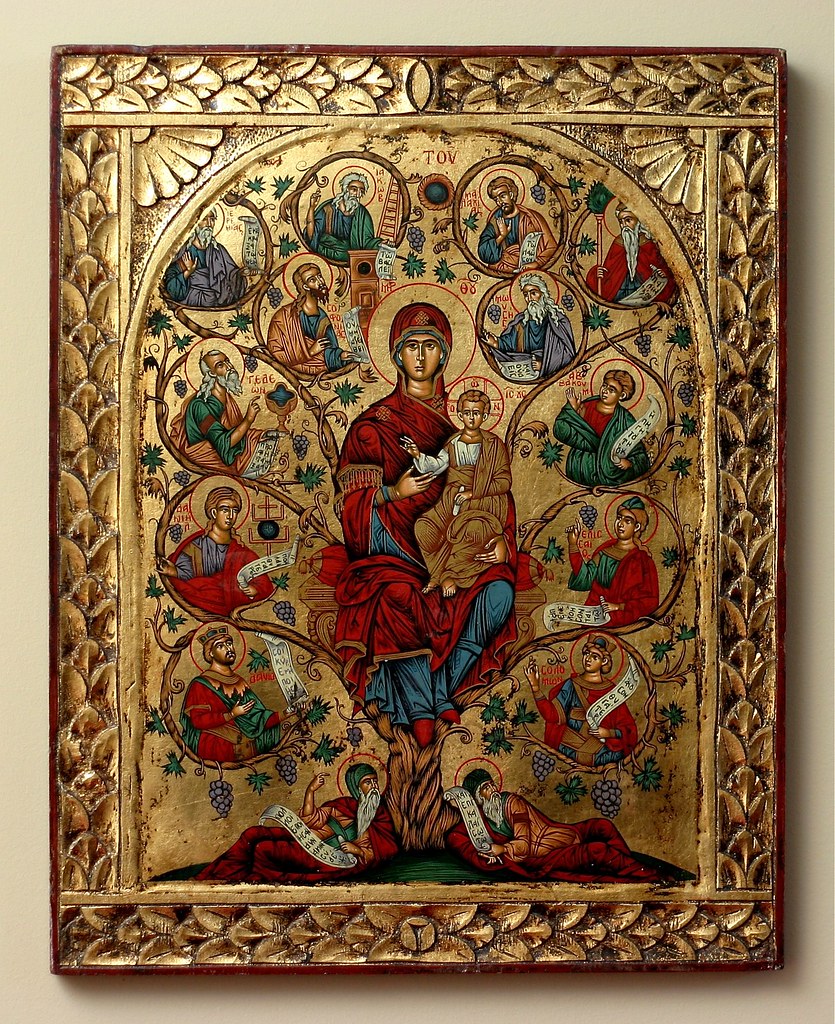
An icon of the Tree of Life. (Source)

Perhaps the most ubiquitous tradition of Christmas in America is decorating a Christmas tree. Whether live or artificial, green or white, festooned in tinsel or bedecked with bells, the Christmas tree is the image that adorns all our houses and heralds the coming of the Yuletide. And not just the houses of Christians. Many who celebrate Christmas as a merely secular holiday will still put up a tree. It just wouldn’t really feel like Christmas without it.

One of the better meditations on the meaning of the Christmas tree. (Source)

Yet the Christian discerns in this symbol something more than just a festive sign of the season.

First, a short excursus about symbols in general. Metaphor opens the speaker to the experience of “augmented reality,” though not at all in the way that phrase has come to be understood in the world of cheap tricks and tacky technology. Pokemon Go is not a metaphor. It’s just an add-on. It discerns nothing essential and establishes no real connections between unlike objects. Metaphor can. The truer the metaphor, the firmer the connection. It’s a dialectical process. Or, if you like a Trinitarian one: two unlike things are drawn together by the speaker, thus forming an entirely new third.

The Sophianic potential of language lies in metaphor. Name and metaphor permit us to imprint, image, and discern a level of reality beyond the merely immediate and sensible. That is why metaphor is impossible in the face of the Beatific Vision. All words die away, since the soul experiences the most heightened level of reality – Being itself.

Sophianic vision relies upon this kind of metaphorical thinking. Without dissolving the dogmas of the faith, Sophiology reads them sideways so as to gain an insight into the mystical realities more properly understood via poetry than, say, the logical language of the manuals. American Sophiologist Dr. Michael Martin has called for a “poetic metaphysics” by which we more potently discern the presence of God in His Wisdom, seen throughout Creation.

What would this “poetic metaphysics” look like beyond textual confines? That is, what would it look like if people actually lived out this search for the Wisdom of God?

For one thing, the soul that sees all in Wisdom will be always immersed in metaphor. The eyes of their heart would discern the connection of lower things to the higher. This is not mere cataphasis, the use of images in prayer. I mean that the daily impressions of life are experienced as taking place on more than one level of reality. The events of the day are read as symbols and metaphors. We encounter this in the life of the Ven. Seraphina di Dio:

The Ven. Seraphina (Source)

“…Anything I looked at I was able to turn into a meditation… When I saw it raining, I thought of the refreshment which the rain brought to the earth and that without it the earth would be arid. I would say: ‘If the water of divine grace did not fall on the soul, it would dry up without providing the fruits of good works.’ … The sight of fish swimming in the sea made me remember how the saints are immersed in God… And in such wise everything, even the slightest things, served me for my spiritual nourishment.”

-Ven. Seraphina di Dio

Such is one example of sapiential living. We might turn to another. Over at Sancrucensis, Pater Edmund Waldstein has furnished a charming passage from St. John of Karpathos:

St. John of Karpathos (Source)

Nothing is more weak and powerless than a spider. It has no possessions, makes no journeys overseas, does not engage in litigation, does not grow angry, and amasses no savings. Its life is marked by complete gentleness, self-restraint and ex­treme stillness. It does not meddle in the affairs of others, but minds its own business; calmly and quietly it gets on with its own work. To those who love idleness it says, in effect : ‘If anyone refuses to work, he should have nothing to eat’ (2 Thess. 3 : 1o). The spider is far more silent than Pythagoras, whom the ancient Greeks admired more than any other philosopher because of the control that he exercised over his tongue. Although Pythagoras did not talk with everyone, yet he did speak occasionally in secret with his closest friends; and often he lavished nonsensical remarks on oxen and eagles. He abstained altogether from wine and drank only water. The spider, however, achieves more than Pythagoras: it never utters a single word, and abstains from water as well as from wine. Living in this quiet fashion, humble and weak, never going outside or wandering about according to its fancy, always hard at work – nothing could be more lowly than the spider. Nevertheless the Lord, ‘who dwells on high but sees what is lowly’ (Ps . 1 1 3 : 5-6 . LXX), extends His providence even to the spider, sending it food every day, and causing tiny insects to fall into its web.

-St. John of Karpathos

One could name many other saints who exhibit this Sophianic tendency of vision through metaphor. For St. Paul of the Cross, as Fr. Faber notes,

St. Paul of the Cross, arguably the greatest Catholic mystic of the 18th century. (Source)

“…everything served to remind him of God, and he used to imagine that all creatures cried out to entreat the love of man for Him who made them. He was often observed, when walking in the fields, to gaze earnestly at the flowers as he went along and to touch them with his stick, saying, ‘Hold your tongues; hold your tongues!’ And he used to tell his religious that the flowers were always calling upon them to lift up their hearts in love and adoration toward their heavenly Creator.”

-Fr. Faber, All For Jesus, Ch. 6, pg. 153

When carefully fostered in the soul – usually by ascetic rigors and conscious efforts of love – it ceases to be merely Sophianic and takes on an iconographic character, such that everything in our field of sensible experience becomes a symbol of union with the higher realm it represents. Namely, God. Thus can we preserve the presence of God in our waking hours out of prayer.

So what does this have to do with Christmas trees?

The decoration of a Christmas tree is, in a certain sense, a concrete realization of this process. Bringing a part of the natural world into our home imprints something of the human and thus of the spiritual. We can see this with animals who have been domesticated. Cats and dogs become part of the family. We discern their personalities. They are not just “dog” but “Buster” or “Gabby.” Thus, name and metaphor go hand in hand in elevating the merely natural to something approximating the human.

We don’t personalize Christmas trees. But in placing them in our homes and filling them with glittering lights and baubles, we heighten the tree into something more than what it was. As we were commanded to do in Eden, we improve the creation and make it radiant. We lend it a new beauty, the fruit of our Godlike creativity. We place a star or an angel at its peak, and a reminder of Our Lord’s Nativity at its base. Thus we turn it into a little Tree of Life, reaching between Heaven and Earth, the natural world manifested in the splendor of its potential divinization.*

In other words, the power of metaphor allows us to experience the tree as something more than what it is at the purely material level. It becomes for us an icon of Holy Wisdom, of Christ abiding in His redeemed Creation.

I am reminded of today’s O Antiphon.

O Sapientia, quae ex ore Altissimi prodiisti,attingens a fine usque ad finem, fortiter suaviterque disponens omnia: veni ad docendum nos viam prudentiae.

O Wisdom, coming forth from the mouth of the Most High, reaching from one end to the other, mightily and sweetly ordering all things: Come and teach us the way of prudence.

-O Antiphon for 17 Dec.

These words are manifested in so many ways throughout time and space. They don’t just belong to Advent. Yet the Christmas Tree can (if we come to it with a Sophianic imagination) serve as one meditative example of Wisdom “sweetly ordering all things” in this holy season.

An icon of Holy Wisdom (Source)

It’s no surprise that Archpriest Sergius Bulgakov wrote favorably of the Christmas Tree.

*I realize of course that not all families use real trees, and that they don’t all place a Nativity under it. But even here, the power of metaphor enters in. In calling an assemblage of wire or aluminum or plastic a “tree,” we are already entering into the world of metaphor and artifice. In that case, we are only one degree removed from what I have described above.

My First Year at Grad School in Twelve Musical Selections

Screen Shot 2018-06-22 at 2.00.39 AM.png

A still from Farinelli. This was the year I both became an 18th century scholar and discovered Castrato arias. (Source)

12. “Somebody That I Used to Know” only Vaporwave.

11. “Sumer is Icumen In,” from The Wicker Man (1973).

10. “Demons,” by Alex and “Sleep Games,” by Pye Corner Audio.

9. Tchaikovsky’s Swan Lake theme.

8. Psalm 129 from King’s College Choir, Cambridge.

7. The soundtrack from Le Roi Danse.

6. “Never Enough” from The Greatest Showman.

5. “Pur Ti Miro,” by Monteverdi.

4. The Little Match Girl Passion, by David Lang

3. The Farinelli soundtrack.

2. Michael Nyman’s “The Garden is Becoming a Robe Room,” “Prospero’s Magic,” and “Chasing Sheep is Best Left to Shepherds.”

1. Various Arias from Handel, especially Rinaldo‘s “Il Vostro Maggio” and “Lascia Ch’io Piangia” as well as most of “Ode for the Birthday of Queen Anne.”


A Relic of the 1965 Liturgy

MissaLuba

Album cover of the Missa Luba. (Source)

That strange Mass produced by the Council in 1965, an interim liturgy somewhere between the Usus Antiquior and the Novus Ordo, was often accompanied by a distinctive style – at once traditional and fresh, what has been called by some “The Other Modern.” Think of the decoration of the National Shrine of the Immaculate Conception in Washington, D.C – especially its many side-chapels. Think of the delightful, dignified, but very vernacular liturgical music of Fr. Clarence Rivers (at least his early material). Think of the ornate but often geometric vestments that emerged from that time. Indeed, just think of Paul VI’s space-age papal tiara.

1965 Mass.jpg

The hybrid Mass of 1965. Not ideal, but considerably better than what followed. (Source)

Recently I discovered a reminder of this strange time in the Church’s history. I was watching a 1968 movie called If… with friends. It’s a disturbing (if artful) film about an uprising at a traditional British public school, and was clearly made in conversation with the student protests that erupted that fateful Spring, fifty years ago. I was surprised to find that one of the major musical motifs was liturgical. Looking it up, I discovered it was the “Sanctus” of the 1965 Congolese Missa Luba. The song is in many ways a synecdoche of the 1965 rite. It starts off with on French Gregorian foot, quickly introduces drums, and ends with an extremely Congolese bit of improvised singing. And, it must be said, it’s very beautiful.

The poignant song, coming from a country and Church in turmoil, strikes me as emblematic of the crushed hopes of that era. So much was anticipated of Congolese independence, so bitterly contested in the five years since. Already, the forces of reaction were coalescing around an upstart colonel who would soon assume control of the country as its first home-grown dictator, Mobutu Sese Seko. And in the Church, those reformers who genuinely tried to bring about a more perfect sense of the divine in the modern world found their position betrayed by a coterie of unorthodox radicals who perverted the sense of the Council’s documents.

Yet we can still hear that bright, fleeting moment of hope in the voices of the Congolese joining their praises to those of the angels.

UPDATE: It has been pointed out to me, correctly, that I have erred in attributing the Missa Luba to 1965 proper. The Mass setting was actually first recorded in 1958. It was in 1965 that the first US release of the album came out. So I suppose that, insofar as we consider its Western reception, the Missa Luba does remain part of the 1965 liturgical landscape. And “The Other Modern” certainly existed in the 1950’s; the aesthetics of 1965 were the culmination of a few decades’ of development.

I suppose my final point, about the parallels in the Church and the Congo, wouldn’t work as well as I had hoped. But at the very least, the Congo in 1958 was indeed a place of tremendous hope for the future. That aspiration manifest in the music was soon crushed by the turmoil of five years of war following Belgium’s official withdrawal in 1960. And the Church? Well, in 1958, I’m not sure anyone really saw what was coming…

Nostalgia Without Illusions

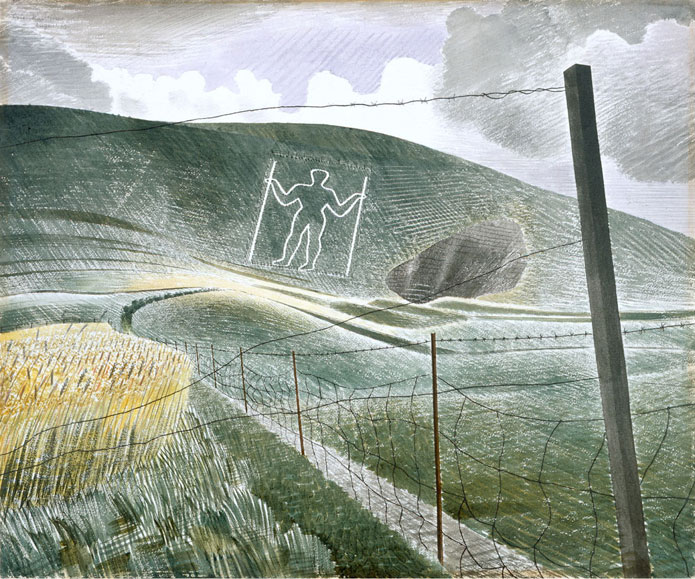
Ravilious-Wilmington-Giant

The Wilmington Giant, Eric Ravilious (Source)

Recently I read an article about a genre of music that had previously been unknown to me: Hauntology. In a nutshell, Hauntology is a throwback to the eerie, folksy world of British childhood in the 1970’s. The author summarizes the genre’s affective impact as “strange, melancholy disquiet.” Apparently music is being made today (and has been for some time) that conjures all at once that decade’s public broadcasting for children, the acoustic sounds of the English folk tradition, psychedelia, pagan chants, and synthesizers. Most of this material has been released through a few different labels: Ghost Box, Clay Pipe, and Trunk Records. Each specializes in a different variation of the general theme. On the whole, though, they all produce music that’s unsettling and evocative of a very particular place and time in the last century. There is something autumnal, something anachronistic, something broken in it all. In short, it’s music that’s haunted.

Many of the albums have cover art inspired by Eric Ravilious or John Nash or Sir Stanley Spencer or even Rex Whistler, those painters who so marvelously captured the quiet unease of the British landscape and its denizens. And the multimedia satirical phenomenon that is Scarfolk fits right into the broader movement. Hauntology is more than just a style of music. It’s an aesthetic.

In this respect, Hauntology is to the 1970’s what Vaporwave is to the late 1980’s and 90’s, or, for that matter, what David Lynch’s entire corpus is to the 1950’s.

vaporwavemall.jpg

Malls built in the early years of Bush I are the stuff of Vaporwave dreams. (Source)

Vaporwave derives its critical bite as well as its occasional airy ephemerality from a unifying sense of dread. Much the same could be said of Hauntology. Only instead of the zombie-like ascent of neoliberal late capitalism under the glittering haze of digital culture and advertising, Hauntology is still preoccupied with the anxieties of the analog age. Orwellian dystopia, the loss of the British countryside, and the destruction of innocence all hover under the surface. It’s drawing upon creepy public service announcements rather than Japanese soft drink commercials. Hauntology is to British Folk Horror as Vaporwave is to Cyberpunk.

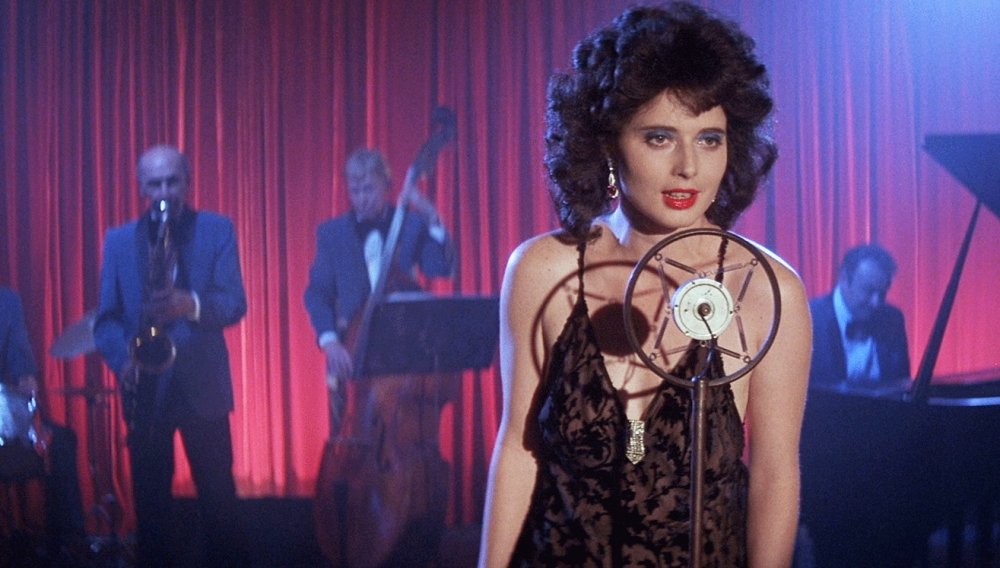
BlueVelvet

A scene from Blue Velvet (1986), one of David Lynch’s most distinctive films. It set the tone for much of what was to follow in its powerful evocation and ultimately ruthless subversion of mid-century norms (Source).

The common denominator is nostalgia, but a nostalgia free of illusions. Each of these aesthetic representations of a remembered decade – Lynch’s 1950’s, Hauntology’s 1970’s, and Vaporwave’s Digital Age – contains a degree of attachment to that particular time. Usually because the main creators involved in producing the aesthetic grew up then, and thus they draw upon the dreamlike haze which alternately gilds and clouds our world in youth. But it’s all shot through with the very real understanding that the past was not as wonderful as we would like to believe. Something nasty lurks just beyond our peripheral vision. We cannot help remember, but in that remembrance, terror awaits.

I’m an American, and only in my early twenties. 1970’s Britain wasn’t a world I ever knew. Nevertheless, I immediately connected with the emotional phenomenon behind Hauntology. Certain relics of that earlier time appeared every now and then in childhood, and even those that weren’t directly from the United Kingdom of the 1970’s often bring to mind that same feeling of remembered unease. Many of Don Bluth’s films animate precisely this strange, sensitive part of my memory. So do Stephen Gammell’s original illustrations of the Scary Stories to Tell in the Dark books. So does The October Country, Ray Bradbury’s wonderful short story collection (which itself significantly predates the main era of Hauntology). So does anything by Lynd Ward. So do parts of Pink Floyd’s The Wall. So does that horrible movie, The Plague Dogs. There are probably more examples I could summon up if I thought about it long enough. I am no stranger to “strange, melancholy disquiet.”

I’ve always liked that sensation, and I’ve always been drawn to other peoples’ nostalgia. As such, I’m super pleased to have discovered Hauntology.

Thoughts on Converting the Young

New-format-for-Coke-Zero-Cherry

The official drink of the movement. (Source)

By now, it has become a commonplace among the Catholic literati that, as one reporter put it, “The Kids are Old Rite.” Traditionalism is on the rise among Millennial Catholics. Several overlapping clans of young, traditional Catholicism have arisen over social media, especially Twitter. Traditional orders get more and younger vocations; older, more progressive orders face extinction in the near future. The Pope himself has taken notice and expressed concerns about this trend. Of course, most of the young trads prefer a pope closer to their own age.

Several unrelated items recently have come up in my news-feed that have collectively crystallized the issue for me.

I

First, a three-part study of FOCUS (The Fellowship of Catholic University Students) has just appeared in the National Catholic Reporter. While I’m often wary of NCR’s coverage on just about anything, I’d encourage you to read it. Sometimes the magazine’s liberal bias gets the best of it, as in a mostly uninteresting examination of FOCUS’s ties to Neo-Conservative and generally right-wing organizations in Part II.

But there are also genuine insights. A lot of the issues raised reminded me of my own somewhat mixed experience with a FOCUS-dominated campus ministry. I certainly made friends, some of whom I still consider important mentors. My first-year Bible Study leader, a fellow student who had been “discipled” by the FOCUS missionaries, was a great influence in my first year of Catholicism (and beyond). But I more or less left the ministry fairly early on, like most of my trad or trad-lite friends. The NCR study gets into some of the reasons why.

For instance, in Part 1, we read:

A FOCUS women’s Bible study group gave Elisa Angevin purpose and strengthened her values — at first. As a freshman at New York University, she met a missionary, who became a mentor and a friend.

But as she met different people outside that community — some of whom were “rubbed the wrong way” by FOCUS — Angevin began to distance herself from the group because it felt exclusionary, rigid and not open to different ways of being Catholic.

“Once you become part of FOCUS, it has a very structured approach,” recalled Angevin, now 25 and a social worker in New York. “It created a lot of passion. But a lot of student leaders looked down on other people who didn’t have the same passion.”

Angevin attended some of FOCUS’ mega-conferences, such as the Student Leadership Summit, and was inspired by the speakers and sense of community. “It was empowering to see people my age who were as excited as I was,” Angevin recalled. “But as I started to get older, the newness had worn off … and it felt very closed.”

A lot of this rings true. Speaking from my own experience, I always got the very strong impression that FOCUS represented a fairly “mainstream” form of Catholicism, the JP2 consensus. Banal liturgy coupled with social conservatism. But there really isn’t any room for traditionalists – or even just those who are friendly to the Old Mass and the piety it sustained. I remember being called “judgmental” for my views. Other trads were  sidelined as well.

I also think that the program’s reliance on *very young* missionaries often leads to a dumbing-down of the vast spiritual and intellectual inheritance that is Catholicism. There’s some call for this at a campus ministry, where ministers have to reach as many people as possible. Not everyone can or even should be St. Thomas Aquinas. Undergraduates don’t often go to ministries looking for lectures, but for some escape from the academic life. Still, must it all be so infantilizing? Perhaps you can see what I mean here:

At the Chicago event, held at the sprawling McCormick Place convention center, FOCUS founder Curtis Martin struts onto the stage, hands in the air, shouting “Woo!” and “Awesome!” to the applauding summit attendees who had been enjoying a contemporary Christian band before his keynote address. Two days earlier, actor Jim Caviezel — Jesus in the Mel Gibson film “The Passion of the Christ” — made a surprise visit to the conference.

“This is how awesome you are,” Martin said. “When the guy who pretended to be Jesus walked in the room, you all stood up and clapped, but when Jesus showed up, you all fell down and knelt. You know the difference. How cool is that?”

What an ineffably stupid way of addressing adults. Mr. Martin manages to strike at once a patronizing and self-congratulatory tone, a true rhetorical feat.

FOCUSavemaria

One thing I learned in the NCR articles is that FOCUS missionaries only get four weeks of training the summer before they begin. And some of that is dedicated to learning how to fund-raise. (Source)

Yet my unease with FOCUS wasn’t just with that sort of standard, if irritating, campus ministry procedure. As a recent convert who had grown up in an Evangelical Protestant school, I found a lot of FOCUS’s Protestant-lite discourse unsatisfying. It was more than just the use of emotivist praise and worship music at Benediction (as grating as that was). It was more than just the way FOCUS mission trips seemed to mirror the sort of make-work vacation mission trips I recognized from my time in the Evangelical world. I got the distinct sense that FOCUS borrowed heavily from the discourse of Evangelicalism, even down to the language it deployed when talking about conversion. Here’s an example from Part III:

As former FOCUS employees (called “missionaries”) or as students involved with the organization on their college campuses, they were taught its “Win, build, send” formula.

“Win” means to build “authentic friendships” with people, with the ultimate purpose of evangelization, while “build” requires helping those friends grow in faith and virtue through what FOCUS calls “the big three” virtues: chastity, sobriety and excellence.

First, we have the shallow reduction of evangelization to a business-like slogan, as if the work of the Holy Ghost could be charted like a marketing campaign. This type of lingo is, in my experience, very common in Evangelical discourse. Paired with it we find the language of authenticity. The first step in FOCUS’s three-part strategy is to “build ‘authentic friendships.'” Authenticity is like obscenity – you can’t define it, but you know it when you see it. The problem, of course, is that you can’t actually plan an “authentic friendship.” The planning is precisely what makes it artificial. Friendships come about organically, and no two look alike. The same can be said of conversions. At best, FOCUS should rather resemble what St. Philip Neri imagined the Oratory to be, though he never constructed any firm plans for the Congregation’s foundation or development. At worst, students get the sense of entering faux, farmed, and framed friendships. Those attract precisely no one.

In the emphasis on “chastity, sobriety, and excellence” as, risibly, “‘the big three’ virtues,” we find a synecdoche of the very strong note of philistine, puritanical prudery ensconced in FOCUS. Encountering this tendency also made me recall the moralistic Calvinism of my youth. Everything in Christianity seemingly came back to sex, drinking, and drugs. No one who ponders the state of American students could seriously suggest that these issues don’t matter, but to hammer on about them to the exclusion of two other triads – Faith, Hope, and Charity, and the Good, the True, and the Beautiful – makes Christianity dull.


FOCUSprots

Protestant Sunday worship, or Catholic conference? Hard to tell…and therein lies the rub. (Source)

But why does FOCUS make “chastity, sobriety, and excellence” its threefold mantra? The FOCUS promotional video in Part 1 offers some insight into their worldview. The narrative told there is one of nostalgia and decline. Various clips from the 1950’s are shown in contrast to the sex, drugs, technology, and mass media of today. The message is obvious: society was better back then, and it’s worse now. But it’s not fundamentally true. First of all, evil has always existed. FOCUS’s Manichaean view of the past may not be unusual, but it’s also deeply lopsided. All the terrible things FOCUS decries about our modern society – pornography, addiction, suicide, the disenchantment of consumerist technology – all of these things existed prior to the 1960’s. And lots of bad things about the society of the 1950’s have disappeared or been greatly mitigated in various ways (need I point out segregation as the elephant in the room?). Yet none of those advances are mentioned. It’s not surprising that social justice Catholics, like trads, find themselves ill at ease with FOCUS. Is it all that shocking that “a lack of racial, ethnic and economic diversity among students served by FOCUS is another criticism?”

The FOCUS video also fails to note the role the Church herself played in clearing the way for, hastening, and abetting the worst changes. Nary a peep do we hear about how leaders of the postconciliar Church abandoned her sacred mission to convert a sinful world, nor the way that such a surrender was intimately tied to the loss of the Mass of Ages.

I don’t intend for this post to be a simple laundry-list of my grievances with FOCUS, philosophical and otherwise. After all, I know plenty of wonderful people who got a lot out of their connection with the organization. The FOCUS missionaries themselves were always perfectly pleasant, and seemed orthodox enough. But I also knew others who felt excluded and patronized by the model they brought to campus ministry. I confess a very deep ambivalence about their hopes to expand ministry to parishes (though the veritable clerisy of middle-class lay ministers that Marti Jewell envisions in Part III of the report is hardly any better).

YoungTrads

An alternative. (Source)

If we want to win the youth with “authenticity,” then look no further than the Latin Mass. Or even just the Novus Ordo celebrated according to Fortescue, as you see at the English Oratories. That which is unmistakably Catholic and orthodox has the best chance of bringing about conversion of heart. I would be curious to know how Juventutem compares to FOCUS in terms of outreach, vocations, etc. Regardless, my own view of how this program of evangelization might best function is in my essay, “The Oratorian Option.” Nothing has changed since then, except that I’ve gotten the chance to attend an Oratorian parish consistently, an experience that has corroborated my original theories. The Eucharist and the worthy celebration of the Mass are at the heart of it all.

It’s just unfortunate that FOCUS, at least as I’ve known them, aren’t interested.

II

The New York Times published a piece on the Trappists of Mepkin, monks in my own home Diocese of Charleston. They’re good, quiet priests who farm mushrooms on a prime piece of real estate next to the Cooper River. The Times profile is nice enough, though I think its central flaws are aptly pointed out by my friend, Fr. Joseph Koczera SJ, in his response over at The City and the World. To wit:

Despite the NYT‘s suggestion that the Mepkin “affiliate program” represents “a new form of monasticism,” the monks themselves realize that it does not. As NYT reporter Stephen Hiltner observes, “the monks at Mepkin are cleareyed about the likelihood that their new initiatives — which will probably attract young, interfaith and short-term visitors — will fail to attract Roman Catholics who are interested in a long-term commitment with the core monastic community.” Mepkin’s abbot also frankly admits that the monastery may not survive: “I’d rather be in a community that has a vital energy and a good community life. And if that means closing Mepkin, that means closing Mepkin.”

“New” and dubiously monastic programs substituted for genuine, old-fashioned monasticism? We’ve seen this before. Mepkin’s well-intended program differs even from, say, the Quarr internship insofar as it isn’t primarily targeted to candidates who might plausibly have a vocation, single Catholic men from the ages of 18 to 25. And unlike Quarr, a monastery which retains its Solesmes heritage, Mepkin seems to be failing in part because it holds too tightly to the Spirit of the Council. Mepkin’s new affiliate program is open to women as well as men, “of any faith tradition.” It seems that the solution they’ve come up with to their vocational crisis is to become less Catholic, not more.

Fr. Koczera continues at length:

As Terry Mattingly points out at GetReligion, the NYT article is very one-sided, focusing on monasteries that are dying without ever asking questions about monasteries that actually are drawing vocations. Most Trappist monasteries in the United States seem to be in straits similar to those of Mepkin, at least judging by yearly statistics published by the Trappist Order. On the other hand, it isn’t difficult to find monasteries in the United States (albeit those of other orders) that continue to attract (and retain) young vocations: one thinks of the Benedictines at Our Lady of Clear Creek Abbey in Oklahoma or Saint Louis Abbey in Missouri, or of the Cistercian Abbey of Our Lady of Dallas (a monastery I’ve written about once or twice before)…Despite the evident sincerity of the monks at Mepkin Abbey, their sense of what young people want belies data about what young Catholics in particular are looking for. As the monks acknowledge, seeking to provide a haven for ‘spiritual but not religious’ types will not lead to an influx of new vocations. The monks may realize, too, that Millennial Catholics who take their faith seriously are also serious about commitment and likely to be unimpressed by a strategy that is specifically tailored to seekers who are “interested in the spiritual life journey, but not in institutional religion.” In this sense, it’s interesting to contrast the NYT story on Mepkin Abbey with a NBC News story from just last week that highlighted the rising number of American Millennials who are choosing to enter religious orders – and who enter looking for a solid sense of identity and commitment that is countercultural. They represent a generation of Catholics who find themselves, as Tracey Rowland writes, “in full rebellion from the social experiments of the contemporary era” as they seek “to piece together elements of a fragmented Christian culture.” Some will find the resources they need to assemble those fragments in one or another of America’s remaining monasteries – but not, it seems, at Mepkin Abbey.

temporary-transfer-to-rome

A 2016 photo of the community of Norcia. The monastery is unlike Mepkin in many ways: young, international, augmented by regular vocations, and above all, Traditional. (Source)

Of the new monasteries that do seem to get vocations (and lots of them), two stand out: Norcia and Silverstream. The lives of these two monasteries are so attractive to young American Catholic men that, though they are in Italy and Ireland respectively, they are mostly inhabited by Americans willing to make the move to Europe. Both are old-rite monasteries. And I would wager that neither Dom Cassian Folsom nor Dom Mark Daniel Kirby went about planning their monastic ventures with catchy slogans or even a very programmatic sense of action. They celebrated the Mass reverently, preached orthodoxy, and, with the help of the internet, they achieved widespread fame. They shared the trust in Divine Providence that St. Philip had as he – or, in his own words, Our Lady – founded the Oratory.

III

My friend John Monaco has just published an excellent personal narrative at his blog, Inflammate Omnia. It describes his Catholic upbringing, difficulties in seminary, extended flirtation with liberalism, and final reversion to a basically Traditionalist position. Parts of it reminded me of my own story: my natural religious sentiment as a child, my vituperative liberalism in High School, my conversion and eventual move towards a more or less Traditionalist orientation, in part through the beneficent influence of the Christian East.

cropped-Sacre-Coeur-940x450

Christ offers us His heart freely and fully. (Source)

I was particularly taken with the way that the Act of Reparation to the Sacred Heart of Jesus, as traditional a devotion as you can get, gently shaped John’s sensibilities over time. His original resistance to the Sacred Heart gave way to the a love of Jesus in precisely this mystery. And by the infallible rule of Lex Orandi, Lex Credendi, the prayer also led him to adhere more perfectly to the Faith as enshrined in Tradition. He writes,

You see, the more I prayed to the Sacred Heart, the more I began to really think about what I was actually praying. Prayer of Reparation? “For what?” I asked. My sins. What does it mean to “resist the rights and teaching authority of the Church which Thou hast founded?” That must obviously mean that the Church has authority, and that Christ founded the Church. The more and more I prayed these prayers, the more I began to question its essence. And even more so, I began to question my own conduct and dispositions.

You see, none of this “mercy” stuff makes sense if we don’t believe that sin actually harms. If all sin is simply personal weaknesses that do not affect our relationship with God and each other, then why do we need forgiveness? Or, in response to some moral theologians, if it is impossible to sin, then what is the purpose of grace? If the Church doesn’t have authority, then why do we consider the command to preach the Gospel? If Christ didn’t found the Church, then why should we bother following it? I also wondered why I was skipping all of the “hard-sayings” of Jesus, such as His words on divorce and remarriage, purity, suffering, obedience, and the promise that the “world” would hate me for preaching the truth. I started examining the fact that people would tell me, “I like you because you’re not talking about Hell and all of that sin stuff all the time”, and that had less to do with me balancing the Christian message than it did with me picking & choosing which parts to speak about.

John also captures the essence of the new, young Traditionalism:

Delving beyond the contemporary face of Catholicism, I was able to re-discover Tradition- not through EWTN or Rorate Caeli, nor through PrayTell or Crux, but rather through a true experience of the sacred liturgy, prayer, and study.

A future church historian will take that line as summative of the entire experience of a generation. The only thing I would add is that in my own case, as with many others, beauty was the central thing. Community, tradition, stability, a sense of history; all these are goods that the Church offers her children. But it was supernatural beauty that captured my imagination and led me to a genuine encounter with the Living God. The Church has the chance to re-present that “beauty ever ancient, ever new” each week at the Mass. It is Christ Himself in the Eucharist who will convert the world. Not our misbegotten, if earnest, attempts to plan out the advance of His Kingdom. If anything, we too often get in His way.

TYPsedia

More of this, please. (Source)

Becket’s “Easier Victory”

becket_martyr

Saint Thomas of Canterbury, pray for us and for England. (Source)

It’s that time a year again. The Feast of St. Thomas Becket, Martyred Archbishop of Canterbury, defender of the Church’s independence from the Crown. Which means we get to watch that fantastic and ever so Catholic film, Becket (1964). For those without access to the full movie, you can watch the very best scene here.

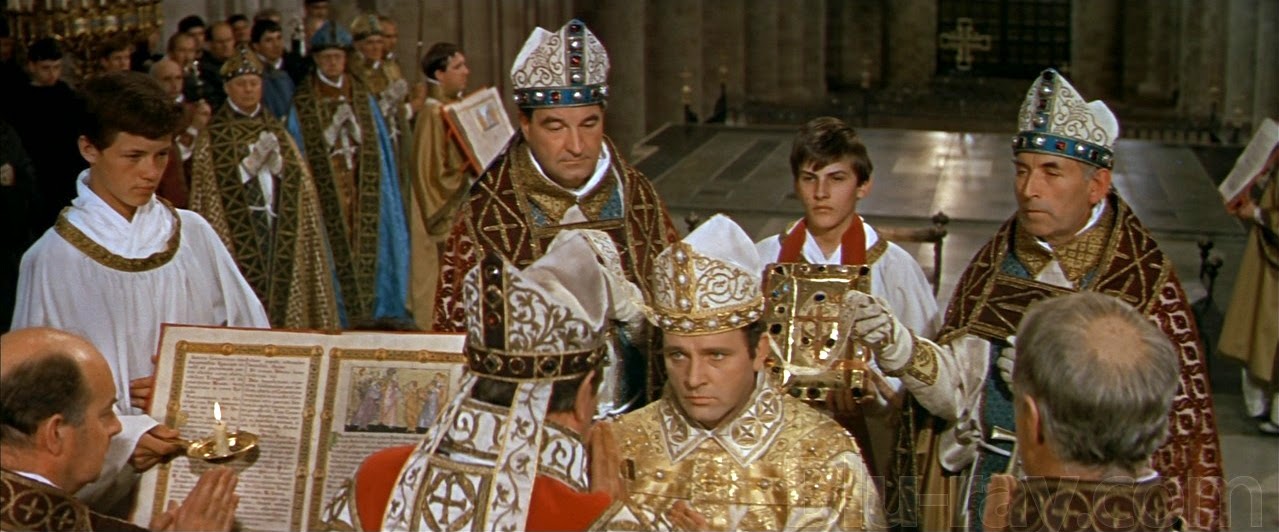
Becket#4

One of the film’s great charms is its collection of beautiful Romanesque vestments, all used properly. (Source)

Let me also add in a great excerpt from T.S. Eliot’s classic 1935 verse drama about the Archbishop, Murder in the Cathedral. It comes from the most climactic moment of the play, when Thomas is about to be killed. His priests have barred the doors of the cathedral to the four assassins, but Thomas will have none of their worldly prudence. His speech presents a brief theology of martyrdom that must stir the heart of any Catholic.

You think me reckless, desperate and mad.
You argue by results, as this world does,
To settle if an act be good or bad.
You defer to the fact. For every life and every act
Consequence of good and evil can be shown.
And as in time results of many deeds are blended
So good and evil in the end become confounded.
It is not in time that my death shall be known;
It is out of time that my decision is taken
If you call that decision
To which my whole being gives entire consent.
I give my life
To the Law of God above the Law of Man.
Unbar the door! unbar the door!
We are not here to triumph by fighting, by stratagem, or by resistance,
Not to fight with beasts as men. We have fought the beast
And have conquered. We have only to conquer
Now, by suffering. This is the easier victory.
Now is the triumph of the Cross, now
Open the door! I command it. OPEN THE DOOR!

(MITC 73-74)

May we so speak in the many trials of our own lesser martyrdoms.

The Music of the Holy Ghost

TarkovskyNostalghia.jpg

A still from Andrei Tarkovsky’s Nostalghia (1983). Clips from Tarkovsky’s films are often incorporated into the Rev Army’s music videos. (Source)

Not long ago, I came across a new band. What a singular group it is. Their music crosses and confuses genres. They produce content at a far scarcer rate than other musical acts. Even their name, taken from a Buñuel film, sets them apart from most of the offerings one comes across today.

Little did I know that I had stumbled upon a cult gem. The Revolutionary Army of the Infant Jesus has been on the scene for quite a while. Almost thirty years ago, they released their first album, The Gift of Tears (1987). Since then, they have only come out with sporadic releases, such as 1990’s Mirror and 2015’s Beauty Will Save the World. The long hiatus has well earned them the title of “One of music’s most elusive and enigmatic acts,” as we can read on their BandCamp site.

Tim Cooper has a great review of their work over at The Quietus:

…the attention-averse trio, who regard themselves as a creative collective rather than a band, make wildly eclectic music rooted in liturgical texts and ecclesiastical iconography, contrasting ethereal beauty with stark brutalism. Celestial choirs rub their cassocked shoulders with squalls of industrial noise, political speeches are interwoven with celluloid dialogue, instrumentation ranges from sombre neo-classical piano to pounding dance beats by way of folk, free-form jazz and experimental psychedelia.

They draw together a variety of spiritual and cultural influences: folk Catholicism, peasant mysticism, Russian Orthodoxy, the experience of post-Soviet Europe, Simone Weil, Welsh poetry. Their work can, I think, be described as sophianic, but it is a sophanicity carefully drawn through the harried cracks of the fallen world. The truth that the Rev Army grips and holds up to the light gleams all the more for being refracted in the shards of our earthly mirror.

Here are some favorite songs with their proper music videos, many of which are just as important for the meaning of the piece as the score itself.

Come Holy Spirit” – the very first Rev Army song I discovered. A bit too much flute and too many drums for me, but it was different enough from anything I had ever heard that it caught my attention.

Bright Field” – the first one that captivated me. The upward lift of the music combined with R.S. Thomas’s stirring paraphrase of the Gospel, not to mention Tarkovsky’s silken, dreamlike visuals, all together inspire something like wonder. Whenever I listen to it, I am reminded of a poem by Rilke.

After the End” – a simple and haunting French ditty set to the grainy images of villagers at prayer. They seem to be visionaries.

Psalm” – a few women chant in English against an increasingly dissonant shower of quasi-industrial background noise. The juxtaposition strikes me as an artistic model of transcendence through persistent prayer.

Repentance” – the most Flannery O’Connor thing you will ever see or hear. I’ll just leave it at that.

Théme de l’homme qui n’a pas cru en lui méme” – a Latin-flavored and occasionally jazzy piece featuring footage from a (staged?) Spanish Lenten procession. In case you hadn’t already noticed, the band is extremely Catholic.

Joy of the Cross” – another Lenten procession, but this time with a soft-edged folk music that makes me think of Fleet Foxes.

Before the Ending of the Day” – the Compline hymn surrounded and supported by an airy yet pulsing larger song. Tarkovsky’s Andrei Rublev provides the meditative visuals. Note that one of the commenters on YouTube wrote, “Please keep making more of these. This helped still my soul.”

Something epicletic moves through their music. But one can find that quality in lots of other work. What sets the Rev Army apart isn’t just their obsession with the Holy Ghost, nor their stylistic eclecticism. It’s their powerful sense of mystery. They never shy away from the divine darkness with which the Holy Ghost enshrouds His manifold works of grace. How refreshing, in an age of “Spirit of the Council” muzak and shallow “praise and worship,” to find music that is overtly Christian and even mystical without ever becoming preachy, dated, or emotivist. They treat their subject, the perennial and universal longing of the human heart for God, with a rare artistic and spiritual sophistication.

Caught up in marvel at the saving mystery of the Holy Ghost, the Revolutionary Army of the Infant Jesus is the real Catholic charismatic revival.

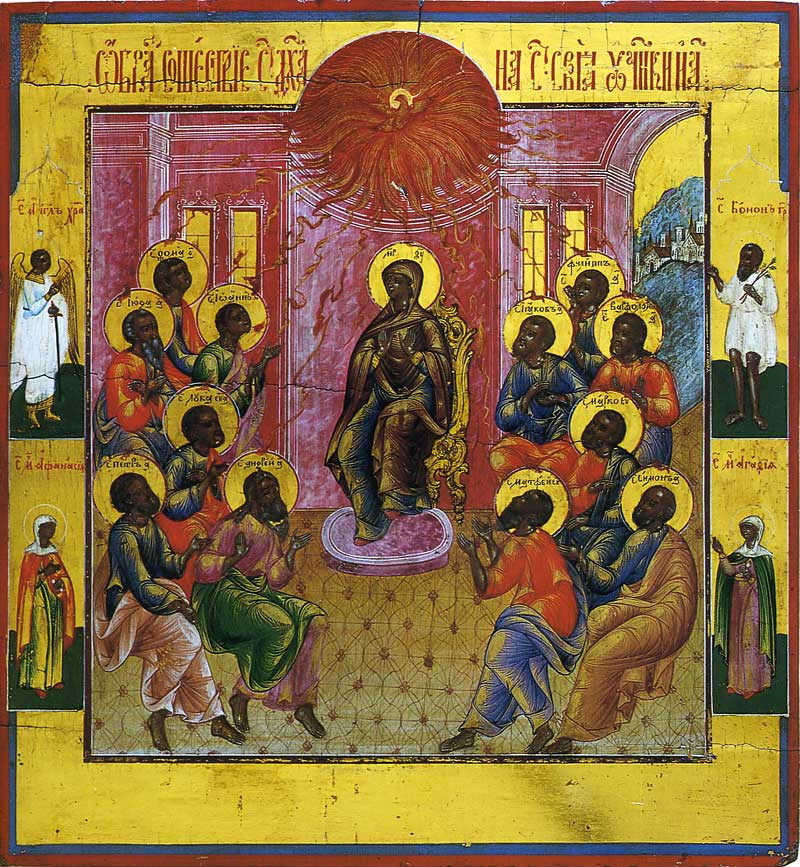
DescentoftheHolySpiritIcon

An icon of the Descent of the Holy Ghost. (Source)

The Lord High Inquisitor’s Song

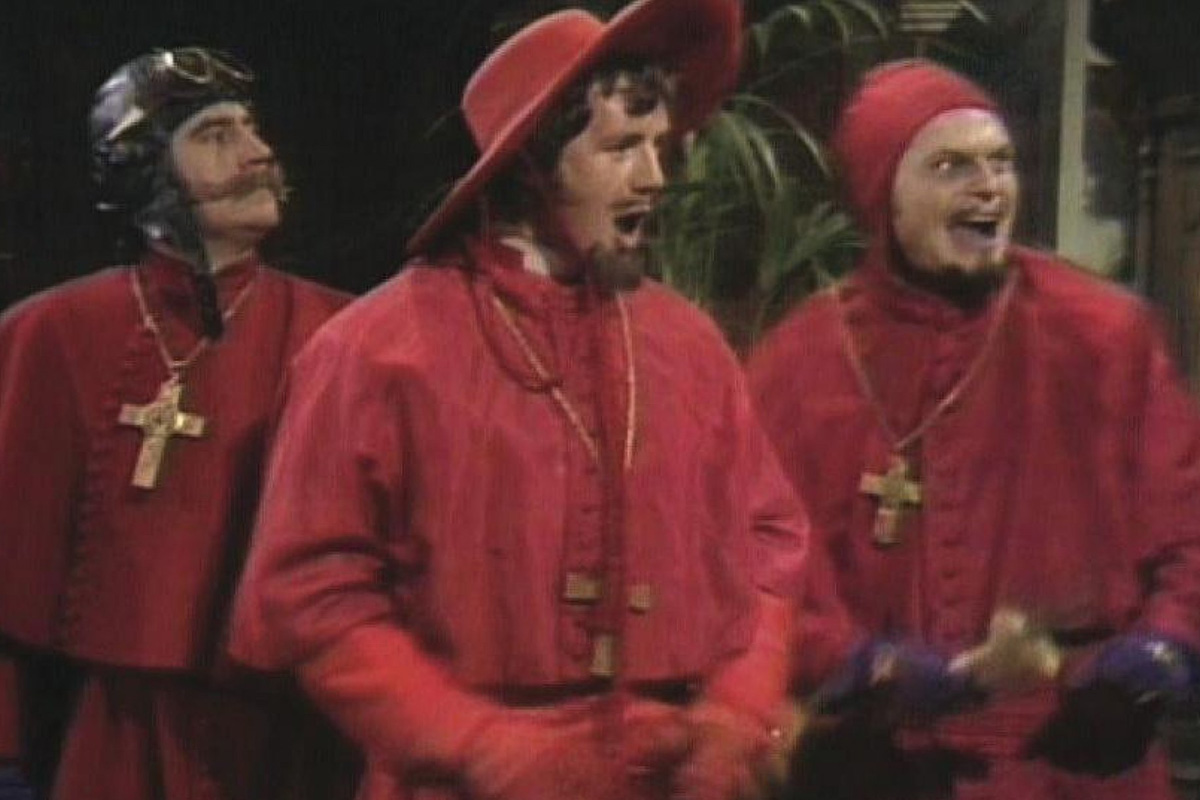
HighInquisitors

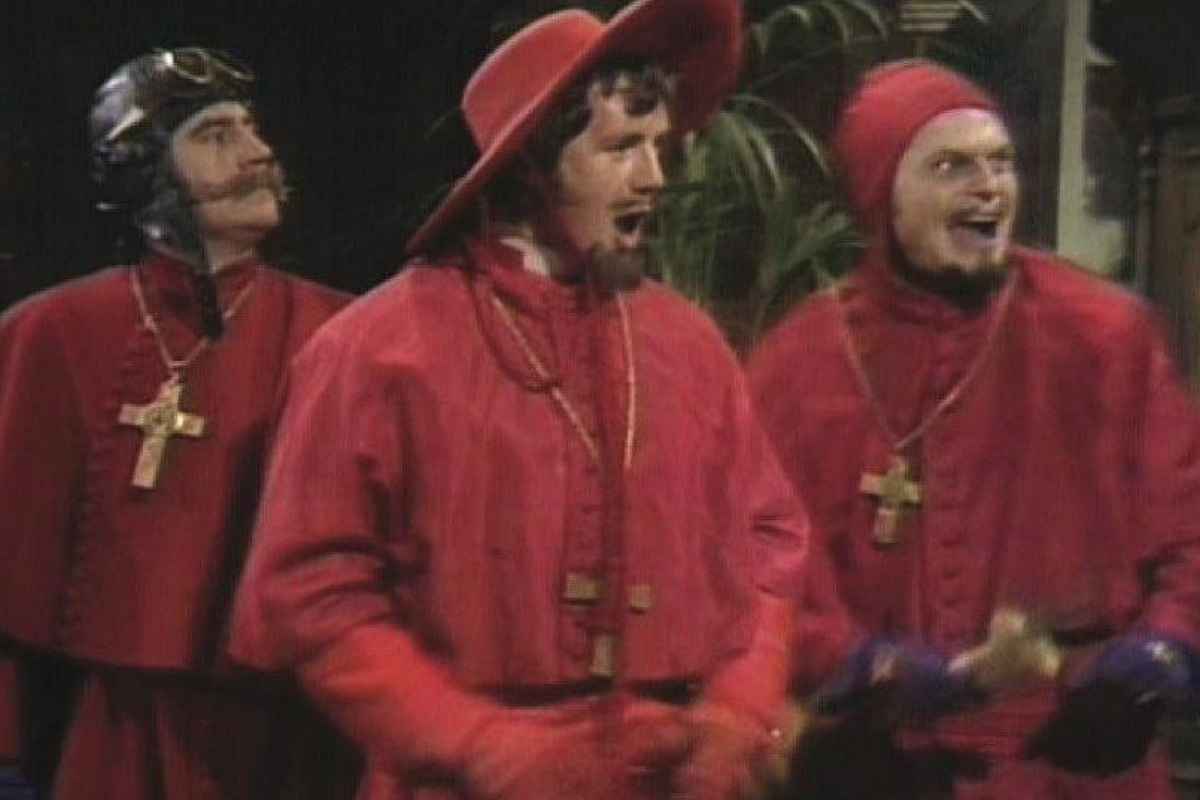
Nobody expects it. (Source)

The Lord High Inquisitor’s Song

(tune)

Cardinal Ko-Ko
As some day it may happen that a victim must be found,
I’ve got a little list—I’ve got a little list
Of ecclesial offenders who might well be underground,
And who never would be missed—who never would be missed!
There’s the pestilential journalists who write for NCR,
and all the ultramontanists who think the Pope’s a Czar—
All clergy who wear ugly stoles and vestments as they pray—
And philistines who think that lace is just a little fey—
Theologians from the Argentine who study how to kiss.
They’d none of ’em be missed—they’d none of ’em be missed!

Chorus
He’s got ’em on the list—he’s got ’em on the list;
And they’ll none of ’em be missed—they’ll none of ’em be missed.

Cardinal Ko-Ko
There’s the Jesuit on Twitter who does not believe in hell.
Since God he does resist—I’ve got him on my list!
Then there’s the German Cardinals who pray to Martin L.
They’re just “ecumenist”—they never would be missed!
Then the liberal who praises, with some social justice rage,
The “spiritual but not religious” tenor of the age;
And the parish secretary who makes fruitcake every year
For the congregation’s Christmas Party (and inspires fear);
And that odd phenomenon, theologians feminist
I don’t think they’d be missed—I’m sure they’ll not be missed!

Chorus
He’s got them on the list—he’s got them on the list;
And I don’t think they’ll be missed—I’m sure they’ll not be missed!

Cardinal Ko-Ko
And those mouth-foaming maniacs who write LifeSite clickbait,
Would that they might desist—I’ve got them on the list!
The Neo-Caths at Crisis in a moral panic state.
And a Two-Tiered Thomist—you know he’s on the list!
Then the smug and smarmy statesman who still wears the scarlet hat
Who bows to tyrants’ wishes from a desk chair in the Vat—
And the bishops who decide they want obedience, not truth
All baby boomers who attack the faithful of the youth—
And all the heretics who can be judged quite Modernist.
They’ll none of ’em be missed—they would none of ’em be missed!

Chorus
You may put ’em on the list—you may put ’em on the list;
And they’ll none of ’em be missed—they’ll none of ’em be missed!