Flannery O’Connor and the Protestant Ex Voto Tradition

Recently I came across a very strange song from an equally bizarre album. The song was “I’m Not Handicapped, Just Inconvenienced,” by Gary Dee Bradford. It was on his 1979 album of the same title. The piece is a chilling mix of bad ventriloquism, preachy Carter-era Evangelicalism, and awkwardly poor singing. Which means, of course, that I loved it.

BradfordHandi.jpg

I’m curious what’s on the full album. (Source)

I soon found out that Bradford, who suffers from a rare physical disability called phocomelia (he lacks arms and has hands at his shoulders), produced a few other albums. Although he produced his most recent work in 2002, most of his output came in the 1970’s and 80’s. In one of the only other songs by Bradford I can find online, 1977’s “Good Ole Gospel Music,” we can hear the prepubescent Bradford sing in a high and eerie voice about the superiority of his chosen genre:

It is the sweetest love song
Ever heard by mortal man.
If we had more Gospel Music
We’d have a better land…a better land!

GaryDeeBradfordGOGM.jpg

Gotta love that 70’s montage work. (Source)

It’s catchy, I have to admit. Even if it’s not exactly Mozart.

It would be easy to make fun of the sheer cheesiness of Bradford’s records and write them off as one more episode in the history of odd music. But in fact, Bradford’s albums deserve more respect than that. They tell us something about the history and spirituality of mid-20th century American Christianity. Bradford wasn’t working in a vacuum.

American Gospel music, particularly that brand of Gospel that flourished in the predominately white churches of the mid-century South, has roots in the musical traditions of Appalachia. One of the most common and longstanding song forms found there is the ballad. Appalachian ballads often tell stories of woe and redemption, sadness and hope. When given a religious inflection, they become the musical versions of faith-sharing, testifying to the work of God in redeeming poor sinners. They are also the Protestant equivalents of the Catholic world’s longstanding folk ex voto tradition.
ExVoto1.jpg

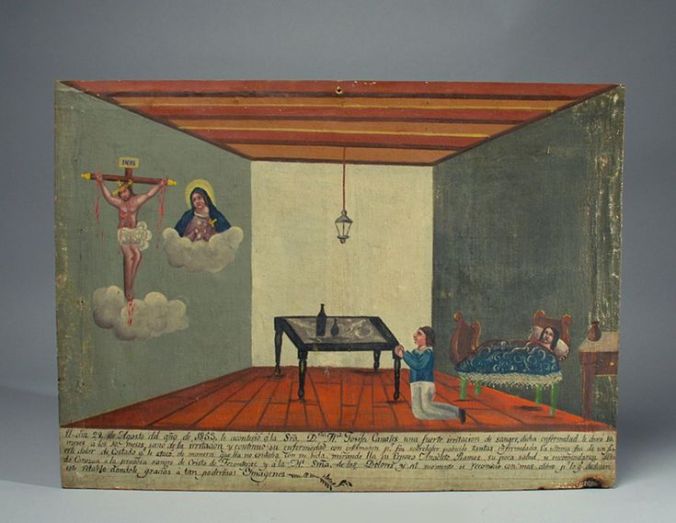
An example of a Mexican ex voto, 1853. (Source)

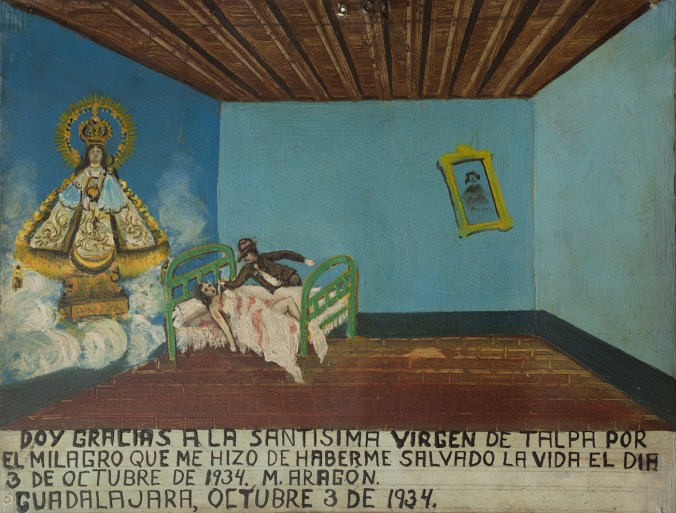
The ex voto is a little painted image offered by a devotee in thanksgiving to Christ, the Virgin, or a saint for a perceived blessing. Usually, the scene of the miracle is depicted in fairly simple (or what the art critics would call “naive”) terms, with a short, handwritten narrative describing the incident below. They are emphatically not “fine art.” Ex votos are the result of folk piety, and they depict the most fundamental relationship of the worshiper and the supernatural, the body and the invisible world, faith and crisis.

There’s also a uniquely New-World flavor to the ex voto form. While examples abound from most historically Catholic cultures, the most exemplary tradition of ex votos can be found in Mexico. Indeed, the ex voto has become one of the country’s national art forms, often stylized and reinterpreted by contemporary artists. Frida Kahlo even collected them.
exvotokahlo01.jpg

An ex-voto of a woman stabbed in bed, owned by Frida Kahlo and believed to have inspired her own painting, “A Few Small Nips.” (Source)

We can see the same kinds of spiritual impulses behind a whole wave of calamity-themed songs in mid-to-late-20th century Gospel. Perhaps we shouldn’t be surprised that, in a Protestant context, the ex voto takes an audible rather than visual form. Take, for example, Jerry D. Brown’s A Crippled Boy’s Prayer and The Fuller Family’s slightly earlier but almost identical A Little Crippled Girl’s Prayer.

CrippledBoysPrayer.jpg

Not a great song, but it makes sense as a sort of ex voto. (Source)

Sometimes, the album as a physical object mirrors the makeup of an ex voto. The back of the albums often carry long messages of praise and thanksgiving in spite of the various afflictions the artists suffer from. For example, on the back of A Little Crippled Girl’s Prayer, we read the words of wheelchair-bound Marsha Fuller:

It’s so great to be a Christian and serving such a great God. He has given so much to me, for most children with my disease lead a quiet life and never have the opportunities that I have had.  At the age of three He gave me a voice to sing with. And three years later God inspired me to write two songs. Since then, I have written four other songs and made two recordings. He has also blessed me in other ways. He gave me a wonderful Mom and Dad whom have loved and cared for me so much. He gave me a wonderful brother, Gene. You don’t find too many twenty-year-old men who loves to sing for the Lord the ways he does. As a family we have had rough times together. Sometimes we didn’t know where the next meal was going to come from because of hospital bills, but, God has always pulled us through. Our house might not be the biggest and our clothes might not be the finest, but as long as we stay true to Jesus someday we’ll have a mansion that outshines the sun. We truly hope that you will be blessed by our message in song to you. Yours in Christ, Marsha Fuller

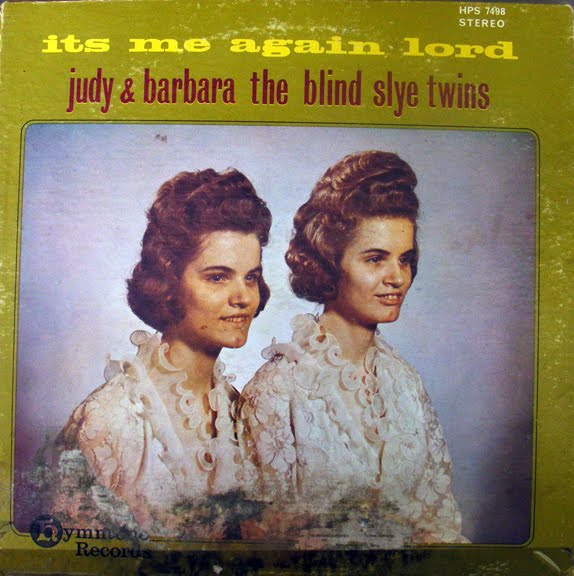
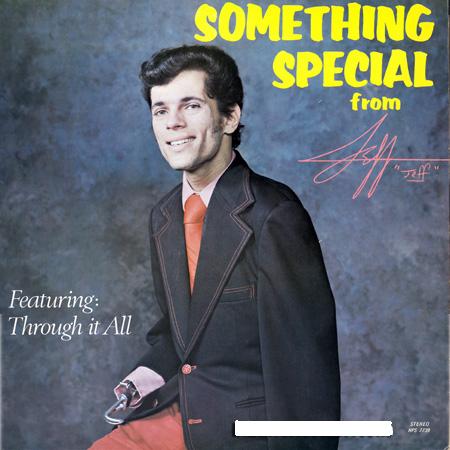
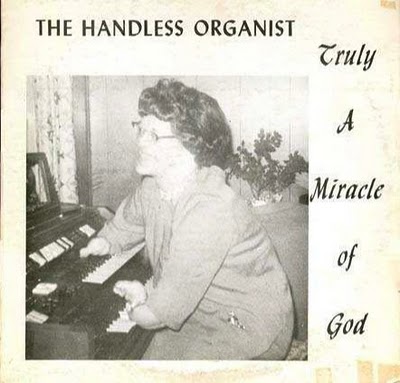
There was a veritable cottage industry of Christian albums by blind, amputee, or otherwise disabled artists that flourished in the middle of the twentieth century. To give a few examples:

ClosertotheSavior.jpg

Denise’s Closer to the Savior, probably from the 1960’s or 1970’s. (Source)
BlindSlye.jpg

Another blind album, It’s Me Again, Lord by Judy & Barbara, the Blind Slye Twins (Source)

BennyDeanBlind.jpg

Benny Dean’s I’d Rather Be Blind (In My Eyes Than In My Soul). A bit on the nose. (Source)
12 JEFF (STEINBERG).jpg

Here’s Something Special from Jeff Steinberg. Note the hook. (Source)
HandlessOrganist.jpg

“Truly a Miracle of God!” (Source)

GospelofLoveAmputee.jpg

Richard & Gail Miller Sing the Gospel of Love. (Source)
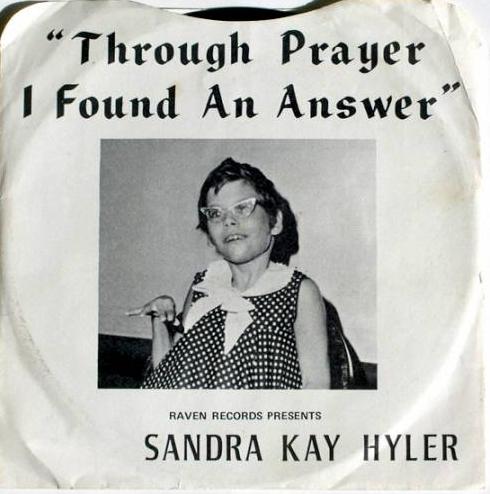
ThroughPrayer.jpg

Sandra Kay Hyler in “Through Prayer I Found An Answer.” (Source)
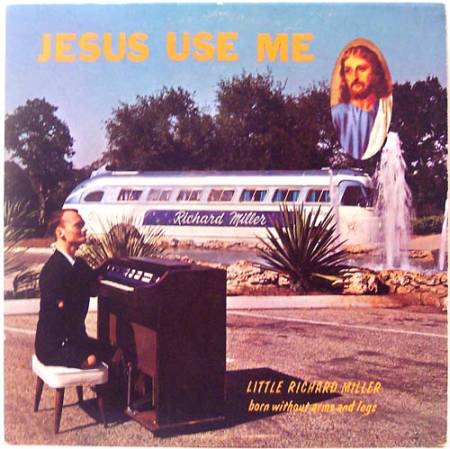
29 richard miller.jpg

Another offering from “Little Richard Miller,” this time with cover art that closely if unintentionally replicates the ex voto model. The full album is online for your listening pleasure. (Source)

These musical works differ from the mainstream of Protestant aural culture in that, even when the songs themselves are classic hymns or are just covers of more obscure songs by disabled artists, they take on a new, personal, and highly-charged meaning in the context of public disability. The artists are not just performing music, they are performing both disability and Christianity – indeed, they perform their disability precisely as the core of their Christianity, and their Christianity as intimately bound up with their disability. The singer born without arms or the blind crooner or the organist missing her hands can all achieve a new status as an icon of model Christian disability. Their performance points towards the hope of a transfiguration that surpasses disability in the kingdom of heaven. Moreover, their physical or mental incapacity is often an implicit analogy for the spiritual deformation, blindness, or weakness found in the more conventional Gospel ballad. The healing of both comes from Jesus.

Mary Douglas, among other anthropologists, has noted that the body physical is often used as an analogy of the body politic. The symbolic representation of the individual corpus speaks to the social body at large – culturally-coded anxieties about the limits of the physical body frequently point to an underlying anxiety about threats to the community. Should it surprise us that the most visible flowering of this disability-obsessed genre came at a time when the culture wars were starting to animate the full force of Southern and Midwestern Protestantism into a politically active bloc with an agenda for cultural change? Surely that socio-political context stands behinds Gary Bradford’s “better land.” The Evangelical doom song, with perhaps its best representatives in the Louvin Brothers, rose to prominence at much the same time.

The fundamentalist folk spirituality that these songs present are a major cultural context in the wonderfully disturbing, deeply Catholic work of Flannery O’Connor. In her short story “A Temple of the Holy Ghost,” she injects it into her description of a Southern freak show. An intersex person addresses two crowds – one made up of men, another of women – before displaying their unusual genitalia. The freak says,

“I’m going to show you this and if you laugh, God may strike you the same way.” The freak had a country voice, slow and nasal and neither high nor low, just flat. “God made me thisaway and if you laugh He may strike you the same way. This is the way He wanted me to be and I ain’t disputing His way. I’m showing you because I got to make the best of it. I expect you to act like ladies and gentlemen. I never done it to myself nor had a thing to do with it but I’m making the best of it. I don’t dispute hit.” Then there was a long silence on the other side of the tent and finally the freak left the men and came over onto the women’s side and said the same thing. (The Collected Stories of Flannery O’Connor 245).

Later, they lead a kind of religious service centered on their own experience of God’s Providence.

She could hear the freak saying, “God made me thisaway and I don’t dispute hit,” and the people saying, “Amen. Amen.”
“God done this to me and I praise Him.”
“Amen. Amen.”
“He could strike you thisaway.”
“Amen. Amen.”
“But he has not.”
“Amen.”
“Raise yourself up. A temple of the Holy Ghost. You! You are God’s temple, don’t you know? Don’t you know? God’s Spirit has a dwelling in you, don’t you know?”
“Amen. Amen.”
“If anybody desecrates the temple of God, God will bring him to ruin and if you laugh, He may strike you thisaway. A temple of God is a holy thing. Amen. Amen.”
“I am a temple of the Holy Ghost.”
“Amen.”
The people began to slap their hands without making a loud noise and with a regular beat between the Amens, more and more softly, as if they knew there was a child near, half asleep. (Ibid., 246)

O’Connor, who suffered from lupus herself, draws a parallel between the freak’s preaching and Benediction of the Blessed Sacrament. In the two episodes, we can perceive both the sovereignty of God’s Providence and the sacramental capacity of matter to bear God.
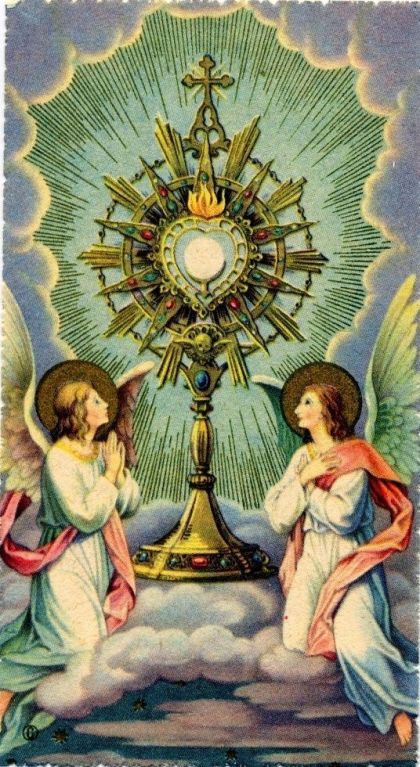
eucharistmonstranceholycard.jpg

A holy card depicting a monstrance, used in Benediction. (Source)

It strikes me as intuitively sensible that O’Connor should have chosen precisely this story to contrast Protestant and Catholic music. Early on in the story, two young Church of God men try to woo a pair of Catholic sisters by singing a Gospel hymn, complete with guitar and harmonica. The girls, who have been educated at convent school, bite back their giggles and respond with the Tantum Ergo. One of their suitors is more right than he knows when, puzzled and slightly disapproving, he calls it “Jew singing.” The two forms of music, though standing in an apparent contradiction, together anticipate the underlying sacramental truth presented by both the Protestant and Catholic services that conclude the story.

O’Connor makes much of Protestant devotional culture in one of her novels, The Violent Bear It Away (1955). It is the story of a boy called to prophesy, of his skeptical schoolteacher cousin, and of the battle they wage for the soul of a mentally disabled child. At one point, we come to the performance of a family of traveling musical missionaries. The high point of the act comes when their little daughter emerges from behind the curtain to preach a rousing sermon. In the course of her preaching, she delivers what may be the book’s central message:

“I’ve seen the Lord in a tree of fire! The Word of God is a burning Word to burn you clean!…Burns the whole world, man and child…none can escape…Are you deaf to the Lord’s Word? The Word of God is a burning Word to burn you clean, burns man and child, man and child the same, you people! Be saved in the Lord’s fire or perish in your own! Be saved in…” (The Violent Bear It Away 134-35).

O’Connor is fond of granting the most clear-eyed spiritual vision to the children in her stories. Many have profound experiences of grace that mark them forever, or they bear testimony of the invisible world’s dangerous immediacy to more skeptical characters.

CrippledGirl

This album makes me think of O’Connor’s 1955 The Violent Bear It Away. (Source)

That includes O’Connor’s disabled children. “The Lame Shall Enter First,” one of O’Connor’s most emotionally crushing short stories, is a close companion to The Violent Bear It Away. It tells the story of a well-meaning social worker, Sheppard, who takes in a clubfooted juvenile delinquent, Rufus Johnson, hoping to steer him towards a productive life. Although he can overlook Rufus’s constant spite, Sheppard is exasperated by the fundamentalist beliefs he clings to. Rufus is convinced he is going to hell, and starts to talk about it with the social worker and his impressionable young son. He steadily grows into the role of preacher even as Sheppard tries desperately to “flush that out of [his] head.” I won’t get into any spoilers, as the story has a wrenching, unforeseen climax. I’ll just say that Sheppard finally realizes he has failed only when Rufus cries at him,

“I lie and I steal because I’m good at it! My foot don’t have a thing to do with it! The lame shall enter first! The halt’ll be gathered together. when I get ready to be saved, Jesus’ll save me, not that lying, stinking atheist, not that…” (The Collected Stories of Flannery O’Connor 480).

Sheppard attributes all of Rufus’s bad behavior to the emotional effect of his clubfoot. But Rufus finds his one hope of salvation in the fact that he has a disability that, according to the logic of heaven, will ensure that he enters the Kingdom first. For Rufus, as for so many of the artists mentioned above, it represents both faith and hope (if not yet charity). Sheppard is too blinded by his prejudice and his loneliness to see that. The results are calamitous.

Rufus’s underlying insight speaks to a truth often forgotten in the Church’s treatment of the disabled. Those with disabilities are not “problems.” It’s true that they may have some special needs with regards to access, attention, etc. But at the end of the day, they are people who have the same basic spiritual needs as any other human beings. They, too, can embody and image Christ – often better than those of us who are blessed enough to be of both sound mind and body.

Gary Bradford himself has spoken publicly about this issue before. Some time in the late 1980’s or early 1990’s, Bradford – by then an adult – gave an interview with a Christian television network. He says,

In the past…so many of our churches, and so many of our people in our church in the past, it’s been the place for the good, the well-bodied, and the abled…And the Church isn’t to be like that; the Church is to take all.

Of course, the other great danger is to place too much emphasis on the disability and not enough on the person who has it. The “magical disabled person” should not become a trope in Christian life. We can’t load our disabled brethren in Christ with that moral freight. It isn’t fair. The disability Gospel genre fosters precisely that kind of harmful thinking; perhaps that is its greatest cultural fault.

I think we can avoid either extreme – neglect or overemphasis – by focusing instead on the individuality and personhood of every disabled Christian. Insofar as the disability Gospel song is an ex voto, it may seem to correspond to a certain type. Catholic ex votos usually do. But that’s only to the outsider who beholds the ex voto. For the one who makes it (or commissions it), the story it tells carries intense and highly particular personal meaning. Put another way; Sheppard may not grasp the hidden meaning of Rufus’s club foot, but Rufus does.

The same goes for the Protestant ex votos we find in this genre. They may seem to correspond to the demands of a cottage industry, but they all epitomize and present individual experiences. That particularity is the best thing we can take from this strange, lost genre of Christian music. There are no generic souls, abled or otherwise.
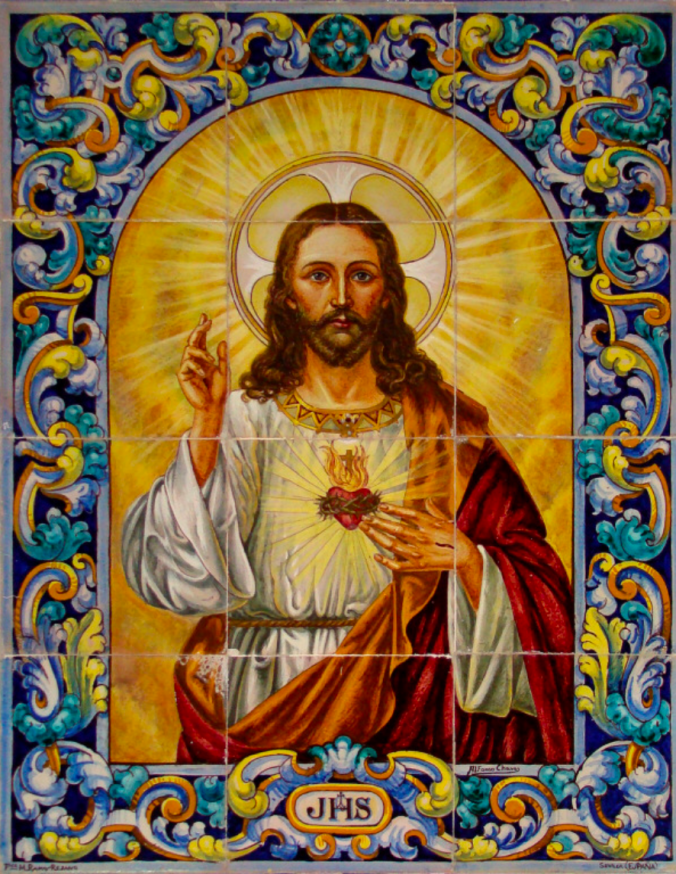

Elsewhere: Two Readings for a First Friday

Screen Shot 2018-07-06 at 2.40.31 AM

Sacred Heart of Jesus, have mercy on us. (Source)

I’m working on a big blog post that’s running rather long. In the meantime, I wanted to refer two posts that, although different in some ways, have a common center.

The first is a little old, though I rather sheepishly confess I only just read it. John Monaco has a very good post over at Inflammate Omnia on how the Sacred Heart devotion can help those struggling with mental illness. John goes over the history of the scrupulous, doubtful view of God’s love, most egregiously enshrined in the heresy of Jansenism. But he also looks at the ways that the Sacred Heart can lead those who suffer from scrupulosity and obsessive-compulsive disorder to approach a healthier, more accurate relationship with God.

The second is from an acquaintance of mine named Patrick McCoy who is both a fairly traditional Catholic and same-sex attracted. Over at his blog, O Crux Ave, he relates his recent experience engaging in street evangelism at St. Louis PrideFest, where he led a small team with the goal of sharing the Love of God with the LGBT community. Appropriately enough, he calls this ministry #SacredHeartLoves Outreach.

Although the two posts deal with different topics, together they form a kind of diptych about the Sacred Heart. Both are honest, even vulnerable personal narratives. Both proclaim the unconditional Love of God for stigmatized groups: the mentally ill and sexual minorities. Thus, both are fitting to read on this first Friday of July, the month of the Precious Blood of Jesus, spilled for all mankind.

Novena to St. Benedict

HolyTwinsPrint.jpg

A print from The Holy Twins by Tomie dePaola, depicting SS Benedict and Scholastica. (Source)

I hope my readers will join me on a novena to the Patriarch of Western Monks, starting today (July 3rd) and ending on the Feast of St. Benedict, the 11th of July. Here is the prayer I will use, taken from EWTN’s website:

Glorious Saint Benedict, sublime model of virtue, pure vessel of God’s grace! Behold me humbly kneeling at your feet. I implore you in your loving kindness to pray for me before the throne of God. To you I have recourse in the dangers that daily surround me.
Shield me against my selfishness and my indifference to God and to my neighbor.
Inspire me to imitate you in all things. May your blessing be with me always, so that I may see and serve Christ in others and work for His kingdom. Graciously obtain for me from God those favors and graces which I need so much in the trials, miseries and afflictions of life. Your heart was always full of love, compassion and mercy toward those who were afflicted or troubled in any way. You never dismissed without consolation and assistance anyone who had recourse to you. I therefore invoke your powerful intercession, confident in the hope that you will hear my prayers and obtain for me the special grace and favor I earnestly implore.

{mention your petition}

Help me, great Saint Benedict, to live and die as a faithful child of God, to run in the sweetness of His loving will, and to attain the eternal happiness of heaven.

Amen.

A Poem by Montague Summers

madonna-delle-grazie-santa-chiara-giuseppe-marullo

Madonna delle Grazie, Naples (Source)

Some of my readers will no doubt remember that very strange fellow I once wrote about, the Rev. Montague Summers. I have had to look at quite a lot of his orchidaceous writings recently for my research, including his poetry. Here is one such poem he wrote in Antinous and Other Poems (1907). It was written while he was still an Anglican, though it anticipates the lusciously Baroque spirituality that would mark his later writings.

Madonna Delle Grazie

Montague Summers

In the fane of grey-robed Clare
Let me bow my knee in prayer,
Gazing at thy holy face
Gentle Mary, Queen of Grace.
Thou who knowest what I seek,
Ere I unlock my lips to speak,
For I am thine in every part
And thou knowest what my heart,
Yearning in my fervid breast,
Ere it be aloud confessed,
Longeth for exceedingly,
Mamma cara, pity me!

By the dearth of childlorn years,
By thy mother Anna’s tears,
By the cry of Joachim,
When the radiant seraphim,
Girdled with eternal light,
Blazed upon the patriarch’s sight
With the joyous heraldry
Of thy sinless infancy.

By the bridal of the Dove,
By thy God’s ecstatic love,
By the home of Nazareth,
When the supernatural breath
Of God enfolded thee, and cried:
“Open to me, love, my bride,
Come to where the south winds blow,
Whence the mystic spices flow,
Calamus and cinnamon,
Living streams from Lebanon.
Fresh flowers upon the earth appear
The time of singing birds is near,
The turtle-dove calls on his mate,
The fruit is fragrant at our gate.
Thy lips are as sweet-smelling myrrh,
When the odorous breezes stir
Amid the garden of the kings;
As incense burns at thanksgivings.
Thy lips are as a scarlet thread,
Like Carmèl is they comely head,
Thou art all mine, until the day
Break, and the shadows flee away!”

Mother, by thy agony
‘Neath the rood of Calvary,
When the over-piteous dole
Pierced through thy very soul
With a sevenfold bitter sword
According to the prophet’s word.
By the sweat and spiny caul,
By the acrid drink of gall,
By the aloes and the tomb,
By thy more than martyrdom,
Dolorosa, give to me
The thing I lowly crave of thee.

By thy glory far above,
Mother, Queen of heavenly love,
By thy crown and royal state,
By thy Heart Immaculate,
Consort of the Deity,
Withouten whose sweet assent He
May nothing deign to do or move
Bound by ever hungered love,
God obedient to thee!

Mother, greatly condescending,
To thy humblest suitor bending,
From thy star-y-pathen throne,
Since it never hath been known
Whoso to this picture hied,
Whoso prayed thee was denied,
Mamma bella, give to me,
The boon I supplicate of thee!

In Santa Chiara, Napoli.

Screen Shot 2018-06-04 at 11.43.14 PM.png

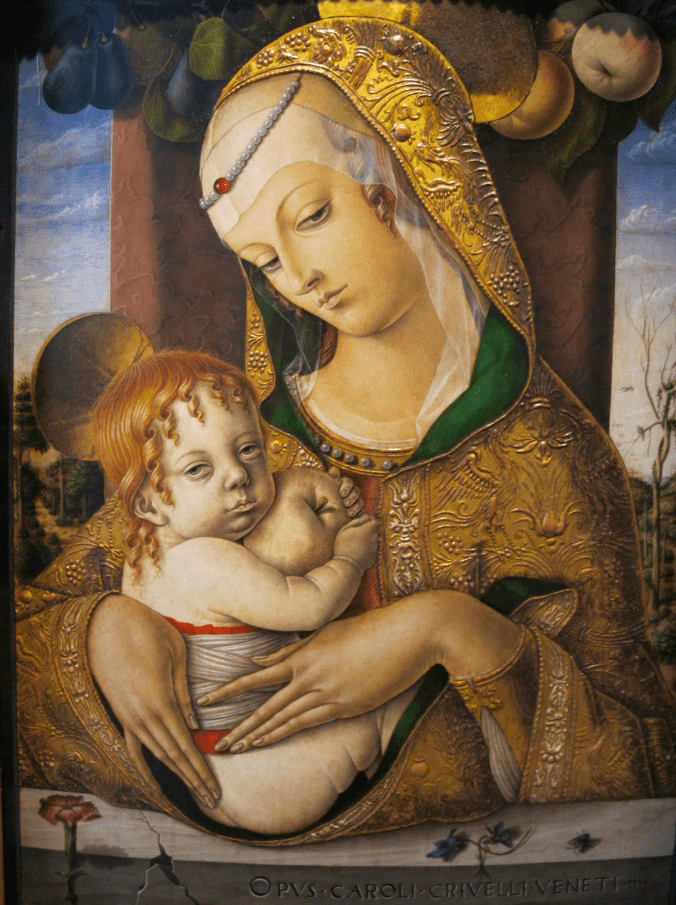
“Madonna and Child,” Carlo Crivelli, c. 1480 (Source)

Elsewhere: A Powerful Prayer of Deliverance

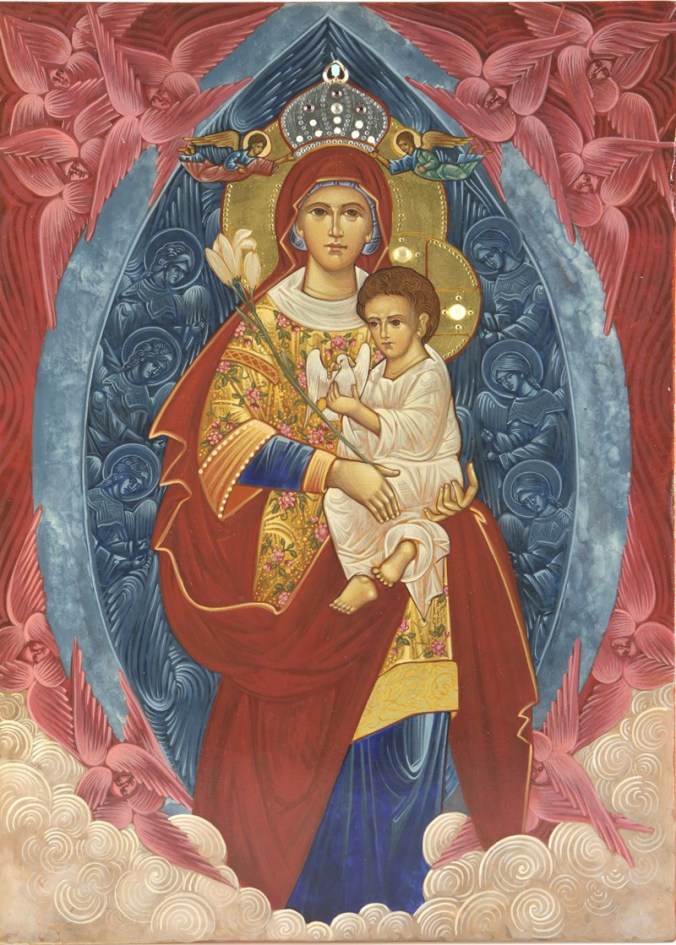
Our Lady of Angels

Icon of Our Lady of Angels. (Source)

Over at Vultus Christi, you can find a series of Chapter Talks on the Rule of Saint Benedict. Today’s commentary concludes with the story of a mighty prayer of deliverance given by the Blessed Virgin Mary to a French priest of the nineteenth century, Bl. Louis-Edoard Cestac. Here it is:

August Queen of Heaven, sovereign Mistress of the Angels, thou who from the beginning hast received from God the power and the mission to crush the head of Satan, we humbly beseech thee to send thy holy legions, that under thy command and by thy power they may pursue the evil spirits, encounter them on every side, resist their bold attacks, and drive them hence into eternal woe.

Who is like unto God?

O good and tender Mother, thou willest always to be our love and our hope.
O Mother of God, send thy holy Angels to defend us and drive far from us the cruel enemy.
Holy Angels and Archangels, defend us and keep us. Amen.

Go read the whole thing. In fact, all of the commentaries are edifying; read them all.

“Love is His Bond”

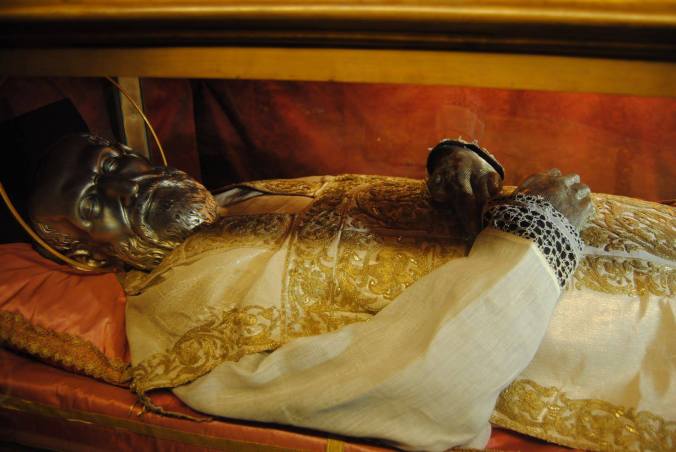
stphilipneribody

St. Philip, pray for us. (Source)

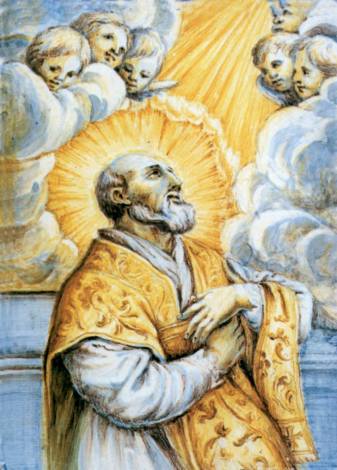
The Mass of St. Philip Neri is a little lesson in joy. The propers again and again stress a common theme: namely, the great saint’s joy, built upon his constant and fiery communion with the Holy Ghost. Holy Mother Church lifts her voice and sings in the Introit, “The love of God is shed abroad in our hearts by the Holy Ghost which dwelleth in us. Praise the Lord, O my soul; and all that is within me praise His holy name.” At the Collect, we pray to God to “mercifully grant that we, who rejoice in his solemnity, may be profited by the example of his virtues.” When, in the third reading, we hear of the saint’s overpowering love of “the spirit of wisdom,” we learn as well that “All good things together came to me with her…and I rejoiced in them all” (from Wisdom 7). The Offertory likewise proclaims with the Psalmist, “I will run the way of Thy commandments, when Thou hast set my heart at liberty” (Ps. 118). Everywhere we turn, we find the joy and freedom that alone springs from communion with the Holy Ghost.

And then we come to a remarkable moment. In the Secret, the priest prays over the offerings,

We beseech Thee, O Lord, favorably to regard these present sacrifices: and grant that the Holy Spirit may inflame us with that fire, wherewith he wondrously penetrated the heart of blessed Philip.

The Church has here enshrined a stunning and highly instructive truth. Yet it is easy to miss.

The very heart of St. Philip – that organ claimed so powerfully by the Holy Ghost in the catacombs of St. Sebastian, ever converting those sinners with the happy fortune of touching Philip’s breast, inflaming the saint with the deathless ardor of love, bearing such close likeness to those sacred hearts of Christ, Our Lady, and St. Joseph, beloved by generations upon generations – that heart is set up for us here in parallel to the Eucharist. For just as it is the Spirit who will so shortly transform bread into the most holy and eternal heart of Jesus, so it is that same Spirit who made of St. Philip’s heart a “hostia pura, hostia sancta, hostia immaculata.” Christ gives himself entirely to us by the Holy Ghost in the Liturgy, and St. Philip Neri became entirely Christ’s by the arrival of the Holy Ghost in those dark catacombs. To possess the heart is to possess the whole man.

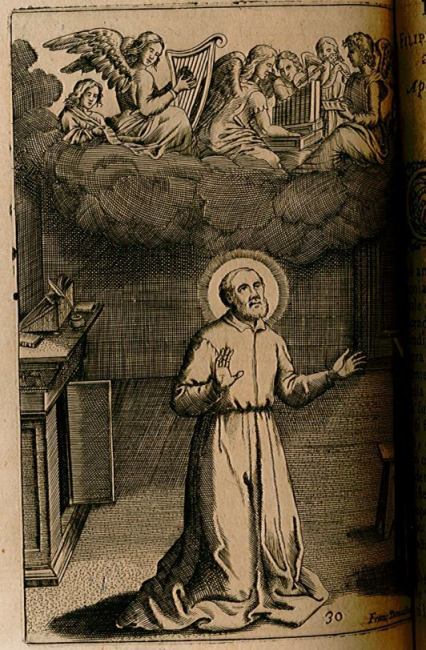
RarePlatePNCardiff

A plate illustrating the life of St. Philip from a rare 1699 Vita, kindly shown to me and since publicly shared by the Cardiff Oratorians. (Source)

This mutual possession of God and man animates everything for the Christian. The more we are given over to it, the more God allows us to partake of His own life. The more we are His, the more He becomes ours. This spiritual truth was well understood by St. Philip, who enshrined it as the principal of unvowed community life in the Oratory. In the words of Bl. John Henry Newman, “Love is his bond, he knows no other fetter.” This line, written of St. Philip, could apply just as well to Our Savior, Jesus Christ. For it is by His indwelling love that we come to love Him. It is by love that we can join our hearts to His in the Eucharist. It is truly by love that we share “that fire, wherewith [the Holy Spirit] wondrously penetrated the heart of blessed Philip.”

The 83rd Psalm comes to the Church’s lips at the Communion. She sings, “My heart and my flesh rejoice in the living God.” These are not only St. Philip’s words, but those of every soul who gives herself over to the indwelling love of God. And at the Postcommunion, the Church prays,

O Lord, who hast fulfilled us with Thy heavenly delights: we beseech Thee, that by the merits of blessed Philip Thy Confessor, and by following him, we may ever earnestly seek after those things whereby we truly live.

filippo-neri

St Philip lived a preeminently liturgical life. (Source)

What are “those things whereby we truly live?” The Holy Ghost, the Eucharist, and prayer – those things, if it be not too blasphemous to speak of them as “things,” which were ever St. Philip’s “heavenly delights.” Or, more properly, that mystic unity of the three in the Liturgy. In his own words, “A man without prayer is like an animal without the use of reason.” And it is surely the grand and orderly and perfect prayer of Christ the Priest and Victim that St. Philip means when he speaks of our super-sensual reason.

What, then, does it mean to “truly live?” If I may be permitted to tie together a few of St. Philip’s maxims, we can discern his own answer to this question:

In the spiritual life there are three degrees: the first may be called the animal life; this is the life of those who run after sensible devotion, which God generally gives to beginners, to allure them onwards by that sweetness to the spiritual life, just as an animal is drawn on by a sensible object. The second degree may be called the human life; this is the life of those who do not experience any sensible sweetness, but by the help of virtue combat their own passions. The third degree may be called the angelic life; this is the life which they come to, who, having been exercised for a long time in the taming of their own passions, receive from God a quiet, tranquil, and almost angelic life, even in this world, feeling no trouble or repugnance in anything. Of these three degrees it is well to persevere in the second, because the Lord will grant the third in His own good time.

A departure from the passions and a cleaving to virtue; mortification mixed with convivial, holy companionship; and above all, an overriding joy.  These are the manifestations of the indwelling love of God. These constitute a life “truly lived.” These are the fragrant flowers accompanying the fruits of the Holy Ghost. “Thou hast set my heart at liberty;” the saint embodies the song of the Offertory.

St. Philip’s life was marked in every way by such a communion with the Holy Ghost, first in a singular and miraculous way in the catacombs, and then again at every Mass. The love of God made him the most perfect model of the very “angelic life” he described to his sons and companions. Those of us privileged enough to count him among our heavenly friends may, by his merciful intercession, hope to share that one Divine Joy he knew so well. May he so pray for us on this, his feast.

Screen Shot 2018-05-22 at 11.27.28 PM.png

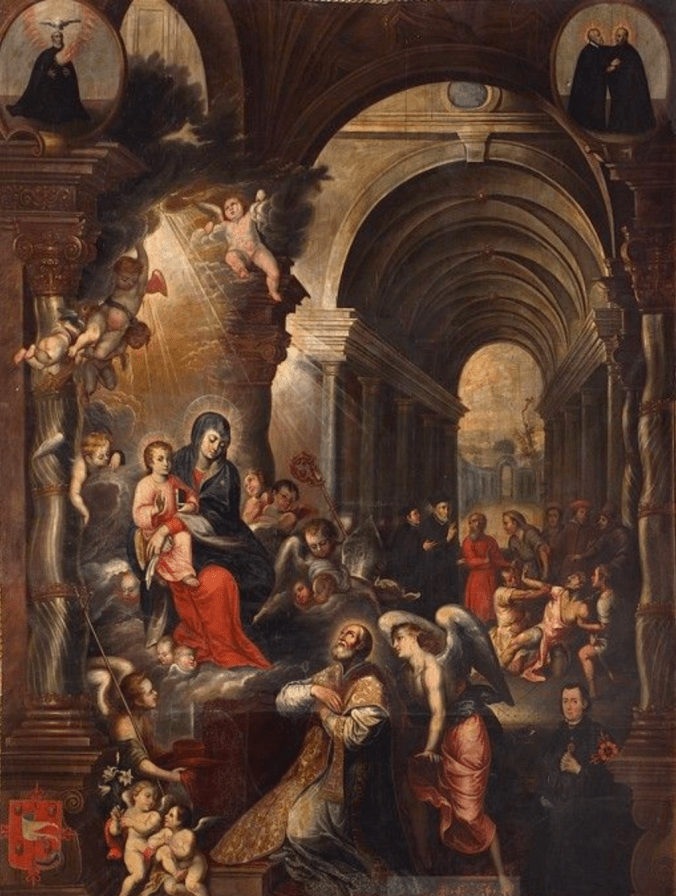
Aparición de la Virgen a San Felipe Neri, Mexico, detail. (Source)


A Hymn for St. Philip’s Day

StPhilipNeridolci

The Carlo Dolci portrait of St. Philip, now in the Metropolitan Museum of Art, New York. (Source)

St. Philip’s Picture

Fr. Frederick William Faber of the London Oratory

I.

Saint Philip! I have never known
A Saint as I know thee;
For none have their wills and ways
So plain for men to see.
I live with thee; and in my toil
All day thou hast my part;
And then I come at night to learn
Thy picture off by heart.

II.

O what a prayer thy picture is!
Was Jesus like to thee?
Whence hast thou caught that lovely look
That preaches so to me?
Sermon and prayer thy picture is,
And music to the eye;
Song to the soul, a song that sings
Of whitest purity!

III.

A blessing on thy name, dear Saint!
Blessing from young and old,
Whom thou in Mary’s gallant band
Hast winningly enrolled!
If ever there were poor man’s Saint,
That very Saint art thou!
If ever time were fit for thee,
Dear Saint! That time is now!

IV.

Philip! Strange missioner thou art,
Biding so still at home,
Content if with the evening star
Souls to thy nets will come!
If ever spell could make hard work
Profit and pastime be,
That spell is in thy coaxing ways,
That magic is in thee.

V.

Sweet-faced old Man! For so I dare,
Saint though thou be on high,
To name thee, for thou temptest love
By thy humility.
Sweet-faced old Man! What are thy wiles
With which thou winnest men?
Art thou all saints within thyself?
If not, what art thou then?

VI.

John’s love of Mary thou hast got,
Thy house is Mary’s home;
And then thou hast Paul’s love of souls
With Peter’s love of Rome.
Thy heart, that was so large and strong,
It could not quiet bide;
O was it not like his that beats
Within a wounded side?

VII.

Saint of the over-worked and poor!
Saint of the sad and gay!
Jesus and Mary be with those
Who keep to thy true way!
O bless us, Philip! Saint most dear!
Thine Oratory bless;
And gain for those who seek thee there
The gift of holiness!

An Employment Triduo to St. Joseph

Recently, several people I know have been looking for jobs. Some were just fired. Others have had a long struggle seeking work. A few have been injured in ways that required them to take time off. All are in need of prayer.

Bearing these troubles in mind, I thought I would make a Triduo – a prayer of three days’ length – to St. Joseph the Worker, asking for his potent intercession, along with that of SS Anthony of Padua, Dymphna, Cecilia, John of God, Thomas More, Philip Neri, Thomas of Canterbury, Fiacre, and Martin of Tours. I hope my readers will join me in this intention.

The text comes from Bl. John Henry Newman’s Meditations and Devotions. I have also attached the Litany of St. Joseph for the last day.

Cuzco-School-18th-century.jpog.jpg

St. Joseph, Ora Pro Nobis (Source)

A Triduo to St. Joseph

First Day
Consider the Glorious Titles of St. Joseph

He was the true and worthy Spouse of Mary, supplying in a visible manner the place of Mary’s Invisible Spouse, the Holy Ghost. He was a virgin, and his virginity was the faithful mirror of the virginity of Mary. He was the Cherub, placed to guard the new terrestrial Paradise from the intrusion of every foe.

V. Blessed be the name of Joseph.
R. Henceforth and forever. Amen.

LET US PRAY

God, who in Thine ineffable Providence didst vouchsafe to choose Blessed Joseph to be the husband of Thy most holy Mother, grant, we beseech Thee, that we may be made worthy to receive him for our intercessor in heaven, whom on earth we venerate as our holy Protector: who livest and reignest world without end. Amen.
(Vide “The Raccolta.”)

Second Day
Consider the Glorious Titles of St. Joseph

His was the title of father of the Son of God, because he was the Spouse of Mary, ever Virgin. He was our Lord’s father, because Jesus ever yielded to him the obedience of a son. He was our Lord’s father, because to him were entrusted, and by him were faithfully fulfilled, the duties of a father, in protecting Him, giving Him a home, sustaining and rearing Him, and providing Him with a trade.

V. Blessed be the name of Joseph.
R. Henceforth and for ever. Amen.

LET US PRAY

God, who in Thine ineffable Providence didst vouchsafe, &c.

Third Day
Consider the Glorious Titles of St. Joseph

He is Holy Joseph, because according to the opinion of a great number of doctors, he, as well as St. John Baptist, was sanctified even before he was born. He is Holy Joseph, because his office, of being spouse and protector of Mary, specially demanded sanctity. He is Holy Joseph, because no other Saint but he lived in such and so long intimacy and familiarity with the source of all holiness, Jesus, God incarnate, and Mary, the holiest of creatures.

V. Blessed be the name of Joseph.
R. Henceforth and for ever. Amen.

LET US PRAY

God, who in Thine ineffable Providence didst vouchsafe, &c.

The Litany of Saint Joseph

 For public or private use.

Lord, have mercy on us.
Christ, have mercy on us.
Lord, have mercy on us.
Christ, hear us.
Christ, graciously hear us.
God the Father of Heaven, Have mercy on us.
God the Son, Redeemer of the world, Have mercy on us.
God the Holy Spirit, Have mercy on us.
Holy Trinity, One God, Have mercy on us.
Holy Mary, pray for us .
Saint Joseph, pray for us.
Illustrious son of David, etc.
Light of the patriarchs,
Spouse of the Mother of God,
Chaste guardian of the Virgin,
Foster-father of the Son of God,
Watchful defender of Christ,
Head of the Holy Family,
Joseph most just,
Joseph most chaste,
Joseph most prudent,
Joseph most valiant,
Joseph most obedient,
Joseph most faithful,
Mirror of patience,
Lover of poverty,
Model of workmen ,
Glory of domestic life,
Guardian of virgins,
Pillar of families,
Solace of the afflicted,
Hope of the sick,
Patron of the dying,
Terror of demons,
Protector of Holy Church,

Lamb of God, Who takest away the sins of the world,
Spare us, O Lord.
Lamb of God, Who takest away the sins of the world,
Graciously hear us, O Lord.
Lamb of God, Who takest away the sins of the world,
Have mercy on us.

V. He made him the lord of His household,
R. And prince over all His possessions.

Let Us Pray.

O God, Who in Thine ineffable providence didst choose Blessed Joseph to be the spouse of Thy most Holy Mother, grant that as we venerate him as our protector on earth, we may deserve to have him as our intercessor in Heaven, Thou Who livest and reignest forever and ever. R. Amen.


The Best Monastic Documentaries

The monastic life is about as far as one can get from the flashy world of the entertainment industry. And yet, it has been the subject of some very good documentaries over the last fifteen years or so. For those curious about the various monks (and nuns) of the world, I thought I would provide a list of a few films with which to start.

Into Great Silence (2006)

Screen Shot 2018-05-16 at 10.05.16 PM.png

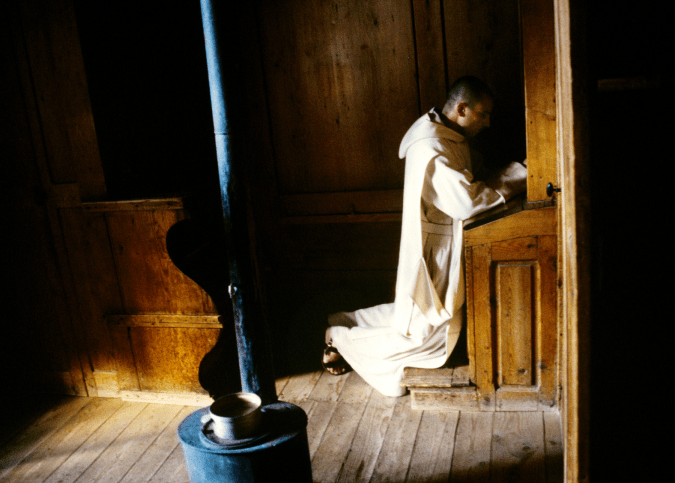
A Carthusian prays in his cell, from Into Great Silence (Source)

This stirring art film by Philip Gröning was produced over several years. Every shot is deeply meditative. We, the viewers, are drawn into a contemplative pose along with the monks themselves. As might be expected, there is very little dialogue – indeed, very little sound at all. We get a powerful sense of the holy silence that envelops the Carthusians of La Grande Chartreuse. Yet when the monks do speak, such as in an interview with an ancient, blind monk that comes towards the end of the film, the words mean something. The chant of the night office given prominent place in the film evokes all the centuries of virtually unchanged monastic life that have come down to us from St. Bruno. This film is hands down the most important and most spiritually insightful documentary about monasticism, and it has continued to exert a powerful influence on most such documentaries since.

Veilleurs dans la nuit (2011)

LeBarrouxMass

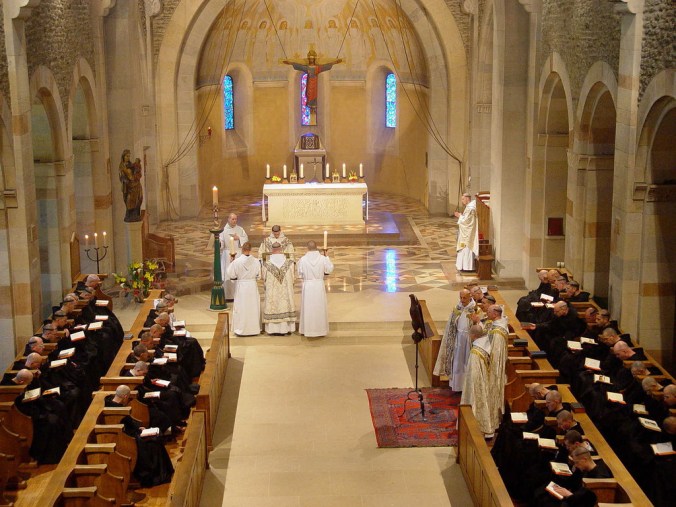
A liturgy at Le Barroux (Source)

The monastery of Sainte Marie-Madeleine du Barroux, founded in the wake of the Second Vatican Council, preserves much of the great tradition of French Benedictine life. It is one of the very few monasteries on earth which has preserved the form of tonsure once known as “the monastic crown.” It is also famous for its grand and elegant celebration of the liturgy, as well as the great holiness of its founder, Dom Gérard Calvet. This French documentary does a good job depicting their life through a mix of commentary and interviews. It is of an entirely different style than Into Great Silence, but it relates more actual information about the monks themselves.

Quaerere Deum (2011)

NorciaBeer

Some of the monks of Norcia with their famous beer (Source)

Filmmaker Peter Hayden of Wilderland Media has done some great and poetic work publicizing the various new monasteries founded in the old world by Americans. The first of these was the Monastero di San Benedetto in Norcia, established in 2000. It is only appropriate then that Hayden should have looked at them first. He produced a “day in the life” style documentary bearing clear influences from Into Great Silence. The slow pace, lack of commentary, and meditative minimalism all recall the best parts of that earlier work. Norcia itself – or what it was before the terrible earthquake of 2016 destroyed much of the town – emerges as a living community “seeking God.” A subdued sense of joy shines throughout.

Benedictine Monks, Ireland (2017)


BrJBAdoration

Br. John Baptist in adoration before the Blessed Sacrament, Silverstream. Photo taken by the author.

Peter Hayden’s second work on the monastic renewal is a more obviously promotional piece of filmmaking than Quaerere Deum. A profile of Silverstream Priory, Benedictine Monks, Ireland depicts the community life of adoration and reparation led by the monks there. Scenes from Mass, chapter, and refectory alternate with candid shots of the monks at work and leisure. Interviews with the Prior and Subprior provide spiritual as well as historical context. As someone who knows the monks personally, I found it a pretty good exposition of their spirit. That peculiarly Benedictine sense of place is evoked through gentle Irish music at various points. And the combined wisdom of Dom Mark and Dom Benedict is a great grounding to the beautiful visuals. I was very taken with the image of Dom Cassian, then only a postulant, in prayer at the pillar and candle.

My only criticism is that, in spite of all these good features, the film fails to capture the overwhelming sense of the supernatural that hangs about Silverstream. I’m not sure if it was the darkness of the year during filming, or the slightly uneven cinematography, or the lack of scenic order that scuttled it for me.  Benedictine Monks, Ireland needs a heavier dose of the contemplative stillness that so strongly marks both Into Great Silence and Quaerere Deum. Still, it’s a nice introduction to the place for those curious about the Benedictine Monks of Perpetual Adoration.

Présence à Dieu (2015)

Screen Shot 2018-05-16 at 10.39.43 PM.png

Matins at Sept-Fons, from Présence à Dieu (Source)

This short film, first brought to my attention by Fr. Joseph Koczera SJ, does a good job showing what a traditional monastery can look like, even if it embraces the new Mass and the vernacular office. Notre Dame de Sept-Fons is currently the largest Trappist monastery in the world, at least in terms of membership – it is also manifestly young and diverse. The film shows why the Abbey keeps getting vocations. A near constant soundtrack of chant carries the viewer along. Présence à Dieu is also full of the Abbot’s exposition of the Rule, which is a nice plus.

God is the Bigger Elvis (2011)

GodistheBiggerElvis

Mother Dolores Hart, wearing her trademark beret, from God is the Bigger Elvis (Source)

This one differs from the others in a few key respects. First, it’s an HBO production, rather than an Indie film. Secondly, it’s about nuns rather than monks. And third, there is a delicate sense of humor throughout that is a refreshing change from the other movies. It tells the story of Mother Dolores Hart, a starlet of the 1950’s who appeared in several features alongside Elvis before becoming a nun at the Benedictine monastery of Regina Laudis in Connecticut. She is now the prioress of the community. The documentary looks at her life and vocation as well as the daily ins and outs of the monastery. Not to be missed!

Life in Hidden Light (2016)

LifeinHIddenLight

A scene in the refectory from Life in Hidden Light (Source)

Monasticism is not confined to the Benedictine family. As Life in Hidden Light reminds us, the Carmelites also have a great tradition of contemplative monasticism. Clearly influenced by Into Great Silence, this film does a great job balancing meditative cinematography and interviews with the Discalced Carmelite sisters of Wolverhampton. One in particular that stands out is the old, mostly deaf nun who speaks about the “mess” of the world and the love of God. I was reminded of Into Great Silence‘s blind Carthusian (not to mention the slightly grotesque Jesuit in “The Enduring Chill,” by Flannery O’Connor). The old nun’s message is a sound, salutary one that we should all hearken to in this day and age.

There are probably other such films out there, but these are a few that might be a good starting place for those interested in the monastic life.