“They Shall Not Bind Thy Wounds With Oil and Wine”

Occasionally I like to present obscure poetry here, especially by unusual figures. My readers will no doubt be well aware of my love of the bizarre and morbid. Here are two extremely rare poems from that equally strange poet, Count Eric Stanislaus Stenbock, an Anglo-Baltic aristocrat who dabbled in just about every religion known to man, kept a menagerie of wild animals at his Estonian palace, and carried a doll he called “le Petit Comte” that he always insisted was his son.

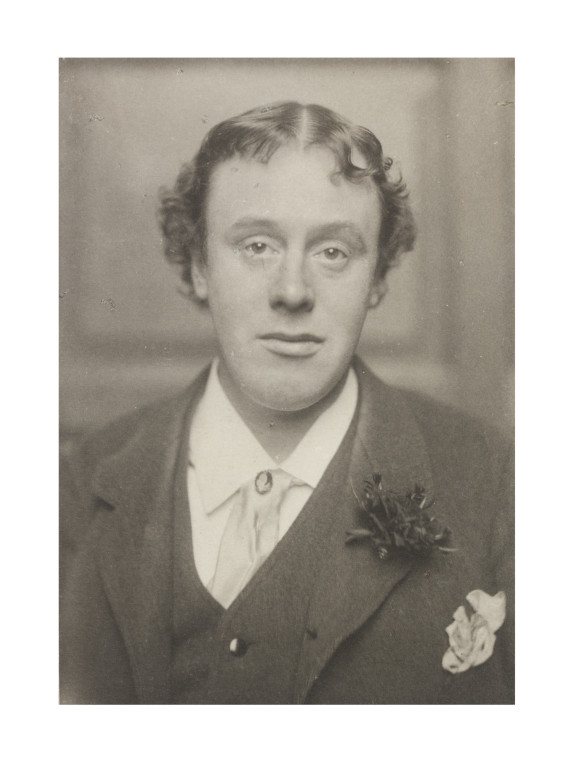
Eric_Stenbock.jpg

Count Stenbock. A more like Huysmans’s Des Esseintes has never walked the earth. (Source)

Original collections of his Decadent verse fetch tens of thousands on the open market. I was privileged enough to view two of them at the Bodleian last year, my source for these two poems. The first dates from 1893, the second from 1883. I chose these two from several others because of the rather striking thematic contrast they afford.

Sonnet VI

O vos ómnes qui transítis per víam, atténdite et vidéte: Si est dólor símilis sícut dólor méus.”

All suffer, but thou shalt suffer inordinately.
All weep, but thy tears shall be tears of blood.
I will destroy the blossom in the blood,
Nathless, I will not slay thee utterly
Nay, thou shalt live—I will implant in thee
Strange lusts and dark desires, lest any should,
In passing, look on thee in piteous mood,
For from the first I have my mark on thee.

So shalt thou suffer without sympathy,
And should’st thou stand within the street and say:
“Look on me, ye that wander by the way,
If there be any sorrow like to mine.”
They shall not bind thy wounds with oil and wine,
But with strange eyes downcast, shall turn from thee.

Sonnet I – Composed in St. Isaac’s Cathedral, St. Petersburg

On waves of music borne it seems to float
So tender sweet, so fraught with inner pain,
And far too exquisite to hear again
Above the quivering clouds that single note,
The tremendous fires of the lamp-light gloat
On the exceeding sweetness of that strain—
Though mightest spend a lifetime all in vain
In striving to recall it, yet recall it not.

Therein are mingled mercy, pity, peace,
Tears wiped away and sorrow comforted,
Bearing sweet solace and a short relief
To those, that are acquainted well with grief,
Reviving for a time joys long since dead,
And granting to the fettered soul release.

A Curious Juxtaposition

PopeFrancis.jpg

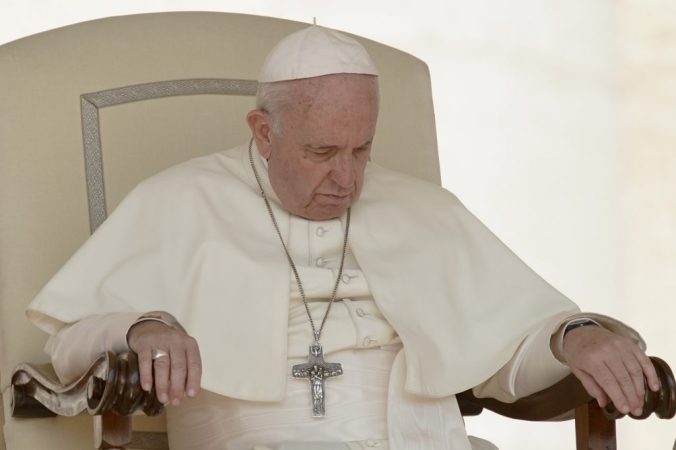
The Pope. (Source)

Let it never be said that His Holiness does not contain multitudes. Consider the following:

“It is not healthy to love silence while fleeing interaction with others, to want peace and quiet while avoiding activity, to seek prayer while disdaining service.” – Pope Francis, Gaudete et Exultate 26

Pope Francis, 3rd of September 2018: “With people who don’t have good will, who seek only scandal, who want only division, who seek only destruction — including within the family: silence, prayer.”

Quelle surprise!

(C.C. Pecknold and I seem to have noticed the same point independently. Great minds and all that)

Elsewhere: Keanu Heydari on Conversion

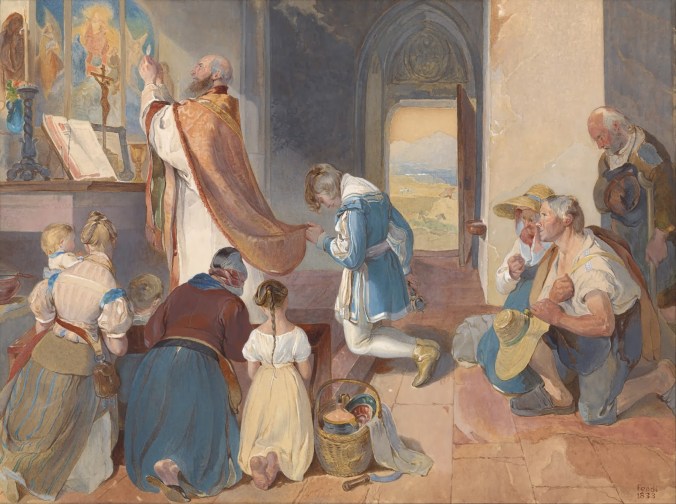
Peter_Fendi_(Austrian_-_Fridolin_Assists_with_the_Holy_Mass_-_Google_Art_Project

Fridolin Assists with the Holy Mass, Peter Fendi. (Source)

Earlier this month, my friend Keanu Heydari penned what is, I think, a very good essay about his own conversion and about conversion in general. I thought these two paragraphs were especially poignant:

If Jesus is the slain Lamb of God, the content of reconciliation is substantial rather than conceptual, or even primarily juridical. Forgiveness is freely given by God, but rather than bestowed, it is—like a substance—dealt with. It is held, beheld, and shared. I am speaking, of course, of understanding reconciliation as a sacramental event rather than as (primarily) juridical proclamation. The removal of our guilt is a free gift of the gracious God, yet it is not as a word, spoken in a booming voice. It is the material, densely textured experience of Jesus Christ, the Word, the Lamb of God, as he dies on Calvary, by the Church community, in the reception of the sacraments, wherein we receive God. The Psalmist implores, “O taste and see that the Lord is good!” (Ps. 34:8, RSV2CE). We taste and see, we behold, the forgiveness of God.

But pictures say more than words ever can. The Catholic artistic paradigm overflows with meaning. It is effusive, dynamic, and embodied. It is densely textured, thickly self-describing, multi-dimensional, and frankly excessive. But it is precisely in these Rabelaisian excesses that Catholic aesthetics gesture, even more powerfully, towards the ineffable, over and above the words themselves that are used in the liturgy. Sacramentally, we can truly say “Ecce homo.” Artistically, we are reminded that things are really happening outside of us, that we aren’t automata aimlessly generating profit for managers and selling our productivity to survive. We are more than the sum of our extrinsically imposed reductive component parts. The liturgy revels in its (in Cartesian terms) obscene uselessness. The defiance of the mass is its strongest selling point, as it were.

Read the whole thing. In what is proving to be an extraordinarily dark time for the Church, Keanu’s essay brings a good deal of hope in the fundamental promise of salvation.

The Best Monastic Documentaries: Eastern Edition

A few months ago, I published a post entitled “The Best Monastic Documentaries.” It was quickly pointed out to me that, although I had covered several good features, they were all about Western monks. So I decided that, once I had the time, I would assemble a review of the best documentaries covering Eastern Monasticism. That time has finally arrived! So buckle up, get out your chotki, and watch some of these films.

60 Minutes Goes to Mount Athos

Simonopetra.jpg

Simonopetra Monastery, Mount Athos, one of the monasteries profiled by 60 Minutes. (Source)

In 2011, viewers who tuned into the Christmas episode of CBS’s popular weekly news-documentary series, 60 Minutes, were greeted with an extraordinarily rare treat. For the first time in thirty years, the monks of Mount Athos had opened up their peninsula to a television crew. I remember when it premiered; this was one of my earliest encounters with the monastic tradition of the East. Bob Simon layers on the journalistic smarm, clearly stunned by and slightly distasteful at the various sacrifices and remnants of Medieval life on the Holy Mountain. Nevertheless, the holy simplicity of the monks that he interviews nevertheless shines through. I’m particularly impressed with the testimony to perpetual prayer – the prayer of the heart – given in this film. And luckily enough for us, both Part 1 and Part 2 can both be found online.

One Day in the Life of a Men’s Monastery

Screen Shot 2018-08-10 at 11.02.02 PM

The sound of the wooden doaca awakens the monks from their sleep and calls them to prayer. (Source)

This quiet, reverent film covers the daily routine of a monastery in Georgia. There is no dialogue and no plot, per se. We don’t follow the actions of any single monk. But the viewer does gain an insight into the feeling of the monastic rhythm in this little, faraway community of Abkhazia. Viewers who have seen Into Great Silence will recognize a very similar style in this film. My only criticism is that there’s rather too much focus on the work of the monks, and not enough on their prayer. Still, those moments of prayer we do see are also noteworthy for clearly showing the larger lay community that depends upon the monastery for spiritual sustenance. This short film is thus perhaps the most poetic production on our list.

The Brethren

Screen Shot 2018-08-05 at 7.48.52 PM

They’re pretty hard core. (Source)

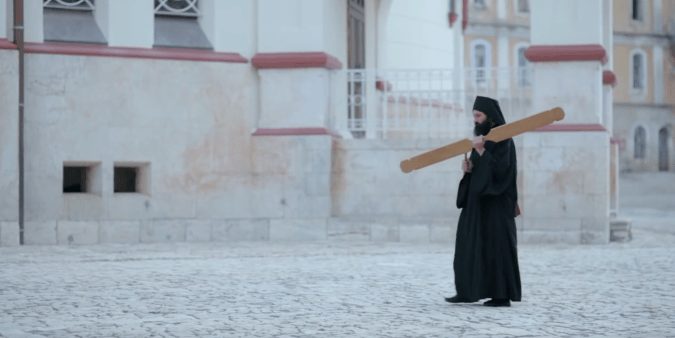
Monks have always sought “the desert,” though sometimes that desert takes the form of tundra. The monks of Trifonov Pechengsky monastery, Kolsky Peninsula, Russia, must be some of the northernmost monastics on earth. This intimate portrait of the community  gives insight not only into the externals of ascetic life at the edge of the world, but also the reasons why men become and remain monks. It also shows, in a more explicit way than One Day in the Life of a Men’s Monastery, that the monks play an important role in their small town’s life and history.

“Hermits of Our Times – Orthodox Christian Monasticism (Hesychasm)”

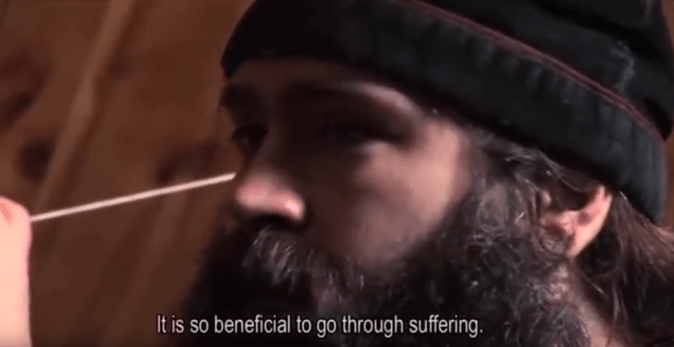
Screen Shot 2018-08-05 at 8.03.09 PM

Monastic wisdom. (Source)

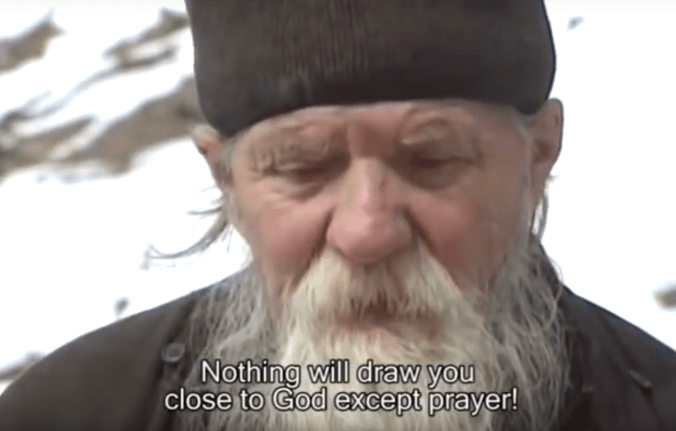
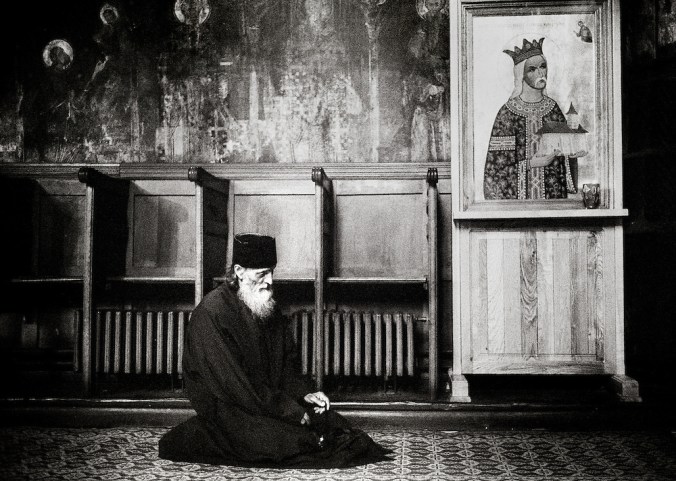
To be fair, this isn’t really a documentary. It seems to be footage from a Romanian Orthodox news service taken in the late 1990’s. But it does shine a helpful spotlight on modern anchorites (then) living in the Romanian forest. Anchorites are not monks per se; at least, they are not cenobites, living in cells within a larger community. They are hermits who may once have been attached to a community but now seek God in solitude. I always find myself deeply impressed by the simplicity and manifest wisdom of these holy men whenever I return to this clip. I am reminded of the sayings of the Optina Elders, the Desert Fathers, or even my good St. Philip Neri.

“The Motorbike Rider Who Became a Monk”

Screen Shot 2018-08-10 at 11.27.49 PM.png

The basics of monastic life, as communicated by a monk in Israel. (Source)

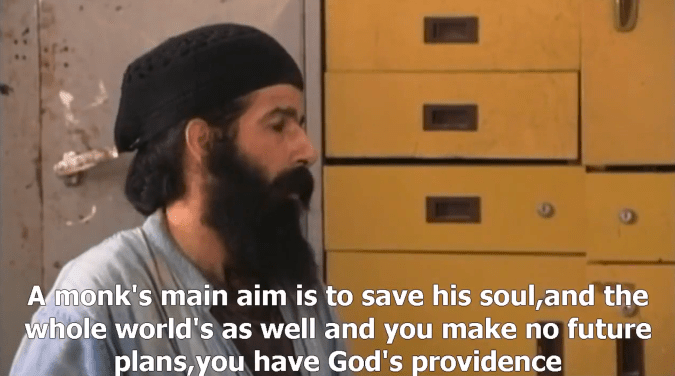
Again, I’m not sure this technically counts as a documentary. But it’s a good interview with a Cypriot who became a monk in Israel, at St. Gerasimos Monastery. One of the great strengths of this film, besides relating a vocation story, is the emphasis it places on the role of the Elder or Spiritual Father. For the Eastern Orthodox, and especially for monks, there is a spiritual lineage passed on from one old monk to younger ones (or to those in the world). In the West, we have mostly lost the sense of Spiritual Fatherhood by dividing its roles between the confessor and the spiritual director, neither of which carries the same weight as the Spiritual Father. But this short and helpful film is a good reminder of what still persists in the monastic tradition.

Behind the Monastery Walls

Screen Shot 2018-08-11 at 12.42.37 AM.png

Inside a Romanian monastery. (Source)

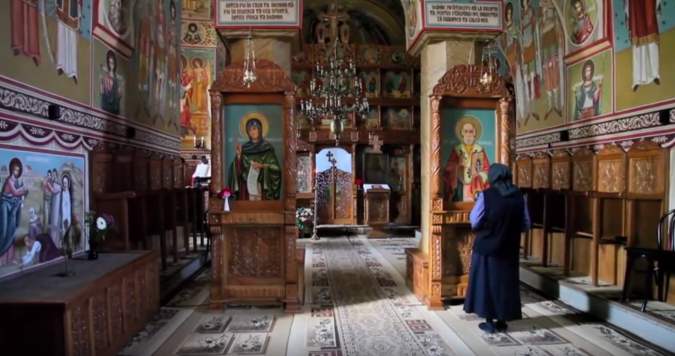
This 2011 documentary looks at the personal stories of various monks and nuns in Romania. It’s an artfully made piece, with a very good choral track throughout. But I admire its spiritual insights more than its aesthetic notes. Although the filmmaker does not seem to take a definitively Christian standpoint, she allows the monastics to speak for themselves. They provide a remarkable testimony to the strength of Orthodox traditions in the wake of Communism. We see not only the monks and nuns themselves, but  also the devotional practices of ordinary believers who come to the monasteries. There are, for instance, many prostrations before icons. I also enjoyed the film for my own personal reasons. Romanian monasticism will always hold a special place in my heart, as it was a trip to a Transylvanian monastery that started my conversion, about seven years ago.

I’m sure there are other examples one could point to, but for now, these are some good places to start. They cover a wide range of Orthodox practices and values, all refracted through the lens of its monastic tradition.


Elsewhere: Mother Mectilde de Bar and the Prayer of Devekut

One of the great works of Vultus Christi has been the exposure of many English-speaking Catholics to the spiritual treasures of the continental Benedictine tradition, especially the life and work of Mother Mectilde de Bar. The good nun was a profound mystic of the Eucharist and a spiritual heir to the French School. Anyone with any interest in Benedictine life, Catholicism in early modern France, or spirituality generally should take note.

MechtildeBNF.jpg

Mother Mectilde de Bar (1614-1698), foundress of the Benedictines of Perpetual Adoration of the Most Blessed Sacrament of the Altar. (Source)

I am very happy to refer my readers to an excellent translation of one of Mother Mectilde’s letters of spiritual direction. The translator, an Oblate of Silverstream, has rendered the 17th century French into elegant and very readable English. A job well done!

Here’s a particularly potent excerpt:

The whole of Christian perfection consists in continual attention to Jesus Christ, and a constant adherence or submission to His good pleasure. These two points contain everything, and their faithful practice will lead you to the highest degree of perfection. Blessed is the soul who observes them.

The first point consists in seeing Jesus Christ in everything; in all events and in all our dealings; in such way that this divine sight removes from us the sight of creatures, ourselves, and our interests, in order to see nothing except Jesus Christ. In a word, it is to have the presence of God continually.

The second point consists in being constantly submissive to His holy will; in being so much subject to His good pleasure that we no longer have any return, at least voluntarily, by which we can withdraw from this respectful obedience.

I am reminded, in reading this passage, of a concept in Jewish mysticism called devekut. To practice devekut is to cleave to God constantly, even in the midst of everyday, profane activities. The Rabbis who founded and nurtured Hasidism in the 18th century made it a central feature of their mystical praxis, though the idea has roots in the Temple traditions of the Old Testament (vide Barker 2004, 37). Dr. Margaret Barker notes that, according to the older, priestly understanding of the word “cleaving” in Hebrew, “to cleave” meant quite literally to join. However, this sense was displaced when the Moses-focused Deuteronomist tradition came to ascendance. The new meaning of “cleaving” was, instead, obedience (Ibid. 37). Mother Mectilde has here joined both meanings in a salutary way.

Holy-Eucharist-Icon.jpg

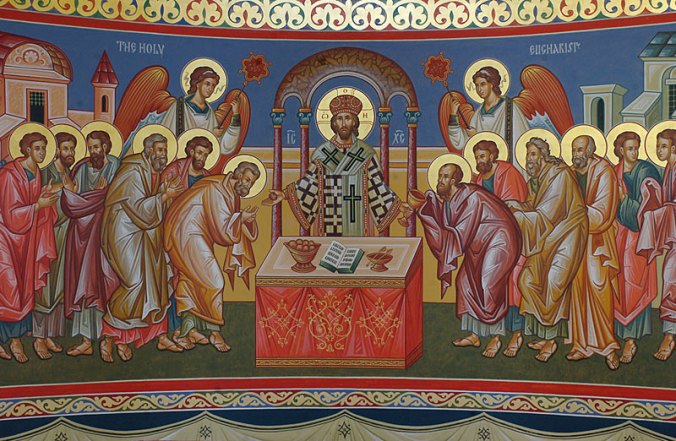
An icon of the Holy Eucharist, showing Christ the High Priest in the Holy of Holies. (Source)

However, I think she places a bit more emphasis on the first, as the primary and indispensable basis of the second. She goes on to write,

Have Jesus Christ imprinted and carved on the center of your soul. Have him in all the faculties of your mind. May your heart be able to think of and long for nothing except Jesus Christ.  May your whole inclination be to please Him. Attach all your fortunes and your happiness to knowing and loving Jesus Christ.[1] May nothing on earth, however great it seems, prevail in you against the constant union you should have with Jesus Christ. May neither heaven, nor earth, nor hell, nor any power, ever separate you from Him.[2]

She continues on and apostraphizes Divine Love, writing

O Jesus all powerful and all love, work in us these two effects of mercy: attract us by your omnipotence and transform us by your love into Yourself.

O love, O love divine, may you burn in us, and that you may consume in us everything that is contrary to you and opposed to your workings.

O life that is not animated by love, how can you be called life? You are a hideous death, and most terrible.

O pure and holy love of Jesus Christ, do not allow a single moment of my life to be spent without love; make me die and throw me into hell a thousand times rather than not to love Jesus Christ.

The first line here is the key; this is the loving and even conjugal language of devekut, not simple obedience. But obedience is implied as the sustaining force and natural result of such attentive love.

Hesychast.jpg

A hesychast at prayer. (Source)

It seems appropriate to me that Mother Mectilde, a Benedictine, should advocate for this kind of “cleaving” prayer, vigilant love in every moment. It has always been the task of the monastic throughout history to preserve this kind of remembrance of God that is itself a form of His presence in the heart. Precisely this “cleaving” constitutes the positive good underlying hesychasm in the East, but it can also be found in many monastic writers of both East and West. Mother Mectilde is not speaking alone. Indeed, she expresses the perennial Wisdom that has always infused the monastic life and made it fruitful.

Read the whole thing over at Vultus Christi.

A Carmelite Daughter of St. Philip: The Venerable Serafina di Dio, O.C.D.

One of my favorite essays to write on this blog so far has been my study of the way that St. Philip Neri embodied certain Benedictine qualities. In that piece, I argue that sometimes we can gain a deeper understanding of a saint by looking at their likenesses with saints of a different religious family or by the influence of other saints in their lives. As an extension of that essay, I’d like to introduce my readers to a Venerable whom they have probably never heard of, one who followed St. Philip in a very Benedictine spirit: the Venerable Serafina di Dio, O.C.D.

Venerabile-serafina-di-dio-fondatrice-.jpg

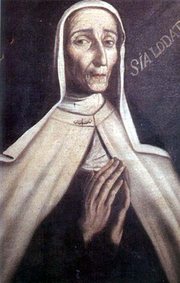
Ven. Serafina di Dio (1621-1699), Neapolitan Carmelite mystic. (Source)

The Life of a Mystic

Prudenza Pisa was born in the Kingdom of Naples in 1621. She clashed with her father at a young age when she refused to marry the young man he had chosen as her husband. She also cut her hair and donned pentiental garb. These actions did not go over well, and she soon found herself expelled from the household. Prudenza resided during this rather fraught period in what was essentially the family chicken coop. Yet she grew closer to her mother, who brought her meals secretly. Prudenza saw these sufferings as an opportunity for growth in trust of God. She also set herself to the good works of visiting the sick. In the Neapolitan Plagues of 1656, she continued her ministry even as the illness claimed her beloved mother. Her behavior at this terrible juncture was edifying:

Seraphina prepared her mother for death and actually closed her eyes when she died on August 5th 1656. Christian burial was not allowed during the plague. With her own hands, she dug a shallow grave in the backyard and personally buried her mother.

Yet her active life was soon to draw to a close. One of her uncles, a prominent priest, died of the same plague. He had been planning to found a convent of enclosed nuns on Capri. She carried on this noble work after his departure. She gathered together various companions from Naples and, on 29th of May, 1661, took the habit of the Discalced Carmelites at Naples Cathedral. It was then that she took the name of Serafina of God. Later that year, the community moved to Capri. Their residence soon proved inadequate, and they constructed a much larger monastery dedicated to the Most Holy Savior. Mother Serafina’s leadership bore fruit in another six Carmelite convents in the Kingdom of Naples, a remarkable flourishing clearly drawing its power from the Holy Ghost.

BenedictXIII.png

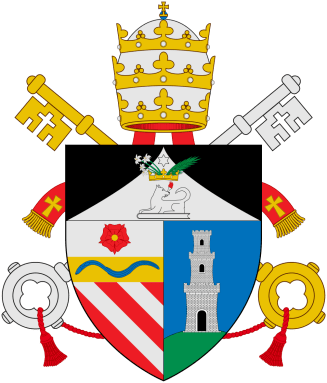
The (very Dominican) arms of Pope Benedict XIII, friend of Ven. Serafina di Dio (Source)

Ven. Serafina was not without trials. Although she wrote an attack on Quietism, she was herself accused of this noxious heresy. For six years, the Inquisition conducted an investigation into her writings and activities. For two, she was confined to her cell without the benefit of Holy Communion. But at last, her name was cleared, in no small part because of the intervention of her friend, Archbishop Vincenzo Maria Orsini, the future Pope Benedict XIII.

There can be little doubt that these troubles arose from within her own religious family. Although Mother Serafina was entirely blameless in conduct, her manner of spiritual leadership won her many enemies among her more lax daughters. Perhaps some of the trouble could have been anticipated from the fact that her recruits were customarily drawn from the ranks of the Neapolitan aristocracy, not a class generally known for its ascetic rigor. The Carmelites treated their foundress poorly. For example, while Serafina was ill in her confinement, she begged to see some of the sisters. They did not come. Yet the patience with which she bore these final trials remains exemplary. As one biographer notes, “Two days before she died she asked the Prioress to look after the sisters who had been so contrary to her, making excuses for their behavior.” This mercy converted the hard of heart, for, as the same writer says, “After her death on March 17, 1699, some of the sisters who were most against her became some of the most enthustiastic promoters of her Cause.”

Spiritual Daughter of St. Philip Neri

An heir of the Tridentine reform, the Ven. Serafina was a great admirer of St. Teresa of Avila, whom she endeavored to emulate in all things. She was a prolific writer, composing at least 2,173 letters and enough theological writing to fill 22 books. Some of her topics included:

SerafinaWriting jpg.jpg

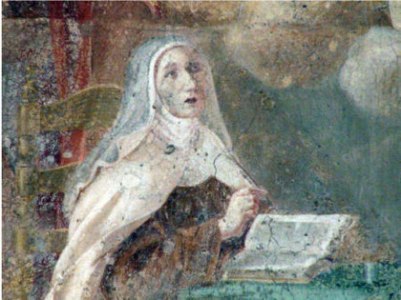
Ven. Serafina writing (Source).

-the prayer of faith
-mental prayer
-the love of God and the practice of the divine presence
-the common life
-conformity to the will of God.

Alas, I don’t believe any of these have been translated into English. Perhaps some intrepid early modernist will someday render these works into the Anglo-Saxon tongue.

Serafina was also a visionary mystic. She went about life with a constant ability to fall into meditation. In Serafina’s own words:

“…Anything I looked at I was able to turn into a meditation… When I saw it raining, I thought of the refreshment which the rain brought to the earth and that without it the earth would be arid. I would say: ‘If the water of divine grace did not fall on the soul, it would dry up without providing the fruits of good works.’ … The sight of fish swimming in the sea made me remember how the saints are immersed in God… And in such wise everything, even the slightest things, served me for my spiritual nourishment.”

The greatest misfortunes could not turn her from the praise of God. For in all things, she perceived the benevolent Providence of God. Her unfailing rule was that “All that God did and allowed was beautiful, good, ordered for our good.” Even the terrible things in life thus became for Serafina an occasion of magnification and blessing.

Serafina was also a visionary mystic. At one point, “She was so overwhelmed with her vision of the Godhead that she wondered what else could be reserved for her in heaven.” The experiences she was granted were extraordinary, though she took pains to keep them discreet. Yet we do have letters attesting to some of her ecstasies.

One figure who emerges as particularly important in her religious life is St. Philip Neri. The Oratorian Fr. Francesco Antonio Agnelli tells us that she honored St. Philip by, for instance, devoutly kissing the feet of the crucifix thirty-three times in his honor; she was repaid for this act of love with a vision of the glorified St. Philip prostrate and kissing the feet of Jesus thirty-three times in her name (Agnelli 194).

Serafina’s spiritual father was Fr. Vincenzo Avinatri of the Naples Oratory. She wrote him letters describing the visions she had of St. Philip. In one such letter, she reports that

“I saw the Saint, with the great Mother of God, in a flame of fire, and surrounded with light…with a sweet countenance, he told me many beautiful things…He showed me what his sons ought to be, and the dignity of the Congregation, made, so to speak, in the likeness of God and of the three Divine Persons, and especially of the Person of the Holy Spirit…Without speaking, he had explained to me the perfection we must have in order to be sons of light. It would be a monstrous thing if fire generated snow, if light brought forth darkness, if crystal produced mud…How much greater wonder would it be, if in any of the sons of St. Philip, who are called sons of the Holy Spirit, there should be any defect!” (qtd. in Agnelli 195-96)

In another vision that came to her on the vigil of St. Philip’s day, she was carried way into a heavenly rapture and saw the Saint aflame with a supernal light. And in view of St. Philip, she saw her own heart on fire, as well. But it did not glow as brightly as his; therefore, she prayed to the Saint that she might receive a more perfect and ample share of Divine Love. As Agnelli describes it,

Then the Saint united his heart with hers, and thus united they sent forth a great flame; she felt so much love that she could not express it, and the Saint invited her to rejoice in the presence of the Lord, and to sing His praises, desiring her to repeat with him these words, Sanctus, Sanctus, Sanctus, Magnus Dominus et laudabilis nimis [Holy, holy, holy, great is the Lord and worthy of all praise], adding that it is impossible to find in the most devout Canticles words more pleasing to God. (Agnelli 194-95).

She was thus adopted by the saint as a kind of daughter in the Spirit. She also looked upon Oratorians as her own sons. This spiritual affinity was later attested by a physical resemblance with St. Philip. When an autopsy was conducted on Mother Serafina’s body, the examiners found signs of transverberation in her heart.

It may seem odd for a visionary to become so friendly with St. Philip and his sons. After all, St. Philip himself was notorious for his skepticism when it came to visions. He had treated the Ven. Ursula Benincasa with unrelenting verbal abuse to test her inspiration – a test she passed, even if the holy man never quite came around to endorsing her. St. Philip taught that, “As for those who run after visions, dreams, and the like, we must lay hold of them by the feet and pull them to the ground by force, lest they should fall into the devil’s net.” Though a man of tremendous supernatural gifts himself, he knew that the spiritual world was a minefield of dangers. False visionaries abounded in his day, and his prudent words have retained their perennial wisdom down into our own era.

To properly understand the nature of Ven. Serafina’s visionary mysticism, and why we can properly say it breathes of a Philippine spirit, we must look at it in the context of her leadership of a Carmelite monastery.

A Liturgical Mysticism

The troubles in Serafina’s life began because of her governance. As one biographer has it,

As often happens, Sr. Seraphina’s strongest talents and graces became her heaviest crosses. In her foundations she shared her convictions about religious life with her sisters. She firmly believed that the best guarantee of authenticity of one’s religious experience was a dogged faithfulness to the traditional forms. She was immersed in the church’s liturgy, the celebration of the Eucharist, the Divine Office, the liturgical year, and the feasts of the Saints. She was often led to intimate communion with Christ Jesus at the liturgy beginning with the midnight office. She also stressed the need for silence and solitude as requisites for prayer. [emphasis mine – RTY]

Her tenacious devotion to the traditional forms of worship and to the great prayer of the Church, the Liturgy and Divine Office, shows that the Ven. Serafina was in every way a monastic. Indeed, these salutary measures evince a Benedictine sensibility.

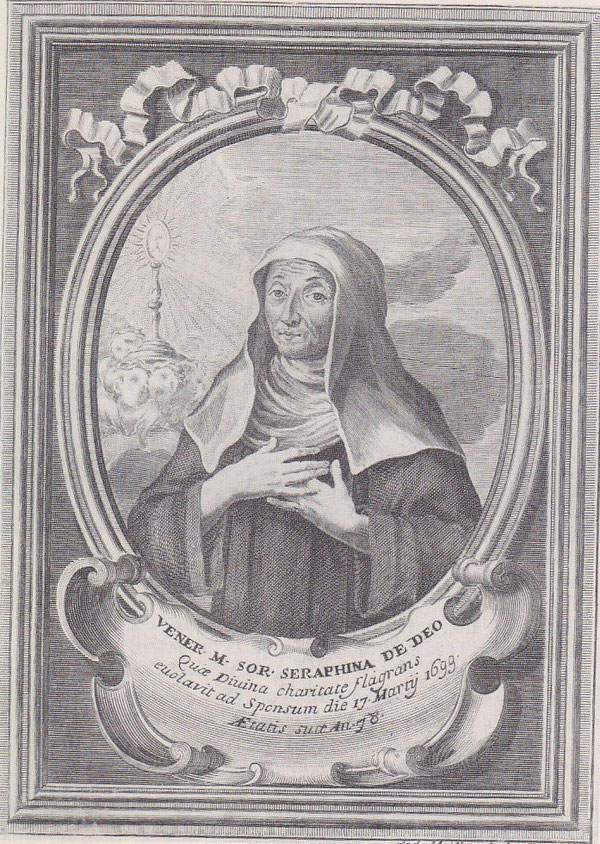
SeraphinadeDeo.jpg

An 18th century portrait of the Ven. Serafina di Dio. Note the prominent place of the Blessed Sacrament in this composition. (Source)

Her ecstasies were not a superfluous and shallow add-on to this liturgical life. She built the house of her prayer upon the rock of tradition, and it was illumined with the uncreated light of the Holy Ghost.

Serafina’s mystical life was tied to her experience of the liturgical calendar. For instance, any of her most profound encounters with St. Philip took place on the vigil and day of his feast (Agnelli 194-95). A cynic would see in this timebound quality a mark of the merely human dimension of religion, a fine example of confirmation bias. But those who have learned of divine things will discover a deeper reality. In Serafina they will see a soul that has grown attuned to the Wisdom of God, made manifest in time through the Incarnation of Christ and the Liturgy of the Church.

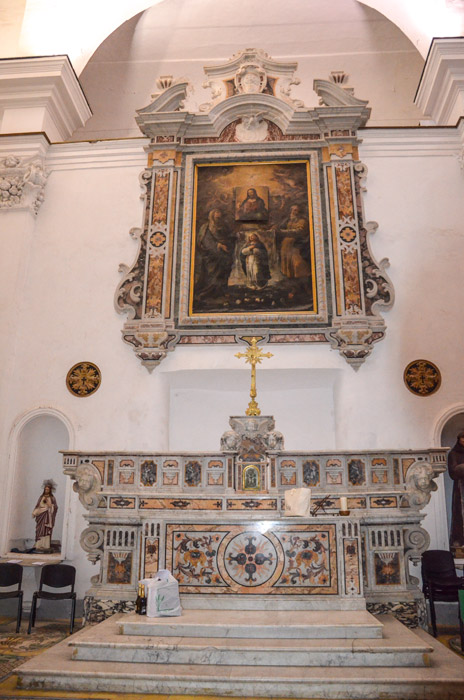
altaresantissimosalvatore.jpg

High Altar of the Chiesa Santissimo Salvatore, Capri. Although it has not been a Carmelite monastery since Napoleonic times, this is the altar where the Ven. Serafina would have received communion. (Source)

These are quintessentially sound foundations for the spiritual life. Her strictly liturgical and monastic way engendered serious opposition among her daughters, but it also gave her the strength to bear that opposition with true Christian patience. One can only imagine the terrible suffering that two years without the Blessed Sacrament must have inflicted on such a soul. Yet, by grounding herself in the Liturgy, she was able to nourish that innate trust in Providence already evident in her earliest days. Surely, that sustained her in the darkest days of her old age.

The Long Road to Sainthood

It seems somehow appropriate that, as an adopted daughter of St. Philip, the Ven. Serafina should not yet have been canonized. Many of his spiritual children have had a similar fate. Witness the stalled cases of Ven. Cardinal Cesare Baronius, Bl. Juvenal Ancina, Bl. Anthony Grassi, and Bl. Sebastian Valfre, just to name a few of the many early modern Oratorians who have not yet reached the highest altars of the Church.

Still, we can pray that this Carmelite mystic will one day be recognized as the saint she was. Let us beg her intercession and emulate her profound devotion to the Liturgy of the Church.

UPDATE: A Carmelite friend pointed out to me that Ven. Serafina was in fact not subject to the jurisdiction of either Carmelite order, essentially running independent Carmelite conservatories of oblates in the Discalced habit, following an adaptation of St. Teresa’s constitutions. She was a sort of Carmelite version of St. Francesca Romana. More info can be found in the works of Smet. As such, any use of the Carmelite letters after her name may be inappropriate, but given a) the unusual nature of the case, and b) the difficulty of changing my title and thus invalidating links, I have decided to keep my text as is and merely add this disclaimer.

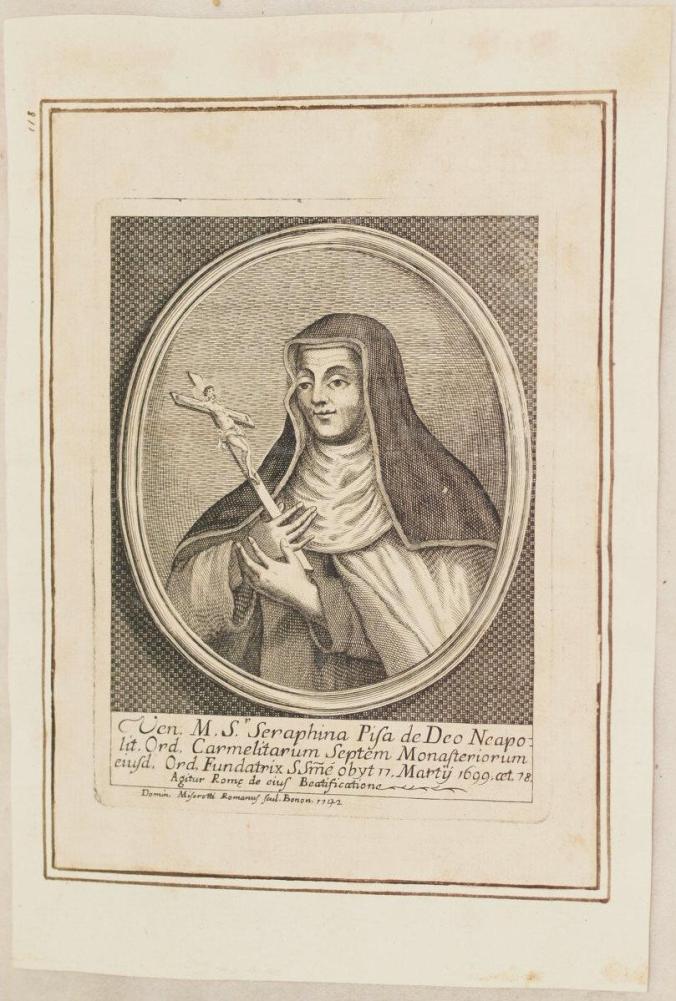
SerafinadeDeo2.jpg

May the Ven. Serafina di Dio pray for us! (Source)

Flannery O’Connor and the Protestant Ex Voto Tradition

Recently I came across a very strange song from an equally bizarre album. The song was “I’m Not Handicapped, Just Inconvenienced,” by Gary Dee Bradford. It was on his 1979 album of the same title. The piece is a chilling mix of bad ventriloquism, preachy Carter-era Evangelicalism, and awkwardly poor singing. Which means, of course, that I loved it.

BradfordHandi.jpg

I’m curious what’s on the full album. (Source)

I soon found out that Bradford, who suffers from a rare physical disability called phocomelia (he lacks arms and has hands at his shoulders), produced a few other albums. Although he produced his most recent work in 2002, most of his output came in the 1970’s and 80’s. In one of the only other songs by Bradford I can find online, 1977’s “Good Ole Gospel Music,” we can hear the prepubescent Bradford sing in a high and eerie voice about the superiority of his chosen genre:

It is the sweetest love song
Ever heard by mortal man.
If we had more Gospel Music
We’d have a better land…a better land!

GaryDeeBradfordGOGM.jpg

Gotta love that 70’s montage work. (Source)

It’s catchy, I have to admit. Even if it’s not exactly Mozart.

It would be easy to make fun of the sheer cheesiness of Bradford’s records and write them off as one more episode in the history of odd music. But in fact, Bradford’s albums deserve more respect than that. They tell us something about the history and spirituality of mid-20th century American Christianity. Bradford wasn’t working in a vacuum.

American Gospel music, particularly that brand of Gospel that flourished in the predominately white churches of the mid-century South, has roots in the musical traditions of Appalachia. One of the most common and longstanding song forms found there is the ballad. Appalachian ballads often tell stories of woe and redemption, sadness and hope. When given a religious inflection, they become the musical versions of faith-sharing, testifying to the work of God in redeeming poor sinners. They are also the Protestant equivalents of the Catholic world’s longstanding folk ex voto tradition.
ExVoto1.jpg

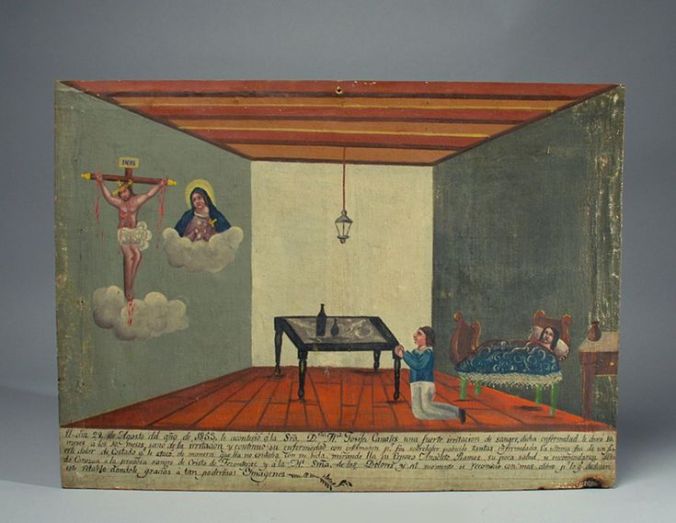
An example of a Mexican ex voto, 1853. (Source)

The ex voto is a little painted image offered by a devotee in thanksgiving to Christ, the Virgin, or a saint for a perceived blessing. Usually, the scene of the miracle is depicted in fairly simple (or what the art critics would call “naive”) terms, with a short, handwritten narrative describing the incident below. They are emphatically not “fine art.” Ex votos are the result of folk piety, and they depict the most fundamental relationship of the worshiper and the supernatural, the body and the invisible world, faith and crisis.

There’s also a uniquely New-World flavor to the ex voto form. While examples abound from most historically Catholic cultures, the most exemplary tradition of ex votos can be found in Mexico. Indeed, the ex voto has become one of the country’s national art forms, often stylized and reinterpreted by contemporary artists. Frida Kahlo even collected them.

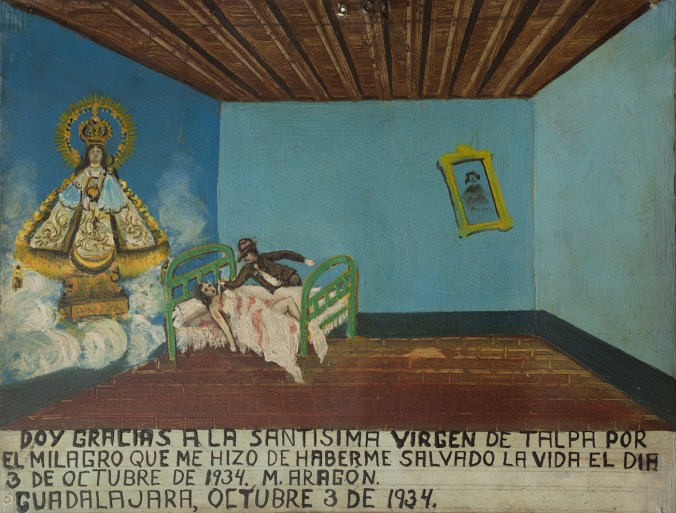
exvotokahlo01.jpg

An ex-voto of a woman stabbed in bed, owned by Frida Kahlo and believed to have inspired her own painting, “A Few Small Nips.” (Source)

We can see the same kinds of spiritual impulses behind a whole wave of calamity-themed songs in mid-to-late-20th century Gospel. Perhaps we shouldn’t be surprised that, in a Protestant context, the ex voto takes an audible rather than visual form. Take, for example, Jerry D. Brown’s A Crippled Boy’s Prayer and The Fuller Family’s slightly earlier but almost identical A Little Crippled Girl’s Prayer.

CrippledBoysPrayer.jpg

Not a great song, but it makes sense as a sort of ex voto. (Source)

Sometimes, the album as a physical object mirrors the makeup of an ex voto. The back of the albums often carry long messages of praise and thanksgiving in spite of the various afflictions the artists suffer from. For example, on the back of A Little Crippled Girl’s Prayer, we read the words of wheelchair-bound Marsha Fuller:

It’s so great to be a Christian and serving such a great God. He has given so much to me, for most children with my disease lead a quiet life and never have the opportunities that I have had.  At the age of three He gave me a voice to sing with. And three years later God inspired me to write two songs. Since then, I have written four other songs and made two recordings. He has also blessed me in other ways. He gave me a wonderful Mom and Dad whom have loved and cared for me so much. He gave me a wonderful brother, Gene. You don’t find too many twenty-year-old men who loves to sing for the Lord the ways he does. As a family we have had rough times together. Sometimes we didn’t know where the next meal was going to come from because of hospital bills, but, God has always pulled us through. Our house might not be the biggest and our clothes might not be the finest, but as long as we stay true to Jesus someday we’ll have a mansion that outshines the sun. We truly hope that you will be blessed by our message in song to you. Yours in Christ, Marsha Fuller

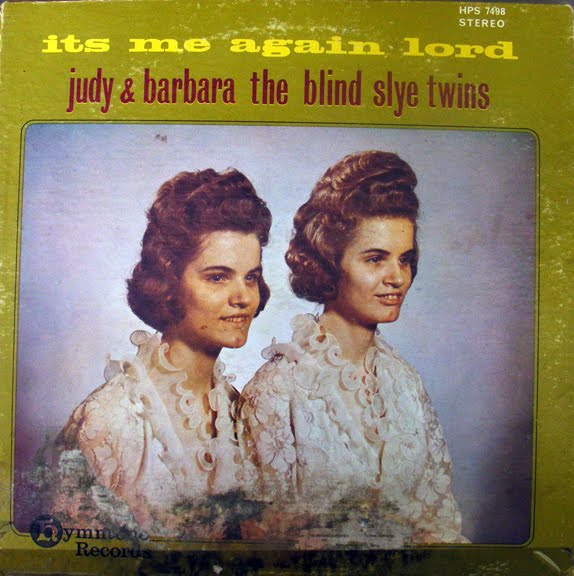
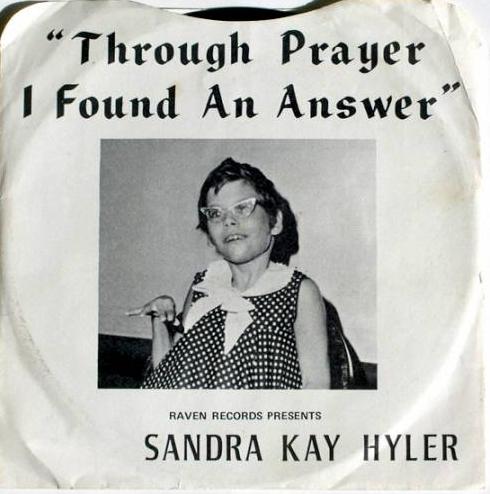
There was a veritable cottage industry of Christian albums by blind, amputee, or otherwise disabled artists that flourished in the middle of the twentieth century. To give a few examples:

ClosertotheSavior.jpg

Denise’s Closer to the Savior, probably from the 1960’s or 1970’s. (Source)

BlindSlye.jpg

Another blind album, It’s Me Again, Lord by Judy & Barbara, the Blind Slye Twins (Source)

BennyDeanBlind.jpg

Benny Dean’s I’d Rather Be Blind (In My Eyes Than In My Soul). A bit on the nose. (Source)

12 JEFF (STEINBERG).jpg

Here’s Something Special from Jeff Steinberg. Note the hook. (Source)
HandlessOrganist.jpg

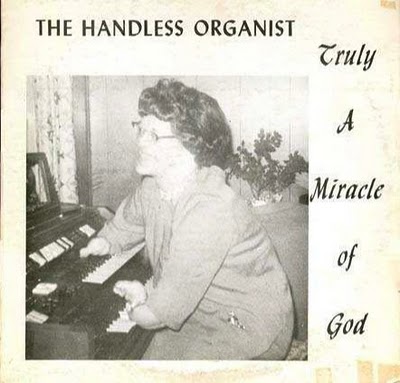
“Truly a Miracle of God!” (Source)

GospelofLoveAmputee.jpg

Richard & Gail Miller Sing the Gospel of Love. (Source)

ThroughPrayer.jpg

Sandra Kay Hyler in “Through Prayer I Found An Answer.” (Source)

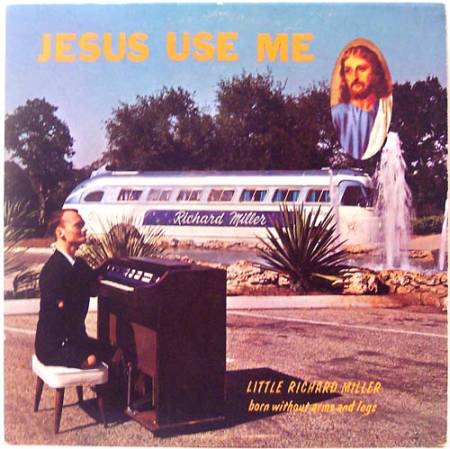
29 richard miller.jpg

Another offering from “Little Richard Miller,” this time with cover art that closely if unintentionally replicates the ex voto model. The full album is online for your listening pleasure. (Source)

These musical works differ from the mainstream of Protestant aural culture in that, even when the songs themselves are classic hymns or are just covers of more obscure songs by disabled artists, they take on a new, personal, and highly-charged meaning in the context of public disability. The artists are not just performing music, they are performing both disability and Christianity – indeed, they perform their disability precisely as the core of their Christianity, and their Christianity as intimately bound up with their disability. The singer born without arms or the blind crooner or the organist missing her hands can all achieve a new status as an icon of model Christian disability. Their performance points towards the hope of a transfiguration that surpasses disability in the kingdom of heaven. Moreover, their physical or mental incapacity is often an implicit analogy for the spiritual deformation, blindness, or weakness found in the more conventional Gospel ballad. The healing of both comes from Jesus.

Mary Douglas, among other anthropologists, has noted that the body physical is often used as an analogy of the body politic. The symbolic representation of the individual corpus speaks to the social body at large – culturally-coded anxieties about the limits of the physical body frequently point to an underlying anxiety about threats to the community. Should it surprise us that the most visible flowering of this disability-obsessed genre came at a time when the culture wars were starting to animate the full force of Southern and Midwestern Protestantism into a politically active bloc with an agenda for cultural change? Surely that socio-political context stands behinds Gary Bradford’s “better land.” The Evangelical doom song, with perhaps its best representatives in the Louvin Brothers, rose to prominence at much the same time.

The fundamentalist folk spirituality that these songs present are a major cultural context in the wonderfully disturbing, deeply Catholic work of Flannery O’Connor. In her short story “A Temple of the Holy Ghost,” she injects it into her description of a Southern freak show. An intersex person addresses two crowds – one made up of men, another of women – before displaying their unusual genitalia. The freak says,

“I’m going to show you this and if you laugh, God may strike you the same way.” The freak had a country voice, slow and nasal and neither high nor low, just flat. “God made me thisaway and if you laugh He may strike you the same way. This is the way He wanted me to be and I ain’t disputing His way. I’m showing you because I got to make the best of it. I expect you to act like ladies and gentlemen. I never done it to myself nor had a thing to do with it but I’m making the best of it. I don’t dispute hit.” Then there was a long silence on the other side of the tent and finally the freak left the men and came over onto the women’s side and said the same thing. (The Collected Stories of Flannery O’Connor 245).

Later, they lead a kind of religious service centered on their own experience of God’s Providence.

She could hear the freak saying, “God made me thisaway and I don’t dispute hit,” and the people saying, “Amen. Amen.”
“God done this to me and I praise Him.”
“Amen. Amen.”
“He could strike you thisaway.”
“Amen. Amen.”
“But he has not.”
“Amen.”
“Raise yourself up. A temple of the Holy Ghost. You! You are God’s temple, don’t you know? Don’t you know? God’s Spirit has a dwelling in you, don’t you know?”
“Amen. Amen.”
“If anybody desecrates the temple of God, God will bring him to ruin and if you laugh, He may strike you thisaway. A temple of God is a holy thing. Amen. Amen.”
“I am a temple of the Holy Ghost.”
“Amen.”
The people began to slap their hands without making a loud noise and with a regular beat between the Amens, more and more softly, as if they knew there was a child near, half asleep. (Ibid., 246)

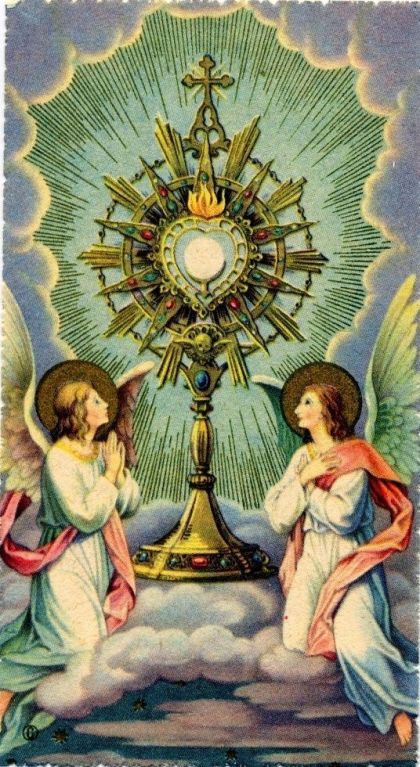
O’Connor, who suffered from lupus herself, draws a parallel between the freak’s preaching and Benediction of the Blessed Sacrament. In the two episodes, we can perceive both the sovereignty of God’s Providence and the sacramental capacity of matter to bear God.

eucharistmonstranceholycard.jpg

A holy card depicting a monstrance, used in Benediction. (Source)

It strikes me as intuitively sensible that O’Connor should have chosen precisely this story to contrast Protestant and Catholic music. Early on in the story, two young Church of God men try to woo a pair of Catholic sisters by singing a Gospel hymn, complete with guitar and harmonica. The girls, who have been educated at convent school, bite back their giggles and respond with the Tantum Ergo. One of their suitors is more right than he knows when, puzzled and slightly disapproving, he calls it “Jew singing.” The two forms of music, though standing in an apparent contradiction, together anticipate the underlying sacramental truth presented by both the Protestant and Catholic services that conclude the story.

O’Connor makes much of Protestant devotional culture in one of her novels, The Violent Bear It Away (1955). It is the story of a boy called to prophesy, of his skeptical schoolteacher cousin, and of the battle they wage for the soul of a mentally disabled child. At one point, we come to the performance of a family of traveling musical missionaries. The high point of the act comes when their little daughter emerges from behind the curtain to preach a rousing sermon. In the course of her preaching, she delivers what may be the book’s central message:

“I’ve seen the Lord in a tree of fire! The Word of God is a burning Word to burn you clean!…Burns the whole world, man and child…none can escape…Are you deaf to the Lord’s Word? The Word of God is a burning Word to burn you clean, burns man and child, man and child the same, you people! Be saved in the Lord’s fire or perish in your own! Be saved in…” (The Violent Bear It Away 134-35).

O’Connor is fond of granting the most clear-eyed spiritual vision to the children in her stories. Many have profound experiences of grace that mark them forever, or they bear testimony of the invisible world’s dangerous immediacy to more skeptical characters.

CrippledGirl

This album makes me think of O’Connor’s 1955 The Violent Bear It Away. (Source)

That includes O’Connor’s disabled children. “The Lame Shall Enter First,” one of O’Connor’s most emotionally crushing short stories, is a close companion to The Violent Bear It Away. It tells the story of a well-meaning social worker, Sheppard, who takes in a clubfooted juvenile delinquent, Rufus Johnson, hoping to steer him towards a productive life. Although he can overlook Rufus’s constant spite, Sheppard is exasperated by the fundamentalist beliefs he clings to. Rufus is convinced he is going to hell, and starts to talk about it with the social worker and his impressionable young son. He steadily grows into the role of preacher even as Sheppard tries desperately to “flush that out of [his] head.” I won’t get into any spoilers, as the story has a wrenching, unforeseen climax. I’ll just say that Sheppard finally realizes he has failed only when Rufus cries at him,

“I lie and I steal because I’m good at it! My foot don’t have a thing to do with it! The lame shall enter first! The halt’ll be gathered together. when I get ready to be saved, Jesus’ll save me, not that lying, stinking atheist, not that…” (The Collected Stories of Flannery O’Connor 480).

Sheppard attributes all of Rufus’s bad behavior to the emotional effect of his clubfoot. But Rufus finds his one hope of salvation in the fact that he has a disability that, according to the logic of heaven, will ensure that he enters the Kingdom first. For Rufus, as for so many of the artists mentioned above, it represents both faith and hope (if not yet charity). Sheppard is too blinded by his prejudice and his loneliness to see that. The results are calamitous.

Rufus’s underlying insight speaks to a truth often forgotten in the Church’s treatment of the disabled. Those with disabilities are not “problems.” It’s true that they may have some special needs with regards to access, attention, etc. But at the end of the day, they are people who have the same basic spiritual needs as any other human beings. They, too, can embody and image Christ – often better than those of us who are blessed enough to be of both sound mind and body.

Gary Bradford himself has spoken publicly about this issue before. Some time in the late 1980’s or early 1990’s, Bradford – by then an adult – gave an interview with a Christian television network. He says,

In the past…so many of our churches, and so many of our people in our church in the past, it’s been the place for the good, the well-bodied, and the abled…And the Church isn’t to be like that; the Church is to take all.

Of course, the other great danger is to place too much emphasis on the disability and not enough on the person who has it. The “magical disabled person” should not become a trope in Christian life. We can’t load our disabled brethren in Christ with that moral freight. It isn’t fair. The disability Gospel genre fosters precisely that kind of harmful thinking; perhaps that is its greatest cultural fault.

I think we can avoid either extreme – neglect or overemphasis – by focusing instead on the individuality and personhood of every disabled Christian. Insofar as the disability Gospel song is an ex voto, it may seem to correspond to a certain type. Catholic ex votos usually do. But that’s only to the outsider who beholds the ex voto. For the one who makes it (or commissions it), the story it tells carries intense and highly particular personal meaning. Put another way; Sheppard may not grasp the hidden meaning of Rufus’s club foot, but Rufus does.

The same goes for the Protestant ex votos we find in this genre. They may seem to correspond to the demands of a cottage industry, but they all epitomize and present individual experiences. That particularity is the best thing we can take from this strange, lost genre of Christian music. There are no generic souls, abled or otherwise.
Elsewhere: Two Readings for a First Friday

Screen Shot 2018-07-06 at 2.40.31 AM

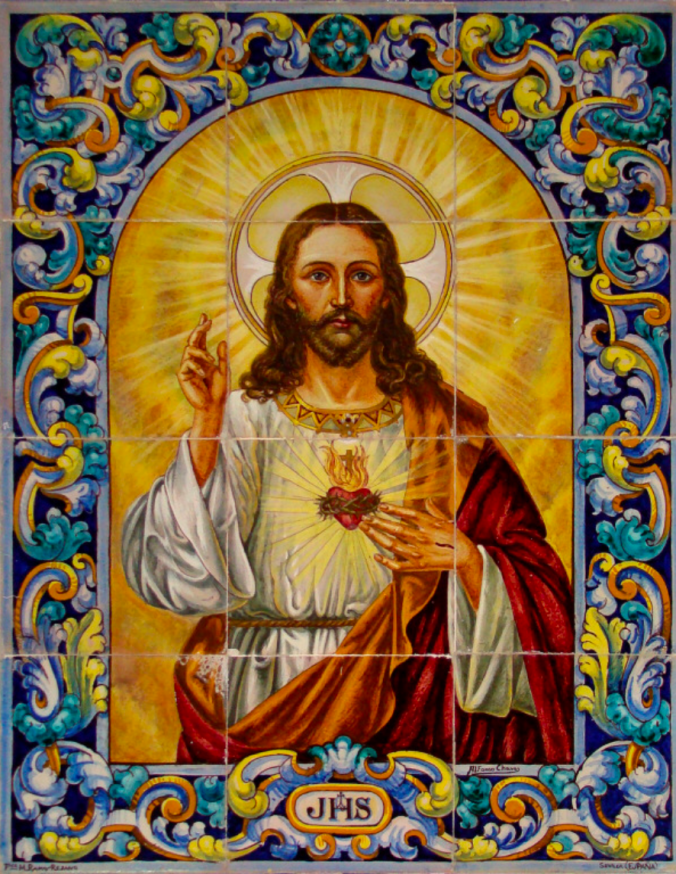
Sacred Heart of Jesus, have mercy on us. (Source)

I’m working on a big blog post that’s running rather long. In the meantime, I wanted to refer two posts that, although different in some ways, have a common center.

The first is a little old, though I rather sheepishly confess I only just read it. John Monaco has a very good post over at Inflammate Omnia on how the Sacred Heart devotion can help those struggling with mental illness. John goes over the history of the scrupulous, doubtful view of God’s love, most egregiously enshrined in the heresy of Jansenism. But he also looks at the ways that the Sacred Heart can lead those who suffer from scrupulosity and obsessive-compulsive disorder to approach a healthier, more accurate relationship with God.

The second is from an acquaintance of mine named Patrick McCoy who is both a fairly traditional Catholic and same-sex attracted. Over at his blog, O Crux Ave, he relates his recent experience engaging in street evangelism at St. Louis PrideFest, where he led a small team with the goal of sharing the Love of God with the LGBT community. Appropriately enough, he calls this ministry #SacredHeartLoves Outreach.

Although the two posts deal with different topics, together they form a kind of diptych about the Sacred Heart. Both are honest, even vulnerable personal narratives. Both proclaim the unconditional Love of God for stigmatized groups: the mentally ill and sexual minorities. Thus, both are fitting to read on this first Friday of July, the month of the Precious Blood of Jesus, spilled for all mankind.

Novena to St. Benedict

HolyTwinsPrint.jpg

A print from The Holy Twins by Tomie dePaola, depicting SS Benedict and Scholastica. (Source)

I hope my readers will join me on a novena to the Patriarch of Western Monks, starting today (July 3rd) and ending on the Feast of St. Benedict, the 11th of July. Here is the prayer I will use, taken from EWTN’s website:

Glorious Saint Benedict, sublime model of virtue, pure vessel of God’s grace! Behold me humbly kneeling at your feet. I implore you in your loving kindness to pray for me before the throne of God. To you I have recourse in the dangers that daily surround me.
Shield me against my selfishness and my indifference to God and to my neighbor.
Inspire me to imitate you in all things. May your blessing be with me always, so that I may see and serve Christ in others and work for His kingdom. Graciously obtain for me from God those favors and graces which I need so much in the trials, miseries and afflictions of life. Your heart was always full of love, compassion and mercy toward those who were afflicted or troubled in any way. You never dismissed without consolation and assistance anyone who had recourse to you. I therefore invoke your powerful intercession, confident in the hope that you will hear my prayers and obtain for me the special grace and favor I earnestly implore.

{mention your petition}

Help me, great Saint Benedict, to live and die as a faithful child of God, to run in the sweetness of His loving will, and to attain the eternal happiness of heaven.

Amen.

My First Year at Grad School in Twelve Musical Selections

Screen Shot 2018-06-22 at 2.00.39 AM.png

A still from Farinelli. This was the year I both became an 18th century scholar and discovered Castrato arias. (Source)

12. “Somebody That I Used to Know” only Vaporwave.

11. “Sumer is Icumen In,” from The Wicker Man (1973).

10. “Demons,” by Alex and “Sleep Games,” by Pye Corner Audio.

9. Tchaikovsky’s Swan Lake theme.

8. Psalm 129 from King’s College Choir, Cambridge.

7. The soundtrack from Le Roi Danse.

6. “Never Enough” from The Greatest Showman.

5. “Pur Ti Miro,” by Monteverdi.

4. The Little Match Girl Passion, by David Lang

3. The Farinelli soundtrack.

2. Michael Nyman’s “The Garden is Becoming a Robe Room,” “Prospero’s Magic,” and “Chasing Sheep is Best Left to Shepherds.”

1. Various Arias from Handel, especially Rinaldo‘s “Il Vostro Maggio” and “Lascia Ch’io Piangia” as well as most of “Ode for the Birthday of Queen Anne.”