Celebrating 200,000 Views

Movin’ on up in the world. (created with two images from Wikimedia Commons)

Sometime in the last month, this blog received its 200,000th view. Thank you to all my wonderful readers for their consideration, their comments, their recommendations, and their sharing of my essays here. Much has changed over the last three years. For instance, it was a pleasure to host my first-ever co-publication as well as my first guest post recently. Yet I’d like to think that some things stay the same. Where has been change, I believe it has been (mostly) improvement. Everything’s coming up roses!

As a way of recapping, here are some of my stats.

These are all the countries where I’ve had views since the start of my blog. While the vast majority have been in the United States, I also have had an appreciable readership outside my native land. Here are the top ten countries where I’ve had the most views overall.

I’m proud to say that I’ve had a total of six views in the Vatican, too.

While I can’t verify this exactly, I believe that the single month with the greatest number of views was March of 2019, when I published “100 Edifying Lenten Penances.”

Thank you again to everyone for taking the time to read The Amish Catholic and making it what it is today. I couldn’t do it without you.

Happy New Year and New Decade!

Te Deum, the chant of the New Year. (Source)

Thus concludes Anno Domini MMXIX. It is strange to think that we are about to enter the third decade of the new millennium. I am by temperament a pessimist, but I hope that this decade is an improvement over the last (a time in which I experienced a tremendous amount of personal growth). Let us pray for God’s continuing mercy and Providence.

Here are some blog stats from the last year, for those who are interested.

In 2019, The Amish Catholic received a total of 66,839 views, with a total of 39,175 visitors. My total views were down this year by 1,035, though I received 3,969 more visitors in 2019. My most popular month was March, in which I received 19,066 views and 12,919 visitors. My least popular month was February, with only 3,011 views and 1,369 visitors. This is really all very good news, since I published many fewer pieces in 2019 than in 2018 – this has been my most intense calendar year of studies ever. Including this summary, I published 42 pieces in 2019 – down from 109 in 2018. Had I been a bit more productive, all my other numbers would have gone up this year.

Here are my top 10 posts:

  1. 100 Edifying Lenten Penances (with over 12,000 views, this is my most popular post ever)
  2. 30 Alternate Religious Mottos
  3. Elsewhere: Courage, the Cardinal, and the Sex Abuse Crisis
  4. When the Sacred is Strange: The Art of Giovanni Gasparro (this one is from 2017, but it remains perennially popular)
  5. The Hidden Wound of Christ
  6. We Do Not Need St. Chesterton
  7. The Best Monastic Documentaries (from 2018)
  8. The Ratzinger Letter: A Failure
  9. Chesterton on Cheese (one of my earliest posts, from June of 2017)
  10. Elsewhere: Catholic Kabbalah

Humor keeps the top spots, while works of controversy and commentary appear with greater frequency this year than in the past. Spiritual and academic pieces usually don’t have a terribly wide appeal – which is probably good, because I’m a young layman and a lowly grad student.

I will highlight one academic piece, however, of which I am somewhat proud: my Church Life Journal argument in favor of the fundamental Catholicity of Jansenism and the continuing relevance of these early modern controversies. The Jansenist controversy remains one of the most important and misunderstood chapters in Church history. I hope to expand some of these themes here and elsewhere in the new year.

I suppose I could finish this trying to come up with a list of lessons I’ve learned over the course of the last year – in blogging, in life, etc. The temptation is even greater in view of the closing decade. Yet that often seems rather contrived. I would rather close with what seems to me the best way to end a year and a decade: on a note of gratitude. I could not have gotten where I am today without tremendous help along the way. Friends, family, mentors, and even strangers have made my life better in ways that I cannot begin to describe. Thank you to everyone who has been there along the way. You know who you are.

And thanks to the friends in heaven who have helped with their many prayers. As I concluded 2018, so will I finish the decade – with a prayer that encompasses all of time.

Glory Be to the Father, and to the Son, and the Holy Ghost,
As it was in the beginning, is now, and ever shall be, world without end.
Amen.

Celebrating 150,000 Views

Icons of the Ecumenical Councils. (Source)

I am pleased and humbled to announce that The Amish Catholic has received 150,000 views! It’s been a wonderful experience since February of 2017. Thank you to all my many readers, especially those of you who take the time to comment on, share, or promote my work. It means more than you know. May God bless all of you!

An Oxonian Blog Worth Reading

The dreaming spires of Oxford. (Source)

I have just discovered that Once I Was a Clever Boy, a blog I used to enjoy but was sorry to see in hiatus, has returned. John Whitehead, the blog’s author, is a friend and a Brother of the Little Oratory here in Oxford. He hasn’t put up any new content recently. Nevertheless, there was a long time when for whatever technical reason – either on John’s end or mine, I was never sure – the blog was totally inaccessible. I’m very happy to see it’s back, and I look forward to more content from this quintessentially Oxonian blog.

Advice from a French Nun

Screen Shot 2018-10-28 at 10.13.24 PM.png

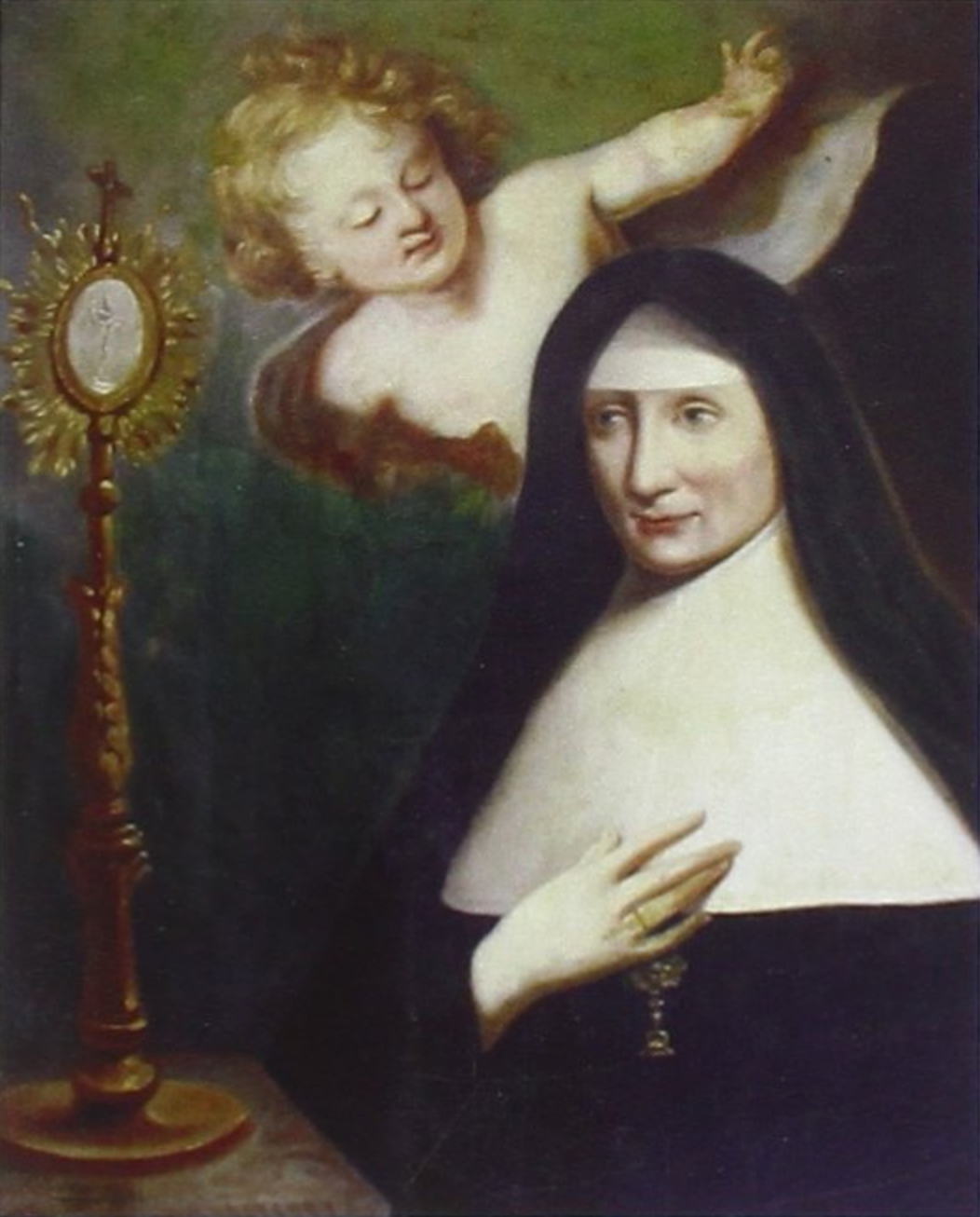
A portrait of Mother Mectilde de Bar adoring the Blessed Sacrament. (Source)

Sometimes readers ask me about more information on Mother Mectilde de Bar (1614-1698), the saintly foundress of the Benedictine Nuns of Perpetual Adoration of the Most Blessed Sacrament of the Altar. I would of course direct those who read French or Italian to any of the several biographical studies about Mother Mectilde that have come out in those languages. However, I would perhaps more eagerly urge my readers to a series of recent posts at Vultus Christi presenting what is, I believe, the first English translations of some of Mother Mectilde’s spiritual letters. Here they are with the titles the translator has given them at VC.

I. “So that I might begin to live in simplicity, like a child.”

II. “On the Meaning of Desolation and Sufferings.”

III. “The state in which you find yourself is of God.”

IV. “The divine labourer who works in you.”

V. “Yet ever thou art at my side.”

VI. “Nothingness doesn’t even attach itself to nothingness.”

VII. “Some sayings of Mother Mectilde.”

VIII. “He sets fire everywhere.”

IX. “All our discontent comes from self-will.”

And on top of all that, there’s a letter from the lay mystic Jean de Bernières to Mother Mectilde. Bernières is a good example of someone who, though posthumously condemned as a “Quietist,” is now being recovered as a source of valuable mystical insight. We have seen the same happen to Benet Canfield before, and it may yet occur to someone like Pietro Matteo Petrucci. More work needs to be done in this area. At any rate, translation of these early modern mystical works is badly needed.

Both as a practicing Catholic and as an historian of early modern Catholicism, I am encouraged that these works are being put into English for the first time. The English-speaking world is now getting a much better sense of the importance of this unique tradition within the Benedictine family. More translations, we are told, are coming. I eagerly await their publication.


100,000 Views

Screen Shot 2018-10-26 at 10.06.14 PM

This deserves some celebration. (Source)

What a milestone. When I started The Amish Catholic in February of 2017, I had no idea it would take off like this. Thank you to everyone who has taken the time to read, share, or comment upon my work. I appreciate your consideration.

Elsewhere: Two Links on the Rosary

Screen Shot 2018-10-07 at 11.46.00 PM

May Our Lady of the Rosary pray for us. (Source)

Over on Twitter, I refer my readers to an incredible thread from Joshua Jennings, who has posted images from an antique book on the fifteen mysteries of the Rosary. The illustrations are delightful, the devotion is manifest, and the typology is sound. Do give it a look.

At Vultus Christi, there is an excellent meditation on the spiritual power of the Rosary. Here’s an excerpt:

The Rosary confounds complexity and decapitates spiritual pride. There is no problem or difficulty that cannot be solved or resolved by faithful persevering recourse to Mary’s Psalter. The Rosary is the gift of the Mother of God to the poor and the powerless, who alone are capable of hearing the Gospel in all its purity, and of responding to it with a generous heart. It is to such as these — the childlike and the weak, the poor and the trusting — that the Rosary is given. It is to such as these that the Rosary belongs.

Read the whole thing.

90,000 Views

90000-readers

Never expected this to happen.

Some time this month, The Amish Catholic received its 90,000th view. Thank you to all my readers for sticking with me, arguing with me, referring me, and generally paying attention.

Elsewhere: Keanu Heydari on Conversion

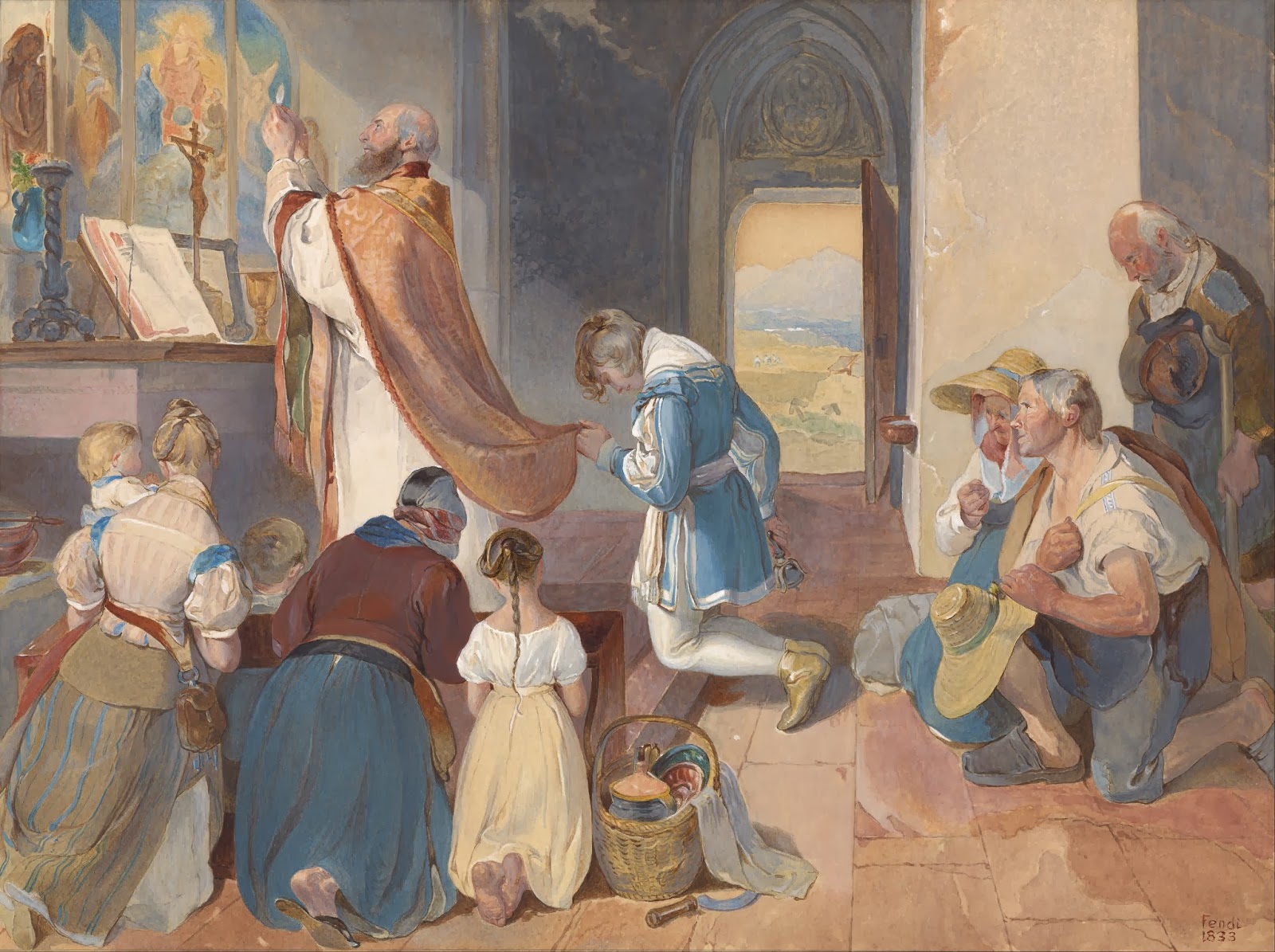
Peter_Fendi_(Austrian_-_Fridolin_Assists_with_the_Holy_Mass_-_Google_Art_Project

Fridolin Assists with the Holy Mass, Peter Fendi. (Source)

Earlier this month, my friend Keanu Heydari penned what is, I think, a very good essay about his own conversion and about conversion in general. I thought these two paragraphs were especially poignant:

If Jesus is the slain Lamb of God, the content of reconciliation is substantial rather than conceptual, or even primarily juridical. Forgiveness is freely given by God, but rather than bestowed, it is—like a substance—dealt with. It is held, beheld, and shared. I am speaking, of course, of understanding reconciliation as a sacramental event rather than as (primarily) juridical proclamation. The removal of our guilt is a free gift of the gracious God, yet it is not as a word, spoken in a booming voice. It is the material, densely textured experience of Jesus Christ, the Word, the Lamb of God, as he dies on Calvary, by the Church community, in the reception of the sacraments, wherein we receive God. The Psalmist implores, “O taste and see that the Lord is good!” (Ps. 34:8, RSV2CE). We taste and see, we behold, the forgiveness of God.

But pictures say more than words ever can. The Catholic artistic paradigm overflows with meaning. It is effusive, dynamic, and embodied. It is densely textured, thickly self-describing, multi-dimensional, and frankly excessive. But it is precisely in these Rabelaisian excesses that Catholic aesthetics gesture, even more powerfully, towards the ineffable, over and above the words themselves that are used in the liturgy. Sacramentally, we can truly say “Ecce homo.” Artistically, we are reminded that things are really happening outside of us, that we aren’t automata aimlessly generating profit for managers and selling our productivity to survive. We are more than the sum of our extrinsically imposed reductive component parts. The liturgy revels in its (in Cartesian terms) obscene uselessness. The defiance of the mass is its strongest selling point, as it were.

Read the whole thing. In what is proving to be an extraordinarily dark time for the Church, Keanu’s essay brings a good deal of hope in the fundamental promise of salvation.

Elsewhere: Mother Mectilde de Bar and the Prayer of Devekut

One of the great works of Vultus Christi has been the exposure of many English-speaking Catholics to the spiritual treasures of the continental Benedictine tradition, especially the life and work of Mother Mectilde de Bar. The good nun was a profound mystic of the Eucharist and a spiritual heir to the French School. Anyone with any interest in Benedictine life, Catholicism in early modern France, or spirituality generally should take note.

MechtildeBNF.jpg

Mother Mectilde de Bar (1614-1698), foundress of the Benedictines of Perpetual Adoration of the Most Blessed Sacrament of the Altar. (Source)

I am very happy to refer my readers to an excellent translation of one of Mother Mectilde’s letters of spiritual direction. The translator, an Oblate of Silverstream, has rendered the 17th century French into elegant and very readable English. A job well done!

Here’s a particularly potent excerpt:

The whole of Christian perfection consists in continual attention to Jesus Christ, and a constant adherence or submission to His good pleasure. These two points contain everything, and their faithful practice will lead you to the highest degree of perfection. Blessed is the soul who observes them.

The first point consists in seeing Jesus Christ in everything; in all events and in all our dealings; in such way that this divine sight removes from us the sight of creatures, ourselves, and our interests, in order to see nothing except Jesus Christ. In a word, it is to have the presence of God continually.

The second point consists in being constantly submissive to His holy will; in being so much subject to His good pleasure that we no longer have any return, at least voluntarily, by which we can withdraw from this respectful obedience.

I am reminded, in reading this passage, of a concept in Jewish mysticism called devekut. To practice devekut is to cleave to God constantly, even in the midst of everyday, profane activities. The Rabbis who founded and nurtured Hasidism in the 18th century made it a central feature of their mystical praxis, though the idea has roots in the Temple traditions of the Old Testament (vide Barker 2004, 37). Dr. Margaret Barker notes that, according to the older, priestly understanding of the word “cleaving” in Hebrew, “to cleave” meant quite literally to join. However, this sense was displaced when the Moses-focused Deuteronomist tradition came to ascendance. The new meaning of “cleaving” was, instead, obedience (Ibid. 37). Mother Mectilde has here joined both meanings in a salutary way.

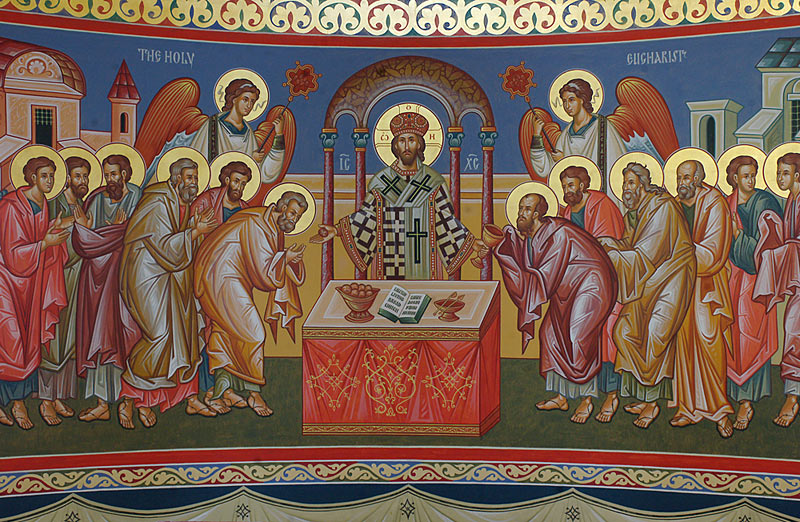
Holy-Eucharist-Icon.jpg

An icon of the Holy Eucharist, showing Christ the High Priest in the Holy of Holies. (Source)

However, I think she places a bit more emphasis on the first, as the primary and indispensable basis of the second. She goes on to write,

Have Jesus Christ imprinted and carved on the center of your soul. Have him in all the faculties of your mind. May your heart be able to think of and long for nothing except Jesus Christ.  May your whole inclination be to please Him. Attach all your fortunes and your happiness to knowing and loving Jesus Christ.[1] May nothing on earth, however great it seems, prevail in you against the constant union you should have with Jesus Christ. May neither heaven, nor earth, nor hell, nor any power, ever separate you from Him.[2]

She continues on and apostraphizes Divine Love, writing

O Jesus all powerful and all love, work in us these two effects of mercy: attract us by your omnipotence and transform us by your love into Yourself.

O love, O love divine, may you burn in us, and that you may consume in us everything that is contrary to you and opposed to your workings.

O life that is not animated by love, how can you be called life? You are a hideous death, and most terrible.

O pure and holy love of Jesus Christ, do not allow a single moment of my life to be spent without love; make me die and throw me into hell a thousand times rather than not to love Jesus Christ.

The first line here is the key; this is the loving and even conjugal language of devekut, not simple obedience. But obedience is implied as the sustaining force and natural result of such attentive love.

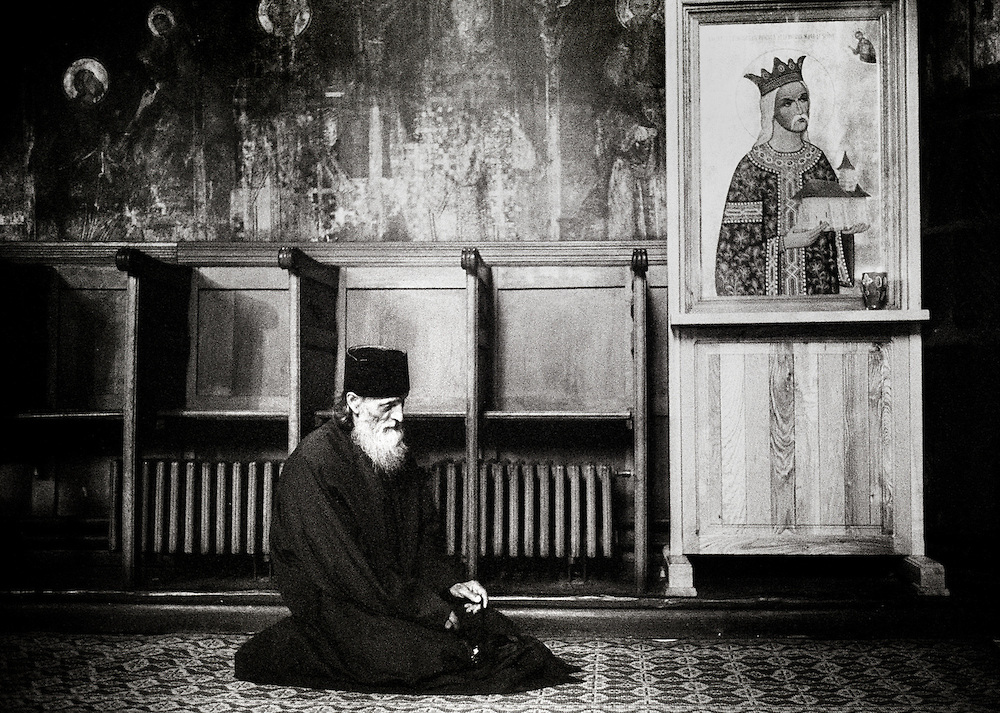
Hesychast.jpg

A hesychast at prayer. (Source)

It seems appropriate to me that Mother Mectilde, a Benedictine, should advocate for this kind of “cleaving” prayer, vigilant love in every moment. It has always been the task of the monastic throughout history to preserve this kind of remembrance of God that is itself a form of His presence in the heart. Precisely this “cleaving” constitutes the positive good underlying hesychasm in the East, but it can also be found in many monastic writers of both East and West. Mother Mectilde is not speaking alone. Indeed, she expresses the perennial Wisdom that has always infused the monastic life and made it fruitful.

Read the whole thing over at Vultus Christi.