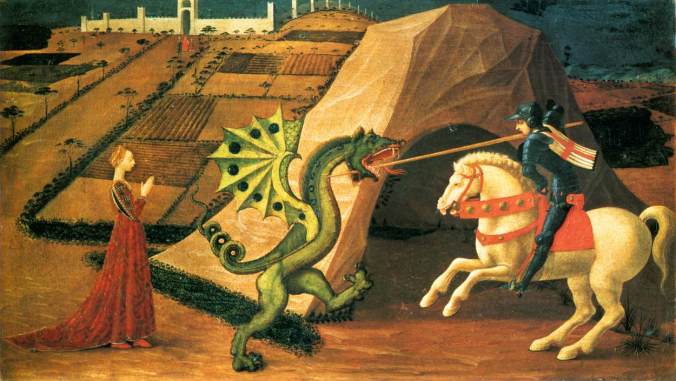
Chesterton’s St. George

Saint_George_and_the_Dragon_by_Paolo_Uccello_(Paris)_01.jpg

“Saint George and the Dragon,” Paolo Uccello, c. 1459 (Source)

The Englishman

G.K. Chesterton

St George he was for England,
And before he killed the dragon
He drank a pint of English ale
Out of an English flagon.
For though he fast right readily
In hair-shirt or in mail,
It isn’t safe to give him cakes
Unless you give him ale.

St George he was for England,
And right gallantly set free
The lady left for dragon’s meat
And tied up to a tree;
But since he stood for England
And knew what England means,
Unless you give him bacon
You mustn’t give him beans.

St George he is for England,
And shall wear the shield he wore
When we go out in armour
With battle-cross before.
But though he is jolly company
And very pleased to dine,
It isn’t safe to give him nuts
Unless you give him wine.
Elsewhere: An Anglo-Catholic Designer You Should Know

Screen Shot 2018-03-13 at 1.40.54 AM.png

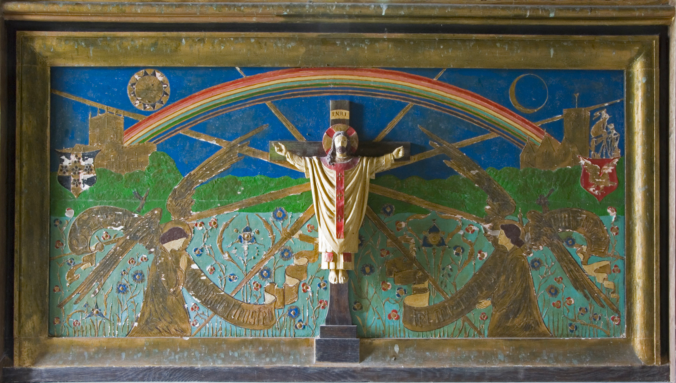
A reredos by John Coates-Carter. (Source)

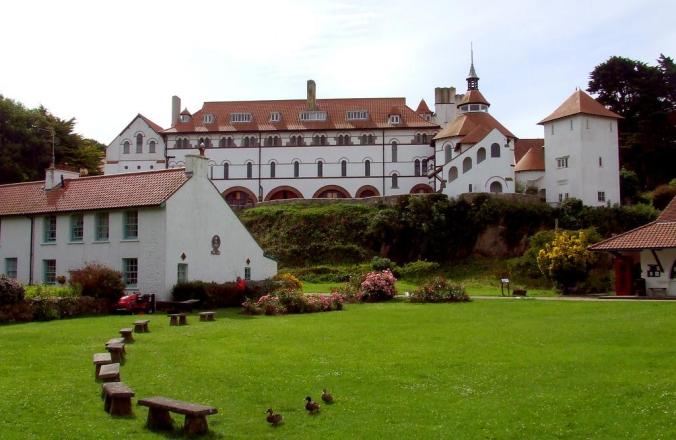
Over at Liturgical Arts Journal, you will find a very good, brief introduction to an ecclesiastical architect of the Arts and Crafts Movement, John Coates-Carter. He is most famous for his design of the (extraordinary) abbey on Caldey Island. Most of his work can be found in Wales. Perhaps because of his regional interest, I had never heard of him before. Yet his altarpieces are about as Anglo-Catholic as you can get. They have all of the features I noted in my article on AC aesthetics; they’re earthy, colorful, idealized, with a hint of the illustrative verging on the cartoonish. And most importantly, the are deeply human. Anglo-Catholicism restored the human face to British ecclesiastical art. We can see that tendency in the luminous angels and vibrant peasants that appear in Coates-Carter’s sacral art. Do go have a look.

CaldeyIsland

Caldey Abbey, designed by John Coates-Carter. (Source)