I am pleased and humbled to announce that The Amish Catholic has received 150,000 views! It’s been a wonderful experience since February of 2017. Thank you to all my many readers, especially those of you who take the time to comment on, share, or promote my work. It means more than you know. May God bless all of you!
In Lent, I often return to the words of the great Bishop of Cambrai, François de Salignac de la Mothe-Fénelon. He is a perennially refreshing source of spiritual wisdom and guidance. Since we are finally in Passiontide, I thought this excerpt from Fénelon’s sermon on prayer, “The Saints Converse with God,” would be greatly edifying for all those of my readers keeping up with the Lenten Spirituality Series.
A portrait of Fénelon in excellent blue-purple episcopal garb (Source)
We must pray with perseverance. The perfect heart is never weary of seeking God. Ought we to complain if God sometimes leaves us to obscurity, and doubt, and temptation? Trials purify humble souls, and they serve to expiate the faults of the unfaithful. They confound those who, even in their prayers, have flattered their cowardice and pride. If an innocent soul, devoted to God, suffer from any secret disturbance, it should be humble, adore the designs of God, and redouble its prayers and its fervor. How often do we hear those who every day have to reproach themselves with unfaithfulness toward God complain that He refuses to answer their prayers! Ought they not to acknowledge that it is their sins which have formed a thick cloud between Heaven and them, and that God has justly hidden Himself from them? How often has He recalled us from our wanderings! How often, ungrateful as we are, have we been deaf to His voice and insensible to His goodness! He would make us feel that we are blind and miserable when we forsake Him. He would teach us, by privation, the value of the blessings that we have slighted. And shall we not bear our punishment with patience? Who can boast of having done all that he ought to have done; of having repaired all his past errors; of having purified his heart, so that he may claim as a right that God should listen to his prayer? Most truly, all our pride, great as it is, would not be sufficient to inspire such presumption! If then, the Almighty do not grant our petitions, let us adore His justice, let us be silent, let us humble ourselves, and let us pray without ceasing. This humble perseverance will obtain from Him what we should never obtain by our own merit. It will make us pass happily from darkness to light; for know, says St. Augustine, that God is near to us even when He appears far from us.
On the 30th of March, 2013, I made the profession of faith at the Easter Vigil and received the sacraments of Confirmation and First Holy Communion from then-Bishop-Elect David Talley. I can still remember the night well. It was raining hard outside, and so we had to light the Paschal fire at the church door. We catechumens and confirmandi huddled in darkness while the rites began. It was a moment of profound holiness, and an Easter liturgy I will never forget.
Much has happened since that night. I am still a sinner, much as I was then. Perhaps I am a bit more aware of the fact, though. That’s a grace in itself. I have been a student, a pilgrim, and a devotee. I have made many friends in heaven and earth who have helped me along the way to God. I am grateful for every one of them, and I hope I have been able to do the same from time to time.
Ever since 2014, I have consecrated every year of my life as a Catholic to some Holy Person. My second year was dedicated to Our Lady, the third to the Holy Ghost, the fourth to the Sacred Heart of Jesus, and the fifth to the Sorrowful and Immaculate Heart of Mary. Keeping in this vein, I hereby consecrate my sixth year as a Catholic to the Most Chaste Heart of St. Joseph.
St. Joseph has been a great friend to me in the past, and has proven the power of his intercession on more than one occasion. I ask my readers to join me in praying now that St. Joseph will bless this coming year with abundant graces proper to my state of life, and especially an outpouring of those virtues which he so admirably exemplified: humility, purity, simplicity, detachment, submission to the will of God, reverence, and a constant, attentive devotion to Jesus and Mary.
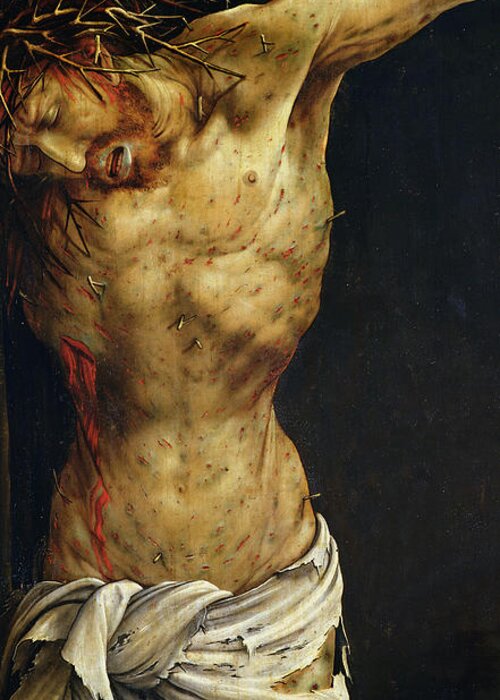
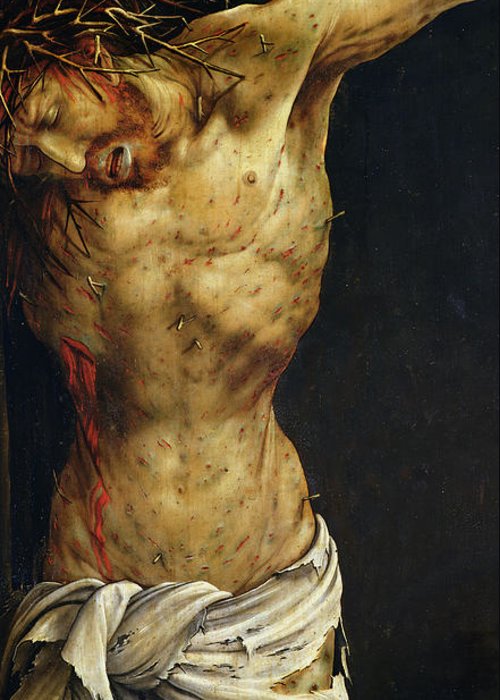
Christ on the Cross, from the Isenheim Altarpiece of Matthias Grünewald (Source)
As part of my Lenten Spirituality Series, here is Dame Julian of Norwich’s meditation on the thirst of Christ, Chapter XVII of Revelations of Divine Love:
“How might any pain be more to me than to see Him that is all my life, and all my bliss, and all my joy suffer?
And in this dying was brought to my mind the words
of Christ: I thirst.
For I saw in Christ a double thirst: one bodily; another spiritual…
For this word was shewed for the bodily thirst: the which I understood was caused by failing of moisture. For the blessed flesh and bones was left all alone without blood and moisture. The blessed body dried alone long time with wringing of the nails and weight of the body. For I understood that for tenderness of the sweet hands and of the sweet feet, by the greatness, hardness, and grievousness of the nails the wounds waxed wide and the body sagged, for weight by long time hanging. And [therewith was] piercing and pressing of the head, and binding of the Crown all baked with dry blood, with the sweet hair clinging, and the dry flesh, to the thorns, and the thorns to the flesh drying; and in the beginning while the flesh was fresh and bleeding, the continual sitting of the thorns made the wounds wide. And furthermore I saw that the sweet skin and the tender flesh, with the hair and the blood, was all raised and loosed about from the bone, with the thorns where-through it were rent in many pieces, as a cloth that were sagging, as if it would hastily have fallen off, for heaviness and looseness, while it had natural moisture. And that was great sorrow and dread to me: for methought I would not for my life have seen it fall. How it was done I saw not; but understood it was with the sharp thorns and the violent and grievous setting on of the Garland of Thorns, unsparingly and without pity. This continued awhile, and soon it began to change, and I beheld and marvelled how it might be. And then I saw it was because it began to dry, and stint a part of the weight, and set about the Garland. And thus it encircled all about, as it were garland upon garland. The Garland of the Thorns was dyed with the blood, and that other garland [of Blood] and the head, all was one colour, as clotted blood when it is dry. The skin of the flesh that shewed (of the face and of the body), was small-rimpled [1] with a tanned colour, like a dry board when it is aged; and the face more brown than the body.
I saw four manner of dryings: the first was bloodlessness;
the second was pain following after; the third,
hanging up in the air, as men hang a cloth to dry; the
fourth, that the bodily Kind asked liquid and there was
no manner of comfort ministered to Him in all His woe
and distress. Ah! hard and grievous was his pain, but
much more hard and grievous it was when the moisture
failed and began to dry thus, shrivelling.
These were the pains that shewed in the blessed head:
the first wrought to the dying, while it had moisture;
and that other, slow, with shrinking drying, [and] with
blowing of the wind from without, that dried and pained
Him with cold more than mine heart can think.
And other pains—for which pains I saw that all is
too little that I can say: for it may not be told.
The which Shewing of Christ’s pains filled me full of
pain. For I wist well He suffered but once, but [this
was as if] He would shew it me and fill me with mind
as I had afore desired. And in all this time of Christ’s
pains I felt no pain but for Christ’s pains. Then thought-me:
I knew but little what pain it was that I asked; and,
as a wretch, repented me, thinking: If I had wist what
it had been, loth me had been to have prayed it. For methought
it passed bodily death, my pains.
I thought: Is any pain like this? And I was answered in my reason: Hell is another pain: for there is despair. But of all pains that lead to salvation this is the most pain, to see thy Love suffer. How might any pain be more to me than to see Him that is all my life, all my bliss, and all my joy, suffer? Here felt I soothfastly [2] that I loved Christ so much above myself that there was no pain that might be suffered like to that sorrow that I had to [see] Him in pain.
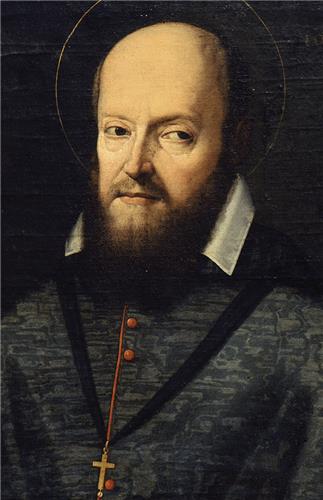
Here is an extremely amusing (and, in its own way, edifying) little chapter from Introduction to the Devout Life. I’ve only just encountered it by chance. It’s passages like this that rather make one understand why Evelyn Underhill summed up his teaching in the one line, “Yes, indeed, my dear Duchess, as Your Grace so truly observes, God is love.”
One can almost hear the Gentleman Saint sipping his tea at the end of each numbered item in the list below.
CHAPTER XXXIII. Of Balls, and other Lawful but Dangerous Amusements.
DANCES and balls are things in themselves indifferent, but the circumstances ordinarily surrounding them have so generally an evil tendency, that they become full of temptation and danger. The time of night at which they take place is in itself conducive to harm, both as the season when people’s nerves are most excited and open to evil impressions; and because, after being up the greater part of the night, they spend the mornings afterwards in sleep, and lose the best part of the day for God’s Service. It is a senseless thing to turn day into night, light into darkness, and to exchange good works for mere trifling follies. Moreover, those who frequent balls almost inevitably foster their Vanity, and vanity is very conducive to unholy desires and dangerous attachments.
I am inclined to say about balls what doctors say of certain articles of food, such as mushrooms and the like—the best are not good for much; but if eat them you must, at least mind that they are properly cooked. So, if circumstances over which you have no control take you into such places, be watchful how you prepare to enter them. Let the dish be seasoned with moderation, dignity and good intentions. The doctors say (still referring to the mushrooms), eat sparingly of them, and that but seldom, for, however well dressed, an excess is harmful.
So dance but little, and that rarely, my daughter, lest you run the risk of growing over fond of the amusement.
Pliny says that mushrooms, from their porous, spongy nature, easily imbibe meretricious matter, so that if they are near a serpent, they are infected by its poison. So balls and similar gatherings are wont to attract all that is bad and vicious; all the quarrels, envyings, slanders, and indiscreet tendencies of a place will be found collected in the ballroom. While people’s bodily pores are opened by the exercise of dancing, the heart’s pores will be also opened by excitement, and if any serpent be at hand to whisper foolish words of levity or impurity, to insinuate unworthy thoughts and desires, the ears which listen are more than prepared to receive the contagion.
Believe me, my daughter, these frivolous amusements are for the most part dangerous; they dissipate the spirit of devotion, enervate the mind, check true charity, and arouse a multitude of evil inclinations in the soul, and therefore I would have you very reticent in their use.
To return to the medical simile;—it is said that after eating mushrooms you should drink some good wine. So after frequenting balls you should frame pious thoughts which may counteract the dangerous impressions made by such empty pleasures on your heart.
Bethink you, then—
1. That while you were dancing, souls were groaning in hell by reason of sins committed when similarly occupied, or in consequence thereof.
2. Remember how, at the selfsame time, many religious and other devout persons were kneeling before God, praying or praising Him. Was not their time better spent than yours?
3. Again, while you were dancing, many a soul has passed away amid sharp sufferings; thousands and tens of thousands were lying all the while on beds of anguish, some perhaps untended, unconsoled, in fevers, and all manner of painful diseases. Will you not rouse yourself to a sense of pity for them? At all events, remember that a day will come when you in your turn will lie on your bed of sickness, while others dance and make merry.
4. Bethink you that our Dear Lord, Our Lady, all the Angels and Saints, saw all that was passing. Did they not look on with sorrowful pity, while your heart, capable of better things, was engrossed with such mere follies?
5. And while you were dancing time passed by, and death drew nearer. Trifle as you may, the awful dance of death must come, the real pastime of men, since therein they must, whether they will or no, pass from time to an eternity of good or evil. If you think of the matter quietly, and as in God’s Sight, He will suggest many a like thought, which will steady and strengthen your heart.
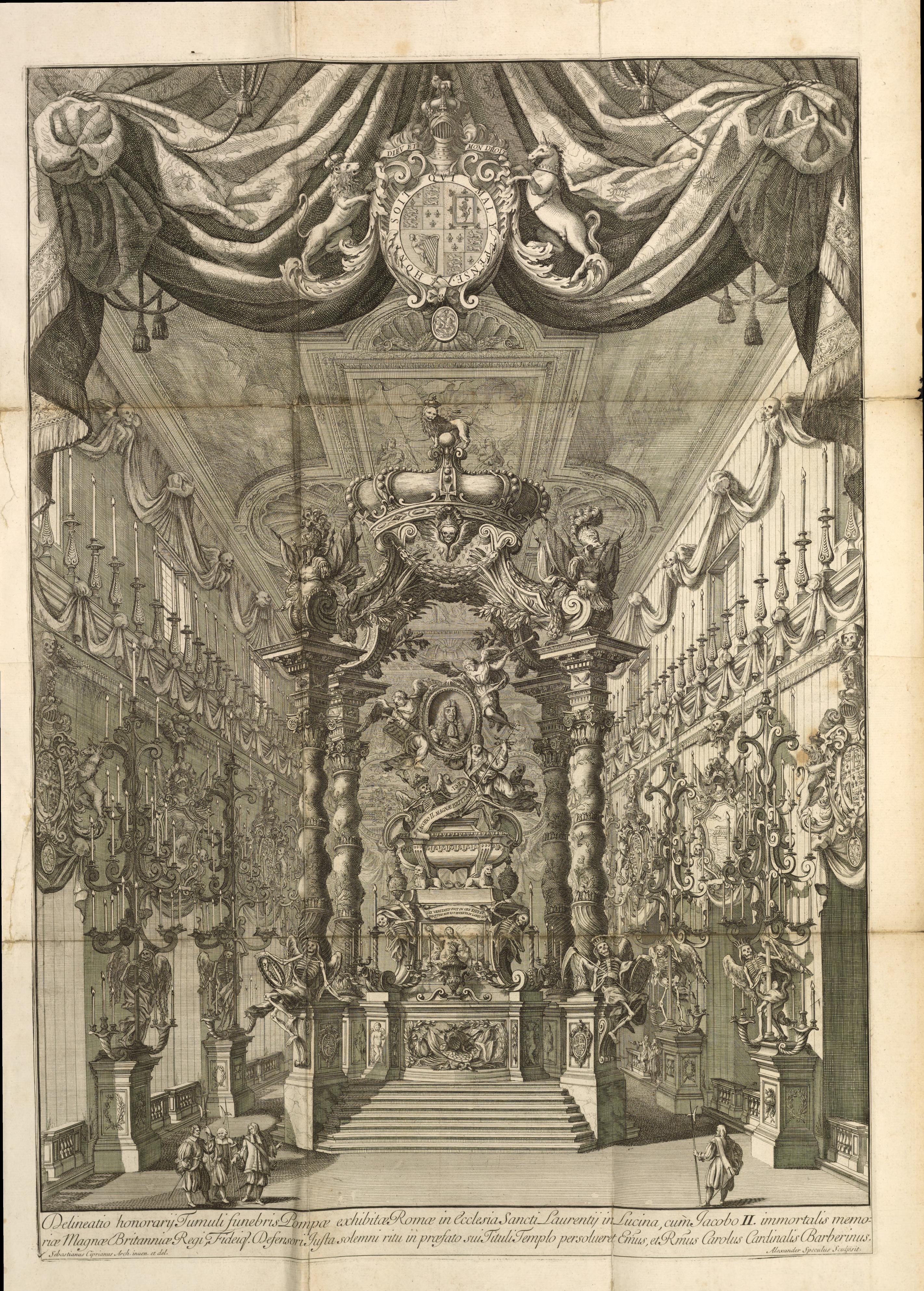
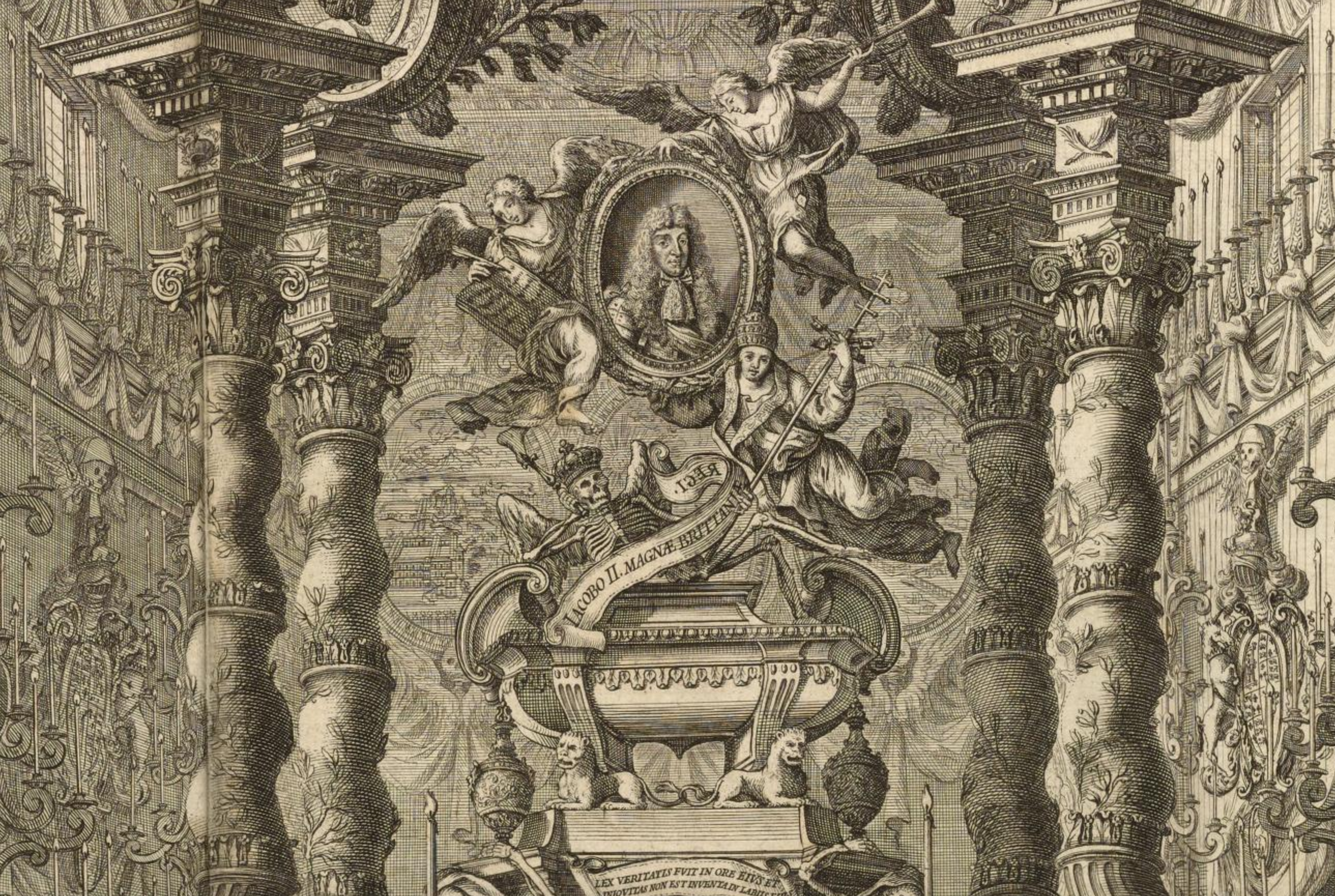
Frontispiece of the Sacra Exequialia. Note the skeletons at the base of the candelabra and baldachin columns. (Source)
A forgotten Latin text of 1702, the Sacra Exequialia in Funere Jacobi II, provides some wonderful views of early modern Catholic funerary rites. Or at least, as those rites were employed for dead monarchs. The central text is Cardinal Barberini’s funeral oration for the king at Rome. Fun fact: if you Google “Exequialia,” it’s the first and one of the only results. While it may not be a hapax legomenon, it’s the sort of rare word that makes epeolaters and logophiles drool.
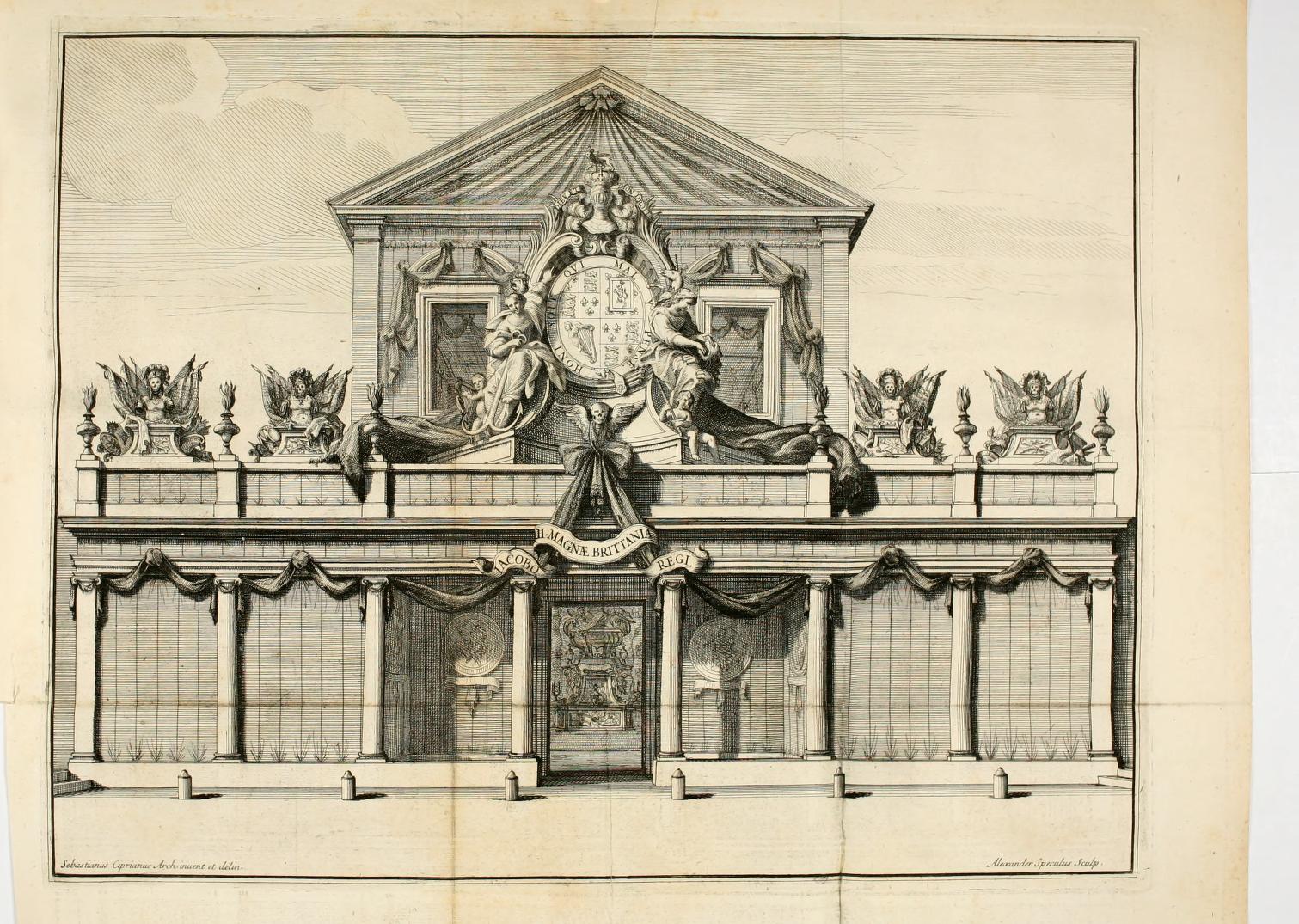
At any rate, I’m not writing this post because of Barberini’s text. The book’s more delicious feature is its several illustrations, including the wild Baroque decoration of the church of San Lorenzo in Lucina as well as several emblems.
The decorations of San Lorenzo in Lucina for the occasion. (Source)
Of course, James II died in Paris and buried in the English Benedictine church there. It is a testament to the respect he was held in by the Papal court that a Cardinal of such standing as Carlo Barberini, Archpriest of the Vatican Basilica, should preach an oration for him in Rome.
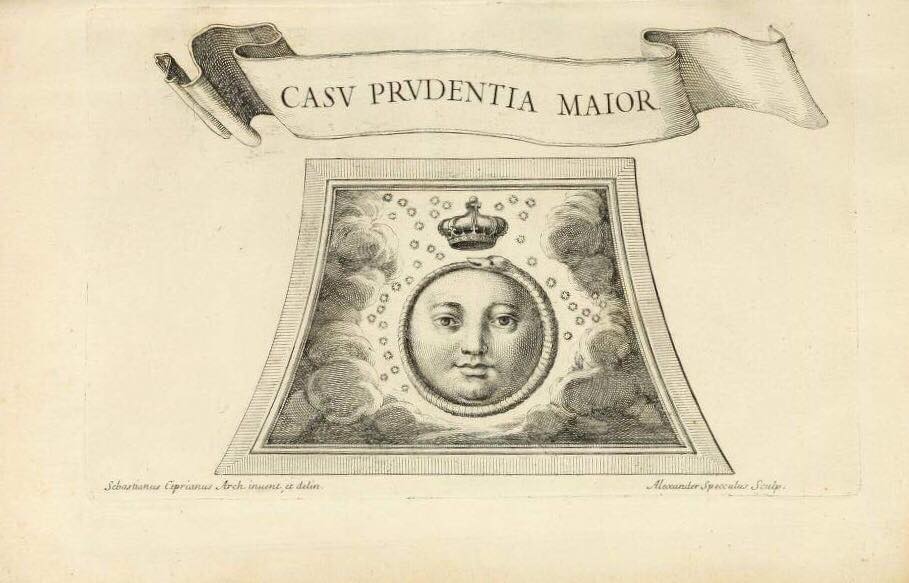
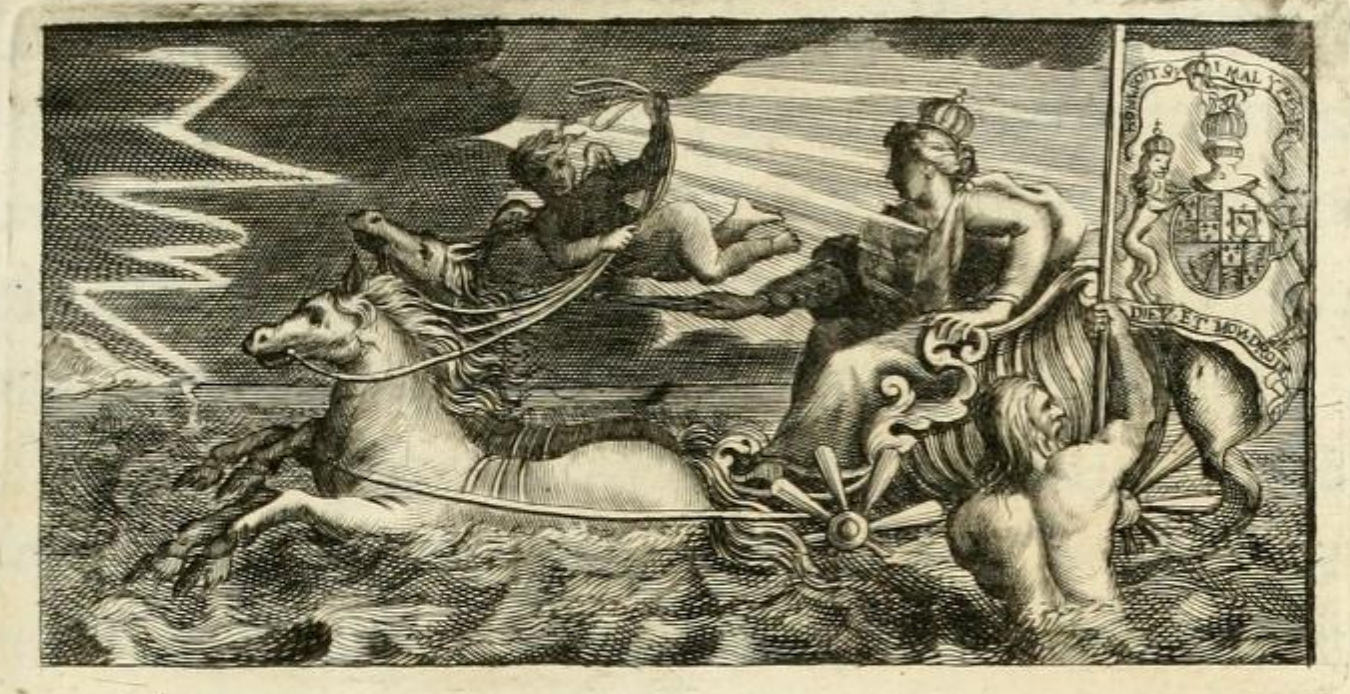
One of the marvellous emblems in the text. Note the Ouroboros. (Source)
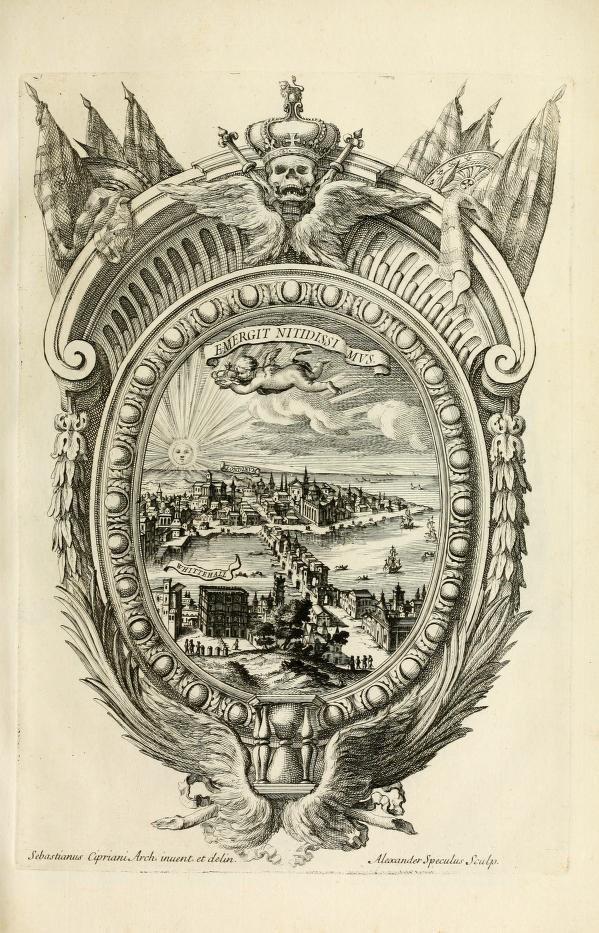
An image of London. There are similar views of Paris and Rome. All were at hung at the high altar behind the catafalque and its baldachin. (Source)
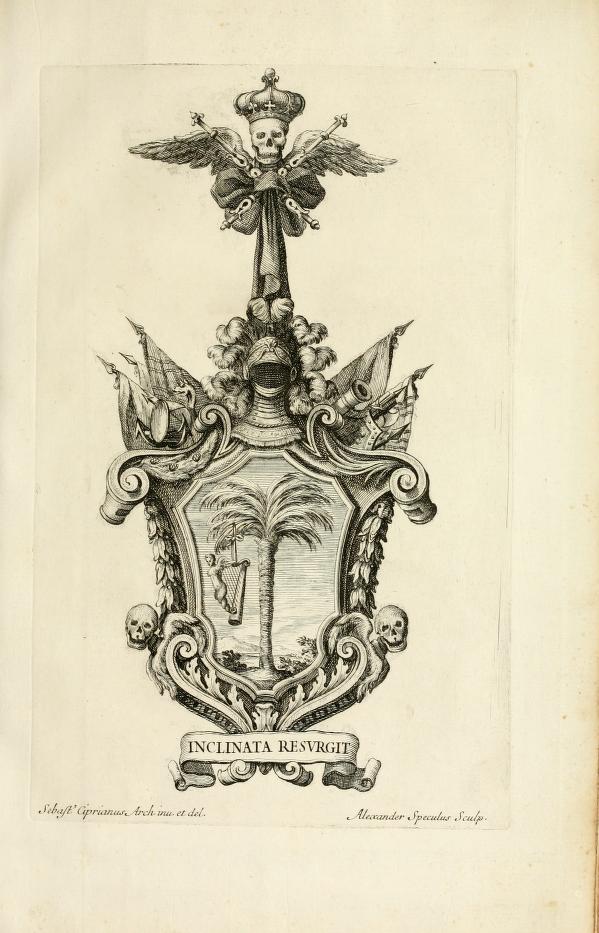
Another moral emblem. I’m particularly fond of this one as the harp recalls not only the exile in Babylon (and thus the Jacobite exile) but also the valiant Irish defense of James’s claim to the throne in 1689. These also would have adorned the walls of the church alongside the King’s arms. (Source)
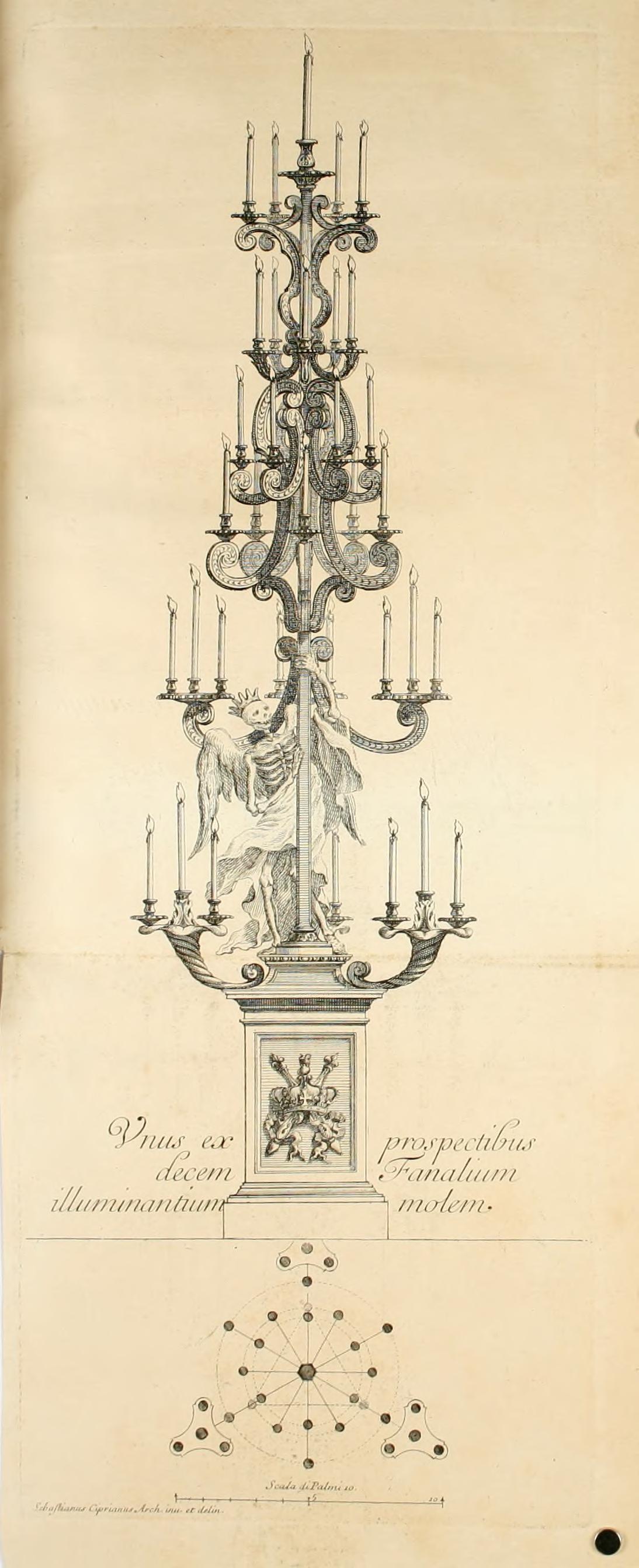
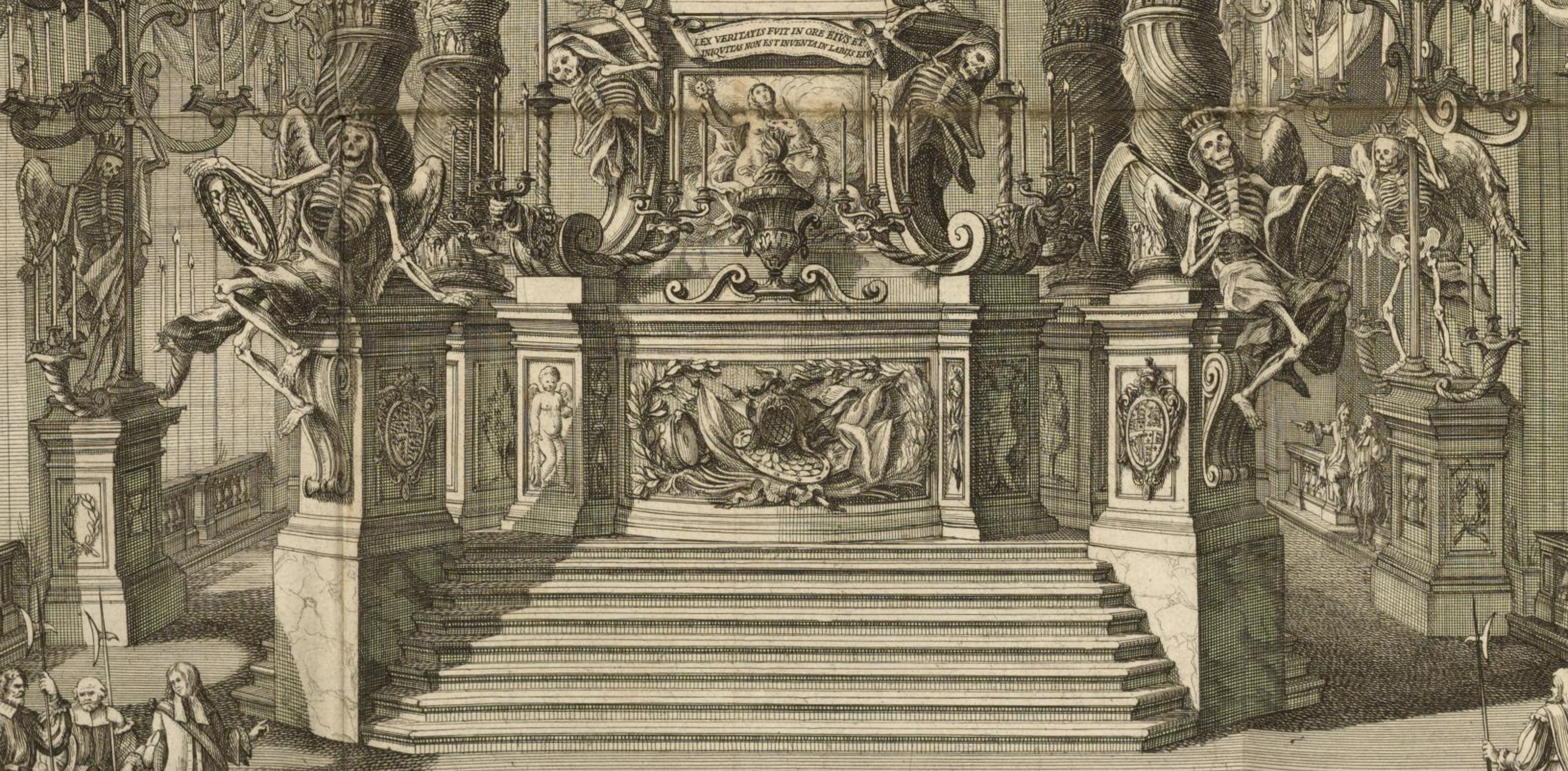
A closer view of the skeletal flambeaux. One can never have too many at a funeral. (Source)
Jacobite emblem accompanying the text of the Oration. (Source)
A closer view of the frontispiece. Note the Pope flying over the catafalque. (Source)
Here you can see the spooky scary skeletons all around the room. (Source)
There are some very exciting publications coming out soon…especially for those of us who study religion in the early modern period.
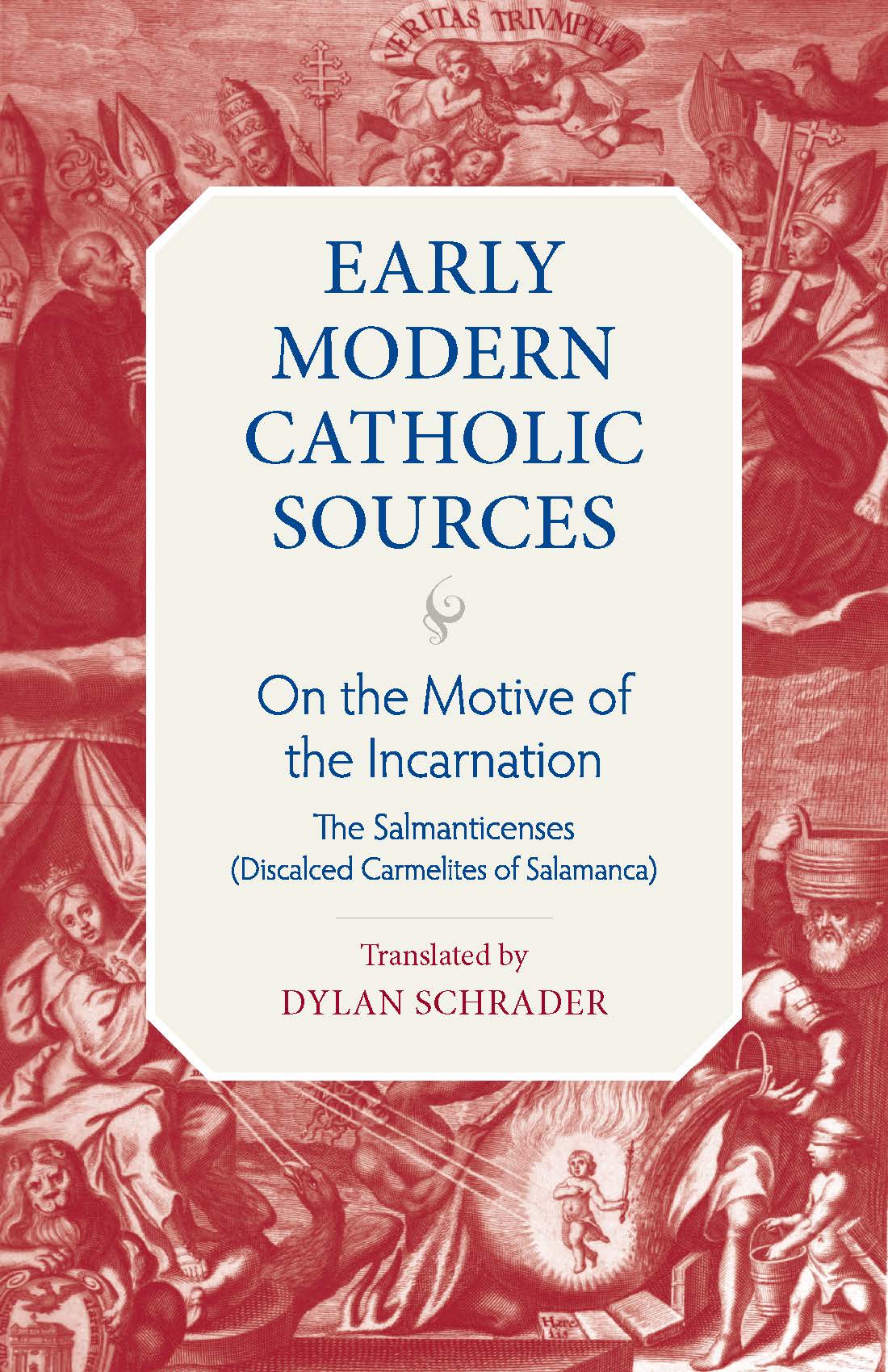
First, there’s a new series from CUA Press on Early Modern Catholic Sources, edited by Ulrich Lehner and Trent Pomplun. The first volume covers Christological debates among the Discalced Carmelites of the School of Salamanca. I think it’s a fair assumption that this material has never been translated before. The first volume should appear in 2019.
Second, and more germane to my own work, we have Jeffrey Burson’s very promising intervention into the perennial “Enlightenment” v. “Enlightenments” debate. His new book, Culture of Enlightening: Abbé Claude Yvon and the Entangled Emergence of the Enlightenment, is scheduled to be released from Notre Dame Press in May 2019. Burson has already established himself as a major scholar of the Catholic Enlightenment, and his newest foray promises to be his most ambitious work yet.
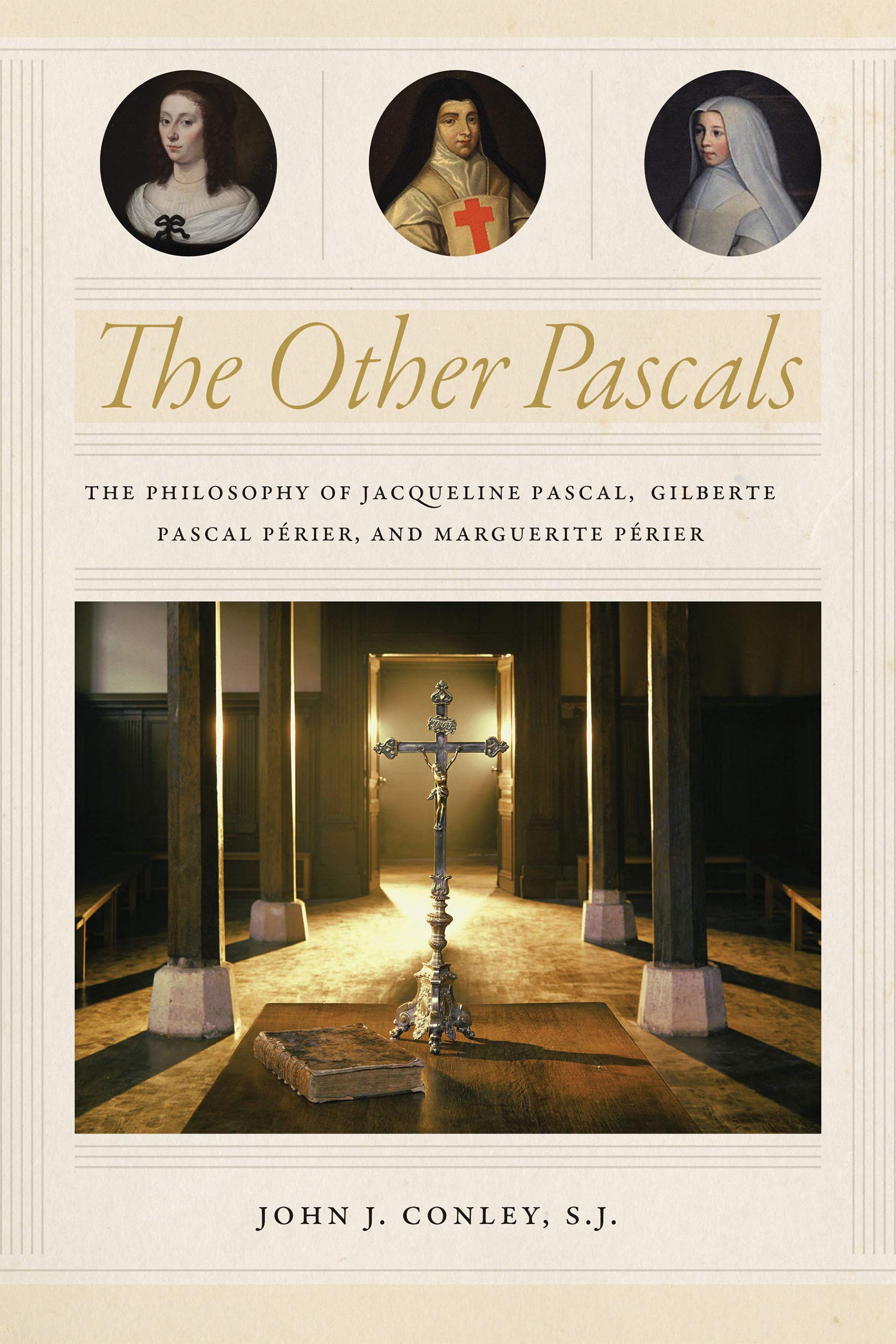
For those of you who, like me, take an interest in the Jansenists and in early modern Catholic women, you’ll be happy to know that there’s a new study of Pascal’s sisters by Rev. John J. Conley, S.J. The Other Pascals: The Philosophy of Jacqueline Pascal, Gilberte Pascal Périer, and Marguerite Périer, another ND Press piece slated for an April 2019 release, will no doubt shed new light on these fascinating figures. Conley has done important work before on Catholic women in the 17th century – I look forward to his newest treatment of the subject.
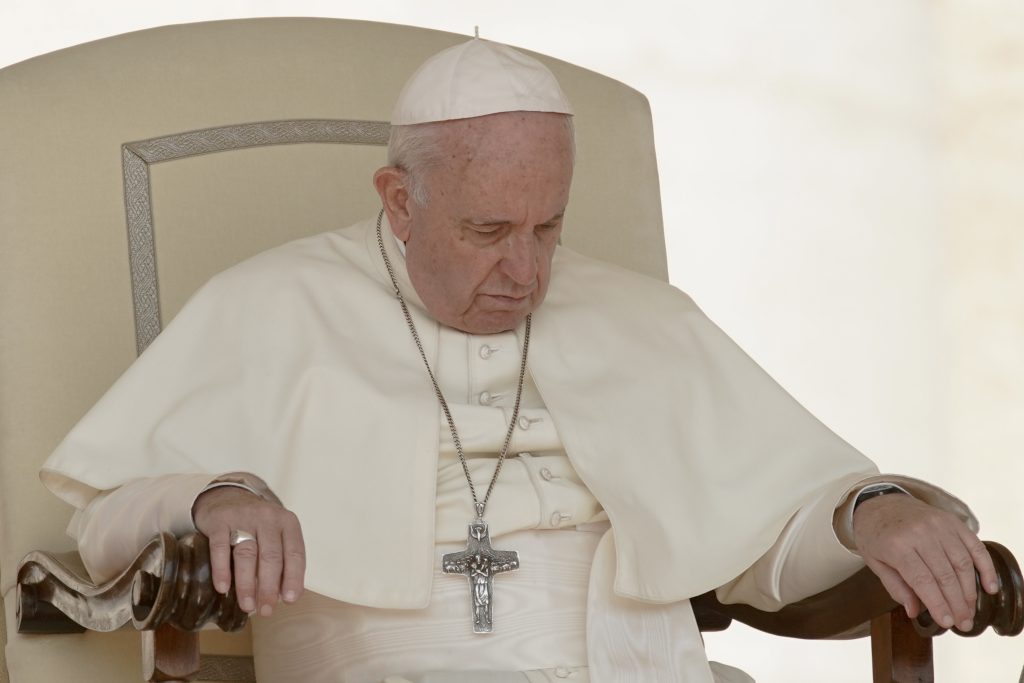
Let it never be said that His Holiness does not contain multitudes. Consider the following:
“It is not healthy to love silence while fleeing interaction with others, to want peace and quiet while avoiding activity, to seek prayer while disdaining service.” – Pope Francis, Gaudete et Exultate 26
Pope Francis, 3rd of September 2018: “With people who don’t have good will, who seek only scandal, who want only division, who seek only destruction — including within the family: silence, prayer.”
Quelle surprise!
(C.C. Pecknold and I seem to have noticed the same point independently. Great minds and all that)
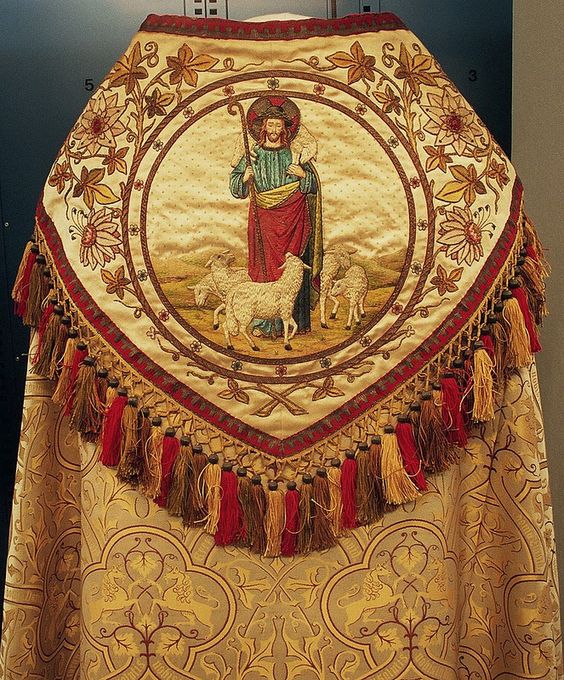
I realize that technically last week was Good Shepherd Sunday in the traditional calendar, but as most of the Catholic world (alas) celebrates it tomorrow, I thought I’d offer up this truly dismal hymn from Fr. Faber. I have never yet heard it set to music, so if any of my readers happen to know of a recording, I would appreciate them kindly sharing it. Fr. Faber is one of my favorite spiritual writers and hymnodists…even when he’s outlandishly bad.
The True Shepherd
Fr. Frederick William Faber
I was wandering and weary
When my Saviour came unto me;
For the ways of sin grew dreary
And the world had ceased to woo me:
And I thought I heard Him say,
As He came along His way,
O silly souls! come near Me;
My sheep should never fear Me;
I am the Shepherd true.
At first I would not hearken,
And put off till the morrow;
But life began to darken,
And I was sick with sorrow;
And I thought I heard Him say,
As He came along His way,
O silly souls! come near Me;
My sheep should never fear Me;
I am the Shepherd true.
At last I stopped to listen,
His voice could not deceive me;
I saw His kind eyes glisten,
So anxious to relieve me:
And I thought I heard Him say,
As He came along His way,
O silly souls! come near Me;
My sheep should never fear Me;
I am the Shepherd true.
He took me on His shoulder,
And tenderly He kissed me;
He bade my love be bolder,
And said how He had missed me;
And I’m sure I heard Him say,
As He went along His way,
O silly souls! come near Me;
My sheep should never fear Me;
I am the Shepherd true.
Strange gladness seemed to move Him,
Whenever I did better;
And he coaxed me so to love Him,
As if He was my debtor;
And I always heard Him say,
As He went along His way,
O silly souls! come near Me;
My sheep should never fear Me;
I am the Shepherd true.
I thought His love would weaken,
As more and more He knew me;
But it burneth like a beacon;
And its light and heat go through me;
And I ever hear Him say,
As He goes along His way,
O silly souls! come near Me;
My sheep should never fear Me;
I am the Shepherd true.
Let us do then, dearest brothers!
What will best and longest please us,
Follow not the ways of others,
But trust ourselves to Jesus;
We shall ever hear Him say,
As He goes along His way,
O silly souls! come near Me;
My sheep should never fear Me;
I am the Shepherd true.
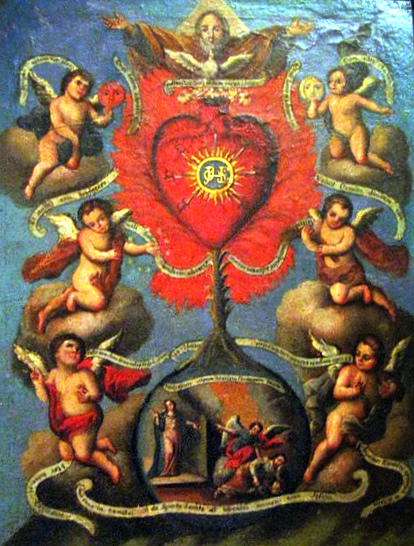
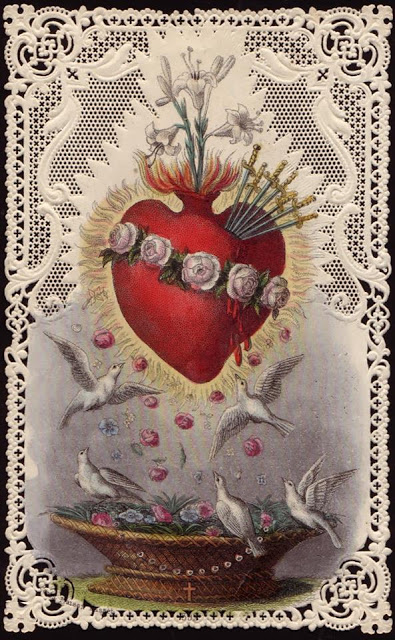
May the Sorrowful and Immaculate Heart of Mary pray for us. (Source)
“To begin and end well, devotion to our Blessed Lady, the Mother of God, is nothing less than indispensable.” – St. Philip Neri, Maxims.
Five years ago, I was received into the Roman Catholic Church at the Easter Vigil. The journey since then has been an adventure, to say the least. Not all of it has been good. I’ve continued to make lots of mistakes, often failing in faith, hope, charity, and all the other virtues. Individual Catholics have often disappointed me. There were moments of doubt along the way, and, like the infamous Pillar of Salt, I am no stranger to the occasional backwards glance.
But in reflecting on those five years, the overwhelming feeling is one of gratitude. The many wonderful people I have met – and, more importantly, the graces I have received – have confirmed for me the essential soundness of my choice. I have no regrets. I only wish more people could know the abiding peace that comes with conversion to the Church that Christ established on St. Peter. And having consecrated myself to Mary, I feel as if I have had a new strength in the spiritual life since last Summer.
Thus far, I have dedicated each year to some mystery of the Faith. It is in that same spirit that I consecrate this sixth year of my Catholic life to the Sorrowful and Immaculate Heart of Mary. I pray that by her triumphant heart, she will continue to guide me to a more perfect knowledge of Her Father, Son, and Spouse. As St. Philip says, “Our Blessed Lady ought to be our love and consolation.” I hope that she ever will be mine.
And thus on this Good Friday, I beg your prayers and those of the saints, that I might persevere in the faith and grow in the love of God.
Most Sacred Heart of Jesus, pray for us.
Our Lady Immaculate, pray for us.
St. Joseph, pray for us.
St. Philip Neri, pray for us.
‘Catholicity, Antiquity, and consent of the Fathers, is the proper evidence of the fidelity or Apostolicity of a professed Tradition’ J.H. Newman, Lectures on the Prophetical Office of the Church, 1837, p. 51






 The Amish Catholic