I reproduce below an adaptation of the notes I took after each episode of The New Pope, which were then posted in a private Facebook group of like-minded Catholics dedicated to the series. Rather than give a full summary evaluation of The New Pope, I thought readers would find this more process-based approach to be interesting, as it shows how my reactions changed over time. That said, I may post something a bit more all-encompassing later. A word of warning: what follows is spoiler-heavy.
Thoughts on Episode 1:
1) It’s gorgeous as ever.
2) Somehow I don’t get the impression that Paolo Sorrentino is very impressed with this pontificate.
3) I guffawed at the video game scene.
4) Looks like this season is going to be, at least in part, an homage to Hadrian the Seventh.
5) I was surprised by how rooted this season is in Italy’s migration crisis
6) The music continues to be brilliant.
7) Silvio Orlando really is an underrated actor.
8) Honestly I thought to myself “Neon Baroque could be my new aesthetic.”
Thoughts on Episode 2:
1) Sorrentino doesn’t understand the English. He has made Brannox into a French decadent, not an English ecclesiastical peer. Though this episode makes me want to see Malkovich as Huysmans.
2) Gutierrez remains the best character.
3) We start to see again Sorrentino’s spiritual tendency for short, sometimes aphoristic enunciations of truth.
4) The continuing importance of the terrorist message makes me suspect Brannox will end like Hadrian VII, only with a jihadist in place of an Ulsterman.
5) Speaking of which, interesting echoes of a lot of English Catholic literary tradition here: Hadrian the Seventh, Newman, Brideshead, even arguably Oscar Wilde.
6) I can’t tell whether the line about the Church “thinking” is a criticism or not. I suspect it’s like Greenland’s ice.
7) Loneliness remains one of the central themes of the series.
Thoughts on Episode 3:
1) The last scene(s) manage at once to be extremely Baroque and extremely Gothic. I was reminded of Ann Radcliffe and Matthew Lewis.
2) Malkopope has arrived, he’s screaming, and I am so here for it.
3) I remain surprised by Sorrentino’s political imagery here. The massacre in Somalia is not the sort of thing one is used to seeing on HBO.
4) Fabiano looks like Michael Jackson and reminded me of the Purple Man in The Violent Bear It Away.
5) It’s still all about loneliness.
6) JP3 is an interesting choice of name. In view of his two speeches, I wonder if the emphasis on “fragility” is in some sense evoking JP2 specifically. Regardless, I suspect it foreshadows something yet to come, or perhaps some secret we have yet to learn.
7) The Meghan Markle jokes were great. Sorrentino’s much funnier – or rather, telling a lot more jokes – in this season.
8 ) Love the dwarf abbess. I wonder if the scene where she’s smoking is a reference to Nasty Habits?
Thoughts on Episode 4:
1) Kind of a boring episode overall.
2) We’re in the slump of sin, where all the characters are at their lowest. Or at least will soon be.
3) Cardinal Assente dancing at the end was fun, but also strangely sad. He’s dancing alone. There is a poignant metaphor here – I was reminded of some of the sadder passages in Frédéric Martel.
4) The Marilyn Manson bit and the further Meghan Markle jokes were hilarious.
5) Return of the Willendorf Venus!
6) This is such a continental show.
7) Malkopope is really starting to grow on me.
8) Gutierrez remains the best because he repents of his sin immediately and receives sacramental absolution.
9) The scene with the gropey priest is like something out of a bad French novel of the 1760s.
10) With Sister Lisette et al., I think Sorrentino is satirizing activist nuns.
Thoughts on Episode 5:
1) Really getting the impression that Sorrentino is a low-key reactionary. Giving a fair explanation of Catholic teaching on homosexuality, implicitly deriding the banality of contemporary Catholic artistic culture, discussion of jihadist attacks on Christians in Europe? Obviously this might reverse in future episodes, but it’s noticeable at this point.
2) Finally getting some proper Sorrentinean surrealism at last.
3) Favorite line in the whole episode came from Sophia – “The Pope produces symbols. The vulgar act of interpretation must fall to others.”
4) The scene with Girolamo and Don Mimmo was beautiful, and I thought, quite moving.
5) I just noticed that Sophia’s name is…well, Sophia. I’m starting to wonder if this is meaningful.
6) Pursuant to point (1) above, I think it’s telling that Gutierrez’s ongoing fling (affair?) with Freddy coincides with a relapse in his alcoholism. This is astounding, given that today the normal depiction of such a relationship would be as a celebration of liberation. Sorrentino suggests it’s the opposite.
7) Disappointed that the strategy is not to “punish” pedophiles, though perhaps the emphasis there was more on adult sexual scandals…?
8) Also Gutierrez in general has been sorely neglected on the whole. He’s not moving the plot anywhere. At all.
9) Based on what I’ve seen so far, I do think Sorrentino is commenting on church politics a good deal more here than he did in The Young Pope. Francis II, Sr. Lisette’s strike, JP3’s elevation of a manifestly corrupt Cardinal…these all have wider resonances in recent church history. And I do wonder whether the cult of Lenny Belardo is in some sense a moment where Sorrentino is reflecting on some of the reception of the show itself.
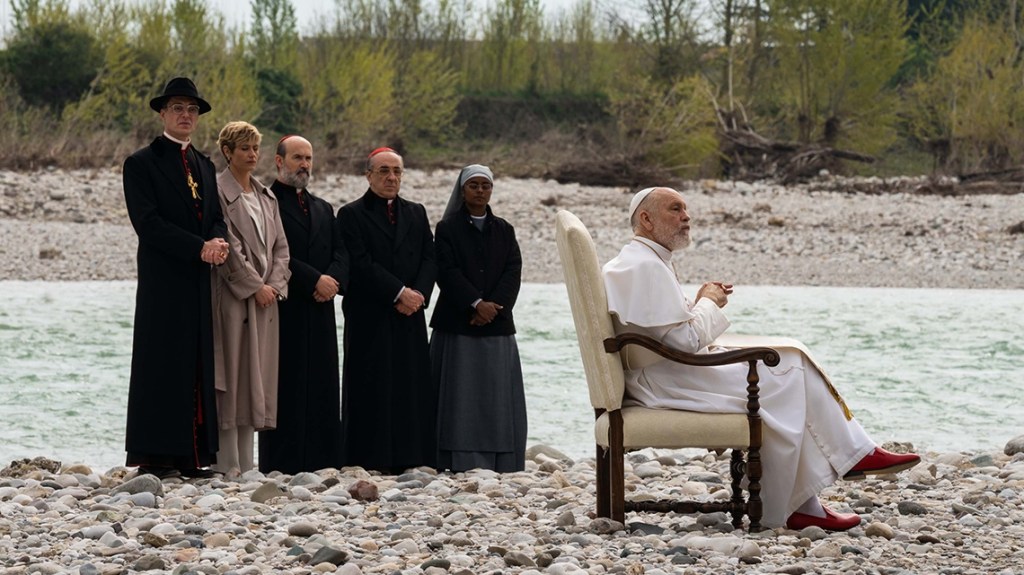
10) The “No!” at Lourdes reminds me of John Paul II’s “We want God” moment in Poland.
Thoughts on Episode 6:
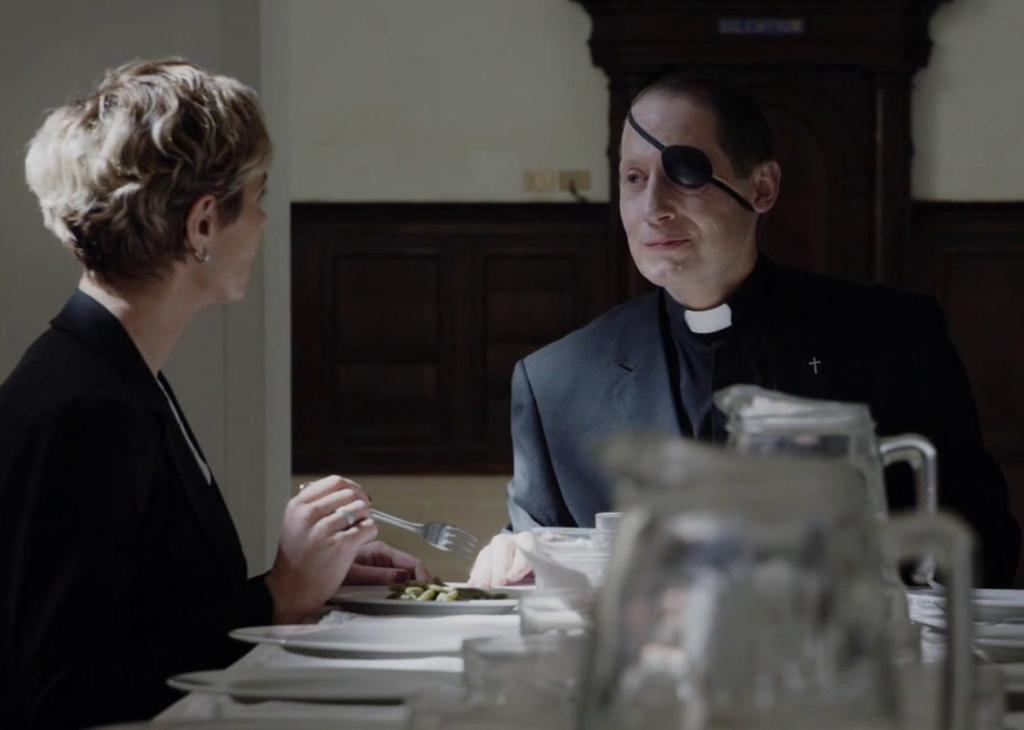
1) Fr Leopold Essence is probably the devil but he mainly reminded me of the Cowboy from Mulholland Drive. He’s literally an accuser, and he accuses by drawing attention to distorted love.
2) He’s an American, too. The only other major American character in this show, without Sister Mary, is Lenny. Is Lenny then the most intelligent man on earth?
3) Wasn’t there some 19th c. Ultramontane who made a comment about the Pope being the most intelligent man on earth because of the charism of infused infallible knowledge?
4) So God is a millipede and the devil is a cockroach?
5) Relatedly, that opening scene is so well shot. It’s just a master class in cinematic art.
6) The dancing midget nun is giving Cardinal Essente a run for his money
7) Creepy old incest mom has a German accent. This seems potentially significant. Atanasio (interesting, unusual name) has had “Nature turn against him.” All of Esther’s storyline, up to now largely detached from the main plot, feels increasingly like a parable. In any other hands it would all seem really very trite like some cheap Victorian novel. But Sorrentino somehow elevates it.
8) Voiello’s sidelining under JP3 reminds me of the similarly disastrous personnel decisions made by JP2
9) The Kabul exile of Hernandez reminds me of Bugnini
10) “There is no room left for poetry” – a great line and a cutting diagnosis. Also, the fact that this line comes where it does in that scene confirms my hypothesis about the broader point of the nuns being a satire of activist sisters as well as liberal/feminist Catholics more generall
11) I wonder if that same line can be taken as a Sorrentinean commentary on gender relations writ large? The struggle for rights has deprived us of poetry…
12) What a surprise; wealthy incest lady is also a racist. She also has a perverse vision of sanctity based on “human warmth.” Interesting.
13) There’s an interesting parallel between Brannox’s interview and Lenny’s Venice speech. Both collapse in their separate ways while their disapproving parents are (potentially) watching.
14) I called the drug addiction early on.
15) This addiction puts Brannox in an interesting parallel with Gutierrez.
16) The moment when Atanasio embraces Esther is I think when that storyline really changed. It was such a terribly sad moment…one could suddenly see past the sexuality of it and instead perceive the fundamental tragedy of the situation, the total lack of human connection and the joyous simplicity of human touch. And yet it also reinforces the underlying loneliness of all parties involved.
17) Good to see Lenny’s still a Saint.
18) Spalletta, thy name is Dziwisz.
19) Increasingly I think Hernandez was invented to de-Sodanoize Voiello for the Italian audience. Voiello in Season 2 gets to engage in the heroic acts that Voiello in Season 1 (clearly modeled on Sodano and Bertone) never could.
20) Voiello really kinda is the center of the whole series isn’t he? In sort of the same way that the bureaucracy or the civil service outlasts pontificates.
21) Brannox on evil, like Brannox on tenderness, really reminds me of JP2 in his more anti-communist and moralistic moments.
22) Sex is so sad in this show.
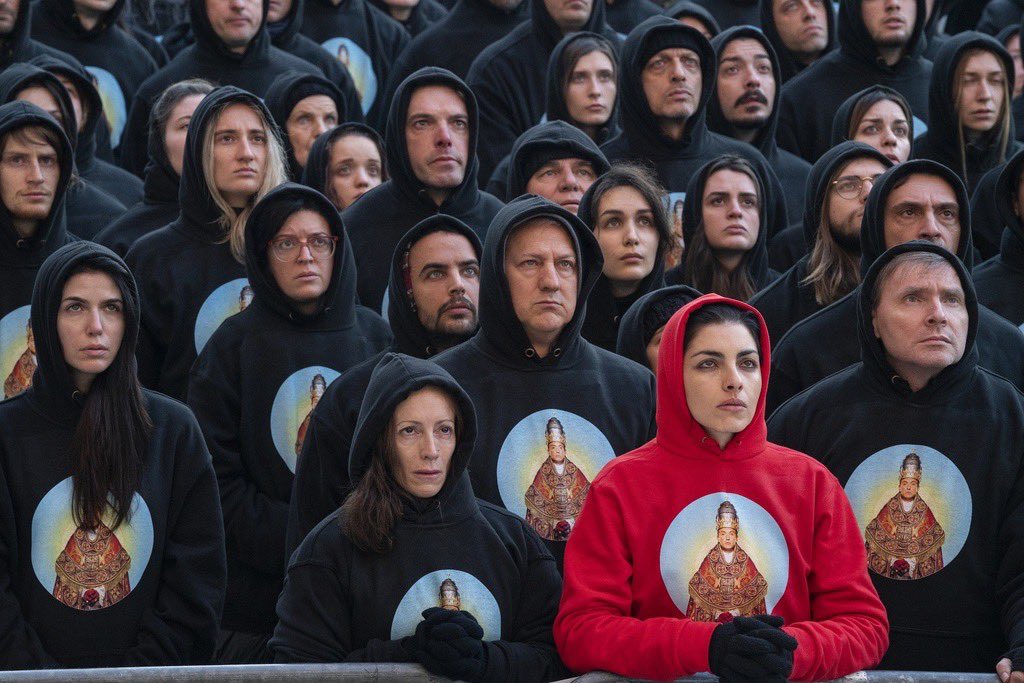
23) It occurred to me for the first time how silly those Lenny sweatshirts are. He never allowed himself to be photographed, so how did they get a photo of him in cope and tiara? Little details that get overlooked…
Thoughts on Episode 7:
1) I was struck by how Sorrentino uses motion and stillness in this episode. When we meet the doctor’s wife, she is rigid and almost lifeless. As she becomes more open to happiness again, she’s able to walk like a model again – to walk beautifully, even artistically. Yet upon her return to her son, she returns to a statuesque stillness. The difference is that now, her stillness is itself artistic – a close imitation of the Pietà, seen a few times throughout the episode. It’s as if there’s a return to suffering, but now it has been transfigured into a kind of beauty (by grace?).
2) A Pope paralyzed by his own physiological problems, surrounded by evil counselors, and unable or unwilling to respond to crimes in the church? No wonder they named Malkopope John Paul III.
3) I’m somehow strangely reassured by the fact that Lenny is the same old Lenny.
4) Really getting tired of all the magical disabled people tropes. Eric is the fourth or fifth this season alone.
5) Venice at night is so typically Sorrentinean. I was reminded of “Youth.”
6) Gutierrez remains the soundest bearer of truth. His words in the confessional were, I thought, quite moving.
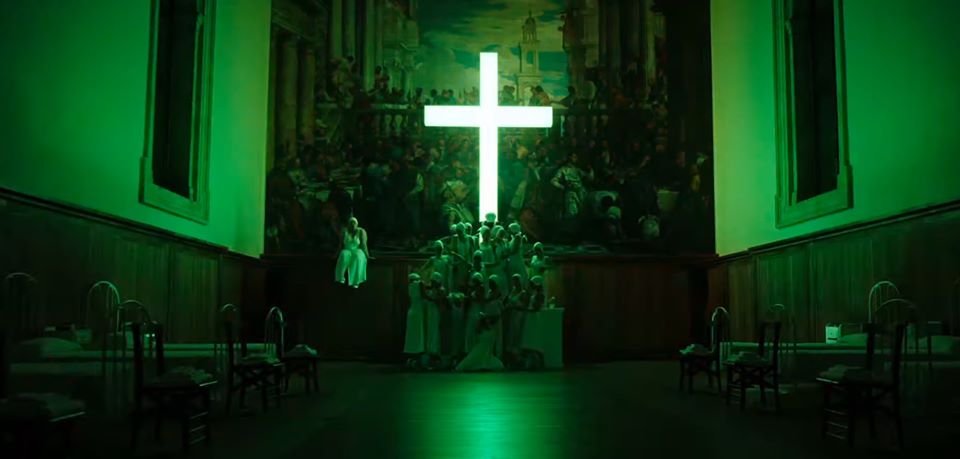
7) The “Purification” scene was aesthetically stunning. It was as if Gustav Klimt and Anselm Kiefer had collaborated on a film. The second time I watched it, I struggled not to get emotional. The silent desperation, the simplicity, the beauty – it’s all so moving.
8) Eric’s miracle is the inverse of Sister Antonia’s, I think – both find death at Lenny’s prayers, but one achieves heaven.
9) The opening scene on the heavenly beach was very funny. I also think it was a kind of reverse foreshadowing of the “Purification” scene, the other moment on a beach in this episode.
10) It occurred to me for the first time how fixated Sorrentino is with the upper classes. Almost all of his work focuses on elites. One wonders if he chooses such stories in part just to film in such gorgeous locations as the doctor’s palace.
Thoughts on Episode 8:
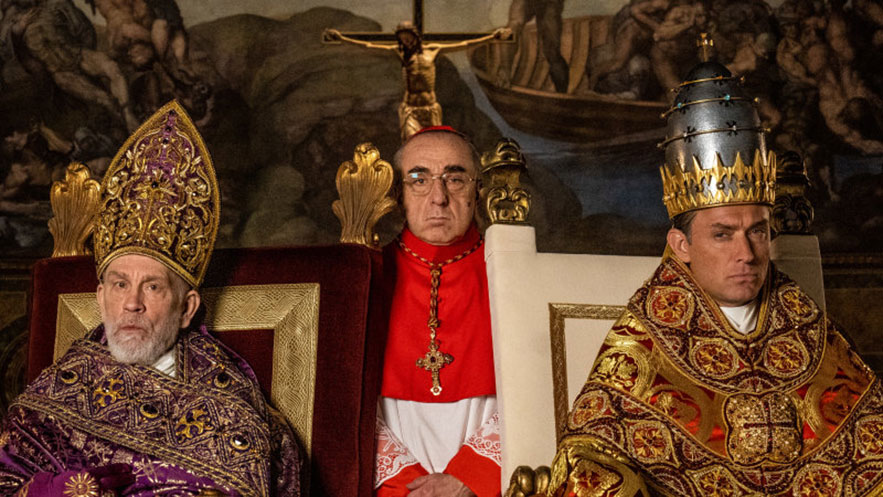
1) I applaud everything Lenny says to the nuns, which is absolutely spot-on. Sorrentino deserves more credit for his understanding of Catholicism.
2) Brannox’s comments on loneliness are one of the more movingly human moments of the series – as are the strange, not-quite-erotic snatches of intimacy between him and Sophia.
3) Voiello’s eulogy was a bit saccharine. Of all the three “speeches” in this episode, his was the weakest. But it was sort of a nice moment of growth for Voiello overall.
4) Assente is awful and I’m glad he got what was coming to him. Voiello proves himself to be that immortal archetype of Italian literature, the crafty, pragmatic priest who snatches victory from the jaws of defeat (I am reminded of Father Pirrone in “Il Gattopardo”).
5) I have reversed my evaluation of Essence. He and Bauer may instead be avenging angels rather than devils, especially in view of their ambush of Spalletta and Co.
6) Why does Bauer use such an outdated phone?
7) Sorrentino really manages to get some beautiful rooms as sets.
8) It really bothers me that the clergy were all wearing the wrong color at the funeral. Requiems – except for Popes – don’t use red! Also, the Latin was incorrect (right?), though I appreciated the effort.
9) One of the key motifs of this episode was the tease. We see moments of relational, almost erotic, teasing from Sophia in her interactions with Brannox at the chalet. Don Camillo’s trick with Assente is a kind of emotional teasing. Lenny teases Voiello with ostensible knowledge about the upcoming football season. There were, I think, a few other examples. I don’t know why Sorrentino relies upon this motif here, but it was really noticeable.
Thoughts on Episode 9:
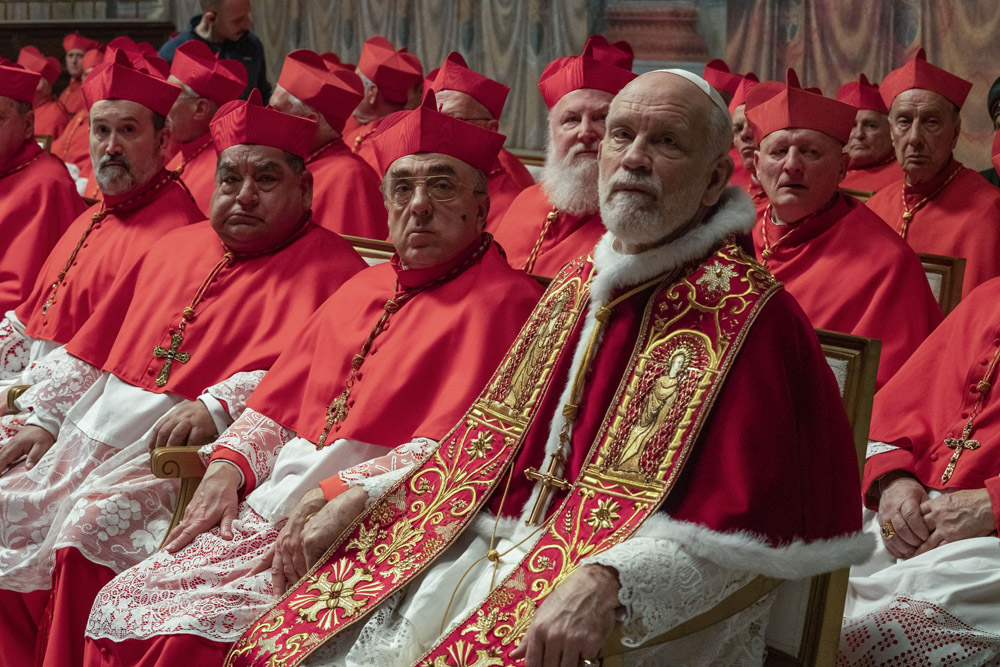
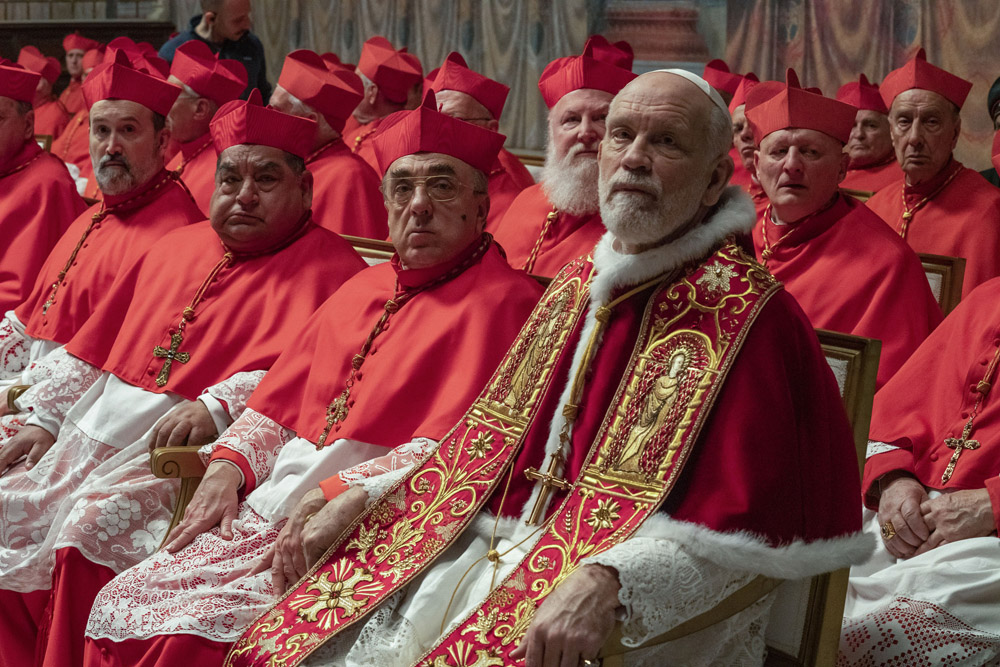
1) That scene in the Sistine Chapel when Pius XIII is lined up with all the cardinals and John Paul III – an extremely powerful aesthetic. Matched only by the Neon Nuns in this season.
2) I really loved Malkovich’s speech from the balcony, which was the strongest in the episode. It was theologically rich, poetic, and delivered in that certain screaming je ne sais quoi that only Malkovich possesses.
3) It occurs to me that there are, as it were, four titular “New Popes” in this series. Francis II, John Paul III, the reformed Pius XIII, and Voiello.
4) The twist with the terrorists is a kind of inversion of Hadrian VII’s ending, which is interesting given the extent to which this season draws upon that narrative throughout.
5) Unclear to me whether Gutierrez (criminally underutilized in this season on the whole) and Brannox have in fact ended up betraying their vows of chastity? We can probably presume the young nun has. Is Sorrentino taking a left turn and endorsing love and sex for all? I don’t know. It would be uncharacteristic and a huge leap from the rest of the series. But perhaps the whole point is in the ambiguity. Isn’t that, after all, the ultimate message of Lenny’s last speech? We don’t have all the answers, and worrying about them too much spoils things.
6) Speaking of speeches, it seems that Sorrentino still doesn’t quite grasp how rhetorical binaries work. Lenny’s “Am I x or am I y” bit echoed the “Are we a or are we b” in the Venice speech on the Blessed Juana. And as then, I’m not sure it really worked.
7) Esther’s story was deeply sad. I’m not totally sure what to make of it – I no longer think it’s a parable (at least not from Episode 7 onward). But it does seem like a critique of a certain kind of an especially Italian devotionalism. It rhymes with his treatment of Tonino Pettola in Season 1, just as Francis II rhymes with Sister Antonia. Sorrentino seems to hate fanaticism.
8) On that note, I absolutely loved the Tonino Pettola call-back at the last shot.
9) I would have liked one last appearance from Leopold Essence since we got so much from Bauer. The scene with the American general was quite funny, though.
10) It seems that, in the end, most of the main characters ended their arc with some kind of love. Brannox gets his parents back. Lenny gets the love of the people, then dies and becomes a real saint. Sophia gets the love of a man she admires (though it’s unclear whether or not their love is sexual). Voiello has a new child to care for, the only love he really knows how to show. Gutierrez may be back with Freddy, but if nothing else, he seems to have kicked his alcoholism and is very happy. Our Romeo and Juliet of the Vatican are reunited with their child. The doctor and his wife are expecting a new baby. Even Bauer is going to marry his escort, like Hosea marrying a prostitute. Perhaps this is the point – the chief thing, the real happy ending, is love. If the question of the series is loneliness, the answer, insofar as we can find one (and Lenny would say the answer belongs to God), is love.
11) And thus, no one except Esther ends up lonely in the end. There seems to be a kind of narrative cruelty in this. But then again, don’t kill priests if you don’t want to go to prison.
12) What the hell was on the walls when Brannox and Lenny have their final confrontation? Very weird, disturbing art.
13) The insistence upon Don Antonio being a “good priest” is encouraging and, I think, representative of Sorrentino’s particular take on Catholicism. Alongside all the aestheticism and insistence on mystery (Pius XIII), there’s both a certain moderation when it comes to the rules (represented by both Voiello and John Paul III) as well as a recognition of real heroism and sacrifice (the various martyrs throughout this season).
14) That said, I think what I most missed in The New Pope was the witty spirituality, that sort of esprit d’escalier of the soul that Sorrentino peppered throughout The Young Pope. There were, to be sure, a few great zingers this season, but nothing that matches “The weight of God” or “Absence is presence” or “What’s under all that ice?” from The Young Pope. Which is odd, I think, since John Paul III seems like an aphoristic character.
15) I guess my other criticism of the season as a whole is that it was, at times, a little too diffuse. Part of what made TYP so powerful was the network of relations radiating out of the fascinatingly complex central character: the agon with his mentor, Cardinal Spencer, the loss of his brother, Dussolier, the foster-motherhood of Sister Mary, the rivalry with Voiello, the unfolding friendship with Gutierrez, and of course, the pain of his abandonment by the parents who leave him again in Venice. Although TYP hardly possesses a linear plot, it at least managed to dive deeply into the psychology and spiritual development of one character. It had a shape. It easily became iconic. But as good as The New Pope is, it doesn’t quite cohere in the same way. It loses itself at times, in part because it’s never quite clear whose story it is.
16) Even the surrealism has been weaker throughout. Remember, the very first scene of TYP is Lenny crawling out of a pyramid of babies at St. Mark’s Square. Where was the equivalent of the kangaroo? A dog doesn’t rise to nearly the same oddity and is thus a far weaker visual and narrative symbol. No one was lusting after the Willendorf Venus this time. No one saw all the Popes of history lined up in a semi-dream sequence (again, another great zinger – “Power is a banal platitude”), or anything like it. The closest we ever got was that absolutely wonderful, Lynchian scene with Leopold Essence and Sophia in the Vatican cantina. More of that would have been salutary.
17) On the whole, though, this was the best thing on television for the last few months, bar none. And even in view of its imperfections, I do think the show says something valuable about Catholicism, about loneliness, and about love. Although COVID certainly complicates this – and I’m not sure it’s strictly necessary – I think I would like to see a third season about Voiello’s papacy. We shall see.


 The Amish Catholic