For Blessed John Henry Newman

john-henry-newman

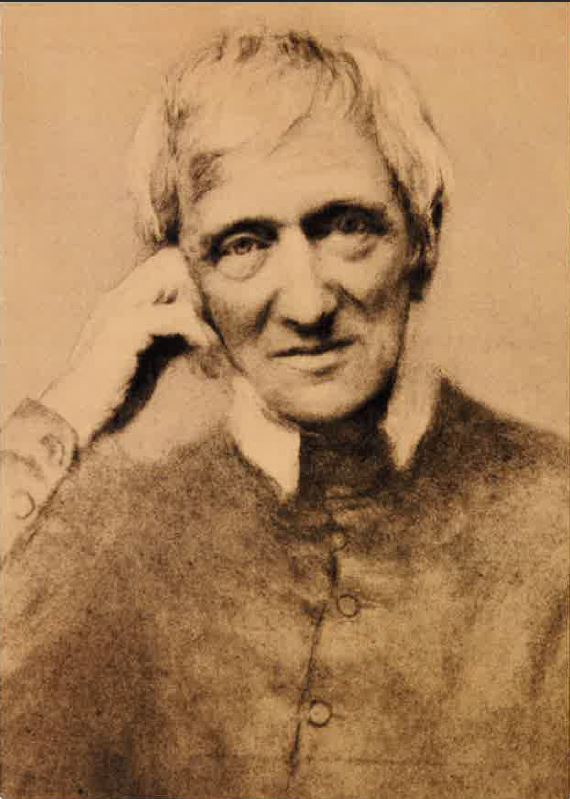
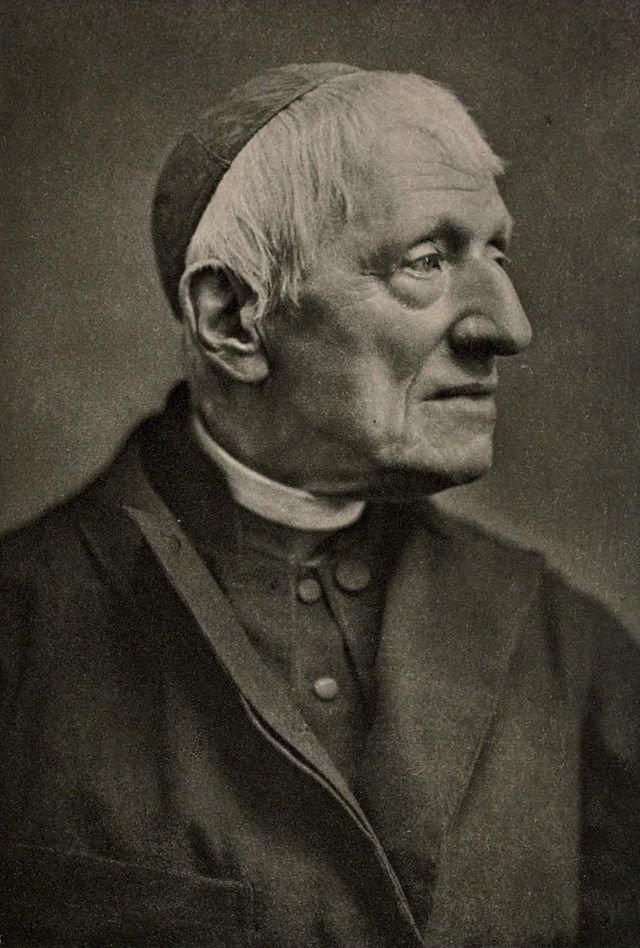
Bl. Newman in his Oratorian habit (Source).

There is so much I could write about Cardinal Newman, on this, his feast day. I have, indeed, already written posts about him many times in the past. But now that courses are starting, I don’t find that I can say as much as I would perhaps like. I also write this essay in some state of exhaustion, having just completed the walking pilgrimage from the Oxford Oratory to Littlemore in honor of Newman’s reception into the Church by the Blessed Dominic Barberi.

So instead of making this a terribly erudite post about a point in Newman’s life or theology, I thought I’d just express my profound gratitude. It can be gauche to make any feast of the Church about one’s self. That is not at all my intention, and I hope I will not be thought self-seeking in writing of my own experience. I don’t pretend that my story is terribly uniquebut it is mine, and no one else can tell it. I am emboldened to relate the history of my own friendship with Blessed John Henry because, as I was taught by Dom Mark Daniel Kirby, “a grace remembered is a grace renewed.” And of course, it’s not really about me. It’s about God, and what He has mercifully done for me through Blessed John Henry Newman.

Saints come to us at many stages of our life. They are always timely, making their appointments according to Heaven’s clock. The mysterious intervention of the saints provides us with one of the many beautiful aspects under which we might consider the manifold glories of providence. They are, as they were in life, God’s instruments; only now, in beatitude, they are eternally and perfectly so. By their intercession, they fill their afterlife with comings and goings, always about God’s business.

Like so many Catholics, I have known the prayers of a saint. Blessed John Henry Newman entered my life when I was still very young in the faith. Of course, I had heard of him before. His name looms large in the history of conversion, and as a convert myself, I found his story interesting if not overly compelling. All that was to change in the spring of my second year, when, in a class entitled, “The University, God, and Reason,” I had the chance to read the first half of his famous educational treatise, The Idea of a University. His magnificent prose and bold defense of knowledge for its own sake thrilled me. I made him my Lenten companion that spring. And in May, I tried (not entirely successfully) to go through all of his Marian meditations for the entire month. A few weeks later, I left for my study abroad.

John-Henry-Newman-2.jpg

Newman in later years. (Source)

This venture is, I think, one of the great privileges and turning-points of my life. The more I reflect on it, and where I have been since, the more I thank God for allowing me that study which was more a pilgrimage than anything else. On my very first day away from home, I had the chance to visit the Brompton Oratory. Leaving the hustle and bustle of Kensington in the late afternoon, stepping into that dark and immense well of stillness, I immediately thought, “This is God’s house.” I had never had that reaction in any other church before, and never yet have since. It was unbidden, unlooked-for, unimagined. Yet there, in the vast twilight of Fr. Faber’s church, I felt the unmistakable presence of God. And whose altar should I find, off in a niche, under a low-hanging balcony? Whose but Cardinal Newman’s? And from Cardinal Newman’s altar I walked up to the transeptsand found the effigy-altar of St. Philip Neri. To this day, it is still my firm conviction that I was led to befriend St. Philip by Blessed John Henry, his son.

That was my first introduction to the Oratory. While I had heard of it and understood some of its distinctives, these were merely academic realities to me until that long journey. Throughout the rest of my travels that summer, my mind turned constantly to Blessed John Henry and St. Philip. In Rome, the presence of the latter seeped from the very walls. I had the grace of visiting the Chiesa Nuova twice, and San Giovanni dei Fiorentini once (though at the time I did not know its history). And when I returned to England to complete the course I had signed up for, I started to find Cardinal Newman everywhere. Across the street from my college in Oxford was the Church of St. Mary the Virgin, where Newman was vicar. I visited Oriel and passed by Trinity, his two colleges. I worshiped weekly at the Oratoryyet another house of St. Philipwhere Newman had preached in his own life. I bought a small portrait of the man himself in the little church shop there. And while on a brief retreat with the monks of Silverstream, I providentially purchased a short biography of St. Philip Neri. It was the first I ever read, and I devoured it in a few days.

I have little to say of the time since my return to the United States in August of 2015. The year that followed was very bad, and my faith suffered greatly. But when I came back after so long a spiritual exile, I once again felt the prayers of Cardinal Newman moving me in the right direction. Slowly but surely, my sense of the presence of God healed. By this point, I was writing a thesis on Newman. I was also seriously pondering my future. I knew I wanted to continue my studies, but the question of where to do so was subject to a number of considerations. So I offered up the issue in prayer to a number of saints, including Our Lady of Walsingham and Bl. Cardinal Newman.

And now I am at Oxford, Newman’s beloved university. Indeed, I am at a college guided by the spirituality of the Anglican movement he began. Cardinal Newman has not failed me by his prayers. I have read so many works by and about him, yet still I feel I have so much more to learn from his life and teaching. He is for me many things at once: intellectual mentor, friend in Heaven, father in God. For someone training for the scholarly life, Newman is a model Catholic academic. He pursued Truth until he found it, and, not resting therein, never ceased following it until his death. I pray that I, too, may follow him out of shadows and images and into the “kindly light” of Truth.

Blessed John Henry Cardinal Newman, Pray for Us.

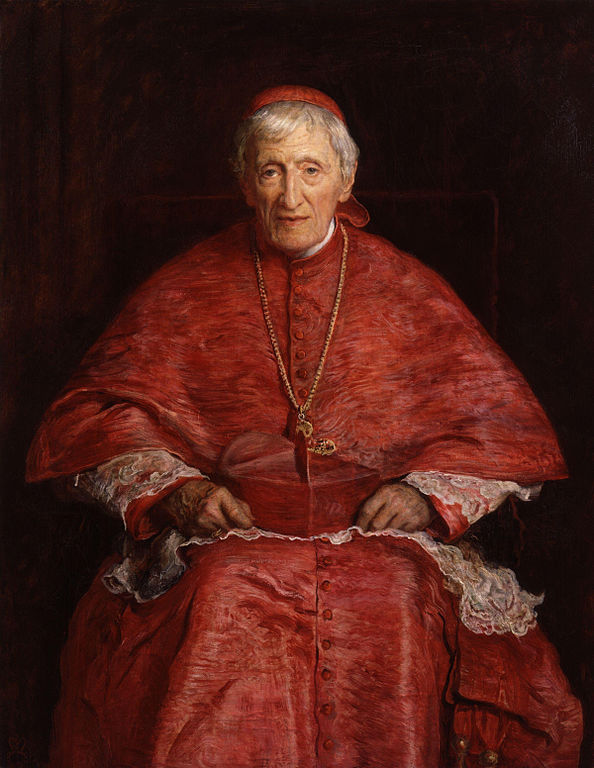
MIllaisNewman

The Millais portrait of Cardinal Newman. (Source)

The Prince of Papist Purple Prose

SacredHeartRoses

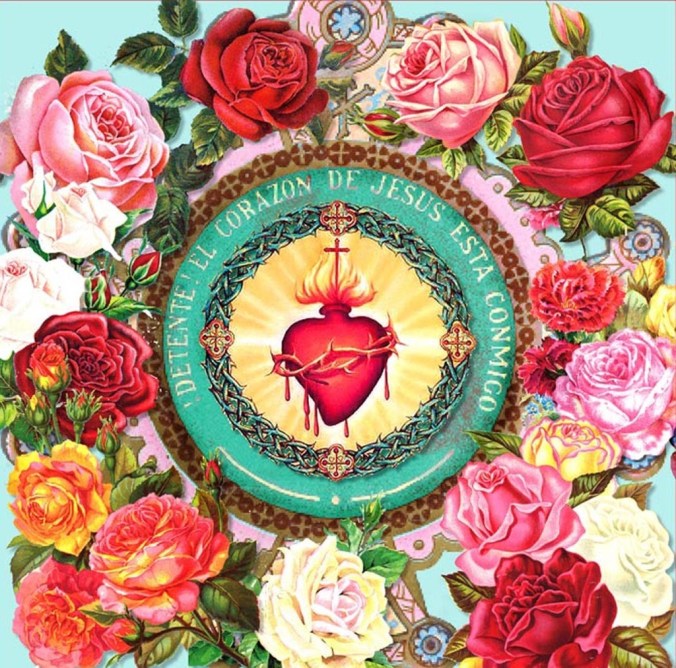
Faberesque religious art. (Source)

The Church offers us the way of salvation. She declares the destination, Heaven; she notes our provenance, the bondage of our sinful nature. And she furnishes a route from the latter up to the former. Or, I might say, “routes.” For while the Cruciform road to Heaven may appear singular from afar, anyone who enters the Journey will find that it is in fact composed of many different paths. The holy diversity of the Church is one testament of its Catholicity. Like a great Cathedral or Basilica that appears as one massive edifice from the street but harbors dozens of little side-altars within, each distinctly the Table of the Lord, the Church offers more streams of spirituality than we can discern. Some flow still in our midst, giving life to multitudes. Others run dry. And some thought long-extinct may suddenly spring forth in new vim and vigor.

It is only a natural and concurrent fact that the Church should likewise offer her children a diverse array of spiritual writers. There is the beautiful, mysterious Areopagite; the mighty, noble St. Augustine; the dazzlingly imaginative St. Ephrem the Syrian; the logical, pacific Aquinas; the bloody consolations of Dame Julian; the gleaming shadows of St. John of the Cross; the brooding brilliance of Pascal; the soaring eloquence of Bossuet; the roseate cheer of St. Thérèse of Lisieux; the luminous fragmentation of T.S. Eliot; the Gothic grotesquerie of Flannery O’Connor.  The list goes on and on.

The English Catholic Revival was a fertile time for spiritual writers. At the fountainhead of the entire movement stands Cardinal Newman, whose massive influence is still being felt by theologians and writers today. The founder of the English Oratory was a masterful stylist, so much so that James Joyce considered him the greatest master of English prose. Every ecclesiastical development proves that Newman’s theology is more timely than ever. He has been lauded by subsequent generations, and rightly so. When he is eventually canonized, he will certainly be declared a Doctor of the Church for his labors.

But he has, sadly, overshadowed another figure, one no less deserving of praise for his own work on behalf of the Gospel. That man is Fr. Frederick William Faber, the founder of the London Oratory.

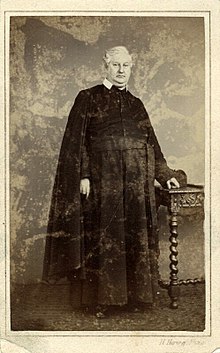
Faber1860

Fr. Frederick William Faber, Father of the Brompton Oratory. (Source)

Faber was an Oxford convert like Newman. After leaving the University, he first served as an Anglican parish priest in Northamptonshire. He would later bring eleven men with him across the Tiber when he resigned his post. After shepherding the community for a short time, he eventually joined forces with Newman and co-founded the English Oratory. They split the country. Newman went to Birmingham, and Faber went to London. In the course of his time there, he gained notoriety as a preacher of remarkable versatility and power, a widely-respected hymnodist, a constant friend of the poor, and an authoritative teacher of the spiritual life. As one source has it, his written works

…are a mine of spiritual gold of the highest purity, refined and drawn from Faber’s deep understanding of Catholic spiritual theology. For he had delved deeply, not only into the standard Scholastic philosophy and theology, but especially into the mystical schools. Father Faber was a brilliant man whose theology of the Absolute Primacy of Christ and Mary is grounded in that of the Subtle Doctor, Blessed John Duns Scotus (1266-1308), all recast in simple ordinary English. (174).

When he died, all the great Catholics of England honored his memory. In France, even the formidable abbot of Solesmes, Dom Prosper Guéranger, admired his writings and wrote of him fondly.

But Faber is a largely forgotten figure today, at least among American Catholics. While most have probably heard at least one or two of his hymns, such as “Faith of Our Fathers,” few read more deeply into his life or thought. Why? What has caused this lacuna in our collective memory?

There are, I think, two primary reasons.

The first is that he is eclipsed by Newman. The two had differences in their own day. Newman was resolutely opposed to the pretensions of Ultramonatism; Faber, like Cardinal Manning, was a strong advocate of Rome’s prerogatives. Newman always wanted to return to Oxford and restore some traces of his old, academic life; Faber was content to build the finest church of Great Britain in London, to better minister to the poor. Newman was always a little wary about Marian titles and devotions; Faber practically bathed in them. As Monsignor Rondald Knox writes in 1945,

While Faber is introducing the British public to the most luscious legends of the Counter-Reformation, Newman is still concerned over the difficulties of Anglicans, still asking how and in what sense Catholic doctrine has developed, still cautiously delimiting the spheres of faith and reason. (“The Conversions of Newman and Faber,” Pastoral and Occasional Sermons, 875).

The tensions surrounding Faber’s spirituality eventually led Newman to formally, judicially separate the two houses. Sadly, “While Newman visited Faber shortly before his death, the two men were not able to fully resolve their differences.”

The second, related to the first, is part stylistic, part spiritual. Consider an analogy. Among the Metaphysical Poets, the meditative Donne has always outshone the ebullient Crashaw. Logos is easy to parse. Its analysis is a straightforward, if sometimes arduous task. Pathos, however, is a more slippery beast altogether, and one less communicable and less persistent than we should like to think. It may fire one breast and repel another. Not all hearts chime the same tune in the same wind. Likewise, Newman’s depth, intellect, and style have garnered more attention than Faber’s flowery devotions. His devotional prose is as purple as it gets. Consider the following passage, taken from Part I of “The Mystery of the Precious Blood.”

SALVATION! What music is there in that word – music that never tires but is always new, that always rouses yet always rests us! It holds in itself all that our hearts would say. It is sweet vigor to us in the morning, and in the evening it is contented peace. It is a song that is always singing itself deep down in the delighted soul. Angelic ears are ravished by it up in Heaven; and our Eternal Father Himself listens to it with adorable complacency. It is sweet even to Him out of Whose mind is the music of a thousand worlds. To be saved! What is it to be saved? Who can tell? Eye has not seen, nor ear heard. It is a rescue, and from such a shipwreck. It is a rest, and in such an unimaginable home. It is to lie down forever in the bosom of God in an endless rapture of insatiable contentment. (“The Mystery of the Precious Blood“)

Or, later in the same volume, when he writes the following passage.

Green Nazareth was not a closer hiding-place than the risen glory of the Forty Days. As of old, the Precious Blood clung round the sinless Mother. Like a stream that will not leave its parent chain of mountains, but laves them incessantly with many an obstinate meandering, so did the Blood of Jesus, shed for all hearts of men, haunt the single heart of Mary. Fifteen times, or more in those Forty Days, it came out from under the shadow of Mary’s gladness and gleamed forth in beautiful apparitions. Each of them is a history in itself, and a mystery, and a revelation. Never did the Sacred Heart say or do such ravishing things as those Forty Days of its Risen Life. The Precious Blood had almost grown more human from having been three days in the keeping of the Angels. But, as it had mounted Calvary on Good Friday, so now it mounts Olivet on Ascension Thursday, and disappears into Heaven amidst the whiteness of the silver clouds. It had been but a decree in Heaven before, a Divine idea, an eternal compassion, an inexplicable complacency of the life of God. It returns thither a Human Life, and is throned at the Right Hand of the Father forever in right of its inalienable union with the Person of the Word. There is no change in the Unchangeable. But in Heaven there had never been change like this before, nor ever will be again. The changes of the Great Doom can be nothing compared to the exaltation of the Sacred Humanity of the Eternal Word. The very worship of the glorious spirits was changed, so changed that the Angels themselves cannot say how it is that no change has passed on God. Somehow the look of change has enhanced the magnificence of the Divine immutability, and has given a new gladness to their adoration of its unspeakable tranquility (“The History of the Precious Blood“).

Or this passage from The Blessed Sacrament, taken from a friend who posted it on Facebook for the Nativity of Mary.

Let us mount higher still. Earth never broke forth with so gay and glad fountain as when the Babe Mary, the infant who was the joy of the whole world, the flower of God’s invisible creation, and the perfection of the invisible and hitherto queenless angels of His court, came like the richest fruit, ready-ripe and golden, of the world’s most memorable September. There is hardly a feast in the year so gay and bright as this of her Nativity, right in the heart of the happy harvest, as though she were, as indeed she was, earth’s heavenliest growth, whose cradle was to rock to the measures of the worlds vintage songs; for she had come who was the true harvest-home that homeless world.

His devotion to Our Lady was legendary. He was, in fact, the first English translator of St. Louis de Montfort’s famous text, True Devotion to Mary…and that even before he had become an Oratorian! He was also probably the first English author to think of Mary as Co-Redemptrix. In one of his hymns, he declares:

Mother of God! we hail thy heart,
Throned in the azure skies,
While far and wide within its charm
The whole creation lies.
O sinless heart, all hail!
God’s dear delight, all hail!
Our home, our home is deep in thee,
Eternally, eternally.
(Source)

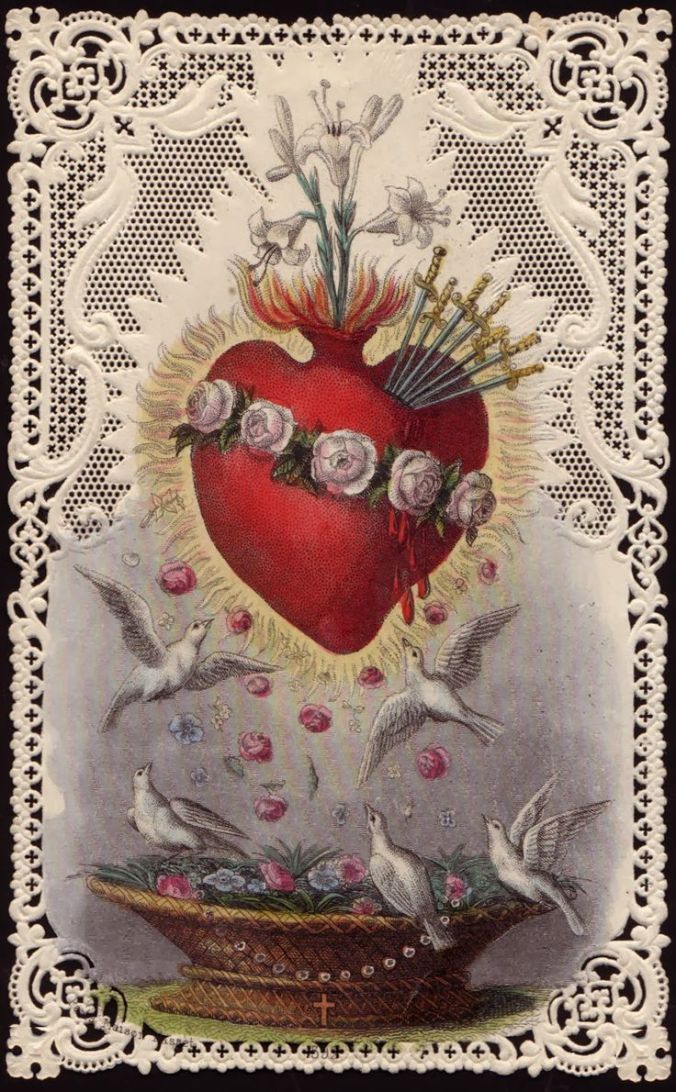
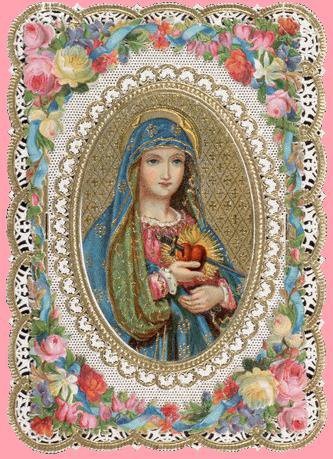
ImmaculateheartRosesDoves

Lace holy card of the Immaculate Heart of Mary. Extremely Fr. Faber’s aesthetic. (Source)

Fr. Faber’s devotion to Our Lady extended beyond his prolific writings. He not only translated St. Louis’s book. In 1846, he undertook his own Marian consecration in the Holy House of Loreto. He had a tendency to refer to the Mother of God as “Mama.” A famous episode related by Monsignor Knox depicts Fr. Faber at one of his more florid moments. After a particularly high Marian procession at the Oratory, he was observed weeping. Without any care for who heard, he cried out, “Won’t Mamma be pleased?” (“The Conversion of Faber,” Pastoral and Occasional Sermons, 891).

None of this spirituality or the writing in which it comes to us fits our modern tastes. It is too perfumed, too sickly-sweet, too campy, too Victorian, too decadent, too redolent of pastel holy cards mouldering in antique prayer books. One critic puts it thus:

There are great slabs of passages, sometimes chapters at a time, which glow with ethereal light but have little content. Hypnotized by his own fluency Faber flows on and on, melodious and tedious…There are awful lapses of taste. (Chapman, quoted here).

And certainly, Faber cared not one shred for taste. The only thing that mattered was the salvation and sanctification of souls. Knox tells us that “‘Art for art’s sake’ had no meaning for him…if a bad verse would have more chance of winning souls than a good verse, down the bad verse would go” (“The Conversion of Faber,” Pastoral and Occasional Sermons, 891). There is much to criticize in this tendency from a purely aesthetic standpoint. Christians should commit themselves to the highest standards in all artistic and literary endeavors.

But it is hard not to like the man weeping after the procession; it is harder still to feel totally averse to passages that glow purple as the evening sky. One has the sense that Fr. Faber would have been a remarkable presence today, if only because his emotionalism and baroque, slightly kitschy aesthetic would have made him an ironic celebrity on Weird Catholic Twitter. Imagine what he would have done with memes!

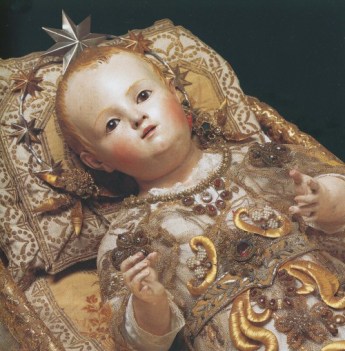
SantaMariaBambina1

Santa Maria Bambina, Southern Italy. (Source)

Yet he would also be a sign of contradiction. We have seen a renewed emphasis on Muscular Christianity, with a proliferation of websites, associations, and thinkpieces all dedicated to restoring “authentic masculinity” and resisting the “feminization” of the liturgy. This is a particularly popular movement within the larger Traditionalist wing of the Church. In brief, the narrative usually runs as follows:

1) After Vatican II, the Novus Ordo initiated a new, “feminine” form of the Mass.
2) This innovation was a substantive capitulation to the Sexual Revolution.
3) Men don’t want to serve a feminized Church in a feminized liturgy, with altar girls, felt banners, versus populum, happy-clappy music, etc.
4) The vocations crisis of the last 30-40 years ensues.
5) As such, we need to restore more pronounced gender binaries and hierarchies along with the Usus Antiquior.

Some of this narrative may be correct. I refrain from judging its particular historical claims, social implications, or theological presuppositions.

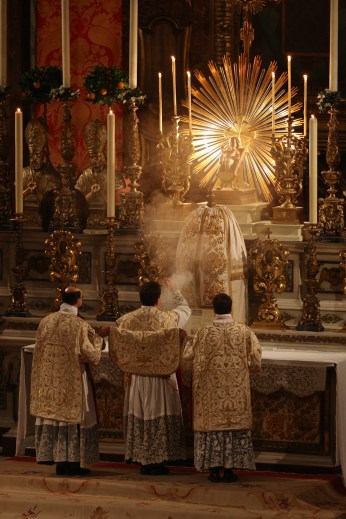
midnightmass3

Midnight Mass at the Brompton Oratory. (Source)

Nevertheless, Fr. Faber confounds that entire way of thinking. He was anything but a “Muscular” Christian. His personality, style, and spirituality were so clearly “feminine” that his own nephew, the publisher Geoffrey Faber, considered him a probable closet case (see David Hilliard’s famous essay “UnEnglish and Unmanly,” page 5). Whether or not his (disputed) conclusions about the priest (and all the leaders of the Oxford Movement) are true, it suffices to say that Fr. Faber was far from the “authentically masculine” man fetishized by the new Muscular Christianity.  Yet liturgically he was known as one of the highest of the high, and his sons at the Brompton Oratory continue that admirable tradition. If nothing else, Fr. Faber’s legacy is the Oratory that still stand as a landmark of reverence, beauty, and transcendent holiness in the midst of postconciliar banality.


What’s more, Fr. Faber is not just a fine hymnodist and devotional writer. He penetrated deep mysteries of the faith. A thoroughgoing Scotist, he advocated the thesis (shared by this author) that Christ probably would have been incarnated anyway even if Adam had never fallen. And as the Church’s Mariology continues to develop, his arguments on behalf of Our Lady’s Co-Redemption may yet prove invaluable. Sophiologists should take note. Here is a man after our own heart.

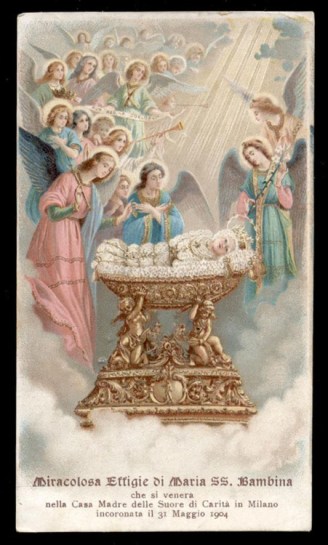
SantaMariaBambina2

A holy card of Santa Maria Bambina. (Source)

Fr. Faber writes of Our Lady’s suffering in a passage worth quoting at length:

But this is not all. She co-operated with our Lord in the redemption of the world in quite a different sense, a sense which can never be more than figuratively true of the Saints. Her free consent was necessary to the Incarnation, as necessary as free will is to merit according to the counsels of God. She gave Him the pure blood, out of which the Holy Ghost fashioned His Flesh and bone and Blood. She bore Him in her womb for nine months, feeding Him with her own substance. Of her was He born, and to her He owed all those maternal offices which, according to common laws, were necessary for the preservation of His inestimable life. She exercised over Him the plenitude of parental jurisdiction. She consented to His Passion; and if she could not in reality have withheld her consent, because it was already involved in her original consent to the Incarnation, nevertheless she did not in fact withhold it, and so He went to Calvary as her free-will offering to the Father. Now, this is co-operation in a different sense from the former, and if we compare it with the co-operation of the Saints, their own co-operation, in which Mary herself alone surpassed them all, we shall see that this other peculiar co-operation of hers was indispensable to the redemption of the world as effected on the Cross. Souls could be saved without the co-operation of the Saints. The soul of the penitent thief was saved with no other co-operation than that of Mary, and, if our Blessed Lord had so willed it, could have been saved without even that. But the co-operation of the Divine Maternity was indispensable. Without it our Lord would not have been born when and as He was; He would not have had that Body to suffer in; the whole series of the Divine purposes would have been turned aside, and either frustrated, or diverted into another channel. It was through the free will and blissful consent of Mary that they flowed as God would have them flow. Bethlehem, and Nazareth, and Calvary, came out of her consent, a consent which God did in no wise constrain. But not only is the co-operation of the Saints not indispensable of itself, but no one Saint by himself is indispensable to that co-operation. Another Apostle might have fallen, half the Martyrs might have sacrificed to idols, the Saints in each century might have been a third fewer in number than they were, and yet the co-operation of the Saints would not have been destroyed, though its magnificence would have been impaired. Its existence depends on the body, not on the separate individuals. No one Saint who can be named, unless perhaps it were in some sense St. Peter, was necessary to the work, so necessary that without him the work could not have been accomplished. But in this co-operation of Mary she herself was indispensable. It depended upon her individually. Without her the work could not have been accomplished. Lastly, it was a co-operation of a totally different kind from that of the Saints. Theirs was but the continuation and application of a sufficient redemption already accomplished, while hers was a condition requisite to the accomplishment of that redemption. One was a mere consequence of an event which the other actually secured, and which only became an event by means of it. Hence it was more real, more present, more intimate, more personal, and with somewhat of the nature of a cause in it, which cannot in any way be predicated of the co-operation of the Saints. And all this is true of the co-operation of Mary, without any reference to the dolors at all…Our Lord had taken a created nature, in order that by its means He might accomplish that great work; so it seemed as if the highest honor and the closest union of a sinless creature with Himself should be expressed in the title of co-redemptress. In fact, there is no other single word in which the truth could be expressed; and, far off from His sole and sufficient redemption as Mary’s co-operation lies, her co-operation stands alone and aloof from all the co-operation of the elect of God. This, like some other prerogatives of our Blessed Lady, cannot have justice done it by the mere mention of it. We must make it our own by meditation before we can understand all that it involves. But neither the Immaculate Conception nor the Assumption will give us a higher idea of Mary’s exaltation than this title of co-redemptress, when we have theologically ascertained its significance. Mary is vast on every side, and, as our knowledge and appreciation of God grow, so also will grow our knowledge and appreciation of her His chosen creature. No one thinks unworthily of Mary, except because he thinks unworthily of God. Devotion to the Attributes of God is the best school in which to learn the theology of Mary; and the reward of our study of Mary lies in a thousand new vistas that are opened to us in the Divine Perfections, into which except from her heights we never could have seen at all.
(“The Compassion of Mary,” emphases in source.)

There is much in this text, and in so many like it, to warm a Catholic’s flagging devotion to the Mother of God. For that treasure alone, we should be grateful.

KitschyMaryCard

A Marian Holy Card. (Source)

As his writing on this subject demonstrates, Father Faber was in all things the most enthusiastic and the most Roman of Catholics. Yet his prodigious work on behalf of the Gospel, and the ardor with which he was wont to express himself, made him a popular figure even among Protestants. His hymns are sung by traditional and mainline Protestant churches even today.

A.W. Tozer held him in high esteem, going so far as to write:

Spinoza wrote of the intellectual love of God, and he had a measure of truth there; but the highest love of God is not intellectual, it is spiritual. God is spirit and only the spirit of man can know Him really. In the deep spirit of a man the fire must glow or his love is not the true love of God. The great of the Kingdom have been those who loved God more than others did. We all know who they have been and gladly pay tribute to the depths and sincerity of their devotion. We have but to pause for a moment and their names come trooping past us smelling of myrrh and aloes and cassia out of the ivory palaces. Frederick Faber was one whose soul panted after God as the roe pants after the water brook, and the measure in which God revealed Himself to his seeking heart set the good man’s whole life afire with a burning adoration rivaling that of the seraphim before the throne. His love for God extended to the three Persons of the Godhead equally, yet he seemed to feel for each One a special kind of love reserved for Him alone. The Pursuit of God, p. 40 (quoted here)

If a modern master of Protestant spirituality can appreciate the peculiar wisdom of this effusive little man, then what excuse do we have? The Church has entrusted him to our memory and will, I hope, some day do so formally at the altar of God.

I began this essay describing the various spiritualities that have animated the Church from its earliest days. Some remain vital, others have disappeared, and some may yet come back from quietude. The strange and fragrant spirituality Father Faber let out into the world may appear as one of those dried-up streams, never again to impart life to the desert of our world. We are not Victorians. Yet this great Oratorian offers his gift to us still. We are the ones who must accept it. I have little doubt that his life, example, and thought are welcome aids in our pursuit of Heaven.

Our Lady of the Vallicella

MadonnaoftheVallicella1

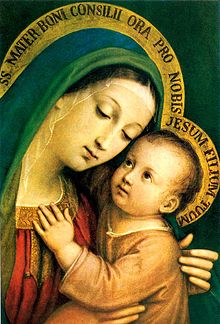
Our Lady of the Vallicella. I don’t know who painted this version. (Source)

Today is the Feast of Our Lady’s nativity. Nine months after the Immaculate Conception, we celebrate the luminous and holy birth of the one who would some day give birth to God Himself. As the Church rejoices with S.s. Anne and Joachim, perhaps we should consider the manifold titles under which Mary has come to be known over the centuries.

Some religious orders have devotions to Our Lady under particular titles. The Cenacle Sisters are devoted to Our Lady of the Cenacle, the Institute of the Incarnate Word takes as its patron the Virgin of Luján, and most famously, the Redemptorists were commissioned by Pope Pius IX to care for and propagate devotion to Our Lady of Perpetual Help. The Dominicans appeal to Our Lady of the Rosary, the Augustinians to Our Lady of Good Counsel, and the Franciscans to Our Lady, Queen of Angels.

But what of the Congregation of the Oratory of St. Philip Neri? Is there a Marian image, title, or devotion proper to the Oratorians? Since the Oratory is not a religious order, the question may seem ill-put. Nevertheless, some research shows that there is in fact a specifically Oratorian icon of the Mother of God: Our Lady of the Vallicella.

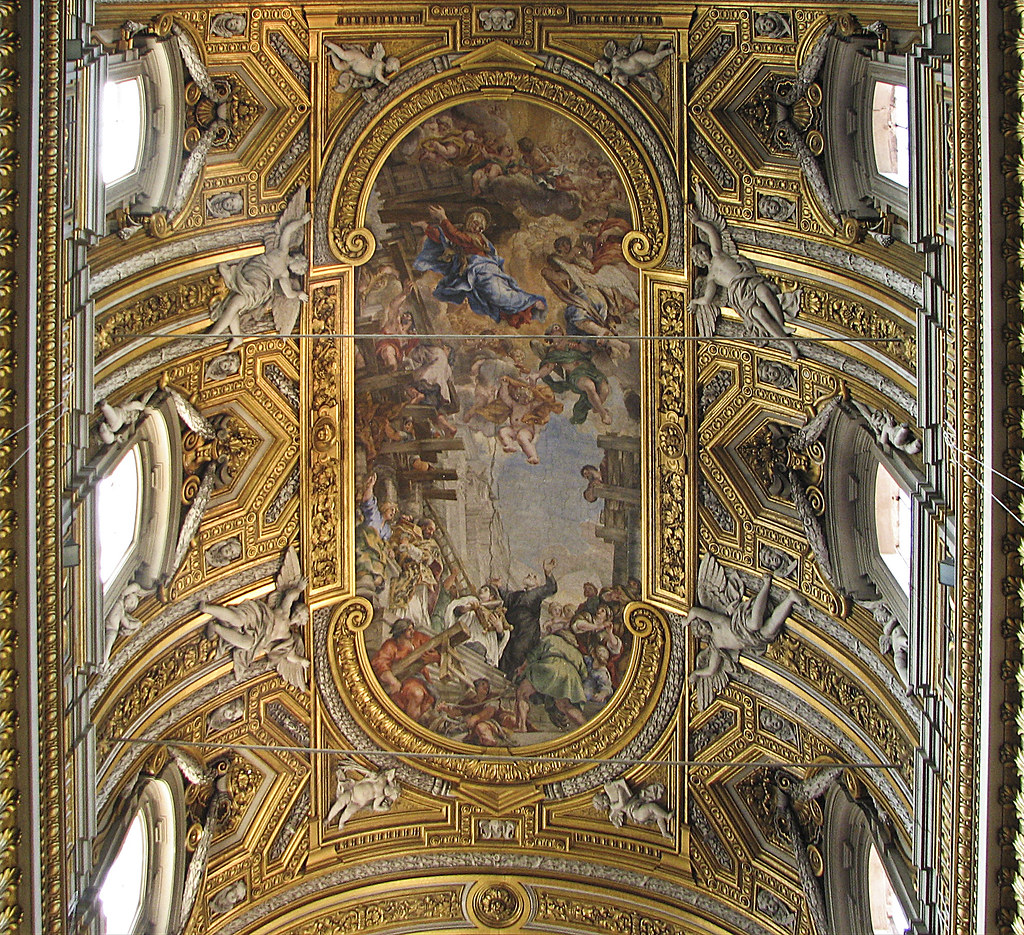
It is related in various lives of St. Philip that, during the construction of the Chiesa Nuova, Our Lady miraculously saved the church. As Gallonio relates in his Vita:

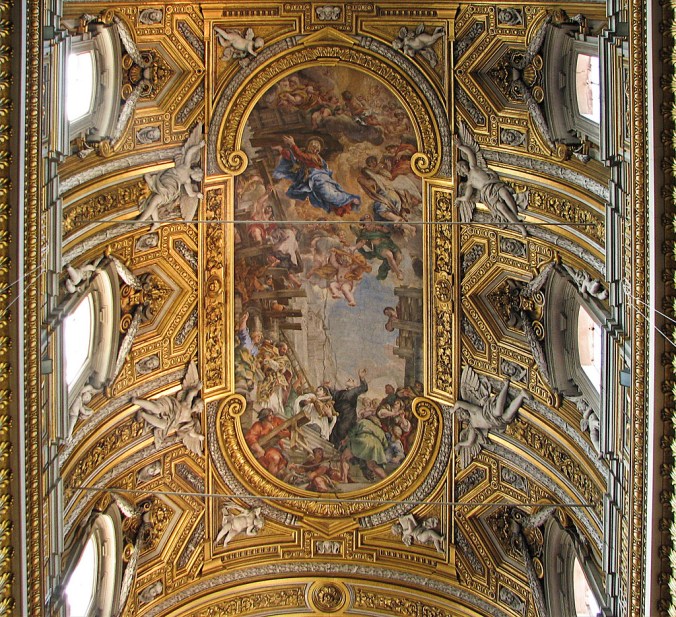
In the following year, 1576, something happened during the building works, which I must not pass over in silence. When the old church had been demolished, along with other buildings on the site of the new construction, one little hovel remained roofed, after the others had been levelled. Suddenly one day Philip had Giovan Antonio, the clerk of works, summoned, and as soon as he arrived he told him to have the roof taken off the hovel immediately. “Last night,” he explained, “I saw the Holy Mother of God, who was holding it up with her own hands.” (The place was being used as a chapel to say Mass and administer the sacraments to the people, for the old church had the responsibility of souls attached to it.) Giovan Antonio went back and ordered the workmen to demolish the roof. As soon as they set to, they noticed that the beam which supported the roof had no support for itself; one of its ends (what they call the beam’s head) was quite out of the wall, which quite astonished those who saw it [Gallonio, Para. 112 – trans. Fr. Jerome Bertram CO].

This incident is memorialized in the ceiling of the Chiesa Nuova.

CNCeiling.jpg

The ceiling of the Chiesa Nuova, in which is depicted the scene of Our Lady preserving the Vallicella from collapse and ruin. (Source)

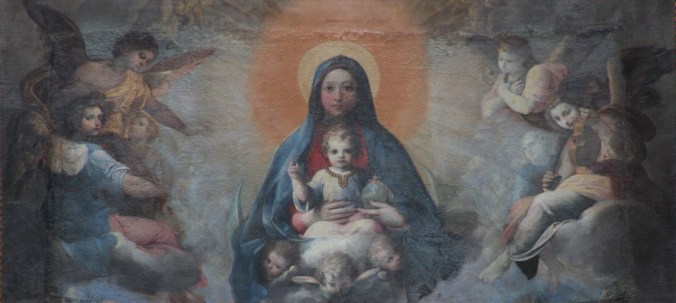
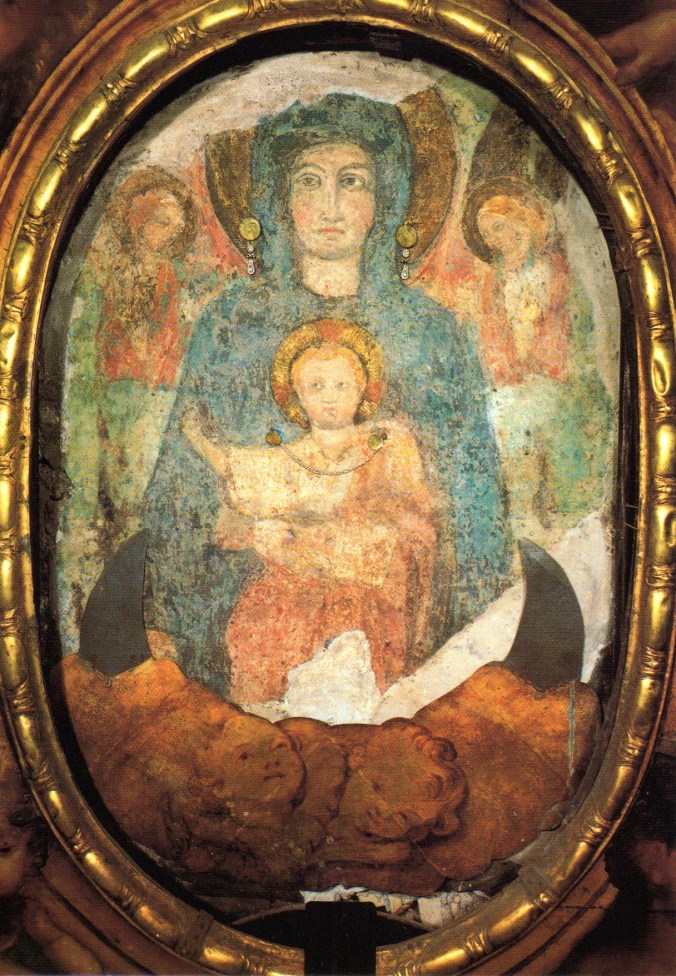
It is my understanding that the Saint and his sons attributed the miraculous intervention of Our Lady to an ancient fresco they uncovered during construction. The image depicts Our Lady in blue holding the Infant Christ. Jesus raises his hand in blessing. Both are seated in the moon, while three adoring cherubs look up with rapt attention. These are the essentials of the icon, which canonically follows the “Nicopeia (bringer of victory) or Kyriotissa (enthroned) type.”

This conjunction suggests something about the icon’s meaning. The Mother of God brings us the ultimate victory, Christ Himself; His victory over death is truly her victory and, by extension, ours. What’s more, their relationship is a mutual enthronement. She takes all of her dignity as Queen of Heaven from Christ, and He is most magnified in Her Heart.

It seems appropriate that an image that bears such a meaning would fall to St. Philip and his sons as a kind of special inheritance. After all, Cardinal Newman’s motto encapsulates the entirety of Oratorian life: Cor ad Cor Loquitur, “Heart Speaks to Heart.” This phrase of the Psalmist describes God’s Liturgical communion with us, our spiritual communion with each other, the key process of evangelizationbut also the intimacy between the Sacred Heart of Jesus and the Immaculate Heart of Mary. And let us not forget that third heart, the Flaming Heart of St. Philip Neri. All in all, communion and reciprocity are key to Oratorian spirituality in a way that is perhaps more pronounced than in other religious families.

12-vallicelliana

The ancient, miraculous fresco-icon of Our Lady of the Vallicella. Currently hidden in the Chiesa Nuova behind the Rubens rendition. (Source)

The story of Our Lady of the Vallicella is not just theological, though. It also winds through some of the more important chapters of Art History.

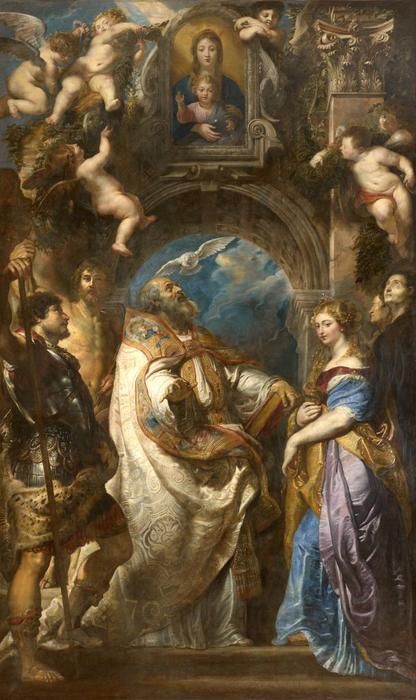
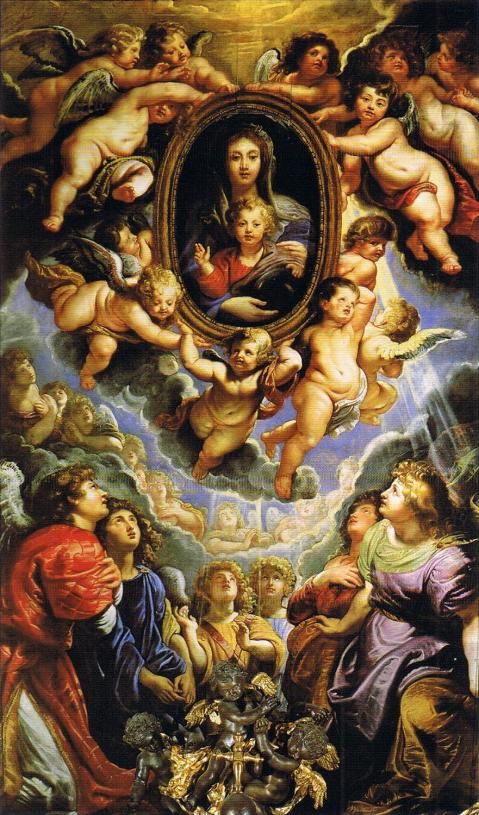
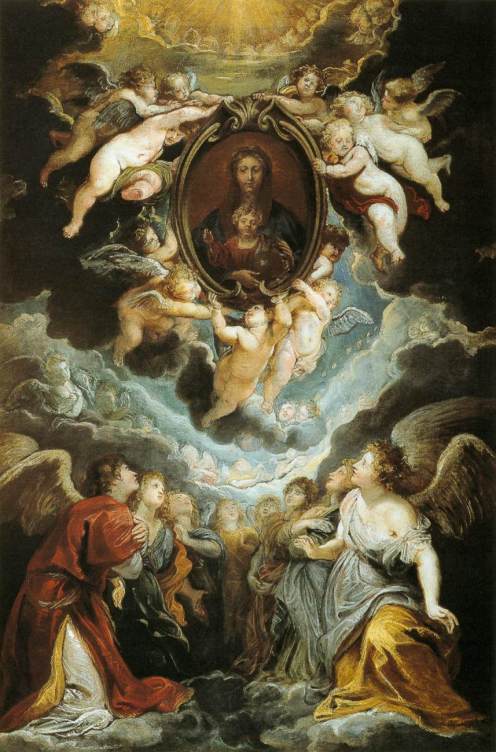
The great Baroque artist Peter Paul Rubens was commissioned by the fathers of the Roman Oratory to paint the church’s high altar. He ended up painting a few. The first, a canvas, was rejected because it was too reflective and is now in a museum at Grenoble. The second, a painting on slate, remains in situ. He later painted a somewhat rougher third version that now hangs in the Academy of Fine Arts in Vienna.

RubensVallicella1

Pope St. Gregory, Surrounded by Saints, Venerating the Miraculous Image of the Virgin and Infant, called Santa Maria of the Vallicella, Rubens, c. 1606-07. The first altarpiece of the Chiesa Nuova, now in Grenoble. (Source)

RubensVallicella2

Madonna della Vallicella, Rubens, 1606-08. The second altarpiece, now in situ at the Roman Oratory. The central image of the Madonna is removable and covers the miraculous fresco. (Source).

RubensValicella3

The Madonna della Vallicella Adored by Seraphim and Cherubim, Rubens, 1608. Now in Vienna. (Source)

Of course, devotion to Our Lady of the Vallicella is, like so many other elements of Oratoriana, not restricted to the sons of St. Philip. As the whole city of Rome is imbued with his spirit, we find her image among the many picturesque street shrines that stand as one of the Eternal City’s most distinctive forms of public piety.

AleteiaValicella.jpg

Our Lady of the Vallicella in a Roman street shrine. Note the way the hands are positioned; Our Lord’s left hand on the Orbis Mundi, with Our Lady’s right. Conversely, His right hand rises in blessing as her left seems to hold or even crown him. This posture is consistent with earlier renditions. (Source).

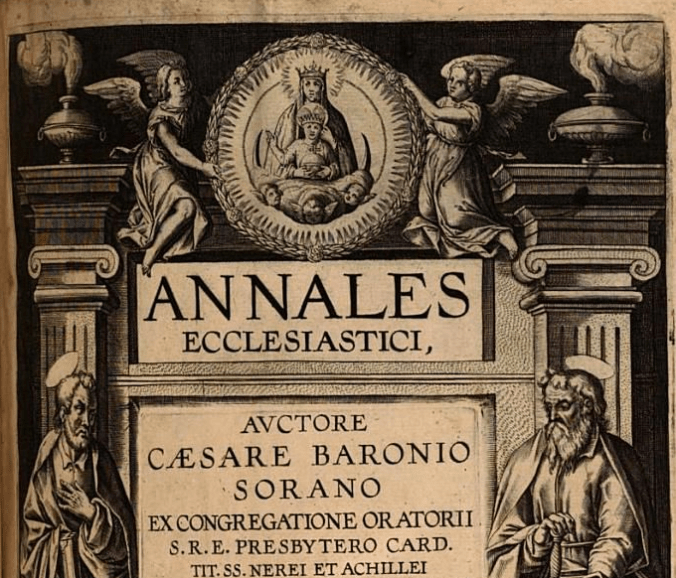
Regardless, Our Lady of the Vallicella quickly became a major emblem of the Congregation. She adorns most of the first-edition title pages of Baronius’s Annales Ecclesastici, as you can seen in this image from the Twelfth Volume.

Screen Shot 2017-09-08 at 2.02.58 AM.png

The title page of the Twelfth Volume of the Ecclesiastical Annals of Cardinal Baronius. (Source)

image.jpeg

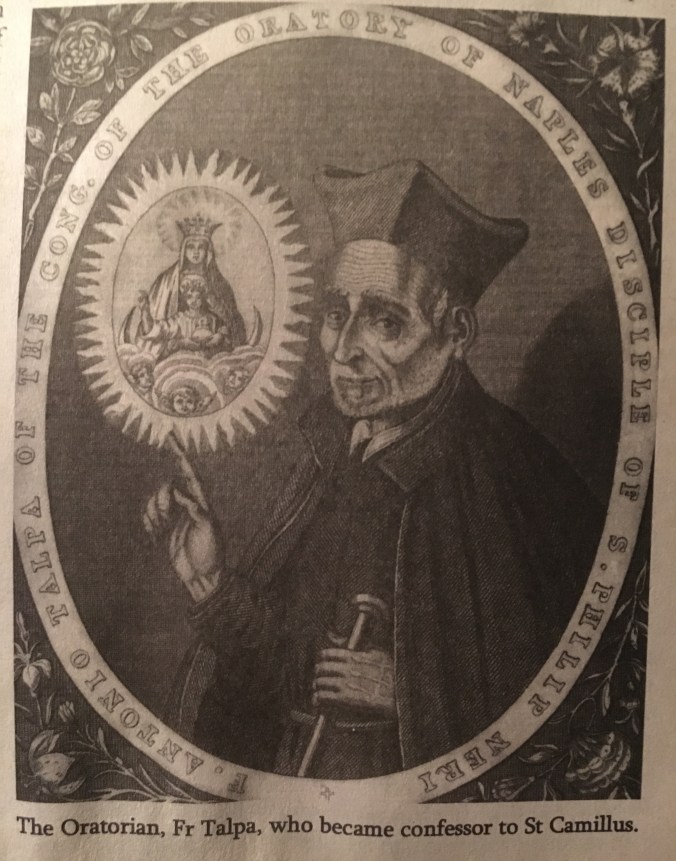
Our Lady of the Vallicella in a portrait of Fr. Antonio Talpa, one of the founders of the Naples Oratory and the confessor of St. Camillus of Lellis. I don’t know how old the image originally is. Photo taken from the 2008 English Edition of Cardinal Capecelatro’s Good Philip, produced by The Desert Will Bloom Press. Page 111.

Later Oratorians also made use of the icon in their publications. This was particularly true of works brought out by the Fathers of the London Oratory. A publication of Fr. Faber’s Spiritual Conferences from 1859 includes the following sigil on its title page:

Screen Shot 2017-09-08 at 2.11.38 AM.png

Our Lady of the Vallicella in one of Father Faber’s many books (Source).

More recent Oratorians have also included this image of the Mother of God on the volumes they have published. For example:

image

Our Lady of the Vallicella as seen on the title page of my copy of Agnelli’s The Excellences of the Congregation of the Oratory of St. Philip Neri, Third Edition (Oxford 2012).

What I have not found yet is any evidence that Our Lady of the Vallicella was enshrined or venerated as an icon anywhere outside of the Roman Oratory. Further research may prove otherwise. Nevertheless, it is my sincere hope on this Feast of the Nativity of Mary that, as we are living in an Oratorian age, devotion to Mary under her Oratorian title will continue to spread.


The Oratorian Option

StPhilipNeriandEnglishSeminarians

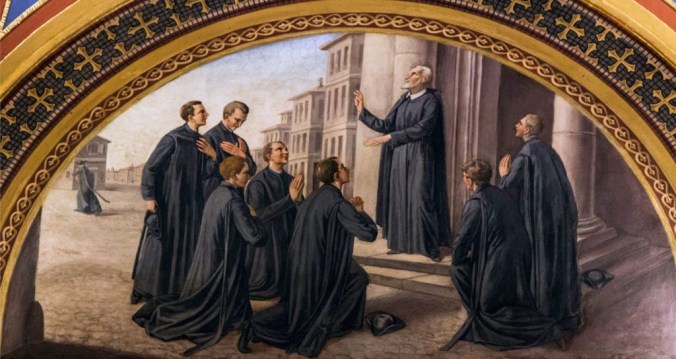
St. Philip Neri blessing the departing seminarians of the English College. Fr. V.J. Matthews tells us that St. Philip would hail the seminarians, whose college is directly across from San Girolamo, with the words Salvete Flores Martyrum, “Hail, flowers of the Martyrs” (Matthews 85). Edited photo by Fr. Lawrence Lew, OP.  (Source).

In a recent post, I suggested that Rod Dreher’s The Benedict Option is a flawed, if well-intentioned, strategy for the Church in our times. I stand by that opinion. I also would like to offer my own “option,” as so many others have done. I will refrain from detailing specific suggestions and strategies, as I have neither the time nor the knowledge nor the experience to profitably contribute to any discussion of specifics. Nonetheless, I think I can say a few things about the general spirit and principles of what we might choose instead of The Benedict Option.

For starters, it would be called something different. Although St. Benedict is an eminent and powerful patriarch, I submit to you that, for our purposes, we must look at another man in an era far more like our own, a man whose spiritual sons also offer powerful examples. That man, of course, is St. Philip Neri.

Early Modernity as Proto-Postmodernity

Like Dreher, I choose my patron saint in part because I think the unique conditions of our own moment deeply resonate with those which St. Philip faced. Any comparison between different periods of time are naturally going to fall flat in certain specifics. But consider, if you will, the following phenomena.

The rise of the Internet, like the advent of printing, has opened up new models of knowledge and new conceptions of the self. Our lives are ever more global, even as new forms of nationalism emerge. We are increasingly aware of various forms of religious difference. Some are extremist, and even violent (see, inter alia, the Münster Rebellion and the sects of the Interregnum). Within the Church, we face public in-fighting among the Cardinals, dangerous sacramental, moral, and doctrinal laxism, a German Church that is falling apart, and a Pope whom the Roman People themselves dislike. We face serious problems with the climate. Our educational aspirations and models are increasingly oriented towards social climbing, even as our specialties are becoming narrower. Literary and textual criticism set the terms of debate in the academy. More broadly, sexual mores have changed considerably, and culture war is the order of the day. Homosexuality and gender nonconformity have emerged as increasingly widely-recognized social phenomena. Our civilizational relationship with Islam is complicated, to say the least. Class divisions and structural inequality have led to political instability. Indeed, unthinkable political events, stemming in large part from those class frictions, have jettisoned any sense of certainty we might hope to sustain.

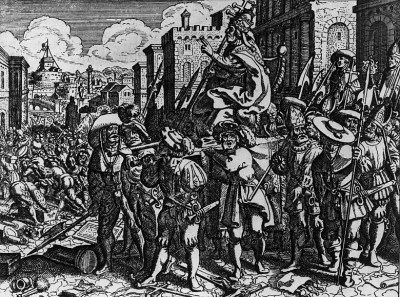
St. Philip arrived in Rome shortly after just such an unthinkable event. In 1527, the armies of the Emperor descended upon the Papal States and launched a horrifyingly brutal sack of the Eternal City. Both Lutheran andmore scandalouslyCatholic soldiers raped, pillaged, and desecrated their way through Rome. It was the second and last sack of Rome committed by civilized Christians, and it put an effective end to the Renaissance in that great city.

Alfonso Cardinal Capecelatro, one of St. Philip’s nineteenth century biographers, describes the event as:

…the terrible sack of Rome in 1527, which had no parallel in the history of the Church, whether regarded as a warning or a chastisement. We must go back to Attila and Genseric to find any event which even distantly approaches it in horror; and even those barbarians were civilized and even reverent in comparison with the soldiers of the most Catholic king and emperor, Charles V. A drunken, furious horde of Lutherans and Catholics together was let loose upon Rome…there were…unutterable outrages not to be thought of without a shudder. (Capecelatro 23).

Pertinent to our purposes, however, is the effect that this calamity left on the culture of Rome. Here, too, Capecelatro is a helpful resource.

To enter into the city of the Holy Apostles Peter and Paul at a time when their authority was spurned, vilified, and trampled into the mire by a terrible heresy; to visit the spots hallowed by the blood of martyrs when all around were the hideous traces of their recent profanation; to live in the holy city when the lives of the clergy themselves were dissolute or unbecoming, when paganism in science and letters and art was alone in honours must have been, to the heart of a saint such as Philip’s, an anguish inconceivably bitter. (Capecelatro 24).

SackofRome1527

A blasphemous mock-Papal procession during the 1527 Sack of Rome. (Source).

If, like Dreher, we wish to compare our own times to the sack of Rome, we ought to look a thousand years later than he does. As with Rome circa 1535, we live in a culture riddled with “a terrible heresy,” Dreher’s “Moralistic Therapeutic Deism” (among others). We Christians in America have witnessed the martyrdoms of our Coptic and Middle Eastern brethren over mass media. The Church is still reeling from a time when “the lives of the clergy themselves were dissolute [and] unbecoming.” The sins of clerical sex abuse continue. And insofar as there is a pagan tendency in our culture today (Camille Paglia certainly thinks there is), it resides in our “science and letters and art.”

While I don’t wish to belabor the point too much, I’ll add that not all is cause for alarm. Many of the good things about early modernity are also true today.

In 1850, Fr. Faber gave a series of lectures to his spiritual sons at the London Oratory. His subject was “The Spirit and Genius of St. Philip Neri.” The second lecture includes a long consideration of St. Philip as the “representative saint of modern times” (Faber 38). Faber argues,

The very essence of heresy and schism is constantly found in the disobedient and antiquarian worship of some pet past ages of the Church, in contradistinction to the present age, in which a man’s duties lie, and wherein the spirit and vigour of the living Church are in active and majestic energy. The Church of a heretic or schismatic is in books and on paper…A Catholic, on the contrary, belongs to the divine, living, acting, speaking, controlling Church, and recognizes nothing in past ages beyond and edifying and instructive record of a dispensation, very beautiful and fit for its day, but under which God has not cast his lot, and which, therefore, he has no business to meddle with or to endeavour to recall. One age may evoke his sympathies, or harmonize with his taste, more than another. Yet he sees beauty in all and fitness in all, because his faith discerns Providence in all. (Faber 40-41).

Dreher would do well to note Fr. Faber’s point. The uncharitable pessimism that animates so much of The Benedict Option is not entirely misbegotten, but certainly falls short of the truth. And why? In part, because Dreher never mentions Church history. His historical narrative of Christianity in Western culture overlooks the actual ways that Christians have responded to modernity since the 16th century. Fr. Faber does not. Instead, he writes,

…it is plain that we are in possession of a great many more doctrinal definitions than we were; the limits of theological certainty are immensely extended. Just as verified observations have extended the domain of the physical sciences, so the number of truths which a believer cannot, without impiety, or in some cases formal heresy, reject, has added to the domain of theology…Now this greater body of certain dogmatic teaching must necessarily influence the whole multitude of believers. It it tells upon literature; it tells upon popular devotion; it tells upon practice…and lastly, it tells upon ecclesiastical art…Neither, in speaking of Modern Times, must we omit to notice the natural connection there is between an increased knowledge of dogma, and the spirit of reverent familiarity in devotion, which has been so prominent a feature in the later Saints.  The more extended the vision of faith becomes, th more familiar a man necessarily grows with the sacred objects of which that faith so infallibly assures him…We must not omit then to name the increase and greater universality of mental prayer, the more generally adopted systematic methods of self-examination, the more common practice of spiritual reading, the ways of hearing mass, the obligation of meditation made the condition in most cases of gaining the indulgences of the Rosary, and other things which are all so many marks of what is called nowadays the increased “subjectivity” of the Modern Mind.(Faber 44-46, 49-50).

FatherFaber2

Fr. Frederick William Faber, founder of the Brompton Oratory in London. (Source)

Faber adds that anyone who would ignore this latter tendency towards “subjectivity” when seeking to evangelize would inevitably “find himself miserably out in his reckoning…The experiment would correct itself” (Faber 50). While Fr. Faber’s optimism is perhaps just as simplistic as Dreher’s pessimism, his perspective helps us attain the proper, prudential, balanced orientation towards modernity that The Benedict Option flatly misses.

Faber offers his historical assessment as a prelude to the consideration of St. Philip Neri’s life and spirituality. For Fr. Faber, St. Philip combines in his person and example the very best of what modernity has to offer. After all, Faber notes, Pippo Buono was ordained while the Council of Trent met. His movement began in an urban setting, “the very capital of Christendom itself,” and he managed to meet and influence “people of all nations” (Faber 51).

Even St. Philip’s personality was that of

…a modern gentleman, of scrupulous courtesy, sportive gaiety, acquainted with what was going on in the world, taking a real interest in it, giving and getting information, very neatly dressed, with a shrewd common sense always alive about him, in a modern room with modern furniture, plain, it is true, but with no marks of poverty about it; in a word, with all the ease, the gracefulness, the polish, of a modern gentleman of good birth, considerable accomplishments, and very various information. (Faber 52).

Fair enough. But why bother applying the example of this modern saint to our peculiar cultural and religious circumstances? It is one thing to say that a saint might have something to teach us. It is another thing altogether to say that a saint’s teaching might prepare us for the peculiarly harsh cultural conditions which seem to loom on the horizon (Dreher wasn’t wrong about all of it).

Faber answers this question, too. He writes of St. Philip:

He came to Rome at one of the most solemn crises of the Church; the capital was full of Saints, and full of corruption too. He was the quietest man at his hard work that ever was seen; yet he magnetized the whole city; and when he died he left it quite a different city from what it was, nay, with the impress of his spirit and genius so deep upon it, that it was called his city, and he the apostle of it, second only to St. Peter. It was no man clothed in camel’s hair, with the attractive paraphernalia of supernatural austerities upon him, no St. Francis, with his Chapter of Mats all round the Porziuncula, that the city and its foreign visitants went so anxiously to see; it was simply an agreeable gentleman, in a comfortable little room, apparently doing and saying just what any one else might do or say as well. He had come at his right time; he suited his age; men were attracted; he fulfilled his mission. (Faber 53).

St. Philip’s example is pertinent to our present debate insofar as he reformed late Renaissance Rome, a society much like ours, by means far more achievable and far more charitable than the contorted stratagems of The Benedict Option.

“Roots Are Very Important”

Admittedly, those words weren’t spoken by St. Philip. They’re actually the climactic revelation from Paolo Sorrentino’s La Grande Bellezza (2013), one of my favorite filmsa story that takes place in Rome. And as with all things Roman, St. Philip is never far away.

Two very singular facts stand out about St. Philip. One is that he was deeply attached to the Eternal City. And, relatedly, he never wished to start a religious order. He always claimed that the Congregation was entirely the work of Mary and the Holy Spirit. St. Philip was even reluctant to permit some of his sons to begin a house in Naples, a decision which would ultimately yield the harvest of many saints. Long before that, St. Philip required those priests he sent to San Giovanni dei Fiorentini to return to San Girolamo every day for the exercises of the Oratoryeven in sweltering heat and downpours of rain.

Borromini Facade of Oratorio dei Filippini (as drawn by Barriere, 1720 engraving)

Borromini’s facade of the Roman Oratory, sketched 1720’s. (Source).

In my recent post on St. Philip’s Benedictine tendencies, I noted that St. Philip understood that spiritual fatherhood can only be built upon a certain degree of stability. Along with that comes a strong sense of place, an immersion in the particular life of any given community. This decentralized localism is why every house of the Oratory throughout the world has its own unique spirit and apostolate. The Congregation only unites under the general aegis of St. Philip’s inspiration, not the ordinary vows of a religious order. To use a somewhat hackneyed analogy—if the Jesuits are the global corporations of the ecclesiastical world, then Oratorians are the folks who run mom & pop shops. However, there is a deeper meaning to this organizational quirk that we will have occasion to examine soon.

That domestic spirit can be summed up by the Oratorian conception of nido, or “nest.” As one source has it,

St Philip’s disciples and penitents sometimes sought him out in his room, where the Exercises of the Oratory were held in the early days. The Oratorian does not emulate a monastic detachment which would periodically surrender one’s very bedroom in manifestation of the premise that material goods are merely ad usum. The Oratorian identifies his room as a nido, a “nest.”

Strong Christian community requires roots. Dreher, as well as the good folks over at places like Front Porch Republic and Solidarity Hall, has frequently made this point over the last several years. It is not a new idea. The Benedict Option is peppered with quotes from Wendell Berry, the godfather of all American localist movements today. If Dreher’s Christian communitarianism is to succeed, then it must be predicated on something very much like the Oratorian sense of place. We would be wise to draw upon the domestic spirit of St. Philip’s nido.

santa-maria-in-vallicella-2

The effigy of St. Philip Neri, created from life once he could no longer lead the pilgrimage to the Seven Churches. Currently in possession of the Roman Oratory. (Source).

And that very sense of local domesticity often leads to precisely the kind of worldly engagement that Dreher’s book tends to overlook and minimize. Although St. Philip was by no means a polemicist, he took an active interest in the affairs of the worldas they transpired within the walls of Rome. He intervened in affairs of state only once, when he required Baronius to withhold absolution from the Pope until the latter had reversed the excommunication of Henri IV. This successful bit of string-pulling on St. Philip’s part probably kept the French crown Catholic for the duration of the Bourbon dynasty.

Of course, there is more to Oratorian domesticity than that. St. Philip’s genius lies not only in his stability, but in the way he invested so much of his spiritual ministry with romanità (in every sense of the word). He drew his principle practices from the sun-baked stones and the boiling air of the Eternal City, as if by some secret alchemy. He was famous for leading ever-more popular pilgrimages along the path of the Seven Churches. And all this, to compete with and vitiate the heathen delights of the Carnival. Where else but in Rome could a saint freely lead and care for such masses of pilgrims along such a venerable route? Where else in the history of modern Europe do we see such a providential alignment of personality, place, and practice against the pagans? The established traditions of spirituality which had already formed Rome were in turn re-formed by St. Philip. It is for this reason that he has been given the honorific title of “Apostle of Rome,” alongside Saints Peter and Paul.

As long as Christianity remains tied to the parish structure, it will always be a local religion. Consequently, St. Philip Neri’s unique resourcefulness will always be relevant. Especially today. As one writer puts it, “The mission of an Oratorian is to work at ‘home’; the Oratory is thus an apt instrument of the New Evangelization, re-proposing the gospel in formerly Christian societies.” God furnishes us with opportunities all around, if only we wish to see with “the eyes of the dove” (Cant. 1:15 paraphrased).

Illumine the Intellect

Such sight will be clearer and more invigorating if sharpened by the intellect. St. Philip’s exercises in the Oratory constituted a kind of holy pedagogy for the men of Rome. In his biography of the saint, the French Oratorian Louis Bouyer describes it well:

The programme of their meetings took some ten years to crystallize into the following form: reading with commentary, the commentary taking the form of a conversation, followed by an exhortation by some other speaker. This would be followed in turn by a talk on Church History, with finally, another reading with a commentary, this time from the life of a saint. All this was interspersed with short prayers, hymns and music, and the service always finished with the singing of a new motet or anthem. It was taken for granted that everyone could come and go as they chose, as Philip himself did. He and the other speakers used to sit quite informally on a slightly raised bench facing the gathering. (Bouyer 54).

Another author gives us a more detailed understanding of the kinds of materials that St. Philip and his sons were reading, hearing, and discussing in the exercises:

In St Philip’s time, the most important of his Exercises, which came to be known as the Secular Oratory, or in some places the Little Oratory, was a daily practice spread out over two to three hours during the leisurely Roman siesta and consisting of (1) a period of mental prayer; (2) a reading from the Scriptures or some spiritual book (e.g., Denys the Carthusian, John Climacus, Cassian, Richard of St Victor, Gerson, Catherine of Siena, Innocent III’s De Contemptu Mundi, Serafino da Fermo’s Pharetra Divini Amoris—St Philip’s favourite readings were the Laudi of Jacopone da Todi and The Life of Blessed Colombini by Feo Belcari), followed by a “discourse on the book,” a commentary and dialogue on the subject of the reading; (3) a discourse on the life of a saint; (4) a moral exhortation—a discourse on the virtues and vices; (5) a discourse on the history of the Church; and finally (6) an oratorio or spiritual canticle. (Source).

Herein we find the germ of Oratorian life, “the daily use of the Word of God” (Talpa, quoted here). St. Philip’s model is eminently conversational. The Oratory converts and sanctifies, not only through its stated arms of the sacraments, prayer, and preaching, but through discussionand, as well shall see, aesthetics.

St. Philip was not, however, given to ostentatious and idle chatter. He well understood the words of St. James, that “the tongue is a fire, a world of iniquity” (James 3:6 KJV). Consequently, he always urged his sons to mortify their speech as well as their reason and intellect. The Oratorians were to be wise, intelligent, even scholarly. But they were not to speak freely of the arts and sciences, nor were they to flaunt their learning. One Oratorian father went so far as to feign ignorance of Latin; another would always try to change the subject when any scholarly or humanistic matter came up in conversation. Amare nesciri“to love to be unknown”these words were ever on St. Philip’s lips.

CaesarBaronius

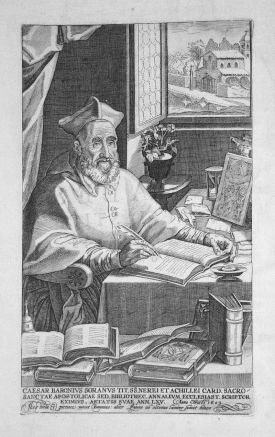
The Venerable Cardinal Caesar Baronius, author of the Annales Ecclesiastici, father of Church history. (Source).

None of this is to suggest that St. Philip was actively anti-intellectual. Far from it! After all, St. Philip was a devoted student of theology and philosophy in his younger days, and Father Faber calls even the mature St. Philip a “great student of history” (Faber 53).  Those words could perhaps be more truly applied to St. Philip’s spiritual son, the Venerable Cardinal Caesar Baronius. It was St. Philip who commanded Baronius to write the Annales Ecclesiastici, the first great work of church history in modern times. The project served a few functions. First, it got Baronius off of preaching, as he had the unpleasant but slightly amusing habit of turning every sermon into a lengthy and vivid discourse on the everlasting torments of hell (I hope that, when he is eventually canonized, the good Cardinal becomes the patron saint of horror writers). The project also productively occupied Baronius’s prodigious intellect, which St. Philip mortified in many other ways. For instance, Baronius was given kitchen duty so frequently that St. Philip playfully wrote above the stove, “Baronius, Coquus Perpetuus.” Finally, St. Philip and Baronius conceived of the book, which unexpectedly became a decades-long enterprise, as a way of challenging the then-dominant historiography of Protestant authors, as exemplified by the Magdeburg Centuries.  A cynic might call this bias. In context, it’s perhaps more fair to interpret Baronius’s motive as one very much akin to those that animate the scholarly disputes of our own day. And because of Baronius’s thoroughgoing method, academic rigor, and meticulous attention to detail, the Annales were received with respect even by those who disputed its claims. It was so impressive a work that several centuries later, Lord Acton could honestly call it “the greatest history of the Church ever written” (Source).

baronius2

St. Philip urging Baronius to write the Annales. (Source).

Nor was Baronius the only model of learning in the Oratory. His fellow cardinal, the aristocratic Francesco Maria Tarugi, was the fox to his hedgehog. Louis Bouyer writes that Tarugi “captivated everyone with his natural eloquence and was never at a loss, no matter what the topic of the moment might be” (Bouyer 64). Here again we see the mark of what we may call the specifically Oratorian geniuserudition crowned with beautiful style and fluency in speech.

If St. Philip stands for an appropriate humility of the intellect, Baronius for a rigorous love of truth, and Tarugi for eloquence in discourse, then we must turn to a fourth figure, the greatest scholar ever to enter the Oratorian life. I speak, of course, of John Henry Cardinal Newman.

In Newman’s long, productive, and complicated life, a few key themes emerge. Three are worth examining in connection with the intellectual tradition of the Oratory. First, we may duly note that Newman always exhibited a great love of knowledge for its own sake, and thus of Truth as such. As he writes in The Idea of a University,

Useful Knowledge then, I grant, has done its work; and Liberal Knowledge as certainly has not done its work,—that is, supposing, as the objectors assume, its direct end, like Religious Knowledge, is to make men better; but this I will not for an instant allow, and, unless I allow it, those objectors have said nothing to the purpose. I admit, rather I maintain, what they have been urging, for I consider Knowledge to have its end in itself. For all its friends, or its enemies, may say, I insist upon it, that it is as real a mistake to burden it with virtue or religion as with the mechanical arts. Its direct business is not to steel the soul against temptation or to console it in affliction, any more than to set the loom in motion, or to direct the steam carriage; be it ever so much the means or the condition of both material and moral advancement, still, taken by and in itself, it as little mends our hearts as it improves our temporal circumstances. And if its eulogists claim for it such a power, they commit the very same kind of encroachment on a province not their own as the political economist who should maintain that his science educated him for casuistry or diplomacy. Knowledge is one thing, virtue is another; good sense is not conscience, refinement is not humility, nor is largeness and justness of view faith. Philosophy, however enlightened, however profound, gives no command over the passions, no influential motives, no vivifying principles. Liberal Education makes not the Christian, not the Catholic, but the gentleman. (The Idea of a University 120-21).

CARDINAL JOHN HENRY NEWMAN PICTURED IN 1865 PHOTO

Newman never abandoned the life of the mind. (Source).

Along with this purity of vision, we naturally find in Newman a perennial appreciation of academic engagement, and when necessary, controversy. Indeed, Newman rose to fame and eventually converted because of his involvement in the ecclesiastical turmoil of the 1830’s and 40’s. He produced his first two great works, Tracts for the Times (1833-1841, in collaboration with others) and The Arians of the Fourth Century (1833) in light of those disputes. Likewise, Newman articulated his great theories of doctrinal development (Essay on the Development of Doctrine, 1845) and the important role of the laity (“On Consulting the Faithful,” 1859) in texts occasioned by ongoing controversies within the Anglican and Roman Catholic churches respectively. And although he could be terribly sensitive to even the slightest criticism, Newman took pains to respond with courtesy, as he did to Charles Kingsley in his famous Apologia Pro Vita Sua (1865). While Newman never sought out polemics and controversies, he was willing to engage in them when the Truth and Honor of God was at stake.

Finally, we ought to remember that Newman was always animated by a sincere love of that singular matrix of the intellectual lifeacademic community. His experience at Oxford profoundly shaped his worldview. He is, of course, still widely regarded as one of the great theorists of higher learning. The Idea of a University (1852, 1858) remains one of the most influential texts on Catholic education in modern times. But the impression that Oxford left on Newman is deeper and more subtle. Newman was drawn to the Oratory in part because he recognized in it the same collegiality that defined the best of the houses at Oxford. Newman writes,

Now I will say in a word what is the nearest approximation in fact to an Oratorian Congregation that I know, and that is, one of the Colleges in the Anglican Universities. Take such a College…change the religion from Protestant to Catholic, and give the Head and Fellows missionary and pastoral work, and you have a Congregation of St Philip before your eyes. (Newman, quoted here).

Newman first considered the Oratory in part because he hoped to offer a ministry to the intellectuals of Britain:

The local bishop, Nicholas Wiseman, invited them to the former seminary at Old Oscott while they decided what to do. Newman named it “Maryvale” and planned some sort of Catholic educational institute there. But then Wiseman sent them off to Rome for ordination. While there, they examined various religious congregations, and realised that St Philip’s Oratory was the most suitable. The Birmingham Oratory was accordingly set up in Maryvale (2 February 1847), before settling on its present site, with another Oratory in London. (Oxford Oratory).

Sadly, Newman was unable to achieve his dream of an Oratory in Oxford during his lifetime. Fr. Jerome Bertram CO has a monograph on the subject, worth looking into. Suffice it to say, Newman looked upon the university as a major and potentially ripe field for an intellectual, aesthetically sensitive Catholic missionary presence. There is a reason why Catholic ministries to university students are very often called Newman Centers.

RobinsonBook

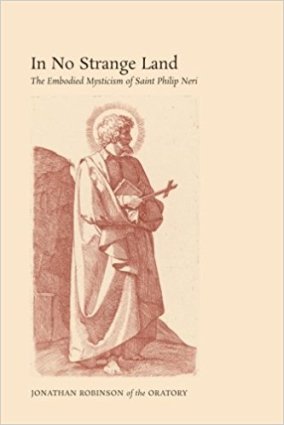
The Oratorian tradition of scholarship continues today, as with, inter alia, the work of Fr. Jonathan Robinson of the Toronto Oratory. Here is the cover of his 2015 book, In No Strange Land: The Embodied Mysticism of Saint Philip Neri. (Source).

Insofar as we are trying to draw out principles that might be of use to the Church in the face of the various cultural challenges which prompted Dreher to write The Benedict Option, I think the Oratorian example, particularly as reflected in Newman’s life and work, may be of use. What lesson we should take? That we ought not abandon the universities and all that they stand for. Yes, there are failures of free speech, episodes of intimidation, and other serious problems at many institutions of higher learning. Dreher, to his credit, has done a good job reporting on the recent madness at Middlebury and Evergreen State.

But the universities overwhelmingly remain the central locations of serious intellectual exchange in this country and the world. While there are some impressive institutions of higher learning outside of or parallel to the formal university system, these are few and far between (see, inter alia, the Maryvale Institute and the Institute for Advanced Studies in Culture). For what it’s worth, Alasdair MacIntyre has explicitly argued for a retrenchment of our position within the academy, both in Three Rival Versions of Moral Enquiry (1990) and elsewhere. As Rowan Williams notes in his review of the book, Dreher seems to write off public discourse entirely. Dreher’s decision to do so is very foolish, more likely to hurt than help the position of Christians in our culture. Moreover, it is alien to the quintessentially Oratorian spirit of a man like Newman.

Contemplate Beauty

One of the marks of the Oratorian charism is a devoted attention to aesthetics. Perhaps it is only appropriate that a vocation emerging from and responding to the Neo-Platonist Renaissance should share its love of beauty. The Florentine St. Philip seems to have known instinctively that beauty evangelizes well and widely.

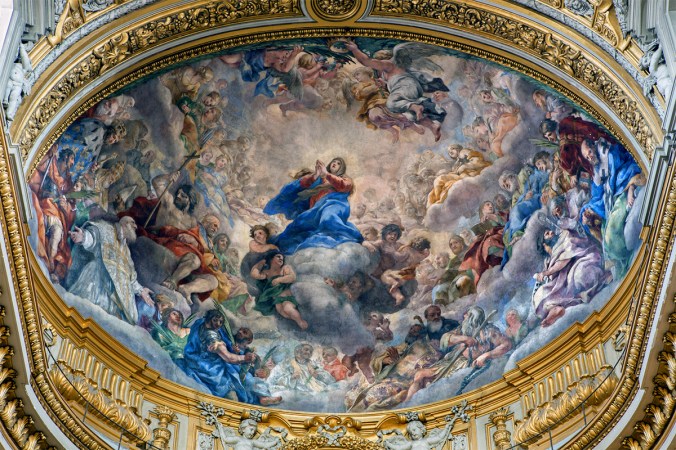
Rome - fresco of Assumption of Virgin Mary in Chiesa Nuova

Baroque apse of Santa Maria in Vallicella, by Pietro da Cortona (Source).

The exercises of the Oratory were never complete without a great deal of music. Louis Bouyer tells us that St. Philip “liked the conversations to be interspersed with music and the meetings to be brought to a close by some singing, so that the evening was filled with harmony” (Bouyer 54). St. Philip engaged the talents of some of the greatest Roman composers of his day. Giovanni Pierluigi da Palestrina took St. Philip as his confessor, and Giovanni Animuccia was so frequently involved that Bouyer tells us, “In all truth nothing but one of Animuccia’s lovely motets could distill the essence of the Oratory and pass it on undiluted” (Bouyer 55). That same essence continued in the Congregation even after St. Philip’s death. Emilio de’ Cavalieri’s Rappresentatione di Anima et di Corpo premiered at the house of the Roman Oratorians in 1600, and as a result, is generally considered the first oratorio.

St. Philip did not limit his careful deployment of beautiful and holy music to the formal exercises of the Oratory. He also knew that the long walks and pilgrimages he conducted around Rome would more easily win souls if they were elevated by sweet harmony. As Bouyer reports,

On such occasions music played a more important role than ever. Animuccia would bring along Rome’s best musicians, and the ‘Adoremus te Christe’ by Orlando de Lassus, or the ‘O vos omnes’ by Vittoria, would mingle with the sound of the fountains’ silvery cascades, of the leaves rustling in the sea breeze…On their way in the freshness of those early summer mornings on the Roman Campagna, Serafino Razzi’s Laudi would alternate with Gregorian Litanies.

At San Sebastiano…would follow a fine Polyphonic Mass, perhaps Palestrina’s wonderful ‘Mass of Pope Marcellus’ or his ‘Ecce Sacerdos magnus’…On their return to the centre of the city they would visit Santa Maria Maggiore on the heights of the Esquiline. Beneath the ceiling which Alexander VI had just decorated with the first American gold to be brought by Christopher Columbus from Peru, and among the Ionic columns of pure white marble, the day would draw to a close in an outburst of Palestrina music, and a ‘Salve Regina’ would fill the falling night with its loveliness gathered from the rivers and the stars. (Bouyer 57-60).

Nor was St. Philip insensible to the appeal of visual beauty. He was fond of Federico Barocci. We can detect in Barocci’s work a certain light sfumato, an airy other-worldliness that hovers over the strikingly intimate scenes the artist depicts. In the works of Barocci, there is something of the spirit of St. Philip, in whom the presence of God was so manifest and so exemplary in one so strangely human.

Federico_Barocci_-_Virgin_and_Child_with_Sts_Simon_and_Jude_(Madonna_di_San_Simone)

Madonna di San Simone, by Federico Barocci, c. 1567. (Source).

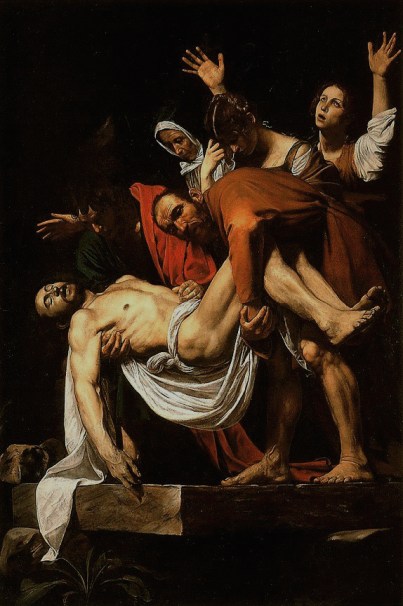
Some years after St. Philip’s death, the Oratorian fathers commissioned Caravaggio to create a sizeable painting for a side-altar. The result was the famous “Entombment of Christ (1603-04), now hanging in the Vatican Museums.

CaravaggioDeposition

The Entombment of Christ, Caravaggio, c. 1603-04. (Source).

These artistic traditions have not fallen away in later houses of the Congregation. The Brompton Oratory in London is renowned for its architecture as well as its world-class Schola Cantorum. Its founder, Fr. Faber, gained wide respect as a hymnodist and poet. Newman also wrote some excellent verse, though he is more commonly regarded as a master prose stylist; Joyce considered him the greatest prose writer in the English language. St. Philip wrote some poetry too, though he destroyed most of his verses before he died. All that survive are a few religious sonnets. As one Italian author puts it,

Philip was perhaps the first who, after the reform in our poetry effected by Bembo and other distinguished men, treated religion with that fine poetic taste with which Petrarch treated the philosophy of Plato. Philip flourished as a poet about 1540; and then he forsook literature and gave himself wholly to God, and flourished far more in holiness, until his death. But though he no longer wrote poetry, he did not set it altogether aside. He well knew its great uses when guided by a christian spirit, and therefore he made a great point of it in his Congregation. He read poetry himself, and ordered that it should be always read and used by his followers in the way described in our previous notes. (Crescimbeni, quoted by Capecelatro, here).

St. Philip frequently found ways of incorporating the Laudi of Jacopone da Todi into the spiritual reading that formed such an important part of the exercises of the Oratory. It was one of only two books we know he brought with him from Florence. The Laudi was a text to which St. Philip returned frequently throughout his life, and one that always bore new graces (Bouyer 53).

AngelStPhilip

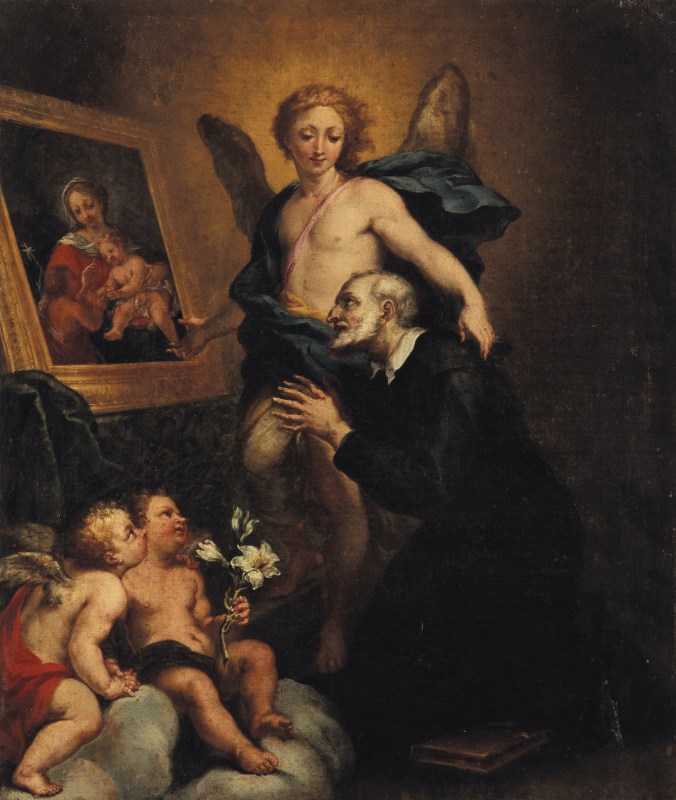
“L’Angelo mostra a San Filippo Neri un dipinto della Vergine con Bambino e San Giovannino,” Circle of Carlo Maratti (Source).

All of this goes to say that St. Philip and his sons were no philistines. They appreciated and, in some cases, produced fine art across a variety of disciplines. While their vocation was never primarily or deliberately aesthetic, Oratorians throughout history have understood the spiritual importance of beauty.

Dreher hits this point pretty well in The Benedict Option. In that sense, my dissent from his recommendation may be more a matter of emphasis than of substance. Insofar as we differ at all, I think my issue is summed up well by Rebecca Bratten Wise:

Perhaps the critics who are timid about these powerful Catholic writers working right now in our midst are waiting for someone else to “baptize” them? Perhaps they are waiting for someone else to say “I heard God there” – because they, themselves, have not learned to open the inner chambers of the ear? Because we do not have a robust Catholic arts culture that teaches us to open all the portals for reception, but instead have embraced a misnamed “Benedict Option” which is all about putting up walls and barriers, drawing those lines in the sand.

Nevertheless, I do strongly criticize Dreher for lacking a sufficiently sacramental vision. The Oratorian aesthetic makes up for this failure, in that it is primarily liturgical.

Live and Love Eucharistically

And thus, we finally turn to the most important feature of St. Philip’s life and charism, the feature which made him a saint and a father of saintshis burning, Eucharistic charity. We can find evidence of St. Philip’s Eucharistic life in the peculiar and highly somatic form of mysticism that we encounter in his vitae. St. Philip never trusted ecstasies and visions, though he was granted such graces himselfusually in connection with the celebration of the Holy Sacrifice.

Capecelatro depicts the scene for us:

But now, in his 76th year, he could no longer restrain the impetuosity of Divine love which glowed within his heart, and he resolved to say Mass in private that he might give free course to his devotion.

MassofSanFilippo

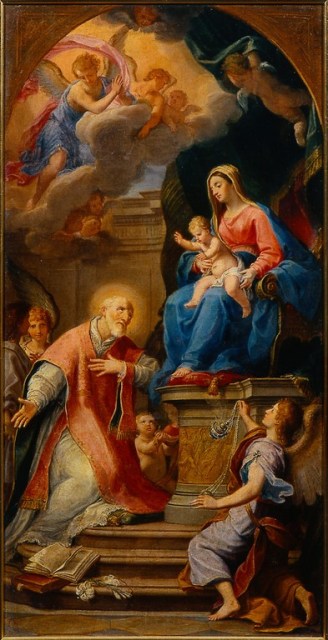
“Madonna con Bambino in trono e san Filippo Neri,” Giacomo Zoboli (Source)

From that time his usual method of saying Mass was this: up to the Domine, non sum dignus, everything went on as before; but at the solemn moment which precedes the priest’s communion, those who were in the chapel withdrew, the server lighted a lamp, put out the altar candles, closed the shutters of the windows, locked both doors, and left the Saint alone with God. Philip would have none to witness the raptures of his love, or to check the freedom of his sighs, words, and tears. A notice was then hung on the door, with these words: “Silence—the Father is saying Mass.” He would remain alone with Jesus in the Adorable Sacrament for two hours, hours of contemplation and of prayer with many tears, and urgent intercession for the Holy Church, the Bride of Jesus Christ, that He would render it as holy in the life of its children as it is in its faith and teaching. After two hours the server came back and knocked gently at the door; if the Saint answered, he opened the door, relighted the candles on the altar, opened the window-shutters, and Philip finished his Mass in the usual way. If the server received no answer, he went away for some time longer, nor did he enter the chapel until the Saint gave some sign that he might do so. What passed in those hours is known to God alone; those who saw Philip when his Mass was over were struck with amazement and awe, until his countenance was pale and wasted, as of one about to die. (Capecelatro 131-32).

And this in the immediate age of Trent! What are we to make of these irregularities?

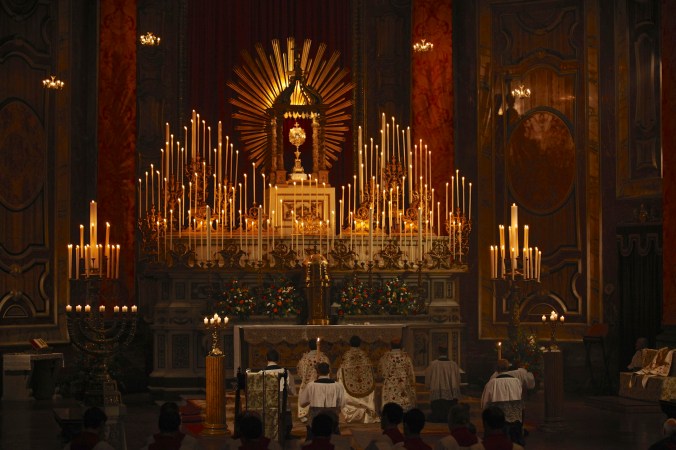
St. Philip’s Mass is not a model of liturgical praxis, but of liturgical spirituality. In his own highly idiosyncratic prayer, St. Philip becomes a universal model of the soul in adoration of the Eucharistic God. St. Philip was, indeed, one of the great apostles of adoration in his time, as he popularized the Forty Hours’ devotion in Rome. Today, the Quarant’Ore remains a tradition of the Church and the Oratory throughout the world.

QuarantOreLondon

The Forty Hours’ Devotion at the London Oratory. (Source).

St. Philip’s sons are known for their tender devotion to the liturgical rubrics. In fact, I draw my title from a line in Fr. Jonathan Robinson’s foreword to Resurgent in the Midst of Crisis: Sacred Liturgy, the Traditional Latin Mass, and Renewal in the Church (2014), by Dr. Peter Kwasniewski. Fr. Robinson speaks of an “Oratorian option” not in relation to the early stages of the Benedict Option controversy, but as “a Reform-of-the-Reform ars celebrandi” (Robinson, in Kwasniewski 3). Indeed, the Oratories of the Anglophone world have a particularly strong reputation for their reverent and careful celebration of the Holy Sacrifice of the Mass. As with the best monasteries, the best Oratories exhibit “dignity and magnificence of the liturgical ars celebrandi” (source). In London, Birmingham, Oxford, Toronto, Vienna, Cincinnati, Pittsburgh, Washington, Brisbane, York, Manchesterin short, wherever the spirit of St. Philip prevails over all rivals and distractionswe find a true Domus Orationis, a “House of Prayer” (Matt. 21:13).

The chief fruit of this discipline is supernatural charity. St. Philip sought to found his congregation on this virtue, not the vows which have historically defined the religious state. There is a Trinitarian logic to this plan. For, just as the superabundant love in the heart of the Trinity impels the Three Divine Persons freely to create, redeem, and sanctify, so too should the love of the Oratory overflow into the streets and lead its members to good works. The love of God descends to a love of brethren, which descends in turn to a love of neighbor. Each of these lesser loves ought to confirm, extend, and refine the higher loves. This chain of charity, then, is a veritable Jacob’s ladder, for those in the angelic state are called ever to climb up and down until their passage into beatitude.

Of course, the basic pattern here is not unique to the Oratory. What sets the Oratory apart is its love of the world. A kind of holy worldliness distinguishes the Oratorian spirit, even as St. Philip’s own outlandish behavior earned him a reputation for other-worldliness. I don’t mean to suggest that St. Philip and his sons were given over to the permissive and pagan times in which they lived. Rather, I mean that St. Philip and the Oratorians are characterized by two separate but related qualities that proceed from their Eucharistic life.

First, St. Philip was renowned for prudence. After all, he was a much sought-after confessor. The irony at the heart of so many of his jokes is that, by mocking his own and others’ pretensions, he demonstrated how utterly divorced so many of our lives are from good Christian common sense. In this respect, he was a true fool for Christ very much after the Eastern model. St. Philip’s prudence did indeed appear foolish to those whose vision could not penetrate to the mysteries of God.

San-Filippo-in-estasi-Guido-Reni-001

From Guido Reni. It seems only appropriate that St. Philip should be so frequently depicted fully vested for Mass. (Source).

While in other ages, prudence led some saints to undertake and advise great hardships for the kingdom, that same virtue taught St. Philip a different path. He drew his own strength from fastidious and hidden rigors, but he always counseled his penitents to avoid excessive asceticism. Once, when the future Cardinal Tarugi, still young and wealthy and vain, came to him for confession, he asked St. Philip if he might wear a hairshirt. St. Philip saw through the man’s pride. He assentedbut only allowed Tarugi to wear the hairshirt on top of all his other garments! For such an admirer of Savonarola, St. Philip could hardly have been farther from his practice when it came to matters of mortification. What little he did urge he usually salted with his own brand of humor. He famously took the Dominican novices of the Minerva out on long picnics and urged them to eat and grow fat. So, too, his pleasant indulgence of children was legendary. And what of those long walks with the crowds under the Roman sky?

St. Philip loved the world. He hated its lies and vices, but he was ever able to peer beyond that sordid stratum and into God’s glory. As one source puts it, “St. Philip was the Apostle of Rome, who by means of the ‘counter-fascination of purity and truth’ reconverted both clerics and laymen in the city at the centre of the Church.” Or, as Louis Bouyer tells us,

Does not Philip, in fact, merely yield to Renaissance optimism? Does he not ignore original sin when he bases his apostolate on freedom and confidence? His ‘religion without tears’ surely expects from undisciplined nature what the discipline of grace alone can produce?

…There is no doubt that it was dangerous to go out against the new paganism with no other arms save love, and just as dangerous to expose his apparently vulnerable simplicity to its disturbing influence, yet his outrageous method made him the victorious apostle of neo-pagan Rome. (Bouyer 28-29).

The love that conquered Rome was the fruit of St. Philip’s sacramental interior life. The unique grace of his special relationship with the Holy Spirit was a cardinal element of that life, but so was his ardent devotion to the Eucharist.

It was this element that I found so disturbingly absent in Dreher’s book. There is no properly Christ-like love of the lost in The Benedict Option, only one angry jeremiad after another. And why? Perhaps because Dreher hardly ever mentions the Eucharist. Dreher writes as if Christ’s presence on earth is an afterthought, one tool among many to be deployed in the quest for community. The result is a spiritually crabbed book, insufficiently sacramental and brimming with self-righteous anxiety.

St. Philip shows us another way.

Conclusion

At the end of the day, there is no silver bullet to halt the various troubles that the Church faces in what seems like an increasingly hostile, secular West. Christ never abandons us to the narrow limits of our own imagination and resources. Instead, He furnishes the Church with untold gifts, charisms, and holy exemplars among the saints. In this sense, the recent proliferation of “Options”to which this essay contributesis probably a blessing.

But we musn’t forget one ineradicable fact. Christ never raises these lesser creations over His own Body, Blood, Soul, and Divinity. There is no blessing, no vocation, and no grace that can go beyond the work of the Adorable Sacrament. If we forsake the one rock of the Altar and instead build upon the sand of the innumerable personal graces and unique charisms spread throughout the Church Universal, then all of our works will shatter beneath the hammer of the storm.

St. Philip Neri understood this truth and lived it out across the long span of his ministry. Those qualities which distinguish the Oratorian charismdomesticity, localism, intellectual rigor, humility, collegiality, aesthetics, urbanity, prudence, and love of the worldcan only be integrated and understood in the light of the sanctuary lamp. St. Philip’s entire life was a ceaseless testament to the power of the Eucharist “for the life of the world” (John 6:52 KJV). In keeping close to the Sacrament and to the example of St. Philip, we may just make it after all.

Heat, Song, Sweetness: A Meditation on the Benedictine Life of St. Philip Neri

spn-indies

“Rome will be your Indies.” St. Philip receives his vocation from a Cistercian. (Source)

It has not been remarked upon very often that St. Philip loved the Benedictines. Monks played an important part in his life at two critical moments: first, when he decided to go to Rome, and second, when he decided to stay in Rome.

While working with his uncle Romolo in San Germano, near Naples, St. Philip would go to pray at Monte Cassino. As one author has it, “From [the Benedictines], he developed a profound love of the liturgy, the Bible and the ancient Church Fathers.” Their rich spiritual life helped cultivate a sense of God’s will, which led him to his first conversion. St. Philip quit his lucrative mercantile career with Romolo and set off for the Holy City. We shall examine his second run-in with the sons of St. Benedict later.

In considering St. Philip, we start to find similarities with other saints. Father Faber likened him unto St. Francis of Assisi; just as St. Francis was the “representative saint” of the middle ages, so was St. Philip the true saint of modernity. Cardinal Newman took another approach, tracing the influence of S.s Benedict, Dominic, and Ignatius Loyola,  thereby arriving at something like a portrait by comparison. My strategy and emphases will differ somewhat from both of theirs.

Among the “great cloud of witnesses” who make up the Church Triumphant, there are an infinite number of likenesses and connections between the saints. Here and there, one spies a similarity in outlook, or devotion, or manner of life between figures who lived across centuries and continents. The eternal coinherence, the “dance” that binds them all, is the ineffable life of the Trinity in Unity. Thus, it is not surprising that when we observe similarities between Philip Neri and that great father among the saints, Benedict of Nursia, we should also find a deeper, Trinitarian resemblance.

I would like to offer a meditation on the life and spirituality of St. Philip through the lens of the Benedictine vows. In doing so, I hope to shed light on the Trinitarian character of the three vows as well as St. Philip’s remarkable interior life. His Trinitarian spirituality was distinguished by the threefold experience of God that the great English mystic Richard Rolle describes in The Fire of Love: “ghostly heat, heavenly song and godly sweetness” (Rolle I.5).

Keeping all of these disparate lenses in mind, let us commence.

I. The Warmth of the Father’s Stability

St-Philip-NeriBoys

St. Philip Neri was especially popular among the young men of Rome. (Source)

St. Philip was the spiritual father of many men in his own day. Palestrina, Animuccia, St. Camillus of Lellis, and others received forgiveness from him in the confessional. He was particularly kind to youth. Once, when the scholarly Baronius complained that the children with whom St. Philip was playing in the yard were too loud for his studies, St. Philip replied that he’d let them chop wood off his own back, if only they might not sin. The long-suffering Baronius accepted St. Philip’s paternal will. It was a salutary and exemplary mortification, and St. Philip knew that. It was also a lesson. St. Philip intended for his sons to live out spiritual fatherhood in the world. And they were to do it, following his own example, with intense joy.

When we contemplate the Fatherhood of God, we are struck dumb with wonder at the abyss of Being abiding in His fullness. God the Father is the immovable, the unshakeable, the indefinable One. It is from God the Father that we learn that fatherhood can only be cultivated upon presence…rootedness…constancy. And it must also blaze with the heat of love. The two qualities are mutually reinforcing. Put briefly, the warmest paternity will cool, harden, and falter if it is not sustained by stability.

St. Benedict understood this dynamic, and when he sought to compose a rule for his spiritual family, he knew that he had to incorporate it into his model. In the very first chapter of the Rule, we read of the different kinds of monks. The worst are those whom St. Benedict calls “Gyrovagues,” men who

…spend their whole lives tramping from province to province, staying as guests in different monasteries for three or four days at a time. Always on the move, with no stability, they indulge their own wills and succumb to the allurements of gluttony (Rule of St. Benedict I).

Instead, St. Benedict calls for his monks to pass their lives in one place, at one task—seeking God. Stability is so central to his vision that he doesn’t even bother writing a chapter about it. Instead, he assumes it as a necessary condition from the very beginning and lets it color his prescriptions from then on.

St. Philip was equally adamant about stability. The organization of the Oratory is a great testament to his idea of stability. Even in the early days, when he first sent some priests to San Giovanni dei Fiorentini, he required that they return to his chamber above San Girolamohis “cenacle,” if you willand continue with the exercises of the Oratory.  When the priests finally left both parishes and moved to Santa Maria in Vallicella, the Chiesa Nuova, St. Philip imagined that his religious family would never grow beyond its four walls. He was deeply reluctant to grant the foundation of an Oratory in Naplesthough it would furnish the Church with great saints such as the Blessed Giovanni Juvenal Ancina.

The basic grain of St. Philip’s idea has endured in those lands where the Oratory has flourished. Oratorians spend their whole priestly lives in one community. They can travel and work more freely than vowed religious, since they are truly secular priests, but their range of motion is restricted by the value of stability that St. Philip imposes on his sons. The quality of that stability differs from the asceticism which marked the experience of the early monks. As Newman puts it:

The Congregation is to be the home of the Oratorian. The Italians, I believe, have no word for homenor is it an idea which readily enters into the mind of a foreigner, at least not so readily as into the mind of an Englishman. It is remarkable then that the Oratorian Fathers should have gone out of their way to express the idea by the metaphorical word nido or nest, which is used by them almost technically. (Newman, qtd. by Robinson).

As Newman said elsewhere:

…the objective standard of assimilation is not simply the Rule or any abstract idea of an Oratory, but the definite local present body, hic et nunc, to which [the novice] comes to be assimilated (Newman, qtd. on the Toronto Oratory Vocations page).

The stability of the Oratory is enlivened with a certain warmth, a familial domesticity that is adequately captured in the Italian nido. The Oratorian has his “nest” in his cell, and beyond that, his house, and beyond that, the city where God has led him. None of these becomes his “nest” by matter of location, but by the network of sacramental relationships he enters there. He is begotten anew by the paternity of St. Philip, by his immediate superiors, and ultimately, by God. The same spirit prevails in the very best monastic houses, as any visitor to Silverstream Priory or the Monastero di San Benedetto in Monte or Stift Heiligenkreuz or Clear Creek Abbey or L’Abbaye Sainte-Madeleine du Barroux can attest. Dom Aelred Carlyle’s Caldey Island had just such a sensibility, as did Nashdom Abbey before its decline. The Oratory and the Benedictine Monastery keep alive the fire of God’s paternal love by their community life and stability in prayer.

II. The Son’s Obedient Song

StPhilipNeriMadonna

The Madonna Appearing to Saint Philip Neri, Sebastian Conca. (Source)

Up to now, I have not addressed the peculiar irony in my approach. The model that St. Philip left for his sons is singular among all others in the Church in its total rejection of vowssuch as those that mark the Benedictine vocation. The constitutions of the Congregation are very clear. Even if all the members around the world should take vows and only one abstain, the true Oratory would rest with that lone dissenter, and not the majority. Instead, Newman tells us, “Love is his bond, he knows no other fetter.” St. Philip trusted that bond of charity to sustain the common life he envisioned for the Oratory.

St. Philip hoped that his sons, through mortification of the intellect and an easy, friendly concord, would persevere in the love that was their peculiar vocation. Just as voices unite in harmony for no better end than beauty, so might we describe the Oratorian ideal as a kind of “song”Rolle’s second experience of God. The liturgy for the Sixth Sunday in Easter illustrates this point admirably. The Introit (Vocem iucunditatis annuntiate), Psalm (Let all the earth cry out to God with joy), and Offertory (Benedicite gentes Dominum) all refer to song as the properly obedient response to God’s grace. The truth and beauty of that good song is attractive to souls made weary by the heavy dross of the world. St. Philip knew this fact well, and he employed some of the leading composers of the timePalestrina and Animucciato write music for the exercises of the Oratory.

Moreover, one could almost imagine that the first reading, which mentions the Apostle Philip, was really intended to tell us something about the life of the Joyful Saint:

Philip went down to the city…and proclaimed the Christ to them. With one accord, the crowds paid attention to what was said by Philip when they heard it and saw the signs he was doing…There was great joy in that city. (Acts 8: 5-8 NAB)

Similarly, the Epistle calls to mind St. Philip’s singular mystical life. We read, “Sanctify Christ as Lord in your hearts,” (1 Pet. 3: 15-18 NAB). And how are we, like St. Philip, to go about sanctifying Christ in our hearts? The Gospel tells us:

If you love me, you will keep my commandments. And I will ask the Father, and he will give you another Advocate to be with you always, the Spirit of truth, whom the world cannot accept, because it neither sees nor knows him. But you know him, because he remains with you, and will be in you. (John 14:15-17 NAB)

Christ is preeminently the man who responds with a song of obedience, and St. Philip follows his lead. And what do St. Philip and his sons sing in their common life? What but the praise of God? What but the Divine Word, the Logos, Christ made present in prayer and scripture and sacrament? Indeed, Eliot’s description of “every phrase/And sentence that is right” could apply just as well to the Oratorian life:

…where every word is at home,
Taking its place to support the others,
The word neither diffident nor ostentatious,
An easy commerce of the old and the new,
The common word exact without vulgarity,
The formal word precise but not pedantic,
The complete consort dancing together
(Little Gidding V)

The life of the Benedictine monk is not so seemingly free. He has one work, the liturgy, the Opus Dei. This one task is the first and final way that the Benedictine fulfills his vow of obedience to Christ. As Chapter 5 of the Holy Rule has it: “The first degree of humility is obedience without delay. This is the virtue of those who hold nothing dearer to them than Christ” (Rule of St. Benedict V). The eleven degrees that follow build upon this cornerstone, marked as it is by the love of Christ. It is a love that conforms the monk to the obedience of Christ crucified. The wicked Sarabaites that St. Benedict describes in Chapter 1 are chiefly marked by their unwillingness to obey:

They live in twos or threes, or even singly, without a shepherd, in their own sheepfolds and not in the Lord’s. Their law is the desire for self-gratification: whatever enters their mind or appeals to them, that they call holy; what they dislike, they regard as unlawful. (Rule of St. Benedict I).

St. Philip knew how to obey. When he was under suspicion of heresy, he immediately ceased his labors in submission to the Papal investigators until he knew the outcome. He only resisted when it came to the cardinalate, which he always resolutely refused. Once, upon receiving the Red Hat, he made jokes about the honor and laughed it off as if it were nothingin the very presence of the Pope! Exasperated, the Holy Father decided to grant St. Philip’s wish, and did not insist on the appointment.

But he also obeyed the voice of God through other figures, such as when he formally received his vocation. Hearing the many stories of St. Francis Xavier in the East, St. Philip determined to set out for India. But he decided to wait and test the calling with the advice of another man he trusted.

In Rome, there is a Cistercian monastery called the Tre Fontane, which takes its name from the legend that when St. Paul was martyred, his head bounced three times. It is said that three fountains miraculously sprang up from the earth where his head fell. Later, a house of religion was founded there. It was to this monastery that St. Philip went to consult a well-respected monk known for his spiritual insights. The monk listened to St. Philip’s situation, and told him to return later. When St. Philip came back to the Tre Fontane, he had his answer“Rome will be your indies.” He never again desired to leave the Holy City. Cardinal Newman tells us that the monk did this under the spiritual guidance of St. John. How appropriate that the Apostle so intimately tied to the Second Person of the Trinity should teach St. Philip to imitate Christ’s obedient humility!

III. The Sweetness of the Spirit’s Conversatio Morum

StPhilipNeriFlamingHeart

The Holy Spirit made the heart of St. Philip sacramental while on this earthly journey. (Source)

Few saints have such a manifest intimacy with the Holy Spirit as St. Philip Neri. Biographers and commentators throughout the centuries have always noted the peculiar affinity between St. Philip and the Third Person of the Holy Trinity.

When St. Philip first came to Rome, he spent most of his nights praying in the catacombs. He drew surpassing sweetness from this salutary solitude. For him, Rome was not just a (recently sacked) city of decadent palaces, picturesque ruins, and opulent vices. Rome was a landscape marked by the work of the Holy Spirit through human history. The catacombs reminded St. Philip of the Church of the martyrs.

It was on one of these vigils that St. Philip experienced a visitation by the Holy Spirit. He came to the catacomb of St. Sebastian on the night before Pentecost. While praying, the Holy Spirit descended upon him. Fr. Philip G. Bochanski of the Oratory describes the scene well:

As the night passed, St Philip was suddenly filled with great joy, and had a vision of the Holy Spirit, who appeared to him as a ball of fire. This fire entered into St Philip’s mouth, and descended to his heart, causing it to expand to twice its normal size, and breaking two of his ribs in the process.  He said that it filled his whole body with such joy and consolation that he finally had to throw himself on the ground and cry out, “No more, Lord!  No more!” (Source).

Throughout his life, St. Philip would report an unremitting heat throughout all of his body, though always most intense around his heart. Even in the dead of winter, he’d be so warm as to freely unbutton his collar when everyone else was shivering. Pressing someone’s head to his breast, letting him hear his heartbeat and feel the miraculous warmth, was enough to convert even the most hardened and impenitent sinners. We can say with no exaggeration that the Holy Spirit made St. Philip a living sacrament. He became a fountain issuing forth graces. He bore all of the sweet fruits of the Holy Spirit. As Fr. Bochanski puts it, “St Philip was convinced and constantly aware of the presence and action of the Holy Spirit in him and through him…He was sure that he had received the gifts of the Holy Spirit, and this assurance set him free to bear the Spirit’s fruits.”

St. Philip’s special relationship with the Holy Spirit drew him into an almost uncontrollable ardor of love for the Eucharist. He was a great mystic of the Blessed Sacrament. Under St. Philip’s direction, the Roman Oratory popularized the Forty Hours Devotion of Eucharistic Adoration, an important precursor for later efforts at Perpetual Adoration. In spite of his wise suspicion of visions and miracles, he was granted innumerable ecstasies. These would usually come in some connection with the Eucharist. St. Philip had jokes read to him in the sacristy as he vested, as he had a very realistic fear of entering a sweet trance of joy before the Mass even began.

In his old age, St. Philip was allowed to give free reign to these Eucharistic ecstasies. By special permission of the Pope, he would say his Mass only in a private chapel on the top floor of the Vallicella. At the consecration, he would kneel down before the altar. The servers would close the windows, shut the door, and place a sign on the handle which read, “Silence! The Father is saying Mass.” Then, in darkness and silence, St. Philip would commune with the Eucharistic God for upwards of two hours. When he was done, the servers would ring a bell, the sign on the door would be removed, and he would continue the Mass as if nothing had happened.

In all of these phenomena, we may be tempted to draw a contrast with the staid, rhythmic, simple spirituality of St. Benedict’s Rule. Not sofor we must examine why St. Philip was given the singular graces that marked his life in the Holy Spirit.

The third vow that St. Benedict demands of his sons is Conversatio Morum, the conversion of manners (Rule of St. Benedict LVIII). The monk enters the monastery that he might “seeketh God,” and seek Him fully (Rule of St. Benedict LVIII). Like all Christians, he is after deification. But unlike most of us, he is called to theosis by shunning the distractions of the World. He can only do this by entering into the sacrifice of the Eucharistic Christ, whom he adores in the liturgy that marks the hours of every day. The Benedictine vocation is, at its heart, life made explicitly Eucharistic.

Dom Mark Daniel Kirby of Silverstream, building upon the work of the Blessed Abbot Columba Marmion and Mother Mectilde de Bar, has put the point admirably. Among many other similar passages, we find in a poem from 2011:

The Eucharistic Humility of God
is inseparable from His Eucharistic Silence.
This Saint Benedict understood,
for in his Rule, the silent are humble,
and the humble silent.
This our Mother Mectilde understood
for she wanted her Benedictine adorers to bury themselves
in the silence of the hidden God,
the ineffably humble God
in the Most Holy Sacrament of the Altar. 
(Source)

In the Eucharist, we find the consummation of all God’s sweetness. “O taste, and see that the Lord is sweet: blessed is the man that hopeth in him” (Psalm 33:9 DRA). It is the grand work of the Spirit, the crown of the sacraments, the dawn of the new and everlasting life. Just as Richard Rolle passed into “the most delectable sweetness of the Godhead,” so too does the monk return each day to the Eucharist to drink of the Spirit’s epicletic sweetness (Rolle I.5).

And St. Philip, with his Eucharistic ecstasies and his intimacy with the Spirit, knew that sweetness better than we can possibly imagine. The sweetness of the Holy Spirit transformed him into an instrument of grace, a human sacrament whose own manners were deeply converted and who aided many along the same journey. It is little wonder that Oratories and Benedictine monasteries remain centers of reverent and beautiful celebration of the Holy Sacrifice of the Mass.

Conclusion

Ritratto di San Filippo-b

Portrait of St. Philip Neri. (Source)

St.-Benedict-81

Portrait of St. Benedict. (Source)

Many writers have found in St. Philip Neri the likeness of other saints, including those predecessors whom he admired, the contemporaries whom he loved, and the innumerable great saints who followed in the generations since he went on to immortal glory.

Yet is any resemblance so striking, and so Trinitarian, as that between the Father of the Oratory and the Father of Monks? In both, we find the very image of the Father, the Son, and the Holy Spirit. In both, we can see the marks of stability, obedience, and conversion of manners. And in both, we detect the surpassing heat, song, and sweetness which Richard Rolle describes as indicative of a true encounter with God.

By their prayers, may we someday share that eternal encounter.

Solimena, Francesco, 1657-1747; The Holy Trinity with St Philip Neri in Glory

The Holy Trinity with St. Philip Neri in Glory, Francesco Solimena. The figure at left is probably the Benedictine Oblate, St. Francesca Romana. The painting, originally intended for the Naples Oratory, now hangs in the Ashmolean Museum of Art and Archaeology at Oxford (Source).

Saint-Benedict-in-Glory-1500-58b5a7553df78cdcd88ab39f

St. Benedict in Glory, c. 1500. Artist unknown. (Source)

Newman’s Novena to St. Philip Neri

StPhilipFlorence

Articles of devotion to St. Philip Neri, Florence. Photo taken by the author in June of 2015.

St. Philip Neri is my favorite saint. I came to his acquaintance during the summer after my second year in college, when I studied abroad in locations marked by the presence of Oratories. I believe that I was, so to speak, “introduced” to St. Philip by his famous son, the Blessed Cardinal Newman, whose work I had already read and admired. It is also perhaps of some significance that I had devoted that year of my Catholic life to the Holy Spirit. Desiring a deeper friendship with St. Philip, I followed along with Newman’s novena to St. Philip last May. Having read several biographies and having started a blog, I thought I might try my own hand at offering some small act of devotion to St. Philip in the form of nine brief meditations on his life and virtues.

Unfortunately, it seems that the frenzy of graduation week has crept up on me, and I was unable to complete this task. I do, however, offer my own biography of the saint. My sources are chiefly the various Oratorian materials produced by the London and Oxford houses, Good Philip, by Alfonso Cardinal Capecelatro, the biographies by V.J. Matthews, Louis Bouyer, Anne Hope, and Theodore Maynard, and finally, sundry writings by Cardinal Newman, Fr. Faber, Fr. Jonathan Robinson, and Monsignor Knox. All are excellent resources, and I would be happy to provide more details about them in the comments section if asked.

The actual text of the novena will be taken from the Newman Reader, which is my go-to source for all things Newman. I claim no authorship of these texts and am entirely in debt to that great theologian, the Blessed Cardinal of the Birmingham Oratory. I have decided to do this, rather than simply link to the Newman Reader, in part because I am starting my novena a day later than Newman does. Newman began his novena to St. Philip on the 17th and ended it on the 25th, presumably because of the various festivities that the 26th would usher in. However, as I do not live in an Oratory, I will be starting and ending a day later, so that the readings of the ninth day fall on the feast proper. There is a certain liturgical grace that comes with the feast this year, but I will discuss that in another post.
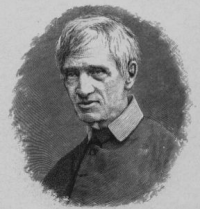
NewmanasanOratorian

John Henry Newman as an Oratorian. (Source)

For now, I’ll say that I will be offering this novena for the vocation of X.

St. Philip, as we shall see, is a very good heavenly guide for young men. He is especially helpful for those who are trying to discern the will of God in their lives.
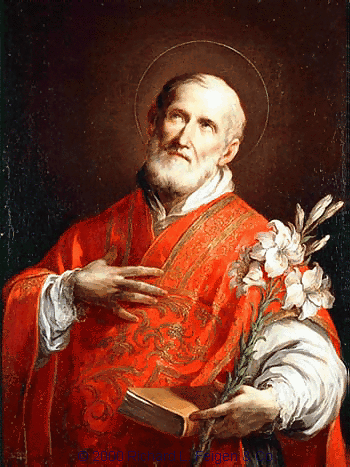
FNeri

A famous image of St. Philip. He is customarily depicted in a red or rose chasuble in iconography. (Source).

Each day, start by reading the meditation and prayer, and then say the prayer of Cardinal Baronius:

Look down from heaven, Holy Father, from the loftiness of that mountain to the lowliness of this valley; from that harbour of quietness and tranquillity to this calamitous sea.  And now that the darkness of this world hinders no more those benignant eyes of thine from looking clearly into all things, look down and visit, O most diligent keeper, this vineyard which thy right hand planted with so much labour, anxiety and peril.  To thee then we fly; from thee we seek for aid; to thee we give our whole selves unreservedly.  Thee we adopt as our patron  and defender; undertake the cause of our salvation, protect thy clients.  To thee we appeal as our leader; rule thine army fighting against the assaults of the devil.  To thee, kindest of pilots, we give up the rudder of our lives; steer this little ship of thine, and, placed as thou art on high, keep us off all the rocks of evil desires, that with thee for our pilot and guide, we may safely come to the port of eternal bliss. Amen.

Those of you who prefer Latin can find it at this link.

On the ninth day, conclude by adding on the Collect and Litany at the very end of this post.

St. Philip’s Life
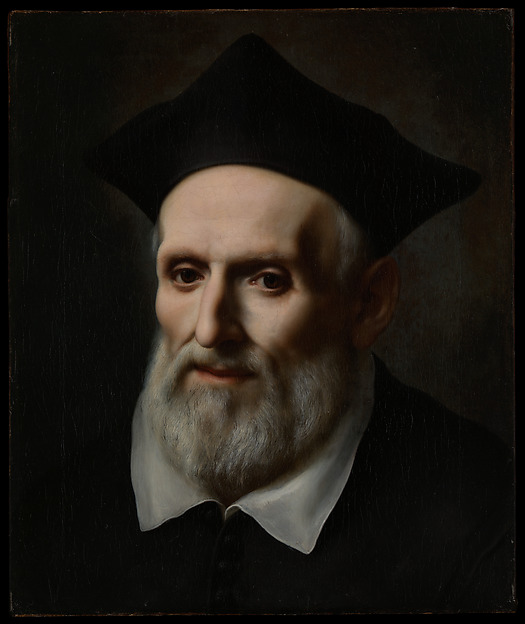
DolciPhilipNeri

Saint Philip Neri (1515-1595), by Carlo Dolci, c. 1645. The finest portrait of the saint was painted long after he died. In his own life, St. Philip was patron of the arts, and was even Palestrina’s confessor. (Image Source).

St. Philip Romolo Neri was born in Florence to a loving father and stepmother and brought up in the faith by the Dominicans of San Marco. The embers of Savonarola’s fiery spirit still burned in the memories of the Florentines, and for the rest of his life, St. Philip would hold the reformer in a high regard. But his temperament was as different from Savonarola’s as day is from night. St. Philip was always good-natured, kind, and generous. He was not overly pious, with play-acting the Mass or anything of that sort. Instead, he cultivated a winning personality that earned him the nickname “Pippo Buono.” He was remarkably humble, never giving much weight to the things of this world. Once, he was shown a beautiful diagram of his family tree; he promptly tore it up.

When he reached adulthood, St. Philip went to seek his fortune with his uncle Romolo, a merchant in San Germano. He found that the life of commerce was not conducive to his temperament, and so, after praying at the shrines of the Benedictines at Monte Cassino and Gaeta, he left for Rome almost penniless. The city had just been sacked by the soldiers of the Emperor, and work was hard to come by. Nevertheless, St. Philip was soon employed as a tutor for the Caccia family. The boys he taught would later go on to lives of holiness as priests. St. Philip made few friends in this period of his life. Like a hermit, he would hardly eat anything and spent his nights in the catacombs, remembering and praying to the martyrs of the early Church. On one such occasion, while he was in the catacombs of San Sebastiano, he had a mystical experience that would forever change his life. The Holy Spirit descended into his heart as a ball of fire. For the rest of his life, he would report heart palpitations, an incredible heat, and physical shaking – sometimes enough to move the chair in which he sat. Upon occasion, it was enough to convert a sinner only to draw their head to his Spirit-infused breast. Only in very old age did he confide his secret. When he died, his heart was found to be considerably enlarged. Several ribs were dislocated by its growth.

But in youth, he kept all this under wraps. He slowly started to gain a following. He would frequent the Seven Stational Churches, even leading bands of pilgrims on picnics. As he got older, these journeys grew in size and festivity. But in the early days, he was followed only by a few young men who were attracted to a charismatic tutor. He would also visit and help in the hospitals, perhaps the most common form of charitable work in Renaissance Italy. He would later exert a great influence on that marvelous saint of the hospitals, St. Camillus of Lellis.

St. Philip and his friends moved into the Church of San Girolamo, where, every afternoon, they would have a time of prayer, hymn-singing, recitation of the Bible, public commentary on the Scriptures, and some lesson from the history of the Church or the lives of the saints. This was the first Oratory. St. Philip’s way of life looked mighty suspicious to the authorities in a Rome still reeling from the Reformation, and he was investigated and opposed by several figures – namely an irate cardinal close to the Pope. But that cardinal died before the end of his investigation into St. Philip, an event whispered to be the wrath of God. Every other opposition fell away, and in time, St. Philip became an established figure in Rome. He was eventually persuaded to seek ordination. While never a Doctor of the Church, St. Philip learned his theology well, and was able to put it to good use in his later pastoral life.

When the Church of the St. John of the Florentines requested that St. Philip move to their community, he balked. Instead, he sent some of his best disciples, including Cesare Baronius, later to become a great cardinal and historian of the Church. However, all of the priests he sent were required to return to San Girolamo every day for the Oratory sessions. In this practice, we can perceive the seeds of the Congregation that would later flourish throughout the Catholic world.
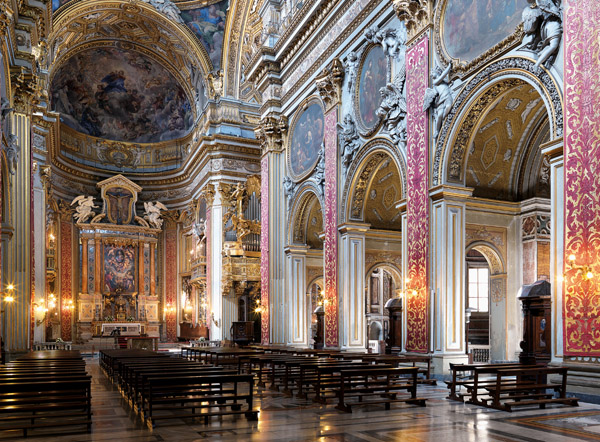
Obejscie 0170

The Chiesa Nuova, Rome. (Source)

When St. Philip was given the chance to build a new church, Santa Maria in Vallicella, he stunned the architects by boldly demanding a much larger structure than expected. Yet build it he did, and the “Chiesa Nuova,” or “New Church,” became the nerve center for the entire Oratorian family. St. Philip always resisted turning the Oratory into a religious order; today, it is still no such thing. Oratorians take no vows, but are bound to each other by a promise of charity. Love (and, one must assume, a tremendous amount of patience) holds each Oratory together. The closest parallel would be the Benedictines, who live in one place their entire life and belong to a wide, loose, familial confederation.

St. Philip Neri made friends with a great many Romans, and more than a few saints. He was on close terms with many of the Popes of his day, and more than one went to him for confession. Two great cardinals came from his immediate circle, Baronius the historian and Tarugi the politician. St. Philip was particularly intimate with the great Capuchin mystic, St. Felix of Cantalice. He also sent so many men to the Jesuits that St. Ignatius took to calling him “the Bell of the Society,” always bringing in more, but never entering himself. All in all, it was for the best. St. Philip’s temperament and spirituality were thoroughly un-Jesuit. Where St. Ignatius was hard, St. Philip was soft; where St. Ignatius was demanding, St. Philip was persuasive; where St. Ignatius sent his sons to a thousand works, St. Philip allowed them but one. But the two saints always held each other in a high, slightly bemused regard. St. Philip was the confessor of St. Camillus of Lellis as well as the composers Palestrina and Animuccia. Their compositions for St. Philip’s afternoon meetings became the first oratorios. St. Philip was always trying to draw souls to Christ by way of holy beauty. This quality, along with so many others, would make him a particularly apt spiritual father for the revival of Catholicism in 19th century Britain.

St. Philip could be a very hard confessor. He could tell if someone was holding back a sin, and he’d often relate the substance of that sin to the penitent himself. Yet his demands were always tempered by a certain tenderness. He was never inclined to endorse any kind of extreme asceticism, and positively distrusted anyone who claimed special visions and ecstasies.

Nevertheless, the Lord did grant him many such graces anywayand usually when saying Mass. St. Philip was a mystic of the Eucharist. Just in order to get through the process of vesting, let alone the Mass itself, he would have his server read jokes to him in the sacristy. In his old age, he would go into ecstasies at the Masses he celebrated, sometimes taking a few hours to say the entire liturgy. He also popularized the devotion of the Forty Hours of Adoration, a tradition that still takes place in so many of the Oratories of the world.

St. Philip was known as a joker, and he would teach his disciples to mortify their reason through his many practical jokes. Along with the Laudi of Jacopone da Todi, the joke books then popular in Florence and Rome were some of his favorite reading. He once showed up to a formal function with half of his beard shaved off. At another solemn occasion, he started to stroke the beard of a Swiss guard for no apparent cause. At yet another time, he made his aristocratic disciple Tarugi follow and carry a little lapdog through the city, to the jeers of the crowds. He is known as the “Joyful Saint” for very good reasons.

He effected such a change in the devotions and morals of the broken, decadent, and dispirited city, that he became known as the Third Apostle of Rome. When he died, he was immediately the subject of widespread devotion. The official workings of the Vatican could not proceed quickly enough for the people of Rome, who prayed to the departed priest with all the zeal they could muster. When he was finally elevated to sainthood in 1622, the Romans took to saying that the Pope had canonized “four Spaniards and a saint.”

Yet Spain would not receive the Florentine’s spiritual heritage in its fullness. Nor would France, where Cardinal de Bérulle heard of the Oratory, liked the idea, and started his own order with a very different organization and spirituality. The French Oratorians may be considered St. Philip’s nephews, but not his sons. For many centuries, only Italy bore the mark of what St. Philip really wanted from his sons – holy, independent houses of secular priests bound together by nothing more than the bond of charity.

And the Italian Oratories persevered valiantly until a convert from Anglicanism came to Rome to study for the priesthood: John Henry Newman. It was Newman, along with Fr. Frederick William Faber and Fr. Ambrose St. John, who brought the Oratory to England, where it thrived as almost nowhere else. The Oratories of Birmingham and London were the great centers of English Catholicism, leavening all the other efforts of the Church in that land. Oratorians played a significant role in the lives of Gerard Manley Hopkins, Oscar Wilde, and J.R.R. Tolkien, to mention but a few. The Oratory has seen an explosion in the United Kingdom over the last few decades, with new houses in Oxford, York, Manchester, Cardiff, and Bournemouth having opened or set to open in the near future. It seems that in these troubled times, the Holy Spirit is multiplying their numbers for some great work. More and more Oratories are starting in the United States, many on the lines of the English and Italian models. In Toronto, Pittsburgh, Cincinnati, Washington, Kalamazoo, and so many more cities, St. Philip is making his home. In these days of preparation for his feast, let us remember the great works God has wrought through him and his sons.

Day 1: Philip’s Humility
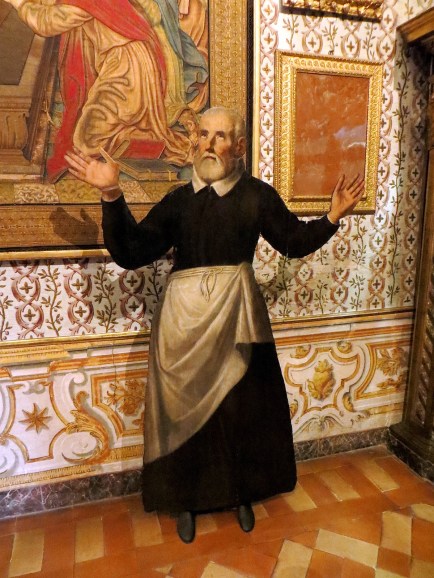
santa-maria-in-vallicella-2

The famous effigy of St. Philip in the Roman Oratory, made while he was still living. It would go around to the Seven Churches when he could no longer make the pilgrimage. (Source)

If Philip heard of anyone having committed a crime, he would say, “Thank God that I have not done worse.”

At confession he would shed abundance of tears, and say, “I have never done a good action.”

When a penitent showed that she could not bear the rudeness shown towards him by certain persons who were under great obligations to him, he answered her, “If I were humble, God would not send this to me.”

When one of his spiritual children said to him, “Father, I wish to have something of yours for devotion, for I know you are a Saint,” he turned to her with a face full of anger, and broke out into these words: “Begone with you! I am a devil, and not a saint.”

To another who said to him, “Father, a temptation has come to me to think that you are not what the world takes you for,” he made answer: “Be sure of this, that I am a man like my neighbours, and nothing more.”

If he heard of any who had a good opinion of him, he used to say, “O poor me! how many poor girls will be greater in Paradise than I shall be!”

He avoided all marks of honour. He could not bear to receive any signs of respect. When people wished to touch his clothes, and knelt as he passed by, he used to say, “Get up! get out of my way!” He did not like people to kiss his hand; though he sometimes let them do so, lest he should hurt their feelings.

He was an enemy to all rivalry and contention. He always took in good part everything that was said to him. He had a particular dislike of affectation, whether in speaking, or in dressing, or in anything else.

He could not bear two-faced persons; as for liars, he could not endure them, and was continually reminding his spiritual children to avoid them as they would a pestilence.

He always asked advice, even on affairs of minor importance. His constant counsel to his penitents was, that they should not trust in themselves, but always take the advice of others, and get as many prayers as they could.

He took great pleasure in being lightly esteemed, nay, even despised.

He had a most pleasant manner of transacting business with others, great sweetness in conversation, and was full of compassion and consideration.

He had always a dislike to speak of himself. The phrases “I said,” “I did,” were rarely in his mouth. He exhorted others never to make a display of themselves, especially in those things which tended to their credit, whether in earnest or in joke.

As St. John the Evangelist, when old, was continually saying, “Little children, love one another,” so Philip was ever repeating his favourite lesson, “Be humble; think little of yourselves.”

He said that if we did a good work, and another took the credit of it to himself, we ought to rejoice and thank God.

He said no one ought to say, “Oh! I shall not fall, I shall not commit sin,” for it was a clear sign that he would fall. He was greatly displeased with those who made excuses for themselves, and called such persons. “My Lady Eve,” because Eve defended herself instead of being humble.

Prayer

PHILIP, my glorious patron, who didst count as dross the praise, and even the good esteem of men, obtain for me also, from my Lord and Saviour, this fair virtue by thy prayers. How haughty are my thoughts, how contemptuous are my words, how ambitious are my works. Gain for me that low esteem of self with which thou wast gifted; obtain for me a knowledge of my own nothingness, that I may rejoice when I am despised, and ever seek to be great only in the eyes of my God and Judge.

Prayer of Cardinal Baronius (above)

Day 2: Philip’s Devotion
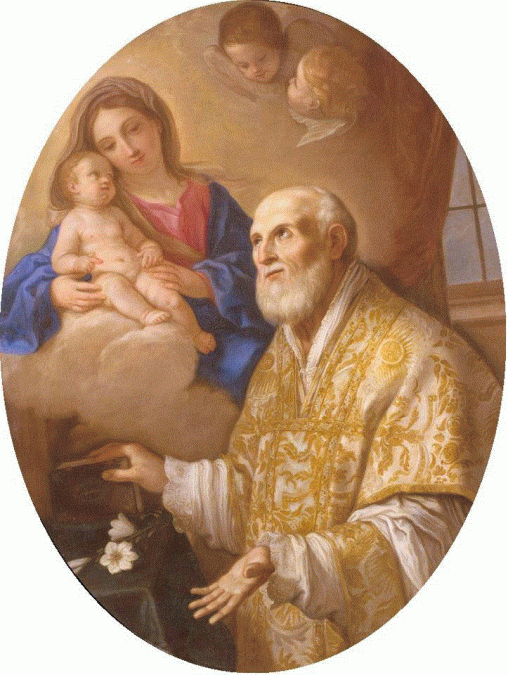
filippo-neriandmadonna

St. Philip had a tender devotion to Our Lady, and she gave him many outstanding graces. (Source).

The inward flame of devotion in Philip was so intense that he sometimes fainted in consequence of it, or was forced to throw himself upon his bed, under the sickness of divine love.

When he was young he sometimes felt this divine fervour so vehemently as to be unable to contain himself, throwing himself as if in agony on the ground and crying out, “No more, Lord, no more.”

What St. Paul says of himself seemed to be fulfilled in Philip: “I am filled with consolation—I over-abound with joy.”

Yet, though he enjoyed sweetnesses, he used to say that he wished to serve God, not out of interest—that is, because there was pleasure in it—but out of pure love, even though he felt no gratification in loving Him.

When he was a layman, he communicated every morning. When he was old, he had frequent ecstacies during his Mass.

Hence it is customary in pictures of Philip to paint him in red vestments, to record his ardent desire to shed his blood for the love of Christ.

He was so devoted to his Lord and Saviour that he was always pronouncing the name of Jesus with unspeakable sweetness. He had also an extraordinary pleasure in saying the Creed, and he was so fond of the “Our Father” that he lingered on each petition in such a way that it seemed as if he never would get through them.

He had such a devotion to the Blessed Sacrament that, when he was ill, he could not sleep till he had communicated.

When he was reading or meditating on the Passion he was seen to turn as pale as ashes, and his eyes filled with tears.

Once when he was ill, they brought him something to drink. He took the glass in his hand, and when he was putting it to his mouth stopped, and began to weep most bitterly. He cried out, “Thou, my Christ, Thou upon the Cross wast thirsty, and they gave Thee nothing but gall and vinegar to drink; and I am in bed, with so many comforts around me, and so many persons to attend to me.”

Yet Philip did not make much account of this warmth and acuteness of feeling; for he said that Emotion was not Devotion, that tears were no sign that a man was in the grace of God, neither must we suppose a man holy merely because he weeps when he speaks of religion.

Philip was so devoted to the Blessed Virgin that he had her name continually in his mouth. He had two ejaculations in her honour. One, “Virgin Mary, Mother of God, pray to Jesus for me.” The other, simply “Virgin Mother,” for he said that in those two words all possible praises of Mary are contained.

He had also a singular devotion to St. Mary Magdalen, on whose vigil he was born, and for the Apostles St. James and St. Philip; also for St. Paul the Apostle, and for St. Thomas of Aquinum, Doctor of the Church.

Prayer

PHILIP, my glorious Patron, gain for me a portion of that gift which thou hadst so abundantly. Alas! thy heart was burning with love; mine is all frozen towards God, and alive only for creatures. I love the world, which can never make me happy; my highest desire is to be well off here below. O my God, when shall I learn to love nothing else but Thee? Gain for me, O Philip, a pure love, a strong love, and an efficacious love, that, loving God here upon earth, I may enjoy the sight of Him, together with thee and all saints, hereafter in heaven.

Prayer of Cardinal Baronius (above)

Day 3: Philip’s Exercise of Prayer
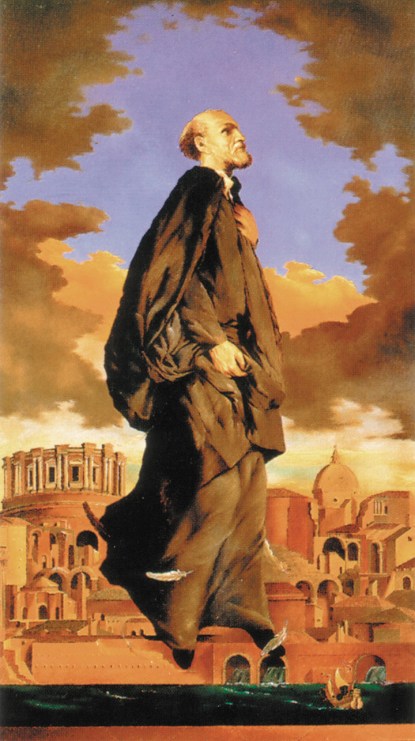
MODERN IMAGE OF ST. PHILIP NERI ONE OF 550 IMAGES IN BOOK ON THE PRIESTHOOD

A depiction of St. Philip by the contemporary Italian artist, Salvo Russo. (Source).

From very boyhood the servant of God gave himself up to prayer, until he acquired such a habit of it, that, wherever he was, his mind was always lifted up to heavenly things.

Sometimes he forgot to eat; sometimes, when he was dressing, he left off, being carried away in his thought to heaven, with his eyes open, yet abstracted from all things around him.

It was easier for Philip to think upon God, than for men of the world to think of the world.

If anyone entered his room suddenly, he would most probably find him so rapt in prayer, that, when spoken to, he did not give the right answer, and had to take a turn or two up and down the room before he fully came to himself.

If he gave way to his habit of prayer in the most trifling degree, he immediately became lost in contemplation.

It was necessary to distract him lest this continual stretch of mind should be prejudicial to his health.

Before transacting business, however trivial, he always prayed; when asked a question, he never answered till he had recollected himself.

He began praying when he went to bed, and as soon as he awoke, and he did not usually sleep more than four, or at the most five hours.

Sometimes, if anyone showed that he had observed that Philip went to bed late or rose early in order to pray, he would answer, “Paradise is not made for sluggards.”

He was more than ordinarily intent on prayer at the more solemn feasts, or at a time of urgent spiritual necessities; above all, in Holy Week.

Those who could not make long meditations he advised to lift up their minds repeatedly to God in ejaculatory prayers, as “Jesus, increase my faith,” “Jesus, grant that I may never offend Thee.”

Philip introduced family prayer into many of the principal houses of Rome.

When one of his penitents asked him to teach him how to pray, he answered, “Be humble and obedient, and the Holy Ghost will teach you.”

He had a special devotion for the Third Person of the Blessed Trinity, and daily poured out before Him most fervent prayers for gifts and graces.

Once, when he was passing the night in prayer in the Catacombs, that great miracle took place of the Divine presence of the Holy Ghost descending upon him under the appearance of a ball of fire, entering into his mouth and lodging in his breast, from which time he had a supernatural palpitation of the heart.

He used to say that when our prayers are in the way of being granted, we must not leave off, but pray as fervently as before.

He especially recommended beginners to meditate on the four last things, and used to say that he who does not in his thoughts and fears go down to hell in his lifetime, runs a great risk of going there when he dies.

When he wished to show the necessity of prayer, he said that a man without prayer was an animal without reason.

Many of his disciples improved greatly in this exercise—not religious only, but secular persons, artisans, merchants, physicians, lawyers, and courtiers—and became such men of prayer as to receive extraordinary favours from God.

Prayer

PHILIP, my holy Patron, teach me by thy example, and gain for me by thy intercessions, to seek my Lord and God at all times and in all places, and to live in His presence and in sacred intercourse with Him. As the children of this world look up to rich men or men in station for the favour which they desire, so may I ever lift up my eyes and hands and heart towards heaven, and betake myself to the Source of all good for those goods which I need. As the children of this world converse with their friends and find their pleasure in them, so may I ever hold communion with Saints and Angels, and with the Blessed Virgin, the Mother of my Lord. Pray with me, O Philip, as thou didst pray with thy penitents here below, and then prayer will become sweet to me, as it did to them.

Prayer of Cardinal Baronius (above)

Day 4: Philip’s Purity
PhilipNeriTiles

St. Philip in tiles. Although I don’t know where this photo was taken, I am reminded of the thriving tradition of decorative tiling in Portugal. (Source).

Philip well knowing the pleasure which God takes in cleanness of heart, had no sooner come to years of discretion, and to the power of distinguishing between good and evil, than he set himself to wage war against the evils and suggestions of his enemy, and never rested till he had gained the victory. Thus, notwithstanding he lived in the world when young, and met with all kinds of persons, he preserved his virginity spotless in those dangerous years of his life.

No word was ever heard from his lips which would offend the most severe modesty, and in his dress, his carriage, and countenance, he manifested the same beautiful virtue.

One day, while he was yet a layman, some profligate persons impudently tempted him to commit sin. When he saw that flight was impossible, he began to speak to them of the hideousness of sin and the awful presence of God. This he did with such manifest distress, such earnestness, and such fervour, that his words pierced their abandoned hearts as a sword, and not only persuaded them to give up their horrible thought, but even reclaimed them from their evil ways.

At another time some bad men, who are accustomed to think no one better than themselves, invited him on some pretext into their house, under the belief that he was not what the world took him to be; and then, having got possession of him, thrust him into a great temptation. Philip, in this strait, finding the doors locked, knelt down and began to pray to God with such astonishing fervour and heartfelt heavenly eloquence, that the two poor wretches who were in the room did not dare to speak to him, and at last themselves left him and gave him a way to escape.

His virginal purity shone out of his countenance. His eyes were so clear and bright, even to the last years of his life, that no painter ever succeeded in giving the expression of them, and it was not easy for anyone to keep looking on him for any length of time, for he dazzled them like an Angel of Paradise.

Moreover, his body, even in his old age, emitted a fragrance which, even in his decrepit old age, refreshed those who came near him; and many said that they felt devotion infused into them by the mere smell of his hands.

As to the opposite vice. The ill odour of it was not to the Saint a mere figure of speech, but a reality, so that he could detect those whose souls were blackened by it; and he used to say that it was so horrible that nothing in the world could equal it, nothing, in short, but the Evil Spirit himself. Before his penitents began their confession he sometimes said, “O my son, I know your sins already.”

Many confessed that they were at once delivered from temptations by his merely laying his hands on their heads. The very mention of his name had a power of shielding from Satan those who were assailed by his fiery darts.

He exhorted men never to trust themselves, whatever experience they might have of themselves, or however long their habits of virtue.

He used to say that humility was the true guard of chastity; and that not to have pity for another in such cases was a forerunner of a speedy fall in ourselves; and that when he found a man censorious, and secure of himself, and without fear, he gave him up for lost.

Prayer

PHILIP, my glorious Patron, who didst ever keep unsullied the white lily of thy purity, with such jealous care that the majesty of this fair virtue beamed from thine eyes, shone in thy hands, and was fragrant in thy breath, obtain for me that gift from the Holy Ghost, that neither the words nor the example of sinners may ever make any impression on my soul. And, since it is by avoiding occasions of sin, by prayer, by keeping myself employed, and by the frequent use of the Sacraments that my dread enemy must be subdued, gain for me the grace to persevere in these necessary observances.

Prayer of Cardinal Baronius (above)

Day 5: Philip’s Tenderness of Heart
StPhilipNeriandthePope.jpg

St. Philip Neri and Pope Clement VIII. (Source).

Philip could not endure the very sight of suffering; and though he abhorred riches, he always wished to have money to give in alms.

He could not bear to see children scantily clothed, and did all he could to get new clothes for them.

Oppressed and suffering innocence troubled him especially; when a Roman gentleman was falsely accused of having been the death of a man, and was imprisoned, he went so far as to put his cause before the Pope, and obtained his liberation.

A priest was accused by some powerful persons, and was likely to suffer in consequence. Philip took up his cause with such warmth that he established his innocence before the public.

Another time, hearing of some gipsies who had been unjustly condemned to hard labour, he went to the Pope, and procured their freedom. His love of justice was as great as his tenderness and compassion.

Soon after he became a Priest there was a severe famine in Rome, and six loaves were sent to him as a present. Knowing that there was in the same house a poor foreigner suffering from want of food, he gave them all to him, and had for the first day nothing but olives to eat.

Philip had a special tenderness towards artisans, and those who had a difficulty of selling their goods. There were two watchmakers, skilful artists, but old and burdened with large families. He gave them a large order for watches, and contrived to sell them among his friends.

His zeal and liberality specially shone forth towards poor girls. He provided for them when they had no other means of provision. He found marriage dowries for some of them; to others he gave what was sufficient to gain their admittance into convents.

He was particularly good to prisoners, to whom he sent money several times in the week.

He set no limits to his affection for the shrinking and bashful poor, and was more liberal in his alms towards them.

Poor students were another object of his special compassion; he provided them not only with food and clothing, but also with books for their studies. To aid one of them he sold all his own books.

He felt most keenly any kindness done to him, so that one of his friends said: “You could not make Philip a present without receiving another from him of double value.”

He was very tender towards brute animals. Seeing someone put his foot on a lizard, he cried out, “Cruel fellow! what has that poor animal done to you?”

Seeing a butcher wound a dog with one of his knives, he could not contain himself, and had great difficulty in keeping himself cool.

He could not bear the slightest cruelty to be shown to brute animals under any pretext whatever. If a bird came into the room, he would have the window opened that it might not be caught.

Prayer

Philip, my glorious Advocate, teach me to look at all I see around me after thy pattern as the creatures of God. Let me never forget that the same God who made me made the whole world, and all men and all animals that are in it. Gain me the grace to love all God’s works for God’s sake, and all men for the sake of my Lord and Saviour who has redeemed them by the Cross. And especially let me be tender and compassionate and loving towards all Christians, as my brethren in grace. And do thou, who on earth was so tender to all, be especially tender to us, and feel for us, bear with us in all our troubles, and gain for us from God, with whom thou dwellest in beatific light, all the aids necessary for bringing us safely to Him and to thee.

Prayer of Cardinal Baronius (above)

Day 6: Philip’s Cheerfulness
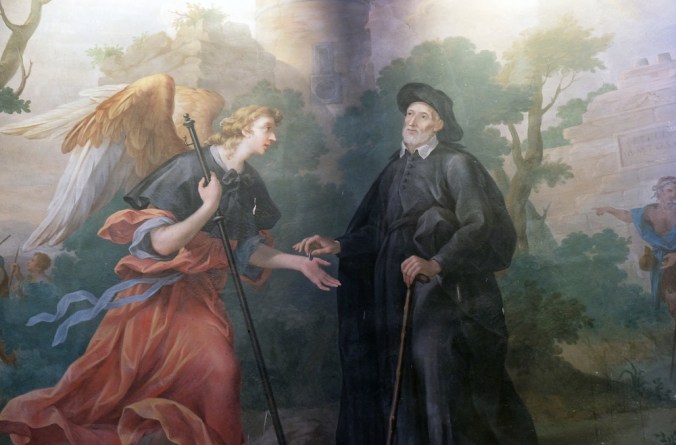
StPhilipNeriAngels

St. Philip and an angel. (Source)

Philip welcomed those who consulted him with singular benignity, and received them, though strangers, with as much affection as if he had been a long time expecting them. When he was called upon to be merry, he was merry; when he was called upon to feel sympathy with the distressed, he was equally ready.

Sometimes he left his prayers and went down to sport and banter with young men, and by this sweetness and condescension and playful conversation gained their souls.

He could not bear anyone to be downcast or pensive, because spirituality is always injured by it; but when he saw anyone grave and gloomy, he used to say, “Be merry.” He had a particular and marked leaning to cheerful persons.

At the same time he was a great enemy to anything like rudeness or foolery; for a buffooning spirit not only does not advance in religion, but roots out even what is already there.

One day he restored cheerfulness to Father Francesco Bernardi, of the Congregation, by simply asking him to run with him, saying, “Come now, let us have a run together.”

His penitents felt that joy at being in his room that they used to say, Philip’s room is not a room, but an earthly Paradise.

To others, to merely stand at the door of his room, without going in, was a release from all their troubles. Others recovered their lost peace of mind by simply looking Philip in the face. To dream of him was enough to comfort many. In a word, Philip was a perpetual refreshment to all those who were in perplexity and sadness.

No one ever saw Philip melancholy; those who went to him always found him with a cheerful and smiling countenance, yet mixed with gravity.

When he was ill he did not so much receive as impart consolation. He was never heard to change his voice, as invalids generally do, but spoke in the same sonorous tone as when he was well. Once, when the physicians had given him over, he said, with the Psalmist, “Paratus sum et non sum turbatus” (“I am ready, and am not troubled”). He received Extreme Unction four times, but with the same calm and joyous countenance.

Prayer

PHILIP, my glorious Advocate, who didst ever follow the precepts and example of the Apostle St. Paul in rejoicing always in all things, gain for me the grace of perfect resignation to God’s will, of indifference to matters of this world, and a constant sight of Heaven; so that I may never be disappointed at the Divine providences, never desponding, never sad, never fretful; that my countenance may always be open and cheerful, and my words kind and pleasant, as becomes those who, in whatever state of life they are, have the greatest of all goods, the favour of God and the prospect of eternal bliss.

Prayer of Cardinal Baronius (above)

Day 7: Philip’s Patience
SanFilippoBW

St. Philip’s otherworldly spirituality was infused with a hard and cutting common sense. (Source).

Philip was for years and years the butt and laughing-stock of all the hangers-on of the great palaces of the nobility at Rome, who said all the bad of him that came into their heads, because they did not like to see a virtuous and conscientious man.

This sarcastic talk against him lasted for years and years; so that Rome was full of it, and through all the shops and counting-houses the idlers and evil livers did nothing but ridicule Philip.

When they fixed some calumny upon him, he did not take it in the least amiss, but with the greatest calmness contented himself with a simple smile.

Once a gentleman’s servant began to abuse him so insolently that a person of consideration, who witnessed the insult, was about to lay hands on him; but, when he saw with what gentleness and cheerfulness Philip took it, he restrained himself, and ever after counted Philip as a saint.

Sometimes his own spiritual children, and even those who lay under the greatest obligations to him, treated him as if he were a rude and foolish person; but he did not show any resentment.

Once, when he was Superior of the Congregation, one of his subjects snatched a letter out of his hand; but the saint took the affront with incomparable meekness, and neither in look, nor word, nor in gesture betrayed the slightest emotion.

Patience had so completely become a habit with him, that he was never seen in a passion. He checked the first movement of resentful feeling; his countenance calmed instantly, and he reassumed his usual modest smile.

Prayer

PHILIP, my holy Advocate, who didst bear persecution and calumny, pain and sickness, with so admirable a patience, gain for me the grace of true fortitude under all the trials of this life. Alas! how do I need patience! I shrink from every small inconvenience; I sicken under every light affliction; I fire up at every trifling contradiction; I fret and am cross at every little suffering of body. Gain for me the grace to enter with hearty good-will into all such crosses as I may receive day by day from my Heavenly Father. Let me imitate thee, as thou didst imitate my Lord and Saviour, that so, as thou hast attained heaven by thy calm endurance of bodily and mental pain, I too may attain the merit of patience, and the reward of life everlasting.

Prayer of Cardinal Baronius (above)

Day 8: Philip’s Care for the Salvation of Souls
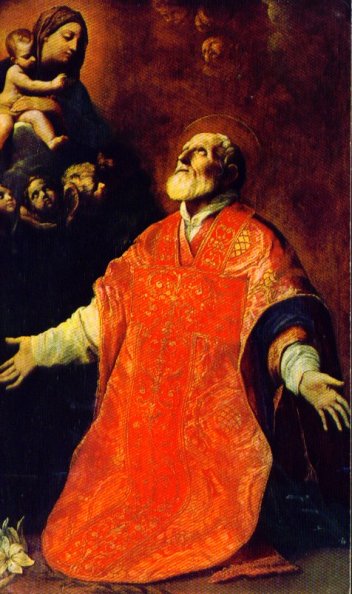
philip1chasuble

St. Philip Neri’s flame-red chasuble is one of the hallmarks of his iconography, such as in this portrait by Guido Reni, 1619. (Source)

When he was a young priest, and had gathered about him a number of spiritual persons, his first wish was to go with them all to preach the gospel to the heathen of India, where St. Francis Xavier was engaged in his wonderful career—and he only gave up the idea in obedience to the holy men whom he consulted.

As to bad Christians at home, such extreme desire had he for their conversion, that even when he was old he took severe disciplines in their behalf, and wept for their sins as if they had been his own.

While a layman, he converted by one sermon thirty dissolute youths.

He was successful, under the grace of God, in bringing back almost an infinite number of sinners to the paths of holiness. Many at the hour of death cried out, “Blessed be the day when first I came to know Father Philip!” Others, “Father Philip draws souls to him as the magnet draws iron.”

With a view to the fulfilment of what he considered his special mission, he gave himself up entirely to hearing confessions, exclusive of every other employment. Before sunrise he had generally confessed a good number of penitents in his own room. He went down into the church at daybreak, and never left it till noon, except to say Mass. If no penitents came, he remained near his confessional, reading, saying office, or telling his beads. If he was at prayer, if at his meals, he at once broke off when his penitents came.

He never intermitted his hearing of confessions for any illness, unless the physician forbade it.

For the same reason he kept his room-door open, so that he was exposed to the view of everyone who passed it.

He had a particular anxiety about boys and young men. He was most anxious to have them always occupied, for he knew that idleness was the parent of every evil. Sometimes he made work for them, when he could not find any.

He let them make what noise they pleased about him, if in so doing he was keeping them from temptation. When a friend remonstrated with him for letting them so interfere with him, he made answer: “So long as they do not sin, they may chop wood upon my back.”

He was allowed by the Dominican Fathers to take out their novices for recreation. He used to delight to see them at their holiday meal. He used to say, “Eat, my sons, and do not scruple about it, for it makes me fat to watch you;” and then, when dinner was over, he made them sit in a ring around him, and told them the secrets of their hearts, and gave them good advice, and exhorted them to virtue.

He had a remarkable power of consoling the sick, and of delivering them from the temptations with which the devil assails them.

To his zeal for the conversion of souls, Philip always joined the exercise of corporal acts of mercy. He visited the sick in the hospitals, served them in all their necessities, made their beds, swept the floor round them, and gave them their meals.

Prayer

PHILIP, my holy Patron, who wast so careful for the souls of thy brethren, and especially of thy own people, when on earth, slack not thy care of them now, when thou art in heaven. Be with us, who are thy children and thy clients; and, with thy greater power with God, and with thy more intimate insight into our needs and our dangers, guide us along the path which leads to God and to thee. Be to us a good father; make our priests blameless and beyond reproach or scandal; make our children obedient, our youth prudent and chaste, our heads of families wise and gentle, our old people cheerful and fervent, and build us up, by thy powerful intercessions, in faith, hope, charity, and all virtues.

Prayer of Cardinal Baronius (above)

Day 9: Philip’s Miraculous Gifts
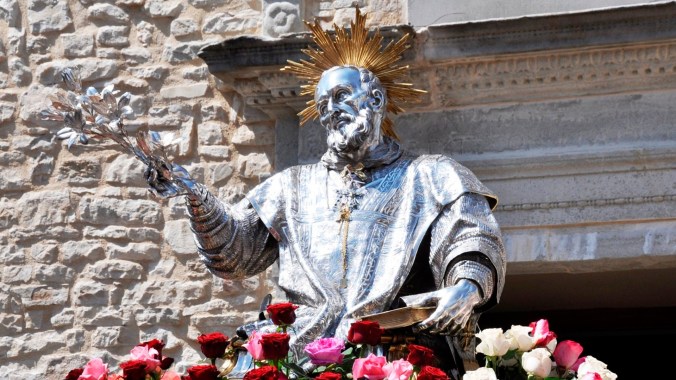
cropped-saint-philippe-neri-welcome2

The veneration of St. Philip has spread around the world. (Source)

PHILIP’S great and solid virtues were crowned and adorned by the divine Majesty with various and extraordinary favours, which he in vain used every artifice, if possible, to hide.

It was the good-pleasure of God to enable him to penetrate His ineffable mysteries and to know His marvellous providences by means of ecstasies, raptures, and visions, which were of frequent occurrence during the whole of his life.

A friend going one morning to confession to him, on opening the door of his room softly, saw the Saint in the act of prayer, raised upon his feet, his eyes looking to heaven, his hands extended. He stood for a while watching him, and then going close to him spoke to him—but the saint did not perceive him at all. This state of abstraction continued about eight minutes longer; then he came to himself.

He had the consolation of seeing in vision the souls of many, especially of his friends and penitents, go to heaven. Indeed, those who were intimate with him held it for certain, that none of his spiritual children died without his being certified of the state of their souls.

Philip, both by his sanctity and experience, was able to discriminate between true and false visions. He was earnest in warning men against being deluded, which is very easy and probable.

Philip was especially eminent, even among saints, for his gifts of foretelling the future and reading the heart. The examples of these gifts which might be produced would fill volumes. He foretold the deaths of some; he foretold the recovery of others; he foretold the future course of others; he foretold the births of children to those who were childless; he foretold who would be the Popes before their election; he had the gift of seeing things at a distance; and he knew what was going on in the minds of his penitents and others around him.

He knew whether his penitents had said their prayers, and for how long they were praying. Many of them when talking together, if led into any conversation which was dangerous or wrong, would say: “We must stop, for St. Philip will find it out.”

Once a woman came to him to confession, when in reality she wished to get an alms. He said to her: “In God’s name, good woman, go away; there is no bread for you”—and nothing could induce him to hear her confession.

A man who went to confess to him did not speak, but began to tremble, and when asked, said, “I am ashamed,” for he had committed a most grievous sin. Philip said gently: “Do not be afraid; I will tell you what it was”—and, to the penitent’s great astonishment, he told him.

Such instances are innumerable. There was not one person intimate with Philip who did not affirm that he knew the secrets of the heart most marvellously.

He was almost equally marvellous in his power of healing and restoring to health. He relieved pain by the touch of his hand and the sign of the Cross. And in the same way he cured diseases instantaneously—at other times by his prayers—at other times he commanded the diseases to depart.

This gift was so well known that sick persons got possession of his clothes, his shoes, the cuttings of his hair, and God wrought cures by means of them.

Prayer

PHILIP, my holy Patron, the wounds and diseases of my soul are greater than bodily ones, and are beyond thy curing, even with thy supernatural power. I know that my Almighty Lord reserves in His own hands the recovery of the soul from death, and the healing of all its maladies. But thou canst do more for our souls by thy prayers now, my dear Saint, than thou didst for the bodies of those who applied to thee when thou wast upon earth. Pray for me, that the Divine Physician of the soul, Who alone reads my heart thoroughly, may cleanse it thoroughly, and that I and all who are dear to me may be cleansed from all our sins; and, since we must die, one and all, that we may die, as thou didst, in the grace and love of God, and with the assurance, like thee, of eternal life.

Prayer of Cardinal Baronius (above)
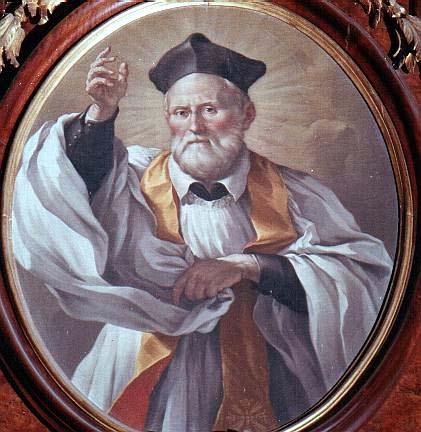
filippo.neri.19

St. Philip Neri, remember thy congregation. (Source)

Collect for the Feast of St. Philip Neri

O God, who never cease to bestow the glory of holiness
on the faithful servants you raise up for yourself,
graciously grant
that the Holy Spirit may kindle in us that fire
with which he wonderfully filled
the heart of Saint Philip Neri.
Through our Lord Jesus Christ, your Son,
who lives and reigns with you in the unity of the Holy Spirit,
one God, for ever and ever.

(Collect for the Feast of St. Philip)

Newman’s Litany to St. Philip Neri
(source)
saints5-23ePhilipNeriGlass

A stained glass depiction. (Source)

Lord, have mercy.
Lord, have mercy.
Christ, have mercy.
Christ, have mercy.
Lord, have mercy.
Lord, have mercy.
Christ, hear us.
Christ, graciously hear us.
God the Father of Heaven,
Have mercy on us.
God the Son, Redeemer of the world, 
Have mercy on us.
God the Holy Spirit,
Have mercy on us.
Holy Trinity, One God,
Have mercy on us.
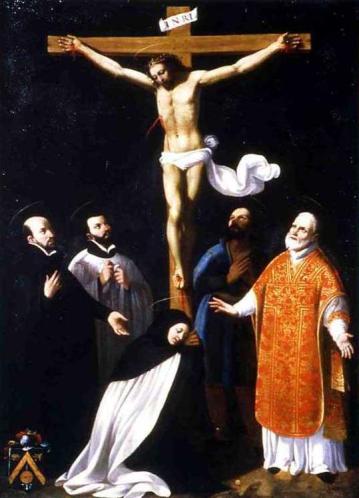
FourSpaniardsandaSaint

St. Philip with (l-r): St. Ignatius Loyola, St. Francis Xavier, St. Teresa of Avila, and St. Isidore the Farmer. All five were canonized on the same day in 1622. The people of Rome said that, on that day, the Church canonized “Four Spaniards and a Saint.” (Source).

Holy Mary,
pray for us.
Holy Mother of God, 
pray for us. 
Holy Virgin of Virgins, etc.

Saint Philip,
Vessel of the Holy Spirit,
Child of Mary,
Apostle of Rome,
Counselor of Popes,
Voice of Prophecy,
Man of Primitive Times,
Winning Saint,
Hidden Hero,
Sweetest of Fathers, 
Martyr of Charity,
Heart of Fire,
Discerner of Spirits,
Choicest of Priests,
Mirror of the Divine Life,
Pattern of humility,
Example of Simplicity,
Light of Holy Joy,
Image of Childhood,
Picture of Old Age,
Director of Souls,
Gentle Guide of Youth,
Patron of thine Own,
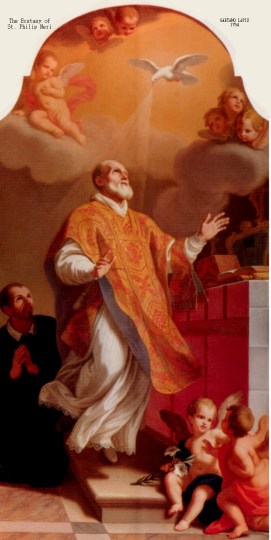
saints5-23dPhilipNeri

“The Ecstasy of St. Philip Neri,” Gaetano Lapis, 1754. (Source)

Thou who observed chastity in thy youth,
Who sought Rome by Divine guidance,
Who hid so long in the catacombs,
Who received the Holy Spirit into thy heart,
Who experienced such wonderful ecstasies,
Who so lovingly served the little ones,
Who washed the feet of pilgrims,
Who ardently thirsted after martyrdom,
Who distributed the daily word of God,
Who turned so many hearts to God,
Who conversed so sweetly with Mary,
Who raised the dead,
Who set up thy houses in all lands,

Lamb of God, Who takest away the sins of the world,
Spare us, O Lord.
Lamb of God, Who takest away the sins of the world, 
Graciously hear us, O Lord.
Lamb of God, Who takest away the sins of the world, 
Have mercy on us.

Christ, hear us.
   Christ, graciously hear us.

V. Remember thy congregation.
R. Which thou hast possessed from the beginning.

Let us Pray.

   O God, Who hast exalted blessed Philip, Thy confessor, in the glory of Thy Saints, grant that, as we rejoice in his commemoration, so may we profit by the example of his virtues, through Christ Our Lord. 
R. Amen.
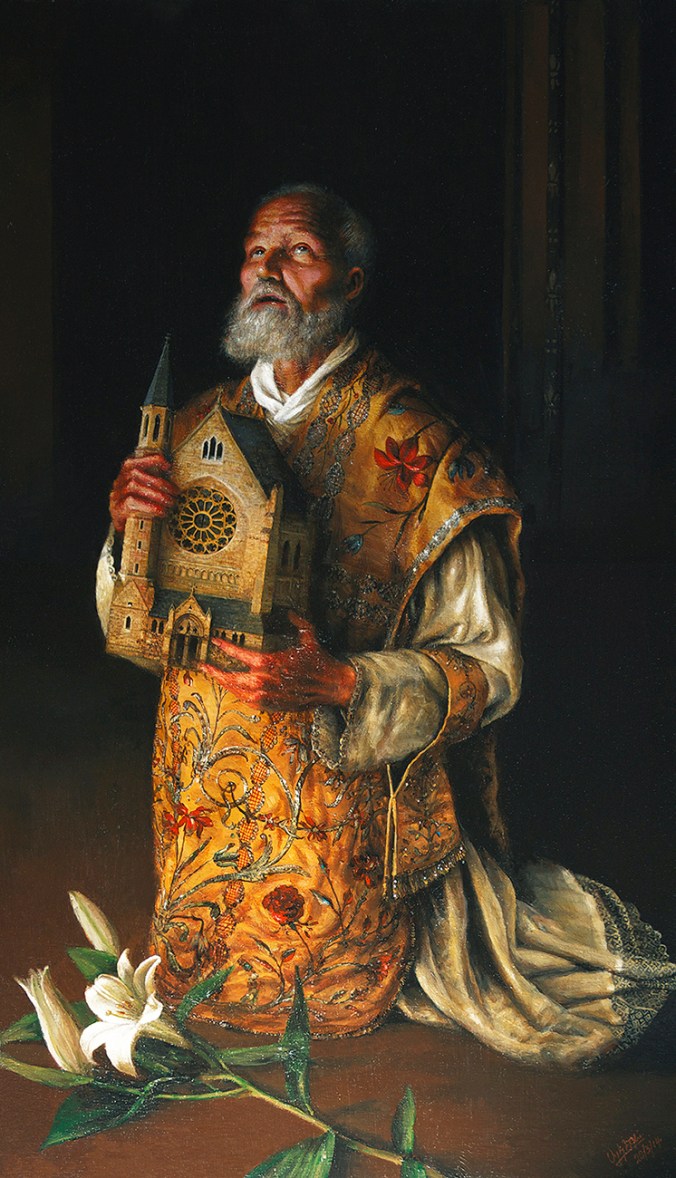
St+Philip+NeriAlvinOng

“St. Philip Neri,” by contemporary artist Alvin Ong. Acrylic on wood. 2014. Commissioned by the Oxford Oratory. (Source)