The Vampirologist: Dom Augustin Calmet OSB

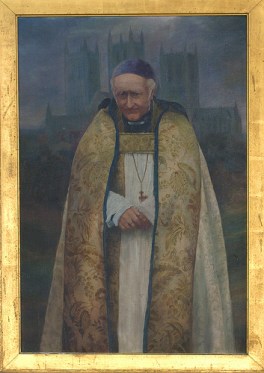
DomAugustinCalmet.jpg

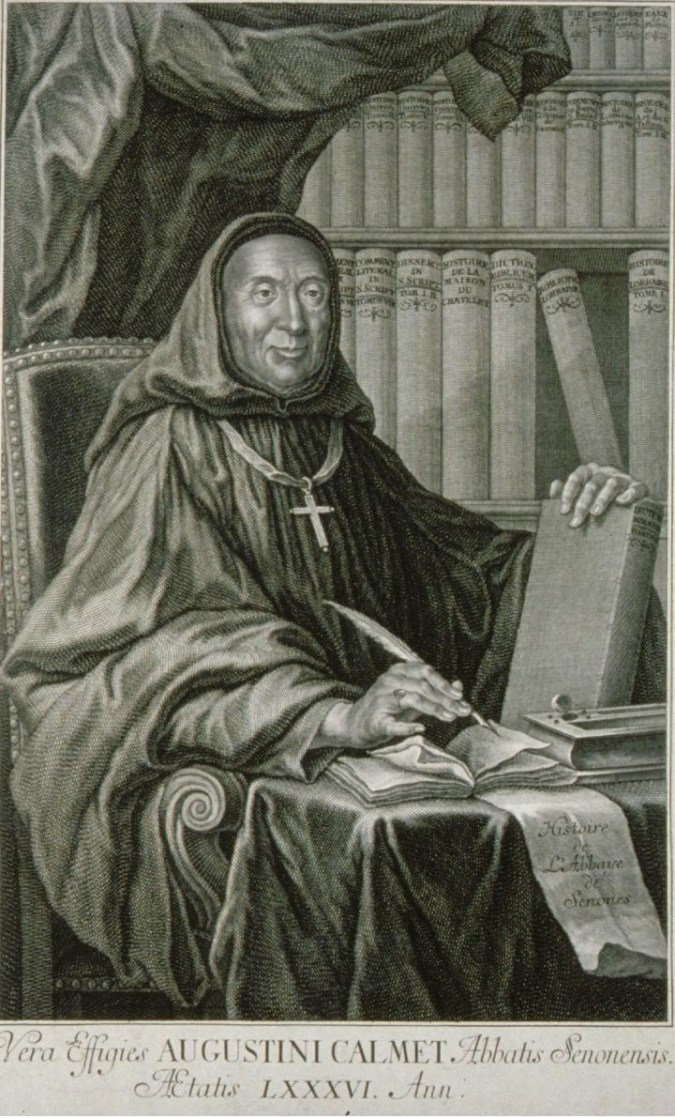
Vera Effigies Augustini Calmet Abbatis Senonensis. (Source).

I was recently asked by the administrator of Catholics from the Crypt to write a brief introduction to Dom Augustin Calmet, Abbot-General of the Congregation of St. Vanne. My qualifications for this task are minimal but, I think, sufficient. First, I know a little about Calmet, which is, sadly, more than many can say. He is an unfairly overlooked figure in our religious and cultural landscape. Secondly, I hope to write my Master’s Thesis on Calmet’s Histoire Universelle, though of course the actual process of research might change my direction. For the time being, I am glad of the challenge, and will likely turn this into the first of a series of short biographies of weird religious figures.

Dom Calmet, born on the 26th of February, 1672, in the then-Duchy of Bar (now Lorraine, France) had a long and impressive career. Entering religious life at the Benedictine Priory of Breuil, he moved around over the years to obtain his education at various abbeys. His itinerary reads like an honor roll of some of the finest establishments of the Franco-German monastic intelligentsia: St. Mansuy, St. Èvre, Munster, Mouyenmoutier, Lay-Saint-Christophe, St. Leopold. Yet the two monasteries most closely associated with his career are Senones Saint-Pierre and Vosges, where he eventually died a holy death.

He achieved widespread scholarly respect for his work in three different fields. First, Calmet distinguished himself as an Exegete. His Biblical method differed from more classical forms of exegesis by focusing entirely on the literal meaning of the text; this exposed him to criticism, even amidst the general acclaim which the book and its abridgements garnered.

DomCalmetTitlePageVampires

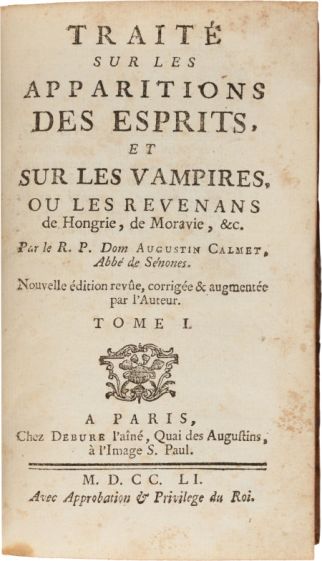
Title page of Book I of his most famous work on Vampires. (Source).

Second, he became an eminent author of sacred and profane history. While my own interest lies most heavily with his Histoire Universelle (1735-47), Calmet also devoted considerable attention to more specific topics. It should come as no surprise, given the libraries to which he had access, that he devoted special care to the region which bore him. His titles include History of the Famous Men of Lorraine (1750), Dissertation on the Highways of Lorraine (1727), Genealogical History of the House of Châtelet (1741), and posthumous histories of both Senones (1877-81) and Munster (1882).

However, Calmet achieved lasting fame for his extremely popular work on Vampires: first, Dissertations on the Apparitions of Angels, Demons, and Spirits, and on the Revenants and Vampires of Hungary, Bohemia, Moravia, and Silesia (1746) He later expanded the text into his famous Treatise on the Apparitions of Spirits and on the Vampires or Revenants of Hungary, of Moravia, &c. in 1752. These texts were, to the best of my knowledge, the first attempt to apply scientific rigor to the tales of the undead then current throughout Europe.

The books were a huge hit, and remain widely respected by occult writers today. To quote one source:

Re-released in 1748, with the most complete edition in 1751, this book is considered to be [the] authoritative treatment on the subject, containing an unprecedented collection of ghostly stories of revenants. It was a best seller for the period, quickly translated into German and Italian for a broader audience. Calmet’s tone considers the possibility of vampires with a certain ambiguity, possibly in light of the larger body of his publications for the church. Still, this is widely regarded as the starting point of all vampiric literature.


The work garnered critical attention from no less a figure than Voltaire. As that eminent source, Wikipedia, relates, Voltaire wrote of Calmet with no small astonishment:

What! It is in our 18th century that there have been vampires! It is after the reign of Locke, of Shaftesbury, of Trenchard, of Collins; it is under the reign of d’Alembert, of Diderot, of Saint-Lambert, of Duclos that one has believed in vampires, and that the Reverend Priest Dom Augustin Calmet, priest, Benedictine of the Congregation of Saint-Vannes and Saint-Hydulphe, abbot of Senones, an abbey of a hundred thousand livres of rent, neighbor of two other abbeys of the same revenue, has printed and re-printed the History of Vampires, with the approbation of the Sorbonne, signed by Marcilli!

[NB: translation is my own]

We can only imagine what conversation transpired between the two thinkers when Voltaire stayed at Senones in 1754, only a few years before the abbot’s death.

It is perhaps unusual that a monk who was, by all accounts, part of the same intellectual circles as the Maurist Enlighteners and the Philosophes would take to such a strange subject. Calmet certainly saw himself as partaking of that wider project. He writes in his preface to the Treatise,

My goal is not at all to foment superstition, nor to maintain the vain curiosity of Visionaries, and of those who believe without examination all that one tells them, as soon as they find therein the marvelous and the supernatural. I do not write but for those reasonable and unprejudiced spirits, who examine things seriously and with sang-froid; I do not speak but for those who do not give their consent to known truths but with maturity, who know to doubt things uncertain, to suspend their judgment in things doubtful, and to refute that which is manifestly false. (Calmet ii).

[NB: translation is my own]

Perhaps we should not be so surprised. After all, the religious history of Europe is peppered with eccentric and erudite men drawn to esoteric studies. And by the time that Dom Calmet died in 1757, the French monastics had not yet reached the height of their oddity. That would come later, with the well-traveled and thoroughly bizarre Swedenborgian and Martinist monk Antoine-Joseph Pernety, whom I hope to someday investigate more thoroughly.

The Revolution changed all that. No longer could monks live their lives freely, let alone attempt serious academic inquiry. It would take the genius of men like Dom Prosper Guéranger to restore the French Benedictines to their former glory.

800px-Senones_88_Saint-Gondelbert.jpg

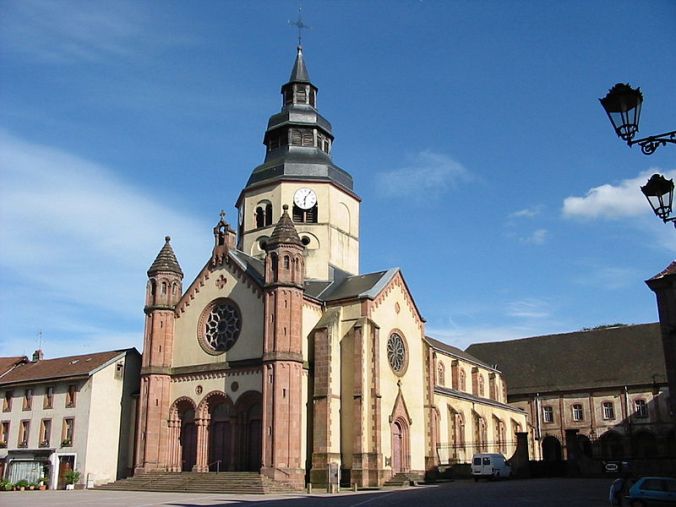
Senones Abbey today. The monastery was dissolved by Revolutionary forces in 1793, then later sold off as State Property and converted into a textile mill. This desecration continued until 1993, when what was left of the abbey became a Monument historique. (Source).

Baronius on Religious Writing

BaroniusColor

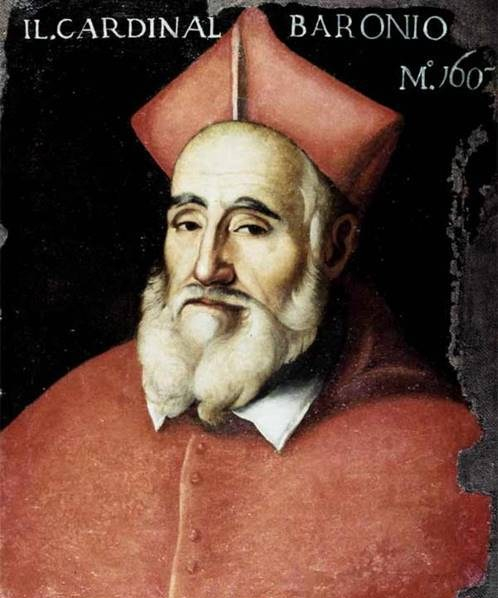
Portrait of Cesar Cardinal Baronius. (Source)

In a recent post, I quoted a letter sent by de Marquais, Abbot of St. Martin’s, to Cesar Baronius about humility and trust in the Providence of God whenever our work seems discouraging. The source I used, the Mediatrix Press edition of Lady Amabel Kerr’s biography of Baronius, has been a great read thus far. In the same chapter, I also found this excellent passage from the Annals, presumably also translated by Lady Kerr herself. She takes it from the dedication of the sixth volume of the Annals.

“No man, however distinguished in intellect or excellent in virtue, is sufficient of himself to handle sacred things. This is clearly demonstrated in Scripture by the example of that artificer who, though employed on only the mechanical structure of the place wherein God was to be worshipped, was declared by Moses to be thereby specially united to divine things. ‘The Lord has filled Bezaleel with the Spirit of God,’ said he, ‘with wisdom and understanding and knowledge and learning, and to work in gold, silver and brass, and in engraving stones and in carpenter’s work. Whatever can be devised artificially He hath given his hand.’ Yet Moses adds that even this work, so well done by aid of the Holy Spirit, was not to be used for God until it had been blessed. If then he who handled only the materials intended for the future service of God had to be himself given to God, how much more is expected of him on whom falls the burden of expounding those things which belong to the truth of the Church. Without doubt he should be ever filled with the Spirit of truth, so that he may complete his work standing firm in the truth.” (qtd. in Kerr 156-57)

As someone who hopes to someday write actual theology, I find these words both challenging and profound. I love the idea that a book can be a kind of little Tabernacle. I hope to carry out my own workacademic, creative, and whatever I can throw up on this blogin just such a spirit.

Too often, it seems that contemporary theologians treat their field as part of the Humanities rather than Divinity. They are overly concerned with political questions, or theories of signification and interpretation, or some such narrow province. On the other hand, some would go too far and forget the other side of the truth that Baronius expounds through his metaphor. The theologian, like Bezaleel, prepares a human work fit for a divine dwelling, but it is indeed a human work. It should speak a human language.

The proper posture, I think, is somewhere between the two. In other words—theologians must remember that their vocation, like all vocations, is theandric. The Sophiological Renaissance led by Michael Martin and the other folks over at Jesus: The Imagination seems to be a good example of that balance applied to actual religious writing. So is the deeply Eucharistic monastic theology of Dom Mark Daniel Kirby. In both of these (very different) cases, the writers achieve the divinity-humanity balance in their theology by hewing close to the sacraments and the sacramental worldview. As Sergius Bulgakov said, “one should imbibe theology from the bottom of the Eucharistic Chalice.”

I like to think that Cardinal Baronius might agree.

Elsewhere: Cooper on Edo Japan

image

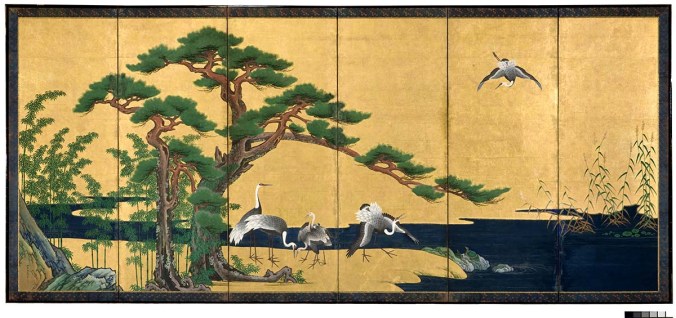
Some art of the Edo period. (Source).

Over at The Heavy Anglo-Orthodox, Matthew Franklin Cooper has an excellent  short post on the history of Edo Japan. I’ve never studied too much Japanese history in any depth, but found Mr. Cooper’s essay a pleasant and enlightening read. However, I did see Silence in January. One of the things about the film that most stood out to me was the simple beauty of 17th century Japan. It is difficult for me to understand how anyone could not find the aesthetics of this period deeply attractive…but de gustibus. 

The Orange Pope

Yesterday was the 327th anniversary of the Battle of the Boyne, when the forces of Protestant Britain defeated the Catholic Irishmen fighting for James II, rightful king of England, Scotland, and Ireland. It is a black day for many Catholics, in no small part because many of them descend from Irish communities that remember the oppression that followed under the penal laws. In Northern Ireland today, July 12th remains a divisive date marked by sectarian tensions and the triumphalist pageantry of the native Scotch-Irish Protestants. One wonders whether the new Conservative-DUP alliance in the Commons will have had any affect on the infamous marches of the Orange Order, founded in remembrance of today’s events.As cursed as the memory of the Boyne remains for Catholics today, it’s worth remembering that things were a bit more complex in the 17th century. I enjoy a good bit of Jacobite nostalgia as much as the next trad, but I also think a more honest assessment of history is worth exploring. Human life is a complicated thing, and the strange story of the Williamite War is riddled with contradictions.

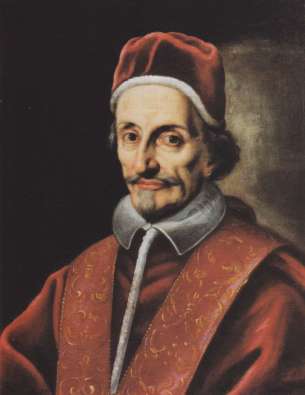
Tremendous irony lies at the heart of the Boyne and what it represents. William of Orange, the stalwart champion of Protestantism, overthrew the Catholic James while secretly in league with Pope Innocent XI.

InnocentXI

His Holiness, Innocent XI P.M. (Source).

Innocent’s political priorities centered on maintaining the balance of power in Europe. In 1690, that meant checking the bellicose Louis XIV. Ever since the marriage of Charles I and Henrietta Maria, the British Crown had been in an ever-closer relationship with France. James II was Louis’s only real ally, and Innocent knew it. The Pope also seems to have considered James a bit dull. He is known to have found his methods in the re-conversion of England more than a little imprudent (it was, in short, a massive failure of triangulation between the vitriolically anti-Catholic Whigs and the pro-Establishment Tories. James was not shrewd enough to manage the two, and ended up pleasing no one).

There was another threat on the table. The future of Catholic France was at stake. Louis XIV had, on the one hand, made moves designed to give him the appearance of Catholic zeal. The revocation of the Edict of Nantes, though not approved by the Pope, is perhaps the greatest example. More troublingly, Louis had rammed through the Four Articles that so antagonized the Papacy by more or less establishing Gallicanism throughout the land. Innocent fought against these measures.

Things came to a boiling point when the Pope, in league with almost all the crowned heads of Europe, clashed with Louis over who would fill the see of Cologne. When the election proved inconclusive, Innocent decided in favor of his own candidate. To quote the Catholic Encyclopedia: “Louis XIV retaliated by taking possession of the papal territory of Avignon, imprisoning the papal nuncio and appealing to a general council. Nor did he conceal his intention to separate the French Church entirely from Rome. The Pope remained firm.”

Enter the Dutch.

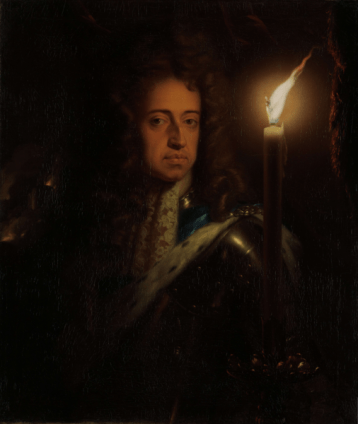
image.png
Willem III, Prince of Orange, King of England and Stadtholder, by Godfried Schalcken. c. 1692-97. (Source)

It is unclear to what extent Innocent might have aided William of Orange. An old legend current at the time asserts that the Pope had financed the expedition with a secret loan of 150,000 scudi. As one reporter puts it, “The sum, equivalent to more than £3.5 million today, equalled the Vatican’s annual budget deficit.” There is, it seems, some truth to this statement. The legend has been supported by more recent research, such as that conducted by the fiction authors Rita Monaldi and Francesco Sorti. They uncovered evidence that corroborated the longstanding claims of other historians.

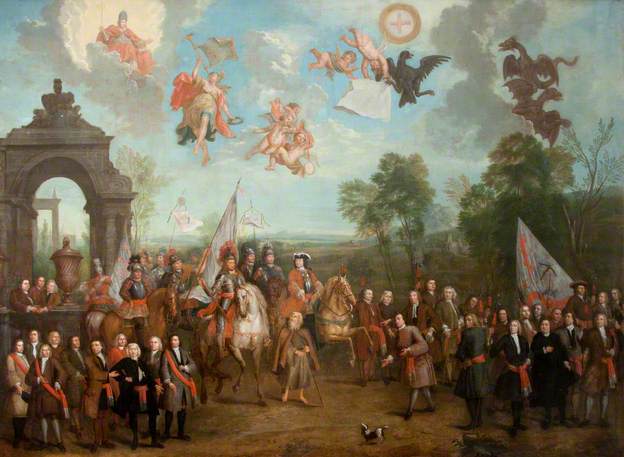
Which leads us to a singular painting by Pieter van der Meulen, The Entry of King William Into Ireland. It has played a controversial role in Northern Irish history. Purchased by the Unionist government of Ulster in 1933, it originally hung in the Great Hall of Stormont. After shifting locations several times, eventually the Rev. Dr. Ian Paisley (of all people) hung it in his office. It is presumably the only picture of the Pope in glory that Dr. Paisley ever liked.

(c) Northern Ireland Assembly; Supplied by The Public Catalogue Foundation

The Entry of King William Into Ireland, Pieter van der Meulen. (c) Northern Ireland Assembly; Supplied by The Public Catalogue Foundation. (Source).

So, why would a Pope act against a Catholic monarcheven covertly?

It seems that he sold Britain and Ireland to save France…and by extension, continental Catholicism. It was a gamble, and a costly one at that. But it seems to have worked in the short run. Although France would later see a terrible anti-Catholic upheaval of its own, Louis was forced to abandon his immediate moves towards schism. He did not become a French Henry VIII. Among all the terrible things that followed the Boyne, at least that one very important good came of it.


Remember Hamburg

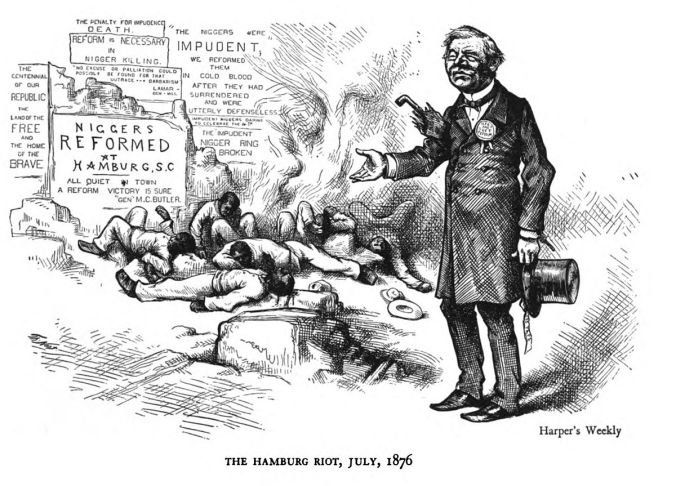
Hamburg_cartoon

Reaction of the Northern press to the Hamburg Massacre. (Source).

One of the great tragedies of Reconstruction was the Hamburg Massacre, committed 141 years ago today. Never heard of it? Neither had I prior to last summer. That was when I saw a temporary exhibit at the Aiken County History Museum, in Aiken, South Carolina. The story shocked me. I reproduce for you here a summary from BlackPast.org.

On July 8, 1876, the small town of Hamburg, South Carolina erupted in violence as the community’s African American militia clashed with whites from the surrounding rural area.  Hamburg was a small all-black community across the river from Augusta, Georgia.   Like many African American communities in South Carolina, it was solidly Republican and with the GOP in charge in Columbia, some of its men were members of the South Carolina National Guard (the Militia).

On July 4, two white farmers from surrounding Edgefield County, Thomas Butler and Henry Getzen, attempted to drive a carriage through the town along the main road, but were obstructed by the all-black Militia which was engaged in a military exercise.  Although the farmers got through the military formation after an initial argument, racial tensions remained high.

Two days later Butler and Getzen brought a formal complaint of obstruction of a public road before the local court in Hamburg.  The case was postponed until July 8.  By that point Matthew C. Butler, an Edgefield attorney, appeared as the farmer’s counsel.  Butler demanded that the Hamburg militia company be disbanded although that action had no direct connection to the complaint.

By this point hundreds of armed white men, including many who were members of various rifle clubs, descended upon the small black community.  Militia members retreated to a stone warehouse which they used as their armory.

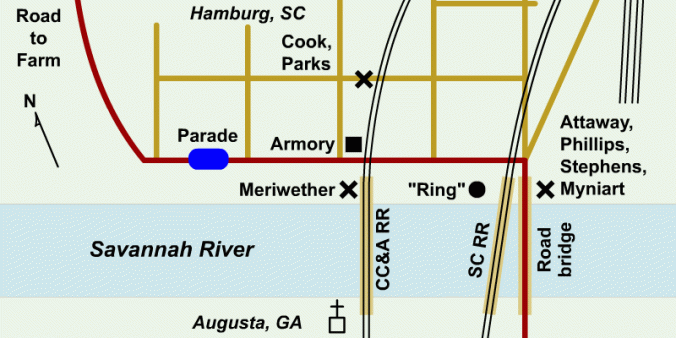
Hamburg_Massacre1

A map of the events. (Source).

Sometime during the afternoon a battle ensued. Surrounded and outnumbered, twenty-five militiamen and fifteen Hamburg residents fought back from the armory. By mid afternoon a white attacker and a militiaman lay dead, and a few more members of the militia were wounded. A cannon was brought over from nearby Augusta and aimed at the armory. As cannon fire blew a hole in the armory, some black militiamen and Hamburg’s Town Marshal, James Cook, attempted to flee. Cook was shot and killed.

The rest of the militiamen and towns people were captured in the armory.  Four of the militiamen were brought out and immediately executed by the white mob. The rest were allowed to escape, though as soon as they began to flee, the whites trained their guns on the escaping men, shooting as many as possible.

Seven men died that afternoon. Six were black militiamen or civilians and one was a white farmer killed in the attack on the armory.

You can read the official report here. The names of the six black men who died are Allen Attaway, Jim Cook, Albert Myniart, Nelder Parker, Moses Parks, David Phillips, and Hampton Stephens.

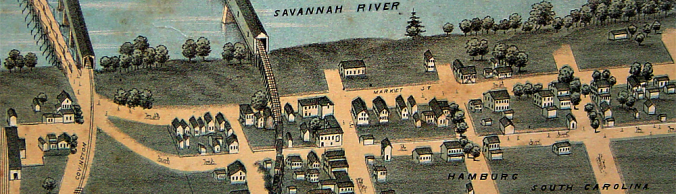
HamburgMap

The town of Hamburg, SC. It was situated immediately across the river from Augusta, GA. (Source)

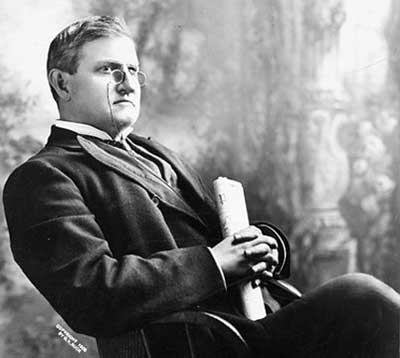
The massacre sparked other troubles throughout the state. Benjamin Tillman, a particularly vitriolic racist, led a pack of Red Shirts that rioted in nearby Ellenton. To quote Wikipedia, “The official record of Deputy US Marshalls indicated between 25 and 30 black men were killed. A New York Times reporter in an article stated as many as 100 blacks were killed in the conflicts, which extended to September 21, with several whites wounded.”

The violence centered on the political tensions. Remember, this was 1876—an election year. Democrats were desperate to take back political control throughout the South. They launched a major campaign of fraud and intimidation to depress the numbers of black voters. The murders at Hamburg, Ellenton, and elsewhere helped sweep Democrat and ex-Confederate general Wade Hampton III to the governor’s office. He went on to “redeem” South Carolina, instituting harsh new laws designed to strictly curtail the rights of the freemen. Tillman would later cite his experience in speeches before the U.S. Senate, stump addresses during his own gubernatorial campaign in 1890, and even a 1909 Red Shirt reunion. On that last occasion, “Pitchfork Ben” declared that “The leading white men of Edgefield” had determined “to seize the opportunity that the Negroes might offer them to provoke a riot and teach the Negroes a lesson.” Tillman claimed that the Hamburg Massacre was a way that “the whites demonstrate[d] their superiority by killing as many of them as possible.” Tillman told his audience,

The purpose of our visit to Hamburg was to strike terror, and the next morning (Sunday) when the negroes who had fled to the swamp returned to the town (some of them never did return, but kept on going) the ghastly sight which met their gaze of seven dead negroes lying stark and stiff, certainly had its effect…It was now after midnight, and the moon high in the heavens looked down peacefully on the deserted town and dead negroes, whose lives had been offered up as a sacrifice to the fanatical teachings and fiendish hate of those who sought to substitute the rule of the African for that of the Caucasian in South Carolina. (Source).

bentillman

Senator and Governor Benjamin “Pitchfork Ben” Tillman, one of the most important white supremacists of the late 19th and early 20th centuries. (Source)

The town of Hamburg eventually washed away in a 1927 flood, with most of the surviving residents relocating to North Augusta. In that city stands a monument to Thomas McKie Meriwether, the only white man who died in the “battle.” It’s a graceful and dignified obelisk that proclaims Meriweather a “young hero” who “gave his life that the civilization builded by his fathers might be preserved for their children’s children unimpaired” and “exemplified the highest ideal of Anglo-Saxon civilization.” The monument breathlessly declares that “By his death he assured to the children of his beloved land the supremacy of that ideal” (Source). No memorial was erected to the six black men killed in the massacre until March of 2016. Their names share a simple stone with Meriwether’s.

These problematic memorials remind me of another controversy very much alive today…and by today, I do truly mean today, July the 8th. Later this afternoon, a collection of white supremacists, fascists, and malcontents will assemble at Lee Park in Charlottesville to protest the removal of the general’s statue. The Washington Post reports that the Ku Klux Klan will be involved and armed. Richard Spencer is headlining the event, but other minor and stranger figures of the Alt-Right are also scheduled to appear (including Augustus Sol InvictusSatanist, Neo-Nazi, ex-Senatorial candidate for the Libertarian Party, and certified Florida Man). The rally, billed as “Unite the Right,” proves a point I have said before and must, sadly, say again; a conservatism that is not anti-racist is not worth defending.

While I don’t have a very strong opinion on the statue’s removal, I do that know that some of my friends will be counter-protesting. I pray that they stay safe. I pray that the forces of violence and oppression will be overcome by the powers of love and justice. And I pray that the horrible example of Hamburg will never be forgottenor repeated.

UPDATE: I mistakenly conflated two different fascist rallies (never thought I’d have to say that). The one on Saturday was just various Klan groups. Photos are all over UVA student and Charlottesville social media. The “Unite the Right” rally is taking place in early August. God deliver us from the Alt-Right.

The Oratorian Option

StPhilipNeriandEnglishSeminarians

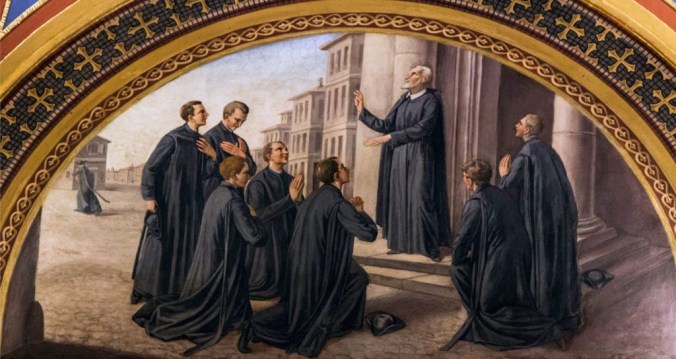
St. Philip Neri blessing the departing seminarians of the English College. Fr. V.J. Matthews tells us that St. Philip would hail the seminarians, whose college is directly across from San Girolamo, with the words Salvete Flores Martyrum, “Hail, flowers of the Martyrs” (Matthews 85). Edited photo by Fr. Lawrence Lew, OP.  (Source).

In a recent post, I suggested that Rod Dreher’s The Benedict Option is a flawed, if well-intentioned, strategy for the Church in our times. I stand by that opinion. I also would like to offer my own “option,” as so many others have done. I will refrain from detailing specific suggestions and strategies, as I have neither the time nor the knowledge nor the experience to profitably contribute to any discussion of specifics. Nonetheless, I think I can say a few things about the general spirit and principles of what we might choose instead of The Benedict Option.

For starters, it would be called something different. Although St. Benedict is an eminent and powerful patriarch, I submit to you that, for our purposes, we must look at another man in an era far more like our own, a man whose spiritual sons also offer powerful examples. That man, of course, is St. Philip Neri.

Early Modernity as Proto-Postmodernity

Like Dreher, I choose my patron saint in part because I think the unique conditions of our own moment deeply resonate with those which St. Philip faced. Any comparison between different periods of time are naturally going to fall flat in certain specifics. But consider, if you will, the following phenomena.

The rise of the Internet, like the advent of printing, has opened up new models of knowledge and new conceptions of the self. Our lives are ever more global, even as new forms of nationalism emerge. We are increasingly aware of various forms of religious difference. Some are extremist, and even violent (see, inter alia, the Münster Rebellion and the sects of the Interregnum). Within the Church, we face public in-fighting among the Cardinals, dangerous sacramental, moral, and doctrinal laxism, a German Church that is falling apart, and a Pope whom the Roman People themselves dislike. We face serious problems with the climate. Our educational aspirations and models are increasingly oriented towards social climbing, even as our specialties are becoming narrower. Literary and textual criticism set the terms of debate in the academy. More broadly, sexual mores have changed considerably, and culture war is the order of the day. Homosexuality and gender nonconformity have emerged as increasingly widely-recognized social phenomena. Our civilizational relationship with Islam is complicated, to say the least. Class divisions and structural inequality have led to political instability. Indeed, unthinkable political events, stemming in large part from those class frictions, have jettisoned any sense of certainty we might hope to sustain.

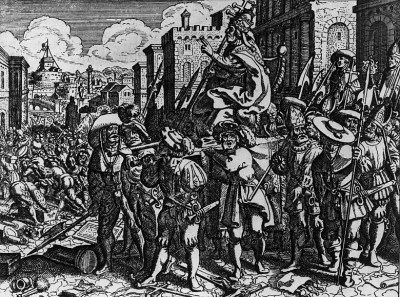
St. Philip arrived in Rome shortly after just such an unthinkable event. In 1527, the armies of the Emperor descended upon the Papal States and launched a horrifyingly brutal sack of the Eternal City. Both Lutheran andmore scandalouslyCatholic soldiers raped, pillaged, and desecrated their way through Rome. It was the second and last sack of Rome committed by civilized Christians, and it put an effective end to the Renaissance in that great city.

Alfonso Cardinal Capecelatro, one of St. Philip’s nineteenth century biographers, describes the event as:

…the terrible sack of Rome in 1527, which had no parallel in the history of the Church, whether regarded as a warning or a chastisement. We must go back to Attila and Genseric to find any event which even distantly approaches it in horror; and even those barbarians were civilized and even reverent in comparison with the soldiers of the most Catholic king and emperor, Charles V. A drunken, furious horde of Lutherans and Catholics together was let loose upon Rome…there were…unutterable outrages not to be thought of without a shudder. (Capecelatro 23).

Pertinent to our purposes, however, is the effect that this calamity left on the culture of Rome. Here, too, Capecelatro is a helpful resource.

To enter into the city of the Holy Apostles Peter and Paul at a time when their authority was spurned, vilified, and trampled into the mire by a terrible heresy; to visit the spots hallowed by the blood of martyrs when all around were the hideous traces of their recent profanation; to live in the holy city when the lives of the clergy themselves were dissolute or unbecoming, when paganism in science and letters and art was alone in honours must have been, to the heart of a saint such as Philip’s, an anguish inconceivably bitter. (Capecelatro 24).

SackofRome1527

A blasphemous mock-Papal procession during the 1527 Sack of Rome. (Source).

If, like Dreher, we wish to compare our own times to the sack of Rome, we ought to look a thousand years later than he does. As with Rome circa 1535, we live in a culture riddled with “a terrible heresy,” Dreher’s “Moralistic Therapeutic Deism” (among others). We Christians in America have witnessed the martyrdoms of our Coptic and Middle Eastern brethren over mass media. The Church is still reeling from a time when “the lives of the clergy themselves were dissolute [and] unbecoming.” The sins of clerical sex abuse continue. And insofar as there is a pagan tendency in our culture today (Camille Paglia certainly thinks there is), it resides in our “science and letters and art.”

While I don’t wish to belabor the point too much, I’ll add that not all is cause for alarm. Many of the good things about early modernity are also true today.

In 1850, Fr. Faber gave a series of lectures to his spiritual sons at the London Oratory. His subject was “The Spirit and Genius of St. Philip Neri.” The second lecture includes a long consideration of St. Philip as the “representative saint of modern times” (Faber 38). Faber argues,

The very essence of heresy and schism is constantly found in the disobedient and antiquarian worship of some pet past ages of the Church, in contradistinction to the present age, in which a man’s duties lie, and wherein the spirit and vigour of the living Church are in active and majestic energy. The Church of a heretic or schismatic is in books and on paper…A Catholic, on the contrary, belongs to the divine, living, acting, speaking, controlling Church, and recognizes nothing in past ages beyond and edifying and instructive record of a dispensation, very beautiful and fit for its day, but under which God has not cast his lot, and which, therefore, he has no business to meddle with or to endeavour to recall. One age may evoke his sympathies, or harmonize with his taste, more than another. Yet he sees beauty in all and fitness in all, because his faith discerns Providence in all. (Faber 40-41).

Dreher would do well to note Fr. Faber’s point. The uncharitable pessimism that animates so much of The Benedict Option is not entirely misbegotten, but certainly falls short of the truth. And why? In part, because Dreher never mentions Church history. His historical narrative of Christianity in Western culture overlooks the actual ways that Christians have responded to modernity since the 16th century. Fr. Faber does not. Instead, he writes,

…it is plain that we are in possession of a great many more doctrinal definitions than we were; the limits of theological certainty are immensely extended. Just as verified observations have extended the domain of the physical sciences, so the number of truths which a believer cannot, without impiety, or in some cases formal heresy, reject, has added to the domain of theology…Now this greater body of certain dogmatic teaching must necessarily influence the whole multitude of believers. It it tells upon literature; it tells upon popular devotion; it tells upon practice…and lastly, it tells upon ecclesiastical art…Neither, in speaking of Modern Times, must we omit to notice the natural connection there is between an increased knowledge of dogma, and the spirit of reverent familiarity in devotion, which has been so prominent a feature in the later Saints.  The more extended the vision of faith becomes, th more familiar a man necessarily grows with the sacred objects of which that faith so infallibly assures him…We must not omit then to name the increase and greater universality of mental prayer, the more generally adopted systematic methods of self-examination, the more common practice of spiritual reading, the ways of hearing mass, the obligation of meditation made the condition in most cases of gaining the indulgences of the Rosary, and other things which are all so many marks of what is called nowadays the increased “subjectivity” of the Modern Mind.(Faber 44-46, 49-50).

FatherFaber2

Fr. Frederick William Faber, founder of the Brompton Oratory in London. (Source)

Faber adds that anyone who would ignore this latter tendency towards “subjectivity” when seeking to evangelize would inevitably “find himself miserably out in his reckoning…The experiment would correct itself” (Faber 50). While Fr. Faber’s optimism is perhaps just as simplistic as Dreher’s pessimism, his perspective helps us attain the proper, prudential, balanced orientation towards modernity that The Benedict Option flatly misses.

Faber offers his historical assessment as a prelude to the consideration of St. Philip Neri’s life and spirituality. For Fr. Faber, St. Philip combines in his person and example the very best of what modernity has to offer. After all, Faber notes, Pippo Buono was ordained while the Council of Trent met. His movement began in an urban setting, “the very capital of Christendom itself,” and he managed to meet and influence “people of all nations” (Faber 51).

Even St. Philip’s personality was that of

…a modern gentleman, of scrupulous courtesy, sportive gaiety, acquainted with what was going on in the world, taking a real interest in it, giving and getting information, very neatly dressed, with a shrewd common sense always alive about him, in a modern room with modern furniture, plain, it is true, but with no marks of poverty about it; in a word, with all the ease, the gracefulness, the polish, of a modern gentleman of good birth, considerable accomplishments, and very various information. (Faber 52).

Fair enough. But why bother applying the example of this modern saint to our peculiar cultural and religious circumstances? It is one thing to say that a saint might have something to teach us. It is another thing altogether to say that a saint’s teaching might prepare us for the peculiarly harsh cultural conditions which seem to loom on the horizon (Dreher wasn’t wrong about all of it).

Faber answers this question, too. He writes of St. Philip:

He came to Rome at one of the most solemn crises of the Church; the capital was full of Saints, and full of corruption too. He was the quietest man at his hard work that ever was seen; yet he magnetized the whole city; and when he died he left it quite a different city from what it was, nay, with the impress of his spirit and genius so deep upon it, that it was called his city, and he the apostle of it, second only to St. Peter. It was no man clothed in camel’s hair, with the attractive paraphernalia of supernatural austerities upon him, no St. Francis, with his Chapter of Mats all round the Porziuncula, that the city and its foreign visitants went so anxiously to see; it was simply an agreeable gentleman, in a comfortable little room, apparently doing and saying just what any one else might do or say as well. He had come at his right time; he suited his age; men were attracted; he fulfilled his mission. (Faber 53).

St. Philip’s example is pertinent to our present debate insofar as he reformed late Renaissance Rome, a society much like ours, by means far more achievable and far more charitable than the contorted stratagems of The Benedict Option.

“Roots Are Very Important”

Admittedly, those words weren’t spoken by St. Philip. They’re actually the climactic revelation from Paolo Sorrentino’s La Grande Bellezza (2013), one of my favorite filmsa story that takes place in Rome. And as with all things Roman, St. Philip is never far away.

Two very singular facts stand out about St. Philip. One is that he was deeply attached to the Eternal City. And, relatedly, he never wished to start a religious order. He always claimed that the Congregation was entirely the work of Mary and the Holy Spirit. St. Philip was even reluctant to permit some of his sons to begin a house in Naples, a decision which would ultimately yield the harvest of many saints. Long before that, St. Philip required those priests he sent to San Giovanni dei Fiorentini to return to San Girolamo every day for the exercises of the Oratoryeven in sweltering heat and downpours of rain.

Borromini Facade of Oratorio dei Filippini (as drawn by Barriere, 1720 engraving)

Borromini’s facade of the Roman Oratory, sketched 1720’s. (Source).

In my recent post on St. Philip’s Benedictine tendencies, I noted that St. Philip understood that spiritual fatherhood can only be built upon a certain degree of stability. Along with that comes a strong sense of place, an immersion in the particular life of any given community. This decentralized localism is why every house of the Oratory throughout the world has its own unique spirit and apostolate. The Congregation only unites under the general aegis of St. Philip’s inspiration, not the ordinary vows of a religious order. To use a somewhat hackneyed analogy—if the Jesuits are the global corporations of the ecclesiastical world, then Oratorians are the folks who run mom & pop shops. However, there is a deeper meaning to this organizational quirk that we will have occasion to examine soon.

That domestic spirit can be summed up by the Oratorian conception of nido, or “nest.” As one source has it,

St Philip’s disciples and penitents sometimes sought him out in his room, where the Exercises of the Oratory were held in the early days. The Oratorian does not emulate a monastic detachment which would periodically surrender one’s very bedroom in manifestation of the premise that material goods are merely ad usum. The Oratorian identifies his room as a nido, a “nest.”

Strong Christian community requires roots. Dreher, as well as the good folks over at places like Front Porch Republic and Solidarity Hall, has frequently made this point over the last several years. It is not a new idea. The Benedict Option is peppered with quotes from Wendell Berry, the godfather of all American localist movements today. If Dreher’s Christian communitarianism is to succeed, then it must be predicated on something very much like the Oratorian sense of place. We would be wise to draw upon the domestic spirit of St. Philip’s nido.

santa-maria-in-vallicella-2

The effigy of St. Philip Neri, created from life once he could no longer lead the pilgrimage to the Seven Churches. Currently in possession of the Roman Oratory. (Source).

And that very sense of local domesticity often leads to precisely the kind of worldly engagement that Dreher’s book tends to overlook and minimize. Although St. Philip was by no means a polemicist, he took an active interest in the affairs of the worldas they transpired within the walls of Rome. He intervened in affairs of state only once, when he required Baronius to withhold absolution from the Pope until the latter had reversed the excommunication of Henri IV. This successful bit of string-pulling on St. Philip’s part probably kept the French crown Catholic for the duration of the Bourbon dynasty.

Of course, there is more to Oratorian domesticity than that. St. Philip’s genius lies not only in his stability, but in the way he invested so much of his spiritual ministry with romanità (in every sense of the word). He drew his principle practices from the sun-baked stones and the boiling air of the Eternal City, as if by some secret alchemy. He was famous for leading ever-more popular pilgrimages along the path of the Seven Churches. And all this, to compete with and vitiate the heathen delights of the Carnival. Where else but in Rome could a saint freely lead and care for such masses of pilgrims along such a venerable route? Where else in the history of modern Europe do we see such a providential alignment of personality, place, and practice against the pagans? The established traditions of spirituality which had already formed Rome were in turn re-formed by St. Philip. It is for this reason that he has been given the honorific title of “Apostle of Rome,” alongside Saints Peter and Paul.

As long as Christianity remains tied to the parish structure, it will always be a local religion. Consequently, St. Philip Neri’s unique resourcefulness will always be relevant. Especially today. As one writer puts it, “The mission of an Oratorian is to work at ‘home’; the Oratory is thus an apt instrument of the New Evangelization, re-proposing the gospel in formerly Christian societies.” God furnishes us with opportunities all around, if only we wish to see with “the eyes of the dove” (Cant. 1:15 paraphrased).

Illumine the Intellect

Such sight will be clearer and more invigorating if sharpened by the intellect. St. Philip’s exercises in the Oratory constituted a kind of holy pedagogy for the men of Rome. In his biography of the saint, the French Oratorian Louis Bouyer describes it well:

The programme of their meetings took some ten years to crystallize into the following form: reading with commentary, the commentary taking the form of a conversation, followed by an exhortation by some other speaker. This would be followed in turn by a talk on Church History, with finally, another reading with a commentary, this time from the life of a saint. All this was interspersed with short prayers, hymns and music, and the service always finished with the singing of a new motet or anthem. It was taken for granted that everyone could come and go as they chose, as Philip himself did. He and the other speakers used to sit quite informally on a slightly raised bench facing the gathering. (Bouyer 54).

Another author gives us a more detailed understanding of the kinds of materials that St. Philip and his sons were reading, hearing, and discussing in the exercises:

In St Philip’s time, the most important of his Exercises, which came to be known as the Secular Oratory, or in some places the Little Oratory, was a daily practice spread out over two to three hours during the leisurely Roman siesta and consisting of (1) a period of mental prayer; (2) a reading from the Scriptures or some spiritual book (e.g., Denys the Carthusian, John Climacus, Cassian, Richard of St Victor, Gerson, Catherine of Siena, Innocent III’s De Contemptu Mundi, Serafino da Fermo’s Pharetra Divini Amoris—St Philip’s favourite readings were the Laudi of Jacopone da Todi and The Life of Blessed Colombini by Feo Belcari), followed by a “discourse on the book,” a commentary and dialogue on the subject of the reading; (3) a discourse on the life of a saint; (4) a moral exhortation—a discourse on the virtues and vices; (5) a discourse on the history of the Church; and finally (6) an oratorio or spiritual canticle. (Source).

Herein we find the germ of Oratorian life, “the daily use of the Word of God” (Talpa, quoted here). St. Philip’s model is eminently conversational. The Oratory converts and sanctifies, not only through its stated arms of the sacraments, prayer, and preaching, but through discussionand, as well shall see, aesthetics.

St. Philip was not, however, given to ostentatious and idle chatter. He well understood the words of St. James, that “the tongue is a fire, a world of iniquity” (James 3:6 KJV). Consequently, he always urged his sons to mortify their speech as well as their reason and intellect. The Oratorians were to be wise, intelligent, even scholarly. But they were not to speak freely of the arts and sciences, nor were they to flaunt their learning. One Oratorian father went so far as to feign ignorance of Latin; another would always try to change the subject when any scholarly or humanistic matter came up in conversation. Amare nesciri“to love to be unknown”these words were ever on St. Philip’s lips.

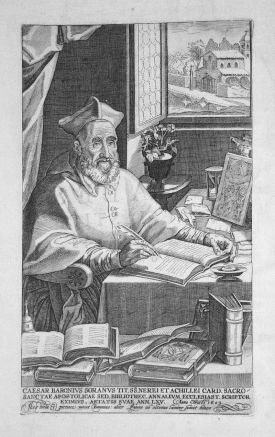
CaesarBaronius

The Venerable Cardinal Caesar Baronius, author of the Annales Ecclesiastici, father of Church history. (Source).

None of this is to suggest that St. Philip was actively anti-intellectual. Far from it! After all, St. Philip was a devoted student of theology and philosophy in his younger days, and Father Faber calls even the mature St. Philip a “great student of history” (Faber 53).  Those words could perhaps be more truly applied to St. Philip’s spiritual son, the Venerable Cardinal Caesar Baronius. It was St. Philip who commanded Baronius to write the Annales Ecclesiastici, the first great work of church history in modern times. The project served a few functions. First, it got Baronius off of preaching, as he had the unpleasant but slightly amusing habit of turning every sermon into a lengthy and vivid discourse on the everlasting torments of hell (I hope that, when he is eventually canonized, the good Cardinal becomes the patron saint of horror writers). The project also productively occupied Baronius’s prodigious intellect, which St. Philip mortified in many other ways. For instance, Baronius was given kitchen duty so frequently that St. Philip playfully wrote above the stove, “Baronius, Coquus Perpetuus.” Finally, St. Philip and Baronius conceived of the book, which unexpectedly became a decades-long enterprise, as a way of challenging the then-dominant historiography of Protestant authors, as exemplified by the Magdeburg Centuries.  A cynic might call this bias. In context, it’s perhaps more fair to interpret Baronius’s motive as one very much akin to those that animate the scholarly disputes of our own day. And because of Baronius’s thoroughgoing method, academic rigor, and meticulous attention to detail, the Annales were received with respect even by those who disputed its claims. It was so impressive a work that several centuries later, Lord Acton could honestly call it “the greatest history of the Church ever written” (Source).

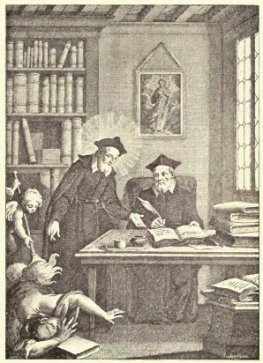
baronius2

St. Philip urging Baronius to write the Annales. (Source).

Nor was Baronius the only model of learning in the Oratory. His fellow cardinal, the aristocratic Francesco Maria Tarugi, was the fox to his hedgehog. Louis Bouyer writes that Tarugi “captivated everyone with his natural eloquence and was never at a loss, no matter what the topic of the moment might be” (Bouyer 64). Here again we see the mark of what we may call the specifically Oratorian geniuserudition crowned with beautiful style and fluency in speech.

If St. Philip stands for an appropriate humility of the intellect, Baronius for a rigorous love of truth, and Tarugi for eloquence in discourse, then we must turn to a fourth figure, the greatest scholar ever to enter the Oratorian life. I speak, of course, of John Henry Cardinal Newman.

In Newman’s long, productive, and complicated life, a few key themes emerge. Three are worth examining in connection with the intellectual tradition of the Oratory. First, we may duly note that Newman always exhibited a great love of knowledge for its own sake, and thus of Truth as such. As he writes in The Idea of a University,

Useful Knowledge then, I grant, has done its work; and Liberal Knowledge as certainly has not done its work,—that is, supposing, as the objectors assume, its direct end, like Religious Knowledge, is to make men better; but this I will not for an instant allow, and, unless I allow it, those objectors have said nothing to the purpose. I admit, rather I maintain, what they have been urging, for I consider Knowledge to have its end in itself. For all its friends, or its enemies, may say, I insist upon it, that it is as real a mistake to burden it with virtue or religion as with the mechanical arts. Its direct business is not to steel the soul against temptation or to console it in affliction, any more than to set the loom in motion, or to direct the steam carriage; be it ever so much the means or the condition of both material and moral advancement, still, taken by and in itself, it as little mends our hearts as it improves our temporal circumstances. And if its eulogists claim for it such a power, they commit the very same kind of encroachment on a province not their own as the political economist who should maintain that his science educated him for casuistry or diplomacy. Knowledge is one thing, virtue is another; good sense is not conscience, refinement is not humility, nor is largeness and justness of view faith. Philosophy, however enlightened, however profound, gives no command over the passions, no influential motives, no vivifying principles. Liberal Education makes not the Christian, not the Catholic, but the gentleman. (The Idea of a University 120-21).

CARDINAL JOHN HENRY NEWMAN PICTURED IN 1865 PHOTO

Newman never abandoned the life of the mind. (Source).

Along with this purity of vision, we naturally find in Newman a perennial appreciation of academic engagement, and when necessary, controversy. Indeed, Newman rose to fame and eventually converted because of his involvement in the ecclesiastical turmoil of the 1830’s and 40’s. He produced his first two great works, Tracts for the Times (1833-1841, in collaboration with others) and The Arians of the Fourth Century (1833) in light of those disputes. Likewise, Newman articulated his great theories of doctrinal development (Essay on the Development of Doctrine, 1845) and the important role of the laity (“On Consulting the Faithful,” 1859) in texts occasioned by ongoing controversies within the Anglican and Roman Catholic churches respectively. And although he could be terribly sensitive to even the slightest criticism, Newman took pains to respond with courtesy, as he did to Charles Kingsley in his famous Apologia Pro Vita Sua (1865). While Newman never sought out polemics and controversies, he was willing to engage in them when the Truth and Honor of God was at stake.

Finally, we ought to remember that Newman was always animated by a sincere love of that singular matrix of the intellectual lifeacademic community. His experience at Oxford profoundly shaped his worldview. He is, of course, still widely regarded as one of the great theorists of higher learning. The Idea of a University (1852, 1858) remains one of the most influential texts on Catholic education in modern times. But the impression that Oxford left on Newman is deeper and more subtle. Newman was drawn to the Oratory in part because he recognized in it the same collegiality that defined the best of the houses at Oxford. Newman writes,

Now I will say in a word what is the nearest approximation in fact to an Oratorian Congregation that I know, and that is, one of the Colleges in the Anglican Universities. Take such a College…change the religion from Protestant to Catholic, and give the Head and Fellows missionary and pastoral work, and you have a Congregation of St Philip before your eyes. (Newman, quoted here).

Newman first considered the Oratory in part because he hoped to offer a ministry to the intellectuals of Britain:

The local bishop, Nicholas Wiseman, invited them to the former seminary at Old Oscott while they decided what to do. Newman named it “Maryvale” and planned some sort of Catholic educational institute there. But then Wiseman sent them off to Rome for ordination. While there, they examined various religious congregations, and realised that St Philip’s Oratory was the most suitable. The Birmingham Oratory was accordingly set up in Maryvale (2 February 1847), before settling on its present site, with another Oratory in London. (Oxford Oratory).

Sadly, Newman was unable to achieve his dream of an Oratory in Oxford during his lifetime. Fr. Jerome Bertram CO has a monograph on the subject, worth looking into. Suffice it to say, Newman looked upon the university as a major and potentially ripe field for an intellectual, aesthetically sensitive Catholic missionary presence. There is a reason why Catholic ministries to university students are very often called Newman Centers.

RobinsonBook

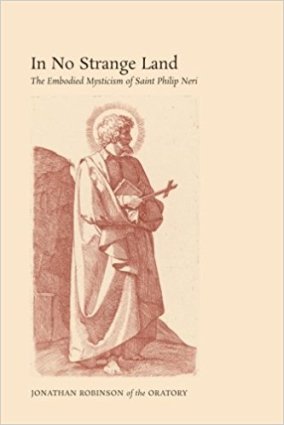
The Oratorian tradition of scholarship continues today, as with, inter alia, the work of Fr. Jonathan Robinson of the Toronto Oratory. Here is the cover of his 2015 book, In No Strange Land: The Embodied Mysticism of Saint Philip Neri. (Source).

Insofar as we are trying to draw out principles that might be of use to the Church in the face of the various cultural challenges which prompted Dreher to write The Benedict Option, I think the Oratorian example, particularly as reflected in Newman’s life and work, may be of use. What lesson we should take? That we ought not abandon the universities and all that they stand for. Yes, there are failures of free speech, episodes of intimidation, and other serious problems at many institutions of higher learning. Dreher, to his credit, has done a good job reporting on the recent madness at Middlebury and Evergreen State.

But the universities overwhelmingly remain the central locations of serious intellectual exchange in this country and the world. While there are some impressive institutions of higher learning outside of or parallel to the formal university system, these are few and far between (see, inter alia, the Maryvale Institute and the Institute for Advanced Studies in Culture). For what it’s worth, Alasdair MacIntyre has explicitly argued for a retrenchment of our position within the academy, both in Three Rival Versions of Moral Enquiry (1990) and elsewhere. As Rowan Williams notes in his review of the book, Dreher seems to write off public discourse entirely. Dreher’s decision to do so is very foolish, more likely to hurt than help the position of Christians in our culture. Moreover, it is alien to the quintessentially Oratorian spirit of a man like Newman.

Contemplate Beauty

One of the marks of the Oratorian charism is a devoted attention to aesthetics. Perhaps it is only appropriate that a vocation emerging from and responding to the Neo-Platonist Renaissance should share its love of beauty. The Florentine St. Philip seems to have known instinctively that beauty evangelizes well and widely.

Rome - fresco of Assumption of Virgin Mary in Chiesa Nuova

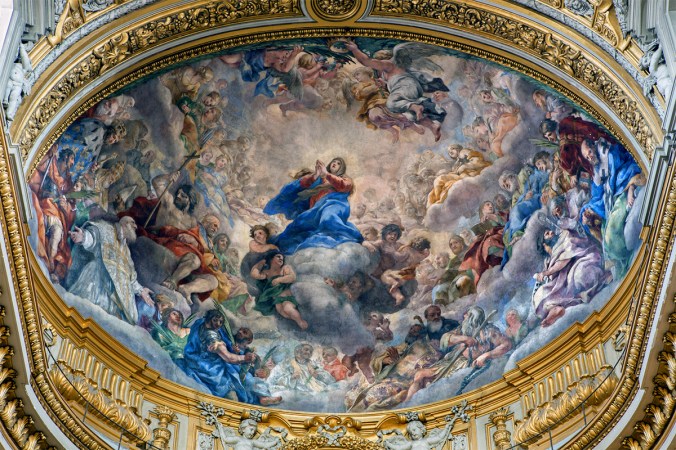
Baroque apse of Santa Maria in Vallicella, by Pietro da Cortona (Source).

The exercises of the Oratory were never complete without a great deal of music. Louis Bouyer tells us that St. Philip “liked the conversations to be interspersed with music and the meetings to be brought to a close by some singing, so that the evening was filled with harmony” (Bouyer 54). St. Philip engaged the talents of some of the greatest Roman composers of his day. Giovanni Pierluigi da Palestrina took St. Philip as his confessor, and Giovanni Animuccia was so frequently involved that Bouyer tells us, “In all truth nothing but one of Animuccia’s lovely motets could distill the essence of the Oratory and pass it on undiluted” (Bouyer 55). That same essence continued in the Congregation even after St. Philip’s death. Emilio de’ Cavalieri’s Rappresentatione di Anima et di Corpo premiered at the house of the Roman Oratorians in 1600, and as a result, is generally considered the first oratorio.

St. Philip did not limit his careful deployment of beautiful and holy music to the formal exercises of the Oratory. He also knew that the long walks and pilgrimages he conducted around Rome would more easily win souls if they were elevated by sweet harmony. As Bouyer reports,

On such occasions music played a more important role than ever. Animuccia would bring along Rome’s best musicians, and the ‘Adoremus te Christe’ by Orlando de Lassus, or the ‘O vos omnes’ by Vittoria, would mingle with the sound of the fountains’ silvery cascades, of the leaves rustling in the sea breeze…On their way in the freshness of those early summer mornings on the Roman Campagna, Serafino Razzi’s Laudi would alternate with Gregorian Litanies.

At San Sebastiano…would follow a fine Polyphonic Mass, perhaps Palestrina’s wonderful ‘Mass of Pope Marcellus’ or his ‘Ecce Sacerdos magnus’…On their return to the centre of the city they would visit Santa Maria Maggiore on the heights of the Esquiline. Beneath the ceiling which Alexander VI had just decorated with the first American gold to be brought by Christopher Columbus from Peru, and among the Ionic columns of pure white marble, the day would draw to a close in an outburst of Palestrina music, and a ‘Salve Regina’ would fill the falling night with its loveliness gathered from the rivers and the stars. (Bouyer 57-60).

Nor was St. Philip insensible to the appeal of visual beauty. He was fond of Federico Barocci. We can detect in Barocci’s work a certain light sfumato, an airy other-worldliness that hovers over the strikingly intimate scenes the artist depicts. In the works of Barocci, there is something of the spirit of St. Philip, in whom the presence of God was so manifest and so exemplary in one so strangely human.

Federico_Barocci_-_Virgin_and_Child_with_Sts_Simon_and_Jude_(Madonna_di_San_Simone)

Madonna di San Simone, by Federico Barocci, c. 1567. (Source).

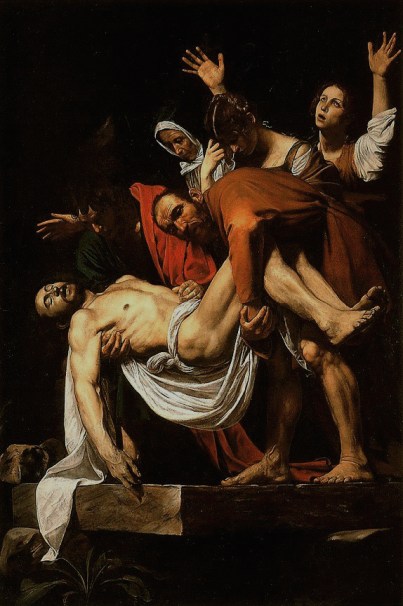
Some years after St. Philip’s death, the Oratorian fathers commissioned Caravaggio to create a sizeable painting for a side-altar. The result was the famous “Entombment of Christ (1603-04), now hanging in the Vatican Museums.

CaravaggioDeposition

The Entombment of Christ, Caravaggio, c. 1603-04. (Source).

These artistic traditions have not fallen away in later houses of the Congregation. The Brompton Oratory in London is renowned for its architecture as well as its world-class Schola Cantorum. Its founder, Fr. Faber, gained wide respect as a hymnodist and poet. Newman also wrote some excellent verse, though he is more commonly regarded as a master prose stylist; Joyce considered him the greatest prose writer in the English language. St. Philip wrote some poetry too, though he destroyed most of his verses before he died. All that survive are a few religious sonnets. As one Italian author puts it,

Philip was perhaps the first who, after the reform in our poetry effected by Bembo and other distinguished men, treated religion with that fine poetic taste with which Petrarch treated the philosophy of Plato. Philip flourished as a poet about 1540; and then he forsook literature and gave himself wholly to God, and flourished far more in holiness, until his death. But though he no longer wrote poetry, he did not set it altogether aside. He well knew its great uses when guided by a christian spirit, and therefore he made a great point of it in his Congregation. He read poetry himself, and ordered that it should be always read and used by his followers in the way described in our previous notes. (Crescimbeni, quoted by Capecelatro, here).

St. Philip frequently found ways of incorporating the Laudi of Jacopone da Todi into the spiritual reading that formed such an important part of the exercises of the Oratory. It was one of only two books we know he brought with him from Florence. The Laudi was a text to which St. Philip returned frequently throughout his life, and one that always bore new graces (Bouyer 53).

AngelStPhilip

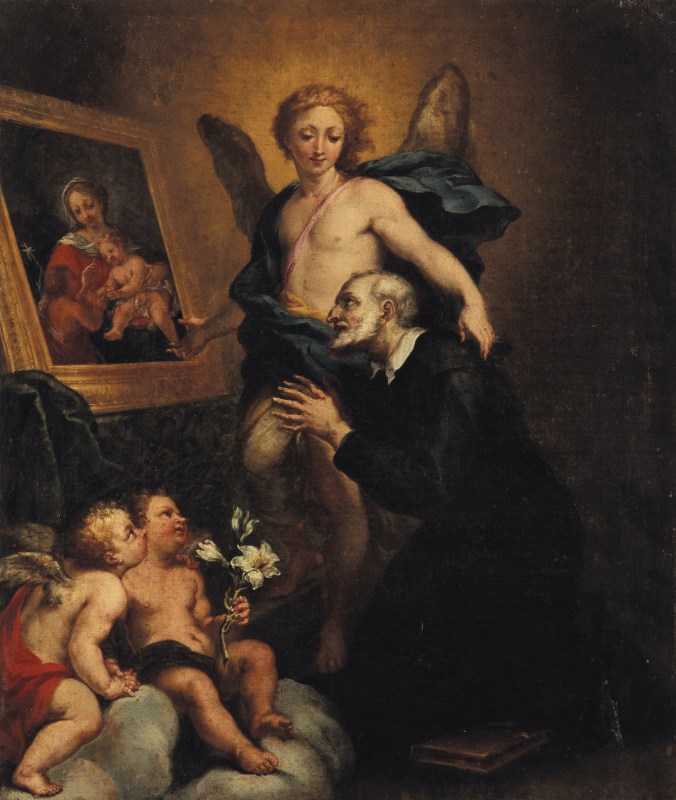
“L’Angelo mostra a San Filippo Neri un dipinto della Vergine con Bambino e San Giovannino,” Circle of Carlo Maratti (Source).

All of this goes to say that St. Philip and his sons were no philistines. They appreciated and, in some cases, produced fine art across a variety of disciplines. While their vocation was never primarily or deliberately aesthetic, Oratorians throughout history have understood the spiritual importance of beauty.

Dreher hits this point pretty well in The Benedict Option. In that sense, my dissent from his recommendation may be more a matter of emphasis than of substance. Insofar as we differ at all, I think my issue is summed up well by Rebecca Bratten Wise:

Perhaps the critics who are timid about these powerful Catholic writers working right now in our midst are waiting for someone else to “baptize” them? Perhaps they are waiting for someone else to say “I heard God there” – because they, themselves, have not learned to open the inner chambers of the ear? Because we do not have a robust Catholic arts culture that teaches us to open all the portals for reception, but instead have embraced a misnamed “Benedict Option” which is all about putting up walls and barriers, drawing those lines in the sand.

Nevertheless, I do strongly criticize Dreher for lacking a sufficiently sacramental vision. The Oratorian aesthetic makes up for this failure, in that it is primarily liturgical.

Live and Love Eucharistically

And thus, we finally turn to the most important feature of St. Philip’s life and charism, the feature which made him a saint and a father of saintshis burning, Eucharistic charity. We can find evidence of St. Philip’s Eucharistic life in the peculiar and highly somatic form of mysticism that we encounter in his vitae. St. Philip never trusted ecstasies and visions, though he was granted such graces himselfusually in connection with the celebration of the Holy Sacrifice.

Capecelatro depicts the scene for us:

But now, in his 76th year, he could no longer restrain the impetuosity of Divine love which glowed within his heart, and he resolved to say Mass in private that he might give free course to his devotion.

MassofSanFilippo

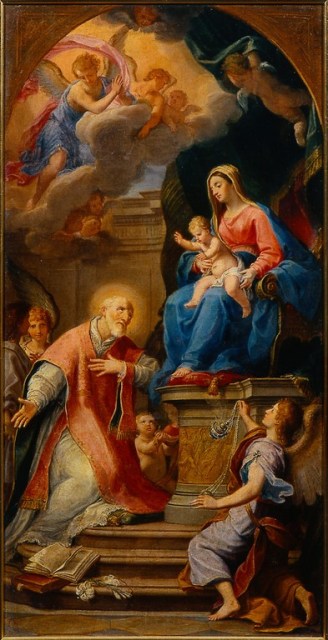
“Madonna con Bambino in trono e san Filippo Neri,” Giacomo Zoboli (Source)

From that time his usual method of saying Mass was this: up to the Domine, non sum dignus, everything went on as before; but at the solemn moment which precedes the priest’s communion, those who were in the chapel withdrew, the server lighted a lamp, put out the altar candles, closed the shutters of the windows, locked both doors, and left the Saint alone with God. Philip would have none to witness the raptures of his love, or to check the freedom of his sighs, words, and tears. A notice was then hung on the door, with these words: “Silence—the Father is saying Mass.” He would remain alone with Jesus in the Adorable Sacrament for two hours, hours of contemplation and of prayer with many tears, and urgent intercession for the Holy Church, the Bride of Jesus Christ, that He would render it as holy in the life of its children as it is in its faith and teaching. After two hours the server came back and knocked gently at the door; if the Saint answered, he opened the door, relighted the candles on the altar, opened the window-shutters, and Philip finished his Mass in the usual way. If the server received no answer, he went away for some time longer, nor did he enter the chapel until the Saint gave some sign that he might do so. What passed in those hours is known to God alone; those who saw Philip when his Mass was over were struck with amazement and awe, until his countenance was pale and wasted, as of one about to die. (Capecelatro 131-32).

And this in the immediate age of Trent! What are we to make of these irregularities?

St. Philip’s Mass is not a model of liturgical praxis, but of liturgical spirituality. In his own highly idiosyncratic prayer, St. Philip becomes a universal model of the soul in adoration of the Eucharistic God. St. Philip was, indeed, one of the great apostles of adoration in his time, as he popularized the Forty Hours’ devotion in Rome. Today, the Quarant’Ore remains a tradition of the Church and the Oratory throughout the world.

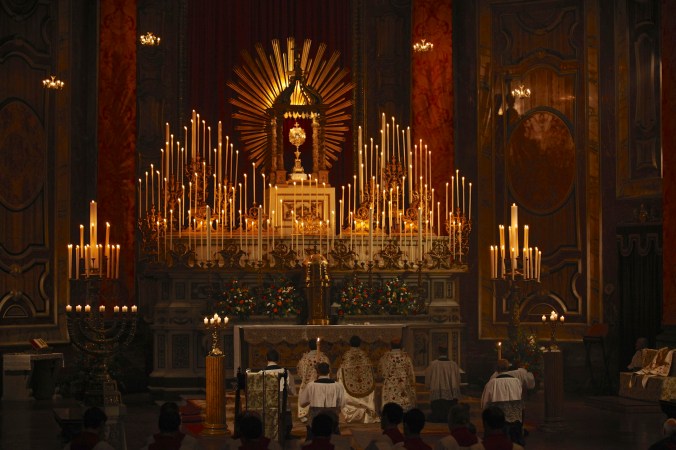
QuarantOreLondon

The Forty Hours’ Devotion at the London Oratory. (Source).

St. Philip’s sons are known for their tender devotion to the liturgical rubrics. In fact, I draw my title from a line in Fr. Jonathan Robinson’s foreword to Resurgent in the Midst of Crisis: Sacred Liturgy, the Traditional Latin Mass, and Renewal in the Church (2014), by Dr. Peter Kwasniewski. Fr. Robinson speaks of an “Oratorian option” not in relation to the early stages of the Benedict Option controversy, but as “a Reform-of-the-Reform ars celebrandi” (Robinson, in Kwasniewski 3). Indeed, the Oratories of the Anglophone world have a particularly strong reputation for their reverent and careful celebration of the Holy Sacrifice of the Mass. As with the best monasteries, the best Oratories exhibit “dignity and magnificence of the liturgical ars celebrandi” (source). In London, Birmingham, Oxford, Toronto, Vienna, Cincinnati, Pittsburgh, Washington, Brisbane, York, Manchesterin short, wherever the spirit of St. Philip prevails over all rivals and distractionswe find a true Domus Orationis, a “House of Prayer” (Matt. 21:13).

The chief fruit of this discipline is supernatural charity. St. Philip sought to found his congregation on this virtue, not the vows which have historically defined the religious state. There is a Trinitarian logic to this plan. For, just as the superabundant love in the heart of the Trinity impels the Three Divine Persons freely to create, redeem, and sanctify, so too should the love of the Oratory overflow into the streets and lead its members to good works. The love of God descends to a love of brethren, which descends in turn to a love of neighbor. Each of these lesser loves ought to confirm, extend, and refine the higher loves. This chain of charity, then, is a veritable Jacob’s ladder, for those in the angelic state are called ever to climb up and down until their passage into beatitude.

Of course, the basic pattern here is not unique to the Oratory. What sets the Oratory apart is its love of the world. A kind of holy worldliness distinguishes the Oratorian spirit, even as St. Philip’s own outlandish behavior earned him a reputation for other-worldliness. I don’t mean to suggest that St. Philip and his sons were given over to the permissive and pagan times in which they lived. Rather, I mean that St. Philip and the Oratorians are characterized by two separate but related qualities that proceed from their Eucharistic life.

First, St. Philip was renowned for prudence. After all, he was a much sought-after confessor. The irony at the heart of so many of his jokes is that, by mocking his own and others’ pretensions, he demonstrated how utterly divorced so many of our lives are from good Christian common sense. In this respect, he was a true fool for Christ very much after the Eastern model. St. Philip’s prudence did indeed appear foolish to those whose vision could not penetrate to the mysteries of God.

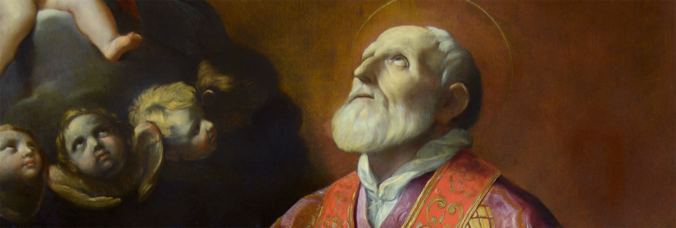
San-Filippo-in-estasi-Guido-Reni-001

From Guido Reni. It seems only appropriate that St. Philip should be so frequently depicted fully vested for Mass. (Source).

While in other ages, prudence led some saints to undertake and advise great hardships for the kingdom, that same virtue taught St. Philip a different path. He drew his own strength from fastidious and hidden rigors, but he always counseled his penitents to avoid excessive asceticism. Once, when the future Cardinal Tarugi, still young and wealthy and vain, came to him for confession, he asked St. Philip if he might wear a hairshirt. St. Philip saw through the man’s pride. He assentedbut only allowed Tarugi to wear the hairshirt on top of all his other garments! For such an admirer of Savonarola, St. Philip could hardly have been farther from his practice when it came to matters of mortification. What little he did urge he usually salted with his own brand of humor. He famously took the Dominican novices of the Minerva out on long picnics and urged them to eat and grow fat. So, too, his pleasant indulgence of children was legendary. And what of those long walks with the crowds under the Roman sky?

St. Philip loved the world. He hated its lies and vices, but he was ever able to peer beyond that sordid stratum and into God’s glory. As one source puts it, “St. Philip was the Apostle of Rome, who by means of the ‘counter-fascination of purity and truth’ reconverted both clerics and laymen in the city at the centre of the Church.” Or, as Louis Bouyer tells us,

Does not Philip, in fact, merely yield to Renaissance optimism? Does he not ignore original sin when he bases his apostolate on freedom and confidence? His ‘religion without tears’ surely expects from undisciplined nature what the discipline of grace alone can produce?

…There is no doubt that it was dangerous to go out against the new paganism with no other arms save love, and just as dangerous to expose his apparently vulnerable simplicity to its disturbing influence, yet his outrageous method made him the victorious apostle of neo-pagan Rome. (Bouyer 28-29).

The love that conquered Rome was the fruit of St. Philip’s sacramental interior life. The unique grace of his special relationship with the Holy Spirit was a cardinal element of that life, but so was his ardent devotion to the Eucharist.

It was this element that I found so disturbingly absent in Dreher’s book. There is no properly Christ-like love of the lost in The Benedict Option, only one angry jeremiad after another. And why? Perhaps because Dreher hardly ever mentions the Eucharist. Dreher writes as if Christ’s presence on earth is an afterthought, one tool among many to be deployed in the quest for community. The result is a spiritually crabbed book, insufficiently sacramental and brimming with self-righteous anxiety.

St. Philip shows us another way.

Conclusion

At the end of the day, there is no silver bullet to halt the various troubles that the Church faces in what seems like an increasingly hostile, secular West. Christ never abandons us to the narrow limits of our own imagination and resources. Instead, He furnishes the Church with untold gifts, charisms, and holy exemplars among the saints. In this sense, the recent proliferation of “Options”to which this essay contributesis probably a blessing.

But we musn’t forget one ineradicable fact. Christ never raises these lesser creations over His own Body, Blood, Soul, and Divinity. There is no blessing, no vocation, and no grace that can go beyond the work of the Adorable Sacrament. If we forsake the one rock of the Altar and instead build upon the sand of the innumerable personal graces and unique charisms spread throughout the Church Universal, then all of our works will shatter beneath the hammer of the storm.

St. Philip Neri understood this truth and lived it out across the long span of his ministry. Those qualities which distinguish the Oratorian charismdomesticity, localism, intellectual rigor, humility, collegiality, aesthetics, urbanity, prudence, and love of the worldcan only be integrated and understood in the light of the sanctuary lamp. St. Philip’s entire life was a ceaseless testament to the power of the Eucharist “for the life of the world” (John 6:52 KJV). In keeping close to the Sacrament and to the example of St. Philip, we may just make it after all.

Chesterton on Cheese

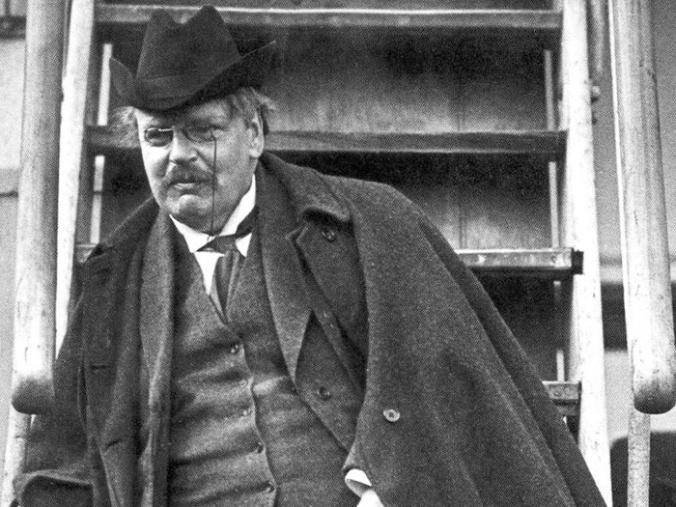
ChestertonCape

G.K. Chesterton died June 14, 1936. (Source).

In honor of the anniversary of his death, I reproduce for you here G.K. Chesterton’s marvelous essay, “Cheese.” I have taken the text from G.K. Chesterton Daily.

MY forthcoming work in five volumes, “The Neglect of Cheese in European Literature,” is a work of such unprecedented and laborious detail that it is doubtful if I shall live to finish it. Some overflowings from such a fountain of information may therefore be permitted to sprinkle these pages.  I cannot yet wholly explain the neglect to which I refer.  Poets have been mysteriously silent on the subject of cheese.  Virgil, if I remember right, refers to it several times, but with too much Roman restraint. He does not let himself go on cheese.  The only other poet I can think of just now who seems to have had some sensibility on the point was the nameless author of the nursery rhyme which says: “If all the trees were bread and cheese” — which is, indeed a rich and gigantic vision of the higher gluttony.  If all the trees were bread and cheese there would be considerable deforestation in any part of England where I was living.  Wild and wide woodlands would reel and fade before me as rapidly as they ran after Orpheus.  Except Virgil and this anonymous rhymer, I can recall no verse about cheese. Yet it has every quality which we require in exalted poetry. It is a short, strong word; it rhymes to “breeze” and “seas” (an essential point); that it is emphatic in sound is admitted even by the civilisation of the modern cities.  For their citizens, with no apparent intention except emphasis, will often say, “Cheese it!” or even “Quite the cheese.”  The substance itself is imaginative. It is ancient — sometimes in the individual case, always in the type and custom.  It is simple, being directly derived from milk, which is one of the ancestral drinks, not lightly to be corrupted with soda-water. You know, I hope (though I myself have only just thought of it), that the four rivers of Eden were milk, water, wine, and ale. Aerated waters only appeared after the Fall.

But cheese has another quality, which is also the very soul of song. Once in endeavouring to lecture in several places at once, I made an eccentric journey across England, a journey of so irregular and even illogical shape that it necessitated my having lunch on four successive days in four roadside inns in four different counties. In each inn they had nothing but bread and cheese; nor can I imagine why a man should want more than bread and cheese, if he can get enough of it.  In each inn the cheese was good; and in each inn it was different.  There was a noble Wensleydale cheese in Yorkshire, a Cheshire cheese in Cheshire, and so on. Now, it is just here that true poetic civilisation differs from that paltry and mechanical civilisation which holds us all in bondage. Bad customs are universal and rigid, like modern militarism. Good customs are universal and varied, like native chivalry and self-defence. Both the good and bad civilisation cover us as with a canopy, and protect us from all that is outside. But a good civilisation spreads over us freely like a tree, varying and yielding because it is alive.  A bad civilisation stands up and sticks out above us like an umbrella — artificial, mathematical in shape; not merely universal, but uniform. So it is with the contrast between the substances that vary and the substances that are the same wherever they penetrate. By a wise doom of heaven men were commanded to eat cheese, but not the same cheese.  Being really universal it varies from valley to valley. But if, let us say, we compare cheese with soap (that vastly inferior substance), we shall see that soap tends more and more to be merely Smith’s Soap or Brown’s Soap, sent automatically all over the world.  If the Red Indians have soap it is Smith’s Soap. If the Grand Lama has soap it is Brown’s soap.  There is nothing subtly and strangely Buddhist, nothing tenderly Tibetan, about his soap. I fancy the Grand Lama does not eat cheese (he is not worthy), but if he does it is probably a local cheese, having some real relation to his life and outlook.  Safety matches, tinned foods, patent medicines are sent all over the world; but they are not produced all over the world.  Therefore there is in them a mere dead identity, never that soft play of slight variation which exists in things produced everywhere out of the soil, in the milk of the kine, or the fruits of the orchard.  You can get a whisky and soda at every outpost of the Empire: that is why so many Empire-builders go mad.  But you are not tasting or touching any environment, as in the cider of Devonshire or the grapes of the Rhine. You are not approaching Nature in one of her myriad tints of mood, as in the holy act of eating cheese.

When I had done my pilgrimage in the four wayside public-houses I reached one of the great northern cities, and there I proceeded, with great rapidity and complete inconsistency, to a large and elaborate restaurant, where I knew I could get many other things besides bread and cheese.  I could get that also, however; or at least I expected to get it; but I was sharply reminded that I had entered Babylon, and left England behind.  The waiter brought me cheese, indeed, but cheese cut up into contemptibly small pieces; and it is the awful fact that, instead of Christian bread, he brought me biscuits.  Biscuits — to one who had eaten the cheese of four great countrysides!  Biscuits — to one who had proved anew for himself the sanctity of the ancient wedding between cheese and bread! I addressed the waiter in warm and moving terms.  I asked him who he was that he should put asunder those whom Humanity had joined. I asked him if he did not feel, as an artist, that a solid but yielding substance like cheese went naturally with a solid, yielding substance like bread; to eat it off biscuits is like eating it off slates. I asked him if, when he said his prayers, he was so supercilious as to pray for his daily biscuits.  He gave me generally to understand that he was only obeying a custom of Modern Society. I have therefore resolved to raise my voice, not against the waiter, but against Modern Society, for this huge and unparalleled modern wrong.

You Must Watch “The Keepers”

TheKeeperspromo

Who killed Sister Cathy? (Source).

You must watch The Keepers if you have Netflix. And if you don’t, you should start a subscription or a free trial to watch it. If you are a Catholic, I dare say that you have a duty to do so. I said the same thing about John Michael McDonagh’s Calvary, for much the same reason.

The Keepers tells the story of Sister Cathy Cesnik S.S.N.D., who was found murdered in the woods outside Baltimore in January of 1970. In seven riveting episodes, the series follows the intrepid amateur investigators who have, for years, devoted untold time and energy to solving this case. As private citizens, they have conducted important research into the case that the police should have done years ago. But the series isn’t just a compelling murder mystery (though, at times, it does rise to the level of the best true-crime tv). The Keepers is also a powerful testimony to the grim reality of clerical sex abuse, the corruption that aids the perpetrators, and the strength of the survivors.

If you are content with what I have written thus far and don’t want to risk any spoilers, then please don’t continue reading.

zzdata-basilica_10

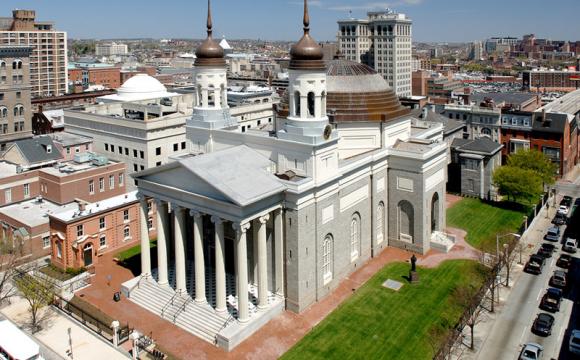
Basilica of the National Shrine of the Assumption of the Blessed Virgin Mary, Baltimore. (Source)

Sister Cathy had previously worked at a local Catholic girls’ school, Archbishop Keough High School. In 1969, she had discovered that the school chaplain and counselor, Father Joseph Maskell, was sexually abusing the students. In November, she disappeared in the night and was never seen alive again.

The series delves deep into the crimes of the priest, which are many and shocking. Maskell was violent and incredibly manipulative. He was a trained psychologist who preyed on his victims’ emotional and personal weaknesses and conducted deeply invasive psychological and physiological tests on them.

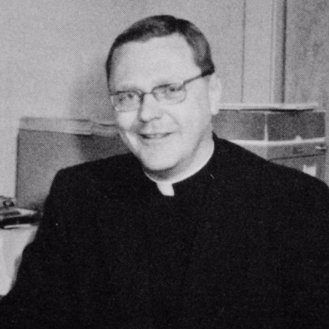
JosephMaskell

The affable face of evil. Father Joseph Maskell, c. 1969. (Source).

But, as with so many of these stories, the far more enraging element of it all is the cover-up. And boy is there a cover-up. Notice I used the present tense. The series strongly suggests that the law enforcement agencies of the greater Baltimore area deliberately turned a blind eye to the abuse and failed to properly investigate Sister Cathy’s murder – even today. There are reasons for this that I won’t get into here.

But perhaps more infuriatingly, the Archdiocese of Baltimore not only refused to give an interview to the filmmakers, but a) lied to the filmmakers about the history of complaints against Maskell, b) never mentioned that Maskell was sent to Ireland after a civil suit in the 1990’s, c) has refused to release any of their records related to Father Maskell, and d) repeatedly scuppered legislation to extend the statute of limitations on cases of sexual abuse. The show gets into some of these matters. But the Archdiocese’s reaction since the series premier has been shameful. It has waged a misbegotten social media campaign to smear the series.

Or consider this concatenation of coincidences I happened to just discover.

In the very last episode, we hear from one of Maskell’s first victims. He was an altar boy at Maskell’s parish, and when he complained to his mother, she alerted the Archdiocese. That was 1967. As a result, Fr. Maskell was promptly transferred to Archbishop Keough, where he carried on a covert reign of terror for eight years alongside his similarly perverted assistant, Fr. Neil Magness. Maskell’s secrets started to leak in the 1990’s when two brave victims, former students of Keough, filed a Jane Doe-Jane Roe suit against him and the Archdiocese. During that period, the first victim – that altar boy, then a dentist and family man – was contacted by the Archdiocese. They set up a private meeting led by (then) Monsignor W. Francis Malooly. At that meeting, Malooly allegedly attempted to bribe the victim into keeping quiet, so as not to provide corroboration for the complainant’s claims.

These are allegations. You are free to reject them. What you are not free to dispute is that the meeting between Malooly and the first victim happened. Malooly himself admits it, though he characterizes it rather differently (as you can see in the show). Likewise, you cannot dispute that Monsignor Malooly was later raised to the episcopate by Pope St. John Paul II and is currently serving as the Bishop of Wilmington, Delaware.

Now, a very strange thing happened when I googled Malooly’s name.

The first news item I got was this:

Screen Shot 2017-06-09 at 4.43.07 AM

But if when I clicked on it, I got this error page:

Screen Shot 2017-06-09 at 4.43.19 AM

And what is The Catholic Review? Why, the newspaper of the Archdiocese of Baltimore!

Screen Shot 2017-06-09 at 4.43.35 AM

Screen Shot 2017-06-09 at 5.16.37 AM

And if you click on the homepage of the website, you get the same error:

Screen Shot 2017-06-09 at 5.18.23 AM
All of this strikes me as suspicious. There may be a perfectly innocuous reason why the Archdiocese of Baltimore’s newsletter is down at precisely the same time that it’s facing a firestorm over its egregious social media response to these allegations. It doesn’t make a lot of sense why the Archdiocese would bother to do something so drastic. I know so little of technology that I may be fumbling towards nothing here, finding strange connections where there are none.

But that timing. It’s hard to discount.

Ultimately, this is why we need good priests. This is why we need souls given to ministries of reconciliation and reparation to the Sacred and Eucharistic Heart of Jesus. Every abuse of an innocent is one more wound to the Holy Face of Christ. Shows like The Keepers remind us of our guilt, and of our need for salvation. They also remind us of our paramount responsibility towards the defenseless.

I don’t write any of this to scandalize the faithful. I write because Catholics should be furious. We should be filled with the righteous wrath of God that these kinds of abusesboth of innocence and powertake place in our midst. I write to my fellow converts, especially younger ones. We don’t talk about this issue enough, probably because most of us have never had direct contact with it. For us recent converts, the sex abuse crisis can often seem like a phenomenon of past decades, something that happened in stifling parish communities simmering with clericalism, patriarchy, and a ghetto mentality to boot. It is easy as a convert, and particularly as a young convert, to write off the sex abuse crisis (implicitly, if not overtly) as a phenomenon of the hypenated-American-Catholicism of the Northeastern working classes, a faith that was more about social pressure and cultural values than theology, tradition, and mysticism.

And in that, we are wrong. Clerical sex abuse and its cover up are still grievous sins that we have not yet fully grappled with, and whichsadlyI expect will continue to be an issue in the future. Among the many disappointments of this pontificate, perhaps the most bitter is that Pope Francis has proven to have such a poor record when it comes to pedophile priests.

There can be no doubt that those aforementioned -isms and -archies made clerical sexual abuse much harder to prevent, much harder to stop, and much harder to punish. The Keepers gets into some of that, though not as much as it could have. And that’s fine. Instead, it captures and sensitively presents the spiritual, emotional core of the problem. At its heart, The Keepers is about bearing witness. It testifies to the profound failure of the Church to guard its innocents. True, the chief villains are all dead. True, we may never know the full rogues’ gallery of their accomplices. But the horrible pains caused by those villains rippled through hundreds of livesand continue to do so today. And we must never forget it.

Kyrie eleison, Christe eleison, Kyrie eleison.

Life Update: Graduate School

SSHChurchView

St. Stephen’s House, Oxford. Source.

This won’t come as a surprise to those of you who know me personally, but in the interest of honesty, archiving, and my own historical interests, I thought I’d post here that I have decided to attend the University of Oxford next year in pursuit of an M.Phil. in Theology, with a concentration in Ecclesiastical History. I will be living at St. Stephen’s House.

StaggersCrest.jpg

The coat of arms of St. Stephen’s House. It incorporates elements of the coat of arms of its founder, Bishop Edward King. (Source)

I’m very happy to be at St. Stephen’s. It is the Anglo-Catholic seminary in Oxford. I am guaranteed to be around people who are seeking ordination in the Church of England. And very high Anglo-Catholics at that. I’m really looking forward to morning and evening prayer every day. While it may not be the prayer of the whole Church in the Divine Office, the Book of Common Prayer is nevertheless a fine, beautiful way to pray and meditate on Scripture in community. I also think that the liturgical rhythms of life at “Staggers,” as it’s called, will be salutary on the whole. It’s even motivated me to try to memorize a few of the old collects, as Peter Hitchens demonstrates in this debate.

While I realize it has changed a great deal over time, the history of St. Stephen’s House is one of the reasons I’m happy to be here. It may not be one of the well-known colleges (it doesn’t even seem to have very much merchandising in the way of scarves, ties, pins, cufflinks, etc., like all the other ones). But Staggers did play its part in the history of Anglo-Catholicism. Founded by Bishop Edward King of Lincoln in 1876, the house soon became a major center of Anglo-Catholicism. It started to produce Tractarian priests by the dozens, and eventually gained a reputation as a factory of bishops and deans of cathedrals. This prolific connection to the Church of England’s highest chambers has continued into its more recent years.

edward-king

Edward King, Bishop of Lincoln. (Source)

Its relationship with Oxford, on the other hand, has varied. It only attained Permanent Private Hall status in 2003. In moving to that arrangement, it joined other historically religious foundations at Oxford: Blackfriars for the Dominicans, St. Benet’s for the Benedictines of Ampleforth, Wycliffe Hall for Evangelicals, Campion Hall for the Jesuits, and Regent’s Park (nominally) for the Baptists. It was at that time that the House broadened its emphasis to include those who were not seeking ordination in the C of E.

Moreover, Staggers has moved around Oxford. It started as a small community near the heart of town, and only much later moved to its present location across the Cherwell. To wit:

For the House’s first years, it was situated near the centre of Oxford, where the New Bodleian Library now stands. From 1919, the House had a site in Norham Gardens, near to the University Parks. In 1980 it moved to the current site…(St. Stephen’s House Blog).

The accommodations that the House took up were built by the Society of St. John the Evangelist, named alongside the parish church they ran (although it is now largely a concert venue, the House clergy still conduct liturgies there each week). The Society priests were also known as the Cowley Fathers. T.S. Eliot conducted at least one retreat there, although he was generally closer to the Benedictines at Nashdom and the Society of the Sacred Mission at Kelham (see Spurr’s biography, Anglo-Catholic in Religion).

In the mid 20th century, the House prospered under the benevolent influence of Father Arthur Couratin, allegedly referred to by some as “Noël Coward in a clerical collar.”

Halliday, Edward Irvine, 1902-1984; Reverend Canon Arthur Couratin, Former Principal of St Stephen's House

Canon Arthur Couratin, Principal of St. Stephen’s House. (Source)

Although its ethos remains largely Anglican, the House has offered a few important alumni to the Church of Rome. Balthasar scholar and theologian Father John Saward graduated there, as did the one-time Bishop of Ebbsfleet and current priest of the English Ordinariate, Monsignor Andrew Burnham. Indeed, they’ve even produced the Primate of the Western Diocese of the Armenian Church of North America, Hovnan Derderian. He is the youngest Armenian archbishop.

Staggers also gave the Church of England Fr. Kenneth Leach, an important Christian Socialist priest. He was trained at St. Stephen’s when it had become a rather homoerotic place, and Leach would famously sum up his time there as “gin, lace, and backbiting.” The writer and Staggers alum A.N. Wilson composed a bitingly comedic satire of the House in those years, entitled Unguarded Hourswhich, as Ignatius Press’s reviewer puts it, is decidedly “not a Catholic novel.” Alas. Wilson, who would eventually return to Christianity after years of very public atheism, would later recall the custom formerly in vogue at Staggers of taking “religious names” that were actually rather saucy nicknames, often of the opposite sex. If Father Couratin was “Noël Coward in a clerical collar,” it seems that by the 1970’s, you were more likely to find Julian and Sandy in soutanes.

I seriously doubt that any of that persists. Women’s ordination in the C of E means that, while many Anglo-Catholics have become more liberal, their seminaries no longer smack of the kinds of homoerotic associations that fueled so many stereotypes (see Cousin Jasper’s famous quip in Brideshead Revisited). Staggers seems to remain as a pillar of sensible, ornate, properly Anglo-Catholic liturgy at its best.

StStephensLiturgy1

A liturgy at the parish church of St. John the Evangelist, St. Stephen’s House, Oxford. (Source).

Requiem

A requiem for the founders of the House. (Source)

StStephensHouseRose.jp

A priest says a Mass at St. Stephen’s House. I highly recommend the source I took this from, Merrily On High. An excellent source for all things Anglo-Catholic.

Of course, I could also emphasize the importance of Oxford in general as a center of CatholicismRoman and otherwise. Here, the Subtle Doctor “fired France for Mary without spot.” Here, Cardinal Wolsey established a college named for his office and, later, all of Christ’s Body on earth. Here, Archbishop Laud attempted to bring back devotion to Our Lady through a little portico on her church in town. Here, Charles I took refuge while his queen heard the Mass of Ages in Merton Chapel. Here, Keble railed against a “National Apostasy.” Here, Newman battled the liberals, and in doing so, broke ground for the Second Spring. Here, Gerard Manley Hopkins served briefly as curate. Here, Oscar Wilde flirted with men and the Church for the first time. Here, Monsignor Ronald Knox cut his clerical teeth as the chaplain of Trinity College. Here, Montague Summers was first haunted by the Vampyre’s shadow. Here, Tolkien and Lewis and Williams and their friends spoke about God long into the stout-softened night. Here, T.S. Eliot studied briefly before going on to greatness in London. Here, Evelyn Waugh thought up a story about two men and a teddy bear. Here, Father Martin D’Arcy pondered the ways of divine and human love. Here, the Oratory finally arrived in 1990 to fulfill Newman’s dream. Here, the late Stratford Caldecott wrote of God’s undying beauty in all things.

OxfordSkyline1

An Oxford morning. (Source).

I could name more ways in which Oxford has played a special role in the life of the Catholic Church. Perhaps I will do so in another post, or a series of posts. For now, I’m just happy to say that I’ll be in a place with a lot of Catholic history, learning about that history. And thank God for that.

CrivelliStephen

“Saint Stephen,” by Carlo Crivelli. Proto-martyr and patron of St. Stephen’s House, Oxford (and perhaps a rather wan patron at that, by the look of this paintingis that asparagus in his hand?). (Source)

PrinceofWalesatStaggers

Also, apparently the Prince of Wales sometimes visits. (Source)

Newman’s Novena to St. Philip Neri

StPhilipFlorence

Articles of devotion to St. Philip Neri, Florence. Photo taken by the author in June of 2015.

St. Philip Neri is my favorite saint. I came to his acquaintance during the summer after my second year in college, when I studied abroad in locations marked by the presence of Oratories. I believe that I was, so to speak, “introduced” to St. Philip by his famous son, the Blessed Cardinal Newman, whose work I had already read and admired. It is also perhaps of some significance that I had devoted that year of my Catholic life to the Holy Spirit. Desiring a deeper friendship with St. Philip, I followed along with Newman’s novena to St. Philip last May. Having read several biographies and having started a blog, I thought I might try my own hand at offering some small act of devotion to St. Philip in the form of nine brief meditations on his life and virtues.

Unfortunately, it seems that the frenzy of graduation week has crept up on me, and I was unable to complete this task. I do, however, offer my own biography of the saint. My sources are chiefly the various Oratorian materials produced by the London and Oxford houses, Good Philip, by Alfonso Cardinal Capecelatro, the biographies by V.J. Matthews, Louis Bouyer, Anne Hope, and Theodore Maynard, and finally, sundry writings by Cardinal Newman, Fr. Faber, Fr. Jonathan Robinson, and Monsignor Knox. All are excellent resources, and I would be happy to provide more details about them in the comments section if asked.

The actual text of the novena will be taken from the Newman Reader, which is my go-to source for all things Newman. I claim no authorship of these texts and am entirely in debt to that great theologian, the Blessed Cardinal of the Birmingham Oratory. I have decided to do this, rather than simply link to the Newman Reader, in part because I am starting my novena a day later than Newman does. Newman began his novena to St. Philip on the 17th and ended it on the 25th, presumably because of the various festivities that the 26th would usher in. However, as I do not live in an Oratory, I will be starting and ending a day later, so that the readings of the ninth day fall on the feast proper. There is a certain liturgical grace that comes with the feast this year, but I will discuss that in another post.
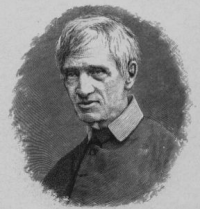
NewmanasanOratorian

John Henry Newman as an Oratorian. (Source)

For now, I’ll say that I will be offering this novena for the vocation of X.

St. Philip, as we shall see, is a very good heavenly guide for young men. He is especially helpful for those who are trying to discern the will of God in their lives.
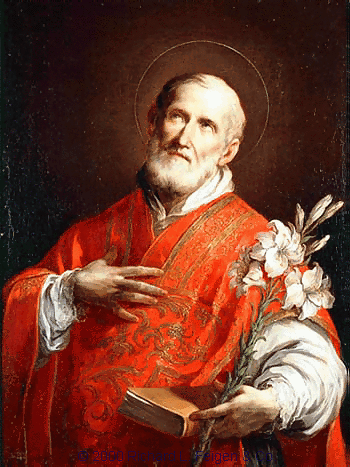
FNeri

A famous image of St. Philip. He is customarily depicted in a red or rose chasuble in iconography. (Source).

Each day, start by reading the meditation and prayer, and then say the prayer of Cardinal Baronius:

Look down from heaven, Holy Father, from the loftiness of that mountain to the lowliness of this valley; from that harbour of quietness and tranquillity to this calamitous sea.  And now that the darkness of this world hinders no more those benignant eyes of thine from looking clearly into all things, look down and visit, O most diligent keeper, this vineyard which thy right hand planted with so much labour, anxiety and peril.  To thee then we fly; from thee we seek for aid; to thee we give our whole selves unreservedly.  Thee we adopt as our patron  and defender; undertake the cause of our salvation, protect thy clients.  To thee we appeal as our leader; rule thine army fighting against the assaults of the devil.  To thee, kindest of pilots, we give up the rudder of our lives; steer this little ship of thine, and, placed as thou art on high, keep us off all the rocks of evil desires, that with thee for our pilot and guide, we may safely come to the port of eternal bliss. Amen.

Those of you who prefer Latin can find it at this link.

On the ninth day, conclude by adding on the Collect and Litany at the very end of this post.

St. Philip’s Life
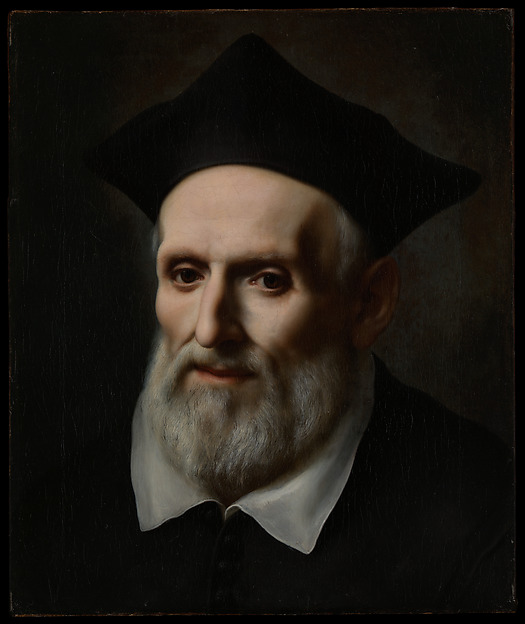
DolciPhilipNeri

Saint Philip Neri (1515-1595), by Carlo Dolci, c. 1645. The finest portrait of the saint was painted long after he died. In his own life, St. Philip was patron of the arts, and was even Palestrina’s confessor. (Image Source).

St. Philip Romolo Neri was born in Florence to a loving father and stepmother and brought up in the faith by the Dominicans of San Marco. The embers of Savonarola’s fiery spirit still burned in the memories of the Florentines, and for the rest of his life, St. Philip would hold the reformer in a high regard. But his temperament was as different from Savonarola’s as day is from night. St. Philip was always good-natured, kind, and generous. He was not overly pious, with play-acting the Mass or anything of that sort. Instead, he cultivated a winning personality that earned him the nickname “Pippo Buono.” He was remarkably humble, never giving much weight to the things of this world. Once, he was shown a beautiful diagram of his family tree; he promptly tore it up.

When he reached adulthood, St. Philip went to seek his fortune with his uncle Romolo, a merchant in San Germano. He found that the life of commerce was not conducive to his temperament, and so, after praying at the shrines of the Benedictines at Monte Cassino and Gaeta, he left for Rome almost penniless. The city had just been sacked by the soldiers of the Emperor, and work was hard to come by. Nevertheless, St. Philip was soon employed as a tutor for the Caccia family. The boys he taught would later go on to lives of holiness as priests. St. Philip made few friends in this period of his life. Like a hermit, he would hardly eat anything and spent his nights in the catacombs, remembering and praying to the martyrs of the early Church. On one such occasion, while he was in the catacombs of San Sebastiano, he had a mystical experience that would forever change his life. The Holy Spirit descended into his heart as a ball of fire. For the rest of his life, he would report heart palpitations, an incredible heat, and physical shaking – sometimes enough to move the chair in which he sat. Upon occasion, it was enough to convert a sinner only to draw their head to his Spirit-infused breast. Only in very old age did he confide his secret. When he died, his heart was found to be considerably enlarged. Several ribs were dislocated by its growth.

But in youth, he kept all this under wraps. He slowly started to gain a following. He would frequent the Seven Stational Churches, even leading bands of pilgrims on picnics. As he got older, these journeys grew in size and festivity. But in the early days, he was followed only by a few young men who were attracted to a charismatic tutor. He would also visit and help in the hospitals, perhaps the most common form of charitable work in Renaissance Italy. He would later exert a great influence on that marvelous saint of the hospitals, St. Camillus of Lellis.

St. Philip and his friends moved into the Church of San Girolamo, where, every afternoon, they would have a time of prayer, hymn-singing, recitation of the Bible, public commentary on the Scriptures, and some lesson from the history of the Church or the lives of the saints. This was the first Oratory. St. Philip’s way of life looked mighty suspicious to the authorities in a Rome still reeling from the Reformation, and he was investigated and opposed by several figures – namely an irate cardinal close to the Pope. But that cardinal died before the end of his investigation into St. Philip, an event whispered to be the wrath of God. Every other opposition fell away, and in time, St. Philip became an established figure in Rome. He was eventually persuaded to seek ordination. While never a Doctor of the Church, St. Philip learned his theology well, and was able to put it to good use in his later pastoral life.

When the Church of the St. John of the Florentines requested that St. Philip move to their community, he balked. Instead, he sent some of his best disciples, including Cesare Baronius, later to become a great cardinal and historian of the Church. However, all of the priests he sent were required to return to San Girolamo every day for the Oratory sessions. In this practice, we can perceive the seeds of the Congregation that would later flourish throughout the Catholic world.
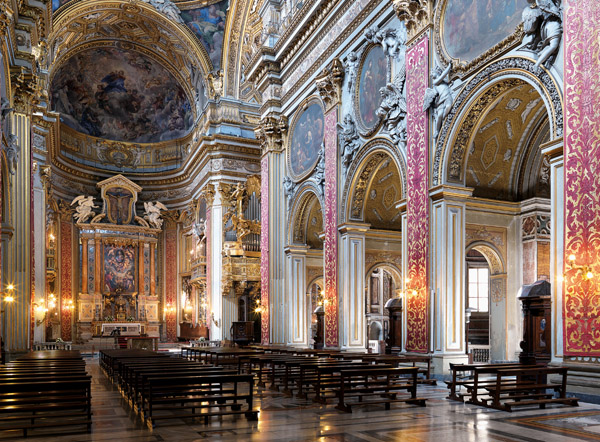
Obejscie 0170

The Chiesa Nuova, Rome. (Source)

When St. Philip was given the chance to build a new church, Santa Maria in Vallicella, he stunned the architects by boldly demanding a much larger structure than expected. Yet build it he did, and the “Chiesa Nuova,” or “New Church,” became the nerve center for the entire Oratorian family. St. Philip always resisted turning the Oratory into a religious order; today, it is still no such thing. Oratorians take no vows, but are bound to each other by a promise of charity. Love (and, one must assume, a tremendous amount of patience) holds each Oratory together. The closest parallel would be the Benedictines, who live in one place their entire life and belong to a wide, loose, familial confederation.

St. Philip Neri made friends with a great many Romans, and more than a few saints. He was on close terms with many of the Popes of his day, and more than one went to him for confession. Two great cardinals came from his immediate circle, Baronius the historian and Tarugi the politician. St. Philip was particularly intimate with the great Capuchin mystic, St. Felix of Cantalice. He also sent so many men to the Jesuits that St. Ignatius took to calling him “the Bell of the Society,” always bringing in more, but never entering himself. All in all, it was for the best. St. Philip’s temperament and spirituality were thoroughly un-Jesuit. Where St. Ignatius was hard, St. Philip was soft; where St. Ignatius was demanding, St. Philip was persuasive; where St. Ignatius sent his sons to a thousand works, St. Philip allowed them but one. But the two saints always held each other in a high, slightly bemused regard. St. Philip was the confessor of St. Camillus of Lellis as well as the composers Palestrina and Animuccia. Their compositions for St. Philip’s afternoon meetings became the first oratorios. St. Philip was always trying to draw souls to Christ by way of holy beauty. This quality, along with so many others, would make him a particularly apt spiritual father for the revival of Catholicism in 19th century Britain.

St. Philip could be a very hard confessor. He could tell if someone was holding back a sin, and he’d often relate the substance of that sin to the penitent himself. Yet his demands were always tempered by a certain tenderness. He was never inclined to endorse any kind of extreme asceticism, and positively distrusted anyone who claimed special visions and ecstasies.

Nevertheless, the Lord did grant him many such graces anywayand usually when saying Mass. St. Philip was a mystic of the Eucharist. Just in order to get through the process of vesting, let alone the Mass itself, he would have his server read jokes to him in the sacristy. In his old age, he would go into ecstasies at the Masses he celebrated, sometimes taking a few hours to say the entire liturgy. He also popularized the devotion of the Forty Hours of Adoration, a tradition that still takes place in so many of the Oratories of the world.

St. Philip was known as a joker, and he would teach his disciples to mortify their reason through his many practical jokes. Along with the Laudi of Jacopone da Todi, the joke books then popular in Florence and Rome were some of his favorite reading. He once showed up to a formal function with half of his beard shaved off. At another solemn occasion, he started to stroke the beard of a Swiss guard for no apparent cause. At yet another time, he made his aristocratic disciple Tarugi follow and carry a little lapdog through the city, to the jeers of the crowds. He is known as the “Joyful Saint” for very good reasons.

He effected such a change in the devotions and morals of the broken, decadent, and dispirited city, that he became known as the Third Apostle of Rome. When he died, he was immediately the subject of widespread devotion. The official workings of the Vatican could not proceed quickly enough for the people of Rome, who prayed to the departed priest with all the zeal they could muster. When he was finally elevated to sainthood in 1622, the Romans took to saying that the Pope had canonized “four Spaniards and a saint.”

Yet Spain would not receive the Florentine’s spiritual heritage in its fullness. Nor would France, where Cardinal de Bérulle heard of the Oratory, liked the idea, and started his own order with a very different organization and spirituality. The French Oratorians may be considered St. Philip’s nephews, but not his sons. For many centuries, only Italy bore the mark of what St. Philip really wanted from his sons – holy, independent houses of secular priests bound together by nothing more than the bond of charity.

And the Italian Oratories persevered valiantly until a convert from Anglicanism came to Rome to study for the priesthood: John Henry Newman. It was Newman, along with Fr. Frederick William Faber and Fr. Ambrose St. John, who brought the Oratory to England, where it thrived as almost nowhere else. The Oratories of Birmingham and London were the great centers of English Catholicism, leavening all the other efforts of the Church in that land. Oratorians played a significant role in the lives of Gerard Manley Hopkins, Oscar Wilde, and J.R.R. Tolkien, to mention but a few. The Oratory has seen an explosion in the United Kingdom over the last few decades, with new houses in Oxford, York, Manchester, Cardiff, and Bournemouth having opened or set to open in the near future. It seems that in these troubled times, the Holy Spirit is multiplying their numbers for some great work. More and more Oratories are starting in the United States, many on the lines of the English and Italian models. In Toronto, Pittsburgh, Cincinnati, Washington, Kalamazoo, and so many more cities, St. Philip is making his home. In these days of preparation for his feast, let us remember the great works God has wrought through him and his sons.

Day 1: Philip’s Humility
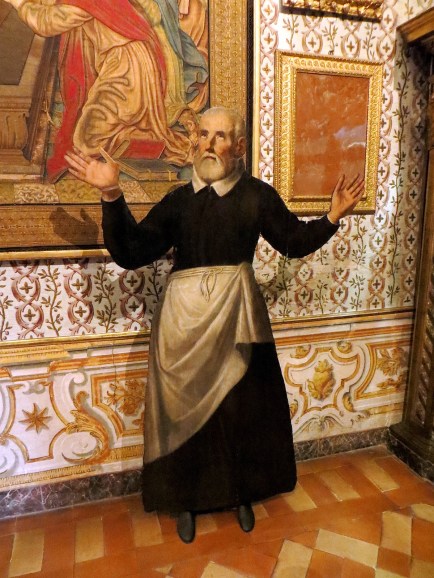
santa-maria-in-vallicella-2

The famous effigy of St. Philip in the Roman Oratory, made while he was still living. It would go around to the Seven Churches when he could no longer make the pilgrimage. (Source)

If Philip heard of anyone having committed a crime, he would say, “Thank God that I have not done worse.”

At confession he would shed abundance of tears, and say, “I have never done a good action.”

When a penitent showed that she could not bear the rudeness shown towards him by certain persons who were under great obligations to him, he answered her, “If I were humble, God would not send this to me.”

When one of his spiritual children said to him, “Father, I wish to have something of yours for devotion, for I know you are a Saint,” he turned to her with a face full of anger, and broke out into these words: “Begone with you! I am a devil, and not a saint.”

To another who said to him, “Father, a temptation has come to me to think that you are not what the world takes you for,” he made answer: “Be sure of this, that I am a man like my neighbours, and nothing more.”

If he heard of any who had a good opinion of him, he used to say, “O poor me! how many poor girls will be greater in Paradise than I shall be!”

He avoided all marks of honour. He could not bear to receive any signs of respect. When people wished to touch his clothes, and knelt as he passed by, he used to say, “Get up! get out of my way!” He did not like people to kiss his hand; though he sometimes let them do so, lest he should hurt their feelings.

He was an enemy to all rivalry and contention. He always took in good part everything that was said to him. He had a particular dislike of affectation, whether in speaking, or in dressing, or in anything else.

He could not bear two-faced persons; as for liars, he could not endure them, and was continually reminding his spiritual children to avoid them as they would a pestilence.

He always asked advice, even on affairs of minor importance. His constant counsel to his penitents was, that they should not trust in themselves, but always take the advice of others, and get as many prayers as they could.

He took great pleasure in being lightly esteemed, nay, even despised.

He had a most pleasant manner of transacting business with others, great sweetness in conversation, and was full of compassion and consideration.

He had always a dislike to speak of himself. The phrases “I said,” “I did,” were rarely in his mouth. He exhorted others never to make a display of themselves, especially in those things which tended to their credit, whether in earnest or in joke.

As St. John the Evangelist, when old, was continually saying, “Little children, love one another,” so Philip was ever repeating his favourite lesson, “Be humble; think little of yourselves.”

He said that if we did a good work, and another took the credit of it to himself, we ought to rejoice and thank God.

He said no one ought to say, “Oh! I shall not fall, I shall not commit sin,” for it was a clear sign that he would fall. He was greatly displeased with those who made excuses for themselves, and called such persons. “My Lady Eve,” because Eve defended herself instead of being humble.

Prayer

PHILIP, my glorious patron, who didst count as dross the praise, and even the good esteem of men, obtain for me also, from my Lord and Saviour, this fair virtue by thy prayers. How haughty are my thoughts, how contemptuous are my words, how ambitious are my works. Gain for me that low esteem of self with which thou wast gifted; obtain for me a knowledge of my own nothingness, that I may rejoice when I am despised, and ever seek to be great only in the eyes of my God and Judge.

Prayer of Cardinal Baronius (above)

Day 2: Philip’s Devotion
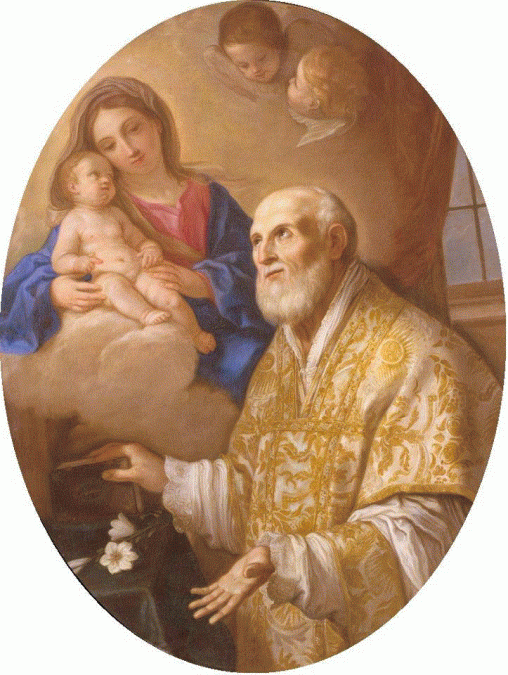
filippo-neriandmadonna

St. Philip had a tender devotion to Our Lady, and she gave him many outstanding graces. (Source).

The inward flame of devotion in Philip was so intense that he sometimes fainted in consequence of it, or was forced to throw himself upon his bed, under the sickness of divine love.

When he was young he sometimes felt this divine fervour so vehemently as to be unable to contain himself, throwing himself as if in agony on the ground and crying out, “No more, Lord, no more.”

What St. Paul says of himself seemed to be fulfilled in Philip: “I am filled with consolation—I over-abound with joy.”

Yet, though he enjoyed sweetnesses, he used to say that he wished to serve God, not out of interest—that is, because there was pleasure in it—but out of pure love, even though he felt no gratification in loving Him.

When he was a layman, he communicated every morning. When he was old, he had frequent ecstacies during his Mass.

Hence it is customary in pictures of Philip to paint him in red vestments, to record his ardent desire to shed his blood for the love of Christ.

He was so devoted to his Lord and Saviour that he was always pronouncing the name of Jesus with unspeakable sweetness. He had also an extraordinary pleasure in saying the Creed, and he was so fond of the “Our Father” that he lingered on each petition in such a way that it seemed as if he never would get through them.

He had such a devotion to the Blessed Sacrament that, when he was ill, he could not sleep till he had communicated.

When he was reading or meditating on the Passion he was seen to turn as pale as ashes, and his eyes filled with tears.

Once when he was ill, they brought him something to drink. He took the glass in his hand, and when he was putting it to his mouth stopped, and began to weep most bitterly. He cried out, “Thou, my Christ, Thou upon the Cross wast thirsty, and they gave Thee nothing but gall and vinegar to drink; and I am in bed, with so many comforts around me, and so many persons to attend to me.”

Yet Philip did not make much account of this warmth and acuteness of feeling; for he said that Emotion was not Devotion, that tears were no sign that a man was in the grace of God, neither must we suppose a man holy merely because he weeps when he speaks of religion.

Philip was so devoted to the Blessed Virgin that he had her name continually in his mouth. He had two ejaculations in her honour. One, “Virgin Mary, Mother of God, pray to Jesus for me.” The other, simply “Virgin Mother,” for he said that in those two words all possible praises of Mary are contained.

He had also a singular devotion to St. Mary Magdalen, on whose vigil he was born, and for the Apostles St. James and St. Philip; also for St. Paul the Apostle, and for St. Thomas of Aquinum, Doctor of the Church.

Prayer

PHILIP, my glorious Patron, gain for me a portion of that gift which thou hadst so abundantly. Alas! thy heart was burning with love; mine is all frozen towards God, and alive only for creatures. I love the world, which can never make me happy; my highest desire is to be well off here below. O my God, when shall I learn to love nothing else but Thee? Gain for me, O Philip, a pure love, a strong love, and an efficacious love, that, loving God here upon earth, I may enjoy the sight of Him, together with thee and all saints, hereafter in heaven.

Prayer of Cardinal Baronius (above)

Day 3: Philip’s Exercise of Prayer
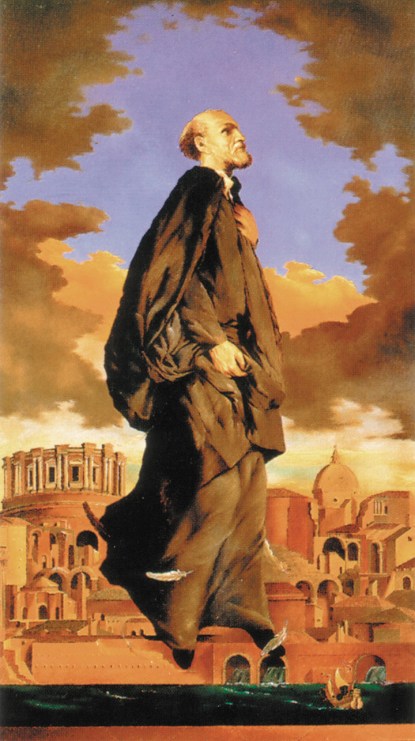
MODERN IMAGE OF ST. PHILIP NERI ONE OF 550 IMAGES IN BOOK ON THE PRIESTHOOD

A depiction of St. Philip by the contemporary Italian artist, Salvo Russo. (Source).

From very boyhood the servant of God gave himself up to prayer, until he acquired such a habit of it, that, wherever he was, his mind was always lifted up to heavenly things.

Sometimes he forgot to eat; sometimes, when he was dressing, he left off, being carried away in his thought to heaven, with his eyes open, yet abstracted from all things around him.

It was easier for Philip to think upon God, than for men of the world to think of the world.

If anyone entered his room suddenly, he would most probably find him so rapt in prayer, that, when spoken to, he did not give the right answer, and had to take a turn or two up and down the room before he fully came to himself.

If he gave way to his habit of prayer in the most trifling degree, he immediately became lost in contemplation.

It was necessary to distract him lest this continual stretch of mind should be prejudicial to his health.

Before transacting business, however trivial, he always prayed; when asked a question, he never answered till he had recollected himself.

He began praying when he went to bed, and as soon as he awoke, and he did not usually sleep more than four, or at the most five hours.

Sometimes, if anyone showed that he had observed that Philip went to bed late or rose early in order to pray, he would answer, “Paradise is not made for sluggards.”

He was more than ordinarily intent on prayer at the more solemn feasts, or at a time of urgent spiritual necessities; above all, in Holy Week.

Those who could not make long meditations he advised to lift up their minds repeatedly to God in ejaculatory prayers, as “Jesus, increase my faith,” “Jesus, grant that I may never offend Thee.”

Philip introduced family prayer into many of the principal houses of Rome.

When one of his penitents asked him to teach him how to pray, he answered, “Be humble and obedient, and the Holy Ghost will teach you.”

He had a special devotion for the Third Person of the Blessed Trinity, and daily poured out before Him most fervent prayers for gifts and graces.

Once, when he was passing the night in prayer in the Catacombs, that great miracle took place of the Divine presence of the Holy Ghost descending upon him under the appearance of a ball of fire, entering into his mouth and lodging in his breast, from which time he had a supernatural palpitation of the heart.

He used to say that when our prayers are in the way of being granted, we must not leave off, but pray as fervently as before.

He especially recommended beginners to meditate on the four last things, and used to say that he who does not in his thoughts and fears go down to hell in his lifetime, runs a great risk of going there when he dies.

When he wished to show the necessity of prayer, he said that a man without prayer was an animal without reason.

Many of his disciples improved greatly in this exercise—not religious only, but secular persons, artisans, merchants, physicians, lawyers, and courtiers—and became such men of prayer as to receive extraordinary favours from God.

Prayer

PHILIP, my holy Patron, teach me by thy example, and gain for me by thy intercessions, to seek my Lord and God at all times and in all places, and to live in His presence and in sacred intercourse with Him. As the children of this world look up to rich men or men in station for the favour which they desire, so may I ever lift up my eyes and hands and heart towards heaven, and betake myself to the Source of all good for those goods which I need. As the children of this world converse with their friends and find their pleasure in them, so may I ever hold communion with Saints and Angels, and with the Blessed Virgin, the Mother of my Lord. Pray with me, O Philip, as thou didst pray with thy penitents here below, and then prayer will become sweet to me, as it did to them.

Prayer of Cardinal Baronius (above)

Day 4: Philip’s Purity
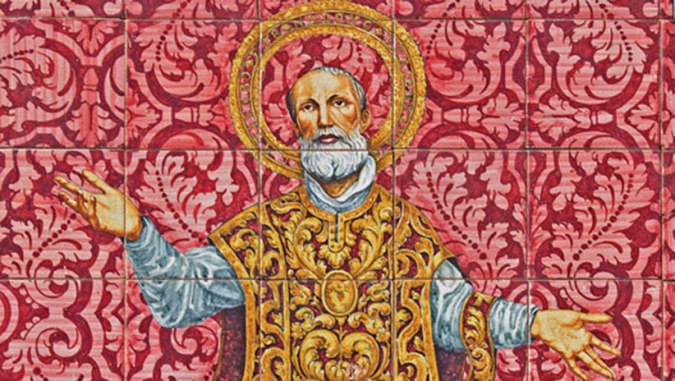
PhilipNeriTiles

St. Philip in tiles. Although I don’t know where this photo was taken, I am reminded of the thriving tradition of decorative tiling in Portugal. (Source).

Philip well knowing the pleasure which God takes in cleanness of heart, had no sooner come to years of discretion, and to the power of distinguishing between good and evil, than he set himself to wage war against the evils and suggestions of his enemy, and never rested till he had gained the victory. Thus, notwithstanding he lived in the world when young, and met with all kinds of persons, he preserved his virginity spotless in those dangerous years of his life.

No word was ever heard from his lips which would offend the most severe modesty, and in his dress, his carriage, and countenance, he manifested the same beautiful virtue.

One day, while he was yet a layman, some profligate persons impudently tempted him to commit sin. When he saw that flight was impossible, he began to speak to them of the hideousness of sin and the awful presence of God. This he did with such manifest distress, such earnestness, and such fervour, that his words pierced their abandoned hearts as a sword, and not only persuaded them to give up their horrible thought, but even reclaimed them from their evil ways.

At another time some bad men, who are accustomed to think no one better than themselves, invited him on some pretext into their house, under the belief that he was not what the world took him to be; and then, having got possession of him, thrust him into a great temptation. Philip, in this strait, finding the doors locked, knelt down and began to pray to God with such astonishing fervour and heartfelt heavenly eloquence, that the two poor wretches who were in the room did not dare to speak to him, and at last themselves left him and gave him a way to escape.

His virginal purity shone out of his countenance. His eyes were so clear and bright, even to the last years of his life, that no painter ever succeeded in giving the expression of them, and it was not easy for anyone to keep looking on him for any length of time, for he dazzled them like an Angel of Paradise.

Moreover, his body, even in his old age, emitted a fragrance which, even in his decrepit old age, refreshed those who came near him; and many said that they felt devotion infused into them by the mere smell of his hands.

As to the opposite vice. The ill odour of it was not to the Saint a mere figure of speech, but a reality, so that he could detect those whose souls were blackened by it; and he used to say that it was so horrible that nothing in the world could equal it, nothing, in short, but the Evil Spirit himself. Before his penitents began their confession he sometimes said, “O my son, I know your sins already.”

Many confessed that they were at once delivered from temptations by his merely laying his hands on their heads. The very mention of his name had a power of shielding from Satan those who were assailed by his fiery darts.

He exhorted men never to trust themselves, whatever experience they might have of themselves, or however long their habits of virtue.

He used to say that humility was the true guard of chastity; and that not to have pity for another in such cases was a forerunner of a speedy fall in ourselves; and that when he found a man censorious, and secure of himself, and without fear, he gave him up for lost.

Prayer

PHILIP, my glorious Patron, who didst ever keep unsullied the white lily of thy purity, with such jealous care that the majesty of this fair virtue beamed from thine eyes, shone in thy hands, and was fragrant in thy breath, obtain for me that gift from the Holy Ghost, that neither the words nor the example of sinners may ever make any impression on my soul. And, since it is by avoiding occasions of sin, by prayer, by keeping myself employed, and by the frequent use of the Sacraments that my dread enemy must be subdued, gain for me the grace to persevere in these necessary observances.

Prayer of Cardinal Baronius (above)

Day 5: Philip’s Tenderness of Heart
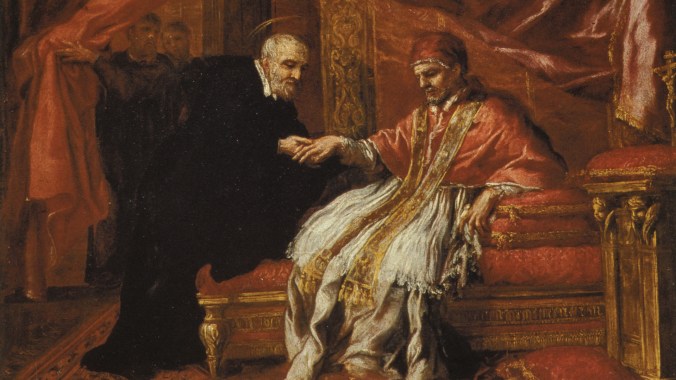
StPhilipNeriandthePope.jpg

St. Philip Neri and Pope Clement VIII. (Source).

Philip could not endure the very sight of suffering; and though he abhorred riches, he always wished to have money to give in alms.

He could not bear to see children scantily clothed, and did all he could to get new clothes for them.

Oppressed and suffering innocence troubled him especially; when a Roman gentleman was falsely accused of having been the death of a man, and was imprisoned, he went so far as to put his cause before the Pope, and obtained his liberation.

A priest was accused by some powerful persons, and was likely to suffer in consequence. Philip took up his cause with such warmth that he established his innocence before the public.

Another time, hearing of some gipsies who had been unjustly condemned to hard labour, he went to the Pope, and procured their freedom. His love of justice was as great as his tenderness and compassion.

Soon after he became a Priest there was a severe famine in Rome, and six loaves were sent to him as a present. Knowing that there was in the same house a poor foreigner suffering from want of food, he gave them all to him, and had for the first day nothing but olives to eat.

Philip had a special tenderness towards artisans, and those who had a difficulty of selling their goods. There were two watchmakers, skilful artists, but old and burdened with large families. He gave them a large order for watches, and contrived to sell them among his friends.

His zeal and liberality specially shone forth towards poor girls. He provided for them when they had no other means of provision. He found marriage dowries for some of them; to others he gave what was sufficient to gain their admittance into convents.

He was particularly good to prisoners, to whom he sent money several times in the week.

He set no limits to his affection for the shrinking and bashful poor, and was more liberal in his alms towards them.

Poor students were another object of his special compassion; he provided them not only with food and clothing, but also with books for their studies. To aid one of them he sold all his own books.

He felt most keenly any kindness done to him, so that one of his friends said: “You could not make Philip a present without receiving another from him of double value.”

He was very tender towards brute animals. Seeing someone put his foot on a lizard, he cried out, “Cruel fellow! what has that poor animal done to you?”

Seeing a butcher wound a dog with one of his knives, he could not contain himself, and had great difficulty in keeping himself cool.

He could not bear the slightest cruelty to be shown to brute animals under any pretext whatever. If a bird came into the room, he would have the window opened that it might not be caught.

Prayer

Philip, my glorious Advocate, teach me to look at all I see around me after thy pattern as the creatures of God. Let me never forget that the same God who made me made the whole world, and all men and all animals that are in it. Gain me the grace to love all God’s works for God’s sake, and all men for the sake of my Lord and Saviour who has redeemed them by the Cross. And especially let me be tender and compassionate and loving towards all Christians, as my brethren in grace. And do thou, who on earth was so tender to all, be especially tender to us, and feel for us, bear with us in all our troubles, and gain for us from God, with whom thou dwellest in beatific light, all the aids necessary for bringing us safely to Him and to thee.

Prayer of Cardinal Baronius (above)

Day 6: Philip’s Cheerfulness
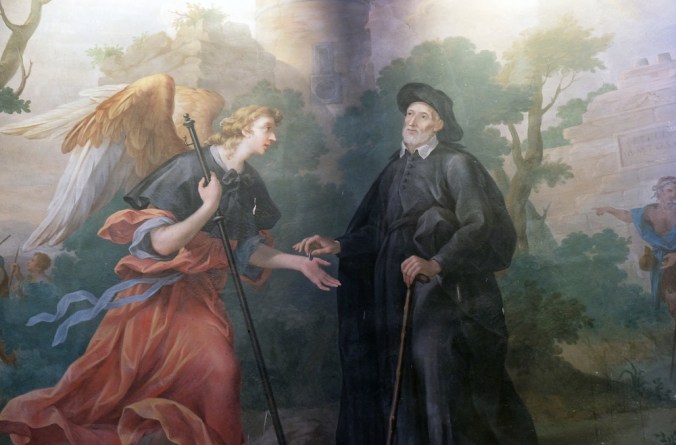
StPhilipNeriAngels

St. Philip and an angel. (Source)

Philip welcomed those who consulted him with singular benignity, and received them, though strangers, with as much affection as if he had been a long time expecting them. When he was called upon to be merry, he was merry; when he was called upon to feel sympathy with the distressed, he was equally ready.

Sometimes he left his prayers and went down to sport and banter with young men, and by this sweetness and condescension and playful conversation gained their souls.

He could not bear anyone to be downcast or pensive, because spirituality is always injured by it; but when he saw anyone grave and gloomy, he used to say, “Be merry.” He had a particular and marked leaning to cheerful persons.

At the same time he was a great enemy to anything like rudeness or foolery; for a buffooning spirit not only does not advance in religion, but roots out even what is already there.

One day he restored cheerfulness to Father Francesco Bernardi, of the Congregation, by simply asking him to run with him, saying, “Come now, let us have a run together.”

His penitents felt that joy at being in his room that they used to say, Philip’s room is not a room, but an earthly Paradise.

To others, to merely stand at the door of his room, without going in, was a release from all their troubles. Others recovered their lost peace of mind by simply looking Philip in the face. To dream of him was enough to comfort many. In a word, Philip was a perpetual refreshment to all those who were in perplexity and sadness.

No one ever saw Philip melancholy; those who went to him always found him with a cheerful and smiling countenance, yet mixed with gravity.

When he was ill he did not so much receive as impart consolation. He was never heard to change his voice, as invalids generally do, but spoke in the same sonorous tone as when he was well. Once, when the physicians had given him over, he said, with the Psalmist, “Paratus sum et non sum turbatus” (“I am ready, and am not troubled”). He received Extreme Unction four times, but with the same calm and joyous countenance.

Prayer

PHILIP, my glorious Advocate, who didst ever follow the precepts and example of the Apostle St. Paul in rejoicing always in all things, gain for me the grace of perfect resignation to God’s will, of indifference to matters of this world, and a constant sight of Heaven; so that I may never be disappointed at the Divine providences, never desponding, never sad, never fretful; that my countenance may always be open and cheerful, and my words kind and pleasant, as becomes those who, in whatever state of life they are, have the greatest of all goods, the favour of God and the prospect of eternal bliss.

Prayer of Cardinal Baronius (above)

Day 7: Philip’s Patience
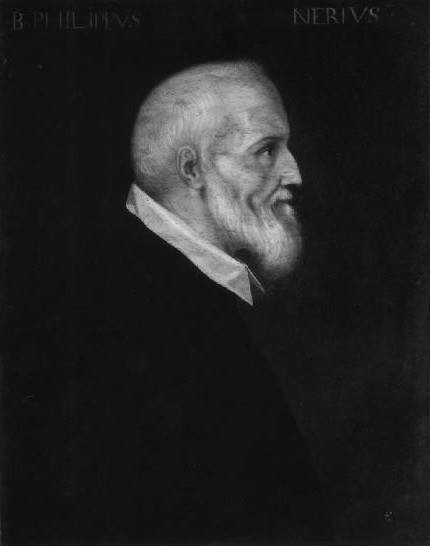
SanFilippoBW

St. Philip’s otherworldly spirituality was infused with a hard and cutting common sense. (Source).

Philip was for years and years the butt and laughing-stock of all the hangers-on of the great palaces of the nobility at Rome, who said all the bad of him that came into their heads, because they did not like to see a virtuous and conscientious man.

This sarcastic talk against him lasted for years and years; so that Rome was full of it, and through all the shops and counting-houses the idlers and evil livers did nothing but ridicule Philip.

When they fixed some calumny upon him, he did not take it in the least amiss, but with the greatest calmness contented himself with a simple smile.

Once a gentleman’s servant began to abuse him so insolently that a person of consideration, who witnessed the insult, was about to lay hands on him; but, when he saw with what gentleness and cheerfulness Philip took it, he restrained himself, and ever after counted Philip as a saint.

Sometimes his own spiritual children, and even those who lay under the greatest obligations to him, treated him as if he were a rude and foolish person; but he did not show any resentment.

Once, when he was Superior of the Congregation, one of his subjects snatched a letter out of his hand; but the saint took the affront with incomparable meekness, and neither in look, nor word, nor in gesture betrayed the slightest emotion.

Patience had so completely become a habit with him, that he was never seen in a passion. He checked the first movement of resentful feeling; his countenance calmed instantly, and he reassumed his usual modest smile.

Prayer

PHILIP, my holy Advocate, who didst bear persecution and calumny, pain and sickness, with so admirable a patience, gain for me the grace of true fortitude under all the trials of this life. Alas! how do I need patience! I shrink from every small inconvenience; I sicken under every light affliction; I fire up at every trifling contradiction; I fret and am cross at every little suffering of body. Gain for me the grace to enter with hearty good-will into all such crosses as I may receive day by day from my Heavenly Father. Let me imitate thee, as thou didst imitate my Lord and Saviour, that so, as thou hast attained heaven by thy calm endurance of bodily and mental pain, I too may attain the merit of patience, and the reward of life everlasting.

Prayer of Cardinal Baronius (above)

Day 8: Philip’s Care for the Salvation of Souls
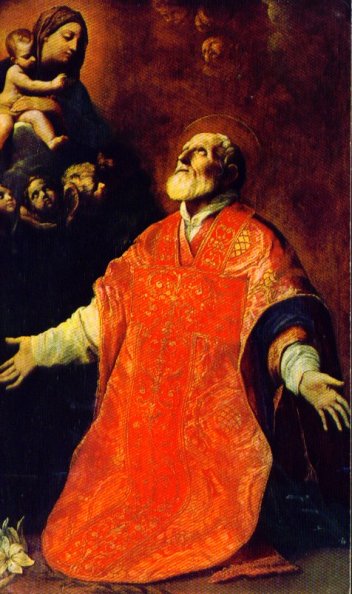
philip1chasuble

St. Philip Neri’s flame-red chasuble is one of the hallmarks of his iconography, such as in this portrait by Guido Reni, 1619. (Source)

When he was a young priest, and had gathered about him a number of spiritual persons, his first wish was to go with them all to preach the gospel to the heathen of India, where St. Francis Xavier was engaged in his wonderful career—and he only gave up the idea in obedience to the holy men whom he consulted.

As to bad Christians at home, such extreme desire had he for their conversion, that even when he was old he took severe disciplines in their behalf, and wept for their sins as if they had been his own.

While a layman, he converted by one sermon thirty dissolute youths.

He was successful, under the grace of God, in bringing back almost an infinite number of sinners to the paths of holiness. Many at the hour of death cried out, “Blessed be the day when first I came to know Father Philip!” Others, “Father Philip draws souls to him as the magnet draws iron.”

With a view to the fulfilment of what he considered his special mission, he gave himself up entirely to hearing confessions, exclusive of every other employment. Before sunrise he had generally confessed a good number of penitents in his own room. He went down into the church at daybreak, and never left it till noon, except to say Mass. If no penitents came, he remained near his confessional, reading, saying office, or telling his beads. If he was at prayer, if at his meals, he at once broke off when his penitents came.

He never intermitted his hearing of confessions for any illness, unless the physician forbade it.

For the same reason he kept his room-door open, so that he was exposed to the view of everyone who passed it.

He had a particular anxiety about boys and young men. He was most anxious to have them always occupied, for he knew that idleness was the parent of every evil. Sometimes he made work for them, when he could not find any.

He let them make what noise they pleased about him, if in so doing he was keeping them from temptation. When a friend remonstrated with him for letting them so interfere with him, he made answer: “So long as they do not sin, they may chop wood upon my back.”

He was allowed by the Dominican Fathers to take out their novices for recreation. He used to delight to see them at their holiday meal. He used to say, “Eat, my sons, and do not scruple about it, for it makes me fat to watch you;” and then, when dinner was over, he made them sit in a ring around him, and told them the secrets of their hearts, and gave them good advice, and exhorted them to virtue.

He had a remarkable power of consoling the sick, and of delivering them from the temptations with which the devil assails them.

To his zeal for the conversion of souls, Philip always joined the exercise of corporal acts of mercy. He visited the sick in the hospitals, served them in all their necessities, made their beds, swept the floor round them, and gave them their meals.

Prayer

PHILIP, my holy Patron, who wast so careful for the souls of thy brethren, and especially of thy own people, when on earth, slack not thy care of them now, when thou art in heaven. Be with us, who are thy children and thy clients; and, with thy greater power with God, and with thy more intimate insight into our needs and our dangers, guide us along the path which leads to God and to thee. Be to us a good father; make our priests blameless and beyond reproach or scandal; make our children obedient, our youth prudent and chaste, our heads of families wise and gentle, our old people cheerful and fervent, and build us up, by thy powerful intercessions, in faith, hope, charity, and all virtues.

Prayer of Cardinal Baronius (above)

Day 9: Philip’s Miraculous Gifts
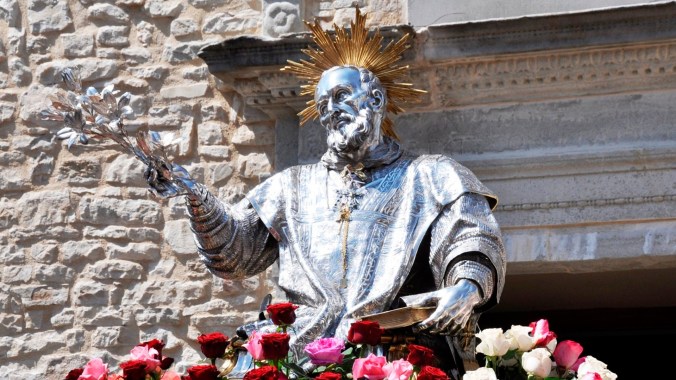
cropped-saint-philippe-neri-welcome2

The veneration of St. Philip has spread around the world. (Source)

PHILIP’S great and solid virtues were crowned and adorned by the divine Majesty with various and extraordinary favours, which he in vain used every artifice, if possible, to hide.

It was the good-pleasure of God to enable him to penetrate His ineffable mysteries and to know His marvellous providences by means of ecstasies, raptures, and visions, which were of frequent occurrence during the whole of his life.

A friend going one morning to confession to him, on opening the door of his room softly, saw the Saint in the act of prayer, raised upon his feet, his eyes looking to heaven, his hands extended. He stood for a while watching him, and then going close to him spoke to him—but the saint did not perceive him at all. This state of abstraction continued about eight minutes longer; then he came to himself.

He had the consolation of seeing in vision the souls of many, especially of his friends and penitents, go to heaven. Indeed, those who were intimate with him held it for certain, that none of his spiritual children died without his being certified of the state of their souls.

Philip, both by his sanctity and experience, was able to discriminate between true and false visions. He was earnest in warning men against being deluded, which is very easy and probable.

Philip was especially eminent, even among saints, for his gifts of foretelling the future and reading the heart. The examples of these gifts which might be produced would fill volumes. He foretold the deaths of some; he foretold the recovery of others; he foretold the future course of others; he foretold the births of children to those who were childless; he foretold who would be the Popes before their election; he had the gift of seeing things at a distance; and he knew what was going on in the minds of his penitents and others around him.

He knew whether his penitents had said their prayers, and for how long they were praying. Many of them when talking together, if led into any conversation which was dangerous or wrong, would say: “We must stop, for St. Philip will find it out.”

Once a woman came to him to confession, when in reality she wished to get an alms. He said to her: “In God’s name, good woman, go away; there is no bread for you”—and nothing could induce him to hear her confession.

A man who went to confess to him did not speak, but began to tremble, and when asked, said, “I am ashamed,” for he had committed a most grievous sin. Philip said gently: “Do not be afraid; I will tell you what it was”—and, to the penitent’s great astonishment, he told him.

Such instances are innumerable. There was not one person intimate with Philip who did not affirm that he knew the secrets of the heart most marvellously.

He was almost equally marvellous in his power of healing and restoring to health. He relieved pain by the touch of his hand and the sign of the Cross. And in the same way he cured diseases instantaneously—at other times by his prayers—at other times he commanded the diseases to depart.

This gift was so well known that sick persons got possession of his clothes, his shoes, the cuttings of his hair, and God wrought cures by means of them.

Prayer

PHILIP, my holy Patron, the wounds and diseases of my soul are greater than bodily ones, and are beyond thy curing, even with thy supernatural power. I know that my Almighty Lord reserves in His own hands the recovery of the soul from death, and the healing of all its maladies. But thou canst do more for our souls by thy prayers now, my dear Saint, than thou didst for the bodies of those who applied to thee when thou wast upon earth. Pray for me, that the Divine Physician of the soul, Who alone reads my heart thoroughly, may cleanse it thoroughly, and that I and all who are dear to me may be cleansed from all our sins; and, since we must die, one and all, that we may die, as thou didst, in the grace and love of God, and with the assurance, like thee, of eternal life.

Prayer of Cardinal Baronius (above)
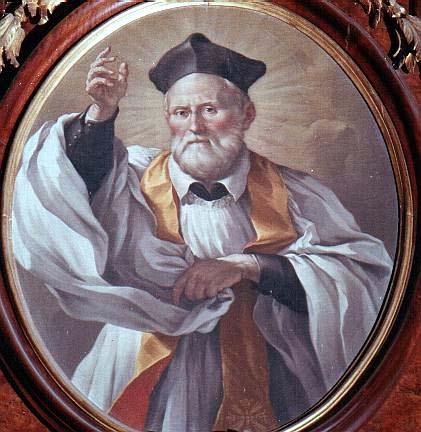
filippo.neri.19

St. Philip Neri, remember thy congregation. (Source)

Collect for the Feast of St. Philip Neri

O God, who never cease to bestow the glory of holiness
on the faithful servants you raise up for yourself,
graciously grant
that the Holy Spirit may kindle in us that fire
with which he wonderfully filled
the heart of Saint Philip Neri.
Through our Lord Jesus Christ, your Son,
who lives and reigns with you in the unity of the Holy Spirit,
one God, for ever and ever.

(Collect for the Feast of St. Philip)

Newman’s Litany to St. Philip Neri
(source)
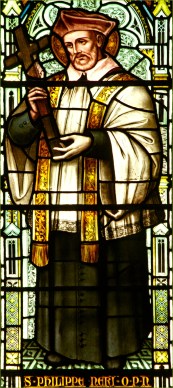
saints5-23ePhilipNeriGlass

A stained glass depiction. (Source)

Lord, have mercy.
Lord, have mercy.
Christ, have mercy.
Christ, have mercy.
Lord, have mercy.
Lord, have mercy.
Christ, hear us.
Christ, graciously hear us.
God the Father of Heaven,
Have mercy on us.
God the Son, Redeemer of the world, 
Have mercy on us.
God the Holy Spirit,
Have mercy on us.
Holy Trinity, One God,
Have mercy on us.
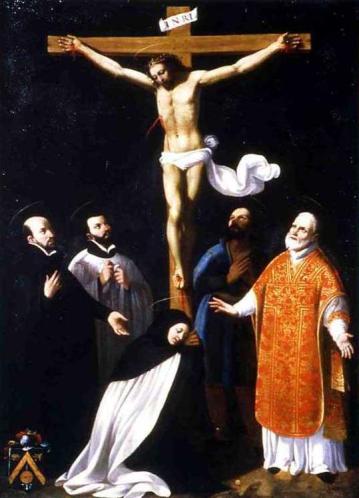
FourSpaniardsandaSaint

St. Philip with (l-r): St. Ignatius Loyola, St. Francis Xavier, St. Teresa of Avila, and St. Isidore the Farmer. All five were canonized on the same day in 1622. The people of Rome said that, on that day, the Church canonized “Four Spaniards and a Saint.” (Source).

Holy Mary,
pray for us.
Holy Mother of God, 
pray for us. 
Holy Virgin of Virgins, etc.

Saint Philip,
Vessel of the Holy Spirit,
Child of Mary,
Apostle of Rome,
Counselor of Popes,
Voice of Prophecy,
Man of Primitive Times,
Winning Saint,
Hidden Hero,
Sweetest of Fathers, 
Martyr of Charity,
Heart of Fire,
Discerner of Spirits,
Choicest of Priests,
Mirror of the Divine Life,
Pattern of humility,
Example of Simplicity,
Light of Holy Joy,
Image of Childhood,
Picture of Old Age,
Director of Souls,
Gentle Guide of Youth,
Patron of thine Own,
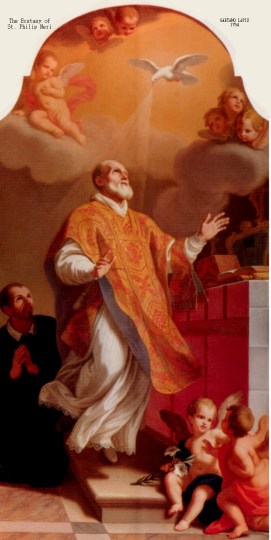
saints5-23dPhilipNeri

“The Ecstasy of St. Philip Neri,” Gaetano Lapis, 1754. (Source)

Thou who observed chastity in thy youth,
Who sought Rome by Divine guidance,
Who hid so long in the catacombs,
Who received the Holy Spirit into thy heart,
Who experienced such wonderful ecstasies,
Who so lovingly served the little ones,
Who washed the feet of pilgrims,
Who ardently thirsted after martyrdom,
Who distributed the daily word of God,
Who turned so many hearts to God,
Who conversed so sweetly with Mary,
Who raised the dead,
Who set up thy houses in all lands,

Lamb of God, Who takest away the sins of the world,
Spare us, O Lord.
Lamb of God, Who takest away the sins of the world, 
Graciously hear us, O Lord.
Lamb of God, Who takest away the sins of the world, 
Have mercy on us.

Christ, hear us.
   Christ, graciously hear us.

V. Remember thy congregation.
R. Which thou hast possessed from the beginning.

Let us Pray.

   O God, Who hast exalted blessed Philip, Thy confessor, in the glory of Thy Saints, grant that, as we rejoice in his commemoration, so may we profit by the example of his virtues, through Christ Our Lord. 
R. Amen.
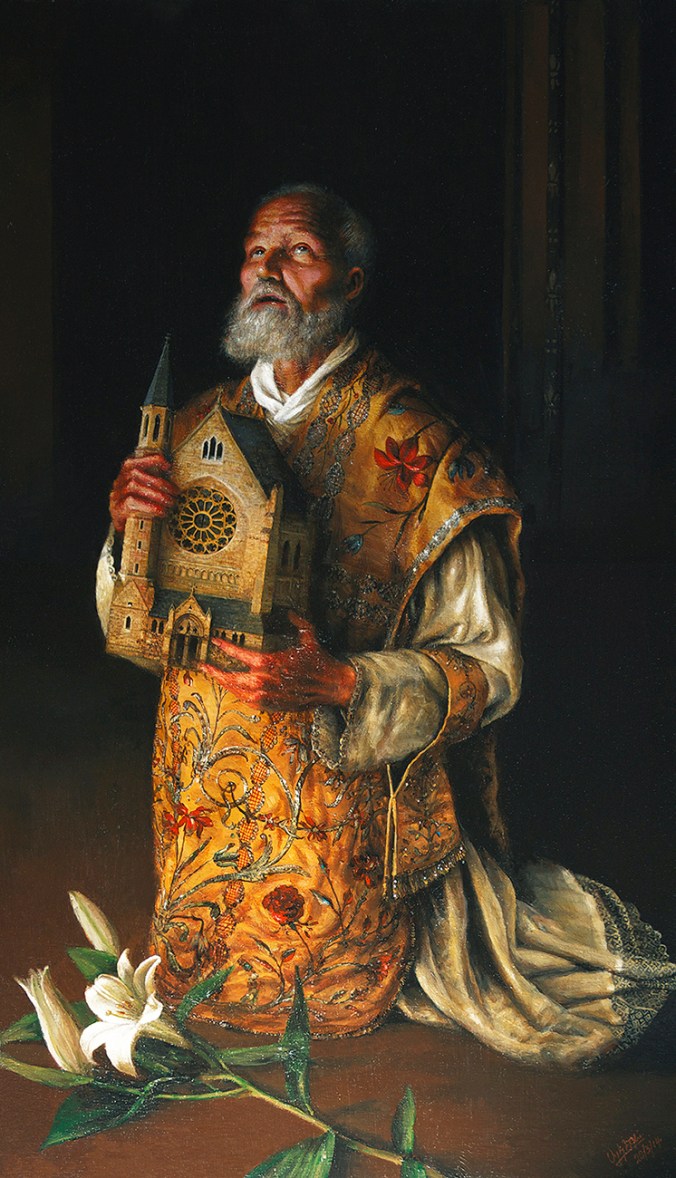
St+Philip+NeriAlvinOng

“St. Philip Neri,” by contemporary artist Alvin Ong. Acrylic on wood. 2014. Commissioned by the Oxford Oratory. (Source)